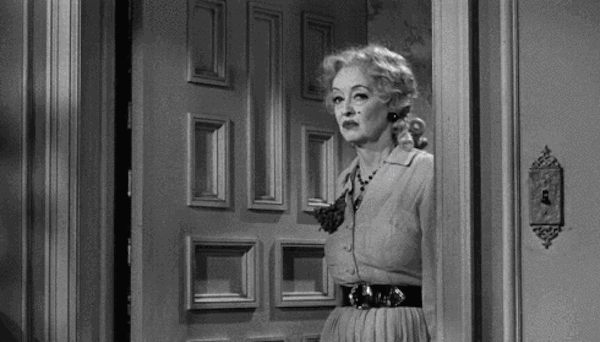
Revisiting Robert Aldrich’s Hag Cinema: Part II ” I wouldn’t piss on Joan Crawford if she were on fire!”

As part of the Dynamic Duos of Classic Film Blogathon hosted by Once upon a screen… and Classic Movie Hub

Joan and Bette

Of all the notorious rivalries identified with Hollywood celebrities, the most enduring in the public consciousness is that of legendary Bette Davis and Joan Crawford. As the documentary ‘Bette and Joan: Blind Ambition‘ (2005) insightfully decries ‘Betty Davis was the screens great Sadist and Crawford was the screen’s great Masochist.’

“If equally matched adversaries are bound to create sparks and flames of conflict, then Bette Davis and the late Joan Crawford should offer a good battle.” - Publisher’s Weekly

Bette Davis on Joan Crawford: “Her eyebrows are like ‘African caterpillars’ and her best performance was "Crawford being Crawford."

Joan Crawford on Bette Davis: "She's phony, but I guess the public really likes that."

bette and Joan for babyjane

I want to preface this piece by qualifying something. With all that’s been written about the infamous feud, there are also those who try to dispel it as a myth, stating that rather than loathing each other Bette and Joan were actually cordial to each other-even chatting on the phone occasionally from the 30s until the making of Baby Jane? And that contrary to what’s been asserted, Davis wasn’t threatened by Joan’s coming to Warner Bros because she felt they were suited to playing different types of roles so there was no conflict there.

Bette Davis, photographed by Maurice Goldberg in 1935 for Vanity Fair
Bette Davis, photographed by Maurice Goldberg in 1935 for Vanity Fair.
Joan Crawford fabulous
the gorgeous Joan Crawford.

When Joan Crawford started to gain momentum with her best melodramas at the studio where Bette Davis’ was queen, Davis was already planning an exodus anyway. Finally in regards to Hush…Hush, Sweet Charlotte when Joan Crawford saw that Bette Davis was acting more like the director taking control and adding more of her own presence in the script while cutting Crawford’s dialogue to shreds, she decided to bow out of the picture claiming illness so she could be let out of the contract.

Bette and Joan on the set of Baby Jane

Some people assert that while they never became close friends, the two stars only wound up being not so friendly to each other in the end. But, for the sake of my theme of the feuding divas, I felt like putting the more sordid version of the saga out there.

The notable feud, fueled by rumor, gossip, falsehoods, and dished-up dirt, drew so much juicy attention to these fierce Divas whose careers and lives often traversed each other in ironic and titillating ways giving us a peek into the tumultuous allure of Hollywood. 

Bette gorgeous color

Joan Crawford color

Both were incredibly talented, super ambitious, independently driven, and possessing strong personalities. They were each on divergent paths to stardom, Crawford gaining her power remote from the proverbial casting couch "She [Joan Crawford] has slept with every male star at MGM except Lassie." –Bette Davis. Most of Crawford’s leading men found her sexual magnetism hard to resist.

But she proved she could command the screen with an invincible vigor and facility to emote and Davis who had a determined streak of flair manifested itself into an unyielding spirit and incomparable depth. Both are ironically similar indomitable, independent, and possessing great fortitude. Both married four times, and both were at the receiving end of hostile and vengeful children ultimately ending up as reclusive alcoholics.

davis-warner-crawford

Aldrich’s iconic offbeat Gothic thriller What Ever Happened to Baby Jane? (1962) brought these two legends together culminating in the classic pairing of two bitter adversaries not only on screen but behind the scenes as well. Baby Jane? would forever consign their iconic images engaged in dramatic conflict and defining their rancorous relationship for an eternity.

The film cannily exploited the genuine animosity between both stars who had been competing for good roles in the 40s. Michael Musto of the Village Voice says this – “They just didn’t get along. Bette thought of herself as a real actress she thought of Joan as just kind of a flashy movie star without any depth.”

CapturFiles_33

CapturFiles_31

Crawford and Tone
Crawford and Tone

Was their long drawn-out public war due to Crawford’s marrying co-star Franchot Tone allegedly stealing him away from Bette? Or was it the competitiveness for good roles in the 40s that drew a wedge between them? These two women were the most illustrious female stars of their day, successful at playing ordinary working-class gals with at times questionable reputations. But good roles were something they both had to fight to get. So was it a case of unrequited love or fierce competition? Either way, for both stars it was a genuinely personal and delicate affair.

On Davis’ last trip to London two years before her death, she revealed that the love of her life was Franchot Tone, but she could never marry him because he was Crawford’s second husband. “She took him from me,” Davis said bitterly in 1987. “She did it coldly, deliberately, and with complete ruthlessness. I have never forgiven her for that and never will.” Crawford already dead for ten years, was still the recipient of an eternal hatred on the part of Davis now 80 years old and desiccated from her stroke.

davis and tone dangerous
Bette Davis and Franchot Tone in Dangerous ’35.

Bette Davis was filming Dangerous 1935 a role that would win her first Best Actress Oscar. Warner Bros. cast her to play opposite the handsome Franchot Tone. In this fabulous melodrama, Davis portrays Joyce Heath an egomaniacal actress considered to be box office poison living in obscurity in the throws of alcohol addiction. Tone plays Don Bellows a playwright who tries to rehabilitate her. The story is loosely based on Broadway star Jeanne Eagels who died of a drug overdose at the age of 35

Davis wound up falling in love with her leading man, unaware that he was already involved with Joan Crawford who was recently divorced from the dashing Douglas Fairbanks Jr. This began the legacy of love jealousy, and possession. At the time Davis was married to musician Ham Nelson. Everyone on set could see that Davis was attracted to co-star Franchot Tone.

Years later she recalled “I fell in love with Franchot, professionally and privately. Everything about him reflected his elegance, from his name to his manners.”-Bette Davis

Crawford first entertained Franchot Tone at her Hollywood home. When he arrived he found her tanned and completely naked in the solarium. According to friends and neighbors, he did not emerge from the seductive sojourn until nightfall.

Tone and Crawford
Franchot Tone and Joan Crawford.

“He was madly in love with her,” Davis confessed, “They met each day for lunch… he would return to the set, his face covered with lipstick. He made sure we all knew it was Crawford’s lipstick.”-Bette Davis

“He was honored that this great star was in love with him. I was jealous, of course.”-Bette Davis

Tone and Crawford
Franchot Tone and Joan Crawford-a dynamic couple.

But instead of Crawford retaliating she reached out to Davis hoping to be friends, but it was too late by then her heart was broken, and she was furious. Crawford announced her engagement to Tone during the filming of Dangerous and they married soon after the film wrapped.

Both actresses were present at the Oscar ceremonies. Davis was nominated for Best Actress. The hostility showed its ugly face when Bette wearing a modest navy blue dress stood up when they announced she’d won the award. Franchot Tone enthusiastically embraced Davis calling her darling” which caused his wife to take notice. Crawford wearing a spectacular gown herself, looked Davis over and coldly said “Dear Bette! What a lovely frock.”

CapturFiles_11 copy
"Joan Crawford and I have never been warm friends. We are not simpatico. I admire her, and yet I feel uncomfortable with her. To me, she is the personification of the Movie Star. I have always felt her greatest performance is Crawford being Crawford."

Interestingly if you consider the inherent veracity of unrequited love that was systemic to their discord we may also consider the allegations that Crawford was herself a promiscuous bisexual in love with Davis, supposedly making several sexual advances toward Davis which were rebuffed with expressed amusement. Davis was an avowed heterosexual. “Gay Liberation? I ain’t against it, it’s just that there’s nothing in it for me.”  “I’ve always liked men better than women.”Bette Davis

CapturFiles_2

Davis also proposed that Crawford used her body and sex to get ahead in Hollywood, “She slept with every star at MGM” she alleged later “of both sexes.”

Some of the women that allegedly were Crawford’s lovers included Greta Garbo, Marlene Dietrich, her friend Barbara Stanwyck & Marilyn Monroe.

The years of hostility and jealousy were only galvanized later by the battle that ensued on the set of Baby Jane? where Davis upended Crawford by endearing herself to director Aldrich. Davis got the Oscar nomination for Best Actress, but Crawford did not. only to have Crawford undermine Davis at the award ceremony sabotaging Davis by accepting the award for Ann Bancroft who won for The Miracle Worker.

Joan accepts oscar for Anne Bancroft

crawford at the oscars

Allegedly Joan shoved Bette aside to grab the coveted statue at the podium. Shaun Considine’s book ‘Bette & Joan The Divine Feud’ relates how when Ann Bancroft’s name was announced Davis felt an icy hand on her shoulder as Crawford said, “Excuse me, I have an Oscar to accept.”

Davis recalls “I will never forget the look she gave me.”It was triumphant. It clearly said ‘You didn’t win, and I am elated!”

Joan accepts the oscar for Bancroft

Making matters worse the newspapers paraded the image of Crawford holding the golden idol that Davis failed to win. According to Bette Davis, Joan was bitter and conspired to keep her from winning the Oscar.

Crawford managed to insinuate herself into accepting the Oscar for Ann Bancroft in case Ann won. The night of the awards Bette Davis shows up fairly confident she could take home the Oscar. She was waiting in the wings with her purse ready to walk on stage when they announced the winner. But Joan Crawford was also hovering in the wings waiting to take her revenge.

From an interview in ’87 -“I was furious. She went to all the New York nominees and said if you can’t get out there, I’ll accept your award. And please do not vote for her. She was so jealous.” Crawford’s scheme worked, it was a terrible slap in the face for Bette Davis.

Jane drags Blanche

“The best time I ever had with Joan Crawford was when I pushed her down the stairs in Whatever Happened to Baby Jane?”

“There may be a heaven, but if Joan Crawford is there, I’m not going.” Bette Davis

Jane sad Jane

Blanche looks out window

And how much does the media fuel this rivalry? Is it partly the paradigm of a film industry that engenders a climate of sexism and ageism that feeds tabloid culture devaluing women’s self-worth and antagonizing the rift that already existed between the two actresses? Consider the symbiosis that occurs between the press and female celebrities, their exploitative and predatory hunger to devour them whole, and the co-dependent dysfunction pervasive in the film industry. You have to wonder how much of the nasty fodder that kept the feud burning was fact and how much of it was a myth the media created.

blanche and Jane begin

It isn’t hard to see how both these aging stars were forced to fight for screen supremacy. An irreconcilable difference that put Aldrich in the sad and awkward position of having to fire Joan Crawford from her role as Cousin Miriam in his second feature with the dynamic duo in his Gothic thriller  Hush… Hush, Sweet Charlotte.

Davis and Crawford on the set of Baby Jane in directors chairs
Davis & Crawford on the set of Baby Jane.
Aldrich Davis & Joan Hush Hush set
Davis & Crawford on the set of Hush… Hush, Sweet Charlotte with Aldrich.

Despite their feud the box office success of Baby Jane? encouraged Aldrich to change the story and characters but reunite the same controversial and quarrelsome stars. Originally called “What Ever Happened to Cousin Charlotte?” written once again by Henry Farrell. Crawford agreed to get back on the screen with her familiar enemy. But when Aldrich asked Bette to star in a second picture with Joan she loathed the idea of ever acting with Crawford again.

CapturFiles_4
“I wouldn’t piss on Joan Crawford if she was on fire.”

crawford older glamor girl

Davis used to say that she and Crawford had nothing in common. She considered Crawford “a glamour puss” who depended on her fabulous looks alone, though Crawford did wind up working with some of my favorite auteurs like Michael Curtiz, George Cukor, Robert Aldrich, Nicholas Ray, Otto Preminger, and Jean Negulesco.

Both were very strong women who had to scratch and claw their way through a mire of misogyny to achieve their stardom. Crawford was always playing the formulaic vulnerable ‘girl from the wrong side of the tracks. Born in poverty she reaches for a dream and strives through hard work to make good. Stories reflecting the struggles of the Depression Era and World War II appealed to audiences of the 30s & 40s.

Based on Bette’s early stage performances critics said she was made of lightning filled with fantastic energy. It was George Arliss who decided Bette would be perfect for his next film The Man Who Played God 1932. He became a bit of a mentor, Bette said he played god to her. In September 1931, she felt finished with her career in Hollywood and was packing her things with her mother ready to return to New York when George Arliss came along and saved her.

Bette and George
Bette Davis and George Arliss’s The Man Who Played God.

Joan Crawford had been married to Douglas Fairbanks Jr. at the time and learned everything about Hollywood royalty and how to become pretentious. When Crawford first arrived in Hollywood she was a dancer, an it-girl flapper for MGM throughout the late silent & early sound eras working alongside Clark Gable.

She didn’t have those signature eyebrows yet. At some point in the 30s, she started changing her look which embraced the heavily arched eyebrows, the wider mouth, and the notorious shoulder pads which became her iconic trademark. She left MGM and joined Warner Bros in 1943.

joan-crawford no eyebrows yet
Crawford before her legendary eyebrows took over her face.
bette fabulous bette
Bette and those big beautiful blues.

Continue reading “Revisiting Robert Aldrich’s Hag Cinema: Part II ” I wouldn’t piss on Joan Crawford if she were on fire!””

Revisiting Robert Aldrich’s Grande Dame Hag Cinema: Part I What Ever Happened to Baby Jane? 1962 ‘Get back in that chair Blanche!’

This post is for The Dynamic Duos in Classic Film Blogathon Hosted by Classic Movie Hub and Once upon a screen…

Dynamic Duos of Classic Film blogathon

READ PART 2 OF REVISITING ALDRICH’S HAG CINEMA HERE:

Revisiting Robert Aldrich’s Hag Cinema: Part II ” I wouldn’t piss on Joan Crawford if she were on fire!”

Davis and Crawford on the set of Baby Jane
Bette Davis and Joan Crawford on the set of What Ever Happened to Baby Jane?

Robert Aldrich is one of my favorite directors with numerous memorable films that transcend a restrictive genre tag. He always brings us a cynical and gritty story with very flawed characters who are at the core ambiguous as either the protagonist or the antagonist. Aldrich took economics in college, then dropped out and landed a very low-paying job at first as a clerk with RKO Radio Pictures Studio in 1941.

He studied with great directors like Jean Renoir. It was his training in the trenches that made him the auteur he is, delving inside the human psyche and questioning what is morality.

CapturFiles_36

Aldrich has a flair for the dramatic. He likes to break molds and cross over boundaries. He also has a streak of anti-authoritarianism running through the veins of his films. There aren’t just traces of his ambivalence toward the Hollywood machine in his film philosophy; he also conflates the ugly truths beneath the so-called American Dream and the “real” people who inhabit that world.

He died in 1983, and while he remained inside the Hollywood circle, he maintained an outsider persona. In his work, he memorialized the misfits and outcasts by making them the anti-heroes, all of whom ultimately were destined to fall because they refused to play the conformity game.

In 1961, Aldrich partnered with Joseph E. Levin to purchase the rights to the British writer John Farrell’s Hollywood horror book, but at first, no one seemed interested. Aldrich got Seven Arts Pictures curious about the film, and so Warner Bros. agreed to distribute it but didn’t allow it to be made on the Warner lot.

Davis Warner Crawford and Aldrich
Bette Davis, Jack Warner, Joan Crawford, and Robert Aldrich.
Aldrich Davis and Crawford promo shot
Robert Aldrich with Bette Davis and Joan Crawford.

Aldrich relates in an interview that “Eliot Hyman at Seven Arts read the script, studied the budget, and told him candidly: “I think it will make a fabulous movie, but I’m going to make very tough terms because it’s a high-risk venture.”

Baby Jane? was not an easy sell, even with the double billing, both the actress’s box office draw had diminished by then. Later on, Aldrich said that the problem with Jane was that “the topic was perceived as controversial and not a built-in moneymaker which would alienate portions of the public.”

Jack Warner was quoted as saying he “Wouldn’t give a plug nickel for either one of those old broads.” Warner was an asshole!

Jack Warner with Davis & Crawford
Warner Studio head Jack Warner with 2 two star ‘broads’ Bette Davis & Joan Crawford.

In interviews with Aldrich, it has been noted that his working relationship with Crawford was already very good, having worked with her on Autumn Leaves (1959). However, with Bette Davis, he had to do a little more convincing. Eventually, she was on board with the project.

By the time Aldrich bought out Levine, the story price had gone from $10,000 to $85,000, and no one seemed interested. But Aldrich relates in an interview that “Eliot Hyman at Seven Arts read the script, studied the budget, and told him candidly: “I think it will make a fabulous movie, but I’m going to make very tough terms because it’s a high-risk venture.”

It was Aldrich’s persistence and his faith in the project that made Davis enthusiastic about the film. Crawford had already expressed a desire to work with Bette Davis in a film. Bette taking on such an unattractive role was pretty gutsy for her.

CM Capture 531

I choose to focus on Baby Jane? and Sweet Charlotte, as they are not only my favorites of his, but also they are 2 incredible pieces of film art with the allure of the dynamic pairing of two of THE most legendary actresses from the silver screen.

What’s most fabulous about the film is that it has both Bette and Joan, which gives it such a dynamic double billing. The film really was a seminal work because nothing quite like it had been done earlier. Films like Sunset Boulevard (1950) and Autumn Leaves (1959) set some groundwork for older actresses to wax crazy dramatic in film. But ultimately the pot boiled over with Baby Jane? and Hush… Hush, Sweet Charlotte.

sunsetblvdgloria

Joan Crawford has the more glamorous role of an aging movie starlet, while Bette Davis must inhabit the role of the decrepitude has-been child of vaudeville.

Bette & Joan promor shot color

And while Aldrich has a notable filmography to his credit, like his Cold War scare noir masterpiece Kiss Me Deadly, his film that exposes the flawed Total Institution of the penal system, The Longest Yard with Burt Reynolds, and his iconic war ensemble, The Dirty Dozen 1967. There’s his other psychological thriller with Joan Crawford playing wife to the psychotic Cliff Robertson in Autumn Leaves 1956 and the two Hollywood ventures exposing the darker side, The Big Knife 1955 with Jack Palance, and of course, Kim Novak in The Legend of Lylah Clare 1968.

autumnleaves-1
Joan Crawford and Cliff Robertson in Aldrich’s Autumn Leaves ’56

What Ever Happened to Baby Jane? Directed by Robert Aldrich is based on the novel by Henry Farrell with a screenplay by Lukas Heller. Cinematography by Ernest Haller (Gone With the Wind 1939, Mildred Pierce 1945, Rebel Without a Cause 1955), Art Direction by the fabulous William Glasgow, Norma Kotch won an Oscar for her costume design on Baby Jane? and Hush… Hush, Sweet Charlotte as well as Aldrich’s The Flight Of The Phoenix (1965).

Co-starring: The main players–Victor Buono as Edwin Flagg, Marjorie Bennett as Dehlia Flagg, Anna Lee as Mrs.Bates, Maidie Norman as Elvira Stitt, and Barbara Merrill (Bette’s daughter) as Liza Bates.

The film premiered on October 26, 1962. and released on Halloween of 1962. Davis was nominated for Best Actress and Victor Buono for Best supporting actor.

What Ever Happened to Baby Jane? is filled with grotesque melancholy, the wasteland of forgotten womanhood, and abject psychosis drenched within the portrayal of a repressed woman-child born of rage and delusion. It’s also a striking condemnation of the rampant sexism and ageism in Hollywood. Another reason I want to talk about Aldrich’s two seminal Grande Dame Guignol films is that both motion pictures set the tone for a whole cycle of films to follow.

Jane peers out window blanche lower right

Jane peers in from doorway
cm-capture-398

For the 50s and 60s, melodramas consisting of plots about mental illness weren’t typically conventional, and a film as extremely grotesque as Baby Jane? could be considered very disturbing. Even as groundbreaking as Hitchcock’s Psycho (1960) was, released the same year as Baby Jane?, Psycho’s narrative veiled Norman Bates as a mild-mannered young man with an Oedipus complex. In Baby Jane? her flagrant derangement is glaring.

Perhaps films like Val Lewton’s Bedlam 1946, Anatole Litvak’s The Snake Pit 1948, and Sam Fuller’s Shock Corridor 1963 addressed the systemic institutional problems surrounding mental illness, but Aldrich’s films are very intimate ventures.

This lurid pulp melodrama of abject madness is superb, particularly because of the uninhibited performances by Bette Davis and Joan Crawford. It was pretty courageous of both starlets to leave the glamor behind for such a ghastly and unpleasant ceremony.

davis crawford juxtapose glamor
Image of glamorous Davis & Crawford courtesy AMC’s Backstory.

baby Jane promo window shot juxtapose

First of all, I LOVE Bette Davis with a passion, the actress and the woman herself. Have you ever seen the fabulous Dick Cavett interview? If not, you should track down a copy. Bette is an enduring icon and one of a kind. She has a distinct style, a unique “hitch to her git along”, as Andy Griffith would say, and is a true Hollywood legend, thoroughly intrepid, dynamic, and just downright glorious!

bette-davis

color Joan older

And I adore Joan Crawford as well. She was unbelievably beautiful when she first started out in motion pictures, before her signature crazed galvanized eyebrows took over her face and those shoulder pads in her wardrobe. It makes me sad to think that these women might have truly despised each other. It’s truly a shame.

Aldrich directed this film with crude veracity, leaving us to dwell on some feelings of ambivalence toward these particular characters. I was with Jane even at her cruelest, although I pretend that the bird died of natural causes and the rat was found that way. I never warmed up to Blanche, even though she was an invalid; I got the sense from her that she was not what she appeared to be.

cm-capture-413

Reducing Davis’s performance in histrionic camp would diminish the moments when she is in stark control of the serious meter of Jane’s growing madness. The oscillation between Jane’s childish tantrums and musings and the all-out fury and retaliations is an artful feat delivered by Davis quite masterfully. She must have enjoyed the role immensely. It must have also been challenging. Jane’s dissipated drunken swagger, the way she literally slouches around the house, and her irritable disposition might be the culmination of not only 30 years of taking care of Blanche, but also a sign that she is inappropriately uninhibited by her years of the undigested bile of animosity, hostility and ultimately her malicious outbursts of paranoia, that lead to her aggression and violence.

cm-capture-105-1

Jane close up

In the end, Jane’s macabre corpse’s white makeup, painted like a mask with a heart-shaped beauty mark, Kewpie-doll lipstick, and blond wig of a massive ringlet gives Jane an extra bizarre persona. While Jane is supposedly a vain character, ironically, she is under the impression that she is fashionable; she is a vaudeville clown with caked-on face powder and slouchy dresses that are adult versions of the Baby Jane stage outfits she wore as a child. When Jane goes out in public wearing fur, wilted corsage, and antique jewelry, it represents her attachment to the past, although it is not flattering to her at all, when, in fact, she is perceived as pitiful. Apparently, Davis herself created the chalky, pale, freakish makeup that Jane puts on when she starts to plan her comeback. It’s almost a decrepit version of the artist-painted face of Geisha culture. In Peter Shelley’s book Grande Dame Guignol Cinema- A History of Hag Cinema from Baby Jane to Mother, he compares the way Blanche looks at the end, with her pasty death mask and dark rings to the actress Irene Papas. It was definitely the dark, imposing eyebrows.

What Ever Happened to Baby Jane

Continue reading “Revisiting Robert Aldrich’s Grande Dame Hag Cinema: Part I What Ever Happened to Baby Jane? 1962 ‘Get back in that chair Blanche!’”

Hyper-Masculinity/Hidden Frailty: The Robert Ryan Aesthetic in Film Noir

In honor of the 40th anniversary of Robert Ryan’s death July 11, 1973 with a special nod to Karen & The Dark Pages for their spectacular tribute to this incredibly real man!

robert ryan

“Ryan was unfailingly powerful, investing his tormented characters with a brooding intensity that suggests coiled depth. Cut off from the world by the strength of their ‘feelings’ his characters seem to be in the grip of torrential inner forces. They are true loners. Ryan’s work has none of the masked, stylized aura of much noir acting. He performs with emotional fullness that creates substantial, complex characters rather than icons.”Foster Hirsch-FILM NOIR: The Darker Side of the Screen

Clearly Robert Ryan’s infinite presence in film and his numerous complex characters manifest an embracing universal ‘internal conflict’ of masculinity. I tribute certain roles the actor inhabited during his striking career. Though he was cast more often in the part as the imposing heavy, the depth and breadth of Ryan’s skill with his rough-hewn good looks should have landed him more roles as a lead male capable of such penetrating levels of emotion. He had a depth that suggests a scarcely hidden intensity smoldering at the surface.

Crossfire-wPaulKelly
Robert Ryan as Montgomery in Edward Dmytryk’s Crossfire 1947.
Act of Violence Ryan
Robert Ryan in Act of Violence ’48

A critic for the New York Times reviewing  Act of Violence (1948)  wrote about Robert Ryan’s persona as the madly driven veteran bent on revenge, Joe Parkson calling him “infernally taut.”

Frank Krutnik discusses ‘Masculinity and its discontents’ in his book In A Lonely Street, “In order to make the representation of masculinity in the noir thriller, there follows a schematic run-through of Freudian work on the determination of masculine identity.” Claiming Freud’s work can be co-opted into film with an emphasis of its relevance to analysis of the cultural machinery of patriarchy.” He discusses patriarchal culture which relies heavily on the maintenance of a gender-structured ‘disequilibrium’ with its roots in the myth of the Oedipal Complex. Involving not only the power-based hierarchy of male service to masculine power but the established normative gender values which inform both the male and female figure.

act of violence ryan and leigh
Act of Violence Robert Ryan as Joe Parkson co-starring Janet Leigh

Many of the characters in Ryan’s noir world are informed by a cultural ‘determinacy of the phallus’ that authorizes toughness and strips the limits of desire as an obligation to masculine identity. The patriarchal power structure predetermines a fixed and limited role that creates a destiny of submission and impotence in Ryan’s characters. But within the framework of these extreme male figures lies an intricate conflict of varying degrees of vulnerability and fragility.

Ryan manifests this duality within hyper-masculine characters. Outwardly physical, confrontational, and hostile, Ryan is a master at playing with men who suffer from alienation and inferiority surrounding their own ‘maleness’ and self-worth. He was never just a dark noir brute or anti-hero but a complex man actualized through layers of powerful dramatic interpretation. His performances suggest a friction of subjugated masculinity bubbling within.

Ryan and Stanwyck in Clash By Nightjpg
Ryan as Earl Pfeiffer and Barbara Stanwyck in Fritz Lang’s Clash By Night.

The trajectory of the male through the Oedipus Complex encompasses male subjectivity which is a principal issue in the noir ‘tough-thriller.’ The ‘existential thematic’ link to the Oedipus myth concerns questions of male desire and identity as they relate to the overarching law of existing patriarchal culture substituted for the original fearsome ‘divinity.’ This element is one of the driving psychological themes underlying any good classic film noir.

In this post, I put my focus primarily on Ryan’s characters within the framework of each film and while I discuss the relationship between him and the central players I do not go as in-depth as I usually do discussing his co-stars or plot design.

I apply this thematic representation to many of the roles engendered in the films of Robert Ryans‘ that I’ve chosen to discuss here. A patriarchal power structure establishes the tragedy of man’s destiny, a fixed and limited role in the character’s own destiny as there is a predominant power that threatens them into submission and sheds light on their own impotence. So many of the noir characters in a Robert Ryan noir world are shaped by a cultural authority structured through ‘determinacy of the phallus’ that authorizes toughness in the male identity that strips away the limits of desire, as an obligation to ‘masculine identity.’

the_set_up
Ryan’s stoic boxer Stoker in Robert Wise’s The Set Up.

I’m focusing on particular Ryan’s roles within a noir context that depict archetypal hyper-masculine tropes and the problematic strife within those characters. Whether Ryan is playing the deeply flawed hero or the tormented noir misfit, his characters are afflicted with an inherent duality of virility and vulnerability, inner turmoil, alienation, persecution, and masochism. It’s a territorial burden that Robert Ryan so effortlessly explores.

These films show Ryan’s trajectory through forces of menacing restraint and poignant self-expression. Within a noir landscape, the schism of stark virility and tenuous masculinity exposes the complexity of alienation, masochism, and frailty. Robert Ryan’s performances are a uniquely fierce and formidable power.

I’m discussing: The Woman On the Beach (1947) haunted & emasculated coastguardsman Lt. Scott Burnett, Caught (1949) neurotic millionaire Smith Ohlrig, The Set-Up (1949) noble over-the-hill boxer Bill ‘Stoker’ Thompson, Born To Be Bad (1950) misanthropic & masochistic novelist Nick Bradley, Clash by Night (1952) cynical misogynist projectionist Earl Pfeiffer, Beware, My Lovely (1952) morose psychotic vagrant handyman Howard Wilton, On Dangerous Ground (1952) unstable, alienated violent cop Jim Wilson, Odds Against Tomorrow (1959) racist persecuted ex-con Earle Slater.

Within the framework of these ‘extreme’ male figures lies an intricate conflict with varying degrees of vulnerability & fragility within the male psyche. The narratives don’t necessarily flesh out this conflict plainly, but Ryan’s performances certainly suggest and inform us about the friction of this subjugated theme bubbling to the surface as he manifests the duality within his hyper-masculine characters. Robert Ryan was a master at playing men who suffer from alienation and inferiority surrounding their own ‘maleness’ and self-worth.

Robert Ryan

Ryan is never just a dark noir ‘brute’ or anti-hero but moreover, a complex male who is actualized through layers of powerful dramatic interpretation. A complexity of stark virility and ‘tenuous maleness’ as the narrative witnesses Ryan’s trajectory transforming him through various dynamic forces of menacing restraint and poignant self-expression. Outwardly physical, confrontational, hostile, and ultimately masculine, and the schism that is inwardly emotional, alienated, self-deprecating, masochistic, and fragile within the film noir landscape. Robert Ryan’s performances still maintain a uniquely fierce and formidable aesthetic of the ‘suffering-marginalized man.’

Continue reading “Hyper-Masculinity/Hidden Frailty: The Robert Ryan Aesthetic in Film Noir”

Postcards From Shadowland No.12

baby doll 2
Baby Doll (1956) Elia Kazan directs Carroll Baker, Eli Wallach, Karl Malden and Mildred Dunnock as Aunt Rose Comfort
Cummings and Robert (Saboteur)
Robert Cummings and Priscilla Lane in Alfred Hitchcock’s Saboteur (1942)
Brighton Rock
Richard Attenborough in director John Boulting’s British Noir Brighton Rock (1947)
David Wayne in Jospeh Losey's version of M (1951
David Wayne in Jospeh Losey’s version of M (1951)
F W Murnau's Faust
F.W. Murnau’s Faust (1926)
Franju  Nuits rouges (1974)
George Franju Judex (1963)
Gloria in The Big Heat
Gloria Grahame in Fritz Lang’s noir classic The Big Heat (1953)
Heddy Lamar
Hedy Lamarr in "Lady of the Tropics" 1939
Ida Lupino On Dangerous Ground
Ida Lupino in Nicholas Ray’s On Dangerous Ground (1952)
judex
George Franju’s Judex (1963) with Channing Pollock
Losey's M clown balloon
Joseph Losey’s remake of the classic M (1951) starring David Wayne and a creepy clown balloon.
Mason Arlene Dahl Jounrey To The Center of The Earth
James Mason and Arlene Dahl in Jules Verne’s Journey To the Center of The Earth 1959
Metropolis
Fritz Lang’s Metropolis (1927) Brigitte Helm
Odds against Tomorrow
Odds Against Tomorrow (1959) Directed by Robert Wise staring Robert Ryan, Harry Belafonte, Gloria Grahame and Shelley Winters. Cinematography by Joseph C. Brun
On Dangerous Ground
On Dangerous Ground (1952) Directed by Nicholas Ray & an uncredited Ida Lupino-Starring Ida Lupino and Robert Ryan
Robert Ryan in odds against tomorrow
Odds Against Tomorrow (1959) Robert Ryan as racist ex-con Earle Slater and Mel Stewart (Henry Jefferson) as Hotel Juno’s Elevator Operator.
Sleep My Love
Douglas Sirk’s Sleep My Love (1948) Starring lovely Claudette Colbert, Robert Cummings & Don Ameche
Svengali-Barrymore
Archie Mayo’s Svengali (1931) starring Lionel Barrymore & Marian Marsh
The Citadel Carol Lombard
Carole Lombard stars in Vigil in the Night (1940) directed by George Stevens
the mask of diijon-von stroheim
Lew Landers’ The Mask of Diijon (1949) starring Erich von Stroheim and Jeanne Bates
The-Lady-from-Shanghai
Rita Hayworth in The Lady from Shanghai 1947
Vampires+Coffin+Window+Juke+Box
Fernando Méndez’s The Vampire’s Coffin (1958) starring Abel Salazar and Ariadna Welter
woman's prison
Lewis Seiler’s Women’s Prison 1955 starring Ida Lupino, Cleo Moore, Jan Sterling, Audrey Totter, and pictured here Phyllis Thaxter

The Mary Astor Blogathon: The Man With Two Faces (1934) A Caligarian Black Comedy with Astor as a Trilby like Sylph and the tell-tale Mustache in a Gideon’s Bible

Astorthon

THE MAN WITH TWO FACES (1934)

or ‘Of Mice and Mustaches’

Man With Two Facs Lobby Card

CapturFiles_1

CapturFiles_1a

Mary Astor plays Jessica Welles a Trilby-Like Sylph who falls under the spell of her treacherous husband played by Louis Calhern. Robinson’s role the tagline would suggest, “It’s the most unusual picture since “Dr. Jekyll and Mr. Hyde.”  is quite misleading as his character Damon is not a split personality, induced by mad science or a fractured id run amok. He is simply impersonating a fictitious mustache, spectacles and goatee wearing Frenchman in order to lure his vicious prey into his vengeful murderous trap. Louis Calhern is an archetypal Svengali/Caligarian figure and ultimately it’s Damon’s fake mustache accidentally left in a Gideon’s Bible that gives the crime away. Archie Mayo had actually directed Svengali in 1931.

CapturFiles_67 Trilby and Svengali
Astor and Calhern Archetypal Trilby and Svengali characters
svengali Barrymore and Marsh
Barrymore and Marian Marsh in Svengali

The Man With Two Faces is a mystery thriller with comical overtones. Invoking Jekyll & Hyde is far off the mark as Edward G. Robinson only dons a disguise to rid his bewitched sister of her treacherous, conniving, abusive and murderous husband. The character of Damon is more like Zorro or The Lone Ranger exacting out a theatrical brand of vigilante justice. As an actor the milieu is perfect for him to wear a ‘mask’ posing as a producer to lure his tortured sister’s husband Vance (Yiddish for bedbug, pronounced ‘vants’ but it applies as Stanley Vance is quite the vermin) into his trap so he can kill him"¦

Mary Astor The Man with Two Faces
Mary Astor as the bewitched Jessica Welles in The Man with Two Faces
Mary Astor
photo of Mary Astor courtesy of Doctor Macro

Mary Astor has a classy, understated beauty. She’s sophisticated and smart, refined and polished and worldly-wise. Often poised and self-possessed with a simmering kind of sexiness. Yet here in The Man With Two Faces, her light is just a bit diminished by the role of Jessica Welles who is forced to shape-shift from lovely star of the stage into a doll imprisoned in a fugue state.

I was thrilled when Dorian from Tales of the Easily Distracted and Ruth of Silver Screenings let me participate in The Mary Astor Blogathon. I wanted to pick a film that I hadn’t seen in order to enhance the fun of bringing some of her films to the attention of readers and really be inclusive while paying tribute to this great woman. I adore Mary Astor. And as much as I like The Maltese Falcon 1941, and simply adore Bogie, it wasn’t that iconic bit of Film Noir flight of fancy that brought Miss Astor to my attention. I hadn’t truly started to notice her work until I did an extensive feature on Robert Aldrich’s Grande Dame Guignol masterpiece Hush"¦ Hush Sweet Charlotte 1964 It was then that I became taken in with Mary Astor’s performance as the bitter and time worn Jewel Mayhew. Then of course being a huge fan of Boris Karloff’s Television series Thriller, I am one of the few people who actually think Rose’s Last Summer was one of the finest episodes of that series. Mary Astor bringing her classy swank and snark to the role of Rose French. I became a devout fan of hers from that time on, and have started trying to devour as much Mary Astor as I can"¦

capturfiles_352

It’s funny how most people might connect her with her role as Brigid O’ Shaughnessy in The Maltese Falcon 1941, but I think of her other contributions like Sandra Kovac in The Great Lie 1941 Mme. DeLaage  The Hurricane 1937 Antoinette de Mauban The Prisoner of Zenda 1937  and of course in Dodsworth 1936 as Mrs. Edith Cortright.

Dodsworth-Mary Astor
Mary Astor and Walter Huston in Dodsworth 1936

The Man With Two Faces is a Warner Bros. black comedy not so much of a mystery, with tinges of the 19th Century melodramatic tradition written for the stage by George S. Kaufman and Alexander Woollcott with a screenplay by Tom Reed and Niven Busch. The original play opened in New York City in 1933 and had 57 performances. Margaret Dale who plays Aunt Martha originated her movie role on the stage. The original cast included Porter Hall and Margaret Hamilton (The Wicked Witch of the West from Oz)

Produced by Hal Wallis, Jack L Warner and Robert Lord and Directed by Archie Mayo (Svengali 1931, Bordertown 1935, The Petrified Forest (1936) Moontide 1942 Angel on My Shoulder 1946) and with the production and art design by John Houghs (Treasure of the Sierra Madre 1948, The Thing From Another World 1951)

Mary Astor as well as Mae Clarke (Frankenstein 1931, Waterloo Bridge 1931 and Public Enemy’s memorable grapefruit in the face girl) seem to be wasted in both these roles where the women are subverted ridiculed, demeaned and inconsequential. I wish Astor had more presence in the film… even the housekeeper Nettie has more spark to her character as does Aunt Martha. Astor just isn’t given enough layers to work with because she is in a trance most of the time, her character Jessica’s lack of affect doesn’t suit her usual spirited performances, here there are only little bursts of the dimension she is capable of.

CapturFiles_2

Ricardo Cortez titles

CapturFiles_1

David Landau and Emily Fitzroy

CapturFiles_2
I went to Syosset High School which was the town right next to Locust Valley… just a little sentimental factoid about your little MonsterGirl

CapturFiles_3

CapturFiles_6

CapturFiles_8

CapturFiles_10
Jessica-“doctor dear why are you such a bother”
Dr. Kendall– “the bother was getting you well enough to act at all"¦ if you think it’s been a picnic”
Jessica-“Alright I’ll rest but do you mind if I get a little excited, it’s the first time in three years"¦ doctor why did all those people remember me?”
CapturFiles_11
Dr. Kendall-” Why shouldn’t they, you weren’t entirely unknown you know.”
Jessica-“I know but comebacks you know, you know what they are. Critics staying home out of kindness. And the Times saying you were ‘adequate’

CapturFiles_7

CapturFiles_10
Damon throws books at Barry as he enters the dressing room
CapturFiles_14a
John Eldredge as playwright Barry Jones
CapturFiles_20 copy
Daphne-“Give the gentleman a cigar”
CapturFiles_16
Barry-Why, he missed me
Damon “Ah, just my luck I always get buck fever when I see an author
Barry-“Damon, I don’t know what you’re sore about your sister has a whole basket full of telegrams and everybody thinks it’s a grand play
Damon– “Yeah, grand for a high school strawberry lawn festival, somebody oughta stuff that second act and put it in a museum"¦”

CapturFiles_17

CapturFiles_11
Barry– “You, you’ve had a hangover for the last ten years. You, you just hangover with him.”

CapturFiles_21

CapturFiles_22
Daphne– “f I had known that, I’d never have acted in your play”
Damon– “Oh Daphne my love… you never acted in any play, never will.”

CapturFiles_23

CapturFiles_29

CapturFiles_38

CapturFiles_39

CapturFiles_40

CapturFiles_44
Aunt Martha– “Well you’ve never said a truer word in your life Mr.Weston the work was just the medicine that Jessica needed”
Ben Weston– “Well I always knew she would act again.”
Aunt Martha “Well I didn’t. I was in front the night she collapsed. They dismissed the audience, you’d a thought she’d been drugged.”
Ben Weston– “A lot of people said it was drugs.”
Aunt Martha– “There were all sorts of stories around but the truth was that husband of hers"¦ Stanley Vance.”
Ben Weston– “From what I’ve heard, he must have been the lowest form of animal life.”
CapturFiles_16
Aunt Martha– “You put it mildly”
Ben Weston– “What I can’t understand is, how a girl of Jessica’s type would"¦ I mean to say, a girl with her brains and talent”
Aunt Martha -“Brains and talent don’t mean much to the Devil Mr. Weston.”
Ben Weston– “I don’t follow you”
Aunt Martha-“Did you ever see a snake with a bird Mr Weston? That’s Jessica and Stanley Vance. Horrible"¦ of course you know the night she collapsed was the night he left. But this is something you may not know. The day she learned that he’d been shot dead in San Francisco was the day her mind began to heal"¦.”

CapturFiles_55

CapturFiles_57

CapturFiles_63

CapturFiles_68

CapturFiles_75

CapturFiles_79

CapturFiles_80

CapturFiles_82

CapturFiles_22 Why do you always break down, you did that tonight
Damon-“Why do you always break down, you did that tonight”
CapturFiles_92
Damon coaches Jessica on the finer points of her acting…

CapturFiles_20

CapturFiles_99

CapturFiles_100

CapturFiles_105

CapturFiles_106
“Hattie I’m famished”

CapturFiles_107

CapturFiles_109

CapturFiles_110

CapturFiles_112

CapturFiles_117

CapturFiles_118

CapturFiles_119
Daphne asks Barry to accompany her on a bit of Stormy Weather.  

CapturFiles_120

Mary Astor who plays actress Jessica Welles, is a delicate Trilby-like sylph who is married to a cold-blooded cad Stanley Vance (Louis Calhern The Asphalt Jungle 1950) Vance is a conniving, controlling Svengali/Caligari-esque cutthroat who not only bilks old ladies out of their fortunes but actually murdered his first wife. He seems to possess the art of hypnosis and uses it to manipulate Jessica into a state of virtual somnambulist enslavement. With the mere tilt of his head and leering eyes that penetrate she goes deeper under his control. In his presence she is a wilting flower, powerless, catatonic and as submissive as Trilby, a piece of clay to be molded in any form Vance desires.

Continue reading “The Mary Astor Blogathon: The Man With Two Faces (1934) A Caligarian Black Comedy with Astor as a Trilby like Sylph and the tell-tale Mustache in a Gideon’s Bible”

Postcards from Shadowland No.11

Beast from 20,000 Fathoms
Beast from 20,000 Fathoms 1953
Bela in Chandu the Magician
Bela Lugosi and Irene Ware in Chandu the Magician 1932
Black Caesar
Fred Williamson in Black Caesar 1973
Cat People 1942 Alice at the pool
Chaney Sr., Lon (He Who Gets Slapped)_
Lon Chaney -He Who Gets Slapped 1924
claudette-colbert-cleopatra-1
Claudette Colbert and Henry Wilcoxon in Cleopatra 1934
Try and Get Me
The Sound of Fury aka Try and Get Me 1950
CrimeWave
Crime Wave 1954
Dante's Inferno
Dante’s Inferno (1911)
FallenAngel
Fallen Angel (1945) Dana Andrews, Alice Faye and Linda Darnell
Gun Crazy
Gun Crazy (1950) Peggy Cummins and John Dall
InALonelyPlace
In a Lonely Place (1950) Gloria Grahame
kitten with a whip
Ann -Margret in Kitten With a Whip 1964
Laura
Gene Tierney and Dana Andrews Laura (1944)
Innocents 1961
The Innocents 1961 with Deborah Kerr
MalteseFalcon jpg
Mary Astor The Maltese Falcon (1941)
misterbuddwing1965
James Garner and Angela Lansbury -Mister Buddwing (1966)
out of-the-past
Out of the Past (1947) Robert Mitchum and Virginia Huston
plunder road
Plunder Road (1957) Elisha Cook Jr.
Seance on a Wet Afternoon
Kim Stanley and Richard Attenborough Seance on a Wet Afternoon 1964
svengali Barrymore and Marsh
Svengali (1931) John Barrymore and Marian Marsh
The blue dahlia alan ladd and veronica lake
The Blue Dahlia (1946) Alan Ladd and Veronica Lake
z-Aelita
Aelita: Queen of Mars (1924)

Quote of the Day! Stolen Identity (1953)

STOLEN IDENTITY (1953)

MPW-44411

Joan Camden is the hostage, wife Karen Manelli prisoner to jealous, mad, and murderous concert pianist husband Claude Manelli (Francis Lederer)Handsome Donald Buka (Street With No Name 1948) plays an American in Vienna in search of a passport to freedom and happiness. He steals the identity of the dead man in his cab, and fate throws him and Karen together. The film is produced by actor Turhan Bey and directed by Gunther Von Fritsch who co-directed with Robert Wise on The Curse of The Cat People 1944.

Stolen Identity lobby card

“Claude has one great love… himself. His love is like a religion and his God asks for human sacrifices!”

Lederer and Camden Stolen Identity

Stolen Identity Donald Buka Joan Camden

MonsterGirl

the clip joint: The Mask of Diijon (1946)

THE MASK OF DIIJON (1946)

The Mask of Diijon

Directed by Lew Landers (The Raven 1935,Crime Inc 1935)this mystery/horror yarn stars the caustic Erich von Stroheim as Diijon a magician and stage illusionist who studies the art of hypnosis. When his wife leaves him for a younger man and he attempts a comeback that ultimately results in his humiliation he becomes driven by his obsession for revenge and plots his master plan to hypnotizing people into committing murders in order to avenge himself.

the mask of diijon-von stroheim

The film also stars Jeanne Bates as Victoria, Edward Van Sloan, William Wright and Denise Vernac.

You mesmerize me as always-MonsterGirl

Séance on a Wet Afternoon 1964: A Conspiracy of Madness Part II- “They're really quite adaptable, children. They're like" little animals.”

As part of my double feature for Furious Cinema’s: Scenes of the Crime Blog-a-thon.

Séance on a Wet Afternoon (1964)

Seance On A Wet Afternoon

Séance on a Wet Afternoon 1964 is an astonishing film by British actor/director/screenwriter Bryan Forbes (Whistle Down the Wind (1961), The L-Shaped Room (1962) King Rat (1965) The Wrong Box (1966), The Whisperers (1967) Deadfall (1968) The Raging Moon (1971) The Stepford Wives 1975) Forbes who also penned the screenplay was only nominated for a BAFTA but actually won the Writers Guild of Great Britain and the 1965 Edgar Award from the Mystery Writers of America. Richard Attenborough was the co-producer on the film as well. Forbes actually adds a slight spin on McShane’s novel by the way he introduces the presence of the Savage’s dead son, Arthur. In an interview, Forbe recalls, ” It was a paperback written by an Australian, a very good paperback, but it had something we couldn’t use because in the book, I believe the child was killed, and we weren’t going to go down that way.”

In the same interview, Bryan Forbes talks about his original conception for the screenplay. “I was counting up the other day; I think I’ve written about 68 screenplays in my career, not all of which have reached the screen but which I’ve actually written. And you start with a blank sheet of paper and I had trouble writing it and at one point… I don’t think I told this to many people, we couldn’t as I say, ‘get it cast’ So I turned it into a burnt out homosexual case, that the medium became a sort of Maurice Woodruff who was living with a young man and it was sort of burnt out. Now had we got away with that it would have been an absolute trail blazer of a movie in 1962, I offered it to Alec Guinness and Tom Courtney and Tom said yes and after a month Guinness said no. But that would have been something. And then I sat down and rewrote another version. And changed certain things and eventually as I say, I managed to get Kim Stanley.”

CapturFiles

Séance on a Wet Afternoon 1964 is based on the novel by Mark McShane. Gerry Turpin received a BAFTA nomination for his stunningly riveting Cinematography. The incredible composer/conductor John Barry (Day of the Locust 1975, Somewhere in Time 1980) wrote the music for the film. Derek York did outstanding editing with art direction by Ray Simm.

Alan Roderick Jones and Peter James created the marvelously significant Set design that placed the narrative in the center of the proper mood.

The film stars the incomparable Kim Stanley as the extraordinary Myra Savage, Richard Attenborough plays her feeble husband, Billy Savage, who is tormented by Myra’s powerful instability.

Kim-Stanley
The astonishing Kim Stanley, haunted by personal demons, was a brilliant actress of stage and screen…
Richard Attenborough actor
Richard Attenborough in the dark British Noir Crime Thriller Brighton Rock ( 1947).

Nanette Newman & Mark Eden are The Claytons. Gerald Sim is Detective Sergeant Beedle, who first starts poking around the Savage’s London house, and Patrick Magee plays Superintendent Walsh Margaret Lacey, Marie Burke, and Maria Kazan are the women at the first Séance, Lionel Gamlin appears at the Séances, Marian Spencer is Mrs. Wintry, Godfrey James is Mrs. Clayton’s Chauffeur and Judith Donner is Amanda Clayton the freckled little girl who falls into Myra’s warped plot to achieve fame.

Much like Bunny Lake Is Missing, this film could be called a Post-Noir offering, yet it flawlessly fits into the psychological suspense-crime genre. Like Bunny Lake, the plot revolves around an unseen child.

What lies at the core of the film is not the crime itself. Again, while the film is seemingly a Post-Noir crime thriller on the surface, it truly is much more of a psychological morality play about the depths of loss and alienation driving a soul whose fragile psyche bends toward madness. It goes to the questions of maternal instinct and inherited destiny. It’s about human frailties and fractured human relationships that fuel both the alienation and the prevailing insanity.

Mediums, Madness, and Mist: The Unquiet Heart of a Séance

CapturFiles_1

CapturFiles_2

Are these three women symbols, as in the ‘three sisters’ from Macbeth, signifying the ‘fates’?

CapturFiles_3

CapturFiles_4

CapturFiles_5

Kim Stanley herself mystically occupies the role of Myra Savage, a professed spiritual medium who truly believes she’s the ‘real thing’ and who holds weekly Wednesday afternoon séances in her London home. The film opens with the camera framed on the lit candle burning in the dark blackness and holds itself there silently for quite a few seconds before it moves to a close-up of hands clasped together in silent obeisance to the moment. We hear a quiet, measured voice speaking. As the camera moves from the hand grasped within the hand. “What, what is it? No, no, no, no”¦ later, later, not now..” Myra whispers to her unseen companion, “A message, what? It’s a young face, he’s waving.” The youngest woman sitting around the table begins to cry. Myra continues. “Peaceful, very peaceful.” The candle crackles, threatening to burn out. “Oh no, no, ssshhh, hush, ssshhh. No, my darling, it’s alright, my precious no more, no more, no more.”

CapturFiles_7a

The candle flame cuts right up the middle of Myra’s face, giving her an ethereal look of serenity. Yet the flame acts as a declaration of the duality or paradox of Myra’s conflicted motherhood, denoting a split or fracture in her personality. A bit of symbolic camera play. And quietly, as she begins to open her eyes, she snuffs the candle out with her fingers, and we are in total blackness for a split second. It is also in this first séance that we see the presence of three women, which I infer as a signpost toward the symbolism of the three weird sisters or ‘fate’ from Shakespeare’s ”Macbeth”. Triggering a sort of marked destiny from this moment on.

CapturFiles_8b

CapturFiles_10

CapturFiles_11

CapturFiles_12

As the séance guests leave the house, exiting into the pouring rain with their scarves and umbrellas, John Barry’s music is composed of trickling, sparse notes like that of raindrops themselves, subtle, dripping, and as moody and dreamy as the opening sequence. The sparse melody is as slow and drawn out, and starkly subdued and somber as Myra’s voice when speaking to her child spirit guide that no one else can hear.

The film’s titles begin to roll as the camera catches little drops of rain on the lens and frames the Victorian house in a small puddle in the street. This is a very effective way to bring us into the dreary moodiness of the story. The house drew Forbes to it because of its characteristic turret.

CapturFiles_11 copy

CapturFiles_13

CapturFiles_16

Continue reading “Séance on a Wet Afternoon 1964: A Conspiracy of Madness Part II- “They're really quite adaptable, children. They're like" little animals.””

Bunny Lake is Missing (1965) & Seance on a Wet Afternoon (1964): Otto Preminger/Bryan Forbes -‘A Conspiracy of Madness’: Part 1

whiteheatscenes

Doll-maker: “This doll had almost been loved to death. You know, love inflicts the most terrible injuries on my small patients.”

BUNNY LAKE IS MISSING (1965)

CapturFiles

Bunny Lake Is Missing (1965) (British) is director/producer Otto Preminger’s psychological thriller, considered to be part of the noir cannon or Post-Noir yet embraces the suspense thriller sub-genre. A thriller about a little girl who may or may not exist! The film deals with the dread of losing yourself, not being believed, and childhood nightmares that are rooted in the sense of lack of safety in the environment where they should be protected.

Lewis Wayne Gallery Lobby Cards

Starring Carol Lynley (The Cardinal 1963, Shock Treatment 1964, The Shuttered Room 1967) as Ann Lake and Keir Dullea (2001: A Space Odyssey 1968, Black Christmas 1974) as brother Stephen Lake, the Americans who relocate to London and exude a mysteriously emotionless manner even when they act frenzied, enraged or frantically distressed.

The film also stars Laurence Olivier as Superintendent Newhouse, Martita Hunt as retired head schoolmistress Ada Ford, Anna Massey as the uptight Elvira Smollett, Clive Revill as Sergeant Andrews, playwright Noel Coward as Horatio Wilson, the lewd, drunken, seedy and lecherous Landlord who is creepy and inappropriate as he carries his little dog Samantha around with him everywhere. He’s also got a wicked whip collection… one which was once owned by the ‘master himself’ the Marquis de Sade.

Otto Preminger and Laurence Olivier on the set of Bunny Lake
Otto Preminger and Laurence Olivier on the set of Bunny Lake.
Preminger and Noel Coward on the set of Bunny Lake
Otto Preminger and Noel Coward who plays the lascivious Horatio Wilson on the set of Bunny Lake Is Missing.

Finlay Currie plays the kindly old Doll Maker, Adrienne Corri is the disagreeable Dorothy, and Lucie Mannheim plays the irascible German cook.

Preminger filmed Bunny Lake Is Missing in stunning black & white using a widescreen format on location in London, hiring Director of Photography and cameraman Denys Coop (The Third Man 1949, Saint Joan 1957, Lolita 1962 and Billy Lair 1963) and Production Designer Don Ashton.

The story is based on the mystery novel by Marryam Modell using the pseudonym Evelyn Piper (who also wrote the novel, The Nanny 1965  brilliantly adapted to the screen starring Bette Davis as a very sympathetic yet disturbed nanny) With a screenplay by John and Penelope Mortimer, Preminger adapted Piper’s original novel and reoriented the story taking it out of New York and placing it in heart of London.

CapturFiles_1
Seth Holt directs my favorite- Bette Davis in The Nanny- a 1965 adaptation of Marryam Modell’s novel.

The incredibly striking, simplistic, and evocative score was composed by Paul Glass (Lady in a Cage 1964) and used not only in the opening titles designed effectively by the great Saul Bass but the theme is used frequently as a childlike refrain, poignant and moving. The British group The Zombies also appear in a television broadcast, featuring three of their songs, “Remember You”, “Just Out of Reach” and “Nothing’s Changed.”

*CapturFiles_1a
No one designs a title sequence like Saul Bass… each one evocative, primal… yet simplistic at its very core.

Hope Bryce (Anatomy of a Murder 1959, Exodus 1960, Advise and Consent 1962) was responsible for the Costume design.

A standout performance is Martita Hunt, the wonderful British character actress who was in Boris Karloff’s Thriller episode as the batty aunt Celia Sommerville in The Last of The Summervilles. Here, she plays the school’s eccentric retired old headmistress Ada Ford who listens incessantly to recordings of little children who tell their nightmares and dreams recorded on her reel-to-reel tape machine.

CapturFiles_2
The fabulous Martita Hunt as the batty Celia Sommerville co-stars Phyllis Thaxter as the cunning cousin Ursula Sommerville in one of the great episodes of Boris Karloff’s anthology television series THRILLER.

CapturFiles_8

Columbia Pictures actually wanted Otto Preminger to cast Jane Fonda as Ann Lake, and Fonda was very anxious to play the role, but Preminger insisted on using Carol Lynley.

Carol Lynley as ann lake
Carol Lynley as Ann Lake.

Much like the hype of Alfred Hitchcock’s Psycho, audiences were not allowed to tell the film’s ending. The film’s poster promoted the tagline “No One Admitted While the Clock is Ticking” I will also choose not to reveal the film’s coda in this post, so as not to give away the culmination of the film’s secrets or its finale.

This was one of Preminger’s last films with a Noir milieu, since The Man With The Golden Arm 1955 starring Frank Sinatra.

Preminger and Frank Sinatra on the set of Man With The Golden Arm
Preminger and Frank Sinatra on the set of Man With The Golden Arm (1955).

Within the film’s openness, and its various environments, it appears that several of the frames are cluttered with visual odds and ends and bits and pieces, the sequence with the unbroken view of dolls, Wilson’s African masks, and whips all evidence of the film’s sense of Fetishism.

Bunny Lake is Missing has a visual openness and fluidity which gives the film a striking dimension. The sweeping camerawork is familiar from the noir days of Preminger’s epic Laura (1944), although here it breaks away more completely from the enclosed environs of the 40s noir film.

Dana Andrews and Gene Tierney in Premingers iconic noir Laura
Dana Andrews and Gene Tierney in Preminger’s iconic noir classic Laura (1944).

Denys Coop’s diligent camera seems to peek into corners, moving through doors and up and down those iconographic STAIRS becoming part of the film’s fretful and apprehensive rhythm. Coop uses peculiar camera angles and lights his subjects from below in order to distort the mood, and throw odd uncomfortable shadows on their faces.

CapturFiles_7

CapturFiles_47
An odd angle as the camera catches Ann Lake coming up the iconographic noir stairs. The visual Images are often a little skewed in Bunny Lake.
CapturFiles_105
While Ann talks with the quirky Ada Ford, her face is lit from underneath giving her an ethereal, fairytale-like glimmer.

BUNNY LAKE IS MISSING: THE SYNOPSIS

CapturFiles_2

CapturFiles_18

CapturFiles_21

A single American mother Ann Lake (Carol Lynley relocates to London England to live with her journalist brother Stephen (Keir Dullea), Ann drops off her four-year-old daughter Felicia nicknamed ‘Bunny’ on the first day at her new nursery school “The Little People’s Garden.” When Ann returns to see how Bunny is getting on in school, she can not find a teacher or administrator present, except for a cranky German cook who is complaining about serving Junket (which is essentially gruel) played by Lucie Mannheim. Ann is forced to leave Bunny unsupervised in the building’s ‘first-day’ room under the promise by the cranky cook that she will look after the child. Ann must rush to meet the movers who are awaiting her at the new apartment. When Ann returns in the afternoon to pick up her little girl, the cook has quit, and she becomes distressed when Bunny is nowhere to be found and the school’s employees Elvira Smollett (Anna Massey) and Dorothy (Adrienne Corri) who are left in charge fervently obstruct Ann’s attempts at locating Bunny even denying that the little girl was ever at the school in the first place. No one remembers having seen her. This creates a mood of distrust and paranoia.

CapturFiles_23

CapturFiles_26

Ann desperately calls her brother Stephen for help. Ann and Stephen were raised without a father, and Ann never married the man who got her pregnant. She and Bunny have depended on Stephen to take care of them. Brother Stephen becomes enraged by the carelessness of the school’s staff, but Scotland Yard begins to investigate the matter. In walks, police superintendent Newhouse acted thoughtfully by Laurence Olivier assisted by Sergeant Andrews played by Clive Revill. Newhouse begins searching through the Lake’s belongings and the details of their lives trying to uncover what seems to be a mystery as to whether the child ever existed at all. He discovers that Ann once had an imaginary childhood daughter named Bunny, but even odder is that there seems to be no presence of Bunny’s belongings at the Lake’s residence.

CapturFiles_57

CapturFiles_60
Little Bunny’s hair brush and comb are set out on the bathroom shelf…

CapturFiles_150

CapturFiles_151
Where are Bunny’s things? A taste of female hysteria and maternal paranoia.
CapturFiles_5
Does the curious headmistress Ada Ford know more about Bunny’s disappearance than she’s telling or is she just one of the plot’s red herrings?
CapturFiles_119
Retired headmistress Ada Ford has a fantastical grasp of the inner workings of a child’s nightmares. Inhabited perfectly by the wonderful character actress Martita Hunt.

There are several red herrings that are inserted into the plot to divert us away from the truth. One such red herring involves retired headmistress, the eccentric Ada Ford played by the marvelous Martita Hunt who seems to have an odd sensibility about children and an acute understanding of childhood motivations which is quickly picked up on by the plasticine yet cold-blooded Stephen Lake. Yet another odd character in the mix is the lecherous landlord Horatio Wilson an aging writer and radio actor played by Noel Coward who revels in his African Fertility Masks and lets himself into the Lakes apartment at will, in a perpetual state of inebriation lurking about making lewd gestures and propositions to Ann. He also has a collection of whips, exhibiting signs of his sadomasochistic proclivities.

CapturFiles_10
Horatio Wilson (Noel Coward) is a peculiar sort… as he intrudes on Ann’s world.

All these strange characters give Inspector Newhouse a lot to digest, as he tries to eliminate all the possible suspects while trying to find a trace of Bunny that proves she actually does exist, not discounting the idea that Ann Lake is a delusional hysterical woman.

Lewis Wayne Gallery Lobby Cards Bunny Lake

Ann and Stephen tell Inspector Newhouse that Bunny’s passport and all her belongings have also gone missing, assumed stolen during the mysterious burglary in the apartment. Another odd detail that doesn’t support Ann’s truly having raised this missing child, is that the school’s authorities claim that they never received a tuition check for a Bunny Lake.

CapturFiles_52
Ann shows Stephen the voucher for the Doll Hospital where Bunny’s doll is being repaired. Proof that she exists? Traces of an incestuous bond from the bathtub…

Ann finally remembers that she has a ticket for the Doll Hospital where she took Bunny’s doll. She remembers this during a scene where Stephen is taking a bath, and brother and sister are both just smoking and talking like a married couple. The film constantly hints at traces of a very incestuous relationship, creepily manifested in several scenes, Stephen’s physical contact with Ann when he tries to comfort her, and one other such overt scene while Stephen is taking his bath…

Lobby Card Bunny Lake

Bunny Lake Lobby Card 54
Ann runs out into the dark and ominous London nightlife to try and get the doll from the repair hospital so she can show the police that Bunny owned a doll, reasoning that this will prove she exists.

Ann at the doll hospital

Continue reading “Bunny Lake is Missing (1965) & Seance on a Wet Afternoon (1964): Otto Preminger/Bryan Forbes -‘A Conspiracy of Madness’: Part 1”