
Where the Sidewalk Ends 1950
It’s Noirvember, a time to celebrate the shadowy riches of film noir, and in Where the Sidewalk Ends, the badge is no guarantee you’re on the right side of trouble.

In Otto Preminger’s Where the Sidewalk Ends (1950), Gene Tierney reunites with her Laura director and co-star Dana Andrews, this time in a supporting role.
Andrews takes center stage as Detective Mark Dixon, a cop with old ghosts knocking around in his head. Unfortunately, he has brought his fists along. He despises criminals, a hatred rooted in his father’s life on the wrong side of the law. Brutal and heavy-handed, his contempt for the criminal element is tangled up with his own family shame and repressed guilt that spills into his work, and without a whisper of conscience, he doesn’t think twice about roughing up a suspect to get him to talk. Dixon wears his badge as though it might finally put some distance between himself and his father’s crooked, shady past. But the disgrace brands him like a second badge, and he takes it out on the men he pursues. Bitter and quick with his fists, he would rather knock an answer out of a suspect than wait for one. Dixon’s brand of justice casts a shadow that stretches all the way to Dirty Harry. Rules do little to hold back a cop who thinks the law gives criminals too much room to breathe. Set in a New York crawling with underworld lowlifes, the film follows Dixon’s relentless pursuit of gangster Tommy Scalise (Gary Merrill), who once ran with his father. Preminger portrays Dixon as a solitary figure, haunted by his past and increasingly unable to separate his inner demons, pulling him from the moral line he’s supposed to walk. He’s made a name for himself down at the 16th Precinct, though the complaints piling up against him have given that name a black eye. Because he’s obsessed with the painful knowledge of being a thief’s son, Dixon spends his life trying to put distance between himself and his father, a shadow he can’t shake. His hatred of criminals, especially Scalise, runs so deep that he starts borrowing their methods to bring them down, until justice becomes a grudge that has turned to poison and a private vendetta.
This is the last in a series of films that Otto Preminger made as a director-for-hire for Twentieth Century Fox in the 1940s. The series includes Laura (1944), which also stars Gene Tierney and Dana Andrews, Fallen Angel (1945), and, once again, Tierney as a troubled society wife whose secret kleptomania leaves her at the mercy of a scheming hypnotist in Whirlpool (1950).

Dana Andrews and Gene Tierney in Laura, where a detective falls under the spell of a beautiful woman’s portrait and the ghost steps out of the frame.
Joseph LaShelle, who won an Oscar for the polished black-and-white world of Laura, gives Where the Sidewalk Ends a burnished edge with considerably less room to breathe. Tightly paced and beautifully shot, the film brings out the bite in Hecht’s writing and feels tailor-made for Preminger. The photography draws on a smoky greyscale, letting soft silvers deepen into bruised blacks and giving the shadows both richness and grit. His other work from Fallen Angel and Road House to Billy Wilder’s The Apartment suggests a cinematographer equally at home with noir’s unease and the loneliness of an ordinary room. Here, working with Preminger’s fluid camera movements and sustained takes, he makes cramped apartments, nighttime streets, and shadowed interiors feel like extensions of Dixon’s predicament: there is space to move, but nowhere to feel entirely safe. The camera does not keep announcing his guilt with a dramatic flourish; it follows him with a patient attention that becomes its own kind of pressure. Even an apparently straightforward passage involving a car elevator gains its suspense through the positioning of the men inside it. The shadows supply the atmosphere, but the careful arrangement of bodies and spaces makes the danger feel close enough to touch.
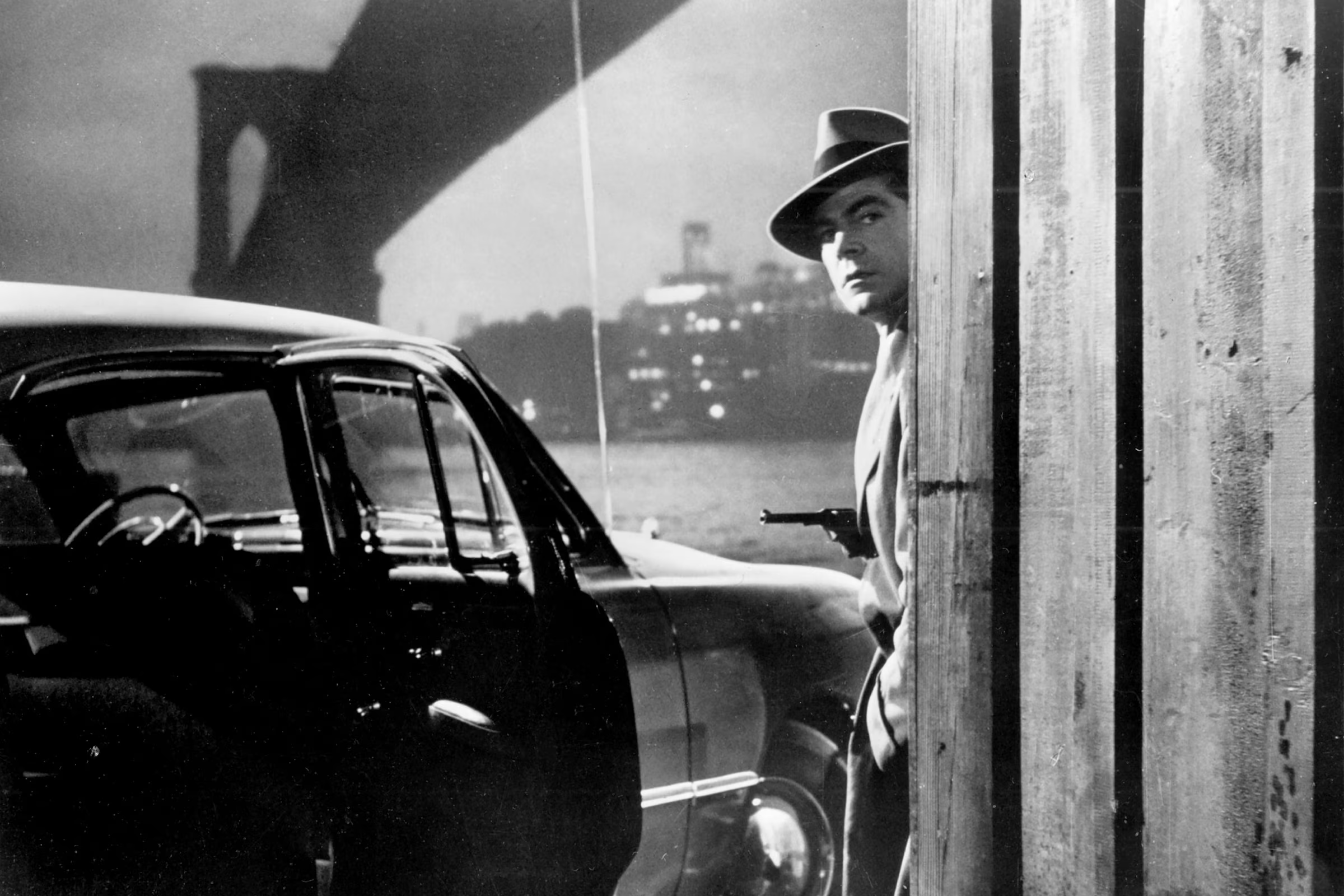
Preminger and LaShelle give that anxiety room to develop. The direction favors fluid movement and sustained takes over a barrage of emphatic close-ups; the camera follows people through rooms with an ease their lives conspicuously lack. LaShelle’s black-and-white photography makes the city feel both inhabited and inhospitable, a place of temporary shelter rather than safety. One particularly effective shot is that extended, fixed, no-cut take of the car carrying Dixon, Scalise, and his men approaching and entering the car elevator, then rising off-screen as they watch each other suspiciously.
The movement is simple, but the arrangement leaves us studying the men inside, waiting for suspicion to become action. Nothing needs to leap out of the shadows when the company is already this bad. Preminger and LaShelle’s off-kilter camera angles and touches of the outlandish, skewed environment give ordinary places an uneasy edge, keeping the suspense grounded in a world we recognize.

Where the Sidewalk Ends film takes its title literally: before we meet Dixon, we’re already looking at the pavement. The film brings us down to street level before the story even begins. There’s no familiar Twentieth Century-Fox fanfare; instead, with an everyday, almost offhand quality, someone whistles Alfred Newman’s ubiquitous “Street Scene” theme as the opening credits appear in chalk on the sidewalk. A pedestrian walks right over the lettering, as though the movie’s introduction were just another part of the pavement. It’s an unassuming entrance, but it sets the right tone for a film about the uneasy distance between a policeman’s authority and the street he patrols. Newman wrote the “Street Scene” theme, but Cyril J. Mockridge composed the film’s score, incorporating Newman’s music.
In Laura, polished manners and expensive taste give murderous possessiveness a respectable place at high society’s table.
In Where the Sidewalk Ends, it doesn’t need any introduction. Preminger takes us downstairs and out into a city where money runs short, tempers run hot, and a badge does not necessarily mean the man wearing it will keep his hands to himself. Violence is no scandalous intrusion here; it is part of the neighborhood’s vocabulary, spoken by crooks and policemen who seem to share the same fluency.

Laura and Where the Sidewalk Ends might take place in the same city, but they tell their stories in very different neighborhoods. Preminger brings Andrews and Tierney back together again, in cramped rooms, modest restaurants, and streets where nobody has much left to lose. Where the earlier film’s characters trade sharp remarks, people here are quicker to throw a punch.
Six years after Laura, Preminger reunites the two stars, and cinematographer Joseph LaShelle, but the elegant rooms and cultivated malice have given way to cheap apartments, gambling joints, and police offices where nobody looks particularly well rested. Film-noir historian Eddie Muller neatly described the change of address as going “from the penthouse to the outhouse.”
Andrews plays the volatile New York Detective Mark Dixon as a man whose anger has become second nature, leaving everyone around him to deal with its consequences. He’s already been warned by his superiors that his fists are doing too much of the questioning, especially when he visits a suspect’s apartment and turns an interrogation into a fight that leaves the man dead and the cop with something of his own to hide.
Dixon’s anger and violence make him a rougher figure than Andrews’s earlier detective. Tierney’s beauty remains, but here it belongs to a working woman modeling clothes for a department store, not a portrait holding a room in its spell. And Andrews seems to have carried his detective’s composure into the next guy’s harsher life: Mark Dixon wears the familiar trench coat, a visual callback to Laura’s Mark McPherson, but beneath it is a man whose weariness has hardened into anger. Bright Lights Film Journal makes a similar comparison, describing Dixon as “an older, sadder, more disturbing version of the cool cop in a trench coat.”
The screenplay is by Ben Hecht, adapted from William L. Stuart’s novel Night Cry, with adaptation credits for Victor Trivas, Frank P. Rosenberg, and Robert E. Kent. Its setup is beautifully unpleasant: what happens when a detective investigating one killing commits another, then uses his professional knowledge to keep himself out of the investigation? Hecht gives the machinery a sharp conversational edge. Everyone in this film rarely wastes a sentence when a verbal jab will do the trick.
Preminger and screenwriter Ben Hecht follow Dixon into an inferno of guilt and the cruel chance of fate, where one unintended death exposes the damage done long before he threw that fatal punch. His deepest reckoning is the recognition that he did not stumble into this nightmare unprepared: every suspect he brutalized, every act of cruelty he mistook for toughness, helped fashion the trap that finally closed around him.
Dana Andrews hardly looks like a man forever one insult away from throwing a punch, but that controlled exterior makes the anger beneath it even more unsettling. His detective sets out to conceal his own guilt with grim efficiency, only to steer the investigation toward an innocent cab driver.
By the early fifties, noir was finding plenty to fear on the supposedly reassuring side of the law. Where the Sidewalk Ends belongs to that uneasy company of films in which a detective’s anger becomes a danger in its own right. Think of Robert Ryan’s Jim Wilson in Nicholas Ray’s On Dangerous Ground (1951), a lonely, embittered cop whose disgust with the people he arrests has turned into a habit of brutality. Then there’s Van Heflin’s chilling portrayal of sociopathic cop Webb Garwood in Joseph Losey’s The Prowler (1951), who belongs in this company too, though his weakness is less a quick temper than a hunger for someone else’s comfortable life. When he’s called to investigate a prowler, he finds Evelyn Keyes, who plays Susan Gilvray, and he decides that he wants her and her home for himself. His badge gets him through the door, but it winds up being no protection for the people who let him in.
The badge may give Dixon authority, but it does not give him mastery over himself. Like Kirk Douglas’s detective in Detective Story, Jim McLeod’s father was a violent man who drove his mother into a mental institution. Dixon carries his father’s criminal past into every confrontation, treating each crook as another opportunity to settle a family grievance. But where Douglas burns with the conviction that he is right, Andrews seems worn down by the suspicion that something is wrong with him. One turns self-righteousness into a weapon; the other keeps finding his own reflection in the people he wants to punish.
These are the troubled precincts of noir, the territory where Where the Sidewalk Ends shares a neighborhood with Detective Story and The Prowler. Here, the question is not merely whether the police can catch a dangerous man, but whether they can recognize one behind a badge.
Mark Dixon is already in trouble when we meet him. His superiors have had enough of his treatment of suspects, and a demotion puts him under Lieutenant Thomas, played by Karl Malden.
“You don’t hate hoodlums; you like to beat them up. You get fun out of it.” Inspector Nicholas Foley, played by Robert Simon

Dixon and his partner Paul (Bert Freed) return to the precinct to find a new authority in place: Lieutenant Thomas, a man with little patience for departures from the rulebook.
Thomas has advanced without Dixon’s habit of leaving bruises behind him; Malden gives his authority an earnest firmness that makes him more troublesome than a conveniently foolish superior would have been. Dixon cannot simply dismiss the man investigating his conduct as incompetent. The department’s warning is clear: another incident could finish him. Naturally, another incident is waiting just around the corner.

Inspector Foley (Robert F. Simon) makes the introductions, then pulls Dixon aside for a less cordial exchange and to lay down the law. “Your job is to detect criminals, not to punish them.” — Inspector Nicholas Foley.
Twelve brutality complaints have caught up with him, costing him his rank and earning him a demotion to second detective. Foley leaves no room for misunderstanding: unless Dixon reins himself in, his next assignment will be pounding a beat.


The trouble begins at a floating craps game at a hotel run by gangster Tommy Scalise, played by Gary Merrill, with a smug composure that practically invites someone to lose his temper.
The high-stakes dice game turns tense when wealthy Texan Morrison (Harry von Zell), flush with $19,000 in winnings, is ready to walk away and call it a night. Having brought him to the game, Ken Paine (Craig Stevens) is expected to keep him there long enough for Scalise to win back his money. Under pressure, Paine starts to get abusive with his estranged wife, Morgan Taylor (Gene Tierney), who is disgusted by the whole deal and is now refusing to keep playing her part in the setup. When she insists on leaving, their quarrel takes on an ugly edge. Paine strikes her, and Morrison, seeing it, steps in to defend her, and the two come to blows, where the Texan takes a knockout punch for his trouble. After that, Paine and Morgan leave.
Dixon and Paul catch a murder call at Scalise’s hotel. Morrison’s luck has run out: the big winner at the dice table is now a corpse, with a knife in the heart.

“Why are you always trying to push me in the gutter?” Scalise asks Andrews. “I have as much right on the sidewalk as you.”
Lieutenant Thomas arrives, and Scalise wastes no time pointing the finger at Paine, though he claims he never saw a knife. Dixon grabs Scalise’s address book and turns up Paine’s address. Thomas sends him to check it out, but Dixon has his own agenda: he wants Scalise, and Paine may be the lever he needs to bring him down.
Scalise keeps returning to his nasal inhaler, a little habit that suggests more than a stubborn cold. Lee Marvin’s Dill would nurse a similar attachment, fixated on his spray bottle in the superb color noir Violent Saturday (1955).


Craig Stevens as Paine in the seedy confines of his room in Where the Sidewalk Ends (1950).
Dixon sees this as an opportunity to get his old enemy, but what ought to be a routine questioning becomes the hinge on which the whole picture swings.
He walks into Paine’s fleabag room without bothering to knock. Paine is on the phone, deeper in the bottle than before, leaving a message for Morrison. Dixon cuts through the drunken haze and tells him Morrison is dead, Scalise has pointed the finger at him, and now he’s coming down to the station.
Paine doesn’t buy it and takes a swing. Dixon answers with a punch that drops him for good. All he did was deck him, but Dixon realizes he’s dead. Stevens gives Paine enough drunken hostility to make the confrontation ugly without making his death seem deserved.

The phone rings. His partner, Paul, calls with a warning that comes one blow too late. Go easy on Paine; he’s a war hero who’s fallen on hard times.
For Dixon, there is still a choice. He could report what happened. Instead, convinced that his reputation will make an accidental killing impossible to explain, he begins arranging the evidence into a more convenient story and planting false clues. He conceals the body, creates a false trail suggesting Paine has left town, and eventually disposes of the corpse in the river. The detective has become his own most resourceful accomplice.
With a dead man at his feet, Dixon trades police work for a cover-up. Now he’s got to get rid of the body. He packs Paine’s suitcase, calls a cab, and passes himself off as Paine on a trip to the train station, where he checks the luggage under the dead man’s name. The idea is to make it look as though Paine left town alive. But when Dixon returns to the room, Paul is already there, close to the secret, though he hasn’t figured it out yet. Bert Freed, as Dixon’s partner Paul Klein, supplies another kind of grounding presence: the everyday proximity of a colleague becomes distinctly uncomfortable when you are depending on everyone overlooking what is right in front of them.

Mark Dixon (Dana Andrews) stays hidden in the hallway as Jiggs Taylor (Tom Tully) arrives at Ken Paine’s apartment in Where the Sidewalk Ends (1950).
They question the landlady, who tells them she saw Paine leave, giving Dixon’s deception a witness. He drops Paul at headquarters, then doubles back to finish the job. But as he hauls the dead guy into the hall, someone arrives. Dixon ducks beneath the stairs with his dead weight and waits in the shadows. The guy at Paine’s door is Morgan’s father, Jiggs, whose temper is fueled by Paine’s mistreatment of his daughter, and he’s come to settle things. He gets no answer and stalks off with his anger still, looking for a target, never knowing how close he’s come.
Dixon dumps the body in the river and heads back to the precinct, where he and Paul are told to get some rest.

Dixon hopes to pin Paine’s death on Scalise. Instead, the investigation turns toward Morgan’s father, cab driver Jiggs Taylor, played by Tom Tully. Jiggs has threatened Paine over how he treated Morgan and has been seen at his apartment. Dixon’s carefully improvised escape route now leads straight to an innocent man. Tully’s good nature works enormously well to gain our sympathy: Jiggs is not merely a complication in Dixon’s cover-up but a father whose protective anger has made him vulnerable to his horrible mistake. The cruel extra detail: a war wound had left Paine with a metal plate in his skull, turning a single punch into a death sentence. Dixon’s violence has killed one man, and his silence is now threatening another.

Dana Andrews as Mark Dixon and Bert Freed as Paul Klein, his fellow detective and partner in Where the Sidewalk Ends (1950).
As Dixon, he’s always on guard, and that watchfulness becomes a kind of confinement: his anger has nowhere to go except outward toward others while he keeps his shame to himself. His face doesn’t give much away, but the effort of keeping it that way tells us plenty. What makes the performance so affecting, though, is the warmth that occasionally escapes his guard. When Dixon takes Morgan to his usual restaurant, his teasing exchanges with Martha briefly reveal a man who knows how to enjoy someone’s company.
Ruth Donnelly’s sharp-tongued Martha gives him a hard time, but there’s warmth in their back-and-forth and an affection that neither of them feels obliged to announce. For a few minutes, he’s not a detective trying to hide what he’s done, just a regular customer trading wisecracks. It’s a relief to see him relax, which makes it even sadder when he has to go back to covering his tracks.

Martha, Owner of Martha’s Cafe: You know, I like places like this that specialize in good food instead of headwaiters.
Det. Mark Dixon: It’s the worst food in town, but don’t worry. They usually serve a stomach pump with the dessert.
Martha: Who invited you to come to my restaurant, Mr. Detective? Not me!
Mark Dixon: Martha’s the head of a ring of burglars. My presence makes her nervous.
Martha: Yeah, last night we got a whole basketful of diamonds. You wanna see?
Mark Dixon: Bring us two of your dangerous dinners, Martha.
Martha: You know how much I’ve been offered to poison this man?
Mark Dixon: Ten dollars.
Martha: That’s right. I’m holding out for fifteen. Two dinners. Do you want wine?
Mark Dixon: Bring a small bottle.
Martha: Huh! Same old cheapskate!
Morgan: [after Martha leaves] She adores you, doesn’t she?
Martha: She ought to. I sent her husband up.
Morgan: Was he really a burglar?
Mark Dixon: Wife beater.

There is welcome oxygen in Ruth Donnelly’s Martha, the diner owner whose brisk manner suggests that a difficult customer is hardly a new species, and affection for Dixon takes the form of mocking threats like cheerfully advertising homicide herself with their quick banter, “You know how much I’ve been offered to poison this man?” she asks. Dixon supplies the figure: “Ten dollars.” Martha is not denying the offer: “That’s right. I’m holding out for fifteen.” For once, the threats come with a cafe dinner rather than a smoke-filled interrogation room. Donnelly steals all her scenes, and her presence is there to remind us that the city holds ordinary people getting on with their lives.
Ruth Donnelly (1896–1982) was a stage-trained character actress whose specialty was drollery: she had a way with brisk delivery, dry humor, and the unmistakable impression that she had heard every excuse in the book before. After establishing herself on Broadway, including in plays by George M. Cohan, she became a familiar Hollywood presence in the 1930s, playing sharp-tongued secretaries, practical-minded friends, and no-nonsense wives who were rarely inclined to suffer foolishness quietly.
Donnelly’s dry wit livened up Footlight Parade as the formidable Mrs. Gould, and she appeared in A Slight Case of Murder as a gangster’s sharp-tongued wife. She also brought a worldly kindness to Sister Michael in The Bells of St. Mary’s and played the warm-hearted Ruth, a fellow patient in Anatole Litvak’s The Snake Pit 1948 starring Olivia de Havilland. Here, she makes Martha the sort of woman who can offer you a meal and cut you down to size without interrupting bringing you the bottle of ketchup. Her briskness has warmth beneath it, and in a film crowded with suspicion, her teasing gives Dixon a rare moment for human ease and for him to catch his breath.
“Innocent people can get into terrible jams too,” Dixon tells Morgan, before adding, “One false move and you’re over your head.” He knows rather more about that predicament than he can afford to explain. His words are meant to reassure her, but he’s still keeping his own part in her father’s trouble to himself.

By now, Morgan is beginning to trust the very man who knows why her father shouldn’t be in custody. Tierney isn’t playing another elusive Laura. Morgan is more down-to-earth, a working woman with a bruising marriage behind her and an unlucky father to worry about. Her part isn’t as richly developed as Andrews’s, but she brings a quiet, subtle openness (something Tierney is masterful at) to their scenes that makes his guardedness even more obvious.
She does not seem to be auditioning to redeem a troubled detective; she believes she has met someone dependable. Her trust makes his deception worse. Dixon is falling for a woman whose life he has helped turn upside down.
Dixon watches as Jiggs and Morgan are hauled into the murder scene and grilled, put through the wringer, every question tightening the noose around the wrong man.
Tormented, sleep offers Dixon no refuge. By the next day, the river has surrendered Paine’s body, and his cover-up is falling on the wrong man. He tries to steer Lieutenant Thomas toward Scalise, but Thomas has fixed on Jiggs.


Lieutenant Thomas punctures the landlady’s story: the man she saw leaving wasn’t Paine but his killer, dressed to pass for him. He arrests Jiggs, and Dixon finds himself caught in a vise of his own making. His growing feelings for Morgan sharpen the torment because her innocent father is taking the fall for his crime.

Neville Brand as Steve, the muscle behind Gary Merrill’s gangster Tommy Scalise, in Otto Preminger’s Where the Sidewalk Ends (1950).
“I can’t figure you out. Your father liked me…” Dixon cuts him off: “Shut up!”
Desperate to break apart the case against Jiggs, Dixon corners Scalise at a steambath, hoping to squeeze out a confession to Morrison’s murder. Instead, Scalise’s muscle beats him unconscious. When he comes around, he stumbles through the haze to Morgan’s doorstep. She gives him a drink and insists he stay the night. She is actually offering shelter to the man whose secret has put her father behind bars.

Morgan: “I’ll fix your head. Come with me.” Dixon: “I suggest you use an axe.”
Andrews performance doesn’t ask us to mistake Dixon for an innocent man; he makes us watch a guilty one think his way out of a bad situation. The way he holds his jaw, the guarded pauses, the effort to keep his face professionally unreadable, all suggest someone discovering how much work it takes to appear ordinary.
In his TCM article “Otto Preminger’s Where the Sidewalk Ends on DVD, December 20, 2005, Jeremy Arnold writes: “His paranoia at being found out becomes our paranoia, too.” The film makes us anxious about Dixon being caught even though we know what he has done. It’s one of noir’s uncomfortable achievements: we know what he has done, yet every interruption threatens to catch us holding our breath for him.
Andrews could make an ordinary man look as though life has quietly worn him down. Whether he’s wearing a uniform or a rumpled suit, he seems unable to switch off, still turning things over in his mind, still working long after the rest of the man who badly needed to sleep.

As the evidence tightens around Jiggs, Dixon tries to help without admitting why he must. He borrows money from Paul to secure the best lawyer in New York for Jiggs, but the attorney turns Morgan away. With that hope gone, Dixon offers the woman he’s falling for the one assurance he has no right to give: her father will soon be cleared. Morgan tells him he can’t know what it means to have a father in jail. And those words strike open an old wound. Quietly, Dixon tells her about his own father, a thief, shot while trying to escape. For a moment, the cop with an answer for everything has nothing to hide behind but the truth about his past.
When Morgan drifts off to sleep, Dixon puts his guilt on paper: a confession addressed to Inspector Foley, to be opened if he doesn’t come back alive. Then he leans on a parolee in Scalise’s outfit, forcing the man to take him to the boss. This time, Dixon makes sure the truth has a way out, even if he doesn’t.

Dixon leans on Willie Bender (Don Appell), a parolee in Scalise’s outfit, forcing him to arrange a meeting with the boss.
Dixon grows more desperate to catch Scalise, but his attempt to confront him ends in a beating rather than the way out he was looking for. Back at headquarters, Inspector Foley tells him off for his clumsy attempt at questioning Scalise, and the confrontation puts him on leave. He arranges another meeting with Scalise. His plan is less an escape than a way to punish himself: let the gangster kill him, and at least Scalise can be held accountable for that death, while the letter clears Jiggs. It is a drastic way to avoid having to tell the truth while still alive.
Even Scalise recognizes the arrangement; he understands how far his hatred has taken him and refuses to cooperate. Scalise: “It’s always a pleasure to watch a cop’s foreplay.” “I didn’t know a guy could hate that much,” he tells Dixon. “Not even you.” Coming from the gangster, it is a particularly ugly reminder of how far Dixon has fallen.
The meeting takes place inside Scalise’s hideout, a cavernous parking garage. Scalise taunts Dixon about his father, who provokes a confrontation and is shot in the arm, but Scalise stops him from being killed when he recognizes what Dixon is trying to pull off.
News then arrives that the police have uncovered the truth about the original crap-game killing. Scalise is about to finish him off when the police arrive. Scalise and his men attempt to escape in the car elevator, but Dixon stops it, trapping them by cutting the power to the building, turning the garage into a cage with Scalise and his men caught inside.

Back at the precinct, Foley congratulates Dixon and returns his letter unopened. His confession still sealed. There it is: a clean exit, for one last moment, the film offers Dixon precisely what he has been trying to find the whole time: a way out. But with Morgan beside him, Dixon hands it back to Foley. This time, he wants it read.
Foley respects the honesty, but it cannot wipe away Paine’s death. Dixon is placed under arrest. His last escape is the one he finally refuses, choosing reckoning over another lie. Morgan promises to stand by him, leaving the film on a bruised but hopeful note: he has lost his freedom, but not his chance at a different life. For the noir antihero, redemption isn’t getting away clean; it’s finally refusing to let someone else pay for his sins.
Dana Andrews had a gift for making composure look like hard labor. Behind that ever-level voice of his and guarded expression, something was always pressing to get out: desire, humiliation, anger, fear, all those qualities rolled into one distinctive manner. In Where the Sidewalk Ends (1950), that tension becomes the engine of one of his most punishing performances. His Mark Dixon wears authority like armor, but it cannot protect him from the shame that lies beneath it. Andrews makes him both dangerous and painfully exposed, a man quick enough to throw a punch, yet helpless before the consequences that unfold. The restraint is never emptiness; it is containment. Andrews gives us a man who feels every bit of it but fights to keep it off his face. But Dixon is running out of room.

In Otto Preminger’s Laura (1944), Andrews’s Detective Mark McPherson has a dry wit and a slightly cocky confidence, until his professional detachment is compromised when his fascination with the woman whose apparent murder he’s investigating starts getting under his skin. He keeps playing it cool, but the case has become something much more – it becomes an increasingly private obsession, much more personal than he wants to admit. In Where the Sidewalk Ends, Dixon feels like that same controlled detective with his defenses worn down, stripped of his protective polished cool: desire still unsettles him, but this time anger and guilt are calling the shots.

Dana Andrews as drifter Eric Stanton and Linda Darnell as Stella, the waitress whose affections draw him into a scheme for money, in Otto Preminger’s Fallen Angel (1945).
In Preminger’s Fallen Angel (1945), Andrews plays Eric Stanton, a broke opportunist whose smooth talk barely disguises his hunger for money, sex, security, and status. He’s a closer cousin to Dixon: always sizing people up, looking for an advantage, and hoping he can talk his way past the consequences, until his conscience starts talking back. Both Stanton and Dixon think they can work the angles and come out clean, maneuvering their way out of any moral troubles. What neither counts on is how hard it becomes to keep lying when someone believes in him, and another person’s trust is harder to escape than suspicion. Caught between Alice Faye’s June Mills, the well-heeled good girl he marries for money, and Linda Darnell’s Stella, the sharp-edged femme fatale he wants but can’t afford, Stanton finds that June’s loyalty awakens a conscience and makes it harder to keep treating her love as just another angle.
William Wyler’s The Best Years of Our Lives (1946) turns that same reserve toward a more openly sympathetic figure. As returning bombardier Fred Derry, Andrews gives a quiet, battered dignity to a veteran whose wartime achievements don’t offer much help with the disappointments of civilian life. Beneath his good looks and easy charm is a man struggling to recover his confidence and find his place in the world. Here, the strain he’s suffering is less a threat than an emotional wound. It’s about pride fighting against humiliation, and survival alongside trauma. That vulnerability also helps explain why Dixon remains relatable even at his worst: Andrews lets us feel the hurt his characters cannot quite put into words; he can make a man’s inability to talk about his pain almost as eloquent as a confession.
As Morgan Taylor, Gene Tierney brings her unmistakable glamour down to street level, giving it the warmth and weariness of a woman who has had to live with other people’s damage. There is nothing remote about her here: she is a cabdriver’s daughter, fiercely devoted to her father, bruised by a marriage to a violent man, yet still willing to risk tenderness. Her beauty doesn’t place her above the film’s battered world; it makes the harshness around her feel all the more unforgiving.
Morgan is no femme fatale beckoning Dixon toward ruin. She is his reckoning, the woman whose trust makes his deception unbearable. Every kindness she offers him deepens the wound of what he knows: the man she turns to for help is the reason her father needs saving. Tierney gives that relationship its quiet emotional force, making Morgan not an escape from Dixon’s guilt but the person who gives him a reason to stop running from it.
Her character offers that redemptive faith and unconditional love to Dixon, who otherwise seems condemned to inhabit a bruised and sunless, unforgiving universe.

Joseph LaShelle’s cinematography gives Where the Sidewalk Ends much of its uneasy atmosphere. While he photographed Laura, here the elegance has a rougher edge. People are crowded into tight, claustrophobic spaces framed by doorways and windows, with LaShelle’s shadows adding to the sense of confinement. Dixon seems to have less room to move as his troubles mount. Yet the camerawork stays remarkably quiet.
Preminger keeps the camera moving with a fluid ease, cutting only when he needs to and saving the close-ups, a restraint that works perfectly with Andrews’s guarded performance. The camera gives us time to watch Dixon trying to keep himself together, without insisting on getting close enough to see every flicker of feeling.
As his career progressed, Preminger grew increasingly insistent on filming on location. Yet Where the Sidewalk Ends makes surprisingly discreet use of New York, favoring enclosed rooms and anonymous corners over streets that announce their address. An elevated train cuts through the night in the distance; Times Square flickers past a car window; the climactic parking garage opens into a cavern of concrete and machinery. These glimpses lend the picture texture.
Eddie Muller called Where the Sidewalk Ends“an unjustly overlooked gem,” and I would agree wholeheartedly; Muller always has his eye on rare noir gems like this one. What makes it work so well is how the cover-up winds up being more revealing than the crime. Dixon spends most of the picture mistaking punishment for justice and control for strength. His first real sign of hope comes when he stops trying to make the evidence go his way. For Noirvember, that is a satisfying variation on the familiar descent: the darkness does not disappear, but this guy finally quits asking it to hide him. His hardest arrest is his own.
Tidbits:
Gary Merrill’s Tom Scalisi was supposed to be a drug addict, but the Production Code prohibited any use or mention of narcotics. Gary Merrill’s character frequently uses a nasal inhaler, though showing no obvious signs of congestion. Developed in 1928, Benzedrine brand amphetamine was available without a prescription by 1934 as a nasal and bronchial decongestant, but it was also noted for its energizing side effects and stimulating, performance-enhancing qualities. It didn’t require a prescription until it was classified as a Schedule II controlled substance in 1959, which is how Scalise’s use of an amphetamine inhaler ducked the Production Code narcotics taboo of the day.
The only feature film appearance for fashion and costume designer Oleg Cassini, who was married to Gene Tierney at the time. They would divorce in 1952. Reportedly, Cassini talked director Otto Preminger into giving him the part.
This is your EverLovin’ Joey sayin’, watch your step, sweethearts; it’s Noirvember, and the sidewalk only goes so far!


