Shadow of a Doubt 1943: Shadow Under a Sunny Sky, Danger in the Doilies Part 2

LINK TO PART 1 HERE

Alfred Hitchcock’s Double Faces: Shadow of a Doubt and Psycho 1960

In both Shadow of a Doubt and Psycho, Hitchcock builds suspense around characters who live double lives, but he stages that duality very differently. In Shadow of a Doubt, Uncle Charlie’s charm and respectability in the Newton household mask his identity as a serial killer of wealthy widows; the film’s tension hinges on the gradual recognition that the adored uncle and the “Merry Widow Murderer” are one and the same man. The doubling of names and the mirrored staging of the two Charlies lets Hitchcock put sweetness and light and a dark side in the same frame, blurring what counts as safely good. Young Charlie’s name mirrors his, and the smallest movements they share quietly give away the bond between them. How deeply she identifies with him, making his darkness feel like a possible version of herself.

Alfred Hitchcock’s Psycho (1960) We All Go a Little Mad Sometimes

By contrast, Psycho turns dual identity into a literal split within Norman Bates himself, dramatized through his alternating personas as a shy motel manager and the Mother figure who commits the murders. The film’s structure withholds this doubling until later in the film, encouraging us to think of Norman and Mother as two separate characters; only the revelation that he is both collapses the divide and exposes a psyche fractured between dependence and homicidal rage. You could hone in on this as Hitchcock’s most blatant version of the “double,” where the conflict isn’t between two people but between two selves jostling for control inside one body.

Where Shadow of a Doubt focuses on the way ordinary family life can harbor a charismatic killer whose evil feels uncomfortably close to the heroine’s own fantasies of rebellion and freedom, Psycho pushes duality inward, making the body itself the site of conflict between competing identities. Uncle Charlie embodies a radical evil, hidden violence camouflaged by everyday respectability, while Norman Bates embodies a more extreme version of the divided self, in which the social self and murderous impulse are separated into distinct, competing characters within one man.

Uncle Charlie is a sort of Bluebeard… born out of an intensely misogynistic Social Darwinist mindset. He is the integrated man who chooses evil, evil that is deeply willed, rooted in a chosen worldview. A predatory, nihilistic misogynist who has an actual philosophy — “Today’s the thing — that’s my philosophy” and his “Do you know the world is a foul sty? Do you know, if you rip off the fronts of houses, you’d find swine?” speech captures a man who has reasoned his way into monstrousness. Norman Bates and Charles’ violence is both gendered,

Norman Bates and Charles’s violence is both gendered, but through a very different mechanism — punishing women on his mother’s behalf rather than out of an articulated worldview. And while Hitchcock builds both villains out of the same idea—the doubling—he splits it in opposite directions. With Uncle Charlie, the double lives outside him: an uncle and niece who share a name, seem to think on the same wavelength, and, as the film keeps hinting, it feels less like two people than one soul stretched across two bodies.

He’s whole, and that’s what makes him terrifying; his evil isn’t some hidden symptom. He is whole within himself, terrifyingly so; his evil isn’t a symptom; it’s a philosophy he can recite at the dinner table without raising his voice. The scary part isn’t that Charlie finds a monster hiding inside a man she loves. She shares his restlessness, his hunger to escape the ordinary. The horror is discovering that his answer to that same restlessness is murderous misogyny, something she wants no part of. The kinship is in the itch, not in the conclusion he draws from it.

Norman Bates flips that setup completely. He doesn’t need a niece to mirror him, because the double already moved inside — one body, two minds — his and his mother’s, and the control passes between them, each one waiting for the other to lose its grip until, by the end, only one is left holding on. Uncle Charlie can look you in the eye and tell you exactly what he believes the world is. Norman can’t even tell you which version of him is talking. His evil isn’t something he chose or could defend; it’s just what’s left after his mind cracked under grief and guilt and never put itself back together. Uncle Charlie picks his darkness. Norman just gets picked by his, again and again, until there’s nobody left inside to take the blame.

Hitchcock uses the two Charlies as a kind of living split-screen, letting us see sweetness and light and the dark side walking arm in arm through the same small-town frame. Psycho routinely reads Norman’s alternation between himself and Mother as a textbook case of fractured identity. By the time we reach the basement revelation, Norman isn’t just slipping between moods; the film turns an internal conflict into a full-blown duet of competing selves, mirror-image killers locked in the same body.

Norman’s duality is framed by Hitchcock’s use of his reflection in the window.

Teresa Wright’s Quiet Brilliance in Shadow of a Doubt

Teresa Wright actually came to Shadow of a Doubt through one of those old-Hollywood “loan-out” deals. Samuel Goldwyn agreed to lend her to Jack Skirball at Universal, who, in turn, was trying to line up Hitchcock through David O. Selznick. Teresa hated the whole loan-out system—it felt like a form of professional servitude, and it meant the studio collected a fat fee while the actor just stayed on their usual salary. Still, for Teresa, the chance to work with Hitchcock was irresistible. She signed on in August and headed up to Santa Rosa, about sixty-five miles north of San Francisco, for two weeks of location shooting. The funny thing is that the project for both of them wound up as a favorite: Hitchcock later singled Shadow of a Doubt out as his personal best, and Wright kept naming it as the film she loved most in her own career.

It’s not hard to see why both Hitchcock and Wright held the film in such high regard. Shadow of a Doubt is a quietly stunning piece of work: unsettling and deeply felt, carried by extraordinary performances and shot in a black-and-white style that makes even the most ordinary scenes feel haunted. Every scene bears the unmistakable hand of a master at work. In shot after shot, you can feel Hitchcock’s assurance that he was always completely in command of his art.

On top of her recent Oscar, which made her a very appealing name for the project, Teresa Wright came to Hitchcock with a strong endorsement from Thornton Wilder, who had been brought in to write the script. The story itself can be read as a kind of shadow version of Our Town, its darker underside. Years later, in 1974, she described her first meeting with Hitchcock in vivid detail, remembering how that collaboration began

“When he told me the story as we sat in his office, it was as if he had already finished the picture. He had it completely planned in his mind, along with every sound effect, and he told me the entire movie, scene by scene. He used anything on his desk as a prop- a drinking glass, a pencil, or a book. He stepped around. If a character was strumming his fingers on a table, for example, it wasn’t an idle gesture- Hitch put a beat to it, like a musical pattern or a refrain. If someone was walking or rustling a newspaper, tearing an envelope or whistling, or if there was a flutter of birds or an outside sound, Htich had everything carefully orchestrated.”

As for the filming process:

“ Hitch made us all feel very relaxed, and his direction never came across as mere instruction. We felt we could trust him, and although he guided us carefully, he also gave us a sense of freedom. He was very calm, as if we were contributing to something that was already a foreseen success. No one plans a film as thoroughly as Hitch, and no one saw it as clearly as he did from the start. Other directors often let things happen during the shooting, but with Hitch’s planning, everything was more serene during production, and therefore more enjoyable… What luck it was for me — this was a wonderful role, a girl who starts off one way and then changes and grows before your eyes as she’s dealt with this awful problem. At the conclusion, it was the end of innocence for young Charlie, because now she knows evil exists, and in the one person she and her mother love the most. She has grown up and learned that someone she has loved and been loved by can literally kill people.”

Not everything about the shoot was comfortable for her. She later recalled that, just before calling “Action!”, Hitchcock would lean in and whisper something obscene—“usually,” she said, “having to do with a young bride on her honeymoon, which I had just returned from.” He also made comments about her husband, writer Niven Busch, especially regarding their age difference, which she found inappropriate. “I tried to cope with this by smiling, as if I didn’t understand him, or as if he was uttering the most polite compliments,” she explained, framing her response as a kind of polite deflection rather than genuine amusement.

According to Donald Spoto and from various stories told over the years, this wasn’t the first or last time Hitchcock entertained himself with a bit of verbal mischief at the expense of a leading lady. It’s tempting to think he was sometimes chasing a reaction—a flash of shock or discomfort right before a demanding shot—since that kind of tactic is hardly unheard of on sets. What makes it stranger is the way it sits against his public persona on the job: the suit, white shirt, and tie; the calm, almost placid manner; the refusal to shout or create chaos. All that bourgeois respectability is sharply at odds with the sudden eruptions of crudely inappropriate remarks.

“Charlotte, age 19 or 20, is one of his nieces, named for him. The film charts the girl’s moral education as she progresses from innocence and untested idealism to a firsthand experience of the eruption of evil amid everyday reality – and the murderous tendency to depravity that is latent in human nature, indeed in everyone. Teresa filmed her role calmly, but inside, she was perhaps for the first time, tearing herself to pieces, enduring a nervous stomach and losing weight. While under Hitchcock’s tutelage, she thought out every moment of her character’s abrupt introduction to the darkness in human nature. She stated, “I had to understand how this woman felt- how she developed to include a mature, tough side, too. After all, cardboard characters are no fun. There’s no place you can go with cardboard, no depth.”—Source: Teresa Wright and Donald Spoto

For someone working under that kind of pressure, Teresa delivers something remarkably close to a lesson in screen acting: “The shots of Wright,” wrote the novelist and critic Stephan Talty, “Have the raw power of those early silent close-ups in which an entire drama was played out on the face of the actor, {and her performance} remains one of the most lucidly beautiful in the cinema.”

Teresa’s work in Shadow of a Doubt really shows how much the film depends on her and how steadily she carries it. Because the film was shot out of sequence, the location work involving the Santa Rosa exteriors done first and the studio interiors saved for later, meant she had to hold Charlie’s whole emotional journey in her mind, she had to keep track of Charlie’s emotional arc almost entirely in her head, even when she’s jumping from one stage of it to another on set, and knowing that the audience would experience it as a steady descent rather than pieced together, the way she was actually filming it. Because she’s in almost every scene, being on screen for nearly the whole picture, she walks that line so carefully that Charlie’s ordeal hits hard in the moment and feels at once startling and, when you look back over it, where the film has taken her, grimly inevitable.

What stays with me is the way she handles Charlie’s innocence. She slowly lets it erode over the course of the film without ever tipping into fake purity or sentimentality.

The early, almost breathless trust she places in Uncle Charlie, where she practically glows with the faith she puts in him, never plays as simple wide-eyed naivety; and when that trust collapses, her talk of stopping him—even killing him if she has to—lands with real weight rather than melodrama. The lines carry a kind of sober conviction instead of tipping into hysterics.

She refuses to treat Charlie as a passive victim. Once the truth about the widows comes into focus, Teresa steps into the role of opposition: she becomes a kind of adversary, someone who sees him clearly and refuses to surrender the moral ground. And she does most of this work not through dialogue, but through the look on her face, the way her eyes move from worshipful to wary, from adoration to suspicion to outright defiance as the film closes in around them.

“You must be thinking the right thing,” she said. Because it will show if you’re not. When there’s a close-up of your eyes, you can’t be thinking of making the 11:45 train or something. “

“In scenes with Henry Travers- he had played the stationmaster in Mrs. Miniver – and with Patricia Collinge as her mother (Aunt Birdie ), Teresa was an acute listener- hence our identification with her character deepens as we listen with her. Opposite the pliant lure of perilously attractive Uncle Charlie, another actress might have been diminished precisely because his character is so fiercely idiosyncratic and unpredictable, but Tressa allowed young Charlie’s moral education to emerge without forcing the issue of a life lesson- and so she left a nuanced, exquisitely rendered performance that gave Shadow of a Doubt its coherence and complexity.” —source: Donald Spoto

“She was lovely to work with,” producer Jack Skirball wrote to Samuel Goldwyn after the picture was released. “And in my opinion, she has no superiors, and few equals as an actress. I was very impressed.”

Hitchcock lavished his praise upon Teresa Wright: “I got along very well with Teresa. IF she can’t act a line in a script, there’s something wrong with the line. She was always prepared and completely professional; she knew what she was doing, she always got things right, and she gave a great deal to the picture.”

As for Teresa, she was candid for the rest of her life: “At the time we made this picture, we all thought it was a great film. But I don’t think any of us had an idea that it would have such an impact on generation after generation.”

Even at the height of World War II, critics were already applauding Teresa. Howard Barnes of the New York Herald-Tribune praised her “quietly authoritative performance that elevated the film into a screen classic.” William Wyler kept boosting her, calling Teresa “an actress who can do no wrong,” and critic Alton Cook went so far as to say she was “one of the great new actresses of our time.” Time pretty much sealed the deal by dubbing her “Hollywood’s best young dramatic actress.”

In 1943, Oscar nominations were announced: Shadow of a Doubt only landed a nod for best original story, based on a six-page outline by Gordon McDonell, and even that lost to William Saroyan’s The Human Comedy. It wasn’t the first time, and definitely not the last, that a Hitchcock masterwork slipped past the industry’s radar. On top of that, many moviegoers, then and long after, were baffled that Teresa Wright’s name was nowhere to be found among the best actress nominees for 1942. To me, both omissions are criminal.

Source: Teresa Wright’s Biography, A Girl’s Got to Breathe: The Life of Teresa Wright, by Donald Spoto.

The Shine on Santa Rosa, and the Rot Beneath: Sunlight on the Sidewalk, Darkness in the Parlor: American Small Town Idealism Shattered and Exposed

In the opening, it’s filmed in Newark, NJ (the Pulaski Skyway), set nominally in the East- Philadelphia- a deliberately nameless, sullied Eastern city contrasted with the idyllic Santa Rosa. That East/West opposition is itself part of the film’s meaning; the Library of Congress essay notes that Hitchcock shoots the East “unflatteringly” as symbolically tainted, with California standing for democratic small-town virtue.

On a historical side, Shadow of a Doubt is significant because it reflects the social anxieties of the early 1940s, when the United States was moving more fully into the Second World War. Santa Rosa is staged as the kind of town wartime America liked to imagine itself defending: clean streets and neighbors who know your name.

The film’s critique of American small-town idealism comes in through the side door. Santa Rosa is presented at first as an almost promotional vision of wartime America: you’d imagine friendly shopkeepers, church picnics, families who can leave their doors unlocked because “nothing bad ever happens here.”

One tiny obsession and brief indulgence: I hear so often from people who say a variation of this, “Things like this don’t happen here,” as if the town’s zip code were a moral force field, and it drives me crazy because it’s just not true—and it’s not innocent. It never fails that that particular statement comes up in every true-crime doc I watch.

What they’re really saying is: “We are the kind of people this shouldn’t happen to.” It implies that violence belongs somewhere else, with other, supposedly “lesser” people or more “obvious” places—the big city, the bad neighborhood, the wrong side of town. It turns tragedy into a weird kind of compliment to themselves: our town is so wholesome, so American, so normal, that reality itself has somehow broken character. I just want to push back against the moral hierarchy baked into “things like this don’t happen here.” …anyway, rant over.

Wartime small-town ideal: In the early 1940s, Hollywood and official culture were busily mythologizing the small town with its charming central square and treeline residential streets, and the happy family as the sturdy, wholesome heart of the nation, all those ideals that were being fought for.

This is not the sentimentalized view that Americans remembered their pre-Pearl Harbor country to be; rather, the film suggests the world has always been filled with horrible people.Three years later, this same concept was repeated in Orson Welles’ The Stranger, a yarn about a post-WWII Nazi who escapes only to settle down in a sleepy American suburbia—the paranoid suggestion being that even though the Nazis were defeated, there was still danger in our seemingly safe communities. – Brian Eggert 2013 essay for Deep Focus Review

Both Hitchcock and Welles, for that matter, sought to challenge blindly optimistic views of small-town America and expose its seedy underbelly.

Here there’s an immediate disruption: Shadow of a Doubt steps into that moment and quietly undermines it, showing how a town that looks perfectly right can still set out the welcome mat for a serial killer.

On screen, the town doesn’t read as distinctly Californian at all. It comes across more like a classic Midwestern community, the small-town narrative of innocence, the kind of setting that feels about as generically American as you can get. Santa Rosa is framed as a typical American town, and the Newton family history absolutely meets that idealized version: the hardworking father, devoted mother, their shiny kids, and their beloved visiting uncle. The shared story the Newtons have about themselves makes the possibility of a serial killer in their midst almost unimaginable, so when young Charlie begins to suspect the truth, she has to fight against the weight of that family myth as much as against her uncle himself.

Critics have focused closely on the film’s vision of small-town America as both cherished and quietly compromised. This folds Shadow of a Doubt into a broader 1940s cycle that exposes the other side of the small town, admiring the way it holds together both its bright and dark faces, a town that presents itself as warm and welcoming, yet might quietly conceal cruelty, self-deception, hypocrisy, and a capacity for looking the other way.

What’s striking, given when the film was made, is how openly it undercuts the comforting image of the American small town. In the middle of the Second World War, when Hollywood was busy bolstering morale and selling an ideal of neighborly, churchgoing normality, Shadow of a Doubt quietly suggests that this kind of town can just as easily embrace a murderer as a cherished relative.

The streets look safe, the community looks devout and kind, and yet all of that warmth proves perfectly capable of sheltering someone whose violence is quietly buried in the scenery of ordinary people. The film is able to optimize this American shadow-self through its use of black-and-white psychological suspense to explore a sense of unease beneath the public rhetoric of unity and sacrifice. This suggests that evil might erupt not only overseas but in the heart of domestic life, highlighting the way characters cling to routine and optimism while underlying tensions and fears about safety, trust, and moral order seep in. Shadow of a Doubt isn’t just about a threat to one young, innocent girl or vulnerable widows; it threatens the symbolic foundations of wartime, postwar, and mid-century domestic spaces in American life.

While it’s not a pure domestic space at the Newtons’ reception, Hitchcock stages bourgeois civility as a fragile performance: the cocktails, polite conversation, and fixed smiles form a social facade that Uncle Charlie’s presence quietly destabilizes. It presents wartime respectability as theatrical and brittle, with its older, affluent guests embodying a false civility that masks the moral unease beneath the polished surface of suburban life. This gathering captures not so much domestic intimacy as a ritual of wartime-practiced bourgeois self-display, a setting whose composed civility is already vulnerable to Uncle Charlie’s intrusive evil. The image doesn’t show the comfort of home but the performance of respectability: here, at the cocktail party, it’s framed as a world of wealth, manners, class privilege, social exclusion, and repression that the film treats as deeply unstable. Already marked by the moral rot Uncle Charlie brings into the narrative.

Hitchcock’s great sleight of hand is to let that postcard image stand even as he quietly proves how easily a serial killer can hide inside it. By putting a murderer at the center of such an impeccably ‘normal’ household, the film brushes up against a broader unease: if the small town and the united family are supposed to be the sound heart of America, what does it mean when corruption arrives not from some urban underworld but from the guest room upstairs?

So here we are, with a film that knows how to capitalize on that myth. Within that postcard setting, we find a serial killer welcomed as a local celebrity, two armchair criminologists gleefully discussing strangulation over dessert, and a household so invested in maintaining its pleasant rituals that young Charlie’s suspicions would be treated almost as a breach of good manners. The film quietly reflects wartime anxieties about what might be lurking beneath the surface of American normalcy, and you can feel that in the way authority figures either misread or willfully ignore danger: the town’s respectability becomes Uncle Charlie’s camouflage. The psychological horror, then, is not just that one man is monstrous, but that a whole community’s desire to see itself as wholesome gives him room to operate.

In that sense, the film doesn’t just unsettle one town; it quietly disturbs a broader cultural fantasy that would harden in the postwar years—the idea of the “good” American community as a kind of moral safe zone. The Rockwell image of the nation, with its front porches, church socials, and polite Main Streets, was never just décor; it became a story Americans told themselves about where danger belongs and where it doesn’t. Shadow of a Doubt slips in before that story fully comes together and suggests that the rot isn’t an import from some distant elsewhere, but something that can grow in the very places most invested in denying it.

The dream as an illusion that requires constant performance

Seen from that angle, Uncle Charlie is not only a killer hiding in plain sight; he’s also a dark answer to the postwar fantasy of the returning hero. He comes home bearing charm, money, and an air of worldly glamour, and the town receives him as proof of its own goodness: look what kind of man our “perfectly American” town produces. The film’s cruelty lies in showing how easily that desire to see him as a success story blinds them to what he really is. The myth of the safe, idealized community doesn’t protect them from violence; it helps to script the conditions under which violence can thrive, hidden inside charisma and respectability.

Critics of postwar suburbia have called it a kind of mirage: a dream that looks solid in photographs but only holds if everyone keeps performing their part—staying married, mowing the lawn, keeping the right distance from whatever feels messy or threatening. Shadow of a Doubt plugs into that logic before the cul-de-sacs even arrive. Santa Rosa isn’t just “nice”; it’s a town whose identity depends on seeing itself as nice, and on smoothing out anything that doesn’t fit. That’s why the most frightening thing in the film isn’t only Uncle Charlie’s violence, but the way it slips so easily into the script—and how he is received as a sort of hero, an ideal son come home, and the town helps him hide simply by insisting that a place like this is no place for evil.

Postwar Dreams and White Picket Nightmares: The Myth of the Safe Town and who gets to live in that ’safe’ place: From Santa Rosa to Levittown

So when people say things like “this doesn’t happen here,” they’re talking about a “here” that was engineered to be racially homogenous and economically filtered. The innocence of the landscape depends, in part, on who has been kept off the streets.

The myth of the safe American town was always very clearly a selective one. Postwar suburbs – places like Levittown – were explicitly built with white families in mind; Levitt himself enforced whites-only policies, and the way loans and mortgages worked, these federal lending practices such as redlining helped make sure a lot of minority families never even had a shot at getting in.

In postwar suburbia and the American Dream language, Santa Rosa can be anywhere USA, like the creation of Levittown, Long Island, NY, and its quaint neighborhood and its ideal little houses that offered veterans the American Dream. I lived in one of these privileged white suburbs and actually grew up a few towns over from Levittown.

Shadow of a Doubt doesn’t suddenly turn it into a story about race, but for me, in later readings of the film, I can’t help but go there because it opens the door to thinking about what (and who) that safety has historically depended on ignoring. Hitchcock isn’t talking about race head-on in Shadow of a Doubt, noticing that his world is almost entirely white and organized around gender/class. But I can’t help noting that the myth of the safe, overwhelmingly white neighborhood has racial baggage. Even if the film doesn’t name it—but watching it now, it’s hard not to connect that “safe town” fantasy to the way real white neighborhoods have treated themselves as sealed off from danger.

The film is clearly uncomfortable with the idea of a perfectly sealed, perfectly innocent community. It hints at a bigger pattern: that the fantasy of safety only works if you ignore the violence, systemic, structural, and personal, that made that fantasy possible to begin with.

Shadow of a Doubt can be read as pressing hard on wartime American values, with figures like the banker, the family dinner table, widows, wealth, and everyday consumer comforts all coming under quiet attack. The film has been memorably described as at once a “subtle stab and warm hug” (Weekly Hitch) to the ideals America imagined itself defending in the 1940s, and that double attitude—smiling on the quaint values of Santa Rosa on the surface, paired with a stark reveal of how darkness can overshadow it—is very close to the tension I’m tracing in my own reading.

In the decades after Shadow of a Doubt, that postcard vision hardened into the now-beloved suburbia: rows of houses and that aggressive lawn culture that seems to be a manic-ured psychosis.

Here comes another tangent: Just like my neighborhood now and the surrounding towns seem obsessed with that vibe – green plastic perfection of their lawns. And they’ve cut down the old regal trees just for the sake of having a more sterile, view-hungry front yard, a bland, spray-painted, golf-course-type green, no clover, no moss, just one dead-flat shade as if it came out of a catalog. And don’t get me started on the leaf blowers, that drone so loudly it’s like a squadron of Bert I. Gordon or Jack Arnold–worthy giant mosquitoes coming in for an attack inside my skull. Rant over; back to the suburban ideal and Shadow of a Doubt.

By the time the film reaches its climax on that train again, the site of both arrival and attempted escape, Shadow of a Doubt has completed a kind of moral initiation story, dragging young Charlie from naïve idealism to a hard-won, nearly adult understanding of the world’s capacity for violence. Hitchcock sets up the final struggle as both a physical and symbolic severing of the tie between the Charlies: the killer uncle quite literally tries to remove the only person who can see him clearly, and in resisting him, she claims not only her survival but her right to interpret the world for herself.

At the funeral that follows, the town gathers to mourn a man they believe to have been taken away so tragically, a man they believed to be respectable and safe, while young Charlie and Jack hold the secret that would shatter that illusion; her last words suggest she will keep the secret about her uncle’s victims even as she remembers what he really is. It’s a remarkably bitter note for such a genteel setting, and maybe that’s why Hitchcock reportedly held this film in such high regard: it allows him to combine, as he put it, character and suspense, and in doing so it leaves a small, lingering stain on the very idea of the cozy American family thriller.

Donald Spoto writes, “[The film] marked a major shift in the director’s tone; from Shadow of a Doubt on, there is a moral cynicism about the human condition that pervades all his best work.”If this outlook was learned from Wilder, Hitchcock’s understanding was incomplete. With the death of Uncle Charlie, the world as represented by the typical American family and the typical small town has been ritually affirmed.”15 While the film and much of Wilder’s works test the moral fiber of his characters, human progress is nonetheless upheld, leaving cynicism in its wake.

Women at the Table, Wolves at the Door: Young Charlie’s Education as a ‘Good Girl’ and Women as Parasites, the Women Her Uncle Loathes: How Classic Cinema Rationalizes Misogyny

Uncle Charlie’s fourth-wall rant is where the misogyny becomes audible (“fat, wheezing animals”), and at the end, during the party honoring him, his toast is the charm that masks it. The misogyny lives inside the beloved-uncle performance — same face, charm concealing contempt: the man the town toasts is the man who rants at us about women who have no place in the world he inhabits.

You could say the white-picket-fence version of the American dream is basically gendered confinement. I’ve already talked about the vision of suburbia as the postwar fantasy of the kind of place that would wind up on a magazine cover: the single-family house, the white picket fence, the lawn, the car in the driveway—matching living-room set, and gleaming kitchen appliances. Even though it promised harmless comfort, it came with a built-in script that enforced a rigid social order that turned domestic life into a sort of soft-walled, psychological cage, especially for white women. That kind of illusion turned the home into a very seductive trap of suburban idealism.

Young Charlie: Poor Mother. She works like a dog. Just like a dog.
Joseph Newton: Where is she?
Young Charlie: She’s out. When she comes back, it’ll be the same thing. Dinner, then dishes, then bed. I don’t see how she stands it.

What’s striking about Shadow of a Doubt is that you can already see the early version of that dream forming in the Newtons’ house, even though it’s the 1940s and not yet the full-blown postwar suburb. Their dining table, their carefully kept routines, their sense that Santa Rosa is a perfectly ordinary town, all feel like the prototype of that later ideal, a family life that looks safe and self-contained, with Emma happily running the household and everyone else orbiting around her. Young Charlie’s restlessness and unease and her quiet fear of waking up one day as her mother’s double. And the sense that she wants something other than her mother’s life puts a hairline crack in that picture, long before the postwar boom turns that life into the norm and codifies it in Levittown houses and magazine spreads. She doesn’t have the language for it yet, but her refusal to settle into that script is part of what makes her eventually so attuned to the wrongness of Uncle Charlie’s presence: she’s already wary of the story that wants to cast her in the role that sees her as following the same quiet, domestic path laid out in front of her.

Young Charlie: We just sort of go along, and nothing happens. We’re in a terrible rut. It’s been on my mind for months. What’s gonna be our future?
Joseph Newton: Oh, come now, Charlie. Things aren’t as bad as that. The bank gave me a raise last January.
Young Charlie: Money? How can you talk about money when I’m talking about souls? We eat and sleep, and that’s about all. We don’t even have any real conversations. We just talk.

During his dinner table rant, Hitchcock frames her face in close-up, letting you watch the remnants of her admiration drain out and be replaced by a kind of stunned clarity. It’s a moment where patriarchy itself stands up at the table, carves into the roast, and tells everyone what it really thinks.

Emmy keeps up her cheerful composure while her brother continues his hateful soliloquy.

Hitchcock lets us see both timelines at once: the cozy, slightly old-fashioned home we’re watching on screen, and the more standardized, seductive trap it’s quietly pointing toward.

Historians like Kimberly Kutz Elliott (Ph.D. in American History from the University of North Carolina at Chapel Hill, specializing in U.S. culture with a strong grounding in women’s and gender history), has talked about how that world did offer real material comfort, but also this very quiet kind of imprisonment—that women were essentially nudged back into the housewife role, told to pour all their meaning into kids and appliances, while feeling this low, creeping sense that something in them was getting quietly flattened. Cultural critics have a great phrase for it: “white picket prisons,” those spaces that look like pure safety from the outside but carry this strange mix of isolation and malaise once you’re actually living inside them. And it’s not a stretch to see Santa Rosa as an early draft of that same story—a town so committed to its own normality, and if there are any flaws, there’s a whole lot of denial and myth-making, because of the town’s need to see itself as “perfectly American.”

Part of what makes Shadow of a Doubt such a quietly brutal film about gender is the way it stages two competing stories of what a woman is meant for. On one side, you have young Charlie, restless and bright, looking for something more than the life she sees laid out in front of her—marriage, children, perpetual cheer, and a vigilant smoothing over of anything unpleasant. Against young Charlie’s unease sits her uncle’s fully crystallized male worldview, his misogyny already hardened into outright disgust.

Diane Negra, Professor of Film Studies and Screen Culture at University College Dublin, who has written a monograph on Shadow of a Doubt, develops this further, suggesting that, in his mind, the women he murders are guilty of disrupting family life and of failing to live up to the expectation that unattached women should remain virtually invisible. Their other transgressions are a moral indictment of their breaking of his code of usefulness and restraint, and of their idleness and self-indulgence.

She also draws connections to Hitchcock’s broader body of work; Negra aligns with Jan Olsson (Swedish film scholar and professor of cinema studies at Stockholm University, best known in Hitchcock studies for his monograph Hitchcock à la Carte (Duke University Press, 2015) and with his broader work on film history and media culture. Olsson’s assessment is that his films frequently depict male revulsion toward women who are neither young nor socially constrained.

If you look at it through this lens, the dinner table scene becomes a chilling articulation of Uncle Charlie’s worldview, one where independent women are not just unwelcome but marked for destruction.
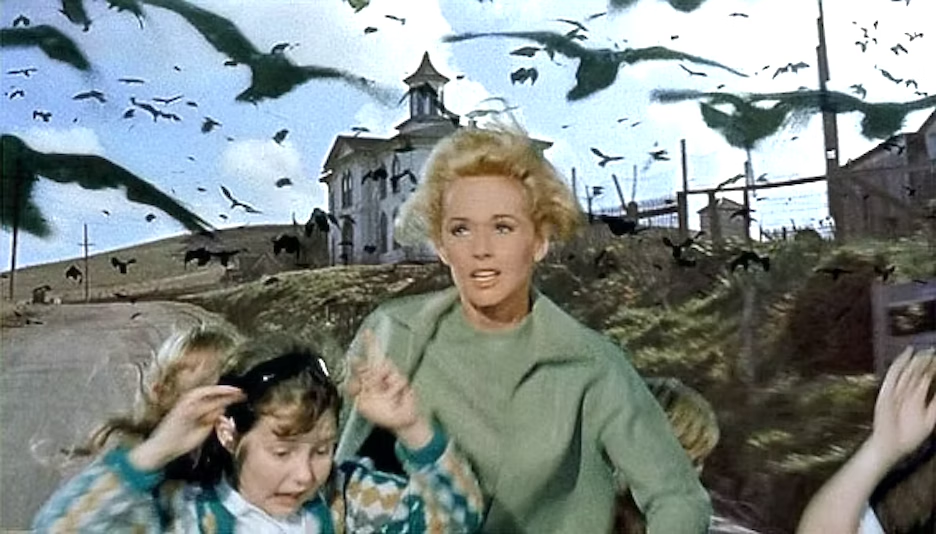
There’s a figure that haunts Hitchcock’s films — the woman who refuses to depend on anyone else, who possesses her own money, her own will, even just a flicker of independence — and she’s treated as something close to a natural disaster. Look at The Birds’ Melanie Daniels, or once again Tippi Hedren in Marnie – Her self-sufficiency and agency unsettle the order men have built around themselves, and Hitchcock is fascinated by how fast that unease turns to primal terror, then to fury. What begins as low-grade dread in the male psyche doesn’t stay there long; it gathers into that fury, and in his world, the fury tends toward murder. The autonomous woman isn’t simply a threat to a marriage or a social arrangement; she’s read as an offense against the way things are supposed to be, and the men around her answer that offense with violence.

These women are caught in a paradox that runs to the bone of Hitchcock’s world: to hold power is to court violence, because a woman in control has, by his logic, already committed the unforgivable offense. Female independence isn’t merely risky here; it’s transgressive at its roots, a violation of an order Hitchcock treats as natural law.

Young Charlie feels that pressure from the start, everyone around her expects her to be the good daughter, the charming niece, the girl who has to help keep the house’s mood, light, while Uncle Charlie represents the part of the system that’s all about punishment: the man who sees women as waste, who believes that getting rid of them is a kind of aesthetic or moral cleansing.

Feminist film theorists like Molly Haskell (From Reverence to Rape) have long pointed out how classical Hollywood has a long history of oscillating between putting women on a pedestal and dragging them into the mud – of presenting women either as revered ideals or degraded objects- and Uncle Charlie’s rhetoric takes its cues and aligns him unmistakably with the latter view.

In terms of Uncle Charlie’s vision, they are opportunists, fat, wheezing widows rather than people. He is almost a textbook case of that kind of thinking, wrapped in charm. Seeing women as waste, as infestation, as a kind of social impurity, something he’s entitled to remove from the polished surface of his refined life, to scrub them from the gleam of his chosen world.

The Merry Widow’s next victim?

He doesn’t simply kill women; he narrates, he philosophizes about them. He hates the specific women he destroys; despises them as a class, turning widows into symbols of everything he finds vulgar and corrupt in femininity and humanity. Those “fat, wheezing widows” he talks about aren’t individual people to him; they’re proof of a larger belief that women are parasitic, vulgar, and barely human.

What makes it especially chilling is that the town listens spellbound to his smooth talk and sees only charm; the violence in his worldview is audible to young Charlie, but not to people who have learned to treat male contempt as just another personality quirk and normalize it.

Hollywood often confined women to highly scripted roles that revolve around caretaking and emotional labor—good daughter, good wife, the ornamental girl- leaving men to occupy the more dangerous or active positions. Male characters get to move through the plot with agency and menace.

Over and over, cinema has had a pretty grim grab-bag of boxes it kept shoving women into, especially when it’s working from a misogynistic mindset. Cinema has spent decades flattening women into a narrow repertoire of types, reducing them to a handful of roles drawn from stock archetypes:

*The damsel in distress: helpless, in danger, waiting for a man to rescue her; her main function is to make the hero look brave and necessary. *The ideal homemaker / good wife: saintly, self-sacrificing, endlessly supportive, defined entirely by domestic work and emotional labor. *The vamp/seductress/femme fatale: hypersexual, dangerous, blamed for tempting men off the “right” path; if something goes wrong, it’s framed as her fault for being too alluring. *The “whore” / loose woman: punished for sexual desire, treated as morally corrupt or disposable, often there to be used and discarded or killed. *The pure, innocent girl: childlike, naïve, there to be protected or possessed; her main narrative job is to embody innocence rather than have a complex inner life. *The Unhinged/Dangerous woman: figures female instability as a threat to order, often marked as irrational, hysterical, or violent, and used to unsettle the household, expose buried tensions, or drive the plot toward crisis. *The manic pixie dream girl / ditzy muse: quirky, charming, existing mainly to jump-start the male protagonist’s growth, without much agency or interiority of her own. *The “nagging” wife or mother: controlling, humorless, constantly contrasted with the freer, more “fun” male lead; her function is to represent the drag of domestic responsibility. *The objectified body: broken up by the camera into legs, cleavage, waist—there to decorate the frame and be looked at, what Laura Mulvey famously called the “male gaze.”

Even when they differ on the surface, these types all exist to serve male stories, as prizes, warnings, or ornaments, rather than as people with their own interior lives.

Young Charlie’s early restlessness – that sense that she wants more out of life puts her in tension with the film’s gender expectations before Uncle Charlie ever gets off the train. She feels that script closing in on her: she’s restless in Santa Rosa, bored by routine, and clearly afraid of turning into her mother, whose energy is poured almost entirely into domestic maintenance and cheerful denial.

Young Charlie’s boredom isn’t just about small-town life; it’s about the particular version of it being handed to her as that “good girl.” The future she’s being quietly steered toward: a life organized around meals, politeness, gossip, and a studied refusal to let anything too dark into the room.

The collision between male authority and female perception:

Female characters often see dangers that male authority figures dismiss. In Shadow of a Doubt, young Charlie’s perception is consistently more accurate than that of the detectives.

The gender tension in the film doesn’t stop at Uncle Charlie’s monologues. Over and over, we watch her see things more clearly than the men around her. A woman’s perception of threat is repeatedly discounted by male authority as one of the ways cinema reflects real social dynamics.

In Santa Rosa, her father jokes his way through hypothetical murder scenarios at the dinner table, while she is slowly realizing that an actual killer is living in her house.

Her job, as everyone keeps gently reminding her, is to keep things pleasant; Uncle Charlie’s job is to keep control of his sister’s household, of his niece, of the story they all think they’re living. He needs to dominate the emotional and narrative atmosphere of the house—he’s the one who treats the family as an audience and the home as his stage.

One of the bleakest insights is that the story asks Charlie to navigate this world while still being treated as a child. She sees more clearly than the men in the story—and as I’ve said before, she is the one who gets wind of the threat, who reads his silences – but because women’s perception in classic cinema is often displaced or doubted, especially when it contradicts male authority, in Santa Rosa, her suspicions are a social problem; and Uncle Charlie’s violence is a private quirk. Her desire for a life beyond her mother’s routine is framed as a phase she’ll grow out of, even as her uncle’s loathing for women goes unchallenged at the dinner table and beneath the surface of his dangerous charm.

When you put all of this alongside the postwar suburban script, the idea that a woman’s fulfillment lies in the perfect home, the perfect family, the perfect community, you start to see why Shadow of a Doubt feels like such an early warning. It suggests that a “good girl” education by social training and a misogynist worldview aren’t opposites at all; they’re two halves of the same structure. One trains women to be pleasant and self-effacing; the other licenses certain men to loathe and harm them while the town looks the other way.

Diane Negra’s book-length study points out that Shadow of a Doubt still resonates with audiences because it’s not only a suspense thriller but also a story about gender and who holds power. “In a related way it illustrates how the film’s terrors have to do with the punishing effects of looking beyond conventional family and gender roles.”

From her interview with Liverpool University Press, where she names a key concept: “I refer to this and other elements of Shadow in terms of what I call the ‘intimacy of fascism.’”

In her view, young Charlie’s shifting perception of her uncle reflects a wider crisis of faith in father figures and other patriarchal authorities: the film begins with the comforting image of the adored male relative and gradually recasts him as a source of threat, revealing how precarious that sense of domestic safety really is. Negra also links Charlie’s trajectory to the wartime context, suggesting that her shift from idolizing her uncle to seeing him without illusions mirrors the tensions and strains women faced as they tried to navigate newfound independence amid old expectations, exposing how fragile domestic stability really is.

Charlie stands out among Hitchcock’s women because the film doesn’t just watch her suffer – it uses her eyes to probe the family itself, turning her into a kind of moral compass for the household that would prefer not to see what its beloved male guest really thinks of the women around him.

Hitchcock doesn’t treat her simply as a victim or an object of desire. Instead, she becomes the point of view through which we see how mid-century American life is organized, especially around the ideal of the family.

What makes young Charlie such a quietly radical heroine is that the film allows her to move beyond her uncle, not simply fear him. The man who first looks like a glamorous, almost father-like figure slowly turns into a reminder of the everyday misogyny and incarnation of the very patriarchal contempt she’s been taught not to question. Consider the silence from her parents after his misogynist outburst at the dinner table.

From his feminist essay Hitchcock the feminist: Rereading Shadow of a Doubt, Thomas Hemmeter suggests that the film doesn’t just mirror traditional patriarchy; it shows where it starts to come apart. In his reading, gender roles in Shadow of a Doubt look shaky and split, shaped inside a fractured patriarchal system, and the Newton home becomes the place where those fractures show themselves most clearly.

The article also leans on Diane Carson’s point that Hitchcock’s worlds leave women stuck between two bad options: quietly putting up with domestic tyranny, or rebelling in ways that are almost guaranteed to fail. In Shadow of a Doubt, young Charlie manages to see through Uncle Charlie and push back against him, but she’s still hemmed in by a social order that expects her to protect the family’s good name, even at the cost of her own truth.

Faced with this choice between clinging to the old machinery, preserving family life, and flirting with violent rebellion, the film exposes the violence simmering within traditional family life, especially for young women. In his view, Uncle Charlie’s fury toward widows- his moral indictment is actually really about a fear of independent, powerful women; as he puts it, [rich widows] who are regarded as inhuman and unnatural, throwing both the social and natural orders off their hinges.

Because she never agrees to marry Jack Graham, Charlie may really be after the independence and power of the ‘merry widows” whom Uncle Charlie targets and despises. So it’s another reason he ends up trying to kill young Charlie, since he sees her as another threat to the so-called natural order.

One question you might ask yourself is, what else does Uncle Charlie represent? A defender of the old order, preserving it through violence, or a psychopath who has lost faith in traditional morality?

His nostalgic recollections of the past suggest it might very well be both. When staring at a picture of his parents, he says, “Everybody was sweet and pretty then, the whole world, a wonderful world. Not like the world today. Not like the world now.” That way of seeing him feels a little too neat. If he were really just rebelling against a rotten world, lashing out at its corruption, there’d be some line he wouldn’t cross, but the film never shows us a line he isn’t willing to step over.

Shadow of a Doubt is more than an accomplished thriller; it also speaks powerfully to its social context and cultural moment. Negra’s interpretation of the film’s gender fault lines is particularly compelling, since she connects young Charlie’s evolving perception of who her uncle really is to deeper questions about authority, trust, and the fragility of domestic stability.

Negra also situates the film in the shifting social landscape of World War II, suggesting that Charlie’s journey mirrors the tensions women faced as they tried to navigate emerging ways women sought their independence alongside traditional domestic expectations. Her analysis extends the feminist work of Modleski and Laura Mulvey, who show how Hitchcock’s films can both quietly reinforce the stage on which patriarchy performs, which sort of tucks patriarchal assumptions back under the rug, and at the same time unsettle and subvert patriarchal ideologies.

She agrees with Modleski, who stated: “the question which continually—if sometimes implicitly—rages around Hitchcock’s work as to whether he is sympathetic toward women or misogynistic is fundamentally unanswerable because he is both…the misogyny and the sympathy actually entail one another.”

In Shadow of a Doubt, Modleski argues, “this context governs the manner in which the female protagonist makes discoveries about the nature and origins of misogyny.” When Negra stresses that young Charlie’s coming-of-age unfolds through her confrontation with male violence and control, she casts the film as a meditation on how deeply misogyny runs and how women begin to recognize it and resist it.

“A Very Sick Man”: Cover, Euphemism, and the Refusal to See

The film keeps dropping the word “sick” around Uncle Charlie, and in my opinion, while scholars are right to read those mentions as symptoms of a real pathology–a psychopathic warp in his relationship to women and family rather than mere evil—the film’s dark joke is that every time the word is actually spoken aloud it’s a cover story, a performance, or a euphemism, never an honest diagnosis. The film’s own use of “sick” is never a way to diagnose or give a clinical or moral verdict as to the source of Uncle Charlie’s darkness; it is always a mechanism of deflection or ‘not-seeing.’

Every “sick” reframes a predator as a patient, dressing the monstrous in a costume the family can mistake for frailty. Calling him sick makes Uncle Charlie tameable; the predator gets recast as a patient, a danger the household can nurse, pity, and quietly make excuses for, rather than one it has to face. That’s the mechanism — it domesticates the threat so it can stay inside the house.

Uncle Charlie hides behind it to avoid the police, performs it to hide his train-berth concealment as Mr. Otis, and the Newtons lean on “under the weather” to avoid hearing what young Charlie is actually saying. That is precisely the ideological operation Robin Wood names — “to acknowledge the existence of sickness and evil but preserve the family from their contamination.” (Robin Wood)

All these allusions to Uncle Charlie being sick begin to add up. This happens at the opening of the boarding house and the train. Uncle Charlie’s landlady, Mrs. Spencer, reads him as ailing: “You look kinda tired to me, and that’s a fact. You got a headache or somethin’? I think maybe you need a real rest.”

Then on the train, a fellow passenger tries to summon a vacationing doctor to “that poor soul” in the next berth, only to be told: “No, Ma’am. He’s a very sick man. Won’t see anyone. I haven’t set eyes on him myself since we first got on the train.” But this “sickness” is Uncle Charlie’s own alibi — he is lying low to dodge the two detectives tailing him. The first time the film names him “sick,” the word is his disguise.

Language like “there’s something wrong with him” or suggesting he isn’t well can sound like euphemistic talk around mental or moral sickness. These lines recur and help cue us that Charlie’s charm masks something deeply off. Young Charlie’s growing sense that “there’s something wrong” with Uncle Charlie is treated as a nagging awareness that he’s not just moody but genuinely unwell. It’s code for the way his bitter monologues about widows and the “smell of money” are staged like eruptions from a sick mind, not a normal cynic. That this ‘sickness’ is misogyny and revulsion toward older or independent women and a broader inability to live in ordinary family life without poisoning it.

During his Santa Rosa arrival, Uncle Charlie staggers off the train bent over a wood-knobbed walking stick, pretending to be ill, and the word “sick” rings out five times in a single greeting:

Young Charlie: “At first, I didn’t know you. I thought you were sick.”?Uncle Charlie: “Sick?”

Young Charlie: “You aren’t sick, are you?… Why, Uncle Charlie, you’re not sick.”?UncleCharlie: “Me, sick?”

(script transcript) — “and then he drops the act. The ‘sickness’ was staged to excuse his having hidden on the train; once he’s safely with the family, it evaporates. Robin Wood flags this exact bit: When Uncle Charlie gets off the train, he is bent over a stick, pretending to be ill; as soon as he sees Young Charlie, he ‘comes erect,’ flourishing the stick.”

The domestic euphemism: When Young Charlie voices real spiritual despair — “this family’s just gone to pieces… I’ve come to the conclusion, I give up.”

Her father Joe recodes it for Emma as “Charlie’s a bit under the weather.”

The family’s vocabulary turns an existential crisis into a minor ailment. (Emma separately murmurs a telegram “might be” because “somebody might be sick or something” now the word as casual filler.)

By the time of the reception, Uncle Charlie’s “sickness” has already been coded as something social and moral, not merely physical, and the party becomes a stage on which that corruption can pass for charm. During the reception, Uncle Charlie in his tuxedo is at the center of the Newton living room, clinking champagne with a guest while the formally dressed company looks on. This is the party Emma throws to honor her brother after his speech to the women’s club, where she toasts him as “our distinguished visitor… who made the best speech heard in town for years… that very good fellow, Mr. Oakley.”

This is the image of the murderer’s public veneration. The garage rescue has just made him look like the hero, and now the town literally raises a glass to him. The “sickness” is invisible here; only the charm is on display.

Uncle Charlie champagne raised, mid-toast, holding his glass aloft. It pairs well with the fourth-wall “Are they?” close-up: same face, same man; here he’s performing health, charm, and celebration of the town’s beloved distinguished visitor, and celebration where the other showed us the pathology staring straight at us. That’s the whole engine of the “sickness” argument in two frames: the diagnosis the dialogue withholds, the camera delivers, but only for a single frame, before the charm snaps back into place and the glass goes up, the wall restored. And the wider reception shot situates the close-up of Uncle Charlie: the charm this time isn’t private, it’s publicly borne out by a roomful of people raising glasses to a murderer.

Several scholars and critics talk about Uncle Charlie in terms that overlap with “sickness”: Diane Negra, in her monograph Shadow of a Doubt (Liverpool University Press, 2021), looks at Uncle Charlie’s “troubled mind” and how his distorted view of women drives the movie’s threat. An essay titled “Uncle Charlie, the smooth arch-villain” (in POV film journal) analyzes him as an elegant but deeply deviant figure whose polished surface hides an abnormal psychology, essentially treating his charm as covering a sickness.

The article by David Greven, “You’re a Strange Girl, Charlie: Sexual Hegemony in Shadow of a Doubt,” discusses Uncle Charlie’s violent misogyny and inability to form healthy relationships, framing him as a man whose desires and hatreds are pathologically structured rather than simply immoral. The piece “The Role of the Queer in Shadow of a Doubt” notes that the film repeatedly signals that there is “something wrong with Charlie,” reading his difference and unease as a kind of coded sickness beyond the eyes of the town and family.

David Cairns’s blog essay “The Strange Affair of Uncle Charlie” talks about him as representing “all that’s exciting and dangerous” while also being a figure of moral and psychological breakdown within the small town, aligning with the idea of a sick presence in the domestic space. The Thornton Wilder Society’s note on the film suggests Uncle Charlie is best understood as a psychopath who has “lost all faith in humanity” and acts only on impulse, which directly ties his violence to a diseased inner life.

Tania Modleski, arriving with 1980s feminist film theory, takes that shift inward and lands it in the family: in her reading, the uncle “represents something inside” young Charlie, so his pathology is inseparable from female desire and the heroine’s “special, incriminating knowledge about men, misogyny and … sympathy actually entail one another” within one patriarchal order rather than belonging to a lone monster.

With Diane Negra, writing from a cultural-studies angle in the 2000s and after, the ‘sickness’ stops being about any one person at all; it becomes something wrong with the country. She frames the film around “the pathologies of violence in American life,” asks whether the threat comes from outside the family or from inside it, and roots the whole crisis in wartime America and its ideas about gender and home. (New Review of Film and Television Studies) So over forty years, the meaning of “sick” keeps moving: It goes from the diagnosis of one man; for Robin Wood, it’s a symptom of what the family is repressing; for Modleski it’s the way a woman can be drawn into identifying with male violence; for Negra it’s a symptom of wartime America itself. Each scholar holds onto the word, but it takes away some of its private, clinical edge, until “sick” no longer names what’s wrong with Uncle Charlie so much as what’s wrong with the world he moves through.

Emma Newton: Wine for dinner – sounds so gay!

Greven is a useful fourth voice to set alongside Wood, Modleski, and Negra because he brings the explicitly queer-theory reading. He reframes the “sickness” talk in a striking way: the habit of calling Uncle Charlie “sick” maps directly onto a real history, the way homosexuality itself was once treated as a medical condition. So where the blog trope treats “sick” as a code, Greven gives it a genealogy. He shows that “sick” was never a neutral diagnosis to begin with; it was already, in the culture Hitchcock drew on, a way of marking a man’s sexuality as diseased.

The trope that reads Uncle Charlie as a personally “sick” predator turns out to be the very move Robin Wood identifies as the film’s surface ideology — the project of “acknowledg[ing] the existence of sickness and evil but preserve[ing] the family from their contamination,” quarantining pathology to one monstrous individual so the American household stays innocent

Wood, writing in the auteurist-humanist late 1960s–80s, accepts the vocabulary of “sickness” but turns it back on the family itself: to him the pathology is “at the heart of the American family, the necessary product of its repressions and sublimations,” and the film ultimately “shatter[s]” Hollywood ideology “beyond convincing recuperation” rather than purging one sick man. The “sickness” migrates from the killer to the household.

—(Robin Wood, Hitchcock’s Films Revisited).

Black Smoke, Rings, and Small-Town Ghosts: The Film’s Symbolism—What Hitchcock Hides in Plain Sight

Smoke and Morality and small-town allegory:

Hitchcock keeps using smoke almost like the weather for the film’s moral atmosphere, letting it drift in and out of scenes the way unease drifts through the Newton household. When Uncle Charlie steps off the train, the black smoke that spills out behind him feels less like a bit of choking machinery and more like something trailing into town that he’s bringing with him, a visible trace of the cities and murders he’s been moving through.

These symbols are not just part of the noir atmosphere; they’re like little warning signals that track Uncle Charlie throughout the film and quietly tie him to his niece. When he arrives, as he brings that dense black train smoke with him, and from then on there’s this pattern of dimmed corners, drifting cigar smoke, and suddenly darkened interiors whenever he’s fully in the frame. You start to feel as if the air itself gets heavier when he’s around, even when no one on screen is saying anything sinister.

It’s one of Hitchcock’s most pointed and repeated uses of symbolism linking Uncle Charlie to blackness, specifically the ebony locomotive that delivers the killer to Santa Rosa, the inky smoke that pours from its stack, and the heavy shadow cast over the station and metaphorically on the family and all of Santa Clara as the engine slows and stops. Wherever Uncle Charlie goes, he brings with him the bottomless dark void of eternity.

The image of black smoke heralding Uncle Charlie’s arrival by train echoes later in The Night of the Hunter, when Harry Powell’s entrance similarly turns a drifting figure into a kind of omen riding into town.

Later, the cigar smoke that curls around his head hangs there like a small cloud, quietly obscuring the room even as everyone else tries to keep things bright and perfectly ordinary.

In his interview with François Truffaut on Shadow of a Doubt, Alfred Hitchcock said the dense, black smoke belching from the train that brings Charles Oakley to Santa Rosa was a deliberate symbol of imminent evil. The unusually dark smoke isn’t just period detail; it’s Hitchcock visually announcing that something malign is arriving in this “idyllic” town. The film keeps returning to smoke and shadow as visual markers of his growing menace and of the darker double life underneath small-town respectability.

There’s even the presence of cigar smoke when he evades detectives, and even car exhaust used to try to kill young Charlie in the garage. It’s as if she’s being enveloped by the cloud of his malevolence.

The smoke accentuates Uncle Charlie’s developing menace and helps visualize the darker side of small-town America. In that way, smoke and shadow function together: they thicken around him, mark his presence, and underscore the duality between Uncle Charlie and young Charlie as the story pushes him further into diabolical territory.

As Alfred Hitchcock later explained in his 1962 interview with François Truffaut (published in Hitchcock/Truffaut),…

I’m puzzled by one detail of the pic­ture. In the first scene at the station, when the train carrying Uncle Charlie is coming in, there’s a heavy cloud of black smoke coming out of the engine’s smokestack, and as the train comes close, it darkens the whole station. I have the feeling that this was done deliberately be­cause when the train is leaving the station, at the end of the picture, there’s simply a small puff of light smoke.

That’s right; I asked for lots of black smoke for the first scene. It’s one of those ideas for which you go to a lot of trouble, although it’s seldom noticed. But here, we were lucky. The position of the sun created a beautiful shadow over the whole station.

The black smoke implies that the devil was coming to town.

Exactly. There’s a similar detail in The Birds when Jessica Tandy, in a state of shock after having discovered the farmer’s body, takes off in her car. To sustain that emotion, I had them put smoke in the truck’s exhaust, and we also made the road dusty. It also served to estab­lish a contrast with the peaceful mood of her arrival at the farm. For that scene, we had the road slightly dampened, and there was no smoke coming out of the truck.

Hitchcock remarking that he asked for “lots of black smoke” for Uncle Charlie’s arrival train scene; it almost implies that the devil was coming to town, visually marking his entrance as a kind of demonic incursion into a bright, innocent setting. The Idyllic town acts as an allegory for America’s perceived unworldliness, with Uncle Charlie’s hidden crimes representing corruption and violence underlying that idealized surface.

Rings, Traps, and Closed Circles: the ring as family romance / Eden

Hitchcock plants the ring before we ever see it: in the very first shot, Uncle Charlie lies on his bed and blows a smoke ring from his cigar — a ring already dissolving as it rises, a weightless little ghost of the emerald one that will pass from his hand into Charlie’s.

The ring Charlie gives his niece is the most literal piece of symbolism with an absurd amount of psychological and narrative weight for such a small prop in the film, and Hitchcock doesn’t bother to hide it; he puts it right on her finger and lets it stay there, tightening the bond between them in plain sight. It’s simultaneously a very double-edged token of love, a piece of incriminating evidence, and a kind of curse all at once.

Gilberto Pérez, a prominent film theorist and critic, who is known especially for his book The Material Ghost: Films and Their Medium, and wrote influential essays on Hitchcock, including work on Shadow of a Doubt. In his chapter “Hitchcock’s Family Romance: Allegory in Shadow of a Doubt which appears in the edited volume Understanding Love: Philosophy, Film and Fiction (Oxford University Press) notes that “Uncle Charlie gives his niece “a ring that suggests an engagement ring and has an inscription on it that incriminates him as a murderer,” and argues that in this gesture “the murder story may be taken as a metaphor for the incest story, the tainted romance between uncle and niece.”

It’s a gift, but it’s also a trap: a stolen object that ties her to the murders and marks her as his chosen confidante, or even his accomplice. The circular motif keeps repeating — rings, table settings, the roundback chairs in the dining room, as if the town itself is a closed loop, a place where stories are meant to go in circles rather than break open, which is exactly what Uncle Charlie is counting on.

Pérez explicitly frames the film not merely as a murder mystery but as an allegory in two interconnected ways: an incestuous family romance; there is a quasi-romantic tension between the two, and a parable of the Garden of Eden.

We can read the film allegorically: an incestuous “family romance” with a boundary-crossing motif between uncle and niece, and as a kind of Eden-like story of innocence, knowledge, and the discovery of evil; he points to the ring as an engagement-like ring, a token whose incriminating inscription makes the taint in their bond tangible. The ring is not just a plot clue; with uncle and niece as doubles, the ring as a corrupted engagement object, and the story as one of innocence lost and knowledge gained.

Engagement imagery: the private presentation of the ring, the way he embraces her when he arrives, and the staging of some scenes (hands touching, lingering shots) have been read as suggesting marriage imagery and a sexualized bond in symbolic form. This intimate object is suggestive of a pseudo-courtship.

On the idea of innocence and knowledge, Pérez adds that as the shadow of a doubt grows darker and the niece comes to know that her beloved uncle is a murderer, the film can be taken as a story associated with the devil. A kind of Eden narrative in which young Charlie’s dawning awareness of her uncle’s crimes stands in for the devil’s temptation of forbidden knowledge of good and evil.

Anima/animus reading: one Jungian interpretation views the romantic/sexual tension between young Charlie and Uncle Charlie as an interplay of the anima and animus archetypes—each projecting a part of their unconscious onto the other, making their bond feel charged beyond family affection. An anima/animus reading is a way of seeing a character as standing for the unconscious feminine or masculine side of the psyche, rather than just as a literal person. It often treats that character as a symbolic mirror or projection of inner psychological forces.

Symbolically, the ring’s marital associations matter: In that moment when Uncle Charlie pushes the ring onto her finger, the gesture tightens their bond at the same moment it marks that bond as morally impossible. It briefly stages it like a grotesque proposal, one that knots together “desire, power and violence”, and calls back his crimes. It binds her to him in a way that feels both intimate and wrong, a little marriage contract written in bad faith. It plays like a small Death and the Maiden scene: a gift that doubles as both a courtship token and a memento of death, wedding her to him through something already stained. Later, with young Charlie’s rejection of the ring, it’s like a refusal of that bond itself – a way of saying she won’t wear an object that stands for a kind of marriage and for his murders. She won’t be a partner in his secret or the silent witness to his crimes.

I first encountered this allusion to the Death and the Maiden mythology and Shadow of a Doubt framing of the ring in an online queer reading of the film, but have been unable to relocate the exact citation; what follows is my paraphrase of that insight. But I feel that it is a grounded analogy of art and film discourse: Death and the Maiden is a long-standing artistic motif where a young woman is paired with a figure of death or doom, often in an eroticized or courtship-like pose. It’s linked to the Greek myth of Persephone’s abduction by Hades, and typically features an intimate gesture (embrace, dance, touch) between a maiden and a death figure; a mix of eros (love) and thanatos (death): seduction intertwined with mortality, and a tension between innocence and danger, attraction and annihilation.

So it can be said that the ring is doing double allegorical duty: on one level, it literalizes the suggestively incestuous family romance by mimicking an engagement, and on another, it ties that tainted intimacy directly to the killings, since the engraving is what eventually links Uncle Charlie to the murdered widows.

On the level of plot and character, the ring is what tips young Charlie from devoted niece into wary investigator/witness. When he first slides it onto her finger, it plays as an overly intense, boundary-crossing offering; later, when she realizes the engraving belongs to one of his victims, it becomes the first solid proof that her suspicions aren’t just morbid, static humming at the edges of her mind.

Hitchcock underlines this shift visually: the ring is picked out in close-up, and then, in the library scene, the camera pulls back, letting her shock turn a single startled moment into a kind of loneliness, as if the knowledge bound up in that small object suddenly pushes the walls back, leaving her alone in a larger, emptier room.

After she confronts him in the ‘Til-Two café, she puts the ring on the table, effectively giving it back. At this point, he has the upper hand again because the physical evidence is back in his possession. Then he uses it to taunt her. Later, when he insists on staying in Santa Rosa, he reminds her there’s “no proof” because he has taken back the ring; he explicitly refers to reclaiming it. Then she steals it back from him. After his murder attempts, she goes into his room, takes the emerald ring, and comes downstairs wearing it again, very deliberately visible. It is at the moment she regains leverage: whoever holds the ring holds the power to expose him.

In the family story, the ring turns into a tool of leverage. Once she realizes what the engraving means, young Charlie uses it to blackmail her uncle into promising to leave town, and for a moment, that lets her feel like she has the upper hand. Later, after she’s taken it back for the staircase scene during his toast, his confidence is shaken the instant he spots the ring back on her finger; the prop works like a visual signal that she knows what it means and will use it against him, and that he’s no longer the only one in the house carrying dangerous knowledge.

Dracula and the “invited evil” motif

While delving deeper into Hitchcock’s masterpiece, some critics explicitly read Uncle Charlie through vampire imagery and Gothic tropes. Hitchcock, as Bill Krohn observes, deliberately heightens the sense that Uncle Charlie has something almost vampiric about him.

Rooming House introduction: Critics have compared Uncle Charlie to Dracula. We first see him lying on the bed in his boarding-house room; like Dracula resting in his coffin, he appears drained and almost corpse-like, with money scattered around him, surrounded by the spoils of his predation, cloaked in darkness (closed blinds).

When the detectives close in, it looks for a moment as if they’ve got him cornered—until the shot widens and he’s somehow slipped away to the rooftop, gazing down with a smug calm and not even winded by the chase. Bound for Santa Rosa, he’s tucked behind the heavy black curtain of his sleeping berth, sealed off and not to be disturbed; the train itself feels like a quiet echo of the Demeter, carrying something dangerous toward an unsuspecting town, as the ship that delivers Dracula to his London estate of Carfax Abbey. Like Demeter in the myth, it brings a disturbance that throws the natural order into imbalance. It’s like a larger symbolic pattern of something dark entering a settled world.

Demeter is the sister of Zeus and the mother of Persephone, and she presides over grain, crops, and the earth’s fertility. The famous myth goes like this: Hades abducts Persephone, but this is also Demeter’s story: her grief over her daughter’s absence causes the earth to become barren (winter), and her joy comes back when Persephone is allowed to return in the spring and summer, bringing back growth.

East-to-West travel: Uncle Charlie’s journey from the East to the small Western town is likened to Dracula’s voyage; critics note repeated references to “back East,” which keep the directional symbolism alive.

The black train smoke when Charlie arrives, the cigar smoke when he evades detectives, and even the car exhaust used to try to kill young Charlie have been read as a recurring “smoke” motif tied to his almost supernatural, elusive menace.

And this may be a small thing, but it’s telling: his refusal to be photographed echoes Dracula’s absence in the mirror, as if the image itself can’t quite hold him.

According to Eggert, there’s even a pointed nod in the dialogue: at one point, Jack tells Ann (Edna May Wonacott) to go tell the story of Dracula, a line that originally referenced Dr. Jekyll and Mr. Hyde but Hitchcock changed it, likely to emphasize the link between Uncle Charlie and Dracula. Taken together, these choices don’t just hint; they make it unmistakable that the film is inviting us to see Uncle Charlie as a kind of fiend.

Mental connection: You can even draw a parallel to Dracula and Mina, arguing that the cross-country cutting between Uncle Charlie on his bed and young Charlie on hers suggests a kind of mental or psychic link, reinforcing the film’s interest in uncanny connection.

Hitchcock threads in these uneasy possibilities, that Uncle Charlie might as well be a vampire, or that there’s something disturbingly intimate between his central pair, and those undercurrents tilt the whole universe off its axis. That kind of quiet sabotage of “normal” and “wholesome” is exactly the territory his best films like to claim.

Staircases and the Fragility of “Safe” Domestic Space

Hitchcock turns the Newton staircase into a visible measure of who holds power in the house. What begins as a bland, all-American stairway, Uncle Charlie gains control; Later, when he rigs the staircase to collapse beneath her, the symbolism hardens: the everyday route becomes a literal trap, where Hitchcock loads suspense, psychological tension, and potential violence concentrated into an ordinary domestic space, and it’s perfectly weaponized in Shadow of a Doubt. You can see the way the Newton staircase shifts from homely family architecture into a “gateway to danger” once Uncle Charlie begins trying to kill young Charlie (sawing through the step). Hitchcock uses staircases to establish hierarchies of power and vulnerability in general: the broader point is that Hitchcock’s staircases are zones of unsteady passage.

The Newton’s staircase, plain and ordinary, ends up becoming one of the film’s most eloquent metaphors. It looks like nothing more than a normal set of steps, and when Charlie nearly falls, on the surface, it appears like a simple household accident, the kind of thing that could happen in anyone’s home. But the staircase also feels like a little vertical map of her life, each step a rung between innocence and a harsher kind of knowing, and Hitchcock stages the slip so that, for a second, it’s like her whole future is tipping over. Once Uncle Charlie tampers with it, that everyday staircase she never thought twice about now quietly conspires to kill her.


The staircase isn’t just part of the wallpaper in Shadow of a Doubt; it’s one of the places where every secret climbs and every power is held overhead. One of the standalone shots is her looking up the stairs. He’s not present, but it feels as if his spirit is there, unseen. The shot shows a pulled-back, high-angle frame from the top of the stairs, with the banister spindles running across the foreground, Charlie at the foot of the stairs looking straight up into the lens.

After Uncle Charlie’s two murder attempts (the staircase and the garage), she goes to the phone to call Jack Graham but can’t reach him, and his absence is exactly what the through-the-banister shot is about. This is one of the key images Ronnie Scheib spells out: Hitchcock shoots Charlie through the banister in successively more high-angle views as she fails to reach Graham, so that “the figure (absent also) who occupies the place of domination at the head of the stairs is obviously Uncle Charlie” (Film Comment, 1976).

This is one of the key images that Ronnie Scheib identifies: as Charlie tries and fails to reach Detective Graham by phone, Hitchcock shoots her through the banister in successively more high-angle views. And here the staircase turns against her, the very structure that organizes the film folds shut like a cage around the one person who actually knows the truth.

This is the visual equivalent of her ‘not-seeing’ turned back on her, all at once: Young Charlie is the one who sees, yet here she’s the one imprisoned, framed behind bars, while the man she can’t reach, Jack Graham, and the man she can’t escape, Uncle Charlie, both stand above her.

The stairs are, quietly, the film’s organizing device; if the film has a spine, it’s this. As The Cinematograph notes, it’s where Hitchcock stages the split between the family’s public life downstairs and its private secrets upstairs. There’s the camera’s complicity, the absence/presence at the stairs (Scheib), and the camera keeps taking Charlie’s side, or pretending to. In this shot, she’s pinned at the bottom of those stairs, looking up at a power she can’t reach yet, the man who stands at the top of them, Uncle Charlie. It pairs neatly with young Charlie’s ring-reveal descent.

That’s why the staircase-through-railing image carries the meaning it does: she’s phoning the wrong man (or rather, the right man who isn’t there), and the man who is there, standing at the head of the stairs, in the place of authority, is Uncle Charlie. The absence and the presence — the power and its reversal — are the whole point.

Coming up Spades on a Train: Who’s holding all the cards?

On the train to Santa Rosa, there’s a group of passengers playing cards near the compartment where Uncle Charlie is keeping to himself and pretending to be ill to avoid other passengers. Among them is a doctor; the other passengers try to get him to go check on Charlie, and he refuses because he’s on vacation.

Around 16 minutes in, Hitchcock appears as a passenger playing cards; he’s shown holding a straight flush / full suit of spades, a visual gag about the director “holding all the cards.”

In that scene, and the shot of his hand of cards that’s all spades, is that wonderful moment in his films when Hitchcock stages his cameo. Even the quick shot of Hitchcock holding a winning hand of spades while Charlie lies ‘ill’ in the next car quietly underlines how much of this story turns on who thinks they’re holding all the cards.

Charlie seems in total control and to have the advantage, as he’s always several steps ahead of everyone, including his family, who have no idea what he’s really done back East. They don’t know who he really is at all.

As the ‘last hand’, the same image also suggests this trip to Santa Rosa functions like the final, decisive hand in a card game: it’s his last big play; once it’s played, his game will effectively be over, which fits the way Santa Rosa becomes the end of the line for him.

Vessels and domestic objects: Symbolic objects and broken innocence

Another reading notes how Uncle Charlie’s casually disturbing the delicate vessel (the water glass he deliberately knocks over) (associated with the feminine) foreshadows his disregard for young Charlie and women more generally. These fragile domestic objects become stand-ins for the pure feminine ideal the town thinks it’s preserving.

That reading is trying to link a small visual moment to the film’s larger gender pattern: the way women and the “feminine” are treated as both precious and expendable at the same time.

Hitchcock fills the Newton home with fragile, ornamental objects—china, glass, vases, things that can be chipped or shattered with one careless movement. When Uncle Charlie casually knocks over one of these vessels, the moment can be read as more than just a bit of business for his hands; it stages his relationship to the domestic world that’s supposedly sheltering him.

The object is delicate, associated with the women who handle and care for it, and he disturbs it without much thought or remorse. In that sense, the vessel becomes a stand-in for the kind of woman the town believes it is protecting: pure, ornamental, easily damaged.

These everyday domestic objects are loaded symbols of trust and deception, treated as precious within the home, but they’re also expected to remain in their place, to be handled gently, displayed, and admired. Uncle Charlie’s easy willingness to smash (he smashes the glass in his rooming house) or mishandle them foreshadows how he will treat young Charlie and women more generally: as things that exist to decorate his world until they irritate or inconvenience him, at which point they can be discarded or destroyed. The house’s little treasures, in other words, embody the “ideal feminine” the town prides itself on, and Uncle Charlie’s carelessness with them hints at how fragile that ideal actually is once a man like him walks in the door.

Responsible for the art direction are Robert F. Boyle and John B. Goodman, with Set direction by Russell A. Gausman and Edward R. Robinson. They shaped the overall design of the sets (architecture, layout, major visual choices) while set decorators handled the specific furnishings, props, and small objects that give the interiors their lived-in feel-things like the Newtons’ dining room, the fragile vessels, the cluttered parlor, and so on.

The article “Melodrama and Mise-en-Scène: The Excess of Objects in Alfred Hitchcock’s Shadow of a Doubt (1943)” in Quarterly Review of Film and Video looks at how the film uses “excessive” objects—household items, décor, small props—to encode melodramatic tension. Even from the abstract, you can see the angle: shadow as a hybrid of psychological thriller and domestic melodramatic fodder, with clutter and props both comforting and overstuffed acting as carriers of emotion and threat.

Merry Widow Waltz motif:

The film’s opening credits play over an image; we literally see elegantly dressed couples waltzing in a ballroom, moving in circles to The Merry Widow Waltz, and the tune keeps coming back as an audio refrain tied to Uncle Charlie and the “Merry Widow” murders.

Hitchcock indulges us with this showier device: the recurring, almost dreamlike image in which, inside Uncle Charlie’s head, well-poised dancers glide through the waltz set to Dimitri Tiomkin’s version of Franz Lehár’s “Merry Widow” theme. The motif keeps circling back, at once needling Uncle Charlie and casting a kind of hypnotic spell over the audience each time it drifts across the screen.

The recurring imagery of people swirling can be read as symbolizing the cyclical nature of deception and discovery, the way the story keeps circling back to Uncle Charlie’s secret before finally confronting it.

The Merry Widow Waltz, with its looping, circling melody that keeps returning, like a dance the film can’t stop repeating, in the same way the Merry Widow Waltz is circling back to link romance and murder. The film’s recurring motifs, such as an image of whirling nineteenth-century dancers and variations of the waltz theme, are splendid.

Shadows and dual frames – Doubling and Twos Everywhere

What I keep noticing, watching, and rewatching Shadow of a Doubt is how much of the story Hitchcock tells not just with shadows and smoke as visual motifs marking Uncle Charlie’s malignant presence but also the duality between the two Charlies and the symbol of twos. The film organizes these long chains of doubles, paired scenes, and repeated motifs around the central doubling between the two Charlies; you can feel the structure itself twinning and untwining them.

In the first act, the film sets up their duality without fully defining it; Charlie imagines her uncle as the answer to her boredom and dissatisfaction; Uncle Charlie, for his part, treats his niece as a useful cover: her adoration and the family’s trust help him blend in, making Santa Rosa a safe place to hide from discovery.

By the second, she is gradually stalking him in her own home, spying on her uncle to unmask him; and in the third act, he reverses the surveillance; he has become the one shadowing her steps, a neat, unnerving inversion that turns their bond into a kind of psychological tug of war where he’s now stalking her with lethal intent.

The film keeps worrying its way back to its emphasis on doubles—the National Film Registry essay on the film calls this emphasis its “single most obviously arresting feature,” and then traces how the movie’s structure keeps mirroring itself. It begins by pointing to the parallel introduction from those dual opening shots of the two Charlies lying on their beds, facing opposite sides of the screen, oceans apart but spiritually in sync, but, as we infer, each other across three thousand miles, with similarly frozen, dissatisfied expressions that thaw only slightly when visitors intrude.

And then to the repeated scenes that pair cozy family rituals with barely suppressed menace, the film’s ‘power of twos’ slowly pulling uncle and niece into alignment, until they feel less like simple opposites (surface) and more like rivals (underneath) to the same restless imagination. The film starts by staging them as opposites, but the doubling pulls them into the same psychic space.

Beyond specific props, the film leans heavily on this doubling: two Charlies, two train scenes (arrival and departure), the two detectives, two fugitives, two deaths -one offscreen as relayed by the detectives, two visits from the police.

I’m drawn to the way the film keeps visually doubling the two Charlies without ever announcing it. Hitchcock keeps putting them in parallel positions—on the stairs, at the dining table, side by side in doorways—so that the compositions rhyme even when the characters think they’re on opposite sides of the situation. The repeated framings make them look like two versions of the same figure caught at different points in a story: one sinking deeper into his own darkness, the other just waking up to how dark the world can be. It’s remarkable, yet not surprising, since Hitchcock is a master at pulling this off, how well the film lets this doubling live mostly in the images, shadows, smoke, matching shot framing, repeated compositions, and mirrored placements that underline the doubling without spelling it out in dialogue.

Shadow of a Doubt is a relentless use of twos—the mirrored openings, two detectives. Early on, Uncle Charlie slips away from the two plainclothes cops who have been tailing him and watches them from above as they cross the street below. They are framed as twins. As they move in from opposite sides of the screen and briefly overlap, their bodies fuse into a single dark shape, a combined shadow on the pavement, a striking yet quiet visual echo of the film’s obsession with doubles and with two figures collapsing into one. Essentially, the theme of ‘two becoming one.”

There are two crime-buff dinner scenes, two phone scenes, Uncle Charlie placing the wire and Anne receiving the call, a bar named the ‘Til-Two, and two attempts on Charlie’s life as a structural commentary on innocence and experience; through these pairings, the film keeps inviting us to look at what lurks underneath and at how thin the line is between safety and threat.

More of the structure is revealed as the film proceeds by twos. First of all, the film takes place in 2 cities: the East Coast and Santa Rosa. Charlie is confronted by two of her friends: the first time, her escort is Uncle Charlie, who remains her symbolic partner; the second time, her escort is the detective who will eventually take her uncle’s place as her implied partner, though that is not resolved by the end of the film.

At the beginning, the two men from the East show up, posing as surveyors, and enter the house under that cover. Later, as other leads dry up after an apparent break in the case elsewhere (after the other suspect’s death) and the pattern of the ‘Merry Widow’ murders points more stubbornly toward Uncle Charlie, Jack and his partner circle back to the Newtons’, this time more plainly as investigators. That second intrusion by twos is the moment when the investigation stops hovering and finally catches up to Uncle Charlie inside the Newtons’ home, entering the family’s space.

There are two scenes at the dinner table; in the first, Charlie is still her uncle’s biggest fan; in the second, he launches into his vile rant. Revealing his philosophy on the uselessness of fading, greedy, fat widows.

Twice, Uncle Charlie sets up boobytraps in attempts to kill his niece. Twice, we visit the church, the first time with Charles and the Newtons, the second time at his funeral when the family mourns his climactic death.

The repeated “two” structure is a visual and narrative way of underlining the twin dynamic between young Charlie and Uncle Charlie, two versions of a life, two paths, two ways of responding to the same world. The paired compositions and mirrored staging keep reminding us that she’s bound up with him, even as she tries to pull away.

This use of the doppelganger motif is also commonplace in literature; it informs, for example, Joseph Conrad’s The Secret Sharer, Edgar Allan Poe’s story “William Wilson,” Stevenson’s Dr. Jekyll, Graham Greene’s Brighton Rock, and numerous other works of fiction.

You can also consider that the use of the ‘double’ is a classic horror device showing the good and bad sides of the same person, and suggests that the “dark side” of young Charlie yearns for the danger embodied in her uncle, which makes her later rejection of him a kind of symbolic self-definition.

Doubling and the moral burden: By linking young Charlie to Uncle Charlie through names, gifts (the ring), and quasi-psychic “twin” imagery, the film turns his history into part of hers. Family ties and inherited stories blur the line between victim and accomplice, making her feel responsible for preserving the family’s image even as she uncovers the uncle’s crimes.

NOTE: This is mainstream Hitchcock central to many of his motion pictures, most notably the quartet of Shadow of a Doubt, Strangers on a Train, Psycho, and Frenzy. Each of these films expresses the theme in an accumulated series of doubles and doubling, which associate but do not identify good and evil. This symbolism clearly links certain figures or elements to good and evil, but it doesn’t outright label them in a simple, unambiguous way. The film sets good and evil in relation to each other through composition, color, gestures, and pairings, but it doesn’t settle the question of who is entirely good or entirely evil; that’s for us to interpret. It suggests it, but it doesn’t do the moral homework for us.

The Unlucky Room Number – 13

Hitchcock seems to have a quiet, ongoing flirtation with the number 13, and Shadow of a Doubt is one of the places where it pops up in a pretty straightforward way. He was born on August 13, and biographical notes often mention that he loved the number and enjoyed slipping this ominous coding into his films as a kind of private joke or signature. It turns up in things like addresses, room numbers, license plates and other little on-screen details, especially in his thrillers, where it can tug on the familiar Western idea of 13 as unlucky while also nodding to his own birthday.

Very early on, he even worked on an unfinished film called Number 13, now lost (also known as Mrs. Peabody), which later writers sometimes treat as the starting point for this habit of planting the familiar superstition of 13 or numbers that add up to 13.

Critics who keep an eye on these patterns argue that the number usually signals disruption, bad luck, or an extra, unsettling presence that doesn’t quite fit into the neat order of twelve—exactly the kind of off-kilter and destabilizing energy his work likes to center.

In Shadow of a Doubt, that tendency shows up in the way we first see Uncle Charlie in his first hiding place, lying in his boarding house room—the street number is 13—marking him right away as a bringer of an ill wind coming which plays like Hitchcock’s private joke about misfortune and a dark omen checking into town before we even know what he’s done: the number quietly frames Uncle Charlie as a walking bad-luck charm, as a curse, and a sign that trouble is already on its way from the city straight into Santa Rosa.

Hitchcock rarely wastes a detail like that, so it’s reasonable to read the room number as part of the film’s symbolic marker rather than a random coincidence.

From Head Trauma to Homicide?

In the film, Emma recalls that when Charlie was a boy, he was struck by a car, and that “everything changed” after that. She reports this in a gentle, nostalgic way, seeing it as one of those family stories about a difficult child or a turning point, without connecting it to anything sinister; her innocence keeps her from seeing it as a possible origin for his problem.

Is this the childhood brain damage trope, where a head injury is suggested as one factor in a character’s later disturbed behavior? In discussions of Uncle Charlie’s psychology, people often mention Emma’s accident anecdote alongside other possible sources: family dynamics, implied early cruelty, and, in some analyses, the real-life serial killer Earle Leonard Nelson, whose own childhood included a severe streetcar accident.

As a child, serial killer Earle Leonard Nelson, whom I mention in Part 1, was struck by a streetcar (or car/train, depending on the source), left unconscious for nearly a week, and was reported to show signs of brain damage afterward, including erratic behavior and memory problems. Some profiles explicitly note those traumatic brain injuries as part of his background when trying to explain his later violent behavior, though of course they don’t “prove” causation in a simple way.

Shadow of a Doubt uses bits of family history as a kind of soft cover or version of Uncle Charlie, which demands affection instead of suspicion.

This is especially true for Emma’s memories and the Newtons’ sentimental stories, to wrap Uncle Charlie in a protective layer of nostalgia that makes his crimes harder to see and harder to name.

Emma’s story about Uncle Charlie’s near-fatal bicycle/traffic accident as a boy turns his past into a tragic family anecdote rather than a warning sign. She also calls him “the baby” of the family and remembers him as a difficult, special child, which encourages everyone to treat his oddness and moodiness as part of his delicate nature instead of something potentially threatening.

Emma’s nostalgic recollections of him as “the baby” of the family and her anecdote about his childhood accident turn his disturbing traits into quirks of a fragile, special boy rather than warning signs of a dangerous man. At the same time, the Newtons’ pride in his glamorous past, his travels, his expensive gifts, the ring he slips onto young Charlie’s finger, allows his wealth and sophistication to be read as proof of success, not as possible evidence of exploitation and murder.

By embedding Uncle Charlie in an idealized small-town narrative of innocence and belonging, the film makes his crimes almost unthinkable within the family’s own story, forcing young Charlie to push against the comforting myths that have always defined who they are in order to see who her uncle really is.

Uncle Charlie’s accident is an ambiguous hint rather than a firm explanation. Hitchcock leaves his misogyny and rage partly unexplained, using Emma’s story as one possible thread for us to tug on while also suggesting other influences (his relationship with his sister, his experience of “the world,” and his own bitter worldview) so that he remains unsettlingly opaque.

The film’s “sick” is never a diagnosis, only ever a smokescreen that recasts the predator as a patient, domesticating the threat so it can stay under the family’s roof,  a deflection that conveniently never asks what actually cracked inside that boy’s skull long before any widow did.

After the Waltz: What Shadow of a Doubt Leaves Us With

At the center of Shadow of a Doubt is something everybody feels and nobody will say out loud, except for Charlie, whose knowledge awakens, and the whole film is built on that gap between the verdict the people around her refuse to speak and the verdict the camera delivers us in plain sight.

The cover is everywhere, and it works on every level at once. It works socially, in the cheerful euphemism the family reaches for when they call Uncle Charlie “a bit under the weather”, a phrase that is less a diagnosis than a household’s way of keeping the curtain drawn.

It works architecturally, in that sunny Santa Rosa street, the picture-perfect small-town exterior that’s really a nice neighborhood hiding rot, a wholesome American town turned into the facade over murder and the bright mirror to the grim Eastern city of the opening, the dream and the dark as two faces of one America. The small town is the disguise the nation wears.

And it works emotionally, in Emma’s adoring gaze, the family’s willful not-seeing, her love as the emotional form of the euphemism, the household version of “he’s just under the weather,” the domestic ideal’s quiet complicity in the rot.

And what’s being covered is a violence that is gendered at its root: the film makes its misogyny literal in the choice of victim, the rich widows, and that one detail turns the Merry Widow murders into something the town might sense but won’t ever say. The only person who does say it, who reads the headline, watches the clues fall into place and doesn’t look away, is young Charlie.

And the film hands her a symbol to act on, the emerald ring, which carries the whole reversal, traveling from his hand, where it’s guilt, a dead woman’s jewelry, into hers, where it becomes leverage, The girl who knew too much doesn’t seize power by force; she does it by picking up an object, and the film lets an emerald ring carry the whole reversal.

Against the family’s blindness, the film sets up its sharpest claim: the two Charlies mirrored, uncle and niece as two sides of one coin – her knowing and his violence as mirror images, the darkness hiding inside the good self (the incestuous mirroring that Robin Wood calls the double, and the female identification with male violence that Tania Modleski traces.

And the cover story survives him. The town that toasted him eulogizes him as a good man, and the verdict, the one idea no one else would speak of, goes undiagnosed even in death. Only the two people standing outside the church doors know the truth, and they keep it. From darkness at the door to the complicity at the grave. Evil walks in; a saint walks out. It’s not really the path of a thriller. It’s the argument of a film about a society that can’t afford to name what it’s harboring.

Shadow of a Doubt may be a morality play, a fable about how insidious evil can be, but it ultimately leaves us in a world where certainty is impossible, even after the danger is removed and temporarily gone.

Young Charlie survives, yet the knowledge she carries about her uncle, her town, and herself can’t be tucked back into the comforting myths of small-town innocence the film starts with.

Hitchcock doesn’t end on a big moment of triumph so much as a kind of uneasy composure: the funeral, the polite eulogies, the minister’s talk about goodness all feel hollow once we know what Charlie knows.

The story is like a slow bruise, with a monster that exists under the charm and small-town shadows. Her silence at the end feels like both moral strength and a lingering wound; she’s learned to live with ambiguity instead of neatly solving it. If you shine that sort of light on it, the film’s real suspense isn’t just about whether Uncle Charlie will be caught, but about whether young Charlie can survive the collapse of her illusions and still choose to act, to see clearly, and to keep going.

The final exchange between Jack Graham and Charlie seems to play this out. Jack reminds Charlie, “Sometimes it needs a lot of watching; it seems to go crazy every now and then, like your Uncle Charlie.”

Hitchcock’s later films, such as Strangers on a Train (1951) or I Confess (1953), deal with similar themes in more complicated, richly detailed, and entertaining ways, but they lack the singularity of this picture. As a result, the simplicity of its scenario might seem restrained next to the director’s more outright explorations, such as Psycho (1960) or Frenzy (1972), but this plainness is essential to the film. – Brian Eggert 2013 essay for Deep Focus Review

When Shadow of a Doubt came out in January 1943, most people treated it as pretty middle-of-the-road. It took years for its reputation to catch up, but decades later, Shadow of a Doubt is rightly seen as a masterwork of cinema.

Please visit Classic Film And TV Corner to read more entries as part of Maddy’s fabulous blogathon!

Sources:

Diane Negra, a Professor of Film Studies and Screen Culture at University College Dublin, who has written a monograph on Shadow of a Doubt (Liverpool University Press, 2021)

Jan Olsson (a Swedish film scholar and professor of cinema studies at Stockholm University, best known for his broader work  on film history and media culture and in Hitchcock studies, with his monograph Hitchcock à la Carte (Duke University Press, 2015)

Molly Haskell (From Reverence to Rape) – feminist film scholar and writer

Thomas Hemmeter’s essay Hitchcock the feminist: Rereading Shadow of a Doubt ” originally appeared in the Hitchcock Annual (1993) and was later reprinted in the collection Framing Hitchcock: Selected Essays from the Hitchcock Annual, edited by Sidney Gottlieb and Christopher Brookhous

Tania Modleski, American feminist scholar and cultural critic – Professor of English at the University of Southern California – Author of The Women Who Knew Too Much: Hitchcock and Feminist Theory, Feminism Without Women: Culture and Criticism in a “Postfeminist” Age, and Loving with a Vengeance: Mass?Produced Fantasies for Women, among other works.

Laura Mulvey is a British feminist film theorist and cultural critic. Emeritus Professor of Film and Media Studies at Birkbeck, University of London -Best known for her hugely influential 1975 essay “Visual Pleasure and Narrative Cinema,” which introduced the concept of the “male gaze,” and for books such as Visual and Other Pleasures, Fetishism and Curiosity, and Death 24x a Second: Stillness and the Moving Image

1962 interview with François Truffaut (published in Hitchcock/Truffaut)

Gilberto Pérez, a prominent film theorist and critic, who is known especially for his book The Material Ghost: Films and Their Medium, and wrote influential essays on Hitchcock, including work on Shadow of a Doubt. In his chapter “Hitchcock’s Family Romance: Allegory in Shadow of a Doubt which appears in the edited volume Understanding Love: Philosophy, Film and Fiction (Oxford University Press)

Sophia Fuller is an aspiring filmmaker and writer set to graduate from UNC Charlotte with a BA in Communications (Mass Media focus) and a BA in Interdisciplinary Studies (Film Production focus) – review of Negra’s work 3/12/25 –Shadow of a Doubt, by Diane Negra, Liverpool: Liverpool University Press, 2021, 136 pages, $31.64 (paperback), ISBN: 9781800859302
Liverpool University Press

Death and the Maiden, written by Ariel Dorfman, first published in November 1990 (in Spanish as La muerte y la doncella), draws on a much older cultural and mythic motif called “Death and the Maiden.” The “Death and the Maiden” motif appears in Renaissance art, where a personified Death embraces or confronts a young woman, and is linked by some scholars to the Greek myth of Persephone’s abduction by Hades as an early version of the life–death, eros–thanatos pairing. Over centuries, it became a recurring image in European art, music, and literature (for example, in paintings by Hans Baldung Grien and in Schubert’s string quartet nicknamed Death and the Maiden), so by the time Dorfman writes his play, he’s tapping into a well-established symbolic pattern

Laura Mulvey is a British feminist film theorist and cultural critic – Emeritus Professor of Film and Media Studies at Birkbeck, University of London – Best known for her hugely influential 1975 essay “Visual Pleasure and Narrative Cinema,” which introduced the concept of the “male gaze,” and for books such as Visual and Other Pleasures, Fetishism and Curiosity, and Death 24x a Second: Stillness and the Moving Image.

Tania Modleski, American feminist scholar and cultural critic – Professor of English at the University of Southern California – Author of The Women Who Knew Too Much: Hitchcock and Feminist Theory, Feminism Without Women: Culture and Criticism in a “Postfeminist” Age, and Loving with a Vengeance: Mass?Produced Fantasies for Women, among other works.

Leitch, Thomas. The Encyclopedia of Alfred Hitchcock. New York: Checkmark Books, 2002.
Wilder, Thornton. “Shadow of a Doubt.” In Thornton Wilder: Collected Plays & Writings on Theater. Ed. J.D. McClatchy. New York: Literary Classics U.S., 2007. 731 – 817

Robert Hughes’s essay “Shadows and Doubts: Hitchcock, Genre and Villainy,” in the collection The Devil Himself: Villainy in Detective Fiction and Film (Greenwood Press)

Donna Kornhaber’s article “Hitchcock’s Diegetic Imagination: Thornton Wilder, Shadow of a Doubt, and Hitchcock’s Mise-en-Scène” in Clues: A Journal of Detection (2013). Kornhaber — an associate professor of English at the University of Texas at Austin and a nationally recognized Academy Film Scholar. lifeandletters.la.utexas

The quote about Uncle Charlie “look[ing] right back at us” comes from a Life & Letters (UT Austin’s College of Liberal Arts magazine) profile of her work on Hitchcock, titled “It’s More Than a Movie”.

David J. Hogan Film Noir FAQ pg 317

Diane Carson’s essay “The Nightmare World of Hitchcock’s Women”

Charles Derry, The Suspense Thriller: Films in the Shadow of Alfred Hitchcock (McFarland, 1988; rev. ed. 2001)

Kimberly Kutz Elliott (Ph.D. in American History from the University of North Carolina at Chapel Hill, specializing in U.S. culture with a strong grounding in women’s and gender history)

Source: Teresa Wright’s Biography, A Girl’s Got to Breathe: The Life of Teresa Wright, by Donald Spoto.

Brian Eggert’s essay in Deep Focus Review 2013

The National Film Registry– the Wilder Society for production narrative and script development, especially anything about Wilder/Our Town and McDonell’s “Uncle Charlie” outline.THORNTON WILDER SOCIETY PAGE https://www.twildersociety.org/works/shadow-of-a-doubt/

Robin Wood’s Hitchcock’s Revisited —(Wood, Hitchcock’s Films Revisited).

David Greven -The article by David Greven, Professor of English at the University of South Carolina, is in his book Intimate Violence: Hitchcock, Sex, and Queer Theory (Oxford University Press, 2017)

David Cairns’s blog essay “The Strange Affair of Uncle Charlie”

Ronnie Scheib (1944–2015), is a serious American film critic, best known as Variety’s longtime New York-based freelance critic (2002–2015), but her most important critical writing appeared in Film Comment in the 1970s and ’80s. she wrote landmark pieces on Ida Lupino (1980), Sam Fuller’s Shock Corridor, Hitchcock, animation, and Hollywood émigrés; she also co-produced a Kino video series on Lupino.

The Oxford Academic study (Oxford Academic).

Shadow of a Doubt 1943: Shadow Under a Sunny Sky, Danger in the Doilies Part 1

A Shadow Over Santa Rosa and The Devil at the Dinner Table: Hitchcock’s Most Polite Nightmare

LINK TO PART 2 HERE

Shadow of a Doubt 1943 has always felt to me like the Hitchcock film that smiles the most sweetly, all the while it’s quietly tightening the noose around our collective necks, a thriller that moves with the unhurried ease of a laid-back small-town visit even as it keeps nudging your nerves out of place. A story about a serial widow-murderer, Uncle Charlie, who flees the East Coast and hides out with his sister in small-town, picturesque Santa Rosa, California. And an almost telepathic bond he shares with his niece, who, at first, much to the delight of Charlotte, otherwise known as young Charlie, named after him, comes to learn the truth in the most brutal way, that her Uncle Charlie is “a symbol of the very worst kind of American monster, while Wright’s decency is hopeful but never blind.” (Brian Eggert essay in Deep Focus Review 2013)

It’s the “one about the killer uncle,” sure, but that shorthand barely grazes what’s actually going on, or begins to capture how intimately Hitchcock and his collaborators are lining up the elements of family affection, a barely veiled horror film, faint currents of noir, and this eerie psychological doubling that turns a bright California street into something closer to quietly unnerving and a feeling of being off-kilter.

I’m fascinated by the film’s subversive psychological density, its slow-burn tension, its critique of suburban/small-town idealism, and the way Uncle Charlie’s misogyny and young Charlie’s coming-of-age arc dramatize women recognizing and resisting male violence. In Shadow of a Doubt, Charlie’s innocence doesn’t last. One recurring theme in these suspense thrillers is what Charles Derry referred to as “the inevitable evanescence of innocence”: innocence fades; you can see this in young Charlie’s arc: she begins by idealizing her uncle, but that image falls apart once she discovers who he is and what he’s really done, and the film insists this version can’t survive, so she’s forced to see him, and herself really—more clearly.

Teresa Wright becomes a melancholy adult whose naivety is shattered by the end of the film. She experiences a type of psychological claustrophobia when she realizes she is faced with a psychopathic uncle, even if it means killing him herself.

Diane Negra argues that young Charlie is a unique female protagonist within Hitchcock’s work; that the film embodies elements of the female Gothic; and that it works as a critique of the mid-century family and of the broader “ideological systems that shape American life.” Shadow of a Doubt is a tidy, idealized version of family life that Hitchcock clearly means to upset.

By slipping a murderer into an ordinary American home, Shadow of a Doubt strips Hitchcock’s favorite theme down to its darkest outline. So many of his films circle the same idea: that beneath the neat surfaces and polite routines of everyday normality, something darker is already in place, just waiting for the right moment to show itself.

Alfred Hitchcock smuggles genuine monstrosity into the coziest of settings, tucking it in among lace curtains and friendly neighbors, and then lets it slowly bleed through—in the uneasy psychology of his characters, in his visual choices and the way the camera and lighting subtly tilt the world off its axis, and in performances that let charm sour into threat and into something quietly terrifying.

Hitchcock’s choice of writer for the screenplay and setting is part of the film’s whole joke about where evil belongs. For Shadow of a Doubt, he turned to Thornton Wilder, fresh off his Pulitzer for Our Town, a play practically synonymous with the quintessentially American small town.

The film’s pedigree matters here: the kind of movie Hitchcock is making is widely read through a noir lens, and it’s part of why it’s so striking that we end up in sunny, small-town Santa Rosa instead of the usual noir city. Instead of the noir urban setting, with its black, rain-slicked streets and hard shadows, we get bright, tree-lined Santa Rosa, with a typical American family, a place that is “intentionally corny” (Eggert), full of harmless side characters, and eccentric neighbors. Everything in Shadow of a Doubt suggests a 1941 setting, on the cusp of America’s entry into World War II, just before the attack on Pearl Harbor.

Young Charlie (Teresa Wright) is an ordinary small-town teenager, just out of high school and still at home, and by the film’s ending it only looks like closure: she’s the one who uncovers the truth and her uncle, confronts him, and survives him, but the order she restores, the fact that Santa Rosa gives Uncle Charlie a hero’s funeral, mourning a killer of a favorite son, without learning who he really is, gets buried right along with him. Nothing is ever actually resolved. In their tidy little world, the rot he brought to the surface goes back underground.

That very world, of course, is exactly what allowed Uncle Charlie (Joseph Cotten) to strangle rich widows and live off their money without ever being suspected. So Wilder’s small-town world and Hitchcock’s keen instincts end up rubbing against each other: the same Santa Rosa that looks so safe in daylight turns out to be the perfect cover for a killer.

It would be easy to file Uncle Charlie under “madman” and leave it at that, but the film insists that he is something more unnerving: intelligent, controlled, and very good at managing how other people see him. His crimes depend not only on violence but on image. As Wilder’s screenplay for Shadow of a Doubt notes in its description of him, his clothes are deliberately showy, a kind of bait for the wealthy women he targets; he dresses to be noticed and admired, not to look like someone who needs their money. Wilder’s script points out this ostentatious quality in his appearance, which becomes one of his tools for luring victims without raising suspicion. In the story, we see that his stolen wealth serves a double function. It funds his social position. His surroundings and his wallet seem to belong to two entirely different men. A shabby room in one hand, a fortune in the other, and neither quite explains him. But it also bankrolls charitable gestures: a large deposit at young Charlie’s father, Joseph Newton’s, bank promises to rebuild the Newtons’ kitchen, and talk of paying for a children’s hospital playroom helps cement his reputation as a generous relative rather than a predator. His philanthropic plans assure his civic currency. “I suppose you might call me a promoter. I’ve done a little bit of everything. The only trouble is that once I make the money, I’m not interested in it.” 

From the start, he is careful about representation in a more literal sense as well: there are no up-to-date photographs of him in circulation, and the one picture his sister keeps at home is treated almost like a relic. Still, even the photograph his sister Emma holds onto would do little to help incriminate him. Uncle Charlie was only nine years old in the photo.

This avoidance of being fixed on paper or film means he can move more freely without being identified. Film scholar Thomas Leitch, in his chapter in The Devil Himself: Villainy in Detective Fiction and Film, notes that Uncle Charlie keeps cycling through a range of roles he plays, including an authoritarian father figure, a suavely attentive escort, and the concerned brother of young Charlie’s fragile mother, as part of the same talent for masquerade, each persona tailored to the expectations of the person he’s dealing with. Altogether, these details make Uncle Charlie less a “crazed killer” than a composed, adaptable con artist and villain whose intellect is devoted to keeping his image spotless while he does his worst in the shadows.

As with Wilder’s nefarious character Uncle Pio in The Bridge over San Luis Rey, (a cunning, highly cultured man who devotes himself to shaping the actress Camila Perichole. He discovers her as a girl, trains her, manages her career, and exerts a strong, morally ambivalent influence over her life, often described as “Svengali-like” – brilliant, manipulative, and deeply entangled with his protégé- sound familiar? This could be Uncle and niece. Uncle Charlie uses his charismatic charm and wit to manipulate people. I love this trope of the “devil in disguise” invading a wholesome town, and how it connects to themes of fate, the randomness of evil, and the fragility of ordinary life.

Leitch’s essay “Shadows and Doubts: Hitchcock, Genre and Villainy,” in the collection The Devil Himself: Villainy in Detective Fiction and Film (Greenwood Press), is a useful chapter-length resource for thinking about Shadow of a Doubt and noir. He notes that the film is often singled out as Hitchcock’s key contribution to film noir, even though it arrives just before the classic boom of darker American crime thrillers. He shows how the film anticipates many noir themes, especially the glamorous drifter as villain and the idea that corruption lives inside the family home —while still sitting a bit awkwardly within rigid genre labels, even though noir itself isn’t a genre—and that’s a whole other conversation.

The project that became Shadow of a Doubt first landed on Hitchcock’s radar while he was still in the thick of making Saboteur (1942), at a point in his career when he liked lining up the next picture before wrapping the current one, a habit that was almost second nature. Hitchcock first heard the story in its earliest shape over lunch, when writer Gordon McDonell, whose wife Margaret worked as a story editor for David O. Selznick, sketched out the core concept for him. In that initial incarnation, called “Uncle Charlie,” the story was headed for a literal cliffhanger: the uncle turns on his niece, and in their struggle, he falls over the edge.

Hitchcock was making Shadow of a Doubt in 1943, right in the thick of World War II, and instead of spies and bomb plots, he hands us Santa Rosa: white picket fences, church socials, children comfortably settled into their routines, and a family who look like pure Saturday Evening Post domesticity, a small-town tableau worthy of a Norman Rockwell cover. Or like people who wandered in from a Thornton Wilder matinee and never found their way out. The fact that Wilder actually co-writes the screenplay alongside Sally Benson and Alma Reville makes it feel even more like Our Town has been gently, almost politely, poisoned from the inside out.

Continue reading “Shadow of a Doubt 1943: Shadow Under a Sunny Sky, Danger in the Doilies Part 1”

MonsterGirl’s 150 Days of Classic Horror #113 Psycho 1960 & The Birds 1963

PSYCHO 1960

Alfred Hitchcock’s Psycho (1960) is the psycho-sexual thriller that yanked back the shower curtain on our deepest fears and cinema’s darkest secrets and showed us what real terror looks like. It’s the film that peered through the peephole and exposed the dark heart of the genre.

A film that didn’t just change horror, but rewired the DNA of cinema itself. Adapted from Robert Bloch’s 1959 novel, which itself drew chilling inspiration from the real-life crimes of Ed Gein, a Wisconsin serial killer whose crimes were truly disturbing. Psycho takes the seed of true crime and grows it into a nightmarish meditation on identity, repression, the monstrous potential, and the unsettling truth that real darkness can hide just beneath the surface of everyday life, tucked away within the people we’d usually never think twice about.

Part of Psycho’s enduring power lies in what it withholds—the violence is never explicit, but rather implied, allowing our minds to fill in the blanks with something far more unsettling. It’s a testament to Hitchcock’s mastery that, despite the lack of graphic imagery, the film remains so psychologically intense that many still find it too frightening to watch.

Janet Leigh’s Marion Crane, the Hitchcock blonde who didn’t make it out of the film, is our way into the story. On the run after a really bad decision, she starts out as our anchor, our heroine—until Hitchcock does something unheard of. He pulls the rug out from under us, shatters and subverts all narrative expectations with the infamous shower scene, a sequence so meticulously constructed (78 camera setups, 52 cuts in 45 seconds) that it became an instant cinematic legend that even now we can’t stop talking about it.

Psycho kicks off with Marion Crane making a desperate grab for a new life, stealing $40,000 and hitting the road. A rain-soaked detour leads her to the lonely Bates Motel, where she meets the awkward but oddly charming Norman Bates, who loves glasses of milk and stuffing things that were once breathing.

Norman Bates is a lonely caretaker running a rundown motel, totally warped and pretty much broken by his domineering mother. Hitchcock takes those two intersecting characters and, with Anthony Perkins in the role as Norman, gives us something unforgettable. Through his mesmerizing performance, Perkins brings Norman to life as both deeply sympathetic and seriously one of the film’s and historically, cinema’s most enduring and unsettling figures. A young man whose mind is so fractured that you’re never sure if he’s the victim, the villain, or somehow both at once. Norman Bates is not just a monster; he has become one of the first truly unflinching American psychos and anti-heroes, and you can’t help but be drawn in by how human he really is on the surface.

After a tense dinner and a fateful shower, Marion vanishes, leaving her sister, boyfriend, and a persistent private detective to unravel what happened. As they dig deeper, the secrets of the Bates house come spilling out, revealing a shocking truth about Norman and his “mother” that redefines the meaning of horror.

Janet Leigh brings real vulnerability to Marion, while Vera Miles is all grit and determination as her sister Lila—she’s not letting anything go unsolved. Then there’s John Gavin as Sam Loomis, who’s basically the poster boy for stubborn, all-American macho (and honestly, sometimes he’s about as flexible as a brick wall). Martin Balsam’s detective Arbogast rounds things out with his dogged persistence. Together, this cast grounds the film’s surreal terror in raw, relatable humanity. When Marion vanishes without a trace, Lila, Sam, and Arbogast follow her trail to the Bates Motel. There, a watchful house on the hill hints at secrets far darker than they ever imagined. They uncover the chilling truth behind Marion’s disappearance and the twisted mystery of her tragic fate.

Cinematographer John L. Russell’s stark black-and-white visuals are more than an aesthetic choice—they’re a psychological landscape, channeling German Expressionism and film noir to mirror the splintered landscape of Norman’s identity and the film’s themes of duality and concealment. Shadows slice across faces, mirrors double and distort, and the Bates house looms like a Gothic specter over the isolated Motel, every frame charged with dread and ambiguity.

Bernard Herrmann’s score is the film’s nervous system: those shrieking, stabbing strings in the shower scene are as iconic as the images themselves, turning the amplifier up on the violence and anxiety to an almost unbearable pitch. The music’s relentless tension is inseparable from the film’s atmosphere, setting a new standard for how sound and image can conspire to unsettle our nerves.

Psycho didn’t just push the boundaries of violence—a violence rendered through Hitchcock’s art of suggestion and sexuality on screen—it obliterated them, introducing the world to the slasher film and forever altering the way filmmakers approached suspense, character, and narrative structure. It was the birth of the modern American horror genre.

Hitchcock’s masterpiece is more than the sum of its shocks; it’s a study in the darkness that can fester beneath the most ordinary facades, a film that forces us to confront the monsters within and leaves us, decades later, wary of shower curtains and gives every lonely roadside motel a sinister edge and certainly a fear of All-American males with boyish good looks who might just have their mummified mother’s body eternally presiding over the shadows, in the fruit cellar.

Alfred Hitchcock’s Psycho (1960) We All Go a Little Mad Sometimes

THE BIRDS 1963

Alfred Hitchcock’s The Birds (1963) is a film where the ordinary turns apocalyptic, and at its center is Tippi Hedren’s Melanie Daniels—a woman whose arrival in the sleepy coastal town of Bodega Bay seems to unleash not just a flock of birds, but the full, terrifying force of female primacy. Melanie is no shrinking violet; she’s glamorous, independent, and unapologetically assertive, a socialite who crosses boundaries and upends the careful order of the Brenner family. Her presence is magnetic and disruptive, and as she steps into this insular community, the natural world itself seems to recoil and revolt.

The film opens with playful flirtation in a San Francisco pet shop, but as Melanie follows Mitch Brenner (Rod Taylor) to Bodega Bay, the tone shifts. What begins as a mischievous romantic pursuit quickly spirals into chaos when the birds—first a lone gull, then an unstoppable swarm—begin to attack. The violence escalates: children are beset at a birthday party, the town is terrorized, and the Brenner home becomes a fortress under siege. Hitchcock’s mastery is evident in every frame—the famous schoolyard scene, crows gathering with mathematical menace behind Melanie; the relentless assault in the attic, where she is reduced from poised outsider to battered survivor.

But beneath the surface, The Birds is a study in gendered power and social anxiety. Melanie’s arrival disrupts the fragile balance of the Brenner household: Lydia Brenner (Jessica Tandy), the possessive mother, sees her as a threat to her bond with Mitch; Annie Hayworth (Suzanne Pleshette), the schoolteacher and Mitch’s former lover, is collateral damage in the struggle for his attention. (It’s very hard for me to see Annie (or Bob Newhart’s Emily Hartley) lying face down with her beautiful eyes pecked out!) As critics and scholars have noted, the birds themselves become avatars of repressed female energy, latent sexuality, and the chaos that erupts when the established order is challenged.

Melanie’s very presence—her boldness, her beauty, her refusal to be cowed—seems to summon the avian apocalypse, as if the town (and nature itself) cannot contain the force she represents. The film never offers a tidy explanation for the attacks, leaving us to grapple with the possibility that the horror is a response to the threat of female autonomy and desire.

The birds, as related to the Harpies of Greek myth, can be seen as expressions pointing to a psychoanalytic and mythological interpretation of Hitchcock’s The Birds. According to Horowitz, the birds in the film can be seen as symbolic manifestations of the Harpies from Greek mythology: female, bird-like creatures associated with sudden violence, punishment, and the embodiment of destructive feminine energy.

The relentless bird attacks are not just random acts of nature, but are deeply connected to the psychological dynamics in the film, specifically, the jealousy and repressed rage of Lydia Brenner, Mitch’s mother. Lydia is threatened by Melanie Daniels’ arrival and her potential to disrupt the family structure. The Harpies, as mythic figures, were known for “snatching” away and exacting retribution, often representing uncontrollable forces of female anger and vengeance. In the context of the film, the birds become an outward expression of Lydia’s internal turmoil and possessiveness, as well as broader anxieties about female power and autonomy. Horowitz situates the bird attacks as both a mythic and psychological phenomenon, linked to the Harpies’ role as agents of chaos and punishment, and to Lydia’s own emotional state, making the violence in The Birds a metaphor for the eruption of suppressed feminine power and resentment within the narrative.

Hitchcock’s technical innovation is everywhere: the seamless blend of live and mechanical birds, the absence of a traditional musical score replaced by electronic soundscapes and silence, the use of long takes and tracking shots to build suspense. The result is a film that feels both immediate and surreal, a waking nightmare where the familiar becomes uncanny and the safe becomes dangerous and lethal.

The Birds stands as a landmark in cinematic history, not just for its groundbreaking special effects and nerve-shredding suspense, but for its willingness to probe the psychological and social undercurrents of fear.

It helped birth the “nature attacks” subgenre, influencing everything from Jaws to Arachnophobia, but its true legacy lies in its ambiguity and its refusal to offer easy answers. The terror, like Melanie herself, is both alluring and unknowable—a force that cannot be domesticated or explained away.

In the end, as the battered survivors drive out of Bodega Bay, flanked by thousands of silent, watchful birds, we are left with a vision of power—feminine, natural, and utterly ungovernable—waiting just beyond the edge of our ordered lives. The Birds is not just a tale of nature gone mad; it is a meditation on the dangers and desires that simmer beneath the surface, and a reminder that what we fear most may be the very thing we cannot control.

Nature’s Fury Blogathon: Alfred Hitchcock’s The Birds (1963) Melanie Daniels as Metaphor: Wanton With Wings-“What are you? I think you’re the cause of all this, I think you’re evil!”

#113 down, 37 to go! Your EverLovin’ Joey formally & affectionately known as MonsterGirl!


Alfred Hitchcock’s Psycho (1960) We All Go a Little Mad Sometimes

“It wasn’t a message that stirred the audiences, nor was it a great performance… they were aroused by pure film.” – Alfred Hitchcock told Francois Truffaut about Psycho, adding that it “belongs to filmmakers, to you and me.” Hitchcock deliberately wanted Psycho to look like a cheap exploitation film.

Upon release, Psycho1960 polarized critics. Bosley Crowther of The New York Times initially dismissed it as “sicko” but later included it in his Top Ten of 1960, praising its “bold psychological mystery.”

film critic Roger Ebert that captures the enduring praise for Hitchcock’s Psycho: “What makes Psycho immortal, when so many films are already half-forgotten as we leave the theater, is that it connects directly with our fears: Our fears that we might impulsively commit a crime, our fears of the police, our fears of becoming the victim of a madman, and of course our fears of disappointing our mothers.”

Critics like David Thomson dismissed Psycho as a “concession to slasher trash,” arguing that Hitchcock “lost interest” post-Marion’s death. However, film scholars Raymond Durgnat and William Rothman argue that Psycho’s second half intensifies its psychological depth, particularly as Norman Bates spirals further into his fractured psyche. The chilling climax, revealing “Mother” as a mummified corpse, forces audiences to confront the unsettling reality of dissociative identity —a theme Hitchcock explores with meticulous rigor and haunting, unsettling intimacy.

From the very first jarring notes and the fractured lines that slice across the screen, spelling out “Psycho” in stark relief, we’re warned that we’re stepping into a story where nothing is as it seems. A ripple of unease builds, echoing the rising strings, as Hitchcock draws us into a world stitched together from secrets, betrayals, and broken minds. Joseph Stefano’s adaptation of Robert Bloch’s novel doesn’t just give us a tale of stolen money and shadowy murders—it peels back the wallpaper of ordinary life to reveal deeper questions about who we are and what we desire. Beneath its surface, Psycho is a mirror reflecting the anxieties of a society obsessed with appearances and haunted by what lurks beneath: the pull of forbidden wants, the tension between who we pretend to be and what we can’t admit even to ourselves. The film quietly warns us that when people are forced to hide or deny their true selves, when identity and desire are locked away, darkness finds a way to seep through the cracks, and the most shocking horrors can wear the most familiar faces.

Before Psycho, most of Hitchcock’s films focused on building suspense and tension between characters, often using color and rarely diving deep into truly deviant or taboo subject matter—aside from a few exceptions like Shadow of a Doubt and Strangers on a Train. Hitchcock himself was known around Hollywood as a bit of an oddball: a perfectionist, sometimes difficult on set, and with a reputation for being both controlling and flirtatious. What’s fascinating is that, right as the 1960s were about to shake up society, Hitchcock decided to reinvent himself as a director with Psycho. Working with Joseph Stefano’s daring script, he delivered a film that shocked audiences with its sexual undertones, glimpses of nudity, and that now-legendary, brutally intense shower scene, pushing boundaries in ways he never had before and helping to usher in a new era of psychological horror.

Hitchcock shot Psycho on a modest $800,000 budget, using the crew from his television series Alfred Hitchcock Presents rather than his usual feature film team. Filmed in black and white, with long stretches of silence and minimalist sets, the Bates Motel and looming Bates house were constructed on Universal’s backlot. In its raw, visceral style, Psycho shares more with gritty noir films like Detour than with Hitchcock’s polished classics such as Rear Window 1954 or Vertigo 1958.

No other Hitchcock film left a greater impression or such a powerful impact on its audience.

The runaway success of Psycho took Hitchcock aback so much that he reached out to the Stanford Research Institute to investigate what made it such a phenomenon. The film was a stark departure from his earlier, more polished, and high-budget productions, which made its impact all the more surprising to him. What truly astonished Hitchcock was how deeply Psycho connected with audiences in ways he hadn’t fully anticipated. Its unique blend of extreme terror and dark humor created an emotional rollercoaster unlike anything he had achieved before, leaving audiences with a strange mix of both terror and his sardonic sense of humor.

According to film scholar Linda Williams, “Genre study has sometimes been the one place in film studies where repeatable audience pleasures…have been scrutinized” (“Discipline and Fun” 359).

“I was directing the viewers,” the director told Truffaut in their book-length interview. “You might say I was playing them like an organ.”

Hitchcock announced, “The late-comers would have been waiting to see Janet Leigh after she had disappeared from the screen action.” For its original audience, it was the most shocking film they had ever experienced. Hitchcock insisted, “Do not reveal the surprises!”

Janet Leigh pays for Anthony Perkin’s psychosis. Molly Haskell, in From Reverence to Rape makes an observation about the treatment of the Hitchcock woman “She must be punished, her complacency shattered; and so he submits his heroines to excruciating ordeals, long trips through terror in which they may be raped, violated by birds, killed. The plot itself becomes a mechanism for destroying their icy self-possession and their emotional detachment…

… Like Norman Bates ‘mother’ in Psycho, who might, by a stretch of the Oedipal complex, be categorized among the brunettes, they are inclined to be possessive and even a little sticky. The Hitchcock protagonist is attracted to the girl he can’t have, and the misogynist in Hitchcock invests the character with poisonous personality traits to punish her for rejecting him. If Hitchcock’s women must be tortured and punished, his men are fully implicated in the deed — and the more detached they seem, the more guilty and morally responsible. “

The ads proclaimed it loudly, yet no audience could have foreseen Hitchcock’s shocking twists—the brutal murder of Marion Crane (Janet Leigh), the apparent heroine, just a third of the way into the film, and the chilling revelation of Norman Bates’s mother. Psycho was marketed with the flair of a William Castle exploitation thriller, heightening its sensational impact. “It is required that you see ‘Psycho’ from the very beginning!”

Slavoj Žižek examines the unsettling narrative shift in Psycho following Marion’s death. The first third of the film highlights how it transitions from her story to a murder mystery centered around Norman Bates. Žižek notes that both Marion’s and Norman’s arcs could function as complete narratives on their own, yet Hitchcock disrupts this structure, creating a jarring effect that reorients the audience’s focus. This deliberate fragmentation underscores the film’s innovative storytelling and its ability to challenge traditional cinematic conventions.

Hitchcock’s decision to kill off Marion Crane in the first part of Psycho shattered the framework of storytelling, transforming the film from a crime thriller to a psycho-sexual shocker and destabilizing audience expectations. This bold move shifted the focus onto Norman Bates, the deeply troubled motel owner whose fractured psyche became a defining template for psychological horror. Hitchcock didn’t stop at narrative shocks—he layered the film with visual cues like mirrors and high-angle shots to evoke voyeurism and duality, drawing viewers deeper into Norman’s disturbed world. And then there’s Bernard Herrmann’s iconic score: among the film’s most indelible elements, and perhaps its most evocative hallmarks, are the shrieking violins during the shower scene, which contrast sharply with the eerie silence of Norman’s final stare, leaving audiences haunted by both sound and stillness.

“The first part (Marion’s story) could well stand alone: it is easy to perform a mental experiment and to imagine it as a thirty-minute TV story, a kind of morality play in which the heroine gives way to temptation and enters the path of damnation, only to be cured by the encounter with Norman, who confronts her with the abyss that awaits her at the end of the road — in him, she sees a mirror- image of her own future; sobered, she decides to return to normal life […] The film’s second part, Norman’s story, is also easy to imagine as a closed whole, a rather traditional unraveling of the mystery of a pathological serial killer.” (Žižek)

Although the twists in Psycho—Marion Crane’s shocking murder and the truth about Norman’s mother–  are now common knowledge, the film remains a chilling thriller. This enduring impact lies in Hitchcock’s skillful crafting of two less obvious elements: Marion’s story setup and her complex dynamic with Norman Bates. Hitchcock treats these early moments with meticulous care, as though they will carry the entire narrative, making their eventual subversion all the more unsettling.

Alfred Hitchcock, Anthony Perkins, and Janet Leigh on the set of Psycho 1960.

Anthony Perkins and Janet Leigh, who played Norman Bates and Marion Crane, respectively, had a license to improvise their parts in Psycho to some degree. Hitchcock gave them free rein within scenes, as long as their ad-libbing didn’t change the angle required for a shot.

The film’s screenwriter, Joseph Stefano, would later describe one piece of improvisation by Perkins as his “most magical moment” in the film. It was the actor’s own decision to have Norman chewing on candy corn, nervously watching on as Marion’s car descends ever-so-slowly down into a swamp.” – (Source – during the scene where Norman disposes of Marion’s body – according to Guy Howie’s article published Mon, 25 March 2024, 11:00, UK from FAR OUT).

The setup revolves around a recurring Hitchcock theme: the guilt of an ordinary individual ensnared in a criminal act. Though Marion Crane steals $40,000, she remains emblematic of Hitchcock’s archetype—an otherwise innocent person caught in the web of wrongdoing.

This is not unlike Hitchcock’s Marnie (1964), in which he revisits his fascination with women on the run and the symbolic significance of their possessions, particularly their suitcases. In the film’s opening scenes, even before we meet Marnie herself, we are introduced to the items she has acquired: a bright yellow handbag containing stolen money, a new suitcase, freshly purchased clothes, and gifts for her mother. These objects are meticulously packed into her suitcase, reflecting not only Marnie’s compulsive need for control but also her attempts to construct a new identity.

Marion Crane’s introduction is far from glamorous—a clandestine afternoon in a dingy hotel room with her divorced lover, Sam Loomis (John Gavin), whose alimony keeps marriage out of reach. Enter $40,000, courtesy of a sleazy real estate client, Mr. Cassidy (Frank Albertson), who all but implies that Marion herself might have a price. Ironically, her crime is born of love, and her victim is hardly worth pity—a slimy opportunist who practically invites his own downfall.

Unveiling the Layers of Madness: Hitchcock’s “Psycho” and the Birth of Modern Horror:

Let’s face it: Anthony Perkins’ Norman Bates is an enigmatic anti-hero. Similarly, in Shadow of a Doubt (1943), Joseph Cotton’s Uncle Charlie’s chilling monologue about widows deserving death is framed from his niece’s horrified point of view. This juxtaposition of intimacy and menace creates both empathy for her fear and fascination with his charisma. By fostering empathy for antagonists, Hitchcock challenged traditional notions of good versus evil in horror storytelling.

Alfred Hitchcock’s cinematic virtuosity with his seminal psycho-sexual thriller, Psycho, has elevated the film to an unparalleled status in the history of cinema, rendering it instantly recognizable and profoundly influential. And let’s face it, what Jaws did for swimming in the ocean, Psycho did as the first horror movie that took away the safety of taking showers in your own home!

With his adaptation of Robert Bloch’s 1959 pulp novel of the same name, Bloch conjured Norman Bates, his mysterious and elusive mother, and the Bates Motel, helping it become a landmark in film history, renowned for its masterful direction and psychological depth. But his conjuration had its roots in the deeply disturbing, grim reality that defies the realm of myth and fantasy.

Continue reading “Alfred Hitchcock’s Psycho (1960) We All Go a Little Mad Sometimes”

It’s the pictures that got small! “Good Evening” Leading Ladies of The Alfred Hitchcock Hour Part 4

See PART 1 & 2 & 3 Here

SPOILERS

*The Lonely Hours -Gena Rowlands & Nancy Kelly- s1e23 – aired May 8, 1963

Gena Rowlands Bio:

The alchemy of Gena Rowlands’ acting style is how she integrates her craft with an indescribable beauty and presence that is reminiscent of Hollywood’s Golden Age.

Before the emotionally distilled and complex actress emerged as an icon, Gena Rowlands set out with her husband John Cassavetes to create a new naturalistic landscape of independent American movies in the 1970s, that inspired generations of filmmakers. She began showing the attractive pull of her strength in dramatic teleplays for early television programming.

Shows like Robert Montgomery Presents, Ponds Theater, Armstrong Circle Theatre, Studio One, The United States Steel Hour, Goodyear Playhouse, General Electric Theater, and, of course, Alfred Hitchcock Presents and The Alfred Hitchcock Hour. She had a regular stint on the television police procedural series, 87th Precinct, playing cop Robert Lansing’s deaf wife. In 1975, she starred alongside Peter Falk (One of Cassavete’s inner sanctum of actors, along with Ben Gazzara) in Columbo’s season 4 episode Playback.

In feature films, she was cast as Jerry Bondi in Lonely Are the Brave in 1962, in Cassavetes’ A Child is Waiting in 1963, and in Gordon Douglas’ Tony Rome in 1967, starring friend Frank Sinatra and Richard Conte.

Working since the mid-1950s, Rowlands began to give shades of the forceful performances to come in the three episodes of Hitchcock’s series, in particular, The Lonely Hours playing off veteran stage actress Nancy Kelly.

Gena Rowlands was nominated for two Academy Awards for her performances in director/actor husband John Cassavetes’ films. In 1974 for A Woman Under the Influence and in 1980 for her gutsy portrait of one tough broad in Gloria 1980.

She was also nominated for eight Golden Globes, having won two, and eight Emmys, winning three. On November 14th, Gena Rowlands was finally given an Honorary Oscar at the Governors Awards ceremony.

“With her bold bone structure and the curtain of her wheat-gold Jackie O coif, Gena Rowlands is the classic Hollywood icon that got away. Had she been born into the Studio ear of the 1930s or 1940s, one suspects that she would have sured up a career running across the grand roles, from the tough boots molls through to the stoic others and peppery femme fatales. She has the angular hardness which typifies the best of them in that period- one can imagine her, as easily as Crawford, Davis, Stanwyck or Bacall.” -bfi.org.uk

“I’d never seen anyone that beautiful with a certain gravitas. It was particularly unique in that time, when many women were trying to be girlish, affecting a superficial, I’m a pretty girl’ attitude. It seemed to be the best way to succeed, but Gena did none of that. There was a directness””not that she wasn’t fun and didn’t smolder””but it came from a place that was both genuine and deep.” – Mia Farrow

Director Sidney Lumet in an interview with critic James Grissom, said: “The highest compliment I can pay to her””to anyone””is that the talent frightens me, making me aware of the lack of it in so many and the power that accrues to those who have it and use it well. And the talent educates and illuminates. She is admirable, which can be said of only a few of us.”

In Faces 1968, nominated for 3 Oscars, Rowlands plays prostitute Jeannie with director Cassavetes with something like steel and fearlessness behind her eyes, asserting a challenge to try and reach her after being crushed by men. Rowland manifests a performance “˜aching with wordless solitude’ (Ebert)

In the visual poem about loneliness and the feeling of isolation, Minnie & Moskowitz 1971 stars Rowland as the edgy blonde Minnie who perceptively flickers with co-star Seymour Cassel and displays her captivating sensuality under Cyclopean sunglasses.

Minnie works in a museum and has never forgiven the movies for selling her a bill of goods. “The movies lead you on,” she tells her friend Florence. “They make you believe in romance and love . . . and, Florence, there just aren’t any Clark Gables, not in the real world. Still, Minnie dreams, and keeps a romantic secret locked in her heart: She’s glad the movies sold her that bill of goods. (Roger Ebert)

Rowlands garnered her first Oscar nomination for her unforgettable performance as Mabel Longhetti in A Woman Under the Influence 1974 co-starring Peter Falk, who is in the grips of Mabel’s mental illness.

“It left me exhausted and depressed-feeling. Some of the time, when you’re walking out there where the air is thin, you just hope you can walk back again.” -Gena Rowlands

From an interview with Matt Zoler Seitz – talking about A Woman Under the Influence-

“That was my favorite movie. I loved doing that movie. I loved it because I loved working with Peter Falk, I loved the mix of comedy in it, that was sort of real comedy. 

The film was about a woman who was obsessed with the love of her husband, for her husband. And he was a regular guy, worked for the city, had to do his work at night, or in daytime when there was a call for it. She plans so heavily for a romantic night, gets her mother to take her children over to her house, gets house in tiptop shape””she was a woman who was really obsessed. Then he got a call that the water line had broken and had to call her and say that he couldn’t come home later, and then he came back the next morning with all of his friends, and she was very happy to see him to offer them all breakfast, but mostly because she wanted to please him always, and she offers to make them spaghetti. Do you remember that scene?

Yes, I remember the spaghetti scene. Everybody remembers that scene, it was a great scene.

”It’s so wonderful to do a scene like that, where it feels so true. You can tell a lot about her in that scene. You see that everything she did was to please him…

I also liked the fact that in that film, I was a little wacko, but my husband understood that and he loved me, and it didn’t bother him that I was as strange as I could be. When I have this terrible breakdown and have to go away for a while, leave him and my children, oh””that’s a hard scene. We’re showing a hard moment in a person’s life, a terribly hard moment. Then she comes back and they try to make it easy for her as possible. It’s just so good, all the scenes.”

As Myrtle Gordon, Rowlands gives another masterful performance in Cassavetes’ Opening Night, portraying a successful stage actress’s ‘final agony of bottoming out’ (Ebert), rehearsing a production of The Second Woman in New Haven, whose life is turned upside down after she witnesses a 17-year-old fan’s death outside the theater.

Gena Rowlands in Opening Night 1977.

Rowlands plays the role “At perfect pitch: She is able to suggest, even in the midst of seemingly ordinary moments, the controlled panic of a person who needs a drink, right here, right now.” (Roger Ebert)

She captures the restless energy that imbues the behind-the-scenes world of the theater and the dreary perspective of Myrtle’s uninspiring production she stars in.’ (Chris Wiegand- The Guardian).

“All while descending into a prolonged crack-up involving binge drinking, consultations with mediums, and a repeat hallucination of a young girl”¦ Early on, when Myrtle is first confronted with the hallucination/girl, there’s a closeup of Rowlands’ face that is an example of her unique genius. Even very talented actors feel the need to show an audience “what a moment is about.” Not Rowlands. In that closeup, Myrtle stares at the girl, wondering if she has finally lost her mind, and then she puts an almost welcoming expression on her face, before mouthing the word, “Hello!” It’s hair-raising.” Ebert)

Nipping at booze, Myrtle trips between reality on and off stage, drenched in an alcoholic delirium – “Rowlands’ drunkenness in “Opening Night” is in the pantheon of Great Drunks onscreen.” (Roger Ebert).

Myrtle drifts in and out of character, conjuring visions of two women who do not exist. Virginia, the role for which she is wary, struggles to portray an older woman for the first time, a character who is aesthetically defined by her age. And embracing the phantom of Nancy, the young girl who died, whose youthful receptiveness is what she seeks to direct, all within an oppressive environment driven by the men she works with, director (Ben Gazzara) and ex-lover co-star (Cassavetes).

How can you bring a character alive if you don’t believe in them – Myrtle asks playwright Sarah Goode played by Joan Blondell. Myrtle needs to reclaim her identity on stage and for herself.

“The scenes in which Myrtle in Opening Night consults first one and then another spiritualist are typical of Cassavetes’ genius in filming madness. He gives us characters who are clearly breaking apart inside, and then sends them hurtling around crazily in search of quick fixes and Band-Aids. (In “Love Streams,” the hard-drinking Cassavetes surrounds himself with hookers, while Sarah (Rowlands), as his sister, fills a taxicab with animals she has “rescued” from a pet store; in “A Woman Under the Influence,” a crowd of basket cases sit down to eat a big dinner that has been whipped together under the delusion that life is normal and everybody is having a great time.” Roger Ebert

Gena Rowlands in Gordon Douglas’ Tony Rome 1967.

In Gloria 1980 directed by John Cassavetes, a film Rowlands considers a ‘gangster comedy’, she gets to play the hard-edged gun moll she would have perfected in the best film noirs of the 1940s. The film takes an unexpected approach to motherhood, as Gloria Swenson becomes the reluctant guardian of a little boy whose family is murdered by the mob. The two go on the run in the gritty streets of New York City in possession of a book that the mob wants. Rowland is never fake while she roars and swears at the thugs chasing her on the subway, moving like the wind down the sidewalks of New York in her silk suits, handling her gun like an uncompromising pro. ‘”˜I don’t want to be a victim! Victim, that’s passe, I’ve played a victim. I don’t want to be a victimized, you know, a victimized person again. This is a victimized person, isn’t it?’ he assures her – No, it’s not a victimized person. A very strong person. You’re not a victim, you’re an ‘anti-victim.” ”Good, don’t get it in your mind that I’m a victim!'” (Rowlands from a conversation with husband John Cassavetes).

Cassel and Rowlands in Minnie and Moskowitz in 1971.

Gloria for Gena Rowlands is where she gives flight to her roles rooted in vulnerability and deep psychological storms. In the film, she attains ascendancy and puts a gun to the head of the personal victimization, and defies some of her older collaborative roles with Cassavetes, interpreted by instability and downward spirals. She wouldn’t allow herself to be trapped by stereotypes of ‘eccentric, middle-aged women,’ which was a role that established her on-screen persona in the 1970s.

“Love is a stream. It is continuous. It doesn’t stop.”

In 1984’s Love Streams, directed by John Cassavetes, Gena Rowlands portrays Sarah Lawson, a character whose life has been unexpectedly upended when she finds herself in the midst of a divorce from her husband Jack, portrayed by Seymour Cassel.

Adding to her pain, her young daughter Debbie (Risa Martha Blewitt) chooses to live with her father instead. At a time when she questions whether she is worthy of love, experiencing an emotional breakdown, she reaches out to her brother Robert (Cassavetes).

Rowlands objected to Cassavete’s script, which found her once again playing a “˜victimized person,” but he assured her that Sarah was truly strong.

Sarah’s divergence from the past ‘madwoman archetype’ is in her resilience from her earlier roles in the 70s – as Mabel in A Woman Under the Influence, whereas her therapist in Love Streams has a similar commentary that her love is “too strong for her family,”

And unlike Minnie, who is stripped down by Cassel in Minnie and Moskowitz in 1971, and Myrtle Gordon, whose mind becomes fractured during the New York premiere of her play in Opening Night, Sarah comes to a reckoning about how love flows and can be reached. And no one but Rowlands could compel heartache to emerge out of a smile.

Source Andrew Key

Source Chris Wiegand, The Guardian

Source: RogerEbert.Com

Continue reading “It’s the pictures that got small! “Good Evening” Leading Ladies of The Alfred Hitchcock Hour Part 4″

It’s the pictures that got small! – “Good Evening” Leading Ladies of The Alfred Hitchcock Hour Part 1

This is Part 1 in a series. See also Part 2 and Part 3.

The CMBA Presents the 2023 Spring Blogathon: Big Stars on the Small Screen — In Support of National Classic Movie Day

SILVER SCREEN STAR’S JOURNEY TO A SMALL GOLDEN BOX

1955 Headliner Alfred Hitchcock film director © Copyright CBS Broadcasting Inc.
All Rights Reserved Credit: CBS Photo Archive

“This is the way of television”¦ Half-hour shows were becoming one-hour shows, so it was decided that ours was to become a one-hour show. I don’t recall whose idea it was. I cannot say I know how the arrangements were made. In television the problem is to maintain a standard (especially after seven years). We were always pretty offbeat, but people get used to us being offbeat.” “”Alfred Hitchcock (as quoted in “The Alfred Hitchcock Presents Companion,” 2001)

“TV has done more for old movie stars than plastic surgery,” -Popular TV critic for the LA Mirror Hal Humphrey wrote his articles based on network and press agent publicity, defended television’s stars in comparison to films during the time in the period when big screen actors were transitioning to television.

The Anne Sothern Show began in 1958.

Citing the examples of Joan Blondell, Ann Sothern, and Joan Crawford, Hal Humphrey claimed that these actresses were not “has-beens.” It might be more apt to describe them as mistakes made by the movie industry and rectified by television.”

During the 1950s, after decades of escaping the world and its worries within the vastness of the darkened movie theater, television delivered the actors we imagined vividly on the big screen and altered the illusion by fitting them inside a little box in our homes.

Television of the 1950s brought the big screen stars into the inner sanctum of our living rooms.
The emergence of television in the 1950s and 60s transformed the entertainment industry, leading many iconic Hollywood actresses to transition from film to TV.

In the 1950s, the transition from film to television was still a relatively new concept, and many Hollywood actresses were hesitant to make the switch.

“The dominant tendency in star studies has been to denigrate the stature of television stardom, to argue that television does not actually produce stars of the complexity, depth, and cultural value that film does, largely because of the medium’s lesser cultural status and its essential familiarity and intimacy…

Television studies scholar Susan Murray rightly comments suspiciously on these theories:

“. . . it would appear as though, while the cinema’s star system was delineated by a complicated aesthetic, industrial and economic history, the television star is simply a fall from grace.”

Therefore, it would seem essential for television to boost the images of such marginal stars by drawing on authenticity as a value superior to the artificiality of constructed glamour and by underscoring television’s ability to rediscover or uncover the genuine talents of the film world’s castoffs and supporting players.”

While some actors perceived TV work as an abdication of their star power, others recognized it as an avenue to sustain their careers and connect with a fresh audience.

Early television frequently recruited performers from various entertainment media, enlisting film actors, radio personalities, and Broadway/stage performers to provide programming talent for the burgeoning medium. Radio had previously offered such a space for Hollywood stars to supplement their film work, but television increasingly took over this role. (Becker)

Until the mid-1950s, studios purposefully kept their stars away from television. However, this claim overlooks the significant number of actors who were no longer bound by contracts with major studios due to the upheaval in the industry.

As a result, these actors were able to seek employment wherever opportunities arose. With labor changes in Hollywood and a decline in overall film production, television became an attractive and viable option for Hollywood actors who were out of work. Studios relented, provided the stars received the opportunity to plug the studio and its recent releases. Variety also cited the decision to allow the 1953 Academy Awards to be aired on NBC as a sign of the film industry’s acceptance of television’s credibility.

Television, desperately trying to establish itself as a big Hollywood name, became an incredibly exploitable asset as famous actors discovered a new outlet that eagerly sought their skills and their drawing power. Hollywood actors played a crucial role in contributing the nuance of prestige to their anthology shows and dramatic teleplays.

Early television strategically leveraged the fame of numerous Hollywood film actors to generate publicity for specific shows, attracting viewers and driving the sales of television sets. Simultaneously, television presented a convenient new job market, offering a fresh lease on life for supporting actors and former stars who needed to revitalize their careers, maintain their popularity, and make money from the emerging medium of television.

Several iconic actresses from classic Hollywood successfully made the swift transition including Joan Crawford, Loretta Young, Bette Davis, and Barbara Stanwyck, all made the leap to television during this period. One of the most notable actresses was Lucille Ball, who starred in the popular sitcom I Love Lucy from 1951 to 1957. Television actually made Lucille Ball a household name.

There were obstacles these actresses encountered, such as adapting to the demands of the smaller screen and managing the more accelerated production schedules of TV shows.

Their performances retained every ounce of their impact, if not enhanced, as they continued to evoke profound emotions and captivate us with the same level of skill, quality, and substance.

In fact, given the advent of dramatic teleplays featuring exciting directors and writers who either adapted classic stories, challenging content, or groundbreaking camerawork, the live format enhanced many performances.

The assumption that only displaced film stars would agree to appear on television is challenged by a diverse array of stars who wound up making a foray into that medium. So what precipitated the union between Hollywood movie stars and television programming during the first commercial decade of TV? And how did television showcase the abundance of screen royalty that ran the gamut of beloved character actors to the reigning stars on the big screen? They were able to transfigure stardom and draw audiences with the same desire to see their iconic stars continue to shine, but on a more intimate level.

Joan Crawford and The Pepsi-Cola Playhouse on ABC from 1953-1955.

“It is commonly assumed that only dethroned film stars would ever consent to appear on television, but the wide range of stars listed above certainly complicates this hypothesis and raises myriad questions. What industrial circumstances made possible this substantial marriage between Hollywood film talent and television programming in TV’s first commercial decade, and how did early television present this plethora of film talent, from the character actor to the reigning star? What can we learn about concepts of stardom by closely analyzing the activities of film stars at the discrete historical moment when television began as a mass medium, borrowing programming formats, corporate methods, and talent from radio and theater, while simultaneously trying to forge a unique institutional and cultural identity?”

…despite an avowed stigma attached to film stars appearing on television, a significant number did appear on the infant medium”¦ and television’s presentations of these stars, along with the public discourse that surrounded them, helped to expose and even alter the parameters of the filmic star system as it was developed to that point, an aspect which audiences surely perceived.” – Christine Becker: Televising Film Stardom in the 1950s

Alfred Hitchcock’s anthology television series, which aired from 1955 to 1965, was a popular show that featured a variety of Hollywood actresses in its episodes.

These actresses had already made a name for themselves in classic Hollywood films but found a new audience and a showcase for their talents. Anthology series typically featured a new story and cast of characters in each episode, allowing actresses to take on a variety of roles.
One of the more regular actresses to appear in Alfred Hitchcock Presents was Barbara Bel Geddes, who starred in the episode “Lamb to the Slaughter” in 1958. Barbara Bel Geddes’ performance in “Lamb to the Slaughter” episode of Alfred Hitchcock Presents has also received acclaim, with critics noting her ability to shift between a sweet and innocent demeanor to a more understated sinister one as her character’s composed homicidal streak are revealed.

Bel Geddes previously starred in films such as “I Remember Mama” and “Vertigo,” and her appearance in Alfred Hitchcock Presents helped cement her status as a talented actress with a range of skills.
Another actress who appeared in the series was Vera Miles, who starred in the iconic episode “The Perfect Crime” in 1957 and Alfred Hitchcock Presents, the very first episode, Revenge. And the episode that I will cover here is ” Don’t Look Behind You. and in Part 4 of my series, Death Scene co-starring John Carradine.

Teresa Wright appeared in perhaps two of the most enthralling episodes, one darkly disturbing and one darkly humorous. Mildred Dunnock appeared in three episodes of Alfred Hitchcock Presents and one episode of The Alfred Hitchcock Hour. Jeannette Nolan appeared in five of the series, and Jessica Tandy appeared in three. That’s a lot of star power in a small box.

Miles had previously worked with Hitchcock in the film “The Wrong Man,” and her appearance in Alfred Hitchcock Presents helped establish her as a talented actress who could hold her own in a variety of roles.

In addition to Bel Geddes and Miles, several other classic Hollywood actresses appeared in the series, including Joan Fontaine, Teresa Wright, Lillian Gish, Mary Astor (who also appeared in the Boris Karloff Anthology series Thriller), Gladys Cooper, Anne Sothern, Gloria Swanson, Anne Baxter, and Bette Davis, just to name a few.

Bette Davis in Out There-Darkness for Alfred Hitchcock Presents S4E16 1959.

Gloria Swanson in Behind the Locked Door S2E22 1964.

Lillian Gish in The Alfred Hitchcock Hour episode Body in the Barn S2E32 1964.

These actresses brought their star power and talent to the Hitchcock series and helped establish it as one of the most popular anthology shows of the era. When Hollywood wasn’t giving them the scripts and not renewing their contracts, they found a chance to continue showcasing their versatility and kept themselves a familiar face with their fans, new and old.

The success of Alfred Hitchcock Presents helped pave the way for more classic Hollywood actresses to transition to television in the 1950s and 1960s. It also helped establish television as a legitimate platform for entertainment and blurred the lines between film and television.

Other actresses who appeared in anthology series in the 1950s include Barbara Stanwyck in “The Barbara Stanwyck Show,” Bette Davis in “The Bette Davis Show,” and Joan Crawford in “The Pepsi-Cola Playhouse.”

These shows allowed actresses to showcase their versatility and reach audiences on a regular basis, helping to solidify their status as Hollywood legends, and both critics and fans have praised these actresses’ abilities to transition from film to television

Acting in front of the camera wasn’t the only transition powerful Hollywood actresses made, Ida Lupino – pioneering actress, director, and producer, known for her trailblazing work in the male-dominated Hollywood industry of the 1940s and 1950s stepped into the episode of The Twilight Zone with its scathing mediation on the Hollywood system that chewed up actresses and spits them out as they aged out of their perceivably viable roles. In The Sixteen-Millimeter Shrine starring Lupino, the opening narration goes as follows:

The Twilight Zone S1E4 1959 Ida Lupino The Sixteen-Millimeter Shrine.

“Picture of a woman looking at a picture. Movie great of another time, a once-brilliant star in a firmament no longer a part of the sky, eclipsed by the movement of earth and time. Barbara Jean Trenton, whose world is a projection room, whose dreams are made out of celluloid. Barbara Jean Trenton, struck down by hit-and-run years and lying on the unhappy pavement, trying desperately to get the license number of fleeting fame.”

Lupino plays aging film star Barbara Jean Trenton, a recluse who lives in her private screening room, reliving her old movie roles from the 1930s over and over. When she is offered a part in a new movie playing the mother, insulted by the callous film mogul who tells her she’s living in the past, all the while Martin Balsam tells her she’s wishing for things that are dead”¦ Barbara vanishes into a movie reel with her old co-stars descends the stairs and blows Balsam a kiss goodbye throwing down a scarf toward the camera and vanishes.

Lupino, who worked avidly with the camera not just on screen but behind the scenes, directed several of the Hitchcock episodes. Another influential woman in the technical side of Hollywood, Joan Harrison, made the transition from film to television. She came on board to produce the show and create the legacy that both series became in American Television.

“Seeing a murder on television… can help work off one’s antagonisms. And if you haven’t any antagonisms, the commercials will give you some.”

“T.V. has brought murder back into the home where it belongs.”

“It seems to me that television is exactly like a gun. Your enjoyment of it is determined by which end of it you’re on.”

“Blondes make the best victims. They’re like virgin snow that shows up the bloody footprints.”

“A glimpse into the world proves that horror is nothing other than reality.”

What is drama but life with the dull bits cut out.“

“I’m sure anyone who likes a good crime, provided it is not the victim.”

Suspense is when the spectator knows more than the characters in the movie.”

“Always make the audience suffer as much as possible.”

“I can’t read fiction without visualizing every scene. The result is it becomes a series of pictures rather than a book.”

“I’m a writer and, therefore, automatically a suspicious character.”

“Dialogue should simply be a sound among other sounds, just something that comes out of the mouths of people whose eyes tell the story in visual terms.”

“You think she’s pretty, you ought to see my slingshot!”

Promotional portrait of British-born American film and television director Alfred Hitchcock (1899 – 1980) as he sits on a stool inside an open steamer trunk, next to an unidentified woman in a top hat, short, satin outfit, and fishnet stockings, for his anthology program ‘The Alfred Hitchcock Hour,’ August 10, 1962. (Photo by CBS Photo Archive/Getty Images)

“… I never said all actors are cattle; what I said was all actors should be treated like cattle.” – Hitchcock according to designer Edith Head who dressed Grace Kelly, Doris Day, and Ingrid Bergman in Hitchcock’s movies. The two reportedly clashed heavily over wardrobe ensembles.

“” Alfred Hitchcock

“No one is writing good suspense stories these days”¦ I don’t know what has happened to the great story tellers “” people like Kipling and Stevenson. We have to take stories and shape them to our needs. Meanwhile, we must go on. We can’t wait for the great ones to show up. I must take the scripts as they land on my desk. I’m responsible for sixteen programs, and I have only seven properties on hand. [Lloyd and Harrison produced all but four episodes from the first season] I’ve managed to get several fine stories, I believe. One is a gambling tale, A Piece of the Action, starring Gig Young and Martha Hyer. It has bitter irony in it. Another is The Final Yow, in which Carol Lynley plays a nun involved in a search for a stolen statue. It has a delicious twist.” Norman Lloyd (The Newark Evening News, August 26, 1962)

Here are a few quotes from classic actresses who starred in The Alfred Hitchcock Hour and Alfred Hitchcock Presents:

Joan Fontaine & Gary Merrill in The Alfred Hitchcock Hour episode The Paragon S1E20 1963.

Fontaine and Hitchcock on the set of The Alfred Hitchcock Hour.

  1. “Working with Alfred Hitchcock was a great honor and an unforgettable experience. He was a master of suspense and a true genius of filmmaking.” – Vera Miles
  2. “Appearing in Alfred Hitchcock Presents was a unique challenge as an actress, as each episode was its own story and character. But it was also a great opportunity to showcase my range as an actress.” – Barbara Bel Geddes
  3. Alfred Hitchcock had a way of bringing out the best in his actors and actresses. He knew how to create tension and drama on screen, and he trusted his performers to deliver their best work.” – Joan Fontaine
  4. Alfred Hitchcock Presents was an exciting and innovative show, and I was thrilled to be a part of it. It allowed me to work with some of the best actors and directors in the business.” – Anne Baxter

Vera Miles and Hitchcock on the set of The Alfred Hitchcock Hour.

Hitchcock made the shift from a half-hour show to an hour format without much issue. “When we had a half-hour show, we could do short stories { } Now, in an hour, we have to go to novels.” His staff read through thousands of crime novels to find the right script. Yet frequently it became necessary to utilize a short story and expand it, in order to fill out the hour.

In the opening set of each episode, the fabulist Hitchcock is given props against an empty stage. At times, he himself becomes the prop or main focal point where he imparts either sage elucidation, comical warning, or sardonic advice. A witty prelude to the evening’s tale or just a frivolous bit of shenanigans to put one in the mood for the evening’s program. As he drolly introduces the night’s story, his monologues were conceived of by James B Allardice.

Jessica Tandy in Alfred Hitchcock Presents episode The Glass Eye s3e1 1959.

THE ALFRED HITCHCOCK HOUR — “The Trap” Episode 18 — Aired 02/22/1965 — Pictured: (l-r) Anne Francis as Peg Beale, Donnelly Rhodes as John Cochran (Photo by NBC/NBCU Photo Bank via Getty Images)
The Alfred Hitchcock Hour Triumph Episode 9 Aired 12/14/1964 Pictured: Ed Begley as Brother Thomas Fitzgibbons, Jeanette Nolan as Mary Fitzgibbons (Photo by NBC/NBCU Photo Bank via Getty Images)

Patricia Collinge in The Alfred Hitchcock Hour episode The Ordeal of Mrs. Snow -S2E25 1964

Repeat Performances:

*Jessica Tandy 3 episodes Alfred Hitchcock Presents The Glass Eye and not included Toby S2e6 and The Canary Sedan S3e37.

*Patricia Collinge 4 episodes Alfred Hitchcock Presents –The Cheney Vase, The Rose Garden, Across the Threshold, and The Landlady-  The Alfred Hitchcock Hour – 2 episodes Bonfire – and not included The Ordeal of Mrs. Snow April 17, 1964.

*Anne Francis 2 episodes Alfred Hitchcock Presents Hooked and not Included Keep Me Company and The Trap S7e5 Feb 22, 1965, aired Nov.7, 1961.

*Mildred Dunnock 3 episodes of Alfred Hitchcock Presents – None Are So Blind, Heart of Gold and not inlcuded The West Warlock Time Capsule S2e35 and 1 episode of The Alfred Hitchcock Hour – Beyond the Sea of Death.

*Vera Miles 1 episode of Alfred Hithcock PresentsRevenge and 1 episode of  The Alfred Hitchcock HourDeath Scene.

*Margaret Leighton 1 episode of Alfred Hitchcock Presents Tea Time and 1 episode of  The Alfred Hitchcock Hour Where the Woodbine Twineth.

*Barbara Bel Geddes – 4 episodes of Alfred Hitchcock Presents – Lamb to the Slaughter, The Morning of the Bride and not included The Foghorn s3e24, and Sybilla S6e10 aired Dec. 6, 1960.

*Gena Rowlands – 1 episode of Alfred Hitchcock Presents – The Doubtful Doctor and 3 episodes of The Alfred Hitchcock HourRide the Nightmare, The Lonely Hours, and Murder Case.

*Doris lloyd 5 epsiodes of Alfred Hitchcock PresentsThe Impromptu Murder, and not included Dip in the Pool, Safety for the Witness, The Shartz-Metterklume Method and The Silk Petticoat. And 4 episodes of The Alfred Hitchcock Hour – One of the Family, Thou Still Unravished Bride and not included The Dark Pool s1e29, and Isabel s2e31.

*Gia Scala – 2 episodes of Alfred Hitchcock Presents -Deathmate and not included Mother, May I Go Out and Swim? s5e26 and 1 episode of The Alfred Hitchcock Hour not included The Sign of Satan s2e27

*Jeannette Nolan –4 episodes of Alfred Hitchcock Presents – The Right Kind of House, The Morning After, and not included The Young One s3e9 and Coming Home s6e35. 1 episode of The Alfred Hitchcock HourTriumph.

*Teresa Wright – 2 episodes of  The Alfred Hitchcock Hour – Three Wives Too Many and Lonely Place.

Mildred Dunnock in The Alfred Hitchcock Hour – Beyond the Sea of Death -S2E14 1964.

Teresa Wright and Bruce Dern in Lonely Place, The Alfred Hitchcock Hour S3E6 1964

Married American actors Gena Rowlands and John Cassavetes (1929 – 1989) in an episode of the television anthology series ‘The Alfred Hitchcock Hour’ entitled ‘Murder Case,’ January 24, 1964. The episode, directed by John Brahm, was originally broadcast on March 6, 1964. (Photo by CBS Photo Archive/Getty Images)

Alfred Hitchcock Presents renamed The Alfred Hitchcock Hour (between 1962-1965), is a classic American television anthology series hosted by preeminent filmmaker Alfred Hitchcock, the show was also an Alfred Hitchcock Production produced by Joan Harrison and Norman Lloyd, airing on CBS and NBC between 1955 and 1965. The series premiered on CBS in October 1955 and went through several changes during its long run. It switched over to NBC for the 1960-61 season. It then returned to CBS with its hour-long format from 1962 to 1963. Getting whiplash, it turned back to NBC once again to finish out its final season.

“One must remember that in the early half-hour days, we were getting the cream of the crop”¦ Some of the best stories of their type in English literature, such as The Glass Eye. In the latter days of the hour show, however, we occasionally had to develop stories from scratch, and the results didn’t always measure up. The half-hour show, which ran twenty-two and a fraction minutes, was sometimes a delight in its brevity and its point, but that doesn’t mean it was a better format.” “”Norman Lloyd (as quoted in “The Alfred Hitchcock Presents Companion,” 2001)

Both series have become seminal works in television history, known for their unique blend of suspense, mystery, and dark humor. The show often revolved around murder plots, mind games, gaslighting, and visceral intrigue, featuring psychological dramas, suspenseful thrillers, and crime-oriented stories often framed through a noir lens and written by celebrated authors featuring a far-reaching cast of Hollywood stars and electrifying performances by beloved character actors.

Both series’ earned a fistful of Emmy, Look Magazine, Golden Globe, and Television Champion awards for the best anthology and/or mystery program during their decade-long run.

Known for its suspenseful and thrilling stories that often revolve around murder, mystery, and psychological intrigue, which often frame crime-oriented stories through a noir lens.

“I much preferred writing for the half-hour show. There was always the possibility of doing what I call “˜gems.’ The half-hours were compact and full of sharp point-breaking, bringing the audience in at the middle and then hitting them with the climax. Very clean. This got a little difficult to achieve in the hour shows, which were more like features except that they weren’t, not really. They were actually more like extended half-hours. More was told about the same thing. I think the show suffered because of it, and I think the Hitchcock people felt so, too.” writer Henry Slesar (as quoted in “The Alfred Hitchcock Presents Companion,” 2001)

Initially, a variety of the stories adapted for the show appeared to be written with the implication that crime does pay if you’re clever and lucky enough to get away with it – clincher. But this did not sit right with the network censors, not to mention Hitchcock’s regular derogatory indictment of their commercials, which put him at odds with the sponsors. So by the postscript, he would update us on the fate of the villains, evildoers, and culprits to assure us that there was a moral code that existed on the show, and ultimately, these malefactors paid a price for their immorality.

In other stories, not all the players were inherently malicious, wicked, twisted, greedy, or conniving. Innocent bystanders and some protagonists were set down in a story that challenged them to come out on the other end of their unnerving or sinister circumstances, and ultimately either found redemption or were delivered from their ordeal. Instead of fate’s unwavering day of retribution, anyone who deserved a break got one, and the sympathetic characters found a silver lining to their storm cloud. Many of the show’s stories revealed their humanity.

Alfred Hitchcock Presents’ episodes cover a wide range of genres, including crime drama, mystery, suspense, psychological thriller, and the occasional horror story. Many of the episodes are adaptations of short stories and novels by famous authors, such as Roald Dahl, Ray Bradbury, and Cornell Woolrich, among other notable novelists and screenwriters.

One of the trademarks of the series is its surprising turnaround of events and twist endings, which are often unique, cleverly crafted, and carefully calculated plots that keep viewers on the edge of their seats. The show’s stories often explore the darker aspects of human nature, delving into the characters’ psychology and motivations. Themes of guilt, paranoia, revenge, and moral ambiguity are often explored, creating a thought-provoking viewing experience, framed with masterful understatement all wrapped up with Hitch’s deliciously droll commentaries, dramatic musical flourishes, and palpable fade-outs.

“Alfred Hitchcock Presents” has been highly acclaimed for its innovative storytelling, compelling performances, and Hitchcock’s masterful direction.

Hitchcock’s strictly British sense of humor, the deliciously wicked tone of the series, and his attitude toward directing television had carried over from his big-screen work in a similar vein for small-screen audiences.

At first, Hitchcock was hesitant about the idea of appearing on TV as his primary interest rested with film. Hitchcock biographer John Russell Taylor wrote that the revelation that Alfred Hitchcock Presents could work came from MCA’s Lew Wasserman, who had been Hitchcock’s former agent and friend. In 1955, Wasserman was putting his mind to potential programming during the early days of television. “We ought to put Hitch on air.” The idea of putting the master of suspense hosting a weekly show had a great deal of good sense.”

Hitchcock had signed a contract with Richard Decker allowing his name to be the image of a monthly magazine Decker published, featuring short stories with a mystery theme written by established or up-and-coming authors. In return for allowing his name to be used, Decker hired Hitch’s daughter Patricia as assistant editor. The publication would be called Alfred Hitchcock’s Mystery Magazine.

In the mid-fifties, very few of Hollywood’s major studios were actively involved in producing series for television. In 1959 MCA under President Lew Wasserman’s leadership added Universal Pictures to its growing list of subsidiaries, and MCA/Revue was changed to Universal Television which then released Alfred Hitchcock Presents.

According to biographer John Russell Taylor, Hitchcock was not pretentious about his success in the motion picture business; however, the iconic director was aware that not many filmmakers who had maintained visibility on his level were actively working in that industry’s medium. While other directors wouldn’t want to be associated with television, Hitchcock had faith in his friend Lew Wasserman and agreed to delve into the world of the small screen, and the series was born.

Alfred Hitchcock named the new telefilm company Shamley Productions after the summer home he and Alma owned in a small village in Shamley Green south of London.

*For most in Hollywood, TV was considered a spurious and unauthentic medium, a commercial junkyard suitable only for unknowns and has-beens.”(from John McCarty and Brian Kelleher from Alfred Hitchcock Presents – An Illustrated Guide to The Ten-Year Television Career of the Master of Suspense)

Wasserman viewed the show and Hitchcock’s hosting of it as a logical, intuitive outgrowth of the very successful Alfred Hitchcock Mystery Magazine. In fact, many of the series’ episodes were adapted from stories that first appeared in the magazine.

And Hitchcock’s attitude toward directing television was that it was a bit of jolly devilry and fooling about from directing feature-length films, as it was far less a painstaking endeavor.

Though Hitchcock still brought his methodical work ethic to the table-

“He took enormous pride in doing these things very fast on a tight TV schedule without going a moment over. I remember when he did Lamb to the Slaughter” and he finished on the nose at six o clock quitting time, he turned around and said “there’s your picture” Then he looked at everybody as if to say, “So don’t comet o me with any ideas that you need an extra hour or two for something else. “It was all in fun, but the message was clear: all of you had better be able to finish at six too.” – Norman Lloyd

Vera Miles in the premier episode of Alfred Hitchcock Presents ‘Revenge’ S1E1 in 1955.

After its debut on October 2 1955 with the first episode “Revenge” directed by Hitchcock himself, each week gained devoted viewers who were thrilled with the show’s sense of the macabre.

Hitchock’s well-known public persona, while considered the archetype of genius over collaboration, boldly moved into the realm of television and was part of a team that created an anthology series with a team of extraordinary writers & directors who were perceptive, literate, and witty.

Hitchcock directed only 18 episodes during its run, including Revenge with Vera Miles, Breakdown with Joseph Cotten, The Case of Mr. Pelham, and Back for Christmas starring Isobel Elsom and Hitchcock regular, English gentleman John Williams. The series was an instant hit and ran for five seasons on CBS, and three on NBC. It won three Emmy Awards and was nominated for 11 more. The series is considered a classic of American television and has been praised for its suspenseful stories, Hitchcock’s iconic introductions, and its illustrious and stellar cast, to say nothing of the outstanding resource of imaginative writers like – Richard Matheson, Ray Bradbury, Roald Dahl, Garson Kanin, John Cheever, Henry Slesar, Ellery Queen, Charles Beaumont, H.G. Wells, Rebecca West, Barré Lyndon, Morton S. Fine, Evan Hunter, Margaret Manners, Robert C. Dennis, Francis M. Cockrell and Columbo’s Richard Levinson and William Link.

Above are two images of Jessica Tandy and Tom Conway in The Glass Eye S3E1 1957.

Robert Stevens who directed 145 episodes of a similar theme show Suspense which ran between 1949-1954 directed over thirty episodes in Hitchcock’s series more than any other director overall, including some of the most memorable like the chilling installment – The Glass Eye starring Jessica Tandy which is a ghoulish adaptation of the classic theme of the ventriloquist who is bedeviled by his dummy. This installment of the show’s second season earned Stevens an Emmy as best director of a half-hour show. He was the only director ever to win an award for Alfred Hitchcock Presents.

In 1959, Stevens took time to direct the pilot for Rod Sterling’s Twilight Zone with Earl Holliman in Where Is Everybody. He did another of the show’s most memorable episodes, Walking Distance.

They helped establish Alfred Hitchcock Presents and The Alfred Hitchcock Hour as one of the great classics of American television – distinctive for their sardonic prologues with Hitchcock as the master of ceremonies conducting the series of sketches, and macabre tableaus that invited you into the evening’s story. Hitchcock intoning impish incentives by writer Jimmy Allardice. The show offered a collection of Mephistophlean teleplays, infused with suspenseful, often darkly humorous masquerades.

The series also features a collection of impressive directors: Ida Lupino, Paul Henreid, Herschel Daugherty, John Brahm, Arthur Hiller, Alan Crosland Jr., Leo Penn, Joseph Pevney, Robert Stevenson, Stuart Rosenberg, Bernard Girard, Robert Florey, John Newland, Don Medford, Francis Cockrell, Boris Sagal, Alf Kjellin and George Stevens Jr.

Hitchcock, Joan Harrison, and actor/producer/director Norman Lloyd preferred stories about unextraordinary people, their lives outwardly not illicit or taboo, however they become involved in dubious, unlucky, or dangerous situations like murder, blackmail, or misguided schemes that descend into a darkly ironic conclusion.

Norman Lloyd, whose speech and singularity carved out a niche as typically British and thoroughly sardonically impish, appeared in several of Hitchcock’s films, most notably Saboteur 1942 as the menacing Frank Fry who meets a spectacular cinematic end.

Norman Lloyd in Alfred Hitchcock’s Saboteur 1942.

“Around 1955 they got Hitchcock to say he’d do television which was a big thing. And in ’57 the order for the half hour show was amplified, with a new series called Suspicion. I think Suspicion had many shows. Hour shows. And MCA took ten of them. New York took ten and so forth. And with the ten he was adding on they used to do 39 half hour shows a series. It was his producer Joan Harrison, is how I really learned how to be a producer. Divine. She was beautiful, exquisitely dressed, in perfect taste for the set. She was divine. She was a writer for him, and she was now his producer. And they needed someone else to come in an help her because of the quantity of the work not for the half hours, but now the hour. So she and Hitch decided, they wanted me to do it. Cause I also knew Joan very well. And so they presented my name”¦ however”¦ And this was told to me by Alan Miller who headed television at MCA, he came back, Alan Miller from the network and says ‘there seems to be a problem about Lloyd’ and Hitch said, ‘I want him!’ that was the end of the blacklist!” -Norman Lloyd

The television series also consisted of several episodes that featured both Hitchcock and Lloyd’s daughters, Patricia and Josie.

The show is characterized by its Aesopean host- “Televisions jovial undertaker” (McCarty and Kelleher)”¦ offering his solemn “˜Good Night.’

Alfred Hitchcock’s cheeky little teasers featured their iconic musical initiation with Gounod’s “Funeral March of a Marionette” as Hitch’s silhouetted kisser merged with the quirky little line drawing, which was led into one of Allardice’s offbeat fun-size segues.

Hitchcock emerges mischievously at the beginning and end of each episode, delivering satirical introductions and conclusions, with his signature tongue-in-cheek reaction to that evening’s stories. His dry and sardonic presence effectively complements the show’s featured parable and displaces any tension from the seriousness of the episode with Hitch’s comic relief.

The show was ravenous for stories, trying to compete with its rivals, The Twilight Zone and Boris Karloff’s Thriller. The insistence on only published stories.

One of Hitchcock’s primary producers was a British-American film producer, screenwriter, and casting director, Joan Harrison. She met Hitchcock in 1935 after answering his ad in a London newspaper for a secretary. She may have begun her career as a secretary to Alfred Hitchcock in 1939. Harrison gained momentum, forging ahead with her career, and by 1940 she was Hitchcock’s associate producer.

But it was her ultra-motivated astuteness and keen administrative proficiency that helped advance herself until in 1939 she became his closest collaborator co-writing several screenplays for Jamaica Inn, Rebecca 1940, Foreign Correspondent Suspicion 1941, and Saboteur. Additionally working with Hitchcock on several films, including Shadow of a Doubt (1943), Rope 1948 and Strangers on a Train (1951).

In 1942 she pursued her own career as an independent producer, a position not held by many women, then. Much of her films fall under the influence of a mystery bent, with one of her finest films being They Won’t Believe Me 1947 a psychological film noir directed by Irving Pichel and starring Robert Young, Susan Hayward, and Jane Greer.

Joan Harrison produced one of the most underrated film noirs, Phantom Lady 1944, directed by Robert Siodmak, based on a novel by Cornell Woolrich, author of Rear Window, and scripted by Bernard C. Schoenfeld, who would later write many of the show’s episodes. Another highly effective and sorely underrated noir Harrison directed is Ride the Pink Horse 1947.

The Very Thought of You: Andrea King in 4 Fabulous Unsung Film Noir Gems!

In 1944, she left Hitchcock’s production company to start her own, producing several films, including The Strange Love of Martha Ivers (1946) and The Locket (1946).

One of the aspects of both the half-hour and full-hour series’ magic was the brilliant cast, borrowing from some of television’s outstanding dramatic character actors of that period, but notably, the stars who made the transition from the big screen to television’s more intimate venue.

Working with Hitchcock on The Trouble with Harry clearly foreshadowed the direction Hitch’s show was going to take. In 1955 Joan Harrison rejoined him as an associate producer both knowledgeable about mystery and suspense literature – she became actively involved in the story selections.

In 1955, Harrison not only produced the show but also served as the casting director for Alfred Hitchcock Presents for its entire run from 1955 to 1965.

She helped cast some of the show’s most famous episodes, including Back For Christmas, Lamb to the Slaughter, and “Hitch Hike.”

Isobel Elsom and John Williams in Alfred Hitchcock Presents – Back for Christmas s1e23 1956.

Alfred Hitchcock Presents Hitch Hike S5E21 1960 starring Suzanne Pleshette, John McIntire, and Robert Morse.

Joan Harrison lends the show its engaging charm, which credits Harrison’s keen eye for selecting the best possible actors to fit the archetypal characters for the compelling, ironic murder mysteries, nail-biters, and crime-driven stories.

Harrison, who progressed from secretary to screenwriter to independent producer, signed onto the show where she was fully able to materialize her vision of some of the most suspenseful dramatizations. She retired from the film industry in 1965.

Norman Lloyd started producing and directing a limited number of episodes each season. At this same time, Gordon Hessler was elevated to associate producer.

Gordon Hessler, who had a TV background that included a period where he was enlisted as a story editor, director, and production associate, also joined the show as a producer. Once Harrison started to phase out her involvement on the show and move back to England with her husband, British mystery writer Eric Ambler, she passed it on to Lloyd while he continued to assist as an associate producer.

“At the end of this time, there was a rearrangement at Shamley and I was made a producer equally with Joan Harrison. It was also around this time that the show went to an hour. We both produced alternately. Then, for the final two years, I was made the show’s executive producer alone.”

Eventually, he moved on to directing horror features- The Oblong Box 1969, Scream and Scream Again 1970, Cry of the Banshee 1970, Murders in the Rue Morgue 1971, and The Golden Voyage of Sinbad 1974.

The series often used writer Robert Bloch, who began working on the show in 1959 in the middle of its ten-year run. The writer hadn’t met with Hitchcock while filming the adaptation of his novel Psycho 1960. Two of Bloch’s published stories had been bought for the series and adapted by others before his arrival in Hollywood later that year.

He began adapting his own published stories, and his work was dramatized for the series. He was heavily involved in the show and mutually committed to writing screenplays and contributing to Boris Karloff’s similar anthology series Thriller both programs produced at Universal Studios.

Boris Karloff’s anthology tv series: It’s a THRILLER!

“Shortly after I began my own work as a novice television writer for a little-esteemed syndication series, I was summoned to Hitchcock’s Shamley Production office and offered an assignment to do a script based on Frank Mace’s story ‘The Cuckoo Clock.’– Robert Bloch

“Give them pleasure. The same pleasure they have when they wake up from a nightmare.” – Alfred Hitchcock

Continue reading “It’s the pictures that got small! – “Good Evening” Leading Ladies of The Alfred Hitchcock Hour Part 1″

Chapter 3 – Queers and Dykes in the Dark: Classic, Noir & Horror Cinema’s Coded Gay Characters:

The subtle gay gangster films of the early 1930s – Little Caesar 1931, The Public Enemy 1931 and Scarface 1932

"Criminals should not be made heroes"¦ The flaunting of weapons by gangsters will not be allowed"¦"

“… the fashion for romanticizing gangsters” must be denounced.

The three films also evenhandedly parcel out social pathology and sexual aberration: homosexuality in Little Caesar. Directed by Mervyn LeRoy from the novel by W.R. Burnett Little Caesar was first out of the gate and an immediate sensation. A diminutive bandit whose single-minded ambition compensates less for his stature than his repressed homosexual desire, Caesar Enrico Bandello is compact, swarthy and tightly wound; his golden boy pal Joe played by the scion of Hollywood royalty Douglas Fairbanks Jr. is tall, patrician and easygoing.

When Joe finds a female dancer and show business success, the jilted Caesar unhinged by a jealousy that dare not speak its name even to himself, makes his first mistakes in judgement. The male triangle is completed by Caesar's worshipful lapdog Otera (George E. Stone) who gazes up at Rico with a rapturous desire that, unlike Rico, he barely bothers to sublimate. Doubly deviant Rico dies for his social and sexual sins, asking in tight close-up and choked up tones, "mother of Mercy, is this the end of Rico?"The famous last words inspired an incisive remark from Robert Warshow on gangster psychology:" Even to himself he is a creature of the imagination" from FILMIC – From Sissies to Secrecy: The Evolution of the Hays Code Queer by Mikayla Mislak

"This is what I get for likin' a guy too much," Rico ‘Caesar’ tells himself after he realizes he’s lost, Joe. Joe, who he has referred to as "soft" and a "sissy." The very pretty Joe (Douglas Fairbanks Jr.) has decided to give up the racket, to be a professional nightclub dancer. Robinson wisecracks, “Dancin’ just ain’t my idea of a man’s game.”

Joe is romantically involved with Olga (Glenda Farrell). ‘Caesar’ is not only jealous of Joe’s relationship with Olga, but he also appears to have no use for women at all.

In the end, there is a telling close-up, a well of tears in his eyes, a subtle quiver in his face. Rico cannot shoot Joe, even though he needs to keep him from squealing. The image of Robinson coming head-on with his feelings reveals his struggle with the repressed love for his dancing pal. The scene is very effective when the camera closes in on Robinson, capturing his dewy, wide-eyed stare. Behind the scenes what helped the intensity of the look of longing turned out to be a serendipitous moment when Robinson had to fire a pistol while looking into the camera, and was unable to keep his eyes open, each time he pulled the trigger. Eventually, they had Robinson’s eyes held open with cellophane tape. The effect worked perfectly.

Another interesting point in Little Caesar that hints at his latent homosexuality is a scene that highlights his clumsy fussiness. Rico is trying on a tuxedo and gazing at himself in the mirror. Posturing gleefully as he swishes at his own reflection. In this scene, Rico also becomes caught in his effete sidekick Otero’s (George E. Stone) gaze, who joyfully watches his boss flit for the mirror.

In The Public Enemy (1931) there is a noteworthy scene when Tom (James Cagney) goes to his tailor to get fitted for a suit. It’s a hilariously fidgety few moments for Cagney while the flamboyant tailor fawns over his arm muscles. When the movie was re-released, the sequence wound up on the cutting room floor.

According to Mislak In Howard Hawk’s Scarface (1932), it could be seen as having a gay subtext, as Antonio ‘Tony’ Camonte (Paul Muni) shows a repressed homosexual desire for his best friend Guino Rinaldo played by George Raft. Hawk’s film doesn’t work on a blatant exhibition of violence, instead, Scarface’s subtlety draws on the subliminal impression of his sexual impulses.

Through my readings, it has been noted that there is a coded gayness inferred from the character of Camonte in Scarface. Rather than the repressed sexual desire for his close friend Guino, I catch more a wind of an incestuous desire for his sister Cesca (Ann Dvorak). Camonte hovers over her with an iron will, not allowing her to have any man touch her. She even alludes to his untoward attentions at one point telling him that he loves her more than just a brother. Camonte (Muni) does focus obsessively over his hair and his wardrobe, which Poppi (Kathy Morely) tells him is ‘sweet’. But there are a few references to Guino being queer. He wears a carnation which is a code for being a gay man in film. Camonte says he’d like a carnation too, takes it out of Guino’s lapel, and tells him “Better no one sees you with this.” He also makes a comment about one of the North Side gang members not being taken seriously because he owns a flower shop! Guino doesn’t show any interest in women until nearly close to the end of the picture, when he submits to Camonte’s sister, Cesca.

“The placement of homosexuality or the real possibility of it in an antisocial context is quite natural. Homosexuality when it is invisible is antisocial. The only condition under which homosexuality has ever been socially acceptable has been on the occasion of its voluntary invisibility, when homosexuality were willing to pass for heterosexuals. Obvious homosexual behavior is reflected onscreen as in real life, only in the ‘twilight world’ of misfit conduct. During the brief period of explicit reference to homosexuals in pre-Code films of the early 1930s. Gay characters were psychologically ghettoized by their routine relegations to a fantasy world or an underworld life….

….in addition to strengthening the Code in 1934, Will Hays reacted to criticism by inserting morals clauses in the contracts of performers and compiling a “doom book’ of 117 names of those deemed “unsafe” because of their personal lives. Homosexuality was denied as assiduously off screen as it was on, a literally unspeakable part of the culture. By 1940 even harmless sex-roles farces such as Hal Roach’s Turnabout were considered perilous in some quarters. The film, about a married couple (Carol Landis and John Hubbard) who switch roles by wishing on an Oriental statue, was described by the Catholic Legion of Decency as dealing with ‘subject matter which may provide references dangerous to morality, wholesome concepts of human relationships and the dignity of man.’ ” –Vito Russo

HITCHCOCK SUBVERTS SUSPENSE!

Hitchcock sensed the ambiguous sexuality in Mrs. Danvers (nicknamed Danny) who embodies the forbidding identity of the coded lesbian in 1940s films. As she strides down the halls of Manderley, there is an element of the angry older woman trope, who is vacant of male companionship by choice, with an added streak of dissatisfied longing. She embodies the sterile matron, showing characteristics of an ‘old maid’ attributed to a repressed lesbian.” Rebecca serves as Fontaine’s idealized mother and that Hitchcock’s films present images of ambiguous sexuality that threaten to destabilize the gender identity of the protagonist.” -(Tania Modleski)

Gay Coding in Hitchcock films

Article by Scott Badman & Connie Russell Hosier

“In typical Hitchcock-ian fashion, the “Master of Suspense” often employed in his films subtle references to gay culture, defying conservative attitudes of the late ’50s.”-Scott Badman & Connie Russell Hosier | February 7, 2017- Editor's note: The following article, like many of Alfred Hitchcock's films, includes references to sex and violence.

Did Martin Landau play a homosexual in North by Northwest? Did Alfred Hitchcock really show gay sex on-screen in Rope, albeit in an unusual way? Was the whole plot of Rebecca driven by the twisted jealousy of an evil lesbian? And, most surprisingly, did Hitchcock depict a gay marriage way back in 1938's The Lady Vanishes?”

Alfred Hitchcock was a complicated man, who put a singular stamp on all his films, infusing them with his droll and macabre sense of humor and imbuing his work from the point of view of a satyr. Hitchcock projects his dark and twisted view of the world as at the end of his films there is sort of a perverted release that he leaves us to contemplate. It also appears that he was playful with the use of his gay-coded characters in many of his films.

Nothing Hitchcock did was unintentional, thereby reinforcing proof that there is a gay subtext to many characters in various films. He was very measured in every detail even before the camera captured the scene. But this method of implying a queer pathology and positing queer elements to the narrative. He was ingenious in the way he veiled his ciphers within the cloak of deniability, in order to slip it by the censors in his cheeky manner.

Though Hitchcock would often imbue his pictures with coded gay characters, among scholars it is still speculative as to which side his view fell on. Given that everything Hitchcock constructed was intentional, it’s easy to see why he would be viewed as homophobic, due to his use of stereotypes that eventually led to queerness possibly being as the source of the crimes. But you have to consider that during the time he reigned, it’s a tribute to Hitchcock that he even embraced the complex issue of homosexuality. It shows me that there was a conscious level of understanding.

In his life, Hitchcock surrounded himself with gay culture be it in England or Hollywood, and he worked with many gay writers and actors. Ivor Novello who starred in two of Hitchcock’s silent pictures was good friends with him and Alma. Hitchcock was also friends with Rope stars John Dall and bisexual Farley Granger who played coded gay characters in the film. Granger also had the lead in Strangers on a Train, co-starring Rober Walker who plays another of Hitchcock’s coded gay characters, Bruno. Anthony Perkins who struggled with his sexuality in real life, plays the ambiguous, stammering, Norman Bates in Psycho. According to Jay Poole, Robert Bloch was interested in ‘abnormal psychology’ and was familiar with Freudian theories on sexual identity. His novel was more suggestive of the taboos, in terms of the incestuous relationship with Norman’s mother and his confused sexual identity.

The assessment of ‘camp’ and queerness can be seen as negative. More contemporary audiences might perceive Psycho as more campy than lurid or scary. Norman’s appearance in the fruit cellar might register with audiences as if he’s a big ugly ridiculous drag queen with a knife. The rest of the film is darkly humorous. (Doty cites Danny Peary)

In contrasting these male characters, one representative of sexually suspect psychosis, the other of gendered and sexual normalcy, Hitchcock blurs the lines between them, creating effects that will inform future depictions of American masculinity… While Lila Crane has been read positively as a lesbian character, and also as Carol Clover’s prototype for the ‘final girl” I demonstrate here that Lila is a more ambiguous figure, tied to social repression and the law. […] (Norman’s voyeurism and Lila’s examination of Norman’s room as pornographic) Infusing these pornographic motifs with addition levels of intensity and dread was the increasingly public threat of homosexuality within the Cold War context in which Hitchcock’s related themes gained a new, ominous visibility. What emerges in Psycho is a tripartite monster-voyeurism-homosexuality-pornography.” — (Scott Badman & Connie Russell Hosier)

WARNING SPOILERS:

Saboteur (1942) producer/writer Joan Harrison wrote the screenplay and collaborated with Hitchcock on many projects for both film and television. In the period of the 1940s to the 1950s, movies often conflated homosexuality with unsavory characters like Nazis, communists, and terrorists.

Saboteur stars Robert Cummings as plane mechanic Barry Kane who is framed for the terrorist bombing of a military installation’s aircraft hanger where they manufacture planes. After he sees his friend die in the explosion, police assume that it was Kane who filled the fire extinguisher with gasoline. Kane goes on the run, to try and find the man he suspects is the saboteur, Frank Fry (Norman Lloyd) who is the real murderer who committed the heinous crime.

Kane stumbles onto a secret group of ‘the firm’, 5th columnists who are plotting to sabotage key targets, military planes, ships, and dams. Kane is dropped into the middle of a cabal of dangerous Americans who have infiltrated positions of power in order to carry out their nefarious plan to disrupt the democratic system and cause chaos. Socialite dowager Mrs. Henrietta Sutton (Alma Kruger) is a New York philanthropist who provides cover for the ‘firm’ run by Otto Kruger as the coldly, sinister Tobin. Kane pretends to go along with the group, and in one scene in a taxi with Alan Baxter who plays Mr. Freeman, there is a queer exchange between the two. Freeman tells Kane about his two little children, one of them is a boy, whom he wishes was a girl. He’s letting his son’s hair grow long and hesitates to cut it. Then he shares his reminiscence about his boyhood when he had glorious long blonde curls. Kane tells him to cut his son’s hair and “save yourself some grief.”

Purely by Hitchcockian fate, Kane is thrown together with Pat (Priscilla Lane) who comes to his aid and at one point tries to distract Fry at the top of the Statue of Liberty. The beautiful Pat flirts with Fry in order to stall him until the police get there, but he isn't the slightest bit interested in her at all. In fact, he seems annoyed by her presence. He's a slim effete figure, a swishy loner with a serpent-like grin. Theodore Price, in his book ‘Hitchcock and Homosexuality (1992), has no doubt Fry was gay. (Ken Mogg 2008)

Saboteur climax prefigures that of North by Northwest between Thornhill (Cary Grant) and the sinister Leonard (Martin Landau) who is also a gay Hitchcockian figure.

We first hear a remark spoken by socialite Mrs. Sutton (Alma Kruger) when Barry (Kane) is taken to the saboteurs’ New York lair, as Barry enters the upstairs room. Mrs. Sutton is addressing a couple of her male colleagues, whom she reprimands: ‘I have to hover over you like an old hen.’

This is precisely the line Hitchcock uses in Rebecca to characterize the somewhat de-natured estate manager Frank Crawley (Reginald Denny) – nearly all the men in the film are so afflicted – and will be used again in The Paradine Case to characterize the gay Latour (Louis Jourdan).

Frank Crawley is ‘as fussy as an old mother hen’; Latour, we’re told, had been ‘like an old mother hen’ to his beloved master, the blind Colonel Paradine.- Ken Mogg (2008)

In North by Northwest (1959) Martin Landau’s character Leonard, displays an undercurrent of homosexuality, that is subtly implied. He’s a devoted bodyguard whose gaze on his boss, Phillip Vandamm, seems to be bubbling with a refined sensibility, romantically fixated on Vandamm (James Mason), a communist spy being hunted by the CIA. For a 1950s film, Leonard’s immaculate fashion sense and his fastidious swagger are a cue of his being queer. Nearing the climax of North by Northwest, the telling scene set in a mid-century modern house reveals Leonard’s love for Vandamm. Hitchcock even sets up the motive for Leonard shooting the object of his affection, jealousy, and rejection. In a notable line toward the end of the movie, Leonard remarks, “Call it my woman’s intuition” affirming the effete stereotype of a feminine gay man. Vandamm is genuinely flattered (contrary to homosexual panic) by Leonard’s feelings, which hints at his motivation for killing the thing he loves. Vandamm (Mason) tells him in that coldly sober tone of his, “I think you’re jealous. I mean it, and I’m very touched. Very.” As Scott Badman & Connie Russell Hosier point out, Hitchcock’s direction shows a “progressive perspective for its time but so brief that it doesn’t fully register with most viewers. Much later, Landau acknowledged that he played Leonard as a homosexual, albeit subtly.”

From the opening of Strangers on a Train (1951), Hitchcock frames the entranceway to the story with a close shot of the main character’s shoes walking to catch the train. Bruno wears elaborate wing tips with high heels and Guy wears a more toned-down fashionable pair of shoes, which are in opposition to each other and illustrate the contrast between the two main characters.

Robert Walker’s Bruno is a menacing, creepy guy with flashy ties, who positions himself after a chance meeting on a commuter train, to assert his influence over famous tennis player, Guy Haines (Farley Granger). Bruno begins to flatter Guy and insinuate himself by sharing his knowledge of Guy’s personal life. He is very proud of the tie that his mother gave him. It is a garish accouterment dappled with lobsters. Like his silken smoking robe and another tie with the name, Bruno embroidered on it. Bruno also spouts a lot of ‘ideas’ he has in that ever prompted mind of his, when talking about Guy’s upcoming divorce and bigamy scandal, “I've got a wonderful theory about that."

Bruno insists on Guy having lunch with him, “sent to my compartment… You see you'll have to lunch with me.” It is obvious, though Hitchcock is very subtle about broadcasting the cues, that Bruno is wooing Guy. Bruno is very effeminate in his demeanor, you could say that he has a ‘flaming’ air about him, always dropping hints about his sexuality. “My father hates me”, insinuating that he is not the kind of man he expects of him. “I've got a theory that you should do everything before you die." He tells Guy amorously, “I like you, I’d do anything for you.”

Bruno Anthony’s plan is for both men to exchange for each other’s murders. There are several scenes that scream Hitchcock’s gay coding. Initially, when the two men meet each other on the train, Bruno is flirtatious, dressed in ‘flamboyant clothes’, which to gay audiences, is seemingly clear to be a gay pickup. Bruno’s not only attracted to the handsome Guy, but he is in fact stalking him as an ‘object’ to fulfill his needs and be his ‘partner’ in his deranged homoerotic plot.

His mother, Mrs. Anthony (the wonderful character actor Marion Lorne) does Bruno’s nails and dotes on her son. As Bruno tells his mother, he wants his nails to look right.

Homosexuality is not explicitly stated, but there is too strong an import for critics and audiences in the know, to ignore. And, considering Hitchcock’s fascination with homosexual subtexts, it’s not a stretch to read into various scenes this way.

There is also the insinuation that Bruno has some serious mother issues, which is one of Hitchcock’s points of reference for his gay coding, such as his use of it with Norman Bates in his film Psycho. Bruno amuses himself by antagonizing his mother (Marion Lorne) who is completely in the dark about the twisted pathology of her homicidal son.

Bruno has set up a visit from Guy who finds himself talking to the sociopath, who’s been waiting for Guy while lying in bed in his silky pajamas. Is this actually arranged as a bedroom seduction?

Another brief sequence takes place at the end which centers around a carousel, a possible symbol of fluid sexuality, and sexual foreplay. The scene shows Bruno and Guy wrestling with each other, the movements could be read as Bruno really achieving what he wanted, to have sex with Guy. Hitchcock even cut different versions of the movie for Britain and the U.S., toning down the implied homosexuality in the American version "” proof positive that he was fully aware of the gay implications in his movies. –(Badman and Hosier)

Hitchcock’s Rope (1948) is based on the play by Patrick Hamilton Rope's End is perhaps one of the more obvious coded gay films with homosexual subtexts in his canon. Arthur Laurents, who eventually came out of the closet and wrote the screenplay, said during a commentary “What was curious to me was that Rope was obviously about homosexuals. The word was never mentioned. Not by Hitch, not by anyone at Warners. It was referred to as ‘it’. They were going to do a picture about ‘it’, and the actors were ‘it’.” The original British stage play was loosely based on the sensational true crime committed by Chicago students Leopold and Loeb in 1924, who killed a fellow student, just to see if they could get away with a motiveless crime. The script was penned by Arthur Laurents in collaboration with Hume Cronyn and Ben Hecht.

Brandon (John Dall) and Philip (Farley Granger) are entitled, affluent snobs, who are self-aggrandizing psychopaths with a Nietzschean superiority. Hitchcock arranges a taut stage play, around a case of Folie à deux. Brandon and Philip are implied coded lovers, who used the crime of murder to stimulate each other as if it were a sex act. The intellectual discourse they have at the beginning of the picture is overshadowed by the sexual banter that precedes what ultimately will become the act of committing a murder. Rope from the beginning of the picture inaugurates a very feverish sexual undercurrent.

In real life, John Dall was gay but died in 1971 without talking openly about his homosexuality. Farley Granger was bisexual when making the movie and then was in a lifelong gay relationship starting in 1963. Alfred Hitchcock was well aware of the sexual orientations of both actors and was reportedly pleased with what is now called the on-screen "chemistry" between the two.

He coded Brandon and Philip as gay by their "sex scene." It occurs at the very beginning of the movie, which is also the murder scene. Hitchcock is strongly equating murder with sex. The murder-sex occurs behind curtained windows. The death scream corresponds to the orgasm. Now visible, the murderers Brandon and Philip quickly put the body in a cabinet and go into a postcoital exhaustion. Philip doesn't even want the light turned on. In an inspired touch, Hitchcock has Brandon light a cigarette, a standard Hollywood indicator for "we just had sex." – (Badman and Hosier)

The unorthodox murderers throw a dinner party with the victim stuffed inside an antique trunk. The film was initially banned in Chicago and other cities, because of its implied homosexual relationship between the two killers. In 1959, the story was revised as Compulsion directed by Richard Fleischer scripted by Richard Murphy, and based on the novel by Meyer Levin. Compulsion remains closer to the actual true-life crime, and the implicit queer undertones are brought more to the surface, with less of Hitchcock’s cheeky innuendo.

Hitchcock employs many homoerotic symbology and allusions, as the couple reenact the murder, with the director conflating violence and sex. For instance, Brandon gets a bottle of champagne still invigorated by the murder, while Philip the weaker of the murderous pair, is nervous. Brandon fondles the bottle of champagne as the two stands close together very intimately. He grasps the champagne bottle as phallus and flirts with the top of the bottle, yet not releasing the cork. All this is stages as foreplay. Philip finally takes the bottle from Brandon and liberates the cork. They then toast to their victim. Film Critic Robin Wood asserts, in The Murderous Gays: Hitchcock’s Homophobia, that these films could be made as more positive or sensitive to homosexuality rather than “traffic in homophobia” and that it perpetuate the notion that homosexuality leads to violence.

Psycho (1960)

Psycho works as a warped adult fairytale about getting lost and paying for one’s transgressions. Marion Crane (Janet Leigh) is a Phoenix secretary who embezzles forty thousand dollars from her employer’s client and goes on the run. Marion is also shown to be a fallen woman, a sexual deviant herself with no morals, not only is she a thief but she is also having an affair with a married man Sam Loomis, (John Gavin). Driving in torrential rain, she pulls into the Bates Motel, an eerie, remote motel off the beaten path. The motel is run by a ‘queer’ sort of young man, Norman Bates (Anthony Perkins) who lives up in the brooding house on the hill, under the dominant authority of his cruel and elusive mother. As Poole puts it, Norman “remains locked in a disturbed world, and, as the film progresses, becomes murderously mad.”

Norman Bates: “A boy’s best friend is his mother.”

Norman is not a masculine figure, he is a mama’s boy who does his mother’s bidding. He is continually identified with his mother and, according to Freud and his psychological tunnel vision, would probably have evolved into a homosexual because of his Oedipal desires. Hitchcock perverts Freud’s narrow theory, by making sure the narrative shows Norman to be attracted to women, not men. It is when Norman’s arousal by the female body, that he dresses in frumpy dresses to represent his mother, who then takes over and annihilates the object of Norman’s desire. Many viewers assume that Norman is a repressed homosexual because he dressed in women’s clothing when manifesting his mother’s personality. Cross-dressing was stereotypically associated with homosexuality, however, Hitchcock’s film tries to make it clear that Norman is attracted to women from the very beginning with the seductive Marion. The concept of fluid sexuality was not understood in 1960, so conflating cross-dressing with homosexuality was a commonly misleading view.
Another interesting point that Jay Poole (Queering Hitchcock’s Classic) brings out is how the décor of the house is itself, queer. Referring to what he cites Foucault’s theory of ‘We Other Victorians’ which essentially invokes ‘the image of the imperial prude.’ Therefore the Bates house itself with its provincial Victorian style from a queer perspective represents the constraints of Victorian sexual expectations, which is — we do not speak of sex, and any relations are to remain between a heterosexual married couple in the privacy of their own bedroom. Norman is surrounded by this oppressive atmosphere and tries to fight his impulses and his carnal desires. He does this by dwelling in his mother’s house, hoping that she will control the voyeuristic, dirty lustful desire he is having about Marion.

Norman Bates: “People never really run away from anything. The rain didn’t last long, did it? You know what I think? I think that we’re all in our private traps, clamped in them, and none of us can ever get out. We scratch and we claw, but only at the air, only at each other, and for all of it, we never budge an inch.”

Marion Crane: “Sometimes we deliberately step into those traps.”

Norman Bates: “I was born in mine. I don’t mind it anymore.”

Psycho, is the first of Hitchcock’s films to break tradition from his usual cultured mystery/suspense tropes. He decided to present this narrative using a pallet of B&W to set up a different tonality. Without the use of the vivid colors that he often used with cinematographer Robert Burks. Psycho deals with a more graphic, monochromatic, psycho-sexual sickness. A sickness that erupts in unprecedented perversity and violence for the director. Hitchcock also kills off his heroine in the first 20 minutes of the film. Psycho, will forever be known for ‘the shower scene.’

It also brings to the screen one of THE most hauntingly intense scenes that will remain in the collective consciousness, for what it lacks in vivid bloodshed, it possesses an uncomfortable voyeuristic gaze that brings us into Norman’s mind with the twists and turns, it assaults us, because of its deeper brutality, a more queasy feeling of psychic angst and inverts our gaze, as Marion stares back at us with her lifeless eyes.

“It’s not like my mother is a maniac or a raving thing. She just goes a little mad sometimes. We all go a little mad sometimes. Haven’t you?”

In the 1950s into 1960 was a time when Americans were seeking out the American ideal, and cultural conformity. It was also a time when many audiences did not explore alternative sexualities and would have conflated homosexuality with a deviant and dangerous personality. Poole suggests “Hitchcock queers the image of sexual purity but reinforces naturalized heterosexuality as the film progresses… Hitchcock utilizes the Freudian explanation of homosexual development in his explanation of Norman’s development as a psychopathic killer despite Norman’s apparent heterosexual orientation.”

Hitchcock believed he made the perfect choice in casting Anthony Perkins as Norman Bates, the homicidal misfit who put on a dress and wig to embody his cruel mother. Norman became a serial killer with a fixation on his castrating mother because she dominated his life and turned him into a monster. Perkin’s himself soft-spoken, androgynous, even perhaps a slightly effete actor. Alfred Hitchcock envisioned another gay character whose inherent corrupted humanity stems from their conflict of being queer. By queer, it can refer to the process of shattering normalcy and vision from the perspective of a heternormative lens. Psycho takes the audience into a place of dis-ease, where seemingly ordinary people are capable of monstrous acts. If Hitchcock’s film is subverting the value of 1950s America, and the transgressive content of Psycho breaks from societal norms, then it can be read as a ‘queer’ film.

[voiceover in police custody, as Norman is thinking]” It’s sad, when a mother has to speak the words that condemn her own son. But I couldn’t allow them to believe that I would commit murder. They’ll put him away now, as I should have years ago. He was always bad, and in the end he intended to tell them I killed those girls and that man… as if I could do anything but just sit and stare, like one of his stuffed birds. They know I can’t move a finger, and I won’t. I’ll just sit here and be quiet, just in case they do… suspect me. They’re probably watching me. Well, let them. Let them see what kind of a person I am. I’m not even going to swat that fly. I hope they are watching… they’ll see. They’ll see and they’ll know, and they’ll say, “Why, she wouldn’t even harm a fly…”

As ‘Judith Butler’ Gender scholar, and ‘Hall’ speak of gender as performance, Hitchcock was clear in the way he developed Stephano and Bloch’s central characters in Psycho. In the final scene, the murderer is revealed and his inner monologues keep hidden, the source of a disturbed, untroubled ‘victim’ of faulty psychological development.’ The opening montage sets the scene for the dark thing that takes place inside ordinary towns and inside the minds of ordinary people. (source: Poole)

Psycho was a vehicle that queered what the public had come to expect from Hitchcock films, and,much like its real-life inspiration (Ed Gein), it queered the notion that America was a place where ‘normal,’ was defined as a quiet, safe, small town life, free from the darkness that lurds in modest roadside motels… With Psycho, Hitchcock abetted by Stefano’s script, would shock audiences with sexual innuendo, apparent nudity coupled with a sadistic stabbing scene. Perhaps most shocking of all, he would leave audiences wondering what might lie below the surface of family, friends neighbors and themselves.” (Jay Poole)

Rebecca (1940), was not one of Hitchcock’s favorite films at all. Adapted from the Gothic novel by Daphne du Maurier, the sick soul here is a menacing lesbian. The formidable Mrs. Danvers ( played by the equally formidable Judith Anderson) is the head Matron of Manderley, living in the shadows of the former Mrs. de Winter. She is a lovesick sapphic with an unnourished desire for her dead mistress, Rebecca. Manderley itself is like a hollow mistress that consumes those inside its ominous hallways. ‘Danny’ resents the new Mrs. de Winter and in one revelatory scene taunts her (Joan Fontaine) trying to drive her to suicide through her cruel torments. She parades Rebecca’s lingerie with a lustful smirk on her diabolical face, running her hands under the sheer, delicate fabric as if she were fondling Rebecca herself.

Mrs. Danvers’ jealousy of Maxime de Winters’ new bride is driven by obsession, a lesbian-coded manifestation, one of jealousy and sexual desire. For Joan Fontaine’s character, Danvers reenacts through storytelling, all the attention she used to lavish on her beloved mistress, running her bath, brushing her hair, admiring the finery of her monogrammed pillowcases. Though Rebecca is only seen as the painting of an alluring woman her ghost haunts Manderley and the new Mrs. de Winter.

In Hollywood movies of the 1940s, coded lesbian characters were far less common than coded gay men. Portrayals of lesbians might define them as dangerous and threatening, as is the case with Mrs. Danvers. Mrs. Danvers implies that she had been married. This allowed Hitchcock's deniability against Judith Anderson’s lesbianism But Mrs. Danver’s eventual demise is brought about by her inability to accept Rebecca’s death or allow anyone to replace her love. And so her desire consumes her literally, in fire.

The Lady Vanishes (1938)

When I first saw Charters (Basil Radford) and Caldicott (Naughton Wayne) in The Lady Vanishes my radar went off like a firehouse siren during the scene where they are both sitting up together in a small bed, one wearing the pajama tops and the other wearing the bottoms, (giving the appearance of both being naked in bed. It was such a marvelous coded moment and I knew they were a loving married gay couple. I found it so refreshing to see the British comedy duo playing a cheeky proper English couple who are cricket fanatics trying to get back to London while the Hitchcockian espionage is happening under their noses.

I enjoyed their farcical vignette about a pair of golfers, the one comedic entry in an otherwise moody collection of ghost stories- Dead of Night (1945) which like The Lady Vanishes, also stars Michael Redgrave.

Hitchcock excelled at getting fine performances from his supporting cast members. They usually are finely honed characterizations portrayed by perfectly cast actors, fascinating and funny, imbued with his dry British humor. Charters and Caldicott are wonderful examples. Played by Basil Radford and Naunton Wayne, two fine stage actors who reprised these characters in subsequent movies and BBC radio programs, Charters and Caldicott follow a long tradition of comedy duos of older men in British Music Hall, vaudeville and stage performances. Most audiences of the time, especially British audiences, would have interpreted their relationship simply as one between eccentric, middle-aged bachelors. (Badman and Hosier)

Though there are so many elements of the duo that is ambiguous, Hitchcock imbues Charters and Caldicott with an affection and closeness that reads like a positively coded gay pairing. The two aren’t played as stereotypically flamboyant or campy. Later in the movie, Charters and Caldicott are heroic in facing down danger, during an onslaught of gunfire by fascist spies.

Charters and Caldicott are stranded at the only hotel in a tiny alpine village. The desk clerk informs them that they must share the maid's room. When they meet the voluptuous Germanic blonde, they glance at each other with an expression that appears to be saying they’re not interested. When they follow the maid to her cramped room, Charter cracks “It’s a pity they couldn’t have given us one each” which could be interpreted as each having their own woman, to have a bit of a romp with. But Charters clarifies himself by saying he meant two rooms. One for the maid and one for them. A mainstream audience could read their conduct as two heterosexual British gentlemen, but if you read between the lines, it is suggested that they have no interest in women. In another scene when the maid enters their shared room without knocking, both men act startled by the intrusion. Caldicott moves in a way that conjures up the role of a protective mate. Once she leaves, Caldicott locks the door.

A master of queering the screen, Hitchcock plays with sexuality using his skillful methods of innuendo and artful suggestiveness "” In an already masterful way of blurring the lines of reality and adeptly flirting with transgression, Hitchcock's milieus are perfect playgrounds for coded gay characters.

Continue reading “Chapter 3 – Queers and Dykes in the Dark: Classic, Noir & Horror Cinema’s Coded Gay Characters:”

Chapter 2 – Queers and Dykes in the Dark: Classic, Noir & Horror Cinema’s Coded Gay Characters:

THE LAND OF MORAL AMBIGUITY: HOLLYWOOD & THE HAYS CODE

"Pictures shall not infer that low forms of sex Relationships are the accepted or common thing…"

Prior to the Production Code, LGBT characters were somewhat prevalent, if heavily stereotyped and exploited, in a number of major films. The 1920s especially were a time of shifting societal norms and expanding artistic experimentation. As women rode the first wave of feminism and prohibition was increasingly challenged, filmmakers began to expand their boundaries and feature more controversial plotlines. – Sophie Cleghorn

Pre-Code was a brief period in the American film industry between the dawn of talking pictures in 1929 and the formal enforcement in 1934 of the Motion Picture Production Code (MPPC) familiarly known as the Hays Code. Pre-Code was a glorious time in the history of cinema. It was during the Depression Era before the cultural politics of Clergy and reformer organizations came in and initiated the need for moral governance over the film industry. Their interference evolved into the Hays Code created to oversee silent and talking pictures.

In the late 1920s before the Hays Code, films began to speak becoming audible and more realistic as Hollywood recognized that many Americans knew all about sex. In the early era of talkies during the gutsy cinema of the Depression era, there was nothing stopping the studios from producing daring films. Hollywood movies weren’t afraid to show gay characters or reference their experiences. Ironically, queers were pretty visible onscreen at this time in American cinema. These characters left an impression on trade papers like Variety which called this phenomenon – “queer flashes.”

Also in the early twenties, there were notorious scandals on and off-screen. Hollywood’s moral ambiguity was literally in the clutches of the Hays Code which the MPPDA used to wage a moral battle against Hollywood that they perceived would eventually lead to cultural ruination. The priggish William Hays was a deacon in the Presbyterian church, a former chair of the Republican party, and postmaster general before he was picked to lead the war on decadence in the movie industry. William Hays was appointed chairman of the Motion Pictures Producers and Distributors Association (MPPDA) from the year it was established in 1922 to 1945, but the Hays Code was not overturned until 1968. Hays and his code regulated film content for nearly forty years. The little worm.

W.C.Fields and Franklin Pangborn- Never Give a Sucker an Even Break (1941)

The Hays Code became a series of self-imposed, perceived-to-be-moral guidelines that told filmmakers and the major studios what was permissible to do in their movies. The Code was established in 1930, and the MPPC set forth censorship guidelines that weren’t yet strictly enforced. And states had their own censorship boards and so their individual standards varied. Hays tried to contain his guidelines without the intrusion of government censorship, so he created his own Production Code that was for all intents and purposes optional for studios.

They felt that the liberal themes of films in the 1920s were contributing to the supposed debauchery infiltrating society. They championed government censorship as the solution to return society to its traditional moral standards (Mondello).

In June 1927, Hays publicized a list of cautionary rules. A construct of ‘Don'ts and Be Carefuls'. The document and empowering legislation spelled out guidelines for propriety on screen in classic Hollywood that became known as the Production Code. It was co-authored in 1929 by Martin J. Quigley, a prominent Catholic layman, editor of the journal Motion Picture Herald, and Reverend Daniel A. Lord, a Jesuit Priest. Their collaboration reflected a ‘Victorianism’ that would tint the freedom of Hollywood’s creative license. “The Production Code was a template for a theological takeover of American cinema.” “No picture should lower the moral standards of those who see it.”

“Just Ten of the Thous Shalt Nots”

Homosexuality

While the Code did not explicitly state that depictions of homosexuality were against the Code, the Code barred the depiction of any kind of sexual perversion or deviance, which homosexuality fell under at the time. -Wikipedia

The convict

"The courts of the land should not be presented as unjust"¦"

Prostitution and fallen women

"Brothels and houses of ill-fame are not proper locations for drama. They suggest to the average person at once sex sin, or they excite an unwholesome and morbid curiosity in the minds of youth"¦"

Bad girls

"Pictures shall not infer that low forms of sex relationship are the accepted or common thing"¦"

Musicals

"Dancing costumes cut to permit indecent actions or movements are wrong"¦ Dances suggesting or representing sexual actions or indecent passion are forbidden"¦"

Adultery and the sanctity of marriage

"Adultery as a subject should be avoided"¦ It is never a fit subject for comedy. Thru comedy of this sort, ridicule is thrown on the essential relationships of home and family and marriage, and illicit relationships are made to seem permissible, and either delightful or daring."

NOT TO MENTION: GOD COMPLEXES-

Boris Karloff is Dr. Henry Frankenstein’s creation. Make-up by Jack Pierce.

By the time the sequel Bride of Frankenstein was released in 1935, enforcement of the code was in full effect and Dr. Henry Frankenstein’s overt God complex was forbidden. In the first picture, however, when the creature was born, his mad scientist creator was free to proclaim “Now I know what it feels like to be a God.”

‘Don’ts’ included “profanity,” “sex hygiene,” “miscegenation,” and "ridicule of the clergy." There was a much longer list of "˜Be carefuls' which indicated it was offensive to “show sympathy for criminals,” “arson,” “surgical operations,” "excessive or lustful kissing” and of course “HOMOSEXUALITY.”

Hays appointed Colonel Jason S. Joy to be in charge of the supervisory agency, the Studio Relations Committee. Once the first talky The Jazz Singer (1927) starring Al Jolson was released a newly fired-up rebel cry was heard from the hoity-toity do-gooders who raised objections against Hollywood’s immorality. What was once suggestive in silent pictures was now committed to sound, with all its risque humor and wicked context.

In 1934 censorship was tightening its stranglehold. Under pressure from the Catholic Church and other religious groups, the Motion Picture Production Code made it so that any marginal gay characters became masked in innuendo, relying on queer symbolism instead. Several grassroots organizations were founded in order to pressure the film industry, the most influential of all was the Catholic Legion of Decency.

So, between the Code and state censorship boards, one might expect that films produced after 1930 would be exemplars of wholesomeness and purity. In practice, the men who enforced the Code on behalf of the MPPDA (Jason Joy and James Wingate) were wholly ineffectual, primarily due to the very small staffs they were allotted to keep up with the work of reviewing scripts, treatments and finished films while battling studios that weren't especially thrilled by the bottleneck caused by the whole operation. The combination of bureaucratic sclerosis and the economic, political and cultural crisis brought about by the Great Depression ushered in a vibrant era of filmmaking and the introduction of many stars whose personas would forever be rooted in their pre-Code films.- Mike Mashon

The Code set in place in 1930 was a turning point in the history of self-regulation. With the strict enforcement of the Production Code, they attempted to influence the discourse in American film without coming out and definitively stating which contexts were strictly forbidden. Instead, they issued phrases like "should be avoided" and "should not suggest." Though a variety of controversial topics weren’t vigorously banned by the Production Code, gay characters WERE strictly prohibited. 

The Man Who Knew Too Much (1934) directed by Alfred Hitchcock- Peter Lorre

When the Hays Code was adopted in 1930, they articulated that, “though regarding motion pictures primarily as entertainment without any explicit purpose of teaching or propaganda, they know that the motion picture within its own field of entertainment may be directly responsible for spiritual or moral progress, for higher types of social life, and for much correct thinking.”

When the MPPDA formally ratified The Code, they demanded that it be followed to the letter but it “lacked an effective enforcement mechanism” – and the studio heads openly defied its frame of mind and its puritanical spirit.

The movie studios had other pressing issues of concern. It was the Great Depression, and studios were barely making it, on the brink of ruin due to low ticket sales. They were quite ready to fight with states over censorship because sex and violence sell. They wanted to draw in audiences that would be titillated by gangsters, vamps, and racy subject matter. Popular musicals could entertain with disparaging racial clichés and glamorous, intoxicating imagery, with hints of queerness. You could also watch languid prostitutes on screen — everyone seems to long for Shanghai Lil, in the film that has it all, Footlight Parade (1933)

Filmmakers tried to switch around controversial subject matter that would not only push the boundaries but would promote ticket sales, with films that would attract a more sophisticated audience. Breen perceived these films to be less ‘dangerous’ a word he often used. They focused on the ‘gangster’ film with its violent content, and when they put their foot on that genre’s neck, Hollywood rolled out the ‘fallen woman‘ films. They tried very hard to get around the scrutiny and so they delved into making horror pictures, and racy comedies. These fare better as they fell under the heading of being ‘unrealistic’ which rendered them as innocuous material to the censors.

During the Great Depression, movies were an escape for audiences in dire need of distraction. The morally-charged stranglehold that was beginning to challenge filmmakers forced them to experiment with movies that were audacious and candid in different ways. Pre-Code actually challenged audiences to watch real-life issues on screen. Pre-Code cinema offered some titillating truths coming out of the dream factory. Depression-era cinema exhibited gay characters, but generally in small parts and often used for comic purposes that managed to cue audiences in, with roles that were codified and readable as queer. ‘Queerness’ was railed against because it subverted traditional masculinity which was under attack by the new socioeconomic crisis in the country. Yet somehow, Hollywood found it to be a viable trigger for ideological gossip.

These films illustrated narratives that were thought-provoking, worldly, and subversive. Movies dealt frankly or were suggestive of sexual innuendo, sexual relationships between races, mild profanity, drug use, promiscuity, prostitution, infidelity, abortion, intense violence, and of course, homosexuality.

William Wellman’s Safe in Hell (1931) stars Dorothy Mackaill as a call girl in hiding. Prostitution is a no no!

Filmmakers took risks delivering a portrait of America with a punishing realism, and creative freedom to portray taboo themes like crime (gangs and guns, violence), and social dilemmas (drug abuse, poverty, and political unrest). And sexual relationships (adultery, promiscuity, deviance = homosexuality). In the 1930s filmmakers also sought to stir up controversy by screening queer characters, in order to shock audiences and drive up their ticket sales. As a result, movies became more lewd, ruthless, and vicious between 1930 and 1934. And Hollywood was its MOST queer from 1932-1934.

Yet during the silent era to the mid-thirties, gay characters were illustrated as stereotypes showcasing the popular tropes established by conventional hetero-normative gender bias. These archetypes were styled to be gender non-conformists. Queer men were fussy, effeminate, and flamboyant. With high-pitched voices, the air under their feet, and waving hands. Essentially, ‘fairies’ were deployed as comic relief on the periphery of the drama. Real-life queers of the Depression era and later periods were exposed to cinematic images, the vast majority being caricatured in which gays and lesbians were often presented as targets of ridicule and contempt for their divine decadence. ‘Entertainers play with gender ambiguity in Broadway thru a Keyhole (1933).‘ (Lugowski)

Lesbians were at the other end of the spectrum. They were ‘masculine,’ demonstrating deep voices, cross-dressing in male attire, and were installed in male-dominated professions. They were often invalidated by the straight male characters and were either played for the uncomfortable humor or shown as baffling to men. The PCA in its Hollywood’s Movie Commandments specified that there could be no comic characters “introduced into a screenplay pantomiming a pervert.” (Lugowski)

Gender Reversals, Queerness, and a Nation in Crisis.–

In Michael Curtiz’s The Strange Love of Molly Louvain (1932) Suddenly, queer imagery in film, typically in the form of comical representations of gay men, lesbians, and ambiguous sexuality, did not seem so funny any-more, least of all to those charged with applying Hollywood’s Production Code to film content. By “queer” imagery, I am focusing particularly on situations, lines of dialogue, and characters that represent behavior coded, according to widely accepted stereotypes, as cross-gendered in nature. As played by such prominent and well-established supporting comedy character actors as Franklin Pangborn, Edward Everett Horton, Grady Sutton, Erik Rhodes, Eric Blore, and Ernest Truex, queer men tended to appear as one of two types.

The queer in his more subdued form appears as the dithering, asexual “sissy,” sometimes befuddled, incompetent,and, if married, very henpecked (Horton), and sometimes fussy and officious (Pangborn). Pangborn, however, was one of the actors who (along with the unsung likes of Tyrell Davis and Tyler Brooke) also played or suggested the other type, the more outrageous “pansy,” an extremely effeminate boulevardier-type sporting lip-stick, rouge, a trim mustache and hairstyle, and an equally trim suit, incomplete without a boutonniere. Although a number of actors played or were even typecast in such roles, one generally doesn’t find a circle of prominent supporting actresses whose personas seemed designed to connote lesbianism (the closest, perhaps, is Cecil Cunningham) lesbian representation occurs frequently as well, and in perhaps a greater range of gradations. At her most overt, the lesbian was clad in a mannishly tailored suit (often a tuxedo), her hair slicked back or cut in a short bob. She sometimes sported a monocle and cigarette holder (or cigar!) and invariably possessed a deep alto voice and a haughty, aggressive attitude toward men, work, or any business at hand. Objections arose because she seemed to usurp male privilege; perhaps the pansy seemed to give it up. -David M.Lugowski: Queering the (New) Deal-Lesbian and Gay Representation and the Depression-Era Cultural Politics of Hollywood’s Production Code

Filmmakers were encouraged not to promote lifestyles of a ‘morally questionable’ nature, so queers remained as humorous detours away from the central story. It was a subtle defiance that filmmakers were determined to feature queer characters in their films in spite of the ban. Because of the threat of boycotts, this created some maneuvering around the scrutiny. Queer identities were not portrayed with depth or realism, this marginalized group was relegated to one-dimensional stereotypes. They were never shown to be in romantic relationships and filmmakers relied on visual cues to signal the character’s identity.

Censors at the PCA, for example, were very worried about the three female characters in William Dieterle’s Dr. Monica (1934) starring Kay Francis. The film is the story of three women, an alcoholic, a nymphomaniac, and a lesbian. In October 1935, Joseph Breen wrote a letter to RKO’s head B.B. Kahane concerned about Follow the Fleet (1936) starring Fred Astaire who gives a dance lesson to all male sailors. “We are assuming of course that you will exercise your usual good taste in this scene of the sailors learning to dance. There will be no attempt to inject any ‘pansy’ humor into the scene.”

Due to a new, stricter Motion Picture Production Code, gays were being swept under the rug in movies. In the late 1930s and 1940s the only way to circumvent the Code was by painting homosexuals as cold-hearted villains (The Celluloid Closet). Now it appeared that gays were committing terrible crimes because of their sexual orientation, implying that homosexuality leads to insanity. In a society where being homosexual was synonymous with being sinful, it is no surprise that Hollywood made the leap to correlating a homosexual orientation with malicious crimes and wicked urges (Weir).

Alfred Hitchcock is a visual magician who rolls out the answers gradually while deconstructing what is explicit in the narrative. He is one of the most measured auteurs, whose eye for detail links each scene together like a skillful puzzle. He has been studied, tributed, and –in my opinion–unsuccessfully imitated. Rigid to conform, he danced around the Hays Code like a cunning acrobat indulging his vision while deflecting the lax regulations. There are arguments that Hitchcock insinuated homophobic messages in some of his films. The queer characters were all deviants and psychopathic predators, who were the ones responsible for some of the most heinous murders on screen. For example, in his film Rope (1948) the two Nietzschian murderers are intellectual companions who get off on trying to perpetrate the perfect murder. They exhibit a romantic friendship with no sexual contact on the screen. Yet there are cues that they are sexually aroused by each other’s mutual pleasure at killing a young boy. The Hays Code inhibited the depiction of a queer couple so Hitchcock had to subtly suggest their sexual relationship by dropping metaphors and visual clues. Though, it might be interpreted through a homophobic lens, and their homosexuality might be at the core of their cruel and immoral nature.

According to David Greven, Hitchcock’s homophelia ‘was through a larger conflict that Hitchcock’s cinema that filmmakers conducted their investigation of American masculinity, one that focused on fissures and failures. Homosexuality emerged as representative of these and also as potential new direction for American masculinity to take, not without serious risk but also treated with surprising, fascinated interest… Hitchcock’s radical de-centering of heterosexual male dominance, devising contemporary narratives of heterosexual male ambivalence that allowed for, at times depended on, an investment in same-sex desire as well as an awareness of its dangerous, pernicious seductions. Homophobia in both Hitchcock and the New Hollywood’s informed by an attendant fascination with the homoerotic that emerges from scenes of gender crisis and disorganization that are rife in both the Cold War and New Hollywood eras. 

Any illicit sexual behavior on screen considered perverse would be demonized and exploited as immoral. Queers were shown as villainous, dangerous deviants who were fated for ruination and/or death.

There were several broad categories the Code was not vague about. Any movies depicting criminality had to essentially illustrate that there would be consequences. The message was clear, any flagrant criminal behavior is abhorrent and audiences should NOT feel sympathy, primarily through the implicit edict of “compensating moral values.”

Authority figures had to be treated with respect, and the clergy could not be portrayed as comic characters or villains. Under some circumstances, politicians, police officers, and judges could be villains, as long as it was clear that those individuals portrayed as villains were the exceptions to the rule.

Clearly, there were some productive strategies for circumventing the Motion Picture Production Code. They enabled characters that performed behind the veil, under the radar of social acceptability, while dancing a step closer to the fringe. It allowed for ‘queering the screen’. I find it feasible to consider how Alexander Doty points out that ‘queering’ something implies that you are taking a thing that is straight and doing something to it. Rather it should be considered that it’s less about co-opting or subverting films – making things queer, and more about how something might be understood as queer.

It might be easy to read Zasu Pitt’s and Thelma Todd’s relationship, the brilliantly paired comedy twosome, as lovers. While they perform humorous heterosexual man-hunting, they sure seem to be most interested in each other and sure look adorable in their pajamas! I wonder, as Big Daddy says if there’s ‘something missing here’. Below, they are in the film short directed by Hal Roach – On The Loose 1931, with bobbed hair, leaning into each other in bed together, looking awfully intimate.

To be ‘queer’ is also to deconstruct existing norms and ‘destabilize’ them, making it harder to define, so that it is a clear picture of non-normative straight masculinity/femininity.

What was perceptible to those ‘in the life’ were expressions, and gestures, of the term often used by the Hays Code, ‘deviancy.’ One of the things that the Code banned in Clause 6 Section 2 on "Sex" was that "sex perversion or any inference to it is forbidden."

Not that films during the reign of the Code were ripe with queer love stories, of course. There were none to be found beyond the foreign offerings of Oswald’s Different From the Others and Mädchen in Uniform. The most prevalent allusion to being gay was the flamboyant man who was the ambiguous bachelor or fussy asexual husband. If there was anything close to a butch woman, she could be an earthy farmer’s wife, a Marjorie Main or Patsy Kelly type (Both lesbians in real life). A tough-as-nails prison matron, a tyrannical madame, or a risque nightclub owner. Perhaps she’s an embittered heavy drinker or just one of the guys who is a faithful friend to the female lead. Maybe she never gets the guy or hasn’t met the right man. Perhaps she was married to a no-good bum and is off men for good!.. And just sometimes, sometimes it’s because… well some of us would know why!

Thelma Todd joined up with Patsy Kelly in comedy series. Here’s a lobby card for their Babes in the Goods. The two became very good friends during their collaboration.

Patsy Kelly had started in Vaudeville and appeared in Wonder Bar 1931 centered around a Parisian club. Kelly played Elektra Pivonaka and sang two lively songs.

She is known for her ballsy, straight-forward, no-nonsense persona, be it her tough-as-nails nurse Mac in Sam Fuller’s The Naked Kiss (1964) or as Laura-Louise, attending to Rosemary (Mia Farrow) in Roman Polanski’s Rosemary’s Baby (1968). Kelly played very non-feminine roles, injecting a bit of her ‘in the life’ energy into the characters in every one of her roles. More often than not she had an unglamorous reputation as a funny spunky, brassy, wise-cracking gal who played a lot of maids. She was outspoken about being an uncloseted lesbian, which hurt her movie career in the 1940s. But she had been a very successful actress on Broadway, returning to the stage in 1971 winning a Tony Award for No, No Nanette and Irene.

In director/screenwriter Sam Fuller’s sensationalist The Naked Kiss (1964), Patsy Kelly plays Mac the nurse, a hard-edged pussy cat. A no-nonsense nurse who lives for helping children with disabilities, but there is no visible sign that she has the slightest interest in men, aside from a smart-alecky comment about Grant bringing her back a man from Europe. Kelly might have wanted her role as an independent woman with a more offbeat way of stating that she is a tough dyke and expected Fuller to write her into the script that way. Knowing Kelly that’s a good assumption. The film is audacious in its scope for dealing with more than one theme, as taboo as prostitution, abortion, and pedophilia.

The Catholic Legion of Decency used their influence to label gays as ‘sexual deviants’, not be depicted on screen. ‘Deviancy’ was used to refer to any behavior deviating from what was perceived to be normal in terms of romance, sex, and gender. Hays even ordered all ‘Nance’ characters to be removed from screenplays.

The Federation of Women’s Clubs and the Hays Code tried to make symbolic gestures to maintain decency in films. The Legion of Decency was getting pressure from the Catholic Church. So in 1934 came up with A-acceptable B-Morally Objectionable and C-Condemned. Hollywood promised to observe the rules. The various subject matter was restricted to screen-open mouth kissing, lustful embraces, sex perversion, seduction, rape, abortion, prostitution, white slavery, nudity, obscenity, and profanity.

But all this unsolicited attention caused the studios to be watchful of their off-screen personnel, and they also had to be certain that the Los Angeles Police Department received payoffs to keep their mouths shut. Though the lurid and shocking subject matter was no longer tolerated on screen, the studios tried to continue to release their films without the intrusion of the Hays Office, even though from a commercial standpoint, sex sells.

Warner Bros.’ lack of cooperation with the Code until the bitter end and how Paramount, which was cooperative under B. P. Schulberg, decided to be “as daring as possible” under Emmanuel Cohen in 1932 and 1933. At MGM, Irving Thalberg’s resistance only really ended with his heart attack and journey abroad to recover in 1933. As James Wingate, Breen’s SRC predecessor, put things that same year: (Lugowski)

In 1934 Jack Warner ignored Breen’s letter and phone calls about a scene in Wonder Bar (1934) that explicitly demonstrates homoerotic desire. In it, one man cuts in to dance with another man, interrupting a woman who is dancing with her male partner. “May I cut in?”  she responds, “Why certainly,” as the man’s suitor grabs her chaperone to dance instead. The film stars Al Jolson who exclaims, “Boys will be boys!” Breen would later write, “It is quite evident that the gentleman [Warner] is giving me the runaround. He evidently thinks that this is the smart thing to do.” Wonder Bar may have added a flash of queer diversion as part of the entertainment, but it is an incredibly offensive and racist film using a cast who are in Black face.

During the ongoing Depression era, sissy and lesbian characters of the period continued to be screened as effeminate and mannish with one change. They became progressively sexualized between 1933-34. As the Depression moved forward, the Code needed to establish a “suitable” masculinity in film that would satisfy the morality police. They wanted this accepted masculinity to mirror the public art imagery that was now being federally funded by the New Deal in the mid-and late 1930s.

Before 1934 the studios were able to ignore the Code’s denouncement and endeavor to censor the movie industry but Hollywood filmmakers could no longer disregard the regulations issued by the Hays Code. The Legion of Decency forced the MPPDA to assert itself with the Production Code and formed a new agency, the Production Code Administration (PCA). The Hays Code was formed in 1930 but it only began to have a profound impact on Hollywood when the Production Code Administration (PCA) began strictly enforcing it in 1934. The crusade to save America’s purity and squash the filth mongers began a cultural war.

It was a system of moral oversight, conservatives lobbied to enforce, using the PCA to compel the industry to drastically adhere to it. PCA is strongest in explaining how the Code tried to at once repress and enable discourse to appeal to the broadest possible spectrum of viewers and to offend the fewest. (Lugowski)

And in 1937, the Production Code Administration (PCA), handed down Hollywood’s Movie Commandments that decried “No hint of sex perversion may be introduced into a screen story. The characterization of a man as effeminate, or a woman as grossly masculine would be absolutely forbidden for screen portrayal.”

The Code was detailed in two parts that reflected the foundation of Catholic principles. The moral vision and "particular applications a precise listing of forbidden material.”

The code was divided into two parts. The first was a set of “general principles” which prohibited a picture from “lowering the moral standards of those who see it”, so as not to wrongly influence a specific audience of views including, women, children, lower-class, and those of "susceptible" minds, called for depictions of the “correct standards of life”, and lastly forbade a picture to show any sort of ridicule towards a law or “creating sympathy for its violation.

The second part of the Code was a set of “particular applications”, which was an exacting list of items that could not be depicted. Some restrictions, such as the ban on homosexuality or on the use of specific curse words, were never directly mentioned, but were assumed to be understood without clear demarcation. Homosexuals were de facto included under the proscription of sex perversion.” — Wikipedia

The second part of the Code was a ban on homosexuality. Though it was not specifically spelled out, queers were the subject under review of ‘sex perversion.’ Though the Hays office would not stand for "more than a dash of lavender" as long as the representation (especially a non-desirable depiction of homosexuality) was fleeting and incidental. Thus, “Pansy comedy" was tolerable in Pre-Code Hollywood. "Despite the watchful eyes of the Hays Office, the trade paper Variety remarked that Hollywood continued what was called "queer flashes" and “mauve characters" who sashayed through Cavalcade 1933, Our Betters 1932, and Sailor's Luck 1932.

The industry moguls and business offices finally had to follow the rules, clean up the ‘sinful’ screen and adopt a symbol of moral righteousness, that came along with a seal. The Code would be certified by a Code Seal printed on the lobby cards of each Hollywood film. And the seal would be an emblem that would appear on the motion pictures themselves. Any film without a Code Seal would be fined $25,000.

After some revisions, they agreed to the stipulations of the Code. … negotiated cuts from films and there were definite"”albeit loose"”constraints, a significant … against homosexuals, all in clear violation of the Hollywood Production Code.

Any sexual act considered perverted, including any suggestion of same sex relationships, sex, or romance, was ruled out.

Thus, during the Golden Age of Hollywood, the PCA scrutinized and censored, everything coming out of Hollywood and put its seal on each movie released. The Hollywood executives preferred to call it “self-regulation” and feared that censorship by the PCA would be even worse if they tampered with the creative ‘source’ of their product. Because of the studios’ defiance, Roman Catholics formed the National Legion of Decency, which became an influential group that would put Hollywood’s transgressions through the ordeal, of boycotts, picketing theaters, urging Catholics not to patronize these immoral movies or fall “under the pain of sin”, being met by hoards of angry protestors at the gates of the studio. Now religious groups and other moral traditionalists began a warlike campaign for the government to regulate what was shown on the screen.

Mae West: She Done Him Wrong 1933

Also, government officials were bent on making gay people invisible from cinematic narratives and the United States Supreme Court handed down the ruling that filmmakers were not protected by the First Amendment in the matter of free speech. They considered Hollywood to be a powerful mechanism that to exploit ‘sinful’ behavior on the screen and influence American audiences. This laid the groundwork for local governments that could weigh in and ban films from their theaters if they considered them immoral. Hollywood could not afford to lose money at the box office from governmental authorities, by negative publicity, or from the threatening boycotts by rabid church groups.

Motion pictures could be regulated and run out of town by cities, states, and by ominous extension, the federal government.

“After all, censorship had been a fact of creative and commercial life for motion picture producers from the very birth of the medium, when even the modest osculations of the middle-aged lovebirds in Thomas Edison's The Kiss (1896) scandalized cadres of (literally) Victorian ministers, matrons, and other variants of a sour-faced species known as the “bluenose.” By common consent, the artistically vital and culturally disruptive spectacle of the motion picture – an entertainment accessible to all levels of society and degrees of moral temperament, including unassimilated immigrants,impressionable juveniles, and other menacing types – required editorial supervision from more mature, pious, and usually Protestant sensibilities” -from Archives Unbound

Hollywood was in the grip of the Code that saw the ‘dream factory’ movie machine as a Hollywood Babylon. While the powers that be were busy policing the murmuration of taboos, Pre-Code was a brief moment in history, a fruitful period between 1929 to 1934. Hays then appointed someone who could intercede between studio moguls and anti-Hollywood groups, Joseph I. Breen. “The vulgar, the cheap, and the tawdry is out!”

The PCA had been known as the Hays Office but to those in Hollywood, once the oversight became an operation with teeth, it became known as the Breen Office. Breen came in to take over the weak Studio Relations Committee (SRC). The Code consisted of thirty-six rules that informed Hollywood filmmakers to limit the representation of or normalization of subject matter considered by religious groups to be “unsavory or morally corrupt.” The SRC and the PCA were the inner mechanisms within the film industry, shaping the content of the film and heading off any ethical problems the film might encounter before it reached the local censors.

Dorothy Mackaill’s Safe in Hell (1931)

Many scenarios disappeared from the movies by mid-1934: for example, audiences would no longer see women’s navels, couples laying in bed together, murderers going unpunished, an illustration of a bedroom that isn’t merely recognized as a bed chamber. The normalization of drug use, the glamourization of criminal behavior, or not following the law, and of course any overtly revealed gay or lesbian character. After 1934, women would not be sporting short haircuts and tailored suits, confidently smoking cigars. Men toned down the gushy gestures that would be interpreted as flamboyant. Gay men and women were transformed into dowdy spinsters and high-strung bachelors.

What we started to see was an ambiguity, a narrative uncertainty that took the burden of responsibility off of the filmmakers and dropped the perception of the content into the laps of the audience. Since the Code asserted that no picture should lower the moral standards of those who saw it, it was a law that bound Hollywood’s accountability for their plots. Ruth Vasey calls the antithesis of this “the principle of deniability” which refers to the ambiguity of the textual vaguery that shifted the message to the individual spectator. Lugowski cites Lea Jacobs, “Under the Code ‘offensive ideas could survive at the price of an instability of meaning… There was constant negotiation about how explicit films could be and by what means (through the image, sound, language) offensive ideas could find representation.” The studios would have to come up with a structure of ‘representational conventions’, that could be understood by a more sophisticated audience yet would fly over the heads of more inexperienced spectatorship. Though producers felt the sharp sting of the Code as a mechanism of restraint, in terms of ‘queerness’ on screen, film studios could use the leverage of deniability to argue about the interpretation of certain scenes.

Once the limits of explicit “sophistication” had been established, the production industry had to find ways of appealing to both “innocent” and “sophisticated” sensibilities in the same object without transgressing the boundaries of public acceptability. This involved devising systems and codes of representation in which “innocence” was inscribed into the text while “sophisticated” viewers were able to “read into” movies whatever meanings they were pleased to find, so long as producers could use the Production Code to deny that they had put them there. Much of the work of self-regulation lay in the maintenance of this system of conventions, and as such, it operated, however perversely, as an enabling mechanism at the same time that it was a repressive one.-(Documents from the Motion Picture Producers and Distributors of America, Inc., 1922 – 1939)

… by assuming that the social crisis over cinematic representation in the early 1930s was caused by the content of motion pictures. The institution of censorship in Hollywood was not primarily about controlling the content of movies at the level of forbidden words or actions or inhibiting the freedom of expression of individual producers. Rather, it was about the cultural function of entertainment and the possession of cultural power. (Tino Balio: Grand Design Hollywood as a Modern Business Enterprise 1930-1939)

Geoff Shurlock was appointed as acting director of the Production Code in the 1940s and as permanent director in 1954. Over the years, Shurlock would straddle the conflict, appeasing both movie producers, and morality mongers trying to persuade the Association Board that introducing more liberal thinking could protect the PCA from fading away. There were attempts to ease up on the Code, in 1954 he introduced an amendment that would eliminate various taboos, for instance, miscegenation, liquor, and some profane words, but producers felt that there weren’t enough considerations to the amendment and the Catholic Legion of Decency felt that even that much went too far. Shurlock had a tough time making everyone happy.

The 1950s witnessed a weakening of the Production Code to restrict specific representations such as adultery, prostitution, and miscegenation. By the beginning of the 1960s, the only specific restriction left was homosexuality = “sex perversion.”

In the 1960s, filmmakers pressured the Production Code Administration. In the fall of 1961, two films went into production that would deal with homosexual subject matter. William Wyler, who had initially directed Miriam Hopkins and Merle Oberon in These Three (1936), revealed that he was working on a more faithful treatment of Lillian Hellman’s play The Children’s Hour; that dealt overtly with the love that dare not speak it’s named. Around the same time director Otto Preminger began to adapt Allen Drury’s political novel Advise and Consent 1962, which delves into the lives of Senatorial candidates that uncovers controversial secrets, including Don Murray’s homosexual encounter.

Throughout Preminger’s career, he challenged the restrictions of the Code and eventually influenced their decision to allow homosexuality to be shown on screen. Also fighting to change the stifling rules was Arthur Krim, president of United Artists, who threatened to ignore the Code and release the film without the mandatory “seal of approval” forcing them to amend it’s ideological strangle hold.

On October 3, 1961, the Production Code Administration backed off: “In keeping with the culture, the mores and values of our time, homosexuality and other sexual aberrations may now be treated with care, discretion, and restraint.”

In order to maintain control of the Administration’s power at least in terms of how homosexuals were portrayed on film, they insisted that the subject be infused with medical overtones, to show it as an ‘illness’. Sympathy or illness in psychological terms, were two key factors. The Code’s changed the use of the word “sex perversion” and replaced it with “homosexuality.”

Don Murray –gay bar scene in Advise and Consent 1962

Another interesting shift was that they owned up to the fact that “mores and values of our time” were changing whether they liked it or not, people were becoming more in touch with the freedom to express their sexuality, society was becoming more permissive, the love generation was upon them and sexual representation was a fearless exploration reflected by a new generation of filmgoers.

Otto Preminger was the only major producer able to successfully release films without the Production Code’s Seal of Approval. He defied the Code (Hadleigh) with movies like Advise and Consent (1961) The Man with Golden Arm (1955) Anatomy of a Murder (1959) Wendell Mayes said “Look at the record–you’ll discover that many of the changes in the Code were a result of Otto Preminger breaking the rules”

Though the Code had been revised in 1961 to open up the door for portrayals of gays on screen, the sissy effete and predatory dyke took on a more sinister role. Because they had been hidden in plain sight using symbology that hinted at either failed masculinity or women performing masculinity. When the MPPA rating system was established in 1968 gays on screen were starting to kick the doors open but what was awaiting them was an even crueler denouement than during the reign of the Code. Queers were now portrayed as suicidal, predatory, or homicidal maniacs. And much like the coded gay characters under the Production Code, things moved very slowly in terms of progress for positive representations of being ‘queer.’

Dirk Bogarde and Dennis Price in Basil Dearden’s brave film Victim (1961)

Between January and June 1962, five films were released that dealt with homosexuality, almost as many as in the previous three decades. One did not receive a seal of approval from the Production Code Administration but was released nonetheless. Even without the seal of approval, British director, Basil Dearden’s Victim (1961) was reviewed in all the publications being considered. The liberal Catholic magazine Commonweal even disagreed with the Production Code Administration’s claim that the film made pleas ‘for social acceptance of the homosexual.’ “63 Still, the consensus among reviewers was that of the Production Code Administration and society at large: films should not and, for the most part, did not condone homosexuality. (Noriega)

This ban applied to all characters attracted to the same gender or characters who differed in their gender presentation or identity. While nudity and violence were quickly reintegrated into film canon following the abandonment of the Production Code, LGBT characters remained taboo. For decades after LGBT characters were allowed to appear in films, their sexuality and gender was shrouded in thinly-veiled innuendos and visual cues. If a character was to be openly same-gender attracted or transgender, they would be gruesomely killed or presented as morally corrupted. (Cleghorn)

Like the Code’s authors, film critics tend to examine the film itself, and not the discursive acts that surround a film and play a sometimes central role shaping its meaning(s). Contemporary gay and lesbian film criticism of Production Code era films operates on the same principle, with the added limitations that historical evidence and homosexual “images” censored. Thus, in order to ensure “the survival of subcultural identity within an oppressive society,” gay and lesbian film critics have employed a wide range of interpretive strategies to recuperate a history of homosexual images from the censored screen. The emphasis, therefore, has been on “subtexting” censored films from a singular presentist perspective. (Sophie Cleghorn)

Sources:

*Mike Mashon & James Bell for Pre-Code Hollywood Before the Censors-BFI  Sight & Sound Magazine (April 2019)

*Archives Unbound (1http://gdc.gale.com/archivesunbound/)

*Sophie Cleghorn: The Hollywood Production Code of 1930 and LGBT Characters.

*Wikipedia-Pre-Code

*David Lugowski-Queering the (New) Deal)

*Chon Noriega

During the period of Pre-Code, queer humor appeared in films such as Just Imagine (1930) and The Warrior’s Husband (1933). The male characters were feminized because of their affinity for writing poetry. This asserted that they must be queer.

The Warrior’s Husband directed by Walter Lang, is a film primarily cast with women. Yet the air of queerness permeates throughout because the women, featuring a butch Queen, are Amazons. Gender is inverted and several other female rulers cross-dress and exude a lesbian vibe. It is inhabited by independent women and swishy men who camped it up as ‘queens’ amusing themselves by flirting with all the good-looking men.

The Warrior’s Husband image courtesy Peplums Blogspot.com

Like so much self deemed culturally aberrant, the homosexual appears with greater frequency and readier acceptance in Pre-Code Hollywood cinema "The thirties was surprisingly full of fruity character comedians and gravel-voice bulldyke character comediennes" film critic Andrew Sarris observed in his touchstone study The American Cinema "but it was always played so straight that when ((character actors) Franklin Pangborn or Cecil Cunningham went into their routines, it was possible to laugh without being too sophisticated." Maybe in the later thirties the homosexual was played straight but in the Pre-Code era, he and she was playing queer. No sophistication was needed to read the same sex orientations as gender disorientations.- Pre-Code Hollywood; Sex, Immorality and Insurrection in American Cinema 1930-1934 by Thomas Doherty.

Miriam Hopkins got the part of free-spirited Gilda in Ernst Lubitsch’s Design for Living 1933. This original Noël Coward play actually featured a Ménage à Trois between the three Bohemian lovebirds in Paris in the decadent thirties. The film also starred Gary Cooper as artist George Cooper and Fredric March as playwright Tom Chambers. The liberated Gilda becomes the girl both men fall in love with. The three make a pact to keep their mutual attractions platonic, but that doesn’t last too long, and they each begin a sexual relationship. When George comes back from a trip to Nice, he finds that Tom has taken up with Gilda. “I can’t believe I loved you both.”

Ben Hecht's screenplay didn’t have a trace of any of Coward’s romantic relationship between George and Tom. Ernst Lubitsch, known for his sophisticated style, directed memorable witty interactions between all four players. Edward Everett Horton as Max Plunkett plays Miriam's bland suitor. Horton is, as usual, a whimsical idiosyncratic delight to watch. And Franklin Pangborn Mr. Douglas, Theatrical Producer is a perfect theatrical queen who is thoroughly annoyed when Gilda approaches him in the restaurant about Tom’s (Fredric March) play “Good Night Bassington”, as she leaves him with this thought, “There, read it, I’m sure you’ll adore it, it’s a woman’s play…”

Al Jolson “Boys will be boys” Wonder Bar (1934)

Any portrayal of on-screen “sex perversion” or homosexuality, even those connected with various tropes of ‘deviant’ sexual behavior were restricted after the enforcement of the Production Code in 1934.

Lending the Code moral authority even within the limits of pure love, asserted the Code delicately certain facts have been universally regarded by lawmakers as outside the limits of safe presentation Father Lord and Mr. Quigley saw no need to defile the document by typesetting long lists of "pointed profanity" or "vulgar expressions" Likewise, the prohibition against homosexuality dared not speak the name, but it didn't need to spell it out. "Impure Love" the love which society has always regarded as wrong and which has been named by divine law"¦ must not be presented as attractive or beautiful."-Pre-Code Hollywood; Sex, Immorality and Insurrection in American Cinema 1930-1934 by Thomas Doherty.

Different From the Others (1919) Conrad Veidt and Fritz Schulz two musicians in love — during the period of Pre-Code.

But, outside of the United States, films were a little more adventurous. Austrian director Richard Oswald’s film bravely shows two men in love. The “third sex” was eventually mocked. One of the earliest films to feature two men in love was the 1919 silent film from Germany,  Different From the Others. Director Richard Oswald's story of two male musicians in love had a typical unhappy ending, but it depicted gay people in a positive light. The film condemned the German law known as Paragraph 175, which outlawed gay behavior. Different Than the Others was censored soon after it was released. Starring Conrad Veidt it is considered the first pro-gay film.

Joseph Breen viewed any meaningful treatment of queer cinema as perverted. Conrad Veidt also gave an emotionally evocative role in The Man Who Laughs 1928, playing a violinist who falls for his student and is then blackmailed for it. The rising Nazi party in Germany attempted to erase these films from the screen, and this made Oswald flee to America.

But, the Hays Code made certain that no films of this type would be seen in the United States. Even books and plays with gay, lesbian, or bisexual narratives were reworked and any content related to the subject was erased in order to meet the social code of the time.

Other non-American films included Dreyer’s Michael (1924) and Mädchen in Uniform (1931) directed by Leontine Sagan and again in (1958) with Lilli Palmer as Fräulein Elisabeth von Bernburg and Romy Schneider as Manuela von Meinhardis. And Viktor Und Viktoria (1933) directed by Reinhold Schünzel.

Mädchen in Uniform (1931) was directed by Leotine Sagan, and starred Dorothea Wieck and Hertha Thiele.

William Dieterle’s Pre-Code German film Sex in Chains (1928) stars the director as Franz Sommer a man sent to prison for manslaughter who, though longing for his wife, develops a close relationship with his cellmate. A fellow inmate informs Franz that he’s “lived to see someone unman himself, just so he could finally sleep.”

In 1927, during the Pre-Code period, director William Wellman’s Wings won an Academy Award for Best Picture, and it also depicted the first gay kiss between two men in American cinema.

Wings follows two Air Force pilots in World War I, Jack (Charles ‘Buddy’ Rogers and Dave (Richard Arlen) who at first rivals for the affections of the beautiful Mary (Clara Bow) before they discover the underlying love they begin to feel for each other. During a boxing match at training camp gets too rough and Jack knocks Dave bloody and silly. Dave gazes up at Jack with an epiphany and the two walk off arm and arm as close ‘buddies’. The relationship is referred to as friendship, but the film paints a picture of two men falling in love.

Dave is mortally wounded in combat at the end of the picture, Jack embraces his dying ‘friend’ with a tender yet impassioned kiss while Mary looks on, framed with her on the outside looking in. Wellman humanizes the men's close relationship in this scene when Jack leans into Dave to embrace him as he dies. He lets him know that nothing has meant more to him than their relationship. The moment feels sympathetic instead of exploitative, yet he mourns Dave’s death. And though it is tinged with homoerotic elements, the case can always be made that it is a story about war, which brought two men closer together.

The Knocking Knees dance. Horton’s homosexuality – comedic, subtle, and acceptable in The Gay Divorcee (1934)

In The Gay Divorcee (1934) crossing the threshold is the archetypal ‘Sissy’, Edward Everett Horton. Marginalized audiences were looking to the movies for any indication of the familiar, any little crumbs left as a trail to be picked up. For instance, there is a moment in Johnny Guitar, the fiercely burning with sensual brawn, Joan Crawford. Bigger than life up on that screen, androgynous in her black cowboy shirt, strides down the stairs, gun in her holster waiting to confront coded dyke, Mercedes McCambridge. Many women’s chests, mine included, heaved a little with delight. That flutter of excitement hit us again when Doris Day sings the sentimental “Secret Love” in Calamity Jane (1953).

In Myrt and Marge (1934) Ray Hedges plays the flaming stagehand Clarence Tiffingtuffer he’s told “Here put this in the trunk and don’t wear it” speaking about one of the show girls costumes. In his boldly effete manner “If we got the runs on the show, the way the girls got in their stockings, I could put the 2nd down payment on my Kimono.”

Clara Bow, Willard Robertson, and Estelle Taylor in Call Her Savage (1932)

From Call Her Savage 1932 purportedly the first on-screen gay bar.

In director William Wyler’s These Three (1936) the relationship between Miriam Hopkin’s Martha and Merle Oberon’s Karen was delicately subtle and though to mainstream audiences might be seemingly obvious to interpret as two women attracted to the male lead, Joel McCrea. It revised Hellman’s play that centered around Martha’s love that dare not speak its name, for Karen. Sam Goldwyn bought the rights to Lillian Hellman’s play The Children’s Hour, a story depicting the supposed ‘carryings-on’ of two female teachers at a private school for girls. Though, These Three on its face is the story of a love triangle between two women and a man, it could read as Martha being more uncomfortable with the presence of Dr. Cardin (McCrea) because he is intruding on her closed relationship with Karen. The later screenplay adapted into the film, The Children’s Hour (1961) directed by William Wyler, was boldly more explicit and revealed the true nature of Martha’s predicament and her struggle with her love for Karen.

These Three (1936) Merle Oberon and Miriam Hopkins.

The Children’s Hour (1961) Shirley MacLaine and Audrey Hepburn.

Coded characters in the film were on the screen relaying messages and signaling to those of us who understand and who are “in the life: that movies can reflect the existence of a queer reality. These representations were not necessarily positive, but films showed evidence that we exist. You would see it in a revealing gesture, or an air of difference about them, though it would be inconspicuous to audiences that were unaware of the cues.

Continue reading “Chapter 2 – Queers and Dykes in the Dark: Classic, Noir & Horror Cinema’s Coded Gay Characters:”

“The Laziest Girl in Town”

MARLENE DIETRICH AS CHARLOTTE INWOOD IN ALFRED HITCHCOCK’S STAGE FRIGHT (1950)

Jane Wyman plays Eve Gill an aspiring actress who gets involved with her friend Jonathan Cooper (Richard Todd) when he is accused of killing his lover’s husband. Marlene Dietrich is Charlotte Inwood a high society cabaret performer whose blood stained dress becomes the flailing truth behind the murder. Michael Wilding is wonderful as Det. Ordinary Smith, and Alastair Sim is equally entertaining as Eve’s quirky father who is recruited to help Jonathon prove his innocence. Sybil Thorndike is Eve’s prickly mother.

Dietrich is glowing with sensuality, emblazoned in Christian Dior, crooning like the sultry Diva she is.

Your EverLovin’ Joey saying these days, it’s alright to be the laziest in town!

The Great Villain Blogathon 2019 Dame Judith Anderson as Mrs. Danvers “Do you think the dead come back and watch the living?”

Thanks to Ruth of Silver Screenings. Kristine from Speakeasy and Karen of Shadows and Satin!

REBECCA (1940)

Men are simpler than you imagine my sweet child. But what goes on in the twisted, tortuous minds of women would baffle anyone. "“Daphne du Maurier, Rebecca

First off, while I cover a good deal of the film, I take it only as far as I can before giving anything away about the great Rebecca. My focus is on the mystery surrounding the first mistress of Manderley’s devoted servant Mrs. Danvers. So I will not be referencing any departures from du Maurier’s novel, nor Rebecca herself or Olivier and Fontaine’s marital outcome. I believe there are still fans of Hitchcock who have not seen the picture, and I want to leave them something to enjoy!

One of the most enduring classic thrillers, psychological thriller, suspenseful and intriguing in the realm of romantic Gothic mysteries. Considered a ‘woman’s picture.’ Brooding atmosphere, perfect pacing, and acting composition from the score to the set design to the cinematography. Manderley is a "˜castle of the mind.' It is too shadowy too remote too unreal because it IS in the mind. It exists now only in the heroine's mind. "Last night I dreamt I went to Manderley again" As these words are visualized on the screen, we don't see a real Manderley, but a Manderley of the mind, a nightmare, a ghost. So imperceptible and subtle, Manderley is one of the vital characters of the story.

As the archetype of the woman-in-peril, Joan Fontaine conjures up the timid young woman who marries the moody and brooding Maxim de Winter, though all actors are overshadowed by Anderson's on-fire performance.

As scholar Mary Ann Doane points out that Rebecca is “initiating the ‘paranoia’ strand of the woman’s picture, a sub-genre in which gullible women discover that the men they married possess strange and sinister intents. The cycle continued through the 1940s-Suspicion (1941) Gaslight (George Cukor 1944) and Secret Beyond the Door… (Fritz Lang, 1948).”

Rebecca was adapted from author Daphne du Maurier and brought to the Gothic paroxysm on screen not only by master Alfred Hitchcock but by the exquisitely low burning maniacal machinations of Dame Judith Anderson (Lady Scarface 1941, All Through the Night 1942, Kings Row 1942, Laura 1944, And Then There Were None 1945, The Strange Love of Martha Ivers 1946, The Red House 1947, The Furies 1950, Cat on a Hot Tin Roof 1958, Inn of the Damned 1975) as Miss Danvers — the epitome of the word villainess.

Mrs. Danvers– That austere cold stare, the measured calculating rhythm of each syllable spoken like serpent-toothed silk cutting like finely sharpened knives to cut the jugular — a harridan — no, a harpy — no, a carefully slithering serpent of a woman in the vein of Angela Lansbury’s sinister housekeeper Nancy who helped the poor bedevil Ingrid Bergman feel gaslighted in Gaslight 1944 or the menacing Gale Sandaagard as Mrs. Hammond that same year in The Letter (1940), but Anderson has the benefit of du Maurier’s dialogue and Hitchcock’s direction at her command.

Interestingly enough, in reading the tensions that had developed over the autonomy in making du Maurier’s story on screen between two headstrong filmmakers, I imagined what the film might have been like in the hands of Val Lewton. Here is an excerpt from Leonard Leff’s book- “For Selznick who read a synopsis of the manuscript in late spring 1938, the story of the novel’s awkward and shy heroine seemed ideal. Selznick’s most impressive discoveries tended to be young women, including Ingrid Bergman, Vivien Leigh, and Joan Fontaine; furthermore, had had long been associated with the industry’s premier “women’s director” George Cukor. In certain respects a “woman’s producer,” attuned to the sensibilities and psychology of the American female (at least as purveyed by the era’s mass-circulation magazines), Selznick agreed with story editor Val Lewton that the second Mrs. de Winter “probably exemplifies the feeling that most young women have about themselves.”

From Hitchcock and Selznick: The Rich and Strange Collaboration of Alfred Hitchcock and David O. Selznick-by Leonard J. Leff- Among the hundred of manuscripts, galley proofs, ad publish novels that poured into the East Coast offices of Selznick International every month, Kay Brown read only a few that she could enthusiastically recommend. Daphne du Maurier’s Rebecca became one of them. Rebecca is “the most fascinating story I have read in ages,” Born wired Hollywood, a certain best-seller. In the novel, a plain and innocent young women (the first-person narrator, whose name du Maurier never reveals) serves as paid companion to a crass American dowager visiting the Riviera. Gossip has it that the aristocratic Maxim de Winter has fled England to Monte Carlo in order to elude painful memories of his recently deceased, much-beloved wife, the fabulously beautiful Rebecca; yet almost inexplicably he proposes marriage to the unglamourous paid companion. Following a honeymoon in Venice, the newlyweds return to Manderley, de Winter’s mansion. Here, the young bride confronts not only the memory of Rebecca-which seems to permeate the estate and to preoccupy and torment its owner-but also her morose husband and the forbidding Mrs. Danvers, Rebecca’s devoted housekeeper.”

Directed by Alfred Hitchcock with a screenplay by Robert Sherwood and Joan Harrison (who produced Alfred Hitchcock's anthology suspense crime television show.) Adapted by Philip MacDonald and Michael Hogan from the 1938 novel by Daphne du Maurier. Music composed by Franz Waxman (Suspicion 1941, Sunset Boulevard 1950, A Place in the Sun 1951.) whose score at times sounds like a classic B horror film by RKO with its eerie organ tremolos.

Cinematography by George Barnes. (That Uncertain Feeling 1941, Ladies in Retirement 1941, Jane Eyre 1943, Spellbound 1945, Mourning Becomes Electra 1947, Force of Evil 1948, The File on Thelma Jordon 1950, War of the Worlds 1953). Art Department/Interior Design -Howard Bristol, Joseph B. Platt, and Eric Stacey. Art director Lyle Wheeler. Film editor James Newcom. Supervising film editor Hal C. Kern. Interiors designed by Joseph B Platt. Fashions by Irene.

The lighting for Rebecca creates a forbidden sense of place. The shadows distinguish where the secrets lurk, with the Gothic architecture and repressed desire.

“She” is in the innocence of white and Mrs. Danvers is always advancing in black…

Rebecca (1940) is auteur Hitchcock’s Gothic style thriller that often delves into the realm of classical horror, ‘old dark house’  or haunting ghost story triggered by the remnants of a beautiful dead woman’s hold on an ancestral manor house and the new marriage brought home to thrive in its shadow. As scholar Tania Modleski writes Rebecca is a ‘presence’ which is never actually present. The character of Rebecca is symbolic of a subversive female desire, and Maxim de Winter who represents the patriarchal rule is terrorized and bound by her presence though she cannot be seen, her power remains intact within the walls of Manderley.

There was tension and discord between director Hitchcock who wanted control over the project and producer David O. Selznick. Though Hitchcock is one of the directors who manages to shake off any solid labels on his work, Rebecca is considered his first film noir. It was Hitchcock’s first American/Hollywood film, although it exudes that distinctly British style from his earlier mysteries. The melancholy tone of Robert E. Sherwood and Hitchcock regular Joan Harrison’s screenplay captures Daphne du Maurier’s 1938 disquieting Gothic novel perfectly.

Behind the scenes of Rebecca 1940 Alfred Hitchcock and Judith Anderson photo by Fred Parrish

Rebecca stars Laurence Olivier as Maxim de Winter, Joan Fontaine as Mrs. de Winter, George Sanders as Jack Favell, Judith Anderson as the sinister chatelaine Mrs. Danvers Nigel Bruce as Major Giles Lacy, C. Aubrey Smith as Colonel Julyan Reginald Deny as Frank Crawley, Gladys Cooper as Beatrice Lacy, Philip Winter as Robert, Edward Fielding as Frith, Florence Bates (The Moon and Sixpence 1942, Whistle Stop 1946, Portrait of Jennie 1948, A Letter to Three Wives 1949, Les Miserables 1952) as Mrs. Van Hopper, Leo G. Carroll as Dr. Baker

The master Hitchcock and cinematographer George Barnes know how to create a moody, atmospheric landscape of suspense. In Rebecca, Joan Fontaine is given the role of an innocent and painfully shy young heroine who remains nameless throughout the film, as she is in du Maurier’s novel. I read that there were early drafts of the original script where the heroine’s name was Daphne as in the writer, but obviously, the decision to keep her without a given name. She meets the brooding aristocratic widower Maxim de Winter played almost too effortlessly by Laurence Olivier who is the master of Manderley. They marry and Maxim brings his new bride back to his ancestral home. At first, she is clumsy and awkward trying to find her way around as mistress of the house. The second Mrs. de Winter is bewildered and haunted by the unseen presence of the first Mrs. de Winter, the uncanny and beautiful Rebecca, who has died in a boating accident a year before. Mrs. de Winter is psychically tortured by the sinister Mrs. Danvers who was Rebecca’s faithful and adoring servant played by the always imposing Judith Anderson, who bombards Joan Fontaine with memories and tactile possessions of the dead woman, whom we never see. She is truly a phantom that haunts the film, the narrative, and our heroine.

Considered for the leading role in Rebecca was Loretta Young, Margaret Sullivan, Anne Baxter, and Vivien Leigh who was restricted by her role in Gone With the Wind 1939. Director Alfred Hitchcock won the Oscar for Best Picture his first and only Best Picture Oscar. George Barnes also won the Academy Award for his Cinematography. Judith Anderson was nominated for Best Supporting Actress as the menacing Mrs. Danvers, the only time in her career she was ever nominated.

Continue reading “The Great Villain Blogathon 2019 Dame Judith Anderson as Mrs. Danvers “Do you think the dead come back and watch the living?””