
“I always think that film music expresses what the actor can’t show or tell.”
—Bernard Herrmann, interviewed by Ted Gilling, Sight and Sound, 1971–72“I feel that music on the screen can seek out and intensify the inner thoughts of the characters… It can propel narrative forward or slow it down. It often lifts mere dialogue into the realm of poetry,”So wrote Bernard Herrmann for a 1972 London recording
“My feelings and yearnings are those of a composer of the 19th century. I am completely out of step with the present.”
-Bernard Herrmann in a letter to his wife“He depends on music and often photographs a scene knowing that music will complete it.”—Bernard Herrmann, interviewed by Ted Gilling, Sight and Sound, vol. 41, no. 1 (1971/72), pp. 36–39; by Cinescores. “He” refers explicitly to Hitchcock in the preceding sentence.
On music as Hitchcock’s weapon of suspense:
“I think that Hitchcock’s films depend enormously on music to build his nutcracker of suspense, and to impose on him a kind of pop culture is to deprive him of one of the greatest weapons in his arsenal.”—From the same Ted Gilling interview. This is the full sentence as reproduced in the transcript. Herrmann was discussing the end of their collaboration and his objection to the pressure for pop-oriented music.
On Hitchcock adapting his editing to the score:
“Hitchcock, for example, is very anxious for you to tell him when you see a rough cut where you plan to use music, because if you’re using music, he’ll cut it differently.”—From the same interview. This gives you a specific account of how the collaboration worked: the planned music could affect Hitchcock’s editing, rather than simply being added to a finished sequence.
On their break—sharper and more confrontational:
“Because … he only finishes a picture 60 percent. I have to finish it for him.”—Bernard Herrmann, interviewed by Royal S. Brown in August 1975. The ellipsis appears in the published transcript; The interview first appeared in High Fidelity in September 1976 and was revised for Brown’s Overtones and Undertones (1994). The Bernard Herrmann Society reproduces it with a note explaining that the original recording was consulted to restore deletions and some of Herrmann’s original wording.
In the Gilling interview, Herrmann also recalls Hitchcock saying, about Vertigo: Alfred Hitchcock, as recalled by Bernard Herrmann.
“If we’re going to have music, we won’t have one word of dialogue; we’ll just have the camera and you.”Composer Miklos Rozsa reportedly said:
“Herrmann was a Gulliver among the film music Lilliputians.”“The thing about Herrmann was that he was a forceful personality and that force in his personality found its voice in those hammering, repetitive themes of his, which you can’t get out of your ear. – Composer John Williams
Before the Image, a Voice- Bernard Herrmann and the music beneath the surface
I often feel that Bernard Herrmann’s music reaches a character’s inner life before the film has found the words for it. It doesn’t merely accompany danger or alert us to the fact that danger is near; it draws us into and lets us also feel their dread, longing, obsession, or loneliness. Before we know its name, we know the sound.
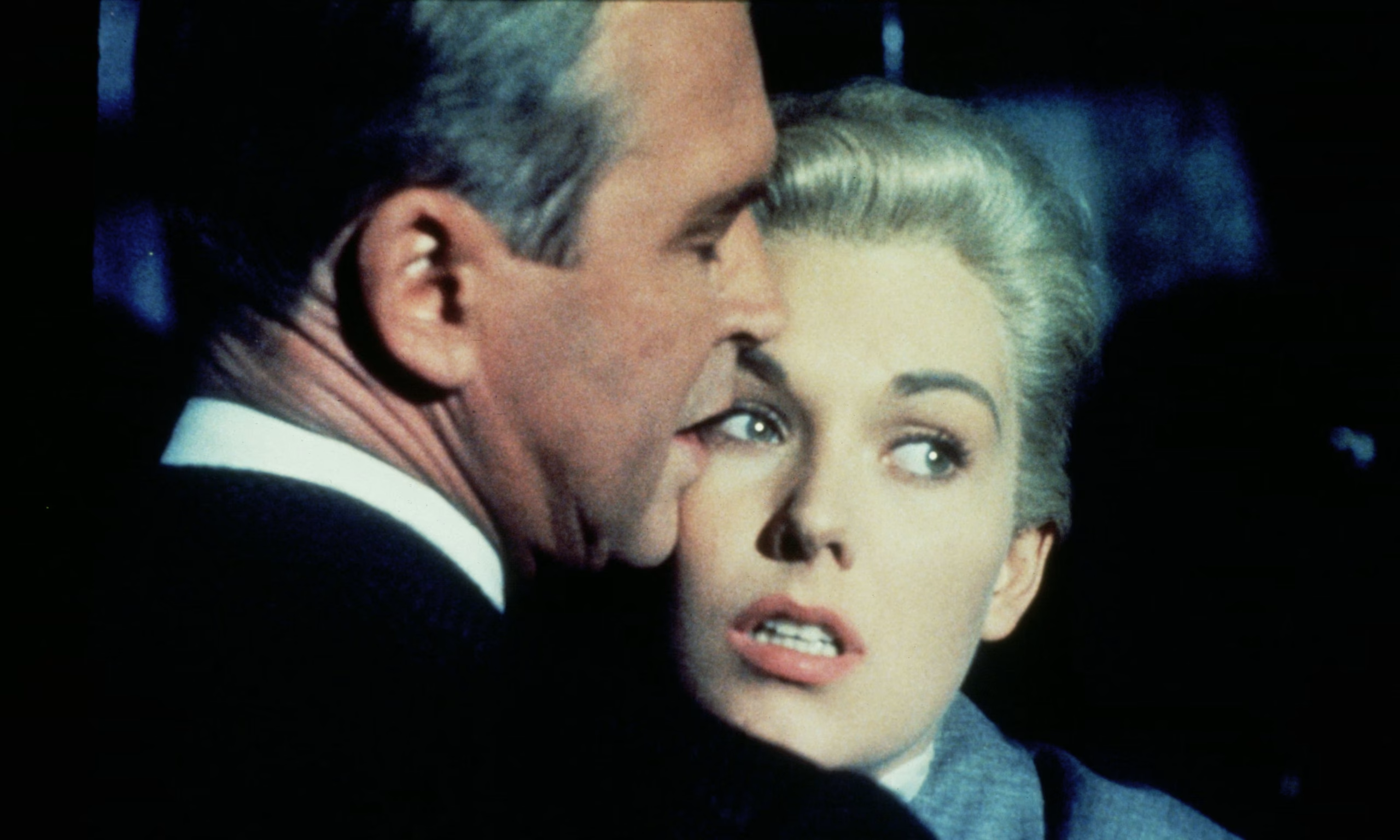
A shower curtain opens, and violins turn into an assault. A woman emerges through a ghostly green light, and the orchestra swells with an obsessive love so desperate that it can no longer distinguish a person from a beautiful phantasm. A taxi moves through Manhattan steam, and the music offers two versions of the city: one is seductive, the other already burning.
These are not merely memorable musical textures or the voices of films like Psycho, Vertigo, and Taxi Driver. They are part of what those films mean. Bernard Herrmann could make an orchestra reveal something that a character would never admit, or that a director preferred to leave unresolved. His music did not always tell us what was happening, but it did tell us what happening felt like, from somewhere dangerously far inside.
Bernard Herrmann’s biographer Steven C. Smith, the author of A Heart at Fire’s Center: The Life and Music of Bernard Herrmann, finds much of Herrmann’s genius in his ability to evoke psychological nuance, and in the way he brought together just the right instruments to give each film its own emotional undercurrents and draw us closer to the characters’ fear and desires.
You may know Bernard Herrmann’s music whether you realize it or not. Think of the dark snarling brass that opens Citizen Kane, the spiraling arpeggiated phrases of Vertigo, or the headlong rush of North by Northwest. Those strings that slash the air in Psycho, the saxophone drifting through Taxi Driver, and, of course, each belongs so completely to its film that it is hard to imagine the images without it in the realm of modern cinema.


Yet there is much more to Herrmann than menace. He could give The Magnificent Ambersons a tenuous elegance, then summon the enormous forces that seem to shake the ground beneath Mysterious Island. Across that range, you can still hear his signature: short phrases that won’t let go, chords that seem suspended in midair, and moments when the music opens unexpectedly into longing. Listen to brass voices plunging in Cape Fear or the sinister whistling theme from Twisted Nerve. The music leaves us unsettled, waiting for a resolution that never quite arrives.
The title The Sound of Suspense fits him, but suspense is only the beginning. Herrmann also understood solitude, tenderness, grief, and the peculiar terror of wanting something that could save you in the end or finally bring you relief, while the threat that you might never attain it feels all too real.
But his music could just as readily open its arms to romance, catch the exhilaration of an adventure, or give us the wonder of stepping into a world we had never imagined. He had room for the whole sweep of feelings, from the smallest private hope to the grandest leap into the unknown. Maybe beneath the famous shocks lies a composer of longing: for lost childhoods (Citizen Kane), unreachable lovers (the heartbreaking separation between Lucy Muir and the ghostly sea captain in The Ghost and Mrs. Muir), vanished worlds (The Magnificent Ambersons – the family’s privileged world gives way to industrial change. His soundtrack captures the loss of an entire social order, not simply one person’s happiness) Herrmann’s score belongs to that story of decline and displacement, and human contact that arrives too late (Taxi Driver, On Dangerous Ground) or at a price. His reputation for terror can overshadow the yearningly romantic side of his music, particularly in North by Northwest and The Ghost and Mrs. Muir. All of it belongs to the emotional territory of his work. He could also make room for love fulfilled, horizons opening, and the sheer joy of being swept into something larger than ourselves.
Bernard Herrmann might have preferred to be celebrated for his opera Wuthering Heights, his symphonies, his cantata Moby Dick, and his other concert works. Yet, according to fellow film composer John Williams, Herrmann’s greatest ambition was to earn recognition as a conductor. Whatever recognition he hoped for, the movies became the place where his imagination left its deepest mark. He helped change not just how films sounded, but what they could say through music, and generations of composers have been listening ever since. That was “his great skill—his understanding of the psychology of the character,” fellow film composer Howard Shore said. Herrmann could hear what was happening beneath a character’s words and actions, then give it musical expression. His scores brought us closer to the fears, desires, and contradictions driving the people on screen.
Herrmann’s music could stir a feeling, resist it, or give it an unexpected gravity. The psychology was in the encounter—not only in the person, but in what happened when that person met the world.


