Shadow of a Doubt 1943: Shadow Under a Sunny Sky, Danger in the Doilies Part 2

LINK TO PART 1 HERE

Alfred Hitchcock’s Double Faces: Shadow of a Doubt and Psycho 1960

In both Shadow of a Doubt and Psycho, Hitchcock builds suspense around characters who live double lives, but he stages that duality very differently. In Shadow of a Doubt, Uncle Charlie’s charm and respectability in the Newton household mask his identity as a serial killer of wealthy widows; the film’s tension hinges on the gradual recognition that the adored uncle and the “Merry Widow Murderer” are one and the same man. The doubling of names and the mirrored staging of the two Charlies lets Hitchcock put sweetness and light and a dark side in the same frame, blurring what counts as safely good. Young Charlie’s name mirrors his, and the smallest movements they share quietly give away the bond between them. How deeply she identifies with him, making his darkness feel like a possible version of herself.

Alfred Hitchcock’s Psycho (1960) We All Go a Little Mad Sometimes

By contrast, Psycho turns dual identity into a literal split within Norman Bates himself, dramatized through his alternating personas as a shy motel manager and the Mother figure who commits the murders. The film’s structure withholds this doubling until later in the film, encouraging us to think of Norman and Mother as two separate characters; only the revelation that he is both collapses the divide and exposes a psyche fractured between dependence and homicidal rage. You could hone in on this as Hitchcock’s most blatant version of the “double,” where the conflict isn’t between two people but between two selves jostling for control inside one body.

Where Shadow of a Doubt focuses on the way ordinary family life can harbor a charismatic killer whose evil feels uncomfortably close to the heroine’s own fantasies of rebellion and freedom, Psycho pushes duality inward, making the body itself the site of conflict between competing identities. Uncle Charlie embodies a radical evil, hidden violence camouflaged by everyday respectability, while Norman Bates embodies a more extreme version of the divided self, in which the social self and murderous impulse are separated into distinct, competing characters within one man.

Uncle Charlie is a sort of Bluebeard… born out of an intensely misogynistic Social Darwinist mindset. He is the integrated man who chooses evil, evil that is deeply willed, rooted in a chosen worldview. A predatory, nihilistic misogynist who has an actual philosophy — “Today’s the thing — that’s my philosophy” and his “Do you know the world is a foul sty? Do you know, if you rip off the fronts of houses, you’d find swine?” speech captures a man who has reasoned his way into monstrousness. Norman Bates and Charles’ violence is both gendered,

Norman Bates and Charles’s violence is both gendered, but through a very different mechanism — punishing women on his mother’s behalf rather than out of an articulated worldview. And while Hitchcock builds both villains out of the same idea—the doubling—he splits it in opposite directions. With Uncle Charlie, the double lives outside him: an uncle and niece who share a name, seem to think on the same wavelength, and, as the film keeps hinting, it feels less like two people than one soul stretched across two bodies.

He’s whole, and that’s what makes him terrifying; his evil isn’t some hidden symptom. He is whole within himself, terrifyingly so; his evil isn’t a symptom; it’s a philosophy he can recite at the dinner table without raising his voice. The scary part isn’t that Charlie finds a monster hiding inside a man she loves. She shares his restlessness, his hunger to escape the ordinary. The horror is discovering that his answer to that same restlessness is murderous misogyny, something she wants no part of. The kinship is in the itch, not in the conclusion he draws from it.

Norman Bates flips that setup completely. He doesn’t need a niece to mirror him, because the double already moved inside — one body, two minds — his and his mother’s, and the control passes between them, each one waiting for the other to lose its grip until, by the end, only one is left holding on. Uncle Charlie can look you in the eye and tell you exactly what he believes the world is. Norman can’t even tell you which version of him is talking. His evil isn’t something he chose or could defend; it’s just what’s left after his mind cracked under grief and guilt and never put itself back together. Uncle Charlie picks his darkness. Norman just gets picked by his, again and again, until there’s nobody left inside to take the blame.

Hitchcock uses the two Charlies as a kind of living split-screen, letting us see sweetness and light and the dark side walking arm in arm through the same small-town frame. Psycho routinely reads Norman’s alternation between himself and Mother as a textbook case of fractured identity. By the time we reach the basement revelation, Norman isn’t just slipping between moods; the film turns an internal conflict into a full-blown duet of competing selves, mirror-image killers locked in the same body.

Norman’s duality is framed by Hitchcock’s use of his reflection in the window.

Teresa Wright’s Quiet Brilliance in Shadow of a Doubt

Teresa Wright actually came to Shadow of a Doubt through one of those old-Hollywood “loan-out” deals. Samuel Goldwyn agreed to lend her to Jack Skirball at Universal, who, in turn, was trying to line up Hitchcock through David O. Selznick. Teresa hated the whole loan-out system—it felt like a form of professional servitude, and it meant the studio collected a fat fee while the actor just stayed on their usual salary. Still, for Teresa, the chance to work with Hitchcock was irresistible. She signed on in August and headed up to Santa Rosa, about sixty-five miles north of San Francisco, for two weeks of location shooting. The funny thing is that the project for both of them wound up as a favorite: Hitchcock later singled Shadow of a Doubt out as his personal best, and Wright kept naming it as the film she loved most in her own career.

It’s not hard to see why both Hitchcock and Wright held the film in such high regard. Shadow of a Doubt is a quietly stunning piece of work: unsettling and deeply felt, carried by extraordinary performances and shot in a black-and-white style that makes even the most ordinary scenes feel haunted. Every scene bears the unmistakable hand of a master at work. In shot after shot, you can feel Hitchcock’s assurance that he was always completely in command of his art.

On top of her recent Oscar, which made her a very appealing name for the project, Teresa Wright came to Hitchcock with a strong endorsement from Thornton Wilder, who had been brought in to write the script. The story itself can be read as a kind of shadow version of Our Town, its darker underside. Years later, in 1974, she described her first meeting with Hitchcock in vivid detail, remembering how that collaboration began

“When he told me the story as we sat in his office, it was as if he had already finished the picture. He had it completely planned in his mind, along with every sound effect, and he told me the entire movie, scene by scene. He used anything on his desk as a prop- a drinking glass, a pencil, or a book. He stepped around. If a character was strumming his fingers on a table, for example, it wasn’t an idle gesture- Hitch put a beat to it, like a musical pattern or a refrain. If someone was walking or rustling a newspaper, tearing an envelope or whistling, or if there was a flutter of birds or an outside sound, Htich had everything carefully orchestrated.”

As for the filming process:

“ Hitch made us all feel very relaxed, and his direction never came across as mere instruction. We felt we could trust him, and although he guided us carefully, he also gave us a sense of freedom. He was very calm, as if we were contributing to something that was already a foreseen success. No one plans a film as thoroughly as Hitch, and no one saw it as clearly as he did from the start. Other directors often let things happen during the shooting, but with Hitch’s planning, everything was more serene during production, and therefore more enjoyable… What luck it was for me — this was a wonderful role, a girl who starts off one way and then changes and grows before your eyes as she’s dealt with this awful problem. At the conclusion, it was the end of innocence for young Charlie, because now she knows evil exists, and in the one person she and her mother love the most. She has grown up and learned that someone she has loved and been loved by can literally kill people.”

Not everything about the shoot was comfortable for her. She later recalled that, just before calling “Action!”, Hitchcock would lean in and whisper something obscene—“usually,” she said, “having to do with a young bride on her honeymoon, which I had just returned from.” He also made comments about her husband, writer Niven Busch, especially regarding their age difference, which she found inappropriate. “I tried to cope with this by smiling, as if I didn’t understand him, or as if he was uttering the most polite compliments,” she explained, framing her response as a kind of polite deflection rather than genuine amusement.

According to Donald Spoto and from various stories told over the years, this wasn’t the first or last time Hitchcock entertained himself with a bit of verbal mischief at the expense of a leading lady. It’s tempting to think he was sometimes chasing a reaction—a flash of shock or discomfort right before a demanding shot—since that kind of tactic is hardly unheard of on sets. What makes it stranger is the way it sits against his public persona on the job: the suit, white shirt, and tie; the calm, almost placid manner; the refusal to shout or create chaos. All that bourgeois respectability is sharply at odds with the sudden eruptions of crudely inappropriate remarks.

“Charlotte, age 19 or 20, is one of his nieces, named for him. The film charts the girl’s moral education as she progresses from innocence and untested idealism to a firsthand experience of the eruption of evil amid everyday reality – and the murderous tendency to depravity that is latent in human nature, indeed in everyone. Teresa filmed her role calmly, but inside, she was perhaps for the first time, tearing herself to pieces, enduring a nervous stomach and losing weight. While under Hitchcock’s tutelage, she thought out every moment of her character’s abrupt introduction to the darkness in human nature. She stated, “I had to understand how this woman felt- how she developed to include a mature, tough side, too. After all, cardboard characters are no fun. There’s no place you can go with cardboard, no depth.”—Source: Teresa Wright and Donald Spoto

For someone working under that kind of pressure, Teresa delivers something remarkably close to a lesson in screen acting: “The shots of Wright,” wrote the novelist and critic Stephan Talty, “Have the raw power of those early silent close-ups in which an entire drama was played out on the face of the actor, {and her performance} remains one of the most lucidly beautiful in the cinema.”

Teresa’s work in Shadow of a Doubt really shows how much the film depends on her and how steadily she carries it. Because the film was shot out of sequence, the location work involving the Santa Rosa exteriors done first and the studio interiors saved for later, meant she had to hold Charlie’s whole emotional journey in her mind, she had to keep track of Charlie’s emotional arc almost entirely in her head, even when she’s jumping from one stage of it to another on set, and knowing that the audience would experience it as a steady descent rather than pieced together, the way she was actually filming it. Because she’s in almost every scene, being on screen for nearly the whole picture, she walks that line so carefully that Charlie’s ordeal hits hard in the moment and feels at once startling and, when you look back over it, where the film has taken her, grimly inevitable.

What stays with me is the way she handles Charlie’s innocence. She slowly lets it erode over the course of the film without ever tipping into fake purity or sentimentality.

The early, almost breathless trust she places in Uncle Charlie, where she practically glows with the faith she puts in him, never plays as simple wide-eyed naivety; and when that trust collapses, her talk of stopping him—even killing him if she has to—lands with real weight rather than melodrama. The lines carry a kind of sober conviction instead of tipping into hysterics.

She refuses to treat Charlie as a passive victim. Once the truth about the widows comes into focus, Teresa steps into the role of opposition: she becomes a kind of adversary, someone who sees him clearly and refuses to surrender the moral ground. And she does most of this work not through dialogue, but through the look on her face, the way her eyes move from worshipful to wary, from adoration to suspicion to outright defiance as the film closes in around them.

“You must be thinking the right thing,” she said. Because it will show if you’re not. When there’s a close-up of your eyes, you can’t be thinking of making the 11:45 train or something. “

“In scenes with Henry Travers- he had played the stationmaster in Mrs. Miniver – and with Patricia Collinge as her mother (Aunt Birdie ), Teresa was an acute listener- hence our identification with her character deepens as we listen with her. Opposite the pliant lure of perilously attractive Uncle Charlie, another actress might have been diminished precisely because his character is so fiercely idiosyncratic and unpredictable, but Tressa allowed young Charlie’s moral education to emerge without forcing the issue of a life lesson- and so she left a nuanced, exquisitely rendered performance that gave Shadow of a Doubt its coherence and complexity.” —source: Donald Spoto

“She was lovely to work with,” producer Jack Skirball wrote to Samuel Goldwyn after the picture was released. “And in my opinion, she has no superiors, and few equals as an actress. I was very impressed.”

Hitchcock lavished his praise upon Teresa Wright: “I got along very well with Teresa. IF she can’t act a line in a script, there’s something wrong with the line. She was always prepared and completely professional; she knew what she was doing, she always got things right, and she gave a great deal to the picture.”

As for Teresa, she was candid for the rest of her life: “At the time we made this picture, we all thought it was a great film. But I don’t think any of us had an idea that it would have such an impact on generation after generation.”

Even at the height of World War II, critics were already applauding Teresa. Howard Barnes of the New York Herald-Tribune praised her “quietly authoritative performance that elevated the film into a screen classic.” William Wyler kept boosting her, calling Teresa “an actress who can do no wrong,” and critic Alton Cook went so far as to say she was “one of the great new actresses of our time.” Time pretty much sealed the deal by dubbing her “Hollywood’s best young dramatic actress.”

In 1943, Oscar nominations were announced: Shadow of a Doubt only landed a nod for best original story, based on a six-page outline by Gordon McDonell, and even that lost to William Saroyan’s The Human Comedy. It wasn’t the first time, and definitely not the last, that a Hitchcock masterwork slipped past the industry’s radar. On top of that, many moviegoers, then and long after, were baffled that Teresa Wright’s name was nowhere to be found among the best actress nominees for 1942. To me, both omissions are criminal.

Source: Teresa Wright’s Biography, A Girl’s Got to Breathe: The Life of Teresa Wright, by Donald Spoto.

The Shine on Santa Rosa, and the Rot Beneath: Sunlight on the Sidewalk, Darkness in the Parlor: American Small Town Idealism Shattered and Exposed

In the opening, it’s filmed in Newark, NJ (the Pulaski Skyway), set nominally in the East- Philadelphia- a deliberately nameless, sullied Eastern city contrasted with the idyllic Santa Rosa. That East/West opposition is itself part of the film’s meaning; the Library of Congress essay notes that Hitchcock shoots the East “unflatteringly” as symbolically tainted, with California standing for democratic small-town virtue.

On a historical side, Shadow of a Doubt is significant because it reflects the social anxieties of the early 1940s, when the United States was moving more fully into the Second World War. Santa Rosa is staged as the kind of town wartime America liked to imagine itself defending: clean streets and neighbors who know your name.

The film’s critique of American small-town idealism comes in through the side door. Santa Rosa is presented at first as an almost promotional vision of wartime America: you’d imagine friendly shopkeepers, church picnics, families who can leave their doors unlocked because “nothing bad ever happens here.”

One tiny obsession and brief indulgence: I hear so often from people who say a variation of this, “Things like this don’t happen here,” as if the town’s zip code were a moral force field, and it drives me crazy because it’s just not true—and it’s not innocent. It never fails that that particular statement comes up in every true-crime doc I watch.

What they’re really saying is: “We are the kind of people this shouldn’t happen to.” It implies that violence belongs somewhere else, with other, supposedly “lesser” people or more “obvious” places—the big city, the bad neighborhood, the wrong side of town. It turns tragedy into a weird kind of compliment to themselves: our town is so wholesome, so American, so normal, that reality itself has somehow broken character. I just want to push back against the moral hierarchy baked into “things like this don’t happen here.” …anyway, rant over.

Wartime small-town ideal: In the early 1940s, Hollywood and official culture were busily mythologizing the small town with its charming central square and treeline residential streets, and the happy family as the sturdy, wholesome heart of the nation, all those ideals that were being fought for.

This is not the sentimentalized view that Americans remembered their pre-Pearl Harbor country to be; rather, the film suggests the world has always been filled with horrible people.Three years later, this same concept was repeated in Orson Welles’ The Stranger, a yarn about a post-WWII Nazi who escapes only to settle down in a sleepy American suburbia—the paranoid suggestion being that even though the Nazis were defeated, there was still danger in our seemingly safe communities. – Brian Eggert 2013 essay for Deep Focus Review

Both Hitchcock and Welles, for that matter, sought to challenge blindly optimistic views of small-town America and expose its seedy underbelly.

Here there’s an immediate disruption: Shadow of a Doubt steps into that moment and quietly undermines it, showing how a town that looks perfectly right can still set out the welcome mat for a serial killer.

On screen, the town doesn’t read as distinctly Californian at all. It comes across more like a classic Midwestern community, the small-town narrative of innocence, the kind of setting that feels about as generically American as you can get. Santa Rosa is framed as a typical American town, and the Newton family history absolutely meets that idealized version: the hardworking father, devoted mother, their shiny kids, and their beloved visiting uncle. The shared story the Newtons have about themselves makes the possibility of a serial killer in their midst almost unimaginable, so when young Charlie begins to suspect the truth, she has to fight against the weight of that family myth as much as against her uncle himself.

Critics have focused closely on the film’s vision of small-town America as both cherished and quietly compromised. This folds Shadow of a Doubt into a broader 1940s cycle that exposes the other side of the small town, admiring the way it holds together both its bright and dark faces, a town that presents itself as warm and welcoming, yet might quietly conceal cruelty, self-deception, hypocrisy, and a capacity for looking the other way.

What’s striking, given when the film was made, is how openly it undercuts the comforting image of the American small town. In the middle of the Second World War, when Hollywood was busy bolstering morale and selling an ideal of neighborly, churchgoing normality, Shadow of a Doubt quietly suggests that this kind of town can just as easily embrace a murderer as a cherished relative.

The streets look safe, the community looks devout and kind, and yet all of that warmth proves perfectly capable of sheltering someone whose violence is quietly buried in the scenery of ordinary people. The film is able to optimize this American shadow-self through its use of black-and-white psychological suspense to explore a sense of unease beneath the public rhetoric of unity and sacrifice. This suggests that evil might erupt not only overseas but in the heart of domestic life, highlighting the way characters cling to routine and optimism while underlying tensions and fears about safety, trust, and moral order seep in. Shadow of a Doubt isn’t just about a threat to one young, innocent girl or vulnerable widows; it threatens the symbolic foundations of wartime, postwar, and mid-century domestic spaces in American life.

While it’s not a pure domestic space at the Newtons’ reception, Hitchcock stages bourgeois civility as a fragile performance: the cocktails, polite conversation, and fixed smiles form a social facade that Uncle Charlie’s presence quietly destabilizes. It presents wartime respectability as theatrical and brittle, with its older, affluent guests embodying a false civility that masks the moral unease beneath the polished surface of suburban life. This gathering captures not so much domestic intimacy as a ritual of wartime-practiced bourgeois self-display, a setting whose composed civility is already vulnerable to Uncle Charlie’s intrusive evil. The image doesn’t show the comfort of home but the performance of respectability: here, at the cocktail party, it’s framed as a world of wealth, manners, class privilege, social exclusion, and repression that the film treats as deeply unstable. Already marked by the moral rot Uncle Charlie brings into the narrative.

Hitchcock’s great sleight of hand is to let that postcard image stand even as he quietly proves how easily a serial killer can hide inside it. By putting a murderer at the center of such an impeccably ‘normal’ household, the film brushes up against a broader unease: if the small town and the united family are supposed to be the sound heart of America, what does it mean when corruption arrives not from some urban underworld but from the guest room upstairs?

So here we are, with a film that knows how to capitalize on that myth. Within that postcard setting, we find a serial killer welcomed as a local celebrity, two armchair criminologists gleefully discussing strangulation over dessert, and a household so invested in maintaining its pleasant rituals that young Charlie’s suspicions would be treated almost as a breach of good manners. The film quietly reflects wartime anxieties about what might be lurking beneath the surface of American normalcy, and you can feel that in the way authority figures either misread or willfully ignore danger: the town’s respectability becomes Uncle Charlie’s camouflage. The psychological horror, then, is not just that one man is monstrous, but that a whole community’s desire to see itself as wholesome gives him room to operate.

In that sense, the film doesn’t just unsettle one town; it quietly disturbs a broader cultural fantasy that would harden in the postwar years—the idea of the “good” American community as a kind of moral safe zone. The Rockwell image of the nation, with its front porches, church socials, and polite Main Streets, was never just décor; it became a story Americans told themselves about where danger belongs and where it doesn’t. Shadow of a Doubt slips in before that story fully comes together and suggests that the rot isn’t an import from some distant elsewhere, but something that can grow in the very places most invested in denying it.

The dream as an illusion that requires constant performance

Seen from that angle, Uncle Charlie is not only a killer hiding in plain sight; he’s also a dark answer to the postwar fantasy of the returning hero. He comes home bearing charm, money, and an air of worldly glamour, and the town receives him as proof of its own goodness: look what kind of man our “perfectly American” town produces. The film’s cruelty lies in showing how easily that desire to see him as a success story blinds them to what he really is. The myth of the safe, idealized community doesn’t protect them from violence; it helps to script the conditions under which violence can thrive, hidden inside charisma and respectability.

Critics of postwar suburbia have called it a kind of mirage: a dream that looks solid in photographs but only holds if everyone keeps performing their part—staying married, mowing the lawn, keeping the right distance from whatever feels messy or threatening. Shadow of a Doubt plugs into that logic before the cul-de-sacs even arrive. Santa Rosa isn’t just “nice”; it’s a town whose identity depends on seeing itself as nice, and on smoothing out anything that doesn’t fit. That’s why the most frightening thing in the film isn’t only Uncle Charlie’s violence, but the way it slips so easily into the script—and how he is received as a sort of hero, an ideal son come home, and the town helps him hide simply by insisting that a place like this is no place for evil.

Postwar Dreams and White Picket Nightmares: The Myth of the Safe Town and who gets to live in that ’safe’ place: From Santa Rosa to Levittown

So when people say things like “this doesn’t happen here,” they’re talking about a “here” that was engineered to be racially homogenous and economically filtered. The innocence of the landscape depends, in part, on who has been kept off the streets.

The myth of the safe American town was always very clearly a selective one. Postwar suburbs – places like Levittown – were explicitly built with white families in mind; Levitt himself enforced whites-only policies, and the way loans and mortgages worked, these federal lending practices such as redlining helped make sure a lot of minority families never even had a shot at getting in.

In postwar suburbia and the American Dream language, Santa Rosa can be anywhere USA, like the creation of Levittown, Long Island, NY, and its quaint neighborhood and its ideal little houses that offered veterans the American Dream. I lived in one of these privileged white suburbs and actually grew up a few towns over from Levittown.

Shadow of a Doubt doesn’t suddenly turn it into a story about race, but for me, in later readings of the film, I can’t help but go there because it opens the door to thinking about what (and who) that safety has historically depended on ignoring. Hitchcock isn’t talking about race head-on in Shadow of a Doubt, noticing that his world is almost entirely white and organized around gender/class. But I can’t help noting that the myth of the safe, overwhelmingly white neighborhood has racial baggage. Even if the film doesn’t name it—but watching it now, it’s hard not to connect that “safe town” fantasy to the way real white neighborhoods have treated themselves as sealed off from danger.

The film is clearly uncomfortable with the idea of a perfectly sealed, perfectly innocent community. It hints at a bigger pattern: that the fantasy of safety only works if you ignore the violence, systemic, structural, and personal, that made that fantasy possible to begin with.

Shadow of a Doubt can be read as pressing hard on wartime American values, with figures like the banker, the family dinner table, widows, wealth, and everyday consumer comforts all coming under quiet attack. The film has been memorably described as at once a “subtle stab and warm hug” (Weekly Hitch) to the ideals America imagined itself defending in the 1940s, and that double attitude—smiling on the quaint values of Santa Rosa on the surface, paired with a stark reveal of how darkness can overshadow it—is very close to the tension I’m tracing in my own reading.

In the decades after Shadow of a Doubt, that postcard vision hardened into the now-beloved suburbia: rows of houses and that aggressive lawn culture that seems to be a manic-ured psychosis.

Here comes another tangent: Just like my neighborhood now and the surrounding towns seem obsessed with that vibe – green plastic perfection of their lawns. And they’ve cut down the old regal trees just for the sake of having a more sterile, view-hungry front yard, a bland, spray-painted, golf-course-type green, no clover, no moss, just one dead-flat shade as if it came out of a catalog. And don’t get me started on the leaf blowers, that drone so loudly it’s like a squadron of Bert I. Gordon or Jack Arnold–worthy giant mosquitoes coming in for an attack inside my skull. Rant over; back to the suburban ideal and Shadow of a Doubt.

By the time the film reaches its climax on that train again, the site of both arrival and attempted escape, Shadow of a Doubt has completed a kind of moral initiation story, dragging young Charlie from naïve idealism to a hard-won, nearly adult understanding of the world’s capacity for violence. Hitchcock sets up the final struggle as both a physical and symbolic severing of the tie between the Charlies: the killer uncle quite literally tries to remove the only person who can see him clearly, and in resisting him, she claims not only her survival but her right to interpret the world for herself.

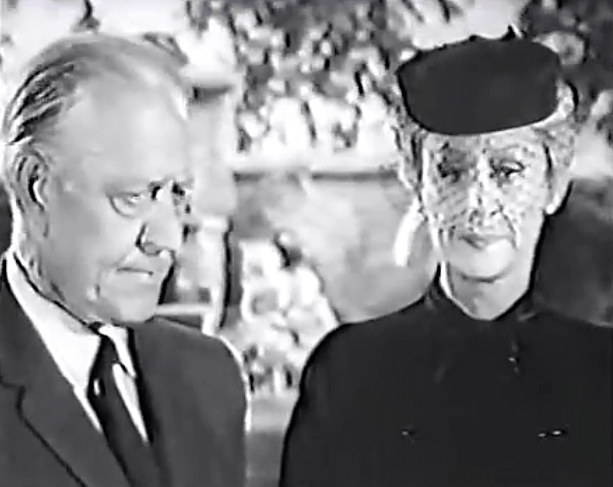
At the funeral that follows, the town gathers to mourn a man they believe to have been taken away so tragically, a man they believed to be respectable and safe, while young Charlie and Jack hold the secret that would shatter that illusion; her last words suggest she will keep the secret about her uncle’s victims even as she remembers what he really is. It’s a remarkably bitter note for such a genteel setting, and maybe that’s why Hitchcock reportedly held this film in such high regard: it allows him to combine, as he put it, character and suspense, and in doing so it leaves a small, lingering stain on the very idea of the cozy American family thriller.

Donald Spoto writes, “[The film] marked a major shift in the director’s tone; from Shadow of a Doubt on, there is a moral cynicism about the human condition that pervades all his best work.”If this outlook was learned from Wilder, Hitchcock’s understanding was incomplete. With the death of Uncle Charlie, the world as represented by the typical American family and the typical small town has been ritually affirmed.”15 While the film and much of Wilder’s works test the moral fiber of his characters, human progress is nonetheless upheld, leaving cynicism in its wake.

Women at the Table, Wolves at the Door: Young Charlie’s Education as a ‘Good Girl’ and Women as Parasites, the Women Her Uncle Loathes: How Classic Cinema Rationalizes Misogyny

Uncle Charlie’s fourth-wall rant is where the misogyny becomes audible (“fat, wheezing animals”), and at the end, during the party honoring him, his toast is the charm that masks it. The misogyny lives inside the beloved-uncle performance — same face, charm concealing contempt: the man the town toasts is the man who rants at us about women who have no place in the world he inhabits.

You could say the white-picket-fence version of the American dream is basically gendered confinement. I’ve already talked about the vision of suburbia as the postwar fantasy of the kind of place that would wind up on a magazine cover: the single-family house, the white picket fence, the lawn, the car in the driveway—matching living-room set, and gleaming kitchen appliances. Even though it promised harmless comfort, it came with a built-in script that enforced a rigid social order that turned domestic life into a sort of soft-walled, psychological cage, especially for white women. That kind of illusion turned the home into a very seductive trap of suburban idealism.

Young Charlie: Poor Mother. She works like a dog. Just like a dog.
Joseph Newton: Where is she?
Young Charlie: She’s out. When she comes back, it’ll be the same thing. Dinner, then dishes, then bed. I don’t see how she stands it.

What’s striking about Shadow of a Doubt is that you can already see the early version of that dream forming in the Newtons’ house, even though it’s the 1940s and not yet the full-blown postwar suburb. Their dining table, their carefully kept routines, their sense that Santa Rosa is a perfectly ordinary town, all feel like the prototype of that later ideal, a family life that looks safe and self-contained, with Emma happily running the household and everyone else orbiting around her. Young Charlie’s restlessness and unease and her quiet fear of waking up one day as her mother’s double. And the sense that she wants something other than her mother’s life puts a hairline crack in that picture, long before the postwar boom turns that life into the norm and codifies it in Levittown houses and magazine spreads. She doesn’t have the language for it yet, but her refusal to settle into that script is part of what makes her eventually so attuned to the wrongness of Uncle Charlie’s presence: she’s already wary of the story that wants to cast her in the role that sees her as following the same quiet, domestic path laid out in front of her.

Young Charlie: We just sort of go along, and nothing happens. We’re in a terrible rut. It’s been on my mind for months. What’s gonna be our future?
Joseph Newton: Oh, come now, Charlie. Things aren’t as bad as that. The bank gave me a raise last January.
Young Charlie: Money? How can you talk about money when I’m talking about souls? We eat and sleep, and that’s about all. We don’t even have any real conversations. We just talk.

During his dinner table rant, Hitchcock frames her face in close-up, letting you watch the remnants of her admiration drain out and be replaced by a kind of stunned clarity. It’s a moment where patriarchy itself stands up at the table, carves into the roast, and tells everyone what it really thinks.

Emmy keeps up her cheerful composure while her brother continues his hateful soliloquy.

Hitchcock lets us see both timelines at once: the cozy, slightly old-fashioned home we’re watching on screen, and the more standardized, seductive trap it’s quietly pointing toward.

Historians like Kimberly Kutz Elliott (Ph.D. in American History from the University of North Carolina at Chapel Hill, specializing in U.S. culture with a strong grounding in women’s and gender history), has talked about how that world did offer real material comfort, but also this very quiet kind of imprisonment—that women were essentially nudged back into the housewife role, told to pour all their meaning into kids and appliances, while feeling this low, creeping sense that something in them was getting quietly flattened. Cultural critics have a great phrase for it: “white picket prisons,” those spaces that look like pure safety from the outside but carry this strange mix of isolation and malaise once you’re actually living inside them. And it’s not a stretch to see Santa Rosa as an early draft of that same story—a town so committed to its own normality, and if there are any flaws, there’s a whole lot of denial and myth-making, because of the town’s need to see itself as “perfectly American.”

Part of what makes Shadow of a Doubt such a quietly brutal film about gender is the way it stages two competing stories of what a woman is meant for. On one side, you have young Charlie, restless and bright, looking for something more than the life she sees laid out in front of her—marriage, children, perpetual cheer, and a vigilant smoothing over of anything unpleasant. Against young Charlie’s unease sits her uncle’s fully crystallized male worldview, his misogyny already hardened into outright disgust.

Diane Negra, Professor of Film Studies and Screen Culture at University College Dublin, who has written a monograph on Shadow of a Doubt, develops this further, suggesting that, in his mind, the women he murders are guilty of disrupting family life and of failing to live up to the expectation that unattached women should remain virtually invisible. Their other transgressions are a moral indictment of their breaking of his code of usefulness and restraint, and of their idleness and self-indulgence.

She also draws connections to Hitchcock’s broader body of work; Negra aligns with Jan Olsson (Swedish film scholar and professor of cinema studies at Stockholm University, best known in Hitchcock studies for his monograph Hitchcock à la Carte (Duke University Press, 2015) and with his broader work on film history and media culture. Olsson’s assessment is that his films frequently depict male revulsion toward women who are neither young nor socially constrained.

If you look at it through this lens, the dinner table scene becomes a chilling articulation of Uncle Charlie’s worldview, one where independent women are not just unwelcome but marked for destruction.
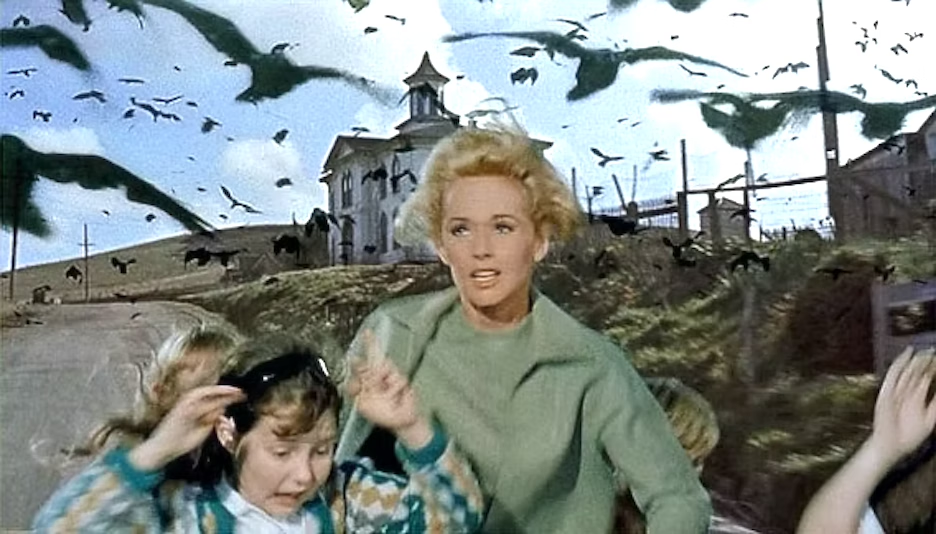
There’s a figure that haunts Hitchcock’s films — the woman who refuses to depend on anyone else, who possesses her own money, her own will, even just a flicker of independence — and she’s treated as something close to a natural disaster. Look at The Birds’ Melanie Daniels, or once again Tippi Hedren in Marnie – Her self-sufficiency and agency unsettle the order men have built around themselves, and Hitchcock is fascinated by how fast that unease turns to primal terror, then to fury. What begins as low-grade dread in the male psyche doesn’t stay there long; it gathers into that fury, and in his world, the fury tends toward murder. The autonomous woman isn’t simply a threat to a marriage or a social arrangement; she’s read as an offense against the way things are supposed to be, and the men around her answer that offense with violence.

These women are caught in a paradox that runs to the bone of Hitchcock’s world: to hold power is to court violence, because a woman in control has, by his logic, already committed the unforgivable offense. Female independence isn’t merely risky here; it’s transgressive at its roots, a violation of an order Hitchcock treats as natural law.

Young Charlie feels that pressure from the start, everyone around her expects her to be the good daughter, the charming niece, the girl who has to help keep the house’s mood, light, while Uncle Charlie represents the part of the system that’s all about punishment: the man who sees women as waste, who believes that getting rid of them is a kind of aesthetic or moral cleansing.

Feminist film theorists like Molly Haskell (From Reverence to Rape) have long pointed out how classical Hollywood has a long history of oscillating between putting women on a pedestal and dragging them into the mud – of presenting women either as revered ideals or degraded objects- and Uncle Charlie’s rhetoric takes its cues and aligns him unmistakably with the latter view.

In terms of Uncle Charlie’s vision, they are opportunists, fat, wheezing widows rather than people. He is almost a textbook case of that kind of thinking, wrapped in charm. Seeing women as waste, as infestation, as a kind of social impurity, something he’s entitled to remove from the polished surface of his refined life, to scrub them from the gleam of his chosen world.

The Merry Widow’s next victim?

He doesn’t simply kill women; he narrates, he philosophizes about them. He hates the specific women he destroys; despises them as a class, turning widows into symbols of everything he finds vulgar and corrupt in femininity and humanity. Those “fat, wheezing widows” he talks about aren’t individual people to him; they’re proof of a larger belief that women are parasitic, vulgar, and barely human.

What makes it especially chilling is that the town listens spellbound to his smooth talk and sees only charm; the violence in his worldview is audible to young Charlie, but not to people who have learned to treat male contempt as just another personality quirk and normalize it.

Hollywood often confined women to highly scripted roles that revolve around caretaking and emotional labor—good daughter, good wife, the ornamental girl- leaving men to occupy the more dangerous or active positions. Male characters get to move through the plot with agency and menace.

Over and over, cinema has had a pretty grim grab-bag of boxes it kept shoving women into, especially when it’s working from a misogynistic mindset. Cinema has spent decades flattening women into a narrow repertoire of types, reducing them to a handful of roles drawn from stock archetypes:

*The damsel in distress: helpless, in danger, waiting for a man to rescue her; her main function is to make the hero look brave and necessary. *The ideal homemaker / good wife: saintly, self-sacrificing, endlessly supportive, defined entirely by domestic work and emotional labor. *The vamp/seductress/femme fatale: hypersexual, dangerous, blamed for tempting men off the “right” path; if something goes wrong, it’s framed as her fault for being too alluring. *The “whore” / loose woman: punished for sexual desire, treated as morally corrupt or disposable, often there to be used and discarded or killed. *The pure, innocent girl: childlike, naïve, there to be protected or possessed; her main narrative job is to embody innocence rather than have a complex inner life. *The Unhinged/Dangerous woman: figures female instability as a threat to order, often marked as irrational, hysterical, or violent, and used to unsettle the household, expose buried tensions, or drive the plot toward crisis. *The manic pixie dream girl / ditzy muse: quirky, charming, existing mainly to jump-start the male protagonist’s growth, without much agency or interiority of her own. *The “nagging” wife or mother: controlling, humorless, constantly contrasted with the freer, more “fun” male lead; her function is to represent the drag of domestic responsibility. *The objectified body: broken up by the camera into legs, cleavage, waist—there to decorate the frame and be looked at, what Laura Mulvey famously called the “male gaze.”

Even when they differ on the surface, these types all exist to serve male stories, as prizes, warnings, or ornaments, rather than as people with their own interior lives.

Young Charlie’s early restlessness – that sense that she wants more out of life puts her in tension with the film’s gender expectations before Uncle Charlie ever gets off the train. She feels that script closing in on her: she’s restless in Santa Rosa, bored by routine, and clearly afraid of turning into her mother, whose energy is poured almost entirely into domestic maintenance and cheerful denial.

Young Charlie’s boredom isn’t just about small-town life; it’s about the particular version of it being handed to her as that “good girl.” The future she’s being quietly steered toward: a life organized around meals, politeness, gossip, and a studied refusal to let anything too dark into the room.

The collision between male authority and female perception:

Female characters often see dangers that male authority figures dismiss. In Shadow of a Doubt, young Charlie’s perception is consistently more accurate than that of the detectives.

The gender tension in the film doesn’t stop at Uncle Charlie’s monologues. Over and over, we watch her see things more clearly than the men around her. A woman’s perception of threat is repeatedly discounted by male authority as one of the ways cinema reflects real social dynamics.

In Santa Rosa, her father jokes his way through hypothetical murder scenarios at the dinner table, while she is slowly realizing that an actual killer is living in her house.

Her job, as everyone keeps gently reminding her, is to keep things pleasant; Uncle Charlie’s job is to keep control of his sister’s household, of his niece, of the story they all think they’re living. He needs to dominate the emotional and narrative atmosphere of the house—he’s the one who treats the family as an audience and the home as his stage.

One of the bleakest insights is that the story asks Charlie to navigate this world while still being treated as a child. She sees more clearly than the men in the story—and as I’ve said before, she is the one who gets wind of the threat, who reads his silences – but because women’s perception in classic cinema is often displaced or doubted, especially when it contradicts male authority, in Santa Rosa, her suspicions are a social problem; and Uncle Charlie’s violence is a private quirk. Her desire for a life beyond her mother’s routine is framed as a phase she’ll grow out of, even as her uncle’s loathing for women goes unchallenged at the dinner table and beneath the surface of his dangerous charm.

When you put all of this alongside the postwar suburban script, the idea that a woman’s fulfillment lies in the perfect home, the perfect family, the perfect community, you start to see why Shadow of a Doubt feels like such an early warning. It suggests that a “good girl” education by social training and a misogynist worldview aren’t opposites at all; they’re two halves of the same structure. One trains women to be pleasant and self-effacing; the other licenses certain men to loathe and harm them while the town looks the other way.

Diane Negra’s book-length study points out that Shadow of a Doubt still resonates with audiences because it’s not only a suspense thriller but also a story about gender and who holds power. “In a related way it illustrates how the film’s terrors have to do with the punishing effects of looking beyond conventional family and gender roles.”

From her interview with Liverpool University Press, where she names a key concept: “I refer to this and other elements of Shadow in terms of what I call the ‘intimacy of fascism.’”

In her view, young Charlie’s shifting perception of her uncle reflects a wider crisis of faith in father figures and other patriarchal authorities: the film begins with the comforting image of the adored male relative and gradually recasts him as a source of threat, revealing how precarious that sense of domestic safety really is. Negra also links Charlie’s trajectory to the wartime context, suggesting that her shift from idolizing her uncle to seeing him without illusions mirrors the tensions and strains women faced as they tried to navigate newfound independence amid old expectations, exposing how fragile domestic stability really is.

Charlie stands out among Hitchcock’s women because the film doesn’t just watch her suffer – it uses her eyes to probe the family itself, turning her into a kind of moral compass for the household that would prefer not to see what its beloved male guest really thinks of the women around him.

Hitchcock doesn’t treat her simply as a victim or an object of desire. Instead, she becomes the point of view through which we see how mid-century American life is organized, especially around the ideal of the family.

What makes young Charlie such a quietly radical heroine is that the film allows her to move beyond her uncle, not simply fear him. The man who first looks like a glamorous, almost father-like figure slowly turns into a reminder of the everyday misogyny and incarnation of the very patriarchal contempt she’s been taught not to question. Consider the silence from her parents after his misogynist outburst at the dinner table.

From his feminist essay Hitchcock the feminist: Rereading Shadow of a Doubt, Thomas Hemmeter suggests that the film doesn’t just mirror traditional patriarchy; it shows where it starts to come apart. In his reading, gender roles in Shadow of a Doubt look shaky and split, shaped inside a fractured patriarchal system, and the Newton home becomes the place where those fractures show themselves most clearly.

The article also leans on Diane Carson’s point that Hitchcock’s worlds leave women stuck between two bad options: quietly putting up with domestic tyranny, or rebelling in ways that are almost guaranteed to fail. In Shadow of a Doubt, young Charlie manages to see through Uncle Charlie and push back against him, but she’s still hemmed in by a social order that expects her to protect the family’s good name, even at the cost of her own truth.

Faced with this choice between clinging to the old machinery, preserving family life, and flirting with violent rebellion, the film exposes the violence simmering within traditional family life, especially for young women. In his view, Uncle Charlie’s fury toward widows- his moral indictment is actually really about a fear of independent, powerful women; as he puts it, [rich widows] who are regarded as inhuman and unnatural, throwing both the social and natural orders off their hinges.

Because she never agrees to marry Jack Graham, Charlie may really be after the independence and power of the ‘merry widows” whom Uncle Charlie targets and despises. So it’s another reason he ends up trying to kill young Charlie, since he sees her as another threat to the so-called natural order.

One question you might ask yourself is, what else does Uncle Charlie represent? A defender of the old order, preserving it through violence, or a psychopath who has lost faith in traditional morality?

His nostalgic recollections of the past suggest it might very well be both. When staring at a picture of his parents, he says, “Everybody was sweet and pretty then, the whole world, a wonderful world. Not like the world today. Not like the world now.” That way of seeing him feels a little too neat. If he were really just rebelling against a rotten world, lashing out at its corruption, there’d be some line he wouldn’t cross, but the film never shows us a line he isn’t willing to step over.

Shadow of a Doubt is more than an accomplished thriller; it also speaks powerfully to its social context and cultural moment. Negra’s interpretation of the film’s gender fault lines is particularly compelling, since she connects young Charlie’s evolving perception of who her uncle really is to deeper questions about authority, trust, and the fragility of domestic stability.

Negra also situates the film in the shifting social landscape of World War II, suggesting that Charlie’s journey mirrors the tensions women faced as they tried to navigate emerging ways women sought their independence alongside traditional domestic expectations. Her analysis extends the feminist work of Modleski and Laura Mulvey, who show how Hitchcock’s films can both quietly reinforce the stage on which patriarchy performs, which sort of tucks patriarchal assumptions back under the rug, and at the same time unsettle and subvert patriarchal ideologies.

She agrees with Modleski, who stated: “the question which continually—if sometimes implicitly—rages around Hitchcock’s work as to whether he is sympathetic toward women or misogynistic is fundamentally unanswerable because he is both…the misogyny and the sympathy actually entail one another.”

In Shadow of a Doubt, Modleski argues, “this context governs the manner in which the female protagonist makes discoveries about the nature and origins of misogyny.” When Negra stresses that young Charlie’s coming-of-age unfolds through her confrontation with male violence and control, she casts the film as a meditation on how deeply misogyny runs and how women begin to recognize it and resist it.

“A Very Sick Man”: Cover, Euphemism, and the Refusal to See

The film keeps dropping the word “sick” around Uncle Charlie, and in my opinion, while scholars are right to read those mentions as symptoms of a real pathology–a psychopathic warp in his relationship to women and family rather than mere evil—the film’s dark joke is that every time the word is actually spoken aloud it’s a cover story, a performance, or a euphemism, never an honest diagnosis. The film’s own use of “sick” is never a way to diagnose or give a clinical or moral verdict as to the source of Uncle Charlie’s darkness; it is always a mechanism of deflection or ‘not-seeing.’

Every “sick” reframes a predator as a patient, dressing the monstrous in a costume the family can mistake for frailty. Calling him sick makes Uncle Charlie tameable; the predator gets recast as a patient, a danger the household can nurse, pity, and quietly make excuses for, rather than one it has to face. That’s the mechanism — it domesticates the threat so it can stay inside the house.

Uncle Charlie hides behind it to avoid the police, performs it to hide his train-berth concealment as Mr. Otis, and the Newtons lean on “under the weather” to avoid hearing what young Charlie is actually saying. That is precisely the ideological operation Robin Wood names — “to acknowledge the existence of sickness and evil but preserve the family from their contamination.” (Robin Wood)

All these allusions to Uncle Charlie being sick begin to add up. This happens at the opening of the boarding house and the train. Uncle Charlie’s landlady, Mrs. Spencer, reads him as ailing: “You look kinda tired to me, and that’s a fact. You got a headache or somethin’? I think maybe you need a real rest.”

Then on the train, a fellow passenger tries to summon a vacationing doctor to “that poor soul” in the next berth, only to be told: “No, Ma’am. He’s a very sick man. Won’t see anyone. I haven’t set eyes on him myself since we first got on the train.” But this “sickness” is Uncle Charlie’s own alibi — he is lying low to dodge the two detectives tailing him. The first time the film names him “sick,” the word is his disguise.

Language like “there’s something wrong with him” or suggesting he isn’t well can sound like euphemistic talk around mental or moral sickness. These lines recur and help cue us that Charlie’s charm masks something deeply off. Young Charlie’s growing sense that “there’s something wrong” with Uncle Charlie is treated as a nagging awareness that he’s not just moody but genuinely unwell. It’s code for the way his bitter monologues about widows and the “smell of money” are staged like eruptions from a sick mind, not a normal cynic. That this ‘sickness’ is misogyny and revulsion toward older or independent women and a broader inability to live in ordinary family life without poisoning it.

During his Santa Rosa arrival, Uncle Charlie staggers off the train bent over a wood-knobbed walking stick, pretending to be ill, and the word “sick” rings out five times in a single greeting:

Young Charlie: “At first, I didn’t know you. I thought you were sick.”?Uncle Charlie: “Sick?”

Young Charlie: “You aren’t sick, are you?… Why, Uncle Charlie, you’re not sick.”?UncleCharlie: “Me, sick?”

(script transcript) — “and then he drops the act. The ‘sickness’ was staged to excuse his having hidden on the train; once he’s safely with the family, it evaporates. Robin Wood flags this exact bit: When Uncle Charlie gets off the train, he is bent over a stick, pretending to be ill; as soon as he sees Young Charlie, he ‘comes erect,’ flourishing the stick.”

The domestic euphemism: When Young Charlie voices real spiritual despair — “this family’s just gone to pieces… I’ve come to the conclusion, I give up.”

Her father Joe recodes it for Emma as “Charlie’s a bit under the weather.”

The family’s vocabulary turns an existential crisis into a minor ailment. (Emma separately murmurs a telegram “might be” because “somebody might be sick or something” now the word as casual filler.)

By the time of the reception, Uncle Charlie’s “sickness” has already been coded as something social and moral, not merely physical, and the party becomes a stage on which that corruption can pass for charm. During the reception, Uncle Charlie in his tuxedo is at the center of the Newton living room, clinking champagne with a guest while the formally dressed company looks on. This is the party Emma throws to honor her brother after his speech to the women’s club, where she toasts him as “our distinguished visitor… who made the best speech heard in town for years… that very good fellow, Mr. Oakley.”

This is the image of the murderer’s public veneration. The garage rescue has just made him look like the hero, and now the town literally raises a glass to him. The “sickness” is invisible here; only the charm is on display.

Uncle Charlie champagne raised, mid-toast, holding his glass aloft. It pairs well with the fourth-wall “Are they?” close-up: same face, same man; here he’s performing health, charm, and celebration of the town’s beloved distinguished visitor, and celebration where the other showed us the pathology staring straight at us. That’s the whole engine of the “sickness” argument in two frames: the diagnosis the dialogue withholds, the camera delivers, but only for a single frame, before the charm snaps back into place and the glass goes up, the wall restored. And the wider reception shot situates the close-up of Uncle Charlie: the charm this time isn’t private, it’s publicly borne out by a roomful of people raising glasses to a murderer.

Several scholars and critics talk about Uncle Charlie in terms that overlap with “sickness”: Diane Negra, in her monograph Shadow of a Doubt (Liverpool University Press, 2021), looks at Uncle Charlie’s “troubled mind” and how his distorted view of women drives the movie’s threat. An essay titled “Uncle Charlie, the smooth arch-villain” (in POV film journal) analyzes him as an elegant but deeply deviant figure whose polished surface hides an abnormal psychology, essentially treating his charm as covering a sickness.

The article by David Greven, “You’re a Strange Girl, Charlie: Sexual Hegemony in Shadow of a Doubt,” discusses Uncle Charlie’s violent misogyny and inability to form healthy relationships, framing him as a man whose desires and hatreds are pathologically structured rather than simply immoral. The piece “The Role of the Queer in Shadow of a Doubt” notes that the film repeatedly signals that there is “something wrong with Charlie,” reading his difference and unease as a kind of coded sickness beyond the eyes of the town and family.

David Cairns’s blog essay “The Strange Affair of Uncle Charlie” talks about him as representing “all that’s exciting and dangerous” while also being a figure of moral and psychological breakdown within the small town, aligning with the idea of a sick presence in the domestic space. The Thornton Wilder Society’s note on the film suggests Uncle Charlie is best understood as a psychopath who has “lost all faith in humanity” and acts only on impulse, which directly ties his violence to a diseased inner life.

Tania Modleski, arriving with 1980s feminist film theory, takes that shift inward and lands it in the family: in her reading, the uncle “represents something inside” young Charlie, so his pathology is inseparable from female desire and the heroine’s “special, incriminating knowledge about men, misogyny and … sympathy actually entail one another” within one patriarchal order rather than belonging to a lone monster.

With Diane Negra, writing from a cultural-studies angle in the 2000s and after, the ‘sickness’ stops being about any one person at all; it becomes something wrong with the country. She frames the film around “the pathologies of violence in American life,” asks whether the threat comes from outside the family or from inside it, and roots the whole crisis in wartime America and its ideas about gender and home. (New Review of Film and Television Studies) So over forty years, the meaning of “sick” keeps moving: It goes from the diagnosis of one man; for Robin Wood, it’s a symptom of what the family is repressing; for Modleski it’s the way a woman can be drawn into identifying with male violence; for Negra it’s a symptom of wartime America itself. Each scholar holds onto the word, but it takes away some of its private, clinical edge, until “sick” no longer names what’s wrong with Uncle Charlie so much as what’s wrong with the world he moves through.

Emma Newton: Wine for dinner – sounds so gay!

Greven is a useful fourth voice to set alongside Wood, Modleski, and Negra because he brings the explicitly queer-theory reading. He reframes the “sickness” talk in a striking way: the habit of calling Uncle Charlie “sick” maps directly onto a real history, the way homosexuality itself was once treated as a medical condition. So where the blog trope treats “sick” as a code, Greven gives it a genealogy. He shows that “sick” was never a neutral diagnosis to begin with; it was already, in the culture Hitchcock drew on, a way of marking a man’s sexuality as diseased.

The trope that reads Uncle Charlie as a personally “sick” predator turns out to be the very move Robin Wood identifies as the film’s surface ideology — the project of “acknowledg[ing] the existence of sickness and evil but preserve[ing] the family from their contamination,” quarantining pathology to one monstrous individual so the American household stays innocent

Wood, writing in the auteurist-humanist late 1960s–80s, accepts the vocabulary of “sickness” but turns it back on the family itself: to him the pathology is “at the heart of the American family, the necessary product of its repressions and sublimations,” and the film ultimately “shatter[s]” Hollywood ideology “beyond convincing recuperation” rather than purging one sick man. The “sickness” migrates from the killer to the household.

—(Robin Wood, Hitchcock’s Films Revisited).

Black Smoke, Rings, and Small-Town Ghosts: The Film’s Symbolism—What Hitchcock Hides in Plain Sight

Smoke and Morality and small-town allegory:

Hitchcock keeps using smoke almost like the weather for the film’s moral atmosphere, letting it drift in and out of scenes the way unease drifts through the Newton household. When Uncle Charlie steps off the train, the black smoke that spills out behind him feels less like a bit of choking machinery and more like something trailing into town that he’s bringing with him, a visible trace of the cities and murders he’s been moving through.

These symbols are not just part of the noir atmosphere; they’re like little warning signals that track Uncle Charlie throughout the film and quietly tie him to his niece. When he arrives, as he brings that dense black train smoke with him, and from then on there’s this pattern of dimmed corners, drifting cigar smoke, and suddenly darkened interiors whenever he’s fully in the frame. You start to feel as if the air itself gets heavier when he’s around, even when no one on screen is saying anything sinister.

It’s one of Hitchcock’s most pointed and repeated uses of symbolism linking Uncle Charlie to blackness, specifically the ebony locomotive that delivers the killer to Santa Rosa, the inky smoke that pours from its stack, and the heavy shadow cast over the station and metaphorically on the family and all of Santa Clara as the engine slows and stops. Wherever Uncle Charlie goes, he brings with him the bottomless dark void of eternity.

The image of black smoke heralding Uncle Charlie’s arrival by train echoes later in The Night of the Hunter, when Harry Powell’s entrance similarly turns a drifting figure into a kind of omen riding into town.

Later, the cigar smoke that curls around his head hangs there like a small cloud, quietly obscuring the room even as everyone else tries to keep things bright and perfectly ordinary.

In his interview with François Truffaut on Shadow of a Doubt, Alfred Hitchcock said the dense, black smoke belching from the train that brings Charles Oakley to Santa Rosa was a deliberate symbol of imminent evil. The unusually dark smoke isn’t just period detail; it’s Hitchcock visually announcing that something malign is arriving in this “idyllic” town. The film keeps returning to smoke and shadow as visual markers of his growing menace and of the darker double life underneath small-town respectability.

There’s even the presence of cigar smoke when he evades detectives, and even car exhaust used to try to kill young Charlie in the garage. It’s as if she’s being enveloped by the cloud of his malevolence.

The smoke accentuates Uncle Charlie’s developing menace and helps visualize the darker side of small-town America. In that way, smoke and shadow function together: they thicken around him, mark his presence, and underscore the duality between Uncle Charlie and young Charlie as the story pushes him further into diabolical territory.

As Alfred Hitchcock later explained in his 1962 interview with François Truffaut (published in Hitchcock/Truffaut),…

I’m puzzled by one detail of the pic­ture. In the first scene at the station, when the train carrying Uncle Charlie is coming in, there’s a heavy cloud of black smoke coming out of the engine’s smokestack, and as the train comes close, it darkens the whole station. I have the feeling that this was done deliberately be­cause when the train is leaving the station, at the end of the picture, there’s simply a small puff of light smoke.

That’s right; I asked for lots of black smoke for the first scene. It’s one of those ideas for which you go to a lot of trouble, although it’s seldom noticed. But here, we were lucky. The position of the sun created a beautiful shadow over the whole station.

The black smoke implies that the devil was coming to town.

Exactly. There’s a similar detail in The Birds when Jessica Tandy, in a state of shock after having discovered the farmer’s body, takes off in her car. To sustain that emotion, I had them put smoke in the truck’s exhaust, and we also made the road dusty. It also served to estab­lish a contrast with the peaceful mood of her arrival at the farm. For that scene, we had the road slightly dampened, and there was no smoke coming out of the truck.

Hitchcock remarking that he asked for “lots of black smoke” for Uncle Charlie’s arrival train scene; it almost implies that the devil was coming to town, visually marking his entrance as a kind of demonic incursion into a bright, innocent setting. The Idyllic town acts as an allegory for America’s perceived unworldliness, with Uncle Charlie’s hidden crimes representing corruption and violence underlying that idealized surface.

Rings, Traps, and Closed Circles: the ring as family romance / Eden

Hitchcock plants the ring before we ever see it: in the very first shot, Uncle Charlie lies on his bed and blows a smoke ring from his cigar — a ring already dissolving as it rises, a weightless little ghost of the emerald one that will pass from his hand into Charlie’s.

The ring Charlie gives his niece is the most literal piece of symbolism with an absurd amount of psychological and narrative weight for such a small prop in the film, and Hitchcock doesn’t bother to hide it; he puts it right on her finger and lets it stay there, tightening the bond between them in plain sight. It’s simultaneously a very double-edged token of love, a piece of incriminating evidence, and a kind of curse all at once.

Gilberto Pérez, a prominent film theorist and critic, who is known especially for his book The Material Ghost: Films and Their Medium, and wrote influential essays on Hitchcock, including work on Shadow of a Doubt. In his chapter “Hitchcock’s Family Romance: Allegory in Shadow of a Doubt which appears in the edited volume Understanding Love: Philosophy, Film and Fiction (Oxford University Press) notes that “Uncle Charlie gives his niece “a ring that suggests an engagement ring and has an inscription on it that incriminates him as a murderer,” and argues that in this gesture “the murder story may be taken as a metaphor for the incest story, the tainted romance between uncle and niece.”

It’s a gift, but it’s also a trap: a stolen object that ties her to the murders and marks her as his chosen confidante, or even his accomplice. The circular motif keeps repeating — rings, table settings, the roundback chairs in the dining room, as if the town itself is a closed loop, a place where stories are meant to go in circles rather than break open, which is exactly what Uncle Charlie is counting on.

Pérez explicitly frames the film not merely as a murder mystery but as an allegory in two interconnected ways: an incestuous family romance; there is a quasi-romantic tension between the two, and a parable of the Garden of Eden.

We can read the film allegorically: an incestuous “family romance” with a boundary-crossing motif between uncle and niece, and as a kind of Eden-like story of innocence, knowledge, and the discovery of evil; he points to the ring as an engagement-like ring, a token whose incriminating inscription makes the taint in their bond tangible. The ring is not just a plot clue; with uncle and niece as doubles, the ring as a corrupted engagement object, and the story as one of innocence lost and knowledge gained.

Engagement imagery: the private presentation of the ring, the way he embraces her when he arrives, and the staging of some scenes (hands touching, lingering shots) have been read as suggesting marriage imagery and a sexualized bond in symbolic form. This intimate object is suggestive of a pseudo-courtship.

On the idea of innocence and knowledge, Pérez adds that as the shadow of a doubt grows darker and the niece comes to know that her beloved uncle is a murderer, the film can be taken as a story associated with the devil. A kind of Eden narrative in which young Charlie’s dawning awareness of her uncle’s crimes stands in for the devil’s temptation of forbidden knowledge of good and evil.

Anima/animus reading: one Jungian interpretation views the romantic/sexual tension between young Charlie and Uncle Charlie as an interplay of the anima and animus archetypes—each projecting a part of their unconscious onto the other, making their bond feel charged beyond family affection. An anima/animus reading is a way of seeing a character as standing for the unconscious feminine or masculine side of the psyche, rather than just as a literal person. It often treats that character as a symbolic mirror or projection of inner psychological forces.

Symbolically, the ring’s marital associations matter: In that moment when Uncle Charlie pushes the ring onto her finger, the gesture tightens their bond at the same moment it marks that bond as morally impossible. It briefly stages it like a grotesque proposal, one that knots together “desire, power and violence”, and calls back his crimes. It binds her to him in a way that feels both intimate and wrong, a little marriage contract written in bad faith. It plays like a small Death and the Maiden scene: a gift that doubles as both a courtship token and a memento of death, wedding her to him through something already stained. Later, with young Charlie’s rejection of the ring, it’s like a refusal of that bond itself – a way of saying she won’t wear an object that stands for a kind of marriage and for his murders. She won’t be a partner in his secret or the silent witness to his crimes.

I first encountered this allusion to the Death and the Maiden mythology and Shadow of a Doubt framing of the ring in an online queer reading of the film, but have been unable to relocate the exact citation; what follows is my paraphrase of that insight. But I feel that it is a grounded analogy of art and film discourse: Death and the Maiden is a long-standing artistic motif where a young woman is paired with a figure of death or doom, often in an eroticized or courtship-like pose. It’s linked to the Greek myth of Persephone’s abduction by Hades, and typically features an intimate gesture (embrace, dance, touch) between a maiden and a death figure; a mix of eros (love) and thanatos (death): seduction intertwined with mortality, and a tension between innocence and danger, attraction and annihilation.

So it can be said that the ring is doing double allegorical duty: on one level, it literalizes the suggestively incestuous family romance by mimicking an engagement, and on another, it ties that tainted intimacy directly to the killings, since the engraving is what eventually links Uncle Charlie to the murdered widows.

On the level of plot and character, the ring is what tips young Charlie from devoted niece into wary investigator/witness. When he first slides it onto her finger, it plays as an overly intense, boundary-crossing offering; later, when she realizes the engraving belongs to one of his victims, it becomes the first solid proof that her suspicions aren’t just morbid, static humming at the edges of her mind.

Hitchcock underlines this shift visually: the ring is picked out in close-up, and then, in the library scene, the camera pulls back, letting her shock turn a single startled moment into a kind of loneliness, as if the knowledge bound up in that small object suddenly pushes the walls back, leaving her alone in a larger, emptier room.

After she confronts him in the ‘Til-Two café, she puts the ring on the table, effectively giving it back. At this point, he has the upper hand again because the physical evidence is back in his possession. Then he uses it to taunt her. Later, when he insists on staying in Santa Rosa, he reminds her there’s “no proof” because he has taken back the ring; he explicitly refers to reclaiming it. Then she steals it back from him. After his murder attempts, she goes into his room, takes the emerald ring, and comes downstairs wearing it again, very deliberately visible. It is at the moment she regains leverage: whoever holds the ring holds the power to expose him.

In the family story, the ring turns into a tool of leverage. Once she realizes what the engraving means, young Charlie uses it to blackmail her uncle into promising to leave town, and for a moment, that lets her feel like she has the upper hand. Later, after she’s taken it back for the staircase scene during his toast, his confidence is shaken the instant he spots the ring back on her finger; the prop works like a visual signal that she knows what it means and will use it against him, and that he’s no longer the only one in the house carrying dangerous knowledge.

Dracula and the “invited evil” motif

While delving deeper into Hitchcock’s masterpiece, some critics explicitly read Uncle Charlie through vampire imagery and Gothic tropes. Hitchcock, as Bill Krohn observes, deliberately heightens the sense that Uncle Charlie has something almost vampiric about him.

Rooming House introduction: Critics have compared Uncle Charlie to Dracula. We first see him lying on the bed in his boarding-house room; like Dracula resting in his coffin, he appears drained and almost corpse-like, with money scattered around him, surrounded by the spoils of his predation, cloaked in darkness (closed blinds).

When the detectives close in, it looks for a moment as if they’ve got him cornered—until the shot widens and he’s somehow slipped away to the rooftop, gazing down with a smug calm and not even winded by the chase. Bound for Santa Rosa, he’s tucked behind the heavy black curtain of his sleeping berth, sealed off and not to be disturbed; the train itself feels like a quiet echo of the Demeter, carrying something dangerous toward an unsuspecting town, as the ship that delivers Dracula to his London estate of Carfax Abbey. Like Demeter in the myth, it brings a disturbance that throws the natural order into imbalance. It’s like a larger symbolic pattern of something dark entering a settled world.

Demeter is the sister of Zeus and the mother of Persephone, and she presides over grain, crops, and the earth’s fertility. The famous myth goes like this: Hades abducts Persephone, but this is also Demeter’s story: her grief over her daughter’s absence causes the earth to become barren (winter), and her joy comes back when Persephone is allowed to return in the spring and summer, bringing back growth.

East-to-West travel: Uncle Charlie’s journey from the East to the small Western town is likened to Dracula’s voyage; critics note repeated references to “back East,” which keep the directional symbolism alive.

The black train smoke when Charlie arrives, the cigar smoke when he evades detectives, and even the car exhaust used to try to kill young Charlie have been read as a recurring “smoke” motif tied to his almost supernatural, elusive menace.

And this may be a small thing, but it’s telling: his refusal to be photographed echoes Dracula’s absence in the mirror, as if the image itself can’t quite hold him.

According to Eggert, there’s even a pointed nod in the dialogue: at one point, Jack tells Ann (Edna May Wonacott) to go tell the story of Dracula, a line that originally referenced Dr. Jekyll and Mr. Hyde but Hitchcock changed it, likely to emphasize the link between Uncle Charlie and Dracula. Taken together, these choices don’t just hint; they make it unmistakable that the film is inviting us to see Uncle Charlie as a kind of fiend.

Mental connection: You can even draw a parallel to Dracula and Mina, arguing that the cross-country cutting between Uncle Charlie on his bed and young Charlie on hers suggests a kind of mental or psychic link, reinforcing the film’s interest in uncanny connection.

Hitchcock threads in these uneasy possibilities, that Uncle Charlie might as well be a vampire, or that there’s something disturbingly intimate between his central pair, and those undercurrents tilt the whole universe off its axis. That kind of quiet sabotage of “normal” and “wholesome” is exactly the territory his best films like to claim.

Staircases and the Fragility of “Safe” Domestic Space

Hitchcock turns the Newton staircase into a visible measure of who holds power in the house. What begins as a bland, all-American stairway, Uncle Charlie gains control; Later, when he rigs the staircase to collapse beneath her, the symbolism hardens: the everyday route becomes a literal trap, where Hitchcock loads suspense, psychological tension, and potential violence concentrated into an ordinary domestic space, and it’s perfectly weaponized in Shadow of a Doubt. You can see the way the Newton staircase shifts from homely family architecture into a “gateway to danger” once Uncle Charlie begins trying to kill young Charlie (sawing through the step). Hitchcock uses staircases to establish hierarchies of power and vulnerability in general: the broader point is that Hitchcock’s staircases are zones of unsteady passage.

The Newton’s staircase, plain and ordinary, ends up becoming one of the film’s most eloquent metaphors. It looks like nothing more than a normal set of steps, and when Charlie nearly falls, on the surface, it appears like a simple household accident, the kind of thing that could happen in anyone’s home. But the staircase also feels like a little vertical map of her life, each step a rung between innocence and a harsher kind of knowing, and Hitchcock stages the slip so that, for a second, it’s like her whole future is tipping over. Once Uncle Charlie tampers with it, that everyday staircase she never thought twice about now quietly conspires to kill her.


The staircase isn’t just part of the wallpaper in Shadow of a Doubt; it’s one of the places where every secret climbs and every power is held overhead. One of the standalone shots is her looking up the stairs. He’s not present, but it feels as if his spirit is there, unseen. The shot shows a pulled-back, high-angle frame from the top of the stairs, with the banister spindles running across the foreground, Charlie at the foot of the stairs looking straight up into the lens.

After Uncle Charlie’s two murder attempts (the staircase and the garage), she goes to the phone to call Jack Graham but can’t reach him, and his absence is exactly what the through-the-banister shot is about. This is one of the key images Ronnie Scheib spells out: Hitchcock shoots Charlie through the banister in successively more high-angle views as she fails to reach Graham, so that “the figure (absent also) who occupies the place of domination at the head of the stairs is obviously Uncle Charlie” (Film Comment, 1976).

This is one of the key images that Ronnie Scheib identifies: as Charlie tries and fails to reach Detective Graham by phone, Hitchcock shoots her through the banister in successively more high-angle views. And here the staircase turns against her, the very structure that organizes the film folds shut like a cage around the one person who actually knows the truth.

This is the visual equivalent of her ‘not-seeing’ turned back on her, all at once: Young Charlie is the one who sees, yet here she’s the one imprisoned, framed behind bars, while the man she can’t reach, Jack Graham, and the man she can’t escape, Uncle Charlie, both stand above her.

The stairs are, quietly, the film’s organizing device; if the film has a spine, it’s this. As The Cinematograph notes, it’s where Hitchcock stages the split between the family’s public life downstairs and its private secrets upstairs. There’s the camera’s complicity, the absence/presence at the stairs (Scheib), and the camera keeps taking Charlie’s side, or pretending to. In this shot, she’s pinned at the bottom of those stairs, looking up at a power she can’t reach yet, the man who stands at the top of them, Uncle Charlie. It pairs neatly with young Charlie’s ring-reveal descent.

That’s why the staircase-through-railing image carries the meaning it does: she’s phoning the wrong man (or rather, the right man who isn’t there), and the man who is there, standing at the head of the stairs, in the place of authority, is Uncle Charlie. The absence and the presence — the power and its reversal — are the whole point.

Coming up Spades on a Train: Who’s holding all the cards?

On the train to Santa Rosa, there’s a group of passengers playing cards near the compartment where Uncle Charlie is keeping to himself and pretending to be ill to avoid other passengers. Among them is a doctor; the other passengers try to get him to go check on Charlie, and he refuses because he’s on vacation.

Around 16 minutes in, Hitchcock appears as a passenger playing cards; he’s shown holding a straight flush / full suit of spades, a visual gag about the director “holding all the cards.”

In that scene, and the shot of his hand of cards that’s all spades, is that wonderful moment in his films when Hitchcock stages his cameo. Even the quick shot of Hitchcock holding a winning hand of spades while Charlie lies ‘ill’ in the next car quietly underlines how much of this story turns on who thinks they’re holding all the cards.

Charlie seems in total control and to have the advantage, as he’s always several steps ahead of everyone, including his family, who have no idea what he’s really done back East. They don’t know who he really is at all.

As the ‘last hand’, the same image also suggests this trip to Santa Rosa functions like the final, decisive hand in a card game: it’s his last big play; once it’s played, his game will effectively be over, which fits the way Santa Rosa becomes the end of the line for him.

Vessels and domestic objects: Symbolic objects and broken innocence

Another reading notes how Uncle Charlie’s casually disturbing the delicate vessel (the water glass he deliberately knocks over) (associated with the feminine) foreshadows his disregard for young Charlie and women more generally. These fragile domestic objects become stand-ins for the pure feminine ideal the town thinks it’s preserving.

That reading is trying to link a small visual moment to the film’s larger gender pattern: the way women and the “feminine” are treated as both precious and expendable at the same time.

Hitchcock fills the Newton home with fragile, ornamental objects—china, glass, vases, things that can be chipped or shattered with one careless movement. When Uncle Charlie casually knocks over one of these vessels, the moment can be read as more than just a bit of business for his hands; it stages his relationship to the domestic world that’s supposedly sheltering him.

The object is delicate, associated with the women who handle and care for it, and he disturbs it without much thought or remorse. In that sense, the vessel becomes a stand-in for the kind of woman the town believes it is protecting: pure, ornamental, easily damaged.

These everyday domestic objects are loaded symbols of trust and deception, treated as precious within the home, but they’re also expected to remain in their place, to be handled gently, displayed, and admired. Uncle Charlie’s easy willingness to smash (he smashes the glass in his rooming house) or mishandle them foreshadows how he will treat young Charlie and women more generally: as things that exist to decorate his world until they irritate or inconvenience him, at which point they can be discarded or destroyed. The house’s little treasures, in other words, embody the “ideal feminine” the town prides itself on, and Uncle Charlie’s carelessness with them hints at how fragile that ideal actually is once a man like him walks in the door.

Responsible for the art direction are Robert F. Boyle and John B. Goodman, with Set direction by Russell A. Gausman and Edward R. Robinson. They shaped the overall design of the sets (architecture, layout, major visual choices) while set decorators handled the specific furnishings, props, and small objects that give the interiors their lived-in feel-things like the Newtons’ dining room, the fragile vessels, the cluttered parlor, and so on.

The article “Melodrama and Mise-en-Scène: The Excess of Objects in Alfred Hitchcock’s Shadow of a Doubt (1943)” in Quarterly Review of Film and Video looks at how the film uses “excessive” objects—household items, décor, small props—to encode melodramatic tension. Even from the abstract, you can see the angle: shadow as a hybrid of psychological thriller and domestic melodramatic fodder, with clutter and props both comforting and overstuffed acting as carriers of emotion and threat.

Merry Widow Waltz motif:

The film’s opening credits play over an image; we literally see elegantly dressed couples waltzing in a ballroom, moving in circles to The Merry Widow Waltz, and the tune keeps coming back as an audio refrain tied to Uncle Charlie and the “Merry Widow” murders.

Hitchcock indulges us with this showier device: the recurring, almost dreamlike image in which, inside Uncle Charlie’s head, well-poised dancers glide through the waltz set to Dimitri Tiomkin’s version of Franz Lehár’s “Merry Widow” theme. The motif keeps circling back, at once needling Uncle Charlie and casting a kind of hypnotic spell over the audience each time it drifts across the screen.

The recurring imagery of people swirling can be read as symbolizing the cyclical nature of deception and discovery, the way the story keeps circling back to Uncle Charlie’s secret before finally confronting it.

The Merry Widow Waltz, with its looping, circling melody that keeps returning, like a dance the film can’t stop repeating, in the same way the Merry Widow Waltz is circling back to link romance and murder. The film’s recurring motifs, such as an image of whirling nineteenth-century dancers and variations of the waltz theme, are splendid.

Shadows and dual frames – Doubling and Twos Everywhere

What I keep noticing, watching, and rewatching Shadow of a Doubt is how much of the story Hitchcock tells not just with shadows and smoke as visual motifs marking Uncle Charlie’s malignant presence but also the duality between the two Charlies and the symbol of twos. The film organizes these long chains of doubles, paired scenes, and repeated motifs around the central doubling between the two Charlies; you can feel the structure itself twinning and untwining them.

In the first act, the film sets up their duality without fully defining it; Charlie imagines her uncle as the answer to her boredom and dissatisfaction; Uncle Charlie, for his part, treats his niece as a useful cover: her adoration and the family’s trust help him blend in, making Santa Rosa a safe place to hide from discovery.

By the second, she is gradually stalking him in her own home, spying on her uncle to unmask him; and in the third act, he reverses the surveillance; he has become the one shadowing her steps, a neat, unnerving inversion that turns their bond into a kind of psychological tug of war where he’s now stalking her with lethal intent.

The film keeps worrying its way back to its emphasis on doubles—the National Film Registry essay on the film calls this emphasis its “single most obviously arresting feature,” and then traces how the movie’s structure keeps mirroring itself. It begins by pointing to the parallel introduction from those dual opening shots of the two Charlies lying on their beds, facing opposite sides of the screen, oceans apart but spiritually in sync, but, as we infer, each other across three thousand miles, with similarly frozen, dissatisfied expressions that thaw only slightly when visitors intrude.

And then to the repeated scenes that pair cozy family rituals with barely suppressed menace, the film’s ‘power of twos’ slowly pulling uncle and niece into alignment, until they feel less like simple opposites (surface) and more like rivals (underneath) to the same restless imagination. The film starts by staging them as opposites, but the doubling pulls them into the same psychic space.

Beyond specific props, the film leans heavily on this doubling: two Charlies, two train scenes (arrival and departure), the two detectives, two fugitives, two deaths -one offscreen as relayed by the detectives, two visits from the police.

I’m drawn to the way the film keeps visually doubling the two Charlies without ever announcing it. Hitchcock keeps putting them in parallel positions—on the stairs, at the dining table, side by side in doorways—so that the compositions rhyme even when the characters think they’re on opposite sides of the situation. The repeated framings make them look like two versions of the same figure caught at different points in a story: one sinking deeper into his own darkness, the other just waking up to how dark the world can be. It’s remarkable, yet not surprising, since Hitchcock is a master at pulling this off, how well the film lets this doubling live mostly in the images, shadows, smoke, matching shot framing, repeated compositions, and mirrored placements that underline the doubling without spelling it out in dialogue.

Shadow of a Doubt is a relentless use of twos—the mirrored openings, two detectives. Early on, Uncle Charlie slips away from the two plainclothes cops who have been tailing him and watches them from above as they cross the street below. They are framed as twins. As they move in from opposite sides of the screen and briefly overlap, their bodies fuse into a single dark shape, a combined shadow on the pavement, a striking yet quiet visual echo of the film’s obsession with doubles and with two figures collapsing into one. Essentially, the theme of ‘two becoming one.”

There are two crime-buff dinner scenes, two phone scenes, Uncle Charlie placing the wire and Anne receiving the call, a bar named the ‘Til-Two, and two attempts on Charlie’s life as a structural commentary on innocence and experience; through these pairings, the film keeps inviting us to look at what lurks underneath and at how thin the line is between safety and threat.

More of the structure is revealed as the film proceeds by twos. First of all, the film takes place in 2 cities: the East Coast and Santa Rosa. Charlie is confronted by two of her friends: the first time, her escort is Uncle Charlie, who remains her symbolic partner; the second time, her escort is the detective who will eventually take her uncle’s place as her implied partner, though that is not resolved by the end of the film.

At the beginning, the two men from the East show up, posing as surveyors, and enter the house under that cover. Later, as other leads dry up after an apparent break in the case elsewhere (after the other suspect’s death) and the pattern of the ‘Merry Widow’ murders points more stubbornly toward Uncle Charlie, Jack and his partner circle back to the Newtons’, this time more plainly as investigators. That second intrusion by twos is the moment when the investigation stops hovering and finally catches up to Uncle Charlie inside the Newtons’ home, entering the family’s space.

There are two scenes at the dinner table; in the first, Charlie is still her uncle’s biggest fan; in the second, he launches into his vile rant. Revealing his philosophy on the uselessness of fading, greedy, fat widows.

Twice, Uncle Charlie sets up boobytraps in attempts to kill his niece. Twice, we visit the church, the first time with Charles and the Newtons, the second time at his funeral when the family mourns his climactic death.

The repeated “two” structure is a visual and narrative way of underlining the twin dynamic between young Charlie and Uncle Charlie, two versions of a life, two paths, two ways of responding to the same world. The paired compositions and mirrored staging keep reminding us that she’s bound up with him, even as she tries to pull away.

This use of the doppelganger motif is also commonplace in literature; it informs, for example, Joseph Conrad’s The Secret Sharer, Edgar Allan Poe’s story “William Wilson,” Stevenson’s Dr. Jekyll, Graham Greene’s Brighton Rock, and numerous other works of fiction.

You can also consider that the use of the ‘double’ is a classic horror device showing the good and bad sides of the same person, and suggests that the “dark side” of young Charlie yearns for the danger embodied in her uncle, which makes her later rejection of him a kind of symbolic self-definition.

Doubling and the moral burden: By linking young Charlie to Uncle Charlie through names, gifts (the ring), and quasi-psychic “twin” imagery, the film turns his history into part of hers. Family ties and inherited stories blur the line between victim and accomplice, making her feel responsible for preserving the family’s image even as she uncovers the uncle’s crimes.

NOTE: This is mainstream Hitchcock central to many of his motion pictures, most notably the quartet of Shadow of a Doubt, Strangers on a Train, Psycho, and Frenzy. Each of these films expresses the theme in an accumulated series of doubles and doubling, which associate but do not identify good and evil. This symbolism clearly links certain figures or elements to good and evil, but it doesn’t outright label them in a simple, unambiguous way. The film sets good and evil in relation to each other through composition, color, gestures, and pairings, but it doesn’t settle the question of who is entirely good or entirely evil; that’s for us to interpret. It suggests it, but it doesn’t do the moral homework for us.

The Unlucky Room Number – 13

Hitchcock seems to have a quiet, ongoing flirtation with the number 13, and Shadow of a Doubt is one of the places where it pops up in a pretty straightforward way. He was born on August 13, and biographical notes often mention that he loved the number and enjoyed slipping this ominous coding into his films as a kind of private joke or signature. It turns up in things like addresses, room numbers, license plates and other little on-screen details, especially in his thrillers, where it can tug on the familiar Western idea of 13 as unlucky while also nodding to his own birthday.

Very early on, he even worked on an unfinished film called Number 13, now lost (also known as Mrs. Peabody), which later writers sometimes treat as the starting point for this habit of planting the familiar superstition of 13 or numbers that add up to 13.

Critics who keep an eye on these patterns argue that the number usually signals disruption, bad luck, or an extra, unsettling presence that doesn’t quite fit into the neat order of twelve—exactly the kind of off-kilter and destabilizing energy his work likes to center.

In Shadow of a Doubt, that tendency shows up in the way we first see Uncle Charlie in his first hiding place, lying in his boarding house room—the street number is 13—marking him right away as a bringer of an ill wind coming which plays like Hitchcock’s private joke about misfortune and a dark omen checking into town before we even know what he’s done: the number quietly frames Uncle Charlie as a walking bad-luck charm, as a curse, and a sign that trouble is already on its way from the city straight into Santa Rosa.

Hitchcock rarely wastes a detail like that, so it’s reasonable to read the room number as part of the film’s symbolic marker rather than a random coincidence.

From Head Trauma to Homicide?

In the film, Emma recalls that when Charlie was a boy, he was struck by a car, and that “everything changed” after that. She reports this in a gentle, nostalgic way, seeing it as one of those family stories about a difficult child or a turning point, without connecting it to anything sinister; her innocence keeps her from seeing it as a possible origin for his problem.

Is this the childhood brain damage trope, where a head injury is suggested as one factor in a character’s later disturbed behavior? In discussions of Uncle Charlie’s psychology, people often mention Emma’s accident anecdote alongside other possible sources: family dynamics, implied early cruelty, and, in some analyses, the real-life serial killer Earle Leonard Nelson, whose own childhood included a severe streetcar accident.

As a child, serial killer Earle Leonard Nelson, whom I mention in Part 1, was struck by a streetcar (or car/train, depending on the source), left unconscious for nearly a week, and was reported to show signs of brain damage afterward, including erratic behavior and memory problems. Some profiles explicitly note those traumatic brain injuries as part of his background when trying to explain his later violent behavior, though of course they don’t “prove” causation in a simple way.

Shadow of a Doubt uses bits of family history as a kind of soft cover or version of Uncle Charlie, which demands affection instead of suspicion.

This is especially true for Emma’s memories and the Newtons’ sentimental stories, to wrap Uncle Charlie in a protective layer of nostalgia that makes his crimes harder to see and harder to name.

Emma’s story about Uncle Charlie’s near-fatal bicycle/traffic accident as a boy turns his past into a tragic family anecdote rather than a warning sign. She also calls him “the baby” of the family and remembers him as a difficult, special child, which encourages everyone to treat his oddness and moodiness as part of his delicate nature instead of something potentially threatening.

Emma’s nostalgic recollections of him as “the baby” of the family and her anecdote about his childhood accident turn his disturbing traits into quirks of a fragile, special boy rather than warning signs of a dangerous man. At the same time, the Newtons’ pride in his glamorous past, his travels, his expensive gifts, the ring he slips onto young Charlie’s finger, allows his wealth and sophistication to be read as proof of success, not as possible evidence of exploitation and murder.

By embedding Uncle Charlie in an idealized small-town narrative of innocence and belonging, the film makes his crimes almost unthinkable within the family’s own story, forcing young Charlie to push against the comforting myths that have always defined who they are in order to see who her uncle really is.

Uncle Charlie’s accident is an ambiguous hint rather than a firm explanation. Hitchcock leaves his misogyny and rage partly unexplained, using Emma’s story as one possible thread for us to tug on while also suggesting other influences (his relationship with his sister, his experience of “the world,” and his own bitter worldview) so that he remains unsettlingly opaque.

The film’s “sick” is never a diagnosis, only ever a smokescreen that recasts the predator as a patient, domesticating the threat so it can stay under the family’s roof,  a deflection that conveniently never asks what actually cracked inside that boy’s skull long before any widow did.

After the Waltz: What Shadow of a Doubt Leaves Us With

At the center of Shadow of a Doubt is something everybody feels and nobody will say out loud, except for Charlie, whose knowledge awakens, and the whole film is built on that gap between the verdict the people around her refuse to speak and the verdict the camera delivers us in plain sight.

The cover is everywhere, and it works on every level at once. It works socially, in the cheerful euphemism the family reaches for when they call Uncle Charlie “a bit under the weather”, a phrase that is less a diagnosis than a household’s way of keeping the curtain drawn.

It works architecturally, in that sunny Santa Rosa street, the picture-perfect small-town exterior that’s really a nice neighborhood hiding rot, a wholesome American town turned into the facade over murder and the bright mirror to the grim Eastern city of the opening, the dream and the dark as two faces of one America. The small town is the disguise the nation wears.

And it works emotionally, in Emma’s adoring gaze, the family’s willful not-seeing, her love as the emotional form of the euphemism, the household version of “he’s just under the weather,” the domestic ideal’s quiet complicity in the rot.

And what’s being covered is a violence that is gendered at its root: the film makes its misogyny literal in the choice of victim, the rich widows, and that one detail turns the Merry Widow murders into something the town might sense but won’t ever say. The only person who does say it, who reads the headline, watches the clues fall into place and doesn’t look away, is young Charlie.

And the film hands her a symbol to act on, the emerald ring, which carries the whole reversal, traveling from his hand, where it’s guilt, a dead woman’s jewelry, into hers, where it becomes leverage, The girl who knew too much doesn’t seize power by force; she does it by picking up an object, and the film lets an emerald ring carry the whole reversal.

Against the family’s blindness, the film sets up its sharpest claim: the two Charlies mirrored, uncle and niece as two sides of one coin – her knowing and his violence as mirror images, the darkness hiding inside the good self (the incestuous mirroring that Robin Wood calls the double, and the female identification with male violence that Tania Modleski traces.

And the cover story survives him. The town that toasted him eulogizes him as a good man, and the verdict, the one idea no one else would speak of, goes undiagnosed even in death. Only the two people standing outside the church doors know the truth, and they keep it. From darkness at the door to the complicity at the grave. Evil walks in; a saint walks out. It’s not really the path of a thriller. It’s the argument of a film about a society that can’t afford to name what it’s harboring.

Shadow of a Doubt may be a morality play, a fable about how insidious evil can be, but it ultimately leaves us in a world where certainty is impossible, even after the danger is removed and temporarily gone.

Young Charlie survives, yet the knowledge she carries about her uncle, her town, and herself can’t be tucked back into the comforting myths of small-town innocence the film starts with.

Hitchcock doesn’t end on a big moment of triumph so much as a kind of uneasy composure: the funeral, the polite eulogies, the minister’s talk about goodness all feel hollow once we know what Charlie knows.

The story is like a slow bruise, with a monster that exists under the charm and small-town shadows. Her silence at the end feels like both moral strength and a lingering wound; she’s learned to live with ambiguity instead of neatly solving it. If you shine that sort of light on it, the film’s real suspense isn’t just about whether Uncle Charlie will be caught, but about whether young Charlie can survive the collapse of her illusions and still choose to act, to see clearly, and to keep going.

The final exchange between Jack Graham and Charlie seems to play this out. Jack reminds Charlie, “Sometimes it needs a lot of watching; it seems to go crazy every now and then, like your Uncle Charlie.”

Hitchcock’s later films, such as Strangers on a Train (1951) or I Confess (1953), deal with similar themes in more complicated, richly detailed, and entertaining ways, but they lack the singularity of this picture. As a result, the simplicity of its scenario might seem restrained next to the director’s more outright explorations, such as Psycho (1960) or Frenzy (1972), but this plainness is essential to the film. – Brian Eggert 2013 essay for Deep Focus Review

When Shadow of a Doubt came out in January 1943, most people treated it as pretty middle-of-the-road. It took years for its reputation to catch up, but decades later, Shadow of a Doubt is rightly seen as a masterwork of cinema.

Please visit Classic Film And TV Corner to read more entries as part of Maddy’s fabulous blogathon!

Sources:

Diane Negra, a Professor of Film Studies and Screen Culture at University College Dublin, who has written a monograph on Shadow of a Doubt (Liverpool University Press, 2021)

Jan Olsson (a Swedish film scholar and professor of cinema studies at Stockholm University, best known for his broader work  on film history and media culture and in Hitchcock studies, with his monograph Hitchcock à la Carte (Duke University Press, 2015)

Molly Haskell (From Reverence to Rape) – feminist film scholar and writer

Thomas Hemmeter’s essay Hitchcock the feminist: Rereading Shadow of a Doubt ” originally appeared in the Hitchcock Annual (1993) and was later reprinted in the collection Framing Hitchcock: Selected Essays from the Hitchcock Annual, edited by Sidney Gottlieb and Christopher Brookhous

Tania Modleski, American feminist scholar and cultural critic – Professor of English at the University of Southern California – Author of The Women Who Knew Too Much: Hitchcock and Feminist Theory, Feminism Without Women: Culture and Criticism in a “Postfeminist” Age, and Loving with a Vengeance: Mass?Produced Fantasies for Women, among other works.

Laura Mulvey is a British feminist film theorist and cultural critic. Emeritus Professor of Film and Media Studies at Birkbeck, University of London -Best known for her hugely influential 1975 essay “Visual Pleasure and Narrative Cinema,” which introduced the concept of the “male gaze,” and for books such as Visual and Other Pleasures, Fetishism and Curiosity, and Death 24x a Second: Stillness and the Moving Image

1962 interview with François Truffaut (published in Hitchcock/Truffaut)

Gilberto Pérez, a prominent film theorist and critic, who is known especially for his book The Material Ghost: Films and Their Medium, and wrote influential essays on Hitchcock, including work on Shadow of a Doubt. In his chapter “Hitchcock’s Family Romance: Allegory in Shadow of a Doubt which appears in the edited volume Understanding Love: Philosophy, Film and Fiction (Oxford University Press)

Sophia Fuller is an aspiring filmmaker and writer set to graduate from UNC Charlotte with a BA in Communications (Mass Media focus) and a BA in Interdisciplinary Studies (Film Production focus) – review of Negra’s work 3/12/25 –Shadow of a Doubt, by Diane Negra, Liverpool: Liverpool University Press, 2021, 136 pages, $31.64 (paperback), ISBN: 9781800859302
Liverpool University Press

Death and the Maiden, written by Ariel Dorfman, first published in November 1990 (in Spanish as La muerte y la doncella), draws on a much older cultural and mythic motif called “Death and the Maiden.” The “Death and the Maiden” motif appears in Renaissance art, where a personified Death embraces or confronts a young woman, and is linked by some scholars to the Greek myth of Persephone’s abduction by Hades as an early version of the life–death, eros–thanatos pairing. Over centuries, it became a recurring image in European art, music, and literature (for example, in paintings by Hans Baldung Grien and in Schubert’s string quartet nicknamed Death and the Maiden), so by the time Dorfman writes his play, he’s tapping into a well-established symbolic pattern

Laura Mulvey is a British feminist film theorist and cultural critic – Emeritus Professor of Film and Media Studies at Birkbeck, University of London – Best known for her hugely influential 1975 essay “Visual Pleasure and Narrative Cinema,” which introduced the concept of the “male gaze,” and for books such as Visual and Other Pleasures, Fetishism and Curiosity, and Death 24x a Second: Stillness and the Moving Image.

Tania Modleski, American feminist scholar and cultural critic – Professor of English at the University of Southern California – Author of The Women Who Knew Too Much: Hitchcock and Feminist Theory, Feminism Without Women: Culture and Criticism in a “Postfeminist” Age, and Loving with a Vengeance: Mass?Produced Fantasies for Women, among other works.

Leitch, Thomas. The Encyclopedia of Alfred Hitchcock. New York: Checkmark Books, 2002.
Wilder, Thornton. “Shadow of a Doubt.” In Thornton Wilder: Collected Plays & Writings on Theater. Ed. J.D. McClatchy. New York: Literary Classics U.S., 2007. 731 – 817

Robert Hughes’s essay “Shadows and Doubts: Hitchcock, Genre and Villainy,” in the collection The Devil Himself: Villainy in Detective Fiction and Film (Greenwood Press)

Donna Kornhaber’s article “Hitchcock’s Diegetic Imagination: Thornton Wilder, Shadow of a Doubt, and Hitchcock’s Mise-en-Scène” in Clues: A Journal of Detection (2013). Kornhaber — an associate professor of English at the University of Texas at Austin and a nationally recognized Academy Film Scholar. lifeandletters.la.utexas

The quote about Uncle Charlie “look[ing] right back at us” comes from a Life & Letters (UT Austin’s College of Liberal Arts magazine) profile of her work on Hitchcock, titled “It’s More Than a Movie”.

David J. Hogan Film Noir FAQ pg 317

Diane Carson’s essay “The Nightmare World of Hitchcock’s Women”

Charles Derry, The Suspense Thriller: Films in the Shadow of Alfred Hitchcock (McFarland, 1988; rev. ed. 2001)

Kimberly Kutz Elliott (Ph.D. in American History from the University of North Carolina at Chapel Hill, specializing in U.S. culture with a strong grounding in women’s and gender history)

Source: Teresa Wright’s Biography, A Girl’s Got to Breathe: The Life of Teresa Wright, by Donald Spoto.

Brian Eggert’s essay in Deep Focus Review 2013

The National Film Registry– the Wilder Society for production narrative and script development, especially anything about Wilder/Our Town and McDonell’s “Uncle Charlie” outline.THORNTON WILDER SOCIETY PAGE https://www.twildersociety.org/works/shadow-of-a-doubt/

Robin Wood’s Hitchcock’s Revisited —(Wood, Hitchcock’s Films Revisited).

David Greven -The article by David Greven, Professor of English at the University of South Carolina, is in his book Intimate Violence: Hitchcock, Sex, and Queer Theory (Oxford University Press, 2017)

David Cairns’s blog essay “The Strange Affair of Uncle Charlie”

Ronnie Scheib (1944–2015), is a serious American film critic, best known as Variety’s longtime New York-based freelance critic (2002–2015), but her most important critical writing appeared in Film Comment in the 1970s and ’80s. she wrote landmark pieces on Ida Lupino (1980), Sam Fuller’s Shock Corridor, Hitchcock, animation, and Hollywood émigrés; she also co-produced a Kino video series on Lupino.

The Oxford Academic study (Oxford Academic).

Shadow of a Doubt 1943: Shadow Under a Sunny Sky, Danger in the Doilies Part 1

A Shadow Over Santa Rosa and The Devil at the Dinner Table: Hitchcock’s Most Polite Nightmare

LINK TO PART 2 HERE

Shadow of a Doubt 1943 has always felt to me like the Hitchcock film that smiles the most sweetly, all the while it’s quietly tightening the noose around our collective necks, a thriller that moves with the unhurried ease of a laid-back small-town visit even as it keeps nudging your nerves out of place. A story about a serial widow-murderer, Uncle Charlie, who flees the East Coast and hides out with his sister in small-town, picturesque Santa Rosa, California. And an almost telepathic bond he shares with his niece, who, at first, much to the delight of Charlotte, otherwise known as young Charlie, named after him, comes to learn the truth in the most brutal way, that her Uncle Charlie is “a symbol of the very worst kind of American monster, while Wright’s decency is hopeful but never blind.” (Brian Eggert essay in Deep Focus Review 2013)

It’s the “one about the killer uncle,” sure, but that shorthand barely grazes what’s actually going on, or begins to capture how intimately Hitchcock and his collaborators are lining up the elements of family affection, a barely veiled horror film, faint currents of noir, and this eerie psychological doubling that turns a bright California street into something closer to quietly unnerving and a feeling of being off-kilter.

I’m fascinated by the film’s subversive psychological density, its slow-burn tension, its critique of suburban/small-town idealism, and the way Uncle Charlie’s misogyny and young Charlie’s coming-of-age arc dramatize women recognizing and resisting male violence. In Shadow of a Doubt, Charlie’s innocence doesn’t last. One recurring theme in these suspense thrillers is what Charles Derry referred to as “the inevitable evanescence of innocence”: innocence fades; you can see this in young Charlie’s arc: she begins by idealizing her uncle, but that image falls apart once she discovers who he is and what he’s really done, and the film insists this version can’t survive, so she’s forced to see him, and herself really—more clearly.

Teresa Wright becomes a melancholy adult whose naivety is shattered by the end of the film. She experiences a type of psychological claustrophobia when she realizes she is faced with a psychopathic uncle, even if it means killing him herself.

Diane Negra argues that young Charlie is a unique female protagonist within Hitchcock’s work; that the film embodies elements of the female Gothic; and that it works as a critique of the mid-century family and of the broader “ideological systems that shape American life.” Shadow of a Doubt is a tidy, idealized version of family life that Hitchcock clearly means to upset.

By slipping a murderer into an ordinary American home, Shadow of a Doubt strips Hitchcock’s favorite theme down to its darkest outline. So many of his films circle the same idea: that beneath the neat surfaces and polite routines of everyday normality, something darker is already in place, just waiting for the right moment to show itself.

Alfred Hitchcock smuggles genuine monstrosity into the coziest of settings, tucking it in among lace curtains and friendly neighbors, and then lets it slowly bleed through—in the uneasy psychology of his characters, in his visual choices and the way the camera and lighting subtly tilt the world off its axis, and in performances that let charm sour into threat and into something quietly terrifying.

Hitchcock’s choice of writer for the screenplay and setting is part of the film’s whole joke about where evil belongs. For Shadow of a Doubt, he turned to Thornton Wilder, fresh off his Pulitzer for Our Town, a play practically synonymous with the quintessentially American small town.

The film’s pedigree matters here: the kind of movie Hitchcock is making is widely read through a noir lens, and it’s part of why it’s so striking that we end up in sunny, small-town Santa Rosa instead of the usual noir city. Instead of the noir urban setting, with its black, rain-slicked streets and hard shadows, we get bright, tree-lined Santa Rosa, with a typical American family, a place that is “intentionally corny” (Eggert), full of harmless side characters, and eccentric neighbors. Everything in Shadow of a Doubt suggests a 1941 setting, on the cusp of America’s entry into World War II, just before the attack on Pearl Harbor.

Young Charlie (Teresa Wright) is an ordinary small-town teenager, just out of high school and still at home, and by the film’s ending it only looks like closure: she’s the one who uncovers the truth and her uncle, confronts him, and survives him, but the order she restores, the fact that Santa Rosa gives Uncle Charlie a hero’s funeral, mourning a killer of a favorite son, without learning who he really is, gets buried right along with him. Nothing is ever actually resolved. In their tidy little world, the rot he brought to the surface goes back underground.

That very world, of course, is exactly what allowed Uncle Charlie (Joseph Cotten) to strangle rich widows and live off their money without ever being suspected. So Wilder’s small-town world and Hitchcock’s keen instincts end up rubbing against each other: the same Santa Rosa that looks so safe in daylight turns out to be the perfect cover for a killer.

It would be easy to file Uncle Charlie under “madman” and leave it at that, but the film insists that he is something more unnerving: intelligent, controlled, and very good at managing how other people see him. His crimes depend not only on violence but on image. As Wilder’s screenplay for Shadow of a Doubt notes in its description of him, his clothes are deliberately showy, a kind of bait for the wealthy women he targets; he dresses to be noticed and admired, not to look like someone who needs their money. Wilder’s script points out this ostentatious quality in his appearance, which becomes one of his tools for luring victims without raising suspicion. In the story, we see that his stolen wealth serves a double function. It funds his social position. His surroundings and his wallet seem to belong to two entirely different men. A shabby room in one hand, a fortune in the other, and neither quite explains him. But it also bankrolls charitable gestures: a large deposit at young Charlie’s father, Joseph Newton’s, bank promises to rebuild the Newtons’ kitchen, and talk of paying for a children’s hospital playroom helps cement his reputation as a generous relative rather than a predator. His philanthropic plans assure his civic currency. “I suppose you might call me a promoter. I’ve done a little bit of everything. The only trouble is that once I make the money, I’m not interested in it.” 

From the start, he is careful about representation in a more literal sense as well: there are no up-to-date photographs of him in circulation, and the one picture his sister keeps at home is treated almost like a relic. Still, even the photograph his sister Emma holds onto would do little to help incriminate him. Uncle Charlie was only nine years old in the photo.

This avoidance of being fixed on paper or film means he can move more freely without being identified. Film scholar Thomas Leitch, in his chapter in The Devil Himself: Villainy in Detective Fiction and Film, notes that Uncle Charlie keeps cycling through a range of roles he plays, including an authoritarian father figure, a suavely attentive escort, and the concerned brother of young Charlie’s fragile mother, as part of the same talent for masquerade, each persona tailored to the expectations of the person he’s dealing with. Altogether, these details make Uncle Charlie less a “crazed killer” than a composed, adaptable con artist and villain whose intellect is devoted to keeping his image spotless while he does his worst in the shadows.

As with Wilder’s nefarious character Uncle Pio in The Bridge over San Luis Rey, (a cunning, highly cultured man who devotes himself to shaping the actress Camila Perichole. He discovers her as a girl, trains her, manages her career, and exerts a strong, morally ambivalent influence over her life, often described as “Svengali-like” – brilliant, manipulative, and deeply entangled with his protégé- sound familiar? This could be Uncle and niece. Uncle Charlie uses his charismatic charm and wit to manipulate people. I love this trope of the “devil in disguise” invading a wholesome town, and how it connects to themes of fate, the randomness of evil, and the fragility of ordinary life.

Leitch’s essay “Shadows and Doubts: Hitchcock, Genre and Villainy,” in the collection The Devil Himself: Villainy in Detective Fiction and Film (Greenwood Press), is a useful chapter-length resource for thinking about Shadow of a Doubt and noir. He notes that the film is often singled out as Hitchcock’s key contribution to film noir, even though it arrives just before the classic boom of darker American crime thrillers. He shows how the film anticipates many noir themes, especially the glamorous drifter as villain and the idea that corruption lives inside the family home —while still sitting a bit awkwardly within rigid genre labels, even though noir itself isn’t a genre—and that’s a whole other conversation.

The project that became Shadow of a Doubt first landed on Hitchcock’s radar while he was still in the thick of making Saboteur (1942), at a point in his career when he liked lining up the next picture before wrapping the current one, a habit that was almost second nature. Hitchcock first heard the story in its earliest shape over lunch, when writer Gordon McDonell, whose wife Margaret worked as a story editor for David O. Selznick, sketched out the core concept for him. In that initial incarnation, called “Uncle Charlie,” the story was headed for a literal cliffhanger: the uncle turns on his niece, and in their struggle, he falls over the edge.

Hitchcock was making Shadow of a Doubt in 1943, right in the thick of World War II, and instead of spies and bomb plots, he hands us Santa Rosa: white picket fences, church socials, children comfortably settled into their routines, and a family who look like pure Saturday Evening Post domesticity, a small-town tableau worthy of a Norman Rockwell cover. Or like people who wandered in from a Thornton Wilder matinee and never found their way out. The fact that Wilder actually co-writes the screenplay alongside Sally Benson and Alma Reville makes it feel even more like Our Town has been gently, almost politely, poisoned from the inside out.

Continue reading “Shadow of a Doubt 1943: Shadow Under a Sunny Sky, Danger in the Doilies Part 1”

Enter Teresa Wright in The Little Foxes 1941 – Behold, tomorrow I will bring locusts" and they shall eat every tree of yours that grows in the field.

“I only ever wanted to be an actress, not a star.”

Teresa Wright may seem lamblike at first glance, but don’t let the soft smile fool you into thinking there isn’t something gutsy within that charming glow. She is one of the most engaging actors, and she shows a resolute luster and independence to take on Hollywood with the same veracity she pursued wicked Uncle Charlie in Shadow of a Doubt.

Wright was not only endearing, but her acting and personal life lacked ceremony and authenticity. She was discovered by Samuel Goldwyn and gained early recognition for her exceptional performances in her first three films. She became the only actor to receive Oscar nominations for each of them. Wright earned an Oscar nomination for Best Supporting Actress and one for Mrs. Miniver.

Teresa Wright and Greer Garson in William Wyler’s Mrs. Miniver (1942).

It stands to reason that Times drama editor Edwin Schallert described Wright’s burgeoning career as “one of the most remarkably brilliant for a young player in Hollywood.” Despite being a Hollywood star, she remained true to herself and rejected the pretentiousness that came along with being a star. She achieved Hollywood stardom on her own terms, without selling out for the sake of glamour.

Teresa Wright was resolute in her refusal to pose for photographs while wearing bathing suits and to subject herself to superficial interviews in gossipy fan magazines. At first, Goldwyn told her he was not of “the bathing suit school of Hollywood producers.”

Muriel Teresa Wright was born in Harlem, New York City. She discovered a passion for acting while attending the exclusive Rosehaven School in Tenafly, New Jersey, after watching Helen Hayes in “Victoria Regina.” While attending high school in Maplewood, N.J., Wright participated in theatrical productions. Although one teacher advised her to pursue typing instead, a public-speaking teacher mentored her and provided her with plays to read. He also arranged for her to spend two summers at the Wharf Theater in Provincetown.

After receiving a scholarship in the two summers preceding her graduation, she began apprenticing at the Wharf Theatre in Massachusetts, appearing in plays such as The Vinegar Tree and Susan and God.
She performed in school plays and graduated from Columbia High School in Maplewood, New Jersey, in 1938. She then decided to pursue acting professionally and moved to New York.

Wright had to drop her first name when she discovered that another actress named Muriel Wright was already registered with Actors Equity.

In 1938, in her first play, she landed an understudy role in Thornton Wilder’s “Our Town” on Broadway and then toured in the play.

It was a minor role, but it also served as a chance to understudy the lead ingénue character of Emily, actress Dorothy Maguire; however, when Maguire failed to return, Teresa continued in the same role under Martha Scott. Wright eventually replaced Martha Scott when the actress adapted the role of Emily in the film version.

Following her successful stage performances, Wright made her remarkable Broadway debut as Mary in Life With Father in 1939. This caught the attention of playwright Lillian Hellman, who recommended her to Goldwyn for the screen version of Hellman’s The Little Foxes.

Teresa Wright as Alexandra (Zan) Gibbons in Lillian Hellman/William Wyler The Little Foxes (1941).

She gained recognition for her work alongside Bette Davis (who played the cold, calculating mother Regina) and Patricia Collinge who reprised her unparalleled Broadway role as the mercurial Aunt Birdie) in the film.

At that time, she had signed a contract with MGM but refused to do publicity stunts or cheese-cake shots that would turn her into a centerfold:

” The aforementioned Teresa Wright shall not be required to pose for photographs in a bathing suit unless she is in the water. Neither may she be photographed running on the beach with her hair flying in the wind. Nor may she pose in any of the following situations: In shorts, playing with a cocker spaniel; digging in a garden; whipping up a meal; attired in firecrackers and holding skyrockets for the Fourth of July; looking insinuatingly at a turkey for Thanksgiving; wearing a bunny cap with long ears for Easter; twinkling on prop snow in a skiing outfit while a fan blows her scarf; assuming an athletic stance while pretending to hit something with a bow and arrow.”

Though she became the unwilling pin-up girl, Teresa Wright became Goldwyn’s biggest overall star during the 1940s.

Teresa Wright and Gary Cooper in Pride of the Yankees (1942) image RKO via Getty Images.

Teresa received Oscar nominations for her roles in Mrs. Miniver (1942), the only movie she made for her studio MGM, and The Pride of the Yankees (1942), winning the Best Supporting Actress trophy for Mrs. Miniver.

In both roles, Teresa Wright gave heartwarming performances as the granddaughter in the sentimental war-era Mrs. Miniver and as baseball icon Lou Gehrig’s kindhearted wife in Pride of the Yankees, starring opposite Gary Cooper. Wright, now one of the most appealing newcomers in Hollywood, garnered two Best Supporting Actress and Best Actress nods in the same year. She holds the record for receiving back-to-back Academy Award nominations in her first three film roles, which still stands today.

Teresa Wright received top billing for Shadow of a Doubt, a film that was her personal favorite and earned every bit of that limelight in Alfred Hitchcock’s psychological thriller. The film places Wright as serial killer Joseph Cotten’s unsuspecting niece, Charlie, at the story’s center. Unsuspecting at first”¦

When Young Charlie (Wright) is over the moon about her favorite Uncle Charlie coming to her sleeping California town for a visit, the whole family celebrates his arrival. Her mother, Emma, Charlie’s older sister (Patricia Collings, who appeared with Wright in The Little Foxes and Casanova Brown), can’t wait to dote on her baby brother. But soon, it comes to light that Charlie might have left strangled wealthy women in his wake, and in fact, maybe The Merry Widow killer.

Teresa Wright gives a nuanced performance as Charlie Newton, who daringly holds her own in a game of cat and mouse with Joseph Cotten. They are tangled up in danger as she carefully draws out his murderous impulses.

But in the shadows beyond the edges, the family is unaware of the two characters diverge ““ one set on self-preservation with a malignant disgust for fat lazy wives who live off their husbands and the other who seeks out the truth and bends toward humanity. Their same names are where it begins and ends. Wright is a glowing jewel in the blackness of Hitchcock’s nightmare.

Continue reading “Enter Teresa Wright in The Little Foxes 1941 – Behold, tomorrow I will bring locusts" and they shall eat every tree of yours that grows in the field.”

It’s the pictures that got small! – “Good Evening” Leading Ladies of The Alfred Hitchcock Hour Part 2

This is Part 2 in a series. See also Part 1 and Part 3.

SPOILER ALERT!

*FINAL VOW: s1e5 aired Oct 25, 1962- Carol Lynley and Isobel Elsom

Carol Lynley Bio:

Carol was born Carol Anne Jones on Feb. 13, 1942, in New York City. Lynley worked as a model and in television from her teen years and performed on numerous early live dramatic television shows. After appearing in the 1958 Broadway play, she delivered a moving performance in the controversial screen version of Blue Denim in 1959, co-starring cutie Brandon De Wilde. She was nominated for a Golden Globe Award for Most Promising Newcomer! She then co-starred with Clifton Webb and Jane Wyman in Holiday for Lovers (1959).

Afterward, she appeared in a variety of popular films, Return to Peyton Place (1961), and Under the Yum Yum Tree (1963) with Jack Lemmon. Carol Lynley appeared in the Otto Preminger film The Cardinal (1963). She was also in The Stripper (1963), and Shock Treatment 1964 where she plays a very disturbed young girl with hyper-sexual tendencies. In the same year, she played Maggie Williams in The Pleasure Seekers. Lynley also took the role of Jean Harlow in the biopic Harlow (1965).

Bunny Lake is Missing (1965) & Seance on a Wet Afternoon (1964): Otto Preminger/Bryan Forbes -‘A Conspiracy of Madness’: Part 1

Her performance as Ann Lake is superb playing a mother who claims her little girl has vanished after dropping her off at her school in Otto Preminger’s Bunny Lake is Missing (1965). She also appeared in the very dark and twisted The Shuttered Room (1965) co-starring Gig Young. The film is based on a story by horror writer August Derleth. In the same year, she played Maggie Williams in The Pleasure Seekers. Lynley also took the role of Jean Harlow in the biopic Harlow (1965).

Lynley appeared in Once You Kiss a Stranger”¦ (1969) and In the pilot episode that launched the iconic television series “The Night Stalker” (1972), the cult chiller directed by John Llewellyn Moxey, Lynely plays the character of Gail Foster, who was portrayed as the girlfriend of Darren McGavin’s journalist of the bizarre and the occult. As the stalwart reporter investigating the uncanny and supernatural, Carl Kolchak often puts Gail through the wringer. This groundbreaking classic television series developed by Dan Curtis went on to inspire popular shows like “The X Files.”

Carol Lynley appeared in various television shows, Alfred Hitchcock Presents, The Alfred Hitchcock Hour, It Takes a Thief, Night Gallery, The Invaders, Kojak, The Man from U.N.C.L.E, Journey to the Unknown, The Sixth Sense, The Magician, The Evil Touch, Quincy M.E. and Police Woman.

There’s got to be a morning after… Goodbye Carol Lynley Sept. 3, 2019

ISOBEL ELSOM BIO:

As Mrs. Eynsford-Hill in My Fair Lady 1964.

British actress Isobel Elsom embodied the epitome of pretentious, grande dame vanity in her acting roles, fashioning her persona as the elegant society woman and piqued upper-class sophisticates in both comedies and drama, with character names like Charlotte Chattle, Genevieve Clivieden-Banks, Auntie Loo-Loo, and Mrs. Eynsford-Hill in My Fair Lady 1964. Elsom was also well-disposed to playing head nuns.

She began her prolific career on stage, making her debut in the chorus of a London production of “The Quaker Girl” in 1911 and her Broadway debut in “The Ghost Train” in 1926, and went on to appear in supporting roles in both silent and talking pictures in England and Hollywood that spanned over 50 years. She maintained her leading status with early British talkies in films such as The Other Woman in 1931, Stranglehold in 1931, The Crooked Lady in 1932, The Thirteenth Candle in 1933, and The Primrose Path in 1934.

Elsom moved on to the New York stage in such plays as The Mulberry Bush (1927), People Don’t Do Such Things (1927), The Silver Box (1928), The Behavior of Mrs. Crane (1928) and The Outsider (1928).

Having settled in America in the 1930s, she established herself as a great character actress with one of her most notable Broadway roles, that of retired actress Leonora Fiske, for whom Flora Robson kept house in Ladies in Retirement. Miss Elsom also appeared in Charles Vidor’s film adaptation of the play in 1941, starring Ida Lupino as Ellen Creed, the one Creed sister who is not veritably insane like sisters Elsa Lanchester and Edith Barrett.

Ladies in Retirement (1941) Though this be madness

Throughout her career, Miss Elsom appeared in numerous Hollywood films, including the supernatural drama Between Two Worlds 1944 with John Garfield, Paul Henreid, and Sydney Greenstreet, Edmund Goulding’s Of Human Bondage 1946 starring Eleanor Parker and The Two Mrs. Carrolls 1947 starring Humphrey Bogart.

The Two Mrs. Carrolls (1947) The ‘Angel of Death’ and a nice glass of warm milk!

Isobel Elsom would swing between doing film and acting on the Broadway stage for the following two decades in productions of Hand in Glove (1944), The Innocents (1950), Romeo and Juliet as Lady Capulet) (1951), The Climate in Eden (1952), The Burning Glass (1954), and The First Gentleman (1957).

Image from the Chaplin Archives, Monsieur Verdoux 1947.

Elsom commanded the screen as the intended victim Marie Grosnay in the offbeat black comedy Monsieur Verdoux 1947 with Charlie Chaplin, Love From a Stranger 1947, The Ghost and Mrs. Muir 1947, in The Paradine Case in 1947, playing the Governess in The Secret Garden 1949, as Mother Superior in The Miracle 1959 starring Kim Stanley, and Love Is a Many Splendored Thing with William Holden and Jennifer Jones.

She made her foray into television in the early 1950s in such shows as The Chevrolet Tele-Theatre, Kraft Theatre, Armstrong Circle Theatre, Suspense, Climax!, Studio 57, Playhouse 90, and in 8 episodes of Robert Montgomery Presents. She was not only cast as Reverend Mother in Final Vow for The Alfred Hitchcock Hour she plays Sister Marie Theresa in season 1 episode The Dark Pool. And she plays John William’s shrewish wife in Alfred Hitchcock Presents, Back for Christmas.

Dialogue-

Sister Pamela-“Sorry Sister Jem, I have only myself to blame.”

Sister Jem-“You’re not thinking of”¦ what we spoke of the other day?”

Sister Pamela-“I haven’t been thinking of anything Sister. I’ve tried not to think.”

Sister Jem-“Have you prayed?”

Sister Pamela-“Sister”¦ I’ve prayed for humility and obedience. But there was no answer in my heart Sister Jem”¦ only silence! If I truly belonged here wouldn’t I know wouldn’t I feel it inside?

Sister Jem- “You must give yourself time child. These things can’t be hurried.”

Sister Pamela (Lynley) –“I wish to leave the order reverend mother.”

Reverend Mother (Isobel Elsom) – “You can’t know what you’re saying.”

Sister Pamela –“I know Reverend Mother.”

Reverend Mother –“But you’re not a child sister Pamela. You mustn’t respond to trouble like a child.”

Sister Pamela –“I’ve thought about it reverend mother, I’ve thought and I’ve prayed.”

Reverend Mother –“When a child is naughty it wants to run away from home- but your home is with God. You cannot run away from him.”

Sister Pamela –“I’m not running away from God. I wish to leave the order, Reverend Mother. I’m not suited I’ve known it for some time. Mr. Downey was right about me.”

Reverend Mother –“Why should anything that Mr. Downey says effect you?”

Sister Pamela –“Because he knew the truth. Some people retreat to God, not advance toward him and that’s what I’ve done. I’ve hidden myself away from the world for what I know to be selfish reasons.”

Reverend Mother –“But is that so bad sister?”

Sister Pamela –“I haven’t been honest not with myself, not with you, and not with God.”

Cinematographer John L. Russell’s camerawork sets up the solitary landscape of Final Vow.

On the eve of her taking her final vows, Sister Pamela suffers a crisis of confidence and faith feeling like she is merely hiding from the outside world. And soon finds herself in the deep end as she tumbles unwisely into the sleazy circle of violent thugs who stole it.

Doe-eyed and guileless Lynley puts forth the purity of a young novitiate who has lived an insulated life now, in search of answers is suddenly confronted with evil resembling a violent low-life, thereby from the safekeeping of the convent, Pamela begins her harrowing descent into Hell.

While gentle and wide-eyed in manner, Lynley still conveys a miraculous balance of fortitude and grace when holding her own in a hostile environment. An unravished bride of Christ, Sister Pamela learns along her journey outside the sanctuary, beyond the walls of the convent, how this story warns of how men treat women.

During her lunch break at work, Jimmy (Gulagher) grabs her wrists looking for a wedding ring, insulting her by mocking her prudish ways, and finally manhandling her suggestively at the party. He also knocks his girlfriend Bess around. And worst and most dangerous of all, he assaults and threatens to kill her at the pawnshop, even after he realizes that she’s a nun.

Synopsis:

The episode opens with a solemn meal at a convent, as Sister Pamela drops a pitcher of milk that smashes on the floor and unsettles everyone at the table, especially Pamela who is a coiled spring. Like the fragmented glass pitcher, Pamela’s innocence is yet to be shattered when she enters the outside world.

Sister Gem (Charity Grace) –“Oh, Sister, not tears again, you’ve cried a whole river these past weeks.” Pamela- Sister Gem, I only have myself to blame.”

Note: The wonderful Charity Grace was a very busy character actress on television. You might recognize her as one of the Morrison sisters on The Andy Griffith Show episode Alcohol and Old Lace where she and her sister run a secret moonshine still operation. It’s one of the most hilarious episodes of the series, especially getting to watch Barney Fife muster such zeal in busting up the still with his axe ‘Pow, pow, pow!’

The older Sister Jem consoles Sister Pamela through her doubts, and The Reverend Mother Isobel Elsom believes that Sister Pamela Wiley’s crisis will disappear in time.

At the request of the Reverend Mother, Sister Pamela is sent to see Sister Lydia in the infirmary, who tells her that she too, once had the same uncertainty as a young novice.

Sister Lydia tasks Sister Pamela with a very special mission to meet the once young hooligan now a reformed gangster, William Michael Downey (R.G. Armstrong) from the early days of parochial school – the failed protégé of the Abbess sister Lydia. Sister Lydia never stopped writing to him for over thirty years. She asks Pamela to go in her place in order to “I want you to see what faith and prayer will do.”

Downey has invited Sister Lydia to his mansion after thirty years of silence to give her a very special statue of St Francis to the convent. It’s a gesture of thanks and a very sacred piece of art.

Sister Jem accompanies Sister Pamela by train to Downey’s opulent penthouse that commands a spectacular view of the city.

“I suppose you think her prayers have helped me.” “Yes, I do.”Have all your prayers been successful, too?”

She admires his art collection. Downey makes a joke, “Funny isn’t it, an old heathen like me.”

While the old gal, Sister Jem, is out like a light on the balcony in an almost fairytale-like slumber. Lyn Murray’s music underscores Gem’s sleep momentarily with an almost childlike lullaby, hinting that her drowse is otherworldly. Sister Pamela and Downey begin a heated dialogue about faith and prayer. And though he wears a classy suit, it cannot disguise his coarse, boorish, and unpolished nature. She rebukes him – “Prayers aren’t business deals.” Still, his words strike at the heart of Sister Pamela’s conflict that she has been living in isolation at the convent in order to hide from the world. Downey is like the serpent’s temptation of Eve, who sows the seed of doubt in Pamela that the convent is not a place of ceremony and service for her but a convenient refuge from life.

Downey enlightens Sister Pamela about the history of the St. Francis statue, which is five centuries old, which lived at the Medici Palace, and was created by the Italian Renaissance artist Donatello. He hands over the statue of St. Francis to Sister Pamela so that she can give it to his benefactress, Sister Lydia. “I hope this’ll make it up to her.”

Now at the train station, a young man emerges out of the hum of the crowd and offers to help the sisters with their suitcases, one which holds the irreplaceable icon. He quickly vanishes. The sisters go to the police, and Pamela notices petty crook Jimmy Bresson in the lineup, who runs a slick little scheme lifting luggage from unsuspecting travelers.

But Jimmy has an alibi for his whereabouts, claiming he was with his girlfriend at the time of the theft. Pamela takes note of his job and his girlfriend’s address and will later track him down at the Gramercy Appliance Co.

Sister Pamela returns to the convent and confesses to Reverend Mother that the theft of the statue is a sign that she cannot be trusted and that it is time to leave the order and stop hiding from the world for selfish reasons. The statue was valuable because-“It was a reward for a lifetime of work.”

The Reverend Mother tells her to take hold of herself but that she’ll have a place there if she should return.

Determined to recover the priceless statue, the guilt-ridden Pamela leaves the convent. She applies for a job at the Gramercy Appliance Co as a typist where she can follow Jimmy who works in the shipping department, and moves into a modest apartment. Then she injects herself into the small group of friends in order to get closer to Jimmy Bresson.

Jimmy -“Princess, you’re a nice kid, you gotta relax, you gotta have fun, you gotta have some games, and I know the rules, I’m just the guy to show ya.”

As Pamela eats her lunch by herself on the loading dock, Jimmy begins to make the moves on her and invites her to a party, which she agrees to. But Jimmy’s girlfriend Bess (Carmen Phillips) gets jealous when he pays too much attention to the lovely Pamela, when he tries to persuade her to come with him, she decides to stay with Bess.

While inside the apartment Bess leaves the room for a moment and Pamela soon finds a pawn ticket from Wormer Pawn Ship. Bess tells Pamela that Jimmy does his business out of the shop.

Under the guise of looking for religious statues, Wormer shows her the stolen statue of St. Francis and asks $20 for it, but calls Jimmy to come because he becomes suspicious of Pamela.

Jimmy shows up and finally recognizes her from the train station, realizing that she’s a nun.

After roughing her up, he and Wormer conspire to do away with her. Though Wormer is superstitious and tells Jimmy that it is “bad luck–robbing a nun.” Before they kill Pamela, Jimmy shoves her into the back room and tells Wormer to call Mike the Broker to appraise the value of the statue.

Unbeknownst to them, Mike turns out to be Downey who signals to Pamela to keep quiet. He tells Jimmy and Wormer that the religious relic is a piece of junk. Downey clarifies to the bumbling pair of thugs that what has no material value can be priceless to the religious who consider the objects to be blessed and convinces them to let Pamela go. Downey gives her the statue and tells her to go and throws Wormer the $20.

Escaping her ordeal, she hurries out into the bright light of day breaking free of the darkness. Out into the open streets holding onto the small treasure with her life when Downey pulls up and drives her back to the convent. He expresses regret for the things he said to her and sees that she is not hiding from the world at all. “Sister I said some rough things to you that day you came to see me. I just wanted you to know I was wrong. You’re not hiding from anything.”

As he leaves, she journeys back inside the convent with her quest in hand, her questions answered, and faith in herself restored.

Credits

* Final Vow was directed by Norman Lloyd and written by Henry Slesar, and was first broadcast on The Alfred Hitchcock Hour on CBS on Thursday, October 25, 1962.
* Lyn Murray’s evocative arrangement is heard frequently throughout the series. Including Hitchcock’s feature-length crime thriller, To Catch a Thief (1955), he scored 35 episodes of The Alfred Hitchcock Hour including The Paragon and What Really Happened.

The Film Score Freak recognizes Lyn Murray composer of the heart obscurely

*RIDE THE NIGHTMARE s1e11- Gena Rowlands aired Nov. 29, 1962

GENA ROWLAND’S BIO

The alchemy of Gena Rowlands’ acting style is how she integrates her craft with an indescribable beauty and presence that is reminiscent of Hollywood’s Golden Age.

Before the emotionally distilled and complex actress emerged as an icon, Gena Rowlands set out with her husband John Cassavetes to create a new naturalistic landscape of independent American movies in the 1970s, that inspired generations of filmmakers. She began showing the attractive pull of her strength in dramatic teleplays for early television programming.

Shows like Robert Montgomery Presents, Ponds Theater, Armstrong Circle Theatre, Studio One, The United States Steel Hour, Goodyear Playhouse, General Electric Theater, and, of course, Alfred Hitchcock Presents and The Alfred Hitchcock Hour. She had a regular stint on the television police procedural series, 87th Precinct, playing cop Robert Lansing’s deaf wife. In 1975, she starred alongside Peter Falk (One of Cassavete’s inner sanctum of actors, along with Ben Gazzara) in Columbo’s season 4 episode Playback.

In feature films, she was cast as Jerry Bondi in Lonely Are the Brave in 1962, in Cassavetes’ A Child is Waiting in 1963, and in Gordon Douglas’ Tony Rome 1967 starring friend Frank Sinatra and Richard Conte.

Working since the mid-1950s, Rowlands began to give shades of the forceful performances to come in the three episodes of Hitchcock’s series, in particular, The Lonely Hours playing off veteran stage actress Nancy Kelly.

Gena Rowlands was nominated for two Academy Awards for her performances in director/actor husband John Cassavetes’ films. In 1974 for A Woman Under the Influence and in 1980 for her gutsy portrait of one tough broad in Gloria 1980.

She was also nominated for eight Golden Globes having won two, and eight Emmys winning three. On November 14th, Gena Rowlands was finally given an Honorary Oscar at the Governors Awards ceremony.

“With her bold bone structure and the curtain of her wheat=gold Jackie O coif, Gena Rowlands is the classic Hollywood icon that got away”¦. Had she been born into the Studio ear of the 1930s or 1940s, one suspects that she would have sured up a career running across the grand roles, from the tough boots molls through to the stoic others and peppery femme fatales. She has the angular hardness which typifies the best of them in that period- one can imagine her, as easily as Crawford, Davis, Stanwyck or Bacall.” -bfi.org.uk

“I’d never seen anyone that beautiful with a certain gravitas. It was particularly unique in that time, when many women were trying to be girlish, affecting a superficial, “˜I’m a pretty girl’ attitude. It seemed to be the best way to succeed, but Gena did none of that. There was a directness””not that she wasn’t fun and didn’t smolder””but it came from a place that was both genuine and deep.” – Mia Farrow

Director Sidney Lumet in an interview with critic James Grissom, said: “The highest compliment I can pay to her””to anyone””is that the talent frightens me, making me aware of the lack of it in so many and the power that accrues to those who have it and use it well. And the talent educates and illuminates. She is admirable, which can be said of only a few of us.”

In Faces 1968, nominated for 3 Oscars, Rowlands plays prostitute Jeannie with director Cassavetes with something like steel and fearlessness behind her eyes, asserting a challenge to try and reach her after being crushed by men. Rowland manifests a performance “˜aching with wordless solitude’ (Ebert)

In the visual poem about loneliness and the feeling of isolation, Minnie & Moskowitz 1971 stars Rowland as the edgy blonde Minnie who perceptively flickers with co-star Seymour Cassel and displays her captivating sensuality under Cyclopean sunglasses.

Rowlands garnered her first Oscar nomination for her unforgettable performance as Mabel Longhetti in A Woman Under the Influence 1974 co-starring Peter Falk, who is in the grips of Mabel’s mental illness.

“It left me exhausted and depressed-feeling. Some of the time, when you’re walking out there where the air is thin, you just hope you can walk back again.” -Gena Rowlands

As Myrtle Gordon, Rowlands gives another masterful performance in Cassavetes’ Opening Night, portraying a successful stage actress rehearsing a production of The Second Woman in New Haven, whose life is turned upside down after she witnesses a 17-year-old fan’s death outside the theater. She captures the restless energy that imbues the behind-the-scenes world of the theater and the “˜dreary perspective of Myrtle’s uninspiring production she stars in.’ (Chris Wiegand- The Guardian).

“All while descending into a prolonged crack-up involving binge drinking, consultations with mediums, and a repeat hallucination of a young girl. Early on, when Myrtle is first confronted with the hallucination/girl, there’s a closeup of Rowlands’ face that is an example of her unique genius. Even very talented actors feel the need to show an audience “what a moment is about.” Not Rowlands. In that closeup, Myrtle stares at the girl, wondering if she has finally lost her mind, and then she puts an almost welcoming expression on her face, before mouthing the word, “Hello!” It’s hair-raising.” Ebert)

Nipping at booze, Myrtle trips between reality on and off stage, drenched in an alcoholic delirium – “Rowlands’ drunkenness in ‘Opening Night’ is in the pantheon of Great Drunks onscreen.” (Roger Ebert).

Myrtle drifts in and out of character, conjuring visions of two women who do not exist. Virginia, the role for which she is wary, struggles to portray an older woman for the first time, a character who is aesthetically defined by her age. And embracing the phantom of Nancy, the young girl who died, whose youthful receptiveness is what she seeks to direct, all within an oppressive environment driven by the men she works with, the director (Ben Gazzara) and the ex-lover co-star (Cassavetes).

How can you bring a character alive if you don’t believe in them? – Myrtle asks playwright Sarah Goode, played by Joan Blondell. Myrtle needs to reclaim her identity on stage and for herself.

Gena Rowlands in Gordon Douglas’ Tony Rome 1967.

In Gloria 1980 directed by John Cassavetes, Rowlands gets to play the hard-edged gun moll she would have perfected in the best film noirs of the 1940s. Gloria Swenson becomes the reluctant guardian of a little boy whose family is murdered by the mob. The two go on the run in the gritty streets of New York City in possession of a book that the mob wants. Rowland is never fake while she roars and swears at the thugs chasing her on the subway, moving like the wind down the sidewalks of New York in her silk suits, handling her gun like an uncompromising pro.

Source Andrew Key
Source Chris Wiegand, The Guardian
Source: Roger Ebert

SYNOPSIS

Ride the Nightmare is a noirish crime drama with low-lighting, William Marguiles frames Rowlands as if she’s outside looking in on a nightmare.

Helen – ”I’ve been awake all night I’ve been trying to visualize going on… to what?… I can’t Chris. All the meaning seems to have gone out of it. It’s not the same She shakes her head faintly puffing on a cigarette. It’s just not the same”

Chris -“We’re the same people Helen.”

Helen -“Are we? I don’t even know who I am. Am I Helen Martin, Am I Helen Philips Or am I married at all? I just don’t know anything, Chris. Least of all the man I’ve been married to for seven years.”

Christopher Martin (Hugh O’Brian) is a successful businessman who has just moved to a new town with his wife Helen (Gena Rowlands). However, their new life is shattered when 3 of Christopher’s old acquaintances, Adam (John Anderson), Steve, and Fred (Jay Lanin), escape from prison. They come looking for Chris after he runs out, leaving them to take the rap for a holdup. They’re dangerous and determined to get revenge.

”What’d he say?” “He said he was coming here and that he was going to kill me.”

He’s been afraid to tell his wife Helen about his past, fearing she would leave him, but he realizes that the moment of truth is at hand.

It starts out with the Martins receiving threatening phone calls until Chris and Helen frantically begin to lock all the doors and windows. Someone is outside watching them.

Chris begins to panic, yelling at Helen to shut off all the lights, “Do like I tell you!” The quiet house turns into a threateningly dark space.

All the time, Helen switches into survival mode, confused but unrattled when a stranger with a gun breaks into the house and confronts Chris, accusing him of being someone else she doesn’t know.

After a scuffle in the dark, the gunman reveals that he found Philips’ O’Brian’s real name.

Helen “You’re making a mistake. Can’t you see he’s not the man your after. Our name is Martin.”

Fred – “Martin hah, Philips is the name I know him by. You thought you could change your name and we wouldn’t find ya That’s right baby”¦ we. For a while there I thought you did get away. Then I saw that picture of ya in that magazine. You know a picture of you in that bowling thing when you won the state championship. And I said to myself – there’s a picture of my old friend Chrissy boy. And I just got to stop in and say hello.”

Helen –“You’d better get out of here, my husband has called the police.”

Fred- “No you didn’t do that did ya? No, you wouldn’t do that would you Chrissy boy? Cause if you called the police they’d send you to jail and you don’t want to go to jail do you Chrissy boy?”

Helen Martin “You did call them (the police) didn’t you Chris?”

Fred “You mean you didn’t tell her Chris, ah that wasn’t nice. You should have told her about your wicked past.”

Chris- “Shut up! Don’t move.”

Fred “Yeah that’s right lady, I’m gonna kill him just like I said I would.”

The two men struggle in the kitchen. She picks up a knife and is about to come and help Chris fight off Fred, but he shoots and kills him. The life she knew changed in one crazy moment, and all she thought she knew was gone. She wanders for a moment in the dark room.

The ice in the tray, the dead body in the kitchen…

Though it’s late in the evening, Olan Soulé, Martin’s drunk neighbor, comes over and pushes himself on them, making a nuisance out of himself in order to borrow ice cubes. He almost wanders into the kitchen where Fred lies dead. They manage to get him out of the house. The second time, there is an annoyance thrown in as beveling distractions thrown in their way as an obstacle, while at the bank trying to get the money for ransom, one of their neighbors hounds him for the canopy dish Helen had borrowed. The intrusion of the neighbors acts as a narrative mechanism to frustrate all of us.

Chris relates the story to Helen: He didn’t tell her because she was so young when they got married, after 7 years, he figured he might not have to

He was young, 19 years old working for a bank, picking up deposits from all the big stores in the area. He didn’t get along with his father, so he started hanging around some of the local bars. That’s where he met Fred. He looks toward the kitchen. Later on, he met Steve and Adam the other two who escaped prison.

They planned a robbery, stealing the deposits from a jewelry store. Chris was a lookout, and he was supposed to warn them, but the old security guard triggered the alarm, and he ran when he heard the police. The three armed men killed the old man.

Chris – “I drove away til the car ran out of gas came to LA changed his name Met her and that was it.”

Helen –“Chris if you think you can put him someplace where they won’t find him Then do it. Do it!”

They drive to Topanga Canyon, where Chris buries Cliff’s body by the side of the road.

When the other two thugs show up John Anderson as Adam and Richard Shannon as Steve, they make Chris go to the bank to get them money in exchange for Helen who they’ve kidnapped and are holding in a shack.

Since Helen is being held hostage at the shack, Chris must drive there alone. After he shoots Steve, Chris and Helen run off into the brush together as Adam chases them deeper into the canyon.

When the couple is cornered, Chris sets fire to some brush, Adam becomes trapped by the blaze engulfed in flames, and Chris and Helen climb to safety as fire trucks and police pass them on the road.

CREDITS

Ride the Nightmare was directed by Bernard Gerard, and it aired on CBS on November 29, 1962.

Richard Matheson was hired to adapt a teleplay from his story for The Alfred Hitchcock Hour, though he found it challenging to condense it to a one-hour television slot. Ride the Nightmare, a paperback original released by Ballantine in 1959, was adapted from Matheson’s short story “Now Die In It.” The story had been previously published in the debut issue of Mystery Tales in December 1958.

Matheson has written some of the most compelling mystery/science fiction & fantasy stories and screenplays – in 1957 with The Incredible Shrinking Man, based on his own novel, The Last Man on Earth, 1964 starring Vincent Price, and The Omega Man 1971 are all based on his novel I Am Legend.

In 1959, he expanded his repertoire to include teleplays, and throughout the subsequent decades, he accumulated numerous credits, including writing for The Twilight Zone and receiving an Edgar Award for his teleplay The Night Stalker (1972). As his career progressed, he garnered increasing recognition and was honored with numerous accolades, including the World Fantasy Award for Life Achievement, the Bram Stoker Award for Lifetime Achievement, and induction into the Science Fiction Hall of Fame.

Omnipresent character actor Olan Soulé who plays the drunken neighbor looking for ice cubes was on the Hitchcock show eight times and is best known for his voice acting, which began in the 1930s on the radio and lasted through the 1980s. In particular for his work as the voice of Batman in several cartoon series. He can be remembered as the prissy Mr. Masters who directs the choral and cringes at Barney Fife’s tone-deaf caterwauling in The Andy Griffith Show’s The Song Festers and Barney and the Chorus.

John Anderson’s extensive credits on TV and in the movies span from 1950 until his death, having appeared in Hitchcock’s Psycho (1960) as well as in three episodes of his TV series.

Continue reading “It’s the pictures that got small! – “Good Evening” Leading Ladies of The Alfred Hitchcock Hour Part 2″

What A Character Blogathon 2021: Actresses of a Certain Character: Mildred Dunnock & Patricia Collinge

I’m an ordinary person in an ordinary life-Mildred Dunnock

Once again my favorite blogathon has rolled around, giving me the chance to pay tribute to the great character actors who add a certain depth and extra layer to stage, film, and television. Just a brief glimpse of them in a story manages to bring something quite special and undeniably memorable. Thank you so much to Aurora of Once Upon A Screen, Kellee of Outspoken and Freckled, and Paula of Paula’s Cinema Club for the opportunity to take a deep dive into the span of these two women’s careers. Leave it to the finest classic film bloggers to host one of the BEST blogathons there is!

It is with extreme pleasure that I’ll be giving attention to two extraordinary actresses who have contributed a quiet depth of character to both film and dramatic television, Patricia Collinge and Mildred Dunnock. Both actresses were also prominent leading ladies of the theatre.

And coincidentally The Nun's Story co-starred Mildred Dunnock and Patricia Collinge. This was Collinge's last appearance in film.

MILDRED DUNNOCK

NEW YORK CITY – JANUARY 20: Mildred Dunnock was sighted on January 10, 1975, at DJ Nite Club in New York City. (Photo by Ron Galella, Ltd./Ron Galella Collection via Getty Images).

A "superb actress who didn't find nearly the roles she deserved" and "suffered the deprivations more keenly than less sensitive artists would have." –Elia Kazan

I WANT YOU, Mildred Dunnock, 1951 Courtesy Everett Collection PUBLICATIONxINxGERxSUIxAUTxONLY Copyright: xCourtesyxEverettxCollectionx MBDIWAN EC033

With the dignity of a weathered carved tree, Dunnock is spare and angular, a handsome yet fey-looking woman with a modest hairstyle and time-worn features. She is an American actress who was prolific in playing spinsters and middle-class mothers. Her weighty performances earned her two Oscar nominations and praise for her performance in Tennessee William's Sweet Bird of Youth. But the role that would garner the most praise, both stage and screen versions, is Linda Loman in Arthur Miller's Death of a Salesman. She originated the role of Loman's hapless wife in Arthur Miller’s classic play on Broadway in 1949. Mildred Dunnock was a founding member of the Actors Studio.

Dunnock was born in Baltimore, Maryland, and acted throughout her college years with the Vagabond Players and the John Hopkins University troupe in Baltimore. She later taught at the Friends School in New York and acted with the Morningside players in their show Life Begins which led her to Broadway, working with the Selwyn Theater in 1932.

Dunnock’s career spanned over four decades, and she was one of the few actresses to have created important roles in the theater by some of the leading playwrights of the twentieth century, Tennessee Williams and Arthur Miller. Her theatrical career debuting on The Great White Way at the age of thirty, lasted over 45 years including 23 shows on Broadway. Though she only appeared in 25 feature films, the quality of her work is to be celebrated.

Dunnock's breakthrough role came eight years later, as Miss Ronberry in the original production of Emlyn Williams' hit play The Corn is Green 1940-42.

Mildred Dunnock was cast in the supporting role of Ethel Barrymore who by that time, had a long and successful stage presence. Barrymore inhabited the role of Miss Moffat the spinster schoolteacher who is passionate about transforming the lives of uneducated, proud young Welsh Miners and giving them a chance to lift themselves out of the darkness and reach toward a better life.

Dunnock plays the prissy spinster Miss Ronberry, a reluctant assistant teacher who becomes devoted to Moffat's endeavor. Her performance attracted the attention of Hollywood. Ironically it was Dunnock, and not Barrymore, who was asked to reprise her role on film when Warner Bros bought the rights and insisted their star Bette Davis be cast for the lead in 1945.

When we first meet Miss Ronberry she is eager to become acquainted with the new tenant whom she thinks is a rugged Colonel. She studies his sizable collection of books and includes his "˜virile' wastepaper basket as one of the illuminating artifacts she infers as deliciously masculine. But Miss Ronberry is stunned when the “L.C.” who wrote the letter she receives turns out to be the feisty Lilly Christabel (“L.C.”) Moffat (Bette Davis).

Dunnock also created the role on the stage of Lavinia Hubbard in Lillian Hellman's Another Part of the Forest with Patricia Neal as Regina. The play was the prequel to Hellman's The Little Foxes, which was a story that reflected the assorted lives of a cunning, bourgeois Southern family in the wake of the Civil War. Bette Davis would bring to life the treacherous Regina in the 1941 film The Little Foxes directed by William Wyler. And Patricia Collinge would be cast in the role of Birdie Hubbard, giving one of the most poignant performances of her career. Dunnock's role playing Lavinia went to Florence Eldridge in the film version of Another Part of the Forest in 1948.

Dunnock appeared with Margaret Rutherford in the stage production of Farewell, Farewell Eugene, and co-starred with Hermione Baddley in Tennessee William’s play The Milk Train Doesn’t Stop Here Anymore at the Morosco Theatre. Shown below are the two actresses with playwright Tennessee Williams.

Mildred Dunnock starred in the dramatic television series, The Ford Theater Hour presentation of Night Must Fall in 1948 co-starring Fay Bainter and Cloris Leachman. Based on the play by Emlyn Williams, and adapted to the big screen in 1937 starring Rosalind Russell, Dame May Whitty, and Robert Montgomery.

She continued to turn in stellar performances on stage. In 1945 she had the supporting role of Tallulah Bankhead on Broadway in the comedy by Phillip Barry called Foolish Nation. Also on Broadway, she starred in Henrik Ibsen's Peer Gynt 1951 where she played John Garfield's mother Tase. Then she appeared in Lee Strasberg's short-lived production of Jane Bowles in The Summer House 1953-54. A "˜surreal and operatic' and "˜darkly funny' (Axel Nissen) work, starring Judith Anderson and Dunnock as manipulative, domineering mothers.

In February of 1949, at the Morosco Theatre on Broadway, Mildred Dunnock premiered in the role that will forever be remembered as her most iconic performance. That of Linda Loman in Arthur Miller's Death of a Salesman, co-starring Lee J. Cobb as Willy Loman. In 1951, Dunnock went on to star in the film version directed by Laszlo Benedek, with Fredrick March stepping into the role of Willy Loman.

Mildred Dunnock from the film ‘Death Of A Salesman’, 1951. (Photo by Columbia Pictures/Getty Images)

New York Times' snarky film critic Bosley Crowther wrote of Dunnock's performance that she was, "simply superb, as she was on the stage "¦ For her portrayal of a woman who bears the agony of seeing her sons and husband turn out a failure, supports the one pretension of this drama to genuine tragedy."

Mildred Dunnock was nominated for her first Academy Award in 1951 for Death of a Salesman but lost to Kim Hunter for Tennessee William's A Streetcar Named Desire. Though Dunnock did not win the Oscar her performance in Salesman began a fruitful decade in both film and theater.

After her 1956 performance in The Wings of a Dove (the stage adaptation of Henry James' novel Child of Fortune), Dunnock disappeared from Broadway for almost four years.

In 1957 Dunnock appeared in the dramatic television series Climax! episode ‘Don’t Touch Me’ co-starring Shelley Winters, three episodes of Kraft Theatre 1950-1957, and four episodes of Studio One 1951-1957.

One of my favorite television appearances of Mildred Dunnock is perhaps the most engrossing episode of Boris Karloff's anthology series Thriller. The Cheaters tells the story about a pair of specs that give the wearer the ability to know "˜the truth', to read other people's thoughts, and to see your true self in the mirror. The episode features Dunnock as Mother Alcott, an eccentric little old-fashioned lady who is a spirited kleptomaniac. She stumbles onto the cursed odd spectacles or "˜cheaters' when she lifts them from a junk/antique store. When she puts them on, she is able to hear her nephew and his wife's interior machinations about Mother Alcott's death. They plan to kill off the old biddy for her money.

Dunnock is perfectly waspish as the old gal who is convinced they are putting poison in her tea, which she spills into the flower pots next to her bed as she confesses to her family doctor/companion about her suspicions. However, her prickly neurosis does bear warning and she manages to take matters into her own hands.

Mother Olcott commits murder – death by hat pin- driven by the cheaters’ revelatory powers. which exposes the scheming of her greedy relatives. Dunnock was superb in Boris Karloff’s anthology series Thriller in the episode The Cheaters 1960.

The Four Skulls of Jonathan Drake (1959)-My lips are sealed, or “only the evil that men do, live after them!”

She appeared in Roald Dahl’s warped television series Way Out episode – William and Mary 1961. Below is Dunnock blowing smoke into the tank holding the brain of her cantankerous husband, Henry Jones.

Mildred Dunnock in the episode ‘William & Mary’ from the television show ‘Way Out’, March 27, 1967. (Photo by CBS Photo Archive/Getty Images).
L.A. – APRIL 4: Mildred Dunnock as Aunt Ida and Shelley Winters as Carol in the CLIMAX! the episode, “Don’t Touch Me.” Image dated April 4, 1957. (Photo by CBS via Getty Images).

In 1964 Mildred Dunnock brought her reserved white gloved sophistication to the role of Minnie in The Alfred Hitchcock Hour episode Beyond the Sea of Death starring alongside Diana Hyland.

As sure as my name is MonsterGirl, this is a Boris Karloff Thriller! “The Storm”

It was during these years she delivered some of her best and most beloved screen roles in films like Baby Doll 1956, Peyton Place 1957, The Nun's Story 1959, BUtterfield 8 1960, and Jack Garfein's Something Wild 1961. Dunnock co-stars as Carroll Baker's judgmental mother, who goes through an emotional journey to reconnect with her traumatized daughter.

Peyton Place earned Dunnock a Golden Globe nomination, for her sensitive portrayal of the devoted school teacher, Miss Elsie Thornton who is undeservedly passed over as principal. Miss Elsie shares strong felt wisdom,” Allison a person doesn’t always get what she deserves. Remember it.”"Allison, if there is anything in life you want, go and get it. Don't wait for anyone to give it to you.”

In The Nuns Story (Audrey Hepburn is a strong-willed nurse who struggles with her place in the church and whether taking her vows was the best direction for her humanitarian work ) Dunnock plays Sister Margarita "Mistress of Postulates" or The Living Rule, (which means an ideal example to the novices and other nuns), where she gives a quiet yet powerful performance as the very serious acolyte to the church. Other sisters include our featured actress Patricia Collinge, the great Peggy Ashcroft, and Dame Edith Evans.

Mildred Dunnock had a creative presence on television in the 1950s and though her film appearances were relatively sparse, they were no doubt memorable. Her keen acting style earned her two Oscar nominations, not just for Death of a Salesman but for Elia Kazan's Baby Doll 1956. Kazan's 1956 version of his play was the one dramatization, Tennessee Williams adapted for the screen himself. In 1957, while Dunnock was nominated for an Oscar a second time, It went to Dorothy Malone for Written on the Wind.

BABY DOLL, from left: Mildred Dunnock, Karl Malden, 1956 Courtesy Everett Collection ACHTUNG AUFNAHMEDATUM GESCHÄTZT PUBLICATIONxINxGERxSUIxAUTxONLY Copyright: xCourtesyxEverettxCollectionx MBDBADO EC075.

Baby Doll, is the uncomfortably, subtly amusing, sensually charged, deviant story set in the South about an abusive blustering slob Karl Malden, anxious with explosive sexual frustration, awaiting his virginal bride (Carroll Baker) to reach the age he can consummate his marriage. (Baker should have won an Oscar for her arresting performance in Something Wild.)

Dunnock's part as Aunt Rose Comfort, a Jacobson hat-wearing, ditzy spinster who shuffles around the house like a lost mouse, suffering from far-reaching timidity is a spark of vulnerability. Malden spends the entire film using Rose as a verbal punching bag bullying her, and threatening to throw her into a home. She may have occupied a tangential piece of the story, nevertheless, her contribution is distinctive.

Tennessee Williams considered Big Mamma to be one of Dunnock's most poignant performances in his play, Cat on a Hot Tin Roof 1955-56, which won the Pulitzer Prize. When the story was adapted to the screen, she lost the role to Judith Anderson. While I think Anderson is a force to be reckoned with, I believe she wasn't the right choice to play Big Momma, the Southern vacuous wife of Big Daddy Pollitt. Dunnock should have been a natural choice. Margaret "Maggie" Pollitt – He says bull when he’s disgusted. Ida "Big Momma” Pollitt – Yes, that’s right. I say bull too, like Big Daddy.

1959 Press Photo Mildred Dunnock in The Confessions of Saint Augustine.

Dunnock took on a rare loathsome role as Gig Young's emasculating mother. In the classic courtroom drama, The Story on Page One 1960 written and directed by Clifford Odets. This puts Dunnock in our view as an oppressive presence and a middle-class dragon in aloof clothing. Mrs. Ellis is a departure from her usual roles and gave her a shot at playing a "monstrous mom", a devouring mother.

Gig Young's defense attorney (Anthony Franciosa), sums up Mrs. Ellis as an- "˜unmitigated monster" A film critic referred to her as "a cruel and voracious she-wolf in deceptively virtuous sheep's clothing."

He is on trial with his lover Rita Hayworth (who gives a fantastic performance) both accused of murdering her drunk and abusive husband played by Alfred Ryder, when Young shoots him in self-defense. Dunnock turns in a chilling performance with her taut strokes of hypocritical correctness, sanctimonious rhetoric, and unfailing selfishness that is an unnerving example of suffocating motherhood, as we watch her compressing the life out of her son.

Dressed in decorous tailored suits, hats, and gloves, Mrs. Ellis spouts banalities, "It's one of the great lessons of life: There's no substitute for breeding."

Dunnocks' role in BUtterfield 8 1960 is closer to her typified mother as she weighs in on her daughter's (Elizabeth Taylor) life as a high-paid escort. Taylor won Best Actress for her performance.

Other films Dunnock made in the 1960s include Sweet Bird of Youth 1962, the adaptation of Tennessee William's play from 1959. The film stars Geraldine Page as the aging screen diva Alexandra del Lago. Dunnock worked with Page once again in the psychological thriller (underscored by Gerald Fried’s menacing soundtrack) What Ever Happened to Aunt Alice? 1969. In Sweet Bird of Youth, Dunnock plays Aunt Nonnie the sister-in-law to Boss Finley (Ed Begley) and aunt to Heavenly Finley (Shirley Knight). Dunnock brought to the film her signature "quiet authority and timorous tenderness." (Axel Nissen)

Directed by John Ford, 7 Women (1966) features a dynamic cast, Anne Bancroft, Margaret Leighton, and Betty Field. Mildred Dunnock, along with Flora Robson, plays older missionaries who are seized by ruthless Mongolian bandits. The standout performance in the film is Anne Bancroft as a wildly ‘progressive’ doctor.

CIRCA 1966: Actress Anne Bancroft and Mildred Dunnock on the set of the movie “7 Women”, circa 196. (Photo by Michael Ochs Archives/Getty Images).

Dunnock and Lee J Cobb revised their exceptional roles in a television version of Death of a Salesman, for which she was nominated for an Emmy.

LOS ANGELES – MAY 8: DEATH OF A SALESMAN The television adaptation of the 1949 play by Arthur Miller. Mildred Dunnock as Linda Loman, Lee J Cobb as Willy Loman. Air date, May 8, 1966. (Photo by CBS via Getty Images).
1949: Lee J Cobb and Mildred Dunnock in a US production of Arthur Miller’s ‘Death Of A Salesman’. (Photo by Keystone Features/Getty Images).

After What Alice Ever Happened to Aunt Alice? in 1969, she appeared in television series and made for tv movies, like Murder or Mercy 1974 with Melvyn Douglas and The Patricia Neal Story in 1981. The Pick-Up Artist 1987 was her last appearance on the big screen.

Unspecified – 1974: (L-R) Mildred Dunnock, Melvyn Douglas appearing in the ABC tv movie ‘Murder or Mercy’. (Photo by Disney General Entertainment Content via Getty Images).

She also appeared as Mrs. Rule in the television series, Circle of Fear 1972 once again co-starring with Melvyn Douglas in the episode ‘House of Evil’. Her final show on Broadway, was in Marguerite Duras' play, Days in the Trees in 1976.

Mildred Dunnock remained active in theater through the 1980s, participating in numerous stage productions at the Long Wharf Theatre in New Haven where she starred in Long Day's Journey Into Night. She also played Amanda Wingfield as part of her collaboration with Tennessee Williams from his story The Glass Menagerie. Dunnock went on to teach at Yale Drama School. She passed away on July 5, 1991, at the age of 90.

FEATURED CLIPS:

Miss Ronberry The Corn is Green 1945

Miss Rizzo Kiss of Death 1947

Mrs. Linda Loman Death of a Salesman 1951

Celanese Theatre ‘On Borrowed Time’ 1952

Mrs. Wiggs The Trouble With Harry 1955

Aunt Rose Comfort Baby Doll 1956

Miss Elsie Thornton Peyton Place 1957

Mrs. Ellis The Story on Page On 1959 

Way Out 1961 ‘William and Mary’

Minnie Briggs Alfred Hitchcock Hour ‘Beyond the Sea of Death’ 1964

Miriam Olcott Thriller The Cheaters 1960

Mrs. Wandrous BUtterfield 8 1960

Mrs. Gates Something Wild 1961

Aunt Nonnie Sweet Bird of Youth 1962

Miss Tinsley What Ever Happened to Aunt Alice 1969

Photograph by Diane Arbus: 1961.

PATRICIA COLLINGE

Over the years, in my journey through classic film and television, I discovered character actress Patricia Collinge, an endearingly beautiful woman, with winsome, kind eyes that glimmer when she speaks. Through her broad sweet-tempered smile, emerges her voice, with a quality that strikes me as distinct, giving the impression of spaces between her words. Like the spaces of amber honeycomb, that are drizzled with her authentically regal and splendid kindness. You will recognize her most often playing sympathetic widows, whimsical mothers, aunts, or vulnerable older women. Collinge was primarily a celebrated stage actress from 1908-1952. I can only imagine what her stage presence would be like, knowing the depth of her acting integrity.

Born in London, Collinge emigrated to America in 1907 and began her acting career on Broadway in 1908 with her first New York stage appearance when she was 16 years old, as a flower girl in The Queen of the Moulin Rouge at the Circle Theatre on Broadway. Look at those beautifully expressive eyes.

She became an acclaimed actress of the theatre in many classic stage productions, penned by such playwrights as George Bernard Shaw, Henrik Ibsen, and J.M. Barrie. Some notable stage appearances — She was the first actress to play the lead role of Pollyanna, which was popularized by Hayley Mills in the 1960 ‘filmitization’ which was also rendered by Mary Pickford in 1920. Collinge received rave reviews for the four-act stage adaptation of Catherine Chisholm Cushing's novel which opened in 1916 at the Hudson Theater on Broadway and ran for 112 shows. She appeared in Hedda Gabler 1926, The Importance of Being Earnest 1926, Venus 1927, She Stoops to Conquer 1928, Becky Sharp 1929, The Lady with the Lamp 1931, The Little Foxes 1939, as Abby Brewster in Arsenic and Old Lace 1941, The Heiress 1947 and her last appearance on stage was 1952 in I’ve Got Sixpence.

Patricia Collinge in the theatrical production of Tillie 1916.

From 1947-48 she starred as Lavinia Penniman in The Heiress at the Biltmore Theatre where she gave 410 performances.

Collinge originated the role of Birdie Hubbard in Lillian Hellman’s The Little Foxes on Broadway in 1939, probably her most notable performance as well as her film debut is that of the forlorn and fragile, beguiling and heartbreaking interpretation of Aunt Birdie Hubbard in the screen version of Lillian Hellman’s The Little Foxes 1941, which was a recreation of her role in the original Broadway production in 1939, which she co-starred with Tallulah Bankhead. While Bankhead was considered to reprise her role as Regina Giddens in the film adaptation, Bette Davis was cast instead. Collinge’s psychologically tortured, neglected, and alcoholic Aunt Birdie is perhaps the most startling performance of the picture.

Collinge's touching performance won her an Academy Award nomination for Best Supporting Actress, and in my opinion, should have delivered her the honor. She lost to Mary Astor for The Big Lie.

Another memorable role is Collinge's Emmie Newton in Alfred Hitchcock's psychological thriller, Shadow of a Doubt 1943 where she plays Teresa Wright's humble, proud, and chatty housewife who dotes over her baby brother Charlie, The Merry Widow Killer. Collinge also rewrote the scene with Macdonald Carey confessing his love for her in the garage. The cast was reportedly dissatisfied with the dialogue and she was asked to rewrite the script, which pleased Hitchcock.

Aside from being an actress, Collinge was a playwright, author, and columnist. In 1938, her comedy, “Dame Nature”, an adaptation of a French drama by André Birabeau was published. Several of Collinge’s short stories were published in the New Yorker and she was also a contributor to the New York Times Book Review. Collinge is also uncredited for writing some of the other dialogue for Shadow of a Doubt, and having been one of several writers on Hitchcock's Lifeboat 1944 in which she did not appear as an actress.

Collinge and Wright would appear together in two other features, The Little Foxes 1941 and as Mrs. Drury once again playing Wright’s mother in Casanova Brown 1944. The film is a seldom-credited romantic comedy about Gary Cooper and Wright who get divorced only to discover that she has given birth to their child. Collinge is a quirky eccentric who judges her daughter's marriage by interpreting the astrological signs to decide whether Cooper is the right man for her daughter.

She later appeared in Hitchcock's anthology mystery series, from 1955-1961. Starring in four episodes of Alfred Hitchcock Presents and in 1962 two episodes of The Alfred Hitchcock Hour. Collinge’s participation in Hitchcock’s outstanding mystery series is a startling example of her acting and should be considered some of her best work. See film clips below:

Aside from The Little Foxes and Shadow of a Doubt, major motion pictures and television credits include Tender Comrade 1943 co-starring Ginger Rogers, Ruth Hussey, and Kim Hunter as women who have moved in together while their husbands are fighting in WWII.

In Teresa 1951, after a six-year absence from film, Fred Zinnemann cast Collinge as Clara Cast, GI John Ericson's controlling, possessive mother who refuses to let go of her son when he brings home an Italian bride (Pier Angeli) after the war. Her performance is quite a shift from her familiarly likable characters. She appeared briefly as Sister William in The Nun’s Story 1959, Collinge also gave dramatic performances in such television series The Web 1953 “Midnight Guest” Celanese Theatre 1952 “Mornings at Seven”, Goodyear Playhouse “The Rumor” 1953, Omnibus “Lord Byron’s Love Letter”, and Studio Ones “Crime at Blossom’s”, The River Garden” and “The Hero”. She also appeared in Armstrong Circle Theater 1955-56 and East Side/West Side 1963 “Creeps Live Here”, and United Steel Hour 1962 “Scene of the Crime”.

Patricia Collinge passed away in New York City at the age of 81 on April 10, 1974.

Patricia Collinge co-stars with Ginger Rogers, Kim Hunter, and Ruth Hussey in Tender Comrade 1943.

9 FEATURED CLIPS:

*As Birdie Hubbard in The Little Foxes 1941

*The Alfred Hitchcock Hour in Bonfire as Naomi Freshwater with psychopathic Peter Falk

*Emmie in Shadow of a Doubt 1943

*East Side /West Side 1963 ‘Creeps Live Here’ as Miss Harriet Allen

*Alfred Hitchcock Presents 3 episodes

Across the Threshold S5 Ep 22 1960, The Rose Garden Season 2 1956, and The Cheney Vase 1955

*Casanova Brown as Mrs Drury 1944

*As Clara Cass in Teresa 1951

This is your EverLovin’ Joey showing a little appreciation to two actresses of a certain character!

The Little Foxes that Spoil the Vines:

THE LITTLE FOXES (1941)

At the turn of the century, the ruthless Hubbard clan spread their greed and opportunistic fervor all throughout the South. Bette Davis commands the screen once again playing the hard-hearted Matriarch Regina who keeps an iron hold on her lovely daughter Alexandra (Teresa Wright). Regina is separated from her husband Horace (Herbert Marshall) who suffers from a serious heart ailment and is living in a sanitarium being treated by doctors in Baltimore. Regina summons her husband after her two conniving brothers Charles Dingle as Ben Hubbard and Carl Benton Reid as Oscar Hubbard conspire to make a killing by forging a lucrative merger with a Chicago cotton magnet. In order to come up with their part of the investment they must rely on Horace’s part of the money. Horace has been estranged from the family and his bitter wife and has no intention of releasing any part of his money to the cunning Hubbard siblings.

Oscar is married to Birdie whom he only married for her money and her family’s plantation which once he owned both begins to abuse her psychologically and verbally to the point that she takes to talking incessantly to anyone who will listen and quietly drinking away her sadness. Trapped in a loveless marriage, and receiving the brunt of such distasteful ire by her husband. She is like a sweet flower that has been trampled upon by the brutal ugly want of greed. Birdie is brought to life by one of the great character actors I can imagine, the wonderful Patricia Collinge who manages to make her pain seem so palpable it’s almost unbearable to watch.

Birdie doesn’t even like her own son Oscar who is already showing signs of the father’s avarice. Leo is played by another favorite of mine, the versatile Dan Duryea, who manages to play a smarmy noodlehead. One of the lighter characters of the film is Jessie Grayson as the unflappable and sagacious Addie the maid who is the true person who keeps the household going smoothly. Richard Carlson plays David Hewitt who encourages Zanda to break away from under her mother’s thumb. The music by Max Steiner has his signature emotional washes of grand mood and the cinematographer Gregg Toland creates a claustrophobic chamber piece for the incredible ensemble cast to work their magic.

Here is one of the most powerfully consequential scenes of the film:

The beautiful heart that pulses within the rotten venomous soul of this old Southern Hubbard family, are those who in this one scene sum up all the love and compassion that director William Wyler presents to us with the help of Lillian Hellman.

This is your EverLovin’ Joey saying The Last Drive In has Tender Grapes!

The Women of Alfred Hitchcock’s Hour (1962-1965)

This review is part of the Summer of MeTV Classic TV Blogathon hosted by the Classic TV Blog Association.

Click here CLASSIC TV ASSOCIATION BLOGSPOT  

to check out this blogathon’s complete schedule!

meTV Blogathon

THE ALFRED HITCHCOCK HOUR

Some of these episodes have been revised and updated to more extensive overviews including biographies of the big-screen actresses who transitioned from Hollywood the television! May 14, 2023, Please visit the links below!

It’s the pictures that got small! – “Good Evening” Leading Ladies of The Alfred Hitchcock Hour Part 1

It’s the pictures that got small! – “Good Evening” Leading Ladies of The Alfred Hitchcock Hour Part 2

It’s the pictures that got small! – “Good Evening” Leading Ladies of The Alfred Hitchcock Hour Part 3

It’s the pictures that got small! “Good Evening” Leading Ladies of The Alfred Hitchcock Hour Part 4


Alfred Hitchcock: The Television Years: 8 Indelible Episodes

There were 93 EPISODES in the series.

Alfred Hitchcock and Crow

“GOOD EVENING…

Hitchcock:To be quite honest, I am not interested in content at all. I don’t give a damn what the film is about. I am more interested in how to handle the material to create an emotion in an audience.”

As a child of the 60s, as soon as the emblematic theme song and opening credits started to play, I would feel chills running up my spine. I remember the reruns were still broadcast late at night, I understood that each story had something foul afoot, a shadow of the uncanny loomed over my tiny shoulders, and the room filled up with a sinister quiver. Even with its smart-alecky delivery and Hitchcock’s well-placed tongue-in-cheek humor to offset some of the more gruesome aspects of the show, I couldn’t wait til 10 pm, and the idea of watching a dreadfully good mystery even for such a young, impressionable mind as my own! The timpani is an intermezzo between each thrilling scene to raise the goose bumps and keep the heart pounding!

Alfred Hitchcock transported his brand of cheeky suspense narratives from the big screen to the advent of the intimate living-room television experience of the 60s where tv stations were fertile with playhouse theater melodramas, stage play-esque stories featuring some of the most emotive and original character actors who’s careers were vibrant with possibility.

Using some of the most well-known mystery writers, seriously cutting-edge and unorthodox directors, and the best actors who could bring forth the most nuanced performances from the riveting scripts.

The show premiered on Thursday, September 20, 1962, from 10 pm-11 pm on CBS. It ran opposite Alcoa Premier Theater on ABC and The Andy Williams Show on NBC. From 1963 -1964 it moved to Friday nites and then from 1964-1965 it found its slot on Monday nites opposite Ben Casey on ABC.

The Alfred Hitchcock Hour ranks among the top fifty longest-running series in television history!

Robert Bloch talks about his years working with Hitch, starting out on the program in 1959. He was summoned to Shamley Productions’ office and offered an assignment to write a script based on Frank Mace’s story “The Cuckoo Clock.” Bloch began adapting his own published stories alongside the other writers on staff. Bloch’s work was only dramatized by other writers when his commitment to the competing anthology show wasn’t calling for his time. That show was Boris Karloff’s Thriller. Bloch recalls producer and part of the creative team Joan Harrison as a remarkable lady who went from secretary to screenwriter to independent producer with a unique vision.

Norman Lloyd had a certain style of speech and mannerisms that might designate him as an Englishman when in fact he was born in Jersey City, New Jersey! Starting out as an unbelievably talented actor who worked several times with Hitchcock in film. Lloyd played Fry in Hitch’s Saboteur 1942, & Mr. Garmes in Spellbound 1945. 

Lloyd had been blacklisted and hadn’t been able to work in television for four or five years.

“Around 1955 they got Hitchcock to say he’d do television which was a big thing. And in ’57 the order for the half hour show was amplified, with a new series called Suspicion. I think Suspicion had many shows. Hour shows. And MCA took ten of them. New York took ten and so forth. And with the ten he was adding on they used to do 39 half hour shows a series. It was his producer Joan Harrison, is how I really learned how to be a producer. Divine. She was beautiful, exquisitely dressed, in perfect taste for the set. She was divine. She was a writer for him, and she was now his producer. And they needed someone else to come in an help her because of the quantity of the work not for the half hours, but now the hour. So she and Hitch decided, they wanted me to do it. Cause I also knew Joan very well. And so they presented my name”¦ however”¦ And this was told to me by Alan Miller who headed television at MCA, he came back, Alan Miller from the network and says ‘there seems to be a problem about Lloyd’ and Hitch said, “˜I want him!’ that was the end of the blacklist!” -Norman Lloyd

Norman Lloyd

Hitch was a world-figure. He was a man of great humor, had a very definite view of the world. He saw the world a certain way and we have as a result what is known as the Hitchcock film. It became the Hitchcock story, so to speak, almost like an Edgar Allen Poe story.” Directors try to imitate him but they never get the mixture right. Only Hitch had the mixture of the romance, the suspense, the humor, the twists” –Norman Lloyd

Joan Harrison started out as Hitchcock’s secretary and began reading scripts, writing synopses, and actually contributing to the scripts. She followed Hitchcock to Hollywood in 1939, working as his assistant, and was then hired by MGM in 1941 as a scriptwriter. In 1943, she became a producer for Universal Studios. To her film credits, she produced some of the most compelling film noir/ mysteries. One of my personal favorites is Phantom Lady 1944, and then… The Strange Affair of Uncle Harry 1945, Nocturne 1946 They Won’t Believe Me 1947, Ride the Pink Horse 1947, Eye Witness 1950, and Circle of Danger 1951.

Director Robert Siodmak, Joan Harrison, Ella Raines and Franchot Tone on the set of Phantom Lady
Director Robert Siodmak, producer Joan Harrison, Ella Raines, and Franchot Tone on the set of Phantom Lady, 1944

Executive Producers on the show, Norman Lloyd and Joan Harrison are partly what made the series so enigmatic. Producers included Herbert Coleman, Robert Douglas, David Friedkin, Gordon Hessler, Roland Kibbee, and David Lowell Rich.

The cinematographers who worked on various episodes included Stanley Cortez, Benjamin Kline, Lionel Linden, William Margulies, Richard Rawlings, John L. Russell, and John F. Warren, with art direction by John J Lloyd and Martin Obzina.

The magnificent musical contributions were offered by Hitchcock veteran Bernard Herrmann and a personal favorite of mine, Lyn Murray, whose stirring melodies recycle themselves in several of the most poignant episodes. The brilliant and prolific Pete Rugolo can be heard as well as Stanley Wilson.

Florence Bush was the hairstylist for the show, and she was very active during the 60s! You’ll spot her name listed in the credits on so many television programs of that era. Including Leave it to Beaver and Hitchcock’s film Psycho!

hitch-save

THE DIRECTORS- Bernard Girard, John Brahm, Alan Crosland Jr., Alf Kjellin, Norman Lloyd, Sydney Pollack, Jerry Hopper, Joseph Pevney, Leonard Horn, Jack Smight, Charles F. Haas, David Lowell Rich, James Sheldon, Herschel Daugherty, Robert Douglas, Joseph Newman, Harvey Hart, Laslo Benedek, William Whitney, Leo Penn, Harry Morgan, Philip Leacock, Lewis Teague, Arnold Laven, David Friedkin, James H. Brown, Alex March, Herbert Coleman, William Friedkin, and Alfred Hitchcock…

THE WRITERS Ray Bradbury, Robert Bloch, Henry Slesar, Cornell Woolrich, Richard Matheson, Gilbert Ralston, Clark Howard, Richard Deming, Morton S. Fine, David Friedkin, Lewis Davidson, Larry M Harris, James Bridges, Selwyn Jepson, Andrew Benedict, Anthony Terpiloff, Avram Davidson, Alfred Hayes, James Holding, Helen Nielsen, Arthur A Ross, Stanley Abbott, Lee Kalcheim, Ethel Lina White, Oscar Millard, James Yaffe, Andre Maurois, Clyde Ware, Davis Grubb, Nigel Elliston, John Wyndham, Harlan Ellison, Robert Branson, C.B Gilford, Francis Gwaltney, Harold Swanton, Margaret Manners, William Fay, S.B. Hough, Emily Neff, Barré Lyndon, Jack Ritchie, Alvin Sargent, Hugh Wheeler, Veronica Parker Jones, Boris Sobelman, Joel Murcott, Margaret Millar, Richard Levinson, William Link, Thomas H Cannon Jr., Randall Hood, Gabrielle Upton, Robert Westerby, Miriam Allen DeFord, William D Gordon, John Collier, James Parish, Kenneth Fearing, Robert Gould, Robert Arthur, William Fay, George Bellak, Robert Twohy, Leigh Brackett, Frederick Dannay, Manfred Lee, Mann Rubin, Douglas Warner, Henry Kane, Alec Coppel, Amber Dean, Lou Rambeau, Edith Pargeter, Charles Beaumont, Francis Didelot, Celia Fremlin, Roland Kibbee, Lukas Heller, Elizabeth Hely, Rebecca West, Richard Fielder, Nicholas Blake, Lee Erwin, Marie Belloc Lowndes, Julian Symons, John Bingham, V.S.Pritchett, John D MacDonald, John Garden, Andrew Garve, Marc Brandell, Patricia Highsmith, Samuel Rogers, Oliver H. P. Garrett

Robert Bloch writer
Writer Robert Bloch was a contributor to many of the show’s spine-tingling narratives!

Hitchcock first managed to develop an anthology series that drew from his magazine and radio stories of the macabre, suspenseful, crime drama, and cheeky thriller, often lensed with a noir style. This show was, of course, Alfred Hitchcock Presents. Eventually, in order to compete with the growing market of 50-minute teleplays, like Playhouse 90, Boris Karloff’s Thriller, The Twilight Zone, etc, Hitchcock changed his format to meet an hour’s worth of programming, still employing Hitch’s classic introductory droll prologue. And where Karloff’s Thriller painted the stories with a more macabre brush stroke, Hitchcock’s anthology show presented these criminal acts in two parts in a most ironic and irreverent manner…

According to John McCarty, Hitchcock made the shift from a half-hour show to an hour format without much issue. “When we had a half-hour show, we could do short stories…{…} Now, in an hour, we have to go to novels.” His staff read through thousands of crime novels to find the right script. Yet frequently it became necessary to utilize a short story and expand it, in order to fill out the hour.

While Boris Karloff’s Thriller was pervasive with its stories of the macabre and the uncanny, Rod Serling’s The Twilight Zone, with its more sociological morality with a heavy science fiction spin, Alfred Hitchcock maintained an ironic lens on very suspenseful/crime-oriented material that kept the focus on human nature as perilous. He always provided the same sort of ‘twist’ at the end as in its pithy precedent, Alfred Hitchcock Presents!

While Alfred Hitchcock Presents might have provided a shorter more enlivened ride to the turn of the plot because it had to deliver the lightning in a more synoptic amount of time, the hour format allowed for more psychological background, with room to build the character study of the players involved.

alfred_hitchcock

Alfred Hitchcock is still the larger-than-life, Aesopsian voice of modern crime-infused with foul deeds springing from human nature and the darker sides of the mortal mind and how far it can reach when working under a compulsion, obsession or pathology. His vision created some of the most compelling little dramas for a ’60s audience to digest, still relevant after all these years.

Hitchcock’s brand of humor was dry and witty, ironic and fablist. Drawing from some of the finest mystery writers of the day, his little tour-de-force dramatizations showcased some of the best examples of theatre and acting even on the small screen. His first show which gave us a 25-minute sequence that the series featured premiered on October 2, 1955, after Alfred Hitchcock had been directing mesmerizing films for over three decades!

CapturFiles

CapturFiles_1
“GOOD EVENING…..”

The iconic opening title sequence for the show has become unforgettably imposed in our psyches and in popular culture, as the simplistic yet mirthful intro possesses the camera fading upon an easily recognizable caricature of Hitchcock’s porcine yet endearing profile. Set against one of the most memorable musical themes written by Charles Gounod– the piece is called Funeral March of a Marionette. A type of adult nursery song that tickles the funny bone, comparable to the curious bone… the one that gets triggered when there’s a marvelous mystery afoot! The theme– suggested by Hitchcock’s musical collaborator, the brilliant Bernard Hermann.

CapturFiles

As if it couldn’t get any more smashingly wicked and alluring, Hitchcock himself takes shape behind the silhouette from the right of screen, then in grand theatrical style walks center stage to eclipse the drawing. He commences with his nightly, “Good evening…” and we are in for an irresistibly gripping treat!

alfred-hitchcock-on-the-set-of-alfred-hitchcock-presents-showing-off-a-noose

In the opening set of each episode, Hitchcock is given props against an empty stage. At times, he himself becomes the prop, or main focal point, where he imparts either sage elucidation, comical warning, or sardonic advice. A witty prelude to the evening’s tale or just a frivolous bit of shenanigans to put one in the mood for the evening’s program. As he drolly introduces the night’s story, his monologues were conceived of by James B Allardice. Many of his missives took shots at the sponsors, spoofing the popular American fixation on commercials and commercialism.

Always at the end of the show, Hitchcock would reappear to lead the audience out of the evening’s events. To either enlighten them on the aftermath of a story, the scenes they did not see, and to reassure us that the criminals featured did get their comeuppance. To tie up any loose ends within the question of morality’s swift hand.

Originally 25 minutes per episode, the series was expanded to 50 minutes in 1962. The show was then renamed The Alfred Hitchcock Hour. Hitchcock directed 17 of the 268 filmed episodes of Alfred Hitchcock Presents.

Hitchcock directed one of the hour-long episodes called “I Saw the Whole Thing,” starring John Forsyth, who is accused of hit and run, while several witnesses swear they saw him leave the scene of the accident.

Alfred Hitchock Being A Big Goof (1)

Here is how the show was syndicated back in the 60s:

  • Sunday at 9:30-10 p.m. on CBS: October 2, 1955 September 1960
  • Tuesday at 8:30-9 p.m. on NBC: September 1960 September 1962
  • Thursday at 10-11 p.m. on CBS: September December 1962
  • Friday at 9:30-10:30 p.m.on CBS: January September 1963
  • Friday at 10-11 p.m. on CBS: September 1963 September 1964
  • Monday at 10-11 p.m. on NBC: October 1964 September 1965

The Alfred Hitchcock Hour, lasted three seasons from September 1962 to June 1965, There were 93 episodes in total. Alfred Hitchcock Presents had a total of 268 episodes.

Hitchcock directed two episodes of Presents that were nominated for Emmy Awards–“The Case of Mr. Pelham (1955) and one of the most popular stories with it’s fabulous dark humor, “Lamb to the Slaughter” (1958) starring Barbara Bel Geddes.

CapturFiles_30

The episode that won an Emmy Award was one of my particular favorites as it is both poignant and eerie, “The Glass Eye” (1957) starring Jessica Tandy, Tom Conway and Billy Barty. Robert Stevens won for his direction.

CapturFiles_14b
Cinematographer John L. Russell’s incredible shots of Jessica Tandy in The Glass Eye.

CapturFiles_20

“An Unlocked Window” (1965) is one of the most starkly intense and transgressive in nature of The Alfred Hitchcock Hour and won an Edgar Award for James Bridges writing in 1966. The episode stars Dana Wynter and Louise Latham, both wonderful, unsung actresses!

CapturFiles_26
Dana Wynter and T.C. Jones in An Unlocked Window–nurses in peril, oh my!
CapturFiles_22
Louise Latham in An Unlocked Window

THE ACTRESSES– Martha Hyer, Vera Miles, Patricia Breslin, Angie Dickinson, Carol Lynley, Carmen Phillips, Isobel Elsom, Charity Grace, Susan Oliver, Kathleen Nolan, Peggy McCay, Adele Mara, Lola Albright, Dee Hartford, Gena Rowlands, Jayne Mansfield, Dina Merrill, Patricia Collinge, Jan Sterling, Elizabeth Allen, Anne Francis, Ruth Roman, Gladys Cooper, Inger Stevens, Zohra Lampert, Diana Hyland, Joan Fontaine, Irene Tedrow, Sarah Marshall, Nancy Kelly, Betty Field, Katherine Squire, Martine Bartlett, Phyllis Thaxter, Natalie Trundy, Linda Christian, Laraine Day, Anna Lee, Lois Nettleton, Madlyn Rhue, Patricia Donahue, Diana Dors, Claire Griswold, Mary LaRoche, Virginia Gregg, Anne Baxter, Jacqueline Scott, Sondra Blake, Ruth McDevitt, Katharine Ross, Patricia Barry, Jane Withers, Joyce Jameson, Teresa Wright, Linda Lawson, Jean Hale, Mildred Dunnock, Felicia Farr, Kim Hunter, Collin Wilcox, Jane Darwell, Jocelyn Brando, Joan Hackett, Gloria Swanson, Lynn Loring, Pat Crowley, Juanita Moore, Naomi Stevens, Marjorie Bennett, Jessica Walter, Gia Scala, Joanna Moore, Kathie Browne, Ethel Griffies, Sharon Farrell, Nancy Kovack, Barbara Barrie, Doris Lloyd, Lillian Gish, Maggie McNamara, Josie Lloyd, Tisha Sterling, Ann Sothern, Patricia Medina, Elsa Lanchester, Jeannette Nolan, Ellen Corby, Julie London, Margaret Leighton, Lilia Skala, Olive Deering, Kathryn Hays, Dana Wynter, Louise Latham, Sally Kellerman, Geraldine Fitzgerald, Fay Bainter, Jane Wyatt, June Lockhart, Colleen Dewhurst

MY SELECTED EPISODES THAT FEATURE THE HITCHCOCK LADIES OF THE EVENING!….

DON’T LOOK BEHIND YOU (9/27/62) VERA MILES as Daphne

Vera MIles Jeffrey Hunter Don't Look Behind YOu
Vera Miles as Daphne and devilishly handsome Jeff Hunter in Don’t Look Behind You
CapturFiles_1
Fear grips the campus and Vera Miles… Abraham Sofaer watches Daphne go out into the dangerous night woods

Directed by John Brahm, written by Barré Lyndon (The War of the Worlds 1953) Based on Samuel Rogers novel co-stars Jeffrey Hunter, Abraham Sofaer, Dick Sargent, Alf Kjellin, Mary Scott, Madge Kennedy.

A small college campus is gripped by fear when a maniac is on the loose. Two young female students are slaughtered while walking home through the surrounding nefarious nighttime woods. All eyes are on several members of the faculty, though the police have no clues to go on. Alf Kjellin plays Edwin Volck, an intense pianist/composer who seems very tightly wound, especially around women. Handsome Jeffrey Hunter is Harold, the psychology professor who dabbles in abnormal behavior. Harold convinces his fiancée Daphne (the lovely Vera Miles) to act as bait to lure the killer out. Vera Miles is always possessed of a smart and inquisitive sensuality. In this episode she’s perfect as an academic who doesn’t shy from the idea of hunting a serial killer.

Harold-“Daphne, I know this man’s secret. I’ve studied these people, I know how they think!”

Daphne-“It’s frightening sometimes”¦ how you know people.”

CAPTIVE AUDIENCE (10/18/62) ANGIE DICKINSON as Janet West

CapturFiles_1

Ed Nelson and Arnold Moss Captive Audience
Actors Ed Nelson and Arnold Moss listen to the recordings sent by the plagued Warren Barrow. Is he a murderer?
Angie and James Captive Audience
Angie Dickinson is the seductress, and James Mason is the tormented man.

This episode is directed by actor turned director Alf Kjellin, based on the teleplay by Richard Levinson and William Link of Columbo! from a story by John Bingham.

James Mason plays mystery writer Warren Barrow a pseudonym he uses to contact his publisher with a series of tape recordings describing what is either the outline for his latest murder mystery or the details of an actual murder he himself is planning to commit. Barrow describes a relationship with an alluring woman named Janet West (the sexy Angie Dickinson) who wants Warren to kill her husband so they can be together. Ed Nelson plays another writer Tom Keller whom the publisher Victor Hartman (Arnold Moss) asks to review the tapes with him in order to help determine whether the impending murder is real or fictional. Angie Dickinson is so perfect as Janet West, the femme fatale Warren Barrow can’t resist.

Janet West- “You know there’s one part of the Bible I know by heart. I saw unto the sun, that the race is not too swift nor the battle too strong, but time and chance happen to them all. Means you can be as clever as you like but you gotta have luck. You gotta work for it and grab it when it comes. I was very poor when I was young. Very poor.”

FINAL VOW (10/25/62) CAROL LYNLEY as Sister Pamela

CapturFiles_2 Oh sister not tears again... you've cried a whole river these past weeks
“Oh sister, not tears again… you’ve cried a whole river these past weeks”-Sister Jem

CapturFiles_15

Directed by Norman Lloyd, story and teleplay by mystery writer Henry Slesar (Alfred Hitchcock Presents, The Twilight Zone, Two on a Guillotine 1965, The Man From U.N.C.L.E. 1966, Batman 1966, Run For Your Life ’66-67 Circle of Fear 1972, McMillan & Wife 1974, Tales of the Unexpected 1981-1984) co-starring Clu Gulager  Isobel Elsom Carmine Phillips, Charity Grace.

Carol Lynley is Sister Pamela who on the eve of taking her final vows has a crisis of faith. Sister Pamela fears that she might just be hiding from the world. The Reverend Mother (Isobel Elsom) sends Pamela and Sister Jem (Charity Grace) on a mission to collect a valuable statue of Saint Francis that is being donated to the convent by reformed gangster William Downey (R.G. Armstrong).

On the way back to the convent, the lovely young novice is fooled by slick hoodlum/loser Jimmy Bresson (Clu Galager, who is terrific at being smarmy), who stalks train stations stealing bags. Pamela is filled with guilt for having let down her dying mentor, Sister Lydia (Sara Taft). She leaves the order and submerges herself in the sleazy jungle where Jimmy works and socializes in order to find the statue and redeem herself. Lynley is another underrated actress who delivers an extremely poignant performance as a girl at the crossroads of her life. She has an endearing, innocent beauty that is genuine and charismatic.

Sister Pamela-“Sorry, Sister Jem, I have only myself to blame.”

Sister Jem-“You’re not thinking of… what we spoke of the other day?”

Sister Pamela-“I haven’t been thinking of anything Sister. I’ve tried not to think.”

Sister Jem-“Have you prayed?”

Sister Pamela-“Sister… I’ve prayed for humility and obedience. But there was no answer in my heart Sister Jem… only silence!

ANNABEL (11/1/62) SUSAN OLIVER as Annabel Delaney

Dean Stockwell and Susan Oliver in Annabel
“You’ve been pretending so long… You don’t know what’s real and what isn’t”-Annabel

CapturFiles

CapturFiles_1
Annabel-“David, what is my picture doing here? David, who lives here?”

Directed by Paul Henreid, written by Robert Bloch, novel by Patricia Highsmith (she wrote the original story for Hitchcock’s Strangers on a Train, 1951), costarring Dean Stockwell, Kathleen Nolan, Gary Cockrell, Hank Brandt, Bert Remsen.

Dense-browed Dean Stockwell plays research chemist David Kelsey, who is hopelessly in love and obsessively fixated on Annabel (the wonderful Susan Oliver). But Annabel is married Gerald Delaney (Hank Brandt) Kelsey assumes a phony identity William Newmaster and pursues Annabel with a blind devotion that is downright creepy. He purchases a beautiful home that he has filled like a shrine to his great love, a place tucked away in the country where they can sojourn in their own private world. The trouble is, Annabel isn’t in on the romance. But David isn’t taking no for an answer. Added to the web of obsessive love is the fact that Linda Brennan (Kathleen Nolan) is as fixated on David as he is on Annabel. What a mess!

BONFIRE (12/13/62)DINA MERRILL as Nora & PATRICIA COLLINGE as Naomi Freshwater

CapturFiles_2

CapturFiles_3

CapturFiles_23

Directed by Joseph Pevney teleplay William D Gordon and Alfred Hayes based on a story by V.S.Pritchett as published in The New Yorker and co-starring Peter Falk in one of his most impressive roles as the psychotic revivalist Robert Evans.

Falk plays a fire-and-brimstone fanatic who yearns for his own church and will kill in order to achieve his life’s dream. First he woos Patricia Collinge (The Little Foxes 1941, Shadow of a Doubt 1943, The Nuns Story 1959) as the wealthy Naomi Freshwater, murdering her one night in order to take over her large house he claims she promised to him in order to help him build his tabernacle. The scene is quite disturbing and fierce. a well done scene that predates many psycho-sexual narratives to follow.

When her niece, the world traveling Laura (Dina Merrill) comes to get her aunts things in order, Robert begins to romance her with the same bombastic fervor as he did her aunt Naomi. As Robert discloses his past to Laura, she discovers that he might have killed his first wife as well and that he has visions of his calling to be a great evangelist. Evans is a deranged ego-maniacal woman hater who mistakes his visions of glory for the need to be in control!

Robbie-“Sure the whole world is filled with problems Miss Naomi. We’ve all got to puzzle over what we’re supposed to think. None of us. There’s nobody that’s gotta puzzle over what we’re supposed to do!”

Naomi-“Oh that’s so clear to me Robbie, you know what to do and you do it… I feel so free! No more aches and pains.”

CapturFiles_2
Robert- “Burn it… Burn it. Take your whole past and burn it out there in that fire pit. Start a new life with me” Laura- “I don’t have your faith in new lives Robert.” Robert-“But I told you once… I’ve got the faith.”

WHAT REALLY HAPPENED (1/11/63)ANN FRANCIS as Eve Raydon & RUTH ROMAN as Addie

CapturFiles_4

CapturFiles_28

CapturFiles_6 copy 2

CapturFiles_4
Mrs Raydon (Gladys Cooper): “I think he’s dead, you’ve always wanted this to happen. You’ve done this to him. You’ve killed him!”

CapturFiles_27

CapturFiles_30

Directed by Jack Smight with a teleplay by Henry Slesar, based on the story by Mary Belloc Lowndes who wrote the novelette The Lodger, which was the inspiration for Hitchcock’s first suspense film in 1927 and of course the version with Jack Palance in 1953 called The Man in the Attic. 

One of my favorite episodes due to the presence of Ann Francis as Eve Raydon and Ruth Roman as her companion, Adelaide ‘Addie’ Strain. Eve is framed as a jezebel by her nasty vicious old mother in law. The storyline has a definite undertone of lesbian desire, akin to Lillian Hellman’s A Children’s Hour. Eve is married to a stuffed shirt named Howard ( Gene Lyonsthe commissioner -Ironside) who resents Addie’s presence and is still tied to his mommy’s (the great Gladys Cooper Rebecca 1940, Now, Voyager 1942, The Song of Bernadette 1943) apron strings. Howard fires Addie, who has been hanging around Eve in the position of ‘maid’, who also happens to have a little boy named Gilly, who breaks a valuable antique, sending Howard into a rage and prompting him to fire her. Addie is desperate to stay with her mistress and poisons Howard’s nighttime glass of milk by spiking it with some K9 liniment. But Eve is accused of the murder instead and her intolerable mother-in-law is all too happy to see her pay for the crime. co-starring Michael Strong as defense attorney Malloy, Stephen Dunn as Jack Wentworth, and Tim O’Connor as Prosecutor Halstead.

Addy talks to Eve about Howard finally firing her-“He means it this time… things could have been so different!”

Addy Strain to Molloy- “I can’t believe that all this is happening, it’s all that woman’s fault. That awful old woman, Mrs Raydon. She hates Eve. She’s always hated her. She hates Eve just because she married her son. That’s why she accused Eve of killing him.”

A TANGLED WEB (1/25/63)ZOHRA LAMPERT as Marie

CapturFiles_2

CapturFiles_5

I heard you David. You're going to marry the maid. At least this afternoon you're going to marry the maid. My wedding present to you will be my absence%22
Gertrude Flynn as Ethel Chesterman, “I heard you, David. You’re going to marry the maid. At least this afternoon, you’re going to marry the maid. My wedding present to you will be my absence.”

CapturFiles_6

CapturFiles_7
Marie-“Your eyes shine in the dark, David. I think you are part Cat”. David –“A tiger, a leopard, ready to pounce.” Marie-“I’m going to have to get a wonderful cage to put you in.” David-“Nobody is going to put me in a cage!! Marie-“Stop, David, you’re hurting me…”

Directed by Alf Kjellin, with a teleplay by writer/director James Bridges (When Michael Calls 1972, The China Syndrome 1979) based on a story by Nicholas Blake.

Zohra Lampert plays Marie, a naïve French maid who runs off with the wealthy son, David (Robert Redford), who is actually a compulsive cat burglar/jewel thief. David’s wealthy mother throws a few coins at them to buy a toaster, goes to Europe, and changes the locks on the door. And so for money David runs to his partner in crime Karl. And so begins a queer struggle with David’s odd accomplice, a flamboyant wig designer Karl Gault played to the hilt by Barry Morse.

David cannot change the way he is, although he is truly in love with Marie, he only knows how to steal and scheme. Karl falls in love with Marie, creating the immortal triangle. In order to get his rival out of the way, Karl creates an elaborate ruse in order to trap David in a robbery gone wrong and have him arrested for the murder of a guard. Co-starring Gertrude Flynn as David’s mother, Ethel Chesterman.

Marie-“Your eyes shine in the dark, David… I think you are part cat.”

THE PARAGON (2/8/63) JOAN FONTAINE as Alice Pemberton

CapturFiles_2

CapturFiles_1a

CapturFiles
John-“Alice have you ever read any fairy tales? There’s one about a princess. She was very beautiful. She lived in a beautiful castle. Had a beautiful garden. But her fairy godmother warned her not to do one thing. There was a particular flower in that garden that she wasn’t to pick. If she did,  she’d lose everything. Her beauty, her castle,  everything. Alice “I don’t get the point”. John –“Alice princess, don’t touch that flower please” Alice- “oh please don’t be silly they only write fairy stories to keep children out of mischief.”

Directed by Jack Smight with a teleplay by Alfred Hayes and a story by Rebecca West. The Paragon allows screen legend Joan Fontaine to give what I feel is perhaps one of the most extraordinary performances of her career. As the infuriating perfectionist who meddles in everyone’s lives Alice Pemberton married to the beaten down John Pemberton played by the always wonderful Gary Merrill.

John loves his wife but is beginning to feel the strain from years of Alice’s intruding and dictating moral codes and her ideals to anyone within reach, even the maid Ethel, played with fabulous scorn by Irene Tedrow. All her friends and relatives cringe at the sight of Alice, for they know she will inject some sort of righteous advice and admonition. Alice is like a child who cannot see the damage she has done or how she hurts the people around her. She believes that she is helping to improve themselves, though she alienates herself instead. John urges with a tender yet firm clues that she must stop her behavior before it’s too late. Even relating a fairy tale to her with a warning… Alice is very much like a character in a fable who does not heed the warnings or the signs that she is tempting the shadows to converge upon her!

THE LONELY HOURS (3/8/63)NANCY KELLY as Mrs. J. A. Williams / Vera Brandon & GENA ROWLANDS as Louise Henderson

CapturFiles_5

CapturFiles_3
Vera-“Michael and I are leaving now, Mrs Henderson, I’m taking him home with me. Oh, I am sorry for you because I think in your own way, you’ve grown really fond of my baby. But you see, Michael is my child. I’ve known that from the very beginning.”

CapturFiles_2

Directed by Jack Smight with a teleplay by William D Gordon based on a story by Celia Fremlin.

Louise (Gena Rowlands) is a busy mother of two precocious young girls, Jennifer Gillespie (What Ever Happened to Baby Jane? young Jane) and a small infant boy. She rents the room upstairs to the mysterious Vera Bradley (Nancy Kelly), who is supposedly working on her thesis paper, but in fact has her eyes on Louise’s baby boy. She secrets him off each day to another room she is renting, that she has decorated for the little guy. She also calls him Michael. The child looks more like Vera as he has dark curly hair, and both Louise and her husband are blonde. Is Vera there to steal the boy and claim him as her own? This is an extremely taut and well-acted little story. The performances by both Kelly and Rowlands are stellar. The interplay between the two women brought me to tears; it was so poignantly played without being melodramatic or contrived. A truly heart-wrenching experience, especially for fans of these fine actresses, as well as one of the most effectively dramatic of all the episodes. Also watch for an appearance by the wonderful Juanita Moore as Mrs. McFarland and Joyce Van Patten as best friend Grace.

THE STAR JUROR (3/15/63) BETTY FIELD as Jenny Davies

CapturFiles_3
Dean Jagger tries to quiet Jennifer West after he tries to steal more than a kiss from the town hussy Alice.
CapturFiles_4
Betty Field plays George’s flakey nagging wife.
CapturFiles
Slamming the fridge door and shuffling her feet. Jenny confronts George’s peculiar behavior on the jury Jenny – “Would the star juror care to give me some justification for his behavior? George- “What behavior?”  Jenny-” What behavior! The behavior that has brought down ridicule and scandal over our heads!” George-” What you talkin’ bout Jenny? Jenny- “Have you gone deaf and blind?… Unplug your ears… open your eyes! George Davies, the most respected highly thought-of citizen in this town protecting this infidel, this murderer… No wonder you get indigestion.”

Directed by Herschel Daugherty with a teleplay by James Bridges and a story by Francis Didelot

Although this is very much Dean Jagger’s vehicle, Betty Field, who is a wonderful actress, stands out as the blowsy, whiney wife to George Davies, who becomes so aroused by the town hussy Alice (Jennifer West) while out at the lake during a picnic. When she rebuffs his advances, he strangles her and allows her boyfriend, JJ Fenton (Will Hutchins), to take the rap for her murder. JJ has been known to knock Alice around, and soon the town is out for his blood. But the guilt of what he has done drives George to try and defend JJ to exasperating results. This is a quirky, dark, comedic episode that just seems to want to be kind to George. The show also co-stars Martine Bartlett as Flossie and the wonderful Crahan Denton as Sheriff Walter Watson, who just won’t take George’s confessions seriously.

THE LONG SILENCE (3/22/63)- PHYLLIS THAXTER as Nora Cory Manson

CapturFiles_6

CapturFiles_8
Nora’s inner monologue- “In heaven’s name, Jean, don’t leave us here alone.”

Directed by Robert Douglas with a teleplay by William D. Gordon & Charles Beaumont based on a story by Hilda Lawrence.

Michael Rennie plays a con man, Ralph Manson, who marries Nora (Phyllis Thaxter) for her money. When he screws up an elaborate scheme to embezzle funds from the bank, trying to pin it on her eldest son, he accidentally kills the boy. While trying to make it look like the young man hangs himself, Nora stumbles into this horrific deed, she winds up taking a fall down the stairs that paralyzes her and leaves her in an apparent catatonic state, which is good for Ralph, as he needs this witness to be silent. But Nora might not stay silent for long… The well-crafted suspense yarn utilizes Nora’s inner monologue to help guide us through the tense narrative cues. This is such a tautly played suspense piece as Nora is conscious of her husband’s murderous nature, and his desperation to keep Nora quiet. It’s only a matter of time before he finds a way of making it look like she dies of natural causes. Enter the pretty Natalie Trundy as her attending nurse Jean Dekker, who senses something is wrong and stays close by! This one’s a nail-biter!

THE DARK POOL (5/3/63) LOIS NETTLETON as Dianne Castillejo & MADLYN RHUE as Consuela Sandino

CapturFiles_5
Dianne-“Oh Nanny it’s wrong, I didn’t think he’d blame you” Nanny-“The important thing is that he isn’t blaming you” Dianne“Oh I’m letting you be hurt and I can’t do that.. I didn’t think he’d react this way. Nanny I”m going to tell him the truth” Nanny-“What are ya going to tell him. That you were with the baby holding a drink!” Dianne-“But you’re not the guilty one, he mustn’t blame you Nanny-“Dear in the past when things went badly you know what happened. You don’t want that now. You promised him that you’d give it up. Oh, when the baby was here it was better” but better’s not what you promised!”
CapturFiles_1
Lois Nettleton as Dianne and Doris Lloyd as Nurse Andrina Gibbs

CapturFiles_3

CapturFiles_2
Consuela- “She feels guilty, she feels responsible for the baby’s death. And the drinking helps her to forget. So we’ll see that she continues to drink. And when the bottle is all gone. We’ll get more Vodka. Or whiskey or whatever she likes. She can hide it from Victor for a while, I suppose. But he will find out, and then he’ll be terribly hurt. and disappointed in her. He’ll need help and sympathy from someone else!”

Directed by Jack Smight with a teleplay by Alec Coppel and William D. Gordon, based on a story by William D. Gordon.

Lois Nettleton plays Dianne Castillejo, who adopts a little boy, who drowns in their swimming pool while she is sitting out in the sun with a cocktail. Dianne is a recovering alcoholic, and there is a question as to whether she was intoxicated when the tragic accident occurred. Dianne is visited by a mysterious woman, (Madlyn Rhue) Consuela Sandino, who claims to be the little boy’s birth mother. She proceeds to blackmail Dianne about the circumstances of the little boy’s death. She convinces Dianne to allow her to stay in the house as a guest, being an old-school friend. Here, she plans on helping Dianne submerge herself in booze so she’ll pay out loads of money and eventually have to be taken away to a sanatorium where she can then work on the handsome (Anthony George) Victor. Co-starring Doris Lloyd as Nanny. 

RUN FOR DOOM 5/17/63 DIANA DORS as Nickie Carole

CapturFiles_5

CapturFiles_4
John Gavin as Dr. Don Reed and Tom Skerritt as friend Dr. Frank Farmer… Don is just smitten.
CapturFiles_2
Scott Brady as Nickie’s boyfriend, Bill, stands by her
CapturFiles_1
Nickie-singing Just One of Those Things-“So goodbye dear and amen” Bill- “Where you going?” Nickie-“Maybe California. You know I came back just to have a look at you. You got really weak eyes Bill. Here’s hoping we meet now and then.” Bill- “But you haven’t asked me to come along.” “Nickie-“Well I came here thinking I’d have to, but I don’t need you anymore the boomerang’s broken baby’ Bill-“You wanna bet!” Nickie “Uhuh, It was great fun, but it was just one of those things.”

CapturFiles_3

Directed by Bernard Girard with a teleplay by James Bridges and a story by Henry Kane.

Doctor Don Reed (John Gavin) falls head over heels for a sexy nightclub singer, the slinky Nickie Carole (Diana Dors), who is just no good. Both his father and Nickie’s own band leader boyfriend try to warn Don. Nickie accepts Don’s proposal of marriage, and then his father drops dead after hearing the news. The newlyweds use the inheritance money to take a honeymoon cruise, in which Don stumbles upon his bride getting all snuggly with another passenger. In a rage, Don causes the man to fall overboard. Of course, Nickie urges Don to keep his mouth shut. And he is now a murderer. Soon after Nickie grows tired of Don, as her old lover Bill warned would happen, and this hard-edged old boyfriend (Scott Brady), Bill Floyd of the Bill Floyd Trio, shows up in the picture again… What will happen to this dangerous triangle of lust and obsession…

THE SECOND SEASON!

A HOME AWAY FROM HOME (9/27/63) CLAIRE GRISWOLD as Natalie Rivers

CapturFiles_2
Natalie-“I understand, they’re patients aren’t they? Permissive therapy?” Dr. Fennick-“Yes, that’s it exactly. A new method, an experiment. I wanted to prove that my patients would act normally if treated like normal human beings.”

CapturFiles_8

CapturFiles_2
Sarah-“Oh, I feel fine, doctor, just fine. I always feel fine talking to you.” Dr. Fennick-“That’s what I’m here for’ Sarah-“Yes, I know but… what am I here for? Beatrice Kay as Sarah Sanders, the aging film star.
CapturFiles_1
Inmates Virginia Gregg as Miss Gibson and Ronald Long as The Major
CapturFiles_3
The real doctors are locked up in the attic!
CapturFiles_5
The deranged Ray Milland as Dr. Fennick who menaces Natalie (Claire Griswold ) in Home Away from Home- The Alfred Hitchcock Hour

CapturFiles_9

CapturFiles_1
Virginia Gregg as Miss Gibson-“The doctors told everyone about you. I know they’re just CRAZY to meet you!!!”

Directed by Herschel Daugherty with a teleplay based on his story by Robert Bloch from Alfred Hitchcock’s Mystery Magazine.

This is one of those great ‘the inmates have taken over the Asylum’ narratives starring Ray Milland. Milland plays Dr. Fenwick, a mentally disturbed doctor who believes in role-playing as a therapeutic means to unlocking a patient’s identity crisis and finding happiness. After he kills the director of the sanitarium, he assumes his identity, of course. He locks away the staff in the attic and allows the inmates to pick roles that would suit their desires. Things are going pretty well until the director’s niece, Claire, shows up to visit her uncle. At least she has never seen her uncle before so she quickly assumes that Milland is who he says he is. Unfortunately, Claire discovers the dead body of her real uncle and urges Fennick to call the police. Uh oh! What mayhem will ensue.

There are great little parts by Virginia Gregg as Miss Gibson roleplaying the nurse, Connie Gilchrist as Martha, Mary La Roche as Ruth… and Beatrice Kay as Sarah Sanders!

A NICE TOUCH 10/4/63  ANNE BAXTER as Janice Brandt

CapturFiles
That’s actor Harry Townes lying dead under that shiny star pillow…

CapturFiles_6 copy 6

CapturFiles_5
Janice referring to Larry (George Segal) –“He’s the kind of man who could make you do anything… anything at all…”

This episode is directed by Joseph Pevney with a teleplay by Mann Rubin

George Segal plays the young, ambitious actor who wins over casting agent Anne Baxter as Janice Brandt. Janice falls deeply in love with Larry, the cocky and short-tempered actor with whom she gets a screen test in Hollywood and turns him into an upcoming male lead.

She has given up everything for this strong-willed actor, including her career, and even sacrificed her marriage.

While back in New York, Janice calls Larry desperately, telling him that her ex-husband Ed (Harry Townes) has tracked her down completely drunk and is now unconscious on the floor. Larry calmly coaches Janice into finishing off the job by smothering him with a pillow, so she can finally be free and join him in Hollywood… But is that all there is to it?

TERROR AT NORTHFIELD (10/11/63) JACQUELINE SCOTT as Susan Marsh & Katherine Squire as Mrs. La Font

CapturFiles_1

CapturFiles_2

CapturFiles_4
Sheriff Will- “You can’t think of anyone at all who might have had a grudge against Frenchie?” Katherine Squire as Mrs. La Font- “Only one person, Will, Myself. He was my son, I loved him, there was no harm in him, he never hurt anyone, but he was lazy. He would not accept responsibility. That’s why he wanted me at the restaurant so I could do all the work of running it, while he’d play Frenchie La Font for the public. I used to get so angry with him. So angry… (crying)
CapturFiles_10
The creepy custodian of the library terrorized poor Susan with his tales of working the slaughterhouses.

Directed by Harvey Hart with a teleplay by Leigh Brackett, and a story by Ellery Queen

In Northfield, a rural community in northern California, a teenage boy, Tommy Cooley, is found brutally murdered. His father, R.G. Armstrong, who is a religious fanatic, goes on a mission to avenge his boy’s murder. There is only one piece of evidence, a broken-off part of the car’s headlight found at the murder scene. First, believing that he is getting signs from God, he murders Frenchie La Font (Dennis Patrick), the person who owned the car. Then the car falls into the hands of an elderly librarian who considered purchasing the car and might have had access to it. The residents of Northfield become terrorized by the events and demand that (Dick York) Sheriff Will Pearce do something about it. Jacqueline Scott who plays Susan March a librarian and the Sheriff’s girlfriend is now the one who wound up with La Font’s car. Cooley now suspects her. He is on a mission from the lord to avenge his son’s death. Will Susan be next? Co-stars Katherine Squire as Mrs.La Font, who turns out a tremendous performance as the mother of a good-for-nothing son who winds up being the victim of Cooley’s wrath.

THE DIVIDING WALL (12/6/63) KATHARINE ROSS as Carol Brandt

CapturFiles_4 copy 6

CapturFiles_6

CapturFiles_3

CapturFiles_6

CapturFiles_7
Carol-“You don’t talk much do you?” Terry-“I guess not.” Carol –“Is the rest of your family like that? Quiet I mean?” Terry- I don’t know. I don’t even know who they were. I was raised in a county home” Carol- “You mean like an Orphanage? Terry “Now what else could it mean? I’m sorry, maybe we oughta start back, it’s a long way. ” Carol -“We can take the subway.” Terry -“I wanna walk, you wanna take the subway? Go ahead if that’s the way you feel about it.”  “Carol-“Why did you come with me?” Terry“I didn’t mean it like that. It’s just that it’s the rush hour now. Look, I gotta thing about being closed up in places is all.” Carol- “Claustrophobia?” Terry “Yeah” Carol- “So does Mr. Calucci. He was a prisoner of war.” Terry– “I was a prisoner once… No war though.” Carol –“You mean the home.” Terry-“Home reformatory, state prison, take your pick. Anything else you’d like to know? Carol“Some date huh?” Terry-Bet you don’t have any boyfriends like me.” Carol- “I don’t have any boyfriends”Terry– “Come on” Carol- “I haven’t dated since high school.” Terry- “Girl like you why not?” Carol-“What do you know about me?” Terry “I could learn.”

Directed by Bernard Girard  (Dead Heat on a Merry-Go-Round 1966, The Mad Room 1969) with a teleplay by Joel Murcott based on a story by George Bellak.

Three paroled ex-convicts stage a heist but inadvertently unleash radioactive cobalt on a small urban city street. Actors Chris Robinson, Norman Fell, and James Gregory, who are now garage mechanics, decide to rob the payroll office. When they can’t crack open the safe, they take it to their garage, which is adjacent to the little shop next door run by Carol.

Terry who is acutely claustrophobic (Chris Robinson) begins a romance with Carol, as he struggles between self-preservation and his sense of humanity and love for this beautiful young woman. Katherine Ross is a particularly seductive pixie in this episode. Ross’s presence brings an element of realism and humanist equilibrium to the very nihilist tone of the story.

GOOD-BYE, GEORGE (12/13/63) PATRICIA BARRY is Lana Layne / Rosemary ‘Peaches’ Cassidy

CapturFiles_3
Lana/Peaches-“You and Snakebite are among the very few things that fail me in that respect.”

CapturFiles_1

Directed by Robert Stevens with a teleplay by William Fay and a story by Robert Arthur.

This is one of the cheeky mystery installments of the show, and Patricia Barry is just superb as the brassy dame with a secret past who’s looking out for number one. The night she wins the Oscar, movie star Lana Layne is visited by her old ex-convict husband George (Stubby Kaye), who, she thought, had died in a prison fight. Rosemary ‘Peaches’ Cassidy had married the bum when she was only seventeen and didn’t know any better. But George has plans of letting Lana remain his wife since she’s so successful and wealthy, and if they did get divorced, she’d owe him half of anything that was hers. She wants to marry handsome manager Harry Lawrence (Robert Culp). Lana clocks George on the head and accidentally kills him. Now Lana and Harry must try to hide the body while finding a place to have their honeymoon, assailed by gossip columnist Baila French (Alice Pearce- Bewitched’s neurotic neighbor Gladys Kravitz). It’s a comedy of errors!

HOW TO GET RID OF YOUR WIFE (12/20/63) JANE WITHERS as Edith Swinney

CapturFiles_5

CapturFiles_2
Rosie, “You’ve had a narrow escape. Well, life’s given you another chance. And you should take it”¦ You should free yourself. When something’s over, it’s over.” The always delightful Joyce Jameson as Rosie Feather, the ‘dancer.’

Directed by Alf Kjellin story and teleplay by Robert Gould

Withers plays Edith Swinney, the consummate nagging harpy who dominates her husband Gerald’s (Bob Newhart) mundane life. Gerald concocts a very elaborate plan to drive Edith mad, using paranoia as he digs a grave-like hole for a fish tank, leaving empty boxes of rat poison around the kitchen. Edith is so convinced that Gerald is out to kill her that she shares her fears with her friends and neighbors. Gerald purchases a pair of rats from a pet shop and plants them in the kitchen. She falls for the bait and puts rat poisoning in his cocoa, making it look like murder made to look like suicide. She calls the police the next morning, but they find a very alive Gerald. Edith is arrested for attempted murder… but is that the end of the story? Joyce Jameson stars as dancer Rosie Feather, always fabulous, perhaps playing the featherbrained blonde bombshell– but always endearing!

THREE WIVES TOO MANY (1/3/64) TERESA WRIGHT as Marion Brown

CapturFiles

You been a bigamist 4 times. Now you can stay alive with me or be dead away from me
Marion Brown tells her husband, “You have been a bigamist 4 times. Now you can stay alive with me or be dead away from me!”

Directed by Joseph Newman with a teleplay by Arthur Ross and a story by Kenneth Fearing.

Dan Duryea is a gambler and a proud bigamist named Raymond Brown. He truly loves his wife… I mean all four of them. But something is going quite wrong. One by one, his wealthy meal tickets are all turning up dead. At first, it appears that they are suicides. But the police start to suspect Brown of murder. Marion (Teresa Wright) has been the long-time dutiful wife who has waited and suffered through heartache to finally have her philandering husband all to herself. Could she be the one who is bumping off all of Ray’s wives? Wright takes a much different approach from the gentle farm wife Stella and shows herself off to be quite resourceful when holding onto a cheating husband!

BEYOND THE SEA OF DEATH (1/24/64/) DIANA HYLAND as Grace Renford & MILDRED DUNNOCK as Minnie Briggs

CapturFiles_1
Grace Renford sarcastically confronts her aunt- “All men are rotten, aren’t they, Minnie? As soon as they’re interested in me, they’re no good!”

CapturFiles_2

CapturFiles_5
Aunt Minnie-“If he’s a doctor at all he should be giving out pills not talking to dead people!”

Directed by Alf Kjellin with a teleplay by Alfred Hayes and William Gordon. Story by Miriam Allen de Ford.

Grace Renford (the haunting Diana Hyland) plays a wealthy and beautiful socialite who longs to meet the man of her dreams. Someone who will love her for who she is and not the money and status that is her legacy. The lonely Grace answers an ad in a spiritualist magazine where she begins to correspond with a young man named Keith Holloway (Jeremy Slate).

He is an engineer who does his work in Bolivia, or so he says. When he comes to the States to meet Grace for the first time, she has rented a modest apartment and pretends that she is just an ordinary working-class girl. Minnie (Mildred Dunnock) acts as guardian to the lost waif and knows something isn’t quite right with this man. But when Grace and Keith get engaged, she tells him about her true identity. Keith insists that he is not interested in her money and that he has his own business ventures in Bolivia. Keith returns to South America, planning on having Grace join him soon. But Grace gets a telegram saying that he has been killed in a mining accident.

Sent into the world of spreading grief, Grace turns to spiritualism and mysticism to find a way to contact her lost love. Thus, Dr.Shankara (Abraham Sofaer) appears, who can connect Grace with her dead love. Wanting to shed her worldly goods, she gives away her possessions to the doctor and his temple. But Minnie suspects that Keith is very much alive and that a scam has been going on with the doctor for years. Minnie tries to intervene with disastrous results!

NIGHT CALLER (1/31/64) FELICIA FARR as Marcia Fowler

CapturFiles

CapturFiles_1

CapturFiles
Roy- “A string of men friends all the time Mrs. Fowler, a string of men friends, a string of men friends all the time ssh don’t tell anybody Roy this is your Uncle Joe from Kokomo Roy, why don’t you go outside in the yard for a little Roy huh!  {} There’s a smell of death around women like you. Death and corruption. You corrupt people the way you go on all the time. So you better cut it out you understand that” Marcia Fowler-“Get away from me you’re out of your mind. Nobody would blame me now if I shot you now with your filthy phone calls, breaking in here like this. How exciting am I now with a gun pointing at you?”

Directed by Alf Kjellin with a teleplay by Robert Westerby & Gabrielle Upton based on Upton’s story.

Felicia Farr  plays the sexy Marcia Fowler, who accuses the neighborhood thug Roy Bullock (Bruce Dern) of not only playing peeping tom but sexually harassing her. Roy is a tightly wound teen filled with angst and rage, and could possibly be a psychopath while we’re at it. He denies it when confronted by Marcia’s husband. (David White)

Marcia does appear to be self-absorbed, neglecting to pay enough attention to her stepson. But when the obscene phone calls begin, Marcia convinces her hubby to confront Roy about it, who tells him she’s just looking for attention. When Roy Fowler goes away on a business trip, he challenges Marcia, calling her a tease and a lousy wife and mother, the way his own mother had failed. Okay, so the angry boy has mother issues. Things get out of hand when Marcia begins to feel threatened and takes out a gun. But is everything as it seems?

THE EVIL OF ADELAIDE WINTERS (2/7/64)KIM HUNTER as Adelaide Winters

CapturFiles

Directed by Laslo Benedek with a story and teleplay by Arthur Ross

Kim Hunter is stunning as a ruthless woman who has no conscience and borders on the sociopathic. At the end of WWII, Adelaide exploits the grief and loss of surviving members of the family to act as a spiritual medium. She earns a nice living by taking money from these grieving people, claiming to ease their suffering by connecting them with their lost loved ones. Gene Lyons plays Adelaide’s bunko buddy Robert who helps set up the patsies for the taking.

There is nothing more heinous than bilking grieving families of soldiers killed in battle out of their money, pretending that she can communicate with them.

Enter the wealthy widower Edward Porter (John Larkin), who has just lost his son in the war. Adelaide convinces him to join her in a Séance. Desperately lonely and longing for his son’s return, Edward begins to come around and embrace Adelaide’s powers. Edward has also fallen in love with Adelaide and wishes the three of them to be together…!

CapturFiles_4
Robert (Gene Lyons) “I taught you everything there is to know about this racket.” Adelaide “Profession Robert.” Robert – “That’s what you’d like to pretend, but it is a racket, a swindle a con game as any I ever did.” Adelaide-” I only obtain the more crude aspects of the profession from you.” Robert-“Everything and I want you to stop pushing me around.” Adelaide-“You taught me a series of Halloween tricks. Carnival mumbo jumbo… I made it pay.” Robert –“They’re still carny tricks.” Adelaide-“Science!” Robert- ‘And you took them from me…”

BEAST IN VIEW 3/20/64JOAN HACKETT as Helen Clarvoe

CapturFiles

CapturFiles

Directed by Joseph Newman with a teleplay by James Bridges and a story by Margaret Millar (Rose’s Last Summer-Boris Karloff’s Thriller starring Mary Astor).

Joan Hackett (The Group, 1966), a very underrated actress of the ’60s & ’70s, plays Helen Clarvoe, a woman who is being tormented by phone calls from a menacing woman named Dorothy, who is threatening her life. Kevin McCarthy is a lawyer, Paul Blackshear agrees to investigate and track the maniacal Dorothy down. The crazy woman blames Helen for the break up of her wedding engagement. Paul finds a photographer for whom Dorothy recently posed, though she has destroyed any negatives and photos of herself. Then the photographer is murdered! While in the midst of his investigation, Paul receives a frantic call from Helen that Dorothy has broken into her apartment and is holding her at gunpoint!

BEHIND THE LOCKED DOOR( 3/27/64)GLORIA SWANSON as Mrs. Daniels

CapturFiles_1 copy 12

CapturFiles_1

CapturFiles_1

CapturFiles_3
Mrs. Daniels-“No, Dave… this is your home now!”

Directed by Robert Douglas with a teleplay by Henry Slesar and Joel Murcott. Story by Slesar.

When Dave Snowden (James MacArthur) and his new bride Bonnie (the lovely and underrated Lynn Loring) visit the estate owned by Bonnie’s late father, Dave finds a mysterious locked door and surmises that there must be something of value hidden there. Bonnie tells her mother (Gloria Swanson) that they’ve just been married, who instantly assumes that Dave is after her inheritance. Mrs.Daniels tries to give the young man money to go away and annul the marriage. Dave is hungry for money and gets Bonnie to go along with a plan for her to fake a suicide attempt by overdosing on sleeping pills. This, they hope, will get the mother’s sympathy. Things go badly when a childhood illness leaves Bonnie allergic to sleeping pills. The climax is stunning as the great ironic natural law of justice is served. Swanson is marvelous as always as the elegant and protective Mrs. Daniels!

THE GENTLEMAN CALLER (4/10/64) RUTH McDEVITT as Miss Emmy Wright

CapturFiles_3
Miss Emmy Rice –“I was just thinking of how awful it is when people are so mean to each other. That’s one thing when you get to be seventy five, you see clearer than anything else. How mean people are to each other.”

CapturFiles copy 14

CapturFiles

Directed by Joseph Newman with a teleplay by James Bridges and a story by Veronica Johns.

The delightful Ruth McDevitt plays Miss Emmy Wright, an elderly lady who sits in the park and is befriended by Gerald Musgrove (Roddy McDowall), who, with his wife, has just successfully robbed $100,000 but needs a good place to hide the dough ’til the heat is off.

Emmy is a known pack rat who invites the couple over to her cluttered and quirky place for many social dinners. Gerald gets the bright idea of stashing the loot inside the old, dust-covered magazines that Emmy has collected over the years. Gerald also convinces Emmy to draw up a will leaving him the beneficiary so that they can later kill her off and claim the clutter that holds their stolen cash. This is a dark comedic episode with stellar performances by both McDevitt and McDowell, playing off each other’s usual droll manner. Co-starring Juanita Moore as Mrs. Jones and Naomi Stevens as Mrs. Goldy.

THE ORDEAL OF MRS. SNOW (4/14/64) PATRICIA COLLINGE as Adelaide Snow

CapturFiles

CapturFiles_4

CapturFiles_5

Directed by Robert Stevens with a teleplay by Alvin Sargent and a story by Patrick Quentin.

Patricia Collinge is one of my favorite character actors. Here she turns in quite a moving performance as a woman trapped in a safe with time running out. And in this episode I’m particularly fond of her doting on her two Siamese cats, being a staunch advocate for cats, and someone who shares their home with let’s say a variety of pussycats, a Siamese rescue being just one of them!

In The Ordeal of Mrs. Snow, Aunt Adelaide Snow is at the mercy of her scheming niece’s husband, Bruce (Don Chastain), who is afraid that Auntie will go to the police about his check forging. While away on a weekend vacation, he locks Mrs. Snow inside the bank vault in her house, hoping she’ll suffocate and it will look like an accident. But he has also locked one of her cats inside. Thank god, because these little felines are very smart indeed. Mrs. Snow’s niece Lorna (Jessica Walter) tries to call her aunt, worried that something is wrong, not realizing what her sneaky, murderous husband has done… Don’t worry, the cats come to the rescue! Also co-starring George Macready as Adelaide’s dear friend, Hillary Prine.

THE SECOND VERDICT (5/29/64) SHARON FARRELL as Melanie Rydell

CapturFiles_2

CapturFiles_3

CapturFiles_5 copy 7

Directed by Lewis Teague with a teleplay by Alfred Hayes and a story by Henry Slesar.

Sharon Farrell plays the seductive Melanie Rydell, who doesn’t intentionally get men chasing after her. But her psychotic husband Lew Rydell (Frank Gorshin) gets off on a murder charge after Ned Murray (Martin Landau) successfully gets him an innocent verdict. To Ned’s horror, he learns that Lew is, in fact, a hot-headed, jealous nutcase who was guilty of murder and is now accusing him of going after his sexy wife. Ned is conflicted by law, but wants to bring this loaded canon to justice, but can’t get him prosecuted for the same crime twice. He solicits the help of an old gangster friend who owes him one but realizes that he has inadvertently put a hit out on the unstable Lew.

ISABEL (6/5/64) BARBARA BARRIE  is Isabel Smith

CapturFiles_1

CapturFiles_2

CapturFiles

Directed by Alf Kjellin. Teleplay by William Fay and Henry Slesar, from a story by S.B. Hough.

Again, the highly underrated Barbara Barrie, who has always given her all in any performance, notably several of The Naked City. Here she plays a very timid and unstable single woman. Isabel wrongly accuses Howard Clemens (Bradford Dillman) of sexual assault. Howard Clemens is sentenced to two years in prison for a crime he didn’t commit. Once he is released, the first thing he does is steal a large amount of money. $13,000, which is the amount he would have drawn as a salary had he not been thrown in jail.

He comes back to the same town where Isabel teaches and opens up a record shop. He purposefully manages to bump into Isabel until he finally gains her confidence. Eventually, the pair becomes engaged. While on their honeymoon, Howard tampers with the fuel ignition switch on the boat, which will cause the boat to explode. He tells Isabel to take the boat out alone. A bit later, he hears the blast and is finally satisfied that he has gotten his revenge on her at last.

BODY IN THE BARN (7/3/64) LILLIAN GISH as Bessie Carnby

CapturFiles_23

Directed by Joseph Newman (The Outcasts of Poker Flats 1952, The Human Jungle 1954, This Island Earth 1955, The Twilight Zone ’63-’64) with a teleplay by Harold Swanton and story by Margaret Manners.

I’ve written about this marvelous episode for Movie Silently’s The Gish Sisters Blogathon! Here Lillian Gish plays the sassy Bessie who lives with her daughter Camilla (Maggie McNamara) Bessie is a staple of the town, and when her handyman falls to his death because of the arrogance of her neighbor Samantha Wilkins (Patricia Cutts-The Tingler 1959) and her whipped husband Henry (Peter Lind Hayes) Bessie goes on a mission to try and bridge the feud with the couple by inviting them over for supper.

Samantha refuses to break bread with the Carnbys, but Henry starts to insinuate himself into Bessie and Camilla’s lives. One night, Henry disappears, and Bessie sees Samantha digging a hole in the barn. She accuses the woman of murder, and eventually, Samantha is executed for killing her husband. But… Henry unexpectedly returns, claiming to have been on a long sea voyage, not able to hear about his wife’s trial. Bessie suspects that Henry has staged the whole thing and begins to feel terrible guilt about what she has done. Will she be able to rectify the awful mistake she has made and bring Henry to justice?

CapturFiles_134

CapturFiles_191
Bessie-“To bring to the light of day the two lies that together make a truth. “

CapturFiles_257

SEASON 3

CHANGE OF ADDRESS (10/12/64) PHYLLIS THAXTER as Elsa Hollands

CapturFiles_2
Elsa –“There’s something wrong with this house, I lye awake at night and I can feel it. There’s is something wrong with this house Something we don’t know about.”
CapturFiles
Elsa-“That’s the girl I saw at the beach, she’s lovely.” Keith- “What I want, what I really want. What I’m sure as sitting here want, uh.” Elsa –“Keith it may be, it just very well maybe I want the same thing”. Keith-“What are you talking about baby? What you were talking about.” Elsa-“How we rid ourselves of each other”¦ and when! Me of you and you of me.”

CapturFiles_1

CapturFiles_3
Michael Blodgett and Tisha Sterling do some mod dancing in Change of Address
CapturFiles
Elsa… do you really need to go down to the basement to see what your adolescent husband wants to show you? Can’t you guess!!!!

Directed by David Friedkin with a teleplay by Morton Fine and David Friedkin and a story by Andrew Benedict.

Elsa Hollands (Phyllis Thaxter) hates the new beach house. Keith Hollands (Arthur Kennedy) refuses to grow older and chases after the local beach hottie Tisha Sterling. The house gives Elsa the chills, and it doesn’t help that Keith starts digging a hole in the basement floor that he claims is for the new boiler. Elsa and Keith keep clashing over the strain in their marriage. She just wants to go back to her old apartment, and senses something terribly wrong with the damp place.

While Keith is playing around with the young blonde beauty, Elsa contacts the ex-owner’s wife to discourage her from selling and perhaps finds out the truth about the place. When Keith can’t take Elsa’s complaints anymore, finding her an obstruction in his world of newfound vitamins, jumping jacks, young beach bunnies, hair dye, turtle necks, late nites out at the disco dancing alongside the dreamy blued-eyed Michael Blodgett, he kills her and buries her in that nice big hole he’s been digging. But will Elsa’s investigation come back to bite Keith in those awfully ugly jogging shorts?

WATER’S EDGE (10/19/64) ANN SOTHERN as Helen Cox

CapturFiles_22

CapturFiles_29

CapturFiles
Helen-“Funny you dreaming’ about me and here we are. Life’s a big surprise.”

CapturFiles_1

CapturFiles_34

CapturFiles_35

Directed by Bernard Girard with a teleplay by Alfred Hayes and a story by the great Robert Bloch!

Rusty Connors (John Cassavetes) is newly released from prison. While in prison, his mate Mike Krause (Rayford Barnes) talks incessantly about the perfect blonde he left behind. Krause dies in prison, and so while Rusty gets out, he decides to look up this gorgeous dish that was married to his former cellmate. Krause had been in prison for robbery and murder, but neither the money nor the body of his partner has ever been found. Could Krause’s wife, Helen, know where the loot is stashed?

Rusty comes to find Helen (Ann Sothern) slinging hash at a greasy spoon, but she is far from the pin-up that Mike Krause crooned about. Still, Rusty plays up to her, thinking that she can lead him to the stolen money. The pair form a tumultuous sexual relationship, greedy to find the hidden cash. They stumble onto an abandoned boathouse infested with starving rats. The two might just turn on each other, but you’ll have to see the episode and find out for yourself! This is a macabre and gritty story by the master of the suspense genre Robert Bloch author of Psycho

LONELY PLACE (11/15/64) TERESA WRIGHT as Stella

CapturFiles_33

CapturFiles_37
Stella “I’m scared of Jesse… You scared of him too. You scared too. talking don’t help Emery I heard you talking to Jessie in the orchard. You told him you married me to have someone to feed ya. Is that why we ain’t ever have any children?”

CapturFiles_50

CapturFiles_57

CapturFiles_59

Directed by Harvey Hart with a teleplay by Francis Gwaltney and a story by G.B Gilford

Teresa Wright is outstanding as poor Stella, married to a horrible dolt of a husband who doesn’t appreciate her. Emory (Pat Buttram is a weak and unloving bumpkin who owns a peach farm. This is a dark Americana tale about a quiet woman named Stella who suffers in silence but has a few joys, like the love of animals, in particular her little pet squirrel. One day, an ominous drifter asks if he can work the farm for a bit. Bruce Dern plays Jesse in a role that surpasses so many of the psychopaths he’s had the opportunity to play. Jesse has a particular viciousness that is spine-tingling. While he helps harvest the peach crop, he secretly torments Stella with his fondness for his sharp knife. Stella feels threatened, but her husband acts clueless, while at times we see that he is very aware of what is going on, he just chooses not to intervene out of cowardice. The episode is perhaps one of the most psychologically enthralling, and its climax will leave you breathless. The performances are absolutely stunning. Just as frightening as any modern thriller on the screen today! And Wright turns in a performance that tugs at your heart with so many levels of emotional reflection as a woman trapped by her circumstances. John F. Warren’s cinematography portrays a rural hinterland that is otherworldly and melancholy.

MISADVENTURE (12/7/64) LOLA ALBRIGHT as Eva Martin

CapturFiles_8

CapturFiles
Eva-“You crying? You are crying, Ha! What do you’ve got to cry about? If anybody’s gonna cry, it should be me. Although I must say… You are a most unusual gasman!”

Directed by Joseph Newman with a story and teleplay by Lewis Davidson.

Eva (Lola Albright) is an adulterous wife to an unsuspecting businessman (George Kennedy) who is a penny pincher, though he is quite well-to-do. One day, a mysterious stranger (Barry Nelson) manages to work his way into the house by claiming to be the gas man. He acts very peculiarly, until finally, he gets her into bed. Colin convinces Eva that it would be easy to kill her husband… This zany and interesting episode has a lot of twists so I won’t give anything away! Just watch for great performances by Nelson and, in particular, the lovely Lola Albright, who can do comedic mystery thrillers with ease!

TRIUMPH (12/14/64) JEANETTE NOLAN as Mary Fitzgibbons

CapturFiles_1

CapturFiles_2

CapturFiles_2

CapturFiles_5
Mary-“You are a vain man.”Brother Thomas- “A minor vice.“ Mary-“There is no such thing as a minor vice.” Brother Thomas “trimming a mustache harms no one.” Mary-“It’s so difficult for you to be the kind of missionary you should be.” Brother Thomas- “I have a good reputation.” Mary-“Because I have made sure of it.” Brother Thomas“Yes, you have.” Mary-“You begrudge me that recognition.” Brother Thomas-“I’m the first to admit it.“ Mary-“I have loved you.”

CapturFiles_4

CapturFiles_6
Mary- “I don’t know if I still do. I’ve had to forget my needs and devote myself to your work.”

Directed by Harvey Hart with a teleplay by Arthur Ross and a story by Robert Branson.

This is a particularly intense addition to The Alfred Hitchcock Hour due to the fine performances by Ed Begley and one of my favorites Jeanette Nolan. Nolan plays Mary, the enigmatic wife of a missionary medical man (Begley). The strong woman behind the man, so to speak. Begley plays Brother Thomas Fitzgibbons, who in actuality is an incompetent surgeon living in a primal world in the rugged terrain of India. Mary is ambitious and wants all the glory for herself and her weak husband. When Tom Simcox and Maggie Pierce –Brother John Sprague and his wife Lucy come to help the mission, Mary fears they will expose the truth about Brother Thomas’ work, as well as usurp their position there. Oh, what a tangled web we weave. Nolan almost reignites her Lady Macbeth with her role as the conniving and treacherous Mary Fitzgibbons– Her silver-tongued laments, as always, put her at the top of my favorite character actors!

WHERE THE WOODBINE TWINETH (1/11/65)MARGARET LEIGHTON as Nell Snyder & JUANITA MOORE as Suse

CapturFiles_2

CapturFiles_12 would you like to meet Mingo when she comes She's not very big
“Would you like to meet Mingo when she comes? She’s not very big. She’s big enough to live in a bird cage and big enough to have a frog for a horse!”
CapturFiles_15 Do you believe me about Mingo?
“Do you believe me about Mingo?”

CapturFiles_18

CapturFiles_29
Eva-“Is it dark where daddy is?”-Nell “ I hope not. I don’t know.” Eva “Numa knows. Mingo says it’s brighter than day! They have bumble bees there too.“-Nell- “Who’s Mingo, honey?”-Eva “My best friend!”

CapturFiles_35

This is one of Alfred Hitchcock Hour’s most supernatural tales that breaks the mold of the crime/suspense drama. Along with The Sign of Satan, The Monkey’s Paw, and The Magic Shop by H.G Wells. Where the Woodbine Twineth could have fit nicely into Boris Karloff’s Thriller anthology series. A haunting tale that will stay with you for a long time. Margaret Leighton is mesmerizing as Aunt Nell, a woman who just can’t embrace her little niece’s wild, imaginative tales. I’ve recently become acquainted with Leighton’s work and have fallen in love with the actress!

Directed by Alf Kjellin with a teleplay by James Bridges and a story by Davis Grubb (who wrote Night of the Hunter, The Cheyenne Social Club, and a few short stories for Rod Serling’s Night Gallery 1971.

Leighton is marvelous as she coldly, rigidly lacks understanding of her recently orphaned niece, who talks about fey people who live under the Davenport and visit her at night. When Eva comes to live with the elderly Mississippi riverboat Captain Snyder, her grandfather, her aunt Nell just can’t break through.

Nell just believes the child to be willful and lazy, trying to blame things on her imaginary friends like Mr. Peppercorn and Mingo… Aunt Nell just can’t handle the role of caretaker to a wily and free-spirited child, and begins to crack under pressure. The conflict becomes very real when Nell challenges Eva at every turn.

When Eva (Eileen Baral) gets a wonderful Creole doll she names Numa from her riverboat King grandfather, tensions ignite and Nell comes face to face with the mystical world where the woodbine twineth. A nether region between life, death, and the realms you cannot see with the naked eye. To balance out the constant struggle between the suffering Nell and the precocious Eva is the calming and level-headed presence of Juanita Moore as Suse, who understands Eva and is more like a mother to the young girl than Nell can possibly manifest from her rigid identity.

CapturFiles_1

CapturFiles

Nell is obsessed with controlling Eva and catching her in lies. She fears the child’s freedom and resents how happy she can be. When she hears Eva chatting and playing with Numa, the doll her grandfather had given Nell, she suspects that it is a child from the neighborhood.

Eva warns that if Nell takes Numa away, Eva will have to trade places with Numa and go to dwell in “Where the Woodbine Twineth.”

But obstinate Aunt Nell defies Eva and puts Numa on top of the player piano, Eva steals Numa away and runs into the woods. Suddenly in an eerie haunting manner the player piano mysteriously starts up by itself. Nell desperately stumbles onto Eva in the backyard playing with a little black girl –they are dancing.

Nell chases the girl away, warning her to stay away but then Eva disappears. When Nell finds a doll in Numa’s box it looks exactly like a porcelain version of little Eva, Nell realizes that the magic was real and that she has lost her little niece forever to the ether world beyond the trees… A changeling in her place, never to return.

One of my all-time favorite episodes. Just effectively creepy yet magical stuff… with a haunting quality that lingers…

FINAL PERFORMANCE (1/18/65) SHARON FARRELL as Rosie

CapturFiles_2

CapturFiles_14

CapturFiles_22

CapturFiles_19

CapturFiles_26

This piece was directed by John Brahm from a teleplay by Clyde Ware & Lee Kalcheim. (Let’s Scare Jessica To Death 1971, All in the Family 1972) is a story based on Robert Bloch.

Roger Perry plays Cliff Allen, a television writer on his way to Hollywood, who picks up a pretty hitchhiker named Rosie. (Sharon Farrell) Later Rosie accuses Cliff of abducting her when he is stopped by the local police. Of course, Cliff denies the charges but the sheriff orders him to come back to town with him. Cliff’s car breaks down, and so he is forced to stay over in a very run-down motel.

Off-the-beaten-path Motels already smack of creepy so as you can imagine when it turns out that it is run by a washed-up vaudeville actor name Rudolph Bitzner or Rudolph the Great ( great –for what you’ll find out! )

Rudolph is played by the wonderful Franchot Tone, who dreams of a comeback someday, and Rosie is the daughter of his dead wife who used to be his partner. Now Rosie not only works at the cafe/motel but she’s being groomed to be part of the comeback act.

Rosie sneaks off to apologize to Cliff for lying, but she is terrified of Rudolph, who is forcing her to marry him once she turns 18, which is in a few days. Cliff agrees to help Rosie escape once his car is fixed. But when he goes to her cabin, she is not there. Rudolph convinces him to sit out in the audience and watch his great comeback act with Rosie before he leaves for Hollywood.

One of the most subtly grotesque and atmospheric relics of the early ’60s before psycho-sexual cinema hit the proverbial fan!

I won’t give it away; you must see this macabre and eerie installation in The Alfred Hitchcock Hour collection.

ONE OF THE FAMILY (2/8/65) LILIA SKALA plays Nurse Frieda Schmidt

CapturFiles_1

CapturFiles

Directed by Joseph Pevney with a teleplay by Oscar Millard (Angel Face 1952, Dead Ringer 1964) and William Bast. Based on a story by James Yaffe

Dexter and Joyce Daily (Jeremy Slate and Kathryn Hays) hire Dexter’s old German nanny, Frieda (the inimitable Lilia Skala), to come and take care of their newborn baby boy. She did such a good job with Dexter when he was just a tot. But Joyce becomes suspicious when she hears a radio broadcast about a nurse who is wanted in the poisoning death of an infant in San Francisco. Frieda does have some peculiar ways, but Joyce goes as far as to contact the murdered baby’s aunt, played by Olive Deering. Christine Callendar only confirms Joyce’s greatest fears that Frieda is the one the police are looking for and that she is a dangerous baby killer!

AN UNLOCKED WINDOW (2/15/65) DANA WYNTER as Stella & LOUISE LATHAM as Maude Isles

Dana Wynter An Unlocked Window

CapturFiles_1

CapturFiles_18a I read a book about a man who only killed trombone players, he beat them to death with their own trombones
As Maude’s husband reads the newspaper about the recent strangulation murders –she comments-“I read a book about a man who only killed trombone players, he beat them to death with their own trombones.”

An Unlocked Window

Directed by Joseph Newman with a teleplay by James Bridges and a story by Ethel Lina White

Stella Crosson (Dana Wynter) is the nurse to an invalid heart patient (John Kerr). Stella needs help and is very happy to get some relief when Nurse Betty Ames (T.C. Jones) shows up to help. The large house is also inhabited by an alcoholic housekeeper, Maude, played by the wonderful Louise Latham. The night is fret-filled with storms, and the news has reported that a maniacal nurse killer is on the loose! Oh, and the power has gone out, so they’re all in the dark.

Maude sends her husband out in the storm to get some medicine, and Stella goes around the house locking all the windows and doors. Except she fails to secure one that is in the creepy basement. The shocking ending will catch you off guard.

THOU STILL UNRAVISHED BRIDE 3/22/65SALLY KELLERMAN as Sally Benner

CapturFiles_3

CapturFiles_1

CapturFiles

Directed by David Friedkin with a teleplay by Morton Fine and David Friedkin and a story by Avram Davidson

American Sally Benner is soon to marry London policeman Tommy Bonn (Ron Randall). While on a transatlantic cruise, they announce their engagement, but four hours before they are to be wed, Sally has pangs of doubt and goes out into the London fog. There have been a series of murders, and her family grows weary for her safety. Tommy and his partner, Stephen Leslie (Michael Pate) go in search of Sally.

They eventually stumble on an odd young man named Edward Clarke (David Carradine), whom they suspect might be the strangler, and with the description of the woman he confesses to murdering, they fear Sally’s fate. The episode also stars Kent Smith and Edith Atwater as Sally’s parents. This episode is very atmospheric and Kellerman as usual does a wonderful job of manifesting a languid sensuality and longing that hangs like dew on the petal.

POWER OF ATTORNEY (4/5/65) GERALDINE FITZGERALD as Agatha Tomlin & FAY BAINTER as May Caulfield

CapturFiles

CapturFiles_1

CapturFiles_4

CapturFiles_5

CapturFiles_2

Directed by Harvey Hart with a teleplay by James Bridges and a story by Selwyn Jepson (Stage Fright! 1950)

Richard Johnson is a smooth con artist, Jarvis Smith, posing as a stock expert who insinuates himself into the lives of the wealthy Mary Caulfield and her suspicious companion, Agatha. It’s always wonderful to see Geraldine Fitzgerald in any performance, and here is no exception. She has an elegant and restrained sensibility that can be as poignant as it is sophisticated. She works well against Fay Bainter, who is always enigmatic like a fine bit of silverware that is timeless and sturdy. Johnson sheds his kindly Dr. Marquay (The Haunting) persona here and plays the perfect cad. Jarvis eventually romances Agatha and takes over the handling of Mary’s sizable fortune, pretending that he is investing it for her. When it comes to light what Jarvis has done, the drama becomes a taut little mystery melodrama.

THE SECOND WIFE 4/26/65 JUNE LOCKHART as Martha

CapturFiles_1

CapturFiles_2

CapturFiles_3

CapturFiles_7

CapturFiles_8

Directed by Joseph Newman with a teleplay by Robert Bloch from a story by Richard Deming

June Lockhart plays Martha Peters. Martha has answered a lonely hearts ad and becomes a mail-order bride. She finally meets Luke Hunter (John Anderson), a miserly, reserved sort of man who seems to have no joy in his life. Married once before, his first wife was a mail-order bride as well, who died under mysterious circumstances. When Luke goes to visit his relatives, Martha’s fears begin to build when she finds a coffin-shaped box hidden in the garage. She also hears her husband digging all night down in the locked cellar.

Suddenly Luke insists that they go on vacation for the Christmas Holidays, and urges her to start packing so they can go visit his relatives. Before they leave the house, Luke unlocks the cellar door and insists that Martha go downstairs and see what he’s been working on!

NIGHT FEVER (5/3/65) COLLEEN DEWHURST as Nurse Ellen Hatch

CapturFiles_1

CapturFiles_2

CapturFiles_3

CapturFiles_5

Directed by Herbert Coleman with a teleplay by Gilbert Ralston and a story by Clark Howard, this is a stand-out story, with a sublime performance by the always-compelling Dewhurst.

Here, Dewhurst plays a very compassionate nurse, Ellen Hatch, who is taking care of a cop-killer, Jerry Walsh (Tom Simcox), on his way to death row. Jerry manages to melt Ellen’s tough yet kind exterior and lure her into believing that he’s fallen in love with her so that she can help engineer his escape.

Hitchcock gulliver travels into