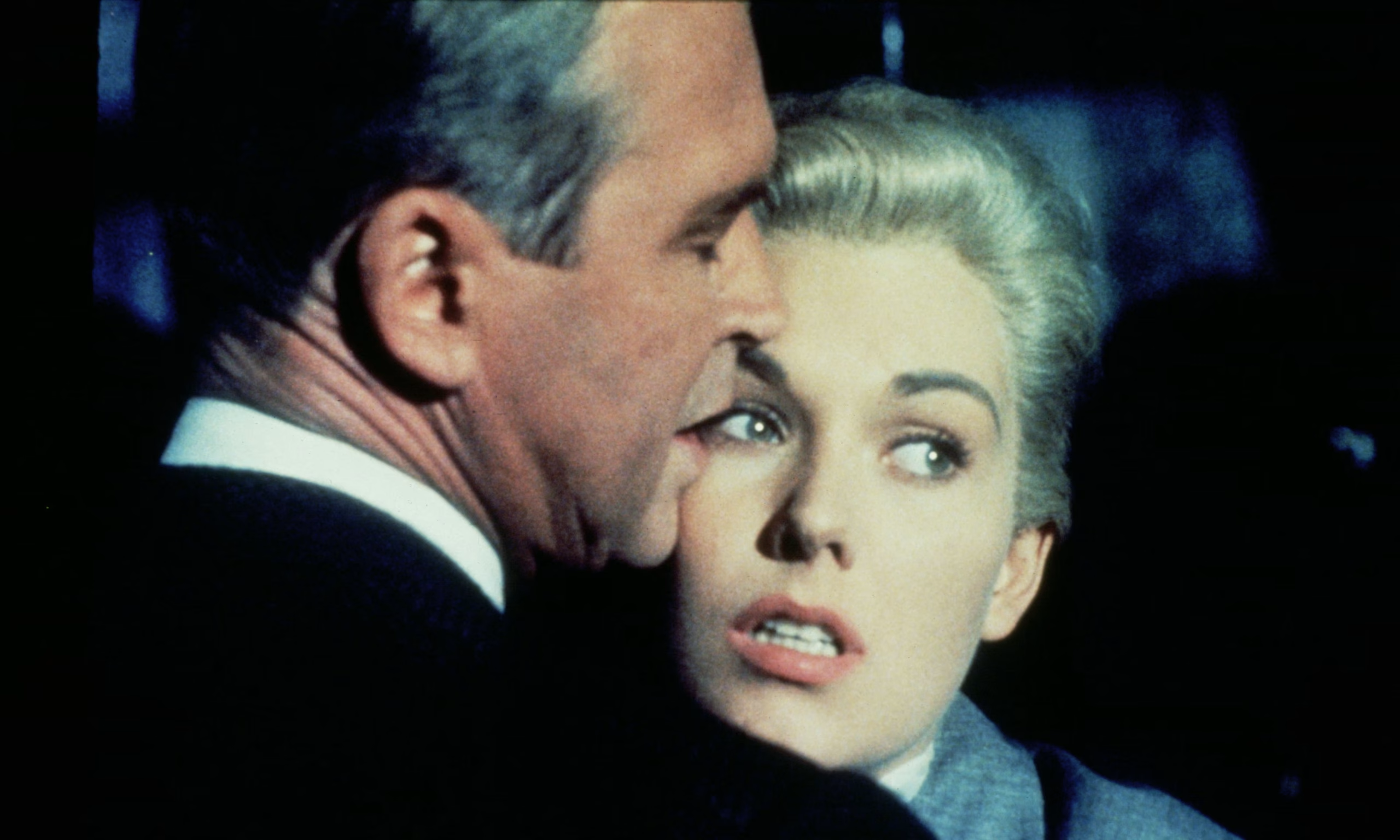
“I always think that film music expresses what the actor can’t show or tell.”
—Bernard Herrmann, interviewed by Ted Gilling, Sight and Sound, 1971–72
“I feel that music on the screen can seek out and intensify the inner thoughts of the characters… It can propel narrative forward or slow it down. It often lifts mere dialogue into the realm of poetry,”So wrote Bernard Herrmann for a 1972 London recording
“My feelings and yearnings are those of a composer of the 19th century. I am completely out of step with the present.”
-Bernard Herrmann in a letter to his wife
“He depends on music and often photographs a scene knowing that music will complete it.”—Bernard Herrmann, interviewed by Ted Gilling, Sight and Sound, vol. 41, no. 1 (1971/72), pp. 36–39; by Cinescores. “He” refers explicitly to Hitchcock in the preceding sentence.
On music as Hitchcock’s weapon of suspense: “I think that Hitchcock’s films depend enormously on music to build his nutcracker of suspense, and to impose on him a kind of pop culture is to deprive him of one of the greatest weapons in his arsenal.”
—From the same Ted Gilling interview. This is the full sentence as reproduced in the transcript. Herrmann was discussing the end of their collaboration and his objection to the pressure for pop-oriented music.
On Hitchcock adapting his editing to the score: “Hitchcock, for example, is very anxious for you to tell him when you see a rough cut where you plan to use music, because if you’re using music, he’ll cut it differently.”
—From the same interview. This gives you a specific account of how the collaboration worked: the planned music could affect Hitchcock’s editing, rather than simply being added to a finished sequence.
On their break—sharper and more confrontational: “Because … he only finishes a picture 60 percent. I have to finish it for him.”
—Bernard Herrmann, interviewed by Royal S. Brown in August 1975. The ellipsis appears in the published transcript; The interview first appeared in High Fidelity in September 1976 and was revised for Brown’s Overtones and Undertones (1994). The Bernard Herrmann Society reproduces it with a note explaining that the original recording was consulted to restore deletions and some of Herrmann’s original wording.
In the Gilling interview, Herrmann also recalls Hitchcock saying, about Vertigo: Alfred Hitchcock, as recalled by Bernard Herrmann. “If we’re going to have music, we won’t have one word of dialogue; we’ll just have the camera and you.”
Composer Miklos Rozsa reportedly said: “Herrmann was a Gulliver among the film music Lilliputians.”
“The thing about Herrmann was that he was a forceful personality and that force in his personality found its voice in those hammering, repetitive themes of his, which you can’t get out of your ear. – Composer John Williams
Before the Image, a Voice- Bernard Herrmann and the music beneath the surface
I often feel that Bernard Herrmann’s music reaches a character’s inner life before the film has found the words for it. It doesn’t merely accompany danger or alert us to the fact that danger is near; it draws us into and lets us also feel their dread, longing, obsession, or loneliness. Before we know its name, we know the sound.
A shower curtain opens, and violins turn into an assault. A woman emerges through a ghostly green light, and the orchestra swells with an obsessive love so desperate that it can no longer distinguish a person from a beautiful phantasm. A taxi moves through Manhattan steam, and the music offers two versions of the city: one is seductive, the other already burning.
These are not merely memorable musical textures or the voices of films like Psycho, Vertigo, and Taxi Driver. They are part of what those films mean. Bernard Herrmann could make an orchestra reveal something that a character would never admit, or that a director preferred to leave unresolved. His music did not always tell us what was happening, but it did tell us what happening felt like, from somewhere dangerously far inside.
Bernard Herrmann’s biographer Steven C. Smith, the author of A Heart at Fire’s Center: The Life and Music of Bernard Herrmann, finds much of Herrmann’s genius in his ability to evoke psychological nuance, and in the way he brought together just the right instruments to give each film its own emotional undercurrents and draw us closer to the characters’ fear and desires.
You may know Bernard Herrmann’s music whether you realize it or not. Think of the dark snarling brass that opens Citizen Kane, the spiraling arpeggiated phrases of Vertigo, or the headlong rush of North by Northwest. Those strings that slash the air in Psycho, the saxophone drifting through Taxi Driver, and, of course, each belongs so completely to its film that it is hard to imagine the images without it in the realm of modern cinema.
Yet there is much more to Herrmann than menace. He could give The Magnificent Ambersons a tenuous elegance, then summon the enormous forces that seem to shake the ground beneath Mysterious Island. Across that range, you can still hear his signature: short phrases that won’t let go, chords that seem suspended in midair, and moments when the music opens unexpectedly into longing. Listen to brass voices plunging in Cape Fear or the sinister whistling theme from Twisted Nerve. The music leaves us unsettled, waiting for a resolution that never quite arrives.
The title The Sound of Suspense fits him, but suspense is only the beginning. Herrmann also understood solitude, tenderness, grief, and the peculiar terror of wanting something that could save you in the end or finally bring you relief, while the threat that you might never attain it feels all too real.
But his music could just as readily open its arms to romance, catch the exhilaration of an adventure, or give us the wonder of stepping into a world we had never imagined. He had room for the whole sweep of feelings, from the smallest private hope to the grandest leap into the unknown. Maybe beneath the famous shocks lies a composer of longing: for lost childhoods (Citizen Kane), unreachable lovers (the heartbreaking separation between Lucy Muir and the ghostly sea captain in The Ghost and Mrs. Muir), vanished worlds (The Magnificent Ambersons – the family’s privileged world gives way to industrial change. His soundtrack captures the loss of an entire social order, not simply one person’s happiness) Herrmann’s score belongs to that story of decline and displacement, and human contact that arrives too late (Taxi Driver, On Dangerous Ground) or at a price. His reputation for terror can overshadow the yearningly romantic side of his music, particularly in North by Northwest and The Ghost and Mrs. Muir. All of it belongs to the emotional territory of his work. He could also make room for love fulfilled, horizons opening, and the sheer joy of being swept into something larger than ourselves.
Bernard Herrmann might have preferred to be celebrated for his opera Wuthering Heights, his symphonies, his cantata Moby Dick, and his other concert works. Yet, according to fellow film composer John Williams, Herrmann’s greatest ambition was to earn recognition as a conductor. Whatever recognition he hoped for, the movies became the place where his imagination left its deepest mark. He helped change not just how films sounded, but what they could say through music, and generations of composers have been listening ever since. That was “his great skill—his understanding of the psychology of the character,” fellow film composer Howard Shore said. Herrmann could hear what was happening beneath a character’s words and actions, then give it musical expression. His scores brought us closer to the fears, desires, and contradictions driving the people on screen.
Herrmann’s music could stir a feeling, resist it, or give it an unexpected gravity. The psychology was in the encounter—not only in the person, but in what happened when that person met the world.
Directed by Norman Dawn the film stars James Arness as Kirk Hamilton, Kasey Rogers as Elaine Jeffries, Bill Kennedy as Martin Shannon, Pierre Watkin as Elaine’s father, Magistrate Jeffries, Gloria Petroff as Janice Jeffries, Tom Hubbard as John Hartley, Jane Harlan as Nancy Holden, Tom Monroe as Captain Tallman, Michael Rye as Captain Hackett, and Fred Kohler Jr.as sailor Nat Mercer.
In 1830, on the American clipper ship named ‘The Queen’ first Mate Kirk Hamilton is assailed by bloody pirates led by Captain Hackett. Kirk is brought ashore to treat his wounds, where he meets Elaine Jeffries and the two fall in love. But Elaine is engaged to rancher Martin Shannon and of course a the male rivalry begins. Once again the ruthless Captain Hackett raids and plunder the colony and kidnap Elaine and her little friend Nancy Holden. Which leads Kirk and Martin Shannon to rescue them from the pirates and various dinosaurs that inhabit the volcanic island!
Directed by Charles Lamont a satirical look at H.G. Wells’ story with our two funny men Bud Abbott and Lou Costello at the center! The film also stars Arthur Franz as boxer Tommy Nelson, Nancy Guild as Helen Gray, Adele Jergens as Boots Marsden, William Frawley as Detective Roberts and Sheldon Leonard as Boots Morgan…
Comedy didn’t escape the horror genre so it certainly didn’t lose time letting Abbott & Costello have a crack at The Invisible Man! By the 1950s they needed gimmicks to seduce their fans into adoring them again. The pair play Bud Alexander and Lou Francis amateur private eyes, hired by boxer Tommy Nelson (Arthur Franz) who’s been accused of killing his manager, to clear his name of the murder. Tommy takes scientist Helen Gray’s serum that produces invisibility. In a hilarious scene Lou poses as a boxer while the invisible Tommy is really doing all the slugging. Of course the duo find the real killer!
ABBOTT AND COSTELLO MEET THE INVISIBLE MAN, Bud Abbott, Arthur Franz, Lou Costello, 1951ABBOTT AND COSTELLO MEET THE INVISIBLE MAN, Bud Abbott, Lou Costello, Arthur Franz, 1951
Det. Roberts: [Tommy Nelson is gone] How did he get out?
Lou Francis:Installments.
Det. Roberts:Installments?
Lou Francis:Yeah, he did a Gypsy Rose Lee, come here!
[they find Tommy’s clothes lying about]
Lou Francis: That, that’s all that’s left of him.
Det. Roberts:Evidently Nelson changed clothes… what was he wearing when you last saw him?
Lou Francis:Air… nothing but air… and then he asked me how he looked.
Det. Roberts:Wearing air? What are you talking about?
Lou Francis:I went to shake his hand, his hand was gone, I looked up to speak to him, his head was gone. Then he took off his shirt, his body was gone, he took off his pants, his legs were gone! Then he spoke to me, I was gone.
Director Curt Siodmak, (director The Magnetic Monster 1953 & Curucu The Beast of the Amazon 1956, Black Friday, The Ape and The Invisible Woman 1940-story/screenplay, The Wolf Man 1941-screenplay, Frankenstein Meets the Wolfman 1943, Son of Dracula 1943-screenplay, I Walked with a Zombie 1943-screenplay )
Bride of the Gorilla stars the gorgeous Barbara Peyton as Mrs. Dina Van Gelding, Lon Chaney Jr. as Police Commissioner Taro, Raymond Burr plays it cool as Barney Chavez , Tom Conway as Dr. Viet, Paul Cavanagh as Klaas Van Gelder , Giselle Werbisek as Al-Long, Carol Varga as Larina, Woody Strode as Nedo the Policeman. and Steve Calvert as the Gorilla.
“The heart is deceitful above all things and desperately wicked!–Klaas Van Gelder
Raymond Burr plays Barney Chavez who manages a plantation in the jungles of South America. He desires his boss plantation owner Klaas Van Gelder’s wife and in order to get his wife Dina he murders him in cold blood. But he is vexed by the old witch Al-Long who has seen his crime, he believes that he has been cursed to become a nocturnal gorilla run amok
Deep in the South American jungle plantation manager Barney Chavez (Raymond Burr) kills his elderly employer in order to get to his beautiful wife (Barbara Payton). However, an old native witch witnesses the crime and puts a curse on Barney. Does he really transform into a killer ape by night or is the curse just a matter of suggestion, and psychological head games pressing on his guilt. He is driven mad believing that he is the ‘jungle demon-the succarat’.
Police Commissioner Taro: [narration] This is Jungle – lush, green, alive with incredible growth – as young as day, as old as time. I, Taro, Police Commissioner of Itman County, which borders the Amazonas River, know it as well as any man will ever know it. Isn’t it beautiful? But I have also learned that beauty can be venomous, deadly, something terrifying, something of prehistoric ages when monstrous superstitions ruled the minds of men, something that has haunted the world for millions of years rose out of that verdant labyrinth. Let me tell you how the jungle itself took the law into its own hands. This was Van Gelder Manor, built to stand against the searing sun, built to shelter generations of Van Gelders, it also has become prey to the powers of the jungle, that terrifying strength that arose to punish a man for his crimes.
Directed by the master who started out as an editor working with Val Lewton, Robert Wise, created this iconic film which gave the science fiction genre a level of artistic authenticity. It’s memorable and sensational for so many of us because of Wises’ directing, Leo Tover’s photography, acting by a stellar cast led byMichael Rennie and Patricia Nealand the art direction, set design and spectacular visual effects.
Michael Rennie plays Klaatu a visitor from another world, millions of miles away from Earth who brings a very dire yet hopeful message to us earthlings. “We have come to visit you in peace and with goodwill.” Klaatu appears essentially as a heavenly angel on a mission of mercy.
Klaatu has been sent as a representative by an organization of planets who have found a way to curb their tendencies toward war by installing other powerful robots like Gort to police them, “In matters of aggression we have given them absolute power over us!” Well, that’s a very provocative statement to make coming from Hollywood in the midst of The Cold War, but hey it’s one method, albeit a dangerous one, as Klaatu explains that “This power cannot be revoked. At first signs of violence they act automatically against the aggressor. The penalty for provoking their action is too terrible too risk.” The violation implies that their planet will be destroyed, which is what Klaatu warns the Earth about. Yes, Klaatu you haven’t achieved perfection with this system but you say it works. So does every dictatorship and totalitarian state.
Of course Michael Rennie is also not at all difficult to listen to as he isnt’ a 10 foot one eyed amorphic blob or a grotesque pants monster. Writer/Film historian Bill Warren mentions this inaccuracy in his book and cites Erich von Däniken. He was an ancient alien theoristclaimed that if aliens had visited before they could come again. Perhaps they left a few travelers behind who shacked up with earthlings and voilà thousands of years later you have a very sophisticated and silky talking Brit who looks smashing in a custom tailored suit.
Patricia Neal is beautiful in that retiring style of hers as widow Helen Benson, Hugh Marlowe plays insurance man Tom Stevens, the wonderfully sage Sam Jaffeplays Professor Jacob Barnhardt, Billy Gray plays Bobbie Benson, Frances Bavierruns the rooming house (another Aunt Bea) as Mrs. Barley, and Lock Martin is lurking inside that great robot silver pants-suit called Gort!
There are tiny bitty part for Stewart Whitman plays a sentry, Olan Soule has a bit part as Mr.Krull, Dorothy Neumann as operator Margaret and Richard Carlson as Thomas Stevens Jr. and few more familiar character actors we all love!
Part of the charm of this film for me on a side note is seeing three of The Andy Griffith Show players like Dorothy Neumannwho plays Otis Campbell’s wife, Olan Soule who plays hotel clerk / prissy choir leader Mr. Masters, and of course Francis Bavier the lovable Aunt Bea.
Dorothy Neumann as Rita Campbell isn’t always just barking at Otis or pouring his hootch down the drain. She’s been a hard working character actress in so many television shows and films you probably love! (The Snake Pit 1948, Sorry, Wrong Number 1948, she was Helen Lawson’s maid in Valley of the Dolls 1967
Leo Tover is at the helm of the camera, and captures the feeling of a world in befuddlement as well as framing many scenes with a noir sensibility as he had shot so skillfully before with The Snake Pit 1948, The Secret of Convict Lake 1951, and A Blueprint for Murder 1953. Art direction byAddison Hehrand Lyle R. Wheeler (Gone with the Wind 1939, Rebecca 1940, All About Eve 1950, Compulsion 1959) The post-modern expressionist Art Deco interior ship design is out of this world by Set direction by Thomas Little (The Grapes of Wrath 1940, All About Eve 1950)
The flying saucer or space-craft which allegedly cost $100,000 was modeled after actual sightings that were very popular and becoming rampant during that time in the 1950s And of course there's always Bernard Herrmann's use of the theremin that just quivers my strings.
Thanks to the direction of Robert Wise (one of my personal favorite directors), The Day the Earth Stood Stillis considered one of THE best and most beloved American Science Fiction films of the fifties. One of the interesting themes that runs through the movie is how Christ-like or archetypal Savior figure Michael Rennie's character Klaatu is– as he comes to save the Earth from their violent ways, and from themselves–in the end only to sacrifice his own life for the cause, then to be resurrected –moving on leaving his grave warning in our laps.
Gort, the menacing “interstellar policeman” from the science fiction film The Day the Earth Stood Still (1951) was a very tall man in the robot suit, and its smooth design posed several practical problems for shooting. Because it was made of flexible neoprene overall, similar to a skin diver’s wetsuit, the props team had to fabricate two suits that laced up in order to keep the fastenings out of sight while filming Gort moving:
One suit laced up at the back (for frontal shots), and the second, which laced up from the front, was used for the shots in which Gort was seen from behind. The neoprene suit creased at the hips, back knees, and front elbows when the actor inside moved, giving the impression of being made from a flexible alien metal. The filmmakers diminished the effect somewhat by keeping Gort’s movements to a minimum or by only shooting his upper body when he walked. – From Wikipedia
The film does work as a allegory during the Cold War era which warns us against our transgressions and wicked tendencies toward violent aggression. Klaatu arrives in his spacecraft with his robot companion a gleaming and imposing silver giant named Gort. Klaatu has been sent by an inter-planetary federation that fears Earth will use the atomic-bomb to destroy the universe in the not too distant future, and warns that if they do not stop their aggressive behavior, they will be blown to bits. Met by the military Klaatu extends an olive branch in the form of a gadget that they interpret as a weapon even though he tells the people of Earth "We have come to visit you in peace and in good will". But they begin firing upon him wounding him and imprisoning him in a hospital where he escapes and assumes the identity of a gentlemanly earthling. Bernard Herrmann’s signature melodic motif of tumult underscores a wonderful scene as authority figures search frantically for Klaaut, and Wise shows the public in various rapt by their radios and television set, reading newspaper headlines about the missing space man!
After Mr. Hardy who comes to interview Klaatu asks where he comes from Klaatu tells him that he’s traveled millions of miles to this planet Klaatu –“lets just say we’re neighbors” Mr Hardy-“It’s hard to think of another planet as neighbors.”
In the meantime Klaatu takes a small Washington boarding house as a mild mannered Maj. Carpenter where he meets Helen Benson (Patricia Neal) and develops a poignant relationship with she and her son Bobby (Billy Gray). Helen is being wooed by insurance agent Tom (Hugh Marlowe) who turns out to be as aggressive and dangerous as the majority of antagonists in the film.
Taking the name from the tag on a borrowed jacket he’s wearing, Klaatu takes the identity of Major Carpenter. When he arrives at the rooming house everyone is stunned at first, as he stands in the shadows.
Mr. Krull “It’s enough to give you the shakes. He’s got that robot standing there, 8 feet tall just waiting to just waiting for orders to destroy us!”
Helen- “This space man or what ever he is, we automatically assume he’s a menace. Maybe he isn’t at all… {…after all he was shot the minute he landed here } I was just wonder what I would do?” Maj. Carpenter-Well perhaps deciding on a course of action he would want to know more about the people here. To orient yourself in a strange environment.”
Mrs. Barley-“If you want my opinion he comes from right here on Earth!”
Olan Soule , John Brown as George Barley and Francis Bavier, Patricia Neal and Michael Rennie as Maj. Carpenter are having a meal at the rooming house.
Klaatu wants to walk among the people of earth to try and understand their, "strange, unreasoning attitudes." As Phil Hardy says Robert Wise's film works so well because of his masterful balance of the "˜ominous allegory with the sub-plot of Rennie's attempt to discover what humans are really like.'
In an amazing scene, where he shows his benevolent nature, Bobby catches his new friend at the blackboard in the Professors lab and solving a complex equation that he had been struggling with, in a few seconds. Bobby asks if the Professor had done it wrong, Klaatu tells him "It just needs a little help."
Klaatu also is befriend by the kindly, wise and brilliant scientist Professor Jacob Barnhardt (Sam Jaffe) who recognizes that Klaatu is not a threat nor a false prophet and reflects the better nature of humankind.
You have faith, Professor Barnhardt?- Klaatu
"Our problems are very complex Klaatu, you mustn't judge too harshly"–Professor Barnhardt
"I can judge only by what I see." –Klaatu
" Your impatience is quite understandable' –Professor Barnhardt
"I'm impatient with stupidity" –Klaatu
Professor Barnhardt:It isn’t faith that makes good science, Mr. Klaatu, it’s curiosity. Sit down, please. There are several thousand questions I’d like to ask you.
Robert Wise and cinematographer Leo Tover know how to paint a film noir canvas within the realm of science fiction The Day the Earth Stood Still bares a striking resemblance to many great noir pictures and their familiar tropes… not the least the misunderstood man on the run forced into the shadows, aided by a good women who has faith in him!
“The Day the Earth Stood Still” Michael Rennie, Hugh Marlowe, & Patricia Neal 1951 20th **I.V.
Bobby follows his friend Maj. Carpenter/Klaatu and discovers his secret! In a panic he runs and informs his mother all about it. She tells him he’s been dreaming again, but she also happens to be with Tom (Hugh Marlowe) who is just waiting to get Maj. Carpenter out of the picture and sets the end in motion.
The set design and use of lighting lends to the magnificent & moody atmosphere of the film.
As the title of the film suggests… it's striking when the moment emerges and everything stops, or stands still.
Klaatu sets the wheels in motion to stop the motion all over the earth! And so everything grinds to halt not only all means of transportation in this modern world, trains, ships, automobiles and buses, tools of industry cease like– farming machines that milk the cows, power stations and factories. Even the creature comforts people take for granted, like washing machines which are left with puddles of sopping clothes, milkshakes that don’t get shook and those poor people at the top of the roller coaster at the amusement park … A nation wide man hunt for the space man begins!
Reporter: I suppose you are just as scared as the rest of us.
Klaatu: In a different way, perhaps. I am fearful when I see people substituting fear for reason.
He tells Helen "If anything should happen to me, you should go to Gort"¦ You must say these words, Klaatu Barada Nikto. You must remember these words.”
Gort resurrects the Christ-like Klaatu
In the end, he is gunned down which summons the ire & wrath of Gort who opens up his metallic visor and lets loose a laser beam killing the soldiers. Consistent with the theme of deliverance and resurrection Gort brings Klaatu back to life and ascends like an other-worldly angel from the Earth to return to his delegation leaving behind the message that they either learn to live in peace or be destroyed that we do not have the temperament to be in control of atomic weaponry.
"I will not speak with any one nation or group of nations I don't intend to add my contribution to your childish jealousies and suspicions. "”Klaatu
"It is no concern of ours how you run your own planet, but if you threaten to extend your violence this earth of yours will be reduced to a burned out cinder"¦ your choice is simple"¦ join us and live in peace or pursue your present course and face obliteration!… We shall be waiting for your answer"¦ the decision rests with you."–Klaatu
Klaatu and Gort take off in the ship, he ascends back into the heavens our future rests with us!
An "˜ominous allegory’ — a reflection of our fears and mistrust– a message that it’s not too late to be overseen by giant soulless robots that might malfunction and reduce you to a cinder if you have an angry outburst about your $6 coffee tasting like mud!.
Directed by Arch Oboler (Strange Holiday 1945 starring Claude Rains, Bewitched 1945 starring Phyllis Thaxter, Bwana Devil 1952 in 3D, The Twonky 1953 and another 3D filmThe Bubble 1966)
Arch Oboler had been regarded very highly for his work in old time Radio primarily on “Lights Out” another show about fantasy/horror & science fiction themes.
Stars William Phipps, Susan Douglas Rubes, James Anderson, Earl Lee and Charles Lampkin.
This independent film has all the trappings of a low-budget art-house film with science fiction over-tones that’s rather dreary and nihilistic in tone. It’s deals with the aftermath of a nuclear holocaust that wipes out the entire civilization except for five survivors. The story has been dealt with either viewed through a campy lens as with Roger Corman’samusing vision of radioactive fall-out Day the World Ended (1955) with it’s cast of diverse survivors stuck in a canyon who are at risk of mutations out in the eerie fog, some turning on each other as their limited resources.
As with Corman’s beloved cult foray, Five’s characters are also victims of radioactive dust clouds, that kills off the animal life on the planet and essentially vaporizes people down to their skeletons.
William Phipps (Crossfire 1947, War of the Worlds 1953, The Brothers Rico 1957 & a slew of television appearances) plays Michael, a man who survived the nuclear disaster because he was stuck in an elevator at the top of the Empire State Building high enough to shield him from the atomic clouds (perhaps I should re-think my fear of elevators and my fear of heights -hhm) He encounters the only other survivors up in the mountains, Rosanne (Susan Douglas) who is going to have a baby, another recognizable actor from the 50s is the handsomely intenseJames Anderson, who plays an aggressive neo-Nazi named Eric, a black doorman named Charles (Charles Lampkin, another familiar face and busy television & film actor) and Mr. Barnstaple (Earl Lee), a bank clerk who is complete denial about what has happened, of course he succumbs to radiation poisoning.
With the mixture of personalities left to band together it isn’t any wonder that tensions build especially because there is only one woman left to go around. Eric cannot help but antagonize Charles and try to make an object out of Rosanne. Roxanne is still waiting for her husband to return, safely to her. The film has a filthy strain of meanness in it, as Oboler wants us to feel the desperation and detestable situation for ourselves. Eric kills Charles and grabs Rosanne with her newborn baby telling her that they are going to search for her missing husband in the city. It’s gruesome and dismal as they stumble upon skeletons in mid pose, in doorways, in their cars trying to escape. When she finds out that husband has perished she wants to go back up to the mountains. The two struggle and Rosanne tears his shirt exposing the fact that Eric has radiation burns all over his chest. In yet another very bleak turn of events, Rosanne’s baby dies while she’s making her way back to the mountains. All that are left now are Michael and the distraught Rosanne to be the archetypal Adam & Eve in a not so paradisiacal Eden drenched in atomic fallout.
The New York Times review said of Oboler’s Five- “Mr. Oboler spends so much time scanning the landscape, the sky, the sea and clouds that he can’t seem to bring himself to tangle with the problems fo his meek and baffled crew. And when he does he contents himself with fashioning a little drama of left-over racial hate in a world virtually empty of people, rather than seek the terror in a human void.”
STAY TUNED FOR PART II OF KEEP WATCHING THE SKIES -THE YEAR IS 1951
Act of Violence 1948 directed by Fred Zinnemann and starring Van Heflin, Robert Ryan and Janet LeighLon Chaney in Victor Hugo’s The Hunchback of Notre Dame 1923What Ever Happened To Baby Jane? 1962 Directed by Robert Aldrich and starring Bette Davis and Joan CrawfordBedlam 1946 directed by Mark Robson Produced by Val Lewton and starring Boris Karloff and Anna LeeBette Davis and Bette Davis in Dead Ringer (1964) directed by Paul Henreid and co-starring Karl Malden and Peter LawfordJoan Blondell and Tyrone Power in Nightmare Alley 1947 written by Jules Furthman for the screen and directed by Edmund GouldingCabin in the Sky 1943 directed by Vincente Minnelli and starring Lena Horne and Ethel WatersCrossfire 1947 directed by Edward Dmytryk starring the Roberts- Robert Young, Robert Mitchum and Robert RyanThe Day the Earth Stood Still 1951 directed by Robert Wise and starring Michael Rennie, Patricia Neal and Hugh MarloweThe Devil Commands 1941 directed by Edward Dmytryk and starring Boris Karloff and Anne Revere written for the screen by Robert Hardy AndrewsTHE OLD DARK HOUSE, THE (1932) GLORIA STUART and BORIS KARLOFF Dir: JAMES WHALEDr JEKYLL AND MR HYDE 1931starring Frederick March & Miriam Hopkins and directed by Rouben MamoulianThey Live By Night starring Farley Granger and Cathy O’Donnell. Directed by Nicholas RayJoan Fontaine and Judith Anderson in Alfred Hitchcock’s Rebecca 1940Phantom of the Opera 1925 starring Lon Chaney and Mary PhilbinTod Brownings Freaks 1932Gloria Grahame Odds Against Tomorrow 1959 directed by Robert Wise Josette Day in Cocteau’s Beauty and the Beast 1946Judith Anderson in Rebecca 1940Janet Leigh and Phyllis Thaxter in Act of Violence 1948Joseph L. Mankiewitz directs Louis Calhern & Marlon Brando in Julius Caesar 1953Fritz Langs’ Metropolis 1927William Castle’s Mr Sardonicus 1961 Starring Guy Rolfe and Audrey DaltonWilliam Wyler directs Shirley McClaine in Lillian Hellman’s The Children’s Hour 1961co-starring Audrey Hepburn and James GarnerMary Astor and Van Heflin Act of Violence 1948Odds Against Tomorrow Shelley Winters and Robert Ryan 1959Gregory Peck in Robert Mulligan’s To Kill a Mockingbird 1962 written by Harper Lee with a screenplay by Horton FooteRobert Ryan in Robert Wise’s The Set-Up 1949Sam Fuller’s The Naked Kiss 1964 starring Constance TowersCecil B DeMille’s Samson and Delilah 1949 -starring Hedy Lamarr and Victor MatureRobert Stevenson directed Bronte’s Jane Eyre 1943 starring a young Elizabeth Taylor and Peggy Ann GarnerThe Children’s Hour Audrey Hepburn and Shirley MacLaineJulie Harris and Claire Bloom in Robert Wise’s The Haunting 1963George Romero’s Night of the Living Dead 1968Barbara Stanwyk as Jo in Walk on the Wild Side 1962 directed by Edward DmytrykWhat Ever Happened to Baby Jane? 1962 Bette Davis and Victor Buono
HAPPY FRIDAY THE 13th- Hope you have a truly lucky day-MonsterGirl