

LINK TO PART 1 HERE
Alfred Hitchcock’s Double Faces: Shadow of a Doubt and Psycho 1960
In both Shadow of a Doubt and Psycho, Hitchcock builds suspense around characters who live double lives, but he stages that duality very differently. In Shadow of a Doubt, Uncle Charlie’s charm and respectability in the Newton household mask his identity as a serial killer of wealthy widows; the film’s tension hinges on the gradual recognition that the adored uncle and the “Merry Widow Murderer” are one and the same man. The doubling of names and the mirrored staging of the two Charlies lets Hitchcock put sweetness and light and a dark side in the same frame, blurring what counts as safely good. Young Charlie’s name mirrors his, and the smallest movements they share quietly give away the bond between them. How deeply she identifies with him, making his darkness feel like a possible version of herself.
Alfred Hitchcock’s Psycho (1960) We All Go a Little Mad Sometimes
By contrast, Psycho turns dual identity into a literal split within Norman Bates himself, dramatized through his alternating personas as a shy motel manager and the Mother figure who commits the murders. The film’s structure withholds this doubling until later in the film, encouraging us to think of Norman and Mother as two separate characters; only the revelation that he is both collapses the divide and exposes a psyche fractured between dependence and homicidal rage. You could hone in on this as Hitchcock’s most blatant version of the “double,” where the conflict isn’t between two people but between two selves jostling for control inside one body.
Where Shadow of a Doubt focuses on the way ordinary family life can harbor a charismatic killer whose evil feels uncomfortably close to the heroine’s own fantasies of rebellion and freedom, Psycho pushes duality inward, making the body itself the site of conflict between competing identities. Uncle Charlie embodies a radical evil, hidden violence camouflaged by everyday respectability, while Norman Bates embodies a more extreme version of the divided self, in which the social self and murderous impulse are separated into distinct, competing characters within one man.
Uncle Charlie is a sort of Bluebeard… born out of an intensely misogynistic Social Darwinist mindset. He is the integrated man who chooses evil, evil that is deeply willed, rooted in a chosen worldview. A predatory, nihilistic misogynist who has an actual philosophy — “Today’s the thing — that’s my philosophy” and his “Do you know the world is a foul sty? Do you know, if you rip off the fronts of houses, you’d find swine?” speech captures a man who has reasoned his way into monstrousness. Norman Bates and Charles’ violence is both gendered,
Norman Bates and Charles’s violence is both gendered, but through a very different mechanism — punishing women on his mother’s behalf rather than out of an articulated worldview. And while Hitchcock builds both villains out of the same idea—the doubling—he splits it in opposite directions. With Uncle Charlie, the double lives outside him: an uncle and niece who share a name, seem to think on the same wavelength, and, as the film keeps hinting, it feels less like two people than one soul stretched across two bodies.
He’s whole, and that’s what makes him terrifying; his evil isn’t some hidden symptom. He is whole within himself, terrifyingly so; his evil isn’t a symptom; it’s a philosophy he can recite at the dinner table without raising his voice. The scary part isn’t that Charlie finds a monster hiding inside a man she loves. She shares his restlessness, his hunger to escape the ordinary. The horror is discovering that his answer to that same restlessness is murderous misogyny, something she wants no part of. The kinship is in the itch, not in the conclusion he draws from it.
Norman Bates flips that setup completely. He doesn’t need a niece to mirror him, because the double already moved inside — one body, two minds — his and his mother’s, and the control passes between them, each one waiting for the other to lose its grip until, by the end, only one is left holding on. Uncle Charlie can look you in the eye and tell you exactly what he believes the world is. Norman can’t even tell you which version of him is talking. His evil isn’t something he chose or could defend; it’s just what’s left after his mind cracked under grief and guilt and never put itself back together. Uncle Charlie picks his darkness. Norman just gets picked by his, again and again, until there’s nobody left inside to take the blame.
Hitchcock uses the two Charlies as a kind of living split-screen, letting us see sweetness and light and the dark side walking arm in arm through the same small-town frame. Psycho routinely reads Norman’s alternation between himself and Mother as a textbook case of fractured identity. By the time we reach the basement revelation, Norman isn’t just slipping between moods; the film turns an internal conflict into a full-blown duet of competing selves, mirror-image killers locked in the same body.

Norman’s duality is framed by Hitchcock’s use of his reflection in the window.
Teresa Wright’s Quiet Brilliance in Shadow of a Doubt
Teresa Wright actually came to Shadow of a Doubt through one of those old-Hollywood “loan-out” deals. Samuel Goldwyn agreed to lend her to Jack Skirball at Universal, who, in turn, was trying to line up Hitchcock through David O. Selznick. Teresa hated the whole loan-out system—it felt like a form of professional servitude, and it meant the studio collected a fat fee while the actor just stayed on their usual salary. Still, for Teresa, the chance to work with Hitchcock was irresistible. She signed on in August and headed up to Santa Rosa, about sixty-five miles north of San Francisco, for two weeks of location shooting. The funny thing is that the project for both of them wound up as a favorite: Hitchcock later singled Shadow of a Doubt out as his personal best, and Wright kept naming it as the film she loved most in her own career.

It’s not hard to see why both Hitchcock and Wright held the film in such high regard. Shadow of a Doubt is a quietly stunning piece of work: unsettling and deeply felt, carried by extraordinary performances and shot in a black-and-white style that makes even the most ordinary scenes feel haunted. Every scene bears the unmistakable hand of a master at work. In shot after shot, you can feel Hitchcock’s assurance that he was always completely in command of his art.
On top of her recent Oscar, which made her a very appealing name for the project, Teresa Wright came to Hitchcock with a strong endorsement from Thornton Wilder, who had been brought in to write the script. The story itself can be read as a kind of shadow version of Our Town, its darker underside. Years later, in 1974, she described her first meeting with Hitchcock in vivid detail, remembering how that collaboration began
“When he told me the story as we sat in his office, it was as if he had already finished the picture. He had it completely planned in his mind, along with every sound effect, and he told me the entire movie, scene by scene. He used anything on his desk as a prop- a drinking glass, a pencil, or a book. He stepped around. If a character was strumming his fingers on a table, for example, it wasn’t an idle gesture- Hitch put a beat to it, like a musical pattern or a refrain. If someone was walking or rustling a newspaper, tearing an envelope or whistling, or if there was a flutter of birds or an outside sound, Htich had everything carefully orchestrated.”
As for the filming process:
“ Hitch made us all feel very relaxed, and his direction never came across as mere instruction. We felt we could trust him, and although he guided us carefully, he also gave us a sense of freedom. He was very calm, as if we were contributing to something that was already a foreseen success. No one plans a film as thoroughly as Hitch, and no one saw it as clearly as he did from the start. Other directors often let things happen during the shooting, but with Hitch’s planning, everything was more serene during production, and therefore more enjoyable… What luck it was for me — this was a wonderful role, a girl who starts off one way and then changes and grows before your eyes as she’s dealt with this awful problem. At the conclusion, it was the end of innocence for young Charlie, because now she knows evil exists, and in the one person she and her mother love the most. She has grown up and learned that someone she has loved and been loved by can literally kill people.”

Not everything about the shoot was comfortable for her. She later recalled that, just before calling “Action!”, Hitchcock would lean in and whisper something obscene—“usually,” she said, “having to do with a young bride on her honeymoon, which I had just returned from.” He also made comments about her husband, writer Niven Busch, especially regarding their age difference, which she found inappropriate. “I tried to cope with this by smiling, as if I didn’t understand him, or as if he was uttering the most polite compliments,” she explained, framing her response as a kind of polite deflection rather than genuine amusement.
According to Donald Spoto and from various stories told over the years, this wasn’t the first or last time Hitchcock entertained himself with a bit of verbal mischief at the expense of a leading lady. It’s tempting to think he was sometimes chasing a reaction—a flash of shock or discomfort right before a demanding shot—since that kind of tactic is hardly unheard of on sets. What makes it stranger is the way it sits against his public persona on the job: the suit, white shirt, and tie; the calm, almost placid manner; the refusal to shout or create chaos. All that bourgeois respectability is sharply at odds with the sudden eruptions of crudely inappropriate remarks.
“Charlotte, age 19 or 20, is one of his nieces, named for him. The film charts the girl’s moral education as she progresses from innocence and untested idealism to a firsthand experience of the eruption of evil amid everyday reality – and the murderous tendency to depravity that is latent in human nature, indeed in everyone. Teresa filmed her role calmly, but inside, she was perhaps for the first time, tearing herself to pieces, enduring a nervous stomach and losing weight. While under Hitchcock’s tutelage, she thought out every moment of her character’s abrupt introduction to the darkness in human nature. She stated, “I had to understand how this woman felt- how she developed to include a mature, tough side, too. After all, cardboard characters are no fun. There’s no place you can go with cardboard, no depth.”—Source: Teresa Wright and Donald Spoto
For someone working under that kind of pressure, Teresa delivers something remarkably close to a lesson in screen acting: “The shots of Wright,” wrote the novelist and critic Stephan Talty, “Have the raw power of those early silent close-ups in which an entire drama was played out on the face of the actor, {and her performance} remains one of the most lucidly beautiful in the cinema.”
Teresa’s work in Shadow of a Doubt really shows how much the film depends on her and how steadily she carries it. Because the film was shot out of sequence, the location work involving the Santa Rosa exteriors done first and the studio interiors saved for later, meant she had to hold Charlie’s whole emotional journey in her mind, she had to keep track of Charlie’s emotional arc almost entirely in her head, even when she’s jumping from one stage of it to another on set, and knowing that the audience would experience it as a steady descent rather than pieced together, the way she was actually filming it. Because she’s in almost every scene, being on screen for nearly the whole picture, she walks that line so carefully that Charlie’s ordeal hits hard in the moment and feels at once startling and, when you look back over it, where the film has taken her, grimly inevitable.

What stays with me is the way she handles Charlie’s innocence. She slowly lets it erode over the course of the film without ever tipping into fake purity or sentimentality.
The early, almost breathless trust she places in Uncle Charlie, where she practically glows with the faith she puts in him, never plays as simple wide-eyed naivety; and when that trust collapses, her talk of stopping him—even killing him if she has to—lands with real weight rather than melodrama. The lines carry a kind of sober conviction instead of tipping into hysterics.
She refuses to treat Charlie as a passive victim. Once the truth about the widows comes into focus, Teresa steps into the role of opposition: she becomes a kind of adversary, someone who sees him clearly and refuses to surrender the moral ground. And she does most of this work not through dialogue, but through the look on her face, the way her eyes move from worshipful to wary, from adoration to suspicion to outright defiance as the film closes in around them.
“You must be thinking the right thing,” she said. Because it will show if you’re not. When there’s a close-up of your eyes, you can’t be thinking of making the 11:45 train or something. “
“In scenes with Henry Travers- he had played the stationmaster in Mrs. Miniver – and with Patricia Collinge as her mother (Aunt Birdie ), Teresa was an acute listener- hence our identification with her character deepens as we listen with her. Opposite the pliant lure of perilously attractive Uncle Charlie, another actress might have been diminished precisely because his character is so fiercely idiosyncratic and unpredictable, but Tressa allowed young Charlie’s moral education to emerge without forcing the issue of a life lesson- and so she left a nuanced, exquisitely rendered performance that gave Shadow of a Doubt its coherence and complexity.” —source: Donald Spoto
“She was lovely to work with,” producer Jack Skirball wrote to Samuel Goldwyn after the picture was released. “And in my opinion, she has no superiors, and few equals as an actress. I was very impressed.”
Hitchcock lavished his praise upon Teresa Wright: “I got along very well with Teresa. IF she can’t act a line in a script, there’s something wrong with the line. She was always prepared and completely professional; she knew what she was doing, she always got things right, and she gave a great deal to the picture.”
As for Teresa, she was candid for the rest of her life: “At the time we made this picture, we all thought it was a great film. But I don’t think any of us had an idea that it would have such an impact on generation after generation.”
Even at the height of World War II, critics were already applauding Teresa. Howard Barnes of the New York Herald-Tribune praised her “quietly authoritative performance that elevated the film into a screen classic.” William Wyler kept boosting her, calling Teresa “an actress who can do no wrong,” and critic Alton Cook went so far as to say she was “one of the great new actresses of our time.” Time pretty much sealed the deal by dubbing her “Hollywood’s best young dramatic actress.”
In 1943, Oscar nominations were announced: Shadow of a Doubt only landed a nod for best original story, based on a six-page outline by Gordon McDonell, and even that lost to William Saroyan’s The Human Comedy. It wasn’t the first time, and definitely not the last, that a Hitchcock masterwork slipped past the industry’s radar. On top of that, many moviegoers, then and long after, were baffled that Teresa Wright’s name was nowhere to be found among the best actress nominees for 1942. To me, both omissions are criminal.
Source: Teresa Wright’s Biography, A Girl’s Got to Breathe: The Life of Teresa Wright, by Donald Spoto.
The Shine on Santa Rosa, and the Rot Beneath: Sunlight on the Sidewalk, Darkness in the Parlor: American Small Town Idealism Shattered and Exposed


In the opening, it’s filmed in Newark, NJ (the Pulaski Skyway), set nominally in the East- Philadelphia- a deliberately nameless, sullied Eastern city contrasted with the idyllic Santa Rosa. That East/West opposition is itself part of the film’s meaning; the Library of Congress essay notes that Hitchcock shoots the East “unflatteringly” as symbolically tainted, with California standing for democratic small-town virtue.

On a historical side, Shadow of a Doubt is significant because it reflects the social anxieties of the early 1940s, when the United States was moving more fully into the Second World War. Santa Rosa is staged as the kind of town wartime America liked to imagine itself defending: clean streets and neighbors who know your name.
The film’s critique of American small-town idealism comes in through the side door. Santa Rosa is presented at first as an almost promotional vision of wartime America: you’d imagine friendly shopkeepers, church picnics, families who can leave their doors unlocked because “nothing bad ever happens here.”
One tiny obsession and brief indulgence: I hear so often from people who say a variation of this, “Things like this don’t happen here,” as if the town’s zip code were a moral force field, and it drives me crazy because it’s just not true—and it’s not innocent. It never fails that that particular statement comes up in every true-crime doc I watch.
What they’re really saying is: “We are the kind of people this shouldn’t happen to.” It implies that violence belongs somewhere else, with other, supposedly “lesser” people or more “obvious” places—the big city, the bad neighborhood, the wrong side of town. It turns tragedy into a weird kind of compliment to themselves: our town is so wholesome, so American, so normal, that reality itself has somehow broken character. I just want to push back against the moral hierarchy baked into “things like this don’t happen here.” …anyway, rant over.
Wartime small-town ideal: In the early 1940s, Hollywood and official culture were busily mythologizing the small town with its charming central square and treeline residential streets, and the happy family as the sturdy, wholesome heart of the nation, all those ideals that were being fought for.
This is not the sentimentalized view that Americans remembered their pre-Pearl Harbor country to be; rather, the film suggests the world has always been filled with horrible people.Three years later, this same concept was repeated in Orson Welles’ The Stranger, a yarn about a post-WWII Nazi who escapes only to settle down in a sleepy American suburbia—the paranoid suggestion being that even though the Nazis were defeated, there was still danger in our seemingly safe communities. – Brian Eggert 2013 essay for Deep Focus Review
Both Hitchcock and Welles, for that matter, sought to challenge blindly optimistic views of small-town America and expose its seedy underbelly.

Here there’s an immediate disruption: Shadow of a Doubt steps into that moment and quietly undermines it, showing how a town that looks perfectly right can still set out the welcome mat for a serial killer.
On screen, the town doesn’t read as distinctly Californian at all. It comes across more like a classic Midwestern community, the small-town narrative of innocence, the kind of setting that feels about as generically American as you can get. Santa Rosa is framed as a typical American town, and the Newton family history absolutely meets that idealized version: the hardworking father, devoted mother, their shiny kids, and their beloved visiting uncle. The shared story the Newtons have about themselves makes the possibility of a serial killer in their midst almost unimaginable, so when young Charlie begins to suspect the truth, she has to fight against the weight of that family myth as much as against her uncle himself.


Critics have focused closely on the film’s vision of small-town America as both cherished and quietly compromised. This folds Shadow of a Doubt into a broader 1940s cycle that exposes the other side of the small town, admiring the way it holds together both its bright and dark faces, a town that presents itself as warm and welcoming, yet might quietly conceal cruelty, self-deception, hypocrisy, and a capacity for looking the other way.
What’s striking, given when the film was made, is how openly it undercuts the comforting image of the American small town. In the middle of the Second World War, when Hollywood was busy bolstering morale and selling an ideal of neighborly, churchgoing normality, Shadow of a Doubt quietly suggests that this kind of town can just as easily embrace a murderer as a cherished relative.
The streets look safe, the community looks devout and kind, and yet all of that warmth proves perfectly capable of sheltering someone whose violence is quietly buried in the scenery of ordinary people. The film is able to optimize this American shadow-self through its use of black-and-white psychological suspense to explore a sense of unease beneath the public rhetoric of unity and sacrifice. This suggests that evil might erupt not only overseas but in the heart of domestic life, highlighting the way characters cling to routine and optimism while underlying tensions and fears about safety, trust, and moral order seep in. Shadow of a Doubt isn’t just about a threat to one young, innocent girl or vulnerable widows; it threatens the symbolic foundations of wartime, postwar, and mid-century domestic spaces in American life.

While it’s not a pure domestic space at the Newtons’ reception, Hitchcock stages bourgeois civility as a fragile performance: the cocktails, polite conversation, and fixed smiles form a social facade that Uncle Charlie’s presence quietly destabilizes. It presents wartime respectability as theatrical and brittle, with its older, affluent guests embodying a false civility that masks the moral unease beneath the polished surface of suburban life. This gathering captures not so much domestic intimacy as a ritual of wartime-practiced bourgeois self-display, a setting whose composed civility is already vulnerable to Uncle Charlie’s intrusive evil. The image doesn’t show the comfort of home but the performance of respectability: here, at the cocktail party, it’s framed as a world of wealth, manners, class privilege, social exclusion, and repression that the film treats as deeply unstable. Already marked by the moral rot Uncle Charlie brings into the narrative.
Hitchcock’s great sleight of hand is to let that postcard image stand even as he quietly proves how easily a serial killer can hide inside it. By putting a murderer at the center of such an impeccably ‘normal’ household, the film brushes up against a broader unease: if the small town and the united family are supposed to be the sound heart of America, what does it mean when corruption arrives not from some urban underworld but from the guest room upstairs?

So here we are, with a film that knows how to capitalize on that myth. Within that postcard setting, we find a serial killer welcomed as a local celebrity, two armchair criminologists gleefully discussing strangulation over dessert, and a household so invested in maintaining its pleasant rituals that young Charlie’s suspicions would be treated almost as a breach of good manners. The film quietly reflects wartime anxieties about what might be lurking beneath the surface of American normalcy, and you can feel that in the way authority figures either misread or willfully ignore danger: the town’s respectability becomes Uncle Charlie’s camouflage. The psychological horror, then, is not just that one man is monstrous, but that a whole community’s desire to see itself as wholesome gives him room to operate.
In that sense, the film doesn’t just unsettle one town; it quietly disturbs a broader cultural fantasy that would harden in the postwar years—the idea of the “good” American community as a kind of moral safe zone. The Rockwell image of the nation, with its front porches, church socials, and polite Main Streets, was never just décor; it became a story Americans told themselves about where danger belongs and where it doesn’t. Shadow of a Doubt slips in before that story fully comes together and suggests that the rot isn’t an import from some distant elsewhere, but something that can grow in the very places most invested in denying it.
The dream as an illusion that requires constant performance

Seen from that angle, Uncle Charlie is not only a killer hiding in plain sight; he’s also a dark answer to the postwar fantasy of the returning hero. He comes home bearing charm, money, and an air of worldly glamour, and the town receives him as proof of its own goodness: look what kind of man our “perfectly American” town produces. The film’s cruelty lies in showing how easily that desire to see him as a success story blinds them to what he really is. The myth of the safe, idealized community doesn’t protect them from violence; it helps to script the conditions under which violence can thrive, hidden inside charisma and respectability.
Critics of postwar suburbia have called it a kind of mirage: a dream that looks solid in photographs but only holds if everyone keeps performing their part—staying married, mowing the lawn, keeping the right distance from whatever feels messy or threatening. Shadow of a Doubt plugs into that logic before the cul-de-sacs even arrive. Santa Rosa isn’t just “nice”; it’s a town whose identity depends on seeing itself as nice, and on smoothing out anything that doesn’t fit. That’s why the most frightening thing in the film isn’t only Uncle Charlie’s violence, but the way it slips so easily into the script—and how he is received as a sort of hero, an ideal son come home, and the town helps him hide simply by insisting that a place like this is no place for evil.

Postwar Dreams and White Picket Nightmares: The Myth of the Safe Town and who gets to live in that ’safe’ place: From Santa Rosa to Levittown
So when people say things like “this doesn’t happen here,” they’re talking about a “here” that was engineered to be racially homogenous and economically filtered. The innocence of the landscape depends, in part, on who has been kept off the streets.
The myth of the safe American town was always very clearly a selective one. Postwar suburbs – places like Levittown – were explicitly built with white families in mind; Levitt himself enforced whites-only policies, and the way loans and mortgages worked, these federal lending practices such as redlining helped make sure a lot of minority families never even had a shot at getting in.

In postwar suburbia and the American Dream language, Santa Rosa can be anywhere USA, like the creation of Levittown, Long Island, NY, and its quaint neighborhood and its ideal little houses that offered veterans the American Dream. I lived in one of these privileged white suburbs and actually grew up a few towns over from Levittown.
Shadow of a Doubt doesn’t suddenly turn it into a story about race, but for me, in later readings of the film, I can’t help but go there because it opens the door to thinking about what (and who) that safety has historically depended on ignoring. Hitchcock isn’t talking about race head-on in Shadow of a Doubt, noticing that his world is almost entirely white and organized around gender/class. But I can’t help noting that the myth of the safe, overwhelmingly white neighborhood has racial baggage. Even if the film doesn’t name it—but watching it now, it’s hard not to connect that “safe town” fantasy to the way real white neighborhoods have treated themselves as sealed off from danger.
The film is clearly uncomfortable with the idea of a perfectly sealed, perfectly innocent community. It hints at a bigger pattern: that the fantasy of safety only works if you ignore the violence, systemic, structural, and personal, that made that fantasy possible to begin with.
Shadow of a Doubt can be read as pressing hard on wartime American values, with figures like the banker, the family dinner table, widows, wealth, and everyday consumer comforts all coming under quiet attack. The film has been memorably described as at once a “subtle stab and warm hug” (Weekly Hitch) to the ideals America imagined itself defending in the 1940s, and that double attitude—smiling on the quaint values of Santa Rosa on the surface, paired with a stark reveal of how darkness can overshadow it—is very close to the tension I’m tracing in my own reading.
In the decades after Shadow of a Doubt, that postcard vision hardened into the now-beloved suburbia: rows of houses and that aggressive lawn culture that seems to be a manic-ured psychosis.
Here comes another tangent: Just like my neighborhood now and the surrounding towns seem obsessed with that vibe – green plastic perfection of their lawns. And they’ve cut down the old regal trees just for the sake of having a more sterile, view-hungry front yard, a bland, spray-painted, golf-course-type green, no clover, no moss, just one dead-flat shade as if it came out of a catalog. And don’t get me started on the leaf blowers, that drone so loudly it’s like a squadron of Bert I. Gordon or Jack Arnold–worthy giant mosquitoes coming in for an attack inside my skull. Rant over; back to the suburban ideal and Shadow of a Doubt.
By the time the film reaches its climax on that train again, the site of both arrival and attempted escape, Shadow of a Doubt has completed a kind of moral initiation story, dragging young Charlie from naïve idealism to a hard-won, nearly adult understanding of the world’s capacity for violence. Hitchcock sets up the final struggle as both a physical and symbolic severing of the tie between the Charlies: the killer uncle quite literally tries to remove the only person who can see him clearly, and in resisting him, she claims not only her survival but her right to interpret the world for herself.
At the funeral that follows, the town gathers to mourn a man they believe to have been taken away so tragically, a man they believed to be respectable and safe, while young Charlie and Jack hold the secret that would shatter that illusion; her last words suggest she will keep the secret about her uncle’s victims even as she remembers what he really is. It’s a remarkably bitter note for such a genteel setting, and maybe that’s why Hitchcock reportedly held this film in such high regard: it allows him to combine, as he put it, character and suspense, and in doing so it leaves a small, lingering stain on the very idea of the cozy American family thriller.
Donald Spoto writes, “[The film] marked a major shift in the director’s tone; from Shadow of a Doubt on, there is a moral cynicism about the human condition that pervades all his best work.”If this outlook was learned from Wilder, Hitchcock’s understanding was incomplete. With the death of Uncle Charlie, the world as represented by the typical American family and the typical small town has been ritually affirmed.”15 While the film and much of Wilder’s works test the moral fiber of his characters, human progress is nonetheless upheld, leaving cynicism in its wake.
Women at the Table, Wolves at the Door: Young Charlie’s Education as a ‘Good Girl’ and Women as Parasites, the Women Her Uncle Loathes: How Classic Cinema Rationalizes Misogyny

Uncle Charlie’s fourth-wall rant is where the misogyny becomes audible (“fat, wheezing animals”), and at the end, during the party honoring him, his toast is the charm that masks it. The misogyny lives inside the beloved-uncle performance — same face, charm concealing contempt: the man the town toasts is the man who rants at us about women who have no place in the world he inhabits.

You could say the white-picket-fence version of the American dream is basically gendered confinement. I’ve already talked about the vision of suburbia as the postwar fantasy of the kind of place that would wind up on a magazine cover: the single-family house, the white picket fence, the lawn, the car in the driveway—matching living-room set, and gleaming kitchen appliances. Even though it promised harmless comfort, it came with a built-in script that enforced a rigid social order that turned domestic life into a sort of soft-walled, psychological cage, especially for white women. That kind of illusion turned the home into a very seductive trap of suburban idealism.
Young Charlie: Poor Mother. She works like a dog. Just like a dog.
Joseph Newton: Where is she?
Young Charlie: She’s out. When she comes back, it’ll be the same thing. Dinner, then dishes, then bed. I don’t see how she stands it.


What’s striking about Shadow of a Doubt is that you can already see the early version of that dream forming in the Newtons’ house, even though it’s the 1940s and not yet the full-blown postwar suburb. Their dining table, their carefully kept routines, their sense that Santa Rosa is a perfectly ordinary town, all feel like the prototype of that later ideal, a family life that looks safe and self-contained, with Emma happily running the household and everyone else orbiting around her. Young Charlie’s restlessness and unease and her quiet fear of waking up one day as her mother’s double. And the sense that she wants something other than her mother’s life puts a hairline crack in that picture, long before the postwar boom turns that life into the norm and codifies it in Levittown houses and magazine spreads. She doesn’t have the language for it yet, but her refusal to settle into that script is part of what makes her eventually so attuned to the wrongness of Uncle Charlie’s presence: she’s already wary of the story that wants to cast her in the role that sees her as following the same quiet, domestic path laid out in front of her.
Young Charlie: We just sort of go along, and nothing happens. We’re in a terrible rut. It’s been on my mind for months. What’s gonna be our future?
Joseph Newton: Oh, come now, Charlie. Things aren’t as bad as that. The bank gave me a raise last January.
Young Charlie: Money? How can you talk about money when I’m talking about souls? We eat and sleep, and that’s about all. We don’t even have any real conversations. We just talk.
During his dinner table rant, Hitchcock frames her face in close-up, letting you watch the remnants of her admiration drain out and be replaced by a kind of stunned clarity. It’s a moment where patriarchy itself stands up at the table, carves into the roast, and tells everyone what it really thinks.


Emmy keeps up her cheerful composure while her brother continues his hateful soliloquy.
Hitchcock lets us see both timelines at once: the cozy, slightly old-fashioned home we’re watching on screen, and the more standardized, seductive trap it’s quietly pointing toward.
Historians like Kimberly Kutz Elliott (Ph.D. in American History from the University of North Carolina at Chapel Hill, specializing in U.S. culture with a strong grounding in women’s and gender history), has talked about how that world did offer real material comfort, but also this very quiet kind of imprisonment—that women were essentially nudged back into the housewife role, told to pour all their meaning into kids and appliances, while feeling this low, creeping sense that something in them was getting quietly flattened. Cultural critics have a great phrase for it: “white picket prisons,” those spaces that look like pure safety from the outside but carry this strange mix of isolation and malaise once you’re actually living inside them. And it’s not a stretch to see Santa Rosa as an early draft of that same story—a town so committed to its own normality, and if there are any flaws, there’s a whole lot of denial and myth-making, because of the town’s need to see itself as “perfectly American.”
Part of what makes Shadow of a Doubt such a quietly brutal film about gender is the way it stages two competing stories of what a woman is meant for. On one side, you have young Charlie, restless and bright, looking for something more than the life she sees laid out in front of her—marriage, children, perpetual cheer, and a vigilant smoothing over of anything unpleasant. Against young Charlie’s unease sits her uncle’s fully crystallized male worldview, his misogyny already hardened into outright disgust.
Diane Negra, Professor of Film Studies and Screen Culture at University College Dublin, who has written a monograph on Shadow of a Doubt, develops this further, suggesting that, in his mind, the women he murders are guilty of disrupting family life and of failing to live up to the expectation that unattached women should remain virtually invisible. Their other transgressions are a moral indictment of their breaking of his code of usefulness and restraint, and of their idleness and self-indulgence.
She also draws connections to Hitchcock’s broader body of work; Negra aligns with Jan Olsson (Swedish film scholar and professor of cinema studies at Stockholm University, best known in Hitchcock studies for his monograph Hitchcock à la Carte (Duke University Press, 2015) and with his broader work on film history and media culture. Olsson’s assessment is that his films frequently depict male revulsion toward women who are neither young nor socially constrained.
If you look at it through this lens, the dinner table scene becomes a chilling articulation of Uncle Charlie’s worldview, one where independent women are not just unwelcome but marked for destruction.
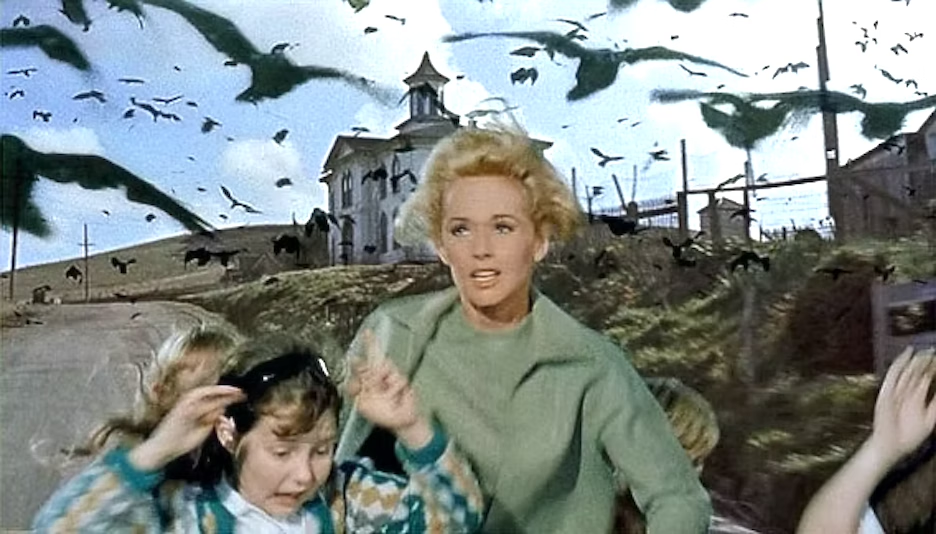
There’s a figure that haunts Hitchcock’s films — the woman who refuses to depend on anyone else, who possesses her own money, her own will, even just a flicker of independence — and she’s treated as something close to a natural disaster. Look at The Birds’ Melanie Daniels, or once again Tippi Hedren in Marnie – Her self-sufficiency and agency unsettle the order men have built around themselves, and Hitchcock is fascinated by how fast that unease turns to primal terror, then to fury. What begins as low-grade dread in the male psyche doesn’t stay there long; it gathers into that fury, and in his world, the fury tends toward murder. The autonomous woman isn’t simply a threat to a marriage or a social arrangement; she’s read as an offense against the way things are supposed to be, and the men around her answer that offense with violence.
These women are caught in a paradox that runs to the bone of Hitchcock’s world: to hold power is to court violence, because a woman in control has, by his logic, already committed the unforgivable offense. Female independence isn’t merely risky here; it’s transgressive at its roots, a violation of an order Hitchcock treats as natural law.
Young Charlie feels that pressure from the start, everyone around her expects her to be the good daughter, the charming niece, the girl who has to help keep the house’s mood, light, while Uncle Charlie represents the part of the system that’s all about punishment: the man who sees women as waste, who believes that getting rid of them is a kind of aesthetic or moral cleansing.


Feminist film theorists like Molly Haskell (From Reverence to Rape) have long pointed out how classical Hollywood has a long history of oscillating between putting women on a pedestal and dragging them into the mud – of presenting women either as revered ideals or degraded objects- and Uncle Charlie’s rhetoric takes its cues and aligns him unmistakably with the latter view.
In terms of Uncle Charlie’s vision, they are opportunists, fat, wheezing widows rather than people. He is almost a textbook case of that kind of thinking, wrapped in charm. Seeing women as waste, as infestation, as a kind of social impurity, something he’s entitled to remove from the polished surface of his refined life, to scrub them from the gleam of his chosen world.


He doesn’t simply kill women; he narrates, he philosophizes about them. He hates the specific women he destroys; despises them as a class, turning widows into symbols of everything he finds vulgar and corrupt in femininity and humanity. Those “fat, wheezing widows” he talks about aren’t individual people to him; they’re proof of a larger belief that women are parasitic, vulgar, and barely human.
What makes it especially chilling is that the town listens spellbound to his smooth talk and sees only charm; the violence in his worldview is audible to young Charlie, but not to people who have learned to treat male contempt as just another personality quirk and normalize it.
Hollywood often confined women to highly scripted roles that revolve around caretaking and emotional labor—good daughter, good wife, the ornamental girl- leaving men to occupy the more dangerous or active positions. Male characters get to move through the plot with agency and menace.
Over and over, cinema has had a pretty grim grab-bag of boxes it kept shoving women into, especially when it’s working from a misogynistic mindset. Cinema has spent decades flattening women into a narrow repertoire of types, reducing them to a handful of roles drawn from stock archetypes:
*The damsel in distress: helpless, in danger, waiting for a man to rescue her; her main function is to make the hero look brave and necessary. *The ideal homemaker / good wife: saintly, self-sacrificing, endlessly supportive, defined entirely by domestic work and emotional labor. *The vamp/seductress/femme fatale: hypersexual, dangerous, blamed for tempting men off the “right” path; if something goes wrong, it’s framed as her fault for being too alluring. *The “whore” / loose woman: punished for sexual desire, treated as morally corrupt or disposable, often there to be used and discarded or killed. *The pure, innocent girl: childlike, naïve, there to be protected or possessed; her main narrative job is to embody innocence rather than have a complex inner life. *The Unhinged/Dangerous woman: figures female instability as a threat to order, often marked as irrational, hysterical, or violent, and used to unsettle the household, expose buried tensions, or drive the plot toward crisis. *The manic pixie dream girl / ditzy muse: quirky, charming, existing mainly to jump-start the male protagonist’s growth, without much agency or interiority of her own. *The “nagging” wife or mother: controlling, humorless, constantly contrasted with the freer, more “fun” male lead; her function is to represent the drag of domestic responsibility. *The objectified body: broken up by the camera into legs, cleavage, waist—there to decorate the frame and be looked at, what Laura Mulvey famously called the “male gaze.”


Even when they differ on the surface, these types all exist to serve male stories, as prizes, warnings, or ornaments, rather than as people with their own interior lives.
Young Charlie’s early restlessness – that sense that she wants more out of life puts her in tension with the film’s gender expectations before Uncle Charlie ever gets off the train. She feels that script closing in on her: she’s restless in Santa Rosa, bored by routine, and clearly afraid of turning into her mother, whose energy is poured almost entirely into domestic maintenance and cheerful denial.
Young Charlie’s boredom isn’t just about small-town life; it’s about the particular version of it being handed to her as that “good girl.” The future she’s being quietly steered toward: a life organized around meals, politeness, gossip, and a studied refusal to let anything too dark into the room.

The collision between male authority and female perception:
Female characters often see dangers that male authority figures dismiss. In Shadow of a Doubt, young Charlie’s perception is consistently more accurate than that of the detectives.
The gender tension in the film doesn’t stop at Uncle Charlie’s monologues. Over and over, we watch her see things more clearly than the men around her. A woman’s perception of threat is repeatedly discounted by male authority as one of the ways cinema reflects real social dynamics.
In Santa Rosa, her father jokes his way through hypothetical murder scenarios at the dinner table, while she is slowly realizing that an actual killer is living in her house.
Her job, as everyone keeps gently reminding her, is to keep things pleasant; Uncle Charlie’s job is to keep control of his sister’s household, of his niece, of the story they all think they’re living. He needs to dominate the emotional and narrative atmosphere of the house—he’s the one who treats the family as an audience and the home as his stage.

One of the bleakest insights is that the story asks Charlie to navigate this world while still being treated as a child. She sees more clearly than the men in the story—and as I’ve said before, she is the one who gets wind of the threat, who reads his silences – but because women’s perception in classic cinema is often displaced or doubted, especially when it contradicts male authority, in Santa Rosa, her suspicions are a social problem; and Uncle Charlie’s violence is a private quirk. Her desire for a life beyond her mother’s routine is framed as a phase she’ll grow out of, even as her uncle’s loathing for women goes unchallenged at the dinner table and beneath the surface of his dangerous charm.

When you put all of this alongside the postwar suburban script, the idea that a woman’s fulfillment lies in the perfect home, the perfect family, the perfect community, you start to see why Shadow of a Doubt feels like such an early warning. It suggests that a “good girl” education by social training and a misogynist worldview aren’t opposites at all; they’re two halves of the same structure. One trains women to be pleasant and self-effacing; the other licenses certain men to loathe and harm them while the town looks the other way.
Diane Negra’s book-length study points out that Shadow of a Doubt still resonates with audiences because it’s not only a suspense thriller but also a story about gender and who holds power. “In a related way it illustrates how the film’s terrors have to do with the punishing effects of looking beyond conventional family and gender roles.”
From her interview with Liverpool University Press, where she names a key concept: “I refer to this and other elements of Shadow in terms of what I call the ‘intimacy of fascism.’”
In her view, young Charlie’s shifting perception of her uncle reflects a wider crisis of faith in father figures and other patriarchal authorities: the film begins with the comforting image of the adored male relative and gradually recasts him as a source of threat, revealing how precarious that sense of domestic safety really is. Negra also links Charlie’s trajectory to the wartime context, suggesting that her shift from idolizing her uncle to seeing him without illusions mirrors the tensions and strains women faced as they tried to navigate newfound independence amid old expectations, exposing how fragile domestic stability really is.


Charlie stands out among Hitchcock’s women because the film doesn’t just watch her suffer – it uses her eyes to probe the family itself, turning her into a kind of moral compass for the household that would prefer not to see what its beloved male guest really thinks of the women around him.
Hitchcock doesn’t treat her simply as a victim or an object of desire. Instead, she becomes the point of view through which we see how mid-century American life is organized, especially around the ideal of the family.
What makes young Charlie such a quietly radical heroine is that the film allows her to move beyond her uncle, not simply fear him. The man who first looks like a glamorous, almost father-like figure slowly turns into a reminder of the everyday misogyny and incarnation of the very patriarchal contempt she’s been taught not to question. Consider the silence from her parents after his misogynist outburst at the dinner table.
From his feminist essay Hitchcock the feminist: Rereading Shadow of a Doubt, Thomas Hemmeter suggests that the film doesn’t just mirror traditional patriarchy; it shows where it starts to come apart. In his reading, gender roles in Shadow of a Doubt look shaky and split, shaped inside a fractured patriarchal system, and the Newton home becomes the place where those fractures show themselves most clearly.
The article also leans on Diane Carson’s point that Hitchcock’s worlds leave women stuck between two bad options: quietly putting up with domestic tyranny, or rebelling in ways that are almost guaranteed to fail. In Shadow of a Doubt, young Charlie manages to see through Uncle Charlie and push back against him, but she’s still hemmed in by a social order that expects her to protect the family’s good name, even at the cost of her own truth.

Faced with this choice between clinging to the old machinery, preserving family life, and flirting with violent rebellion, the film exposes the violence simmering within traditional family life, especially for young women. In his view, Uncle Charlie’s fury toward widows- his moral indictment is actually really about a fear of independent, powerful women; as he puts it, [rich widows] who are regarded as inhuman and unnatural, throwing both the social and natural orders off their hinges.
Because she never agrees to marry Jack Graham, Charlie may really be after the independence and power of the ‘merry widows” whom Uncle Charlie targets and despises. So it’s another reason he ends up trying to kill young Charlie, since he sees her as another threat to the so-called natural order.
One question you might ask yourself is, what else does Uncle Charlie represent? A defender of the old order, preserving it through violence, or a psychopath who has lost faith in traditional morality?
His nostalgic recollections of the past suggest it might very well be both. When staring at a picture of his parents, he says, “Everybody was sweet and pretty then, the whole world, a wonderful world. Not like the world today. Not like the world now.” That way of seeing him feels a little too neat. If he were really just rebelling against a rotten world, lashing out at its corruption, there’d be some line he wouldn’t cross, but the film never shows us a line he isn’t willing to step over.
Shadow of a Doubt is more than an accomplished thriller; it also speaks powerfully to its social context and cultural moment. Negra’s interpretation of the film’s gender fault lines is particularly compelling, since she connects young Charlie’s evolving perception of who her uncle really is to deeper questions about authority, trust, and the fragility of domestic stability.
Negra also situates the film in the shifting social landscape of World War II, suggesting that Charlie’s journey mirrors the tensions women faced as they tried to navigate emerging ways women sought their independence alongside traditional domestic expectations. Her analysis extends the feminist work of Modleski and Laura Mulvey, who show how Hitchcock’s films can both quietly reinforce the stage on which patriarchy performs, which sort of tucks patriarchal assumptions back under the rug, and at the same time unsettle and subvert patriarchal ideologies.
She agrees with Modleski, who stated: “the question which continually—if sometimes implicitly—rages around Hitchcock’s work as to whether he is sympathetic toward women or misogynistic is fundamentally unanswerable because he is both…the misogyny and the sympathy actually entail one another.”
In Shadow of a Doubt, Modleski argues, “this context governs the manner in which the female protagonist makes discoveries about the nature and origins of misogyny.” When Negra stresses that young Charlie’s coming-of-age unfolds through her confrontation with male violence and control, she casts the film as a meditation on how deeply misogyny runs and how women begin to recognize it and resist it.
“A Very Sick Man”: Cover, Euphemism, and the Refusal to See
The film keeps dropping the word “sick” around Uncle Charlie, and in my opinion, while scholars are right to read those mentions as symptoms of a real pathology–a psychopathic warp in his relationship to women and family rather than mere evil—the film’s dark joke is that every time the word is actually spoken aloud it’s a cover story, a performance, or a euphemism, never an honest diagnosis. The film’s own use of “sick” is never a way to diagnose or give a clinical or moral verdict as to the source of Uncle Charlie’s darkness; it is always a mechanism of deflection or ‘not-seeing.’

Every “sick” reframes a predator as a patient, dressing the monstrous in a costume the family can mistake for frailty. Calling him sick makes Uncle Charlie tameable; the predator gets recast as a patient, a danger the household can nurse, pity, and quietly make excuses for, rather than one it has to face. That’s the mechanism — it domesticates the threat so it can stay inside the house.
Uncle Charlie hides behind it to avoid the police, performs it to hide his train-berth concealment as Mr. Otis, and the Newtons lean on “under the weather” to avoid hearing what young Charlie is actually saying. That is precisely the ideological operation Robin Wood names — “to acknowledge the existence of sickness and evil but preserve the family from their contamination.” (Robin Wood)
All these allusions to Uncle Charlie being sick begin to add up. This happens at the opening of the boarding house and the train. Uncle Charlie’s landlady, Mrs. Spencer, reads him as ailing: “You look kinda tired to me, and that’s a fact. You got a headache or somethin’? I think maybe you need a real rest.”
Then on the train, a fellow passenger tries to summon a vacationing doctor to “that poor soul” in the next berth, only to be told: “No, Ma’am. He’s a very sick man. Won’t see anyone. I haven’t set eyes on him myself since we first got on the train.” But this “sickness” is Uncle Charlie’s own alibi — he is lying low to dodge the two detectives tailing him. The first time the film names him “sick,” the word is his disguise.
Language like “there’s something wrong with him” or suggesting he isn’t well can sound like euphemistic talk around mental or moral sickness. These lines recur and help cue us that Charlie’s charm masks something deeply off. Young Charlie’s growing sense that “there’s something wrong” with Uncle Charlie is treated as a nagging awareness that he’s not just moody but genuinely unwell. It’s code for the way his bitter monologues about widows and the “smell of money” are staged like eruptions from a sick mind, not a normal cynic. That this ‘sickness’ is misogyny and revulsion toward older or independent women and a broader inability to live in ordinary family life without poisoning it.

During his Santa Rosa arrival, Uncle Charlie staggers off the train bent over a wood-knobbed walking stick, pretending to be ill, and the word “sick” rings out five times in a single greeting:
Young Charlie: “At first, I didn’t know you. I thought you were sick.”?Uncle Charlie: “Sick?”
Young Charlie: “You aren’t sick, are you?… Why, Uncle Charlie, you’re not sick.”?UncleCharlie: “Me, sick?”
(script transcript) — “and then he drops the act. The ‘sickness’ was staged to excuse his having hidden on the train; once he’s safely with the family, it evaporates. Robin Wood flags this exact bit: “When Uncle Charlie gets off the train, he is bent over a stick, pretending to be ill; as soon as he sees Young Charlie, he ‘comes erect,’ flourishing the stick.”
The domestic euphemism: When Young Charlie voices real spiritual despair — “this family’s just gone to pieces… I’ve come to the conclusion, I give up.”
Her father Joe recodes it for Emma as “Charlie’s a bit under the weather.”
The family’s vocabulary turns an existential crisis into a minor ailment. (Emma separately murmurs a telegram “might be” because “somebody might be sick or something” now the word as casual filler.)
By the time of the reception, Uncle Charlie’s “sickness” has already been coded as something social and moral, not merely physical, and the party becomes a stage on which that corruption can pass for charm. During the reception, Uncle Charlie in his tuxedo is at the center of the Newton living room, clinking champagne with a guest while the formally dressed company looks on. This is the party Emma throws to honor her brother after his speech to the women’s club, where she toasts him as “our distinguished visitor… who made the best speech heard in town for years… that very good fellow, Mr. Oakley.”
This is the image of the murderer’s public veneration. The garage rescue has just made him look like the hero, and now the town literally raises a glass to him. The “sickness” is invisible here; only the charm is on display.

Uncle Charlie champagne raised, mid-toast, holding his glass aloft. It pairs well with the fourth-wall “Are they?” close-up: same face, same man; here he’s performing health, charm, and celebration of the town’s beloved distinguished visitor, and celebration where the other showed us the pathology staring straight at us. That’s the whole engine of the “sickness” argument in two frames: the diagnosis the dialogue withholds, the camera delivers, but only for a single frame, before the charm snaps back into place and the glass goes up, the wall restored. And the wider reception shot situates the close-up of Uncle Charlie: the charm this time isn’t private, it’s publicly borne out by a roomful of people raising glasses to a murderer.
Several scholars and critics talk about Uncle Charlie in terms that overlap with “sickness”: Diane Negra, in her monograph Shadow of a Doubt (Liverpool University Press, 2021), looks at Uncle Charlie’s “troubled mind” and how his distorted view of women drives the movie’s threat. An essay titled “Uncle Charlie, the smooth arch-villain” (in POV film journal) analyzes him as an elegant but deeply deviant figure whose polished surface hides an abnormal psychology, essentially treating his charm as covering a sickness.
The article by David Greven, “You’re a Strange Girl, Charlie: Sexual Hegemony in Shadow of a Doubt,” discusses Uncle Charlie’s violent misogyny and inability to form healthy relationships, framing him as a man whose desires and hatreds are pathologically structured rather than simply immoral. The piece “The Role of the Queer in Shadow of a Doubt” notes that the film repeatedly signals that there is “something wrong with Charlie,” reading his difference and unease as a kind of coded sickness beyond the eyes of the town and family.
David Cairns’s blog essay “The Strange Affair of Uncle Charlie” talks about him as representing “all that’s exciting and dangerous” while also being a figure of moral and psychological breakdown within the small town, aligning with the idea of a sick presence in the domestic space. The Thornton Wilder Society’s note on the film suggests Uncle Charlie is best understood as a psychopath who has “lost all faith in humanity” and acts only on impulse, which directly ties his violence to a diseased inner life.
Tania Modleski, arriving with 1980s feminist film theory, takes that shift inward and lands it in the family: in her reading, the uncle “represents something inside” young Charlie, so his pathology is inseparable from female desire and the heroine’s “special, incriminating knowledge about men, misogyny and … sympathy actually entail one another” within one patriarchal order rather than belonging to a lone monster.
With Diane Negra, writing from a cultural-studies angle in the 2000s and after, the ‘sickness’ stops being about any one person at all; it becomes something wrong with the country. She frames the film around “the pathologies of violence in American life,” asks whether the threat comes from outside the family or from inside it, and roots the whole crisis in wartime America and its ideas about gender and home. (New Review of Film and Television Studies) So over forty years, the meaning of “sick” keeps moving: It goes from the diagnosis of one man; for Robin Wood, it’s a symptom of what the family is repressing; for Modleski it’s the way a woman can be drawn into identifying with male violence; for Negra it’s a symptom of wartime America itself. Each scholar holds onto the word, but it takes away some of its private, clinical edge, until “sick” no longer names what’s wrong with Uncle Charlie so much as what’s wrong with the world he moves through.
Emma Newton: Wine for dinner – sounds so gay!
Greven is a useful fourth voice to set alongside Wood, Modleski, and Negra because he brings the explicitly queer-theory reading. He reframes the “sickness” talk in a striking way: the habit of calling Uncle Charlie “sick” maps directly onto a real history, the way homosexuality itself was once treated as a medical condition. So where the blog trope treats “sick” as a code, Greven gives it a genealogy. He shows that “sick” was never a neutral diagnosis to begin with; it was already, in the culture Hitchcock drew on, a way of marking a man’s sexuality as diseased.
The trope that reads Uncle Charlie as a personally “sick” predator turns out to be the very move Robin Wood identifies as the film’s surface ideology — the project of “acknowledg[ing] the existence of sickness and evil but preserve[ing] the family from their contamination,” quarantining pathology to one monstrous individual so the American household stays innocent
Wood, writing in the auteurist-humanist late 1960s–80s, accepts the vocabulary of “sickness” but turns it back on the family itself: to him the pathology is “at the heart of the American family, the necessary product of its repressions and sublimations,” and the film ultimately “shatter[s]” Hollywood ideology “beyond convincing recuperation” rather than purging one sick man. The “sickness” migrates from the killer to the household.
—(Robin Wood, Hitchcock’s Films Revisited).
Black Smoke, Rings, and Small-Town Ghosts: The Film’s Symbolism—What Hitchcock Hides in Plain Sight

Smoke and Morality and small-town allegory:
Hitchcock keeps using smoke almost like the weather for the film’s moral atmosphere, letting it drift in and out of scenes the way unease drifts through the Newton household. When Uncle Charlie steps off the train, the black smoke that spills out behind him feels less like a bit of choking machinery and more like something trailing into town that he’s bringing with him, a visible trace of the cities and murders he’s been moving through.
These symbols are not just part of the noir atmosphere; they’re like little warning signals that track Uncle Charlie throughout the film and quietly tie him to his niece. When he arrives, as he brings that dense black train smoke with him, and from then on there’s this pattern of dimmed corners, drifting cigar smoke, and suddenly darkened interiors whenever he’s fully in the frame. You start to feel as if the air itself gets heavier when he’s around, even when no one on screen is saying anything sinister.
It’s one of Hitchcock’s most pointed and repeated uses of symbolism linking Uncle Charlie to blackness, specifically the ebony locomotive that delivers the killer to Santa Rosa, the inky smoke that pours from its stack, and the heavy shadow cast over the station and metaphorically on the family and all of Santa Clara as the engine slows and stops. Wherever Uncle Charlie goes, he brings with him the bottomless dark void of eternity.

The image of black smoke heralding Uncle Charlie’s arrival by train echoes later in The Night of the Hunter, when Harry Powell’s entrance similarly turns a drifting figure into a kind of omen riding into town.
Later, the cigar smoke that curls around his head hangs there like a small cloud, quietly obscuring the room even as everyone else tries to keep things bright and perfectly ordinary.
In his interview with François Truffaut on Shadow of a Doubt, Alfred Hitchcock said the dense, black smoke belching from the train that brings Charles Oakley to Santa Rosa was a deliberate symbol of imminent evil. The unusually dark smoke isn’t just period detail; it’s Hitchcock visually announcing that something malign is arriving in this “idyllic” town. The film keeps returning to smoke and shadow as visual markers of his growing menace and of the darker double life underneath small-town respectability.
There’s even the presence of cigar smoke when he evades detectives, and even car exhaust used to try to kill young Charlie in the garage. It’s as if she’s being enveloped by the cloud of his malevolence.
The smoke accentuates Uncle Charlie’s developing menace and helps visualize the darker side of small-town America. In that way, smoke and shadow function together: they thicken around him, mark his presence, and underscore the duality between Uncle Charlie and young Charlie as the story pushes him further into diabolical territory.
As Alfred Hitchcock later explained in his 1962 interview with François Truffaut (published in Hitchcock/Truffaut),…
I’m puzzled by one detail of the picture. In the first scene at the station, when the train carrying Uncle Charlie is coming in, there’s a heavy cloud of black smoke coming out of the engine’s smokestack, and as the train comes close, it darkens the whole station. I have the feeling that this was done deliberately because when the train is leaving the station, at the end of the picture, there’s simply a small puff of light smoke.
That’s right; I asked for lots of black smoke for the first scene. It’s one of those ideas for which you go to a lot of trouble, although it’s seldom noticed. But here, we were lucky. The position of the sun created a beautiful shadow over the whole station.
The black smoke implies that the devil was coming to town.
Exactly. There’s a similar detail in The Birds when Jessica Tandy, in a state of shock after having discovered the farmer’s body, takes off in her car. To sustain that emotion, I had them put smoke in the truck’s exhaust, and we also made the road dusty. It also served to establish a contrast with the peaceful mood of her arrival at the farm. For that scene, we had the road slightly dampened, and there was no smoke coming out of the truck.
Hitchcock remarking that he asked for “lots of black smoke” for Uncle Charlie’s arrival train scene; it almost implies that the devil was coming to town, visually marking his entrance as a kind of demonic incursion into a bright, innocent setting. The Idyllic town acts as an allegory for America’s perceived unworldliness, with Uncle Charlie’s hidden crimes representing corruption and violence underlying that idealized surface.
Rings, Traps, and Closed Circles: the ring as family romance / Eden


Hitchcock plants the ring before we ever see it: in the very first shot, Uncle Charlie lies on his bed and blows a smoke ring from his cigar — a ring already dissolving as it rises, a weightless little ghost of the emerald one that will pass from his hand into Charlie’s.
The ring Charlie gives his niece is the most literal piece of symbolism with an absurd amount of psychological and narrative weight for such a small prop in the film, and Hitchcock doesn’t bother to hide it; he puts it right on her finger and lets it stay there, tightening the bond between them in plain sight. It’s simultaneously a very double-edged token of love, a piece of incriminating evidence, and a kind of curse all at once.
Gilberto Pérez, a prominent film theorist and critic, who is known especially for his book The Material Ghost: Films and Their Medium, and wrote influential essays on Hitchcock, including work on Shadow of a Doubt. In his chapter “Hitchcock’s Family Romance: Allegory in Shadow of a Doubt which appears in the edited volume Understanding Love: Philosophy, Film and Fiction (Oxford University Press) notes that “Uncle Charlie gives his niece “a ring that suggests an engagement ring and has an inscription on it that incriminates him as a murderer,” and argues that in this gesture “the murder story may be taken as a metaphor for the incest story, the tainted romance between uncle and niece.”

It’s a gift, but it’s also a trap: a stolen object that ties her to the murders and marks her as his chosen confidante, or even his accomplice. The circular motif keeps repeating — rings, table settings, the roundback chairs in the dining room, as if the town itself is a closed loop, a place where stories are meant to go in circles rather than break open, which is exactly what Uncle Charlie is counting on.
Pérez explicitly frames the film not merely as a murder mystery but as an allegory in two interconnected ways: an incestuous family romance; there is a quasi-romantic tension between the two, and a parable of the Garden of Eden.
We can read the film allegorically: an incestuous “family romance” with a boundary-crossing motif between uncle and niece, and as a kind of Eden-like story of innocence, knowledge, and the discovery of evil; he points to the ring as an engagement-like ring, a token whose incriminating inscription makes the taint in their bond tangible. The ring is not just a plot clue; with uncle and niece as doubles, the ring as a corrupted engagement object, and the story as one of innocence lost and knowledge gained.

Engagement imagery: the private presentation of the ring, the way he embraces her when he arrives, and the staging of some scenes (hands touching, lingering shots) have been read as suggesting marriage imagery and a sexualized bond in symbolic form. This intimate object is suggestive of a pseudo-courtship.
On the idea of innocence and knowledge, Pérez adds that as the shadow of a doubt grows darker and the niece comes to know that her beloved uncle is a murderer, the film can be taken as a story associated with the devil. A kind of Eden narrative in which young Charlie’s dawning awareness of her uncle’s crimes stands in for the devil’s temptation of forbidden knowledge of good and evil.
Anima/animus reading: one Jungian interpretation views the romantic/sexual tension between young Charlie and Uncle Charlie as an interplay of the anima and animus archetypes—each projecting a part of their unconscious onto the other, making their bond feel charged beyond family affection. An anima/animus reading is a way of seeing a character as standing for the unconscious feminine or masculine side of the psyche, rather than just as a literal person. It often treats that character as a symbolic mirror or projection of inner psychological forces.
Symbolically, the ring’s marital associations matter: In that moment when Uncle Charlie pushes the ring onto her finger, the gesture tightens their bond at the same moment it marks that bond as morally impossible. It briefly stages it like a grotesque proposal, one that knots together “desire, power and violence”, and calls back his crimes. It binds her to him in a way that feels both intimate and wrong, a little marriage contract written in bad faith. It plays like a small Death and the Maiden scene: a gift that doubles as both a courtship token and a memento of death, wedding her to him through something already stained. Later, with young Charlie’s rejection of the ring, it’s like a refusal of that bond itself – a way of saying she won’t wear an object that stands for a kind of marriage and for his murders. She won’t be a partner in his secret or the silent witness to his crimes.
I first encountered this allusion to the Death and the Maiden mythology and Shadow of a Doubt framing of the ring in an online queer reading of the film, but have been unable to relocate the exact citation; what follows is my paraphrase of that insight. But I feel that it is a grounded analogy of art and film discourse: Death and the Maiden is a long-standing artistic motif where a young woman is paired with a figure of death or doom, often in an eroticized or courtship-like pose. It’s linked to the Greek myth of Persephone’s abduction by Hades, and typically features an intimate gesture (embrace, dance, touch) between a maiden and a death figure; a mix of eros (love) and thanatos (death): seduction intertwined with mortality, and a tension between innocence and danger, attraction and annihilation.
So it can be said that the ring is doing double allegorical duty: on one level, it literalizes the suggestively incestuous family romance by mimicking an engagement, and on another, it ties that tainted intimacy directly to the killings, since the engraving is what eventually links Uncle Charlie to the murdered widows.
On the level of plot and character, the ring is what tips young Charlie from devoted niece into wary investigator/witness. When he first slides it onto her finger, it plays as an overly intense, boundary-crossing offering; later, when she realizes the engraving belongs to one of his victims, it becomes the first solid proof that her suspicions aren’t just morbid, static humming at the edges of her mind.
Hitchcock underlines this shift visually: the ring is picked out in close-up, and then, in the library scene, the camera pulls back, letting her shock turn a single startled moment into a kind of loneliness, as if the knowledge bound up in that small object suddenly pushes the walls back, leaving her alone in a larger, emptier room.
After she confronts him in the ‘Til-Two café, she puts the ring on the table, effectively giving it back. At this point, he has the upper hand again because the physical evidence is back in his possession. Then he uses it to taunt her. Later, when he insists on staying in Santa Rosa, he reminds her there’s “no proof” because he has taken back the ring; he explicitly refers to reclaiming it. Then she steals it back from him. After his murder attempts, she goes into his room, takes the emerald ring, and comes downstairs wearing it again, very deliberately visible. It is at the moment she regains leverage: whoever holds the ring holds the power to expose him.


In the family story, the ring turns into a tool of leverage. Once she realizes what the engraving means, young Charlie uses it to blackmail her uncle into promising to leave town, and for a moment, that lets her feel like she has the upper hand. Later, after she’s taken it back for the staircase scene during his toast, his confidence is shaken the instant he spots the ring back on her finger; the prop works like a visual signal that she knows what it means and will use it against him, and that he’s no longer the only one in the house carrying dangerous knowledge.
Dracula and the “invited evil” motif
While delving deeper into Hitchcock’s masterpiece, some critics explicitly read Uncle Charlie through vampire imagery and Gothic tropes. Hitchcock, as Bill Krohn observes, deliberately heightens the sense that Uncle Charlie has something almost vampiric about him.


Rooming House introduction: Critics have compared Uncle Charlie to Dracula. We first see him lying on the bed in his boarding-house room; like Dracula resting in his coffin, he appears drained and almost corpse-like, with money scattered around him, surrounded by the spoils of his predation, cloaked in darkness (closed blinds).
When the detectives close in, it looks for a moment as if they’ve got him cornered—until the shot widens and he’s somehow slipped away to the rooftop, gazing down with a smug calm and not even winded by the chase. Bound for Santa Rosa, he’s tucked behind the heavy black curtain of his sleeping berth, sealed off and not to be disturbed; the train itself feels like a quiet echo of the Demeter, carrying something dangerous toward an unsuspecting town, as the ship that delivers Dracula to his London estate of Carfax Abbey. Like Demeter in the myth, it brings a disturbance that throws the natural order into imbalance. It’s like a larger symbolic pattern of something dark entering a settled world.
Demeter is the sister of Zeus and the mother of Persephone, and she presides over grain, crops, and the earth’s fertility. The famous myth goes like this: Hades abducts Persephone, but this is also Demeter’s story: her grief over her daughter’s absence causes the earth to become barren (winter), and her joy comes back when Persephone is allowed to return in the spring and summer, bringing back growth.
East-to-West travel: Uncle Charlie’s journey from the East to the small Western town is likened to Dracula’s voyage; critics note repeated references to “back East,” which keep the directional symbolism alive.
The black train smoke when Charlie arrives, the cigar smoke when he evades detectives, and even the car exhaust used to try to kill young Charlie have been read as a recurring “smoke” motif tied to his almost supernatural, elusive menace.
And this may be a small thing, but it’s telling: his refusal to be photographed echoes Dracula’s absence in the mirror, as if the image itself can’t quite hold him.
According to Eggert, there’s even a pointed nod in the dialogue: at one point, Jack tells Ann (Edna May Wonacott) to go tell the story of Dracula, a line that originally referenced Dr. Jekyll and Mr. Hyde but Hitchcock changed it, likely to emphasize the link between Uncle Charlie and Dracula. Taken together, these choices don’t just hint; they make it unmistakable that the film is inviting us to see Uncle Charlie as a kind of fiend.

Mental connection: You can even draw a parallel to Dracula and Mina, arguing that the cross-country cutting between Uncle Charlie on his bed and young Charlie on hers suggests a kind of mental or psychic link, reinforcing the film’s interest in uncanny connection.
Hitchcock threads in these uneasy possibilities, that Uncle Charlie might as well be a vampire, or that there’s something disturbingly intimate between his central pair, and those undercurrents tilt the whole universe off its axis. That kind of quiet sabotage of “normal” and “wholesome” is exactly the territory his best films like to claim.
Staircases and the Fragility of “Safe” Domestic Space

Hitchcock turns the Newton staircase into a visible measure of who holds power in the house. What begins as a bland, all-American stairway, Uncle Charlie gains control; Later, when he rigs the staircase to collapse beneath her, the symbolism hardens: the everyday route becomes a literal trap, where Hitchcock loads suspense, psychological tension, and potential violence concentrated into an ordinary domestic space, and it’s perfectly weaponized in Shadow of a Doubt. You can see the way the Newton staircase shifts from homely family architecture into a “gateway to danger” once Uncle Charlie begins trying to kill young Charlie (sawing through the step). Hitchcock uses staircases to establish hierarchies of power and vulnerability in general: the broader point is that Hitchcock’s staircases are zones of unsteady passage.
The Newton’s staircase, plain and ordinary, ends up becoming one of the film’s most eloquent metaphors. It looks like nothing more than a normal set of steps, and when Charlie nearly falls, on the surface, it appears like a simple household accident, the kind of thing that could happen in anyone’s home. But the staircase also feels like a little vertical map of her life, each step a rung between innocence and a harsher kind of knowing, and Hitchcock stages the slip so that, for a second, it’s like her whole future is tipping over. Once Uncle Charlie tampers with it, that everyday staircase she never thought twice about now quietly conspires to kill her.


The staircase isn’t just part of the wallpaper in Shadow of a Doubt; it’s one of the places where every secret climbs and every power is held overhead. One of the standalone shots is her looking up the stairs. He’s not present, but it feels as if his spirit is there, unseen. The shot shows a pulled-back, high-angle frame from the top of the stairs, with the banister spindles running across the foreground, Charlie at the foot of the stairs looking straight up into the lens.
After Uncle Charlie’s two murder attempts (the staircase and the garage), she goes to the phone to call Jack Graham but can’t reach him, and his absence is exactly what the through-the-banister shot is about. This is one of the key images Ronnie Scheib spells out: Hitchcock shoots Charlie through the banister in successively more high-angle views as she fails to reach Graham, so that “the figure (absent also) who occupies the place of domination at the head of the stairs is obviously Uncle Charlie” (Film Comment, 1976).
This is one of the key images that Ronnie Scheib identifies: as Charlie tries and fails to reach Detective Graham by phone, Hitchcock shoots her through the banister in successively more high-angle views. And here the staircase turns against her, the very structure that organizes the film folds shut like a cage around the one person who actually knows the truth.
This is the visual equivalent of her ‘not-seeing’ turned back on her, all at once: Young Charlie is the one who sees, yet here she’s the one imprisoned, framed behind bars, while the man she can’t reach, Jack Graham, and the man she can’t escape, Uncle Charlie, both stand above her.
The stairs are, quietly, the film’s organizing device; if the film has a spine, it’s this. As The Cinematograph notes, it’s where Hitchcock stages the split between the family’s public life downstairs and its private secrets upstairs. There’s the camera’s complicity, the absence/presence at the stairs (Scheib), and the camera keeps taking Charlie’s side, or pretending to. In this shot, she’s pinned at the bottom of those stairs, looking up at a power she can’t reach yet, the man who stands at the top of them, Uncle Charlie. It pairs neatly with young Charlie’s ring-reveal descent.
That’s why the staircase-through-railing image carries the meaning it does: she’s phoning the wrong man (or rather, the right man who isn’t there), and the man who is there, standing at the head of the stairs, in the place of authority, is Uncle Charlie. The absence and the presence — the power and its reversal — are the whole point.
Coming up Spades on a Train: Who’s holding all the cards?
On the train to Santa Rosa, there’s a group of passengers playing cards near the compartment where Uncle Charlie is keeping to himself and pretending to be ill to avoid other passengers. Among them is a doctor; the other passengers try to get him to go check on Charlie, and he refuses because he’s on vacation.

Around 16 minutes in, Hitchcock appears as a passenger playing cards; he’s shown holding a straight flush / full suit of spades, a visual gag about the director “holding all the cards.”
In that scene, and the shot of his hand of cards that’s all spades, is that wonderful moment in his films when Hitchcock stages his cameo. Even the quick shot of Hitchcock holding a winning hand of spades while Charlie lies ‘ill’ in the next car quietly underlines how much of this story turns on who thinks they’re holding all the cards.
Charlie seems in total control and to have the advantage, as he’s always several steps ahead of everyone, including his family, who have no idea what he’s really done back East. They don’t know who he really is at all.
As the ‘last hand’, the same image also suggests this trip to Santa Rosa functions like the final, decisive hand in a card game: it’s his last big play; once it’s played, his game will effectively be over, which fits the way Santa Rosa becomes the end of the line for him.
Vessels and domestic objects: Symbolic objects and broken innocence
Another reading notes how Uncle Charlie’s casually disturbing the delicate vessel (the water glass he deliberately knocks over) (associated with the feminine) foreshadows his disregard for young Charlie and women more generally. These fragile domestic objects become stand-ins for the pure feminine ideal the town thinks it’s preserving.

That reading is trying to link a small visual moment to the film’s larger gender pattern: the way women and the “feminine” are treated as both precious and expendable at the same time.
Hitchcock fills the Newton home with fragile, ornamental objects—china, glass, vases, things that can be chipped or shattered with one careless movement. When Uncle Charlie casually knocks over one of these vessels, the moment can be read as more than just a bit of business for his hands; it stages his relationship to the domestic world that’s supposedly sheltering him.
The object is delicate, associated with the women who handle and care for it, and he disturbs it without much thought or remorse. In that sense, the vessel becomes a stand-in for the kind of woman the town believes it is protecting: pure, ornamental, easily damaged.
These everyday domestic objects are loaded symbols of trust and deception, treated as precious within the home, but they’re also expected to remain in their place, to be handled gently, displayed, and admired. Uncle Charlie’s easy willingness to smash (he smashes the glass in his rooming house) or mishandle them foreshadows how he will treat young Charlie and women more generally: as things that exist to decorate his world until they irritate or inconvenience him, at which point they can be discarded or destroyed. The house’s little treasures, in other words, embody the “ideal feminine” the town prides itself on, and Uncle Charlie’s carelessness with them hints at how fragile that ideal actually is once a man like him walks in the door.
Responsible for the art direction are Robert F. Boyle and John B. Goodman, with Set direction by Russell A. Gausman and Edward R. Robinson. They shaped the overall design of the sets (architecture, layout, major visual choices) while set decorators handled the specific furnishings, props, and small objects that give the interiors their lived-in feel-things like the Newtons’ dining room, the fragile vessels, the cluttered parlor, and so on.
The article “Melodrama and Mise-en-Scène: The Excess of Objects in Alfred Hitchcock’s Shadow of a Doubt (1943)” in Quarterly Review of Film and Video looks at how the film uses “excessive” objects—household items, décor, small props—to encode melodramatic tension. Even from the abstract, you can see the angle: shadow as a hybrid of psychological thriller and domestic melodramatic fodder, with clutter and props both comforting and overstuffed acting as carriers of emotion and threat.
Merry Widow Waltz motif:
The film’s opening credits play over an image; we literally see elegantly dressed couples waltzing in a ballroom, moving in circles to The Merry Widow Waltz, and the tune keeps coming back as an audio refrain tied to Uncle Charlie and the “Merry Widow” murders.

Hitchcock indulges us with this showier device: the recurring, almost dreamlike image in which, inside Uncle Charlie’s head, well-poised dancers glide through the waltz set to Dimitri Tiomkin’s version of Franz Lehár’s “Merry Widow” theme. The motif keeps circling back, at once needling Uncle Charlie and casting a kind of hypnotic spell over the audience each time it drifts across the screen.
The recurring imagery of people swirling can be read as symbolizing the cyclical nature of deception and discovery, the way the story keeps circling back to Uncle Charlie’s secret before finally confronting it.
The Merry Widow Waltz, with its looping, circling melody that keeps returning, like a dance the film can’t stop repeating, in the same way the Merry Widow Waltz is circling back to link romance and murder. The film’s recurring motifs, such as an image of whirling nineteenth-century dancers and variations of the waltz theme, are splendid.
Shadows and dual frames – Doubling and Twos Everywhere
What I keep noticing, watching, and rewatching Shadow of a Doubt is how much of the story Hitchcock tells not just with shadows and smoke as visual motifs marking Uncle Charlie’s malignant presence but also the duality between the two Charlies and the symbol of twos. The film organizes these long chains of doubles, paired scenes, and repeated motifs around the central doubling between the two Charlies; you can feel the structure itself twinning and untwining them.

In the first act, the film sets up their duality without fully defining it; Charlie imagines her uncle as the answer to her boredom and dissatisfaction; Uncle Charlie, for his part, treats his niece as a useful cover: her adoration and the family’s trust help him blend in, making Santa Rosa a safe place to hide from discovery.
By the second, she is gradually stalking him in her own home, spying on her uncle to unmask him; and in the third act, he reverses the surveillance; he has become the one shadowing her steps, a neat, unnerving inversion that turns their bond into a kind of psychological tug of war where he’s now stalking her with lethal intent.
The film keeps worrying its way back to its emphasis on doubles—the National Film Registry essay on the film calls this emphasis its “single most obviously arresting feature,” and then traces how the movie’s structure keeps mirroring itself. It begins by pointing to the parallel introduction from those dual opening shots of the two Charlies lying on their beds, facing opposite sides of the screen, oceans apart but spiritually in sync, but, as we infer, each other across three thousand miles, with similarly frozen, dissatisfied expressions that thaw only slightly when visitors intrude.

And then to the repeated scenes that pair cozy family rituals with barely suppressed menace, the film’s ‘power of twos’ slowly pulling uncle and niece into alignment, until they feel less like simple opposites (surface) and more like rivals (underneath) to the same restless imagination. The film starts by staging them as opposites, but the doubling pulls them into the same psychic space.
Beyond specific props, the film leans heavily on this doubling: two Charlies, two train scenes (arrival and departure), the two detectives, two fugitives, two deaths -one offscreen as relayed by the detectives, two visits from the police.
I’m drawn to the way the film keeps visually doubling the two Charlies without ever announcing it. Hitchcock keeps putting them in parallel positions—on the stairs, at the dining table, side by side in doorways—so that the compositions rhyme even when the characters think they’re on opposite sides of the situation. The repeated framings make them look like two versions of the same figure caught at different points in a story: one sinking deeper into his own darkness, the other just waking up to how dark the world can be. It’s remarkable, yet not surprising, since Hitchcock is a master at pulling this off, how well the film lets this doubling live mostly in the images, shadows, smoke, matching shot framing, repeated compositions, and mirrored placements that underline the doubling without spelling it out in dialogue.

Shadow of a Doubt is a relentless use of twos—the mirrored openings, two detectives. Early on, Uncle Charlie slips away from the two plainclothes cops who have been tailing him and watches them from above as they cross the street below. They are framed as twins. As they move in from opposite sides of the screen and briefly overlap, their bodies fuse into a single dark shape, a combined shadow on the pavement, a striking yet quiet visual echo of the film’s obsession with doubles and with two figures collapsing into one. Essentially, the theme of ‘two becoming one.”

There are two crime-buff dinner scenes, two phone scenes, Uncle Charlie placing the wire and Anne receiving the call, a bar named the ‘Til-Two, and two attempts on Charlie’s life as a structural commentary on innocence and experience; through these pairings, the film keeps inviting us to look at what lurks underneath and at how thin the line is between safety and threat.
More of the structure is revealed as the film proceeds by twos. First of all, the film takes place in 2 cities: the East Coast and Santa Rosa. Charlie is confronted by two of her friends: the first time, her escort is Uncle Charlie, who remains her symbolic partner; the second time, her escort is the detective who will eventually take her uncle’s place as her implied partner, though that is not resolved by the end of the film.
At the beginning, the two men from the East show up, posing as surveyors, and enter the house under that cover. Later, as other leads dry up after an apparent break in the case elsewhere (after the other suspect’s death) and the pattern of the ‘Merry Widow’ murders points more stubbornly toward Uncle Charlie, Jack and his partner circle back to the Newtons’, this time more plainly as investigators. That second intrusion by twos is the moment when the investigation stops hovering and finally catches up to Uncle Charlie inside the Newtons’ home, entering the family’s space.
There are two scenes at the dinner table; in the first, Charlie is still her uncle’s biggest fan; in the second, he launches into his vile rant. Revealing his philosophy on the uselessness of fading, greedy, fat widows.
Twice, Uncle Charlie sets up boobytraps in attempts to kill his niece. Twice, we visit the church, the first time with Charles and the Newtons, the second time at his funeral when the family mourns his climactic death.
The repeated “two” structure is a visual and narrative way of underlining the twin dynamic between young Charlie and Uncle Charlie, two versions of a life, two paths, two ways of responding to the same world. The paired compositions and mirrored staging keep reminding us that she’s bound up with him, even as she tries to pull away.

This use of the doppelganger motif is also commonplace in literature; it informs, for example, Joseph Conrad’s The Secret Sharer, Edgar Allan Poe’s story “William Wilson,” Stevenson’s Dr. Jekyll, Graham Greene’s Brighton Rock, and numerous other works of fiction.
You can also consider that the use of the ‘double’ is a classic horror device showing the good and bad sides of the same person, and suggests that the “dark side” of young Charlie yearns for the danger embodied in her uncle, which makes her later rejection of him a kind of symbolic self-definition.
Doubling and the moral burden: By linking young Charlie to Uncle Charlie through names, gifts (the ring), and quasi-psychic “twin” imagery, the film turns his history into part of hers. Family ties and inherited stories blur the line between victim and accomplice, making her feel responsible for preserving the family’s image even as she uncovers the uncle’s crimes.
NOTE: This is mainstream Hitchcock central to many of his motion pictures, most notably the quartet of Shadow of a Doubt, Strangers on a Train, Psycho, and Frenzy. Each of these films expresses the theme in an accumulated series of doubles and doubling, which associate but do not identify good and evil. This symbolism clearly links certain figures or elements to good and evil, but it doesn’t outright label them in a simple, unambiguous way. The film sets good and evil in relation to each other through composition, color, gestures, and pairings, but it doesn’t settle the question of who is entirely good or entirely evil; that’s for us to interpret. It suggests it, but it doesn’t do the moral homework for us.
The Unlucky Room Number – 13
Hitchcock seems to have a quiet, ongoing flirtation with the number 13, and Shadow of a Doubt is one of the places where it pops up in a pretty straightforward way. He was born on August 13, and biographical notes often mention that he loved the number and enjoyed slipping this ominous coding into his films as a kind of private joke or signature. It turns up in things like addresses, room numbers, license plates and other little on-screen details, especially in his thrillers, where it can tug on the familiar Western idea of 13 as unlucky while also nodding to his own birthday.
Very early on, he even worked on an unfinished film called Number 13, now lost (also known as Mrs. Peabody), which later writers sometimes treat as the starting point for this habit of planting the familiar superstition of 13 or numbers that add up to 13.
Critics who keep an eye on these patterns argue that the number usually signals disruption, bad luck, or an extra, unsettling presence that doesn’t quite fit into the neat order of twelve—exactly the kind of off-kilter and destabilizing energy his work likes to center.
In Shadow of a Doubt, that tendency shows up in the way we first see Uncle Charlie in his first hiding place, lying in his boarding house room—the street number is 13—marking him right away as a bringer of an ill wind coming which plays like Hitchcock’s private joke about misfortune and a dark omen checking into town before we even know what he’s done: the number quietly frames Uncle Charlie as a walking bad-luck charm, as a curse, and a sign that trouble is already on its way from the city straight into Santa Rosa.
Hitchcock rarely wastes a detail like that, so it’s reasonable to read the room number as part of the film’s symbolic marker rather than a random coincidence.
From Head Trauma to Homicide?

In the film, Emma recalls that when Charlie was a boy, he was struck by a car, and that “everything changed” after that. She reports this in a gentle, nostalgic way, seeing it as one of those family stories about a difficult child or a turning point, without connecting it to anything sinister; her innocence keeps her from seeing it as a possible origin for his problem.
Is this the childhood brain damage trope, where a head injury is suggested as one factor in a character’s later disturbed behavior? In discussions of Uncle Charlie’s psychology, people often mention Emma’s accident anecdote alongside other possible sources: family dynamics, implied early cruelty, and, in some analyses, the real-life serial killer Earle Leonard Nelson, whose own childhood included a severe streetcar accident.
As a child, serial killer Earle Leonard Nelson, whom I mention in Part 1, was struck by a streetcar (or car/train, depending on the source), left unconscious for nearly a week, and was reported to show signs of brain damage afterward, including erratic behavior and memory problems. Some profiles explicitly note those traumatic brain injuries as part of his background when trying to explain his later violent behavior, though of course they don’t “prove” causation in a simple way.
Shadow of a Doubt uses bits of family history as a kind of soft cover or version of Uncle Charlie, which demands affection instead of suspicion.

This is especially true for Emma’s memories and the Newtons’ sentimental stories, to wrap Uncle Charlie in a protective layer of nostalgia that makes his crimes harder to see and harder to name.
Emma’s story about Uncle Charlie’s near-fatal bicycle/traffic accident as a boy turns his past into a tragic family anecdote rather than a warning sign. She also calls him “the baby” of the family and remembers him as a difficult, special child, which encourages everyone to treat his oddness and moodiness as part of his delicate nature instead of something potentially threatening.
Emma’s nostalgic recollections of him as “the baby” of the family and her anecdote about his childhood accident turn his disturbing traits into quirks of a fragile, special boy rather than warning signs of a dangerous man. At the same time, the Newtons’ pride in his glamorous past, his travels, his expensive gifts, the ring he slips onto young Charlie’s finger, allows his wealth and sophistication to be read as proof of success, not as possible evidence of exploitation and murder.
By embedding Uncle Charlie in an idealized small-town narrative of innocence and belonging, the film makes his crimes almost unthinkable within the family’s own story, forcing young Charlie to push against the comforting myths that have always defined who they are in order to see who her uncle really is.
Uncle Charlie’s accident is an ambiguous hint rather than a firm explanation. Hitchcock leaves his misogyny and rage partly unexplained, using Emma’s story as one possible thread for us to tug on while also suggesting other influences (his relationship with his sister, his experience of “the world,” and his own bitter worldview) so that he remains unsettlingly opaque.
The film’s “sick” is never a diagnosis, only ever a smokescreen that recasts the predator as a patient, domesticating the threat so it can stay under the family’s roof, a deflection that conveniently never asks what actually cracked inside that boy’s skull long before any widow did.
After the Waltz: What Shadow of a Doubt Leaves Us With

At the center of Shadow of a Doubt is something everybody feels and nobody will say out loud, except for Charlie, whose knowledge awakens, and the whole film is built on that gap between the verdict the people around her refuse to speak and the verdict the camera delivers us in plain sight.
The cover is everywhere, and it works on every level at once. It works socially, in the cheerful euphemism the family reaches for when they call Uncle Charlie “a bit under the weather”, a phrase that is less a diagnosis than a household’s way of keeping the curtain drawn.
It works architecturally, in that sunny Santa Rosa street, the picture-perfect small-town exterior that’s really a nice neighborhood hiding rot, a wholesome American town turned into the facade over murder and the bright mirror to the grim Eastern city of the opening, the dream and the dark as two faces of one America. The small town is the disguise the nation wears.
And it works emotionally, in Emma’s adoring gaze, the family’s willful not-seeing, her love as the emotional form of the euphemism, the household version of “he’s just under the weather,” the domestic ideal’s quiet complicity in the rot.
And what’s being covered is a violence that is gendered at its root: the film makes its misogyny literal in the choice of victim, the rich widows, and that one detail turns the Merry Widow murders into something the town might sense but won’t ever say. The only person who does say it, who reads the headline, watches the clues fall into place and doesn’t look away, is young Charlie.
And the film hands her a symbol to act on, the emerald ring, which carries the whole reversal, traveling from his hand, where it’s guilt, a dead woman’s jewelry, into hers, where it becomes leverage, The girl who knew too much doesn’t seize power by force; she does it by picking up an object, and the film lets an emerald ring carry the whole reversal.
Against the family’s blindness, the film sets up its sharpest claim: the two Charlies mirrored, uncle and niece as two sides of one coin – her knowing and his violence as mirror images, the darkness hiding inside the good self (the incestuous mirroring that Robin Wood calls the double, and the female identification with male violence that Tania Modleski traces.
And the cover story survives him. The town that toasted him eulogizes him as a good man, and the verdict, the one idea no one else would speak of, goes undiagnosed even in death. Only the two people standing outside the church doors know the truth, and they keep it. From darkness at the door to the complicity at the grave. Evil walks in; a saint walks out. It’s not really the path of a thriller. It’s the argument of a film about a society that can’t afford to name what it’s harboring.
Shadow of a Doubt may be a morality play, a fable about how insidious evil can be, but it ultimately leaves us in a world where certainty is impossible, even after the danger is removed and temporarily gone.

Young Charlie survives, yet the knowledge she carries about her uncle, her town, and herself can’t be tucked back into the comforting myths of small-town innocence the film starts with.
Hitchcock doesn’t end on a big moment of triumph so much as a kind of uneasy composure: the funeral, the polite eulogies, the minister’s talk about goodness all feel hollow once we know what Charlie knows.
The story is like a slow bruise, with a monster that exists under the charm and small-town shadows. Her silence at the end feels like both moral strength and a lingering wound; she’s learned to live with ambiguity instead of neatly solving it. If you shine that sort of light on it, the film’s real suspense isn’t just about whether Uncle Charlie will be caught, but about whether young Charlie can survive the collapse of her illusions and still choose to act, to see clearly, and to keep going.

The final exchange between Jack Graham and Charlie seems to play this out. Jack reminds Charlie, “Sometimes it needs a lot of watching; it seems to go crazy every now and then, like your Uncle Charlie.”
Hitchcock’s later films, such as Strangers on a Train (1951) or I Confess (1953), deal with similar themes in more complicated, richly detailed, and entertaining ways, but they lack the singularity of this picture. As a result, the simplicity of its scenario might seem restrained next to the director’s more outright explorations, such as Psycho (1960) or Frenzy (1972), but this plainness is essential to the film. – Brian Eggert 2013 essay for Deep Focus Review
When Shadow of a Doubt came out in January 1943, most people treated it as pretty middle-of-the-road. It took years for its reputation to catch up, but decades later, Shadow of a Doubt is rightly seen as a masterwork of cinema.

Please visit Classic Film And TV Corner to read more entries as part of Maddy’s fabulous blogathon!
Sources:
Diane Negra, a Professor of Film Studies and Screen Culture at University College Dublin, who has written a monograph on Shadow of a Doubt (Liverpool University Press, 2021)
Jan Olsson (a Swedish film scholar and professor of cinema studies at Stockholm University, best known for his broader work on film history and media culture and in Hitchcock studies, with his monograph Hitchcock à la Carte (Duke University Press, 2015)
Molly Haskell (From Reverence to Rape) – feminist film scholar and writer
Thomas Hemmeter’s essay Hitchcock the feminist: Rereading Shadow of a Doubt ” originally appeared in the Hitchcock Annual (1993) and was later reprinted in the collection Framing Hitchcock: Selected Essays from the Hitchcock Annual, edited by Sidney Gottlieb and Christopher Brookhous
Tania Modleski, American feminist scholar and cultural critic – Professor of English at the University of Southern California – Author of The Women Who Knew Too Much: Hitchcock and Feminist Theory, Feminism Without Women: Culture and Criticism in a “Postfeminist” Age, and Loving with a Vengeance: Mass?Produced Fantasies for Women, among other works.
Laura Mulvey is a British feminist film theorist and cultural critic. Emeritus Professor of Film and Media Studies at Birkbeck, University of London -Best known for her hugely influential 1975 essay “Visual Pleasure and Narrative Cinema,” which introduced the concept of the “male gaze,” and for books such as Visual and Other Pleasures, Fetishism and Curiosity, and Death 24x a Second: Stillness and the Moving Image
1962 interview with François Truffaut (published in Hitchcock/Truffaut)
Gilberto Pérez, a prominent film theorist and critic, who is known especially for his book The Material Ghost: Films and Their Medium, and wrote influential essays on Hitchcock, including work on Shadow of a Doubt. In his chapter “Hitchcock’s Family Romance: Allegory in Shadow of a Doubt which appears in the edited volume Understanding Love: Philosophy, Film and Fiction (Oxford University Press)
Sophia Fuller is an aspiring filmmaker and writer set to graduate from UNC Charlotte with a BA in Communications (Mass Media focus) and a BA in Interdisciplinary Studies (Film Production focus) – review of Negra’s work 3/12/25 –Shadow of a Doubt, by Diane Negra, Liverpool: Liverpool University Press, 2021, 136 pages, $31.64 (paperback), ISBN: 9781800859302
Liverpool University Press
Death and the Maiden, written by Ariel Dorfman, first published in November 1990 (in Spanish as La muerte y la doncella), draws on a much older cultural and mythic motif called “Death and the Maiden.” The “Death and the Maiden” motif appears in Renaissance art, where a personified Death embraces or confronts a young woman, and is linked by some scholars to the Greek myth of Persephone’s abduction by Hades as an early version of the life–death, eros–thanatos pairing. Over centuries, it became a recurring image in European art, music, and literature (for example, in paintings by Hans Baldung Grien and in Schubert’s string quartet nicknamed Death and the Maiden), so by the time Dorfman writes his play, he’s tapping into a well-established symbolic pattern
Laura Mulvey is a British feminist film theorist and cultural critic – Emeritus Professor of Film and Media Studies at Birkbeck, University of London – Best known for her hugely influential 1975 essay “Visual Pleasure and Narrative Cinema,” which introduced the concept of the “male gaze,” and for books such as Visual and Other Pleasures, Fetishism and Curiosity, and Death 24x a Second: Stillness and the Moving Image.
Tania Modleski, American feminist scholar and cultural critic – Professor of English at the University of Southern California – Author of The Women Who Knew Too Much: Hitchcock and Feminist Theory, Feminism Without Women: Culture and Criticism in a “Postfeminist” Age, and Loving with a Vengeance: Mass?Produced Fantasies for Women, among other works.
Leitch, Thomas. The Encyclopedia of Alfred Hitchcock. New York: Checkmark Books, 2002.
Wilder, Thornton. “Shadow of a Doubt.” In Thornton Wilder: Collected Plays & Writings on Theater. Ed. J.D. McClatchy. New York: Literary Classics U.S., 2007. 731 – 817
Robert Hughes’s essay “Shadows and Doubts: Hitchcock, Genre and Villainy,” in the collection The Devil Himself: Villainy in Detective Fiction and Film (Greenwood Press)
Donna Kornhaber’s article “Hitchcock’s Diegetic Imagination: Thornton Wilder, Shadow of a Doubt, and Hitchcock’s Mise-en-Scène” in Clues: A Journal of Detection (2013). Kornhaber — an associate professor of English at the University of Texas at Austin and a nationally recognized Academy Film Scholar. lifeandletters.la.utexas
The quote about Uncle Charlie “look[ing] right back at us” comes from a Life & Letters (UT Austin’s College of Liberal Arts magazine) profile of her work on Hitchcock, titled “It’s More Than a Movie”.
David J. Hogan Film Noir FAQ pg 317
Diane Carson’s essay “The Nightmare World of Hitchcock’s Women”
Charles Derry, The Suspense Thriller: Films in the Shadow of Alfred Hitchcock (McFarland, 1988; rev. ed. 2001)
Kimberly Kutz Elliott (Ph.D. in American History from the University of North Carolina at Chapel Hill, specializing in U.S. culture with a strong grounding in women’s and gender history)
Source: Teresa Wright’s Biography, A Girl’s Got to Breathe: The Life of Teresa Wright, by Donald Spoto.
Brian Eggert’s essay in Deep Focus Review 2013
The National Film Registry– the Wilder Society for production narrative and script development, especially anything about Wilder/Our Town and McDonell’s “Uncle Charlie” outline.THORNTON WILDER SOCIETY PAGE https://www.twildersociety.org/works/shadow-of-a-doubt/
Robin Wood’s Hitchcock’s Revisited —(Wood, Hitchcock’s Films Revisited).
David Greven -The article by David Greven, Professor of English at the University of South Carolina, is in his book Intimate Violence: Hitchcock, Sex, and Queer Theory (Oxford University Press, 2017)
David Cairns’s blog essay “The Strange Affair of Uncle Charlie”
Ronnie Scheib (1944–2015), is a serious American film critic, best known as Variety’s longtime New York-based freelance critic (2002–2015), but her most important critical writing appeared in Film Comment in the 1970s and ’80s. she wrote landmark pieces on Ida Lupino (1980), Sam Fuller’s Shock Corridor, Hitchcock, animation, and Hollywood émigrés; she also co-produced a Kino video series on Lupino.
The Oxford Academic study (Oxford Academic).


