"For some nights I slept profoundly; but still every morning I felt the same lassitude, and a languor weighed upon me all day. I felt myself a changed girl. A strange melancholy was stealing over me, a melancholy that I would not have interrupted. Dim thoughts of death began to open, and an idea that I was slowly sinking took gentle, and, somehow, not unwelcome possession of me. If it was sad, the tone of mind which this induced was also sweet. Whatever it might be, my soul acquiesced in it." "• Joseph Sheridan Le Fanu, ‘Carmilla’
The Light in the Window … The Lock on the Door … The Sounds in the Night! A Possession is Taking Place!
A while ago I double featured Let’s Scare Jessica to Death (1971) and The Night God Screamed (1971). I made it clear that I felt Let’s Scare Jessica to Death was the superior film but somehow they made good companion pieces. And since I’m a child of the 70s, those days of the double bill, musty theaters, milk duds, and groovy posters, I’ve decided to pair these particular films. And once again, I’ll emphasize now that I believe Lemorato be by far not only the superior film but one of the MOST uniquely beautiful horror/fantasy films I’ve ever seen.
Because the film hit a very bumpy road on its release, it wound up being passed around like an orphan from one distributor to another. Thus is the reason for several titles over the years. It has been called The Legendary Curse of Lemora and Lemora, Lady Dracula, the latter hoping to ride the wave of low-budget vampire films that have now also attained cult status such as Bob Kelljan’s authentically potent Count Yorga Vampire 1970 starring Robert Quarry, and the equally stylish Blacula 1972 and of course the Gothic vampire pageantry of Hammer Studios churning out stylish costume melodramas with a lesbian vampire sub-text like The Vampire Lovers 1970 and Lust For a Vampire 1971, Stephanie Rothman’s The Velvet Vampire 1971, and Vicente Aranda’s The Blood Spattered Bride 1972. The liner notes written by Richard Harland Smith of Video Watchdog & Chris Poggiali of Fangoria and Shock Cinema interviewed Richard Blackburn and Byrd Holland and point out that Blackburn’s film is “less exploitative” yet “not unerotic” while using the “fragility of innocence.”
From the Journal of Horror and Erotic Cinema-Edited Andy Black
Bev Zalock’s- Girl Power From The Crypt
“In a sense, horror more than any of the other exploitation genres, with its monsters of the imagination, feeds fantasy and configures fear in a very direct way. With its linking of sex and death, horror taps into the unconscious and is associated with surrealism and the fantastic in both literature and cinema. Desire becomes the primary mise-en-scene within the realm of the supernatural and, as David Pirie observes in his excellent book The Vampire Cinema’ there is a strong cultural connection between our perception of sex and the supernatural. Pirie cites an article by Susan Sontag written in 1967 entitled “The Pornographic Imagination” in which she locates the fantastical realm of the human imagination as the site in which the two are classically connected.” – from Susan Sontag’s piece–Styles of Radical Will 1966
Celeste Yarnall is the dark lady vampire in Stephanie Rothman’s -The Velvet Vampire-co-starring Sherriy Miles.
In addition to these lesbian vampire narratives, you have Jess Franco’sVampyros Lesbos 1970 and auteur Jean Rollin’s distinctive style who like Hammer connected suggestions of the ‘pornographic imagination’ that Susan Sontag describes. Films that use the spectrum of surrealist imagery from the Gothic to the gory. What they share is a ferocious appetite for power and the desire for sexual freedom.
Directed and written by Richard Blackburn (Eating Raoul 1982 with cult idol Mary Woronov and co-written with director Paul Bartel) fresh out of UCLA film school, with his pal Robert Fern. Blackburn has said in interviews that there are things he would have done differently with a better budget and more time. He shot Lemora in a month. I think the crudely macabre tonality of Lemora is what makes films like these from the good old ’70s oneiric, quintessential, haunting, and flawless as is.
There is a discrepancy as to whether the running time of the film is either 85 minutes or 113 minutes (uncut). The remastered DVD through Synapse Films took the original 35mm negatives and brought this film back to its ‘never before seen clarity.’ The prints were presumed lost for over 30 years.
The hauntingly macabre and somber music is by Dan Neufeld who crafted electronica and claviers and what I think might be a Melatron to evoke the eerie essence of the story is absolutely brilliant. With crying strings that fortify distorted wails and moans. With music box tinkling, poignant yet eerie flutes, and piano, muted horns-noises that shimmer and reverberate on cue with the dialogue or surreal set piece- I wish Dan Neufeld had done more movie scores. The sound design, the dysmorphic groans-unearthly wails- they’re the sounds you’d imagine the ‘old ones’ make in a Lovecraftian tale. Even the crickets and chorus frogs of the swamp sound metamorphosized into frightening aberrations.
Alastair Sim, Sybil Thorndike, and the smoking hot Marlene Dietrich as actress/singer Charlotte Inwood who wears Christian Dior gowns and sings the languid torch song- “Laziest Girl in Town.”
Jane Wyman is adorable as always playing a young aspiring actress who tries to help prove her friend, Richard Todd’s innocence in the murder of performer Marlene Dietrich’s husband. One of Hitchcock’s best!- Adapted for the screen by Whitfield Cook (Strangers on a Train) and Hitchcock’s wifeAlma Reville. (Suspicion 1941, Shadow of a Doubt 1943) Based on the novel by Selwyn Jepson. With Fabulously nuanced cinematography by Wilkie Cooper(Jason and the Argonauts.)
Directed by Jack Smight (Harper 1966, The Illustrated Man 1969, Airport 1975 (1974) plus various work on television dramas and anthology series) John Gay wrote the screenplay based on William Goldman’s novel (Butch Cassidy and the Sundance Kid 1969, screenplay for The Stepford Wives, Marathon Man ’76, Magic ’78, The Princess Bride. Smight shows us sensationalist traces of The Boston Strangler killings to underpin his black satire.
Lee Remick, George Segal & Eileen Heckart on the set of No Way To Treat A Lady (1968).
No Way To Treat a Lady 1968 Stars Rod Steiger, George Segal, Eileen Heckart, Lee Remick, Murray Hamilton, David Doyle, Val Bisoglio, Michael Dunn, Val Avery, and the ladies… Martine Bartlett, Barbara Baxley, Irene Daily, Doris Roberts Ruth White and Kim August as Sadie the transvestite, a female impersonator who was a featured performer at a Manhattan cabaret.
The film has its gruesome, grotesque, and transgressive set pieces of women splayed with lipstick kisses on their foreheads. Director Jack Smight’s and writer William Goldman’s vision is outrageously dark, sardonic, satirical, penetrating, and contemptuous of motherhood and humanity in general.
From“Ed Gein and the figure of the transgendered serial killer” by K.E. Sullivan–“NO WAY TO TREAT A LADY a story about a serial killer who was psychologically abused by his mother and kills women to get revenge upon her. The killer is most likely based on William Hierans (The Lipstick Killer),yet the narrative foregrounds cross-dressing as part of the murderer’s technique, despite the fact that Hierans did not cross-dress.”
The dynamic Rod Steiger enlivens the screen as lady killer Christopher Gill, living in the shadow of his famous theatrical mother. He impersonates different characters in order to gain access to his victim’s homes, where he then strangles them, leaving his mark a red lipstick kiss on their foreheads. Gill begins a game of cat and mouse with police detective Morris Brummel (George Segal), who lives at home with his domineering mother.
There is an aspect of the film that is rooted in the ongoing thrills of watching Rod Steiger don his disguises as a sex killer. But what evolves through the witty narrative is the moral confrontation between the antagonist and protagonist surrounding their conflicting values and class backgrounds. The one psychological thread that runs through their lives is the parallel and sexual neurosis both have because of their dominating mother figures.
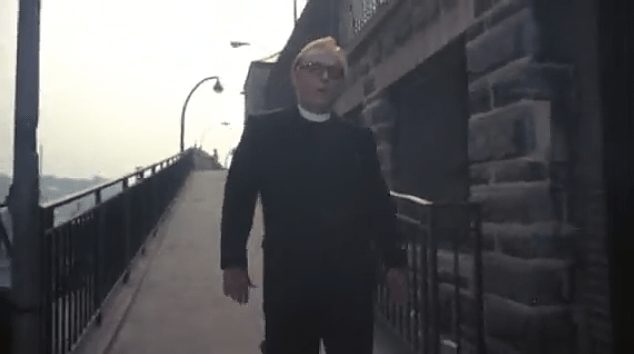
The opening scene… Christopher Gill impersonating Father McDowall (Steiger) is walking down the street viewed with a long shot, he’s whistling a ‘sardonic’ tune… in the vein of “the ants go marching” alongside The East River. Present, is the activity of cars passing by on the East Side Highway.
As he approaches the camera, we can see that he is wearing a priest’s frock.
We hear the city noises, the sounds of cars honking, young children plowing into him as they run by, and a young girl in a short lime green dress greets him as he continues to walk along the sidewalk.
As Gill passes Kate Palmer (Lee Remick) descending the stairs of the apartment house, he says, “Top of the morning to you, young lady!”
This energizing piece of playful film noir directed by H. Bruce Humberstone (The Crooked Circle 1932, Charlie Chan ) is based on a novel by pulp writer Steve Fisher with a script by Dwight Taylor.
I Wake Up Screaming stars the swarthy Victor Mature sandwiched between two lovely ladies, Betty Grable and Carole Landis and co-stars Laird Cregar and Elisha Cook Jr.
With a fantastic musical landscape by Cyril J Mockridge and you’ll hear the familiar melody Street Scene by Alfred Newman played over the main titles as well as this trailer… It gets me humming all over the house!
The stunningly shot frames with noir style shadows, odd angles and low lighting are lensed by cinematographer Edward Cronjager.
A model Vicky Lynn (Carole Landis) dies mysteriously and Inspector Ed Cornell (Laird Cregar This Gun For Hire 1942, Hangover Square 1945) is obsessed with Frankie Christopher’s (Victor Mature) part in the murder!
Told in flashback we see how Frankie meets Vicky who’s first waiting tables, then introduces her to the right social circles. When she’s about to head for Hollywood to become a rising starlet, someone kills her. Inspector Cornell wants Frankie to go down for the murder, and the only one he can turn to for help is Vicky’s sister Jill (Betty Grable) who isn’t exactly crazy about the guy….
Sadly the beautiful Carole Landis who had starred in One Million B.C.(1940) with Victor Mature died of an overdose and the headlined stories about her death read like this “The Actress Who Could Have Been…But Never Was.”
“Hungrily, he watched her walk down the street…and then he squeezed the trigger!”
There’s a crazed sniper picking off brunettes, as the police scramble to try and profile the psychology of the killer on the loose!
Gritty psycho-sexual film noir based on a story by Edna & Edward Anhalt. Screenplay by Harry Brown (A Place in the Sun ’51, The Man on the Eiffel Tower ’49) Director of Photography is the great Burnett Guffey (From Here To Eternity ’53, Private Hell 36, NIghtfall ’57, The Strange One ’57, Screaming Mimi ’58) With music by George Antheil (uncredited stock music compose)And film editing by the great Aaron Stell(Human Desire ’54, Beginning of the End ’57, Touch of Evil ’58, Lonelyhearts ’58, The Giant Gila Monster & The Killer Shrews ’59, To Kill A Mockingbird 1962).
Directed by Edward Dmytryk  marking his return to Hollywood after he was named on the blacklist and served time in jail for contempt of court.
Richard Kiley as Doctor James G. Kent “I’d look for somebody that’s been getting tough with women from the very beginning… maybe he started small slugging them on a dark street or something like that… maybe some woman did something mean to him when he was a kid. Whoever it was, he’s been killing her over and over again!
The poster for The Baby alone is disturbing in it’s ability to create an instant queasy feeling and queer flutter that hits your senses due to the inappropriate visual environment. A crib with a large pair of legs hanging over the edge. The hands holding an axe and a sexualized young female holding a teddy bear. So let’s just get these words out of the way for starters…
Touching on so many taboos and cultural deviance is director Ted Post’s shocker The Baby 1973. starring the mighty Ruth Roman.
Look at that sensual face… what a beauty Ruth RomanStill of Ruth Roman and Robert Walker in Alfred Hitchcock’s Strangers on a Train (1951)
Day of the Animals 1977, Look in Any Window 1961, Bitter Victory 1957, Strangers on a Train noir thriller Down Three Dark Streets 1954, The Window 1949, various television performances The Naked City’s ‘The Human Trap’ Climax!, Dr. Kildare, The Outer Limits, Burke’s Law, The Name of the Game, I Spy, Marcus Welby M.D, Mannix, Ironside, Gunsmoke, The Sixth Sense, Mod Squad and more!
And I’ve got to mention that Anjanette Comer is an excellent rival to play the ‘outsider’ antagonist against Ruth Roman in this battle of wills.
Anjanette Comer stars in the ABC movie of the week’s Women-in-Peril feature film FIVE DESPERATE WOMEN 1971…
Directed byTed Postwho gave us Beneath the Planet of the Apes 1970, perhaps my favorite of the ‘ape’ films after the original. Saw each of the series during their theatrical release. Sadly Ted Post passed away just this past August 2013.
James Franciscus in Ted Post’s Beneath the Planet of the Apes 1970 Clint Eastwood & Ted Post collaborating on the set of Magnum Force
He directed television for years beginning in the 50s. I love the TV movie also starring Beneath the Planet of the Apes blond hunk James Franciscus… who co-starred with the fabulous Lee Grant in Night Slaves (1970) and Dr. Cook’s Garden 1971 with a murderous Bing Crosby. And hey while I”m touting made-for-TV movies how bout Five Desperate Women1971 where he most likely met Anjanette Comer? He’s also responsible for several episodes of Rod Serling’sThe Twilight Zone (1959-1964), including “Mr. Garrity and the Graves” and “The Fear.”  Post also directed two episodes of the Boris Karloff horror anthology show you know I truly love, Thriller (1961-1962), The Specialists & Papa Benjamin. And geez Columbo ’75-’76, A Matter of Honor and A Case of Immunity. Most people probably cite him for Clint Eastwood’s Dirty Harry vehicle Magnum Force 1973 or Good Guys Wear Black 1978. Ted Post knows how to put together a thriller!
The Baby’s screenplay was penned by Abe Polsky (The Rebel Rousers 1970, The Gay Deceivers 1969)According to IMDb trivia, it took almost a year for Polsky to convince Post to direct the film because Post found the topic too ‘dark.’ While in retrospect the film must have ruffled many feathers, and the themes are truly disturbing, there isn’t anything in there that hasn’t been done in a contemporary film in some way, and ideas that force us to think are a good thing. Especially when it’s wearing 70s clothes, and showcasing groovy genre character actors.
The seventies were rife with psycho-sexual theatre that showcased really uncomfortable themes, but somehow managed to create an atmosphere of low-budget art. Consider this, haven’t you seen episodes of Law & Order SVU, Criminal Minds, & CSI where some of the most brutal acts of inhumanity and grotesque forms of torture and abuse are highlighted in graphic detail? In the 70s it was more nuanced, bathed in muted lighting gels amidst experimental cinematic framing and absolutely moving musical scores.
So on one level refer to the litany of words above and assign your favorite one to The Baby, yet on another level, let’s look at this film and ‘react’ to it and recognize its power.
Baby’s photograph is lensed in an ‘anthropological’ way as it shows him in captivity-the bars of his crib symbolically like the bars of a prison
If a movie lingers, if it stays with you for hours, days, then it has done something right. I think this film is perhaps as uniquely disturbing as it is underrated & thoughtfully done. The subject matter is perverse and a potent yet slightly murky thriller. A provocative, revolting little psychodrama. One with an eerie, queasy moodiness amidst the ornate set design and restrained performances.
The ’70s were so good for giving us these kinds of surreal, sinisterly captivating, and unsettling themes. The House That Screamed 1963, Let’s Scare Jessica to Death 1971, Silent Night, Bloody Night 1972, Lemora” A Child’s Tale of the Supernatural 1973, Blood and Lace 1971, What’s The Matter With Helen 1971, so many, too many to mention. Narratives rife with taboos, power struggles, psychosis, ritual murders, and deviance.
Directed by William Fraker (cinematographer on Rosemary’s Baby 1968, Bullitt 1968 uncredited on Incubus 1966for Roger Corman, and The Day of The Dolphin 1973, Looking for Mr Goodbar 1977).
A Reflection of Fear1973was hacked to pieces in order to receive a PG rating for Columbia Pictures. Fraker made his feature debut as cinematographer on one of my favorite psychological thrillers – Curtis Harrington’s cat and mouse thriller GAMES 1967 with Simone Signoret. He was the camera operator for my beloved fantasy ’60s series The Outer Limits TV series 1963-1965. No wonder that this film’s atmosphere is a hazy, dreamy landscape that transcends the outward appearance of reality.
László Kovács (Easy Rider ’69, That Cold Day in the Park ’69) enhances the look and feel of the film as director of Photography. AReflection of Fear is based on a novel by Stanton Forbes called Go To Thy Deathbed with a screenplay by Lewis John Carlino (Seconds 1966, The Mechanic 1972, The Sailor Who Fell From Grace with the Sea 1976).
Blogger David Furtado from his fabulous Wand’rin’ Star cites in a post from Sondra Locke’s autobiography The Good, The Bad and The Very Ugly- A Hollywood Journey –
“Then came a film which was a landmark, professionally and personally: A Reflection of Fear, directed by promising filmmaker William A. Fraker, who had been nominated for several Oscars as a director of photography, and who had directed Monte Walsh with Lee Marvin and Jeanne Moreau, one of the last great and underestimated westerns. Sondra Locke plays the mysterious and unbalanced “ ˜Marguerite’, a girl of sixteen.
As Marguerite in A Reflection of Fear (released in 1973).
“Once again, Gordon and her plotted a scheme to get Fraker interested, since they both thought the role was almost perfect for her. Gordon Anderson even played the “voice” of “˜Aaron’, Marguerite’s alter-ego. Unfortunately, the film was butchered by Columbia since it dealt with themes deemed too strong for the general public. Locke found the attitude ridiculous, even more so because, at that time, “audiences were enthralled with the young girl in The Exorcist, spewing vomit and masturbating with crucifixes”. Nonetheless, she became longtime friends with the director and his future wife Denise, who was very supportive when Locke had serious health problems.”
This is the first film of underrated cult starSandra Locke. She was perfectly unorthodox, as the odd Agatha Jackson alongside Colleen Camp in DEATH GAME 1977, where they held actor Seymour Cassel hostage and played mind games with him. As Marguerite, she is perfectly chilling in her debut.
Sandra Locke is the captivating young sylph, Marguerite, and Robert Shaw portrays her estranged father, Michael.Mary Ure (Shaw’s real-life wife at the time) plays her mother, Katherine. Swedish actress Signe Hasso lurks as Marguerite’s sinister grandmother, Julia. This harpy-like matron seems to be the locus of the askew matriarchy that treats Marguerite like a sickly princess caught in a closed universe. It plays like a dark fairy tale where, initially, she appears to be at the mercy of wicked women.
Mary Ure is absolutely gorgeous, seductive, and refined. Signe Hasso is a marvelous actress I’ve admired for a while now; she’s elegant and quite regal though imposing as her character called for. Both Ure & Hasso exude an unsavory perfume.
Richard Burton and Mary Ure in Look Back In Anger, 1959
Quirky and affable Sally Kellerman plays Michael’s fiancé, Anne, who worked with Fraker on The Bellero Shieldwith Martin Landau, airing on Feb. 10th, 1964—one of my favorite The Outer Limits episodes with the Bifrost alien. Fraker also worked on the set with Signe Hasso on TheOuter Limits Production and Decay of Strange Particles, which is yet another superb entry in the short-lived yet transcendently brilliant series.
Chita Rivera, Sally Kellerman, and Martin Landau in The Bellero Shield- The Outer Limits- William Fraker was on the camera crew.George Macready and Signe Hasso in Production and Decay of Strange Particles -as part of The Outer Limits 60s TV series.
Gordon Anderson (also the voice of Ratboy 1986) is the voice in the film of the imperceptible Aaron, doll or boy I won’t tell …
Fred Myrow (Soylent Green 1973, Scarecrow 1973, Phantasm 1979)is responsible for the haunting musical score that is dizzying with lilting harps and mandolin, low muted French horn, music box shimmer, and eerie wavelengths of noise. Joel Schiller is the art director (Rosemary’s Baby 1968, The Muppet Movie) and Phil Abramson (Bullitt 1968, Close Encounters of the Third Kind 1977 and Raging Bull 1980) does the creepy and suffocating set design which is perfect for the sense of repression, dread, and decay.
A Reflection of Fear has been referred to as a proto-slasher. There is the use of a caped hooded ‘masher.’ Perhaps this film set off a slew of slashers to come, but several reviews have cited a correlation between this film and Hitchcock’s Psycho ’60. Perhaps it’s the bright child with a mother complex who likes horticulture instead of taxidermy. Anyhoo, as an obscure ’70s psycho-sexual thriller, it has its universe to spin in.
If I were to disclose anything because I love a good hint- I could say the closest the film’s storyline comes to is actually an episode of the 1968 TV series Journey to the Unknown – “Miss Belle” with George Maharis and Barbara Jefford, but that’s all I’m sayin’… if you know the episode I mean, I’ve just given you a golden crumb to nibble on.
The multi-layered narrative surrounds a disturbed and alienated sixteen-year-old girl named Marguerite (Sondra Locke), who exists in a private world of dolls that she talks to and who in voice-over – talks back in the quietude and opulent isolation with her affluent mother (Mary Ure) and grandmother (Signe Hasso) at an exclusive Inn somewhere in Canada. Marguerite is not only held captive by her mother and grandmother but, to my impression, is seemingly a willing recluse who yearns for the love of the father she’s only known by the various books he sends her on art, flowers, etc.
Katharine (Ure) and Grandmother (Hasso) read a letter from Michael.
Grandma Julia-“I hardly think he’s coming again for you my dear she’s his daughter after all”Mother Katherine-“We’ve been so careful Mother” Julia-“A glimpse would perhaps satisfy him for another fifteen years” Katharine-“A glimpse would hardly satisfy Michael of Marguerite” Julia- “Would you stir his curiosity? And… Marguerite seeing Michael might tempt her to certain idolatry of the man.”
Sandra Locke’s intense eyes.
Something is not right within the family dynamic. When Marguerite’s father Michael (Robert Shaw) finally arrives this particular languid summer to ask his wife for a divorce so he can marry Anne (Sally Kellerman), the vitriol comes out as Grandmare “turns the knife in” as Michael exclaims. Mary refuses to set him free unless he agrees to never see Marguerite ever again.
Once Michael sees his wisp of a daughter, whom he’s never known in the flesh, his peculiar gaze becomes transfixes on her. He finds her enchanting. He actually says so several times. Yet he is concerned about the way his wife and mother-in-law are holding the child prisoner. As he considers rescuing the child, the dynamic starts to invade Anne’s future life with Michael, and the brutal murders begin to ensue.
Katharine see Michael again after many years.
Michael returns to meet his daughter.
One of the central mysteries is whether Marguerite is being driven mad by her mother and grandmother, is she delusional, or if there truly is an Aaron – her mysterious unseen playmate? Either way, the concept is provocative and malefic. Always lensed in darkness, it adds to the creepiness of the matter at hand. “You keep me cooped up in here like one of the dead dolls in your trunk,”- whispers Aaron a mere shadow.
The painting of the figure in black with a large staff looks similar to the life-size doll of Aaron that Marguerite keeps in her bedroom.
The local police come to investigate. Mitchell Ryan plays the cop who suspects the father, Michael, of the murders. The lovers, Michael and Anne (Kellerman), are to remain close to the crime scene, so they move into the estate as sort of an unspoken house arrest.
Mitchell Ryan interviews Robert Shaw about the murders.
Sondra Locke manages to catch my interest with curiosity at her queer sort of whimsical prettiness, more odd than sensual. Here as childlike, gaunt,and pale as schoolhouse chalk, which works for the character of Marguerite. She carries on creepy Socratic dialogues with her decrepit dolls.
Marguerite’s presence is both disturbing and sympathetic as she plays at being a fay prisoner, kept isolated by her grandmother and mother while exhibiting extraordinary intelligence and a primal burgeoning sexuality.
The image of Aaron slowly arises in the frame in pure shadow- it’s a very powerfully eerie moment in the film.
Marguerite lives in a fantasy world, she’s brilliant, owns microscopes, a pond filled with amoebas, has full knowledge of horticulture, stamen and pistils and all that, has rooms filled with a myriad of creepy dolls in tatters and decay, a specie of cannibal fish which she finds quite natural in the natural order of things.
Something that Michael’s girlfriend Anne will invoke when describing how Marguerite is trying to “devour” her father. Consume him, which he allows, as part of the odd liturgy of perverse underpinnings of the narrative. Incest, sexual repression, sexual mutilation, castration anxiety, oedipal lust, castrating females-misandry (women hating men) “Don’t ever let a man touch you, it’ll mean death.” Her mother tells Marguerite in a flashback through voice-over.
Marguerite’s main confidant is a doll… or is he… named Aaron, a very belligerent spirit either way, who is quite possessive of Marguerite and seems to be destructive, antagonistic, and malevolent. Neither the mother nor grandmother believe he is anything more than a doll. Or perhaps they know more than they are willing to disclose to Michael when he comes to visit after 15 years. He wants to marry the lovely Anne, but Marguerite’s mother refuses to give him a divorce as a way of punishing him and using it as a weapon to keep him from seeing his daughter again.
During his visit, the odd relationship is shown, depicting father and daughter in a sexualized framework. It’s painful to watch as Michael doesn’t discourage Marguerite’s advances, not even in front of Anne.
The cringy relationship between father and daughter.
Aaron begins to become more violent as the father and Anne intrude on the opulent, isolated netherworld these women seem to inhabit. Fraker, who was the director of photography on D.H Lawrence’s story The Fox 1967 directed by Mark Rydell, is really good at capturing the visual sense of place surrounding alienation, repression, and the immortal triangle. A quiet world, when all at once an intruder turns everything into chaos.
Katharine is destroyed by Michael’s presence.
The film is rather brutal and grotesque even within the kaleidoscopic colors and hazy shadows that both Frakerand Kovács manifest to murk and lurk and obscure what we see. This heightens the horror of the thing rather than impinges on it. The incandescent lighting and subdued colors of cinematography by the great László Kovács using filters and gels create a hazy, shadowy landscape that’s as enigmatic as the story.
The murders are savage, phallus-driven mutilations and speak of sexual repression and hatred toward women.
Marguerite is referred to as “enchanting” more than once. Her skin is translucent, and her Alice in Wonderland exterior purposefully dresses her up to look as if she’s falling through the rabbit hole at any minute. This might be a way to draw attention to the underlying turmoil of growing sexual awakening. Once her mother and grandmother are out of the way, she begins to wear more adult clothing. She also injects bottles of what is supposed to be insulin, but the labels have been removed from the bottles: Curiouser and curiouser.
At one point, she asks her father to give her the injection so that it won’t hurt as much. In retrospect, I think this is a pretty clear allusion to Marguerite’s desire to have her father penetrate her.
Sandra Locke’s performance is quite chilling, with her childlike, almost sociopathic lack of affect, it comes across as an eerie sexualized pubescent blonde droid, rather than a child who has been secreted away by the older women in her life, in a clandestine garden paradise with malevolent forces afoot.
Her voice is a frail, wispy spirit with no earthly substance, dressed in little girl finery, spouting factoids about sea life and flowers but bearing no resemblance to a real child of this world. Initially, her dolls have more breadth to them. But Marguerite begins to awaken by the presence of her father.
Marguerite’s dolls represent her closed world; some even mimic the people in her sheltered life… Herself, Grandmare, and Father…
Marguerite’s mother and grandmother are cold and uncommunicative. There’s no sign of nurturing, although her mother calls her chéri.
The two women obviously hate men and have done a good job of keeping little Marguerite from coming in contact with anyone of the male species. Even the male fish get eaten by the stronger female of the species.
Sally Kellerman is the one character that buoys us to the normal ‘outside’ practical world. She sees all the subversive deeds and perversions that are rampant around the old estate but still refuses to walk away from the man she loves. She is the one stable witness to the madness as it unfolds.
William Fraker and screenwriters Edward Hume and Lewis John Carlino (who also wrote the screenplay for The Sailor Who Fell From Grace With the Seain ’76 interesting enough this too dealt with disturbed children with higher intelligence), allow the repulsive sexualized relationship between father and daughter to flourish til we’re as completely uncomfortable as Anne is.
In a very edgy scene where Marguerite, whose room is next to her father and Anne, masturbates while the couple is making love. Marguerite calls out “father’” while she climaxes so that the couple can hear her cries. Anne finds this entire experience vile, though by now, she shouldn’t be surprised by the odd child’s behavior and finally almost leaves Michael yet still remains in this sick environment.
Anne and a day at the beach with Michael and Marguerite.
The film is apparently heavily cut due to censorship in order to secure a ‘PG’ rating for its original U.S. theatrical release in the early ’70s. I’d love to see the unedited version someday.
The shocking twist ending was a bit muddled in terms of its visual revelation, but finding out that the film was badly modified due to censorship might explain some of the jagged continuity. I don’t mind the obfuscation of various key scenes as they add to the sense of mystery and concealment. The reveal at the end comes to full fruition like a gut punch.
Sadly, Mary Ure died suddenly in her sleep in 1975 after an accidental overdose of pills and booze. The imposing and ever larger-than-life actor Robert Shaw suffered a massive heart attack in 1978 and so joined her in death.
This film is not for everyone, especially those that find psycho-sexual thrillers objectionable because their pathology is usually based on some kind of subversive wiring in the brain or dysfunctional or arrested development of the family structure. But if you’re like me, who just can’t devour enough obscure 70s dark and delectable lunacy, then try and catch this one night… bring your favorite doll. And if it is your cup of arsenic-laced tea, you might also try Secret Ceremony 1968 starring Elizabeth Taylor, Mia Farrow, and Robert Mitchum. It also promises to disturb!
This has been a reflection of -Your EverLovin’ MonsterGirl
“The mansion… the madness… the maniac… no escape.“
Silent Night, Bloody Night (1972)
Alternative title: “Night of the Dark Full Moon”
This is perhaps one of my favorite classic horror films of the 1970s—a gloomy tale of incest, madness, depravity, and revenge. I’ve chosen not to give away any of the plot twists or reveal the secrets of the story. I will not spoil the ending for those who haven’t seen this obscurely surreal gem.
Though many consider the film a cult hit, it’s still obscure and deserves a first look for those who might be interested in seeing it or who are drawn to the newly discovered beautiful moments that occur in such a low-budget horror film.
Directed by Theodore Gershuny (Sugar Cookies 1973), Silent Night Bloody Night 1972 was actually filmed in 1970 but not released until ’72. Contrary to some people’s beliefs,Silent Night Bloody Nightpredates Bob Clark’s Black Christmas by four years. Silent Night Bloody Nightplays like an eerie and odd nightmare. I know it gets compared to Clark’s Black Christmas, which is an undisputed masterpiece, but Silent Night Bloody Night was filmed in 1970 and came out two years before. It has its own very unique story to tell.
Woronov acts as a sort of tour guide/witness, narrating the opening sequence, telling of Butler’s death on the day before Christmas 1950, to the gruesome story that unfolds surrounding the Butler house and its legacy.“One last time I’ve got to see this ground one last time… It’s beautiful now as if nothing had happened here. {…}For twenty years that house lay empty, exactly as Wilfred had left it.”
Based on Jeffrey Konvitz’s story, he wrote yet another of my top favorite horror classics of the 70s, The Sentinel,starring the superb Burgess Meredith as a very cheeky devil. I read both books, which were equally chilling, back when reading the novel was as thrilling as going to see it on the big screen. Silent Night, Bloody Night is being re-released on DVD on December 10th, restored from 35mm. This excites me indeed! My copy has already been pre-ordered.
What made Silent Night, Bloody Nightso richly evocative for me was its uniquely creepy and unselfconsciousness. Dealing with heavy themes, it managed to come across as a startling, fairy tale-like bit of bloodletting with an authentic 70s flair. I don’t need a more hideous version of this movie with hacked body parts as a way to reintroduce this story. This does not frighten me, nor disturb me in a good way. I imagine it might become like every other violent blood show with effects and body violations that will detract from the moodiness of the original.
Silent Night, Bloody Night kicks off with a bang—literally—when old Wilfred Butler is found dead, burned outside his imposing mansion in a small New England town on Christmas Eve, 1950. Decades later, his estranged grandson, Jeffrey, inherits the estate, insisting on selling it off, which brings in a slick city lawyer, John Carter, and his assistant, Ingrid. The local town council is eager to buy the supposedly haunted place for a steal, but as night falls and John and Ingrid decide to spend the night in the house, things go completely off the rails. They’re brutally murdered in their bed by an unseen killer, plunging the town into panic just as Christmas is about to begin.
From there, the film unravels into a tangled web of mystery, violence, and old family secrets. The killer starts making eerie phone calls under the name “Marianne,” summoning townsfolk to the mansion, where they’re picked off one by one, crimes involving axes, candlesticks, and a lot of cleverly staged suspense. Jeffrey shows up, only to find he’s walked into a nightmare. He connects with Diane, the mayor’s daughter, and together, piecing clues from newspaper archives and scribbled notes, they dig into the Butler family’s dark past.
We slowly learn, through an intense sepia-toned flashback, that Wilfred Butler not only lost his wife and committed his daughter Marianne to the house-turned-asylum but fathered a child with her under horrific circumstances. The mansion’s time as a mental institution saw more cruelty, with the staff partying and indulging while the inmates, neglected and abused, finally revolt in a bloody uprising, a sequence as nightmarish as it is tragic.
That legacy of trauma simmers right up to the present. As bodies start piling up, the sheriff, Tess the switchboard operator, and mute newspaperman Charlie Towman, among them, it comes out that the killer is none other than Wilfred himself, who faked his fiery death years ago. He’s been lurking nearby, his life defined by vengeance and unspeakable guilt over what happened in his house. The inmates (Towman, Tess, and the rest) who brutally killed his beautiful Marianne have been living in the town as the respectable people who run the place. In the final chaotic confrontation, both Jeffrey and the mayor are killed, but Diane manages to shoot Wilfred, ending his bloody spree.
The dust settles months later, as Diane returns to watch the mansion—haunted by so many secrets—finally demolished. It’s the kind of ending that’s more mournful than triumphant, really: you get the sense that knocking the house down can’t quite erase the legacy of what happened there. The film wraps all this up in a chilly, Gothic atmosphere, mixing a murder mystery with slasher and haunted house vibes. Silent Night, Bloody Night is part family curse, part small-town horror, and part cautionary tale about the secrets we bury and bodies that refuse to stay hidden.
Patrick O’Neal opens the original film by playing a brief role as a big-shot realtor John Carter who gets axed to pieces in bed with his lover. Cult film star Mary Woronov plays Diane Adams daughter of the Mayor. Walter Klavun is the town Sheriff, Bill Mason.
John Carradine plays mute curmudgeon Charlie Towman, who publishes the weekly newspaper. Apparently, his croaks and grunts were dubbed in afterward. Walter Abel(Fury 1936, Mr. Skeffington 1944) plays Mayor Adams. And Fran Stevens plays Tess Howard, who operates the switchboard.
Plus, the film is set against the backdrop of an assortment of Andy Warhol’s acting “Factory.” Mary Woronov was once married to director Theodore Gershuny, supporting players Ondine, Candy Darling, Kristen Steen, Tally Brown, Lewis Love, filmmaker Jack Smith, and artist Susan Rothenberg. Character actor Philip Bruns plays the patriarch of the estate, now deceased, the eccentric Wilfred Butler.
James Patterson, who plays Grandson Jeff Butler (Lillith 1964, In The Heat of the Night 1967), died of cancer shortly after the principal shooting was completed. They substituted Patterson’s voice with another actor. Patterson’s Grandson, Jeff, has a sort of veiled flirtation with Woronov, the mayor’s daughter.
Henry Shrady’s art direction was responsible for the wonderful sense of claustrophobic ambiance that becomes part of the pervasive madness he created later on with Jack Palance’s and Martin Landau’s hilariously frightening performances in Alone In The Dark in 1982. Shrady also did (Cry Uncle 1971, and Squirm 1976).
In a small rural New England town, (I recently lived in New England for two years and can tell you that writer Stephen King has his pulse on a very real provincial and closed society that keeps its secrets and its turmoil quietly buried underneath the pristine beauty of the landscape) Wilfred Butler, played by Philip Bruns, is the patriarch who reigned over his estate secluded, away from the small town, dies on Christmas Eve 1950 as he runs from the place set on fire.
The film’s prologue shows Wilfred Butler running from the mansion, enveloped by flames. Then we are dropped into the present day. Patrick O’Neal, who plays real estate agent Jack Carter, comes to the small town of East Willard in order to finalize the sale of the Butler house with the town elders. Who are the four sullen and strangely nervous bunch? The excellent casting and presence of these somewhat distressed characters add a nice layer to the creepiness that builds. Fran Stevens as Tess Howard is perfect. Abel as the Mayor, the ubiquitous Carradine as the mute bell-ringer Towman, and Walter Klavun as Sheriff Mason are equally well suited to play this strange and secretive quartet.
Carter reeks of sophistication and arrogance. When Carter arrives at the house with his gorgeous lover Ingrid (Astrid Heeren), as they carry on while spending the night in the house, ultimately, they get themselves hacked up by a mysterious intruder with an axe.
Grandson Jeffrey Butler comes to town as well to sell off the estate. The locals begin to appear agitated, and just to make the story a bit edgier, there’s a nearby insane asylum inmate who has escaped and is on the prowl.
“Tess… I’ve come back,” says the creepy whispering voice on the phone.
Once opulent and inhabited by Wilfred and his young daughter Marianne, the Butler house has been uninhabited and abandoned for years. Twenty years after tragedy struck the Butler estate, horrible events begin to unfold again during the Christmas season. Grandson Jeffrey, who has inherited his grandfather’s creepy place, now wishes to sell it. The town elders are also insistent on buying the Butler house, too, with a strange urgency.
But as Christmas approaches, an unmistakable sense of menace creeps through the old mansion and the town itself. A deadly and unbalanced presence haunts both its shadowy halls and quiet streets. One by one, the four prominent townsfolk drawn by their own secrets or summoned by something darker, find themselves lured back to the old house to be butchered. There, in a grim inversion of holiday cheer, they meet violent and untimely ends, each murder peeling back another layer of the town’s genteel facade and exposing the rot that’s been festering beneath for decades.
Although the film has the appearance of a 1970s’ low-budget’ feature, what has emerged for me as I revisit these films with a sense of nostalgia and the clarity of retrospection is that many obscure films like this one can be considered thrift store classics, minimalist masterpieces because of their sparsely framed environments, authentically offbeat characters, and a realism that doesn’t get covered up by opulent set pieces and star billing. The scratchy, gritty, low lighting creates an eerie darkness and creates its own unease. The film is a pauper’s painting: Beauty and ingenuity flourishing where extravagance is absent.
Still, Silent Night Bloody Night is undoubtedly one of the most atmospheric horrors of the 1970s, like Let’s Scare Jessica To Death. It’s a self-contained world of distorted truths, hysteria, a claustrophobic bit of vintage nihilism, and yet again, a tone of subverted American values.
As the flashback unfolds in Silent Night, Bloody Night, it reveals the mansion’s ghastly second life as a mental institution—a supposed refuge that quickly became a place of deep suffering and profound mistreatment. The story peels back the veneer of holiday celebrations to show doctors and staff feasting and drinking, oblivious or indifferent to the pain in the rooms above, as the patients languish in their cages and cells.
This sequence says a lot about the failures and cruelties of institutional psychiatry: those in power are insulated by privilege and self-indulgence, turning the mansion into a prison of neglect, while at the same time, the most vulnerable are left unheard and abused. The celebration held by the doctors, with its grotesque air of normalcy, underscores just how easily cruelty can hide behind routine and ritual.
Eventually, the mounting resentment and trauma boil over, leading to a rebellion—an eruption of violence that is both horrifying and deeply cathartic. The patients, driven beyond endurance, rise against their oppressors in a sequence shrouded in sepia tones and haunted silence, with the caretakers’ complacency and gluttony ultimately sealing their fate.
Wilfred Butler’s narration captures this chilling contrast:
“Oh I knew that they would gorge themselves into a stupor that afternoon… it was their celebration; I expected no less. Since they had come into my house, they had acted as if they owned it—they had behaved like poor relations, half guilty but finally unable to control their appetites… after dinner, they danced and drank as they usually did.”
We aren’t thinking, “Will the characters survive?” because every aspect of the story sort of lies within the looming darkness as it circles back on the reveal. We’re left to be frightened for ourselves and the creeping dread. The question of escape doesn’t enter into it. The question of ‘what is really going on here?’ does, and it becomes progressively disturbing as we learn the history and the tragedy.
This is one of the most memorable flashbacks of 70s horror films for me. It is performed in murky sepia and with a wide-angle lens to add to it a sickly, decrepit tone of the archaic mournfulness of a disturbing past. As it shows us what happened long ago at the Butler Estate in the 1930s, it’s one grotesque fête. For me, it’s a creepy, claustrophobic sequence that is unforgettable, and for those post-modern junkies, it’s filled with Warhol minions.
Gershuny and Adam Giffard frame the plot from the POV of the mysterious killer stalking the house and the townsfolk. Once again, the film predates Bob Clark’s Black Christmas with its use of the point-of-view of Billy, that film’s psychopathic stalker, the freakishly terrifying voice on the phone, and, of course, the grisly murders.
Patterson, who plays Jeff Butler’s grandson, was dying of cancer at the time. He has an interestingly defined face, like Tommy Lee Jones, partially a type of sensuous ugly, and just a bit menacing.
The townsfolk’s secret is finally revealed. They are not the upstanding citizens they pretend to be. They wanted to purchase the house so they could rid themselves of the history of the place. One by one, they are knocked off by the mysterious black gloved killer.
On his way to investigate the mansion, Sheriff Bill Mason stops by Wilfred Butler’s disturbed grave. There, the killer ambushes him and beats him to death with a shovel, leaving his body at the cemetery.
Tess Howard, the switchboard operator, meets her end when, lured by an eerie, whispering voice over the telephone, she ventures alone into the darkness of the mansion. She’s bludgeoned to death inside the foyer, smacked with a candlestick by the unseen killer.
John Carradine’s character, Towman the mute newspaperman, who constantly rings his bell to grab the others’ attention, although he doesn’t utter a word, exudes a cantankerousness. Charlie Towman is killed when, after having his hands severed by the killer, he blindly stumbles into the road and is fatally run over by Jeffrey’s car.
Summoned to the mansion, Mayor Adams arrives armed with a rifle, ready for confrontation. In the chaos that follows, both he and Jeffrey Butler open fire on each other and are killed in the shootout.
It’s all gruesome and opaque, making this film a uniquely satisfying chiller.
Diane grabs Jeffrey’s revolver and shoots Wilfred Butler—her grandfather and the actual murderer- three times, sending him tumbling down the stairs and ending his murderous rampage. The film ends with Diane as the sole survivor, watching in subdued shock as the haunted Butler mansion is finally demolished, its secrets and the horror that gripped the town buried beneath the rubble. The chilling sense remains that, while the house is gone, the scars of its dark history endure just beneath the surface.
The film possesses some truly effective, grisly death scenes: axe murders and uncomfortable themes. I won’t call this film a slasher flick, though it is referred to as such at times. What is characteristic of 70s atmospheric horror stories is that they emerge more potent in retrospect than when they were initially viewed. I credit this to a sense of unselfconscious filmmaking. Some low-budget horror films possess a natural eeriness that is allowed to come to the surface. Therefore, it forms an organic, horrifying realism and sense of dread.
James Plumb remade Silent Night, Bloody Night in 2013, released as Silent Night, Bloody Night: The Homecoming.
Merry Bloody Christmas from your EverLovin’ 70s MonsterGirl!
William Cameron Menzies’ nightmarish ground hogs day tale of alienation, colonization, loss of identity and good old fashioned sci-fi alien goodness. Bearing a storyline and set design that could be considered analogous to The Wizard of OZ… that for a later post. My brother used to tease me every time the picture came on tv that the aliens looked like they each were walking like they had taken dumps in their pants monster costumes.
Here’s a little Saturday morning pre-Halloween treat for you to enjoy!!!! Grab a quick cold cola before it goes disappearing down that sandy hill o’re yonder.…
Don’t worry it’s only a dream… or is it? MonsterGirl
Steve Hasbrat (Theater Management) over at Anti-Film School has graciously given me the opportunity to join their 3rd Annual Horror Movie Spooktacular in time for Halloween. And I get to chat about five movie monsters that I consider to be my favorites. If you know me by now, you’ll understand that asking me to narrow down anything to a mere 5 is quite a challenge. But I venture to say that if I cheat and mention a few who would have made the list, angry villagers won’t be hurling flaming torches at my porch if I do…
A little bit about Anti-Film School’s blogging philosophy from their About page!
“Founded in July of 2011, Anti-Film School is a film website that reviews both new and old films while also heavily focusing on grindhouse cinema, exploitation flicks, cult cinema, B-movies, and classic horror. Since its launch, it has gone on to receive 100,000 views, become a member of the Large Association of Movie Blogs, and be featured on Total Film online under “3 Cool Film Blogs to Visit,” GuysNation, Flights, Tights, and Movie Nights, Furious Cinema, and the Grindhouse Cinema Database. It is all tied together by a retro drive-in aesthetic. We apologize in advance for any missing reels, the sticky floors, shady audience members, stale popcorn, and broken seats.”
Oh, those woebegone days of broken velvet-covered creaky seats, your feet sticking to the floor from spilled Coke and milk duds… the smell of popcorn, salty sweat, and the tallest person in the theater sitting directly in front of you when there are loads of empty seats left…! I wonder why that always happens to me all the time…?
When you think of existentialism, well, when I am the MonsterGirl nerd of all time, I think of EXISTENTIALISM, Camus, Sartre & Kierkegaard, which immediately come to mind. When Steve asked me to think of 5 movie monsters that endeared themselves to me, I started to think of what it was, that essence of the thing, that impressed upon me so much about each monster’s character. It’s that they are Monsters in Search of an Existential Crisis.
Descartes said, “I think, therefore I am.” Existentialists say, “I am, therefore I think.”
This philosophy emphasizes radical skepticism and the uniqueness and isolation of the individual experience, an individual who is inhabiting an indifferent universe. Existentialism regards human existence as unexplainable and completely free. In this universe, there is no guiding Dogma that can help us. We’re all faced with equally unfortunate choices, leading to doom and despair. All human endeavors are meaningless and virtually insignificant, so when faced with the fact of existence, humans feel despair. Existential angst is when we are aware of the awful pointlessness of our existence. So life is an unknowable concept with strange forces that spring from this mysterious existence, with nothing that has any meaning, and fighting it is futile. Cheerful stuff…
Without further ado, here are our 5 monsters stuck in an existential landscape of despair, angst & searching for an identity in a cruel cruel universe.
What is it about monsters that we love? What truly remains with ‘us’ classic horror fans is something deeper and eternally soldered into our collective psyches.Something about ‘the monster’ has either caused us to ‘identify’ with them or has triggered a profound fear response that lasts a lifetime.
All monsters, you could say, are inherently existential figures because they come from a place of alienation, the unknown, and live outside the realm of perceived normalcy. ‘5 Monsters in Search of an Existential Crisis’seeks to understand how these particular characters are either the epitome of the existential ‘deviant’ (not to suggest deviancy in the context of being perverse but in the sense that they deviate from the norm of ‘accepted’ human nature, like a freak or a sword swallower or a drag queen), or have been placed in the middle of an existential environment.
Invasion of the Body Snatchers 1956 Dana Wynter and Kevin McCarthy.Luce Potter as the Martian Intelligence in William Cameron Menzies’s fantastical Invaders from Mars 1953.Jack Arnold’s quintessential journey of the existential transcendent man Grant Williams in The Incredible Shrinking Man.
However, poor Grant Williams was not a monster; he was only a transcendental man on a journey, projected into a monstrous world where the ordinary becomes a nightmare landscape for him. Films are based on stories where the alien, be it from space or here on earth, is a figure used to criticize rationality, conformity, tolerance, and lack of empathy, and often create discord between science and the military. They raise the question of fear of losing one’s identity amidst the cold war environment, or just to show that there are sinister threats from without & within!
Writers like Charles Beaumont, Richard Matheson, and Ray Bradbury were great at conjuring these “Outsider’ themes. I’d love to have included It Came From Outer Space (1953) with the amorphous Eye creatures that happened to be friendly aliens who crash-land in a desert cave.
It Came From Outer Space 1953 Richard Carlson and Barbara Rush.
I love these existential fellas, scary as they may be. Like Grendel who is the consummate existential literary figure and he was hideous, yet he’s one of my favorite characters in literature. Grendel struggles with the eternal question, am I a monster or a hero?
While these movie monsters may be hideous to some, I find them compelling and heroic in their journey to claim their place in a hostile world. Except for those nasty soul-eating land crabs whom I love just because they’re so cheeky, cheesy, and entertaining as hell!
For me, the quintessential existential man/monster (and that’s not a pants monster ) is Mary Shelley’sliterary Prometheus re-imagined by James Whale’s flagrant masterpiece. A man-made from the scraps of robbed corpses and brought to life by the electrical secrets of heaven. Yes, Frankenstein’s Monster, portrayed by the great Boris Karloff, manifested a truly complex enigma of conception, creation, and existential angst that’s both fearsome yet sympathetic.
We can sympathize with the monster, as with Frankenstein & The Gill Man from Creature From the Black Lagoon. We can find our involvement (at least I can) as one viewed with empathy toward the monster’s predicament. Depending on how much the film constructs its viewpoint, it leans toward creating pathos in the narrative. Usually, this means permitting these monsters to express human desires and then making sure that those desires are thwarted and frustrated and ultimately destroyed. The Outsider Narrative can be seen so clearly in the horror/sci-fi hybrid Creature From The Black Lagoon. Film monsters like The Gill Man form vivid memories for us, becoming icons and laying the groundwork for the classical experience of good horror.
I think Creature From The Black Lagoonis quite a perfect film, as it works on so many different levels. The most obvious is that scientists have invaded a unique creature’s habitat only to force their domination and belligerence on him. In the midst of this, a sort of skewed romance between Romeo and Juliet evolves. The Gill Man never intends to threaten Julie Adam’s character, Kay Lawrence. Quite the contrary, it’s the two opportunistic men who tote phallic harpoons around like extra penises on hand to fight each other about questions of ethics, how to conduct scientific research, and over Kay like spoiled children.
1) FRANKENSTEIN’S MONSTER: As portrayed by the great BORIS KARLOFF
“Oh, in the name of God! Now I know what it feels like to be God!”- Henry Frankenstein.
Thanks to the great make-up artist Jack Pierce, Boris Karloff’s poignant yet terrifying transformation into Frankenstein’s monster is the most memorable, indelible ‘classic monster’ for me. Boris Karloff said in 1957, “Jack’s words still echo in my mind: ‘This is going to be a big thing!'”
Mary Shelley created a transfixed symbol of existential angst. The gentleness that Boris Karloff imbued his character with will always touch my heart so deeply. Most memorable for me is the scene with the blind priest who breaks bread and shares his humble shack with his new ‘friend’ in Bride of Frankenstein, which is my favorite of the three films where Karloff portrayed the monster.
Frankenstein; or, The Modern Prometheus is a novel written by Mary Shelley about an eccentric scientist, Victor Frankenstein, who creates a grotesque creature in an unorthodox scientific experiment. Just a brief mention in regards to the literary source, Victor Frankenstein, is told by the monster that he refers to himself as “the Adam of your labors”, and elsewhere as someone who “would have” been “your Adam”, but is instead “your fallen angel.”
The film’s opening narrative goes like this: “We are about to unfold the story of Frankenstein, a man of science who sought to create a man after his own image without reckoning upon God. It is one of the strangest tales ever told. It deals with the two great mysteries of creation.; life and death”
“Beware; for I am fearless and therefore powerful.”
“How dangerous is the acquirement of knowledge and how much happier that man is who believes his native town to be the world, than he who aspires to be greater than his nature will allow.” “• Mary Shelley, Frankenstein
“I do know that for the sympathy of one living being, I would make peace with all. I have love in me the likes of which you can scarcely imagine and rage the likes of which you would not believe. If I cannot satisfy the one, I will indulge the other.” “• Mary Shelley, Frankenstein
Victor Frankenstein possessed great hubris. As many a mad scientist seeking the secrets of life tends to be. I suppose you must have that kind of insane drive to push back against the boundaries of the knowable to discover what lies beyond. BUT, when a man tries to act as God himself, one who creates life from the dead, challenging the biological fact that it is ‘women’ who give birth, who produce that life in the end. Ultimately, Victor Frankenstein’s monster is an existential failure. He justifies his work to Dr. Waldman: “Where should we be if nobody tried to find out what lies beyond? Have you never wanted to look beyond the clouds and stars, to know what causes trees to bud and what changes darkness to light? But if you talk like that people call you crazy…! Well, if I could discover just one of these things, what eternity is, for example, I wouldn’t care if they did think I was crazy.”
The imposing first sight of the monster shatters that scene. Jack Pierce’s, extraordinary make-up on Boris Karloff combined with the actor’s facial expressions and gestures are sheer brilliance.
Boris Karloff conveys a dead man’s angst who’s brought to life by a heretical scientist, inhabits his new world with such wonder, conflict, and rage, so exquisitely it’s actually painful to watch as he is scorned and tormented as a ‘thing.’ who never asked to be created in the first place.
For the sake of brevity, I’ll call him Frankenstein although he is ‘the monster.’Frankenstein has become an accepted name for Victor’s/Henry’s film version of a scientific yet unorthodox achievement.
And like that of Grendel, Frankenstein is the ultimate existential monster and Karloff gives him a child-like quality that wrenches at your heart with pathos. Born into an unknown world, unaware of his purpose in life, why he was created, and essentially who he is.
Karloff recalled, “I don’t think the main screenwriter Bob Florey really intended there to be much pathos inside the character.But Whale and I thought that there should be. We didn’t want the kind of rampaging monstrosity that Universal seemed to think we should go in for. We had to have pathos; Whale wanted to leave an impact.” They certainly achieved that with Karloff’s performance and Whale’s vision.
And I say this because he was born a blank slate, tabula rasa. Only to have men of science and the surrounding community, some inherently belligerent, some like Henry’s assistant Fritz, who is abusive and brutal and tortures the monster, defining who he is because of his ‘difference’. It’s after Frankenstein’s first rampage that the monster evokes our sympathy.
At first, the monster is like a newborn infant. Henry tells him to sit down, but he doesn’t understand the word yet. He follows the doctor’s gestures and hand signals.
Again Karloff,“Whale and I saw the character as an innocent one {…} Within the heavy restrictions of my make-up I tried to play it that way. This was a pathetic creature like us all, had neither wish nor say in our creation and certainly didn’t wish upon itself, the hideous image which automatically terrified humans whom it tried to befriend. The most heart rending aspect of the creature’s life, for us was his ultimate desertion of his creator-it was though a man in his blundering searching attempts to improve himself was to find himself deserted by God.”- from Karloff More Than a Monster- Stephen Jacobs
This sentiment is the essence of why Frankenstein is such a profoundly existential character, his crisis of alienation and detachment from his creator. In Cynthia Freeland’s book The Naked and The Undead, she cites Gregory Mank: “From the beginning Karloff’s approach to his ‘dear old monster’ was one of love and compassion. To discover and convey such sympathy was an outstanding insight, considering that rarely has an actor suffered so hideously by bringing to life a character.”
The hours of make-up and constructing the heavy suit Karloff had to endure, wearing it on the set during long days of shooting eventually crippled his legs and left him extremely bow-legged and in immense pain.
Dr. Henry Frankenstein (Colin Clive) and his assistant Fritz (Dwight Frye) go to a graveyard and steal a body. The fanatical Dr. Frankenstein believes that life can be created from death. He challenges the systems of morality for an ambiguous crack at being God-like. We, therefore, shift our allegiance and empathy toward the monster, who becomes the central figure of the story. And now that he’s been forced into existence, he wants Henry to create a mate for him, and why not! All god’s children got a girl…
Again if I could have had a few more choices The Bride would have been on my list in a flash of lighting! I adore Elsa Lanchester andFranz Waxman’sscore is perhaps one of the most evocative themes I just can resist becoming ebullient when ever I hear it!
With his bizarre experiments, Henry defies the laws of nature and the mortal contract with the universe, daring to try to give birth to his own creation. When he sends his assistant to steal a brain, the cruel knucklehead mistakenly takes a criminally insane brain without the doctor realizing it. Shutting himself off from the outside world and his fiance Elizabeth (The gorgeous Mae Clarke) she arrives at the castle to see what’s going on. Meanwhile, the constructed body from scraps, sewn together from various bodies of several dead men, is strapped to the slab and raised up into the violent electrical storm. Lightening surges into the body of the monster and soon… “Look! It’s moving. It’s alive. It’s alive… It’s alive, it’s moving, it’s alive, it’s alive, it’s alive, it’s alive, IT’S ALIVE!” – Henry Frankenstein.
Frankenstein emerges from his electrifying awakening into a dire world he did not ask to come into. To be shunned and controlled and reviled within only a few moments of his awareness. He has no chance to make his own choices or choose his own journey; He’s automatically an outsider who threatens those who perceive him as different and thus dangerous.
Frankenstein is an ‘object of the grotesque’ in this typified mad scientist /monstrous creation movie. A scientist is obsessed with the ‘secrets of life itself’, and his creation turns out to be a monster. The assistant is deformed in some way and often antagonistic to the monster, setting off a provoked rampage. The lab is fabulous, with scientific regalia and various apparatus in an isolated setting.
Ken Strickfaden’sdesigns or ‘special electrical properties’ buzzing light shows knobs and bottles and tubes in Henry Frankenstein’s lab are astounding. Charles D Hall’sart direction & set aides in the creation of an ambivalent scenery where science and morality conflict. The outside world is lensed as an ordered world, stylistically counter-posed to Henry’s laboratory’s clandestine dark and unorthodoxy. James Whale injected a lot of camp into the Gothic sensibilities.
Frankenstein is labeled a ‘monster.’ Therefore, he causes suffering to others and perpetuates the idea that he is, in fact, ‘a monster’. But most of us can see him as an existential anti-hero. It is the law of the existential philosophy that says HE must be responsible for his actions. These are actions that have justification but still have no bearing on the violent things he does. We are conflicted because we sympathize with his dilemma. Like a confused child who asks where I come from. Why am I here? Who is my creator? Why have they abandoned me, and what is friendship? Watching Frankenstein journey through a hostile landscape is painful for me as he’s chased by angry villagers with flaming torches. He only wanted to see the little girl float like a flower… He’s strung up on a cross like an obvious Christ figure, beaten, chained, drugged, and sought after to be deconstructed; he is a figure in an eternal existential crisis. A monster who doesn’t understand if he’s a man or truly a monster.
Interesting note: Bela Lugositurned the part of the monster down because he didn’t want to grunt and John Carradinerefused to play monsters at all, and also rejected the offer to play Frankenstein.