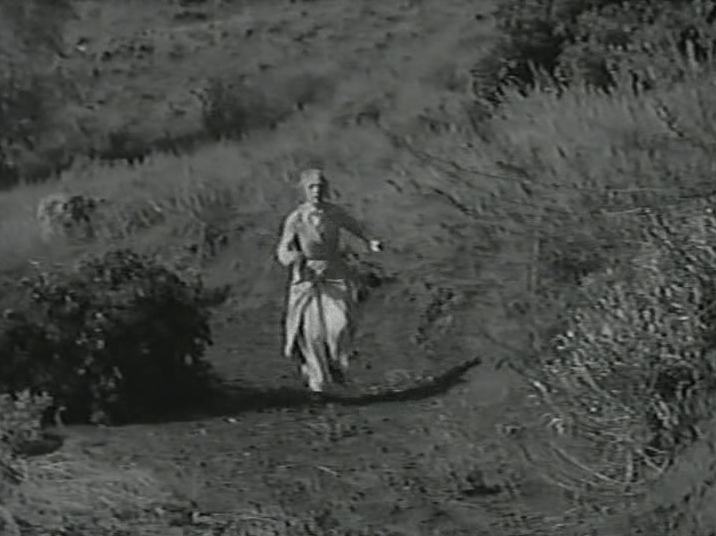
William Cameron Menzies’ nightmarish ground hogs day tale of alienation, colonization, loss of identity and good old fashioned sci-fi alien goodness. Bearing a storyline and set design that could be considered analogous to The Wizard of OZ… that for a later post. My brother used to tease me every time the picture came on tv that the aliens looked like they each were walking like they had taken dumps in their pants monster costumes.
Here’s a little Saturday morning pre-Halloween treat for you to enjoy!!!! Grab a quick cold cola before it goes disappearing down that sandy hill o’re yonder.…
Don’t worry it’s only a dream… or is it? MonsterGirl
Steve Hasbrat (Theater Management) over at Anti-Film School has graciously given me the opportunity to join their 3rd Annual Horror Movie Spooktacular in time for Halloween. And I get to chat about five movie monsters that I consider to be my favorites. If you know me by now, you’ll understand that asking me to narrow down anything to a mere 5 is quite a challenge. But I venture to say that if I cheat and mention a few who would have made the list, angry villagers won’t be hurling flaming torches at my porch if I do…
A little bit about Anti-Film School’s blogging philosophy from their About page!
“Founded in July of 2011, Anti-Film School is a film website that reviews both new and old films while also heavily focusing on grindhouse cinema, exploitation flicks, cult cinema, B-movies, and classic horror. Since its launch, it has gone on to receive 100,000 views, become a member of the Large Association of Movie Blogs, and be featured on Total Film online under “3 Cool Film Blogs to Visit,” GuysNation, Flights, Tights, and Movie Nights, Furious Cinema, and the Grindhouse Cinema Database. It is all tied together by a retro drive-in aesthetic. We apologize in advance for any missing reels, the sticky floors, shady audience members, stale popcorn, and broken seats.”
Oh, those woebegone days of broken velvet-covered creaky seats, your feet sticking to the floor from spilled Coke and milk duds… the smell of popcorn, salty sweat, and the tallest person in the theater sitting directly in front of you when there are loads of empty seats left…! I wonder why that always happens to me all the time…?
When you think of existentialism, well, when I am the MonsterGirl nerd of all time, I think of EXISTENTIALISM, Camus, Sartre & Kierkegaard, which immediately come to mind. When Steve asked me to think of 5 movie monsters that endeared themselves to me, I started to think of what it was, that essence of the thing, that impressed upon me so much about each monster’s character. It’s that they are Monsters in Search of an Existential Crisis.
Descartes said, “I think, therefore I am.” Existentialists say, “I am, therefore I think.”
This philosophy emphasizes radical skepticism and the uniqueness and isolation of the individual experience, an individual who is inhabiting an indifferent universe. Existentialism regards human existence as unexplainable and completely free. In this universe, there is no guiding Dogma that can help us. We’re all faced with equally unfortunate choices, leading to doom and despair. All human endeavors are meaningless and virtually insignificant, so when faced with the fact of existence, humans feel despair. Existential angst is when we are aware of the awful pointlessness of our existence. So life is an unknowable concept with strange forces that spring from this mysterious existence, with nothing that has any meaning, and fighting it is futile. Cheerful stuff…
Without further ado, here are our 5 monsters stuck in an existential landscape of despair, angst & searching for an identity in a cruel cruel universe.
What is it about monsters that we love? What truly remains with ‘us’ classic horror fans is something deeper and eternally soldered into our collective psyches.Something about ‘the monster’ has either caused us to ‘identify’ with them or has triggered a profound fear response that lasts a lifetime.
All monsters, you could say, are inherently existential figures because they come from a place of alienation, the unknown, and live outside the realm of perceived normalcy. ‘5 Monsters in Search of an Existential Crisis’seeks to understand how these particular characters are either the epitome of the existential ‘deviant’ (not to suggest deviancy in the context of being perverse but in the sense that they deviate from the norm of ‘accepted’ human nature, like a freak or a sword swallower or a drag queen), or have been placed in the middle of an existential environment.
Invasion of the Body Snatchers 1956 Dana Wynter and Kevin McCarthy.Luce Potter as the Martian Intelligence in William Cameron Menzies’s fantastical Invaders from Mars 1953.Jack Arnold’s quintessential journey of the existential transcendent man Grant Williams in The Incredible Shrinking Man.
However, poor Grant Williams was not a monster; he was only a transcendental man on a journey, projected into a monstrous world where the ordinary becomes a nightmare landscape for him. Films are based on stories where the alien, be it from space or here on earth, is a figure used to criticize rationality, conformity, tolerance, and lack of empathy, and often create discord between science and the military. They raise the question of fear of losing one’s identity amidst the cold war environment, or just to show that there are sinister threats from without & within!
Writers like Charles Beaumont, Richard Matheson, and Ray Bradbury were great at conjuring these “Outsider’ themes. I’d love to have included It Came From Outer Space (1953) with the amorphous Eye creatures that happened to be friendly aliens who crash-land in a desert cave.
It Came From Outer Space 1953 Richard Carlson and Barbara Rush.
I love these existential fellas, scary as they may be. Like Grendel who is the consummate existential literary figure and he was hideous, yet he’s one of my favorite characters in literature. Grendel struggles with the eternal question, am I a monster or a hero?
While these movie monsters may be hideous to some, I find them compelling and heroic in their journey to claim their place in a hostile world. Except for those nasty soul-eating land crabs whom I love just because they’re so cheeky, cheesy, and entertaining as hell!
For me, the quintessential existential man/monster (and that’s not a pants monster ) is Mary Shelley’sliterary Prometheus re-imagined by James Whale’s flagrant masterpiece. A man-made from the scraps of robbed corpses and brought to life by the electrical secrets of heaven. Yes, Frankenstein’s Monster, portrayed by the great Boris Karloff, manifested a truly complex enigma of conception, creation, and existential angst that’s both fearsome yet sympathetic.
We can sympathize with the monster, as with Frankenstein & The Gill Man from Creature From the Black Lagoon. We can find our involvement (at least I can) as one viewed with empathy toward the monster’s predicament. Depending on how much the film constructs its viewpoint, it leans toward creating pathos in the narrative. Usually, this means permitting these monsters to express human desires and then making sure that those desires are thwarted and frustrated and ultimately destroyed. The Outsider Narrative can be seen so clearly in the horror/sci-fi hybrid Creature From The Black Lagoon. Film monsters like The Gill Man form vivid memories for us, becoming icons and laying the groundwork for the classical experience of good horror.
I think Creature From The Black Lagoonis quite a perfect film, as it works on so many different levels. The most obvious is that scientists have invaded a unique creature’s habitat only to force their domination and belligerence on him. In the midst of this, a sort of skewed romance between Romeo and Juliet evolves. The Gill Man never intends to threaten Julie Adam’s character, Kay Lawrence. Quite the contrary, it’s the two opportunistic men who tote phallic harpoons around like extra penises on hand to fight each other about questions of ethics, how to conduct scientific research, and over Kay like spoiled children.
1) FRANKENSTEIN’S MONSTER: As portrayed by the great BORIS KARLOFF
“Oh, in the name of God! Now I know what it feels like to be God!”- Henry Frankenstein.
Thanks to the great make-up artist Jack Pierce, Boris Karloff’s poignant yet terrifying transformation into Frankenstein’s monster is the most memorable, indelible ‘classic monster’ for me. Boris Karloff said in 1957, “Jack’s words still echo in my mind: ‘This is going to be a big thing!'”
Mary Shelley created a transfixed symbol of existential angst. The gentleness that Boris Karloff imbued his character with will always touch my heart so deeply. Most memorable for me is the scene with the blind priest who breaks bread and shares his humble shack with his new ‘friend’ in Bride of Frankenstein, which is my favorite of the three films where Karloff portrayed the monster.
Frankenstein; or, The Modern Prometheus is a novel written by Mary Shelley about an eccentric scientist, Victor Frankenstein, who creates a grotesque creature in an unorthodox scientific experiment. Just a brief mention in regards to the literary source, Victor Frankenstein, is told by the monster that he refers to himself as “the Adam of your labors”, and elsewhere as someone who “would have” been “your Adam”, but is instead “your fallen angel.”
The film’s opening narrative goes like this: “We are about to unfold the story of Frankenstein, a man of science who sought to create a man after his own image without reckoning upon God. It is one of the strangest tales ever told. It deals with the two great mysteries of creation.; life and death”
“Beware; for I am fearless and therefore powerful.”
“How dangerous is the acquirement of knowledge and how much happier that man is who believes his native town to be the world, than he who aspires to be greater than his nature will allow.” “• Mary Shelley, Frankenstein
“I do know that for the sympathy of one living being, I would make peace with all. I have love in me the likes of which you can scarcely imagine and rage the likes of which you would not believe. If I cannot satisfy the one, I will indulge the other.” “• Mary Shelley, Frankenstein
Victor Frankenstein possessed great hubris. As many a mad scientist seeking the secrets of life tends to be. I suppose you must have that kind of insane drive to push back against the boundaries of the knowable to discover what lies beyond. BUT, when a man tries to act as God himself, one who creates life from the dead, challenging the biological fact that it is ‘women’ who give birth, who produce that life in the end. Ultimately, Victor Frankenstein’s monster is an existential failure. He justifies his work to Dr. Waldman: “Where should we be if nobody tried to find out what lies beyond? Have you never wanted to look beyond the clouds and stars, to know what causes trees to bud and what changes darkness to light? But if you talk like that people call you crazy…! Well, if I could discover just one of these things, what eternity is, for example, I wouldn’t care if they did think I was crazy.”
The imposing first sight of the monster shatters that scene. Jack Pierce’s, extraordinary make-up on Boris Karloff combined with the actor’s facial expressions and gestures are sheer brilliance.
Boris Karloff conveys a dead man’s angst who’s brought to life by a heretical scientist, inhabits his new world with such wonder, conflict, and rage, so exquisitely it’s actually painful to watch as he is scorned and tormented as a ‘thing.’ who never asked to be created in the first place.
For the sake of brevity, I’ll call him Frankenstein although he is ‘the monster.’Frankenstein has become an accepted name for Victor’s/Henry’s film version of a scientific yet unorthodox achievement.
And like that of Grendel, Frankenstein is the ultimate existential monster and Karloff gives him a child-like quality that wrenches at your heart with pathos. Born into an unknown world, unaware of his purpose in life, why he was created, and essentially who he is.
Karloff recalled, “I don’t think the main screenwriter Bob Florey really intended there to be much pathos inside the character.But Whale and I thought that there should be. We didn’t want the kind of rampaging monstrosity that Universal seemed to think we should go in for. We had to have pathos; Whale wanted to leave an impact.” They certainly achieved that with Karloff’s performance and Whale’s vision.
And I say this because he was born a blank slate, tabula rasa. Only to have men of science and the surrounding community, some inherently belligerent, some like Henry’s assistant Fritz, who is abusive and brutal and tortures the monster, defining who he is because of his ‘difference’. It’s after Frankenstein’s first rampage that the monster evokes our sympathy.
At first, the monster is like a newborn infant. Henry tells him to sit down, but he doesn’t understand the word yet. He follows the doctor’s gestures and hand signals.
Again Karloff,“Whale and I saw the character as an innocent one {…} Within the heavy restrictions of my make-up I tried to play it that way. This was a pathetic creature like us all, had neither wish nor say in our creation and certainly didn’t wish upon itself, the hideous image which automatically terrified humans whom it tried to befriend. The most heart rending aspect of the creature’s life, for us was his ultimate desertion of his creator-it was though a man in his blundering searching attempts to improve himself was to find himself deserted by God.”- from Karloff More Than a Monster- Stephen Jacobs
This sentiment is the essence of why Frankenstein is such a profoundly existential character, his crisis of alienation and detachment from his creator. In Cynthia Freeland’s book The Naked and The Undead, she cites Gregory Mank: “From the beginning Karloff’s approach to his ‘dear old monster’ was one of love and compassion. To discover and convey such sympathy was an outstanding insight, considering that rarely has an actor suffered so hideously by bringing to life a character.”
The hours of make-up and constructing the heavy suit Karloff had to endure, wearing it on the set during long days of shooting eventually crippled his legs and left him extremely bow-legged and in immense pain.
Dr. Henry Frankenstein (Colin Clive) and his assistant Fritz (Dwight Frye) go to a graveyard and steal a body. The fanatical Dr. Frankenstein believes that life can be created from death. He challenges the systems of morality for an ambiguous crack at being God-like. We, therefore, shift our allegiance and empathy toward the monster, who becomes the central figure of the story. And now that he’s been forced into existence, he wants Henry to create a mate for him, and why not! All god’s children got a girl…
Again if I could have had a few more choices The Bride would have been on my list in a flash of lighting! I adore Elsa Lanchester andFranz Waxman’sscore is perhaps one of the most evocative themes I just can resist becoming ebullient when ever I hear it!
With his bizarre experiments, Henry defies the laws of nature and the mortal contract with the universe, daring to try to give birth to his own creation. When he sends his assistant to steal a brain, the cruel knucklehead mistakenly takes a criminally insane brain without the doctor realizing it. Shutting himself off from the outside world and his fiance Elizabeth (The gorgeous Mae Clarke) she arrives at the castle to see what’s going on. Meanwhile, the constructed body from scraps, sewn together from various bodies of several dead men, is strapped to the slab and raised up into the violent electrical storm. Lightening surges into the body of the monster and soon… “Look! It’s moving. It’s alive. It’s alive… It’s alive, it’s moving, it’s alive, it’s alive, it’s alive, it’s alive, IT’S ALIVE!” – Henry Frankenstein.
Frankenstein emerges from his electrifying awakening into a dire world he did not ask to come into. To be shunned and controlled and reviled within only a few moments of his awareness. He has no chance to make his own choices or choose his own journey; He’s automatically an outsider who threatens those who perceive him as different and thus dangerous.
Frankenstein is an ‘object of the grotesque’ in this typified mad scientist /monstrous creation movie. A scientist is obsessed with the ‘secrets of life itself’, and his creation turns out to be a monster. The assistant is deformed in some way and often antagonistic to the monster, setting off a provoked rampage. The lab is fabulous, with scientific regalia and various apparatus in an isolated setting.
Ken Strickfaden’sdesigns or ‘special electrical properties’ buzzing light shows knobs and bottles and tubes in Henry Frankenstein’s lab are astounding. Charles D Hall’sart direction & set aides in the creation of an ambivalent scenery where science and morality conflict. The outside world is lensed as an ordered world, stylistically counter-posed to Henry’s laboratory’s clandestine dark and unorthodoxy. James Whale injected a lot of camp into the Gothic sensibilities.
Frankenstein is labeled a ‘monster.’ Therefore, he causes suffering to others and perpetuates the idea that he is, in fact, ‘a monster’. But most of us can see him as an existential anti-hero. It is the law of the existential philosophy that says HE must be responsible for his actions. These are actions that have justification but still have no bearing on the violent things he does. We are conflicted because we sympathize with his dilemma. Like a confused child who asks where I come from. Why am I here? Who is my creator? Why have they abandoned me, and what is friendship? Watching Frankenstein journey through a hostile landscape is painful for me as he’s chased by angry villagers with flaming torches. He only wanted to see the little girl float like a flower… He’s strung up on a cross like an obvious Christ figure, beaten, chained, drugged, and sought after to be deconstructed; he is a figure in an eternal existential crisis. A monster who doesn’t understand if he’s a man or truly a monster.
Interesting note: Bela Lugositurned the part of the monster down because he didn’t want to grunt and John Carradinerefused to play monsters at all, and also rejected the offer to play Frankenstein.
Although Lillian Gish set the standard for excellence when she first started out in silent film having been discovered by D W Griffith in 1912, I’ll always love her as the resolute Rachel Cooper in Charles Laughton’s masterpiece Night of the Hunter 1955
Not to mention her memorable performances as Mother Mary of Mercy in Portrait of Jennie 1948 and Laura Belle McCanles in Duel in the Sun 1946, & Victoria Inch in The Cobweb 1955. I’d love to see the 1969 television version where she plays Martha Brewster inArsenic and Old Lace where she co-stars with Helen Hayes.
In Body in the Barn, Lillian Gish brings her manifest greatness to bare as Bessie Carnby a strong willed old lady who refuses to be coddled toward death, is a centerpiece of the community and loves the Apple Jack she hides under her pillow. When she butts heads with new neighbor Samantha Wilkins the sparks fly and Gish gives one hell of a performance!
Wonderful set direction by Julia Heron and John McCarthy Jr and cinematography by William Margulies.
Lillian Gishplays Bessie Carnby an intractable grand old lady who refuses to hold her tongue when the pretentious Samantha Wilkins (Patricia Cutts) and her ‘saggy kneed’ husband Henry (Peter Lind Hayes) move to the county and put up a fence.
Maggie McNamarais Bessie’s niece Camilla Peter, Kent Smith(Cat People) as Dr Adamson,Josie Lloyd(Lydia Crosswaithe The Andy Griffith Show and daughter to Norman Lloyd) is The Wilkins’ housekeeper Nora, James Maloney is Ed the storekeeper Doodles Weaver as Gregg, Bruce Andersen as Huckaby Richard Niles as the Deputy and Kelly Thordsen as Sheriff Pate O. Turnbull.
What makes this simple genteel mystery story set in a bucolic quaint American town work so well is Lillian Gish’s fortitude that brings a stunning exactness to her performance as a stubborn and proudful woman whose fierce independence won’t let the truth be denied its due.
In the opening prologue, Hitch as one of his various props is dressed up like a scarecrow. It was suggested that since he’s been frightening people for years ‘why not birds’.
It’s one of his funniest little introductions as he tells us about the evening’s story all Tuxedoed, stuffed with straw…and typically cheeky.
He had a number of visitors “One little girl and a tin woodsman who are quite bothersome. They seem to be under the absurd impression that I’m going to be up the road dancing with them…”
The story as Hitch suggests is one which inhabits a ‘Bucolic Mood.’ A pleasant little tale of homicide, lust, deceit revenge, and greed. A story that works its way backward in order to bring us up to the present day, using the lead character Bessie Carnby’s narration to tell us how things came to be the way they are. The episode has a bit of the voyeurism of Rear Window 1954 in it.
Lillian Gish brings to life Bessie Carnby, a staunchly proud woman, fearless and pragmatic. She’s an irascible old gal who’s been fending off death for years, can stand on her own two feet, and doesn’t like the idea that Samantha Wilkins, a harpy who owns a prosperous farm in the county has put up a fence along the community path.
Samantha’s veins are filled with ice as she bosses her husband Henry around and doesn’t care about being a good neighbor. After Effram Judge, Bessie’s handyman falls off the cliff into the white water rapids below though the body is never found, the vitriol and venom flow between these two women who have no need to parse words. Bessie blames The Wilkins fence for Effram’s accident. Samantha Wilkins shows no sympathy or concern for the poor man’s death or what the community thinks about her fence. It’s on her property and that’s that.
Bessie lives with her niece Camilla and is seen by Doc Sam Adamson. The unassuming Henry Wilkins befriends Bessie and Camilla and gets himself invited to dinner. But when he doesn’t show up, Bessie becomes suspicious that the virulent Samantha might have killed her husband and buried him in the barn.
Bessie has been listening to Camilla who shares Henry’s private confidences that his wife once attempted to murder him and he fears she will try again. After months with no letters or postcards or calls, Samantha refuses to tell anyone where her husband might be, Bessie and Camilla are convinced that something foul is afoot after Bessie spies on Samantha with binoculars watching the woman go back and forth to the barn with flashlight and shovel.
Gossip and nosiness go with any small community, but once Bessie sneaks into the barn to snoop around she discovers a grave and now Sheriff Turnbull and the town discover a quick-lime cadaver clutching one of Samantha’s buttons and wearing Henry’s wedding band. The body is thus identified as that of Henry Wilkins.
All eyes are on Samantha now as she is the number one suspect in her husband’s murder.
I don’t want to give away the ending to the story so I’ll leave you in the barn with the quick-lime stiff.
Doodles Weaver as Gregg.the clerk catalogs the milk glass vase which secretly holds Bessie’s note inside.
Body in the Barn opens with moving men unloading the Carnby’s farmhouse antiques into a large truck. Bernard Herrman’s musical imprint pokes through the bucolic mood with clarinets and strings paying homage to nature and the simple life.
A dealer Mr. Huckaby (Bruce Andersen) is walking around appraising and cataloging all the contents of the house. The sundry knickknackery and antiques like milk glass, etc. Huckaby’s clerk (Charles Kuenstle) drops a milk glass vase as he fumbles with his clipboard.
When Huckaby inquires what it was, he assures the clerk that it was only a replica and to forget it. But the camera pans downward to show shreds of packing paper amidst the shattered shards of milk glass on the floor, and one rolled-up handwritten note sitting in the middle of the confetti debris.
Composer Herrmann’s wondrous musical swirls assist the lens in closing in on the note that was hidden within the small vase. Thus begins the voiceover… as Bessie narrates the evening’s story.
The voice-over begins-“By the time this is found, it’ll be all over. Justice would have had its day. The scales will be in balance again…
“By the time this is found, it’ll be all over. Justice would have had its day. The scales will be in balance again. {the scene begins to cross fade} It will be all over with me too. I’m ill and tired and I’ve been dying so long I’m bored with it… I’d lived in the county a long time. This is my home. These are my people. Now they’ve turned against me. But still I owe them something. I owe it to them to set history straight. To bring to the light of day the two lies that together make a truth.”
We are dropped into a landscape of vast open fields. Lillian Gish as Bessie Carnby and our narrator is running frenzied in a nightgown and robe as if carried by the wind.
Aunt Bessie runs feverishly to the seaside cliff. She is met by her niece Camilla. “Aunt Bessie you turn right around and go on back home.” Bessie says, “Not on your life,” Bessie asks her niece, ‘Who was it? Who fell off that cliff last night? ““There is nothing you can do about it right now go on back to the house” ” Was it Effram?” She looks at her aunt direly. Bessie begs her “Tell me, tell me”“They think so… they haven’t found him yet.”
Bessie takes in a deep breath.
Camilla runs after her fiery Aunt. The sheriff asks the Wilkins, “What time did you hear him yell?”
“A little past 8 I’d say”Henry answers, “Before 8”he looks at her. “Samantha I was in the barn by 8” She insists in her rigid tone, “He yelled before that” Henry replies, “I could have sworn”“About 10 to, I was in the kitchen and I heard it from the opened window”
Bessie, out of breath comes running up the hill and asks the sheriff, if they’ve found the body. He points to the raging waters below and tells her that if he fell into that, he probably won’t be found by this side of Tightwater.
Sheriff Turnbull says, “He had no business walking this path, dark coming on with his eyes as bad as they were Bessie.” She defends such a notion, “He wasn’t used to this path!”
Samantha Wilkins snaps, “He could have taken the road.”“A mile and a half out of his way” Bessie croaks out a passionate condemnation at the cold-hearted woman.
The sheriff asks “Is this a piece of his MacInall?”
“He was wearing it when he left” Bessie begins to cry.
Sheriff Turnbull figures, “Well he probably got it caught in the fence here and tried to get it loose and got careless with his footing.”
“He wasn’t used to that fence… none of us are”Bessie spins around and glares at Samantha Wilkins who says. “I’m sorry about that” Bessie exclaims, “It’s a great comfort to us all Mrs Wilkins… A great comfort to us all… He has a nephew in Rhode Island and he’ll feel a sight better when I tell him that the woman who put up the fence that killed Effram Judge is sorry.” Samantha Wilkins’ caustic tongue doesn’t hesitate, “If it was my hired man I would have driven him home.” Bessie meets Samantha’s barbs head-on, “Or if you were me you would have stayed in bed like the doctor ordered.”“My fence belongs on my property line that’s where i put it and that’s where it’ll stay.”
“My fence belongs on my property line. That’s where I put it and that’s where it’ll stay… If it fenced off a short cuts that’s too bad it’s legal and proper… make of it what you will but don’t try to put the death of Ef Judge on my conscience.” –Samantha Wilkins
The banter between Lillian Gish and Patricia Cutts is a wonderful piece of dramatic interplay.
” I don’t have to put it there Mrs. Wilkins, that path’s been a public thoroughfare for over a century YOU had no right.”
Lillian Gish’s performance here is spectacular as she modulates her voice from an inner strength that springs forth from lifelong wisdom to a tone of righteous indignation.
The two women frame a powerful exposition of the old vs the modern vs the sacred traditionalism of small-town ethics and suggest to us a commentary on class struggle. The modern world has intruded on the old quaint ways of a simpler time. With the wealthy and almost demonic Samantha, entitled and encroaching on the quaint ways of an old-fashioned woman and the world she used to inherit. Causing one man’s death and alienating an entire community. Before the Wilkins came and put up the fence, life was simple. Bessie spells it out in her tirade perfectly.
Samantha starts to attack Bessie, “Since when…” but her husband Henry breaks in as if to plead with his wife to show some compassion, “Samantha…”
Sheriff Turnbull finally breaks up the quarrel, “Now there’s no point hashing this thing over now.”
Samantha Wilkin’s voices raises up an octave, “I’m not gonna stand here and hear that old biddy blame me…”Bessie objects “Biddy!” Samantha adds “Yes and a snooper and a gossip and a community nuisance.” Bessie tries to argue, “You listen to me” Samantha overpowers her, “No wonder I put up that fence it’s the only protection I got with a neighbor like you.”“I’ve been a good neighbor all my life. I’m a respected member of this community. I was a friend of the McKelvys long before you bought High Hollow. You and that saggy kneed excuse for a husband.” Samantha shouts, “Shut your mouth.” “We got along before you. There was this give and take between us. None of this building of fences. We got along. But you(she points her finger at Samantha Wilkins) You’ll get your comeuppance you. You’ll see you’ll get your comeupp…”
Suddenly Bessie appears to have an attack. She collapses and Sheriff Turnbull catches her.
Henry Wilkins picks her up and tells her he’s taking her home. She’s gasping for air and out of breath but she tells him to put her down. Camilla calls out “Aunt Bessie…” In a rasping voice, she tells him “I’ll get there on my own two legs.”
The sheriff tells Bessie that if the doc knew what she was up to he’d have her hide.
Henry begins to carry her. She continues to argue with the exhausted breath she’s got left.
Samantha comments to Sheriff Turnbull “I guess I”m to blame for that too.” He answers her, “I wouldn’t be at all surprised.”
Photo of the great William Castle -courtesy of Spine Tingler.
“The film is frightening because it forces us to examine the kinds and bases of belief. We confront the idea that the Christian myth is certainly no more believable that its mirror image, and possibly less so. And beyond this, we are also forced to realize that our mode of believing in Christianity is quite different from the one with which we perceive ‘real’ things –In other words, while Polanski’s film is determinedly realistic, it is at the same time a challenge to realism, locating the ordinary world of plausible social interaction within a wider and more primitive universe of magic, sorcery, and supernatural forces.” –Hollywood Hex, -Makita Brottman
Rosemary’s Baby is my favorite film. I plan on doing one of my long-winded major features on this masterpiece in its entirety but for the sake of celebrating William Castle this week, I’d like to strictly focus on his contribution to an iconic tour de force that would not have been filmed if not for him. Rosemary’s Baby premiered in June 1968.
Roman Polanski on William Castle: “He was an excellent technician who understands filmmakers’ problems and doesn’t have the usual worries other producers have. He made a constant effort to make me happy in my work. I can’t think of a better producer.”
After many years of William Castle slaving over B movies and programmers like The Whistler and The Crime Doctor, he found his niche in horror. He saw Henri-Georges Clouzotle Diaboliquein 1955 and it lit a fire in his belly to create his own Gothic creepy storytelling that would lure the audience under its spell. Thus sung Macabre in 1958. While certainly not Diabolique,Macabre put Castle on the path toward creating engaging & frightening landscapes that would entertain millions!
That same year, thanks to his very successful House on Haunted Hill and his 12-foot plastic glow-in-the-dark skeleton deemed ‘Emergo’ that flew over theatre audiences, he was now dubbed the ‘King of Gimmicks.’Â Castle went on to chill us with The TIngler in ’59, 13 Ghosts in ’60, Homicidal and Mr Sardonicus in ’61, Strait-Jacket in ’64, and I Saw What You Did in ’65 both landing Joan Crawford at the helm.
William Castle’s Homicidal ’61starring Jean Arless (Joan Marshall)
With all the ballyhoo and commercial success, Bill was craving respect. He thought he’d find that admiration in Rosemary’s Baby, a novel by Ira Levin(A Kiss Before Dying, The Stepford Wives, Boys From Brazil) about an unassuming pretty little housewife chosen by a coven of New York City witches to be the mother of Lucifer’s only begotten son and heir.
What is remarkable about the film is the realism. It is so careful to remain dedicated to the naturalistic tone of Levin’s novel showing us a set of ordinary characters in an apparently common world. Then they gradually become introduced to extraordinary elements of dark forces, both magic and fantasy that begin to overwhelm the narrative. We as spectators are now caught up in Rosemary’s plight and her utter sense of powerlessness. This story is less about witches and more about paranoia and the lack of control over our own bodies and destiny. However explained in supernatural terms, it’s still about losing trust with those closest to us, the people we depend on to protect us from harm. We watch as Rosemary’s world turns upside down.
I saw Rosemary’s Baby during its theatrical release in New York in June 1968. It was billed as a double feature with The Mephisto Waltz. We won’t get into how either really enlightened or truly nutty, depending on your perspective, my mom was for taking her 6-year-old little girl to see two very intense horror pictures dealing with adult and subversive themes.
I was an extremely mature child and the film not only didn’t traumatize me, but it also opened up a world of desire for me to see as many intellectual horror stories without fear of nightmares. Although I must admit when I used to watch Robert Wise’sThe Haunting in broad daylight on a Saturday afternoon, I did manage to lock the basement door and shove the large gold (the color of Archie Bunker’s favorite chair) loveseat in front of it to keep any boogeyman from coming up the basement stairs into the den when I was alone in the house.
I also just saw Rosemary’s Baby remastered on the big screen at the Film Forum a few weeks ago. I have to admit, that as soon as Christopher Komeda’s music starts playing and the bird’s eye view of the Dakota emerges on screen the electricity started flowing up my legs, this time not my usual RLS, I began weeping. Not only is Rosemary’s Baby my favorite film, but I also recognize the confluence of perfectionism in each and every scene that makes it a flawless masterpiece, from the vibrant performances to the exquisite storytelling. Every detail is magical and I don’t mean devilish, I mean artfully.
Something else wonderful happened during the screening that day. Amidst all the other film geeks like myself, and aside from the audible pleasure the audience let out when the magnificent Ruth Gordon and Sidney Blackmer walk on the screen where we all laughed and silently cheered for their strolling entrance as the iconic quirky and eccentric devil-worshiping senior citizens. When Bill Castle did his Hitchcock walk on by the phone booth, I realized that it wasn’t only me smacking my partner Wendy’s knee with childhood excitement, “There’s Bill, there he is!!! We both chuckled with glee to see his wide warming grin. Suddenly we heard others in the crowd stirring and murmuring “there he is, that’s Bill Castle!!!” Amidst all the appurtenances Rosemary’s Baby has to offer, so many of us fans were thrilled to catch sight of Mr.Castle with his fat cigar standing by the phone booth. We were collectively excited to see the man who had entertained us all these years. It was heartwarming. I did tear up.
I recognize Roman Polanski as the auteur that he is, but that is not what I want to dwell on here. I want to stress that Rosemary’s Baby would not have been made if it weren’t for William Castle and his perseverance, passion, and eye for intellectual property. William Castle acknowledged that The Lady From Shanghai was a work of art because of Orson Welles‘ direction, however, it was Castle who first discovered and purchased the rights to If I Should Die Before I Wake, only to have Orson Welles turn around and pitch it to Harry Cohn as his own idea.
It was Rosemary’s Baby that Bill chose to elevate his status from B movie maker to respected filmmaker in a very fickle industry. Let’s pay tribute to one certain fact: Rosemary’s Baby would not be the film it is after 45 years without William Castle’s imprint on it.
Bill’s memoirs Step Right Up, I’m Gonna Scare the Pants Off America (which is a fantastic read for any enthusiast about the golden age of Hollywood and just a darn good bit of storytelling) describes how William Castle’s literary agent Marvin Birdt, the person who found the script and insisted Bill read the galleys immediately. Castle looked at the title and dismissed it saying “It’s probably some story about an unwed mother… cheap exploitation. Who the hell wants to make a picture like that?”Â
Bill Castle thought the film just wasn’t for him at that point. It was 1968 and the film industry wasn’t really embracing horror films anymore. He was so overwhelmed with the lousy books and manuscripts that were piling up that he just couldn’t fathom wasting any time with yet another piece of junk. But, it took him all of three hours to finish the story, as he said, ‘bathed in sweat and shaking.’ Castle saw the magnitude of Ira Levin’s story when it was still in unpublished manuscript form: “I made up my mind when I read the novel Rosemary’s Baby that it was the greatest novel that would translate into a screenplay that I had ever read. That just lent itself to a brilliant movie. And I loved the property and I brought the property because I wanted to prove to the industry and my fellow peers that I could do something really brilliant.” (Step Right Up, 2010) He told Ellen, his wife, that it was one of the most powerful books he’d ever read, and that it would be an incredible picture to make. When Ellen finished reading it, she told him “It’s disturbing… frightening and brilliant.”(SRU, 2010) But Ellen also warned that he’d have trouble with the Church.
William Castle and the love of his life, his beautiful wife Ellen courtesy of Spine Tingler.
Castle’s agent Birdt tormented him about other studios and directors interested in the story and making offers. Later, Castle found out that the book had actually been offered to Alfred Hitchcock first. One wonders what it might have looked like if Hitch had been behind the camera, storyboarding Levin’s work.
Bill Castle was worried that he was going to lose the picture, but where was he going to get the quarter of a million Birdt demanded to finance the rights to the film? He asked Birdt to offer one hundred thousand dollars upfront and then fifty thousand if the book became a bestseller with five percent of one hundred percent of the net profits. His agent wasn’t very encouraged that they’d accept the offer. The waiting to hear back was excruciating, but Castle did get the rights to Rosemary’s Baby. Now he had to come up with the money!
In Step Right Up, Bill describes how Robert Evans, in charge of Paramount Pictures, called to check in, not sure William Castle could handle such a serious motion picture. But, Charles Bluhdorn, owner of Paramount, wanted to meet with Castle personally to discuss the picture, saying “I have big plans for Paramount, and they include you.” Castle found Bluhdorn’s persona magnetic. He told him that Bob Evens had informed him about Castle’ obtaining Rosemary’s Baby.“Would you like to make the picture for us?” Of course, Castle told him, yes.
head of Paramount Robert Evans
“Your services as producer, how much would you want?” Bill Castle corrected Bluhdorn by adding the word ‘director’… trying to avoid negotiating with this man without his lawyer. Bluhdorn wasn’t having any of that. He told Castle that he would not negotiate with lawyers on the making of Rosemary’s Baby. It’s either between Castle and him, or Donnenfeld and Castle’s attorney. Castle decided he had the ego to take on this financial genius and told him he’d negotiate with him directly. But first, Bill asked him if he had read the story. Bluhdorn had not. Bill thought that worked to his advantage as the story was intensely disturbing so the less Bluhdorn knew about the story the better.
Robert Evans and Roman Polanski
When Bill Castle finally blurted out that he’d want to produce and direct, Bluhdorn laughed at him and called him a ‘big ridiculous clown.’ He tried to offer Bill only one hundred fifty thousand for the film plus thirty percent of the profits. Bill told him no way. It was a hard bargaining session. Bluhdorn didn’t know what he was dealing for and Bill did, Bluhdorn was also dropping the phony niceties and getting close to bowing out of any deal. “If I walk through that door, Rosemary’s Baby is finished at Paramount. No one -and I mean no one- will renegotiate!” Castle finally composed his inner panic and came back at the austere blowhard with an offer of two hundred fifty thousand and fifty percent of the profits. It was a deal. (Step Right Up, 2010)Â
Bill Castle courtesy of Spine Tingler.
Bill’s daughter, Terry Castle remembers, “He had to do whatever he could and it was his time. Mom and Dad mortgaged the house and they bought the rights for a substantial amount of money.” (Spine Tingler: The William Castle Story)
With that he asked Castle’s age and if he’d heard of director Roman Polanski, or seen any of his pictures. Castle had seen Repulsion and Knife in the Water. Bluhdorn sang Polanski’s praises calling him a genius. He impressed upon Castle that with the director’s youth and Castle’s experience as a producer, they could both learn from each other. Bill Castle started to find his fire, “Look Mr. Bluhdorn, the reason I bought Rosemary’s Baby with my own money was to direct the film… It’s going to be an important motion picture and I’m not going to miss the opportunity of directing.” (Step Right Up, 2010)
Bluhdorn told him that Polanski directs Rosemary’s Baby or no deal, and asked Bill to at least meet the young director. Castle says “I had made up my mind to hate him on sight"¦ and that he wasn’t going to direct the picture I said absolutely no way. I bought the picture, I bought the book. I own it, I’m going to direct it..{…} I worked all my life to get something worthwhile on the screen and so at first sight I hated him.” He’d sent Polanski the galleys to read and if after meeting him he decides he doesn’t want him directing the movie then fine. Bill Castle says in his memoirs that while Bluhdorn was a tough negotiator he was at least an honorable and fair man whose handshake was better than a written contract.
Castle and Polanski courtesy of Spine Tingler
InStep Right Up, 2010Castle describes his first impression of Roman Polanski was that he was a little cocky vain narcissist who liked to look at himself in the mirror a lot. Bill asked if he liked the story, “I like it very much… It will make a great picture.” Polanski spoke in his Polish accent. “You would like to direct Rosemary?”Bill asked. “That’s why I’m here. Nobody will be able to direct it as well as Roman Polanski.” And Bill Castle’ felt that Ira Levin’s book was perfect for the screen, needing absolutely no changes whatsoever in adapting it. This was something he felt passionately about. He posed the question to Polanski.“The book is perfect… no changes must be made,” Bill says that Polanski was so intense about this that it was quite jarring. “It’s one of the few books I have read that must be translated faithfully to the cinema.” (Step Right Up, 2010)
And having read Levin’s book, I can tell you that reading each line of every page is exactly like watching the story unfold on screen. It is the most faithful adaptation I’ve ever read, more like reading the script after the fact.
Then Castle posed a trick question to Polanski to see what his vision was for filming the narrative, suggesting to him that the camera should not only move around a lot but use strange shots to tell the story. Polanski was empowered by his convictions and told Bill, “No, I don’t Mr. Castle. Actors tell a story… like peeping through the keyhole of life. I do not like crazy tricks with the camera… must be honest.” That was exactly how Bill Castle saw the film being made. When Polanski told Bill to start calling him Roman, Bill couldn’t help but start to like this man who truly did share a special vision for a very special story. Polanski went on to tell him, “Bill, we can make a wonderful picture together. I have been looking for a long time for a Rosemary’s Baby. To work with you would be my privilege.” (Step Right Up, 2010)
Terry Castle, Bill’s daughter, remembers: “Polanski came over to the house and he was this young wild guy, just this incredibly wily dynamic man with this very thick accent talking about cameras and light he was just incredibly dynamic himself and my dad totally got him. He wanted to get Rosemary’s Baby made and he wanted to produce it"¦ and yet he wanted to direct it. But I think once he met Roman Polanski I think he understood he could bring something incredibly special to the project. And I think it was okay for Dad to give that up to him because I think he saw the brilliance in this man. […] Even though he wasn’t going to be directing it at least his name was going to be on it as a William Castle production and he was making for the first time in his life an important studio film.” (Spine Tingler: The William Castle Story)
The last thing Bill Castle needed to know was who he’d pick to write the screenplay and why. Polanski told Bill he would do it himself because he would stick strictly to the book. They spent the rest of the time discussing the film, Bill finding Polanski brilliant and extremely open. He immediately called Bluhdorn and told him that he was right Polanski was the only one who could direct Rosemary’s Baby. Bill Castle had the wisdom and grace to understand that Polanski would make a great film, but to be fair to Bill Castle. it’s also only after his careful facilitation and thoughtful know-how that helped bring Ira Levin’s story to life.
Polanski kept his word, he wrote the screenplay and adhered strictly to the book as promised. Polanski asked Bill to help him find a house by the beach to work and that he’d send his fiance over to help him look for one. On a Sunday morning, Sharon Tate was standing at Bill Castle’s door. They found the perfect beach house for the couple, owned by Brian Aherne who was in Europe.
Polanski wanted to use Richard Sylbert to do the set design for the film. Sylbert had just finished working on Mike Nichols’ The Graduate. Roman Polanski thought his work was brilliant. Polanski suggested Tuesday Weld in the lead as Rosemary. Bill agreed that she was a fine actress but said, “I think the role was written for Mia Farrow” Polanski watched her in several episodes of Peyton Place and didn’t agree. He thought Tuesday Weld would be better. Jane Fonda, Julie Christie, Elizabeth Hartman, and Joanna Pettet were also considered for the part. Evans asked about the casting of Rosemary, and they both gave their choices. Evans told them that he didn’t think Mia Farrow was available because she was working with George Cukor, he’d check with Zanuck at Fox and in the meantime try and get a reading with Weld.
Tuesday Weld
Now the buzz was all over Hollywood and every actress in town felt they would be just perfect for the lead role, but Polanski was still stubborn about Tuesday Weld. When Zanuck called Bill and told him the Cukor picture fell through, and Mia was available. Bill set up a meeting with Mia and Polanski over lunch and Polanski wound up being completely mesmerized by her. He finally agreed she would play Rosemary. The rest is history.
Roman Polanski actually developed a wonderful working relationship with Mia Farrow on the set. She didn’t bring any preconceived motivations to her role as Rosemary Woodhouse. Supposedly he had some difficulties with Catherine Deneuve on the set of Repulsion, but he found Mia very amenable to work with. Mia followed Polanski’s directions very well, which might explain some of her childlike and innocent air in her performance of the blithe and charming Rosemary.
William Castle had success with When Strangers Marry ’44, with (Kim Hunter and Robert Mitchum) and was well regarded for the work he did for RKO with his brilliantly offbeat The Whistler series.
With Johnny Stool Pigeon,Castle directs this uncluttered and obscure little film noir, pairing Shelley Winters and Dan Duryea who made Larceny a year earlier and would then do another picture together, Winchester ’73 in 1950.
Dan Duryea and Shelley Winters in Winchester 73 photo courtesy of all things Duryea @ http://danduryeacentral.blogspot.com/Shelley Winters and Dan Duryea in William Castle’s Johnny Stool Pigeon 1949 promo courtesy of Dan Duryea Central blog spot
It’s an entertaining programmer lensed with a semi-documentary style utilizing the usual noir voice-over to aid in the storytelling as Howard Duff’s character narrates the action as he goes undercover as Mike Doyle.
Scripted by Robert L. Richards (Act of Violence 1948) is based on a story by Henry Jordan. Using stock music by an uncredited Miklós Rózsa.
With cinematography by Maury Gertsman (Blond Alibi ’46, The Brute Man ’46, Ma and Pa Kettle ’49, The Glass Web ’53, The Creature Walks Among Us ’56). The moody visuals are courtesy of filming on location in San Francisco and Tucson. The old-style pier scenes with the opening shoot-out in the warehouse to the customs check with rows of cars at the Mexican border in Tucson give the picture the comfortable feel of added realism of 1949.
beautiful exterior shots of the Tucson sky.
A young sailor gets off a ship carrying a sack. He’s meeting up with a hood named Carter. They’re trafficking heroine from the Orient.Federal Agents Morton and Harrison are in pursuit.
“Get your hands up and stay where you are.”
The young man is shot by his accomplice. Agent Morton looks at his wallet to id him.Morton (Howard Duff) goes on to narrate from here-“Someone in Shanghai told him a way to make an easy buck and he believed him. All he needed was luck. And so one night on a Shanghai dock they slipped something into his hand that looked like an ordinary can of tobacco. Only it wasn’t and John Whalen wasn’t lucky.”it certainly wasn’t an ordinary can of tobacco
With a fantastic cast as follows-Â Shelley Winters, Howard Duff, Dan Duryea who made 3 other noir classics that year in 1949 (Manhandled, Criss Cross, & Too Late for Tears), and co-stars Tony Curtis, John McIntire, Barry Kelley, and Leif Erickson.
photo courtesy of Dan Duryea Central Blog Spot.
Duryea is marvelous as always, playing the quintessential sneering oily voiced cynic who’s a sympathetic slick, and snickering ‘bad guy’ that you just have to like.
Dan Duryea as Johnny Evans photo courtesy of Dan Duryea Central Blog Spot.photo courtesy of Dan Duryea Central Blog Spot
Howard Duff plays it straight as George Morton a federal narcotics agent who goes undercover to infiltrate a syndicate of criminal heroin smugglers. He enlists the help of childhood pal now convict, Johnny Evans (Dan Duryea) a hoodlum he’s sent to Alcatraz for life. Now getting him sprung so Johnny can help him sneak inside the big drug operation and bust it wide open. Naturally, Johnny hates cops but his wife has just died from an overdose which Morton uses to convince Johnny to help him catch these dangerous drug runners.
Of course, there’s conflict between these two men, as Morton’s on a mission and Johnny’s vowed revenge. Johnny Evans helps Morton get a new identity as they infiltrate the powerful gang of drug dealers.
photo courtesy of Dan Duryea Central Blog Spot
Morton now using the name of Mike Doyle, Johnny go to Vancouver where McCandles the drug lord uses his floozie blonde Terry to keep an eye on the pair. Like any good gritty and sexy charged thriller Johnny Evans falls for Terry who only only seems to have eyes for Morton. Ah, the eternal triangle lives on as they travel to Tuscon where the dangerous drug deal is about to go down at the Mexican border crossing.
Gangly but wily rancher Nick Avery (John McIntire) doesn’t trust these two from the get-go. The team must be loyal to each other if they want to remain above suspicion. It’s great grist for the noir narrative mill as we must wait and see whether Johnny will sell Morton out to this gang of thugs.
Johnny Stool Pigeon also features a first-time role for a young Tony Curtis who plays a mute pretty boy hired killer who can’t seem to place Morton/Mike Doyle’s face but it’s lurking in his memory from the time they chased Carter and Joey spots them in the hallway. He’d just killed Carter, having been sent there to kill their San Francisco connection so he wouldn’t squeal.
Uncredited bit player Tony Curtis’ only spent a few seconds on screen doing the rumba with Yvonne DeCarlo in Robert Siodmak’sCriss Cross ’49, That little spark of sexy flare made Universal realize that they had a star on their hands.
doing the rumba with Yvonne DeCarlo in Robert Siodmak’s Criss Cross ’49.
Gang moll blonde Terry is played by Universal’s new voluptuous Shelley Winters. Who begins her long career starting out as a whiny, trashy yet outre charismatic sex pot.
I’ve got a special feature waiting at the Last Drive In’s snack bar all about Shelley Winters and her impressive contribution to film.
Duryea’s character keeps us guessing as to whether he’s going to betray Morton and turn into a ‘stool pigeon’. It’s a great little match-up of the likable Duff and Duryea as they play the eternal unwilling partners in conflict as they journey from San Francisco to Vancouver and then to a luxury ranch in Tucson run by the slimy Nick Avery, as amiable as a snake in the grass.
Disembodied screams, rattling chains, and ghoulish groans amidst creaking doors- all a delicious mixture of frightful sounds that emanate from a jet-black screen.
Suddenly Watson Pritchard’s floating head narrates the evening’s spooky tale…
“The ghosts are moving tonight, restless… hungry. May I introduce myself? I’m Watson Pritchard. In just a moment I’ll show you the only really haunted house in the world. Since it was built a century ago, seven people including my brother have been murdered in it, since then, I own the house. I’ve only spent one night there and when they found me in the morning, I… I was almost dead.” -Watson Pritchard
The marvelously dashing face of Vincent Price or for the film’s purposes, Frederick Loren’s head sporting a plucky mustache and highbrow tone introduces himself in front of the imposing Modern-Ancient structure.
“I’m Frederick Loren and I’ve rented the house on haunted hill tonight so my wife can give a party. A haunted house party"¦ She’s so amusing. There’ll be food and drink and ghosts and perhaps even a few murders. You’re all invited. If any of you will spend the next twelve hours in this house, I’ll give you each $10,000. Or your next of kin in case you don’t survive. Ah, but here come our other guests…”“It was my wife’s idea to have our guests come in funeral cars… She’s so amusing. Her sense of humor is shall we say, original. I dreamt up the hearse. It’s empty now but after a night in the house on haunted hill"¦ who knows.”“Lance Schroeder a test pilot, no doubt a brave man but don’t you think you can be much braver if you’re paid for it?”“Ruth Bridges the newspaper columnist. She says the reason for her coming to the party is to write a feature article on ghosts. She’s also desperate for money. Gambling.”“Watson Pritchard a man living in mortal fear of a house and yet he’s risking his life to spend another night here"¦ I wonder why? He says for money.”“Dr. David Trent a psychiatrist. He claims that my ghost will help his work on hysteria. But don’t you see a little touch of greed there around the mouth and eyes?”“This is Nora Manning- I picked her from the thousands of people who work for me because she needed the 10,000 more than most. Supports her whole family… Isn’t she pretty?”“The parties’ starting now and you have until midnight to find the house on haunted hill.”
Von Dexter’s music, a mixture of solemn strings, and a sustained and queasy Hammond organ & Theremin greet us with an eerie funeral dirge while the shiny black gimmicky funeral cars pull up in front of the quite sinister post-modern structure.
And this is just the opening fanfare of William Castle’sclassic House on Haunted Hill!
White’s story is quirky and wonderfully macabre as it works at a jolting pace delivering some of the most memorable moments of offbeat suspense in this classic B&W B-Horror morsel from the 50s!
The success of the film inspired Alfred Hitchcock to go out and make his own low-budget horror picture- Psycho 1960.
Much of the style and atmosphere can be attributed to the unorthodox detail by art director Dave Milton and set designer Morris Hoffman. The exterior of the house is actually The Ennis Brown House in Los Angeles, designed by Frank Lloyd Wright, built in 1924, and now listed on the National Register of Historic Places.
There’s a pervasive sense of dread in House on Haunted Hill, that makes the house itself a ‘spook.’
Whether the house is haunted or not, its forbidding presence tells us that it just doesn’t matter. The history of the house itself, its violent past is enough to give one chills. While not in the classic sense like that of RobertWise’s diseased and imposing Hill House, William Castle does a fabulous job of inventing a parameter to tell a very cheeky and pleasurable little scare story. As David J Skal puts it succinctly “The real, if unintentional spook in House on Haunted Hill is postwar affluence.”
The narrative is fueled by the creepy atmosphere of the house itself. Not using a claustrophobic Old Dark House trope but rather a modern Gothic construction that swallows you up with odd motifs and a sense of malignancy within the fortress walls. The starkness of the wine cellar and it’s empty minuscule dark grey rooms with sliding panels is almost more creepy than black shadowy corners with cobwebs and clutter. Director of Photography Carl E Guthrie  (Caged 1950) offers some stunning and odd perspective camera angles and low lighting which aid in the disjointed feeling of the sinister house’s magnetism.
The constant explorations into the viscera of the house by the guests is almost as titillating as the criminal set-up and conspiracy that is afoot propelled by Von Dexter’s tantalizingly eerie musical score with deep piano notes and eerie wispy soprano glossolalia.
House on Haunted Hill works wonderfully, partly due to the presence of the urbane master of chills and thrills, the great Vincent Price who plays millionaire playboy Frederick Loren. Vincent Price was a versatile actor who should not be pigeonholed as merely a titan of terror, given his too numerous layered performances in great films like Otto Preminger’sLaura ’44, Joseph L. Mankiewicz’sDragonwyck ’46, etc. Vincent Price did however make his mark on the horror genre with House on Haunted Hill. The New York Herald-Tribune praised Price’s performance as having “waggish style and bon-vivant skepticism.”
As David J Skal puts it in his, The Monster Show {Vincent Price} “Could bring an arch elegance to the most insipid goings-on…“
The omnipresent Elisha Cook Jr. is superb as Watson Pritchard, the neurotic sot who is riddled with fear, spouting anecdotes about the house’s grisly history.
I adore Elisha Cook, from his cameo in Rosemary’s Baby, his performance as George Peatty in Kubrick’s masterpiece The Killing ’56 to his very uniquely intense role as Cliff the sexually jazzed up drummer in Phantom Lady ’44.
Elisha Cook Jr as the doomed George Peatty in Stanley Kubrick’s The Killing ’56.
The strikingly beautiful Carol Ohmart plays Loren’s treacherously seductive wife Annabelle who is sick of her husband’s irrational jealousy. Has she already tried to poison him once but failed? The story alludes to as much. Annabelle wouldn’t be happy with a million-dollar divorce settlement, she wants ALL her husband’s money! Annabelle is Loren’s fourth wife, the first wife simply disappeared.
In Edward Dmytryk’sWalk on the Wild SideBarbara Stanwyck is no ordinary ‘Jo’
Stanwyck was the epitome of independence and determination. She had a streak of non-conformity, toughness, and resilience.
Stanwyck was born Ruby Stevens in Brooklyn, July 16th 1907. A New Yorker like me and a fellow Cancerian. Her mother died and her father disappeared when she was 4, leaving her and her brother in the care of her older sister Mildred and foster homes where she’d often run away. At age 9 Ruby toured with her dancer sister, a John Cort Showgirl practicing the routines back stage. Watching her idol Pearl White on the big screen inspired her to go into showbiz. She quitt school at age 14, followed her sister’s lead and became a Ziegfeld Follies girl.
Ziegfeld Girl 1924 Barbara Stanwyck.
In 1929 Stanwyck had the lead in the road company production of the Broadway hit ‘Burlesque’ which was a hit in theater. She shared the stage with Mary Tomlinson, a clergyman’s daughter who most likely ran away from home because she was a lesbian. Mary changed her name to Marjorie Main and become the quick talkin’ ‘Ma’ in the raucous Ma and Pa Kettle series from ’49-’57.
Marjorie Main as the unflappable Ma Kettle.
One of her good friends during those years was pianist Oscar Levant who said Stanwyck was “wary of sophisticates and phonies.”
Ruby became Barbara Stanwyck at age 19 while she had the lead in ‘The Noose’ on Broadway. At 21 she was introduce by Levant to Frank Fay star of Vaudeville and ten years older than she, a closet homosexual, alcoholic and abusive husband. They married and moved to Hollywood in 1929 when Stanwyck was on her way to becoming a star of the silver screen. They used her money and bought a mansion in Brentwood. That’s how she and Joan Crawford (married to Franchot Tone at the time) became neighbors and close friends.
At first Stanwyck starred in a few B movies but began getting attention for her roles in Ladies of Leisure ‘30, Illicit ’31, Night Nurse ’31, and Miracle Woman ’31.
Stanwyck in Illicit 1931.
While working with Frank Capra on Ladies of Leisure he taught her that much of acting was conveyed with the eyes and that unless the audience was drawn in, the dialogue didn’t matter. This was her breakthrough movie. Edward Bernds who worked with Capra said “That first take with Stanwyck was sacred.”
Stanwyck’s first Academy Award nomination was for the downtrodden mother Stella Dallas ’37 where her old friend Marjorie Main played her mother-in-law.
Three nominations followed for Ball of Fire ’42 with Gary Cooper,Double Indemnity ’44, and Sorry Wrong Number ’48 with Burt Lancaster.Stanwyck was now on her second marriage to another gay man, the handsome Robert Taylor. Their ’39 marriage was arranged by the studio. The couple had separate bedrooms.
Barbara Stanwyck and Robert Taylor on the cover of Movie Life
Some assert that Stanwyck had a lifelong relationship with her publicist Helen Ferguson. It’s not for me to wager yes or no nor to be concerned with her private life one way or the other. If she wanted us to know it was her choice to share it.
In ’35 she played the rugged farm girl living in a man’s world– Annie Oakley, a masculine woman who was great with a gun.
She did a slew of romantic comedies with charismatic co-stars. Twice with Henry Fonda in the screwball The Mad Miss Manton ’38, and Preston Sturges‘ The Lady Eve ’41. Remember The Night ’40 opposite Fred MacMurray was her first film with costume designer Edith Head.
Some of my favorite films of her’s were: playing opposite co-star William Holden in Rouben Mamoulian’sGolden Boy ’39. Then Meet John Doe 1941, Lady of Burlesque, and the immortal femme fatale Phyllis Dietrichson in 1944 Double Indemnity, The Strange Love of Martha Ivers ’46, The Two Mrs. Carrolls ’47, Cry Wolf ’47, B. F.’s Daughter ’48, Sorry, Wrong Number ’48, in 1950 The File on Thelma Jordan, No Man of Her Own & The Furies. Fritz Lang’s tumultuous Mae Doyle opposite Robert Ryan in Clash By Night ’52, Witness to Murder ’56, There’s Always Tomorrow ’56, Crime of Passion ’57 & Forty Guns ’57.
Phyllis Dietrichson is brought to life by Barbara Stanwyck in the noir staple Double Indemnity ’44.Stanwyck and MacMurray Double Indemnity ’44.Stanwyck and Wendell Corey in The File on Thelma Jordan 1950.
Clifton Webb who co-starred in Titanic 53 called her his “Favorite Hollywood Lesbian.” It’s pretty significant that Barbara had finally played her one and only screen lesbian in Walk on the Wild Side ’62. Barbara Stanwyck’s sexual orientation has been called ‘the best kept secret in the movies’ by Axel Madsen who wrote the very engaging The Sewing Circle. It’s a hell of a read!
Three years later shecreated a new image for herself as the gutsy matriarch Victoria Barkley in the television western The Big Valley. Stanwyck loved her character ‘an old broad who combines elegance with guts.’Â
Stanwyck as classy & rugged frontier woman Victoria Barkley in 60s television show The Big Valley 1968.
Walk on the Wild Side was Barbara Stanwyck’s return to the big screen since playing Cattle Queen Jessica Drummond in Sam Fuller’s sexually charged western Forty Guns 1957 which had this fantastic line, `Can I touch it?’asks Jessica referring to Griff Bonnell’s (Barry Sullivan) gun. Griff tells her, ‘It might go off in your face’Â Stanwyck was in love with the Western genre.
in 1962 the film sets this lurid lesbian melodrama and peek at the underbelly of bordello life, down in the midst of the underworld revisiting the archetypes of gays being part of the illicit subculture of society. Revisiting the ‘sexual ghetto’ in quite the same way the briefly liberated films of the early Thirties depicted them. As Vito Russo says in The Celluloid Closet,“The movies simply reflected what little they could identify of a hidden world and, in both pre-Code and post-Code times saw Homosexuals solely in sexual terms because that what had always been sold.”
For over thirty years the subject had not been talked about, so when the ban was lifted, filmmakers picked up where they had left off. The film was able to represent the whore house openly as just that, a house of prostitution.
Walk on the Wild Side is the story of a New Orleans brothel and the seductive melodrama surrounding an obsessed drifter in search of his lost love, the lugubrious courtesan who is ensnared in a tangled web of vice, decadence, and the lesbian madame who desires to possess her.
The bordello is stocked with liquor, a bartender who never quits pouring, and a full jazz ensemble who plays fabulous bluesy melodies that cater to their clients while the employees all seem to suffer from a collective languorous state of mind.
Stanwyck’s Jo Courtney’s villainous nature accepts her own lesbianism. Instead of killing herself like Shirley MacLaine’s Martha in The Children’s Hour ’61, Jo decides to declare her power by opening up a brothel and selling sexuality on her own terms.
Jo lusts after and loves her object of desire Hallie, played by model-actress Capucine. But the love that dares not speak its name finds itself disrupted once smooth-talking Texas farmer Dove Linkhorn (Laurence Harvey) comes looking for Hallie. Three years prior Hallie and Dove swam and kissed each other and danced themselves silly til Dove was hopelessly hooked on the lovely divinity that he refers to as his ‘religion.’ Dove had to wait for his ailing father to die before he could come and claim his love.
Jo bitterly resents the intrusion of Dove and feels threatened by this young buck’s presence. The camera frames his coming between Jo and Hallie.
The film was not the huge success they thought it would be despite the adult themes and stellar cast. Probably because of its screenplay which doesn’t allow Algren’s novel to freely express its most provocative and sociological themes. Nelson Algren’s book focused on the seedy underbelly of New Orleans during the Depression Era 30s. Screenwriters, Fante, Morris, and Hecht while synthesizing the essence of the story, their observations gloss over the grittier descriptiveness and atmosphere of Algren’s murky brothels filled with even more vile and violent pimps. A world that showcased fetishistic patrons and sullen whores who wade around in the muck hoping for a better life. While the film has a way of self-moralizing the plot to death at times, Algren’s novel did not show contempt for his prostitutes. It had a real strain of class-conscious angst and didn’t sermonize about the unpalatable people who lived on the fringe of society but rather focused on those in power who exploited them. In some ways the film hones in on the story making it a more intimate venture into melodrama.
SILVER SCENES IS HOSTING THE UNIVERSAL BLOGATHON! SO I THOUGHT I’D BRING OUT THE UNIVERSAL TELEVISION PRODUCTION OF BORIS KARLOFF’S ANTHOLOGY… LET ME ASSURE YOU, IT’S A THRILLER!!! VISIT SILVER SCENES AND CHECK OUT ALL THE WONDERFUL CONTRIBUTIONS TO THIS HALLOWEEN CELEBRATION!
“I think the title leaves the stories wide open to be based on melodrama not violence or shock. They’ll be stories about people in ordinary surroundings and something happened to them. The whole thing boils down to taste. Anybody can show you a bucket of blood and say-‘This is a bucket of blood’, but not everyone can produce a skilful story”–Boris Karloff (1960)
At the bottom of this feature, you will find links to my older Thriller posts. Some of my favorite episodes- as well as 4 newly covered episodes in brief for the MeTV Summer of Classic TV Blogathon!-Masquerade, Parasite Mansion, Mr.George, and The Purple Room!
From the show’s opening iconic musical score, you know something deliciously sinister is about to occur. The word THRILLERappears against a fractured white web-like graphic title design quite a bit in the style of Saul Bass. The discordant piano and horn stabs of modern jazz already bring you into the inner sanctum of menacing storytelling. As Boris would often say as a precursory welcome, “Let me assure you ladies and gentlemen, as sure as my name is Boris Karloff, this is a thriller.”
Thrillerwas filmed on the same network and sound stage as Alfred Hitchcock Presents. Producer Writer & Director Douglas Benton claims though not hearing it directly that Hitchcock resented Thriller, as he considered Hubbell Robinson encroaching on his territory.
Benton states, “Actually we weren’t doing the same thing he was, he was doing some very sophisticated ‘twist’ material. Hitchcock was doing the sort of thing that they started out to do on Thriller… We {Frye, Benton et al} came along and improved the ratings considerably and got a tremendous amount of press and Hitchcock didn’t like the competition. I don’t think he ever came out and said ‘get rid of ’em’ but he did allow them to enlarge his show from -a half hour to an hour, and that made it more difficult for us to stay on.” {source: Boris Karloff-More Than A Monster The Authorized Biography by Stephen Jacobs}
The series was developed by Executive Producer Hubbell Robinson program director and then executive vice president at CBS who was responsible for dramatic shows like Studio One & Playhouse 90 and produced Arsenic and Old Lace (tv movie ’69) with Lillian Gish & Helen Hayes. Boy oh boy would I like to get my hands on a copy of that!
Lillian Gish, Helen Hayes with Bob Crane rehearsing for Arsenic and Old Lace ’69
In 1959 he left CBS to start his own production company, Hubbell Robinson Productions. Robinson had said “Our only formula is to have no formula at all,” endeavoring that each week’s episode would not be like the week before, bringing viewers one-hour feature pictures that were“consciously and deliberately striving for excellence. {…}Each plot will be unique, unusual.” –Robinson {source: Boris Karloff-More Than A Monster The Authorized Biography by Stephen Jacobs}
Also on board were producers William Frye, Fletcher Markle & Maxwell Shane (The Mummy’s Hand ’40, Fear in the Night ’47) who added their vision of a superior mystery & horror anthology for MCA’s Revue Studios which would conform to the trend of anthology series’ featuring a host to introduce each week’s story.
The format had somewhat ambivalent themes, leaving the show’s narrative straddling both genres of crime melodrama and tales of the macabre. But… either of these atmospheres created by some of the best writers, directors, and players delivered a highly intoxicating blend of both, remaining a powerful anthology with uniquedramatic flare.
Karloff loved the title for the show, “It’s an arresting title. And it does not tie you to one type of show. You can have suspense and excitement, without getting into violence {…} There will be none of the horror cliches on this programme {…} we will deal with normal people involved in unusual situations.”
Boris Karloff was very critical of horror for the sake of horror, during Thriller’srun,“We’re in an era of insensate violence. Today it’s shock, so-called horror and revulsion. I think the idea is to excite and terrify rather than entertain. The story is muck for the sake of muck. The over emphasis of violence on screen and tv has reached the point of being utterly absurd… That’s one thing you won’t find on Thriller-violence for the sake of violence, shock for the sake of shock.”{source:Boris Karloff-More Than A Monster The Authorized Biography by Stephen Jacobs}
Not only was there an unmistakable atmosphere to each of Thriller’s episodes, the stories themselves were lensed in a unique way that was very ahead of its time. The actors brought a serious attitude to their characters and the plot development and didn’t treat them as merely short pulp stories as fodder for the tv masses. This was an intelligent show, and the presence of Boris Karloff added a charming and cerebral primacy to the show’s narration. It was like being tucked in by your remarkable grandfather who loved to tell a good spooky tale to you right before bedtime. I’ve said this plenty, I wish Boris Karloff had been my grandfather. Everyone who has ever worked with Karloff had nothing but glowing praise for the great and gentle man. He exuded a quiet grace and was the consummate professional taking every part seriously and extremely generous with his time even as he suffered from his physical limitations. Karloff had been getting on in years and his grand stature was riddled with arthritis causing his legs to bow.
Actress Audrey Dalton said, “Just the perfect gentleman. A terribly British, wonderful wonderful man.” Actor Ed Nelson who was dying to work with Karloff said, “He was a very gentle man” Douglas Benton had said, “Boris Karloff-God, what a lovely man.”
Karloff as Clayton Mace the phony mentalist in The Prediction
While filming The Prediction the scene at the end when he must lie down in the pool of rainy water and die, Karloff asked director John Brahm “Is this the best way for the camera?” who said, “Yes, it is but good lord you don’t have to lie there and have gutter water coursing up your britches like that!” Karloff replied, “Oh yes I do! This is my work. I insist.” {source: Boris Karloff-More Than A Monster The Authorized Biography by Stephen Jacobs}
Every installment of the show offered us a chance to see Karloff as he enters the Thriller stage as a sage Fabulist delivering us the evening’s program with a refined articulation of philosophy and captivating storytelling encapsulated in a compelling little prologue, often infused with its own brand of dark humor.
When I found out that Rachel from The Girl With the White Parasol was hosting a Barbara Stanwyck Blogathon, I chomped at the bit to participate. I love Stanny, pure and simple. She not only changed the way women demonstrated their power in the film, but she’s also gutsy, gorgeous, and persuasive in a very unconventional way.
Barbara Stanwyck, unlike some of her other vice-ridden murderous roles, plays Sally Morton, an archetypal woman in peril, although not as individuated as ‘hysterical’ or pathetic like Leona Stevenson in Anatole Litvak’sSorry, Wrong Number 1948.
The consummate Woman-in-Peril is Stanny as Leonora Stevenson in Anatole Litvak’s Sorry, Wrong Number 1948.
Stanny brought a unique kind of dynamism to the Suspense and noir landscape. Her face, bred with burning spirit and animal coolness, exudes a subtle psychology, ferocious independence, and dramatic intelligence.
The Stanwyck role was originally performed by Elisabeth Bergner in Martin Vale’s stage play. A suspense-thriller that fits within the realm of noir with Gothic tinges of horror. Humphrey Bogart appeared in the classic horror film The Return of Doctor X 1939. Bogart plays the subdued yet sinister malefactor Geoffrey Carroll. He’s a cynical, eccentric, and alienated artist. Stanny plays Sally, the woman he kills his first wife for, poisoning her with glasses of milk, just like in Hitch’s Suspicion 1941.
The Two Mrs. Carrolls is also the second pairing of Humphrey Bogart and Alexis Smith, who plays Cecily Latham, the ‘other woman.’ She first acted opposite Bogie in Conflict 1945, where he played Richard Mason pursuing his wife’s sister, Alexis Smith’s Evelyn Turner.
Bogart and Smith in Conflict 1945.
Produced by Mark Hellinger for Jack Warner and directed by Peter Godfrey (Cry Wolf 1947 also starring Stanny & The Woman in White 1948) The Two Mrs. Carrolls is a woman in peril, female victim story à la Hitchcock.
Barbara Stanwyck in Peter Godfrey’s noir thriller, Cry Wolf 1947.
Stanwyck’s role diverges from some of her more famous female villains, the noir femme fatale who embodies the unacceptable archetype of the sexually aggressive woman. In this film, she plays the more marginalized ‘good woman’ who is worthy of being a wife and often the victim, contrasted by the lustful and conniving femme fatale Cecily (Alexis Smith), who embodies treachery and a freely expressed sexuality.
The film co-stars Nigel Bruce as Dr. Tuttle, Isobel Elsom (Ladies in Retirement 1941, Monsieur Verdoux 1947) as Mrs. Latham Patrick O’Moore as Charles Pennington (Penny), Ann Carter as Beatrice Carroll, Anita Bolster (The Lost Weekend, Scarlet Street 1945) as Christine, the maid, and Barry Bernard as the blackmailing chemist Horace Blagdon. There’s a welter of melodramatic music by Franz Waxman, plenty of Gothic shadows by cinematographer J.Peverell Marley (Hound of the Baskervilles 1939, House of Wax 1953), and gorgeous fashions by Edith Head.
Barbara Stanwyck looks stunning throughout the film in the costumes envisioned by Edith Head.
Made in 1945, Warner Bros. most likely held back the release of this film as it was very close to Bogart’s role in Conflict that same year. Bogart, the quintessential scruffy cigarette-smoking everyman equipped with a trench coat, fedora, and gritty sneer, is very capable of playing complex characters with a disturbed pathology of inner turmoil. I think of his role as the controlling and ill-tempered script writer Dixon Steele in Nicholas Ray’s In a Lonely Place 1950or Captain Queeg in The Cain Mutiny 1954.
Humphrey Bogart as the unstable Dix and Gloria Grahame in Nicholas Ray’s 1950 psychological noir In A Lonely Place.
In The Two Mrs. Carrolls,Bogart is cast as Geoffrey Carroll, a Bluebeardesque psychotic who first feels driven to paint his muse, the object of his desire, only to feel compelled to destroy her once he’s done exalting her essence using poisoned milk as his method of murder. He is not unlike Vincent Price’s anachronism of a Hudson Valley nobleman driven by an insane need for an heir in Dragonwyck 1946, in an extension of the Bluebeard mythos as he kills his wives who are incapable of giving him sons.
Michael Redgrave as the deranged architect married to the object of his desire/destructive force Joan Bennett in Fritz Lang’s The Secret Beyond the Door 1948.
Certain Noir films are the manifestation of psychosis, emerging in the form of the ‘mad artist’, most notablyEdgar Ulmer’s Bluebeard 1944. Franchot Tone was the obsessively deranged sculptor in Siodmak’s underrated film noir Phantom Lady 1944, and Architect Michael Redgrave in Fritz Lang’s incredible depiction of noir psychosis in The Secret Beyond the Door 1947 which had suggestive imagery of a dream-like atmosphere with its overt Freudian fairy tale patterns tied to psychoanalytical interpretations of childhood trauma and sexual significance. Joan Bennett refers to her own ability to purge these ‘repressed poisons’ because she is so chatty and exorcizes her demons by talking too much.
Joan Bennett gazes at her own image in Fritz Lang’s The Secret Beyond the Door- the iconic mirror!
Peter Godfrey’s The Two Mrs. Carrollsand Fritz Lang’s The Secret Beyond the Door 1948 are ideal examples of a leading man portraying creativity and obsessiveness driven to madness. In the former, Barbara Stanwyck plays Sally Morton, who has a whirlwind romance with painter Geoffrey Carroll (Humphrey Bogart), only to learn that he is actually married to an invalid wife. Carroll is desperate to possess Sally, as he claims she has ‘saved’ him so that he can paint again. Before they had met, his work suffered. When Sally finds out that Geoffrey is married, she flees their romantic sojourn, leaving Carroll in a cave, showing dismay and turbulence on his face. Carroll goes to London and sees a chemist, signing a fictitious name. After several glasses of milk, the first Mrs. Carroll is dead, and Sally becomes the second Mrs. Carroll.
Sally becomes his new ‘subject,’ a replacement as the artist’s inspiration and love object. But once the wealthy and decadent tigress Cecily Latham (she wears animal print) aggressively pursues him to paint her and become her lover, Sally’s fate is sealed. Carroll transfers his fixation to his new object, Cecily Latham, played by the gorgeous Alexis Smith (I saw her on Broadway in the 70s. She won a Tony award for her performance in the hit Broadway musical Follies... what a treat!)
The film is an odd and edgy thriller that opens in a pastoral setting in Scotland where Sally and Geoffrey are having a quaint picnic by the lake, while Geoffrey sits upon a rock and sketches her. The initial loveliness and serene atmosphere sets out to misdirect us as a place much like Eden. The couple, we learn, have been dating for two weeks. Everything bears the most ordinary of appearances, as Geoffrey and Sally’s budding romance seems filled with a lighthearted joyfulness in alliance with the surrounding paradisal scenery.
McGregor tells him he’s caught a fish, and Geoffrey yells to him, “Well, from this distance, that takes real talent. Throw that whale back the way I feel today. I don’t want even a fish to be unhappy!”
Geoffrey Carroll tells Sally, “Two weeks of the only real happiness I’ve ever known.” I love you, Sally, I love you.”As soon as Geoffrey utters these words and the couple embraces, the sky begins to well up with uneasy clouds. Accompanied by old man McGregor, who has the typified Scottish accent warning them of the rough weather brewing.
As the foreboding torrential rainstorm quickly breaks the opening serenity, this symbol of strife and disturbance oppresses the joy and becomes a metaphor as the film ends with a similar rainstorm that besets Sally’s world.
This will inevitably turn into a nightmarish landscape for Sally. Still, the serene local diverts us from the darkness to come, as we soon discover that Carroll is a disturbed artist who constantly needs fresh female inspiration in order for his art and sexual gratification to thrive. His art depends on it, and he is willing to kill the women he once desired to sustain himself.
The couple seeks refuge from the rain in a nearby cave. As Geoffrey goes to get his fishing gear and picnic basket from McGregor, Sally remains behind, holding his jacket. As she calls after him, a letter falls out of her pocket. She picks up the small white envelope and is horrified to see it is addressed to Mrs. Carroll. The extraordinary range of emotions Stanwyck is capable of reflecting within a single frame is cogent and palpable as she shifts from content glances to an interior that aches. Her eyes glimmer with a crushed spirit. Franz Waxman’s dramatic score confronts the moment as the dark outline of the cave frames Sally.
Once Geoffrey returns to the cave, he finds Sally suddenly unyielding and in emotional distress.
“This fell out of your pocket; you evidently forgot to mail it when we left the inn. It’s addressed to a Mrs. Geoffrey Carroll.” “My wife.” “Why didn’t you tell me?” ” I tried to from the first day, but I couldn’t. There’s a child, too.” “Are you separated?” “No, that letter was to ask for a divorce.” “Have you been married long?” “We’ve been together for ten years; my wife’s been an invalid ever since the child was born.”“Do you think I’d marry you now? I’m afraid you don’t know me very well.” “I know I love you.” “I don’t want that kind of love.” Why didn’t you tell me before?” “I didn’t want to lose you.” “But it would have saved so much hurt, and now it’s no use.” “I don’t believe that. “Before I found you, I was finished. There was nothing. I couldn’t work. I couldn’t think, I didn’t care. We mustn’t lose each other, Sally, ever. We couldn’t if we tried because our love is.”
Sally breaks down and flees the cover of the cave, crying, ‘No… no.’Not wanting to hear Geoffrey’s excuses, she runs out into the pouring rain.
“Miss Morton, do you hear me, you’ll catch your death,” McGregor calls out to Sally his words echo within the walls of the cave, reverberating in Geoffrey’s mind.
He gives a tortured look as symbolic bars of rain obfuscate his figure. As Waxman’s music acts like a buzzsaw in his twisted psyche, he looks down at the letter lying at his muddied feet and grips his head.
The scene switches to Blagdon (Barry Bernard), the cash chemist, sealing up a package with wax. He’s an unsavory character with a scar that gives him an added edge of sleaziness. Bladgon hands Geoffrey the register, “You’ll have to sign for this, sir.” Blogdan answers the phone; he’s lost a bet on the horses.
“You see this scar, Mr. Fleming, is it?” Well, I got this scar when I was 9 years old. I was kicked by a horse, and I’ve been trying to get even with the ‘orses ever since, but it ain’t quite worked out.”The two walk over to an easel holding a painting. Bea tells her father, “You’re a genius. Wait until you finish this one, Father, The Angel of Death.” “You think it’s good, huh?” “I should say I do. It’s frightening, of course, and makes me shiver sometimes, but so definitely Mother. Do you think she’ll live until we finish the picture?”
Geoffrey Carroll returns home to his London flat where he greets his daughter Beatrice. He takes the little white package from the chemist and puts it in his pocket. Geoffrey asks how her mother is doing, and she tells him about the same.
He says, “What are you talking about, well of course she’ll live. What do you mean?” “Don’t get excited, Father. We both want her to live because we love her so much. That doesn’t mean she will live, does it?”
Bea tells her father that although she spends more time with her mother, she adores him… “I love you, too, and I admire you tremendously.”
A bell rings; it is time for Mrs. Carroll’s milk. Beatrice goes into the kitchen to prepare the hot white liquid for her mother. Geoffrey enters the room and takes the saucepan and glass from his daughter, pouring the milk himself. Standing outside the bedroom door, holding the glass of warm milk, a queer look sploshes over his face like waves of disequilibrium. He suddenly tells Bea that she’ll be going away to school starting tomorrow.
Carroll lurks outside his wife’s door like a fiendish vampire.
Christine, the maid, greets Mr.Pennington at the door, her angular face always an expression of joy!
Bea-“I said it was tremendous. “ Penny-“Yes, but it’s a bit creepy, don’t you think?” “That’s only at first. You get accustomed to it. Then you think it’s wonderful. She was my mother. Died a little less than two years ago.” “I’m sorry.” “You needn’t be. We all die sooner or later.” Bea’s comment is calm and canny. Penny says, “I’ve heard a rumor to that effect.” “It isn’t exactly as Mother was because it isn’t a portrait. Yet it is like her, too. Father says it’s representational.” “Your father took the very word right out of my mouth.”
Two years later, Sally now the second Mrs.Carroll and Geoffrey are living in Ashton in Sally’s Gothic manor house inherited from her father.
Charles Pennington (Patrick O’Moore), or Penny, is greeted at the door by Christine (Anita Bolster), the housemaid. As he waits for Sally, he studies the painting of the first Mrs. Carroll, not noticing Beatrice sitting in the armchair. She tells him the painting is tremendous.
Ann Carter, as Carroll’s precocious daughter Bea, figures prominently in the film as the lens through which the conscience of the story reveals its moral code. Ann Carter exudes a mature seriousness reminiscent of Curse of the Cat People 1944 with her otherworldly air. She possesses a no-nonsense touch to the mixed-up morality she’s surrounded by that contributes to the pervasive despair and instability.
Barbara Stanwyck looks stunning as she enters the room. Sally tells Bea she needn’t leave, that Penny is a dear old friend. Bea tells her they’ve already met, and he’s ‘nice, quite nice.’Penny asks how old she is, “45 or 50?’“She does give that impression, but she’s sweet.”
Penny is kind and obviously still very much in love with Sally. In a very evolved and civil manner, he hasn’t forgiven her for running out on him. She feels terrible about it and says she should have given him some words. But when she met Geoffrey, when he came back, it was as if nothing else mattered. He tells her that all a disappointed suitor needs to do is look at her. He asks if she’s as happy as she looks. Sally tells him, “He’s good to me.”“He better be. Purely out of morbid curiosity, I should like to meet him.”
She tells him that Geoffrey is working upstairs in his studio and that she’ll call on him. Penny tells her that he’s not the only visitor. Mrs. Latham and her daughter Cecily are expected any minute. They’re his friends and clients.
“And Penny, in case I didn’t make myself clear. It’s grand to see you again, really grand.”“Thanks, in case I didn’t make myself clear.” Oh, Sally.”
Sally runs up the staircase, excited about her guests; she addresses the vinegary Christine.
“Christine, there’ll be other visitors. Take them straight to the garden. Tea for five.” “Tea for five! Bread and butter?” “Yes, and some cucumber sandwiches.” “Some cakes, too?” “Well, if there are any.” “We haven’t got any cakes.” “Well then, don’t serve them.” “I will.”
Waxman’s dynamically turbulent score breaks the witty moment as Geoffrey paces his studio. Throwing down his paintbrush and grabbing the canvas, he begins to rub the oil with turpentine, wiping away what he has painted with hostility.
Several frames show Geoffrey bisected by the large paintbrushes. This might be a visual indication of his fractured personality.Sally enters the room and sees him. “What are you doing?” “Something I should have done weeks ago; I’m sick of looking at it. A phony.” “You can’t always paint masterpieces.” “Well, I can always try.” “I don’t understand it, Sally, this fine old house, the most beautiful surroundings I’ve ever known, and you. I have everything here. Then why isn’t my work better? What’s wrong?”
Of all the notorious rivalries identified with Hollywood celebrities, the most enduring in the public consciousness is that of legendary Bette Davis and Joan Crawford. As the documentary ‘Bette and Joan: Blind Ambition‘ (2005) insightfully decries ‘Betty Davis was the screens great Sadist and Crawford was the screen’s great Masochist.’
“If equally matched adversaries are bound to create sparks and flames of conflict, then Bette Davis and the late Joan Crawford should offer a good battle.” -Â Publisher’s Weekly
Bette Davis on Joan Crawford:Â “Her eyebrows are like ‘African caterpillars’ and her best performance was "Crawford being Crawford."
Joan Crawford on Bette Davis:Â "She's phony, but I guess the public really likes that."
I want to preface this piece by qualifying something. With all that’s been written about the infamous feud, there are also those who try to dispel it as a myth, stating that rather than loathing each other Bette and Joan were actually cordial to each other-even chatting on the phone occasionally from the 30s until the making ofBaby Jane? And that contrary to what’s been asserted, Davis wasn’t threatened by Joan’s coming to Warner Bros because she felt they were suited to playing different types of roles so there was no conflict there.
Bette Davis, photographed by Maurice Goldberg in 1935 for Vanity Fair.the gorgeous Joan Crawford.
When Joan Crawford started to gain momentum with her best melodramas at the studio where Bette Davis’ was queen, Davis was already planning an exodus anyway. Finally in regards to Hush…Hush, Sweet Charlotte when Joan Crawford saw that Bette Davis was acting more like the director taking control and adding more of her own presence in the script while cutting Crawford’s dialogue to shreds, she decided to bow out of the picture claiming illness so she could be let out of the contract.
Some people assert that while they never became close friends, the two stars only wound up being not so friendly to each other in the end. But, for the sake of my theme of the feuding divas, I felt like putting the more sordid version of the saga out there.
The notable feud, fueled by rumor, gossip, falsehoods, and dished-up dirt, drew so much juicy attention to these fierce Divas whose careers and lives often traversed each other in ironic and titillating ways giving us a peek into the tumultuous allure of Hollywood.Â
Both were incredibly talented, super ambitious, independently driven, and possessing strong personalities. They were each on divergent paths to stardom, Crawford gaining her power remote from the proverbial casting couch "She [Joan Crawford] has slept with every male star at MGM except Lassie." –Bette Davis. Most of Crawford’s leading men found her sexual magnetism hard to resist.
But she proved she could command the screen with an invincible vigor and facility to emoteand Davis who had a determined streak of flair manifested itself into an unyielding spirit and incomparable depth. Both are ironically similar indomitable, independent, and possessing great fortitude. Both married four times, and both were at the receiving end of hostile and vengeful children ultimately ending up as reclusive alcoholics.
Aldrich’s iconic offbeat Gothic thriller What Ever Happened to Baby Jane? (1962) brought these two legends together culminating in the classic pairing of two bitter adversaries not only on screen but behind the scenes as well. Baby Jane? would forever consign their iconic images engaged in dramatic conflict and defining their rancorous relationship for an eternity.
The film cannily exploited the genuine animosity between both stars who had been competing for good roles in the 40s. Michael Musto of the Village Voice says this – “They just didn’t get along. Bette thought of herself as a real actress she thought of Joan as just kind of a flashy movie star without any depth.”
Crawford and Tone
Was their long drawn-out public war due to Crawford’s marrying co-star Franchot Tone allegedly stealing him away from Bette? Or was it the competitiveness for good roles in the 40s that drew a wedge between them? These two women were the most illustrious female stars of their day, successful at playing ordinary working-class gals with at times questionable reputations. But good roles were something they both had to fight to get. So was it a case of unrequited love or fierce competition? Either way, for both stars it was a genuinely personal and delicate affair.
On Davis’ last trip to London two years before her death, she revealed that the love of her life was Franchot Tone, but she could never marry him because he was Crawford’s second husband. “She took him from me,” Davis said bitterly in 1987. “She did it coldly, deliberately, and with complete ruthlessness. I have never forgiven her for that and never will.” Crawford already dead for ten years, was still the recipient of an eternal hatred on the part of Davis now 80 years old and desiccated from her stroke.
Bette Davis and Franchot Tone in Dangerous ’35.
Bette Davis was filming Dangerous 1935 a role that would win her first Best Actress Oscar. Warner Bros. cast her to play opposite the handsome Franchot Tone. In this fabulous melodrama, Davis portrays Joyce Heath an egomaniacal actress considered to be box office poison living in obscurity in the throws of alcohol addiction. Tone plays Don Bellows a playwright who tries to rehabilitate her. The story is loosely based on Broadway star Jeanne Eagels who died of a drug overdose at the age of 35
Davis wound up falling in love with her leading man, unaware that he was already involved with Joan Crawford who was recently divorced from the dashing Douglas Fairbanks Jr. This began the legacy of love jealousy, and possession. At the time Davis was married to musician Ham Nelson. Everyone on set could see that Davis was attracted to co-star Franchot Tone.
Years later she recalled “I fell in love with Franchot, professionally and privately. Everything about him reflected his elegance, from his name to his manners.”-Bette Davis
Crawford first entertained FranchotTone at her Hollywood home. When he arrived he found her tanned and completely naked in the solarium. According to friends and neighbors, he did not emerge from the seductive sojourn until nightfall.
Franchot Tone and Joan Crawford.
“He was madly in love with her,” Davis confessed, “They met each day for lunch… he would return to the set, his face covered with lipstick. He made sure we all knew it was Crawford’s lipstick.”-Bette Davis
“He was honored that this great star was in love with him. I was jealous, of course.”-Bette Davis
Franchot Tone and Joan Crawford-a dynamic couple.
But instead of Crawford retaliating she reached out to Davis hoping to be friends, but it was too late by then her heart was broken, and she was furious. Crawford announced her engagement to Tone during the filming of Dangerous and they married soon after the film wrapped.
Both actresses were present at the Oscar ceremonies. Davis was nominated for Best Actress. The hostility showed its ugly face when Bette wearing a modest navy blue dress stood up when they announced she’d won the award. Franchot Tone enthusiastically embraced Davis calling her ‘darling”which caused his wife to take notice. Crawford wearing a spectacular gown herself, looked Davis over and coldly said “Dear Bette! What a lovely frock.”
"Joan Crawford and I have never been warm friends. We are not simpatico. I admire her, and yet I feel uncomfortable with her. To me, she is the personification of the Movie Star. I have always felt her greatest performance is Crawford being Crawford."
Interestingly if you consider the inherent veracity of unrequited love that was systemic to their discord we may also consider the allegations that Crawford was herself a promiscuous bisexual in love with Davis, supposedly making several sexual advances toward Davis which were rebuffed with expressed amusement. Davis was an avowed heterosexual. “Gay Liberation? I ain’t against it, it’s just that there’s nothing in it for me.” “I’ve always liked men better than women.” –Bette Davis
Davis also proposed that Crawford used her body and sex to get ahead in Hollywood, “She slept with every star at MGM” she alleged later “of both sexes.”
Some of the women that allegedly were Crawford’s lovers included Greta Garbo, Marlene Dietrich, her friend Barbara Stanwyck & Marilyn Monroe.
The years of hostility and jealousy were only galvanized later by the battle that ensued on the set of Baby Jane? where Davis upended Crawford by endearing herself to director Aldrich. Davis got the Oscar nomination for Best Actress, but Crawford did not. only to have Crawford undermine Davis at the award ceremony sabotaging Davis by accepting the award for Ann Bancroft who won for The Miracle Worker.
Allegedly Joan shoved Bette aside to grab the coveted statue at the podium. Shaun Considine’s book ‘Bette & Joan The Divine Feud’ relates how when Ann Bancroft’s name was announced Davis felt an icy hand on her shoulder as Crawford said, “Excuse me, I have an Oscar to accept.”
Davis recalls“I will never forget the look she gave me.”It was triumphant. It clearly said ‘You didn’t win, and I am elated!”
Making matters worse the newspapers paraded the image of Crawford holding the golden idol that Davis failed to win. According to Bette Davis,Joan was bitter and conspired to keep her from winning the Oscar.
Crawford managed to insinuate herself into accepting the Oscar for Ann Bancroft in case Ann won. The night of the awards Bette Davis shows up fairly confident she could take home the Oscar. She was waiting in the wings with her purse ready to walk on stage when they announced the winner. But Joan Crawford was also hovering in the wings waiting to take her revenge.
From an interview in ’87 -“I was furious. She went to all the New York nominees and said if you can’t get out there, I’ll accept your award. And please do not vote for her. She was so jealous.” Crawford’s scheme worked, it was a terrible slap in the face for Bette Davis.
“The best time I ever had with Joan Crawford was when I pushed her down the stairs in Whatever Happened to Baby Jane?”
“There may be a heaven, but if Joan Crawford is there, I’m not going.”– Bette Davis
And how much does the media fuel this rivalry? Is it partly the paradigm of a film industry that engenders a climate of sexism and ageism that feeds tabloid culture devaluing women’s self-worth and antagonizing the rift that already existed between the two actresses? Consider the symbiosis that occurs between the press and female celebrities, their exploitative and predatory hunger to devour them whole, and the co-dependent dysfunction pervasive in the film industry. You have to wonder how much of the nasty fodder that kept the feud burning was fact and how much of it was a myth the media created.
It isn’t hard to see how both these aging stars were forced to fight for screen supremacy. An irreconcilable difference that put Aldrich in the sad and awkward position of having to fire Joan Crawford from her role as Cousin Miriam in his second feature with the dynamic duo in his Gothic thriller Hush… Hush, Sweet Charlotte.
Davis & Crawford on the set of Baby Jane.Davis & Crawford on the set of Hush… Hush, Sweet Charlotte with Aldrich.
Despite their feud the box office success of Baby Jane? encouraged Aldrich to change the story and characters but reunite the same controversial and quarrelsome stars. Originally called “What Ever Happened to Cousin Charlotte?” written once again by Henry Farrell. Crawford agreed to get back on the screen with her familiar enemy. But when Aldrich asked Bette to star in a second picture with Joan she loathed the idea of ever acting with Crawford again.
“I wouldn’t piss on Joan Crawford if she was on fire.”
Davis used to say that she and Crawford had nothing in common. She considered Crawford “a glamour puss” who depended on her fabulous looks alone, though Crawford did wind up working with some of my favorite auteurs like Michael Curtiz, George Cukor, Robert Aldrich, Nicholas Ray, Otto Preminger, and Jean Negulesco.
Both were very strong women who had to scratch and claw their way through a mire of misogyny to achieve their stardom. Crawford was always playing the formulaic vulnerable ‘girl from the wrong side of the tracks. Born in poverty she reaches for a dream and strives through hard work to make good. Stories reflecting the struggles of the Depression Era and World War II appealed to audiences of the 30s & 40s.
Based on Bette’s early stage performances critics said she was made of lightning filled with fantastic energy. It was George Arlisswho decided Bette would be perfect for his next film The Man Who Played God 1932. He became a bit of a mentor, Bette said he played god to her. In September 1931, she felt finished with her career in Hollywood and was packing her things with her mother ready to return to New York when George Arliss came along and saved her.
Bette Davis and George Arliss’s The Man Who Played God.
Joan Crawford had been married to Douglas Fairbanks Jr. at the time and learned everything about Hollywood royalty and how to become pretentious. When Crawford first arrived in Hollywood she was a dancer, an it-girl flapper for MGM throughout the late silent & early sound eras working alongside Clark Gable.
She didn’t have those signature eyebrows yet. At some point in the 30s, she started changing her look which embraced the heavily arched eyebrows, the wider mouth, and the notorious shoulder pads which became her iconic trademark. She left MGM and joined Warner Bros in 1943.
Crawford before her legendary eyebrows took over her face.Bette and those big beautiful blues.