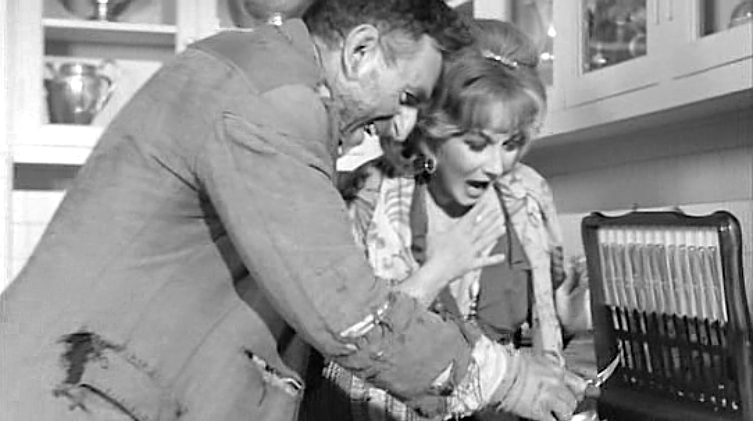
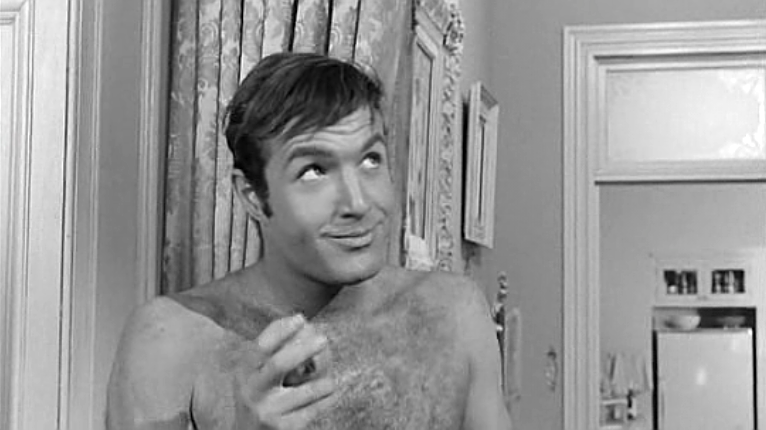
"Noir exploits the oddness of odd settings, as it transforms the mundane quality of familiar ones, in order to create an environment that pulses with intimations of nightmare." – Foster Hirsch, The Dark Side of the Screen
You can read more about this iconic noir masterpiece in The Dark Pages feature issue.
Here’s the link below to order a copy of The Dark Pages for yourself or subscribe all year round… so you’ll always get your fill of everything Noir from this sensational publication!
Produced by Mark Hellinger (The Naked City, Brute Force, and The Two Mrs. Carrolls Music by Miklós Rózsa; Cinematography by Elwood Bredell (Ghost of Frankenstein 1942, Phantom Lady 1944). Boldly directed by the great Robert Siodmak. The Screenplay is by Anthony Veiller and uncredited co-writers John Huston and Richard Brooks.
The Killers (1946), with its doomed hero, flashbacks, and seedy characters is one of the finest in the film noir canon. The film is a gritty dream with carnal fluidity and monochromatic beauty. The Killers is a neo-gangster noir film with a liminal and evocative intensity. Director Robert Siodmak gives the film a violently surreal tone"” it's a stylishly slick, richly colorful black and white film where the players live in a world condemned by shadow. Burt Lancaster plays out the obsession theme with ‘unfaithful women’ leading to his ultimate demise.
The evocative opening scene is one of the most powerfully ferocious in film noir. It is faithful to Ernest Hemingway's short story. The determined thrust of the first twelve minutes mesmerizes. It has a villainous and cynical rhythm, paced like shadowy poetry in a dark room with no open windows. The film opens with Miklos Rozsa's ominous brassy jazz that later becomes the killer’s motif. Two men drive into a small town, Anywhere, USA. We see them from behind in the darkest black silhouette inside the car.
While cars and trains are iconographic means of escape in noir films, the opening sequence of The Killersoffers no escape. The two gunmen enter the screen in their vehicle veiled by the darkness of the highway road. The vision is more like one of bringing the means of death to this ordinary environment. The peculiar, unsettling gunmen Al and Max (Charles McGraw and William Conrad) are two dark forces invading an ordinary landscape with their malicious and aggressive presence. The dark highway is a typical Hemingway metaphor for the eternal strife, of ‘going nowhere’ and his cycle of ‘heroic fatalism.' The road is an unfinished trajectory, unpredictable and unknown with no way out but "˜the end.'
We see the two walking onto the street silhouetted in shadow. We know they are trouble. They enter a diner reminiscent of Edward Hopper's 1942 painting "˜Nighthawks.' Perhaps this American Diner scene influenced scavenger-hunting director Quentin Tarantino for his Pulp Fiction in 1994.
The men ask about a man they're looking for, "˜the Swede.' They make no effort to hide their malevolence. They revel in belligerence as they demean and degrade the men in the small-town diner. Al and Max begin to psychologically torture George (Harry Hayden) who works the counter and Nick the boy at the end of the counter. They exude an offensive egotism and a cruel antisocial spirit as they barrage the men with perverse assaults.
George: "What'll it be, gentlemen?""¨Max: "I don't know. What you want to eat, Al?""¨Al: "I don't know what I want to eat.""¨ Max: "I'll have the roast pork tenderloin with apple sauce and mashed potatoes.""¨ George: "That's not ready yet.""¨ Max: "Then what's it on the card for?""¨ George: "Well, that's on the dinner. You can have that at six o'clock. That clock is ten minutes fast. The dinner isn't ready yet.""¨ Max: "Never mind the clock. What have you got to eat?"
The conversation is absurd and meaningless. It is just a mechanism to bully these townsmen. They continue to harass George asking "You got anything to drink?" George tells them "I can give you beer, soda, or ginger ale." Al: "I said you got anything to drink?" George submits a quiet "no." Max says "This is a hot town, whatta you call it?"George: "Brentwood." Al turns to Max "You ever hear of Brentwood?"Max shakes his head no. Al asks George "What do you do for nights?"
Max takes a deep breath and groans "They eat the dinner, they all come here and eat The Big Dinner."The outsider mocks the small-town conformity of eating whatever is served. George looks downward murmuring "That's right"and Al says "You're a pretty bright boy aren't you?"He uses "boy" to demean. George mutters "Sure" and Al snaps back "Well you're not!"
Al now shouts to the young man at the end of the counter "Hey you, what's your name?" he looks earnestly at Al and says "Adams. Nick Adams." Al says, "Another bright boy." There is sadism at work here, almost subconsciously homophobic/homoerotic in the way they are using the term "boy" to subvert these bystanders' manhood. Max says, "town's full of bright boys."
The cook comes out from the kitchen bringing the plates. "One ham and one bacon and" George starts to serve the men the food and asks "Which one is yours?"Al says "Don't you remember bright boy?" the continued use of this phrase truly begins to tear at the layers of our nerve endings. George starts laughing and Max says "What are you laughing at?" "nothing."
"You see something funny?" "No.""Then don't laugh." "Alright."Again Max says "He thinks it's alright." Al says "Oh, he's a thinker." It's an antisocial backlash to an intellectual society that would perceive Al and Max as outcasts. This is where a noir film begins to break the molds of Hollywood’s civilized society. The two intruders have trespassed into an ordinarily quiet community to shatter its sense of security. It is the death of humanism in film language.
Max and Al tie up Nick and the cook in the kitchen. "I'll tell ya what's gonna happen, we're gonna kill the Swede, you know big Swede, works over at the filling station." He lights a cigarette. George says, "You mean Pete Lund?"Max takes the cigarette out of his mouth and the smoke enervates George's face, "If that's what he calls himself"¦ Comes in every night at 6 o'clock don't he?"
Georges asks "What are you gonna kill him for? What did Pete Lund ever do to you?" Max replies," He never had a chance to do anything to us he never even seen us." The conversation is so matter-of-fact that it's chillingly absurd. Again George asks, "What are you gonna kill him for?" Max smirks "We're killing him for a friend."Al pokes his head through the sliding window to the kitchen "Shut up you talk too much" but Max says "I gotta keep bright boy amused don't I?"
When George explains that "˜the Swede' never comes in after 6 pm, the killers head to the station where he works. George unties the men in the kitchen. Nick leaves to warn "˜Swedes,' jumping fences on his way to the rooming house.
At the rooming house, Pete (Lancaster) is on his bed in almost complete darkness, face hidden in the shadows, his body's repose in stark contrast to the backdrop of the frenetic orchestration by Rozsa. Nick enters and urgently warns him about the two dangerous men. Nick asks, "Why'd do they want to kill ya?"He replies: "There’s nothing I can do about it. I did something wrong. Once. Thanks for coming.” His tone is soft and fatalistic.
Nick offers "I can tell you what they're like?" Swede replies "I don't wanna know what they're like… thanks for coming.""Don't you wanna go and see the police?""No that wouldn't do any good." Nick asks "Isn't there something I could do?""There ain't anything to do.""Couldn't you get out of town?" He answers "No… I'm through with all that running around."
A merciful violin plays while Swede remains resigned to the dark bed. His large hands rub his face. We hear the squeaking of a door downstairs as it opens slowly and then shuts. The Swede turns his head looking slightly worried for the first time. He leans up in the bed, the light from outside hitting his face, as Al and Max mount the staircase that leads to his room.
The Swede listens like a trapped animal. He does not betray any fear, only a gloomy resignation that his life is about to end. It is not death that he ponders, but memories and another enemy. Cinematographer Elwood Bredellswitches between close-ups of Lancaster's face and the door, then suddenly the two men come in blasting. From pitch black begins a light show, arcing like electricity striking a void. The canon fire gunshots pour into a field of blackness. The killers walking up the stairs acts as foreplay and the gunfire is like violent intercourse"¦ White hot flashes of light break grave blackness. The last image we see as it fades to black is Lancaster's hand falling limp by the bedpost. The last words we hear are Swede uttering "Charleston was right, Charleston was right."
This is where the powerful prologue ends and Hemingway's story leaves us with no explanation as to the reason for Swede's murder, nor insight into why he acquiesces to his death by not trying to elude the killers and his fate. From this moment on Veiller's screenplay starts to expose the back story of the killing.
Look at the killer chemistry between Lancaster & Gardner… I’d get shot up in the dark for either one…!
Hugh O’Brian as the smarmy Hank Walker–“Haven’t I seen you around?”
Ruth Roman as the tough-as-nails Margot Eliot– “It’s possible. I’ve been there.”
Director Alexander Singer’s melodrama (Singer’s Psyche 59 (1964) starring Patricia Neal who suffers from hysterical blindness, has a much more compelling frenetic slick psychology) Love Has Many Faces comes off as a meandering soap opera in balmy Acapulco Mexico… as Lana Turner plays Kit Jordan a millionairess who marries Cliff Robertson a self-loathing malcontent who sold all 8 pints of his blood to be owned by her. Though her love is as ‘thin as ice…’
Enrique Lucerois marvelous as Lieutenant Riccardo Andrade a Mexican Columbo who is trying to get to the bottom of one of Lana’s young male lovers who apparently committed suicide over their break up.
Aside from wishing that the fabulous Ruth Romanand Virginia Greyhad more of a presence in the film…
Virginia Grey was the audacious Candy in The Naked Kiss 1964 … God she was gorgeous!
… I was struck by two things…
If you’ve been following my blog you’ll know that I love Ruth Roman-she has a raw natural sensuality that dwells in her eyes and oozes out of her pores.“Instant blackmail”Kit is never without a drink or a flashy beach ensemble!
“I was born a character actor. I was never really a leading man type.” –Burgess Meredith
Oliver Burgess Meredith
WHAT A CHARACTER! BLOGATHON 2014
It’s here again! The most fabulous blogathon honoring those unsung stars that add that certain singular glimmer to either the cinematic sphere or the small screen sky–The character actors we’ve grown to love and follow adoringly. Thanks so much to Aurora at Once Upon A Screen, Outspoken & Freckled, and Paula’s Cinema Club for hosting such a marvelous tribute once again!
This post’s title comes from the opening narrative for Rod Serling’s favorite Twilight Zone episode “Time Enough At Last.” ‘Witness Mr. Henry Bemis, a charter member in the fraternity of dreamers’ From Season 1 episode 8 which aired on November 20th, 1959.
Directed by John Brahm, “Time Enough At Last” tells the story of a little bespectacled bibliophile bank teller named Henry Bemis, a bookworm, a slave to the iron-fisted hand of time and all its dreary inescapable obligatory scars and yearnings.
Browbeaten by his wife, boss, and even the public at large who see him as an outcast because of his ravenous appetite to read books! Henry can’t even sneak away to read a newspaper during work hours. He’s forced to resort to studying the labels on condiment bottles. She won’t even let him read the ketchup. His harpy of a wife Helen ( Jacqueline deWit) even blackens in the lines of his books at home, calling it “doggerel“– One day as fate would have it, he steals away to the basement vault of the bank to catch up on his beloved preoccupation, when –as many Twilight Zone episodes had been infused with a dose of Rod Serling’s nihilism (as much as there is his hopeful message), the feared 50’s bomb annihilates our vision of the world that was swarming just a few moments before. Suddenly poor Henry seems to be the last man on earth. But wait… perhaps not poor Henry.
As he stumbles through the debris and carefully placed set pieces– the remnants of man’s destructive force, Henry comes upon the city’s public library filled with BOOKS!!! Glorious books…
While he must struggle against the approaching loneliness of the bleak future ahead, he begins to see the possibility of a new world where he could dream, and wander through so many scrawled worlds. Already an outsider he could finally live a life free to be as his boss rebuked him, a “reader.’
Henry starts to amass various piles of selected readings. There was time now. Time enough, at last, to read every word on the written page without interruption, interference, or judgment.
Yet…fate once again waves her fickle finger via The Twilight Zone and leaves bewildered Henry without his much-needed glasses, now they have fallen on the great stone steps, crushed by Henry’s own feet. As with every role Meredith brings to life the character of Henry Bemis with so much mirth and pathos.
He’s always just a bit peculiar, idiosyncratic, eccentric, lyrical, salty, sometimes irascible, but always captivating and distinctive, His voice, his persona, his look, his style… Burgess Meredith could always play the Henry Bemises of the world and grab our hearts because he has that rare quality of being so damn genuine.
Let’s face it even when the prolific Burgess Meredithis playing a cackling penguin– nemesis to the caped crusader Batman or the devil himself (alias the dapper and eccentric Charles Chazen with Mortimer the canary and his black and white cat Jezebel in tow) in The Sentinel 1977 based on the novel by Jeffrey Konvitz and directed by Michael Winner–he’s lovable!
He always manages to just light me up. Ebullient, mischievous, and intellectually charming, a little impish, a dash of irresolute cynicism wavering between lyrical sentimentalism. He’s got this way of reaching in and grabbing the thinking person’s heart by the head and spinning it around in dazzling circles with his marvelously characteristic voice. A mellifluous tone was used often to narrate throughout his career. (I smile even at the simplest nostalgic memory like his work on television commercials, as a kid growing up in the 60s and early 70s I fondly remember his voice for Skippy Peanut Butter. Meredith has a solicitous tone and a whimsical, mirthful manner. Here’s a clip from a precious vintage commercial showcasing Meredith’s delightfully fleecy voice.
And his puckish demeanor hasn’t been missed considering he’s actually played Old Nick at least three times as I have counted. In The Sentinel 1977, The Twilight Zone and Torture Garden! While in FreddieFrancis' production, he is the more carnivalesque Dr. Diabolo–a facsimile of the devil given the severely theatrical make-up, goatee, and surrounding flames"¦ he is far more menacing in Michael Winner's 70s gem as the spiffy Charles Chazin.
Burgess Meredith as Dr. Diabolo in Torture Garden 1967
And while I resist even the notion of redoing Ira Levin/William Castle and Roman Polanski’s masterpiece Rosemary’s Baby if, and I’m only saying if… I could envision anyone else playing alongside Ruth Gordon as the quirky and roguish Roman Castevet it could only be Burgess Meredith who could pull that off!
Also being a HUGE fan of Peter Falk’s inimitableColumbo– I ask why why WHY?! Was Burgess Meredith never cast as a sympathetic murderer for that relentless and lovable detective in the rumpled raincoat to pursue? Could you imagine the chemistry between these two marvelous actors?
Burgess Meredith all of 5′ 5″ tall was born in Cleveland Ohio in 1907. His father was a doctor, and his mother a Methodist revivalist. We lost him in 1997 at the age of 89. That’s when he took his “dirt nap…”the line and that memorable scene from Grumpier Old Men 1993that still makes me burst out laughing from the outlandish joy of it all!… because as Grandpa Gustafson (Meredith) tells John Gustafson (Jack Lemmon) about how he’s managed to live so long eating bacon, smoking and drinking his dinner–what’s the point…? “I just like that story!”
Leading man material… Street of Chance 1942.
Burgess Meredith said himself, that he wasn’t born to be a leading man, yet somehow he always managed to create a magnetic draw toward any performance of his. As if where ever his presence in the story was, it had the same effect as looking in a side view mirror of the car “Objects are closer than they appear”–What I mean by that is how I relate his contribution becoming larger than the part might have been, had it been a different actor. Like the illusion of the mirrored reflection, he always grew larger in significance within the story–because his charisma can’t help but consume the space.
He took over the landscape and planted himself there like a little metaphysical essence, animating the narrative to a higher level of reality.
Meredith started out working with the wonderful Eva Le Gallienne joining her stage company in New York City in 1933. His first film role was that of Mio Romagna in playwright Maxwell Anderson’sWinterset 1936 where Meredith plays the son of an immigrant wrongfully executed for a crime he did not commit. He also joined the ranks of those in Hollywood who were named as “unfriendly witnesses’ by the House Un-American Activities Committee finding no work, being blacklisted in the 1950s. Â
During the 1960s Meredith found his way back in various television roles that gave us all a chance to see and hear his incredible spectrum of performances. One of my personal favorites, dramatically potent and vigorously absorbing was his portrayal of Duncan Kleist in the Naked Citytelevision series episode directed by Walter Grauman (Lady in A Cage 1964)Â Hold For Gloria Christmas.
The groundbreaking crime and human interest series NAKED CITY– cast Meredith as a 60s beat poet & derelict Dunan Kleist who is literally dying to leave the legacy of his words to a kindred spirit.
A powerful performance told through flashback sequences that recollect his murder as he storms through the gritty streets and alleyways of New York City a volatile alcoholic Greenwich Village poet trying to get back his precious manuscript of poems that were stolen as he bartered them away bit by bit for booze -he has bequeathed his work to the anonymous Gloria Christmas. The chemistry between Burgess Meredith and Eileen Heckart who plays his estranged wife is magnificent exuding years of anguish and disappointment. Heckart is another character actor who deserves a spotlight.
Â
BURNT OFFERINGS 1976–Dan Curtis’ priceless treasure of creepy camp featuring Karen Black, Oliver Reed, and once again uniting the incredible Eileen Heckart with our beloved Burgess Meredith as the ominous Roz and Arnold Allardyce.
Roz & Arnold… charming… creepy!
Another memorable role for me is his spirited performance as Charles Chazin alias The Devil in one of my all-time favorite horror classics The Sentinel. “Friendships often blossom into bliss.” – Charles Chazin. Ooh, that line still gives me chills…
Many people will probably love him for his iconic character study of a crusty cantankerous washed-up boxing trainer named Mickey in the Rocky series of films. Or perhaps, for his colorful cackling or should I say quacking villain in the television series Batman -his iconic malefactor — The Penguin!
IMDb fact-His character, the Penguin, was so popular as a villain on the television series Batman (1966), the producers always had a Penguin script ready in case Meredith wanted to appear as a guest star.
Burgess Meredith will always remain one of the greatest, most versatile & prolific actors, a character in fact… beloved and eternal…
“Like the seasons of the year, life changes frequently and drastically. You enjoy it or endure it as it comes and goes, as it ebbs and flows.”- Burgess Meredith
“I’ll just take amusement at being a paradox.”- Burgess Meredith
[on his childhood] “All my life, to this day, the memory of my childhood remains grim and incoherent. If I close my eyes and think back, I see little except violence and fear. In those early years, I somehow came to understand I would have to draw from within myself whatever emotional resources I needed to go wherever I was headed. As a result, for years, I became a boy who lived almost totally within himself.”- Burgess Meredith
WELCOME TO JO GABRIEL & THE LAST DRIVEIN’S –500th POST!
“Ghosts are the outward sign of an inward fear”-Ambrose Bierce
“Everything is worse…if you think something is looking at you.” ” — Shirley Jackson
From- Cinematic Hauntings edited by Gary J. and Susan Svehla chapter The Haunting by Bryan Senn.
“Adult in concept and wide in scope. The Haunting is designed not only to appeal to those who approach the supernatural from an intellectual level, but also to the legions of movie patrons who delight in a genuine ghost story.”-The Haunting press book
Halloween is around the corner, I hear the rusty gates creaking, the rattling of skeletons, the flapping wings of jolly bats, smell the candy corn and Hershey’s kisses and the owls are hooting, the spooks are spooking, and I sense the chill of night seeping through the curtains as the best holiday of the year is upon us!
What better way to honor such a ghoulishly ghostly and creepy eve than to explore one of the all-time great movies, ghost story notwithstanding, in honor of my 500th post? Yes, long-winded me has finally reached a milestone.
How do you begin to write about a film that continues to share the spot of the favorite movie in my world alongside Rosemary’s Baby?What can I say that hasn’t already been said about Robert Wise’s masterwork, The Haunting,from 1963? How do you even give suitable tribute to a timeless masterpiece that defies genre and deserves to be upheld as unremarkable?
Incidentally, I was reading Pam Keesey’s terrific essay, The Haunting and the Power of Suggestion: Why Robert Wise’s Film Continues to ‘Deliver the Goods’ to Modern Audiences.Keesey points to a comment that Stephen King makes while admiring Wise’s film. He remarks, “Something is scratching at the ornate, paneled door… Something horrible… but it is a door Wise elects never to open.” Once again, Pam Keesey cites Wise’s influence as written about in Edmund G. Bansak’s wonderful Fearing the Dark: The Val Lewton Career, one of my favorite books in my library. Wise finally found a film that could pay homage to his mentor, Val Lewton.
“Lewton trademarks–the reverence for the underdog, the focus upon humanist concerns, the alliance between danger and darkness, the depiction of fate as an unstoppable force, and, of course the preoccupation with things unseen.”-Bansak
Sorry, Stephen King, but we don’t always need to see the monster– Val Lewton understood that well, and managed to create some of the most compelling moments of terror for us, just by suggesting and triggering our own innate fears of the unknown. This is one of the most essential working mechanisms of Wise’sThe Hauntingthat has withstood the perils of time.
Robert Wise worked as an editor among Val Lewton’s magic team of artists.
He learned the secret to any good work of fantasy/horror/suspense/noir is to suggest, BUT not reveal, what is the heart of the narrative on the screen itself, but allow our own subconscious fears and anxieties to do their work. Much credit has to be given to Nelson Gidding’s (I Want to Live! 1958, The Andromeda Strain 1971) remarkable screenplay.
While working on West Side Story, Robert Wise picked up a copy of Shirley Jackson’s ghost story. In an interview in Midnight Marquee #37, Wise recalled, “I was reading one of the scary passages–hackles were going up and down my neck–when Nelson Gidding (screenwriter)… burst through the door to ask me a question, I literally jumped about three feet out of my chair. I said, ‘If it can do that to me sitting and reading, it ought to be something I want to make a picture out of.”
Wise wasn’t sure he’d get to direct the film, noted in Bright Lights #11–“I called nervously to see if it might be available…{…}because usually by the time a book comes out in New York, the big movie companies have scouts back there, story departments, and they grab it up and it’s gone. I found out this one hadn’t been picked up.”
According to Bryan Senn in an interview in 1995, “I persuaded United Artists to buy the book rights for me and finance a screenplay. And I got Nelson Gidding, who did I Want to Live! (1958) for me to do the screenplay. When we got it done however United Artists got a little cold on it and didn’t want to proceed with it. So I talked to my agent about it. I had left a contract with MGM a few years before; I got out of the contract early but I had to promise to give them another film.
THE HAUNTING, Claire Bloom, Russ Tamblyn, Julie Harris, Richard Johnson, 1963.
The studio wasn’t keen on a supernatural horror thriller, nor of the idea of not using big named stars for the picture.Wise wanted to use classically trained actors like both British Shakespearean actors Richard Johnson and Claire Bloom and American actress Julie Harris.Wise also wanted to work with Russ Tamblyn again whom he worked with in 1961 on West Side Story. Tamblyn was reluctant to do the part after reading the script but threat of suspension from the studio urged him to take the role. Years later he recounts it being one of his favorite roles.
Luck will out and Wise needing to go over to England for a command performance of West Side Story, was able to use MGM’s little studio outside London called Boreham Wood Studios which gave him a bigger budget to work with.
And I can say without any doubts, that I’m with Robert Wise- when I was little, watching The Haunting even during the day, sun shining outside, my heart would pound and I would feel a restless shudder as I sat quietly watching what I consider to still be one of the scariest films of all time. And though I’ve seen it again and again, I still feel said hackles up the back of my neck. The shivers of fear and dread, and a true sense of terror that grips you every single time!
The confluence of artistry, Robert Wise’s sensibility that he synthesized from working with ValLewton, Jackson’s incredible ghost story, Gidding’s compelling script, the collective ensemble performances by all the great actors involved, the effective score by Humphrey Searle, and idiosyncratic and visually disorienting cinematography by Davis Boulton (Stage Fright 1950, I Thank A Fool 1962) The sense of place and the incredible performances that inhabited that uncanny space.
Photo of Richard Johnson, Claire Bloom, Russ Tamblyn, and Julie Harris in the movie The Haunting, 1963. Photo/Art by: anon.
All these elements went into creating one masterfully crafted visual narrative, a psychological maneuver, a tale of terror, and one memorable landscape of uncanny dread and paranoia.
The house itself was set in England and not the story’s old-money New England territory. While there are numerous tales of haunting in England, Jackson’s story was set in New England, and Wise wanted to stay close to the novel’s reality. It wasn’t hard to find the right house in England. However, the more daunting task was getting the roads closed off so Julie Harris could drive her car on the wrong side of the road for the scene where she travels to Hill House. Robert Wise explained in Fantastic Films, that “We wanted a house that basically had an evil look about it” He finally found the perfect house in Warwickshire, a 200-year-old manor house called Ettington Park, Wise felt that its, “facing of mottled stone with gothic windows and turrets” was exactly what they needed.
The house possessed an “unexpected, even frightening, authenticity” According to Russ Tamblyn, “It was definitely a strange place, especially the grounds. The house itself, had a history… oh, children who had been murdered, and a twelve year old who had committed suicide, some other woman who had fell out of a window.” Not to mention the little cemetery out in the back which was supposedly haunted. People had seen ghosts there.
Dr. John Markway: [voice-over narration] “An evil old house, the kind some people call haunted, is like an undiscovered country waiting to be explored. Hill House had stood for 90 years and might stand for 90 more. Silence lay steadily against the wood and stone of Hill House, and whatever walked there… walked alone.”
The film is powerful in the way it brings us into its mystifying grasp. We hear the velvet tones of Richard Johnson narrating to us, greeting us, if you will join the haunting. His voice-over is the visual montage of past events that reveals to us the menacing house. The inception of its evil roots, a domineering man, Hugh Crain, had built Hill House for his wife and daughter, “in the most remote part of New England he could find.” In a freak or strange accident, the wife had “died seconds before she was to set eyes on the house.” Her carriage crashed against a tree, her lifeless arm hanging out of the carriage in close-up. Crain’s second wife floats down the dark Victorian-style hall (Wise was the editor of The Magnificent Ambersons (1942), and the figure of the wife moving swiftly through the darkness reminds us of that film-This impression is also confirmed in More Things Than Are Dreamt of edited by Alain Silver & James Ursini ) then tumbles down a flight of stairs breaking her neck.
“The audience is thrown into the point of view of the second Mrs. Crain as she stumbles down the stairs and blurred, twisted shots approximate the last things she saw in life. Finally a grim but striking deep focus wide angle captures her sprawled at the foot of the main stairs, eyes wide in fright and her corpse in the lower foreground of the frame and behind her shadowy killer, the house itself.”–source More Things Than Are Dreamt Of -edited by Silver & Ursini
After Crain dies in England, his only daughter Abigail “grew up and grew old” In Hill House, eventually hiring a village girl to be a paid companion, “it’s with this young companion the evil reputation of Hill House really begins” When the companion took a farmhand out onto the veranda while her mistress banged on the wall with her cane and died calling for help. The companion inherited Hill House only to be driven to suicide by the unseen, menacing atmosphere of the place. She walked up to the top of the spiral staircase in the library and hanged herself. “They say that whatever there was–and still is–in the house eventually drove the companion mad.”
For Dr. John Markway (Richard Johnson), Hill House is a chance to prove himself. Eleanor has been chosen to be part of the research team because of the shower of stones that had fallen on her house when she was a little girl. Possibly possessing the powers of psychokinesis, the ability to materialize her inner demons, anger, and nightmares. Pointedly, when Eleanor says, “Suppose the haunting is all in my mind?”
From Silver & Ursini’s edited chapter Modern Classics- in More Things Than Are Dreamt Of- “The harp, the knockings, the writing on the wall-all these have a visual and aural presence in film which contradicts any inclination of the viewer to believe that Eleanor is doing this herself; and yet the word on Markway’s questionnaire which Luke doesn’t understand ‘psychokinesis’, makes it possible that she is. Even the interruption of her most flirtatious moment with Markway permits two readings. The house, her possessive, predestined lover, strikes at the harp strings out of jealousy and the need to control her. Or, like Henry James’ repressed governess in Edmund Wilson’s reading, Eleanor does it herself out of fear of sex. Both are possible.”
Having read an interesting essay that touches on Robert Wise’s 1963 ghost story from Hidden Horror, the chapter on Carnival of Souls by Prof. Shelly Jarenski makes a few interesting comparisons to Carnival of Souls 1962
Such as the prelude –“And we who walk here, walk alone.” in my malleable childhood mind, both the prelude and the coda stayed with me like a creepy lullaby or maudlin soliloquy. Jarenski asserts, “The film’s core themes are encapsulated in that line uttered by the misfit heroine Eleanor Lance.” I would totally agree with her assessment. The Haunting is not merely a ghost story; it is a story about an alienated loner, a ‘misfit heroine’ who is in dire search for relief or release, possibly from this world. We, too, are witnesses to a lonely, disillusioned woman (I loathe to use the word: spinster), most likely a virgin, who is longing to make a connection.
Jarenski writes, “Words like “˜we’ or “˜walking’ does create an “ominous ambiguity.” That Eleanor will either join the collection of lost souls in Hill House or be doomed to walk alone for all eternity in “˜isolation and despair.’
Asserting that Carnival of Souls can be understood as a corollary to the more ceremonious and celebrated The Haunting because“It portrays what being part of the community of the dead, while simultaneously feeling utterly alone, looks like.”
In More Things Than are Dreamt Of-Silver and Ursini point out the idea thatThe Hauntingis much more than just a ghost story. As Shirley Jackson wrote in her novel, “During the whole underside of her life, ever since her first memory Eleanor had been waiting for something”¦”
Theodora, affectionately known as Theo, has been recruited to help in the research because of her extremely honed powers of ESP. This becomes established before Dr. Markway introduces everyone around the breakfast table. While Mrs. Dudley regurgitates her soliloquy of fear & gloom, Theodora takes a mental inventory of Eleanor’s psychic bag, and when Eleanor asks how she knew what she was thinking, Theo cheekily replies, “You wear your thoughts on your sleeve.”
The Haunting(1963)could be said to be the penultimate example of ‘nothing up that proverbial sleeve’ and ‘it’s what you don’t see’ cinematography. The visual narrative is what makes it timelessly heart-pounding to watch and what gives it an artistic atmosphere of misdirection, anxiety, hysteria, dread, romanticism, and well, yes, that “haunting’ feeling.
Memorable scenes of veiled terror lurking in the corners or beyond the massive wooden door frames. The allusion to the various cold spots is underscored by trilling piano keys. Stark frames capture a portion of the house as if it were a live entity. Dr. Markway refers to the house as being ‘born bad. The manifestation of the angry and tyrannical Hugh Crane, who built an evil house. There are so many moments of The Haunting that have stayed with me for years. And I must admit that I usually watch it several times a year, like one makes pot roast because the craving strikes you at that moment. “It’s time to watch The Haunting again,” is heard in our house. I can never forget the moment when Julie Harris as Nell awakens frightened, where we hear a child’s muffled laughter swiftly turning to a menacing scream. She tells Theo that she’s breaking her hand, she’s holding it so tight. The camera only focuses on Nell and her outstretched arm in the darkness, swallowed up in her ornate room, like a fly in a spider’s web. When she can no longer bear Theo’s tight grip, she screams, “Stop it!” and turns the light on, only to find in horror that she’s been holding a ghostly hand. “Whose hand was I holding?” Theo is shown across the room, still lying in bed, unaware that Nell had been going through any nightmarish ordeal.
In other sequences, the visual perspective seems to warp all we see, pulling us into the dis-ease of Hill House. From the moment Eleanor pulls up to Hill House, the point of view is skewed so that we are watching Eleanor, who is also being watched by the house. It’s a startling moment as she realizes, “It’s staring at me.”
And of course, there’s the eerie and otherworldly invisible assault on the two women as something unseen pounds on the doors with a ‘cannonball’ Disembodied laughter, scratching, growling, and Baroque-style brass doorknobs with Medusa’s face that turn ever so slowly, as if something trying to gain entry into the room.
Eleanor ‘Nell’s’ name has been scripted on the wall in something ‘like chalk.’
And then the ghostly message written on the ostentatious wallpaper in ‘something like chalk’ outside the dining room-“Help Eleanor -Come Home!”
Hill House’s expression of love, the seduction by way of written message in ‘something like chalk’ both frightens Eleanor yet stimulates her because someone or something was finally paying attention to her. as Alain Silver and James Ursini point out the house’s dark secrets, “represent the intimacy which Eleanor has never had with any other being…”
There’s also the emphasis on the powerfully imposing use of matrix work, utilizing the inherent designs of the interiors themselves, textiles, wallpaper, and wood carvings to create diabolical faces watching back at us. The stone and bronze cherubs and gargoyles that inhabit Hill House, the myriad of mirrors, and long winding hallways mixed with the turbulent sky outside the towering Hill House.
The iconic scene where the door seems to expand as if breathing was actually two technical people who used 2x4s to push into the middle to create the effect. It’s that simple, and yet it is one of the most lasting scenes in film history.
The book by Shirley Jackson, The Haunting of Hill House, is a hell of a read, but as a rarity, the film invokes the uncanny of the story even better than the novel.
“SCREAM…no one will hear you! RUN…and the silent footsteps will follow, for in Hill House, the dead are restless!”
I’ve had any number of people over the years say to me, ‘You know, Mr. Wise, you made the scariest picture I’ve ever seen and you never showed anything. How’d you do it?” And it goes back to Val Lewton, by the powers of suggestions”–Robert Wise in Fearing the Dark: The Val Lewton Career
Robert Wisemade The Haunting in 1963 as a way of paying homage to his mentor, Val Lewton, who had died 12 years earlier.
The always-poised Richard Johnson plays the very earnest Dr. John Markway, a researcher in the paranormal who wants to use Hill House, an imposing Gothic New England house, as the main epicenter for his studies in the supernatural. Based on the legend of all the ghostly goings-on surrounding said place, Markway gets Mrs Sanderson (Fay Compton) to agree to lease the house to him for one year. Though she is the voice of caution
– Mrs. Sanderson: “The dead are not quiet in Hill House.”
The great Fay Compton as the crusty waspy Mrs. Sanderson warns Markway that the dead are not restful at Hill House.
Markway initially collects the names of potential participants in his experiment and chalks them on his blackboard. Eventually, the names drop off, and only two women arrive to help him uncover the truth behind the legend of Hill House. Is it truly haunted?
Theodora: “Haven’t you noticed how nothing in this house seems to move until you look away, and then you just… catch something out of the corner of your eye?”
Theo, sensing a presence, says, “It wants you, Nell… the house is calling you.”
Mrs. Sanderson sends along her cocky nephew out of the Midwest, Luke (Russ Tamblyn) to accompany Dr. Markway since one day Luke hopes to inherit Hill House. The exterior of Hill House is an actual Hotel called the Ettington Park Hall Hotel in Stratford-upon-Avon, England. The interior sets were brilliantly designed by John Jarvis.
We meet Eleanor ‘Nell’ Lance (Julie Harris) in her sister’s living room, which doubles as her bedroom. The very hypersensitive Nell is being tortured by her sister, brother-in-law, and their precocious brat of a child who insists on playing a child’s record march consisting of inane flutes and snare rattles, causing a pervasive tenor of chaos, madness, and dysfunction. Like nails on a blackboard, the little tune serves not only to cause psychic aural conflict and irritate Nell but also pulls us into her sense of being trapped in a claustrophobic world where she must break free. Nell steals the family car and hits the road with all her belongings in a box, driving out of Boston out into the light of the New England air toward something, anything, even the unknown, which would be better than the captivity she’s been experiencing. She is one of the people Dr. Markway has invited to participate in exploring Hill House.
More Things Than Are Dreamt Of edited by Alain Silver & James Ursini- The Haunting of Hill House is a third-person novel with a lot of interior monologues and other first person aspects…{…}Eleanor is neither a para-psychologist nor a believer, but a disheartened spinster yearning for escape and adventure; or as Jackson puts it, ‘During the whole underside of her life, ever since her first memory, Eleanor had been waiting for something…’
Eleanor is the first person to see the ‘vile’ house. Silver & Ursini frame it by Jackson’s occult vision, that Hill House is the cause of Eleanor’s ‘deliverance and destruction’. How Eleanor’s religious discourse becomes an ironic fate that turns inward on itself for in the end, “journeys end in lovers meeting” Eleanor’s volatile relationship with Hill House is absolutely one of love/hate.
Upon her arrival, she is confronted by two of the locals who harbor a maniacal animosity toward city people. The Dudleys were played by Rosalie Crutchleyand Valentine Dyall ( Who was perfectly sinister as Jethrow Keane in Horror Hotel 1960, yet another favorite classic horror film of mine.)
Rosalie Crutchley attributes the films power to Robert Wise’s skillful direction and David Boulton’s sinister cinematography that transformed the benign Ettington Park into the malevolent manor of Hill House. “It was a strange house” the actress told Bryan Senn. Crutchley continues, “which looked threatening from the outside but which wasn’t actually at all. But it was brilliantly shot you see, so that it looked very, very threatening.”
Mr. Dudley: “You’ll be sorry I ever opened the gate.”“Get away from here; get away at once. It’s my chance. I’ve been given a last chance. I could turn my car around and go away from here, and no one would blame me. Anyone has a right to run away. But you are running away, Eleanor. And there’s nowhere else to go.”
Mrs. Dudley takes care of the interior of Hill House as no one else in the village dares come near the place, setting out the meals but being very clear about leaving before it gets dark. The sardonic grin on her face as she divulges to Nell and Theo her little creepy-intoned soliloquy… “No one will come any further than town…”
No one will hear you scream… Mrs. Dudley’s expression is somewhat a combination of that intense little fellow, the prairie dog from the viral YouTube video where he turns around and stares, and Lewis Carroll’s Cheshire Cat.
Anyhoo… Markway leads the other three on a journey of discovery of the unknown. He chose Eleanor ‘Nell’ because of her poltergeist experience that occurred when rocks pelted her family home for a week. Eleanor suffered from a tremendous guilt complex shortly after losing her chronically ill mother, whom she cared for and who passed away, and this puts Nell on the edge of a breakdown. Theodora is known quite well for her powers of ESP. Luke Sanderson is the skeptical playboy of the foursome…
Markway is filled with glee as they have stumbled onto the proverbial ‘cold spot.’Luke-“There’s got to be a draft!”Dr. Markway tells Luke-“Look I know the supernatural is something that isn’t supposed to happen but it does happen… and if it happens to you your liable to have that shut door in your mind ripped right off its hinges!”
The ‘Adventurous All’ get together, trading small conversations and observations, while Hill House begins to reveal its cold heart. Or is the house truly a bad place? Built by a man who used odd angles and macabre embellishments, he created one “distortion as a whole,”as Nell comments. Hugh Crane, a man who was a religious zealot, entrapped his daughter in the foul house until her death as an old maid. She grew up and grew old in the house, where a series of mysterious accidents, suicides, and deaths ensued… Hill House is the epitome of Dark spaces or Bad spaces.
The nurse is too busy out on the veranda with the farm hand to hear Abigail pound on the door with her cane, and eventually hangs herself after inheriting Hill House.
Eleanor Lance: “Can’t you feel it? It’s alive… watching.”
Hill House does begin to show particular attention toward the vulnerable, fragile, and bedeviled Nell. But…
That begs a larger question. Can a house be born bad, or have Nell’s neurotic fixations and need to belong caused her to unravel the mysteries of the place much quicker? Is it just her longing and alienation that has created a certain madness, or is it both a ghost story and a story of abject loneliness and psychosis? Much like a Lewton story, there is the feeling of intense loneliness, an imbalance in the environment that is either mental or perceived to be a reality, and ambiguity that links these elements to the supernatural world.
There are definitely themes of repressed sexuality exhibited by the presence of the very stylish Mary Quant sporting Theo (Claire Bloom), who it is heavily suggested is a sophisticated Greenwich Village Sapphic who toys with the uptight Nell. When asked what frightens Theo, she glumly replies, “Of knowing what I want.”
Something that begins to cause friction between the ensemble because Nell has fallen into the well of deep delusion and longing, for Dr. Markway not realizing that he is not just only interested in her as a test subject but he is already married.
Theodora, dressed like a black widow, spins her web of jealousy yet reveals the truth about Markway and Nell’s unrequited love.Theo-“You’re making a fool of yourself over him.” Nell-“I’d rather be innocent than like you.”Theo-“Meaning what?” Nell-“Now, who’s being stupid and innocent? You know perfectly well what I mean.” Theo- “Is this another of your crazy hallucinations?”Nell- “I’m not crazy.”Theo-“Crazy as a loon. You really expect me to believe you’re sane and the rest of the world is mad.” Nell-“Well, why not? The world is filled with inconsistencies, unnatural things, nature’s mistakes, they’re called you, for instance!”Nell tells Theodora that “she’s the monster of Hill House.”Markway sees that Nell is unraveling and threatens to send her packing.
Poor Nell is a tragic Gothic figure whose famous inner monologues might slightly touch the third rail of hysterical camp yet somehow manage to become a restrained performance of inner turmoil and madness that perfectly co-exists parallel to the odd and uncanny manifestations escalating in Hill House, with a rainstorm of inner monologues to guide us through the treacherous darkness.
Mrs. Markway shows up unexpectedly and asks to sleep in the most rotten heart of the house… Nell obliges by telling her about the nursery, which, until now, has been sealed.
“Now I know where I’m going–I’m disappearing inch by inch into this house.”
In Scarlet Street Magazine, Julie Harris stated that she would have played Nell differently. “Well, I would’ve been odder looking as Eleanor,” Harris said. “I think she was too ordinary. I just wanted to be — odder.” That’s okay, Julie Harris, whom we sadly lost on August 24th of last year. No one could have done a better job of bringing Eleanor Lance to life than you did… Your Eleanor Lance will eternally remain the central tragic figure of the play, as Pam Keesey calls her the ‘persecuted innocent.’
By the end of the film, Luke, who is the cynic of the bunch, tells us…” It ought to be burned down… and the ground sowed with salt.”
The poor bedeviled Nell dances with the statue of Hugh Crane, believing that both he and she have killed Grace Markway.Grace Markway ( Lois Maxwell) doesn’t go untouched by the dark forces that lay behind the stone and silent standing wood… well, maybe not so silent!
–Happy Halloween, gang… and thanks for making all 500 posts a whirling experience! – Your Everlovin’ MonsterGirl
I never pay attention to IMDb scores… I like to watch something and get my own feel for a film or television show. So I won’t mention that this film got a whopping 2.1 and is considered one of THE WORST films ever made. Yes, it’s true it’s terrible even when judged by the standards of the most elite cheesy films that have been dubbed a ‘turkey’… So terrible…. in that delicious, so bad it’s good way…It is inane on an Operatic level!
I mean a rambling patchwork carpet monster. The underside of this slow roaming rug whose cotton batting seems glued with excelsior having come unfurled after years of moths gnawed at it… make it look like the stuffing’s coming out of this film itself!
It’s ‘creeping’ head has little hardware coils like dread locks on it’s bulbous alien dome. Reminiscent of creative animator Art Clokey’s lovable green clay guy– it’s almost Gumby-sequeface wearing a prairie bonnet of scrap metal or a mutated brussels sprout wearing curlers? One could even imagine a Venutian Raggedy Ann doll's head…. geesh this creeping nightmare is a wonderful mess!
Gumby’s alien grandma Medusy?
not to mention…
When the thing rears up, it looks more like director Nelson, was working on some subliminal Freudian angst about giant gaping vagina's eating him"¦ a woven vagina I might add with a phallus shaped head! Wow talk about your double entendres.
Neither the acting nor the storyline matter since it’s all about the lumbering carpet monster on the screen… wow, this is sublimely brilliant in an unintentional way, or for the purposes of this blogathon, it’s Accidentally Hilarious!–So many scenes in fact are hysterical, so much so that the folks at MST3K couldn’t resist the temptation to lampoon it.
Let me say I adore this film. The same way that us cult fanatics worship Ed Wood’s films—Because they are endearing and engaging and utterly ludicrous yet engrossing. That takes a certain kind of distinctive potion to create a film that both stinks…. yet entertains ceaselessly.
There’s even a documentary called “Creep’ by Colorado film maker Pete Schuermann www.creepfilm.com which chronicles the behind the scenes going ons of seedy director Art J. Nelson, a con man, pimp, drug addict and purveyor of under aged girls who reportedly ‘auditioned’ for him. He was threatened with jail time.
I know people have written about MANOS: The Hands of Fate (1966) being the worst, or Plan 9 From Outer Space, and of course Phil Tucker’s awesomely ludicrous Robot Monster (1953) befit with a cockamamie ape suit, diving helmet and bubbles, lots of tiny little bubbles. And of course the ever popular ‘Jan in the Pan’, better known as The Brain That Wouldn’t Die 1962
Still… It’s this little creeping gem that gets under the skin a little like ring worm.
Worm… no more like slug. Yes, the Creeping Terror is a giant monster that looks like the prop department ransacked a decaying mansion’s attic and found Old Granny Holestead’s Persian Rug who mated with a Chinese Dragon Costume from the Chinese New Year’s Dragon Dance designed by Jim Henson.
The best part is the speed at which this monster…. well…. CREEPS. it actually does creep. So slowly, at a slugs pace, that it’s any wonder it gets to eat any people in the film at all.
There’s so much time to run away from this lumbering human eating carpet slug, but NO!!!!! people get devoured as if frozen in time, slowly caught in their fright scream–as they are consumed by this broadloom land shark, this gaping maw of an area rug on the prowl and the mostly female legs hanging out the hole to prove it!
From John Stanley’sRevenge of the Creature Features Movie Guide– “It depicts an elongated alien monster resembling a clumsy shag rug which devours people through a gaping maw, overturns cars and takes forever to shamble ten feet!”
Yes that’s another fetish aside from the leggy part of the female anatomy that the monster is fixated on, it also has a hankering for cars. Loves to rub up against them, turn them over… and shamble after them…
this man is parked at lover’s lane by himself… hhmm
still just settin’ and smokin’ his pipe at lover’s lane
Something of interest for me is the fact that Byrd Holland plays the sheriff. He was responsible for the make-up in Lemora (1973) and The Baby (1973) starring Ruth Roman and Cronenberg’s Rabid (1977).Holland is a highly intelligent and talented artist, and I love to see someone with their own vision start out in such a uniquely either intentional or inadvertent timeless culty piece of artistic refuse.
Directed by A. J. Nelson aka Vic Savage the actor who plays Martin Gordon. The story is written by Robert Silliphant. The Beach Girls and the Monster 1965 & The Incredibly Strange Creatures Who Stopped Living and Became Mixed-Up Zombies!! 1964
Vic Savage (director A. J. Nelson himself) plays deputy Martin Gordon, Shannon O’Neil plays new bride Brett Gordon, William Thourlby is Dr. Bradford, John Caresio plays Col. James Caldwell, Brendon Boone plays Barney the Deputy. Jack King is Grandpa Brown, Louise Lawson is the blonde in the gold pants…. And Larry Burrell is our narrator… thanks Larry for the stirring police procedural or army training film like earnestness.
The director of photography is Andrew Janczak,A.J. Nelson did the editing and Clifford Stine is attributed with the special effects. Jon Lackey designed the monster. (Perhaps, After an all night drinking binge woke up under his Aunt Tilly’s Turkish Rug imagined he was being eaten and boom you got a monster!
The opening titles were designed by the uncredited visual effects specialist Richard Edlund.
Frederick Kopp’s scintillating musical score is perfect for the mood, with discordant jazz piano and troubled horns!
There’s some very funky sound effects actually and in spots a grim Hammond organ underscore the scenes with a ironic incongruous hilarity. Then a serious horn section cuts in with the anxious post modern piano stabs that accentuate the rollicking peril….!
Art Direction by Bud Raab… art direction? Teehee that’s a credit worth mocking!
Okay the plot rolled into one tiny little carpet runner– Actually filmed in Lake Tahoe
A rocket crash lands in the fictional Angel County, California. What comes crawling out of the busted hull of the craft is an alien monster that looks like a lumbering Cabaret Kafkaesque metamorphosized Turkisk Rug that mated with a caterpillar and moves at the rate of of 2 inches per hour– wreaking havoc in a small town. As it traipses through the country scenery and urban nite life it munches on all it encounters.
Now the newly married deputy Martin Gordon (the sheriff has been killed while investigating the ship, by a second little carpet monster still inside the spacecraft) must stop it from eating the entire town. Aided by scientist Dr. Bradford and Col James Caldwell and the military. (guys who can’t aim their guns in time or spread out enough or not trip over their own combat boots not to get eaten!) Caldwell gets orders to suppress the news about the monster.
This mindless ravenous rug is actually a probe that is on earth to take samples, analyze and send them back to their alien galaxy before they plan on conquering our planet!
The only film with no dialogue but tons of incongruous narration. Reportedly the original audio tracks were lost. What’s left are scenes that are guided by sober voice-over and the side step here and there to regard the virtues of married life…
Narrator: “Barney and Martin had been bachelor buddies for years. But now that Martin was settling down to marriage, they were slowly drifting apart. Barney, naturally, was still dating all the girls in town, and he couldn’t understand why Brett and Martin didn’t pal around with him more than they did. He couldn’t comprehend that married life brought with it not only new problems and duties, but the necessary togetherness of husband and wife as well. Despite Brett’s most tactful considerations, such as inviting him over to dinner quite often, Barney was growing resentful of her, or at least she felt that he was. Since time began this change in relationships probably happened to all buddies in similar circumstances. Life has its way of making boys grow up, and with marriage, Martin’s time had come. His life was now Brett, a life that he thoroughly enjoyed.”
That’s okay guys, I’ll just let myself out. Thanks for the drink…Narrator-“In a remote part of the county a first in a series of tragedies..” delightful jazz score
Veiled warnings against the ills of sexual freedom and singlehood considering most 50s & 60s Sci-Fi/Horror films show that the victims are eaten while in the throws of youthful raging hormones or libidinous acts of desire. Evidenced by the shots of the female legs that lay sprawling out of the gaping orifice of the wonderfully asinine monster’s mouth. He also eats a girl in a bikini, several couples at a picnic, grandpa and little Bobby fishing!
Narrator: “That afternoon, in Mungreeve Park, a group of neighbors got together for a hoot-e-nanny.”
And of course the rudimentary neckers parked at the local lovers lane.
One of the most bizarre and ‘creepy’ scenes that stuck out for me is where the mother hanging her laundry is about to be the carpet-pillar’s snack, just prior to, she shows us the thermometer before she’s about to take her baby’s temperature rectally ‘off camera‘… Oy vey!!! No not that way please!!!!!
Narrator-“Betty Johnson blows a good bye kiss to her husband … but for the last time”
why is this baby crying?Please don’t eat me now… my baby’s inside and he’s got a terrible temperature! Is that you junior?Mommy will be there in a moment darling! Nice to have met you carpet monster!
But perhaps the most surreal, and favorite scene for me is the killer (literally) dance sequence when the carpet monster invades the dance hall. People are twisting and gyrating all groovy and early rock n’ roll 60s like and this plodding monstrosity manages to devour all of these hapless souls who just stand there waiting to get eaten… remember the stampede from The Blob!!!! this is the antithetical-flight– the languid stand there and wait to be eaten group death scene.
Grandpa and Bobby went fishing… poor Grandpa and Bobby… Bobby? Bobby? Bob–bee!!!!!
Swinging at the dance hall!!!
credited as the girl in the gold pants!
actress flew in from Newark NJ for this memorable piece of dialogue-“My god what is it?” that’s what we’d all like to know!
when a giant alien carpet monster invades the dance hall festivities it just goes without saying… there should also be a bar room brawl!
Clear the dance floor… Hot soup coming through!-And did someone order the Lobster Newburg?Yummy… another pair of female gams to crunch on!
He’s on his third pair of lady legs!!! just loves ’em!
though the crowded dance floor scrambled to get away as fast as mannequins in a store window-there were no survivors!At Perswigian’s Rug Bazaar there’s no rug too big for our craftsmen to appeal to your good taste!–we deliver even on Sundays!Oh gosh… these men’s slacks always repeat on me!Traipsing…. shamble… traipsing… shamble… plod along… traipse some more….
And of course that oh so awkward scene of the giant Persian rug, or pieces of rugs sewn together that attacks an automobile with passengers… looking like it’s actually making whoopee with the car spray painted 23 Skiddoo— for the third time we see a pair of female legs (an obvious fetish of director Nelson’s, being consumed by the great sluggish beast–oh my this film’s got so many wacky tid bits.
This creeping carpet thingy just leisurely eats it’s way through people til you’re scratching your head asking why and how? because the pace it shambles is more emblematic of a Bergman character contemplating life and not a 60s sci-fi monster. Well with the exception of Corman & Blaisdell’s cucumber monster in It Conquered the World who sort of just trundled out the cave barely flapping it’s rubber arms at the flame throwers!
Narrator- “Martin was outraged by the governments intellectual approach to a monster that had already killed and caused the disappearance of his two close friends.”
Aside from the moral message, get married… the film isn’t somber, intense or foreboding. It’s not nostalgically exhilarating or dreary or even tragically triumphant… it’s just darn hilarious! And there you have it….
So much carpet monster eating carnage!!!
Narrator: “The Sergeant, a shaken man, returned babbling about what had happened. Realizing the full danger of the situation, decided he had only one means left to stop the monster: Grenades. Now Bradford made a drastic move. Acting on his superior authority, he forbade Caldwell to destroy the creature. The Colonel, more concerned with saving human lives than advancing Science, told Bradford to “Go to Hell.”
From IMDb trivia-
According to rumors, a more impressive looking monster was originally designed and built for the movie. However, only a few days before shooting was to begin, the monster was stolen. Pressed for time and out of money, director Vic Savage and his crew hastily threw together the infamous “pile of carpets” monster that appears in the film.
The stock audio of the monster’s growling was also used in Battle Beyond the Sun (1962) and Jack the Giant Killer (1962).
Filmed at the Spahn Ranch infamous Manson gang residence.
The opening titles were done by then-unknown Richard Edlund. He is uncredited in the film.
Evidence is lacking that this film ever received a theatrical release. There were no advertised theatrical showings in The New York Times, the Los Angeles Times, or The Chicago Tribune before it began to be shown on television circa 1976.
As much as I am passionate about Boris Karloff’s anthology television show THRILLER, I throw my enthusiasm to all things science fiction & fantasy toward the 60s series that brought to life some of the most memorable monsters and thought provoking story lines that was The Outer Limits.
As a kid I remember how the shivers of excitement ran through my veins as soon as the control voice began to usher in a new segment as the wavy white lines trembled on the screen. The voice was odd, yet familiar like an intimate stranger who could read your thoughts and knew your deepest fears.
I knew I was in for something majestic and beyond the realm of belief. While THRILLERtapped into my core fears of things that lurked in the shadows of this earthly domain, somehow The Outer Limits managed to propel my fears into the outer reaches of the universe. Still the things that go bump in the night, but more like the night sky.
And so I fondly assign a few of my favorite stories here at The Last Drive In, with follow ups to some more down that unknowing wavy road of life. If you’re not already a fan of this uniquely mind broadening show, then do yourself a favor and a try and catch an episode or two. You’ll see some favorite actors I’m sure, and I bet a Zantiunder your bed… if you’re not even moved just a little by it’s poignant– strange and at times grotesquely whimsical way of painting a fantastical moral with some gorgeous visual cues and dynamic acting style to drive the message home and articulate thought provoking & philosophical themes.
The ground breaking postmodern metaphysical world of science fiction & fantasy from the brilliant mind of executive producers Leslie Stevensand Joseph Stefanowas far ahead of it’s time. Created by Leslie Stevens. Story consultant Lou Morheim and transcendent musical score by Dominic Frontiere(first season from 1963-64 ) The heavenly awe inspiring music never fails to make my chest heave, as the celestial melody creates the mood of a living breathing universe expanding, a near religious experience of the magnitude of awe that Science Fiction evokes in the hearts of dreamers.
The music for the second season was scored by Harry Lubin. There were 49 episodes in total….
Perhaps the first television show that was truly pioneering, unprecedentedly radical, inventive and even sociological in it’s contribution to the genre. It boasted some remarkable visual effects, and still remains a memorable collection of thoughtful plays that stretch the boundaries of imagination.
The Outer Limits could be considered Science Fiction/Fantasy genre, An anthology series created by Leslie Stevens and narrated by Vic Perrin who was the voice behind the Control Voice. Similar somewhat to The Twilight Zonewith more of an earnest tone given rise to more Science Fiction oriented stories
A Daystar Productions–Villa DiStefano. United Artists Television originally aired on ABC with a run from September 16, 1963 "“ January 16, 1965
The show used writers like Leslie Stevens, Donald S Sanford, Lou Morheim, (The Beast From 20,000 Fathoms 1953) Harlan Ellison, and Seeleg Lester.
With cinematography by Conrad L.Hall, (American Beauty 1999, Marathon Man 1976, In Cold Blood 1967, Cool Hand Luke 1967, Butch Cassidy and The Sundance Kid 1969) You can imagine the vision that framed the stories behind the camera from the genius of Hall’s cinematic eye. John M Nickolaus (House of the Damned and The Day Mars Invaded Earth 1963 both very unique films partly due to the way they were lensed by Nickolaus) and Kenneth Peach.
Utilizing some of the greatest directors like Byron Haskins (Arsenic and Old Lace 1944, War of the Worlds 1953, Robinson Crusoe on Mars 1964)John Brahm (The Lodger 1944, The Twilight Zone, Boris Karloff’s Thriller) Laslo Benedek(The Wild One 1953), Leslie Stevens, Gerd Oswald, Paul Stanley, John Erman, Robert Flory, James Goldstone, Leonard Horn, Felix Feist, Charles Haas, Alan Crosland Jr. and Abner Biberman
Featuring some of the greatest character actors like Martin Landau, Sally Kellerman, William Shatner, Cliff Robertson, Jacqueline Scott, Sidney Blackmer, Robert Culp, Geraldine Brooks, Donald Pleasence, David McCallum, Jill Hayworth, John Considine, Shirley Knight, Jeff Corey, Harry Townes, Harry Guardino, Gary Merrill, Salome Jens, Ed Nelson, Martin Sheen, James Shigeta, John Anderson, Scott Marlowe, Ed Asner, Kent Smith, Joan Camden, Mark Richman, Nina Foch, Phillip Abbott, Gladys Cooper, Ralph Meeker, Jay Novello, Michael Tolan, Bruce Dern, Olive Deering, Henry Silva, Carroll O’ Connor, Barry Morse, Miriam Hopkins, John Hoyt, Marsha Hunt, Don Gordon, George Macready, Neil Hamilton, Walter Burke, Simon Oakland, Ruth Roman, Alex Nicol, Tim O’Connor, Warren Oates, Luane Anders, Gloria Grahame, Nellie Burt, Russell Johnson, Nick Adams, Nancy Malone, Marion Ross, Macdonald Carey, Sam Wanamaker, David Opatoshu, Joyce Van Patten, Signe Hasso, Allyson Ames, Leonard Nimoy, Robert Duvall, Vera Miles, Barbara Rush, Cedric Hardwicke, Malachi Throne, Peter Lind Hayes, Joan Freeman, Abraham Sofaer, Eddie Albert, June Havor, Howard DaSilva, Marianna Hill, Warren Stevens, Robert Webber, Michael Constantine, Crahan Denton, Grant Williams, and Peggy Ann Garner to name some of the acting highlights.
Cliff Robertson appears in the shows first The Galaxy Being…
The Control Voice: There is nothing wrong with your television set. Do not attempt to adjust the picture. We are controlling transmission. If we wish to make it louder, we will bring up the volume. If we wish to make it softer, we will tune it to a whisper. We can reduce the focus to a soft blur, or sharpen it to crystal clarity. We will control the horizontal. We will control the vertical. For the next hour, sit quietly and we will control all that you see and hear. You are about to experience the awe and mystery which reaches from the inner mind to… The Outer Limits.
Much of the episodes could be considered stagey and theatrical, with the acting a bit dramaturgical or heavy-handed for a science fiction/ fantasy television drama, but as writers David J Schow and Jeffrey Frentzen say in THE OUTER LIMITS: The Official Companion “… the embroidered quality of their performances. At times the dialogue seems hammy and intemperate, but since good theatre is not a reflection of the world, but a mirror distortion of its exaggerated for-point-making purposes, the bigger-than-life nature of the players is fitting.
First, let me say that I’m a huge fan of Robert Culp! So naturally this episode is very special to me. Culp appeared in a few more episodes of the series, this one being my favorite. At times his performance went beyond sublime. Directed by Byron Haskin with Conrad Hall as director of photography. Dominic Frontiere’s gorgeous score.
One of the most compelling of all The Outer Limitsepisodes. Allen’s dilemma is torn between his love and devotion to his wife Yvette and the scientific ideals he adheres to. Out of hubris –These misguided scientists trying to do a good thing for humanity, make huge mistakes and wind up destroying one of the blessed things about the world… a family (Yvette finds out she is pregnant right before Allen fakes his death) who has a right to life and love.
The Cast- Robert Culp as Allen Leighton, Geraldine Brooks as his wife Yvette, Leonard Stone as Dr. Phillip Gainer, Martin Wolfosn as Dr. Herschel
Is this the day? Is this the beginning of the end? There is no time to wonder, not time to ask, “Why is it happening, why is it finally happening?” There is time only for fear, for the piercing pain of panic. Do we pray? Or do we merely run now, and pray later? Will there be a later? Or is this the day?
An altruistic group of scientists theorizes that in order to unite all the people of the earth, there must be a common enemy! Sounds feasible right… So they re-configure in larger size an alien being called a ‘Thetan’ rhymes with Cretan…
To unify all the nations around the world against a frightening invasion of extraterrestrials. Essentially, they design to manufacture a ‘scarecrow.’ After pulling names out of a bowl to see which one of the scientists will undergo the grueling intensive physiological transformation by surgical transplantation, reassignment, and exposure to environmental conditions similar to that of the planet Theta so he can be turned into a larger version of the little Thetan they keep in a cage. Although the creature is mostly seen in shadow, the sound it makes is hilarious and yet compelling at the same time. Somewhat as if you put a gag on a nasty muppet…
Physicist Allen Leighton (Robert Culp) gets to be the lucky guy. Once transmogrified into an alien, he will pilot a spaceship that will land in front of the UN while in session to confront the General Assembly with a laser gun…
Allen-“You know what we really need to stop fighting among ourselves. Something else to fight, Somebody else. Really something else has to come along that will scare us all out of our skins!” Yvette–“We stop fighting each other, we start fighting a scarecrow"¦ that's a gorgeous solution" Allen-"Well we don't exactly fight it, but we fear it"¦ So we unite against it. And if the threat continues long enough we gradually become used to being united. We actually grow to like it. Yvette-"Some scarecrows don't even scare"¦ crows!" Allen-"One might."“Mark against Evil.”
Allen goes off on a tangential soliloquy induced by the wrong reaction to the drugs he’s been given. He mentions Prometheus… how fitting that these mad scientists are creating a modern-day monster by playing God..."Listen there's more to this levitation than just the physical. I'm really able to fly. Are you aware of that? No, you're no Phil Gainer, Professor Gainer, Dr Gainer. Hello Dr. Gainer, allow me to present (in a german accent) these mad doctors here. Constant as you are of the space-time continuum. There's globules of solid (cackles in a whisper) propellant To send me on my long journey"¦. through the underworld or the "”listen you gotta put pegs on my eyes Phil tells him to lye down According to ?'s law ( makes like his hands like ray guns and shoots"¦) laughing “I see you all, you got fat faces you know that. Baby eyes over baby pouts. Come on. Skidder along on your little rats’ feet. I am Callahan, Callaban.(he chuckles to himself) with a Ph.D. Ba Ba Black Sheep Have you any krell upstairs, downstairs in my baby's nightshade? All around the town crying through the lochs how the children in their beds know it's 8'O'Clock Stay back, stay back you think your putty little hands can hold Prometheus Odysseus Tycho Star…”
Of course, the idea is that every nation will band together to fight this one enemy, but ahhh often the best-laid plans of mice and men often go astray… Allen’s ship accidentally lands by the United Labs facility, and as he moves through the woods, with his oversized scaly arms, giant head, bug eyes, and backward -jointed bird-like clawed feet he is a lumbering monstrosity with a tube up its mouth breathing in nitrogen. He uses his laser gun to disintegrate a station wagon to scare a pack of hunters and their dogs. The men wind up mortally shooting him.
First, the group fakes Allen’s death, whose wife is not only a little psychic but deservingly cynical about the facts surrounding her husband’s plane crash. Yvette insists on hanging around the research lab. She has a special psychic link with Allen and feels sympathetic pangs when he is near. In a touching scene in the beginning the two have a gesture they share where Allen uses his fingers to mark her forehead “Mark against evil”
In the end when Allen finds his way back to the lab, Yvette again feels her husband’s presence and his pain. She runs to the lab where she finds him dying. Just before the monster, he makes the ‘mark against evil’ on her head. This very special ritual confirms that this was her husband.
Scarecrow and magic and other fatal fears do not bring people closer together. There is no magic substitute for soft caring and hard work, for self respect and mutual love. If we can learn this from the mistake these frightened men made, then their mistake will not have been merely grotesque. It will have been at least a lesson-a lesson at last to be learned.
The monster suit created a huge outpouring of fan mail for the show. Byron Haskin brought in a Hungarian stuntman and acrobat named Janos Prohaska to play the alien. He used stilts that raised him up nearly two feet off the ground. Within the costume, he gripped armatures inside the elbows, he balanced himself to look like a man leaning forward on his crutches. The giant head was designed by Wah Chang and included functional eyelids, pulsating veins, and a bellows mouth all propelled by air cylinders. Prohaska was literally sealed inside the rubberoid skin, then situated forward on his stilts- he was able to see out of the nose!
Everyone at Projects Unlimited contributed to the costume, though Byron Haskin designed it.
“She was very badly raped, you see! We were assaulted by a gang of vicious, young, hoodlums in this house! In this very room, you are sitting in now! I was left a helpless cripple, but for her, the agony was too great! The doctor said it was pneumonia; because it happened some months later! During a flu epidemic! The doctors told me it was pneumonia, but I knew what it was! A VICTIM OF THE MODERN AGE! Poor, poor girl!”-quote from Stanley Kubrick’s A Clockwork Orange (1971)
Lady in a Cage is a nasty and vicious piece of work.
James Caan- is the violent anti-social ruffian Randall Simpson O’Connell and a good choice for ‘The Great Villain Blogathon’ Since I’ve covered two sympathetic antagonists, I thought it was necessary to write about a true villain in every sense of the word. He’s an *animal* as he calls himself. He is not an anti-hero, he is a sadistic, and violently wired punk, a vicious hoodlum, a product of a modern age.
Randall is a misogynist brute who beats his girlfriend Elaine (we hear the blows from behind the door as she both screams and exults in sexual excitement), and would have probably sexually harassed Mrs. Hilyard but for the fact that he mentions how he hates his grandmother, an older and sexless figure. He is physically rough with her, feeling that she is an ‘old crow’ who is controlling and manipulative and has pushed her son to threaten suicide. Undertones of an Oedipal nature run through the plot line as Randall is raging against the devouring mother, that Hilyard represents in the story, which truly plays like a modern mythic tragedy. Randall traumatizes Hilyard until she is almost insane with fear.
Lady in a Cageis a grimy urban ordeal drenched in taboo and inhabited by drunken derelicts, boozy dames, doped-up delinquents, and menacing cruelty that escalates until it is almost unbearable.Â
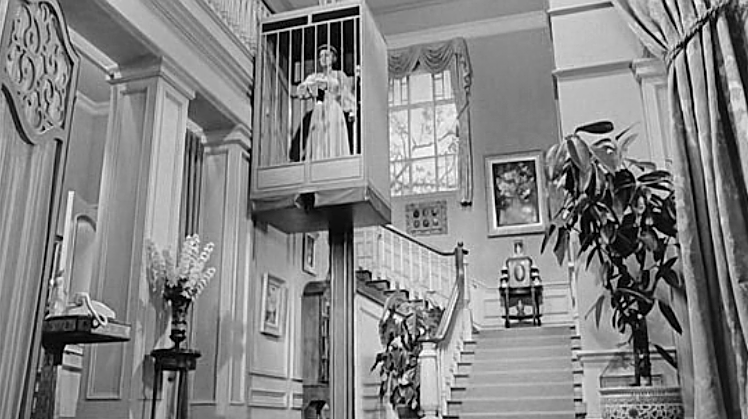
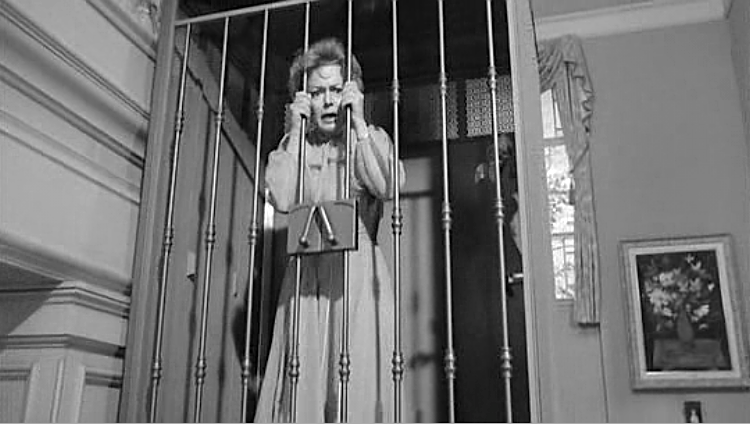
de Havilland’s lovely face distorts in the reflected mirrored panel of the elevator as she begins to unravel from the brutality and captivity she confronts, all within the vanilla-white tonality of her quiet house. The interior shots alternate with the outer rat race, the urban grime, and modern desolation.
Randall leers at Hilyard from under the stocking like a vicious hobgoblin.
As Tony Williams writes in his chapter Trying to Survive on the Darker Side in The Dread of Difference-edited by Barry Keith Grant-where he cites Grauman’s film “The monstrous adult child product of a traumatic family situation existed in Earlier Decades, as works such as Curse of the Cat People 1944, Psycho, The Strangler 1963, Lady in a Cage 1964, Marnie 1964, I Dismember Mama 1972, The Killing Kind 1973.” James Caan made an appearance as a soldier with radio in Billy Wilder’s Irma La Douce (1963)
Randall was James Caan’s first credited feature film role after getting his start with small television parts such as The Alfred Hitchcock Hour, “Memo from Purgatory” where he plays a writer who goes undercover in a street gang so he can get inspiration for his book. Kraft Suspense Theatre in 1963, Dr. Kildare, Death Valley Days, Combat!, and the ruthless Marty Feketi in ‘Bullets Cost Too Much’ episode of The Naked City 1961 extraordinary social commentary police procedural tv series that ran from 1958-1963. I’m still working through my new DVD box set, and let me tell you, there ain’t nothing like this show with its incredible cast of character actors, dramatic storytelling, and on-location cinematography in New York City in the 60s.
A snippet of the exchange between Hilyard and Randall…
Mrs.Hilyard-“You’re from an asylum?”
Randall-“Asylum? Oh no, you don’t. Reformatory. Work farm. I have been inside every way there is to be inside. I have been some kind of inside since I was nine years old.“
Mrs. Hilyard-“Oh I see. You’re one of the many bits of offal produced by the welfare state. You’re what so much of my tax dollars goes for the care and feeding of.”
Caan, with his very ‘masculine’ hairy chest, was a much more subtle psychopath in Curtis Harrington’s psychological thriller Games 1967 where he gaslights the beautiful but emotionally delicate Katherine Ross with the help of sensual goddess Simone Signoret. BTW, I’ll be doing a special feature on the works of Curtis Harrington hopefully by the summer.
James Caan in Curtis Harrington’s Games 1967 with Katherine Ross
Randall even takes off on Marlon Brando’s Stanley Kowalski from Tennessee William’s A Streetcar Named Desire, as he belches, shirtless (most of the film), and leers and smirks in his outre tight jeans.
This evokes “I think I’m going to be sick” from the respectable Mrs. Hilyard who voices her scorn. Randall is in control and enjoys the power struggle, sadistically amused by her indignation and repulsion, “Watch the human being be sick in a cage.” He’s looking for any excuse to lash out.
Randall says [to George Brady the bum] “We’re gonna kill you. First you, then the pig (Sade)… and then, the human being!”
It is suggested that Randall also likes to beat up on his girlfriend Elaine, as she has a black eye. As I stated earlier, off camera while up in the master bathroom behind closed doors, it is implied that she actually vocalizes pleasure when he hits her. Elaine herself is an angry and hyper-sexual oddity, perhaps even a sociopath as well, as she moves her body provocatively, quite aware of her seductive maneuvering. She enjoys watching violent acts and she dances to a small music box in a very sexually inappropriate way. Obviously, she is wired to believe that sexuality and violence go together.
Olivia de Havilland as Mrs. Cornelia Hilyard is terrorized by James Caan as the violent Randall Simpson O’Connell and his gang of sociopathic miscreants.
de Havilland’s Cornelia Hilyard suffers from delusions toward the climax –that Randall is her son Malcolm. First when she faints after she speaks to Randall thinking he is Malcolm and then again when he reads the letter and uses the words ‘release’ – as the screen becomes all wavy, as she self-accuses that she is a ‘monster.’
de Havilland having taken the role after Joan Crawford turned down the part of Cornelia Hilyard, and then ironically stepping in a little later that year to fill Joan’s high heels in Hush Hush… Sweet Charlotte when personalities clashed on the set with Bette Davis and Robert Aldrich.
Walter Grauman(his first film obscure B cult classic- The Disembodied 1957, writing for television Peter Gunn, Matinee Theatre, Perry Mason, The New Breed, The Untouchables, Naked City, Twilight Zone (Miniature) Route 66, Burke’s Law, Kraft Suspense Theatre, Honey West, The Fugitive, The Streets of San Fransisco and Barnaby Jones- Directing tv movie horrors like Daughter of the Mind, The Man Who Cried Wolf, Crowhaven Farm, Paper Man, They Call it Murder and The Golden Gate Murders ’79, a terrific hard to find a film with David Janssen and Susannah York.
I just love Grauman’s realist style– it’s raw and captivating mise en scène and here he directs this very taut thriller, that somehow seems to elude a definitive genre category as it falls into place amongst the transgressive noir-hybrids of the 60s, its been linked with Grande Dame Guignol cinema, and it’s every bit a suspense crime drama but there is little written about it in any of my books on the THRILLER or NOIR film genres. Film historian Kim Newman points out that the sub-genre that was a popular psycho trend of the 1960s where “the aging actress as *monster* was inaugurated” by Aldrich’s Whatever Happened to Baby Jane? (1962)
It also showcases elements of the horror style rampant in the 60s and yet again, I’ve found it difficult to locate it in any index, and I’ve got a full library on that subject as you can imagine. The idea of home invasion and torture isn’t a subject that’s been missed this side of the 21st Century. It’s been a featured narrative on shows like Law and Order, Dexter, and Criminal Minds comes to mind.
Gregory A Waller writes in the introduction in American Horrors: Essays on the Modern American Horror Film- “The 60’s provided a number of noteworthy horror films -still disturbing oddities like What Ever Happened to Baby Jane? (1962), Lady in a Cage (1964), and The Haunting (1964) with its restrained ‘adult’ major studio, quasi-Victorian terror.”
The idea of the home being invaded in an era that was coming off of the industrial age of suburban comforts, ice maker refrigerators, frozen dinners, air conditioners, and appliances for an easier way to be a homemaker. the notion of this once safe, comfortable, and innocent lifestyle is thus shattered by the intrusion of a doomed and violent world out of control. Even more stunning is that the action happens in broad daylight.
Martin Rubin sums it up in his book Thrillers-Lady in a Cage“epitomizes modern day social decay through the predicament of a cut-off shut-in Olivia de Havilland terrorized by lowlifes and juvenile delinquents.”
The shots of exteriors, interiors, and certain objects are key to framing a visual atmosphere of entrapment.
The script was written by writer/producer Luther Davis The Hucksters 1047, B.F.’s Daughter 1948, Kismet 1965, Across 110th Street (1972, tv movies Daughter of the Mind 1969 with Ray Milland and Gene Tierney, The Old Man Who Cried Wolf 1970 with Edgar G. Robinson.
co-starring as Caan’s female sidekick is Jennifer Billingsly as Elaine, Rafael Campos is Essie (a very hard-working character actor in the sixties and seventies, I especially loved him as Little Emanuel with one leg shorter than the other in All in the Family), William Swan as Malcolm Hilyard, Scatman Crothers as the junkman’s assistant,
Lady in a Cage also includes Ann Sothern as the weary and wanton Sade, Jeff Corey as the derelict George L Brady/ who decries, “Repent, repent”the two outliers of society, taking advantage of Mrs. Hilyard’s predicament instead of helping her.
With art direction and production design by Hal Pereira who worked on such great Hitchcock thrillers as Rear Window ’54, Vertigo ’58, and Capote’sBreakfast at Tiffany’s ’61
The evocative soundtrack of beat jazz and experimental nuances by composerPaul Glass (Bunny Lake is Missing 1965, Five Desperate Women 1971 tv movie, To the Devil a Daughter 1976)
At times Glass underscores the world gone awry with sounds akin to the mechanism of social order having just snapped a spring, and becoming uncoiled and shorted out!
The opening credits are framed with the use of bar-like graphics symbolic of not only the literal plot entrapment but the atmosphere of being caged in as well. The linear graphics that interplay with the rolling list of credits remind me of the work of title designer Saul Bass.
The titles are reminiscent of Saul Bass.
Leon Barsha takes care of the tense editing. Barsha knows how to create claustrophobic chaos as he did with Joan Crawford in Sudden Fear 1952, Midnight Lace 1960, editing a few of the most outstanding episodes of The Twilight Zone– A Penny For Your Thoughts ’61, The Grave ’61 and Will the Real Martian Please Stand Up ’61.
Rudolph Sternadproduction designer/art director-died a year before the film was released. Just to mention a few of his credits-(Dead Reckoning 1947, Walk a Crooked Mile 1948, The Member of the Wedding 1952, High Noon 1952, The Wild One 1953, The Defiant Ones 1958, Inherit the Wind 1960, It’s a Mad Mad Mad Mad World 1963) Set designers were Sam Comer and Joseph Kish.
Cinematographer Lee Garmes has a list of credits, having started as a painter’s assistant and prop boy. He lensed some of the most beautifully visual films, The Garden of Allah 1927, Lilies of the Field 1930, Scarface 1932, Call Her Savage 1932, Strange Interlude 1932 then later uncredited for Gone With the Wind, Guest in the House 1944, and of course some of my favorite films, Nightmare Alley 1947, The Paradine Case 1947 and Portrait of Jennie 1948 onto noirs, Detective Story and The Captive City.
Garmes sets up certain shots that give the impression of a brutally grotesque modern masquerade fête of social misfits on a rampage in a woman-in-peril film.
With various close-ups on the players’ faces, in particular, de Havilland as she begins to lose it. Often the trio are framed at angles where they look over Mrs. Hilyard who appears like a trapped animal in a cage, as they taunt her from above. She seems smaller and helpless. de Havilland begins to lose her coiffed appearance as she devolves, her hair becomes unkempt and she is drenched in perspiration. It’s quite visually disturbing and graphically unnerving. As these good shockers often are as Grauman and Garmes use extreme close-ups of de Havilland’s mouth when she screams for help. The emphasized shots of the alarm bell ringing to no avail, reminds of the detail that cinematographer Ernest Haller paid toward elements of communication and non-escape (the myriad shots of the phone, the stairs) in Aldrich’sWhat Ever Happened To Baby Jane?
Emphasis on anonymous hands blasting car horns all modern lines of communication that are chaotic and used in an audibly offensive way-dehumanizing noise. To show the indifference and cruelty of the world, a little girl runs her roller skates along a bums leg…
As voyeurs we see Malcolm through window blinds, peering through the bars of his private world- He writes a letter to his mother-“Darling.”
Malcolm is a coded gay character in the film.
Malcolm’s misadventure with the car sets off a chain reaction of horrific events to follow–fate is in the driver’s seat.throughout Lady in a Cage, Lee Garme’s camera focuses on objects of communication or the lack thereof… Modern conveniences and bourgeois trifle.
Twenty-First Century Desolation.
Lady in a Cage –Hal Pereira’s set is more modern, sterile, streamlined, inharmonious, and unwelcoming. There are many disturbing scenes with the subtle distinction of this hostility and inhumanity like the girl who runs her roller skates over the leg of an unconscious man, an evangelist spouting off about the evils of the world on the radio, a dog hit by a car that drivers keep passing by without stopping.
The date is the 4th of July, it is an extremely hot day, and people’s nerves are more sensitive and agitated during these heat waves which usually leads to more crime. There are exploding garbage cans in the street to mark the holiday.
Garmes focuses on Mrs. Hilyard through the bars of her cage and the reflections in the mirrored panel. We begin as voyeurs. Malcolm is writing his letter, addressing his mother as ‘darling.’ Perhaps a little undeveloped sub-text is to be discussed in a different kind of post. Considering that this one is in a series of ‘love notes’ he writes to her. “Darling” Hhmm???
It is made apparent though not explicitly, that Malcolm is in fact gay, and his mother’s domineering personality is at the source of his homosexuality, which is what films of the 60s & 70s would tend to illustrate.
de Havilland has a screen presence that is quite sophisticated and almost imposing with her sense of stylish intellect and decorum. This puts de Havilland’s Mrs. Hilyard in an interesting position on the graph of class struggle, as Randall and his gang aren’t just fighting amongst their own contemporaries, he is challenging an upper-class society lady and mother figure to attack back.
Ironically what sets off the sequence of actions that ensue is Malcolm whose car hits a ladder, that tears out wires that short out the power lines. He causes the accident that creates the electricity to go out leaving his mother stranded in her gilded prison. He is yet another character in the film who is distracted by his own agenda, self-absorbed carelessness, and indifference. Played out like a tragedy, it is at the chance moment when Malcolm causes the power outage that his mother wearing a sheer negligee gets into her elevated cage locking herself inside like a sitting canary. The ‘cage’ has a mirrored panel by the buttons, that allow for de Havilland/Mrs.Hilyard is to be seen from various angles and expressions.
With her in her gilded trap is a transistor radio, which is reporting about the uncovered murder victim, a woman who has been decapitated!
Mrs. Hilyard (Olivia de Havilland) is a poetess and a wealthy widow who lives in a stifling bourgeois mansion with her son Malcolm (William Swan) Cornelia, though she is never actually called by her first name, has had an elevator installed in her mansion after she breaks her hip. We see Malcolm writing a letter to his mother as he is about to go away for a weekend, leaving his mother all alone in the house. Malcolm appears to be stifled by his mother’s overbearing love, even to the point of her insisting that he drink his orange juice. As he leaves in his car, he backs into a ladder that nudges a wire that short circuits.
This subtle set of events triggering a negative chain reaction causing a power outage, only sparks the larger series of violent circumstances that begin to spiral out of control. Of course, Cornelia Hilyard is now trapped in her gilded cage of an elevator. She has an emergency alarm, which she uses while the electricity is out, but only one person is aroused by the alarm. A derelict wino named George L. Brady (Jeff Corey) hearing the alarm in the alley he ignores her cries for help, and instead helps himself to some of her things. Brady feigns muteness while he rummages around her things, as she is helpless to do anything about it. In desperation she tries to bargain with him to help her, “I will build a shrine to you.”
The use of white is so vanilla–like Mrs. Hilyard.
Repent is tattooed on Brady’s hand.
Much like Joan Crawford’s Blanche Hudson whose entrapment was because she was wheelchair-bound, the camera would often focus on the distance between the phone that was always out of reach. The lines of communication had been a constant hurdle to invoking the sense of dread and captivity.
Randall and his little band of riff-raff wonder where the old bum stumbled onto a $40 toaster and packs of cigarettes.
Brady shows up at Sade’s apartment, telling her about the house filled with so much loot!
But Brady is only the first character who will prey on the weakness and vulnerability of Mrs. Hilyard. The ferocious and unsympathetic opportunism is a theme that will carry through the film’s storytelling. And none is likable and no one is safe from harm. While we might feel slightly ambivalent toward the poor souls who are down and out on their luck, or the proper and uptight Mrs Hilyard who is the central sufferer in the piece, the narrative doesn’t allow much time for us to feel compassion which only illustrates that the message of nihilism translates with an authentic sting. Mrs. Hilyard is every bit part of the testimony of elitist apathy and arrogance that comes along with a hypocritical and so-called civilized modern society.
The film begins to escalate with a real sense of urgency and a smothering atmosphere of dread. The derelict Brady fences the goods and then pays a visit to his slovenly dame Sade (Ann Sothern). This sets off yet another ripple in the threatening current that is building in the narrative.
Following Brady from the junk dealer to Sade’s apartment the vicious trio learns about Mrs Hilyard’s house. The savage bunch of hoodlums Randall, Elaine, and Essie hang back and wait for the right time to strike. The three lowlifes follow George and Sade to the mansion wearing stockings to obscure their identities, as they start ravaging the place. Eventually, they kill the old bum George L Brady who is in a way the second catalyst for the crime of invading and tormenting the trapped Mrs. Hilyard. Hypocritical too as he decries, ‘repent’ though he not only ignores her pleadings for help, he engages the mechanism of ill-fate-he must also be the first to be disposed of. And although we do not see any of the gory details when they stab him to death, the murder is still quite gruesome, as the force of violence still permeates the screen with Paul Glass’ use of music box nuance to create contrast between the two experiences.
When the phone rings, it startles both Sade and Brady. As Mrs.Hilyard yells into the phone after it rings she knocks it off the hook, but Sade rips the wire out of the wall. Hilyard starts to lose it, calling out for help, calling out ’emergency’. Sade creeps up the stairs while Hilyard hangs in mid-air in her cage. Hilyard tells her “This is my house, my sons, and mine. I broke my hip and am somewhat incapacitated.”
Sade coldly ignores Mrs Hilyard’s pleas for help “Haven’t you ever needed help?” but Sade stops and only thinks for a split second and continues to walk away. “Perfume, is that perfume? A woman, are you a woman?… Listen, Hello my name is Hilyard. I am Mrs. Hilyard.” The bum Brady creeps around the stairs and cage. As if the house has been invaded by termites come to pick it clean. Hilyard continues to try and make contact with her intruders “What’s your name? Won’t you answer me? Please answer me” She moves around the inside confines of her gilded prison calling out for them to answer her. With no success.
“Please help me get out of this horrible cage. Please, please PLEASE!!!!” Suddenly the moment is broken with a horrifying wail, as the three hoodlums rush the stairs wearing stocking masks. It’s an immobilizing stunner in the film, that breaks the initial inertia of Hilyard’s entrapment and the circular photography that creates a whirlpool effect. At first a mind-numbing monotony and then a blitz of chaos.
Randall makes Sade his pickup truck.Hilyard soaked in sweat and crazed has already been driven half mad. Now she is terrified.Randall appears at the staircase looming down on her. His face was concealed by the stocking mask. Grinning at her he smacks his fists together. A show of brutish force. “Who, what monsters… Do you stink… get out…. steal and get out. What sort of creatures are you? Randall slithers over to her and pounds on the top of the cage. “Oh, even animals would have more civil compassion than you” Randall –“What… what you. You’re something holier than thou? Huh… You’re something ah. You ain’t no animal?” Hilyard- “I am a human being… a thinking feeling creature” He belches in her face. she winces. “Ah well me I”m an animal. Right now I am all animal. Lot of times I can’t even make animal. A lot of times I’m what do ya call, an inmate? But animal’s better.” Hilyard-“What do you mean inmate… asylum… you’re from some asylum?” He says-“Asylum…(tisk) Oh no you don’t. hahaha… reformatory. Work farm. I been inside everywhere there is to be inside. I been some kind of inside since I was a, 9 years old.” Hilyard with contempt in her voice-“Oh I see… you’re one of the many bits of offal produced by the welfare state. You’re what so much of my tax dollars go to the care and feeding of.” Randall answers her-“Well a, I don’t know from offal, but yeah… yeah. And I sure do want to thank you ma’am for all them tax dollars. The food is lousy though… belch, haha” He begins to literally rattle her cage.
This image of the ‘outside world’ gazing at us– the audience while they are confronting Hilyard creates a chilling moment that is truly indicative of a horror film– We too become voyeurs looking in on society as it implodes from violence and apathy The four intruders watch her with their masks on. As the monsters watch their prey lose control she cracks within her captivity. They study her. We study them watching her. The entire plot closes in on itself at that moment. The world turns –inside out from outside in.
She begins an inner monologue “The world must have ended. Someone on one side or the other must have pushed the button. Dropped the bomb.”She puts on her little transistor radio… She hears...”Ladies and gentlemen, here stands before us, the man of tomorrow”the radio spouts its media dogma. Modern experimental music underscores the insanity of the moment. The complete loss of rational thought. Civility and safety. Applause The sounds of haywire, slipped cogs, and shorted fuses. the noise of chaos. She laughs and drops the radio out of the elevator it lands on the floor and smashes. She begins to laugh heartily. She has lost it.
They lock Sade in the closet never to be heard from again–not before they rough her up a bit, pushing her into a mirrored dressing table, where she cuts herself. George Brady’s fate is much worse.
At this point, Randall sets his sights on Mrs.Hilyard who is trapped as the lady in said cage.
Mrs. Hilyard becomes less consequential at the moment the vicious trio arrives, as she is a symbol of the weakened society–the raw meat for the predatory wild animals, the more vulnerable of the modern jungle which will get picked off first. As Shelley so aptly notes, it’s very ‘Darwinian’ and the survival of the fittest. Mrs. Hilyard as much as refers to the city as a jungle.
Mrs. Hilyard-“I am a human being. A feeling, thinking, human being.”
Randall-mocking her- “Okay. I am *all* animal. Sure beats the hell outta being an inmate…”
Mrs. Hilyard ” … inmate?… Asylum?
Randall begins tormenting her, by playing head games. He shows her a note from her son Malcolm telling her he’s about to commit suicide because of her overbearing motherly love. “Release me from your generosity. Release me from your beauty. Release me from your love.”
The entire film’s universe is filled with deviant and transgressive characters. Sade is a self-hating woman who demeans herself because of her weight. Her ability to escape the chaos is hampered by her greed to take part in the looting of Mrs, Hilyard’s house. To add to the queasy touches, Sade wears a jeweled headband giving her an odd-ball air of eccentricity. She would again play a similar type of character as Thelma Lambert in Curtis Harrington’sThe Killing Kind 1973-another mother who loves her son too well, he becomes a lady killer…
The pawnbroker Mr. Paul only has one eye. perhaps this is symbolic of a skewed vision of the world that surrounds him. He is also an opportunistic figure. Brady and Sade are afflicted with alcoholism.Â
As Peter Shelley says in Grande Dame Guignol Cinema the film is “A disturbing indictment of the amorality of 1964 American society, as well as a nightmare for those suffering from claustrophobia and vertigo, this film introduces Olivia de Havilland to the Grande Dame Guignol subgenre.”
Walter Grauman creates an atmosphere of deafening nihilism that is so harsh and brutal it is almost hard to watch it at times. An indictment of modernity, opportunism, and the industrial age, the use of sound with the car horns blaring in clusters of traffic, the sounds from the streets that invade Mrs. Hilyard’s closed-in world is exhausting. The film delivers a sense that all of life is a furious, insensitive rhythm of hostility and discord. There is no empathy toward the individual and people are merely anonymous faces making the strident and shrill noise and disturbing the quietude of civilized life.
What makes this a suspense/noir hybrid is the environment of entrapment and flawed characters, with Lee Garmes’ camera angles and Leon Barsha’s razor-sharp editing that keeps the pacing at an uncomfortable beat. Even the graphics that follow the credits representative of the bars of a cage symbolizing the narrative’s imprisonment. Cinematic bars were deftly used in What Ever Happened to Baby Jane? as Aldrich wanted us to feel at every turn the same sense of captivity that Blanche as well as Jane’s state of mind, and the landscape of the old Gothic mansion which felt like it was desolate and decaying.
And much like What Ever Happened to Baby Jane’s use of the outer world excursions Jane would take that would constantly throw light into the closed-in universe of Hudson’s mansion, Grauman and Garmes utilize shots of the ever-turning world outside Mrs. Hilyard’s captivity to emphasize this contrast visually reinforcing the horror that is taking place within the confines of the house that is shut off. We feel that every frame has a sense of intrusion.
The film has so much cruelty in it… it’s an exercise in Nihilism.
Outside the house, the world goes on spinning, the paper boy delivers the news on an ordinary street.
Essie finds the letter. “Darling Mom… “Hey, how bout that it sounds real a …. gay,” Mrs Hilyard asks Essie-“What is that that you’re holding? Where did you get it?” Essie-“What am I holding, a letter that was on the desk upstairs, do you want to hear it?” Randall tells Essie-“Ah, let her die curious.”
Randall asks her-“Is your little boy married?”“I bet you had him at it til he was about twelve didn’t ya?… kept him sucking” She slaps him hard across the face. He grabs her violently, pushing his arm across her throat.
He begins to taunt her with the letter. “Darling Mom,”She tries to grab it away from him. He slams her hard against the wall of the cage. with his forearm pressed against her neck. His hairy sweaty chest is exposed, like he’s a pirate, his white shirt tied at the waist. Randall continues reading the letter from Malcolm -“I’ll be thirty next Wednesday, and I won’t have many more chances in life.”
Mrs Hilyard confused says-“What, what”Randall continues to read– “Every time I try to leave you, you add a room or dress up the house, or charm me…”He looks straight at her. She looks horrified. “No…” Randall says-” I thought you only had him at it til he was twelve. But you still got him at it… How do you charm him baby” He pulls her back by her hair… “I had a holier than thou old crow of a grandmother. She tried to keep me at it too. I’d a killed her if she hadn’t died… Like she was trying to kill me. Like you kill this um what’s his name… uhm Malcolm.” Mrs Hilyard begs, “No, no this is his too you know he decorated it himself. Complete freedom to come and go he wanted to stay here. Why would he write me a letter? We’re as close as…” She pauses and looks into Randall’s eyes. He smiles quietly at her as she begins to have an awareness. Randall asks her again, “He’s not married is he? Does he even have a girl?”“He has many women friends” “Oh yeah yeah yeah, all his friends are from public shower rooms I bet” She struggles but he continues to hold her up by her hair. It’s barbaric. He continues to torment her with her son’s letter. “Uhm, give me my half of what’s in the living room safe. What safe!!!!!!!” He repeats that line again…”Release me from your generosity, release me from your beauty, release me from your love.” Now she has truly begun to confuse reality and fantasy after she hears him say the word love. She says “Oh love” and touches his face as if it is Malcolm’s. “Oh love, love you could have your half any time you wanted. My half too for that matter.” Essie interrupts. “Read her the P.S. It’s got what they call some real buckshot in it… real loaded. Read it to her” Randall finishes the letter-“P.S. Think it over. I’ll call in a little while. Please make it yes or quite simply I’ll kill myself.”
The interplay between Caan and de Havilland is utterly realistic. A volatile and primal confrontation between young and old, civil society and the disillusioned masses, and paternal and maternal law. fear and compassion. She passes out and slides down the wall of the cage. Essie calls up to Randall-“You didn’t kill her?” He tells him-“No…Fainted, lying on the floor like a pile of old clothes.”
Elaine and Essie go to look for the safe. Randall is left alone in the cage with Mrs.Hilyard who has fainted. For a brief moment, it almost appears as if Randall feels sorry for her. He touches her face and neck. He looks the most thoughtful he’s been. He whispers to himself. “Old crow baby.” This is a hint at Randall’s mother’s issues which does not excuse his violent abuse of women.
The film was refused a cinema certificate in the UK by the BBFC and remained unavailable until 2000.
Reviews courtesy of Paul Shelley’s Grande Dame Guignol Cinema- The picture was released on July 8, 1964.
“Lady in a Cage adds Olivia de Havilland to the list of cinema actresses who would apparently rather be freaks than be forgotten … a grande chance to go ape. Attagirl, Ollie“- Time, June 19, 1964
“…{S}ordid, if suspenseful, exercise in aimless brutality… A discerning viewer is left curious and repelled… Olivia de Havilland as the trapped ‘Lady’ does project a sense of fear and self-appraisal … a surface, somewhat obvious portrayal.”-A. H. Weller, The New York Times, July 11, 1964
“…{A} noxious, repulsive, grueling experience… Davis’s sensationalistically vulgar screenplay is haphazardly constructed, full of holes, sometimes pretentious, and in bad taste. {de Havilland} gives one of those ranting, raving wild-eyed performances often thought of as Academy Award oriented. {She} does about as well as possible under the dire circumstances.” Variety May 25, 1964
 Right now I’m all *MonsterGirl* Hope you’ve enjoyed this post for The Great Villain Blogathon!
“All men dream, but not equally. Those who dream by night in the dusty recesses of their minds, wake in the day to find that it was vanity: but the dreamers of the day are dangerous men, for they may act on their dreams with open eyes, to make them possible.”– T.E. Lawrence
“You can’t depend on your eyes when your imagination is out of focus.”- Mark Twain
IT’S ALL IN THE EYES! -THE LEGACY OF GLORIA SWANSON/NORMA DESMOND & GLORIA HOLDEN/COUNTESS ZALESKA
Are these wicked women? Do they exemplify the monstrous feminine? I dare say NO! They are sensual yet tragic figures!
Gloria Holden’s Countess Zaleska is a victim of her bloodline (literally)–her father Dracula’s legacy, desperately seeking out redemption and’ release’ from the torture of her relentless desires. (lesbianism in the form of blood lust) And Gloria Swanson‘s enduring Norma Desmond an aging silent screen star pushed out by talkies-a victim of a punishing Hollywood institution that forces older women into self-delusion. Though her beauty did not fade, the praise and recognition have.
Both women are literally immortal!
Ironically without realizing the connection, there are two threads of synchronicity that revealed themselves after I decided to pair both Glorias. A) Both women have male servants who show a stoic undying co-dependent worship of their mistress and B) Hedda Hopper appears in both films…
“She gives you that weird feeling!” –tagline from Dracula’s Daughter
Two Glorias, two dynamic forces on screen- Written about endlessly, on the surface spider women, vamps and villainesses perhaps… but to the thoughtful observer and film fanatic like myself… they are sympathetic figures in a cruel world…
“Cast out this wicked dream that has seized my heart.”- subtitle from one of Gloria/Norma’s silent films.
First, let’s begin with our ‘close-up’- on Gloria Swanson as the eternally mesmerizing Norma Desmond in Billy Wilder’s masterpiece! Norma is in actuality the one trapped in an orbit of ambivalence about her own primacy which ultimately devolves into a vulnerable, needy, discontented, and brooding personality whose dependency upon men and (one opportunistic man in particular) is self-destructiveness turned outward.
Written and directed by auteur Billy Wilder(Double Indemnity 1944, The Lost Weekend 1945, Ace in the Hole 1951, Stalag 17 (1953), Witness for the Prosecution 1957, Some Like It Hot 1959, The Apartment 1960, which won BEST PICTURE that year, beating out ELMER GANTRY!).
Considered the last motion picture in the film noir canon. The first is Billy Wilder’sDouble Indemnity 1944with his notoriously sexified femme fatale Phyllis Dietrichson, who’s got a great pair of gams showcasing that diamond ankle bracelet, dark sunglasses, and Barbara Stanwyck’scool exterior. And Wilder’s last noir, Sunset Boulevard, unofficially marked the end of classical noir’s heyday. Sunset Boulevard truly pushes the conventions of noir to its limits.
Written for the screen by Wilder and Charles Brackett (The Lost Weekend ’45, Edge of Doom, ’50, Niagara ’53).
Music by Franz Waxman (Magnificent Obsession ’35, The Invisible Ray ’36, A Day at the Races ’37, The Man Who Cried Wolf ’37, Gone With the Wind -uncredited, Humoresque ’46 I Married a Monster From Outer Space, Home Before Dark, there’s so much more– see IMDb profile).Waxman’s score is superb, from the exhilarating opening sequence that accompanies the flurry of police and newsreel camera trucks racing to the crime scene, the vibrant strings and strident horns that accentuate modernity, to the more subtle, poignant moments that underscore Norma’s internal agony.
John Seitzis responsible for the evocative and quirky noir-esque cinematography (Sullivan’s Travels ‘4I, Double Indemnity ’44, The Lost Weekend ’45).
The use of light in key frames showcases Gloria Swansonas Norma Desmond who exults whenever she is either watching herself or is thrust into sudden illumination rendering her as somehow lost. The use of shadows and oddly lit spaces evoke the sense of her tragic misconstruction of reality.
Bruce Crowther on- Cinematographer Seitz who helped to define some of the memorable images of Sunset Boulevard– “Rarely does full light intrude upon this movie… Seitz handles the often cluttered sets using lighting to direct the eye to each scene’s key areas. Even when light is used fully, as when Norma steps into the beam of her home movie projector or when a lighting technician at the studio turns the spotlight on her, it serves a dark purpose… Here it shows with appalling clarity the incipient madness that will eventually destroy Norma.”
Arthur P Schmidt, the film editor, died at age 52 (worked on Ace in the Hole and Some Like it Hot with Wilder).
Art direction by Hans Dreier and John Meehan, fabulous mise-en-scène by set designers Sam Comer & Ray Moyerwho both worked on (Read Window 1954, Vertigo 1958, Breakfast at Tiffany’s 1961) Which arranges the landscape of Norma’s World with Art Deco style furnishing, elaborate candelabras, wrought iron scrolled staircases, tapestries, and ornate lighting fixtures. Norma’s bedroom is something out of a Gothic fairytale with its superfluous ruffles and claustrophobic pageantry.
Wilder and his artistic design team create an atmosphere of decadence and decay. Using an ornate baroque visual style that puts emphasis on the surroundings which are careful set pieces of time-worn opulence. The scenes are filled with a cluttered and suffocating mise-en-scène. Sunset Boulevardreveals the conflict of the old grandeur of the silent era with the hollow clamor of modernity, as a ‘clash of styles and eras.’
Once Joe walks in from the brightly lit Los Angeles hustle and bustle, the tone turns darker, as he steps inside the confines of the mansion, crowded with the serpentine wrought iron staircase, large yet dim light fixtures, and ancient-looking columns that appear to be disintegrating in small scattered parts. Set against the crispness of Max’s white gloves and Norma’s black sateen lounging pajamas, it offsets the sense of a perishing house oddly and creepily. Again, this is where noir meets horror by the elements combined in the visual style.
Most effectively is the central character of Norma Desmond whose electrifying intensity and melodramatic flare projects an other-world style in contrast with the biting and cynical, dispassionate humor of the younger screenwriter from the age of talkies.
According to Sam Kashner and Jennifer MacNair, many of the film’s props came from own Swanson’s home and scrapbooks. “One shot pans across the table covered with Swanson’s film stills, the photographs in old frames capturing her young face and heavily painted eyes.”
The portrait in Norma’s living room was painted by Geza Kende.Wilder also borrowed a film clip of “Norma” in her prime from a Swanson film Erich Von Stroheim directed, Queen Kelly 1929.
From Foster Hirsch’s The Dark Side of the Screen- he cites Amir Karimi in Toward a Definition of the American Film Noir as the true period of noir beginning with Wilder’s Double Indemnity and ending with the same directors Sunset Boulevard 1950. He goes on to say that Wilder’s noir drama’s contain “the biting social comment, the stinging disapproval of the American way”Sunset Boulevard“transfers noir psychology to a novel setting, the decaying mansion of a once-grand film star. Wilder’s portrait of the megalomaniacal Norma Desmond is etched in acid; she is the embodiment of Hollywood’s rotting foundations, its terminal narcissism, it’s isolation from reality.”
Norma’s sensational costumes were created by prolific designer Edith Head, who resurrected Swanson’s silent era look, the exotic and exaggerated costumes and fashions of an ex-screen Goddess, which point back toward Swanson’s past. She wears a hat, adorned with a peacock feather, in the scene where she is reunited with Cecil B.DeMille. This is a visual homage to a headdress she wore in Male and Female 1919 one of the first films in which she was directed in.
The silent movie queenNorma Talmadgeis reported as “the obvious if the unacknowledged source of Norma Desmond, the grotesque, predatory silent movie queen”– Dave Kehr, “An independent woman, nobly suffering in silents”, New York Times, 11 March 2010.
Sunset Boulevard could not have been cast with anyone better than the dynamic and grande actress who in 1919 was signed to a contract by Cecil B. DeMille.With this, her comeback role, Gloria Swanson ignites the screen with her eponymous Norma Desmond -star of the silent screen -Norma Desmond, the tragic central satellite of the story, who herself is dreaming of a comeback. Swanson’s performance is as much transfixing as it is exquisite.
The intoxicating beauty of Gloria Swanson from the silent era.
Swanson herself was a very hard-working actress in the 1910s and 1920s with Mack Sennett before joining Paramount Studios. She started her own production company in the mid-’20s but only made a few talkies in the 1930s. She made six silent films with Cecil B. DeMille.
As Leo Braudy says in his insightful book, The World in a Frame: What We See– Aesthetically, Swanson faces into the film as the fictional character Norma Desmond and faces outward toward us as the star. He calls her role a ‘meditation’ on her screen image and the relationship between the old world of silent films and the new world of 1950s Hollywood. He refers to the other actors who were her contemporaries playing themselves as ’embalmed’ with her in the past, losing their relevance to the audience and ultimately their power.
Billy Wilder’s film is, as James Naremore says in his book More Than Night- Film Noir in its Contents, an “iconoclastic satire” and “a savage critique of modernity.”Much like Aldrich’s The Big Knife, it is a condemnation of Hollywood in the cycle of films released in the 1950s. Also notable is The Bad and The Beautiful 1952. Naremore points out that these films coincided with the blacklist and the decline of studio-owned theater chains, marking the end of an era. Norma’s character is a casualty of changing times.
Co-starring as the ill-fated, gutless, ‘big dope’, unemployed screenwriter who becomes Norma’s gigolo is smooth and sexy William Holden as Joe Gillis. Erich Von Stroheimplays Norma’s devoted butler and ex-hubby Max Von Mayerling. Erich Von Stroheim who had directed Swanson in Queen Kelly ’29 is perfectly suited to play her servant/ex-husband/devotee.
The film also co-stars Nancy Olson (Union Station 1950) as Betty Schaefer, Fred Clark as Sheldrake, Lloyd Gough as Morino, Jack Webb as Artie Green, Franklyn Farnum as the undertaker, and special appearances as themselves, Cecil B. DeMille, Hedda Hopper, Buster Keaton, Anna Q Nilsson, H.B. Warner, and composers Ray Evans and Jay Livingston.
The film is a Gothic, poetic nightmare in noir that so often evinces a sympathetic lens toward the forgotten characters who engage the audience like apparitions of another time in Hollywood. The unorthodox narrative embraces a vividly unstable noir identity that dwells within the constructs of American life, pushing the limits of social and sexual convention to a dark place of obsession and excess. However, Wilder scripted this as a black comedy, the noir stylization that had by now run through its recurring patterns still manages to create the incessant mood of bleak cynicism and a distant vulgarity.
Bruce CrowthersReflections in a Dark Mirror- “Of the other German emigres who worked in Hollywood the most significant contributor to the film noir is Billy Wilder, whose Ace in the Hole perhaps the most cynical movie ever to come out of Hollywood, Double Indemnity with its mesmerizing manipulative spider-woman and Sunset Blvd with its atmosphere of brooding baroque insanity are classics of the genre.”
“Wilder introduces a creepy atmosphere of eccentric ruin that’s strange and destroys lives, yet hypnotically alluring and seductive from a lost indulgent age.”– Alain Silver & James Ursini from The Encyclopedia of Film Noir-The Directors
Wilder wanted stark reality and realism to pierce the veil of illusion and fantasy that was the dream factory of Hollywood in the 1950s. He portrays a corrupt landscape of used-up people, conniving agents, writers hustling to get their scripts sold, and the loneliness and alienation that permeates a world of broken dreams and perpetual struggle. Andrew Dickos in Street With No Name calls Wilder’s noir films “visions are steeped in cruel and corrosive humor, distinctive in its own right and its ability to function apart from the noir universe.”
In this provocative masterpiece, Billy Wilder masterfully evokes a shudder in us, “by emphasizing its verisimilitude, though, Wilder reveals the hidden truths of the world’s cruelest company town- from the isolation of forgotten celebrities to the crass efficiency of producers. Not only a thrilling and strange piece of entertainment, the film also is an indictment of Hollywood.” –Kashner & MacNair
Louis B. Mayer, at a private screening of Sunset Boulevard, was furious with Wilder for his cruel portrayal of the industry that supported him. At the party before the various celebrities, he reproached him, “You have disgraced the industry that made and fed you! You should be tarred and feathered and run out of Hollywood!”Wilder kept the script hush-hush using the innocuous code title A Can of Beans. Wilder and Brackett feared that Hollywood would respond negatively to their damning portrayal of Hollywood.
He offers us the very typified archetypes of classical noir with his doomed anti-hero, the dangerous femme fatale, and the good girl redeemer. Also present are the familiar themes of entrapment, claustrophobia, instability, corruption, flawed character, psychological crime melodrama and even the police procedural with it’s thrilling opening sequence as the newsreel cameras and police cars, their sirens blaring, tear up the streets as they speed toward the murder scene.
The inimitable Mae West turned down the part of Norma Desmond
Originally, Billy Wilder wanted the legendary & incomparably sexy and suggestive writer/actress Mae Westto play Norma. West declined because she found the story to be ‘too dark’. She also didn’t want a film that portrayed the relationship between an older woman and a younger man that reflected itself as hideous. The two approached Greta Garbo, who also declined the offer. Wilder also approachedMary Pickford, who was appalled by the offer, and they had to apologize to her. It wasGeorge Cukorwho suggestedGloria Swanson. Wilder asked Gloria Swanson to screen test for the part in 1949, and she almost said no. She had worked with Wilde, who had adapted the screenplay for her film Music in the Air 1934. Norma is a larger-than-life film character, though an exaggeration of reality, considering Swanson wasn’t ancient, she was only fifty at the time!
Wilder had contracted Montgomery Clift to play Joe Gillis. Clift left the picture, finding it too uncomfortably close to his own life, because of the younger man’s relationship- he allegedly had an affair with Libby Holman, a popular singer of the 20s whose career was ruined by the scandal surrounding the shooting death of her husband. Clift had spent time with Holman, who also lived in a sprawling mansion much like Norma’s. Wilder worried that the age difference between Swanson and Holden wasn’t big enough; Swanson was fifty, and Holden was thirty-one.Wilder hadn’t been impressed with some of Holden’s more mediocre films of the ’40s, even though he had starred in Rouben Mamoulian’s Golden Boy (1939) with co-star Barbara Stanwyck. Sunset Boulevardmade William Holden’s career. While I find Joe Gillis to be a dismissive, smarmy ass who sort of had it coming to him, in this picture, I let it be known that I’m a huge fan of William Holden!- he did a superb job of playing it cagey, opportunistic, and sarcastic as hell.
Wilder mirrors Joe Gillis’ from his own start as a shaky Hollywood writer having moved from Germany to America after Hitler’s rise to power, He used to be a “˜taxi dancer’ who would dance with any unattached older women who were willing to pay for his services.
One of the most iconic scenes from Sunset Boulevard,aside from the film’s fever dream climax where Norma descends the grand staircase, plunging into her gathering madness, is the scene that illustrates the withering passage of a lost era. The three fading silent film stars play bridge in the parlor of Norma’s decaying Gothic mausoleum. During the scene with the old stars playing bridge, the collectors come and take Joe’s car away, the only passport to freedom he has.
“˜The wax works’cracks-wise, struggling snarky screenwriter Joe Gillis, referring to Norma’s bridge party guests. Wilder envisioned this scene as purposefully macabre, or as Kashner and MacNair call it, “ghastly.” See figures gathered around the table, as the sequence unfolds, it is revealed that these actors are actually playing themselves. Silent screen actress Anna Q. Nilsson and H.B. Warner, who had played Christ in Cecil B. DeMille’s 1927 picture The King of Kings. And the Legendary actor of silent cinema, Buster Keaton, is there too. Kashner and MacNair describe his features ravaged by alcohol abuse.” Even Gloria Swanson as Norma Desmond in a way is paying tribute to herself by recalling the bridge game in the parlor scene-“Came close to giving us all the creeps.”
Like the bridge guests, DeMille plays himself with scenes shot on the real set of his 1949 motion picture Samson and Delilah. Erich Von Stroheim, himself a once great director, Wilder uses him poignantly as Max, who mourns his former life. Wilder touches on the fact that Stroheim in real life had a rough time with his career, often going over budget and ultimately making box office flops.
As I’ve pointed out here in this piece for The Great Villain Blogathon, I am using Norma Desmond to argue that she isn’t the psychotic spider woman or villainess that she’s been referred to and that the film neither makes fun of her, yet creates a sense of sympathetic apology to this grande dame mostly revealing her as quite a tragic figure. I neither see her as washed up nor grotesque, but a beautifully powerful woman possessed of intensity. She is the one who is ‘trapped’ in the web of an unforgiving culture that demonizes women for their sexual primacy. Norma is possessed of desire. The desire to still be adored. The desire to make a ‘return’ to motion pictures. The desire to be loved as a great star. The desire to be loved by Joe.
It’s Joe Gillis that is not a very likable guy, who is uncaring, weak, too shallow, and powerless. Let’s face it he’s a self-acknowledged heel. Ironically, sadly it is Norma’s story that is being told through this guy’s voice and perspective yet another way that her character is silenced, her personae distorted and perverted through the male gaze.
Once again Silver & Ward point out eloquently-
“Norma herself as portrayed by Gloria Swanson is a tragic figure. imbued by Wilder with powerful romantic presence… A woman obsessed, she clings to her vision with a tenacity that must ultimately be granted a grudging admiration and she is the only character in the film with the possible exception of Erich Von Stroheim’s fanatically loyal Max, who inspires genuine sympathy. Watching herself on screen in an old movie, she leaps into the projector’s murderous blast of light and cries, ‘They don’t make faces like that anymore!’ It is difficult for the viewer to favor Joe’s cynicism over her fervor, however misguided or self-centered it may be…”
THERE’S A MONSTROUS FEMALE IN OUR MIDST- SOME CHARACTERIZATIONS OF NORMA:
“ONLY THE MAN WHO WROTE PSYCHO COULD JOLT YOU LIKE THIS”
Director Michael Anderson( The House of the Arrow 1953, The Dam Busters 1955, Chase a Crooked Shadow 1958, Conduct Unbecoming 1975, Logan’s Run 1976, Dominique is Dead 1979 ) creates a wavelength of dark tension and monochromatic extremes in this atmospheric post noir suspense yarn.
Adapted for the screen by Joseph Stefano’s (The Outer Limits 60s & Psycho 1960) based on the novel byMax Ehrlich (The Reincarnation of Peter Proud, The Glass Web, various dramatic television series)
The Naked Edge opens as the credits roll in a manner similar to Saul Bass, we are dropped into a gruesome stabbing in the darkly lit office building, where George Radcliffe (Gary Cooper)is the key witness.
Sadly, This would be Gary Coopers last film, after battling cancer. The Naked Edge was released a month after his death, but was not received well at the box office.
After Mr. Evan Wrack (the marvelous Peter Cushing) grills the only witness to murder in court Gary Cooper in his last role plays American George Radcliffe whose testimony helps bring a guilty verdict for murder and theft of his co-worker Donald Heath (Ray MacAnally) who then gets sent to prison.
There’s a question as to whether Heath actually committed the crime???
Years later…
George’s wife Martha, the always enchantingDeborah Kerrbegins to suspect her husband when various clues start pointing in his direction… Is she married to a cold blooded killer?
With a fantastic supporting cast, Peter Cushing, Michael Wilding, Eric Portman, Diane Cilento,Hermione Gingold, as Lilly Harris, Ronald Howard, Helen Cherry, Wilfrid Lawson and Diane Clare.
Dramatic musical score by William Alwyn (The Fallen Idol 1948, She Played with Fire 1957, I Accuse! 1958, A Night to Remember 1958, Burn Witch Burn 1962)
Most impressive is the offbeat cinematography by Erwin Hillier (The Mark of Cain 1947, The House of the Arrow 1953, Chase a Crooked Shadow 1958, and perhaps his best–the extraordinary Eye of the Devil 1966 again with Deborah Kerr, David Niven and Sharon Tate)
Hillier’s quirky angles and low lighting add an apprehensive atmosphere, and loads of key frames that are just beautifully shot as a refrain to the tension. Both Anderson & Hillier love to emphasize faces… it’s a touch that I love about their work together.
George Radcliffe:“Do you think a woman could live with a man and sleep with him and not know she was sleeping with a murderer?” Martha Radcliffe: “Do murderers make love differently?“
Lilly Harris-“He implied that the fear of talking, had something to do with the fear of giving… sexually that is”
There are thousands of films in my collection… this has been one of them! Your ever lovin’ MonsterGirl
“She went to sleep as a secretary… and woke up a madman’s bride!”
“I don’t know what this is all about, but I promise you some very serious trouble unless you stop it immediately. You know perfectly well I’m Julia Ross.”
Directed by Joseph H. Lewis (The Mad Doctor of Market Street 1942, So Dark the Night 1946, Gun Crazy 1950, A Lady Without Passport 1950, The Big Combo 1955) Screenplay by Muriel Roy Bolton from the novel The Woman in Red by Anthony Gilbert. With a fabulous odd-angled, shadow-stricken spin by cinematographerBurnett Guffey, it’s no wonder this suspense thriller has the elements of a stylized psychological noir. Â
Nina Fochis Julia Ross, a young English girl seeking employment. She answers an ad at a fake employment agency run by none other thanAnita Sharp-Bolsteras Sparkes, who’s even more cantankerous in this role. Julia, saddened by the news that the guy she loves is marrying another girl, thinks she’s found the perfect job working for a wealthy widow Mrs. Hughes (Dame May Witty), whose son, the creepy Ralph (George Macready), lives with her.
George Macreadyis exceptional as a psychotic murderer who is prone to fits of violence. He has already killed his wife, stabbing her to death and throwing her body into the quiet sea.
Ralph Hughes– {Looking out at the ocean] “Beautiful, isn’t it? Would you like to listen to the sea and hear what it says? It doesn’t say anything, does it? That’s what I like about the sea. It never tells its secrets, and it has many – very many secrets.”
Ralph has a thing for knives, and Mommy Hughes has to keep taking sharp objects away from him and locking them away in a drawer. Dame May Witty is superb as his overprotective mother, who is willing to concoct an elaborate scheme and even kill in order to cover up her son’s murder.
Ralph Hughes- “It’s all Marion’s fault. She shouldn’t have cried.”
Mrs. Hughes- “Ralph, you never told me – was it an accident, or did you intend to kill her after she made her will?”
Ralph- “I didn’t plan it. I liked her well enough, but when she found out I’d been lying about my income, she accused me of marrying her for her money. I said of course that was what I’d married her for. Then she cried. She was always crying. Then she slapped me. I had my knife in my hand, and I…” [He begins slashing at the sofa cushion with his knife, slicing it over and over]
Mrs. Hughes- “Stop it, stop it!” (she tries to take the knife away)
Ralph- “Don’t do that!”
Mrs. Hughes- “Put that away! Ralph, I’m trying to help you.”
Ralph- “I still say we should have called the police and told them a prowler broke in and killed her.”
Mrs. Hughes- “With the marks of your fingers on her? The scratches on your face?”
Julia goes to live at the house, but once she’s there, Mrs. Hughes, Ralph, and Sparkes drug her tea and spirit her off to the ocean village of Cornwall.
They’ve burned her clothes, stopped any means of communication from getting through, put bars on her windows, and convinced the village that she’s out of her mind so no one believes her story about being held prisoner by these seemingly well-bred murderous grifters.
There, they gaslight Julia, telling her that she is the first Mrs. Marion Hughes who has had a nervous breakdown. They’ve even convinced Alice, the maid (Queenie Leonard), that she’s going mad and that she’s suicidal. Alice gossips around town, and soon after, everyone, even the police, the doctors, and the reverend and his wife, believe Hughes’ story. It seems like there’s no escape for Julia in sight. Along the path to doom, Ralph torments Julia with his menacing presence, and every attempt Julia makes to escape is thwarted.
They plan on making it look like she’s committed suicide so they can bury her as Mrs. Hughes since the real wife is lost at sea – and take her money.
After, it looks like Julia has taken an overdose of poison… Ralph –“Why try to save her? Let her die. That’s what we want.” Mrs. Hughes- ” Don’t be stupid, Ralph. If she’s taken poison, we must act as though we cared!”
This is a very taut little suspense yarn that keeps you on the edge up until the end. With some extraordinary camera work and a very simple tale of murder, mistaken identity, and mayhem!
Co-starring Ottola Nesmithas Mrs. Robinson,Joy Harringtonas the resentfully sullen Bertha, Doris Lloyd is marvelous as Mrs. Mackie, Julia’s landlady, Roland Varno and as Julia’s love interest Dennis Bruce, Olaf Hytten as Reverend Lewis and Leonard Mudie as Peters.