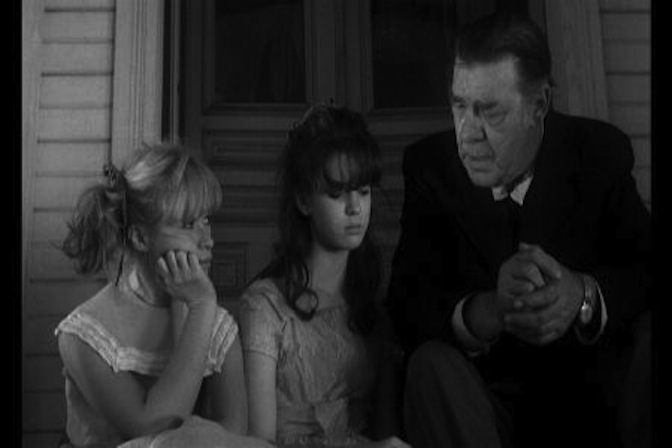
Grande Dame/Guignol Cinema: Robert Aldrich’s Hag Cinema Part 2 Hush…Hush, Sweet Charlotte 1964 “He’ll Love You Til He Dies”

Hush… Hush, Sweet Charlotte (1964)

Directed by Robert Aldrich, written by Henry Farrell, who also wrote What Ever Happened to Baby Jane? (1962), How Awful About Allan (1970) and the made-for-tv film The Eyes of Charles Sand (1972) scripted by Lukas Heller and Farrell. Starring the legendary Bette Davis as Charlotte Hollis, Olivia de Havilland as cousin Miriam Dearing, and Joseph Cotten as Drew. The inimitable Agnes Moorehead as Velma Cruthers. Cecil Kellaway as Harry Mills, Victor Buono as Big Sam Hollis, Mary Astor as Jewel Mayhew, and a very young Bruce Dern as John Mayhew. George Kennedy as the foreman and extra recasting of Wesley Addy as Sheriff Luke Standish, and Dave Willock from Baby Jane?

Aldrich apparently had another hit with his 2nd genre film, which opened to generally positive reviews. With the exception of this scathing review in The New York Times, by Bosley Crowther who couldn’t have been more off the mark, he writes “So calculated and coldly carpentered is the tale of murder, mayhem, and deceit that Mr. Aldrich stages in this mansion that it soon appears grossly contrived, purposely sadistic and brutally sickening. So, instead of coming out funny, as did Whatever Happened to Baby Jane? it comes out grisly, pretentious, disgusting, and profoundly annoying.”

Again, I wholly disagree with Crowther, as this film wasn’t meant to be as campy as Baby Jane, and “funny” is an odd word for the film as well, nor was there an unwritten rule that said Aldrich had to restrain some of the grisly details from this picture. I don’t believe chaining an invalid to a bed, feeding them road kill, and slowly starving them to death is the less disgusting proposal. And as far as being brutally sickening, I see Charlotte as a hauntingly nightmarish allegory.

Let me say that I loved Peter Shelley’s book. He compiled some great examples of the genre and added a lot of information and insight to the subject matter; I was with him all the way, so there were a few points of divergence in our opinions of Hush… Hush, Sweet Charlotte isn’t a slight to the author at all. According to Peter Shelley in his Grande Dame Guignol Cinema: A History of Hag Horror from Baby Jane to Mother, the chapter on Hush Hush Sweet Charlotte, the film suffered from the absence of Joan Crawford. Shelley considered the follow-up film to be a “bloated reprisal of the pivotal components of the earlier film” (pg.57). Actually, I think quite the contrary about this suspenseful, understated film. It has less of a feeling of a”bloated” extension of the first Hag film, as Charlotte appears more distilled, virtually more refined in its subtle use of hallucinatory machinations, with a very cogent argument for Charlotte’s sustained ire and melancholy. Shelley considers the location an attempt to surpass the Grande Guignol aspect of its predecessor by placing it in a southern Gothic milieu, the Ascension Parish, but he thinks it fails with its “florid exoticism” again because it lacks the electrifying cast choice by not reuniting Crawford and Davis. Additionally, I say too much of a good thing becomes a device therefore a reuniting of the two would have minimized the impact that the prior collaboration by both film stars made on Baby Jane. I think that Hush… Hush, Sweet Charlotte is perhaps even an elegant piece and stands well on its own, as a taut psychological portrayal of the regressive woman, and at its very essence is an ideal Grande Dame film.

I think Crawford would have brought a certain purposeful intensity that worked for her in so many films, but would have overshadowed the interplay between Davis’s Charlotte and Olivia de Havilland’s subtle, malignant charm in her characterization of cousin Miriam. Supposedly, after the great success of Baby Jane, Crawford agreed to do a follow-up film. Aldrich encouraged writer Henry Farrell to create a new story called “What Ever Happened To Cousin Charlotte?” Bette Davis asked that the title be changed to fit the line from the song. So Aldrich agreed, and Davis signed on. Crawford, however, wanted her name to come first on the credits, unlike Baby Jane, where Davis’s name appeared left of the screen or side by side. Leftward is the more pronounced association as the star. Bette Davis even agreed to this provision. Once the shooting began in Baton Rouge on June 4th, 1964, Davis only got to film one scene with Crawford, where she watches Crawford enter the mansion. Otherwise, they never did another scene together from that point on. The production was put on hold because Davis was called away to finish some re-shoots on Where Love Has Gone in Los Angeles. Continue reading “Grande Dame/Guignol Cinema: Robert Aldrich’s Hag Cinema Part 2 Hush…Hush, Sweet Charlotte 1964 “He’ll Love You Til He Dies””

March 23, 2011 – A Legend, Elizabeth Taylor dies at 79: Girl with the violet eyes…

“I feel very adventurous. There are so many doors to be opened, and I’m not afraid to look behind them.”
Elizabeth Taylor

Today we lost a true legend. One of the most evocatively beautiful and Dionysian actresses of all time, and a passionate humanitarian. To say Elizabeth Taylor is one of my favorite people would sound contrived and pale inadequately to how much I truly love her. Dame Elizabeth was and always will be what dreams are made of.

Elizabeth Taylor was indeed a legendary actress known for her stunning beauty, captivating performances, and undeniable screen presence. Many people have described her as a true Hollywood icon and an embodiment of grace and elegance. Her ability to emote and convey a wide range of emotions on-screen was one of her greatest talents.

Taylor had a unique ability to portray complex characters with depth and authenticity. Whether she was expressing joy, sorrow, love, or despair, her emotive power was unparalleled. Her raw sensuality, expressive violet eyes, radiant smile, and subtle gestures allowed her to connect with audiences on a profound level. She could effortlessly captivate viewers with her every movement and expression.

Throughout her illustrious career, Taylor showcased her emotional range in films like “Cleopatra,” “Cat on a Hot Tin Roof,” “Who’s Afraid of Virginia Woolf?” and some very obscure films but no less significant due to her evocative presence. Her performances garnered critical acclaim and multiple Academy Awards, further solidifying her status as a cinematic goddess.

Off-screen, Taylor was also known for her philanthropic work and her genuine compassion for others. Her charisma and ability to connect with people transcended the silver screen, making her beloved by fans worldwide.

Elizabeth Taylor possessed a unique ability to emote like a goddess, captivating audiences with her beauty, talent, and raw emotional power. She will always be remembered as one of the greatest actresses of all time.

Sam Fuller’s The Naked Kiss (1965): Part I: “There’ll be no later, this town is clean”

May 16th celebrates #NationalClassicMovieDay! with FIVE STARS BLOGATHON

Boris Karloff’s Thrilling: Another Visit with Boris Karloff’s Cinematic Television Masterpiece

When I first started blogging on The Last Drive In, I chose one of my most beloved memories, a thing of nostalgia for me, and what I consider to be one of the greatest television programs that contained not only the classic crime mystery drama, but Gothic horrors based on some of the most prolific writers of these genres back then, such as Cornell Woolrich , Robert Bloch and August Derleth.

I recently covered episodes like The Hungry Glass, The Hollow Watcher, The Grim Reaper, The Cheaters, The Incredible Doktor Markesan and Pigeons From Hell.


This time I will be blogging about a few more interesting tales such as The Ordeal of Dr Cordell starring Robert Vaughn. The Remarkable Mrs. Hawk starring Jo Van Fleet and John Carradine, The Premature Burial starring Sidney Blackmer (the piercing Roman Casstavette in Rosemary’s Baby) and Boris himself as Dr. Thorne. And finally Rose’s Last Summer starring Mary Astor since I’m on a Mary Astor kick what with working on my Aldrich series and Hush…Hush Sweet Charlotte post that’s giving me an infarction, it’s so detailed, yet I don’t know how to write any other way.

I’ll be periodically choosing other great episodes from the series,but these were the ones I thought would be really interesting to cover right now.

I am talking about Boris Karloff’s television series that ran from 1960-1962: Thriller: The Complete Series.

Also the contributions by directors like John Brahm, Ida Lupino , Herschel Daugherty, Arthur Hiller and Paul Henreid who had a unique visual perspective that created creepy landscapes and lighting that would fit the noir canon very well.Also very notable for me as a musician are the musical scores by Mort Stevens, Pete Rugolo and Jerry Goldsmith that were nothing short of stunning, evocative melodies that tore at your soul and fit the mood of each episode,adding another vivid dimension to the atmospherics.

I have written earlier about some of my favorite episodes from Boris Karloff’s anthology series Thriller, which was an unusual collection of mixed genres. The series seems to be a very popular one here at The Drive In, so I’ve decided to write about a few more that have stayed with me over time, not that I didn’t absolutely love every single episode, all 67 of them. I only wish there had been more, or that someone would discover lost episodes that were never released. I have virtually watched each episode hundreds of times, not only catching little details for the first time with each reviewing, but never do I grow tired of them. That is the sign of something timeless, and masterful. And the more time goes by, I realize even further how preeminent this body of work truly is.

I can only imagine how excited fans like me were when they finally released the box set.I cried, I am not even kidding you. I, like many other devotees, waited a very long time for them to release this masterpiece on DVD. I used to have to wait up until 3am back in the day so that I could set my VCR to record when the Sci-Fi Channel had the good sense to run the episodes. Although I’d always get hocked off that the commercials were ads with nude girls telling me to “pick up the phone” while they were sliding up and down a pole. I know that boys and men love sci-fi and horror, but news flash! girls and women actually can have an avid appreciation for all things scary, thrilling and wondrous like the marvels of science, just as much. We can have a visceral passion for action and frightmares just like anyone else. So having to endure the “babes” of late night Sci-Fi Channel commercial land was irksome. Now I can watch Boris with some undisturbed dignity and I don’t have to be told to “pick up the phone” by some bimbo jutting her tongue over her shiny lip gloss, as if that were sexy to me. I’d rather watch Marisa Mell or Barbara Steele sitting under a tree reading a book. But again I digress as by now you know I am apt to do. Forgive MonsterGirl her little occasional rants.

So anyway, not only was there unmistakable atmosphere to each of Thriller’s episodes, but the stories themselves were lensed in a unique way that was very ahead of it’s time. The actors brought a serious attitude to their characters and the plot development, and didn’t treat them as merely short pulp stories as fodder for the tv masses. This was an intelligent show, and the presence of Boris Karloff only added a charming sage fabulist narration that was like being tucked in by your remarkable grandfather who loved to tell a good spooky tale to you right before bedtime. I’ve said this plenty, I wish Boris Karloff had been my grandfather.

MonsterGirl

MonsterGirl’s Sunday Nite Surreal: Spider Baby 1968-“This has gone well beyond the boundaries of prudence and good taste.”

Spider Baby or The Maddest Story Ever Told -1968

Virginia “I caught a big fat bug right in my spider web and now the spider gets to give the bug a big sting. Sting, Sting, Sting, Sting, Sting!”

Spider Baby is one of the most original psychological horror gems that is as queerly frightening as it is endearing. It opens with Bruno the Chauffeur played by Lon Chaney Jr. singing a little nursery song about werewolves and vampires and it’s quite effectively eerie as the opening hymn. Chaney’s character delivers one of my favorite lines–it’s a childish hymn that tributes oddballs in the world who struggle to find their place in the world.

Bruno, The Chauffeur: “Just because something isn’t good doesn’t mean it’s bad.”

The film is special partly due to the presence of Lon Chaney Jr. as Bruno who looks after the Merrye children with undying devotion. Living in the decrepit and crumbling old family mansion, they are the last generation of surviving Merryes occupying the odd space like a whimsical little fun-house.

Because of inbreeding the family has been cursed with a type of mental regression, and arrested development. Bruno sort of cleans up any of the messes or homicidal fatalities that happen due to the Merryes being like wild unchecked gremlins.

Including the postman (Mantan Moreland busy actor in the 40s who often took off on black caricatures for the all-white films he played all jittery or stereotyped buffoonery Hollywood made a brand out of his name and his ebullient persona. Anyway, he should have known better than to try and leave a package any further than the steps, instead of poking his head inside the window and being trapped in Virginia’s theoretical web and being sliced up with a large pair of knives, losing an ear that will be kept in a little box as a token. He was a big bug caught in her net after all.

sb2-hr

Directed by Jack Hill (Blood Bath 1966, The Big Doll House 1971, Coffy 1973 and F0xy Brown 1974) who brilliantly populates this queer little world with the perfect characters, all on a budget of $65,000.

Lon Chaney was only paid a flat fee of $2,500 for his role and it was a little poignant to watch his performance with bits of his alcoholism seeping through the character, he had been drinking pretty heavily at that point but had remained sober during filming. The role had meant a lot to Chaney, who got the part after John Carradine turned it down.

Ronald Stein’s music is often lyrical & offbeat (Attack of the 50 Ft Woman (1958), Dementia 13 (1963), It Conquered the World & She Creature (1956) Not of this Earth, Attack of the Crab Monsters, The Undead, Dragstrip Girl (1957) The Girl in Lovers Lane (1960) The Haunted Palace (1963).

The film’s alternative titles are The Liver Eaters. Cannibal Orgy– I assure you there is no orgy, and there isn’t any cannibalism on screen. There is the family bible or a reference book that explains how exclusive Merrye Syndrome affects only that family, where the disease: causes its victims to regress mentally to a pre-infantile state of savagery and cannibalism. The three surviving children of Titus Merrye are Elizabeth who dresses like a little girl (creepy) and Virginia who thinks she’s a giant spider.

The Merrye sisters Virginia (Jill Banner) and Elizabeth (Beverley Washburn) are suited as the demented girls, and then there’s Ralph, adorable feral little Ralph manifested by the quirky Sid Haig who would later take on grittier roles as screen heavies in exploitation films.

Carol Ohmart (House on Haunted Hill 1959) comes into the picture as Cousin Emily Howe who is after the family fortune not expecting to uncover the house of Merrye madness.

31 Flavors of Noir on the Fringe to Lure you in! Part 4 The last Killing in a Lineup of unsung noir

1911484,J8pewl_AL5lVjAz0EF78Zj+1+ep9VZmtno7d6guTTjRw+7oNmxMioOI6kztYzm9gPGnkVBCfYYeZ3H8jcyq0DA==

The film has been compared to the work of iconoclast Luis Buñuel. who was considered a moralist director who definitely populated his films with the sense that revolution was necessary to change the stagnant ways people conform to their lives.

I can see the dinner scene as a nod to his The Exterminating Angel, as the table is set where everyone but the guests are vegetarians. Ralph has caught a Rabbit. Unfortunately, it’s the neighborhood cat. When Ralph grabs the ‘rabbit’ and starts tearing into it, Cousin Peter (Quinn Redeker)  is confused because he thought he was a vegetarian. Bruno tells him “But Ralph is allowed to eat anything he catches!”

Spider Baby creates its own little universe of characters who move in their own orbit with a sense of unorthodoxy. Virginia with that large bow in her hair is ridiculous as it is uncomfortably creepy for an obviously grown young woman to sport a child’s ribbon like a doll, where she evolves into a monstrous assassin with her two sharp knives in her anxious hands elevating her to a truly gruesome character and not just a childish simpleton.

It’s this teetering irony of the film that takes us from darkly whimsical to suddenly going for the jugular that creates the uneasy feeling surrounding the Merrye family.

It’s one of THE definitive Cult films for sure, as it’s witty, macabre, quirky, irreverent, and a bit of film noir in its use of shadows and devious figures doomed from the beginning. Spider Baby is an adult fairy tale with dark corners and speculative questions about madness and responsibility and who gets to make those decisions. And Carol Ohmart just looks damn sexy in her black lingerie as she runs around amidst the ‘old dark house’ trope as the woman in peril.

4796_tn

Savage hunger of a BLACK WIDOW.

MBDSPBA EC005

IMDb Fun Fact:

The film was shot in August and September of 1964 with the title “Cannibal Orgy, or The Maddest Story Ever Told”, but its release was held up for years because the producers went bankrupt, which tied up the film in legal limbo. Independent producer David L. Hewitt acquired it for distribution in 1968 and changed the title to “Spider Baby” and “The Liver Eaters.”

MonsterGirl’s Quote of the day: The Bellero Shield/ The Outer Limits 1964

The Outer Limits; The Bellero Shield airdate Feb 10th, 1964

This sweet visitor from space is one of my all-time favorite Outer Limits creatures. You can spot him in The Theatre Ephemera!

this episode is loosely inspired by Shakespeare’sThe Tragedy of Macbeth.

Control Voice: (opening narration) There is a passion in the human heart which is called aspiration. It flares with a noble flame and by its light man has traveled from the caves of darkness to the darkness of outer space. But, when this passion becomes lust when its flame is fanned by greed and private hunger, then aspiration becomes ambition by which sin the angels fell.

Judith Bellero: “Someone spoke of the trembling way: a bridge between earth and heaven. When I grew up, I found it in the mythology book. Scandinavians call it the “Bifrost.” I thought of this as our “Bifrost.” A trembling way to what for me would be heaven–power, far-flung holdings, undiminishable authority!”

Bifrost Alien: ” I cannot speak your language. I analyze your eyes. In all the universes, in all the unities beyond the universes, all who have eyes, have eyes that speak, and all speak the same language.”


Control Voice: (closing narration) When this passion called aspiration becomes lust, then aspiration degenerates becomes vulgar ambition by which sin the angels fell.

MonsterGirl’s Quote of The Day! The Blue Dahlia (1946)

THE BLUE DAHLIA (1946)

Johnny Morrison ( Alan Ladd ): “You oughta have more sense than to take chances with strangers like this.”
Joyce Harwood (Veronica Lake): “It’s funny, but practically all the people I know were strangers when I met them.”

More Life Lessons from Barney Fife : “It’s therapetic!”

From: Barney Mends A Broken Heart


Barney: “You know it’s welling up inside of you, so get it out.

Andy: “I don’t want to talk about it”

Barney: I know you don’t want to but you got to…because it’s therapetic!”

“You been hurt…now you got all that anger and that hatred just boilin’ inside of you making you sick and miserable and you got to get it out…
And the only way to get it out is to talk…it’s therapetic!”


Obscure Scream Gems: The Monolith Monsters 1957 “The desert’s full of things that don’t belong”

THE MONOLITH MONSTERS 1957

From Outer Space they Came! Now these amazing Monolith Monsters reveal Powers… Shocking beyond belief! The most startling Science-Fiction concept ever brought to the screen! Stranger than anything science had ever discovered as THRILL CROWDS UPON THRILL…”The Monolith Monsters”

The film starts out with the constellation of stars and planets. The vast universe in the scope of the night sky. The narrator in typical 50s vox populi style not unlike the control voice from the original The Outer Limits yet more cornball, warns us, setting up the prologue as the “explaining” portion of the film’s story. The origin of the phenomena will soon hold a small desert town hostage with sheer panic and terror.

The earth comes into central focus on the screen surrounded by tiny lights of stars and darting flames like arrows pelting the strata that we see as long-distant spectators. Continue reading “Obscure Scream Gems: The Monolith Monsters 1957 “The desert’s full of things that don’t belong””