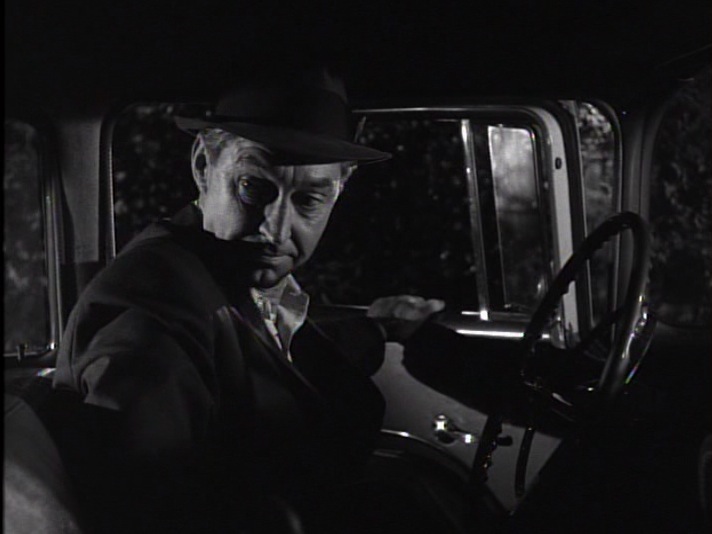
The Incredible Doktor Markesan played by Boris Karloff for one of Thriller’s most memorable episodes of the series!
A sign reads “NO TRESPASSING ~VIOLATORS WILL BE SHOT ON SIGHT~DokTor Konrad Markesan”
The Incredible DokTor Markesan aired Feb 26 1962 perhaps the most creepy of all the Thriller stories, originally appeared in Weird Tales Magazine and was taken from a story written by August Derleth and Mark Schorer, and adapted by Donald S Sanford and directed by Robert Florey. The rotting corpse makeup byJack Barron actually predates Romero’s 1968 Night Of The Living Dead, which I feel only made both effectively more creepy by the B&W film.
Mort Stevens’s score begins as gravely contemplative and daydreamy single notes on the piano beckon us into this episode, then begins the darker, deeper cello strings foreboding and ominous. As the piano resolves into more somber chords, the young Fred Bancroft and his new bride Molly drive up to the entrance of Oakmoor. What has happened to the broad green lawns and the servants in starched white uniforms? They proceed to enter the house, the door having been strangely left unlocked. Seemingly vacant, Oakmoor is crocheted in cobwebs, from years of neglect. There is no electricity. Fred lights a candelabra and the couple continue to search for Fred’s Uncle Konrad. As they start to ascend the staircase, suddenly a door creaks open, the music sways from ominous to severe, and a sallow, blank, expressionless, Konrad Markesan steps out of the shadows. Uncle Konrad stares up at them, ashen, emotionless, his right hand poised in a state of rigor, he stares off, silent. Fred trying to ingratiate himself awkwardly, remains smiling, excruciatingly strained in the midst of his Uncle’s peculiarly inhospitable behavior. Molly acutely more aware of his uncle’s bizarre presence stands there obviously horrified and uncomfortable while Fred still flounders to make a connection with his relative. Molly chirps out a “Hello” and from the moment Fred holds out his hand to shake his Uncle’s, Markesan turns away and says “Come with me” and proceeds to leave the grand hallway.
This little mystery gem Directed by George B. Seitz and based on the play by Bayard Veiller, takes place in Colonial India where the great Dame May Whitty (My Name is Julia Ross 1945, Green Dolphin Street 1947 and Night Must Fall 1937) plays Mme. Rosalie La Grange
a medium who arranges a seance to try and prove her daughter Nell O’Neill’s (Madge Evans)
innocence in a murder investigation. La Grange proceeds to help Inspector Marney (played by Lewis Stone) solve the crime.
The cast also includes Elissa Landi, Henry Daniell, and Charles Trowbridge.
Trivia from IMDb: The play opened on Broadway in New York City, New York, USA on 20 November 1916 and had 328 performances. Margaret Wycherlyplayed the role of Rosalie La Grange, as she also did in the 1929 film version.
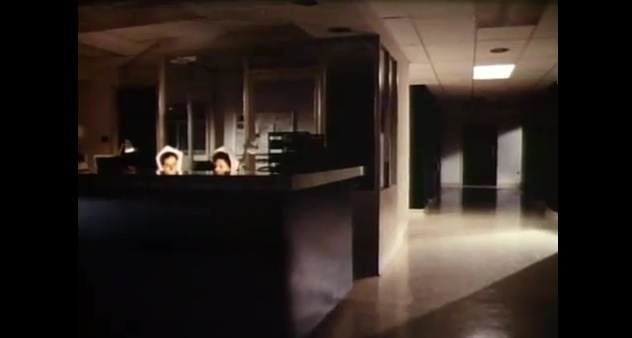
Hoping to cure his violent seizures, a man agrees to a series of experimental microcomputers inserted into his brain but inadvertently discovers that violence now triggers a pleasurable response!
MonsterGirl is on the go! I’ll be back in a few weeks folks! Stay tuned…
I’m about to leave the beautiful coast of Maine and settle in for a while in Caldwell NJ! So MonsterGirl is on the move again, but not silent for long.I’ll be blogging and recording my music soon enough! But while this journey isn’t Wanderlust on my part, it certainly sort of brings out the true gypsy blood in me!!!!
So here’s to Maria Ouspenskaya as Meleva! I don’t have the earrings, but oy do I have the Babooshkas on hand. So hang in there, and I’ll be posting more in the next few weeks, once I get settled into my new digs.
PS: It’s an 110 year old Victorian and I swear it’s haunted!!!! It’ll make for some inspiring posts, I bet!
Maria Ouspenskaya plays Meleva the Gypsy in George Waggner’s 1941 Universal Horror Classic The Wolf Man 1941
Maria Ouspenskaya as Meleva the Gypsy!Jo Gabriel singer/songwriter-gypsy and part time blogger as MonsterGirl
Written by the prolific Curt Siodmak and starring Lon Chaney Jr. as the ill- fated Lawrence Talbot the Wolfman, Claude Raines as Sir John Talbot Sr and Bela Lugosi as Bela the gypsy! Also starring Evelyn Ankers.
Here’s a to howling successful move to N.J friends!-Joey (MonsterGirl)
Release date -Nov. 17, 1961 Episode directed by Anton Leader, written by Rod Serling and starring Lois Nettleton as Norma and Betty Garde as Mrs. Bronson.
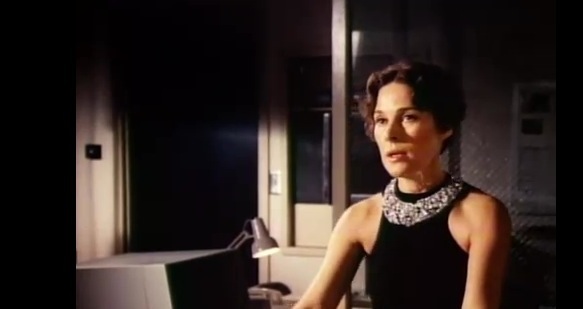
When the Earth falls out of orbit, two women try to cope with increasingly oppressive heat in a nearly abandoned city.
This is a film by writer, and director Ranald MacDougall who wrote screenplays for such films as The Unsuspected 1947, Possessed 1947, Mildred Pierce 1945, and The Naked Jungle 1954.
With writing credits to M.P. Shiel from their novel “The Purple Cloud”, Ferdinand Reyher’s “End of The World” and co-written by MacDougall. Harry Belafonteis an uncredited producer of the film.
With an incredibly evocative score by Miklós Rózsa (Spellbound 1944, Double Indemnity 1945) and a Noirish framework by cinematography Harold Marzorati, it’s an edgy adventure for Noir and Sci-fi fans alike.
This could be considered a Socio-Noir experience, as it deals at times frankly with the issue of race and gender, while not as critically as it might be dealt with today, for its time, it approaches the subject matter with a narrative that starts the conversation.
Filmed with gritty realism, set in an urban milieu with characters who are flawed and in conflict with each other and their surroundings.
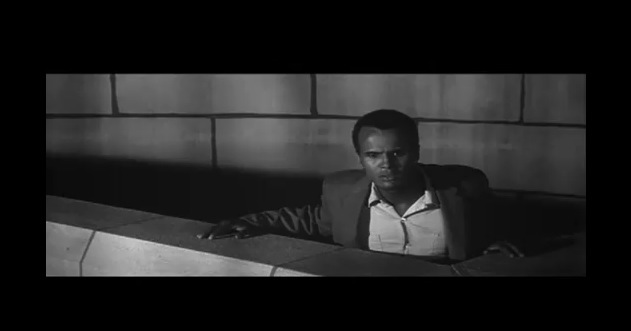
Harry Belafonte plays Ralph Burton a miner trapped under the city for several days as a result of a cave-in. After days of isolation and deprivation, he manages to dig himself out of his underground grave.
Soon after he discovers that the entire population of Earth has been destroyed by nuclear holocaust.
He ventures to New York City and stumbles upon a once thriving metropolis that is now a desolate urbane wasteland, not unlike the landscape that Charlton Heston’s Neville faced in post-apocalyptic L.A.
Much like Neville, Ralph sets up a home for himself but is suddenly thrown into flux by the discovery of Inger Stevens as Sarah Crandall, the last surviving female on Earth.
The World, The Flesh and The Devil is an allegorical journey about desolation, survival, human nature, sacrifice, and the evolution of men and women trying to define themselves.
Thrown into the mix of this newly formed friendship between the only living black man and white woman, intrudes a third character Mel Ferrerwho plays Benson Thacker a white entitled privileged male who has somehow navigated a small boat into the NYC harbor.
The triangle is formed and the tensions play out in a script that might have been penned by Rod Serling, who often took on the issue of race, class, and at times, but less so, gender with his thoughtful philosophical Sci-fi television show The Twilight Zone.
The two men struggle over who will be the dominant male suitor… who will take ownership of Sarah as if she weren’t already the last female on earth, her sexuality becomes amplified, her body thus systematically objectified to the nth degree, and does she even have a say in choosing neither of the men at all…white or black!
Try and catch this lesser-known post-apocalyptic tale filmed way back in the late 50s!
“The only problem we have is that there are two of us and only one of her!”“Why don’t you toss a coin!”
“This is New York, as no man has ever seen it. Empty, deserted, it’s teaming millions gone…! This is the setting for the most unusual picture ever filmed. The most daring idea or attempted in motion picture entertainment. The last three people alone in the world. What are the emotions of this girl? Facing a future that no woman before her has ever known. What of the man torn by basic human emotion as they stand on the brink of the unknown? Here is the film that crashes through time and the future. It may stun you, and shock you, but above all, it will grip your imagination as no film has ever done!”
“What would you do if you were one of the last three people on earth!”
An underrated episode of Boris Karloff’sThriller in brief! even for me, that is…
The Storm -Release date Jan. 22nd, 1962
Directed by Herschel Daugherty adapted for television by writer William D. Gordon from a short story by crime novelist MacIntoch Malmar. Which was later adapted for television, again directed by Hershel Daugherty in an updated film called The Victim 1972Â starring the wonderful Elizabeth Montgomery and the always acerbic Eileen Heckart.
Starring Nancy Kelly as Janet Willsom (The Bad Seed 1956) The classic American horror-thriller film directed by Mervyn LeRoy won Kelly an Oscar for Best Actress that year as psychotic Rhoda Penmark’s (Patty McCormack) mother, Christine Penmark.
Walter Kerr of the New York Herald Tribune wrote of her "Tony Award-winning stage performance:
“Though Miss Kelly has done attractive work on Broadway before, she has never really prepared us for the brilliance of the present portrait” (Walter Kerr-New York Times, January 14, 1995).
The evil Rhoda strokes her mother. Scarier than clowns….!
The Storm also stars James Griffith as Ed Brandies the quirky lecherous and intrusive cab driver. David McLean as Ben T. Willsom and Jean Carroll as the voice of phone operator Drucie. Not to be forgotten, the beautifully sleek and ever-present Baba the black cat and real star of this episode…
Nancy Kelly plays Janet Willsom, a woman besieged by noises and bad weather, while isolated in her home, waiting for her husband Ben to arrive home in during a raging storm. Kept alerted and accompanied by her faithful black cat Baba, Janet must first fend off the nauseating advances of the cabbie who brings her home and wants to practically move in on her, while her husband is away on business.
When I originally posted this feature I had made a reference to Hitchcock in the post concerning the body of the dead girl in the trunk. The focus is on her lifeless finger, with the large diamond ring dangling as limp as a soggy carrot.
The Storm, in general, contains striking elements of a good old-fashioned Hitchcock thriller! As well as the framing of one hell of a good stage play!
I hadn’t been asked to join in the BEST HITCHCOCK MOVIE (THAT HITCHCOCK NEVER MADE)Â yet. So here it is once again, with a few little tidbits thrown in so that it can take its place in the wonderful blogathon that’s going on between July 7 -July 13!
Nancy Kelly- strong actress, beautiful, never got to play a Hitchcock heroine!
The use of a strong woman, alone in a situation where there is a person unknown stalking her. Plenty of red herrings thrown in to divert our attention, and one hell of a dead body stuffed in a trunk, that we the audience are privy to, but not the feature’s protagonist, Janet Willsom.
Janet Willsom, finds herself in the midst of one single night’s journey of survival, trying to stay one step ahead of a murderer and also delay an uncomfortable bit of evidence, that could turn her entire world upside down.
From its small taut moments of built-in suspense, until the eventual climax, ‘The Storm’ plays out truly like any good Hitchcock ‘Woman in Peril’ such as Dial M For Murder 1954 Starring Grace Kelly and Ray Milland.
Grace Kelly – The Strong Hitchcock blond-beautiful!
The episode opens with a mysterious pair of man’s trousers assailing a beautiful blonde in the midst of the rainstorm. She is strangled and stuffed in a trunk in the cellar, as we are strategically shown the emphasis on a shiny diamond ring on her lifeless finger sticking out of the trunk. A very Hitchockian moment…
Is Janet now being stalked by the same mad killer? What’s behind every noise and flash of light and sweep of shadow?
I love this episode because it creates a perfectly creepy environment of isolation. Very much lit as a faithful crime drama Film Noir, the shear simplicity of each moment, each little task Janet undergoes to create normalcy and safety in her surroundings, what would usually be merely ordinary banal gestures become tautly drawn-out maneuvers in a darkly ominous, tweaked and dangerous landscape.
Invoking more of a sense of terror because of its bared-down realism, than a manufactured horror. As suggested by David Schow‘s wonderful commentary of this episode on the recently released DVD box set, the atmosphere of the isolated ‘woman in peril‘ who must fend off whatever is lurking, reminds us of Audrey Hepburn in Wait Until Dark 1967
This is also a faithful psychological Film Noir piece, utilizing the very best in Nancy Kelly as the dame in danger and James Griffith as the lasciviously intrusive cab driver Ed whose quirky character is either a raving maniac or just a red herring to throw us off the scent of the true murderer.
Versatile actor of film and stage Stacy Keach plays the poetic everyman Pat Quid who is driving a semi across Australia carting a truckload of meat, pig carcasses specifically, due to the high demand as there is a meat strike going on. As in any good traveler mystery, he encounters a variety of odd characters who periodically pop up time and again, as if they are all trapped in some kind of desert purgatory.
Along the way, there are also the occasional hitchhikers who are traveling on the same highway. Pat and his trusted companion Boswell, a dingo, like to occupy his time playing word games to make the journey more stimulating.
He likes to imagine the identities of other people on the road, guessing what they do for a living.
Stopping over to sleep at a motel one night, he loses his room to a mysterious guy in a dark green van who has picked up a foxy young hitchhiker. A girl Quid had decided to pass up along the way, as it is not his practice to pick up hitchhikers because it is against regulations.
That night he sleeps in the back of his cab but is aroused at 4 am by the garbage trucks who have come to pick up the motel trash. Boswell is sniffing around the plastic rubbish bags, chewing at whatever smells tempting on the inside.
Strangely up too, is the guy from the dark green van, who is watching out the window to see that the collectors are picking up the garbage.
The night before, we witness him murdering the young girl passenger that he brings to the motel. Most likely he has disposed of her body in the bags set out on the curb.
After seeing Green Van Man on the road, burying another garbage bag, and once Quid sees a cooler or ‘lunch box’ on the guys front seat, which is big enough to hold a human head, Quid puts a few things together and decides that this guy is probably the serial killer that the news has been talking about.
Jamie Lee Curtis plays Pamela ‘Hitch’ Rushworth a hitchhiker Quid finally picks up after the third time seeing her on the side of the same road.’Third time lucky!’
The two form an amateur detective team, playing cat and mouse with the elusive Green Van Man as they begin to try and track the serial killer on their own. The chemistry between the two does not have the hallmark romanticism of a typically immortal Hitchcock pairing, Keach and Curtis are more working-class guts and grit and less polish and panache.
But in Quid’s pursuit of the Green Van Man, it brings him to the attention of the police, who then suspect him of being the killer. Throughout the film, Quid plays the alienated nice guy, who is misunderstood, and under suspicion.
Directed by Richard Franklin(Patrick 1978, Psycho II 1983)Based on an original story by Richard Franklin and adapted for the screen by Everett De Roche. Also starring Marion Edward as Madeleine ‘Frita’ Day and Grant Pageas Smith or Jones the Green Van killer.
Not least of which are the few obvious touts to Hitch himself: The casting of Janet Leigh’s (1960 Psycho’s Marion Crane) daughter with actor Tony Curtis, the wonderfully androgynous Jamie Lee Curtis.
Curtis’s character Pamela has a nickname in the film which is ‘Hitch’ and Franklin actually directed Psycho II in 1983 which starred Anthony Perkins revisiting his iconic role as Norman Bates. Franklin obviously had an appreciation for the story and Hitchcock’s contribution to the mystery/suspense genre.
At one point in the film, Pamela in the back of Quid’s cab picks up a vintage Alfred Hitchcock Mystery Magazine from the 60s.
The more significant allusions that can be drawn from the film are Keach’s role as Patrick Anthony Quid, using a Hitchcockian formula, ‘The Wrong Man.’
The police not only suspect him of the murders, but Quid becomes alienated by the rest of the hostile players in the film, even going as far as being set up by the real killer, not unlike Hitchcock’s later and quite starkly disturbing Frenzy 1972.
Starring Barry Fosteras the criminally insane misogynist Robert Rusk, the necktie killer who rapes and strangles his female victims in what I feel Hitchcock lensed with an utter brutal realism that stays with you.
In Frenzy it is Jon Finchwho plays Richard Ian Blaney the misunderstood working-class man who is falsely blamed for a series of murdered women. Blaney also becomes set up as a patsy by the killer, like Quid for the murders.
Unlike Frenzy’s lustful sex maniac who we get to see up close and personal, remember the hideous line… ‘lovely.’
Green Van Man maintains anonymity, a distance from us and the camera, so the intimacy of the plot is stifled and a line is drawn in the sand as far as understanding the killer’s identity any closer than his gloves, his guitar wire, and the dark green van.Which might be the point. Although, Robert Rusk was a fertile character that repulsed yet fascinates.
Barry Foster plays the misogynist sex murderer, Robert Rusk… a necktie strangler! in Alfred Hitchcock’sFRENZY 1972
Missing is the profoundly evocative score from Bernard Herrmann. Road Games doesn’t utilize music as much to underscore its narrative. Although it’s sound editing is very key in various spots of the film to accentuate the sense of alienation that is pervasive in the film. Where Herrmann’s romantic scoring might guide the viewer along the way to either an empathetic moment or a suspenseful point in a film, the use of sound in Road Games is incorporated in a much more holistic way. And the film starts out quietly, bleakly, allowing Keach’s Pat Quid to stretch his characterization of a solitary man on a journey.
Another interesting motif of the film that utilizes some of the traditional stylizations of a Hitchcock film is the use of The MacGuffin– The cooler or ‘lunch box’ that is frequently shown framed in one scene or another which is the possession of the Green Van Man, might or might not hold something of interest or relevance or could just be a big red herring. We wonder as does Quid, whether it holds the severed head of the foxy hitchhiker we see being murdered in the beginning of the film.
I found it interesting that our first awareness of the murders takes place in a motel, not unlike 1960s Psycho.
Also of interesting note is the use of the ‘Open Road’, expansive at times indicative of alienation and desolation, lending to ‘the traveler’ theme. Like Tippi Hedren in The Birds 1963.
I’m also reminded of the cinematic open landscapes as seen in North by Northwest 1959, with its desert environment. While not a single-engine plane as the nefarious mode of transportation in pursuit, Quid is often swallowed up by the vast Australian expanse, being taunted by a maniac in a dark green van that is playing cat and mouse with the protagonist!
Cary Grant is on the run and swallowed up whole by the vastly open landscape in Hitchcock’s North By Northwest 1959.
And again with the character of Marion Crane (Janet Leigh) traveling from Arizona attempting to escape the mundane ticking of her working-class existence. Running away after having stolen a large sum of money from one of the Bank’s clients. Hoping to be together with her lover Sam Loomis ( John Gavin.)Unfortunately stumbling onto yet another desolate hostile environment that is hidden underneath quiet American family values and a nice mama’s boy named Norman Bates.
Janet Leigh is Marion Crane on the run in Hitchcock’s benchmark thriller Psycho 1960
Hitchcock often used actors who could be perceived as an ‘everyman’ Quid reiterates this line several times in the film, “Just because I drive a truck doesn’t mean I”m a truck driver.” He’s fair and ethical and is just looking to do his job, but won’t be defined by anyone else’s standards.
The Lighting has the certain feel of a Hitchcock thriller, the Neo-Noirish ambient colors, highlighting only the ‘object’ the director wants us to see, with everything else framed within shadow. The obscuring of a purposefully arranged set with an emphasis on the specific players being lit in close up. And colors used specifically to accentuate a mood. The use of color in Road Games helps develop the feeling of a surreal type of desolation.
Right from the beginning of the film, Quid the protagonist, starts out in conflict with this mysterious stranger in the dark green van. The game of cat and mouse begins.
Oh… a neon Motel sign. Not quite the Bates Motel, but it will serve its purpose for Mr Smith or Jones, the Green Van Man.The mysterious young female hitch-hiker, standing in our view.
The killer Mr Smith or Jones checking into the motel.
“First he steals my girl and then he steals my bed"¦ ”
“I hope she steals his wallet. I bet she doesn’t even wait to take her socks off.
You’ll read some of the best writing and insight into some extraordinary films, lensed by various bloggers who have gathered together to honor one of the greatest film makers, Alfred Hitchcock.
Putting a spin on the director and focusing on films that while Hitch did not direct, the feel and flavor of his highly stylized work comes through as either artful homage or unspoken symbiosis.
I’ll be chiming in on July 11th with my take on 1981 Road Games starring Stacy Keach and Jamie Lee Curtis, as well as re-reviewing an earlier Boris Karloff’s Thriller episode called The Storm. So here’s to that silly man with the inimitable voice and droll sense of humor, dark and ironic and filled with morbid joyfulness!
A special belated Happy Birthday to Hitch’s daughter Patricia who celebrated her 84th on the 7th of this month!