Quote of the Day! Holiday Affair (1949)

HOLIDAY AFFAIR (1949)

Connie“It’s an awfully little train to carry enough dynamite to change a person’s life.”

Carl ” Anything can change a life that’s ready to be changed.”

Holiday Affair is a delightful romantic comedy with great dialogue and more than just a few humorous scenes to make you feel good this holiday season. directed by Don Hartman, with a screenplay by Isobel Lennert based on the story Christmas Gift by John D. Weaver.

It’s a few days before Christmas. Janet Leigh plays Connie Ennis, a secret shopper who gets the philosophical and straight-talking Steve Mason (Robert Mitchum) fired when he neglects to turn her in after she tries to return the train set she purchases for her employer. Connie is a single mom, who is raising a wonderful little boy named Timmy (Gordon Gebert) but living in the shadows of her dead husband who was killed in the war. She is being romanced by Carl Davis (Wendell Corey) but once Steve enters Connie’s life, her whole world is thrown upside down.

This is your EverLovin Joey wishing you a wonderful Holiday Affair!

What A Character! Blogathon 2019 Thelma Ritter “Always a bridesmaid and never the bride”

It’s here again, my favorite blogathon that honors those unsung actors we love to see inhabit films and most often enhance them immeasurably!

I want to thank Paula’s Cinema Club, Once Upon A Screen… and Outspoken & Freckled for hosting this important event that brings to light those essential personalities that populate memorable films and television programs with their own rare brilliance. This year I am honoring the great Thelma Ritter!

With her warm and weather-worn face, Thelma Ritter is the quintessential expression of a working-class dame, the working-class mother, the everywoman. And no one can deliver a snappy quip quite like Thelma Ritter. Between her mournful tones of better days or raising a stink about this or that, you can almost see the cleaning rag over her simple brown hairdo hanging out the window in Brooklyn just chatting it up with the neighbors. Thelma Ritter, with hands-on hip, spouts barbs, and verbal gems from an endless fountain of everyday wisdom.

And I want to make this clear from the start, Thelma is no plain, dowdy, or shabby spinster, she’s a beautiful woman. So there’ll be no agism or misogynistic observations in this tribute.

"Usually looking like a cross between Mother Courage and a cafeteria lunch lady, [Mankiewicz], who would repeatedly explore the theme of the effects of ambition on his characters, was blessed with Ritter"˜s presence in allegedly subservient roles as truth-tellers disguised as maids in"¦ All About Eve (1950)." "”Moira Finnie Streamline, The Filmstruck Blog

Thelma Ritter's legacy is that of the wise-cracking and world-weary characters who inform us in any role that she is just a regular gal like you or me. We feel empathy for her, and we laugh along with the sharp-witted come backs she so famously utters. Whenever she shows up on the screen she enlivens whatever plot she was sent out to explore with that cynical and bold approach to life offering that dialogue that had razor-sharp teeth.

Ritter was one hell of a character actor/comedian who worked on the radio and then quickly established herself in top-billed supporting roles in post-war Hollywood. She was nominated 6 times without winning a single Oscar between 1950-1962. She tied with Deborah Kerr for the most nominated without winning the award. It is a crime that she never won a statue or a star on the Hollywood Walk of Fame.

As writer Paddy Chayefsky wrote in his New York Times tribute for her death: “She was never properly publicly recognized as an actress. ["¦] She was a character actress, which means only that they don't write any starring parts for middle-aged women."

Frank Capra called her "the best of all character actresses."

Even in her performances of the most plain of women, she exuded sophistication, often classier than the upper-class people that satellite around her. She often played characters who had the answers and the gumption to say it like it is, the truth that circulates through each story, driving sanity, stability, clarity, and compassion into the narrative.

None of her roles could ever be considered ordinary. Her characters always exuded her own brand of humanity. The people she played were immediately relatable to all of us.

Thelma Ritter was born in Brooklyn New York in 1902 on St Valentine's Day on Hart Street in South Brooklyn. Born of a Dutch immigrant father and a Scottish mother. Thelma would have to rely on her wits as the family was not of an advantaged background. Maybe that's why she has a keen witty charm, a lovable persona, and a certain pluckiness and curt wisdom that doesn't allow for quick comebacks by the other actors. Though cast as a supporting actress, her name always appears on the bill or right up in the title close to the stars often being the more memorable in the picture. She brought cracking wise to a whole other level of artistry.

She attended the Academy of Dramatic Arts, the class of 1922, but did not graduate with her class as she had to quit to earn money. She made her Broadway debut in a comedy called The Shelf, costarring with other notable character actors Jessie Ralph, Lee Patrick, and Donald Meek. She appeared in 32 performances before the show closed in 1926. Then she was in Times Square (1931) which didn't have a very long run on Broadway. She took some time off to raise her children and then went back to work initially in radio. Her daughter Monica Moran is an actress, they appeared together in the 1966 road company of Bye Bye Birdie co-starring Tab Hunter.

Thelma Ritter was actually 41 at the time of her wonderful film debut as the uncredited harried Christmas shopping mother in Miracle on 34th Street (1947). Ritter left such an impression on director George Seaton and 20th Century Fox head Darryl F. Zanuck that they lengthened her small part in the film and decided to cast her in other pictures. This sparked a career where she wouldn't make a multitude of films, but a film a year from 1947 until her retirement in 1969. The films she did appear in were extremely popular and received well by the critics.

Ritter's uncredited role of Captain's secretary in Call Northside 777 (1948) was left on the cutting room floor. The credits were left in, but she is nowhere to be seen in the film. Though again uncredited she appeared as the sharp-tongued maid Sadie Dugan in director Joseph L. Mankiewicz's 1949 melodrama A Letter to Three Wives starring Jeanne Crain, Linda Darnell, and Ann Southern.

In A Letter to Three Wives, Thelma Ritter plays the maid Sadie Dugan who works for an upper middle-class couple George (Kirk Douglas) and Rita Phipps (Ann Sothern). Kirk Douglas plays an English teacher and his wife Rita is a writer for a radio soap opera, played by Ann Sothern. Sadie ingratiates herself into the family feeling right at home telling Rita "The cap's out. Makes me look like a lamb shop with pants on" when Rita asks her to wear a frilly hat while serving dinner to important guests. Ritter has wonderful lines that she expresses with ease. The writing was handpicked for her brand of comedy that cuts through the melodrama of the film. While describing her disdain for Rita's radio program she comments, "Do you know what I like about your program? Even when I'm running the vacuum, I can understand it."

Ritter's first major role as a lady's companion was Birdie Coonan in All About Eve (1950). Director Joseph L. Mankiewicz was so taken with Ritter’s style, that she was the first choice to play Birdie, the edgy ex-vaudevillian maid to theater Diva Margot Channing (Bette Davis in her Oscar-nominated role). He claimed he wrote the screenplay with Thelma Ritter in mind. Aside from Addison Dewitt (George Sanders), Birdie is the only one who isn't fooled by Eve (Ann Baxter). Ritter's character has a keen understanding of the realities of life and is honest and gruff with the waif-like manipulative and ambitious Eve. Her role was so impressive that she received her first of six nominations for the Academy Award for Best Supporting Actress.

When Eve first recounts her sad background to Margot, Birdies reacts with the infamous line "What a story! Everything but the bloodhounds snapping at her rear end." The original line used was "˜ass' instead of "˜rear end.' But Joseph Breen's office was clamping down on "morals" and found the original word too vulgar.

All through the film All About Eve, Birdie tries to inform Margot of Eve's duplicitous nature, while everyone else is also taken in by the "˜kid'. Margot asks, "Birdie, you don't like Eve, do you? Birdie answers, "You looking for an answer or an argument?" Margo, "An answer." Birdie, "No." Margo, "Why not?" Birdie, "Now you want an argument."

Thelma Ritter's most significant trademark is her sassy streetwise meddling, to offer her wisdom and advice even when not being asked for it. After All About Eve, she would be cast in strong supporting roles for the rest of her career.

The next year she would once again be nominated for the wonderful picture directed by underrated directed Mitchell Leisen’s The Mating Season (1951) co-starring Gene Tierney, followed by With a Song in My Heart (1952), Pickup on South Street (1953) as Moe Williams (A film she should have won the Oscar for her outstanding performance) then came Pillow Talk in 1959 and Birdman of Alcatraz (1962).

John Lund and Thelma Ritter in a scene from the film ‘The Mating Season’, 1951. (Photo by Paramount Pictures/Getty Images)

While most older female character actresses go loveless in their films, Thelma Ritter is one who manages to not always fly solo in the storylines. She often gets to have a love interest. The Mating Season (1951) directed by M. Leisen, is a satirical look on class culture, and a hilarious story of mistaken identity. Thelma as Ellen McNulty runs a small hamburger joint in Jersey and when the bank forecloses she goes to Ohio to be with her son Val (John Lund), who has just married socialite Maggie (Gene Tierney). Maggie is not a snob, but Ritter's son is embarrassed by his humble background. Miriam Hopkins plays Tierney's mother and former ambassador's wife and pretentious elitist, Fran Carleton.

Robert Osborne called The Mating Season a delightful romantic comedy that most people don't know about. The film brought Thelma at age 48 "the closest to inheriting the mantle of the great Marie Dressler than anyone in Hollywood since Dressler's death in 1934."

Ellen secretly works to make enough money to buy an $18 hat to wear when she meets her daughter-in-law. The way Thelma Ritter uses the hat as a prop in the storyline adds an endearing touch to the film. Thelma drops in unexpectedly to meet her new daughter-in-law and is mistaken for a domestic that the new bride has hired to cook and serve at her dinner party. Her son's boss, Mr Kalinger (Larry Keating) falls for Ellen after she rubs liniment on his chest while he is sick. She finds out he's much like her dead husband"” the kind of guy stray dogs take to.

Ellen –"If you’re a chicken, you can fool people about your feathers. But when you start laying eggs all over the place, they know you’re a chicken."

Ellen: “You don’t know what it was like working with her yesterday. I felt like I was 21 again.”
Val: “Oh Malarky”
Ellen: “Look wiseguy, I didn’t feel like I was 21 when I was 21.”

"Despite the fact that she usually played variations of a Shakespearean "wise fool", she often played a person whose keen awareness of her place in our supposedly classless society made her secure enough in it to voice her opinions without fear.” -Moira Finnie

Ritter finally receives above-the-title star billing in George Cukor's delightful romantic comedy starring Jeanne Crain and Scott Brady, The Model and the Marriage Broker (1951) Another highly underrated picture. Director Cukor adds a sensitive touch to this endearing film creating a world with plenty of witty dialogue and quirky characters. The cast is filled with lonely-hearted misfits including Nancy Kulp, Zero Mostel, and Dennie Moore. Ritter plays good-hearted, wryly-witted yet sympathetic matchmaker Mae Swasey who just doesn't want anyone to be alone after her own husband had left her for another woman years before. Mae goes on a mission of mischief to fix up Matt Hornbeck (Brady) with model Kitty Bennett (Jeanne Crain) though Hornbeck initially puts up a good fight saying he has no intention of getting married… that is until he meets Kitty.

Mae to Mr. Wixted (Zero Mostel) about planning a date with Nancy Kulp, "A real live wire, low voltage but steady.”

THE MODEL AND THE MARRIAGE BROKER [US 1951] SCOTT BRADY, JEANNE CRAIN, THELMA RITTER Date: 1951

"Anybody with four pints of blood that can stand on their two feet long enough to say I do is in a position to get married."-Mae

Dan Chancellor (Jay C. Flippen) "Beautiful up here, isn’t it? Those trees. I’ve always liked that poem that said, “Only God can make a tree.”

Mae Swasey, "Yeah, but on the other hand, you gotta figure, who else would take the time?"

As Young as You Feel (1952) Monty Wooley, Allyn Joslyn, and Thelma Ritter

Following the romantic comedies Ritter appears in one of the most extraordinary and evocative noir masterpieces by director Samuel Fuller, Pickup on South Street (1953).

In Pickup on South Street 1953 directed by Samuel Fuller, Ritter plays Moe Williams the best pickpocket stoolie in the business. A police informant who sells neckties on the street corners and wants a fancy funeral and a nice plot out on Long Island. Robert Osborne couldn't have stated it better, "Moe Williams lives in the underworld and ekes out a living by selling secrets and information for a price. It's a far cry from the kind of roles Thelma usually plays. More sinister than lovable."

Moe is streetwise and world-weary. She's broken down by her years getting by on the rough streets of New York City selling ties and secrets to the police. She also cares about what happens to Skip McCoy (Richard Widmark) one of the local petty thieves who picks pockets and chills his beer in the river.

Jean Peters is fantastic in the role of Candy, and Thelma Ritter in Pickup on South Street.

As Moe Williams In Pickup on South Street (1953), Ritter inhabits a darker world than we're used to seeing her in. Worn down by life on the street as a tie hustler and informant to the law, her weakness for telling the truth puts her in harm’s way. It's one of the most gloomy and heart-rending roles in any of her films as it takes a hardened dismal look at crime, postwar greed, and the fear of Communist infiltration. Throughout the picture Moe is fatalistic about her future. She is a character we feel empathy for, and I think it's one of Ritter's finest performances.

In a heartbreaking tour de force Ritter gives a performance that should have garnered her the Academy Award for Best Supporting Actress. Director Sam Fuller created a role just typed for Ritter's blood, as she poured every ounce of her soul into the character that'll make you hold your breath, then weep.

She appeared in the 1953 version of Titanic with Barbara Stanwyck. She plays affluent Maude Young who once again, is mistaken for a domestic, with some of the best lines in the picture added for comic relief.

Maude Young: [after Richard (Clifton Webb) has rejected his son Norman and refused to play in the shuffleboard match with him] "It certainly clouded up. Well, word’ll do it faster than a hickory stick any time."

Maude Young: “Where I come from this is either a revival meeting or a crap game.”

Maude Young: “I’ve seen that look before. He’s a runaway. Earl Meeker: From what, some woman?Maude: No, he’s running too fast for that.”

Ritter made several significant appearances on the small screen between 1953 and 1962. In 1955 she played Mrs. Fisher in The Show-off, and Agnes Hurley in Paddy Chayefsky's The Catered Affair (Bette Davis played Agnes Hurley in the film version a year later). Playwright Paddy Chayefsky was so taken with Thelma Ritter that he wrote about the 1955 television play, "The Catered Affair was an unfocused piece in which the first act was farce and the second was character comedy, and the third was abruptly drama. There aren't a dozen actresses who could make one piece out of all that; Miss Ritter, of course, did."

The Farmer Takes a Wife 1954 as Lucy Cashdollar plays Betty Grable's friend on the Eerie Canal Lucy Cashdollar- "Don’t forget, I’m a five-time widow, and when they died they all left me everything they owned. Rest their souls." Fortune Friendly "What do you want with me I'm broke?" Lucy Cashdollar-"Well, I figure after five rich husbands, the next one would be on the house."

Also in 1955, Thelma Ritter played Abby in 20th Century-Fox Hour's television adaptation of Sidney Howard's play, Christopher Bean. Thelma is often compared to the great Marie Dressler, who played the same role in the 1933 film Christopher Bean. Thelma Ritter takes on the ironic and poignant role of a woman whose worth is seen through the eyes of an alcoholic artist who paints a portrait of her.

Ritter finished her 6-year contract with Twentieth Century Fox in 1955, playing Alicia Pritchard in director Jean Negulesco's Daddy Long Legs. Ritter did return in The Second Time Around in 1961.

When explaining why her contract had not been renewed, Ritter joked that “I don't look so good in a toga." Referring to Fox's preference at the time for epics filmed in CinemaScope centered around all things ancient.

Rear Window 1954 Thelma plays the feisty wisecracking nurse, Stella. The scenes with Thelma and Jimmy Stewart were marvelous. Her character's voice delivered both reason and common sense and in their scenes, we learn about Jimmy Stewart's character. Thelma brought her comic flair to the role of Stella. As Pat Hitchcock explained "The humor that Thelma Ritter brought to Rear Window was absolutely wonderful. And my father, he loved that because he knew that you couldn't keep going and keep going. You had to give the audience a break. You had to have them laugh at something. His whole life was about the importance of having a sense of humor with whatever you do."

Deborah Kerr rides in a jeep with Thelma Ritter in a scene from the film ‘The Proud And Profane’, 1956. (Photo by Paramount/Getty Images)

After twenty-six years away, Thelma returned to Broadway in 1957 to play Marthy in the hit musical New Girl in Town, based on Eugene O'Neill's play Anna Christie. For her part, she won a Tony Award (in a tie with Gwen Verdon who won for Anna). This was the first time in history that two actresses won from the same show.

Cameron Pru'Homme, Thelma Ritter, and Gwen Verdon –On the set of New Girl In Town.

American actors Thelma Ritter (1905 – 1969) and Cameron Prud’homme (1892 – 1967) in a performance of the Bob Merrill play, ‘New Girl in Town’ at the 46th Street Theatre, New York, New York, mid-1957. (Photo by Gjon Mili/The LIFE Picture Collection via Getty Images)

At the Tony Awards with Robert Preston Thelma Ritter Helen Hayes Ralph Bellamy.

She went on to appear in the hit romantic comedy Pillow Talk (1959). She played the supportive lead with Doris Day and Rock Hudson, exchanging her usual barbs this time with Doris Day about her love life. "If there's anything worse than a woman living alone it’s a woman saying she likes it."

She continued to act in successful roles in the 1960s in films like John Huston's The Misfits in 1961 (playing Isabelle Steers, co-starring Marilyn Monroe, Clark Gable, Montgomery Clift, and Eli Wallach). Then, in How the West Was Won in 1962, and then she was once again paired with Doris Day and James Garner in Move Over, Darling in 1963.

Ritter also appeared on television shows like General Electric Theater in 1960 and the popular Westerner Wagon Train in 1962. She appeared in Alfred Hitchcock Presents in a very chilling, nail-biting episode called The Baby Sitter.

In director John Frankenheimer's Birdman of Alcatraz (1963) Thelma Ritter delivers quite a drastic departure from any of her other roles. She portrays the numb and obsessive mother, loyal to her son Robert Stroud (Burt Lancaster) in one of his most lucid performances. The movie creates a claustrophobic relationship between mother and son, as she is stricken with a myopic vision of championing for him while he is locked away in prison. Axel Nissen calls it "one of the most emotionally ugly characters in her filmography she is cold and uses stillness brilliantly."

Ritter received her last Oscar nomination for her performance as Burt Lancaster's controlling mother. She lost to Patty Duke for The Miracle Worker.

In 1963 she was in A New Kind of Love (1963) starring Paul Newman and Joanne Woodward. Ritter plays Leena, who wears a perfume called "My Sin" and is a buyer at Bergner's Department Store. Leena is attracted to her boss, George Tobias.

She also appeared in the disastrous Broadway production of UTBU 1966 with Margaret Hamilton and Tony Randall.

Coming full circle, Ritter made her last big screen appearance in a small role in George Seaton's What's So Bad About Feeling Good? 1968 In Feb 1968 she co-starred with Tab Hunter and her own actress daughter Monica in a stock production of Neil Simon's Barefoot in the Park at the Papermill Playhouse in New Jersey, before retiring. She did not live long enough to enjoy her retirement.

Thelma died of a heart attack in New York City just nine days before her 67th birthday. Thelma Ritter was very beloved amongst her colleagues and co-stars, and also critics adored her.

"On screen, Ritter projected a wonderfully sanguine and calm acceptance of human frailty and need. It is this quality, combined with her rueful humor and notorious wisecracks, that give depth to her finest performances"¦{"¦} Though she played a few middle-or upper-class women towards the end of her career, Ritter was obviously best suited to playing women on the lower echelons of the social ladder"¦{"¦} She represents the legion of women who keep the wheels of the world turning"– Alex Nissen

CLIPS

Miracle on 34th Street (1949) Peter's mother

A Letter to Three Wives (1949) Sadie Dugan the maid uncredited

City Across the River (1950) Mrs. Katie Cusack

Perfect Strangers (1950) Lena Fassier

All About Eve 1951

I'll Get By 1951 Miss Murphy

The Mating Season 1951

The Model and the Marriage Broker 1951 as Mae Swayse

As Young as You feel 1952 as Della Hodges

Titanic 1953

Pickup on South Street 1954

The Farmer Takes a Wife 1954 as Lucy Cashdollar

Rear Window 1955 as Stella

Daddy Long Legs 1955

Alfred Hitchcock Presents 1956 The Baby Sitter Lottie Slocum

The Proud and Profane 1956 as Kate Connors

A Hole in the Head 1959 as Sophie Manetta

Pillow Talk 1959 as Alma

The Misfits 1961

Birdman of Alcatraz 1962 as Elizabeth Stroud

Move Over, Darling 1963

The Incident 1967 as Bertha Beckerman

FILMOGRAPHY & AWARDS

Thelma Ritter won a Tony Award on Broadway in 1957 for the hit musical New Girl in Town, for which she won a Tony in a tie with Gwen Verdon in 1958. She won an Emmy (in 1956), Nominated for Best Actress in a Supporting Role for the Goodyear Television Playhouse production of The Catered Affair. A Golden Globe Awards Nominated for Best Supporting Actress for All About Eve (1950) The Mating Season (1951)) With A Song in My Heart (1952), Pickup on South Street (1953), Pillow Talk (1959), and Birdman of Alcatraz (1962) and nominated for a Golden Globe for All About Eve, The Mating Season and Boeing Boeing (1965)

  • Miracle on 34th Street (1949) Peter's mother
  • A Letter to Three Wives (1949) Sadie Dugan the maid uncredited
  • Call Northside 777 (1949) captains secretary uncredited her scene was left on the cutting room floor
  • City Across the River (1950) Mrs. Katie Cusack
  • Perfect Strangers (1950) Lena Fassier
  • Too Dangerous to Love 1951
  • All About Eve 1951 as Birdie Coonan "”companion to theater Diva Margot Channing the only character aside from George Sanders' Addison Dewitt who isn't fooled by conniving Eve.
  • I'll Get By 1951 as Miss Murphy
  • The Mating Season 1951 as Ellen McNulty
  • The Model and the Marriage Broker 1951 as Mae Swayze
  • As Young as You feel 1952 as Della Hodges
  • Radio Broadcasts 1953 Theater Guild on the Air "A Square Peg"
  • With a Song in my Heart 1953 as Clancy
  • radio shows such as Radio Broadcasts Theater Guild on the Air "A Square Peg" (1953).
  • Titanic 1953 as Maude Young playing a version of the Unsinkable Molly Brown done up to the nines again mistaken for a housekeeper or maid.
  • Pickup on South Street 1954 directed by Samuel Fuller as Moe Williams the best pick pocket stoolie in the business
  • The Farmer Takes a Wife 1954 as Lucy Cashdollar plays Betty Grable's friend on the Eerie Canal
  • Rear Window 1955 as nurse Stella
  • Lux Video Theatre 1954 Christmas in July theatre guest
  • The Best of Broadway The Show Off 1955 Mrs. Fisher
  • Daddy Long Legs 1955 as Alicia Pritchard
  • Goodyear Playhouse 1955 The Catered Affair as Mother created the role that Bette Davis adapted to the screen.
  • Repertory Theatre 1955 The Ghost Writer as Muriel
  • Lucy Gallant 1955 as Molly Basserman
  • The 20th Century Fox Hour 1955 “Christopher Bean” as Abby
  • Alfred Hitchcock Presents 1956 The Baby Sitter Lottie Slocum
  • The Proud and Profane 1956 as Kate Connors
  • New Girl in Town (1957) on Broadway
  • The United States Steel Hour 1957 The Human Pattern as Ma Garfield
  • Telephone Time 1957 plot to save a boy as Mary Devlin
  • A Hole in the Head 1959 as Sophie Manetta
  • Pillow Talk 1959 as Alma plays her housekeeper who likes to drink she's hilarious
  • General Electric Theater 1960 Sarah's Laughter as Doris Green
  • Startime 1960 The Man as Mrs. Gillis
  • The Misfits 1961 as Isabelle Steers
  • The Second Time Around 1961 as Aggie Gate
  • Birdman of Alcatraz 1962 as Elizabeth Stroud plays Burt Lancaster's mother
  • Wagon Train 1962 The Madame Sagittarius Story as Madame Delphine Sagittarius
  • How the West Was Won 1962 Agatha Clegg a middle-aged woman looking for a husband on the wagon train heading west across America
  • For Love or Money 1963 as Chloe Brasher
  • A New Kind of Love 1963 as Lena O'Connor
  • Move Over, Darling 1963 as Grace Arden plays James Garner's mother, a wealthy upper-class woman who is an atypical character for her
  • Boeing, Boeing 1965 as Bertha
  • The Incident 1967 as Bertha Beckerman
  • What's so Bad about Feeling Good? 1968 Mrs. Schwartz

This is your EverLovin’ Joey saying you may have thought you were often only a bridesmaid but to so many of us, you’ll forever be the Queen of character actors and unrelenting quips! We love you Thelma Ritter…

Beautiful Poison: Jean Simmons in Angel Face (1953) & Gene Tierney in Leave Her To Heaven (1945)

It's that dastardly wonderful time of year when  Speakeasy* Shadows and Satin & Silver Screenings host The Great Villain Blogathon 2017! featuring an endless array of diabolically cunning, insensate evil, down right nefarious and at times psychotic adversaries that Cinema has to offer!

Now in the past several years I've taken a long look at Gloria Holden & Gloria Swanson: When the Spider Woman Looks: Wicked Love, Close ups & Old Jewels -Sunset Blvd (1950) and Dracula’s Daughter (1936).

Dark Patroons & Hat Box Killers: for 2015's The Great Villain Blogathon! I focused on the extraordinarily passionate Vincent Price in Dragonwyck 1946 and the ruthlessly sublime Robert Montgomery in Night Must Fall 1937"”in a twisted nail biter by director Walter Graumen who puts the lovely Olivia de Havilland in peril at the hands of a sociopathic animal James Caan "” Lady in a Cage (1964) for the spectacular Blogathonian lady's hosting the 2014’s "”The Great Villain Blogathon and once again last year for 2016's event, I featured True Crime Folie à deux: with my take on Truman Capote’s true crime drama In Cold Blood (1967) & the offbeat psycho thriller The Honeymoon Killers (1969).

I was tempted to do a double feature tribute to the two masterful, despicably loathsome characters brought to life by Robert Mitchum. First his superb manifestation of the crazed preacher Harry Powell in Charles Laughton's expressionist masterpiece The Night of the Hunter (1955). And then as the animalistic psychotic Max Cady in director J. Lee Thompson's Cape Fear (1962).

I might not wait until The Great Villain Blogathon 2018, and just do a special feature "Robert Mitchum's Alpha Madmen" because he & these two films are just too good not to write about before next go around! And I'm simply mad about Robert Mitchum, not to worry, not mad in the same way as Angel Face's Diane Tremayne!

The Great Villain Blogathon is perhaps one of my favorite blogathons because the possibilities are devilishly deliciously endless. My mind began to wander around all the delightfully deadly possibility of dastardly dames…

Beautiful Anti-Heroines with a psychological underpinning as in THE DARK MIRROR 1946 starring Olivia de Havilland playing twin sisters one bad, one good, de Havilland also embodies that certain dangerous allure in MY COUSIN RACHEL 1952.

THE STRANGE WOMAN 1946 features a very cunning and mesmerizing Hedy Lamarr, and then there’s always Anne Baxter who portrays a deeply disturbed woman in GUEST IN THE HOUSE 1944. All would be excellent choices for this bad ass… blogathon! BUT…!

This year, I find myself drawn to two intoxicatingly beautiful antagonists who's veneer of elegance & delicate exquisiteness is tenuously covering their obsessive shattered psyches. Jean Simmons and Gene Tierney both manage to create an icy austerity and a menacing malignancy within the immediate allure of their physical beauty and wiles. 

Also significant in both these films, the characters of Diane Tremayne and Ellen Berent flip the male gaze and conquer it for themselves, being the ones "˜to look'.

In both these films, the two deadly women are father-fixated! Both are pathologically jealous. And both women will not go "easy" Diane won't put the car in gear "Easy!" and Ellen will not leave Dick alone and go away "easy." These two killer psycho-noir ladies are a great pairing of deadly damsels!

DEFINITION : beauty |ˈbyo͞odē|

noun (pl. beauties)

1 a combination of qualities, such as shape, color, or form, that pleases the aesthetic senses, especially the sight: I was struck by her beauty | an area of outstanding natural beauty.

DEFINITION : CRIMINALLY INSANE

criminally |ˈkrimən(ə)lē|

adverb

1 in a manner that is contrary to or forbidden by criminal law:

psychosis |sīˈkōsəs|

noun (pl. psychoses |-ˌsēz| )

a severe mental disorder in which thought and emotions are so impaired that contact is lost with external reality.

DEFINITION: OBSESSION

obsession |əbˈseSHən|

noun

the state of being obsessed with someone or something: she cared for him with a devotion bordering on obsession.

  • an idea or thought that continually preoccupies or intrudes on a person’s mind:

DEFINITION: FREUDIAN

Freudian |ˈfroidēən| Psychology

adjective

relating to or influenced by Sigmund Freud and his methods of psychoanalysis, especially with reference to the importance of sexuality in human behavior.

DEFINITION:PATHOLOGICALLY JEALOUS

pathological |ˌpaTHəˈläjək(ə)l| (also pathologic)

adjective/noun

the science of the causes and effects of diseases, especially the branch of medicine that deals with the laboratory examination of samples of body tissue for diagnostic or forensic purposes."”"¢ mental, social, or linguistic abnormality or malfunction"”compulsive; obsessive

jealous |ˈjeləs|

adjective

*feeling or showing envy of someone or their achievements and advantages:

*feeling or showing suspicion of someone’s unfaithfulness in a relationship:"¢

*fiercely protective or vigilant of one’s rights or possessions:

"¢ (of God) demanding faithfulness and exclusive worship.

From Mary Ann Doane's book "The femme fatale is the figure of a certain discursive unease, a potential epistemological trauma. For her most striking characteristic, perhaps, is the fact that she never really is what she seems to be. She harbors a threat which is not entirely legible, predictable or manageable. In thus transforming the threat of the woman into a secret, something which must be aggressively revealed, unmasked, discovered "¦ Her appearance marks the confluence of modernity, urbanization, Freudian psychoanalysis"¦The femme fatale is a clear indication of the extent of the fears and anxieties prompted by shifts in the understanding of sexual difference in the late nineteenth century"¦ "

Doane goes on to say that it's no wonder cinema was a great place for the femme fatale of 1940s noir with the femme fatale representing a sign of deviant strength. That could be said of both of our highlighted villainesses!

ANGEL FACE (1952)


She loved one man … enough to KILL to get him!

Directed by Otto Preminger written by Frank Nugent, Oscar Milland, Chester Erskine, and an uncredited Ben Hecht.

Jean Simmons stars as the antagonist Diane Tremayne Jessup, Robert Mitchum plays Frank Jessup, Mona Freeman as nice girl Mary Wilton, Herbert Marshall as Diane’s beloved father, Mr. Charles Tremayne, Barbara O'Neil as stepmother Mrs. Catherine Tremayne, Leon Ames as attorney Fred Barrett, and Kenneth Tobey as nice guy Bill Compton, who is also Franks ambulance jockey partner. Cinematography by Harry Straddling (Suspicion 1941, A Streetcar Named Desire 1951, A Face in the Crowd 1957, The Dark at the Top of the Stairs 1960, Gypsy 1962, My Fair Lady 1964) and haunting score by great composer  Dimitri Tiomkin.

Angel Face is a bit of a reserved psycho-drama/noir directed by Otto Preminger who also produced. Quite striking in its few brutal moments scattered throughout as the murders play out at the hands of the extremely poised Jean Simmons, (So Long at the Fair 1950, The Big Country 1958, Spartacus 1960) which is what gives the film its nasty ironic burn in the end.

Jean Simmons was absolutely mesmerizing as Charlotte Bronn, a tormented woman who suffers a nervous breakdown, who leaves the institution and tries to make sense of her life with her austere husband Dan O’Herlihy, sister Rhonda Fleming, and sympathetic Efrem Zimbalist Jr. in director Mervyn Leroy’s Home Before Dark 1958.

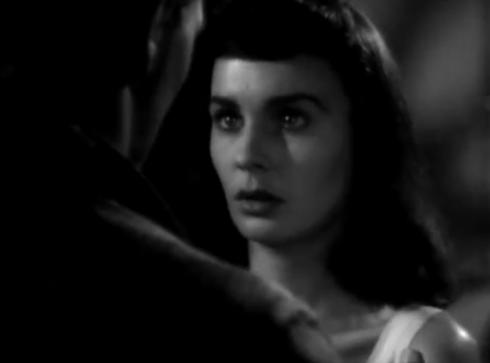
In Angel Face, Simmons plays it almost perfectly chilling with her refined beauty that displays no affect, a few obvious inner demons behind those dreamy eyes, not so much bubbling passion underneath as there are bursts of fervency out of necessity. She stunningly floats through the scenes with ice water in her veins, determined to possess, first her father (Herbert Marshall) and then Frank Jessup (Robert Mitchum).

As an actor, Robert Mitchum possesses an enormous range, and many layers to his film & real-life persona– although he always exudes that smooth yet brawny exterior, he can either play it self-possessed, a coolly determined hero or visceral anti-hero, and at times he’s been quite effective as a sicko. In Angel Face, Mitchum while still the usual rugged beast and cocksure fella, this time he is foolish and unsympathetically led by his pants, right into our anti-heroin’s trap…

Frank should have stayed with nice nurse Mary, a nice fella for a girl.

Herbert Marshall as Charles Tremayne tries to explain to the doctor and the ambulance drivers what might have happened when the gas valve was left on in his wife’s bedroom.

Robert Mitchum plays former race car driver Frank Jessup, an ambulance jockey who becomes drawn into Diane Tremayne's (Jean Simmons) psychotically woven web of obsessive love. Frank and Bill are called to the wealthy Tremayne family's hilltop mansion when Catherine Tremayne (Barbara O’Neil) is almost asphyxiated when the gas valve on her bedroom fireplace is stuck on. In reality, Diane's attempt to gas her stepmother fails. It seems that Diane is insanely jealous of the woman who took her dear doting father Charles’ (Herbert Marshall) attentions away.

Catherine Tremayne insists that someone has tried to kill her and that the gas inhalation was not a suicide attempt. Catherine Tremayne is looked after by the doctor, given a sedative, and tucked into bed. Frank wanders down the great staircase, lured by haunting piano playing.

Frank wanders into the parlor when he hears the refined and innocent doe-eye-looking Diane playing a classical melody on the grand piano. He is immediately struck by the beautifully delicate young woman. As soon as Diane sees Frank who tells her that her stepmother is okay, she becomes hysterical. He tries to calm her down in his gruff manner, "Look take it easy I told ya she's gonna be fine." Diane continues to sob, "Leave me alone." He grabs her arm forcefully and yells at her to stop it, but Diane acts as if she is inconsolable, while Frank is getting more frustrated with her. So, the big guy slaps her, slaps her hard. Some sort of awareness washes over her face, in fact, she might have rather liked getting smacked in the face and so, she slaps him back, just as hard. Frank laughs, "Now look, the manual says that's supposed to stop hysterics, it doesn't say a word about getting slapped back." "I'm sorry", "That's alright forget it. I've been slapped by dames before."

We can see that there is something definitely off about this strange young woman and it should have raised the hair on the back of his neck but Frank is a bit of a dog you see.

Frank and Bill drive back to the hospital where they are set to get off from work. Frank says goodnight to Bill and walks over to the cafe because Mary is waiting on his call. Bill tells Frank he’s a lucky guy, and he agrees- “You know it!”

What Frank doesn't realize is that Diane has jumped into her little sportscar and has followed the men in the ambulance all the way back to the hospital. She watches as Frank enters the cafe. Harry the cafe owner says, "Well if it ain't the dead body jockey" "Sure Harry that's why I come here it looks like the morgue."

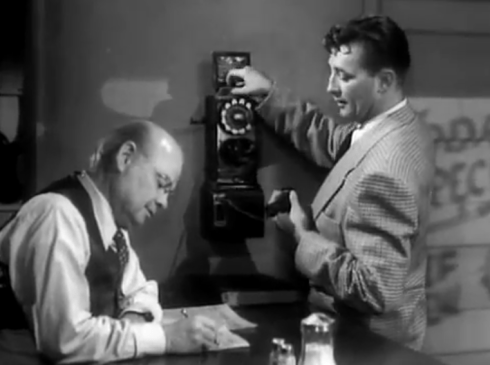
Frank puts a coin in the phone and begins to call Mary but he gets a busy signal. He turns around and voilà Diane is standing there. She floats out an innocent sounding, "Hello." Frank pleasantly surprised says "Well hello, you do get around fast don't ya." Diane answers, "I parked my broomstick outside" Frank-"Beer Harry… what do witches drink?"

Now"¦ This is why Frank is a dog, it doesn't trouble him that this young woman has followed him to work. He was supposed to have dinner with his girlfriend Mary who is a nurse at the hospital and a wonderful person.

Naturally, one busy signal and Frank's attention span is switched to this young stalker whom he finds intriguing. He finally gets Mary on the phone and tells her that he's too tired to get together and goes off into the night to dine and dance with Diane. He is now ensnared in her web.

Frank-“I’ll see you tomorrow” Mary-“Tomorrow… was it a rough call?” Frank staring at Diane- “Yeah, rough.”

Diane asks Mary to lunch… she’s got a plan you see.

What makes Diane even more conniving is that the next day she meets Mary for lunch and tells her about her evening with her boyfriend. She puts it under the pretense of helping the couple out with Frank’s plans on owning his own sports car repair ship, Diane having the means to offer financial support. But the seed is planted and Mary gets the heavy hint dropped that Frank is a dog and feels betrayed by Frank's lie about being too tired. Mary is no dope and she lets Diane know that she won't be a fool. She tells Diane that she would have rather not known about their evening together and knows that Diane has brought her to lunch to try and shake her faith in Frank and to "find out how stupid" she was. Mary isn't the typical good girl in noir"”she's more streetwise than that and a bit jaded by the ways of the world. She’s a good girl, but not a dumb girl.

That night Frank is about to go out on a date with Mary and he continues to lie about the previous evening "I was so beat last night I hit the sack as soon as I got in" Mary tells him "That, I can believe."

Diane walks into the diner and tells Frank that she met with Mary for lunch.

Diane-“Go ahead hit me.” Frank-“First I’ll buy you dinner then I’ll hit ya.” Diane -“When I tell you what I did you probably won’t want to see me again, ever.” Frank-“Sounds pretty grim.” Diane-“I had lunch with Mary I told her about last night… oh not everything just that we went out together.” Frank gripes-“Well why did you say that, I told her that…” Diane-“I just told her that I wanted to help you get the garage.” Frank-“Oh yeah you’re a big help.”

Later that evening while dropping subtle barbs at each other about the price of Diane’s spending, she lays the groundwork for getting Catherine to hire Frank as her new chauffeur.

Diane to Catherine complaining about her expense account-“Don’t you know it’s the simple things that cost the most!”

Diane tells Catherine that she could really use a chauffeur…

Now that Frank and Mary's relationship is strained Diane moves in for the kill, she initiates a passionate kiss, she tempts him with the idea of a race coming up, tempting him with “pebble beach” and that she will loan her car to him, also luring him with the security of a better-paying job.

He decides to take a job with the Tremayne's as her stepmother Catherine's chauffeur, though he tells Diane he's just "not the type" even move into an apartment over the garage. Diane tells Frank about her father, how he is a widowed writer, who has been wasting his talent, marrying into money for its comfort with the rich Catherine whom Diane despises for the way she treats him.

Part of Diane's diabolical plot to draw Frank into her web, she pretends to be nice to Catherine asking her to invest in Frank's desire to open up his own garage that caters to sports cars.

This is also a way for Diane to ingratiate herself into Frank’s life by appealing to his love of fast cars, as an extension of her own dangerous mind, she drives a sports car that Frank seems to be dazzled by and covets as he was once a race car driver. This is just an example of one of Diane's manipulative powers as she seduces Frank with the illusion that he will be in control. Race cars are vehicles that represent freedom and freedom of movement as they are capable of high speeds and risk-taking. Both Diane and Frank seem to want to move at their own speed and of their own volition with no one interfering. In that way, they are suited. Frank wants to do his own thing, opening up his own garage and Diane is looking for someone new to possess and control since her father is now a little more out of her reach.

But this is where the bait, or point of attraction leads Frank down a dangerous spiraling road led completely by Diane's calculating will"” where he will ultimately and literally crash and burn.

And so Frank meets with his employer who is receptive to him. Catherine actually thinks he’s a very nice young man and calls over to her lawyer to look over the papers, feeling fine about lending a great deal of money for him to open up his own garage, though she must wait for her attorney to look over the financial details of the transaction. Frank believes the deal is going to happen, until Diane sabotages the whole thing by insinuating herself using deception once again, pretending to show Frank a crumpled paper from the waste pail with the figures for the investment, that her stepmother supposedly trashed. Frank seems surprised that Catherine decided not to go ahead with it, as she appeared keen on the idea.

“Oh, Frank I’m so sorry.” Frank-“Don’t take it so hard. You had a nice idea it just didn’t work that’s all.” Diane-“I’m so sorry for you.” Frank-“She changed her mind forget it, we’ll make a big night of it.” Diane– “Not tonight.” Frank slightly annoyed-“Now why?” Diane warns him, “It would be safer not to. We have to be careful for a few days. More than ever now.” Frank-“What do we have to be careful of now?” Diane-“Well if she finds out she’ll dismiss you and I couldn’t stand to lose you now…” Frank-“So she fires me and I get another job. Maybe it’s better that way. At least we won’t have to play around like this. Hiding like kids.” Diane-“You don’t know her Frank. She’d lock me in.” Frank laughs-“How could she lock you in?” Diane-“She could do anything to me because of my father. If I try to fight her, she makes him pay for it, she knows I can’t stand that, please try to understand.”

Of course, Diane has constructed this lie as Catherine was very interested in going through with the deal. She wants to poison Frank's mind against Catherine, and Frank doesn't go straight to Catherine and merely asks if this is true, he just takes Diane's word for it.

Once he is working for the Tremayne's, and the prospect of his garage will not materialize-Frank gets antsy.

While Diane plays chess with dear old daddy, Frank gets bored playing chauffeur above the garage and tries to call Mary but he can’t reach her. Diane says goodnight to Father laying out his milk, biscuits, and cigarettes by his bedside, like the loving daughter, he can’t do without.

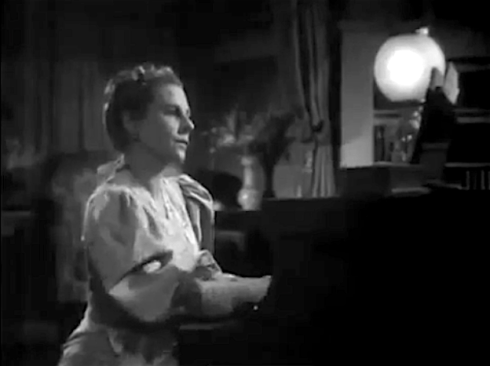
While Diane sits at the piano and plays her lamenting melody, in her eyes she appears like a black widow knowing that she has a juicy fly trapped above the garage, planning her next strategy which comes in the middle of the night.

She comes to Frank’s room crying and frightened claiming that Catherine had been in her bedroom looking down at her. Diane says with her most delicate voice-“It was so strange I wanted to speak but I couldn’t.” Diane tells Frank that Catherine had closed the window and put the gas on in her room, that she heard that awful hissing sound. She didn’t dare leave the room. Frank wants to tell her father and the police, but Diane quickly gathers her composure, “No Frank we mustn’t do that.” 

Diane's pretense of paranoia about Catherine's trying to kill her emerges more clearly for Frank who is now taking notice of it.

An exercise in frustration, Frank begins to realize that he is in love with a lovely yet quite homicidal head case! but he fails to untangle himself from this deadly beauty.

Frank  [of Diane’s supposed ‘evil’ stepmother] … "If she’s tryin’ to kill you, why did she turn on the gas in her own room first?"

Diane  “To make it look as though somebody else was guilty"¦”

Frank  "Is that what you did?"

Diane  "Frank, are you accusing me?"

Frank  "I’m not accusing anybody. But if I were a cop and not a very bright cop at that, I’d say that your story was as phony as a three-dollar bill."

Diane “How can you say that to me?"

Frank  "Oh, you mean after all we’ve been to each other?… Diane, look. I don’t pretend to know what goes on behind that pretty little face of yours – I don’t *want* to. But I learned one thing very early. Never be the innocent bystander – that’s the guy that always gets hurt. If you want to play with matches, that’s your business. But not in gas-filled rooms – that’s not only dangerous, it’s stupid."

Diane tells him that she’s very tired. He says “Yeah, that I can believe.” When she tries to kiss him, he pulls away from her.

Meantime Frank visits with Mary, who is on her way out to meet up with Bill for a date. She is surprisingly nice to Frank which is more than he deserves. She tells him Bill was sure he’d show up for last night’s bowling tournament he tells her –“I’ve been busy.”

Frank asks how Bill did in the tournament, she tells him “Wonderful.” Frank answers, “He’s been making out alright with you too huh.” 

Mary says, “Bill was very sweet to me after you walked out.”

Frank-“I took a job that pays better than being a lousy ambulance driver, is that a crime?” Mary- “Is taking the boss’s daughter to the Mocalmba (club) part of the job?” Frank-“They got a good band there, remind me to take you there sometime.” 

You just can’t blame Mary for trying to move on, Bill is a much more dependable and very likable guy who has worshiped Mary from the beginning. She asks about Frank’s new life, and he tells her that he's thinking of quitting.

He tells her, "I’ve been thinking about quitting, it’s a weird outfit, not for me."

Frank asks-“What’s the score Mary, has Bill taken over or do I still rate?”

Mary-“That’s a hard question to answer and I don’t think a fair one to ask” Frank-“A very simple question, yes or no, Bill or me? Can’t you make up your mind?” Mary tells him, “Yes, but I want to be sure you can make up yours. Can’t we let it go at that for a while” Frank-“Oh, I’m on probation, okay, how bout tonight, we got a date?” Mary laughs- “Why not” Frank says, “You know something you’re a pretty nice guy… for a girl.”

The next day Frank is going to leave, but Diane has packed her bags and stumbles onto Frank packing his own bags. She asks him where he is going. He tells her that he’s quitting, and when she asks why, he tells her, “Well maybe it’s the altitude. Living up here makes my heart pound.”

Of course, Diane collapses onto the couch and begins to weep. Frank tells her, “Now let’s face it I never should have taken this job. You shouldn’t have asked me… you know I’m right. You have your world I have mine. You got beautiful clothes a big house, someday you’ll come into a lot of money. I got a pair of big hands and not much else.”

“But all I want is you. I can’t let you go now… I won’t.”

He tells Diane that he wants to quit his job and she becomes upset as her plaything and the object of her second fixation is now slipping away from her. Frank doesn't want to be involved with the whole package anymore. “It’s no good I tell you, I’m not getting involved.” She asks "Involved with what?"

"How stupid do you think  I am –You hate that woman. Someday somehow you’re gonna hate her enough to kill her. It’s been in the back of your mind all along.”

Diane says coldly-“So she’s fooled you too! Just like she has everyone else.”

Diane reminds Frank about her father’s book. That one day she went into his desk to hide a present for him, just “something between him and me…”

And she found inside the drawer where he was supposed to keep his manuscript, there was nothing but a stack of blank paper. He hasn't written a line since he married Catherine. At first Frank just blows this off, “So he got tired. Writer marries a rich widow what’d ya expect him to write… checks.”  This touches on a nerve, “Don’t joke about my father!” She tells Frank that Catherine has "humiliated and destroyed him."

Frank tells her that there’s no law that says she has to stay, she could move out and find work the way other girls must do. She tells Frank that she would leave if it weren’t for her father. “That’s where I came in. I guess that’s where I leave.”

“Frank please will you tell me one thing? Do you love me at all? I must know…”

“I suppose it’s a kind of love. But with a girl like you, how can a man be sure.” Diane quietly asks, “Will you take me with you?” 

Frank-“You had it all figured out didn’t ya? You mean you’d really leave your father and everything here.” Diane-“If I have to, to keep you.” Frank-“I could be wrong about you.”

Diane begins to tell Frank how she can sell her jewels and the fancy car and he can get a small garage at first. He wants her to be sure of what she is getting herself into. She tells him that she’s sure. They hear Catherine’s car pull around. He tells her to think it over for a few days. Her kisses and sympathetic story about her poor father have worked perfectly on Frank. And she makes sure that he promises that he won’t leave until then. Diane’s maneuvering has worked.

Diane leaves Frank’s room, and walks passed Catherine’s car. Tiomkin’s score plays fervently, feverishly as she looks down the steep cliff and seems thoughtful about the car that is framed behind her. Finding an empty package of cigarettes stuck in the hedge, she holds it out and watches it as it drops down the deep cliff side. Shades of darker things are soon to follow.

Diane is so sinister she even loans Catherine a pair of her new driving gloves, just for the irony of it all. Sometimes she can be so sweet.

Catherine needs to go to her bridge game looking for Frank to drive her, Diane makes the excuse that he needed to go to Santa Barbara, having loaned her sports car to him. Diane offers to drive her instead, knowing all too well that she’ll refuse. And of course, Catherine does in fact decide to drive herself to her bridge game. At the last minute, Charles decides to tag along for a ride to Beverly Hills.

Diane languidly floats as if in a psychotic trance and sits at her piano performing the same melody she played the night she failed to asphyxiate Catherine. We can hear Diane playing her melancholy ‘death song’ on the grand piano as her stepmother and father proceed to drive. But…

Diane has figured out how to tamper with the gear shift. She's been watching Frank tinker with the mansion’s cars and learns how to reconfigure the brakes and the shift.

Catherine starts up the car, put the gear into drive AND the car shoots backward rather than forwards –it has been rigged to go into reverse, as her stepmother and father are propelled over the steep cliff’s edge.

An homage to the earlier murder, the convertible car goes careening over the jagged cliff, rolling over and over and smashing against the rocks, the crash dummies used are quite effective as they (Catherine and Diane's father) seem to become crushed under the twisted fiery metal"¦

here's a nifty gif to illustrate

It is one horrific scene indeed. A scene that truly rattles me!

Diane is successful at the second attempt on her stepmother's (Barbara O'Neil Stella Dallas 1937, Gone with the Wind 1939, All this, And Heaven Too 1940, Secret Beyond the Door 1947, Whirlpool 1950) life. The problem with Diane's almost ingenious perfect murder unbeknownst to her is that dear Daddy wasn't supposed to be a passenger in the car so he also dies in the fiery crash, a casualty in the wreckage of Diane's unbridled psychotic scheme of stepmother machine meddling.

The police think there is something strange about the accident and Frank is charged with murder after Diane's packed suitcase is found in his room.

The cop on the case knows Frank from driving the ambulance, and he brings Frank in for questioning. Detective Lt. Ed Brady asks how Frank came to work for the Tremaynes, and Frank tells him that he sort of just fell into it, after they had gotten the call about Catherine’s near asphyxiation. Ed tells him he knows. He’s got the report right there on his desk, Detective Lt. Ed Brady (Larry J. Blake)-“Probably accidental, sure makes you wonder, don’t it.”  Frank asks, “What da ya mean?” Ed “She claims somebody tried to murder her” Frank laughs it off-“She was hysterical, why would anyone try to murder her?” Ed-“Are you kiddin’ a woman with her kind of money? Oh by the way Frank, what sort of a girl is this stepdaughter er… Diane?” Frank tells him, “Very nice girl, very pretty girl.” Ed-“Any boyfriends?” Frank-“None that I ever saw. She and her father were very close.” he puffs on his cigarette some more. Ed mentions “But didn’t get along with her stepmother eh” Frank- “I didn’t say that.” Ed-“Okay okay, when was the last time you drove the Tremayne car?”

Ed shows him the packed suitcase and then tells Frank he should get himself a lawyer.

Attorney Fred Barrett (Leon Ames), Diane’s lawyer comes to see her in the prison hospital ward.

“She idolized the man Fred it’s no wonder her nerves are cracked!”

Diane suffers a breakdown as she had only wanted to kill her stepmother, she never intended on killing her beloved father when she tinkered with the car. It looks like Frank is involved because he was the last known person to handle the car. He was known to have worked on the cars at the Tremaynes.

The Tremayne family lawyer hires one of L.A.'s best defense attorneys, Fred Barrett a master at playing on a jury's emotions.

Barrett tries to tell her that it won’t serve either her or Frank to shoulder the blame because the jury would believe them both guilty. In a moment of honesty, she tries to save Frank’s neck. Seeming less like a crazy girl and in more control of her powers now in the aftermath of what she has done, inadvertently killing her father, she wants to take responsibility for the murders herself, not wanting anyone to defend her and that she acted alone.

Diane confesses to the crime-“But I’m telling the truth.”

“The truth is what the jury decides…not you, not me, not Frank.”

At first Frank doesn’t want to go along with Barrett’s plan.

Barrett-“To be perfectly blunt Mr. Jessup I’m not particularly invested in saving your neck. The concern is with my client Diane Tremayne” Frank-“Yeah that’s what I figured” Barrett tells him, “But the point is you have a much better chance together than separately. And the evidence actually points much more to you than it does to her. The fact that an automobile was involved” Frank interrupts, “If she thinks she can get away with that she’s lost her mind.”

Frank and Diane are married at the hospital…

The ladies at the prison bake the bride and groom a wedding cake-“Kids we sure hope you beat the rap!”

Barrett concocts a scheme to have Frank and Diane married in the hospital jail ward where Diane is spending her time while first catatonic, she is then convalescing after the breakdown. Diane’s legal team insists that she marry Frank so that it would seem like the couple was just innocent young people who intended matrimony and not having a sordid affair. They want Diane to keep her honest revelations to herself. A morally distasteful strategy that might guarantee a good outcome for them at the trial.

This scheme tries to offset any more scandal for the headlines framing it as two innocent people in love. And that explains they leave the Tremayne house that day with plans to elope.

Another bad choice, Frank goes along with it, hoping to save his own skin not wanting to be convicted of the murders himself. He allows yet again an outside influence to manipulate his life. The idea of Frank and Diane getting married seems to push Diane further into the delusion that they will remain married and that she will have a future with Frank.

But Frank now wants nothing to do with the obsessive murderous Diane. D.A. Judson (Jim Backus) brings in the car's mangled motor and drive shaft to demonstrate his theory of how the transmission was jimmied to stay in reverse. The defense attorney Barrett manages to create a measure of reasonable doubt, supplied by with his own specialists who do create doubt in the minds of the jury and the trial ends with an acquittal. And the couple is now free to go. Frank wants a divorce.

Returning to the mansion Frank tells Diane he'll go visit Mary to see if she'll take him back. If she won't he'll leave for Mexico. Diane is devastated and in desperation makes him an offer. She'll loan him her jaguar to go see Mary. If Mary takes him back, he can keep the car. If not he'll bring the car back.

Here we are not sure whether Diane's psychosis has broken up a little like a dark cloud getting clearer, as she appears more genuine at this point, or if she is still manipulating Frank.

She shares a little history about her childhood and where her fixations might be coming from. She tells him that she was only ten years old when her mother was caught in an air raid in England, after which her father "became everything" to her. But once he married Catherine, Diane says she used to fantasize about what she and her father would do if her stepmother were dead.

She tells Frank that now she realizes that Catherine never meant any harm and she wants him to believe her when she says that she would give her life to bring them back. This is why she tells Frank that he cannot leave her because she wouldn't know what to do without him. Now appearing just more desperately lonely than viciously psychotic. But Frank isn't ready to stay married to her, not even try at staying close, though he doesn't hate her, he is "getting out all the same."

After Frank leaves she closes up the house, dismisses the servants, and wanders around the estate alone, before she goes to Frank's room where she spends the night curled up in the armchair wrapped in his jacket.

Diane believes that she'll never see him again. She goes to Barrett's office, wanting to confess, and Barrett reluctantly agrees to take her statement. Diane details how she unwittingly got Frank to show her while giving the car a tune-up on how to rig the car to go in reverse. But he tells her she can't be tried again due to double jeopardy. Her admission shows that she might not be totally delusional, just a regretful psychotic.

When Diane returns to the lonely mansion, Dimitri Tiomkin's dark score swells dramatically around Diane as she appears to drift bereft with grief through the empty halls and rooms. But Diane's hopes are sparked when Frank returns, Mary has by right rejected him, preferring the kind and loyal ex-partner Bill and Frank decides to leave for Mexico.

Diane pleads with him to let her go along. He says no way. Even though he's called a cab, he decides to let her drive him to the bus station. They get in the jaguar, and Diane brings champagne and two glasses.

It might not be necessarily clear when the idea came to Diane If it was the final realization that she'd be driving him to the station never to see him again. Maybe she thinks she can change his mind over that glass of champagne. But something clicks in her brain when Frank criticizes the way she puts the car in gear, as he exclaims. "Easy" seems to spark her reaction…

He pours the champagne as she starts the engine. Then looking at him, she floors the car in reverse as the two go frighteningly backward over that scary steep cliff…

And rockets them down the same cliff that killed her father and stepmother, the car smashing against the rocks and mangled into the same kind of twisted metal sculpture.

Irony-a few minutes later the cab arrives"¦. Frank you idiot.

The scene is given its moxie by cinematographer Harry Straddling (Suspicion 1941, A Streetcar Named Desire  1951, A Face in the Crowd 1957)

Angel Face dramatically embraces the darker implications of noir.

I admit, I’d have a hard time saying no to Jean Simmons too… but Franks stupidity and Mitchum's ability to play a tough guy (who smokes a cigarette sexier than any man I can think of) a guy just floating where the wind blows his pants is aptly described in Silver and Ursini's book"”FILM NOIR: THE DIRECTORS– on Otto Preminger

"One of the big achievement of Preminger his writers his cast and composer Tiomkin is to create a tone of amour fou in Angel Face that is realistic, poignant, delirious and suspenseful in equal doses. Frank is not the smartest guy, but he's not a dummy, either. His lackadaisical attitude about life is embodied in Mitchum's languid body language. Slow on the uptake about how dangerous Diane is, his problem is one of the noir anti-hero most common:thinking with his balls and not his brains. If he hadn't given Diane a second chance, if Mary had taken him back;and if he'd realized Diane was willing to sacrifice her own life to be with him. A lot of ifs. Frank is always a half-beat behind trying to get in rhythm and he pays for it dearly. Preminger actually generates some sympathy for Diane when she tries to make up for the murders by confessing, only to realize the state will never punish her. Barrett's assertion she may end up institutionalized if she presses the issue is more unpalatable to her than the gas chamber. When she comes home before seeing Frank for the final time, the romantic delirium builds to fever pitch, culminating in a bittersweet shot of her curled up in the shadows in Frank's room. Frank's coat wrapped around her. It is one of the most moving sequences"¦ the character is completely self-aware of her own psychosis. Angel Face is Preminger's finest noir."

Continue reading “Beautiful Poison: Jean Simmons in Angel Face (1953) & Gene Tierney in Leave Her To Heaven (1945)”

All *kinds* of observable differences: The world of Ruth Gordon

wac2

It’s that wonderful time of the year when we all get to celebrate those unsung actors with loads of character, thanks to Aurora of Once Upon a Screen, Paula’s Cinema & Club & Outspoken and Freckled who are hosting the Fifth Annual WHAT A CHARACTER! BLOGATHON 2016… This will be my fourth time contributing to this fantastic event, having covered Jeanette Nolan, Burgess Meredith, and last year’s Agnes Moorehead. As many of you know, it’s often the actors on the periphery of some of our favorite films that fill out the landscape with their extraordinary presence, a presence that becomes not only essential to the story but at times become as memorable perhaps even larger than life when compared with the central stars themselves. I’m thrilled to be joining in the fun once again and am sure that it’s going to be just as memorable this year as ever before!

Actress Ruth Gordon (Photo by © Alex Gotfryd/CORBIS/Corbis via Getty Images)

The ASTONISHING… RUTH GORDON!

quote-3

“The earth is my body; my head is in the stars.”-Ruth Gordon as Maude

harold-and-maude

Maude:A lot of people enjoy being dead. But they are not dead, really. They’re just backing away from life. *Reach* out. Take a *chance*. Get *hurt* even. But play as well as you can.”

I’ve been waiting to write about my love of Ruth Gordon for quite some time and felt that this would be the best way to get off the pot and just start singing those praises for this remarkable lady of theatre, film, and television. Ruth Gordon in so many ways channeled her true personality through the character of Maude, in life –she too always projected a spirit that played as well as she could…

capturfiles_3

capturfiles_10

“Choose a color, you’re on your own, don’t be helpless.” –Ruth Gordon -An Open Book

capturfiles_10

quote-2

There’s a vast dimension and range to Ruth Gordon’s work both her screenwriting and her acting, the effects leave a glowing trail like a shooting star. With her quirky wisdom and sassy vivacity that plucks at your heart, Ruth Gordon stands out in a meadow of daisies she is emblazoned as bright and bold as the only sunflower in the field. No one, just no one has ever been nor will ever be like this incredible personality.

capturfiles_17

For a woman who is impish in stature, she emanates a tremendous presence, a smile like the Mona Lisa, sporting a unique and stylish way she expresses herself with a poetic & fable-like language. Ruth Gordon is a character who dances to a different rhythm — how she sees herself and how she performs *life* is uniquely mesmerizing as it is burgeoning with all the colors of the universe.

capturfiles_4-copy-3

harold-and-maude-dance

Ruth Gordon is a dramaturgical pixie, with a curious hitch in her git-along… an impish dame who rouses and fortifies each role she inhabits with a playful, mischievous, and almost esoteric brand of articulation.

In a field of different daisies Ruth Gordon is that sunflower that Maude soliloquies poetically to Harold —

Maude-“I should like to change into a sunflower most of all. They’re so tall and simple. What flower would you like to be?”

Harold-“I don’t know. One of these, maybe.”

Maude-“Why do you say that?”

Harold-“Because they’re all alike.”

Maude-“Ooooh, but they’re *not*. Look. See, some are smaller, some are fatter, some grow to the left, some to the right, some even have lost some petals. All *kinds* of observable differences. You see, Harold, I feel that much of the world’s sorrow come from people who are *this”, (pointing to a daisy) yet allow themselves to be treated as *that*.” (she gestures to a field of daisies)

harold-and-maude

ruth-as-minnie

quote-1

From the Arlene Francis 1983 interview with Ruth Gordon– actress, screenwriter and playwright…

ruth-gordon-1975-photo-by-alfred-eisenstaedt

Ruth Gordon 1975 photo by Alfred Eisenstaedt

Ruth Gordon never wanted to be told how to write nor be instructed on how to act… from her autobiography An Open Book- “I don’t like to be told how to act either. When I’m left alone thoughts come… ‘Don’t try to think’ said our New England philosopher, Emerson, leave yourself open to thought. If you find out stuff for yourself, you get to know what you believe; what you like, how to live, how to have a good time. It’s important to have a good time.”

capturfiles_22

capturfiles_24

from Hugh Downs Interview

" I did grow up to have character. And I'm always doing some damn thing that uh I don't wanna do but I know it's right to do. And I finally thought of something in my next book and I'm gonna have it in there and it's a very important thing to remember. Just because a thing is hard to do doesn't make it any good. You tackle something and you work at it and slave at it and say now I'm gonna do this I'm gonna do it and when you've done it better think it over and see if it was worth it"¦ some easy things like falling off a log and stuff  those easy things probably just as good but a New Englander has to do it the hard way. "

capturfiles_25

Arlene Francis "You once said "˜never face facts' how can you avoid it?"
Ruth Gordon-"Oh my god look, we're not facing facts now surely cause I might dry up and not have a thing to say in the world and then where would you be, you know"¦ ["¦] it would be stupid there are enough hazards in the world, I'm 85 now and I'm at my very best peak of my looks which might be an interesting thing to anybody because you figure, 18 why wouldn't I be better looking than now?… "Don't lets anyone tell their symptoms, it would be the most boring thing, even though everybody has so many"¦ so the "˜don't face your facts' is if you face what's the matter with you, you know we'd open a window and say goodbye everybody like tinker bell and take off and hope you could fly (she laughs) Don't face the facts you know, I was 18 years old I was going on the stage didn't know anybody in New York and I didn't know anybody on the stage, and I wasn't beautiful and I wasn't tall which everybody was in those days, and uh I didn't have any money and how was I gonna do this, so if I didn't ‘not face those facts’ I'd say too bad she wanted to be an actress"¦"

capturfiles_35

Ruth Gordon, who always dreamed of becoming a ‘film’ star, beside an astonishing stage presence talks about winning awards for her work–" The main award that I really value is the award I give myself and people say Oh you don't know when you're good you know, the audience knows, people know but you don't know Well that's stupid I know when I'm good for myself You might not like it, they might not like it, the public might not like it, but I know that wonderful performance that doesn't happen too often, when anticipation and realization come together because that night when it's all perfect and is great and you know "¦ that you've just taken off"¦ that's my award"¦"Â 

capturfiles_31

Ruth Gordon is bold and vibrant and an actress who never shied away from taking the quirkiest and most eccentric roles. From irreverent Ma in Every Which Way But Loose (1978) and the poignant Becky Rosen in Boardwalk (1979) to the perspicacious Maude in Harold and Maude (1971) George Segal’s Tushy biting batty mother-Mrs. Hocheiser in Where’s Poppa? (1970) and of course the queen of campy kitschy New York City’s enigmatic coven hostess with the mostest– Minnie Castevet in Rosemary’s Baby (1968)

minnie-in-the-kitchen-with-rosemary

ruth-as-minnie

Once Ruth Gordon personified the unforgettable Minnie Castevet in "Rosemary's Baby" in 1968 she manifested a lasting and unfading, enigmatic character that only Ruth Gordon could infuse with that unforgettable energy.

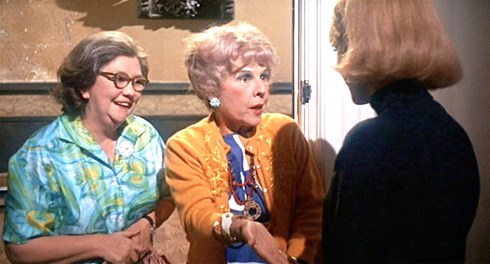
Minnie is perhaps one of the most vividly colorful film characters with her sly and farcical mispronunciations and a wardrobe that is distinctly tacky. Part cosmopolitan part menacing, no one could have performed Minnie Castevet quite like Ruth Gordon, that next-door meddling neighbor who befriends an American housewife, who is secretly waiting to become the godmother to the devil’s unborn son.

rosemarys-baby-ro-and-min

rosemarysbaby_097pyxurz

Gordon appears as if she was cut from a mold that makes her seem like a rebel to the inner workings of Hollywood. And as extremely unconventional as she can be, there is always a depth and authenticity to the wackiest of characters she’s portraying. From the lyrically loving and life-devouring Maude in Hal Ashby’s different style of love story.

harold-maude

" Well it's a very good movie, I was absolutely wonderful Collin Higgins wrote a great movie Bud Cort was sensational, Hal Ashby became one of the top directors so how do you account for that, well it just happened. But, you see, some guy in Cambridge Mass. he wrote from the YMCA he wrote me a letter and he said, "˜I've seen Harold and Maude' I don't know how many times he'd seen it, and he said I'm at a loss to know why it means so much to me and I think about it , I think about it a lot and I finally came to the conclusion that it's because to get through life you have to have somebody to tell it to' that's a very profound remark. I've had lovers I've have friends I've had family and I didn't exactly tell it to them but Garson Kanin I tell it to him whether it's bad whether I'm a failure whether I'm going grey. Somebody to tell it to. And it's a very very necessary part of life. And in Harold & Maude Harold who was a kind of helpless geek with looks riches money everything he had "¦ except knowing how to live. And Maude who didn't have anything except she knew how to live. And Harold could tell it to her. he could tell it to her. She didn't always have the answer. But he could pour it out. And so it was wonderful really, just pour it out, I said once even if I'm wrong agree with me because you know to Gar, have somebody you know would stand up for you."

garson-and-ruth

Ruth and husband Garson Kanin… super writing team!

bud-and-ruth-this-is-your-life

Bud Cort remained very close friends with Ruth Gordon. Here he is talking about her tremendous influence on This is Your Life television show honoring the extraordinary actress/writer.

budd-and-gordon-on-the-set

ruth-and-hal-ashby-on-set

Ruth Gordon and Hal Ashby on the set of Harold and Maude 1971.

harold-and-maude-bw-funeral-shot

capturfiles_23

from the Dick Cavett interview from September 19, 1969 expressing how if you had never seen Ruth Gordon on the stage “You would lament that facta lady who is one of the incomparable ladies of American Theatre. There have been cults about Ruth Gordon for years and years and years. When great performances on Broadway are discussed, Laurette Taylor in The Glass Menagerie or Mildred Dunnock in Death of a Salesman, or Vivien Leigh or any of the classics are referred to Olivier in Oedipus, Ruth Gordon in *The Matchmaker* is always brought up as one of the masterpieces of all time. And she has been a wondrous presence in the theatre for over 50 years. Splendid comedian and a splendid comic writer."

capturfiles_8

capturfiles_28

Ruth Gordon Jones was born October 30, 1896, in Quincy, Massachusetts. "growing up with the brown taste of poverty in her mouth." As a child, she wrote fan letters to her favorite film stars and received a personal reply from Hazel Dawn. So struck with stage actress Hazel Dawn after seeing her perform in "The Pink Lady" in Boston, Ruth Gordon decided to go into acting. After high school, she went to the American Academy of Dramatic Arts in New York City and was an extra in silent films made in Fort Lee, New Jersey making $5 in 1915. She made her Broadway debut in 1915 as one of the Lost Boys later that year in Peter Pan or The Boy Who Wouldn't Grow Up as Nibs. She garnered a favorable review by Alexander Woolcott, who at the time was an extremely influential theater critic eventually the two became close friends and he was her mentor. Gordon was typecast in "beautiful but dumb" roles in the early 20s.

Ruth Gordon began to hone her craft and push the range of her acting ability which she revealed in Edith Wharton's Ethan Frome, the restoration comedy The Country Wife in which she appeared at the influential theater–London's Old Vic. She eventually found her way to Broadway and landed a role in Henrik Ibsen's A Dolls House during the 1930s.

Severely bow-legged, in 1920 she spent time in a hospital in Chicago where she had her legs broken and straightened.

capturfiles_19-copy
ruth-gordon-dr-erlichs-magic-bullet
Ruth Gordon as Edward G. Robinson’s wife in director William Dieterle’s Dr. Erhlich’s Magic Bullet 1940.
two-faced-woman-2
Ruth Gordon with the great Greta Garbo in director George Cukor’s Two-Faced Woman 1941.
Ruth Gordon (1931)
Ruth Gordon (1931)
She was married to actor Gregory Kelly from 1921-1927 when he died of heart disease. In 1929, she had a child (Jones Harris) with Broadway producer Jed Harris. She starred in plays in New York City and London, not doing another film until she played Mary Todd in director John Cromwell’s Abe Lincoln in Illinois 1940, co-starred with Edward G. Robinson in director William Dieterle’s Dr. Ehrlich’s Magic Bullet 1940 and appeared as Miss Ellis in director George Cukor’s film starring  Greta Garbo film Two-Faced Woman 1941 and co-starred with Humphrey Bogart in Action in the North Atlantic 1942.
abe-lincoln
spirit-of-the-people-1940


Ruth Gordon plays Ann Sheridan’s mother in director Lewis Milestone’s story of a small fishing village in Norway and the resistance to the Nazi occupation, Gordon plays Anna Stensgard the unassuming wife and neurotic mother who lives too much in the past in Edge of Darkness 1943.
edge-of-darkness
capturfiles_25
In 1942, active on Broadway again, she married writer Garson Kanin and started writing plays. Together with her husband, she wrote screenplays for Katherine Hepburn and Spencer Tracy like A Double Life 1947, Adam’s Rib 1949, and Pat and Mike 1952. She also wrote an autobiographical play “Years Ago”, that then became a film directed by the great George Cukor starring Jean Simmons, Spencer Tracy, and Teresa Wright in The Actress 1953 about her life growing up and getting into the theatre.
capturfiles_16
capturfiles_15
Ruth Gordon and her husband were included in a round-up of theatre actors questioned by the House on Un-American Activities in 1947 and flown to Washington for questioning. Nothing came of the investigation.
In the 1960s she returned to Hollywood with roles in films and television adaptations–
The television movie version of Noel Coward’s 1941 play Blithe SpiritRuth Gordon manifests the spiritual medium Madame Arcati in the 1966 tv version.
capturfiles_1
lord-love-a-duck
Ruth Gordon as Stella Barnard co-starring with Roddy McDowall and Tuesday Weld in Lord Love a Duck 1966.
Playing Mrs. Stella Barnard in Lord Love a Duck 1966 The film stars Tuesday Weld as the innocent attention-seeking teenager from a broken home who aspires to become loved by everyone wears 12 colorful cashmere sweaters given to her by friend and mastermind Roddy McDowall (who was 36 at the time playing a teen!) Director George Axelrod’s biting satire pokes fun at teen beach movies of the 1960s, elitism, and the adults that satellite around their machinations …

Stella Bernard: (Ruth Gordon) “You lied to me, Miss Greene. You permitted me to believe your father was dead.”

Barbara Ann: (Tuesday Weld) “Well, they’re divorced.”

Stella Bernard: (Ruth Gordon) “In our family we don’t divorce our men; we *bury* ’em!”

Where’s Poppa? 1970 In director Carl Reiner’s black comedy- Ruth Gordon lets it rip as the irreverent Mama Hocheiser whose senile antics are driving New York attorney Gordon Hocheiser (George Segal) to the brink. When he finally meets the loving and naive nurse Louise Callan (Trish Van Devere), worried his mother’s idiosyncrasies will ruin his budding romance, he grasps at any means to finally get rid of her! Ron Leibman is hilarious as Brother Sidney!
 
Inside Daisy Clover 1965, for which Ruth Gordon returned to the screen after almost 20 years -was nominated for an Oscar and won a Golden Globe as Supporting Actress… One of my favorite directors Robert Mulligan creates a portrait of a tomboy (Natalie Wood) who dreams of being a singer, lives in a trailer, and runs a beachside concession stand where she forges the autographs of Hollywood stars — suddenly discovered Daisy rises to stardom herself, falls in love with Robert Redford, only to turn her back on the viciousness of the business.
capturfiles_38
capturfiles_37
Ruth Gordon plays her quirky card-playing mother whom she calls ‘Old Chap’ who lives in her own world. Daisy loves her dearly, but the studio heads force her to hide Old Chap/Mrs. Clover is in an old age home and tells the public she’s dead in order to project her star image without an eccentric & batty mother in her life. Ruth Gordon once again plays batty to the poignant level of art form.
Inside Daisy Clover co-stars Christopher Plummer, Robert Redford, and Roddy McDowall, with a wonderful soundtrack, “You’re Gonna Hear From Me” by André Previn and Dory Previn.
inside-daisy-clover-beach-scene
Police (Harold Gould)-“You waited seven years to report your husband missing?” Mrs. Clover-‘The Dealer’ “I just started missin’ him this morning.”
Natalie Wood grew so fond of Ruth Gordon after working on the film Inside Daisy Clover that she made her the godmother to her daughter Natasha Gregson Wagner
capturfiles
ruth-natalie-and-redford-inside-daisy-clover
Gordon plays Alice Dimmock involved in a dangerous battle of wits with the menacing Clare Marrable who buries her victims in her lovely rose garden–Geraldine Page hires companions who have nice savings built up and no relatives to come around looking for them in What Ever Happened to Aunt Alice 1969.
What Ever Happened to Aunt Aice?
WHAT EVER HAPPENED TO AUNT ALICE? 1969 directed by Lee H. Katrin was Produced by Robert Aldrich Music by Gerald Fried.
In this taut Grande Dame Guignol horror thriller Whatever Happened to Aunt Alice 1969, Ruth Gordon portrays Alice Dimmock who sets out to uncover the truth behind her companion’s (Mildred Dunnock) disappearance after she takes a job with the austere and cunning Clare Marrable, a prolific serial killer who sows the seeds of her rose garden with her victims.
Director Lee H. Katzin and Bernard Girard’s psychological thriller positions two powerful actresses in a taut game of cat and mouse…
Geraldine Pages plays the ghastly & audacious serial killer Claire Marrable, whose husband left her penniless. In order to keep living a life of luxury and comfort she begins offing her paid companions who have stashed doe and no family to come looking for them. When Edna Tinsley played by Mildred Dunnock goes missing and becomes part of Mrs Marrable's wondrous garden of roses, Ruth Gordon pretends to be Page's companion in order to get to the truth about her missing friend.
Ruth Gordon was amazed at the showing of What Ever Happened to Aunt Alice? She figured that by playing the part of a woman in peril at the mercy of the ruthless and calculating psychopath, performed perfectly by Geraldine Page, at the final moment of confrontation her split decision to for self-preservation and become a murderer herself or be true to her inherent goodness allowing herself to be a victim. Ruth Gordon believed that it was this defining moment the goodness that ruled Alice’s heart and head would be the most powerful moments in the film. Yet, when the audience responded to this critical scene, to her surprise they screamed out “Kill her, kill her!” The audience wanted Ruth’s character to live so badly…

from director Hal Ashby’s Harold and Maude (1971).

harold-and-maude

A 79 old woman and a twenty-year-old lost soul meet at a funeral and find love and life together in a darkly light comedy. Bud Cort creates an iconic figure of a young privileged young man disillusioned by life, who gets a kick out of antagonizing his priggish mother Mrs. Chasen (Vivian Pickles) with creative faked suicides. Once Harold is exposed to the wisdom and insight that Maude imparts, she manages to open up his heart and teaches him how to reach out and embrace the substance of life’s beauty.

harold-and-maude-1

capturfiles_13-copy

ruth-as-maude

“You know, at one time, I used to break into pet shops to liberate the canaries. But I decided that was an idea way before its time. Zoos are full, prisons are overflowing… oh my, how the world still *dearly* loves a *cage.* “-the inimitable Maude
harold_et_maude
Harold: “Maude” Maude: “Hmm?” Harold: “Do you pray?” Maude: “Pray? No. I communicate.” Harold: “With God?Maude: “With *life*”

Every Which Way But Loose 1978.

ma-in-everywhich-way

Ruth Gordon plays the impertinently, uninhibited Ma to Clint Eastwood as trucker Philo Beddoe & Orville (Geoffrey Lewis) who travel around the West Coast looking for street-style prize fights. Along for the ride are Beverly D’Angelo as Echo, and evasive love interest Sondra Locke as country singer Lynn Halsey-Taylor. There’s a hilarious assorted misfit motorcycle gang member and Philo’s pet Orangutan Clyde who’s always stealing Ma’s Oreo cookies!

Ruth Gordon reprised her role as the cantankerous Ma in Any Which Way You Can 1980.
Ma after Clyde has eaten her bag of Oreos-“Ohh! Stop that, ya goddamn baboon. No respect! No privacy! No nothing!”
 
ruth-every-which-way-but-loose

co-staring with Lee Strasberg in Boardwalk 1979.

boardwalk-lee-and-ruth

boardwalk1

boardwalk

Lee Strasberg plays David Rosen and Ruth Gordon portrays his wife Becky who own a wonderful little diner, a loving older couple who have lived in their Coney Island Jewish neighborhood for 50 years until a gang moves in and changes the communities quality of life by threatening the local store owners with violence if they don’t pay ‘protection’ money. When David defies them, they burn down the diner and desecrate the synagogue. Janet Leigh also co-stars as Florence Cohen.

Ruth Gordon manifests a marvelously warm and poignant chemistry with master actor/teacher Lee Strasberg.

art_boardwalk_031414_584

boardwalk-ruth-and-lee
She personified the unforgettable role of Minnie Castevet in "Rosemary's Baby" in 1969. Manifesting an unfading, enigmatic character that only Ruth Gordon could perform.
Ruth Gordon started to get more regular film and television roles. Reprising the role of Minnie Castevet in the made for tv fright-flick Look What’s Happened to Rosemary’s Baby (1976) and played the devouring Jewish mother Cecilia Weiss in the television movie The Great Houdini 1976. And the television movie The Prince of Central Park 1977.
capturfiles_28
ruth-gordon-the-prince-of-central-park-tv-movie
Ruth Gordon was cast in the feature film The Big Bus (1976) among a terrific ensemble of actors. She appeared as Arvilla Droll in Scavenger Hunt 1979 and the very touching film about growing up and friendship- My Bodyguard 1980 in -Maxie (1985) Ruth Gordon plays Chris Makepeace’s kindly but rascally grandmother, while he finds a way to school bully Matt Dillon from beating him to a pulp, he finds an outcast that everyone is afraid of to be his bodyguard in Adam Baldwin. The film also co-stars John Houseman.
ruth-in-my-bodyguard
ruth-and-makepeace-in-my-bodyguard
Ruth Gordon co-stars with Chris Makepeace in 1980s My Bodyguard.
maxie-close-and-gordon
Ruth Gordon co-stars with Glenn Close in Maxie 1985.
maxie
 
As the eccentric Marge Savage in the ABC tv Movie of the Week directed by John Badham starring Alan Alda- Isn’t It Shocking (1973) Gordon possessed the seamless ability to oscillate between a delightfully aerated conviviality and acerbic snapdragon capable of delivering the most colorful tongue lashing!
Alda plays a small-town sheriff with his quirky secretary/sidekick Blanche (Louise Lasser) who is daunted by a string of mysterious deaths that are plaguing the elderly town folk. Edmund O’Brien plays Justin Oates an odd serial killer who is holding a lifetime grudge against his old friends who humiliated him in high school. Marge was his great love who might have done him wrong! Co-stars Lloyd Nolan, and Will Geer and the county coroner who uncovers the weird details that connect the murders.
mrs-warrens-profession-stageplay-george-bernard-shaw-gordon-plays-mrs-warren-and-redgrave-plays-daughter-vivie
Lynn Redgrave stars with Ruth Gordon in the stage production of George Bernard Shaw’s Mrs. Warren’s Profession.
Ruth Gordon was nominated for Broadway’s 1956 Tony Award as Best Dramatic Actress for playing Dolly Levy in Thornton Wilder’s “The Matchmaker.” Ruth Gordon says that Wilder had been a tremendous help and influence to her, having ‘picked him up in front of The Booth Theater’ way back when. She won a Golden Globe award as Best Supporting Actress as Natalie Wood’s mother she calls Old Chap in Inside Daisy Clover and a much-deserved Academy Award for Best Supporting Actress in Rosemary’s Baby.
She was nominated for a Golden Globe for playing Maude in Harold and Maude in 1971.
In the 1970s and 1980s she played parts in well-known television shows like Kojak as psychic Miss Eudora Temple in Season 2 “I Want to Report a Dream”, Rhoda, and Taxi (which she won an Emmy for.)
ruth-gordon-dances
and in the superb episode of Columbo as mystery writer Abigail Mitchell one of the most sympathetic murderesses’ of the series as she avenges the death of her beloved niece with unrelenting Lt. Columbo dauntlessly nipping at her heels. And though Abigail finds Columbo to be a very kind man,  he tells her not to count on that. He must stay true to his calling as a homicide detective though we wish he would just Abigail get away with murder– in “Try and Catch Me.”
Ruth Gordon as mystery writer Abigail Mitchell: I accept all superlatives.

Ruth Gordon also had the distinguished honor of hosting Saturday Night Live in 1977.

Ruth Gordon died of a stroke at 88 in Massachusetts with her husband Garson at her side.
the-final-shot

“She had a great gift for living the moment and it kept her ageless.” 

"” Glenn Close

Ruth Gordon had quite a unique way of expressing herself on stage, screen, and in person, and as Dick Cavett had said about the great actresses’ ability to always project her incomparable persona, what we get!  –  "It's a lesson in something that only Ruth Gordon can teach." And as she would say, she had “a lot of zip in her doo dah.” 

I’ll end by saying this about this astonishingly iconic character whose sagacity and spark will never dim when asked that particularly interesting question, ‘If you had 3 people you could meet in Heaven who would you choose?’ Ruth Gordon, you would be one of them!- With all my love, MonsterGirl

Wishing a Happy Grand Birthday to Olivia de Havilland 100 years old July 1st 2016!

Olivia
“I don’t need a fantasy life as once I did. That is the life of the imagination that I had a great need for. Films were the perfect means for satisfying that need.” — Olivia de Havilland

Esther Somers, Olivia de Havilland Leo Genn and Mark Stevens The Snake Pit 1948

The remarkable Olivia de Havilland turns 100 years old today. And it tickles me deeply and sincerely that we share the same birthday July 1st, so while I should be celebrating my own turn of the wheel, I felt it important to join in with so many others who recognize de Havilland’s enormous contribution to cinema and whose  lasting grace and beauty still shines so effervescently.

And so… I’d like to pay a little tribute to a few of my favorite performances of this grand lady!

Olivia de Havilland won the Academy Award for Best Actress in To Each His Own (1946) and The Heiress (1949) and nominated for her incredible performance in The Snake Pit (1948), Hold Back the Dawn (1941), and Supporting Actress as the gentle, stoic but powerful strong Melanie in Gone With the Wind (1939).

Melanie and Scarlett

at 99
The timeless beauty and grace of the great Olivia de Havilland at 99 years young!

Olivia

static1.squarespace.com
You’ve got to love a woman who has the wisdom to be surrounded by Siamese cats! Yet another thing we share… I adore you Olivia-

Olivia de Havilland never shied away from taking on challenging roles, whether she played the archetypal ‘bad’ woman or the ‘good’ woman this astonishing actress could convey either nature with the ease of a jaguar who stirs with inner pride and purpose.

She still possesses that certain inner quality that is a quiet, dignified beauty whose layers unravel in each performance. Consider her heart wrenching portrayal of the emotionally disturbed Virginia Stuart Cunningham thrown into poignant turmoil when she finds herself within the walls of a mental institution but doesn’t remember her husband (Mark Stevens) or how or why she is there. It’s an astounding performance in director Anatole Litvak’s The Snake Pit (1948)

Olivia and Mark

Olivia and Mark Stevens

The Snake Pit

The New York Film Critics awarded Olivia de Havilland Best Actress for The Snake Pit (1948). She was nominated for the Academy Award for Best Actress in a leading role.  

CapturFiles_8

Leo Genn and Olivia
In an interview Olivia has said, “I met a young woman who was very much like Virginia… a schizophrenic with guilt problems. She had developed a warm rapport with her doctor, but what struck me most of all was the fact that she was rather likable and appealing.. it was that that gave me the key to the performance. “

The Snake Pit photo Alamy

Olivia de Havilland threw herself into the role of Virginia by getting up close and personal with mental health treatments of the time. She observed patients and the various modalities that were used in these institutions like, doctor/patient therapy sessions, electric shock therapy and hydrotherapy and attended social events like dances within the institution.

snake-pit-1948

Here’s just a mention of some of my favorite performances by this great Dame of cinema, who as Robert Osborne so aptly spoke of her “… the ever present twinkle in her eyes or the wisdom you sense behind those orbs.”

captain-blood-errol-flynn-1935
Olivia de Havilland as Arabella Bishop in director Michael Curtiz’s Captain Blood (1935 ) co-starring familiar screen lover Errol Flynn
It's Love I'm After 1937
That multi layered manifestation of intelligence, courage and majesty… director Archie Mayo’s It’s Love I’m after (1937) co-stars another great STAR… friend, Bette Davis.

tumblr_n70ta14bwh1qiwrzoo1_500

They Died With their Boots On
Olivia is romanced again by the dashing Errol in They Died with their Boots On (1941)
The Adventures of Robin Hood 1938
Olivia de Havilland as the exquisite Maid Marian in The Adventures of Robin Hood (1938)
olivia_marian_adventures of robin hood
Olivia plays Maid Marian in Michael Curtiz’s The Adventures of Robin Hood 1938 once again co-starring with Errol Flynn. Olivia wears a magnificent wardrobe designed by Milo Anderson

Bette and Olivia in In This Our Life 1942

Reunited with Bette Davis she and Olivia play sisters Stanley and Roy Timberlake, in director John Huston’s In This Our Life 1942 where Bette steals Roy’s fiancée (George Brent).

The Dark Mirror 1946

In director Robert Siodmak’s psychological thriller The Dark Mirror (1946) Olivia de Havilland plays duel roles as dichotomous identical twins, one purely good the other inherently evil.

The Heiress

With Montgomery Clift in director William Wyler’s The Heiress 1949 Oilvia de Havilland plays the timid & naive Catherine Sloper who falls under the spell of opportunist Morris Townsend (Clift).

My Cousin Richard and Olivia

My-Cousin-Rachel-
Olivia de Havilland plays the intoxicating yet lethal Rachel who lures Richard Burton toward a dangerous fate. Adapted from Daphne du Maurier’s novel. The film also co-stars the sublimely beautiful Audrey Dalton!
MY COUSIN RACHEL, Olivia de Havilland (center, wearing veil), Richard Burton (right of de Havilland), 1952, TM and Copyright © 20th Century Fox Film Corp. All rights reserved,
MY COUSIN RACHEL, Olivia de Havilland (center, wearing veil), Richard Burton (right of de Havilland), 1952, TM and Copyright © 20th Century Fox Film Corp. All rights reserved

20562 - Not as A Stranger

In director Stanley Kramer’s melodrama Olivia de Havilland plays doctor Kristina Hedvigson who gets involved with the egotistical Lucas Marsh (Robert Mitchum) in Not as a Stranger (1955)

HamiltonDeHavillandBrazziMimieux

George Hamilton, Olivia, Rossano Brazzi and Yvette Mimieux on the set of Light in the Piazza (1962) filmed in Florence Italy. de Havilland plays Meg Johnson whose daughter having suffered a head injury has left her developmentally challenged. Both mother and daughter are seduced by the romantic atmosphere of Florence.

Olivia and Yvette

Now we come to a very powerful performance that of Mrs. Cornelia Hilyard one of Olivia’s most challenging roles as she is besieged upon by psychotic home invaders, James Caan, Jennifer Billingsley, Rafael Campos, Jeff Corey and Ann Southern who hold the uptight American matriarch in her gilded house elevator when the electricity goes out and the animals get in, in Walter Grauman’s brutal vision of the American Dream inverted. Lady in a Cage (1964)

capturfiles_1761

capturfiles_1101

Olivia de Havilland replaced Joan Crawford when tensions built on the set of the follow up to What Ever Happened To Baby Jane? 1962, the Grande Dame Guignol psychological thriller. Olivia de Havilland brought her own wardrobe and was not a stranger to pulling out the darker side of her acting self, portraying in my opinion perhaps one of the most vile and virulent antagonists the cunningly evil Cousin Miriam in director Robert Aldrich’s Hush… Hush, Sweet Charlotte 1964

HUSH... HUSH, SWEET CHARLOTTE, Bette Davis, Olivia de Havilland, 1964. TM and Copyright © 20th Century Fox Film Corp. All rights reserved.
HUSH… HUSH, SWEET CHARLOTTE, Bette Davis, Olivia de Havilland, 1964. TM and Copyright © 20th Century Fox Film Corp. All rights reserved.

Hush...-Hush-Sweet-Charlotte-Robert-Aldrich-1964-1

Olivia and Joseph Cotten

6coldpacking

olivia-de-havilland-hush-hush-sweet-charlotte

Friends Bette Davis and Olivia

Flawless beauty

olivia-de-havilland

Happy Birthday Grand Dame Olivia de Havilland… You are what puts the shine in the word ‘star’ forever vibrant and beloved by your fans and this girl who is honored to share your birthday! Hope it’s a grand day! Your EverLovin’ Joey

Save

Postcards From Shadowland: no. 15

Anna The Rose Tattoo
Anna Magnani in Tennessee William’s The Rose Tattoo (1955) directed by Daniel Mann
Blood of a Poet 32 Cocteua
director Jean Cocteau’s The Blood of the Poet (1932) starring Enrique Rivero
Broken-Blossoms-Gish
Lillian Gish stars in Broken Blossoms in D. W. Griffith’s (1919) visual poetry
kongo1932
Kongo (1932) Lupe Velez torments Virginia Bruce in this remake of West of Zanzibar (1928)
GIULETTA MASINA in Fellini's masterpiece oneric journey Juilet of the Spirits 1965
Guiletta Masina is brilliant in Juliet of the Spirits (1965) Fellini’s masterpiece oneric journey
kuroneko
director Kaneto Shindô’s Kuroneko (1968) a beautifully disturbing ghost story
Anita Louise as Titania
Anita Louise as Titania Queen of the Faeries in A Midsummer Night’s Dream 1935
Brando and Schneider The Last Tango in Paris
Marlon Brando and Maria Schneider in The Last Tango in Paris 1972
Ohmart and Franz The Wild Party
Arthur Franz, Anthony Quinn and Carol Ohmart in The Wild Party 1956
Annex - Alexander, Katharine as Alda Death Takes a Holiday)_01
Death Takes a Holiday (1934) Katherine Alexander as Alda with Fredric March as Prince Sirki/Death
curtis-strangler
Richard Fleischer directs Tony Curtis in The Boston Strangler 1968
Dead of Night
Part of several segments of this classical ghost story, Alberto Cavalcanti directs Michael Redgrave in perhaps one of the most famous frightening tales in “The Ventriloquist’s Dummy” Dead of Night (1945)
Shock Corridor
Peter Breck is attacked by Nymphomaniacs in Sam Fuller’s Shock Corridor (1963)
Brighton Rock Dick Attenborough as Pinkie Brown with Carol Marsh
Film noir thriller Brighton Rock (1947) starring Richard Attenborough as Pinkie Brown co-stars with Carol Marsh
Clementine
John Ford’s epic western drama -My Darling Clementine 1946 starring Henry Fonda and Linda Darnell
The Maids 1933 men in drag
Charles Busch, left, and Peter Francis James in a 1993 Classic Theater Company production of "The Maids" (1933) in which the sisters were men in drag
The Living Dead Man 1926-Michel Simon Jérôme Pomino
The Living Dead Man 1926-Michel Simon as Jérôme Pomino
the-bride-wore-black
François Truffaut’s tribute to Alfred Hitchcock with The Bride Wore Black (1968) starring the incomparable Jeanne Moreau
The Sea Hawk 1924
The Sea Hawk (1924) directed by Harold Lloyd starring silent film idol Milton Sills
through a glass darkly
Harriet Andersson in Through A Glass Darkly (1961) director Ingmar Bergman
The notorious Last Supper sequence in Luis Buñuel's VIRIDIANA.  Credit: Janus Films.  Playing 4/24 - 4/30.
The notorious Last Supper sequence in Luis Buñuel’s VIRIDIANA Janus Films. 

What a Character! Blogathon 2015: Agnes Moorehead- The Lavender Lady

wac3

Agnes
Ages from the famous ‘boiler scene’ as the tormented Aunt Fanny in Welles’ superior to Citizen Kane’s The Magnificent Ambersons. Fanny to the self-obsessed & spoiled Georgie “It’s not hot!!! it’s cold, the plumbers disconnected it… I wouldn’t mind if they hadn’t…!  I wouldn’t mind if it burned!!!”
 quote-it-s-an-unavoidable-truth-fear-of-life-closes-off-more-opportunities-for-us-than-fear-agnes-moorehead-79-52-48
agnes historical society photo
A simple and wholesome beginning… Agnes Robertson Moorehead was born on December 6th, 1900 in Clinton, Massachusetts. Her mother was a mezzo-soprano and her father was a Presbyterian minister whose work eventually moved the family to St. Louis, Missouri. She started her acting career on stage at the age of 3, and by the time she was 12, she was active in the St. Louis Municipal Opera as a dancer and singer. She went to college for biology at Muskingum College in Ohio but remained active in acting. After college, she moved to Wisconsin (her family was now in Reedsburg, Wisconsin), and taught drama and English at local schools. She earned a Masters in English at the University of Wisconsin in Madison. Agnes eventually would earn a doctorate from Bradley University.
acting school
college
My partner Wendy and I happened to have lived in Madison for a wonderful 8 years while she was in grad school at the University of Wisconsin. I wrote my favorite album Fools & Orphans while living on Starkweather Creek on the East side of town. So Agnes’ presence there is all the sweeter to me…
To earn the money she would need, not only to eat but to build toward her dream of heading to New York City and acting school, she taught English, Speech, and Ancient History at Centralized High School in Soldiers Grove. Teaching was something she maintained a strong affection for.
059-agnes-moorehead-theredlist
When she eventually saved enough money to get to New York City she audition for the American Academy of Dramatic Arts in the summer of 1926- she was accepted. I’m reading Charles Tranberg’s wonderful book, she talks about starving herself, being grateful for enough loose change to buy a buttered roll from the Automat  "¦
Afterward, she moved to New York City and enrolled in the American Academy of Dramatic Arts. Agnes studied with Charles Jehlinger at The (AADA) American Academy of Dramatic Arts, where he taught people that ‘imagination’ is the key!
Not making it on Broadway during the 30s, she used her marvelous voice to make a name for herself in the media of radio. She began performing as many as six shows each day. During her radio performances, she met Orson Welles, and Joseph Cotton and the three formed the famous Mercury Players Theatre. Agnes made her film debut in 1941 in Orson Welles' "˜Citizen Kane'. She went on to play vital, high-spirited saucy & strong female roles in film and television eventually landing the iconic role as "Endora" on the popular & timelessly beloved television show "Bewitched" (1964-1972). She was married twice but eventually lived alone, enjoying solitude. She died quietly away from friends and the public, from lung cancer that had spread from her Uterus, she succumbed in 1974 in Rochester Minnesota. With Agnes’ work ethic, she had maintained a busy schedule though drained and tired from the illness, performing hours on the stage and doing television appearances until she could no longer manage.
IMDb tidbit- Agnes’ death from cancer is often linked to other actors and crew members who worked on The Conqueror (1956). Including Susan Hayward, John Wayne and director Dick Powell, to name a few. The conspiracy theory behind the strong beliefs are that they were exposed while on location at the site which received heavy fallout from nuclear testing at the (then) Nevada Proving Grounds.

Fiercely private. Considered not beautiful because of her ‘hawk-like’ face. I would boldly beg to disagree. Agnes Moorehead has a beauty that transcends the quaint and lovely upturned nose. She has a regal beauty as if royalty runs in her veins, with a sage otherworldliness and a voice like a chameleon that can change its tone and tenor to fit her myriad characterizations. I wish she and hope she knew that although she was THE consummate character actress for the ages, she too was as beautiful as any other leading star with a deep & fiery magnetism that draws you in ~

young agnes

Agnes had that spark in her since she was a very little Agnes, embodying, manifesting & emoting like the characters from the books she read and from the theater. Her adoring father or mother would find her re-enacting scenes in her room!

Here’s a beautifully written snapshot of Agnes Moorehead by The Red List– data base by Romuald Leblond & Jessica Vaillat

“Wanting to become a comedian from a young age – her mother had become accustomed to discovering her daughter in her imaginary world and often asked her: "˜Who are you today, Agnes?' -  Agnes Moorehead appeared regularly on Broadway stages during the late 1920s.  She rapidly became a celebrated radio actress and joined Orson Welles's Mercury Theater on the Air from 1940. In 1941, Orson Welles offered the "˜Fabulous Redhead' her first film role in Citizen Kane as the cruel and bitter mother of the lead role. The part soon shaped the other roles Agnes Moorehead would be offered while they privileged heartless authoritarian or neurotic women such as the menacing aunt of Johnny Belinda, in 1948. In 1943, on the radio, the American comedian delivered one of her most legendary performances in Sorry, Wrong Number for which she created an exhausting and dynamic presentation – "˜radiant and terrifying'. In 1964, she was cast as Samantha Steven's sarcastic and buoyant mother, in Bewitched and, although she disliked the rapid pace of television series, the show helped install the actress in the pantheon of American pop culture icons. Quite an irony for a woman who didn't "˜particularly want to be identified as a witch.”

Agnes Moorehead went on from her imaginative childhood musings to play some of the most colorful characters on stage, radio, film, and television- perhaps her persona had been ‘shaped by Citizen Kane’ but Agnes obviously had a range of emotions and archetypes she could readily tap into as she is a natural, authentic artist… making her a cultural icon recognized by so many people & an even a new generation of avid fans!

004-agnes-moorehead-theredlist-Agnes Moorehead, 1920s

Agnes -[commenting on the “Method” school of acting] “The Method school thinks the emotion is the art. It isn’t. All emotion isn’t sublime. The theater isn’t reality. If you want reality, go to the morgue. The theater is human behavior that is effective and interesting.” –from Charles Tranberg’s book I Love the Illusion: The Life and Career of Agnes Moorehead

Tranberg’s book is a wonderful read, he discusses from the beginning, the wealth of material he found at the historical society at the University of Wisconsin’s Historical Society. It is a marvelous place with marble floors worn down by years and the warm & musty smell of bygone years, the building holds the archives of so many historical documents and films. For Agnes Moorehead, 159 boxes of material to be precise. He was not just a fan of Endora but her performances on old-time radio in which she really shined. His book hints that her fire and brimstone Rev. John Moorehead with his sermons had a bit of the frustrated actor in the man, and why Aggie felt drawn to theater in the first place. He also read Shakespeare to the children. Her mother Molly was the boisterous outgoing flamboyant one who lived to be 106 and died in 1990"¦ always saying what was on her mind, unless it was a strictly personal subject… sound familiar?

022-agnes-moorehead-theredlist-Endora

He also writes about Agnes' spirituality and religious devoutness. That is "˜wasn't a gimmick or publicity stunt' she really was a devoted Christian. It might cause heads to tilt, how such a fundamentalist woman would pick a career where she would be surrounded by creative types, often gay people that would become her friends. And though she was not thrilled with the idea of playing a witch, she certainly conjured the most iconic embodiment of the vexing & colorful Endora.

060-agnes-moorehead-theredlist
Elizabeth Montgomery and Agnes Moorehead publicity shot Bewitched -courtesy of The Red List

“Lavender is just pink trying to be purple” she paraphrased Proustby Quint Benedetti from his book- (My Travels with) Agnes Moorehead: The Lavender Lady: (more BEWITCHING than Endora)– he goes onto to say, “And now I can see all the hues of her personality in that statement: the royalty, the naivete, the selfhishness, the piercing intuition and sometimes the astonishing lack of it  (her two marriages), the phoniness and the irrepressible humanity it contained, the coldness and the longing to be warm and sometimes the warmth, the insecurity and the yearning to be loved, the human simplicity touching greatness. Agnes Moorehead in a way did what so many actor and actresses never did. She left her mark on society both as an actress and as a person.” Benedetti knew Agnes Moorehead for ten years and was her personal assistant for five of those years.

In her long & unforgettable career – Agnes Moorehead’s film debut as Charles Foster Kane’s picture of stoic motherhood, the bitter and icy cold Mary Kane.

Citizen Kane mother image 2
Stoic Motherhood-Mary Kane in Orson Welles’ Citizen Kane (1941).

Citizen Kane

She went on to play the emotionally tortured Aunt Fanny in what Charles Transberg rightly refers to Orson Welles’ The Magnificent Ambersons as "˜a mangled masterpiece' I would give anything to see the footage that RKO hacked to pieces"¦ and the ending that should have been, where Fanny is playing cards in the boarding house with the other old maids. The more nihilistic coda that RKO feared would turn the public off in the midst of WWII.

Agnes as Aunt Fanny Magnificent Ambersons

I know what you're gonna do... you're gonna leave me in the lurch
Aunt Fanny-“I know what you’re gonna do… you’re gonna leave me in the lurch…”
008-agnes-moorehead-theredlist-Tim Holt and Agnes Moorehead in The Magnificent Ambersons directed by Orson Welles, 1942
The Magnificent Ambersons (1942) directed by Orson Welles co-starring Joseph Cotton. Agnes Moorehead plays poor Aunt Fanny-Image courtesy of The Red List.
Fanny Georgie and Uncle Jack- The cake and milk indulgence scene. Jack tells Georgie
Georgie (Tim Holt), Uncle Jack (Ray Collins), and Aunt Fanny- The milk and cake indulgence scene. Jack tells Georgie later after teasing her “Can’t think of anything Aggie does have except her feelings for Morgan.”
CapturFiles
Fanny-Can't you see that I approve of what you're doing?” Georgie (Tim Holt)-“What the heck is wrong with you” Fanny- “Oh you're always picking on me, always"¦ ever since you were a little boy.” Georgie- “Oh my gosh” Fanny- “You wouldn't treat anybody in the world like this, except old Fanny Old Fanny you say nobody but Old Fanny so "¦ I'll kick her! Nobody will resent it. I'll kick her all I want to and you're right, I haven't got anything in the world since my brother died. Nobody nothing.”

jane-eyre-agnes-moorehead
Agnes Moorehead as the heartless & cruel Mrs. Reed who sends young Jane away to Thornfield in Jane Eyre-aside from mothers, aunts spinsters & old maids, Moorehead performs her first evil character! in director Robert Stevenson’s adaptation of Jane Eyre (1943).

026-agnes-moorehead-theredlist-Agnes Moorehead in Mrs. Parkington directed by Tay Garnett, 1944
Agnes Moorehead in Mrs. Parkington directed by Tay Garnett, 1944- courtesy The Red List.
044-agnes-moorehead-theredlist-Humphrey Bogart and Agnes Moorehead in Dark Passage directed by Delmer Daves, 1947
Humphrey Bogart and Agnes Moorehead in Dark Passage directed by Delmer Daves, 1947.
024-agnes-moorehead-theredlist-Agnes Moorehead in The Women in White directed by Peter Godfrey, 1948
Agnes Moorehead in The Women in White directed by Peter Godfrey, 1948-courtesy of The Red List.
020-agnes-moorehead-theredlist-James Stewart, Agnes Moorehead and June Allyson in The Stratton Story directed by Sam Wood, 1949
James Stewart, Agnes Moorehead, and June Allyson in The Stratton Story directed by Sam Wood, 1949- courtesy The Red List
001-agnes-moorehead-theredlist-Agnes Moorehead for Government Girl directed by Dudley Nichols, 1943
Agnes Moorehead for Government Girl directed by Dudley Nichols, 1943-courtesy The Red List.
her heiness and the bellboy -hedy
Agnes Moorehead as Countess Zoe and Hedy Lamarr as Princess Veronica in Her Highness and the Bellboy (1945).
013-agnes-moorehead-theredlist-Agnes Moorehead for The lost moment directed by Martin Gabel, 1947
Agnes Moorehead publicity shot for The Lost Moment directed by Martin Gabel, 1947.
092-agnes-moorehead-theredlist-Selma Jacobson, Edward G. Robinson and Agnes Moorehead in Our Vines Have Tender Grapes directed by Roy Rowland, 1945
courtesy of-the red list-Edward G. Robinson and Agnes Moorehead in Our Vines Have Tender Grapes directed by Roy Rowland, 1945.
028-agnes-moorehead-theredlist-Agnes Moorehead with Moira Shearer in Story of Three Loves:The Jealous Lover directed by Gottfried Reinhardt, 1953
Agnes Moorehead with Moira Shearer in Story of Three Loves: The Jealous Lover directed by Gottfried Reinhardt, 1953.
015-agnes-moorehead-theredlist-All That Heaven Allows 1955
Rock Hudson, Jane Wyman, and Agnes Moorehead in All That Heaven Allows 1955 directed by Douglas Sirk.
012-agnes-moorehead-theredlist-Agnes Moorehead and Tallulah Bankhead in Main Street to Broadway directed by Tay Garnett, 1953
Agnes Moorehead and Tallulah Bankhead in Main Street to Broadway directed by Tay Garnett, 1953.
032-agnes-moorehead-theredlist-Vincent Price and Agnes Moorehead in The Bat directed by Crane Wilbur, 1959
Vincent Price and Agnes Moorehead as mystery writer Cornelia Van Gorder in The Bat directed by Crane Wilbur, 1959.
033-agnes-moorehead-theredlist-Agnes Moorehead and Tyrone Power on the set of Utamed directed by Henry King, 1955
Agnes Moorehead and Tyrone Power on the set of Untamed directed by Henry King, 1955-courtesy of The Red List.
010-agnes-moorehead-theredlist-Agnes Moorehead and Kim Novak in Jeanne Eagels directed by George Sidney, 1957
Agnes Moorehead and Kim Novak in Jeanne Eagels directed by George Sidney, 1957.
046-agnes-moorehead-theredlist-Agnes Moorehead and Eleanor Parker in Caged directed by John Cromwell, 1950
Agnes Moorehead as the kindly Warden Bond and Eleanor Parker in Caged directed by John Cromwell, 1950 One of THE best women in prison films : courtesy of The Red List.
Aggie as Velma
Agnes Moorehead as the irascible Velma Cruthers in Robert Aldrich’s Grand Dame Southern Gothic follow-up to What Ever Happened To Baby Jane? (1962).

Stage: Agnes began touring in George Bernard Shaw's Don Juan in Hell (1951) & revival 1973, Gigi 1973 co-starring with Alfred Drake.

Don Juan in Hell Boyer, Moorehead and Hardwicke
Charles Boyer, Agnes, and Sir Cedric Hardwicke in the stage production of Don Juan in Hell.
052-agnes-moorehead-theredlist-Agnes Moorehead in Don Juan in Hell on Broadway, 1952
Agnes Moorehead in Don Juan in Hell on Broadway, 1952- Image courtesy of The Red List.
054-agnes-moorehead-theredlist-Agnes Moorehead in Don Juan in Hell on Broadway, 1952
Agnes Moorehead in Don Juan in Hell on Broadway, 1952-Image courtesy of The Red List.
042-agnes-moorehead-theredlist-Alfred Drake and Agnes Moorehead in the stage version of the musical Gigi, 1973
Agnes Moorehead in the stage version of the musical Gigi, 1973-image courtesy of The Red List

Selected Radio:– Mercury Theater founded with Orson Welles- Mysteries in Paris, The Gumps, The New Penny, The March of Time (1967-38), The Shadow (1937-39), The Mercury Theater of the Air (ensemble) The Campbell Playhouse, The Cavalcade of America (1938-41), Mayor of the Town

049-agnes-moorehead-theredlist-Lionel Barrymore and Agnes Moorehead for The Mayor of the Town, NBC Radio, 1943
Lionel Barrymore and Agnes Moorehead for The Mayor of the Town, NBC Radio, 1943. For 7 years Moorehead would perfect her persona as the Mayor’s grousy housekeeper Marilly, a little of Marilly would emerge again as part of her Velma in Hush… Hush, Sweet Charlotte 1964.

(1942-49), Suspense (1942-1960.) And of course, in 1945 she played the women-in-peril-(in bed) Mrs. Stevenson in the CBS radio mystery program Suspense- Sorry, Wrong Number, which became “radio’s most famous play.” 

Radio

According to Charles Tranberg, Agnes was offered a supportive role in the film version starring Barbara Stanwyck, saying that she wisely turned it down, coming to understand that she would always be considered a ‘character actress’ and not a leading lady. This would influence her decision to focus more on the stage, beginning with her affiliation with the acclaimed Don Juan in Hell and later her very popular one-woman show.

one woman show

On December 10, 2008 Celebrating Moorehead's 108th anniversary on Turner Classic Movies- Moira Finnie writing for Movie Morlocks published a wonderful interview with Tranberg when asked if Agnes enjoyed both the mediums of radio and stage, he answered "I think she liked the challenges offered by all he mediums she worked on. The stage because it's proximity in front of an audience. Radio because she had to create a complex characterization without being seen and could use her voice in many different ways. Film because it offered her the opportunity to visualize a characterization. Television because of its intimacy."

Aggie Radio

Aggy in Dracula with The Mercury Theater
Agnes Moorehead and Orson Welles with The Mercury Theater’s radio production of Dracula

Moira Finnie’s piece is wonderfully insightful and witty. While watching David O Selznick's Since You Went Away (1945) "It struck me for the hundredth time that the presence of Agnes Moorehead in many classic and not so classic films was often what gave a movie a spine."

"She proved her versatility throughout her career. She arranged her aquiline features accordingly  to convey a believable briskness, sometimes comforting, sometimes disapproving. She most often appeared as a pragmatic presence in many films that have etched themselves on our collective memory."

Moira Finnie aptly says it perfectly, honing in on the essence of what truly makes Agnes Moorehead such a powerful performer, "The actress could shift her characterizations easily from vinegary disapproval to warmly compassionate to richly detailed portraits of good and evil women."

034-agnes-moorehead-theredlist-Agnes Moorehead on CBS Radio, 1945

Selected FilmsCitizen Kane 1941 (Mary Kane), The Magnificent Ambersons 1942 (Fanny), The Big Street 1942 (Violet Shumberg), Journey into Fear 1943 (Mrs. Mathews), Jane Eyre 1944 (Mrs.Reed), Since You Went Away 1944 (Mrs. Emily Hawkins), Dragon Seed 1944 (Third Cousin’s Wife), The Seventh Cross 1944 (Mme. Morelli), Mrs Parkington 1944 (Baroness Aspasia Conti), Our Vines Have Tender Grapes 1945 (Bruna Jacobson) Dark Passage 1947 (Madge Rapf) The Lost Moment 1947 (Juliana Borderau), Summer Holiday 1948 (Cousin Lily), The Woman in White 1948 (Countess Fosco), Johnny Belinda 1948 (Aggie MacDonald-nominated best supporting actress) The Great Sinner 1949 (Emma Getzel), Caged 1950 (Ruth Benton progressive Prison Warden), Captain Blackjack 1950 (Mrs. Emily Birk), Fourteen Hours 1951 (Christine Hill Cosick) , Showboat 1951 (Parthy Hawks), Magnificent Obsession 1954 (Nancy Ashford), All That Heaven Allows 1955 (Sara Warren), The Left Hand of God 1955 (Beryl Sigman), The Revolt of Mamie Stover 1956 (Bertha Parchman), Jeanne Eagels 1957 (Nellie Neilson), Raintree County 1957 (Ellen Shawnessy), The Story of Mankind 1957 (Queen Elizabeth I), Night of the Quarter Moon 1959 (Cornelia Nelson), The Bat 1959 (Cornelia van Gorder) Pollyanna 1960 (Mrs. Snow), Twenty Plus Two 1961 (Mrs. Eleanor Delaney) How the West Was Won 1962-(Rebecca Prescott), Who’s Minding the Store? 1963 (Mrs. Phoebe Tuttle), The Singing Nun 1966 (Sister Cluny)

Nominated four times for Best Actress in a Supporting Role for The Magnificent Ambersons (1942), Mrs. Parkington (1944), Johnny Belinda (1948), and of course as Velma in director Robert Aldrich’s Hush… Hush, Sweet Charlotte (1964)

velma and charlotte
Velma Cruthers and Charlotte Hollis in Robert Aldrich’s Grand Dame Southern Gothic thriller Hush… Hush, Sweet Charlotte 1964.

agnes and bette set

It is the vitriolic, cantankerous yet loyal & righteous companion Velma to Bette Davis’ tragic Southern Gothic has- been belle Charlotte that won my heart. Moorehead brought to life a raw and rugged plain quality of humanness that touched me so deeply, as did Davis’ incredible performance.

How impressed I was with her pantomime in The Invaders credited as "˜The Woman' in Rod Serling’s sociological anthology fantasy series Twilight Zone"¦ Moorehead had no dialogue in the episode yet she demonstrated so much art and emotion from her ‘primal woman’s body language.

The Woman 2

The Woman the invaders
Credited as The Woman… here Agnes plays The Primal woman in Rod Serling’s The Invaders episode of The Twilight Zone aired on Jan. 27, 1961.
CapturFiles_136
Moorehead’s use of body language and her knowledge of pantomime brought to life primal undomesticated women from ‘a’ planet terrorized by invaders who didn’t need to speak one word to convey her fear or instinct self-preservation.

She did win a Golden Globe Award for Best Supporting Actress -Laurel Award 2nd place for Top Supporting Performance for Hush… Hush, Sweet Charlotte 1964.

For many people, she will be remembered as Endora, Samantha, and Darrin Steven's (the fabulous Dick York) caustic ill-provoking mother-in-law from the netherworld. who hands down the legacy of being Bewitched"¦ from 1964-1972. Initially, Moorehead had turned down the role of Endora, and it wasn’t until Elizabeth Montgomery herself asked the actress to join the cast, never expecting it to last more than one season!

Elizabeth and Agnes color 2

Agnes Moorehead, Elizabeth Montgomery, and Dick York in Bewitched.

Moorehead did her string of horror films in the 70s that featured many fine actresses who had played fine ladies in their day, only to find Grand Dame Guignol roles waiting for them on the other side of fabulous fame…

What’s The Matter With Helen 1971 Curtis Harrington’s wonderful horror of personality psycho-drama where Aggie plays an Aimee Semple McPherson-type character called Sister Alma co-starring with friend Debbie Reynolds and the incomparable Shelley Winters!

What's+the+Matter+With+Helen_Agnes+Moorehead-1971

What's+the+Matter+With+Helen_Shelley+Winters_Debbie-Reynolds-1971

Dear Dead Delilah
Here’s Aggie as Delilah the ill-tempered heiress whose relatives all want their grimy hands on her millions! It’s a 70s horror gem

And then there’s always the campy & gruesome Dear Dead Delilah 1972 she plays Delilah Charles, and appeared in Night of Terror 1972 a tv movie of the week& Frankenstein: The True Story 1973.

frankenstein the true story tv films

frankenstein The True Story

This slideshow requires JavaScript.

Some very special clips of the immortal Aggie!

The much talked about ‘boiler scene’ Agnes as Aunt Fanny from The Magnificent Ambersons (1942)

Mary Kane the picture of stoic motherhood in Orson Welles’ Citizen Kane (1941)

Agnes as Baroness Conti in Mrs. Parkington (1944)

Agnes as Aggie MacDonald in Johnny Belinda (1948)

Agnes as Warden Bond with poor Eleanor Parker in prison noir classic Caged (1950)

Agnes as mystery writer Cornelia Van Gorder in The Bat (1959)

Agnes as Madame Bertha Parchman in The Revolt of Mamie Stover (1956)

Agnes as Mme. Morelli in The Seventh Cross (1944)

Agnes as the indomitable Velma Cruthers in Hush… Hush, Sweet Charlotte (1964)

Agnes as The Primal ‘Woman’ in a short clip -The Invaders ep. of The Twilight Zone 1961

Agnes as the vexing but always colorful Endora in television’s popular series Bewitched

Beautiful Agnes

With all my love & admiration, Agnes Moorhead… You are one of a kind! -Love, Joey

It’s Saturday and the Anti-Damsel Blogathon 2015 is (HER)E!!!

2-h0kbsu

It’s Saturday, day One of the Anti-Damsel Blogathon 2015! And Fritzi  of Movies Silently who will be taking over on Sunday… and I are SO knocked over by the amazing turn out! We’re glad to see you so raring to go just like those women who kicked down doors, crossed boundaries and forged a wholly unique path for themselves and other women who are empowered and inspiring and unrestrained to be gloriously-themselves.

So I’ll not wasted any further time with ‘cheap sentiment’ as Bette so effectively impresses upon us… and just get on with the show!

Saturday’s –Anti-Damsels

Movies Silently | Life, Liberty and the Pursuit of Milton Sills: How Miss Lulu Bett Struck a Blow for the New Woman

Our host Fritzi chooses a ‘new’ kind of women Miss Lulu Bett who as she explains the wonderful Lulu and her story as “throwing off the gloomy shackles of Victorianism and making her own way in the modern world! And Lulu’s not so easy to bully!

1-miss-lulu-bett-12

The Last Drive In  |    Hedy Lamarr : from Ecstasy to Frequency- A Beautiful Life

A true legend, not just because she was considered the most beautiful woman in the world, but because of her enduring spirit to express her genius and the profound contributions she made to science!

Glamorous portrait of movie actress Hedy Lamarr wearing white fox fur short jacket.1938

The Motion Pictures | Ida Lupino: An Anti-Damsel On Screen and Off

Lindsey at The Motion Pictures pays tribute to one of the most versatile mavericks Ida Lupino. Actress, writer, director, producer. An Emmy-nominated actress and as Lindsey points out, the second woman ever to be admitted to Hollywood's Director's Guild. To look at her long impressive career & body of work is to behold a legend that took the reigns and made her life in the shape of Ida Lupino!

ida2

Mind of Levine | Profane Angel, Boss Bitch: The Madcap Badassery of Tragic Carole Lombard

The mind of Levine comes up with a title that makes me feel all warm inside because she conjures up a bold title that I can grab onto. As of late, I’ve been devouring every film I can on the incredible Carole Lombard, who tragically died in a plane crash. What would she have accomplished in a lifetime if she had survived?

She has a pantheon place here at The Last Drive In. Irreverent, hilarious, gorgeous, sublime, and one step ahead of her male leads. A comedic timing and genius that shook up a studio system that couldn’t handle her verve. Well just read this amazing contribution to the event in Stacy LeVine’s own words… Carole Lombard is forever a legend, and an Anti Damsel if there ever was one!

CapturFiles

Nitrate Glow  | Hilda of Horus: Prince of the Sun (1968)

Nitrate Glow offers us a beautiful gem from 1968… directed by Isao Takahata. Hilda is the little songstress who was way before her time in terms of animation heroines. Nitrate Glow offers an incredibly eloquent and insightful look at a unique film!

CapturFiles_1

Speakeasy | Cobra Woman (1944) Maria Montez as Tollea/Naja

Kristina’s offbeat & clever insight =Cobra Woman and it’s a hell of a choice. It’s got the good twin/bad twin paradigm and Maria Montez, a warrior woman in charge! Here’s just a tidbit of Kristina at Speakeasy’s perspicacity!

It is said that "no drug-soaked brain could dream up the horrors of Cobra Island," ‘but this movie dreamed it up and brought it to vivid life. This is fantastic entertainment and pulpy comic book spectacle bursting at the seams with fantastic things:’

Fantastic things like Maria Montez and Anti Damsel for sure…I know what I’m watching later!

CapturFiles

The Joy & Agony of Movies | Sue Ann (Tuesday Weld) in Pretty Poison (1968)

When you think of a woman who is less imperiled you think Jessica Walter as Evelyn Draper or as The Joy & Agony of Movies did, Tuesday Weld is spine-chilling as Sue Ann Stepanek, a pretty sociopath who lets nothing get in her way! She is the epitome of the ‘pretty bad girl’ It’s a great addition to the Anti Damsel Blogathon!

Anthony+Perkins_Tuesday+Weld_Pretty+Poison

Tales of the Easily Distracted | Charade (1963) The tale of four men and the woman who loves him

Leave it to Dorian of Tales of the Easily Distracted to offer us a witty and apropos tribute to the Anti Damsel Audrey Hepburn as Regina Lampert in Charade (1963) Just because Hepburn exudes a delicate finery and elegance, she has always manifested a power that strikes out like a lioness! Charade is a wonderful romantic comedy that showcases why the versatile Audrey Hepburn is a legend!

CapturFiles

Critica Retro | Tess Harding (Katharine Hepburn) in Woman of the Year

Crítica Retrô talks about one of the great Anti-Damsel legends Katherine Hepburn as Tess Harding the epitome of the strong & independent gal in Woman of the Year (1942).

CapturFiles

The Hitless Wonder | Lady Jane Ainsley (Frieda Inescort) in The Return of the Vampire (1943)

Frieda Inescort plays Lady Jane Ainsely in The Return of the Vampire in 1943. Now it’s no small task to play it empowered alongside Bela Lugosi! Lady Jane Ainsley: “Your eyes look like burning coals. Don’t come any nearer. Don’t touch me.”

Serendipitous Anachronisms | Zira (Kim Hunter) in Planet of the Apes 1968

CapturFiles

Serendipitous Anachronisms pays tribute to the great Kim Hunter and her memorable character as Dr. Zira in Planet of the Apes 1968. It’s a passionate piece about brave and brilliant women who command an entire civilization of men, oops I mean apes with her strong leadership style and wisdom… Couldn’t have an Anti-Damsel Blogathon without her!

shadowsandsatin | Blondie Johnson (1933) Joan Blondell

The prolific Karen has to say about our lovable Joan “downtrodden Depression-era woman who transforms her existence from bleak oppression to indisputable triumph. Using her wits, her nerve, and her determination” We couldn’t have an Anti Damsel party without inviting one of the most effervescent gals Joan Blondell!

CapturFiles_1

Once Upon a Screen | Attack of the 50 Foot Woman  Allison Hayes

Who better than to pay tribute to an immensely empowered, and I do mean immense! 50 feet worth of empowered woman, than Aurora from Once Upon a Screen. Nancy Fowler Archer will remain indelibly in our secret voyeuristic yearnings to grow tall enough to kick the crap out of the finks who dare betray us!

kECA3Pdv95oXyAIVFnV2JHU7ZXtx9jQ2hBYuTEXmbzfwVeOu_IdtmjkHL03tVTYIrdbjN16PEwTV_33QV5act21vEiv7uAwLIFXPJzmwrL61H1V-oRhwYJokvjCBzVg97Q

Old Hollywood Films | Rachel Cooper (Lillian Gish) in Night of the Hunter

Old Hollywood Films does this Anti Damsel Blogathon proud to showcase one of the greatest legends, Lillian Gish brings to life one of the strongest, pure hearted gun totin’ characters Rachel Cooper in Charles Laughton’s Masterpiece Night of the Hunter (1955) And says… this is a gif that just keeps giving!!! Thanks, Old Hollywood Films for sharing this fabulist heroine!

nightofthehunter3

Moon in Gemini | Vance Jeffords (Barbara Stanwyck) in The Furies

Moon in Gemini has also honored this grand bash with yet another legendary figure of empowered women-ness! We can’t neglect Barbara Stanwyck and this post will make all you Stanny fans happy with…

The Furies: The Anti-Damsel with a Daddy Fixation! I would have liked to take one of those Dr. Taylor classes. And as Debbie so aptly puts it- “Is there any character that Barbara Stanwyck played that COULDN'T be classified as an anti-damsel?”

I’d say no! it wasn’t possible for her to be non-empowered or in peril. She didn’t have those strong shoulders and that gritty voice for nothing. Even if Bogie was poisoning her milk, or she was bedridden or stalked by a dream lover or even a witness to a murder, she never quite seemed like a weak woman. Just a strong one in the wrong place at the right time. So dive in now to Moon in Gemini’s brilliant perspective on quite an interesting Stanwyck film!

furies3

bnoirdetour | Edie Johnson (Linda Darnell) in No Way Out 1950

BNoirDetour showcases the talent of Linda Darnell in this highly charged film of social criticism that explodes on the screen in No Way Out (1950)! As Edie Johnson is caught in the crossfire of racism, she’s got a lot of guts to rise above the chaos and come out kicking!

1950_no_way_out_still

CineMaven's Essays from the Couch | Carol Richman (Ella Raines) in Phantom Lady

When CineMaven’s Essays from the Couch writes that her heart skips a beat because of our Anti Damsel-themed Blogathon, I want to return the compliment and say how grateful both Fritzi and I are for the overwhelming response to this tribute to empowered women! And CineMaven, you couldn’t have picked someone better to cause pangs in my heart than the underrated Ella Raines in what I think is one of THE most incredibly intricate psychological film noirs Phantom Lady, with gutsy Carol (Ella) as our heroine!

phantom-lady-x

Goregirl's Dungeon | Anna Karina in the films of Jean-Luc Godard

You’ll never get anything but unique and mind-expanding insight from Goregirl’s Dungeon. I was sooo thrilled to have her join in and offer her take on an Anti Damsel. Read her fascinating overview of Anna Karina in the films of Jean -Luc Godard…

CapturFiles_1

Sacred Celluloid | The Vampire Lovers (1970)

Nick Cardillo of Sacred Celluloid gives us a glimpse into Hammer’s heyday and the birth of the Gothic Anti Damsel female vampire archetype, as he covers Ingrid Pitt in The Vampire Lovers (1970)

damsel

Defiant Success | Deborah Kerr in From Here to Eternity 1953

Defiant Success has made this Anti Damsel Blogathon that much better for having covered Deborah Kerr as Karen Holmes a woman who speaks her mind in From Here To Eternity (1953) Kerr is the consummate anti damsel and she always wields that classy composure!

CapturFiles_2

The Wonderful World of Cinema | Lola Delaney (Shirley Booth) in Come Back Little Sheba 1952

As Virginie from The Wonderful World of Cinema says- “Movie heroines are not always princesses waiting for a prince to rescue them, they are not always victims or damsels in distress. Female movie characters can be strong, they can have guts, determination, and many other wonderful qualities” Shirley Booth had a powerful stamina and warmth that couldn’t be extinguished. We’re so happy to have her as a part of our Anti-Damsel Blogathon!

600full-come-back-little-sheba-screenshot

Carole & Co. | Carole Lombard as producer and feminist

Carole & Co. devotes a journal to the groundbreaking versatility, beauty, and comedic genius of Carole Lombard. We’re so glad to have her join us for the Anti-Damsel Blogathon! Taken away from us too soon, journey through this insightful post and read about Lombard as a producer!

3656190_1000

Karavansara | Emma Peel in The Avengers

Karavansara has done the honor of taking up my wish list and paying tribute to one of THE most iconic sexy and strong female role models of the 60s. I am with them. Diana Rigg & Emma Peel both left a huge impression on me growing up. And yes I couldn’t resist having one of my first crushes either… Read this well-written tribute to one of the finest examples of empowerment…! 

“Emma Peel, as portrayed by Dame Diana Rigg, is one of the icons of the 1960s, a sex symbol, and one of the earliest strong, empowered female leads in television entertainment.”

17a7460177c44e4b66b3455f9c8e4c3d

Mondo Heather | Marni Castle as Big Shim in She Mob 1968

Heather Drain of Mondo Heather explores the Uber mod & deviant world of the Cult & Exploitation 60s paying tribute to a pretty formidable Anti-Damsel Big Shim (Marni Castle) sporting a steel bra that could be registered as a lethal weapon. The film includes other divinely demented Anti Damsels’ as Heather writes- “Sweety East (Monique Duval), who is a Texan-fried, butt-crack rocking version of Honey West, things go from nutzoid to putting out fire with gasoline”

PS: You gotta love a reference to Honey West (Anne Francis) that sexy private eye with her groovy house ocelot Bruce!

vlcsnap-00012

wolffian classic movies digest | Joan Crawford as Mildred Pierce 1945

Naturally, we couldn’t do this empowering bash without spotlighting the great Joan Crawford. And Wolffian Classic Movies Digest does a wonderful job of reminding us why Crawford the Legend and Mildred Pierce the Anti Damsel are so timeless… Here’s a quote from their fabulous piece –“Joan Crawford starting out as the happy housewife breaks free of that mold becoming her own woman as She carries the movie on her Broad shoulders”

Yeah, Joan Crawford just spewed Anti Damsel!

CapturFiles_4

Smitten Kitten Vintage | Bette Davis as Margo in All About Eve 1950

Smitten Kitten Vintage did one hell of a bang up job covering not only the incomparable Bette Davis but her iconic portrayal of Margo Channing in All About Eve 1950. The film that put her back on track in Hollywood! Read this insightful piece here. Because no Anti Damsel Blogathon would be complete without the legendary Bette ‘hold onto your seatbelts it’s gonna be a bumpy night’ Davis

501-all-about-eve

Superfluous Film Commentary | Gene Tierney in The Ghost and Mrs. Muir

Superfluous Film Commentary shares the sublimely bold Gene Tierney as Lucy Muir, a steadfast widow who is fiercely independent and isn’t afraid of ghosts either! A beautiful film and a wonderful contribution to our Anti-Damsel bash! As they so eloquently put it Tierney is “positively radiant Gene Tierney, likewise fits the definition of empowered.”

CapturFiles_3

CMZ3rTWUkAAepgJ

I’ll think I’ll go get a banana split until we’re back with Fritzi on Sunday for more Empowered Lady Love!- Your everlovin’ MonsterGirl

tumblr_lao4t85Le81qzkq51o1_500

Hedy Lamarr: From Ecstasy to Frequency! A Beautiful Life

The Heavenly Body 1944

“My mother always called me an ugly weed, so I never was aware of anything until I was older. Plain girls should have someone telling them they are beautiful. Sometimes this works miracles.”

“I must quit marrying men who feel inferior to me. Somewhere there must be a man who could be my husband and not feel inferior.”

“I appreciate subtlety. I have never enjoyed a kiss in front of the camera. There’s nothing to it except not getting your lipstick smeared.”

“I’m a sworn enemy of convention. I despise the conventional in anything, even the arts.”

Glamorous portrait of movie actress Hedy Lamarr wearing white fox fur short jacket.1938
Glamorous portrait of movie actress Hedy Lamarr wearing a white fox fur short jacket. photo taken in 1938.

Hedy Lamarr was born Hedwig Eva Maria Kiesler in Vienna, Austria on November 9th. Her first film was "Geld Auf Der Strasse" ("Gold on the Street") but it wasn't until she appeared nude in the Czech film director Gustav Machatý‘s visually provocative masterpiece Ekstasy" ("Ecstasy") (1933) that she started causing ripples around the world. Ecstasy was banned in the U.S. because of that overly suggestive orgasm she so vividly reflects on screen

extase-1932-02-g
Adam (Aribert Mog) & Eva Hermann (Hedy Lamarr) in Extase 1933

As Eva Hermann Hedy Lamarr plays a young girl who marries a much older rigid man obviously suffering from a compulsive disorder. He doesn't show her any form of physical affection at all in his ordered world. Left with no passion, and no human contact, Eva feels cut off from the world and imprisoned by this loveless marriage. So she leaves and goes home to her father. While swimming in the lake, her horse runs off with her clothes! (thus the famous frontal nude scene as she swims and then runs for cover). Coming to her aide she meets a very sensual young man named Adam (Aribert Mog) and of course… there's instant chemistry and the two fall in love.

CapturFiles_2

CapturFiles_3

ecstasy 1933
ecstasy 1933

In the 2nd controversial part of the film, Adam & Eva make love in what I think is one of THE most erotic images in early cinema, also one of the first on-screen orgasms. As Eva's heaving body is framed by the camera’s visually erotic rhythm. Eva/Hedy manifests a look on her face of"¦ well. that just says she's experiencing ECSTASY.

But her husband has become grief-stricken and in a twist of fate discovers that his bride has become involved with the young man whom he fatefully happens to meet on the road one day"¦ Outside the tavern where the young lovers dance and rejoice, the husband shoots himself.

There isn't much dialogue, the film relies on the breathtaking visual narrative, as Eva journeys to find release from her conflicted life. When you look beyond the whole infamous nude swimming scene that not only caused a sensation here in America, it dogged Hedy for years, what's most significant is how many dimensions Hedy conveyed without words.

Ecstasy

Hedy is in Ecstasy

In director John Cromwell’s marvelous film noir intrigue the beautiful Hedy Lamarr plays Gaby who falls for the romantic jewel thief Pepe Le Moko (Charles Boyer) while in the Casbah!

Algiers 1938
Hedy Lamarr with Charles Boyer in Algiers (1938) Gaby: “It’s late. I must go” Pepe le Moko: “Suppose you don’t come tomorrow? “Gaby: “Suppose I don’t? Can’t you ever get away from the Casbah?” Pepe le Moko: “Why do you ask? Gaby: Can’t you?” Pepe le Moko: “No. I’m caught here, like a bear in a hole. Dogs barking, hunters all around, no way out of it. Do you like that? Maybe it’s lucky for you.” Gaby: “I don’t like it. And it’s not lucky.” Pepe le Moko: “You’re right. If you don’t come back, I might do anything. I might go down to your hotel to get you.” Gaby: “Tomorrow, Pepe”. Pepe le Moko: “Tomorrow?” Gaby: “I never break a promise.”
When Hedy made her Hollywood screen debut in Algiers (1938) she is photographed at a distance. As she approaches the camera hidden by the shadows of noir, it is when she slowly begins to walk off-screen and suddenly turns directly toward the screen that her stunning close-up became meteoric, and her mythological beauty was delivered to us with an intoxicating mystique. She was often typecast as the eternal vamp, the dangerous temptress, because of her mesmerizing persona.

Hedy had said, "My face is my misfortune"¦ a mask I cannot remove. I must live with it. I curse it.”

Hedy Lamarr became known as the most beautiful woman in the world!

0
Hedy Lamarr became known as the most beautiful woman in the world!
white-cargo-hedy-lamarr-1942
in 1942 Lamarr spoke the words in White Cargo “I am Tondelayo.” setting the world afire with the flames of her mysterious sensuality.

In White Congo 1942, Lamarr is Tondelayo a captivating temptress. The story is about a love-hate triangle in the Congo in 1910. Harry Witzel (Walter Pidgeon), is a station superintendent, Langford (Richard Carlson), is an English manager, and Hedy plays the beautiful Tondelayo. The two men fight over Tondelayo, who eventually uses her feminine wiles to lure in Langford. He marries her. But, she grows bored of him in a few months and pursues Harry. Harry refuses, reminding her of her wedding vows, so she obtains poison to get her husband out of the way. But Harry interferes and Tondelayo gets a taste of her own medicine.

Some of her motion pictures that have stirred me are, Lady of the Tropics (1939), I Take This Woman (1940) with Spencer Tracy, Comrade X (1940) with Clark Gable, Boom Town (1940) with Clark Gable, Spencer Tracy & Claudette Colbert. Come Live with Me (1941) a comedy/romance co-starring James Stewart, and Ziegfeld Girl (1941) co-starring Judy Garland and James Stewart. Crossroads (1942) is a fabulous film noir co-starring William Powell and Claire Trevor. In Tortilla Flat (1942) Lamarr plays ‘Dolores Sweets Ramirez’ alongside Spencer Tracy and John Garfield. And My Favorite Spy (1951) with Bob Hope!

My Favorite Spy 1951
Bob Hope & Hedy in My Favorite Spy (1951).
I Take this Woman
Spencer Tracy and Hedy in I Take This Woman (1940).
Annex - Gable, Clark (Comrade X)_08
Clark Gable & Hedy in Boom Town 1940.
Experiment Perilous -Albert Dekker
Paul Lukas, Hedy Lamarr George Brent, and Albert Dekker in Jacques Tourneur’s Experiment Perilous (1944).

In 1944 there was The Heavenly Body, The Conspirators and Experiment Perilous co-starring George Brent and Paul Lukas, directed by the great Jacques Tourneur.

Aside from Ecstasy (1933) in my view perhaps her most intoxicating performances were in 1946 & 1947. Hedy appeared in two suspenseful films, one starring George Sanders, The Strange Woman (1946), where she plays a ruthless seductress. The wild Jenny Hagar born in New England in the early 1800s to a drunkard aspires for a life of luxury at any cost, driving Louis Hayward as Ephraim Poster to frenzied distraction, ultimately leading to a fateful end. George Sanders might be the only one who understands her free and strange spirit.

TheStrangeWoman
Louis Hayward & Hedy in The Strange Woman 1946.
The Strange Woman
Hedy Lamarr & George Sanders in Edgar G. Ulmer’s The Strange Woman (1946).

Hedy is intoxicating and multi-layered in Dishonored Lady (1947) she plays Madeleine Damien, alongside husband-to-be John Loder as Felix Courtland. She is a high-powered fashion editor who has a stressful job, gossiping chatter surrounding her, and bad luck with men. Nearing a breakdown, she goes to a psychiatrist, literally when she crashes her car on his property. Dr. Richard Caleb (Morris Carnovsky) advises her to quit her job, move, and assume a new identity and a ‘new soul’. She follows his advice, takes up painting, and falls in love with pathologist David Cousins (Dennis O’Keefe) who lives downstairs at the boarding house run by Mrs Geiger (Margaret Hamilton). But he finds out about her past when one of the men she dated before tries to frame her with murder.

Hedy Dishonored Lady
Dr. Richard Caleb (Morris Carnovsky) offers to help Madeleine Damien (Hedy) in Dishonored Lady (1947).
dishonored-lady-1-g
Felix Courtland (John Loder) is an absolute heel! in Dishonored Lady (1947).
dishonored Lady
The great hat in Dishonored Lady 1947.

Memorable Cecil B DeMille epic Samson and Delilah (1949) where this mesmerizing Philistine falls for the virile Samson (Victor Mature) but in the end she cuts off his, em… hair, yeah that’s it, hair. He is tortured, blinded, pulls down the temple around the people and well… never trust a dame who can woo the secret of your power off your lips especially when she has access to really sharp knives.

samson-et-dalila-1949-02-g

hedylamarr2
Samson:The oldest trick in the world. Silk trap baited with a woman.” Delilah: “You know a better bait, Samson? Men *always* respond.”

samson-et-dalila-1949-05-g

Delilah

LadyWithoutPassport1950_2022_678x380_06092014124323
In A Lady Without Passport (1950) Marianne Lorress co-stars with John Hodiak.

So U.S. Immigration Service Agent Peter Karczag (John Hodiak) is sent to Havana to address the problem of foreign nationals coming to the U.S. through Cuba. He goes undercover as a Hungarian who wants to illegally immigrate to the U.S. and uncovers a human trafficking ring and a concentration camp for refugees. At the camp, he falls in love with Marianne Lorries (Hedy Lamarr), who is also trying to enter the U.S. But if he does his job, she would be apprehended in the operation.

In Albert Zugsmith’s melodrama The Female Animal (1957) she plays an aging film star who competes with her daughter for the same man. The film co-stars Jane Powell and Jan Sterling.

Hedy Lamarr has played some of the most provocative women in her film career, yet her real life was just as filled with suspense and intrigue as that of her silver screen persona.

lamarr-hedy-05-g

Before coming to the U.S. while living in Austria in the early 1930’s Hedy married weapons mogul Friedrich Mandl. He treated her as his trophy wife, taking her to meetings with business associates (where she strategically listened & learned a lot about weapons technology) and using her to throw parties for the likes of Hitler and Mussolini. Friedrich imprisoned her"” literally not letting her out of the house, warning servants to keep a watchful eye on her. Eventually, after a few attempts at leaving (he wouldn't let her outside alone), Hedy drugged one of her maids, stole her clothing, and was able to escape with all her jewelry to London in 1937. In 1938 she left London on the Normandie for America. On board she met MGM producer Louis B. Mayer who offered her a contract, insisting she work on her English accent and that she change her name (she was too much associated with the film Ecstasy). She chose Lamarr after silent film and stage actress Barbara La Marr.

She soon became a 1940s Hollywood sensation. MGM called her the "Most Beautiful Woman in the World." In fact, later on, she would become the archetypal model for Sean Young’s role as Rachel in Blade Runner (1982) and as Catwoman in Batman Returns (1992). In 1942 she was Hal Wallis' first choice for Ingrid Bergman's role in Casablanca.

lamarr-hedy-02-g

She made a fiery entrance when she walked onto the screen in Algiers (1938) with Charles Boyer. She started doing light romantic comedies with the likes of Jimmy Stewart (Come Live With Me 1941), Clark Gable, Spencer Tracy & Claudette Colbert in (Boom Town in 1940).

Boom Town
Hedy with Clark Gable, Spencer Tracy & Claudette Colbert in Boom Town (1940).

In I Take This Woman 1940 Spencer Tracy’s character describes Georgi Gragore (Hedy)- Dr. Karl Decker: “She’s like something you see in a jeweler’s window. A single, flawless gem on a piece of black velvet. You take one long look and then you pass on.”

Hedy had 5 more husbands after Mandl. Bette Davis introduced her to one of her husbands, John Loder.

She wanted to be more than beautiful but they kept giving her the same roles with no substance. She hated that she was valued more for her looks than her intelligence.

While she was growing up, Hedy was privately tutored at home. Eventually, she went to a secondary all-girls school in Vienna, focusing on mathematics and science. She was always more interested in staying home and reading Scientific American than in Hollywood parties and gossip. She had a room in her house devoted to engineering and wanted to contribute to the war effort by developing secret communications technology. When she did go to Hollywood parties, she always gravitated toward the geekiest party-goers. This is how she met avant-garde pianist and composer George Antheil.

CapturFiles

inventiondraft-frequency hopping.

CapturFiles

Hedy Lamarr with shipfitter Richard Spencer, as she tries to boost War Savings Bond sales by touring the Philadelphia Navy Yard in Pennsylvania circa 1940s
Hedy Lamarr with ship fitter Richard Spencer, as she tries to boost War Savings Bond sales by touring the Philadelphia Navy Yard in Pennsylvania circa the 1940s.

Together, they decided to address the problem the Navy was having of using torpedoes against the German U-Boats and Japanese subs. Radio guiding systems only had one frequency, which could be found and jammed easily by the enemy. Inspired by her radio's remote control, she worked with Antheil to develop something she called "frequency hopping." The idea was that the guidance system and torpedoes would synchronize themselves on continually changing radio frequencies. In 1942 they signed over the patent to the U.S. Navy, where it sat unused until 1958. The idea was ahead of its time and the technology simply didn't exist during the war. When the patent was used Spread Spectrum Frequency Hopping became a critical part of developing technologies we use every day"” wifi, GPS, and cell phone networks.

Hedy hated the Nazis and resolutely wanted to help the war effort. Despite her intelligence and knowledge of weapons technology, when she approached the Navy and wanted to help them win the war, they thought more of her celebrity and beauty and offered her a spot selling war bonds. She became one of the most successful sellers of war bonds, drawing crowds of 15,000-20,000 people in rallies all over the U.S. (people passed out and police had to control crowds when she attended a massive rally in Newark, NJ). She became a popular pin-up girl, and regularly worked in the Hollywood Canteen, serving food to, and dancing with, servicemen before they headed overseas to the war. But Hedy truly wanted to contribute to the technology that would win the war. Unfortunately, she didn’t fit the dominant war paradigm"” she was beautiful and her "place" was that of entertainer and not a scientist. It wasn't until the 1990s that she was recognized for her engineering achievements.

This slideshow requires JavaScript.

 With all my love and great admiration to you, Hedy Lamarr…

Enduring Empowerment : Women Who didn’t Give a Damn! …in Silent & Classic film!

THE SILENT YEARS: When we started not giving a damn on screen!

godless-girl-chair-smash
THE GODLESS GIRL (1929) CHAIR SMASH courtesy of our favorite genius gif generator- Fritzi of Movies Silently.

anti-damsel-banner

In celebration of our upcoming Anti Damsel Blogathon on August 15 & 16, I had this idea to provide a list of bold, brilliant, and beautiful women!

There was to be no indecent exposure of the ankles and no SCHWOOSHING!  Not in this Blogathon baby!

From the heyday of Silent film and the advent of talking pictures to the late "˜20s to 1934 Pre-Code Hollywood, films were rife with provocative and suggestive images, where women were kicking up a storm on screen… The end of the code during the early 60s dared to offer social commentary about race, class, gender, and sexuality! That’s our party!

In particular, these bold women and the screen roles they adopted have become legendary. They sparked catchy dialogue, inspired fashion trends, or just plain inspired us… Altogether there are 111 of SOME of the most determined, empowered, and uniquely fortified femmes of classic film…!

First of course I consulted the maven of all things splendid, shimmery, and SILENT for her take on silent film actresses and the parts that made them come alive on the immortal screen…. Fritzi at Movies Silently has summoned up these fabulous femmes…

Rischka Wildcat
1) Rischka (Pola Negri) in The Wildcat (1921) Ernst Lubitsch’s hyperactive Dr. Seussian comedy is worth seeing for the sets alone but the best part is Pola Negri’s Rischka, a young bandit queen who is terrorizing the mountains. She meets the local Lothario during a robbery and by the end of the scene she has stolen his heart. And his pants.
Countess A Woman of the World
2) The Countess (Pola Negri) in A Woman of the World (1925) Anyone who thought going to Hollywood would tame Pola Negri’s wild side had another thing coming. In this film, she plays a countess whose skull tattoo causes an uproar in Anytown, USA. The film also features a romance between Negri and the stuffy local prosecutor, who soon finds himself on the receiving end of her bullwhip. Not a metaphor.
Miss Lulu Bett
3) Lulu (Lois Wilson) in Miss Lulu Bett (1921) Independent women weren’t always given to violence and thievery. In the case of Lulu, she is a single woman trapped in two Victorian social conventions: spinster and poor relations. During the course of the film, she rejects both titles, learns her own self-worth, and empowers herself to enter into a healthy relationship with the local schoolmaster. Tasty feminism!
She's-a-Sheik
4) Zaida (Bebe Daniels) in She’s a Sheik (1927) Silent movie audiences enjoyed reversals of gender tropes. The Rudolph Valentino vehicle The Sheik (1921) had been a smash hit and had spawned many rip-offs and parodies. (kidnapping = love = box office!) In this case, a warrior princess falls for a French officer and decides the most sensible course of action is to abduct him for the purpose of marriage. Sadly, this comedy seems to be one of many silent films that are missing and presumed lost.
Eves Leaves
5) Eve (Leatrice Joy) in Eve’s Leaves (1926) Another gender reversal comedy, Eve’s Leaves features twenties fashion icon Leatrice Joy as a tomboy sailor who finds the perfect man while ashore on business. She ends up saving the day– and her favorite dude in distress– through quick thinking, a knowledge of knots, and a mean right hook.
Ossi The Doll
6) Ossi (Ossi Oswalda) in The Doll (1919) Ernst Lubitsch featured another feisty heroine in this surreal comedy. Our hero wishes to dodge marriage but cannot gain his inheritance without a bride. A plan! He will buy a lifelike doll from a famous toymaker and marry that. What he doesn’t know is that the doll was broken, the toymaker’s daughter has taken its place and she means to teach the reluctant bridegroom a lesson. Oswalda’s mischievous antics are a delight.
Molly Sparrows
7) Molly (Mary Pickford) in Sparrows (1926) Mary Pickford was America’s Sweetheart during the silent era and audiences adored her fearless heroines. Molly is one of her boldest. She’s an orphan raised in a Southern swamp who must rescue a kidnapped infant. The epic final race across the swamps– complete with alligators– is still harrowing to behold.
Helen Lass of the Lumberlands
8) Helen (Helen Holmes) in A Lass of the Lumberlands (1916) Helen Holmes was an action star who specialized in train-related stunts and adventure. In this 1916 serial, she saves the day on numerous occasions and even saves her love interest from peril on the train tracks. (It should be mentioned that the Victorian “woman tied to the train tracks” cliche was incredibly rare and usually treated with ridicule in silent films.) This is another movie that is missing and presumed lost.
Musidora Judex
9) Diana Monti (Musidora) in Judex (1916) Not all the empowered women in classic films were heroines. In the case of Musidora, her most famous roles were as criminal. She was the deadly thief/hit-woman Irma Vep in Les Vampires and then took on the titular caped crusader in Judex. Smart, stealthy, and likely to slip a stiletto between the ribs… in short, a woman not to be trifled with.
Ambassador's-Daughter
10) Helen (Miriam Nesbitt) in The Ambassador’s Daughter (1913) This short film from Thomas Edison’s motion picture studio features espionage and a quick-thinking heroine. She tracks down spies at the embassy, follows her suspect, and manages to steal back the documents that he purloined from her father. Not at all bad for a film made seven years before the Nineteenth Amendment was ratified.
Cornelia The Bat
11) Cornelia Van Gorder (Emily Fitzroy) in The Bat (1926) It’s a dark and stormy night and a murderous costumed villain means to recover stolen loot in an isolated mansion. What is an elderly woman to do? Take up her trusty pistol and investigate, of course! She also wields a dry wit and keeps cool under pressure. The Bat doesn’t stand a chance.
Catherine The Eagle
12) Catherine the Great (Louise Dresser) in The Eagle (1925) As mentioned above, Rudolph Valentino specialized in aggressive wooing but he finds the shoe on the other foot in this Russian romance. Louise Dresser is a kick as the assertive czarina who knows what she likes and goes for it.

Now to unleash the gust of gals from my tornadic mind filled with favorite actresses and the characters that have retained an undying sacred vow to heroine worship… In their private lives, their public persona and the mythological stardom that has & still captivates generations of fans, the roles they brought to life, and the lasting influence that refuses to go away…!

Because they have their own unique rhythm to the way they moved through the world… a certain kind of mesmerizing allure, and/or they just didn’t give a hoot, a damn… nor a flying fig!

tumblr_mc3ckyQi1w1qjnz9go1_500

“The most courageous act is still to think for yourself. Aloud”-Coco Chanel

Stars like Bette Davis, Barbara Stanwyck, Joan Crawford, and Ida Lupino managed to keep re-inventing themselves. They became spirited women with an inner reserve of strength and a passion for following their desires!

Stanny
Barbara Stanwyck posing with boxing gloves!

The following actresses and their immortal characters are in no particular order…!

Double Indemnity
13. Phyllis Dietrichson (Barbara Stanwyck) Double Indemnity (1944) set fire to the screen as one of the most seductive femme fatales"” a dame who made sunglasses and ankle bracelets a provocative weapon. She had murder on her mind and was just brazen enough to concoct an insurance scam that will pay off on her husband’s murder in Double Indemnity (1944). Walter Neff (Fred MacMurray) is the insurance guy who comes around and winds up falling under her dangerous spell"¦ Walter Neff: "You'll be here too?" Phyllis: " I guess so, I usually am." Neff: "Same chair, same perfume, same ankle?" Phyllis:  "I wonder if I know what you mean?" Neff: "I wonder if you wonder?"
Bacall Slim To Have and Have not
14. Marie "Slim" Browning in To Have and Have Not (1944) Lauren Bacall walked into our cinematic consciousness at age 19 when Howard Hawks cast her as Marie "Slim" Browning in To Have and Have Not (1944). A night club singer, (who does a smoking rendition of Hogie Carmichael's "˜How Little We Know") She's got a smooth talking deep voiced sultry beauty, possesses a razor-sharp wit to crack wise with, telling it like it is, and the sexiest brand of confidence and cool. Slim has the allure of a femme fatale, the depth of a soul mate and the reliability of a confidant, and a fearless sense of adventure. Playing across Bogart as the jaded Captain Harry Morgan who with alcoholic shipmate Eddie (Walter Brennan ) runs a boating operation on the island of Martinique. Broke they take a job transporting a fugitive running from the Nazis. Though Morgan doesn't want to get involved, Slim is a sympathizer for the resistance, and he falls in love with her, while she makes no bones about wanting him to with all the sexual innuendo to heat things up! Slim: “You know you don’t have to act with me, Steve. You don’t have to say anything, and you don’t have to do anything. Not a thing. Oh, maybe just whistle. You know how to whistle, don’t you, Steve? You just put your lips together and… blow.”
Bette as Margo Channing in All About Eve
15. Margo Channing (Bette Davis) All About Eve (1950) In all Bette Davis' films like (Jezebel (1938) Dark Victory (1939) The Letter (1940) Now, Voyager (1942)), she shattered the stereotypes of the helpless female woman in peril. Davis had an unwavering strength, fearlessly taking on the Hollywood system and embracing fully the moody roles that weren't always "˜attractive.'  Davis made her comeback in 1950, perhaps melding a bit of her own story as an aging star in All About Eve. Margo must fend off a predatory aspiring actress (Anne Baxter as Eve Harrington) who insinuates herself into Margo's territory. Davis manifests the persona of ambition and betrayal which have become epic… “Fasten your seat belts, it’s going to be a bumpy night."Â 
a dead ringer bette david Paul Henreid
16. Margaret DeLorca / Edith Phillips (Bette Davis) plays the good twin/bad twin paradigm in Dead Ringer (1964). Edith is a struggling working-class gal who owns a nightclub, and Margaret is her vein and opportunistic twin who stole her beau Frank away and married into a wealthy lifestyle. On the night of his funeral, Edith shoots Margaret in a fit of vengeful pique, then assumes her identity with ironic results. Davis again proves even though she commits murder, she can manifest a pathos like no one else"¦ Margaret DeLorca: You really hate me, don’t you? You’ve never forgiven me in all these years.”  Edith Phillips: “Why should I? Tell me why I should.”  Margaret DeLorca: “Well, we’re sisters!”  Edith Phillips: “So we are… and to hell with you!”

Grande Dames/Guignol Cinema: Robert Aldrich’s Hag Cinema Part II: What Ever Happened to Baby Jane? 1962: “You mean all this time we could have been friends?”

bette
17. Jane Hudson (Bette Davis) in What Ever Happened to Baby Jane? (1962) is a forgotten alcoholic former child star living in a faded Hollywood mansion with her invalid sister Blanche (Joan Crawford), herself an aging Hollywood star. They punish each other with vicious mind games, temper tantrums, and repressed feelings of revenge and jealousy.  Jane is a tragic tortured soul whose life becomes "˜ugly' because she’s been shunned and imprisoned by a fatal secret to which sister Blanche holds the key. What makes Jane such an empowered figure are the very things that have driven her mad. Jane's itching for a comeback and is ready to dance and sing her way back into everyone's heart! Jane has a child-like innocence that gives her that ambition and pure drive to see herself back on the stage. She believes it. While other people might laugh at her behind her back, Jane's repressed rage also leaves room for joy. She's an empowered aging actress who refuses to give up the spotlight"¦ Good for you Jane, now put down that hammer and feed Blanche something edible"¦ Davis delivering yet another legendary line… Blanche: “You wouldn’t be able to do these awful things to me if I weren’t still in this chair.” Jane: But you *are*, Blanche! You *are* in that chair!”
Neal and Newman
18. Alma Brown (Patricia Neal), in Hud (1963): Playing against the unashamed bad boy Hud Bannon (Paul Newman), Alma is a world-weary housekeeper who drips with a quiet stoic sensuality and a slow wandering voice that speaks of her rugged womanly charm. The philandering Hud is drawn to Alma, but she's too much woman for him in the end… Hud Bannon: “I’ll do anything to make you trade him.” Alma Brown: “No thanks. I’ve done my time with one cold-blooded bastard, I’m not looking for another.”

Ball of Fire (1941) Directed by Howard Hawks Shown: Henry Travers, Oscar Homolka, Gary Cooper, Leonid Kinskey, Aubrey Mather, S.Z. Sakall, Richard Haydn, Tully Marshall, Barbara Stanwyck
19. Sugarpuss O'Shea (Stanny) in Ball of Fire (1941) is just that, a sexy ball of fire and a wise-cracking night club singer who has to hide out from the mob because her testimony could put her mobster boyfriend Joe Lilac (Dana Andrews) away for murder! Some nerdy professors (including Gary Cooper) want to exploit her to study slang and learn what it's like to speak like real folk and does she turn their world upside down? Sugarpuss O’Shea: [needing help with a stubborn zipper] "You know, I had this happen one night in the middle of my act. I couldn’t get a thing off. Was I embarrassed!"
https://thelastdrivein.com/2013/07/21/edward-dmytryks-walk-on-the-wild-side-1962-at-the-doll-house-when-people-are-kind-to-each-other-why-do-they-have-to-find-a-dirty-word-for-it/

Killer Jo Walk on the Wild Side
20. Jo Courtney (Barbara Stanwyck) in Walk on The Wild Side (1962). Jo runs the New Orleans bordello called The Doll House with an iron hand"” when anyone steps out of line she knows how to handle them. Stanwyck had the guts to play a lesbian in 1962, madly in love with Hallie Gerard (Capucine). Stanwyck's Jo Courtney is elegant, self-restrained, and as imposing as Hera in tailored suits. Having to be strong in a man’s world, her strong instinct for survival and the audacious will to hold onto Hallie brings her world to a violent conclusion"¦Â  "Oh, you know me better than that Hallie. Sometimes I've waited years for what I wanted."Â Â Â 
high-sierra
21. Marie Garson (Ida Lupino) in High Sierra (1941) Roy “Mad Dog" Earle has been pardoned from a long prison term. Marie, a rough around the edges taxi dancer, finds herself resisting her attraction to this brutal gangster, forming a very complicated dynamic with a second mobster who wants to pull off a high-stakes robbery. Marie is a force of nature that bristles from every nerve she purely musters in this tale of doom-fated bad boys, but more importantly here"¦ A woman can raise a rifle with the best of them! Marie Garson “Yeah, I get it. Ya always sort hope ya can get out, it keeps ya going.”

The Dark Drawer: Four Obscurely Fabulous Film Noir Fare…

ida-lupino-in-private-hell-36
22. Lilli Marlowe (Ida Lupino) in Private Hell 36 (1954) This rare noir gem is written by the versatile powerhouse Ida Lupino who also plays Lilli Marlowe. Lilli has expensive tastes. After getting caught up in an investigation of a bank heist, she falls in love with the blue-collar cop Cal Bruner (Steve Cochran). Cal has secretly stashed away the missing money from that bank heist and then begins to suffer from a guilty conscience.  Lilli's slick repartee is marvelous as Cal and his reluctant partner Jack Farnham (then husband Howard Duff) focus on her, hoping she'll help them in their investigation. Lilli's tough, she's made it on her own and isn't about to compromise now"¦ Cal may be falling apart but Lilli knows what she wants and she always seems to keep it together! Lilli Marlowe: “Ever since I was a little girl, I dreamed I’d meet a drunken slob in a bar who’d give me fifty bucks and we’d live happily ever after.”
Tallulah Lifeboat
23. Constance Porter (Tallulah Bankhead) in Lifeboat 1944. It's WWII and Connie is a smart-talking international journalist who's stranded in the middle of the Atlantic Ocean with an ensemble of paranoid and desperate survivors. Eventually, her fur coat comes off, her diamond bracelet and expensive camera get tossed into the sea. But she doesn't give a damn, she can take the punishment and still attract the hunky and shirtless (yum) John Kodiak"¦ survival's just a state of mind"¦ and she does it with vigor and class and a cool calm! Connie Porter: “Dying together’s even more personal than living together.” 
member-of-the-wedding-ethel-waters-julie-harris-1952
24. Berenice Sadie Brown (Ethel Waters) The Member of the Wedding 1952. Berenice doesn't take any crap. She’s in charge of the brooding, temperamental tomboy Franky Addams (Julie Harris) who feels like an outsider. Berenice’s kitchen is a place of wisdom as she tries to bestow some life lessons, to a child who is a wild and longing little soul"¦ Berenice is the only steady source of nurturing and a strong pair of shoulders to lean on"¦ Thank god Franky/Harris didn't start having her droning inner monologues until The Haunting (1963). Frances ‘Frankie’ Addams: [throws the knife into the kitchen door] “I’m the world’s greatest knife thrower.”  Berenice Sadie Brown: [when Frankie threatens her with a knife] “Lay it down, Satan!” 
CapturFiles
25. The Bride (Elsa Lanchester) Bride of Frankenstein (1935) The Bride might be one of the first screen women to rabidly defy an arranged/deranged marriage. She's iconic,  memorable, and filled with glorious hiss!.. because The Bride may have come into this world in an unorthodox way, but she'll be damned if any man is going to tell her who to love! James Whale isn't the only one who brought about life in this campy horror masterpiece"¦ Elsa Lanchester manifested The Bride with a keen sense of fearsome independence. No matter whether the Monster demands a Mate, The Bride isn't ready and willing. Lanchester always took daring roles that were larger than life because she had a way of dancing around the edges of Hollywood conventions. Charming, hilarious, and downright adorable even with the wicked lightning-struck hair and stitches and deathly pale skin! the bride-"Hiss"¦Scream"¦”

Annex - Russell, Rosalind (His Girl Friday)_01
26. Hildy Johnson (Rosalind Russell) in His Gal Friday (1940) Hildy is a hard-bitten reporter for New York City's The Morning Post. She's just gotten back from Reno to get a divorce from her louse of a husband who happens to also be her boss Walter Burns (Cary Grant). Hildy's anxious to break ties with her manipulative ex-husband who just isn't ready to let her leave the job or their marriage so she can marry straight-laced Bruce (Ralph Bellamy)"¦ and he'll do so by any means. But she's nobody's fool"¦ and if she stays it's because she's made up her mind to embrace Walter's crazy antics"¦ Hildy Johnson: [to Walter on the phone] “Now, get this, you double-crossing chimpanzee: There ain’t going to be any interview and there ain’t going to be any story. And that certified check of yours is leaving with me in twenty minutes. I wouldn’t cover the burning of Rome for you if they were just lighting it up. If I ever lay my two eyes on you again, I’m gonna walk right up to you and hammer on that monkeyed skull of yours ’til it rings like a Chinese gong!” 
https://thelastdrivein.com/2014/04/23/when-the-spider-woman-looks-two-glorias-wicked-love-close-ups-old-jewels-the-sympathetically-tragic-villainesses-of-sunset-blvd-1950-and-draculas-daughter-1936/

025-gloria-swanson-theredlist
27. Norma Desmond (Gloria Swanson) in Sunset Boulevard (1950) There's just no one quite like Norma Desmond. It's 1950's decadent Hollywood, the heyday of the Silent Era long gone"¦ and a true screen icon, a sympathetic soul, fights her way to a comeback. brought to life by Gloria Swanson. Swanson, who knew very well what it was like to be a screen goddess railing against fading away, creates an atmosphere of fevered madness. She's a woman whose desires are punished by an industry and the men who hold the reigns. But Norma doesn't give a damn she'll always be ready for that eternal close-up"¦ Yet another memorable phrase is turned and a legend both on and off screen is reborn. Joe Gillis: “You’re Norma Desmond. You used to be in silent pictures. You used to be big.”  Norma Desmond: “I *am* big. It’s the *pictures* that got small.” 
Vivien Leigh in The Roman Spring of Mrs Stone
28. Karen Stone -(Vivien Leigh) in The Roman Spring of Mrs. Stone (1961) Karen Stone has the misfortune of being a 50-year-old actress. There's no place in the theatre for an old woman of 50. On the way to Italy with her husband who is much older than she, he dies of a heart attack on the plane. Karen decides to settle in Rome and live a quiet life of solitude in her magnificent villa. Contessa Magda Terribili-Gonzales (Lotte Lenya) is an opportunistic Madame who employs charming young gigolos to wine, dine, and bleed dry wealthy older women. She introduces Paolo di Leo (Warren Beatty) to Karen in hopes that it will bring about a showering of riches from this great American lady. Karen has no use for her old theatre friends, the status, and the game of staying on top. She enjoys the serenity of her life at the villa. Yet she is shadowed by a young Italian street hustler's mysterious gaze. At first, Karen is reserved and cautious but soon she allows Paolo to court her, and the two eventually begin an affair. Karen is aware Paolo is using her for her money, but her passion has been released. She is using him as well. But when his mood begins to sour and he turns away, Karen finds him with a younger wealthy upcoming starlet that he is already sizing up as his next meal ticket"¦ The fling ends but Karen has taken back the power of attraction and sexual desire, and turns the usual stigmatizing dichotomy on its head, while it was okay when she was a younger woman married to a much older man,  she takes a younger male lover Karen Stone: “You see… I don’t leave my diamonds in the soap dish… and when the time comes when nobody desires me… for myself… I’d rather not be… desired… at all.” 
Ava-and-Richard-Burton-in-The-Night-of-the-Iguana
29. Maxine Faulk (Ava Gardner) in Night of the Iguana (1964). Maxine is a personification of the loner. She is sexually, morally, and socially independent from opinion. When Ava was cast as the "earthy widow" the director said her "feline sexuality" was perfect for one of Tennessee Williams' "hot-blooded ladies." Maxine runs a quiet out-of-the-way tourist oasis in Mexico. When a busload of provincial middle-aged ladies break down, Maxine has to host Judith Fellowes (Grayson Hall) a repressed lesbian, her gaggle of ladies who lunch, and Sue Lyon, a Lolita who is chasing Rev. T. Lawrence Shannon (Richard Burton) a defrocked alcoholic priest, that Maxine would like to become better acquainted with. Once Hannah Jelkes (Deborah Kerr) and her elderly grandfather arrive, the atmosphere seems to shift and Shannon is confronted with questions of life and love. Everyone at the hotel has demons and the rich and languid air seems to effect everyone"¦ Maxine waits patiently for Lawrence to realize that they could have a passionate life together if he'd stop torturing himself"¦ Gardner’s scene dancing in the ocean with the two young men is daring and provocative and purely Ava Garnder- Judith Fellowes: [Yelling at Shannon] “You thought you outwitted me, didn’t you, having your paramour here cancel my call.”  Maxine Faulk: “Miss Fellowes, honey, if paramour means what I think it does you’re gambling with your front teeth.”
AVA-GARDNER-AS-MAXINE-FAULK-IN-THE-NIGHT-OF-THE-IGUANA_3
 Ava Gardner | Maxine Faulk in Night of the Iguana 1964.
HAROLD AND MAUDE, Bud Cort, Ruth Gordon, 1971
30. Maude (Ruth Gordon) in Harold and Maude (1971) There is no one quite like Ruth Gordon. She's a sage, a pixie filled with a dreamy light that shines so bright from within. You can't help but believe that she was as effervescent off-screen as she was on screen.  Maude has a transcendent worldview and a personal dogma to live life to the fullest and not waste time with extraneous matters. She believes everyone should be themselves and never mind what other people think"¦ What else can you say about a character that vocalizes as much wisdom as any of the great and insightful spiritual leaders? Maude and Ruth both have tenacity, vivacity, and perspicacity"¦Â  Maude: “Harold, *everyone* has the right to make an ass out of themselves. You just can’t let the world judge you too much.”  — Maude: “I should like to change into a sunflower most of all. They’re so tall and simple. What flower would you like to be?”  Harold: “I don’t know. One of these, maybe.”  Maude: “Why do you say that?”  Harold: “Because they’re all alike.”  Maude: “Oooh, but they’re *not*. Look. See, some are smaller, some are fatter, some grow to the left, some to the right, and some even have lost some petals. All *kinds* of observable differences. You see, Harold, I feel that much of the world’s sorrow comes from people who are *this.”

tumblr_n2uvdas0cl1rvcjd7o3_500

bloody-mama-cast
31. Ma Kate Barker (Shelley Winters) in Bloody Mama 1970: You know that Roger Corman was going to get the BEST woman who didn't give a damn to play Ma Barker, the machine gun-wielding matriarch of a notorious gang of bank robbers. She'll do anything for her boys"¦ Four boys only a mother could love. She’d kill for them! Ma Barker was irreverent and as mean as a bear backed into a beehive. A bold and brazen nature that delves into a whole other level of "˜no fucks given.'  Holding up a bank with her machine gun in hand "Alright everybody now reaches for the nightgown of the lord, REACH!"Â 
Grayson-Hall-in-Satan-in-High-Heels-1962-grayson-hall-
32. Pepe (Grayson Hall) in Satan in High Heels (1962). Pepe is the owner of a posh burlesque house in mod-yet-gritty 60s New York City. Pepe is an incessant smoker and savvy, domineering woman who brings the story about a new ‘singer’ Stacey Kane (Meg Myles) who joins the club, to a boil"” even as she stays as cool as the center seed of a cucumber. Pepe tilts her head sizing up all the various patrons who inhabit her club with just the right mix of aloofness and self-possession as she puffs on her cigarette. She's always ready with the quick lash of her tongue like a world-weary drag queen.  “Bear up, darling, I love your eyelashes.” — “You’ll EAT and DRINK what I SAY until you lose five pounds IN THE PLACES WHERE!”
Dunne, Irene (Awful Truth, The)_01
33. Lucy Warriner (Irene Dunne), The Awful Truth (1937) Before the ink on the divorce papers is dry Jerry (Cary Grant) and Lucy Warriner (Irene Dunne) torture each other and sabotage any chances of either of them getting re-married. Both Lucy and Jerry carry on monologues to themselves throwing out quick-witted repartee so that we can see both sides of the story. One evening, when Jerry is flirting with the idea of marrying into a high society family, Lucy impersonates his sister, playing at it like a cheap bimbo. At one point she does a fabulous drunken Hoochie dance, wiggling around with a provocative sway falling into her ex-husband’s arms in a way that should definitely put a dent in Jerry's plans. Lucy is hell-bent on driving Jerry crazy, yet becomes flustered herself when the tables are turned on her as she tries to carry on with her new fiancé (Ralph Bellamy). Jerry Warriner: “In half an hour, we’ll no longer be Mr. and Mrs. Funny, isn’t it.”  Lucy Warriner: “Yes, it’s funny that everything’s the way it is on account of the way you feel.”  Jerry Warriner: “Huh?”  Lucy Warriner: “Well, I mean, if you didn’t feel that way you do, things wouldn’t be the way they are, would they? I mean, things could be the same if things were different.”  Jerry Warriner: “But things are the way you made them.”  Lucy Warriner: “Oh, no. No, things are the way you think I made them. I didn’t make them that way at all. Things are just the same as they always were, only, you’re the same as you were, too, so I guess things will never be the same again.”

https://thelastdrivein.com/2021/11/27/31-flavors-of-noir-on-the-fringe-to-lure-you-in-part-2/

Ruth and Steve
34. Catherine ‘Cay' Higgins (Ruth Roman) in Tomorrow is Another Day (1951). Catherine is a tough dance hall girl who isn't afraid to get herself dirty. She goes on the lam for the sake of self-preservation when her new love interest Bill Clark (Steve Cochran) is wrongfully accused of killing her abusive pimp"¦ and geez he's just gotten out of prison after a long stretch. Cay is ballsy, extremely earthy, and exudes an inner strength that is so authentic it's hard not to believe she could take one on the chin and still keep going. She embodies an indestructible sort of sex appeal, a powerfully passionate and self-assertive woman you'd want to be with you if you're ever on the lam"¦ Catherine ‘Cay’ Higgins: “You worked a whole day just to dance a minute at Dream Land?  Bill Clark: It was worth it.”
Lizabeth Scott and Raymond Burr in Pitfall 1948
35. Mona Stevens (Lizabeth Scott) Pitfall (1948) Mona is a sultry dewy blonde fashion model with a low simmering voice in the greatest tradition of the noir femme fatale. Forbes falls for her, and they begin to see each other, though she unwittingly starts the affair without knowing he's married. It's a recipe for disaster because ex-cop turned private dick J B MacDonald (Raymond Burr) is psychotically obsessed with Mona and will set things up so Forbes goes down. Mona is a tough cookie, who unfortunately keeps attracting the wrong men. But she can take on any challenge because she's got that noir frame of mind. She's a doll who can make up her own mind and can hold a gun in her hand as easily as if it were a cigarette. Mona "You're a little man with a briefcase. You go to work every morning and you do as you're told."
Fugitive_kind_Anna
36. Lady Torrence (Anna Magnani ) in The Fugitive Kind (1960) Lady is an earthy woman whose passions run like a raging river & her emotions and truths flow freely on the surface clear and forceful. She is a shop owner in Louisiana who is stoically existing in a brutal marriage to her cruel and vindictive husband Jabe (Victor Jory) who's bedridden and dying of cancer. Lady dreams of building a confectionary in the back of the store. Along comes Marlon Brando as Valentine "Snakeskin' Xavier, a guitar-playing roamer who takes a job in the shop. Lady's jaded loneliness and Valentine's raw animal magnetism combust and the two begin a love affair. And Lady suddenly sees possibility again and her re-awakened passion empowers her to live her dreams. Lady-"Let's get this straight, you don't interest me no more than the air you stand in."
and-the-wild-wild-women
37.  Egle (Anna Magnani) "¦ And the Wild Wild Women (1959) Egle is the toughest inmate at this Italian prison for women. When Lina (Giulietta Masina) is convicted of a wrong felony charge, Egle takes her under her hardened wing and tutors her in the ways of crime. Egle is an instigator, she's volatile and inflammatory and stirs up quite a riot at times. She's got no fear. She is a tougher-than-nails, armpit-washing dame who just could care less about anyone else's comfort or freedom. She's a woman who has built up a tough exterior long enough that she truly is made of steel. The only thing that may betray that strength is at times the past sorrow or suffering that swims in her deep dark eyes.
The Rose Tattoo
38. Serafina Delle Rose (Anna Magnani) in The Rose Tattoo (1955) As the tagline states "˜Seething with realism and frankness!" You can't get any other kind of performance from Magnani, her passionate soul is right up front, on her face, and in her movements like a wild animal, she moves so freely. Serafina is a perpetual grieving widow filled with fire, playing against another actor (Burt Lancaster) whose bigger-than-life presence comes her way to bring about a lighthearted romance"¦ Serafina is a seamstress in a small New Orleans town. She lives with the memory of her dead husband as if he were a saint. She mourns and wears black to show she is still committed to her man, even after he's been killed by police while smuggling drugs for the mafia hidden in the bananas in his truck. With the presence of the local Strega or witch (Serafina gives deference to these things illustrating that she is of an older world of ancient feminine magic and empowerment), and her wandering goat, the town of fish wives & gossips who point, stare judge, wail and cackle with their unkind insults put Serafina it forces her to fight for every last bit of dignity. Serafina gives deference to these things illustrating that she is of an older world of ancient feminine magic and empowerment. Once she learns her dead husband Rosario Delle Rose (who had a rose tattoo on his chest) was having an affair, the spell that leaves her imprisoned by mourning, breaks and awakens her will to celebrate life once again. She is stubborn, & passionate, and she has a strength that commands the birds out of the trees.  Serafina “We are Sicilians. We don't leave girls with the boys they're not engaged to!” Jack "Mrs Delle Rose this is the United States.” Serafina “But we are Sicilians, and we are not cold-blooded!”
Virginia Woolf Liz
39. Martha (Elizabeth Taylor) in Who's Afraid of Virginia Woolf? (1966) Martha who is the archetypal Xanthippe and George (Richard Burton) are a middle-aged couple marinated in alcohol, using verbal assaults, brutal tirades, and orgies of humiliation as a form of connecting to one other. All the characters spew biting blasphemous satire and are each neurotic in their own ways. But Martha is a woman who spits out exactly what she wants to say and doesn't hold back. It's an experiment in at-home couple's therapy served with cocktails, as they invite Nick and Honey (George Segal and Sandy Dennis) to join the humiliating emotional release. In the opening of the film Martha arrives home and does a nod to Bette Davis while also condemning her own personal space and the state of her marriage, as she says "What a dump." "I swear to GOD George, if you even existed I'd divorce you.”– Martha: "You're all flops. I'm the Earth Mother, and you are all flops."

Sam Fuller’s The Naked Kiss (1965): Part I: “There’ll be no later, this town is clean”

1353301663_4-elizabeth-taylor
40. Gloria Wandrous  (Elizabeth Taylor) in Butterfield 8 (1960). Gloria is a fashionable Manhattan beauty who’s part model, part call girl–and all man-trap. She grew up during the Depression and couldn't escape the sexual advances of her uncle. New York City was for her a great escape. Gloria becomes an independent, sexually free woman who wants to get paid for her time. She hits the bottle a lot because she has those dark troubling memories from her past that make her want to drown her thoughts. She winds up meeting a wealthy business executive who's married, Weston Liggett, (Laurence Harvey) instantly he becomes entranced by her. She's thrown off course and headed toward a fateful end because she sees a kindred soul in the disillusioned Liggett who isn't happy in his marriage. Their passion breathes new life into both lonely people. Though we can admire her sexual liberation, in cinema, women in the 60s ultimately had to be punished for their willful freedom, though it's a double standard of course. Liz Taylor is another screen goddess who never shied away from bold & provocative roles. Gloria Wandrous: “Command performances leave me quite cold. I’ve had more fun in the back seat of a ’39 Ford than I could ever have in the vault of the Chase Manhattan Bank.”
22bbb68b30f14b6ef29d4a360c05ea07
41. Severine Sevigny (Catherine Deneuve) in Belle du Jour (1967) A whole new world opens up to Severine, a repressed housewife married to a doctor when she decides to spend her midweek afternoons as a prostitute. While she can not seem to find any pleasure or intimacy with her husband, she blossoms in the brothel run by Madame Anais (Geneviève Page) and adopts a persona that can experiment with her secret desires of being dominated, her sexual appetites flourish during the day, when often she runs into more rough clients. But, sexual freedom has a price and ultimately, a relationship with a volatile and possessive John (Pierre Clémenti) could prove to be dangerous. Severine breaks free of the confines of convention, like marriage, and explores a provocative even deviant kind of sexual behavior. She allows herself to go further and explore the most secret desires by indulging them, it is quite adventurous and risky and Deneuve masters it with a transcendent elegance. Madame Anais: “I have an idea. Would you like to be called “Belle de Jour?”  Séverine Serizy: “Belle de Jour?”  Madame Anais: “Since you only come in the afternoons.”  Séverine Serizy: “If you wish.” 

The Bride Wore Black 1968: Jeanne Moreau… Goddess of the Hunt

Moreau Bride Wore Black
42. Julie Kohler (Jeanne Moreau) in The Bride Wore Black (1968) Julie Kohler is on a mission of revenge for the men who accidentally shot her husband on their wedding day outside the church. It was a short marriage"¦ Julie finds a maniacal almost macabre sort of presentation to her theater of revenge, she moves through the film with the ease of a scorpion. But there's dark humor and irony  (in François Truffaut’s homage to Hitchcock) running through the narrative. Like a good mystery thriller, it utilizes very classic iconographic motifs. Julie is a captivating figure of sadness and passion put out at the height of its flame. Once passion for her late husband, and now passion for revenge. It's playful and sexy and Moreau is utterly brilliant as the resourceful Julie Kolher who creates a satirically dire & elaborate, slightly Grande Guignol adventure of a vengeful woman on a crusade to exact poetic justice where the system has failed. Coral: “Permit me to make an impossible wish?” Julie Kohler: “Why impossible?” Coral: “Because I’m a rather pessimist.” Julie Kohler: “I’ve heard it said: “There are no optimists or pessimists. There are only happy idiots or unhappy ones”.Julie-"It's not a mission. It's work. It's something I must do" Priest"“"Give it up""¨ Julie"“"That's impossible, I must continue til it's over""¨Priest"“"Have you had no remorse in your heart?"¦ don't you fear for your soul?""¨Julie-"NO"¦ no remorse, nor fear.""¨Priest-"You know you'll be caught in the end""¨Julie-"The justice of men is powerless to punish, I'm already dead. I stopped living the moment David died. I'll join David after I've had my revenge."
Brigitte Helm Alraune
43. Alraune ten Brink -Brigitte Helm as Alraune 1928. A daughter of destiny! Created by Professor Jakob ten Brinken (Paul Wegener) Alraune is a variation on the Shelley story about a man and his womb envy- which impels him to create a humanoid figure from unorthodox methods. A creation who does not possess a soul. He dared to violate nature when he experiments with the seed (sperm) of a hanged man and the egg of a prostitute. Much like James Whale's Frankenstein who sought the secrets of life, Alraune is essentially a dangerous female whose origin is seeded from this socially constructed "˜deviance’ of the hanged criminal and the whore (the film proposes that a whore is evil- I do not) Mixing the essence of sin with the magical mandrake root by alchemist ten Brinken he is seeking the answer to the question of an individual’s humanity and whether it be a product of nature or nurture. Alraune stumbles onto the truth about her origin when she reads the scientist's diary"¦ What could be more powerful than a woman who isn't born with the sense of socially ordered morality imposed or innate? Is she not the perfect femme fatale without a conscience, yet"¦ A woman who knows she is doomed to a life without a soul, she runs away with her creator’s love-sick nephew, leaving Professor ten Brinken, father figure, and keeper- alone.
night-of-the-hunter
44. Rachel Cooper (Lillian Gish) in Night of the Hunter (1955) "I've never been in style, so I can never go out of style." Lillian Gish. There are certain images that will remain with you long after seeing masterpieces like Night of the Hunter. Aside from Harry Powell and Mitchum's frightening portrayal of an opportunistic sociopath, beyond the horror of what he is, the film is like a childhood fairy tale. It's a cautionary tale about the boogeyman but it's also a story about the resilient spirit and far-reaching imagination of children. And those who are the guardian angels of the world. One of the most calming and fortifying images- is that of Rachel Cooper (Lillian Gish) protecting the children from harm, holding the rifle, and keeping watch like a wonderful fairy godmother elected by fate to guard those little ones with her powerful brand of love"¦ There's just something about Gish's graceful light that emanates from within and the character she manifests in the righteous Rachel Cooper"¦. Rachel Cooper: “It’s a hard world for little things.”

Chapter 3 – Queers and Dykes in the Dark: Classic, Noir & Horror Cinema’s Coded Gay Characters:

Lucille Ball in The Dark Corner
45. Kathleen Stewart- (Lucille Ball) in The Dark Corner (1956) Kathleen Stewart is the always faithful and trustworthy secretary of private investigator Bradford Galt (Mark Stevens) She's the right amount of snarky and just a sexy bundle of smarts"¦ Bradford Galt: “You know, I think I’ll fire you and get me a Tahitian secretary.”  Kathleen Stewart: “You won’t like them; those grass skirts are a fire hazard.”  Kathleen just won't quit her boss. She knows he's in trouble and wants to help him face it head-on. She keeps pushing Galt to open up that steel-safe "heart", of his and let her help. Once she's in on the intrigue, she's right there with him, putting her secretarial skills aside and getting into the fray with her love interest/boss. She shows no fear or hesitation, doesn't look down on Galt's past, and is quite a versatile sidekick who really helps him out of a dangerous setup! She’s that other sort of film noir heroine Not quite the "˜good girl' nor a femme fatale. A strong sassy woman who doesn't shy away from danger and when she's in"¦ She's in it ‘for keeps.’ And say"¦ isn't that empowering!. Kathleen tells it like it is, sure she dotes on the down-and-out guy and is the strong shoulder to lean on, whenever things get frenzied or rough. Doesn't make her a sap, it makes her a good friend and companion! Kathleen: “I haven’t worked for you very long, Mr. Galt, but I know when you’re pitching a curve at me, and I always carry a catcher’s mitt.”  Bradford Galt: “No offense. A guy’s got to score, doesn’t he?”  Kathleen: “Not in my league. I don’t play for score, I play for keeps.”
Bella-Donna-Mae-West
46. Lady Lu (Mae West) in She Done Him Wrong (1933) In the Gay Nineties, Lady Lu is a voluptuous nightclub owner/singer (she sings-A Guy What Takes His Time) who has men falling all over themselves. One is her ex-lover who just escaped from prison, and a few waiting in the wings. Lu is interested in the handsome Captain Cummings (Cary Grant) who runs the temperance league across the way. Lady Lu loves to be bathed in and dazzled by diamonds, lots of diamonds. But Lu is also determined to seduce missionary Cary Grant… who is more interested in her soul than in her body-Marvelous Mae tells him- “Maybe I ain’t got no soul.” Mae had a hand in creating the woman who didn't give a damn! She gave us the immortal line"¦ “Come up’n see me some time. I’m home every evenin’–“Lady Lou: “Listen when women go wrong, men go right after them.”  Captain Cummings: “Well, surely you don’t mind my holding your hand?”  Lady Lou: “It ain’t heavy – I can hold it myself.” 
CapturFiles
47.  Nicole Horner (Simone Signoret) in Diabolique (1955) Simone Signoret is a torrent of sensuality (Room at the Top 1959, Ship of Fools 1965) Christina Delassalle (Véra Clouzot) plays the wife of a sadistic husband Michel Delassalle (Paul Meurisse) the controlling headmaster at their boarding school for boys. Nicole is the mistress of the cruel Michel, who has formed a special bond with Christina. Nicole incites the timid and weak woman to kill the bastard by drowning him in a bathtub and dumping his body in the school's unused mucky swimming pool. Nicole is determined and forceful in her mission to rid Christine of this abusive beast and the two women go through with the plan.  Nicole Horner: [to Christina] “I won’t have any regrets.”  In short, the pool is drained, and the body isn't there. And then there are numerous eerie sightings of the dead man which eventually drives the murderesses into a panic"¦Â  Is Nicole in on an even more nefarious scheme to drive Christina crazy? For now, the main focus is how Nicole summons a thuggish type of power that is riveting.  What's remarkable about the film, aside from Clouzot's incredible construction of a perfectly unwinding suspense tale, Signoret’s performance exudes grit and an unrelenting audaciousness. Nicole.  Christina Delassalle: “Don’t you believe in Hell?”  Nicole Horner: “Not since I was seven.” 
rosemarysbaby
48 Mia Farrow is Rosemary Woodhouse in Rosemary's Baby 1968.
Ruth and Mia
48. Rosemary Woodhouse (Mia Farrow) in Rosemary's Baby 1968. Rosemary has a fearless defiance in an ordinary world that becomes an unsafe space and a deep well of paranoia. Beyond guarding her body and motherhood against all intruders, Rosemary has an open mind, and a delicate brand of kindness although troubled by a catholic upbringing that haunts her, she is still "˜too good' and too independent to taint. And she winds up taking her life and the life of her baby on her own terms. No one could have manifested the spirit of Rosemary Woodhouse like Mia Farrow. It's an indomitable image of striking resiliency. A heroine who braves an entire secretive cult of devil worshipers entrenched in the high society of NYC. That takes a lot of guts people!"¦ Ruth Gordon as well personifies a meddling old New York busybody who just happens to be a modern-day witch. Minnie Castavet also does what she wants -as she is empowered with her quirky style and her beliefs, as wicked as they may be"¦And her wardrobe is bold, kitschy, and fabulous! Rosemary Woodhouse: “Pain, begone, I will have no more of thee!”
Geraldine Page
49. Alexandra Del Lago (Geraldine Page) in Sweet Bird of Youth (1962) Alexandra Del Lago is a decadent, soaked in boozed, and fading film star who is picked up by a drifter by Chance Wayne (Paul Newman) for a tumble in the sheets. He's been trying to break into the film biz for years, and hoping that Alexandra can help him get a screen test. He also wants to be reunited with his old flame Heavenly Finley (Shirley Knight). Chance Wayne: “I had my picture on the cover of Life magazine!… And at the same time, I was… employing my other talent, lovemaking.”  Alexandra Del Lago: “That may be the only talent you were ever truly meant for.” The roles that Geraldine Page would often take were filled with an intellect that transcends the strong female archetype. As Alexandra, she has a unique sort of cynical romanticism that exudes, a bit of alienation, a touch of longing, and a penetrating intensity. She might be a washed-up film star but she's also a philosopher with a grasp of vocalizing the ironies and tragedies of life. She wants to drown her sorrows in liquor so she can escape from the pain of her life, and the uncertainty the future holds. But within that internal tumult is the soul of a great lady. Narcissistic, world-weary, and a spirit stoked by those heartaches.

Anna Lucasta (1958) | Pers: Eartha Kitt, Sammy Davis Jr | Dir: Arnold Laven | Ref: ANN040AE | Photo Credit: [ United Artists / The Kobal Collection ] | Editorial use only related to cinema, television and personalities. Not for cover use, advertising or fictional works without specific prior agreement
50. Anna Lucasta (Eartha Kitt) (1958) Young Anna is rejected by her sanctimonious father Joe played to the hilt by Rex Ingram. While the rest of the family wants Anna to come home, her self-righteous father can't resist demonizing his daughter, with an underlying incestuous desire that he is battling.  Anna takes the cliched road of the fallen woman and becomes a good-time gal who meets Danny (Sammy Davis Jr.) a cab-driving sailor who is as smooth as silk and as fiery as molten lead. Though there is an underlying sadness because of the estrangement with her father, Anna possesses a strong sense of self, and exudes a fiery passion that cannot be denied"¦ She isn't a bad girl, she had to find her own way and again, it often leads to taking control of who you love and how you love. She and Sammy have a smoking hot chemistry on screen, and Kitt is just powerful as a woman who made that road her own"¦Â  Danny- “Tell her who Papa is” (speaking about the little carved wooden Haitian idol he's given her) Lester – “That's the model of Agwé the Haitian god of the sea. Seems he's good to sailors” Anna- “Looks like Papa and me’s got something in common"¦”
https://thelastdrivein.com/2011/01/05/phantom-ladyforgotten-cerebral-noir/

phantom_lady_2
51. Carol Richman (Ella Raines) in Phantom Lady 1944 Carol Richman risks her life to try to find the elusive woman who can prove her boss (Alan Curtis) didn’t murder his wife. The unhappy guy spends a fateful evening with a woman he has picked up in a bar. He doesn't know her name but she wears an unusual hat, which might be a clue for Carol to try and track down. Carol's got so much guts, she puts herself in harm’s way so many times but she's fearless just the same. Even when she meets the super creepy jazz drummer Cliff Milburn, who obviously is manic and might just be a sadist in bed, (if his drumming is any indication.) Plus there's always the deranged sculptor Jack Marlow (Franchot Tone) who seems to be a menacing force.  Cliff Milburn (Elisha Cook Jr) “You Like Jive?” Carol "˜Kansas' Richman "You bet, I'm a hep kitten."Â 
femme-fatale-pam-grier-coffy-theringtrick-tumblr
52. Pam Grier is Coffy 1973  Okay okay tho I’m sneaking in past the 1970 cut-off"¦ I'm a woman who doesn't give a damn and nods to one of the greatest ’70s icons"¦ Pam Grier set the pace for strong female heroines that laid the groundwork for all the others to follow… so she gets a nod from me! She plays a nurse who becomes a vigilante in order to get justice against the inner-city drug dealers who are responsible for her sister's overdose"¦ Coffy sets the bar high for strong female characters who wouldn't back down, and who possessed a strength that is meteoric and a force to be reckoned with. A beautiful, resourceful, intelligent -a strikingly irrepressible image that will remain in the cultural consciousness for an eternity. Arturo Vitroni: “Crawl, n*gger!” Coffy: [pulls out gun] “You want me to crawl, white mother fucker?” Arturo Vitroni: “What’re you doing? Put that down.” Coffy: “You want to spit on me and make me crawl? I’m gonna piss on your grave tomorrow.”
shadow-of-a-doubt-joseph-cotten-teresa-wright-strangling-1943
53. Charlie (Teresa Wright), in Shadow of a Doubt (1943) Charlie is tired of small-town life with her parents and annoying younger sister. She's a girl starved for new adventures, longing for something exciting to happen, to stir up her life. Careful what you wish for"¦ She's overwhelmed with joy when her beloved Uncle Charlie (Joseph Cotton) decides to pay the family a visit. But something isn't quite right with her idol, he begins to exhibit a strange sort of underlying hostility and troubling secret nature"¦ Her mother's (Patricia Collinge) younger brother is actually a sadistic serial killer who preys on rich widows by marrying them, then strangling them! He's so charming and charismatic that women can't help being drawn to him. But young Charlie begins to see through his facade. Why would he cut out the news headline in the paper about a murderer who kills rich women? It all begins to take shape, and unfortunately, Uncle Charlie can't afford to have his favorite niece spill the beans.  What's remarkable about young Charlie is that for a girl who fantasizes and indulges herself in things of a more romantic nature, she's pretty darn brave in the self-preservation department since no one else in the family believes her suspicions that he's The Merry Widow killer. And she might just have to go rogue and wind up killing him in self-defense"¦ Young Charlie: “Go away, I’m warning you. Go away or I’ll kill you myself. See… that’s the way I feel about you.”
NakedKiss5
Constance Towers & Virginia Gray.

Sam Fuller’s The Naked Kiss (1965): Part I: “There’ll be no later, this town is clean”

Constance Towers The Naked Kiss
54. Kelly (Constance Towers) in The Naked Kiss (1964) The opening of the film is one of the most audacious entrances in early exploitation cinema, as Kelly confronts her pimp who has shaved off her hair and stolen her money. Kelly brutally pummels the rat with her handbag. Stripped of her hair she looks like a mannequin signifying her as the "˜object' She is introduced to us from the opening of the narrative as a fighter. Kelly manages to fit into the quaint new town of Granville she's made her home until the perverse true nature of Granville's benefactor is exposed. Grant (Michael Dante) possesses a dark secret that Kelly stumbles into and ultimately explodes into scandal. The story is a minefield of social criticisms and hypocrisy that allow Kelly to rise above her persecution by the local cop Griff (Anthony Eisley) who isn’t averse to taking Kelly to bed himself or frequenting Madame Candy's (Virginia Gray) high-class "cat house' yet he's above reproach. Griff tells Kelly it’s a clean town and he doesn't want her operating there. But Kelly wants out of the business. She's great with disabled children at the hospital and just wants a fresh start. Until she exposes the truly deviant secret about Grant and winds up accused of his murder. Kelly initially walks the fine line of being the "˜whore' of the story, the one who needs redemption only to have the narrative flip it around and more importantly it's the town that must be redeemed because of it is jaundiced complacency from the long-kept secrets of the wealthy Patriarchal family that owns and run it. Kelly is a powerful protagonist because she kicks down the door of hypocrisy and judgment. Kelly also shatters the limitations that are placed on women. There exists a displaced female rage that started to become articulated later on with ‘feminist parable’ films during the late 60s and 70s. In the end, she no longer is labeled or objectified, or persecuted. She is embraced as a savior. Kelly's got a reserve of strength and a great sense of self. To me, she ends up being a heroine who rather than redeems herself becomes the catalyst for cleansing the "˜white middle-class' town of its hypocrisy… Kelly (talking to Capt. Griff Anthony Eisley)"I washed my face clean the morning I woke up in your bedroom!"

Grande Dame/Guignol Cinema: Robert Aldrich’s Hag Cinema Part V: Hush…Hush, Sweet Charlotte 1964 “You’re my favorite living mystery” “Have you ever solved me?”

agnes-moorhead-hush-hush
55. Velma (Agnes Moorehead) in Hush Hush Sweet Charlotte (1964) Velma is Charlotte's trusted companion. She shows a lot of gumption when Cousin Miriam (Olivia de Havilland) shows up trying to gaslight poor Charlotte who's suffered enough at the grotesque and tawdry way she lost her fiancee, and how she lived under the oppressive thumb of her father (Victor Buono). Velma wasn't nary shy a bit to face off with Cousin Miriam, that intimidating gold-digging she-devil in Park Avenue clothes. (From de Havilland’s own wardrobe) Velma always says it like it is, and tries to be a trusted friend to Charlotte even when the whole town shuns her as a crazy axe murderess. We all need friends who would either help you hide the body, or at least defend you against an accusing mob"¦ either way. I'm pretty sure Velma could have taken Miriam if she didn't have Joseph Cotton’s help on her side"¦ And we can't forget Mary Astor's firebrand performance as Jewel Mayhew"¦ Jewel Mayhew: “Well, right here on the public street, in the light of day, let me tell you, Miriam Deering, that murder starts in the heart, and its first weapon is a vicious tongue.”– Velma Cruther talking to Cousin Miriam: “O you’re finally showin’ the right side of your face. Well, I seen it all along. That’s some kinda drug you have been givin’ her. Isn’t it? It’s what’s been making her act like she’s been. Well, Ah’m goin’ into town and Ah’m tellin’ them what you have been up to.”

Continue reading “Enduring Empowerment : Women Who didn’t Give a Damn! …in Silent & Classic film!”