


Dear readers, I am grateful to finally be back on line, after some of the devastation that so many people experienced from this past storm.
We got a little thrown back into the primitive days of reading ghost stories by candle light instead of watching them on TV, and huddling together with the cats to stay warm.
Others in New York and New Jersey did not fair as well. I send so much peace and healing to those who have been adversely affected.
If there is anything I can do, please reach out. Now that PSE&G has thrown us back into Modernity, I can not only feel my fingertips again, I can also continue to blog once again.
Also of special note: While I was out of communication, I missed out on so many lovely sentiments about my contribution to the Val Lewton Blogathon as well as some of the nifty things I posted before all went BLACK!
Thank you all for being so kind and supportive to my blog. Every comment means a lot, and makes me smile so wholeheartedly.
My heart goes out to my friends and neighbors here in the Tri State Area. We are strong, we have our senses of humor and we stick together in times like this. Be well, be safe, be happy until all is restored again.
With much peace, Joey MonsterGirl
I’ll leave you with a wonderful mascot of energy Behold Eck!


MonsterGirl from Planet Earth , present day!

The Cassandra Metaphor can have various invocations. Also called a ‘syndrome’, ‘complex’, ‘phenomenon’ ‘dilemma’ or ‘curse.’ This occurs when valid warnings are dismissed or ignored.
Originating from Greek Mythology, Cassandra was the daughter of Priam King of Troy. Apollo became obsessed with her beauty and so gave her the gift of prophecy. But once Cassandra rebuffed Apollo’s sexual advances, he cursed her making it impossible for anyone to believe her warnings. She could never convince anyone of her predictions.
Thus could be the origin of ‘the hysterical woman.’ Women often depicted in films as hysterical, to be dismissed, confined, calmed down, psychiatrically subdued and shut away.
The metaphor has been used in various contexts of psychology, philosophy and cinema.


Trick or Treat! It’s….MonsterGirl !!!!!!!!!


Based on a true crime, A nice suburban family man Gene Courtier makes the mistake of picking up a hitch-hiker who turns out to be dangerous escaped convict Victor Gosset, on the run from the police.Â
His gang proceeds to hold Courtier’s family hostage at their home at gunpoint.
As time ticks on, the situation becomes more tense and volatile culminating into a living nightmare!


Directed and written by Andrew L. Stone as a crime noir thriller, it stars Jack Kelly and Hildy Parks as the Courtiers and Vince Edwards as the ruthless woman hungry Victor Gosset.

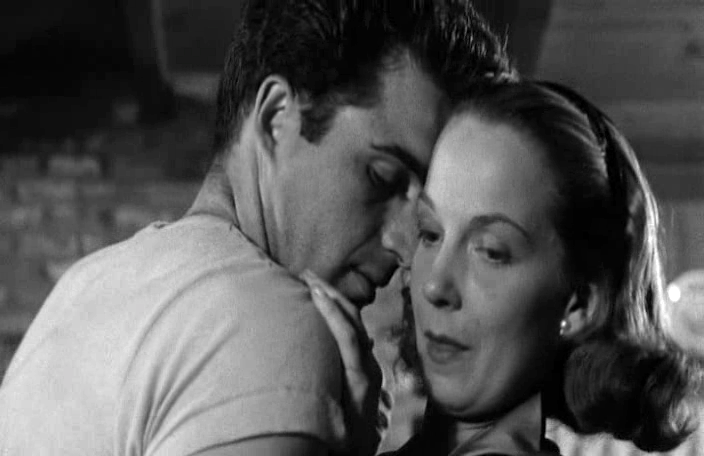

At first Gosset wants Courtier to sell his car for the cash, but Batsford (Cassavettes) wants to hold the family hostage for the ransom money instead…
Also stars John Cassavettes as Robert Batsford. and David Cross as Luther Logan the other two men in Gosset’s gang. A real gripping thriller!


Don’t pick up any hitch-hikers, but of course you knew that by now-MonsterGirl cares!

This post continues from Part 1 at the link above!
And now, Part II
The child per se makes us uneasy, ambivalent ; we are anxious about the human propensities concentrated by the child symbol. It evokes too much of what has been left out or is unknown, becoming easily associated with the primitive, mad and mystical. – James Hillman ” Abandoning the Child” in Loose Ends.


To continue with this blog post about one of Lewton’s very precious stories, less dark than his others, and dealing with childhood, the fears of and by children.
All of Lewton’s works dealt with subject matters that forced us to push the boundaries of ‘the familiar.’ They challenged us to face a darker, more mysterious reality of the natural world and the incomprehensible landscape of the human psyche.


Curse of the Cat People (1944) acts as a cinematic continuum to Lewton’s Cat People 1942, featuring Simone Simon once again as the alluring and sensual Irena Dubrovna Reed, who may or may not have belonged to a race of beings that could shapeshift into the physical form of a large cat or black panther when sexually aroused.
The symbol of Irena synthesized the fear of women’s sexuality, sexual freedom, the women’s body, and often the correlation that is made with women’s emotional existence and madness. What is engendered in Cat People (1942) is far less about a woman who can morph into a predatory feline and more about the collective fear of ‘The Monstrous Feminine.’


While Amy is not Irena’s biological daughter, Amy is truly more of a progeny to Irena and the mystique she embodies because they are both alienated figures who are frustrated and misunderstood. Who stand outside the social community which is pumped from the veins of ‘rational’, normative thoughts and behaviors. Amy is the figure of ‘The Fearing Child,’ an innocent who not only has ‘power’ but can wreak havoc in our ‘normal’ world.


Both characters are imaginative and rely on their senses. They are more connected to the natural world, to the darkness, which is associated with feminine energy, and less intellectual, which is considered a masculine marker. They are considered emotional, irrational, and dangerously unpredictable. The character of Oliver Reed is just as frightened and, moreover, threatened by his six-year-old little girl as he was of his beautiful and tragic wife Irena, who was more a victim than ever, the ‘monster’ she was perceived to be.
In Cat People, Curse of the Cat People, I Walked With A Zombie, The Leopard Man, The 7th Victim, and Isle of The Dead, there aren’t concrete Monsters as in Universal films, as in Frankenstein’s creation, Dracula, or The Wolf Man.

RKO studio heads had a mistrust of Lewton’s creative vision, his unconventional approach to some esoteric subject matter, or volatile subjects such as a woman’s sexual desires. Lewton, rather than using literal lumbering, fanged, or hairy monsters, used the powers of suggestion and shadow to tell the story.


Lewton disliked mask-like faces that were hardly human, the kinds of images that were expected from the horror genre he was infiltrating. Lewton liked to reveal the monsters that were lurking in the subconscious primitive recesses of our own imaginations. Shadows become the monster in these films, they are the mysterious layer that surfaces in world that only makes sense in the light of day. And Amy draws the shadows to her…
They do not have scary faces, they are quite human and in fact ordinary. He takes the ‘familiar’ and inverts it, subverts it, rattles the soundness of an accepted experience, and turns it into either an illusion, a nightmare, or a fit of paranoia. He taps into our childhood fears and sets those fears on the frightened characters in his shadow plays. Usually, the thing they fear is uprooting their own personal desires and the fear of coming face to face with them.

Oliver couldn’t handle Irena’s sexual desires, nor her desirability; it triggered too much of his own primal urges, and so he demonized her, a fragile girl in a foreign country who believed in folklore from her very ancient set of beliefs handed down for centuries.

A story which quite often itself was ambiguous as to whether the threat was real or imagined. RKO wanted to be in competition with Universal, so they added footage of a menacing Panther, which was inserted into several scenes of Cat People.

Val Lewton’s short story ‘The Bagheeta’ appeared in Farnsworth Wright’s July 1930 issue of Weird Tales Magazine. Lewton was dabbling in concepts of terror, before he even got to RKO.

The story takes place in Ukraine (from which MonsterGirl’s people hail!) and is a coming-of-age story about a 16-year-old boy named Kolya who helps his Uncle forge armor. Someone comes into the village with a slaughtered sheep, who claims to have seen a Bagheeta, a monstrous black leopard that can change its form into a beautiful woman. Only one person can kill a Bagheeta, and that is a virgin male, for he needs to be able to resist her seductive powers. If he is seduced, the woman will change back into the black leopard and kill the boy and eat him! Lewton would eventually adapt and produce his story for RKO in the form of Cat People in 1942 starring Simone Simon, the suggested embodiment of a Bagheeta.
His vision, from the constantly passing bars,
has grown so weary that it cannot hold
anything else. It seems to him there are
a thousand bars, and behind the bars, no world.
As he paces in cramped circles, over and over,
the movement of his powerful, soft strides
is like a ritual dance around a center
in which a mighty will stands paralyzed.
Only at times the curtain of the pupils
lifts, quietly — An image enters in,
rushes down through the tensed, arrested muscles,
plunges into the heart and is gone.
-Rainer Maria Rilke


Produced by Val Lewton and directed by Robert Wise and Gunther von Fritsch, scripted by DeWitt Bodeen, and stars Simone Simon as the ghost of Irena, Kent Smith as Oliver Reed, Jane Randolph as Alice Reed, Eve March as Miss Callahan, Julia Dean as Mrs. Julia Farren, Elizabeth Russell as Barbara Farren, Sir Lancelot as Edward, and Ann Carter as Amy Reed. Ann Carter played Beatrice Carroll in the riveting noir classic The Two Mrs. Carrolls (1947)with Humphrey Bogart and Barbara Stanwyck.
Curse of the Cat People is filled with poignant original music by Roy Webb and with Cinematography by Nicholas Musuraca (Cat People 1942, The Fallen Sparrow 1943, The 7th Victim 1943, The Spiral Staircase 1945 Bedlam 1946 and Out of The Past 1947) It’s no wonder Curse of The Cat People has many of the elements of a classic film noir piece.

After the tragic death of his wife Irena, played by the beautiful Simone Simon, Oliver Reed, once again played by Kent Smtih, has remarried his co-worker Alice (Jane Randolph). They now have a very serious yet gentle six-year-old girl named Amy (Ann Carter) who is taken to daydreaming and being a loner.
She does not mix in well with the other children at school who do not understand her sensitivity or her private world of fantasy that she has built around her as a survival mechanism.


Amy’s father, Oliver, constantly wields authoritative criticism of his daughter’s daydreaming and wants her to play with the other children and exist in the ‘real’ world. Amy has a birthday party for which she invites the children in her class, but no one shows up that day, and Oliver discovers that she has mailed out the invitations by placing them in the magic wishing tree, which is a hollowed-out knot of the large tree out behind the house.


 .
.

Oliver had told Amy this was a magic spot when she was younger, and she remembers it, understanding it to be true because her father told her it was. She was taught to believe in magic and then, without preparation, was expected to denounce all things wondrous without any serious provocation on her part. She is only six years old, after all.
Saddened by her classmates’ absence at her party, Oliver, Alice, and Edward, the manservant from Jamaica, throw Amy a smaller party instead, complete with a birthday cake decorated with six little candles.
Amy is told to make a wish but not to tell anyone what it is, or it won’t come true. Again, Amy is conflicted by the mixed messages the adults in her life are giving her. She tells her father that wishes don’t come true. Oliver tells her, “Some do.” Her mother, Alice, embellishes by saying that you just can’t say it out loud, or it will nullify the magic wish.

Once again, there is a suspension of disbelief on their terms, disavowing Amy and her ability to develop a clearly defined sense of fantasy and reality. How can she properly order her world?


The children at school are furious with Amy for not inviting them as promised. As they shun her, they lead her to an old, sinister-looking mansion, where someone calls to her from the window. A voice calls out to her to come closer. Amy looks around, and the unseen person throws down a white handkerchief threading a gold ring.


Directed by Terence Young, and starring Eric Portman, Edana Romney, and Barbara Mullen. Edana Romney co-wrote the script.
Eric Portman plays Paul Mangin, who thinks he is Cesare Borgia reincarnated and that Mifanwy Conway (Edana Romney) is his lost love from a previous life. Corridor of Mirrors also showcases appearances by Christopher Lee and Valentine Dyall. A table at a nightclub with Mifanwy and her companions offers a fleeting glimpse of an astonishingly young Christopher Lee in his film debut, marking the beginning of a legendary career.
Terence Young’s film is a masterpiece of exquisite British filmmaking, immersing us in a rich atmosphere and evoking a mood that rivals the best psychological suspense thrillers and horror films from the forties, like the shadow plays of Val Lewton and the Gothic dark romances such as Wuthering Heights 1939, Rebecca 1940, and Jane Eyre 1943.

Corridor of Mirrors evokes an atmospheric, hallucinatory spectacle akin to Henri Alekan’s cinematography as he follows Josette Day’s travels through the mansion in Cocteau’s 1946 fable-like masterpiece Beauty and the Beast, imbued with its baroque, gilded, and ornate set design. Andre Thomas’s poetic lighting and camera angles suffuse the landscape of labyrinthine corridors, creating a somber and otherworldly landscape that evokes traces of Lewis Carroll’s Alice in Wonderland as Edana Romney journeys through the dreamy complexity of the mansion, trying to break free of the spell, as she pursues the white cat, who is an emblem of Alice’s white rabbit.
Terence Young’s haunting directorial debut is one of those rare films that sweeps you straight into its opulent, unsettling dreams. It is a stunning and dreamlike gothic noir steeped in romantic obsession, sorrow, and psychological unease. At the center of it all is Paul Mangin, an enigmatic, larger-than-life artist absolutely obsessed with the past. The story spirals around this mysterious figure who cloaks his mansion and himself (in velvet capes), in Renaissance grandeur and holds the profound certainty that his soul has spent lifetimes, shaped by love and loss, echoing across centuries. Paul’s interest in Mifanwy is nothing more than a reflection of a cherished image, a portrait whose allure her appearance unsettlingly echoes, devoid of true understanding or affection.
Edana Romney wasn’t just cast as Mifanwy; she shaped the role herself, working closely with co-producer Rudolph Cartier to adapt Chris Massey’s novel into the screenplay. Watching her on screen, she moves almost like she’s sleepwalking, and while her acting is somewhat restrained, it actually adds to the film’s hypnotic, dreamlike quality. Throughout, she’s shadowed by a mysterious woman and a fluffy white cat, both quietly watching, which only deepens the sense of eerie voyeurism and subtle unease.


When Paul meets the beautiful Mifanwy Conway, lovely, possibly shady, and just curious enough to get drawn into the sinister spell, his fixation deepens. He’s convinced she’s the reincarnation of a long-lost lover from centuries ago and seeks to shape her to fit this spectral ideal. She rides beside Paul through shadowed London streets, the horse-drawn cab winding toward a vast, brooding mansion at the city’s heart. Paul, a forbidding aesthete veiled in grand delusions of a past life as an Italian noble, seeks to ensnare the sensuous Mifanwy in the dark embrace of his twisted reverie.
From its shadow-drenched corridors and warped reflections, the film blurs the boundary between reality and hypnotic fantasy. Corridor of Mirrors is a wild, shadowy fever dream drenched in mystery and illusion. It carries you from these dark, mirror-lined hallways and the lavish costume balls right into haunting galleries filled with faceless mannequins. Reality and fantasy melt together here; sometimes, you aren’t sure which is which. It’s like stepping into a twisted fairy tale. Each scene pulses with the quiet torment of lives trapped in mirrors, echoes of Pygmalion, Bluebeard, and Cocteau’s haunted fairy tales. It is as if the characters are caught in a maze of glass, unable to escape their own reflections and obsessions.
Paul Mangin’s obsession leads to madness, murder, and a shattering denouement amid wax effigies in Madame Tussauds, where the film’s onyx gloom gives way to truth and a tragic sense of justice.
The film’s Gothic atmosphere occupies a rare and haunting space, yet it draws subtle echoes from both Hitchcock’s Vertigo (1958) and Fritz Lang’s eerie 1947 thriller, The Secret Beyond the Door. In the latter, a new bride, Joan Bennett, uncovers a chilling secret: her husband’s obsession with recreating rooms where murders have taken place, a macabre blurring of the lines between love and death, passion and violence.
André Thomas’s cinematography is a world unto itself, with its eerie, poetic visual style transforming the film into a hypnotic dreamscape. He plays with light and reflection brilliantly so that you almost lose track of where the real world ends and fantasy begins, those iconic mirrored corridors, where characters and their secrets multiply endlessly in flickering candlelight, and movement, fracturing reality and plunging the film’s characters into a labyrinth of shifting perspectives. Thomas’s cinematography exquisitely captures the film’s sumptuous costumes and intricate décor, draping each scene in a play of shimmering shadows and delicate highlights. His lens lingers on textured fabrics and ornate surroundings, bathing the opulence in a luminous glow that feels both intimate and grand, inviting us to step into a world where every detail is a visual feast. Thomas bathes the set in a chiaroscuro haze in key sequences, such as Mifanwy’s passage through the mansion’s long, mirrored hall lined with faceless mannequins. Nothing is quite what it seems. This approach blurs the line between fantasy and reality, uniting the film’s aching romantic longing and its creeping psychological dread. In every veil and distortion, the characters’ tangled obsessions and fractured selves mirror each other.
George Auric’s (who scored Cocteau’s La Belle et La Bête) score for Corridor of Mirrors flows like a dark, Gothic, melancholic river beneath the film’s haunting imagery, its melodies rising and falling with the rhythm of obsession and longing. The music is at once ethereal and grounded, shimmering with delicate strings that weave through shadowy passages and shadow-drenched ballrooms, while moments of brooding brass and subtle piano suggest the deep undercurrents of psychological unease and brooding desperation. The late moments, underscored by sweeping, delicate orchestration, evoke the grandeur and tragic beauty of the unfolding drama, making his score an essential part of the film’s haunting allure. Auric’s composition turns every whispered secret and silken touch into a symphony of passion and peril. The gowns were designed by Owen Hyde-Clark and constructed by French couturier Maggy Rouff.
“In projecting the slow abandonment of one’s identity, her third and final performance on the big screen evokes the pleasure, and the terror of romantic submission, Smith says — Mifanwy is a princess who, unlike Cinderella, who waits for a prince, or Snow White or Sleeping Beauty, immobile without the touch of a man’s lips, must break her own spell.” (Imogen Sara Smith for Criterion)
Corridor of Mirrors is a lush, visually extravagant meditation on identity and desire, where the past’s spectral grip suffuses every candle-lit room and character’s haunted gaze. The artistry of set and cinematography deepens its poetic melancholy, making the film a rare British gem, finely blended of exquisite and unsettling, and forever suspended between passion and despair, somewhere between the promise of love and the weight of memory.


See you in the mirror soon, MonsterGirl
