“No one comes any further than town, in the dark, in the night. No one will come any further than that; In the dark, in the night. –
Mrs. Dudley, Robert Wise’s 1963 masterpiece, The Haunting


My pop was the strong silent type. He was stoic. He was fearless. He was fair…Growing up in the Bronx he would pronounce things like Toilet Paper as Terlit Paper and Oil as Erl. He had been a marine in the Korean War. He worked two jobs most of his life until a heart condition knocked him down permanently. Mom was a mix of Sarah Bernhardt and Blanche DuBois. She was an incredible painter and a frustrated actress who did local Theater and sang a bit like Ethel Mermen which brought about a lot of wrath on me as a kid because the neighbors would taunt me about it. She always left the kitchen door open and would bellow out show tunes while making lunch or cleaning the house. I would be harassed relentlessly about it until I moved away from the neighborhood.
Me, I was terrorized by the neighborhood kids for being different. Not different like weird in a serial killer way. I didn’t light things on fire or have a fascination with taxidermy. No, I was normal in that regard. I just wasn’t mainstream like them. And I was very very sensitive. They smelled it on me like fresh blood to a shark. 
They tortured me endlessly. One such person even locked me in her basement for what seemed like an eternity, although it was probably no more than a few hours. It’s not like I was Stephanie Powers at the mercy of Tallulah Bankhead in Die Die My Darling or anything but still as a child, that was traumatic. That’s why I gravitated toward the misunderstood monster. So what if he was greenish? hairy, 50 feet tall, and eating tourists. He had feelings, didn’t he? You gotta eat don’t ya?
Mom and Pop never treated me like a freak, even though I was obsessed with monsters and creepy tales and the supernatural etc. They nurtured my imagination and allowed me to explore my creativity and my otherness. I’ll always be grateful to them for that. They gave me my piano when I was 8 years old. They encouraged me to play for their friends and anyone who would listen. Even the plumber. They were very proud of their pretty little monster girl. It made me kind and sympathetic. Thank god they understood that about me and didn’t force me to roller skate or become a cheerleader. Yikes! And I did play with dolls, I was just less interested in Barbi and more into action figures and Aurora Models of Frankenstein and Wolf Man.
One of Pop’s jobs was working for a printer. He worked the presses late at night and would often go on deliveries to the local Stationery and Candy Stores on Long Island. There’s nothing really like that anymore. Just 7/11’s and Gas Station Mini marts. But I am sure there are those who will remember the small mom-and-pop stationery stores that carried all your needs. At least Whalens did. My pop would often take me on his route and buy me the latest issue of Forest J Ackerman’s Famous Monsters Of Filmland. I’d get a package of SweetTarts and perhaps the latest DC comic with Iron Man or The Flash! These little excursions meant the world to me. My pop never complained that I was not doing girlie things or that I might have been morbidly preoccupied with creatures with 1,000.000 eyes or Mad Doctors and such!
He just loved me and let me be. He even put up with my taking his hammer and tools to build the space stations out of boxes, putting on knobs and dials where ever I could find loose odds and ends around the house. This I would endeavor in the basement. Oh, he’d get a little annoyed if I’d forget to put things back in his workbench, but he never said, go put on a dress and stop acting like Dr. Pretorius!
Although I don’t think he would have known who that was, more like Gary Cooper is like it. And that’s cool with me!
My folks never put constraints on me. They would let me stay up late and watch Chiller Theater or Alfred Hitchcock Presents or Thriller. And when the latest Hammer Horror, 70’s cult Film or Drive-In movie came out, they would take me. I spent so many balmy Saturday afternoons in the cool dark movie theater enraptured by the double bill’s offering. I saw Rosemary’s Baby and The Mephisto Waltz at 9 years old. They were released as a double feature. They had a lot of double features back then. Nothing like today. Back then I would see every horror movie there was to see. On television, Movie Theaters, and Drive-In Theatre. My imaginary world often collided with my waking life.
I could always count on my folks to give me access to the dream world that was horror and sci-fi. It was my salvation and my escape. They were my muse of a sort. I carry those impressions with me still. I’ve written music because of it. I’ve learned to cope because of it. It gave me a unique perspective on life, which I think is very characteristic of classic horror movie fans.

On the weekends I would watch cartoons like The Groovy Ghoulies or shows like Lost In Space. I’d sketch superheroes and read true stories from Hans Holzer about ghosts all over the world. I had a subscription to Fate Magazine. I had toys like Cootie that bore a resemblance to the Zanti Misfits from The Outer Limits. I’d build Aurora Models of the Universal Monsters and sometimes, I’d put the chair against the basement door when no one was home. I believed in things that lurked in the dark. But I welcomed them as long as they were on the television screen or on a page. This was just a bit of my childhood on Warren Drive. This was where dreams were made. And visions became clear. On Warren Drive…


Directed by John Brahm, and adapted by Donald S Sanford from the short story by Robert Bloch which appeared in Weird Tales Magazine, The Cheaters concerns an odd pair of spectacles that allow the wearer to read people's thoughts. Inscribed on the inside is Veritas The Latin word for The Truth.
In Roman mythology, Veritas (meaning truth) was the goddess of truth, a daughter of Saturn, and the mother of Virtue. It was believed that she hid in the bottom of a holy well because she was so elusive.
“The Cheaters” also lay bare the frightening and often hideous true nature of someone's soul hidden behind their façade. Their Anima Sola or The Lonely Soul, as Jungian psychology considered it.
n.
2. In Jungian psychology:
The Anima Sola or Lonely Soul is a Catholic depiction of a suffering person — almost always a woman — in chains amidst the barred prison doors and flames of Purgatory, the place where sinners go while awaiting final judgment.The Anima Sola is taken to represent a soul suffering in purgatory, usually, if not always, a woman. The woman has broken free from her chains in the midst of a prison (barred doors) and is surrounded by flames, representing purgatory. She appears penitent and reverent, and her chains have been broken, an indication that, after her temporary suffering, she is destined for heaven.
In the case of The Cheaters, I think that the soul’s chains are the corporeal body that binds the true inner self. The funny yellow glass that van Prinn has invented through alchemy allows the boundaries to be crossed over in order to see the actual soul suffering in its physical purgatory.
Karloff introduces this memorable episode, his words linger on the edge of the air so melodically like a soft sermon as the preamble to The Cheaters.

“When a man shuts himself off from his neighbors when he conducts mysterious experiments"¦ there’s bound to be talk. There were those that whispered that Old Dirk van Prinn was a sorcerer or worse… He might not have been remembered at all had not his research led him to the discovery of a most unusual formula for making glass.”


Fade in Henry Daniell who makes a brief appearance as Dirk Van Prinn, the alchemist/inventor of the spectacles or "the cheaters" Locked away in his primitively rustic laboratory, we see him tinkering amongst the flasks of liquid and scales, a pair of pliers in his hand as he finishes setting the "yellowed old lenses" in the wireframes. He has discovered a peculiar formula for making glass!

The housekeeper Mrs. Ames brings him a package annoying him with an offer of some nourishing soup since he hasn’t had a bite all day. Irritated by the intrusion he just wants her to leave him alone. Mrs. Ames keeps peaking around him trying to catch sight of his mysterious room. He tells her goodnight.

Jerry Goldsmith’s evocative score teems with eerie delight as the strings pluck and trill out macabre musical strokes and a piano tinkles with flute embellishments that flutter as afterthoughts as he sits in front of the large mirror by candle light.


He tries on the spectacles and stares at his own reflection the camera blurs our vision momentarily. van Prinn is horrified by the image he is gazing at. As we view his face in close-up, it distorts as he becomes more frightened by what he sees looking back at him in the mirror. The camera closes in on his tinted spectacles and the look of abject fear in his eyes.
The music becomes a frenzied climax as the scene trades with a black background and a few low piano notes held as Boris Karloff walks on screen to tell us about the evening’s terror tale.


I've always been struck by Henry Daniell's unusual facial features that often lend to many of the sinister roles he's played in the horror film genre. He's somewhat like a Faustian marionette, with a wooden-like grimace frozen in extreme sardonic glee. I particularly loved him in one of my favorite classic campy films of 1959 The 4 Skulls of Jonathon Drake Daniell’s make-up for the Well of Doom episode bears a striking similarity to Lon Chaney’s character in Tod Brownings, London After Midnight 1927.

One hundred years later the spectacles are found by Joe Henshaw junk man, in a hidden compartment of an old rotting, dust-covered desk in Prinn's abandoned house.
The Cheaters includes wonderful performances by Paul Newlan as Joe Henshaw, the down-on-his-luck junk dealer who discovers the cheaters in more ways than one when he stumbles onto the spectacles at the old Bleaker Place where van Prinn did his experiments.
Continue reading “The Cheaters [Essay on Thriller with Boris Karloff] ‘Know thyself’”
“For the sightless eyes of the Hollow Watcher see more than you might imagine.” –Boris Karloff

The Hollow Watcher was written by Jay Simms, the man responsible for bringing us the screenplay of The Killer Shrews 1959. This is American Gothic. The mood is perfectly inhospitable and eerie with a poignant score that creates an atmosphere of queasy desolation.
Directed by William F. Claxton. The episode stars Audrey Dalton as Meg O’Danagh Wheeler, Warren Oates as Wheeler, Sean McClory as Sean O’Danagh, and assorted members from the Andy Griffith Show. Sandy Kenyon, Denver Pyle as Ortho Wheeler, Norman Leavitt, Mary Grace Canfield as Ally Rose, and then great character actor Walter Burke as Croxton.
MonsterGirl “Listens”: Reflections with great actress Audrey Dalton!

A Backwoods hollow, rife with superstition, folklore, and omens. Abuse, murder, greed, and rural righteous retribution for sins delivered by a legendary wielder of the law The Hollow Watcher. Black Hollow’s name for the bogeyman. A very homespun scarecrow. A straw man. A stitched guy on a stick, who watches over the simple people of Black Hollow from up on a hill. If any of the town folk should transgress they would surely be at the mercy of either ‘claws, feet or teeth’ of The Hollow Watcher. Do stuffed men have teeth I wonder?

The town of Black Hollow is filled with characters that are nosy gossips who seem almost gleeful with the idea that someone might fall out of grace within the old-fashioned laws watched over by this bucolic straw avenger. There’s a pervading fear anyone might become the next victim of their rustic beastie which lurks in the fields by night. The townspeople are also ethnocentric bigots who are suspicious of all outsiders or foreigners. The locals refer to Meg as ‘that fancy woman’ putting her in a way that separates and admonishes her for her difference
The abusive father, the general store’s proprietor Ortho Wheeler is perfectly cast, by Denver Pyle (Briscoe Darling on The Andy Griffith Show )


Ortho doesn’t approve of his son Hugo’s new wife. To Ortho, she’s “mail order baggage” The perfect hypocrisy of this self-righteous and sexually repressed small-town brutality is illustrated when Ortho in a rage, savagely rips Meg’s dress and then proceeds to tell her “Your nakedness is an abomination before the lord.” Typical of a patriarchal figure to damn the female subject of his gaze and project his own inner conflict onto them. This kind of religious fanaticism breeds an inverted frenzy that comes across as moral zealotry.


Hugo Wheeler thinks he has married a virgin mail bride from Ireland. An innocent lass whom he can dominate sexually, although Audrey Dalton who plays Meg successfully holds him at bay throughout the episode which adds to the tension. Hugo remains husband in name only. Warren Oates plays Hugo who enacts his carnal frustrations with such a subtle volatility that we wish mercifully that Meg would at least grant him entry to a mere kiss.


Hugo has been emasculated by his brutish father, and so he seeks out Meg’s physical attention to help boost his nerve to fend off his daddy’s assaults and to bridge the gap between a weak young farm boy and his rightful claim of manhood. After Ortho tells Hugo, “Come to the barn and get your lickin’“ Hugo asks Meg, “If I stand up to daddy, things will be different?” His identity seems to hinge on this. Ortho thrashes his son into a bloody swollen heap who passes out from the beating, in the meantime, Meg cracks Ortho in the back of the head with a very large farm implement and kills him.


What Hugo doesn’t know is that Meg already has a husband Sean who has killed a woman in back Ireland for her money and has now come to America to reunite with his bride who plans on doing the same to Hugo.
She has stuffed his daddy’s body into the scarecrow that sits atop the hill, hoping the locals will find the body and blame him. No one goes there but field mice and copper-headed serpents. Even the carrion birds, seem to sense the evil deed that’s been done and stay far away from that straw man in the field. Meg says, “It’s because it isn’t quite dead” The Black Hollow bumpkins suspect that either Hugo and his curious foreign witch-like bride have offed Ortho or that The Hollow Watcher has plucked him out because he was “mean enough.”


The pathologically fragile Meg who clings to her rag doll as if it were the child she’s never had, is in actuality awaiting her real husband, the dapper Sean who eventually arrives and begins to masquerade as her brother in order to swindle her woefully boorish and crude husband Hugo Wheeler out of his inheritance. Unfortunately, she has no idea where Ortho’s fortune is hidden.
Meg eventually starts to descend into subtle madness because she finally believes in Hugo’s “spook” and that The Hollow Watcher is a thing that sneaks around in the shadows getting closer and closer, casting judgment upon her and waiting in the darkness to exact his revenge. As Boris says in the beginning she’s afraid of “The wrath of a demon such as The Hollow Watcher.”


Although, the ending of this episode is slightly anti-climatic because we eventually see the scarecrow confront the weary Meg and it’s simplistic presence could be considered laughable, coming closer and closer its burlap-painted face peeking through the window pane. It clumsily follows her up the stairs, {my Grandma Milly could have outrun it!} Still, The Hollow Watcher has a wonderfully creepy American Gothic quality to it. And really, how could you make a simple straw man terrifying in the 60s? The effect at the end exposing Ortho Wheeler’s skeleton is pretty striking…
The sweetly sad melody written by Sidney Fine and William Lava sounds much like American composer Aaron Copeland and really adds a very moving dimension to this bleak and eerie story.
I love the cameo appearances from the Andy Griffith Show regulars, which adds to the homegrown rustic feel of the episode. Makes me sort of want to break into a rousing section of “Sourwood Mountain “Old Man Old Man I want your daughter- hey, ho, diddle-um day.” Mary Grace Canfield has a brief appearance as Ally Rose a homely plain town girl, (although It always bothered me that she was often cast as the ugly girl. I thought she was adorable and I wonder how it must have made her feel whenever they would send out a casting call for a homely girl and her agent would say Mary Grace there’s a role for you. Isn’t that awful really? It truly pains me.


Sourwood Mountain
Chickens a-crowin’ on Sourwood Mountain,
Hey, ho, diddle-um day.
So many pretty girls I can’t count ’em,
Hey ho, diddle-um day.
Old Man Old Man I want your daughter
Hey ho diddle um day
Bake me bread and tote me water
Hey ho diddle um day
My true love’s a blue-eyed daisy,
She won’t come and I’m too lazy.
Big dog bark and little one bite you,
Big girl court and little one spite you.
My true love’s a blue-eyed daisy,
If I don’t get her, I’ll go crazy.
My true love lives at the head of the holler,
She won’t come and I won’t foller.
My true love lives over the river,
A few more jumps and I’ll be with her.
Ducks in the pond, geese in the ocean,
Devil’s in the women if they take a notion.
RG
Nathaniel Hawthorne‘s short story Feathertop is about a scarecrow created and brought to life in seventeenth-century Salem, Massachusetts by a witch in league with the devil. He is intended to be used for sinister purposes and at first, believes himself to be human, but develops human feelings and deliberately cuts his own life short when he realizes what he really is. In the Japanese mythology compiled in Kojiki in 712, a scarecrow appears as a deity, Kuebiko, who cannot walk but knows everything of the world.
The Scarecrow is one of the most familiar figures of the rural landscape not only in the United Kingdom but throughout Europe and many other countries of the world. His ragged figure has been recorded in rural history for centuries. His image has proved irresistible to writers from William Shakespeare to Walter de la Mare as well as to filmmakers since the dawn of the silent movie. Yet, despite all his fame, the origins and the development of the scarecrow have remained obscured in mystery.
The earliest known written fact about scarecrows was written in 1592.Definition of a scarecrow – That which frightens or is intended to frighten without doing physical harm.Literally, that which – scares away crows, hence the name scarecrow.
Â
MonsterGirl bids you howdy!
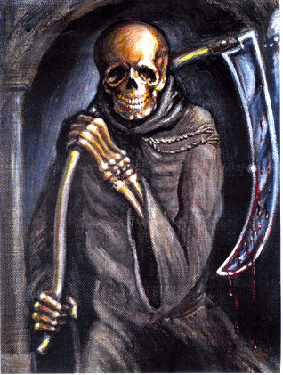
Directed by Herschel Daugherty and adapted by Robert Bloch from a story by Harold Lawlor it concerns a 19th-century painting and its fatalistic legend The Grim Reaper created by a morbidly obsessed painter Henri Radin. Radin who hangs out in graveyards and paints “still lifes” at the morgue, creates this cursed painting and then proceeds to hang himself. Again, much like with “The Cheaters”, whoever the painting falls into the hands of seems to doom them to a tragic or violent death.
The wonderful Henry Daniell plays Henri Radin’s father who comes looking for his son, only to find that he’s hung himself, leaving his morbid portrait of death behind.


Boris Karloff presents the evening’s tale of terror standing in front of the infamous painting.


Fast forward to the present-day Natalie Schafer "Lovie Howell" from Gilligan's Island plays famous mystery writer Beatrice Graves who has a penchant for the dramatic, drives a hearse, and lives at Grave's End, a Charles Adams-style mansion she uses for publicity. She purchases the cursed painting in order to garner some attention from the press. She also has a preference for lecherous husbands and has now married her 6th, a smarmy actor Gerald Keller (Scott Merrill) 20 years younger who is constantly chasing her after Bea’s lovely secretary Dorothy Lyndon (Elizabeth Allen) who looks like a Hitchcock blonde in this episode.
William Shatner plays Bea’s nephew Paul Graves who reads about his eccentric aunt obtaining the cursed painting. He arrives hoping to convince her that she's in mortal danger, having made the fatal error of bringing this cursed monstrosity into her home.


In actuality Paul is plotting to kill her and blame her death on the painting~ His eccentric Aunt Bea is a lush who waves him away as if swatting a fly and dismisses him for being “the world’s oldest eagle scout.” In reality, Paul is setting everyone up using the legend of Radin’s painting to cover his murderous plans to become the recipient of Beatrice Grave's inheritance until the painting decides to hold court and wield its bloody justice with its scythe. There are some authentically chilling aspects to this episode. The subject of Stigmata is injected into the plot, as part of the legend holds that the painting bleeds whenever someone has been chosen to die. Dorothy understands Stigmata to be a religious phenomena Paul tells her “No it’s not a religious painting unless the man who painted worshiped death.”


Natalie Schafer is wonderful as Aunt Bea modulating between being a sympathetically fragile, sensually self-destructive, and tragic character then she emerges as vitriolic and sulfurous as the great Medusa quite imposing as a figure of the Monstrous Feminine.


Many of Thriller’s female characterizations were very complex and well-developed. Medusa as an archetype has historically been seen as the archetype of “the nasty mother” Bea Graves having wed a man young enough to be her son. While Medusa symbolizes sovereign female wisdom and female mysteries Bea being a “mystery’ writer, understands her predicament and walks into the flames of desire anyway. She is universal Creativity and Destruction in eternal Transformation. She rips away our mortal illusions. Bea has no illusion that her husband loves anything more than her millions but she desires him anyway. In this case, Bea knows that she is on a self-destructive path and seems to embrace it willingly. “To me, death is no more than a business partner.”


We never see the actual Reaper step out of the painting, in the way he was used in the literal sense in Fritz Lang’s 1925 masterpiece Metropolis where you see him step forward swinging his scythe. With this episode’s adaptation of the myth, It’s the sound and glimpse of his scythe cutting through the air in volatile swipes that create the slashing, nightmarish effect.

“In English lore, death is often given the name the “Grim Reaper” and shown as a skeletal figure carrying a large scythe, and wearing a midnight black gown, robe or cloak with a hood, or sometimes a white burial shroud Usually when portrayed in the black-hooded gown, his face is not to be seen, but is a mere shadow beneath the hood.”
In some cases, the Grim Reaper is able to actually cause the victim’s death, leading to tales that he can be bribed, tricked, or outwitted in order to retain one’s life. Other beliefs hold that the Spectre of Death is only a psychopomp, serving only to sever the last tie from the soul to the body and guide the deceased to the next world and having no control over the fact of their death. image at bottom ; dance of death. psychopomps”
The origins of the Grim Reaper go back far into the past and he was known by many names. In old Celtic folklore, he was known as L'Ankou, sometimes called Father Time. To the Greeks he was known as Cronus and the Romans called him Saturn.
Don’t be grim, I’ll be back with more Thrilling episodes! MonsterGirl


