"For some nights I slept profoundly; but still every morning I felt the same lassitude, and a languor weighed upon me all day. I felt myself a changed girl. A strange melancholy was stealing over me, a melancholy that I would not have interrupted. Dim thoughts of death began to open, and an idea that I was slowly sinking took gentle, and, somehow, not unwelcome possession of me. If it was sad, the tone of mind which this induced was also sweet. Whatever it might be, my soul acquiesced in it." "• Joseph Sheridan Le Fanu, ‘Carmilla’
The Light in the Window … The Lock on the Door … The Sounds in the Night! A Possession is Taking Place!
A while ago I double featured Let’s Scare Jessica to Death (1971) and The Night God Screamed (1971). I made it clear that I felt Let’s Scare Jessica to Death was the superior film but somehow they made good companion pieces. And since I’m a child of the 70s, those days of the double bill, musty theaters, milk duds, and groovy posters, I’ve decided to pair these particular films. And once again, I’ll emphasize now that I believe Lemorato be by far not only the superior film but one of the MOST uniquely beautiful horror/fantasy films I’ve ever seen.
Because the film hit a very bumpy road on its release, it wound up being passed around like an orphan from one distributor to another. Thus is the reason for several titles over the years. It has been called The Legendary Curse of Lemora and Lemora, Lady Dracula, the latter hoping to ride the wave of low-budget vampire films that have now also attained cult status such as Bob Kelljan’s authentically potent Count Yorga Vampire 1970 starring Robert Quarry, and the equally stylish Blacula 1972 and of course the Gothic vampire pageantry of Hammer Studios churning out stylish costume melodramas with a lesbian vampire sub-text like The Vampire Lovers 1970 and Lust For a Vampire 1971, Stephanie Rothman’s The Velvet Vampire 1971, and Vicente Aranda’s The Blood Spattered Bride 1972. The liner notes written by Richard Harland Smith of Video Watchdog & Chris Poggiali of Fangoria and Shock Cinema interviewed Richard Blackburn and Byrd Holland and point out that Blackburn’s film is “less exploitative” yet “not unerotic” while using the “fragility of innocence.”
From the Journal of Horror and Erotic Cinema-Edited Andy Black
Bev Zalock’s- Girl Power From The Crypt
“In a sense, horror more than any of the other exploitation genres, with its monsters of the imagination, feeds fantasy and configures fear in a very direct way. With its linking of sex and death, horror taps into the unconscious and is associated with surrealism and the fantastic in both literature and cinema. Desire becomes the primary mise-en-scene within the realm of the supernatural and, as David Pirie observes in his excellent book The Vampire Cinema’ there is a strong cultural connection between our perception of sex and the supernatural. Pirie cites an article by Susan Sontag written in 1967 entitled “The Pornographic Imagination” in which she locates the fantastical realm of the human imagination as the site in which the two are classically connected.” – from Susan Sontag’s piece–Styles of Radical Will 1966
Celeste Yarnall is the dark lady vampire in Stephanie Rothman’s -The Velvet Vampire-co-starring Sherriy Miles.
In addition to these lesbian vampire narratives, you have Jess Franco’sVampyros Lesbos 1970 and auteur Jean Rollin’s distinctive style who like Hammer connected suggestions of the ‘pornographic imagination’ that Susan Sontag describes. Films that use the spectrum of surrealist imagery from the Gothic to the gory. What they share is a ferocious appetite for power and the desire for sexual freedom.
Directed and written by Richard Blackburn (Eating Raoul 1982 with cult idol Mary Woronov and co-written with director Paul Bartel) fresh out of UCLA film school, with his pal Robert Fern. Blackburn has said in interviews that there are things he would have done differently with a better budget and more time. He shot Lemora in a month. I think the crudely macabre tonality of Lemora is what makes films like these from the good old ’70s oneiric, quintessential, haunting, and flawless as is.
There is a discrepancy as to whether the running time of the film is either 85 minutes or 113 minutes (uncut). The remastered DVD through Synapse Films took the original 35mm negatives and brought this film back to its ‘never before seen clarity.’ The prints were presumed lost for over 30 years.
The hauntingly macabre and somber music is by Dan Neufeld who crafted electronica and claviers and what I think might be a Melatron to evoke the eerie essence of the story is absolutely brilliant. With crying strings that fortify distorted wails and moans. With music box tinkling, poignant yet eerie flutes, and piano, muted horns-noises that shimmer and reverberate on cue with the dialogue or surreal set piece- I wish Dan Neufeld had done more movie scores. The sound design, the dysmorphic groans-unearthly wails- they’re the sounds you’d imagine the ‘old ones’ make in a Lovecraftian tale. Even the crickets and chorus frogs of the swamp sound metamorphosized into frightening aberrations.
Directed by Jack Smight (Harper 1966, The Illustrated Man 1969, Airport 1975 (1974) plus various work on television dramas and anthology series) John Gay wrote the screenplay based on William Goldman’s novel (Butch Cassidy and the Sundance Kid 1969, screenplay for The Stepford Wives, Marathon Man ’76, Magic ’78, The Princess Bride. Smight shows us sensationalist traces of The Boston Strangler killings to underpin his black satire.
Lee Remick, George Segal & Eileen Heckart on the set of No Way To Treat A Lady (1968).
No Way To Treat a Lady 1968 Stars Rod Steiger, George Segal, Eileen Heckart, Lee Remick, Murray Hamilton, David Doyle, Val Bisoglio, Michael Dunn, Val Avery, and the ladies… Martine Bartlett, Barbara Baxley, Irene Daily, Doris Roberts Ruth White and Kim August as Sadie the transvestite, a female impersonator who was a featured performer at a Manhattan cabaret.
The film has its gruesome, grotesque, and transgressive set pieces of women splayed with lipstick kisses on their foreheads. Director Jack Smight’s and writer William Goldman’s vision is outrageously dark, sardonic, satirical, penetrating, and contemptuous of motherhood and humanity in general.
From“Ed Gein and the figure of the transgendered serial killer” by K.E. Sullivan–“NO WAY TO TREAT A LADY a story about a serial killer who was psychologically abused by his mother and kills women to get revenge upon her. The killer is most likely based on William Hierans (The Lipstick Killer),yet the narrative foregrounds cross-dressing as part of the murderer’s technique, despite the fact that Hierans did not cross-dress.”
The dynamic Rod Steiger enlivens the screen as lady killer Christopher Gill, living in the shadow of his famous theatrical mother. He impersonates different characters in order to gain access to his victim’s homes, where he then strangles them, leaving his mark a red lipstick kiss on their foreheads. Gill begins a game of cat and mouse with police detective Morris Brummel (George Segal), who lives at home with his domineering mother.
There is an aspect of the film that is rooted in the ongoing thrills of watching Rod Steiger don his disguises as a sex killer. But what evolves through the witty narrative is the moral confrontation between the antagonist and protagonist surrounding their conflicting values and class backgrounds. The one psychological thread that runs through their lives is the parallel and sexual neurosis both have because of their dominating mother figures.
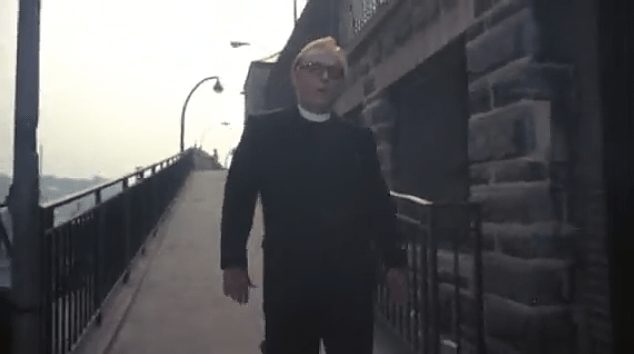
The opening scene… Christopher Gill impersonating Father McDowall (Steiger) is walking down the street viewed with a long shot, he’s whistling a ‘sardonic’ tune… in the vein of “the ants go marching” alongside The East River. Present, is the activity of cars passing by on the East Side Highway.
As he approaches the camera, we can see that he is wearing a priest’s frock.
We hear the city noises, the sounds of cars honking, young children plowing into him as they run by, and a young girl in a short lime green dress greets him as he continues to walk along the sidewalk.
As Gill passes Kate Palmer (Lee Remick) descending the stairs of the apartment house, he says, “Top of the morning to you, young lady!”
Goregirl and David Arrate have been offering a most fascinating and dare I say titillating series for the past two months now. Something Weird Video. There isn’t enough time in the day to delve into all the goodies they’ve been showcasing. It’s darn impressive and just wanted to share it here at The Last Drive In…
This is a western remake of the film noir masterpieceKiss of Death (1947
Hugh O’Brian plays Daniel Slade Hardy a convicted bank robber who just wants to get back to his wife and live a peaceful life. But fellow inmate, the homicidal psychopath Felix Griffin writer/producer (Robert Evans- executive producer onRosemary’s Baby) makes his life a living hell when he starts terrorizing his wife Ellen (Linda Crystal) and begins a killing rampage… Co-starring Dolores Michaels as May, Stephan McNally as Marshal Frank Emmett, Edward Andrews as Judge Parker. Directed by Gordon Douglas (Them 1954, In Like Flint 1967) and scripted by Ben Hecht.& Lederer who did the ’47 screenplay for Kiss of Death.
I’m with Aurora – Edward G Robinson is one of the greats. I even named a cat after him… Thanks lady for doing this wonderful tribute to the man who contributed so much…
The poster for The Baby alone is disturbing in it’s ability to create an instant queasy feeling and queer flutter that hits your senses due to the inappropriate visual environment. A crib with a large pair of legs hanging over the edge. The hands holding an axe and a sexualized young female holding a teddy bear. So let’s just get these words out of the way for starters…
Touching on so many taboos and cultural deviance is director Ted Post’s shocker The Baby 1973. starring the mighty Ruth Roman.
Look at that sensual face… what a beauty Ruth RomanStill of Ruth Roman and Robert Walker in Alfred Hitchcock’s Strangers on a Train (1951)
Day of the Animals 1977, Look in Any Window 1961, Bitter Victory 1957, Strangers on a Train noir thriller Down Three Dark Streets 1954, The Window 1949, various television performances The Naked City’s ‘The Human Trap’ Climax!, Dr. Kildare, The Outer Limits, Burke’s Law, The Name of the Game, I Spy, Marcus Welby M.D, Mannix, Ironside, Gunsmoke, The Sixth Sense, Mod Squad and more!
And I’ve got to mention that Anjanette Comer is an excellent rival to play the ‘outsider’ antagonist against Ruth Roman in this battle of wills.
Anjanette Comer stars in the ABC movie of the week’s Women-in-Peril feature film FIVE DESPERATE WOMEN 1971…
Directed byTed Postwho gave us Beneath the Planet of the Apes 1970, perhaps my favorite of the ‘ape’ films after the original. Saw each of the series during their theatrical release. Sadly Ted Post passed away just this past August 2013.
James Franciscus in Ted Post’s Beneath the Planet of the Apes 1970 Clint Eastwood & Ted Post collaborating on the set of Magnum Force
He directed television for years beginning in the 50s. I love the TV movie also starring Beneath the Planet of the Apes blond hunk James Franciscus… who co-starred with the fabulous Lee Grant in Night Slaves (1970) and Dr. Cook’s Garden 1971 with a murderous Bing Crosby. And hey while I”m touting made-for-TV movies how bout Five Desperate Women1971 where he most likely met Anjanette Comer? He’s also responsible for several episodes of Rod Serling’sThe Twilight Zone (1959-1964), including “Mr. Garrity and the Graves” and “The Fear.”  Post also directed two episodes of the Boris Karloff horror anthology show you know I truly love, Thriller (1961-1962), The Specialists & Papa Benjamin. And geez Columbo ’75-’76, A Matter of Honor and A Case of Immunity. Most people probably cite him for Clint Eastwood’s Dirty Harry vehicle Magnum Force 1973 or Good Guys Wear Black 1978. Ted Post knows how to put together a thriller!
The Baby’s screenplay was penned by Abe Polsky (The Rebel Rousers 1970, The Gay Deceivers 1969)According to IMDb trivia, it took almost a year for Polsky to convince Post to direct the film because Post found the topic too ‘dark.’ While in retrospect the film must have ruffled many feathers, and the themes are truly disturbing, there isn’t anything in there that hasn’t been done in a contemporary film in some way, and ideas that force us to think are a good thing. Especially when it’s wearing 70s clothes, and showcasing groovy genre character actors.
The seventies were rife with psycho-sexual theatre that showcased really uncomfortable themes, but somehow managed to create an atmosphere of low-budget art. Consider this, haven’t you seen episodes of Law & Order SVU, Criminal Minds, & CSI where some of the most brutal acts of inhumanity and grotesque forms of torture and abuse are highlighted in graphic detail? In the 70s it was more nuanced, bathed in muted lighting gels amidst experimental cinematic framing and absolutely moving musical scores.
So on one level refer to the litany of words above and assign your favorite one to The Baby, yet on another level, let’s look at this film and ‘react’ to it and recognize its power.
Baby’s photograph is lensed in an ‘anthropological’ way as it shows him in captivity-the bars of his crib symbolically like the bars of a prison
The Seven Minutes1971 is based on a novel by Irving Wallace. Directed by provocateur Russ Meyer(Lorna 1964), Faster, Pussycat, Kill! Kill! & Mudhoney(1965) with a screenplay by Richard Warren Lewis and an uncredited Manny Diez. This film comes on the heels of his hit at FOX with Beyond the Valley of the Dolls 1970. (Dolls with a screenplay by Roger Ebert) Meyer and Fred Mandl (Checkmate, The Munsters, The Twilight Zone, The Fugitive) create a great visual romp with the cinematography. The opening titles roll over the first almost seven minutes of the film as we hear the ticking of a clock…
With a very unusual cast of character actors starring Wayne Maunder as Mike Barrett, and Marianne McAndrew  (Hello Dolly 1969, The Bat People 1974) as Maggie Russell. Philip Carey (I’ve always been amazed at how much he reminds me of Charlton Heston) as District Attorney Elmo Duncan.
Phillip Carey has always reminded me of Charlton Heston in stature and mannerism- a great underrated character actor…
the ubiquitous John Carradine. I could watch him in anything… he tickles me…the beautiful Yvonne de Carlo here as Constance Cumberland movie actress.love love love that Yvonne de Carlo- a kindly beauty (I met her on the set of Laugh-In at the Westbury Music Fair in the 70s while taping the show live… She was an absolute gem, warm-hearted and filled with tangible grace.)
Music byStu Phillips(Quincy M.E.) with Lionel Newman supervising. BB King sings Seven Minutes.
‘The Seven Minutes’ refers to an artistically erotic banned book published thirty-five years ago in Paris, that essentially opens up the floodgates for the public discourse about pornography, censorship, violence against women, and the dual standards during a time when morality was ambiguous. You know, just like today.
Argo Book Stores clerk played by Robert Maloney… arrested for knowingly selling smut… convenient scapegoat for the cause.Charles Drake plays vice cop Kellogg entrapping the poor Mr. Fremont book seller for being a clerk where an allegedly filthy book is being sold.
A bookstore clerk is indicted for selling obscene material which leads to a court trial. There is also the question as to whether this licentious book actually led to the rape of a young girl. The film is part trial based as the defense lawyers try to hunt down any clues that would prove the author of the book was not a smut merchant but trying to express an artistic viewpoint that can not be silenced by censorship.
Wayne Maundy as Michael Barrett’s defense attorney for bookseller Fremont
The author and the mystery surrounding their identity are key to the plot. Meyers does a high-spirited job of developing this narrative with engrossing scenes that portray a society of zealots and self-serving neophytes in turmoil with themselves. All amidst a groovy 70s palate that’s nostalgic and filled with a colorful verisimilitude.
The film opens with some great 70s devil may care by composer Stu Phillips. At first, we see a beauty chasing her dog passed a small storefront. The story reveals that the vice bureau is staking out the ARGUS bookstore, as Sgt Kellogg (Charles Drake) walks in with his cigarette box tape recorder ready to entrap the clerk for selling smut. He asks the young bookseller for something ‘brand new -unusual, ‘something you wouldn’t find in an ordinary library.’The clerk (Robert Maloney) just tells him to look around, the jackets tell the story pretty well.
Kellogg casually asks for one particular book on display The Seven Minutes by JJ Jadway and the bookseller repeats the title ‘Oh yeah” Kellogg remarks, “That’s a pretty sexy cover ain’t it?” As Kellogg ogles the pretty blonde talking to the young clerk who tells him she’ll see him later.
Sargent Kellogg (Charles Drake) “You read it?” Clerk -“The new addition at least… the first one was banned thirty-five years ago.” Kellogg-Â “How come it was banned?” Clerk– “Cause it was considered obscene” Kellogg-Â “Do you think the book’s obscene?” Clerk– “Why don’t you buy the book and find out for yourself.” “How much is it?” ” $7.30 with the tax.”
“Wrap it up… You the manager around here?” Clerk-“Yeah, the day manager.” Kellogg-“Who do I bring it back to if I don’t like it” The clerk answers– “Fremont, Ben Fremont.”Kellogg waves.
Kellogg’s partner is tape-recording the conversation from the car. “Took you long enough.”“Literary conversations take a little doing, we better start comparing, same jacket same title, same publisher, same publishing date, and copyright… Let’s pay Mr. Fremont another visit.”
They arrest him for knowingly selling obscene matter which is a misdemeanor in the state of California. And this starts the ball rolling in this film. As the powers that be, seek out district attorney Duncan who feels that The Seven Minutes would be found obscene if taken to court.
Mike and Faye Osborne are bed pals. She’s the spoiled daughter of an influential father.Cars the way they used to look… oh those were the days.never had one of these… but I know people who did! cool…70s memorabilia. Even the brown striped sheets.
the hair and the groovy chick appear later on at a funky club but I couldn’t resist putting her in the visual time capsule with the Volkswagon bug and the phone and Selleck…teehee.Mr Selleck don’t you look fine! He plays the publisher’s son Phil Sanford of Sanford Publishing.Â
Check out that cherry Volkswagon and Corvette, check out that cool 70s phallus phone, Check out that really young Tom Selleck as the publishing guy… who calls hot shot attorney Michael Barrett (a very cool Wayne Maunder) who is representing the publisher Phil Sanford (Tom Selleck) who’s in a panic about the book clerk Fremont going to jail for selling one of Sanford House’s books.
The tower of self-righteousness Elmo Duncan the D.A. (Phillip Carey) wants to be propelled into the Senatorial seat in California. The powers that be who want him to become Senator conspire to exploit this contrived issue of corruption & decency so Duncan has a powerful platform to run on. This elite cabal wants to build a state-wide case in which Elmo Duncan can fight the ‘Smut Merchants.’
Defense Attorney Mike Barrett tries to appeal to district attorney Duncan.District Attorney Duncan looms large as the figure of ethical fortitude.the secret cabal setting up the scenario for Duncan to influence public opinion and win the election. Stanely Adams, Olan Soule & Jay C. Flippen
They have a political agenda to stamp all youthful violence incited by salacious material in reading matter and films, and so this cause has become the lynchpin with which they hope to win an election, making ‘The Seven Minutes’ the subject of their campaign.
Meanwhile, a violent rape takes place involving the son Jerry (John Sarno) of a wealthy advertising tycoon Frank Griffith (Lyle Bettger) who owns a copy of The Seven Minutes and was present at the time of the assault committed by his psychotic friend, the one who actually commits the brutal rape.
The rape scene is handled with quick cuts interwoven with Wolf Man Jack doing his thing on the air. It’s all very frenetic as the soundtrack “love train” is sung by Don Reed.
The prevailing secret surrounding pathetic Jerry Griffith (John Sarno) is that he’s been emasculated by his domineering father and now can’t get it up, so he’s impotent sexually and in helping Sheri Moore (Yvonne D’Angers) while she’s being attacked by his violent friend.
Jerry takes the blame for the rape and refuses to talk about it, thereby implicating himself as an impotent sissy and allowing the lynch mob and voyeurs to assert that Jerry would not have committed such an act if The Seven Minutes hadn’t been available to him. Duncan is now convinced that a clean boy wouldn’t have done the crime if it weren’t for the availability of the dirty book.
this is Shawn ‘baby doll’ Devereaux -well it sure ain’t Tennessee Williams and Elia Kazan’s vision of Carroll Baker is it…
These hypocritical old cronies have young girls of their own on the side, watching pornography while salivating at the mouth. Yerkes has a girlfriend he calls ‘baby doll’ who dances provocatively for these guys. She’s got ample boobs (It is a Russ Meyer film after all) hanging out of her 70’s style yellow hot pants. Amidst the interesting subject matter Shawn ‘Baby Doll’ Devereaux gyrates and inserts herself into the frame to show us the hypocrisy of these old farts who condemn others for their own personal agenda all the while being the worst kind of purveyors of sinful behavior.
the wealthy Frank Griffith that wants all this smut taken out of the reach of impressionable teens like his son. What’s carefully framed by Meyers playing in the background is a porn film that the men have been reviewing and enjoying way too much-we witness the HYPOCRISY.
Russ Meyer had his own dealings with censorship so the subject is probably of very personal substance for him. He does a fantastic job of pointing out the duality of persuasions. And he builds the story really well here. Showing the belligerence by equal sides of the coin toward a moral center and a society ripping at the shreds of personal freedom to express, create and destroy.
Whether you’re an avid Russ Meyers fan or just think you might like to venture into the complex questions the film evokes, presented in that real 70s style The Last Drive In weeps for most days, it’s a film worth watching, even just to spot the few character actors that pop up on the screen like baby doll’s and Faye Osborne’s (Yvonne & Edy) eh hems… well you know… the cleavage shot!
What appears on the surface as a controversy surrounding a banned book that contains alleged salacious material-The defense evokes some good examples of Henry Miller’s ‘Tropic of Capricorn’ or, D.H. Lawrence’s ‘Lady Chatterley’s Lover’, etc.
What manifests is an interesting commentary on censorship, masculinity, and the spurious connection between perceived immoral content and violence in society.
Manhood and masculinity is a texture that is not necessarily used as the theme in the story, but let me tell you it is all-pervasive with images of Duncan heaving his heavyweights as he sweats and works out in front of Mike, spouting his holier-than-thou rhetoric. It was almost masturbatory.
He gave Michael that “politician’s holier than thou number” Duncan was hostile while he pumped weights in front of the intellectual Mike Barrett. Dueling of masculinity and the question of causality with pornography and violence against women.
Duncan talks to a church official about ‘freedom’ Duncan–Â “We only want to penalize those who would corrupt it.”
Duncan and his reprehensible comrades belong to a group called Strength Through Decency.
The acronym STD... was this intentional? Probably. It’s hilarious as these types of organizations do spread like a social disease. They’re against lust, motorcycles, homosexuals, and lesbians. All the factors that made the 70s so dangerous of course. Those lustful lesbians on motorcycles riding down 5th Avenue in NYC wreaking havoc with our delicate morality. Why I’m surprised we all survived it…
So as much as the words “smut merchants’ are bandied around, and the question of censorship takes priority in full view, the underlying sub-context is the posturing of masculinity and the double standard of sexism & classism and who gets to play and who must obey.
Marianne McAndrews is fabulous as Maggie Griffith. I really dig those orange orbs… truly the light fixtures I mean…
I won’t get into the story behind the mystery or the trial, the story behind Jerry’s impotence, the elitism, or the ultimate reveal about the author of The Seven Minutes. The media frenzy that occurs feeds on the sensationalism of the situation who condemn the book but want to hear about the details of rape victim Sherri’s violation.
Is The Seven Minutes a beautiful novel about a woman’s awakening or really filthy trash? You’ll have to find out… but I’ll say that Russ Meyer’sThe Seven Minutes is a great addition to the socially conscious sexually charged films of the late 60s & 70s like Roger Vadim’s Pretty Maids All In a Row, and Robert Thom’s Angel, Angel Down We Go 1969…
Director Brian de Palma’sphantasmagorical phantom of the opera rock opera in the vein of Mephistopheles featuring the music from sensational songwriter Paul Williams who also plays Swan and the fantastic Jessica Harper (actress, composer, singer & writer)as Pheonix. William Finley plays Winslow/The Phantom and Gerrit Graham is Beef.
I’d never sell my soul to the devil-just your ordinary little soulful MonsterGirl for sure!