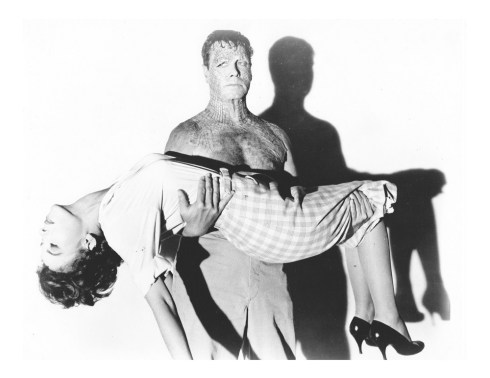
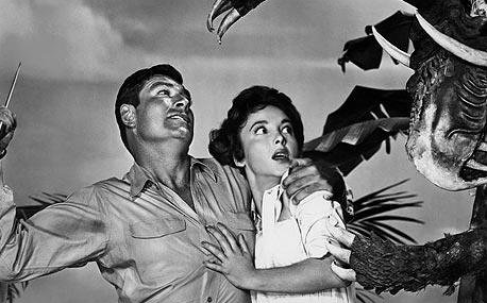
Let’s take a delightfully campy, tongue-in-cheek stroll through two of the kookiest crypt-crawlers the 1950s ever coughed up: The Four Skulls of Jonathan Drake (1959) and The Thing That Couldn’t Die (1958). Both are proof that sometimes the best chills come with a wink, a nudge, a pair of sandals made from 200-year-old skin from a walking dead tribal witch doctor, and a severed head in a box.
The Four Skulls of Jonathan Drake (1959), is a treasure brought to you by one of my favorite directors of the campy, the schlocky, and glorious B fare: Edward L. Cahn (Creature with the Atom Brain 1955, The She-Creature 1956, Invasion of the Saucer Men 1957, The Zombies of Mora Tau 1957, Invisible Invaders 1959 and my particular favorite It!, the Terror from Beyond Space 1958). The film stars Eduard Franz, Valerie French, Henry Daniell, Grant Richards, and Paul Wexler. It’s the macabre family tradition-every Drake man who hits sixty gets a complimentary disappearing head and a reserved spot in the crypt’s exclusive skull collection, all courtesy of a vengeful Jivaro shaman with a grudge that just won’t quit. A curse and a zombie with lips sewn shut (played by Paul Wexler, who looks like he had a run-in with an unoiled sewing machine).
Anthropologist Jonathan Drake (Eduard Franz, a man who’s seen one shrunken head too many) is next on the chopping block. After his brother’s head goes missing, in this family, losing your head isn’t just a figure of speech- it’s practically a rite of passage. Jonathan and his plucky daughter Alison (Valerie French) team up with a skeptical cop (Grant Richards) to unravel the mystery. The culprit? Dr. Emil Zurich (the wooden-faced Henry Daniell, as sinister ever), who’s been keeping himself alive by swapping heads and dabbling in immortality, with the help of Zutai, the world’s surliest and most persistent zombie, who makes vocalizations like Curly Howard of the Three Stooges when he’s hit with a bullet.
Key moments include Zutai’s stealthy rose-trellis climbs, heads turning up in crypts, and a police investigation where the only thing more suspicious than the deaths is the décor. The film’s atmosphere is pure Halloween fun: theremin music, foggy crypts, and enough skulls to make Hamlet jealous. In the end, The Four Skulls of Jonathan Drake is less a whodunit and more a head-spinning carousel of curses, shrunken noggins, and stitched-lip zombies, all whirling around a family tree that’s overdue for some serious vengeful pruning.
Like a fever dream conjured by Edgar Allan Poe after a late-night binge on jungle adventure comics, the film barrels toward its climax with the subtlety of a headhunter at a flea market rummaging for skulls where immortality is just a stitch away, and the only thing more dangerous than the villain’s voodoo is the risk of losing your head before the credits roll.
THE THING THAT COULDN’T DIE 1958
Directed by Will Cowan and starring William Reynolds, Carolyn Kearney, Robin Hughes, and Andra Martin. If you’ve ever wondered what would happen if a psychic ranch girl, a box of evil, and a 16th-century Satanist’s head walked into a California dude ranch, wonder no more. The Thing That Couldn’t Die answers the question nobody asked: “How long can you keep a head ina centuries-old, sealed wooden crate before things get weird?”
Jessica (Carolyn Kearney), who can find water with a stick and has trouble with her psychic powers, unearths a centuries-old box on her aunt’s ranch. Instead of Spanish doubloons, out pops the still-living head of Gideon Drew (Robin Hughes, a low-budget Svengali with hypnotic eyebrows). Yes, Robin Hughes is the actor who plays the Devil, credited as The Howling Man, in the Twilight Zone‘s “The Howling Man,” Season 2, Episode 5, which aired in 1960. He portrays the mysterious prisoner held by monks, who is revealed through a memorable transformation scene as Satan himself.
Back to the head – Drew’s head that is, separated from his body by Sir Francis Drake, proceeds to telepathically possess ranch guests and staff, who dutifully tote him around.
Highlights include the head’s uncanny ability to hypnotize with a glare, a parade of characters getting possessed faster than you can say “hilarious head in a box horror,” and a climax where the villain’s head is finally reunited with his body, only to be foiled by a fleur-de-lis amulet and a hero who apparently read the script’s last page. The ending is so abrupt you’ll wonder if the editor just got bored and left for lunch, but not before giving us the immortal lesson: The thing that wouldn’t die… actually could, and did, with a little help from some Catholic jewelry.
Both films are like haunted house rides at a county fair- creaky, a little rickety, but full of charm and the kind of scares that are best enjoyed with a bowl of popcorn and a group of wisecracking friends. Whether you’re dodging shrunken heads or ducking a telepathic noggin, these B-movie gems prove that in the world of 1950s horror, the only thing more dangerous than a curse is the set decorator’s imagination!
THE BRAINIAC 1962
Abel Salazar’s turn in The Brainiac/el Baron del Terror 1962 proves that vengeance never looked so delightfully bizarre: a comically monstrous baron (Salazar) returning from the Inquisition’s flames, armed with a forked tongue for brain-sucking and an impeccably grim sense of revenge, proves that in Mexican Gothic horror, even a centuries-old curse can come with a wink and a forked tongue firmly in cheek of campy charm. The Brainiacis so hilariously low-budget and campy and yet somehow grotesquely startling that it’s become an essential part of the movie’s charisma. The monster’s absurd yet iconic presence is somewhere between charmingly ridiculous and endearingly terrifying.
One of my favorite childhood memories of those late-night forays into midnight movies was that split-second jolt I’d get when the Brainiac would lurch onto the screen, clumsily galumphing forward with his lobster-claw hands like a creature sailing in on the tail of a comet streaking across the night sky (which it does!), as if the fiend’s arrival was timed with cosmic mischief and a snap, crackle, suck of ozone!
The Brainiac 1962 evokes an outlandish, almost comical image of hands that look like gastric proton pumps. Quivering squid-fingered suction cup pincers and a big rubber head with bulging empty black eyes, a monstrous sculpted face resembling a cross between an anteater, a fly, and the devil himself, his nose a twisted proboscis like some mosquito spawned from a sci-fi fever dream, jutting out with unnerving prominence. All pointy eared — It isn’t just alien; it’s a bizarre muppet hybrid, both nasty and mesmerizing, like something that crawled out of the shadows of a forgotten puppet show on an alternate dimension’s late-night TV, forever caught between nightmare and carnival and topped off with tufts of wild ratty black hari somewhere between a moody Gothic brooding prince and a 70s garage band’s reject wig.
I was utterly captivated by that fiendish creature, his grotesquely long, flicking tongue, and the surreal image of him delicately, graphically I might add, spooning out brains from a gleaming silver serving dish. It’s one of those rare horror films that, even after all these years, still manages to tickle my sense of wonder and nostalgia. Watching it now is like sinking my spoon into a large bowl of classic horror comfort food, with just the right pinch of camp to keep things deliciously entertaining.
Abel Salazar’s The Brainiac (original Mexican title El Barón del Terror, 1962), directed by Chano Urueta, waltzes across the screen with the campy confidence of a film convinced of its own peculiar greatness. The opening tableau whisks us to Inquisition-era Mexico, where Baron Vitelius d’Estera (Abel Salazar himself, producer and ham in chief), after being subject to a myriad of tortures, is condemned for necromancy and sentenced to fiery doom. But this isn’t your average execution—Vitelius, smoke curling around his theatrical brow, curses the judges and prophesies vengeance when a comet next passes by. Flash forward (tornado-slide style) three centuries to the swinging 1960s, where that very comet ignites the Mexican night sky and drops off our newly reincarnated, vengeance-driven warlock.
In The Brainiac, the lead astronomer is Professor Saturnino Millán, portrayed by Luis Aragón. He is the knowledgeable head of the observatory team vigilantly watching for the comet heralding Baron Vitelius d’Estera’s return from his centuries-old execution, foretold to awaken dark events linked to the Baron’s curse. Their vigilance serves as an early warning symbolizing scientific reason trying to grapple with the transcendental supernatural evil.
Working closely alongside him is Licenciado Francisco Coria, played by Carlos Nieto, who assists with the celestial observations and helps interpret the ominous signs. He is a practical presence at the observatory and is romantically involved with Victoria Contreras, played by Rosa María Gallardo. Victoria Contreras is a direct descendant of Álvaro de Contreras, one of the Inquisitors who condemned Baron Vitelius d’Estera to death, making her a target of the Baron’s vengeful wrath that spans centuries.
Victoria adds a much-needed splash of humanity to this bunch of stargazers, grounding the cosmic freak show with real feelings, because even when you’re chasing a brain-sucking fiend, personal drama insists on sticking around to watch the show.
Professor Millán, his earnest assistant Francisco, and Francisco’s worried fiancée Victoria find themselves reluctantly tangled in Baron Vitelius d’Estera’s sinister web when their scientific watch for the ominous comet unknowingly signals the moment the fiendish Baron bursts back into life, turning their peaceful lives into a showdown between cosmic curiosity and brain-sucking Gothic chaos.
After the fireball crashes near their observatory, the Baron arrives in human guise shortly after the comet lands, encountering the young couple Francisco and Victoria. During this meeting, he impresses them by casually mentioning his skill in astronomy and science, masking his sinister plans. The couple then invites him to visit their mentor, Professor Millán, unwittingly opening the door for Vitelius into the elite scene and beginning his hunt for the descendants of the Inquisitors who condemned him centuries ago. This encounter, pivotal to linking the Baron’s ancient curse with the modern-day victims, sets the stage for the Baron’s eerie blend of charm and menace, allowing him to infiltrate their circle and organize deadly gatherings where his vengeance begins to take physical form.
Someone’s got to keep an eye on the sky, and this observatory trio occupies a crucial narrative space: their anticipation of the comet sets the supernatural clock ticking. The relationship between these characters and Abel Salazar’s Vitelius d’Estera is indirectly adversarial; their scientific search for answers digs a deeper burr hole in the skull, between cold, hard reason and the Baron’s occult madness, linking the celestial to the sinister while Vitelius’ resurrected menace and theatrical villainy sweeps through the city like a Gothic plague.
Baron Vitelius d’Estera assumes the identity and the attire of a contemporary, aristocratic figure, essentially posing as a sophisticated gentleman whose activities revolve around social gatherings, elegant parties, and private visits to the homes of his victims, and his own lavish space, where he infiltrates society and enacts his revenge.
The film delights in the Baron’s transformations, the most gloriously absurd to behold, setting the stage for Vitelius to hunt down the descendants of his accusers.
Enter the modern cast of those descended from the inquistion—dashing Rubén Rojo as Rolando/Marcos Miranda, elegant Rosa María Gallardo as Victoria Contreras and a gallery of other descendant social class blissfully unaware that their glamorous parties are about to become unwitting stages for the infernal marionette’s grisly cerebral sampling.
With each graymatter tonic break—that is, Vitelius ducking away from these dinner parties to snack on brain pâté kept in a silver dish—the Baron picks off his prey, using both his sorcerous mesmerism (to paralyze while he transforms with his delightfully wretched prosthetics.
Detective Inspector/Comandante (David Silva) shuffles after the Baron in a procedural subplot, providing the only semblance of resistance as Mexico City grows increasingly short of its intelligentsia.
Director Chano Urueta’s camera, ably wielded by José Ortiz Ramos, slathers each set with shadows, oversized castle décor, and eerily artificial lighting that only enhances the otherworldly flavor of parody. There’s a gleeful love of the macabre here—the kind that invites laughter as much as (accidental) chills. As a kid, it definitely evokes more cringes out of me when the Baron transforms and suck the brains out of people’s skulls.
Cast and crew gleefully camp it up: Salazar relishes both his sophisticated tailored suits and his menacing rubber-masked marauding; the entire cast seems to be having a blast, Ariadne Welter appears in the role of a bar girl credited as Chica asesinada en restaurant. Like everyone, their earnestness is as endearing as the baron’s tongue is improbable.
Critical voices of the 1960s, when they paid attention, veered between mild bemusement and outright ridicule; the film’s trash masterpiece status was cemented over drive-in and late-night viewings, even as cinema journals found themselves marveling at the monster’s odd sensuality and the script’s bravura disregard for logic.
I’d like to champion—and perhaps even canonize—The Brainiac for its lysergic surrealism, affectionately lauding its unforgettable scenes: the Baron’s hypnotic command over decadent socialites, noirish femmes haunting shadowed streets, a bowl of brains presented with the elegance of a fine pâté, and, of course, the eerily mesmerizing sequences of vampiric brain-sucking horror.
The Brainiac earns its cult favorite status through gloriously absurd moments that blend horror with infectious charm, delighting in deliciously chaotic and monstrous theatrics. If The Brainiacis a horror film, it is one with a deliriously raised eyebrow, triumphantly out of step with the ripening sophistication of 1960s genre films. While Hammer Studios bathed Dracula in Technicolor blood and The Innocentsplumbed new psychological depths, Urueta and Salazar embraced the loopy extremes in this particular monster movie with its rubber-faced fiend, Gothic melodrama, and a Baron consumed not only by vengeance, but by a hearty appetite for gray matter and cinematic immortality alike.
The delight is infectious: the more seriously it’s taken, the more outrageously it charms, making it the rare cult favorite where even a damnéd aristocrat, warlock necromancer, and sorcery, can demand a spot at the cocktail party—brains on the menu, of course.
#63 down 87 to go! Your EverLovin Joey, formally & affectionately known as MonsterGirl!
This Halloween season I’m covering those fierce women who graced the 1950s Science Fiction & Fantasy/Horror screen with their beauty, brawn and bravado! Like years past–I pay tribute to the Scream Queens of the 1930s & 1940s.
We’ve arrived at the 1950s decade’s deliriously dynamic dames… Who had to deal with mad scientists, gigantism, alien invasions and much more menace & mayhem!
Of course, I plan on doing the 1960s and 1970s in the next year–and you’ll notice that I am listing some of our Queen B’s future films & television appearances of a supernatural or science fiction nature and even a few scattered exploitation films that fit the bill. A few photos have been added to fill out the framework of their contribution to the genre. I’ve included honorable mentions to those who starred in at least one film and perhaps a few science fiction & horror anthology shows on television.
And I guess I should be super clear about this, so no one gets their hackles standing on end, not one actress who wound up only getting an honorable mention (be it one of your favorites, and believe me there are a few of mine on that smaller list), by any means does it imply that I think they have a less substantial participation in the decade’s genre.
All these actresses have performed in other types of films-other genres and dramatic roles and enjoyed a full career that transcends the science fiction & horror films they appeared in.
Allied together they created the fabric of the 1950s decade, colored by their unique and valuable presence to ensure that science fiction & horror/fantasy will live on to entertain and enamor a whole new generation of fans and aficionados.
Collectively and Individually, these women are fantastic, and I feel very passionate about having put this wonderful collection together as a tribute!
I can’t begin to describe the admiration I’ve developed over the past several years, by delving into Beverly Garland’s long impressive career as a popular cult actress. All I can think of saying– seems crude– but it’s what truly comes to mind… Beverly Garland kicks some serious ass!!!
From historian/writer Tom Weaver-“For most fans of 50s horror there are just no two ways about it. Beverly Garland is the exploitation film heroine of the period. A principal member of Roger Corman’s early stock company, she was the attractive, feisty leading lady in such Corman quickies as It Conquered the World, Gunslinger, Naked Paradise, and Not of this Earth. In between Corman assignments she braved the perils of the Amazon River on writer-director Curt Siodmak’s Curucu, Beast of the Amazon, and a less harrowing Hollywood backlot swamp in Fox’s the Alligator People. Her 1960s film work included Pretty Poison, The Mad Room and the multi-storied Twice Told Tales with Vincent Price. Overall, this list of titles is unmatched by any other ’50s genre actress.”
The diverse, dynamic and uniquely sexy Beverly Garland was born in Santa Cruz, California. She studied with dramatics teacher Anita Arliss, sister to Hollywood actor George Arliss. Garland also worked in radio actually appeared semi-clothed in various racy shorts, until she made her first feature debut supporting role in the taut noir thriller D.O.A (1949) starring Edmund O’Brien. Beverly started out doing small parts in science fiction/horror films such as The Neanderthal Man 1955and The Rocket Man 1954. But her cult/exploitation status was forged when she signed onto to work with legendary filmmaker Roger Corman, the first film takes place in Louisiana called Swamp Women. In 1983 Beverly Garland received a star on the Hollywood Walk of Fame. She worked right up until 2004 and sadly passed away in 2008.
There are so many credits Beverly Garland has under her belt, I can only list the few that are memorable for me, but here she is linked to her massive IMDb list of credits for you to peruse. One of the roles that stands out for me is her groundbreaking role in the late 1950s as Casey Jones a policewoman for NYC in the series called Decoy (1957) Garland finds herself in diverging & dangerous situations where she not only uses her sexy good looks but her smarts and her instincts to trap criminals from all walks of life. It’s a fabulous show and it shows not only how diverse Beverly Garland is but the show was a historical first for a woman starring in a dramatic television series.
Beverly Garland has performed in drama’s including a musical with Frank Sinatra directed by Charles Vidor The Joker is Wild (1957) Film Noir (The Miami Story 1954, New Orleans Uncensored 1955, Sudden Danger 1955, The Steel Jungle 1956, Chicago Confidential 1957, Science Fiction/Fantasy, Adventure, Exploitation, Westerns and Crime dramas & Thrillers like Pretty Poison 1968. For the purposes of The Last Drive In tribute to this magnetic actress, here are those performances in the genre I’m featuring both film & television series!
“The Memories of working with Roger Corman are pleasant because I got along with him very well. He was fun to be around and work with. We always did these films on a cheap budget, and people were always mad at Roger because he’d hardly feed us! And no matter what happened to you, your worked regardless… You could be dead and Roger would prop you up in a chair!”-Beverly Garland
From Beverly Garland’s Interview in “Interviews with B Science Fiction and Horror Movie Makers: Writers, Producers, Directors, Actors, Moguls and Makeup” by Tom Weaver (McFarland 1988).
In The Mad Room (1969) her character was pregnant–so was she at the time, with her son James.
[referring to her 1950s Roger Corman cult films] “It’s funny today because it’s so ridiculous. But at the time, it was very serious! We were just actors doing our best, I think. None of us overacted. I’m not saying we weren’t good. We didn’t do it tongue-in-cheek. We really meant it. We gave our all. We were serious, good actors and we played it seriously.”-Beverly Garland
“Maybe I do come on strong, and people sense in me a strength and a positiveness . . . It’s really the way I look and act, not the way I am . . . Once you cut through the protective coating, I’m strictly molasses.”-Beverly Garland
Audrey Dalton““ “I noticed you wrote a bit about Beverly Garland. She was such a dear friend of mine. She was in Pretty Poison with Noel Black who just passed away last year. Bev died years ago and even though she remained active in the Scarecrow and Mrs King for so long, she loved acting in “B” films the most.”
Waitress Nola Mason in The Neanderthal Man 1954, Ludine in The Rocket Man 1954, Vera in Swamp Women 1956, Claire Anderson in It Conquered the World 1956, Dr. Andrea Romar in Curucu the Beast of the Amazon, Nadine Storey in Not of this Earth 1957, Joyce Webster in The Alligator People 1959, Ellen Winslow in Stark Fear 1962, as Alice Pyncheon in Twice-Told Tales (1963) Mrs. Stepanek in Pretty Poison 1968, Mrs. Racine in The Mad Room 1969, Science Fiction Theatre (TV Series) Katherine Kerston / Sally Torens– The Other Side of the Moon (1956) … Katherine Kerston– The Negative Man (1955) … Sally Torens, The Twilight Zone (TV Series) Maggie- The Four of Us Are Dying (1960), Thriller (TV Series) Ruth Kenton– Knock Three-One-Two (1960).
Tom Weaver – “In your Corman movies you yourself generally played plucky, strong willed, sometimes two-fisted types.”
Beverly Garland- “I think that was really what the scripts called for. In most all the movies I did for Roger my character was kind of a tough person. Allison Hayes always played the beautiful, sophisticated “heavy” and I played the gutsy girl who wanted to manage it all, take things into her own hands. I never considered myself much of a passive kind of actress-I never was very comfortable in love scenes, never comfortable playing a sweet, lovable lady. Maybe if the script wasn’t written that way, then probably a lot of it I brought to the role myself. I felt I did that better than playing a passive part.”
Swamp Women (1956) An undercover policewoman helps three female convicts escape from prison so that they can lead her to a stash of stolen diamonds hidden in a swamp. Co-stars Marie Windsor, Carole Mathews, Mike Connors, Susan Cummings and Ed Nelson!
Also in Swamp Women 1956, Garland was expected to do her own stunts, even dropping out of a 20 foot tree. Roger Corman told her “When you’re killed you have to drop” Roger planted three guys underneath the tree to catch Beverly when she let’s go. “And when they killed me I just fell-dead weight on these three poor guys!” Roger told her “You’re really one of the best stuntwomen I have ever worked with.”
Even after breaking her ankle in Gunslinger 1956, Beverly was a trooper, she did all her fight scenes and worked to finish the film for Roger Corman, even though she couldn’t walk for weeks after that!
As Ellen Winslow, Garland takes a courageous role as a non-victim of abuse and assault, she pushes back head on against the grain instead of wilting from the trauma she prevails. The film showcases the gutsy quality Garland herself tried to portray in all her performances. in the darkly psychological Stark Fear (1962)A sadistic husband mentally tortures his wife, while eventually planning to murder her. Although no one believes her, she gets help from an unexpected source.
Beverly Garland recalls making Swamp Women co-starring Marie Windsor with Tom Weaver-“Swamp Women! Ooh that was a terrible thing! Roger put us up in this old abandoned hotel while we were on location in Louisiana- I mean it was really abandoned! Roger certainly had a way of doing things back in those days-I’m surprised the hotel had running water! I remember that we each had a room with an iron bed. Our first night there, I went to bed and I heard this tremendous crash! I went screaming into Marie Windsor’s room, and there she was with the bed on top of her-the whole bed had collapsed! Well, we started laughing because everything was so awful in this hotel. just incredibly terrible, and we became good friends.”
Carole Mathews, Marie Windsor and Beverly Garland in Swamp Women.
Beverly Garland not only exuded a gutsy streak in every role she took, but she also shared the notable distinction of starring in one of Boris Karloff’s THRILLER episodes called Knock-Three-One-Two co-starring with the wonderful character actor Joe Maross, who has a gambling problem and will be beaten to a pulp if he doesn’t pay his bookie. So he enlists the help of a psychopathic lady killer to murder his wife Beverly for her tightly held purse and large savings account!
Tom Weaver asks Beverly Garland if she enjoyed working on Twice-Told Tales (1963) — “Oh, I love it because I loved Vincent Price. He is the most wonderful sweet, adorable man! I don’t remember much about the movie, I just remember working with Vinnie and how wonderful he was.”
Tom Drake, Bill Elliott, and Beverly Garland in Sudden Danger (1955).
On working with Roger Corman on Gunslinger (1956) after Allison Hayes, another seasoned actress and a bloomin’ trooper who broke her arm during filming. The working conditions were dismal, but Beverly Garland isn’t a woman you can keep down. “I always wondered if Allison broke her arm just to get off the picture and out of the rain. It poured constantly. But what I adored about Roger was he never said, ‘This can’t be done.’ Pouring rain, trudging through the mud and heat, getting ptomaine poisoning, sick as a dog–didn’t matter. Never say die. Never say can’t. Never say quit. I learned to be a trooper with Roger. I could kid him sarcastically about these conditions and laugh. That’s why we got along so well. On Gunslinger, I was supposed to run down the saloon stairs, jump on my horse, and ride out of town. Now, we never had stunt people in low-budget films. Riding, stunts, fights–we all did it ourselves, and we all expected it, and we all just said it was marvelously grand. I told myself just to think tall. So my first take I thought tall and sailed right over the saddle and landed on the other side of the horse. The second take, I twisted my ankle running down the stairs– a bad twist.”
Beverly Garland and Allison Hayes in Roger Corman’s Western Gunslinger (1956).Directed by Noel Black, Beverly plays Mrs Stepanek, the mother of sociopathic Sue Ann Stepanek, played by Tuesday Weld. Anthony Perkins is Dennis Pitt, a mentally disturbed young man with delusions, released from an institution only to stumble into Folie à deux with someone who is more violent and disturbed than he is!
Beverly Garland plays feisty nurse Nadine Storey in Roger Corman’s creepy alien invasion film Not of this Earth 1957 co-starring the white-eyed vampiric villain Paul Birch as Paul Johnson-why not Smith?
About working with Roy del Ruth on The Alligator People–“He was sweetheart of a guy and a good director. The Alligator People was a fast picture, but he really tried to do something good with it. And I think that shows in the film. It’s not something that was just slapped together. It as such a ridiculous. story…).. I felt when I read the script and when I saw the film, which was a long time ago, that it ended very abruptly. It all happened too fast; it was kind of a cop out. But there really was no way to end it. What were they going to do-were they going to have us live happily ever after and raise baby alligators?”
Beverly Garland is having fun on the set of The Alligator People.Beverly Garland with Lon Chaney Jr. in Roy del Ruth’s The Alligator People.Directed by Roy Del Ruth, Beverly stars as Joyce Webster, a woman who, while under hypnosis, recalls a horrific story. She goes in search of her husband, who has gone missing. He is part of a secret experimentation with men and alligators. Bruce Bennett co-stars.
Directed by Curt Siodmak, Curucu, Beast of the Amazon 1956 stars Beverly Garland as Dr. Andrea Romar and John Bromfield as Rock Dean, who venture up the Amazon River to find the reason why the plantation workers are fleeing from a mysterious monster!
On first seeing the cucumber creature that Paul Blaisdell designed for It Conquered the World–“I remember the first time I saw the It Conquered the World Monster. I went out to the caves where we’d be shooting and got my first look at the thing. I said to Roger, ‘That isn’t the monster…! That little thing over there is not the monster, is it?’ He smiled back at me , “Yeah, Looks pretty good, doesn’t it?’ I said, ‘Roger! I could bop that monster over the head with my handbag!’ This thing is no monster, it was a terrible ornament!’ He said, ‘Well don’t worry about it because we’re gonna show you, and then we’ll show the monster, back and forth.’ ‘Well, don’t ever show us together, because if you do everybody’ll know that I could step on this little creature! Eventually I think they did do some extra work on the monster: I think they resprayed it so it would look a little scarier, and made it a good bit taller. When we actually filmed, they shot it in shadow and never showed the two of us together.”
Beverly Garland, as Clair talking on the radio to IT– “I hate your living guts for what you‘ve done to my husband and my world, and I’m going to kill you! Do you hear that? I’m going to kill you!”…) “So that’s what you look like, you’re ugly…) You think you’re gonna make a slave of the world… I’ll see you in hell first!“
It Conquered the Wold (1956) is yet another Roger Corman campy gem that features my favorite cucumber monster created by Paul Blaisdell. Beverly stars as Claire Anderson, married to Dr. Tom Anderson, played by Lee Van Cleef, who communicates with an alien life form who claims he comes in peace. Co-stars Peter Graves and Sally Fraser.
Tom Weaver asks —“Do you ever look back on your B movies and feel that maybe you were too closely associated with them? That they might have kept you from bigger and better things?
Beverly Garland —“No, I really don’t think so. I think that it was my getting into television; Decoy represented a big turn in my life. Everybody did B movies, but at least they were movies, so it was okay. In the early days, we who did TV weren’t considered actors; we were just horrible people that were doing this ‘television’ which was so sickening, so awful, and which was certainly going to disappear off the face of the earth. Now, without TV, nobody would be working. No-bod-y. But I think that was where my black eye came from; I don’t think it came from the B movies at all.”
Tom Weaver-“Which of your many horror and science fiction roles did you consider your most challenging?”
Beverly Garland–“Pretty Poison. It was a small part, but it had so much to say that you understood why Tuesday Weld killed her mother. I worked hard to make that understood not a surface one, but tried to give you the lady above and beyond what you would see in a short time.”
Beverly Garland, as policewoman Casey Jones, was in the stirring television series Decoy, which was broadcast from October 14, 1957, to July 7, 1958.
The bewitchingly beautiful Audrey Dalton was born in Dublin, Ireland, and maintains the most delicately embroidered lilt of Gaelic tones became an American actress in film in the heyday of Hollywood and the Golden Age of television. Knowing from early on that she wanted to be an actress while studying at the Royal Academy of Dramatic Arts was discovered by a Paramount Studio executive in London, thus beginning her notable career starring in classic drama, comedy, film noir, science fiction, campy cult classic horror and dramatic television hits!
Since then, I’ve had the incredible honor of chatting with this very special lady whom I consider not only one of THE most ethereal beauties of the silver screen, Audrey Dalton is a versatile actress and an extremely gracious and kind person.
Audrey Dalton made a monumental contribution to one of the biggest beloved 1950s “˜B’ Sci-Fi treasures and she deserves to be honored for her legacy as the heroine in distress, pursued by a giant bunny killing Mollusk “That monster was enormous!” ” Audrey commented in her interview with USA Today.
Gail MacKenzie in The Monster that Challenged the World 1957, Baroness Maude Sardonicus in William Castle’s Mr. Sardonicus 1961 Boris Karloff’s Thriller (1960-1962)- Norine Burton in The Prediction, Meg O’Danagh Wheeler in The Hollow Watcher and Nesta Roberts in Hay-Fork and Bill-Hook.
Audrey Dalton plays Meg O’Danagh who is haunted by local prejudice and the rural boogeyman that is The Hollow Watcher.
Audrey Dalton in Hay-Fork and Bill-Hook is shown here with Doris Lloyd as Mother Evans. There’s witchcraft afoot in the Welsh moors.William Castle’s Mr. Sardonicus 1961 stars Audrey Dalton as Baroness Maude Sardonicus, who is a prisoner to her husband’s madness driven to fury because his face has been stuck in a horrifying grimace when he found his father was buried alive. Co-stars Guy Rolfe as Sardonicus and Ronald Lewis
Barbara Rush and Marlon Brando in The Young Lions 1958-Twentieth Century FoxBarbara Rush and Harry Townes in Strategy of Terror (1969)Frank Sinatra and Barbara Rush in Come Blow Your Horn (1963)Frank Sinatra, Dean Martin, Sammy Davis Jr., Richard Bakalyan, Victor Buono, and Barbara Rush in Robin and the 7 Hoods (1964)
Barbara Rush appeared in director Martin Ritt’s turbulent suburban drama No Down Payment 1957 with ex-husband Jeffrey Hunter, although they weren’t married to each other in the film.
Jeffrey Hunter, Pat Hingle, Patricia Owens, and Barbara Rush in Martin Ritt’s No Down Payment (1957) co-stars Joanne Woodward, Sheree North, and Tony Randall.
Barbara Rush, Possesses a transcendent gracefulness. She moves with a poise like a dancer, a beautiful gazelle stirring in the gentle quiet spaces like silent woods. When I see Barbara Rush, I see beauty personified by elegance and decency. Barbara Rush will always remain in my eyes, one of the most gentle of souls on the screen, no matter what role she is inhabiting. She brings a certain kind of class that is not learned, it’s inherent.
She was born in Denver, Colorado, in 1927 and began at the University of California. Then she joined the University Players, taking acting classes at the Pasadena Playhouse. Paramount scooped Barbara up and signed her to a contract in 1950. She debuted with The Goldbergs (1950) as Debby Sherman, acting with Gertrude Berg as Molly Goldberg, a popular television program that follows the warm, human story of the famous Jewish Bronx radio & TV family, the Goldbergs, and their everyday problems—co-starring David Opatoshu and Eduard Franz.
Before joining the Goldbergs, she met the strikingly handsome actor Jeffrey Hunter, who eventually became a hot commodity at 20th Century Fox. Barbara Rush and Jeffrey Hunter fell in love and were married in December 1950. They became Hollywood’s most gorgeous couple, and the camera seemed to adore them. Their son Christopher was born in 1952.
Television became a wonderful avenue for Barbara Rush’s talent, she appeared in guest parts in many popular tv series of the 1960s and 1970s. She also co-starred in TV movies. One enjoyable character she played was a guest villain on the 1966 television series Batman as femme fatale “˜Nora Clavicle” Barbara Rush also played Marsha Russell on the popular television drama Peyton Place 1968-69
Barbara Rush also turned to work on the stage. She garnered the Sarah Siddons Award for her starring role in Forty Carats. Making her Broadway debut in the one-woman showcase, “A Woman of Independent Means” which also subsequently earned her the Los Angeles Drama Critics Award during its tour. Other showcases included “Private Lives”, “Same Time, Next Year”, “The Night of the Iguana” and “Steel Magnolias”.
Barbara Rush still possesses that transcendent beauty, poise, and grace. She will always be someone special someone memorable.
INTERVIEW QUESTIONS:
Joey Q: Did you ever imagine Jack Arnold’s “It Came from Outer Space” (1953) with you (in that black dress by Rosemary Odell) aiming that laser beam would become so iconic, and leave such a lasting impression on fans and film historians after all these years?”¨
Barbara Rush: A: I’d never think that anybody who saw it needed to see it again, but if it left an impression, that’s fine. I loved the chiffon dress. It was too weird that these people that came from other space were too frightening to look at, so they took the form of regular humans. What I thought was interesting that these creatures didn’t actually want to be there and weren’t vicious at all. They were just trying to fix their ship and get it together. I remember thinking that with a lot of science fiction films; we were so afraid these creatures, but they were just trying to get away and weren’t threatening at all.
Joey Q: Is there a role you would have liked to play — let’s say in a Gothic thriller? Or was there ever a script for one that you turned down that you regret now? Were there any other high quality A-picture science fiction film scripts sent to you after “When Worlds Collide” (1951) and “It Came from Outer Space” (1953)?
Barbara Rush “¨”¨A: I don’t remember anything that was given to me to do other than those two pictures. That was all just orders from the studio. The science fiction film I admired the most was the picture E. T. ““ I just love that film and it is my favourite, but I never thought it was something I wanted to be in myself.
Joey Q: “The Outer Limits” is one of the most extraordinary anthology television shows of the 1960s. It was clearly ahead of its time, beautifully crafted and though-provoking. You star as the tortured Leonora in the episode “The Forms of Things Unknown” which is perhaps one of THE finest of the series written by Joseph Stefano, all due to the cinematography, lighting, and particularly the ensemble acting. Do you have any lasting impressions or thoughts about that role and/or working with Vera Miles, Cedric Hardwicke, David McCallum, and Scott Marlowe?
Barbara Rush A: I loved doing that show and loved Vera Miles. She was just the most wonderful person to work with. She was so funny. There was a scene where she had to run after me in the forest in the rain. After that miserable experience she told me:”Barbara, I promise you I’ll never chase after you in the rain, in the forest, ever again.” I thought the episode was very interesting, though.
Joey Q: In that same high calibre of dramatic television series, were you ever approached by William Frye, Doug Benton, or Maxwell Shane from Boris Karloff’s “Thriller” series or by Alfred Hitchcock for his anthology series? You would have been extraordinary in either television program! These shows were remarkably well-written and directed and I’m certain there would have been a perfect role for your wonderful acting style. Did you ever receive a script or were you ever interested in appearing on either of those shows?
Barbara Rush A: Unfortunately they didn’t really seem to want me. They never got in touch with me about anything. I would have loved to work for Hitchcock ““ I liked his films.
Joey Q: It seems that the early 70’s found you a niche in the macabre. Perhaps this is because you are such a consummate actress and the contrast of your gentility works well with the darker subject matter. In 1971 you co-starred with Henry Darrow in a short piece on Rod Serling’s “Night Gallery” – “Cool Air.” It was a Gothic romantic tale based on H.P. Lovecraft’s story about a woman who falls in love with a man who must remain in a refrigerated apartment dare something dreadful occur. Then, in 1972 you appeared in “The Eyes of Charles Sands” as Katherine Winslow co-starring Peter Haskell and Joan Bennett, a film about ESP and solving a murder. Then came “Moon of the Wolf” where you co-starred with David Janssen and Bradford Dillman, two very handsome leading men. Did you enjoy venturing into these uncanny story lines?
Barbara Rush A: I particularly enjoyed working with Bradford Dillman, who was a dear friend of mine. We more or less grew up together, in Santa Barbara. In one of these he played a werewolf and he’d have these hairy mittens as part of his costume and he’d come trampling in all the time ““ as a werewolf! I have a tendency to get very hysterical about how funny people can be, and he’d just make me crack up. “¨We were shooting ““ I think in New Orleans or Mississippi, somewhere in the south ““ on location, so it was very hot. Poor Brad who had to walk around in those mittens.
Attended and graduated from the University of California, Santa Barbara (1948). She graduated from the Pasadena Playhouse School for Performing Arts in Pasadena, California.
Is mentioned in the movie Shampoo (1975), when hairdresser Warren Beatty says “I do Barbara Rush’s hair”.
Was separated from second husband Warren Cowan in 1969 at the time she learned of first husband Jeffrey Hunter’s sudden death following brain surgery after falling down a flight of stairs.
Appears in No Down Payment (1957) with ex-husband Jeffrey Hunter, they both portraying married characters, but not married to each other.
She is one of five actors to have played “Special Guest Villains” on Batman (1966) who are still alive, the others being Julie Newmar, John Astin, Joan Collins and Glynis Johns.
“I can safely say that every movie role I was ever offered that had any real quality went to someone else.”-Barbara Rush
As Joyce Hendron in When Worlds Collide 1951, Ellen Fields in It Came from Outer Space 1953 Night Gallery episode as Agatha Howard in ‘Cool Air’ released on December 8, 1971, based on a story by H.P. Lovecraft and in The Outer Limits as Leonora Edmond in the episode The Form of Things Unknown written by Joseph Stefano released on May 4, 1964, as Karen Lownes in Kraft Suspense Theatre tv series ‘In Darkness, Waiting (1965), as Nora Clavicle and The Ladies’ Crime Club Batman Series 1966, Moon of the Wolf (TV Movie) 1972 as Louise Rodanthe, as Katherine Winslow in The Eyes of Charles Sand (1972), The Bionic Woman (TV Series) – Jaime’s Mother (1976) … Ann Sommers / Chris Stuart, 1979 Death Car on the Freeway (TV Movie) as Rosemary
Jack Arnold, Richard Carlson, Charles Drake, Russell Johnson, and Barbara Rush in It Came from Outer Space (1953).
Everybody wants to know about Barbara Rush’s fabulous clothes in It Came From Outer Space, in particular this lovely black gown.. so here it is–designed by Rosemary Odell…
COOL AIR. First aired on December 8, 1971, Paintings for the opening of each episode were done by artist Tom Wright
The classy, fashionable villainess Barbara Rush as Nora Clavicle and The Ladies’ Crime Club Batman Series 1966.Vera Miles as Kasha and Barbara Rush as Leonora pushed to the limit of all they can bare poison Scott Marlowe a sadistic blackmailer and leave him in the trunk of their car. As they flee the scene they stumble upon an Old Dark House where the servant Ralph Richardson takes care of Tone Hobart played by David McCallum a solitary sad young man, an introvert who tinkers with clocks, an inventor who is able to tip the balance of time and bring back the past and ultimately the dead. Barbara Rush conveys a depth of sadness and vulnerability that is tragic and beautifully pieced together for this macabre story written by Joseph Stefano. The lighting traps each player in the shadows of their own machinations. It is a brilliant little morality play.
Barbara Rush and Vera Miles on the set of The Outer Limits television series episode The Form of Things Unknown.
The cinematography by Conrad L. Hall is extraordinarily moody and dark in this psychological supernatural story by Joseph Stefano.
The Four Skulls of Jonathan Drake (1959) Directed byEdward L Cahn,(It, The Terror From Beyond Space (1958)which was sort of the inspiration for Ridley Scott’sALIEN and the very cool Invisible Invaders (1959) whose Walking Corpses predated Romero’sNight Of the Living Dead 1968) story by Orville H.Hampton and starring the uniquely featured (he looks as if his face has been carved from wood) Henry Daniel who plays Dr. Emil Zurich. Valerie French plays Alison Drake. Grant Richards plays Lt Jeff Rowan and Eduard Franz plays Jonathan Drake. Paul Wexler plays the hulking zombie Zutai whose lips have been sewn shut with rotted-looking string. And Howard Wendell as Dr. George Bradford.