WELCOME TO JO GABRIEL & THE LAST DRIVEIN’S –500th POST!
“Ghosts are the outward sign of an inward fear”-Ambrose Bierce
“Everything is worse…if you think something is looking at you.” ” — Shirley Jackson
From- Cinematic Hauntings edited by Gary J. and Susan Svehla chapter The Haunting by Bryan Senn.
“Adult in concept and wide in scope. The Haunting is designed not only to appeal to those who approach the supernatural from an intellectual level, but also to the legions of movie patrons who delight in a genuine ghost story.”-The Haunting press book
Halloween is around the corner, I hear the rusty gates creaking, the rattling of skeletons, the flapping wings of jolly bats, smell the candy corn and Hershey’s kisses and the owls are hooting, the spooks are spooking, and I sense the chill of night seeping through the curtains as the best holiday of the year is upon us!
What better way to honor such a ghoulishly ghostly and creepy eve than to explore one of the all-time great movies, ghost story notwithstanding, in honor of my 500th post? Yes, long-winded me has finally reached a milestone.
How do you begin to write about a film that continues to share the spot of the favorite movie in my world alongside Rosemary’s Baby?What can I say that hasn’t already been said about Robert Wise’s masterwork, The Haunting,from 1963? How do you even give suitable tribute to a timeless masterpiece that defies genre and deserves to be upheld as unremarkable?
Incidentally, I was reading Pam Keesey’s terrific essay, The Haunting and the Power of Suggestion: Why Robert Wise’s Film Continues to ‘Deliver the Goods’ to Modern Audiences.Keesey points to a comment that Stephen King makes while admiring Wise’s film. He remarks, “Something is scratching at the ornate, paneled door… Something horrible… but it is a door Wise elects never to open.” Once again, Pam Keesey cites Wise’s influence as written about in Edmund G. Bansak’s wonderful Fearing the Dark: The Val Lewton Career, one of my favorite books in my library. Wise finally found a film that could pay homage to his mentor, Val Lewton.
“Lewton trademarks–the reverence for the underdog, the focus upon humanist concerns, the alliance between danger and darkness, the depiction of fate as an unstoppable force, and, of course the preoccupation with things unseen.”-Bansak
Sorry, Stephen King, but we don’t always need to see the monster– Val Lewton understood that well, and managed to create some of the most compelling moments of terror for us, just by suggesting and triggering our own innate fears of the unknown. This is one of the most essential working mechanisms of Wise’sThe Hauntingthat has withstood the perils of time.
Robert Wise worked as an editor among Val Lewton’s magic team of artists.
He learned the secret to any good work of fantasy/horror/suspense/noir is to suggest, BUT not reveal, what is the heart of the narrative on the screen itself, but allow our own subconscious fears and anxieties to do their work. Much credit has to be given to Nelson Gidding’s (I Want to Live! 1958, The Andromeda Strain 1971) remarkable screenplay.
While working on West Side Story, Robert Wise picked up a copy of Shirley Jackson’s ghost story. In an interview in Midnight Marquee #37, Wise recalled, “I was reading one of the scary passages–hackles were going up and down my neck–when Nelson Gidding (screenwriter)… burst through the door to ask me a question, I literally jumped about three feet out of my chair. I said, ‘If it can do that to me sitting and reading, it ought to be something I want to make a picture out of.”
Wise wasn’t sure he’d get to direct the film, noted in Bright Lights #11–“I called nervously to see if it might be available…{…}because usually by the time a book comes out in New York, the big movie companies have scouts back there, story departments, and they grab it up and it’s gone. I found out this one hadn’t been picked up.”
According to Bryan Senn in an interview in 1995, “I persuaded United Artists to buy the book rights for me and finance a screenplay. And I got Nelson Gidding, who did I Want to Live! (1958) for me to do the screenplay. When we got it done however United Artists got a little cold on it and didn’t want to proceed with it. So I talked to my agent about it. I had left a contract with MGM a few years before; I got out of the contract early but I had to promise to give them another film.
THE HAUNTING, Claire Bloom, Russ Tamblyn, Julie Harris, Richard Johnson, 1963.
The studio wasn’t keen on a supernatural horror thriller, nor of the idea of not using big named stars for the picture.Wise wanted to use classically trained actors like both British Shakespearean actors Richard Johnson and Claire Bloom and American actress Julie Harris.Wise also wanted to work with Russ Tamblyn again whom he worked with in 1961 on West Side Story. Tamblyn was reluctant to do the part after reading the script but threat of suspension from the studio urged him to take the role. Years later he recounts it being one of his favorite roles.
Luck will out and Wise needing to go over to England for a command performance of West Side Story, was able to use MGM’s little studio outside London called Boreham Wood Studios which gave him a bigger budget to work with.
And I can say without any doubts, that I’m with Robert Wise- when I was little, watching The Haunting even during the day, sun shining outside, my heart would pound and I would feel a restless shudder as I sat quietly watching what I consider to still be one of the scariest films of all time. And though I’ve seen it again and again, I still feel said hackles up the back of my neck. The shivers of fear and dread, and a true sense of terror that grips you every single time!
The confluence of artistry, Robert Wise’s sensibility that he synthesized from working with ValLewton, Jackson’s incredible ghost story, Gidding’s compelling script, the collective ensemble performances by all the great actors involved, the effective score by Humphrey Searle, and idiosyncratic and visually disorienting cinematography by Davis Boulton (Stage Fright 1950, I Thank A Fool 1962) The sense of place and the incredible performances that inhabited that uncanny space.
Photo of Richard Johnson, Claire Bloom, Russ Tamblyn, and Julie Harris in the movie The Haunting, 1963. Photo/Art by: anon.
All these elements went into creating one masterfully crafted visual narrative, a psychological maneuver, a tale of terror, and one memorable landscape of uncanny dread and paranoia.
The house itself was set in England and not the story’s old-money New England territory. While there are numerous tales of haunting in England, Jackson’s story was set in New England, and Wise wanted to stay close to the novel’s reality. It wasn’t hard to find the right house in England. However, the more daunting task was getting the roads closed off so Julie Harris could drive her car on the wrong side of the road for the scene where she travels to Hill House. Robert Wise explained in Fantastic Films, that “We wanted a house that basically had an evil look about it” He finally found the perfect house in Warwickshire, a 200-year-old manor house called Ettington Park, Wise felt that its, “facing of mottled stone with gothic windows and turrets” was exactly what they needed.
The house possessed an “unexpected, even frightening, authenticity” According to Russ Tamblyn, “It was definitely a strange place, especially the grounds. The house itself, had a history… oh, children who had been murdered, and a twelve year old who had committed suicide, some other woman who had fell out of a window.” Not to mention the little cemetery out in the back which was supposedly haunted. People had seen ghosts there.
Dr. John Markway: [voice-over narration] “An evil old house, the kind some people call haunted, is like an undiscovered country waiting to be explored. Hill House had stood for 90 years and might stand for 90 more. Silence lay steadily against the wood and stone of Hill House, and whatever walked there… walked alone.”
The film is powerful in the way it brings us into its mystifying grasp. We hear the velvet tones of Richard Johnson narrating to us, greeting us, if you will join the haunting. His voice-over is the visual montage of past events that reveals to us the menacing house. The inception of its evil roots, a domineering man, Hugh Crain, had built Hill House for his wife and daughter, “in the most remote part of New England he could find.” In a freak or strange accident, the wife had “died seconds before she was to set eyes on the house.” Her carriage crashed against a tree, her lifeless arm hanging out of the carriage in close-up. Crain’s second wife floats down the dark Victorian-style hall (Wise was the editor of The Magnificent Ambersons (1942), and the figure of the wife moving swiftly through the darkness reminds us of that film-This impression is also confirmed in More Things Than Are Dreamt of edited by Alain Silver & James Ursini ) then tumbles down a flight of stairs breaking her neck.
“The audience is thrown into the point of view of the second Mrs. Crain as she stumbles down the stairs and blurred, twisted shots approximate the last things she saw in life. Finally a grim but striking deep focus wide angle captures her sprawled at the foot of the main stairs, eyes wide in fright and her corpse in the lower foreground of the frame and behind her shadowy killer, the house itself.”–source More Things Than Are Dreamt Of -edited by Silver & Ursini
After Crain dies in England, his only daughter Abigail “grew up and grew old” In Hill House, eventually hiring a village girl to be a paid companion, “it’s with this young companion the evil reputation of Hill House really begins” When the companion took a farmhand out onto the veranda while her mistress banged on the wall with her cane and died calling for help. The companion inherited Hill House only to be driven to suicide by the unseen, menacing atmosphere of the place. She walked up to the top of the spiral staircase in the library and hanged herself. “They say that whatever there was–and still is–in the house eventually drove the companion mad.”
For Dr. John Markway (Richard Johnson), Hill House is a chance to prove himself. Eleanor has been chosen to be part of the research team because of the shower of stones that had fallen on her house when she was a little girl. Possibly possessing the powers of psychokinesis, the ability to materialize her inner demons, anger, and nightmares. Pointedly, when Eleanor says, “Suppose the haunting is all in my mind?”
From Silver & Ursini’s edited chapter Modern Classics- in More Things Than Are Dreamt Of- “The harp, the knockings, the writing on the wall-all these have a visual and aural presence in film which contradicts any inclination of the viewer to believe that Eleanor is doing this herself; and yet the word on Markway’s questionnaire which Luke doesn’t understand ‘psychokinesis’, makes it possible that she is. Even the interruption of her most flirtatious moment with Markway permits two readings. The house, her possessive, predestined lover, strikes at the harp strings out of jealousy and the need to control her. Or, like Henry James’ repressed governess in Edmund Wilson’s reading, Eleanor does it herself out of fear of sex. Both are possible.”
Having read an interesting essay that touches on Robert Wise’s 1963 ghost story from Hidden Horror, the chapter on Carnival of Souls by Prof. Shelly Jarenski makes a few interesting comparisons to Carnival of Souls 1962
Such as the prelude –“And we who walk here, walk alone.” in my malleable childhood mind, both the prelude and the coda stayed with me like a creepy lullaby or maudlin soliloquy. Jarenski asserts, “The film’s core themes are encapsulated in that line uttered by the misfit heroine Eleanor Lance.” I would totally agree with her assessment. The Haunting is not merely a ghost story; it is a story about an alienated loner, a ‘misfit heroine’ who is in dire search for relief or release, possibly from this world. We, too, are witnesses to a lonely, disillusioned woman (I loathe to use the word: spinster), most likely a virgin, who is longing to make a connection.
Jarenski writes, “Words like “˜we’ or “˜walking’ does create an “ominous ambiguity.” That Eleanor will either join the collection of lost souls in Hill House or be doomed to walk alone for all eternity in “˜isolation and despair.’
Asserting that Carnival of Souls can be understood as a corollary to the more ceremonious and celebrated The Haunting because“It portrays what being part of the community of the dead, while simultaneously feeling utterly alone, looks like.”
In More Things Than are Dreamt Of-Silver and Ursini point out the idea thatThe Hauntingis much more than just a ghost story. As Shirley Jackson wrote in her novel, “During the whole underside of her life, ever since her first memory Eleanor had been waiting for something”¦”
Theodora, affectionately known as Theo, has been recruited to help in the research because of her extremely honed powers of ESP. This becomes established before Dr. Markway introduces everyone around the breakfast table. While Mrs. Dudley regurgitates her soliloquy of fear & gloom, Theodora takes a mental inventory of Eleanor’s psychic bag, and when Eleanor asks how she knew what she was thinking, Theo cheekily replies, “You wear your thoughts on your sleeve.”
The Haunting(1963)could be said to be the penultimate example of ‘nothing up that proverbial sleeve’ and ‘it’s what you don’t see’ cinematography. The visual narrative is what makes it timelessly heart-pounding to watch and what gives it an artistic atmosphere of misdirection, anxiety, hysteria, dread, romanticism, and well, yes, that “haunting’ feeling.
Memorable scenes of veiled terror lurking in the corners or beyond the massive wooden door frames. The allusion to the various cold spots is underscored by trilling piano keys. Stark frames capture a portion of the house as if it were a live entity. Dr. Markway refers to the house as being ‘born bad. The manifestation of the angry and tyrannical Hugh Crane, who built an evil house. There are so many moments of The Haunting that have stayed with me for years. And I must admit that I usually watch it several times a year, like one makes pot roast because the craving strikes you at that moment. “It’s time to watch The Haunting again,” is heard in our house. I can never forget the moment when Julie Harris as Nell awakens frightened, where we hear a child’s muffled laughter swiftly turning to a menacing scream. She tells Theo that she’s breaking her hand, she’s holding it so tight. The camera only focuses on Nell and her outstretched arm in the darkness, swallowed up in her ornate room, like a fly in a spider’s web. When she can no longer bear Theo’s tight grip, she screams, “Stop it!” and turns the light on, only to find in horror that she’s been holding a ghostly hand. “Whose hand was I holding?” Theo is shown across the room, still lying in bed, unaware that Nell had been going through any nightmarish ordeal.
In other sequences, the visual perspective seems to warp all we see, pulling us into the dis-ease of Hill House. From the moment Eleanor pulls up to Hill House, the point of view is skewed so that we are watching Eleanor, who is also being watched by the house. It’s a startling moment as she realizes, “It’s staring at me.”
And of course, there’s the eerie and otherworldly invisible assault on the two women as something unseen pounds on the doors with a ‘cannonball’ Disembodied laughter, scratching, growling, and Baroque-style brass doorknobs with Medusa’s face that turn ever so slowly, as if something trying to gain entry into the room.
Eleanor ‘Nell’s’ name has been scripted on the wall in something ‘like chalk.’
And then the ghostly message written on the ostentatious wallpaper in ‘something like chalk’ outside the dining room-“Help Eleanor -Come Home!”
Hill House’s expression of love, the seduction by way of written message in ‘something like chalk’ both frightens Eleanor yet stimulates her because someone or something was finally paying attention to her. as Alain Silver and James Ursini point out the house’s dark secrets, “represent the intimacy which Eleanor has never had with any other being…”
There’s also the emphasis on the powerfully imposing use of matrix work, utilizing the inherent designs of the interiors themselves, textiles, wallpaper, and wood carvings to create diabolical faces watching back at us. The stone and bronze cherubs and gargoyles that inhabit Hill House, the myriad of mirrors, and long winding hallways mixed with the turbulent sky outside the towering Hill House.
The iconic scene where the door seems to expand as if breathing was actually two technical people who used 2x4s to push into the middle to create the effect. It’s that simple, and yet it is one of the most lasting scenes in film history.
The book by Shirley Jackson, The Haunting of Hill House, is a hell of a read, but as a rarity, the film invokes the uncanny of the story even better than the novel.
“SCREAM…no one will hear you! RUN…and the silent footsteps will follow, for in Hill House, the dead are restless!”
I’ve had any number of people over the years say to me, ‘You know, Mr. Wise, you made the scariest picture I’ve ever seen and you never showed anything. How’d you do it?” And it goes back to Val Lewton, by the powers of suggestions”–Robert Wise in Fearing the Dark: The Val Lewton Career
Robert Wisemade The Haunting in 1963 as a way of paying homage to his mentor, Val Lewton, who had died 12 years earlier.
The always-poised Richard Johnson plays the very earnest Dr. John Markway, a researcher in the paranormal who wants to use Hill House, an imposing Gothic New England house, as the main epicenter for his studies in the supernatural. Based on the legend of all the ghostly goings-on surrounding said place, Markway gets Mrs Sanderson (Fay Compton) to agree to lease the house to him for one year. Though she is the voice of caution
– Mrs. Sanderson: “The dead are not quiet in Hill House.”
The great Fay Compton as the crusty waspy Mrs. Sanderson warns Markway that the dead are not restful at Hill House.
Markway initially collects the names of potential participants in his experiment and chalks them on his blackboard. Eventually, the names drop off, and only two women arrive to help him uncover the truth behind the legend of Hill House. Is it truly haunted?
Theodora: “Haven’t you noticed how nothing in this house seems to move until you look away, and then you just… catch something out of the corner of your eye?”
Theo, sensing a presence, says, “It wants you, Nell… the house is calling you.”
Mrs. Sanderson sends along her cocky nephew out of the Midwest, Luke (Russ Tamblyn) to accompany Dr. Markway since one day Luke hopes to inherit Hill House. The exterior of Hill House is an actual Hotel called the Ettington Park Hall Hotel in Stratford-upon-Avon, England. The interior sets were brilliantly designed by John Jarvis.
We meet Eleanor ‘Nell’ Lance (Julie Harris) in her sister’s living room, which doubles as her bedroom. The very hypersensitive Nell is being tortured by her sister, brother-in-law, and their precocious brat of a child who insists on playing a child’s record march consisting of inane flutes and snare rattles, causing a pervasive tenor of chaos, madness, and dysfunction. Like nails on a blackboard, the little tune serves not only to cause psychic aural conflict and irritate Nell but also pulls us into her sense of being trapped in a claustrophobic world where she must break free. Nell steals the family car and hits the road with all her belongings in a box, driving out of Boston out into the light of the New England air toward something, anything, even the unknown, which would be better than the captivity she’s been experiencing. She is one of the people Dr. Markway has invited to participate in exploring Hill House.
More Things Than Are Dreamt Of edited by Alain Silver & James Ursini- The Haunting of Hill House is a third-person novel with a lot of interior monologues and other first person aspects…{…}Eleanor is neither a para-psychologist nor a believer, but a disheartened spinster yearning for escape and adventure; or as Jackson puts it, ‘During the whole underside of her life, ever since her first memory, Eleanor had been waiting for something…’
Eleanor is the first person to see the ‘vile’ house. Silver & Ursini frame it by Jackson’s occult vision, that Hill House is the cause of Eleanor’s ‘deliverance and destruction’. How Eleanor’s religious discourse becomes an ironic fate that turns inward on itself for in the end, “journeys end in lovers meeting” Eleanor’s volatile relationship with Hill House is absolutely one of love/hate.
Upon her arrival, she is confronted by two of the locals who harbor a maniacal animosity toward city people. The Dudleys were played by Rosalie Crutchleyand Valentine Dyall ( Who was perfectly sinister as Jethrow Keane in Horror Hotel 1960, yet another favorite classic horror film of mine.)
Rosalie Crutchley attributes the films power to Robert Wise’s skillful direction and David Boulton’s sinister cinematography that transformed the benign Ettington Park into the malevolent manor of Hill House. “It was a strange house” the actress told Bryan Senn. Crutchley continues, “which looked threatening from the outside but which wasn’t actually at all. But it was brilliantly shot you see, so that it looked very, very threatening.”
Mr. Dudley: “You’ll be sorry I ever opened the gate.”“Get away from here; get away at once. It’s my chance. I’ve been given a last chance. I could turn my car around and go away from here, and no one would blame me. Anyone has a right to run away. But you are running away, Eleanor. And there’s nowhere else to go.”
Mrs. Dudley takes care of the interior of Hill House as no one else in the village dares come near the place, setting out the meals but being very clear about leaving before it gets dark. The sardonic grin on her face as she divulges to Nell and Theo her little creepy-intoned soliloquy… “No one will come any further than town…”
No one will hear you scream… Mrs. Dudley’s expression is somewhat a combination of that intense little fellow, the prairie dog from the viral YouTube video where he turns around and stares, and Lewis Carroll’s Cheshire Cat.
Anyhoo… Markway leads the other three on a journey of discovery of the unknown. He chose Eleanor ‘Nell’ because of her poltergeist experience that occurred when rocks pelted her family home for a week. Eleanor suffered from a tremendous guilt complex shortly after losing her chronically ill mother, whom she cared for and who passed away, and this puts Nell on the edge of a breakdown. Theodora is known quite well for her powers of ESP. Luke Sanderson is the skeptical playboy of the foursome…
Markway is filled with glee as they have stumbled onto the proverbial ‘cold spot.’Luke-“There’s got to be a draft!”Dr. Markway tells Luke-“Look I know the supernatural is something that isn’t supposed to happen but it does happen… and if it happens to you your liable to have that shut door in your mind ripped right off its hinges!”
The ‘Adventurous All’ get together, trading small conversations and observations, while Hill House begins to reveal its cold heart. Or is the house truly a bad place? Built by a man who used odd angles and macabre embellishments, he created one “distortion as a whole,”as Nell comments. Hugh Crane, a man who was a religious zealot, entrapped his daughter in the foul house until her death as an old maid. She grew up and grew old in the house, where a series of mysterious accidents, suicides, and deaths ensued… Hill House is the epitome of Dark spaces or Bad spaces.
The nurse is too busy out on the veranda with the farm hand to hear Abigail pound on the door with her cane, and eventually hangs herself after inheriting Hill House.
Eleanor Lance: “Can’t you feel it? It’s alive… watching.”
Hill House does begin to show particular attention toward the vulnerable, fragile, and bedeviled Nell. But…
That begs a larger question. Can a house be born bad, or have Nell’s neurotic fixations and need to belong caused her to unravel the mysteries of the place much quicker? Is it just her longing and alienation that has created a certain madness, or is it both a ghost story and a story of abject loneliness and psychosis? Much like a Lewton story, there is the feeling of intense loneliness, an imbalance in the environment that is either mental or perceived to be a reality, and ambiguity that links these elements to the supernatural world.
There are definitely themes of repressed sexuality exhibited by the presence of the very stylish Mary Quant sporting Theo (Claire Bloom), who it is heavily suggested is a sophisticated Greenwich Village Sapphic who toys with the uptight Nell. When asked what frightens Theo, she glumly replies, “Of knowing what I want.”
Something that begins to cause friction between the ensemble because Nell has fallen into the well of deep delusion and longing, for Dr. Markway not realizing that he is not just only interested in her as a test subject but he is already married.
Theodora, dressed like a black widow, spins her web of jealousy yet reveals the truth about Markway and Nell’s unrequited love.Theo-“You’re making a fool of yourself over him.” Nell-“I’d rather be innocent than like you.”Theo-“Meaning what?” Nell-“Now, who’s being stupid and innocent? You know perfectly well what I mean.” Theo- “Is this another of your crazy hallucinations?”Nell- “I’m not crazy.”Theo-“Crazy as a loon. You really expect me to believe you’re sane and the rest of the world is mad.” Nell-“Well, why not? The world is filled with inconsistencies, unnatural things, nature’s mistakes, they’re called you, for instance!”Nell tells Theodora that “she’s the monster of Hill House.”Markway sees that Nell is unraveling and threatens to send her packing.
Poor Nell is a tragic Gothic figure whose famous inner monologues might slightly touch the third rail of hysterical camp yet somehow manage to become a restrained performance of inner turmoil and madness that perfectly co-exists parallel to the odd and uncanny manifestations escalating in Hill House, with a rainstorm of inner monologues to guide us through the treacherous darkness.
Mrs. Markway shows up unexpectedly and asks to sleep in the most rotten heart of the house… Nell obliges by telling her about the nursery, which, until now, has been sealed.
“Now I know where I’m going–I’m disappearing inch by inch into this house.”
In Scarlet Street Magazine, Julie Harris stated that she would have played Nell differently. “Well, I would’ve been odder looking as Eleanor,” Harris said. “I think she was too ordinary. I just wanted to be — odder.” That’s okay, Julie Harris, whom we sadly lost on August 24th of last year. No one could have done a better job of bringing Eleanor Lance to life than you did… Your Eleanor Lance will eternally remain the central tragic figure of the play, as Pam Keesey calls her the ‘persecuted innocent.’
By the end of the film, Luke, who is the cynic of the bunch, tells us…” It ought to be burned down… and the ground sowed with salt.”
The poor bedeviled Nell dances with the statue of Hugh Crane, believing that both he and she have killed Grace Markway.Grace Markway ( Lois Maxwell) doesn’t go untouched by the dark forces that lay behind the stone and silent standing wood… well, maybe not so silent!
–Happy Halloween, gang… and thanks for making all 500 posts a whirling experience! – Your Everlovin’ MonsterGirl
Directed by Robert Allen Schnitzer and written by Anthony Mahon, Schnitzer, and Louis Pastore? Okay… While I’ve never seen anything else by Schnitzer, this moody, surreal, haunting, and often frenetically disturbing reverie has remained with me all these years. Some people think it’s a weak film, not even a horror movie. I’m not saying it’s a masterpiece, but I think it’s a genre gem!
What’s really strange about this hidden terror film is cinematographer/director Victor Milt ( Run Stinky Run, Sex Wish) has done some weird really obscure stuff after working on The Premonition and director-writer Schnitzer hasn’t done anything I can talk about here either. So how did this remarkably creepy film become what it is??? I wish I knew the answer, but there have been memorable films created by one-time feature film directors like Herk Harvey who usually did shorts or documentaries that envision the gorgeous dreamlike Carnival of Souls 1962. At least writer-actor Richard Blackburn did Eating Raoul in 1982 after his unbelievable Lemora: A Child’s Tale of the Supernatural 1973. (Coming to the Last Drive In soon!)
Great character actor Jeff Corey plays the investigating Police Det. Lt. Mark Denver. There’s even a gypsy woman, played by Wilmuth Cooper.Â
Jeff Corey plays the investigating Police Det. Lt. Mark Denver.
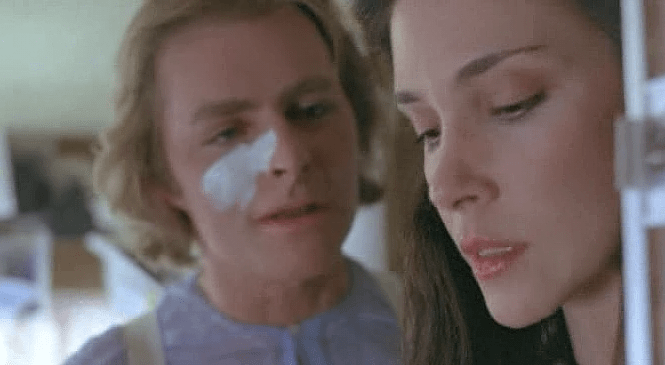
I saw The Premonition when it first arrived in theaters in 1976. It frightened the bejesus out of me then, with its nightmarish segments in particular Jude’s (Richard Lynch) and Andrea’s (Ellen Barber) uncontrollable fits of rage. Their joint psychosis was a very powerful elixir as part of the carnival set piece. Their relationship alone could have made for an interesting story of madness, obsession, and self-destruction.
This film was my introduction to the interesting actor that is, Richard Lynch. The film has stayed with me. I’ve read other people’s reviews who think the script is ridiculous, muddled and the pacing is choppy. Still, it has a haunting quality to it, especially Lynch and Ellen Barber’s performances. The music by Henry Mollicone is fantastical for the vibe of the film and fascinates me, now I have to see his musical performance in the fascinating documentary The Face on the Barroom Floor 2013.
The lens has a ghostly haze over it. with a low drab subdued tonality. The music brings you in like a soft wailing of an otherworldly siren. An eerie Glossolalia, the fluid vocalizing of the tormented Andrea. Reminding me of the amazing Lisa Gerrard from Dead Can Dance.
The institutional green bus pulls over and Andrea grips herself looking toward something. The clear pale blue sky hovering over Andrea feels chilly. She is beautiful yet strange, walking slowly toward the carnival grounds. A flutter of birds let out into the air, the vocalizing continues and Ferris Wheel comes into focus with another stomach-turning carnival ride. These daydreaming machines add color to the midway landscape. It is desolate here.
It somewhat creates a colorful version of Carnival of Souls the haunting set pieces of desolation, and otherness that play on our deepest thoughts. The impressions effervesce in fairgrounds and we construct fantasies.
Dulcimer and glistening piano bring forth Jude, a cigarette hanging out of his oddly angular face and lion-like blonde mane, he’s almost sexy ugly. The film is still lensed in cold aqua greens and pale blue. He steps out of his trailer, we see he’s wearing white ballet slippers like a mime. The piano rolls magnificently. Henry Mollicone is a virtuoso. With electronic music by Pril Smiley.
Jude steps out onto the pavement, wearing suspenders he begins a series of theatrical movements. Moving dramatically with his scarf.
Jude expresses with his body more fervently as if he hears the grand piano playing. He reaches up to the blue sky so vivid so crystalline blue. As Jude, it is a lonely dance for a sad solitary clown. As he bends downward he sees Andrea standing there. It is a portent, life is about to be turned truly upside down.
The story is a simple and unreserved one, gripping and nightmarish for all the players and us who witness a small girl being hunted psychically by her dangerously unstable biological mother who is traveling with a carnival.
The scene cuts to them sitting in his trailer she’s looking at photographs through a spyglass. He says “Look at those eyes, Andrea, and the mouth… see that. I saw her yesterday when I took the photograph. This time I’m positive I know it’s her” “You sure her name is Janie” “Yeah I’m sure, here look”He flips the photo over and the name and age are on the back.“Janie Bennett the age is right… it all figures… it’s gotta be her” Andrea asks, “Where does she live?” Jude tells her, ” Dover is about 5 miles from here.”
Jude begins to put on his heavy white grease paint. Andrea goes to the board and touches the photo of Janie…
She turns to him…Â ” I thought you’d forgotten about me Jude” ” I told you I’d call you as soon as I found something didn’t I?” “Jude what if it’s not her, what if it’s like all the other times… what if we come out with nothing what then?” Then we wait and we keep on waiting until we find her”
When Andrea shows up at Janie’s school, the music becomes a flutter of wings with flute as the children run free from their inside captivity. Andrea fingers the metal holes in the fence moving slowly, waiting for her little girl to appear. Finally, Janie is standing before her she calls to her, then Janie runs to her adoptive mother Sherrie who is waiting in the car.
Back in Jude’s trailer-Jude says, “We were lucky it couldn’t of taken years to find her” “It did take years… five stinkin’ years in that rotten pit” Jude answers, “Oh it wasn’t all that bad, I mean we wouldn’t have met otherwise.”Â
Andrea’s horrible beer-drinking tv junkie landlady in Curlers.
The use of ‘red’ in this movie is distinct. It is the characteristic color that symbolizes Andrea’s passion, madness, and self-destruction. Red is Andrea’s COLOR… down to her lipstick.
The window impresses me as a Mark Rothko painting. The color red is very impressionistic and so vital to the film’s narrative.
Jude tells Andrea that he has found a house. A small house in the woods, a nice place to settle down with the kid.
Andrea glows and a weird smile emerges at first “Settling down!” Then clenching her teeth as she drags the comb through wet raven tresses. “What are you talking about settling down for… what are you talking about. Sometimes I just don’t understand you Jude. Settling down for what…?this comes first! “
But Jude explains that they can hide out in that house til things blow over. She walks away towel drying her hair.
He remains on the topic “Nobody’s lived there for years. they’ll never find us”
Jude lays on the bed smoking a cigarette while Andrea in a red bathrobe, plays a beautiful piece of music on the piano.
The scene switches to Miles talking to Dr Kingsly his associate about parapsychology as she instructs a small class.
“The Clairvoyant reality is totally rejected by science and finds expression only in our art, music religion.”
At the same time, the film is juxtaposing images of Andrea having a primordial psychic meltdown. Not even a maternal scream, just a core anaphylactic roar from deep within.
Sherrie begins to see visions of a volatile confrontation between Jude and Andrea. On the spectral plane, it comes across in distorted yowls and negative film images. It’s quite a frightening effect. I remember being terrified by these scenes in the darkness of the theater. Like little shock treatments to a burgeoning MonsterGirl mind…
For people who think there isn’t enough explanation to the narrative Sherrie’s friend hints at the idea when spending the night telling Sherrie that she had heard of two minors who had been trapped for several days, they began sharing the same hallucinations. In this way, her question about Sherry’s disturbing visions somehow being linked to Janie’s bad dreams is true.
A psychic storm is brewing from the rage and unrequited desires of both Jude and Andrea. Janie and Sherrie naturally begin to form a single wavelength that tunes into this frequency. At least this is the premise of the film. The one link is Janie the child… and who will be the conquering mother?
While Miles is not working late with the attractive Professor Kingsly, he’s eating cotton candy and riding the merry-go-round with her.. hhm… at the carnival-definitely research related… as she suddenly looks down at Mile’s wedding band her happy expression fades away.
Meanwhile, Andrea and Jude pull up in that fabulous green pickup. The crickets and chorus frogs are singing their night song. Jude shuts the motor off. In her red dress, nails, and oz slippers like the Witch of the West Andrea creeps or slithers into the house to take Janie.
the frame appears to give an almost fun house effect with the striped wallpaper that disorients us.Andrea’s presence on the stairs casts a dark menacing shadow along the wall, reminiscent of Nosferatu.
The use of electronic sounds is excellent.
Andrea’s casting darkness, shadowing the wall is reminiscent of Nosferatu. Andrea is almost as icy as a dead thing herself… wanting to lure the child back, it looks and feels vampiric. Yet this is Janie’s biological mother, which creates some ambivalence for me as she deserves to have at least guided contact with her daughter, otherwise, why let her out of the mental hospital?
It creates the effect of psychic static the use of sound used whenever the camera focuses on Andrea’s movements.
And the framing of Andrea looking back into the den while Sherri sleeps utilizes the striped walls as they also become as distorted as a fun house room. Very disorienting.
The last remnant of shadow left from Andrea creeping up the steps is eerie as Sherri sleeps as if under a spell. Once again… a notion of Nosferatu. Andrea even has a dark complexion that could even be considered Eastern European gypsy, like Bela Lugosi.
The use of electronic static, noise represents Andrea’s state of mind at the moment. The use of low lighting and color is well-placed and creates a surreal atmosphere of worlds colliding.
The electronic noises that represent Andrea’s madness and presence are like a metallic insect. As if she hisses and slithers into Janie’s room. Everything is backlit. Andrea’s color is hot reds, and Janie’s is a cool blue.
Sherrie wakes up to the sound of the rocking chair in Janie’s room.
Nobody can tell me that this film isn’t an eerie, haunting little story, that stays with you… If it doesn’t deliver on the kinds of gruesome gory chills you’d expect from a 70s horror story then you’re watching the wrong film. But this film is highly underrated and often shot down by critics who feel it falls short. Oh well… The rest of us who know its strength will continue to advocate for it…Back to the film….-MonsterGirl ♥
Andrea runs down the stairs taking one of Janie’s dolls after fighting with Sherrie who is clinging to Janie on the bed. Andrea screams up to Sherrie… “She is Mine… she will always be mine-!!!!!!” Her voice is strained, powerful, almost magnetic.
Back at Jude’s little house in the woods, Andrea is holding Janie’s doll as if it were her.
“You are such a pretty baby,” Andrea says to the doll. Jude staring out the bleak window of the little house looks on with a worried stare. He rips the head off the doll as it squeaks Andrea screams and cries. Jude has become more unhinged himself. It has been brewing in him since the beginning. But it is not working out the way he had envisioned. He can’t control Andrea, and she obviously doesn’t care for him the same way. Two mentally ill people fighting over their own neurosis.
“What’d you do to my baby?”“Your baby, your baby is back in the goddam house with its mother.”
“What’s it to you? You’re not her father!! You are nobody’s father. And you’re never gonna be anyone’s father… You aren’t even a goddam MAN!!!!
Andrea destroys Jude’s manhood as if she took a knife and thrust it in.
Jude loses it… we hear screams.
At the same time…Sherrie gets cold in the bathroom, and the mirror freezes over. She cannot see herself. It’s a supernatural event that begins to connect the events surrounding the players involved.
Jeff Corey the investigating cop shows up at Janie’s biological father’s house to ask some questions about Andrea.
I’ve noticed the narrative uses a lot of frames where people are either looking out windows or doors or standing in the doorframe looking in. It’s that tout to parapsychologies’ introspective plane of existence…the within powers that surround all of us on a personal level. The character look inward, we’re watching them look inward and we wind up looking inward with them…
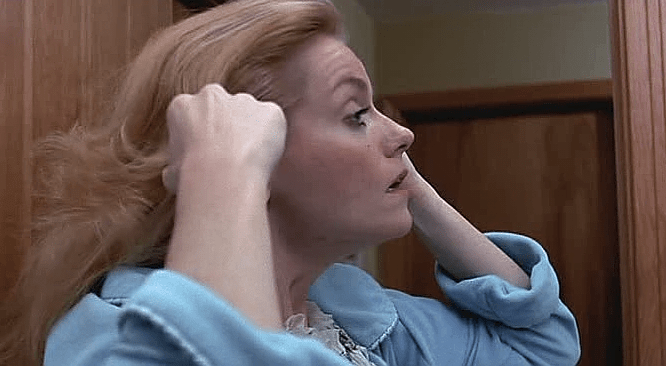
Danielle Briseboismakes her debut playing Janie Bennett the wee one who is being visited by her psychic/psychotic mother through horrifying visions like a vampiric wraith filtering through the ether reaching outward to contact her little girl who was given away to foster parents while she was in the mental ward. But Janie is terrified and wants to remain with her foster parents Prof. Miles and Sherri Bennett played bySharon Farrell  (Larry Cohen’sIt’s Alive 1974) and Edward Bell. Farrell is always good at playing adorable cheap, neurotic, and a little over the edge. Brisebois was still really cute at this stage before she became Archie Bunker’s annoying niece until she grew up into a sexy rock singer.
I have to admit that seeing this film in the theater when I was an impressionable teenager really freaked me out a bit. The images were quite startling, and in retrospect, anything Carnival-related is wonderfully creepy and wonderfully eerie, as it attains its own self-contained world. The vision of the crazy Andrea Fletcher is quite stunning as well, so as far as the pacing being muddled or uninteresting, I suppose those people who hated this film were looking for more 70s bloody, axes, psycho-sexual mind games, animals attacking or devil children. This story is a bit of a childlike nightmare amidst, Folie à deux insanity, loss, possession, motherhood, and longing. The narrative slips between a mordant sense of all these themes, as it expands beyond the literal world and works on our unconscious participation in moral ideals of motherhood, rights, and the boundaries that separate us all by a psychic thread.
Andrea (Ellen Barber who plays Mickey Roarke’s secretary in Nine 1/2 Weeks (1986) comes to Janie’s school to try and grab her, but Janie’s new mommy Sherri has a premonition and manages to arrive just in time to save Janie. Andrea lives with her wildly menacing boyfriend, a clown named Jude. Yikes, as if Lynch wasn’t frightening on a good day, wearing white face paint and painted on tears… it still gives me the heebie-jeebies.
Andrea is obsessed with getting Janie back, and Jude will do anything for his nutty girlfriend. The pair manage to kidnap Janie leaving the Bennetts in a panic who then seek out the help of a parapsychologist Dr. Jeena Kingsly (Chitra Neogy) a colleague of Miles. They hope that she can decipher Sherrie’s terrifying visions, as she also has a psychic link to Janie she must try and track her down before the unstable Andrea loses it completely and harms her daughter.
The story makes it hard for us to sympathize with Andrea as a protagonist longing to be reunited with her daughter because she herself is such a threatening figure. She’s been recently released from an institution and is still emotionally volatile. She met Jude while she was hospitalized. Jude keeps a watchful eye out for Janie, working for the carnival he’s in the position to see a lot of children pass through. One day he spots Andrea’s daughter with Sherri.
He tells Andrea that he’s seen Janie which is the catalyst for a wave of psychic visions that beset Sherri. Dr. Kingsly tries to guide Sherri to use her powers of ESP to find Janie and connect with her to track her down and bring her back.
Jeff Corey is on the scene talking to the landlady and helping to locate the kidnapped Janie.
Filmed in Mississippi the look has a haunting rustic and starkly Gothic feel to it. There’s an untouchable sense of a dreamy, trance-like aura that surrounds the frames. It disconnects us from all things being easily explained, but dreams are like that and the atmosphere of the eerie and urgent narrative compensates for the lack of cohesive and sensible plot design.
In the 70s not all things were explained coherently. Sometimes the figures floated upon landscapes that were nightmarish and made no sense. As in Let’s Scare Jessica to Death 1971, and yet it was this ambiguity that created the mystique, the mystery, and the mood.
What makes a story a thing that is haunting are visions not clearly defined, nor affirmations said aloud. The outstanding theme that jolts you into a sense of agony is the pull between two mothers, one who is emotionally destructive yearning for her child, and the other, desperately trying to protect the child she believes is hers now.
Caught in between is Janie who can only feel the thrust of possession surrounding her, the vivid nightmares and fears of innocence and unknown. Also tangled in the web of possession is Jude who is merely being used as a means to procure Janie for Andrea. His frustration turns outward like the rage of a tornado. Lynch’s face reveals his turbulence well. Andrea taunts him until he is so wounded that he keeps the child even when he doesn’t have to. If I say more I will give away part of the story…
There are some truly shocking moments-The painting crying blood when Dr. Kingsly tells Sherri just to let it flow when trying to teach her to hone in on her psychic insights. -Andrea wearing a ruby red evening gown soaked in blood appears in Janie’s bedroom with a rocking chair (turtle lovers look away) it is extremely eerie and somber. Her hands seem like talons, once again The Monstrous Feminine arrives on cue.
There are a few visions or apparitions of Andrea drenched in blood and the recurring forming of ice on those iconographic mirrors. Mirrors, the pathway to see ourselves is clouded by ice in order to obscure Sherri’s view into the psychic world.
The climax is a mesmerizing sequence, one that will either have you laughing and dismissing this film completely as others have done, or it will stay with you as it has with me, a beautiful little nightmare.
This is your EverLovin’ Joey sayin’ I have a premonition you’ll be back to The Last Drive In!
You could say that Evelyn Ankers is still the reigning queen of classical 1940s horror fare turned out by studios like RKO, Universal, and Monogram. But there was a host of femme scream tales that populated the silver screen with their unique beauty, quirky style, and/or set of lungs ready to wail, faint, or generally add some great tone and tinge to the eerie atmosphere whenever the mad scientist or monster was afoot. Some were even monstrous themselves…
For this upcoming Halloween, I thought I’d show just a little love to those fabulous ladies who forged a little niche for themselves as the earliest scream queens & screen icons.
I’m including Elsa Lanchester because any time I can talk about this deliriously delightful actress I’m gonna do it. Now I know she was the screaming hissing undead bride in the 30s but consider this… in the 40s she co-starred in two seminal thrillers that bordered on shear horror as Mrs. Oates in The Spiral Staircase1945 and a favorite of mine as one of Ida Lupino’s batty sisters Emily Creed in Ladies in Retirement 1941
I plan on venturing back to the pre-code thirties soon, so I’ll talk about The Bride of Frankenstein, as well as Gloria Holden (Dracula’s Daughter, Frances Dade (Dracula) and Kathleen Burke (Island of Lost Souls) Gloria Stuart and Fay Wray and so many more wonderful actresses of that golden era…
Elsa Lanchester as Mrs.Oates in director Robert Siodmak’s The Spiral Staircase 1945The Sister Creed in Ladies in Retirement 1941 starring Elsa Lanchester, Ida Lupino, and the wonderful Edith Barrett (right)
the playfully pretty Anne Nagel.Anne Nagel & Lon Chaney Jr in a promo shot for Man Made MonsterAnne Nagel was strapped to the slab and at the mercy of the ever-mad Lionel Atwill. Here comes the glowing Lon Chaney Jr! in his electric rubber suit in Man Made Monster!
The depraved mad scientist Lionel Atwill working with electro biology pins gorgeous red-headed Anne Nagel playing June Lawrence, to his operating slab in Man Made Monster 1941. Lon Chaney Jr. comes hulking in all aglow as the ‘Electrical Man’ which was his debut for Universal. He carries Anne Nagel through the countryside all lit up like a lightning bug in rubber armor. Man Made Monsterisn’t the only horror shocker that she displayed her tresses & distresses. She also played a night club singer named Sunny Rogers also co-starring our other 40’s horror heroine icon Anne Gwynne in the Karloff/Lugosi pairing Black Friday in 1940.
She played the weeping Mrs.William Saunders, the wife of Lionel Atwill’s first victim in Mad Doctor of Market Street 1942. And then of course she played mad scientist Dr Lorenzo Cameron’s (George Zucco’s) daughter Lenora in The Mad Monster 1942. Dr. Cameron has succeeded with his serum in turning men into hairy wolf-like Neanderthal monsters whom he unleashes on the men who ruined his career.
Anne Nagel and Lionel Atwill Mad Doctor of Market Street.
Poor Anne had a very tragic life… Considered that sad girl who was always hysterical. Once Universal dropped her she fell into the Poverty Row limbo of bit parts. Her brief marriage to Ross Alexander ended when he shot himself in the barn in 1937, and Anne became a quiet alcoholic until her death from cancer in 1966.
Dr. Cameron’s daughter Lenora (Anne Nagel) discovers the wolf-like man in his laboratory in The Mad Monster.Glenn Strange as Petro the Hairy man in The Mad Monster 1942.
the sultry Anne Nagel and Bela Lugosi in Black Friday 1940 photo courtesy Dr. Macro.
Martha was in noir favorites The Big Sleep 1946 & Alimony1949. This beauty played an uncredited Margareta ‘Vazec’s Daughter’along side Ilona Massey as Baroness Elsa Frankenstein and the marvelous older beauty Maria Ouspenskaya as Maleva the gypsy! in Frankenstein Meets the Wolf Man 1943.Then she played heroine Dorothy Coleman in Captive Wild Woman 1943 and Miss McLean in The Mummy’s Ghost 1944.
Originally Martha MacVickar she started modeling for photographer William Mortenson. David O Selznick contracted the starlet but Universal took over and put in her bit parts as the victim in Frankenstein Meets the Wolf Man and in other ‘B’ guilty pleasures like Captive Wild Woman &The Mummy’s Ghost. She was also the pin-up girl for WWII magazines.
Martha also starred in other noir features such as Ruthless 1948 and The Big Bluff 1955. She was Mickey Rooney’s third wife.
Martha Vickers and Humphrey Bogart in The Big Sleep photo courtesy of Dr. Macro.Martha Vickers and Lon Chaney in Frankenstein Meets the Wolf Man.Martha Vickers and John Carradine in Captive Wild WomanI just can’t resist Vicker’s sex appeal here she is again… Wow!
Though Logan made very few films including Opened By Mistake 1940, her contribution to women who kick-ass in horror films and don’t shrink like violets when there’s a big bald baddie coming after you with a net and a bottle of chloroform, makes you a pretty fierce contender even if you are only 7 inches tall! As Dr. Mary Robinson (Janice Logan), Logan held it all together while the men were scattering like mice from the menacing google eyed Dr. Cyclops played superbly by Albert Dekker.
Fay Helm as Nurse Strand with John Carradine in Captive Wild Woman.
Fay Helm played Ann Terry in one of my favorite unsung noir/thriller gems Phantom Lady1944 where it was all about the ‘hat’ and she co-starred as Nurse Strand alongside John Carradine in Captive Wild Woman. Fay played Mrs. Duval in the Inner Sanctum mystery Calling Dr. Death with Lon Chaney Jr. 1943
Ella Raines and Fay Helm in Phantom Lady.
Fay Helm plays Jenny Williams in Curt Siodmak’s timeless story directed by George Waggner for Universal and starring son of a thousand faces Lon Chaney Jr in his most iconic role Larry Talbot as The Wolf Man 1941
Fay as Jenny Williams: “Even a man who is pure in heart and says his prayers by night, may become a wolf when the wolfbane blooms and the autumn moon is bright.”
Fay was in Night Monster 1942. Directed by Ford Beebe the film starred Bela Lugosi as a butler to Lionel Atwill a pompous doctor who falls prey to frightening nocturnal visitations. I particularly love the atmosphere of this little chiller with its swampy surroundings and its metaphysical storyline.
Dr. Lynn Harper (Irene Hervey- Play Misty For Me 1971) a psychologist is called to the mysterious Ingston Mansion, to evaluate the sanity of Margaret Ingston, played by our horror heroine Fay Helm daughter of Kurt Ingston (Ralph Morgan) a recluse who invites the doctors to his eerie mansion who left him in a wheelchair.
Fay gives a terrific performance surrounded by all the ghoulish goings on! She went on to co-star with Bela Lugosi and Jack Haley in the screwball scary comedy One Body Too Many (1944).
Irene Hervey as Dr. Lynn Harper –Night Monster 1942.
Fay Helm in Night Monster.Fay Helm with Bela the gypsy in The Wolf Man.
Bela Lugosi as half ape half man really needed a shave badly in The Ape Man 1943, and Louise Currie and her wonder whip might have been the gorgeous blonde dish to make him go for the Barbasol. One of the most delicious parts of the film was its racy climax as Emil Van Horn in a spectacle of a gorilla suit rankles the cage bars longing for Currie’s character, Billie Mason the tall blonde beauty. As Bela skulks around the laboratory and Currie snaps her whip in those high heels. The film’s heroine was a classy dame referred to as Monogram’s own Katharine Hepburn! She had a great affection for fellow actor Bela Lugosi and said that she enjoyed making Poverty Row films more than her bit part in Citizen Kane! And I would be remiss if I didn’t mention that she appeared in several serials, from both Universal & Republic like The Green Hornetand Captain Marvel.
Tom Weaver in his book Poverty Row HORRORS! described The Ape Man as “a Golden Turkey of the most beloved kind.”
Louise Currie followed up with another sensational title for Monogram as Stella Saunders in Voodoo Man 1944 which again features Lugosi as Dr. Richard Marlowe who blends voodoo with hypnosis in an attempt to bring back his dead wife. The film also co-stars George Zucco as a voodoo high priest and the ubiquitous John Carradine as Toby a bongo-playing half-wit “Don’t hurt her Grego, she’s a pretty one!”
Pat McKee as Grego, Louise Currie, John Carradine, and Bela Lugosi in Monogram’s Voodoo Man 1944.the outrageous Voodoo Man 1944
I thought it appropriate to offer you this peek into Roger Corman’s slant on H.P. Lovecraft’s short story “The Case of Charles Dexter Ward”,using an Edgar Allan Poe title…Starring Vincent Price and… screenplay by Charles Beaumont!
Co-staring our very special man of the month Lon Chaney Jr. as Simon Orne.
“Carrying on a family tradition of masterful motion picture horror!”
Photo courtesy of Wrong Side of the Art Lon Chaney Jr with Vincent Price in The Haunted Palace 1963
Act of Violence 1948 directed by Fred Zinnemann and starring Van Heflin, Robert Ryan and Janet LeighLon Chaney in Victor Hugo’s The Hunchback of Notre Dame 1923What Ever Happened To Baby Jane? 1962 Directed by Robert Aldrich and starring Bette Davis and Joan CrawfordBedlam 1946 directed by Mark Robson Produced by Val Lewton and starring Boris Karloff and Anna LeeBette Davis and Bette Davis in Dead Ringer (1964) directed by Paul Henreid and co-starring Karl Malden and Peter LawfordJoan Blondell and Tyrone Power in Nightmare Alley 1947 written by Jules Furthman for the screen and directed by Edmund GouldingCabin in the Sky 1943 directed by Vincente Minnelli and starring Lena Horne and Ethel WatersCrossfire 1947 directed by Edward Dmytryk starring the Roberts- Robert Young, Robert Mitchum and Robert RyanThe Day the Earth Stood Still 1951 directed by Robert Wise and starring Michael Rennie, Patricia Neal and Hugh MarloweThe Devil Commands 1941 directed by Edward Dmytryk and starring Boris Karloff and Anne Revere written for the screen by Robert Hardy AndrewsTHE OLD DARK HOUSE, THE (1932) GLORIA STUART and BORIS KARLOFF Dir: JAMES WHALEDr JEKYLL AND MR HYDE 1931starring Frederick March & Miriam Hopkins and directed by Rouben MamoulianThey Live By Night starring Farley Granger and Cathy O’Donnell. Directed by Nicholas RayJoan Fontaine and Judith Anderson in Alfred Hitchcock’s Rebecca 1940Phantom of the Opera 1925 starring Lon Chaney and Mary PhilbinTod Brownings Freaks 1932Gloria Grahame Odds Against Tomorrow 1959 directed by Robert Wise Josette Day in Cocteau’s Beauty and the Beast 1946Judith Anderson in Rebecca 1940Janet Leigh and Phyllis Thaxter in Act of Violence 1948Joseph L. Mankiewitz directs Louis Calhern & Marlon Brando in Julius Caesar 1953Fritz Langs’ Metropolis 1927William Castle’s Mr Sardonicus 1961 Starring Guy Rolfe and Audrey DaltonWilliam Wyler directs Shirley McClaine in Lillian Hellman’s The Children’s Hour 1961co-starring Audrey Hepburn and James GarnerMary Astor and Van Heflin Act of Violence 1948Odds Against Tomorrow Shelley Winters and Robert Ryan 1959Gregory Peck in Robert Mulligan’s To Kill a Mockingbird 1962 written by Harper Lee with a screenplay by Horton FooteRobert Ryan in Robert Wise’s The Set-Up 1949Sam Fuller’s The Naked Kiss 1964 starring Constance TowersCecil B DeMille’s Samson and Delilah 1949 -starring Hedy Lamarr and Victor MatureRobert Stevenson directed Bronte’s Jane Eyre 1943 starring a young Elizabeth Taylor and Peggy Ann GarnerThe Children’s Hour Audrey Hepburn and Shirley MacLaineJulie Harris and Claire Bloom in Robert Wise’s The Haunting 1963George Romero’s Night of the Living Dead 1968Barbara Stanwyk as Jo in Walk on the Wild Side 1962 directed by Edward DmytrykWhat Ever Happened to Baby Jane? 1962 Bette Davis and Victor Buono
HAPPY FRIDAY THE 13th- Hope you have a truly lucky day-MonsterGirl
Disembodied screams, rattling chains, and ghoulish groans amidst creaking doors- all a delicious mixture of frightful sounds that emanate from a jet-black screen.
Suddenly Watson Pritchard’s floating head narrates the evening’s spooky tale…
“The ghosts are moving tonight, restless… hungry. May I introduce myself? I’m Watson Pritchard. In just a moment I’ll show you the only really haunted house in the world. Since it was built a century ago, seven people including my brother have been murdered in it, since then, I own the house. I’ve only spent one night there and when they found me in the morning, I… I was almost dead.” -Watson Pritchard
The marvelously dashing face of Vincent Price or for the film’s purposes, Frederick Loren’s head sporting a plucky mustache and highbrow tone introduces himself in front of the imposing Modern-Ancient structure.
“I’m Frederick Loren and I’ve rented the house on haunted hill tonight so my wife can give a party. A haunted house party"¦ She’s so amusing. There’ll be food and drink and ghosts and perhaps even a few murders. You’re all invited. If any of you will spend the next twelve hours in this house, I’ll give you each $10,000. Or your next of kin in case you don’t survive. Ah, but here come our other guests…”“It was my wife’s idea to have our guests come in funeral cars… She’s so amusing. Her sense of humor is shall we say, original. I dreamt up the hearse. It’s empty now but after a night in the house on haunted hill"¦ who knows.”“Lance Schroeder a test pilot, no doubt a brave man but don’t you think you can be much braver if you’re paid for it?”“Ruth Bridges the newspaper columnist. She says the reason for her coming to the party is to write a feature article on ghosts. She’s also desperate for money. Gambling.”“Watson Pritchard a man living in mortal fear of a house and yet he’s risking his life to spend another night here"¦ I wonder why? He says for money.”“Dr. David Trent a psychiatrist. He claims that my ghost will help his work on hysteria. But don’t you see a little touch of greed there around the mouth and eyes?”“This is Nora Manning- I picked her from the thousands of people who work for me because she needed the 10,000 more than most. Supports her whole family… Isn’t she pretty?”“The parties’ starting now and you have until midnight to find the house on haunted hill.”
Von Dexter’s music, a mixture of solemn strings, and a sustained and queasy Hammond organ & Theremin greet us with an eerie funeral dirge while the shiny black gimmicky funeral cars pull up in front of the quite sinister post-modern structure.
And this is just the opening fanfare of William Castle’sclassic House on Haunted Hill!
White’s story is quirky and wonderfully macabre as it works at a jolting pace delivering some of the most memorable moments of offbeat suspense in this classic B&W B-Horror morsel from the 50s!
The success of the film inspired Alfred Hitchcock to go out and make his own low-budget horror picture- Psycho 1960.
Much of the style and atmosphere can be attributed to the unorthodox detail by art director Dave Milton and set designer Morris Hoffman. The exterior of the house is actually The Ennis Brown House in Los Angeles, designed by Frank Lloyd Wright, built in 1924, and now listed on the National Register of Historic Places.
There’s a pervasive sense of dread in House on Haunted Hill, that makes the house itself a ‘spook.’
Whether the house is haunted or not, its forbidding presence tells us that it just doesn’t matter. The history of the house itself, its violent past is enough to give one chills. While not in the classic sense like that of RobertWise’s diseased and imposing Hill House, William Castle does a fabulous job of inventing a parameter to tell a very cheeky and pleasurable little scare story. As David J Skal puts it succinctly “The real, if unintentional spook in House on Haunted Hill is postwar affluence.”
The narrative is fueled by the creepy atmosphere of the house itself. Not using a claustrophobic Old Dark House trope but rather a modern Gothic construction that swallows you up with odd motifs and a sense of malignancy within the fortress walls. The starkness of the wine cellar and it’s empty minuscule dark grey rooms with sliding panels is almost more creepy than black shadowy corners with cobwebs and clutter. Director of Photography Carl E Guthrie  (Caged 1950) offers some stunning and odd perspective camera angles and low lighting which aid in the disjointed feeling of the sinister house’s magnetism.
The constant explorations into the viscera of the house by the guests is almost as titillating as the criminal set-up and conspiracy that is afoot propelled by Von Dexter’s tantalizingly eerie musical score with deep piano notes and eerie wispy soprano glossolalia.
House on Haunted Hill works wonderfully, partly due to the presence of the urbane master of chills and thrills, the great Vincent Price who plays millionaire playboy Frederick Loren. Vincent Price was a versatile actor who should not be pigeonholed as merely a titan of terror, given his too numerous layered performances in great films like Otto Preminger’sLaura ’44, Joseph L. Mankiewicz’sDragonwyck ’46, etc. Vincent Price did however make his mark on the horror genre with House on Haunted Hill. The New York Herald-Tribune praised Price’s performance as having “waggish style and bon-vivant skepticism.”
As David J Skal puts it in his, The Monster Show {Vincent Price} “Could bring an arch elegance to the most insipid goings-on…“
The omnipresent Elisha Cook Jr. is superb as Watson Pritchard, the neurotic sot who is riddled with fear, spouting anecdotes about the house’s grisly history.
I adore Elisha Cook, from his cameo in Rosemary’s Baby, his performance as George Peatty in Kubrick’s masterpiece The Killing ’56 to his very uniquely intense role as Cliff the sexually jazzed up drummer in Phantom Lady ’44.
Elisha Cook Jr as the doomed George Peatty in Stanley Kubrick’s The Killing ’56.
The strikingly beautiful Carol Ohmart plays Loren’s treacherously seductive wife Annabelle who is sick of her husband’s irrational jealousy. Has she already tried to poison him once but failed? The story alludes to as much. Annabelle wouldn’t be happy with a million-dollar divorce settlement, she wants ALL her husband’s money! Annabelle is Loren’s fourth wife, the first wife simply disappeared.
“All that we see or seem is but a dream within a dream.” — Edgar Allan Poe
‘Leave Your Faith, Fear, and Sanity at the Water’s Edge – Jo Gabriel
“There are terrible creatures, ghosts, in the very air of America.” -D.H. Lawrence
Taken from his chapter The Bloody Chords of Memory, which I think is very appropriate for this discussion, Scott Poole from Monsters in America: Our Historical Obsession with the Hideous and the Haunting states that, “it would be too simplistic to view monster tales as simple narratives in service of American violence. The monster is a many-headed creature, and narratives about it in America are highly complex. Richard Kearney describes the appearance of a monster in a narrative, in a dream, or in sensory experience ‘as a signal of borderline experiences and unattainable excess.’
In 1971, two films were released with a sort of queasy verisimilitude, using a monochromatic color scheme and protracted themes of insanity, fanaticism, and self-annihilation. One drawing more of its flicker from the time of cult murders by religious fanatics, and an anti-establishment repudiation reflected in the cult fringe film. The Night God Screamed utilizes as its anti-hero the motorcycle gang who hate ‘citizenship’ and phony institutionalized prophets. These outliers are dirty, rebelliously dangerous hippies who are hyped up and deluded into following a charismatic cult leader, a Neanderthal named Billy Joe Harlan, performed with a Shakespearean griminess by Michael Sugich.
Michael Sugich as the maniacal Mansoneseque cult leader Billy Joe.
He’s quite a Mansonesque figure with his malefic unibrow. This offering, aptly called The Night God Screamed, even boasts a scene where the cult actually crucifies the clean-cut minister Willis, a man of traditional gospel played by Alex Nicol.They essentially nail him to his own pridefully giant wooden phallic cross. Leaving his wife Fanny (Jeanne Crain) to scramble in the darkened halls, conflicted as to whether to try and help her husband or save herself from the cult’s ferocious blood lust, driving her into a numb moral and cognitive stasis of unresponsiveness, reason, and human connection. I will talk about this film in Part II.
The beautiful Jeanne Crain.
Let’s Scare Jessica To Death (1971) is a film that hints at a post-modern Americana Gothicism permeated by a rustic folksy style of vampirism, with its small town coteries, paranoia, and the archetypal hysterical woman in a sustained level of distress and adrift on a sea of inner monologues and miasma of fear. I’ll begin in Part I with my much-loved classic horror…
LET’S SCARE JESSICA TO DEATH 1971
“Leave your insanity at the door.”
Let’s Scare Jessica To Death 1971) is not only a far superior film, but it also—perhaps unintentionally—embodies the most iconic 1970s tropes, capturing what made that remarkable wave of horror films from the era so extraordinary.
I feel like it’s time to show some love to one of my most very treasured classic horror films of the 1970s, a film that I’ve placed within my top 25 best horror films of all time. I’m talking about the atmospheric and illusory!
I’ll be covering this chilling gem in the next week and have decided to couple it with another rare oddity of the obscurely horrific 70s genre that is quite brutal and I feel works well as a companion piece. Starring Silver Screen beauty, Jeanne Crain in The Night God Screamed (1971).
So keep your genre fan eye’s peeled for my upcoming-
Let’s Scare Jessica To Death (1971) & The Night God Screamed (1971)- Leave Your Faith, Fear and Sanity at the Water’s Edge.






![Title: OLD DARK HOUSE, THE (1932) "¢ Pers: STUART, GLORIA "¢ Year: 1932 "¢ Dir: WHALE, JAMES "¢ Ref: OLD005AA "¢ Credit: [ UNIVERSAL / THE KOBAL COLLECTION ]](https://i0.wp.com/thelastdrivein.com/wp-content/uploads/2013/08/the-old-dark-house.jpg)


