Director Max Ophüls( Letter From An Unknown Woman 1948, The Reckless Moment 1949) offers a gritty and volatile film noir starring James Mason, Barbara Bel Geddes, and the imposing figure of Robert Ryan. With an uncredited assistant directorship by Robert Aldrich. Based on the book Wild Calendar by Libbie Block
Written by Arthur Laurents (The Snake Pit 1948, West Side Story 1961, The Way We Were 1973)
Interesting question: If Howard Hughes gained control of RKO in 1949, was Robert Ryan’s characterization of Smith Ohlrig truly based on Hughs?
A young Howard Hughes…Ryan was perfect for the part of Smith Ohlrig.
Also stars Frank Ferguson (regular on Andy Griffith Show) as Quinada’s partner Dr. Hoffman, Art Smith as Ohlrig’s psychiatrist who knows Ohlrig is a walking powder keg, Natalie Schafer as Dorothy Dale and Curt Bois as Ohlrig’s personal assistant, and like many a good Film Noir delivers, the snarky gay cipher – Franzi Kartos, who’s incessantly calling Leonora DARLING… that if subtitled would read ‘you bourgeois cow…’
One of the staples of the Noir catalog, Caught is a brutish and self-contained story about an egomaniac, hungry for power and consumed by a nasty possessiveness that borders on the psychotic.
Paging Dr. Freud… a classic case of overcompensation and oh yes… this man is a ticking time bomb.
Robert Ryan is chilling as the Neanderthal bigwig worth millions of dollars, with an explosive rage that rests on simmer until something sets him off when it doesn’t go his way. Oh, and Ohlrig also suffers from panic attacks, which he believes is truly a heart condition and not a nervous disorder.
Barbara Bel Geddes is the naive Leonora Eames, who has childlike fancies of marrying a wealthy man and living a life of luxury. Invited to a party on a boat one night, she meets Smith Ohlrig outside on the pier, near his yacht. Although Ohlrig could have any woman he chooses, something about Leonora sparks on him. From the very first encounter, we can see that it’s not a romantic chemistry that stirs Ohlrig, but something more forbidding and sinister.
Once he sets his sights on her, taking her for a ride in his car, he decides there and then, to marry this plain girl, whom he doesn’t love but knows he can possess easily.
Leonora soon realizes that her dream has become a nightmare and that Smith is a menacing character who treats her like part of the furniture and is not quite right in the head.
Ohlrig refuses to give Leonora a divorce, so she decides to leave her opulent home on Long Island and take a job as a receptionist in the city working for a doctor who runs a free clinic in a very poor neighborhood.
Perhaps this is Leonora’s way of cleansing her soul for making the mistake of marrying for money and not for love.
James Mason is Dr. Larry Quinada the absolute antithesis of Smith Ohlrig. He’s genteel and compassionate, and soon the two fall in love, though Leonora is held captive by her dominating husband.
Leonora Eames: Look at me! Look at what you bought!
Complicating matters is the fact that Leonora becomes pregnant by the sadistic Ohlrig who would rather see her a prisoner in the sterile palace that is her home rather than let her go free… Is the threat of financial security and the welfare of their unborn child that which will chain her to him forever…?
Smith Ohlrig: Is she coming down? Franzi Kartos: [Stands silent, knowing that Leonora is not coming down] Smith Ohlrig: [Getting angrier] Why the devil do you think I sent you up there, you dirty little parasite? Get her down here! Franzi Kartos: [Long pause] I think I prefer to be a headwaiter again, Mr. Ohlrig. Franzi Kartos: [Heads for the door, then stops] You know, you’re a big man, but not big enough to destroy that girl. Goodbye.
Franzi Kartos tinkling the ivories…darling.
There are thousands of fabulous films in my collection just as thrilling, this is one of them! Don’t you get caught-MonsterGirl
Directed by Charles Vidor the man responsible for the eminent noir classic, Gilda 1946 and no relation to the more well know King Vidor. With a screenplay byReginald Denham (The Mad Room 1969 a modern reworking of the same play, Suspense, Kraft Theater and Alfred Hitchock Presents)
The Mad Room 1969 a modern reworking of Denham’s Ladies in Retirement starring Shelley Winters and Stella Stevens.
The film is a suspenseful story with tremors of ethical dilemma, evocative of pity and encompassed by the moor like fog of madness and desperation.
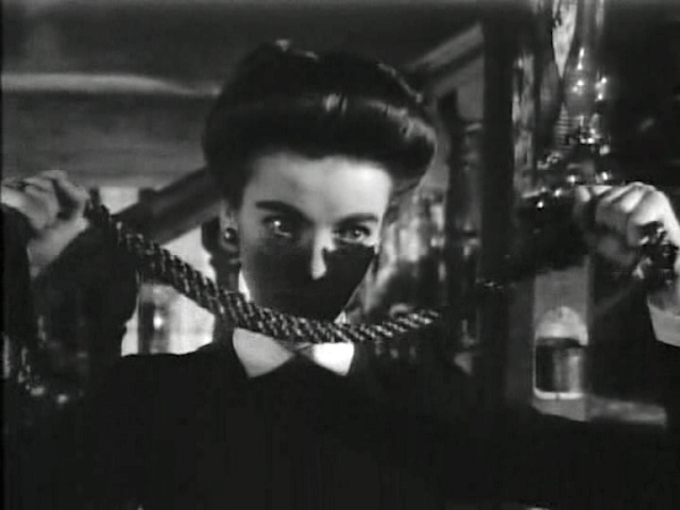
Ida Lupino plays the reticent Ellen Creed, housekeeper to the colorful Leonora Fiske (Isobel Elsom) who has retired from the music hall stage. Ellen is the obsessive guardian of her two loosely screwed sisters Emily and Louisa portrayed deliciously vague sort of loony by Elsa Lanchester (Emily) and Edith Barrett (Louisa).
Ellen manipulates Leonora to allow her quirky siblings to come and visit, well aware that she has no intention of making it a temporary stay. Once Leonora realizes that the two are batty, she demands that they leave forcing Ellen to do the unthinkable, to not only murder her employer, but create a deceptive strategy that will allow the sisters to dwell in sanctuary at the cozy manor house by the moors.
Unfortunately, Ellen not only has the full time job of wrangling her nutty sisters, she becomes the target of her blackmailing nephew Albert Feather, played with a dash of charming malevolence by Louis Hayward. ( And Then There Were None 1945, Ruthless 1958, House By The River, Night Gallery: Certain Shadows on The Wall.)
The film is moody, macabre, theatrical, with a musty air of Gothic as Leonora’s remains lay hidden in the coal bin behind the bricks, near the grand piano where she once boisterously sang Tit -Willow from The Mikado…
The atmosphere stays closed in, as all three sisters flit about exposing their disconnection to reality. Evelyn Keyes is Lucy the house maid who brings a bit of naivete to the atmosphere as she too falls prey to Albert the ‘charming rogue” who gets her to participate unwittingly in his ruthless scheme of blackmail.
A quiet and delicately creepy hybrid of the old dark house sub genre of horror, mixed with suspenseful psychological thriller as it whimsically touches on the subject of mental illness and the darker sides of human nature.
The brooding Lanchester and the chattering, guileless Barrett (I Walked With A Zombie, The Ghost Ship, Jane Eyre all 1943) are wonderful as the one who is intense and a compulsive collector, to the one who is as fay as an aged wood sprite, wide eyed and childlike.
In contrast to the flightiness of her two sisters, the tightly coiled Lupino is beautiful and menacing as she anguishes over the fate of the peculiar pair who act more like undisciplined children, and less the blatant lunatics.
It’s the subtle intrusions of reality that impinge on the character’s terminal state of fantasy,which brings out the self-centered, insulated psyches of the two sisters. This creates the environment of insanity, and while they cause the situation to ignite a criminal conspiracy because of their unchallenged instability they are essentially harmless ultimately exposing Ellen as the most dangerous and cunning in the family.
Albert charms his way into Leonora’s home and heart!
Louisa Creed: I hate the dark. It frightens me. Sister Theresa: It shouldn’t, my dear. Don’t you believe we’re watched over? Louisa Creed: Oh yes. But I’m never quite sure who’s watching us.
Ida Lupino on the set of Ladies in Retirement 1941
There are thousands of films as fabulous as this in my collection, this is just one of them!-MonsterGIrl
Directed by Michael Gordon, Produced by Ross Martin, based on a play, and adapted to the screen by Ivan Goff and Ben Roberts, this crime melodrama is filled with all the right tawdry drama and campy dialogue that makes watching films from the fabulous 60’s so much fun!
Starring Lana Turner as Sheila Cabot a woman who is married to a dying shipping magnate Matthew Cabot ( Lloyd Nolan). Anthony Quinn portrays Dr. David Rivera, Matthew Cabot’s attending physician. The wealthy couple lives in a sumptuous home in San Francisco.
Sheila and the good Doctor, begin having an affair, and soon after their sparks fly, the lovers decide to murder Sheila’s nasty yet, terminally ill husband.
But as often the way these juicy tales of murder and passion go, someone knows the lovers have killed off the rich old Cabot, and begins blackmailing them.
Sandra Dee plays Cathy, Cabot’s daughter from his first marriage. Richard Basehart is Howard Mason, Cabot’s greedy business partner. John Saxon plays Blake Richards, the chauffeur, who is pursuing Cathy, and Ray Walston, Virgina Grey and Anna May Wong fill out the cast of dubious characters, all of whom might be the ‘one’ who knows about their crime!
Oh the flashy melodramatics, Oh Turner’s wardrobe! There are thousands of films in my collection, this is just one of those deliciously trashy ones.- MonsterGirl…
Directed by Terence Young, and starring Eric Portman, Edana Romney, and Barbara Mullen. Edana Romney co-wrote the script.
Eric Portman plays Paul Mangin, who thinks he is Cesare Borgia reincarnated and that Mifanwy Conway (Edana Romney) is his lost love from a previous life. Corridor of Mirrors also showcases appearances by Christopher Lee and Valentine Dyall. A table at a nightclub with Mifanwy and her companions offers a fleeting glimpse of an astonishingly young Christopher Lee in his film debut, marking the beginning of a legendary career.
Terence Young’s film is a masterpiece of exquisite British filmmaking, immersing us in a rich atmosphere and evoking a mood that rivals the best psychological suspense thrillers and horror films from the forties, like the shadow plays of Val Lewton and the Gothic dark romances such as Wuthering Heights 1939, Rebecca 1940, and Jane Eyre 1943.
Corridor of Mirrors evokes an atmospheric, hallucinatory spectacle akin to Henri Alekan’s cinematography as he follows Josette Day’s travels through the mansion in Cocteau’s 1946 fable-like masterpiece Beauty and the Beast, imbued with its baroque, gilded, and ornate set design. Andre Thomas’s poetic lighting and camera angles suffuse the landscape of labyrinthine corridors, creating a somber and otherworldly landscape that evokes traces of Lewis Carroll’s Alice in Wonderland as Edana Romney journeys through the dreamy complexity of the mansion, trying to break free of the spell, as she pursues the white cat, who is an emblem of Alice’s white rabbit.
Terence Young’s haunting directorial debut is one of those rare films that sweeps you straight into its opulent, unsettling dreams. It is a stunning and dreamlike gothic noir steeped in romantic obsession, sorrow, and psychological unease. At the center of it all is Paul Mangin, an enigmatic, larger-than-life artist absolutely obsessed with the past. The story spirals around this mysterious figure who cloaks his mansion and himself (in velvet capes), in Renaissance grandeur and holds the profound certainty that his soul has spent lifetimes, shaped by love and loss, echoing across centuries. Paul’s interest in Mifanwy is nothing more than a reflection of a cherished image, a portrait whose allure her appearance unsettlingly echoes, devoid of true understanding or affection.
Edana Romney wasn’t just cast as Mifanwy; she shaped the role herself, working closely with co-producer Rudolph Cartier to adapt Chris Massey’s novel into the screenplay. Watching her on screen, she moves almost like she’s sleepwalking, and while her acting is somewhat restrained, it actually adds to the film’s hypnotic, dreamlike quality. Throughout, she’s shadowed by a mysterious woman and a fluffy white cat, both quietly watching, which only deepens the sense of eerie voyeurism and subtle unease.
When Paul meets the beautiful Mifanwy Conway, lovely, possibly shady, and just curious enough to get drawn into the sinister spell, his fixation deepens. He’s convinced she’s the reincarnation of a long-lost lover from centuries ago and seeks to shape her to fit this spectral ideal. She rides beside Paul through shadowed London streets, the horse-drawn cab winding toward a vast, brooding mansion at the city’s heart. Paul, a forbidding aesthete veiled in grand delusions of a past life as an Italian noble, seeks to ensnare the sensuous Mifanwy in the dark embrace of his twisted reverie.
From its shadow-drenched corridors and warped reflections, the film blurs the boundary between reality and hypnotic fantasy. Corridor of Mirrors is a wild, shadowy fever dream drenched in mystery and illusion. It carries you from these dark, mirror-lined hallways and the lavish costume balls right into haunting galleries filled with faceless mannequins. Reality and fantasy melt together here; sometimes, you aren’t sure which is which. It’s like stepping into a twisted fairy tale. Each scene pulses with the quiet torment of lives trapped in mirrors, echoes of Pygmalion, Bluebeard, and Cocteau’s haunted fairy tales. It is as if the characters are caught in a maze of glass, unable to escape their own reflections and obsessions.
Paul Mangin’s obsession leads to madness, murder, and a shattering denouement amid wax effigies in Madame Tussauds, where the film’s onyx gloom gives way to truth and a tragic sense of justice.
The film’s Gothic atmosphere occupies a rare and haunting space, yet it draws subtle echoes from both Hitchcock’s Vertigo (1958)and Fritz Lang’s eerie 1947 thriller, The Secret Beyond the Door.In the latter, a new bride, Joan Bennett, uncovers a chilling secret: her husband’s obsession with recreating rooms where murders have taken place, a macabre blurring of the lines between love and death, passion and violence.
André Thomas’s cinematography is a world unto itself, with its eerie, poetic visual style transforming the film into a hypnotic dreamscape. He plays with light and reflection brilliantly so that you almost lose track of where the real world ends and fantasy begins, those iconic mirrored corridors, where characters and their secrets multiply endlessly in flickering candlelight, and movement, fracturing reality and plunging the film’s characters into a labyrinth of shifting perspectives. Thomas’s cinematography exquisitely captures the film’s sumptuous costumes and intricate décor, draping each scene in a play of shimmering shadows and delicate highlights. His lens lingers on textured fabrics and ornate surroundings, bathing the opulence in a luminous glow that feels both intimate and grand, inviting us to step into a world where every detail is a visual feast. Thomas bathes the set in a chiaroscuro haze in key sequences, such as Mifanwy’s passage through the mansion’s long, mirrored hall lined with faceless mannequins. Nothing is quite what it seems. This approach blurs the line between fantasy and reality, uniting the film’s aching romantic longing and its creeping psychological dread. In every veil and distortion, the characters’ tangled obsessions and fractured selves mirror each other.
George Auric’s (who scored Cocteau’s La Belle et La Bête) score for Corridor of Mirrors flows like a dark, Gothic, melancholic river beneath the film’s haunting imagery, its melodies rising and falling with the rhythm of obsession and longing. The music is at once ethereal and grounded, shimmering with delicate strings that weave through shadowy passages and shadow-drenched ballrooms, while moments of brooding brass and subtle piano suggest the deep undercurrents of psychological unease and brooding desperation. The late moments, underscored by sweeping, delicate orchestration, evoke the grandeur and tragic beauty of the unfolding drama, making his score an essential part of the film’s haunting allure. Auric’s composition turns every whispered secret and silken touch into a symphony of passion and peril. The gowns were designed by Owen Hyde-Clark and constructed by French couturier Maggy Rouff.
“In projecting the slow abandonment of one’s identity, her third and final performance on the big screen evokes the pleasure, and the terror of romantic submission, Smith says — Mifanwy is a princess who, unlike Cinderella, who waits for a prince, or Snow White or Sleeping Beauty, immobile without the touch of a man’s lips, must break her own spell.” (Imogen Sara Smith for Criterion)
Corridor of Mirrors is a lush, visually extravagant meditation on identity and desire, where the past’s spectral grip suffuses every candle-lit room and character’s haunted gaze. The artistry of set and cinematography deepens its poetic melancholy, making the film a rare British gem, finely blended of exquisite and unsettling, and forever suspended between passion and despair, somewhere between the promise of love and the weight of memory.
The Queen of Spades (1949) is an obscure British psychological thriller. Associate Producer Jack Clayton was on board for this film, directed by Thorold Dickinson (Gaslight, 1940), who came onto the project at the last minute. Adapted to the screen by Rodney Ackland and Arthur Boys from the 1834 novella written by Alexander Pushkin. The story could have easily been dreamt up by Aleksei Tolstoy, Ivan Chekhov (The Drop of Water sequence in Black Sabbath), Nikolai Gogol, or even Oscar Wilde.
It also brings to mind Edgar Allan Poe’s short story “Never Bet the Devil Your Head: A Moral Tale.” Which of course was brought to life by Federico Fellini in the segment of Spirits of the Dead 1968called Toby Dammit, featuring the work of divine actor Terence Stamp.
Terence Stamp as Toby Dammit in the segment of the same name as part of Spirits of the Dead. Directed by Federico Fellini, 1968. Based on the short story by Poe, Never Bet The Devil Your Head.From Mario Bava’s Black Sabbath 1963 vignette, The Drop of Water, based on a story by Chekhov.Boris Karloff stars in an adaptation of Tolstoy’s story in the segment about The Wurdelak.
It’s clear that Russians are very good at telling Ghost stories and notorious for telling tales about selling your soul to the Devil!
The Queen of Spades stars Anton Walbrook, Edith Evans, and Yvonne Mitchell. Also in the supporting cast is Ronald Howard, son of Leslie Howard, who bears a striking resemblance to his father. Andrei is of a noble background, a soldier as well, and Herman Suvorin’s only friend. He is truly in love with Lizaveta (Yvonne Mitchell). The evil Suvorin even steals a few of Andrei’s poetic words to use in one of his love letters to lure Lizaveta.
An ambitious officer, Herman Suvorin, becomes obsessed with learning the secret card combination that once made an elderly countess fabulously rich, a secret she supposedly bought with her soul. To get it, he worms his way into the household through her young companion, Lisaveta, only to drive the old woman to her death and find himself haunted, literally and figuratively, by what he’s done.
The film is a lost masterpiece of British Gothic cinema, with its arresting visuals, the elegant but uncanny set design, and the way mirrors, shadows, and sound are used to keep pace with Walbrook’s unraveling.
The evocative music scored by Georges Auric(Beauty and the Beast (1946), The Innocents (1961), and Wages of Fear1953, just to mention a very few!) is as heart-wrenching as it is heroic, drawing out the exquisite melody and chord changes to reach the soul and twist it into knots while it lingers.
What can I say about the gorgeous cinematography by Otto Heller? The odd camera angles are reminiscent of the great German Expressionist movement, something from Fritz Lang, or the use of light and darkly dreamy angles like those of Carl Theodor Dreyer.
Even without any sound, the story would have emerged from the screen as a powerful cautionary tale, rife with grotesque and compelling characters.
The film is an arresting fairytale, that’s dreamy, and haunting in its imagery, and perhaps, as visually stunning as I dare say Jean Cocteau’sLa Belle et la Bete 1946 or Julian Duvivier’s Flesh and Fantasy1943, and the collaborative efforts of Alberto Cavalcanti, Charles Crichton, Basil Dearden, and Robert Hamer’sDead of Night 1945.
Betty Fields and the mysterious mask salesman in Flesh and FantasyMichael Redgrave and his dummy in Dead of Night
There are frames so masterfully conjured in shadow that you might even think you’re watching Film Noir or an obscure Val Lewton production. Either way, TheQueen of Spades defies any single label; it is a wonderful fusion of many compelling elements.
You know, a lesser director would simply sit back and let Walbrook carry everything, but Dickinson matches his intensity by filling the frame with signs of fracture; reflections that don’t feel trustworthy, hallways that seem to lengthen under the pressure of paranoia, and images that keep you guessing whether the Countess is a victim or a supernatural predator.
Dickinson’s direction emphasizes a brooding, Gothic atmosphere through chiaroscuro lighting in opulent Russian interiors and Expressionistic use of shadows to convey psychological turmoil. There are unsettling close-ups of Walbrook’s intense gaze
It has a melancholy, fairy-tale logic of its own, drawing on mystery, crime, noir, and supernatural horror from that golden age when the way a film looked mattered as much as what anyone said or did.
Dickinson films all of this with a rich, brooding flair. The interiors feel like gilded mausoleums: heavy drapes, ornate mirrors, and those deep pools of black shadow that look ready to swallow the characters whole. Light and darkness battle it out in every frame, faces half-carved by candlelight, staircases that vanish into ink, cards gleaming like tiny white tombstones on the imagined color of green baize. There are close-ups of Walbrook’s gaze so intense they almost feel like a challenge to us: are you really sure this is all in HIS head?
The world around him is just as expressive. Otto Heller’s camera turns the Russian aristocracy into a kind of living ghost story, with costumes and sets that feel slightly heightened, slightly unreal, like a memory of the 19th century rather than a documentary reconstruction. Georges Auric’s music threads through it all like a nervous pulse, amplifying the sense that fate is already written, and every choice these characters make is just another step toward it.
What I love is how the film stands at a crossroads: you can feel the influence of German Expressionism in those tilted shadows and uncanny compositions, but there’s also the fatalism and moral rot of film noir seeping through the cracks. It’s Gothic horror dressed in cards and uniforms, already nudging its way toward the more modern obsessions of psychological thrillers, what happens inside a mind when greed, fear, obsession, and desire all start playing their own rigged game.
The Queen of Spades (1949), treated as a major work of British Gothic cinema, gains an even stronger atmospheric charge when you factor in Thorold Dickinson’s background as an editor, his earlier work on the original Gaslight, and the circumstances that brought him onto the film at very short notice, reshaping both script and tone.
Anton Walbrook’s career and temperament; his origins as Adolf Wohlbrück in Vienna; his pre-war success in German cinema and theatre; his flight from Nazi Germany; his reinvention in Britain; and how that history of exile and doubleness feeds into his performance as Herman Suvorin in this film. All of that should feel integrated, a context that enriches the reading of the film, not little biographical footnotes.
Thorold Dickinson leans hard into a brooding, Gothic mood. He floods those St. Petersburg interiors with chiaroscuro light, corridors carved out of shadow, letting faces emerge from the dark as if the shadows are thinking for themselves, surfacing as if summoned rather than simply lit.
The camera keeps circling back to Walbrook’s eyes in unnervingly tight close-ups, so that a single glance can feel like a threat or a crack in his sanity.
The world around him is just as expressive. The cinematography feels like guilty opulence under siege: The rooms are crowded with heavy fabrics, ornate furniture, and elaborate uniforms and gowns that don’t just signal 19th-century Russian aristocracy, they make the whole society feel overdecorated and airless, as if the characters are being slowly smothered by their own luxury.
Otto Heller’s work is explicitly, metaphorically visual with his use of towering shadows, inky pools of darkness, expressionist angles, creating St. Petersburg as a maze of pitchblack and candleflame, faces carved out of shadow like reliefs, the gambling den as a kind of infernal chapel where light and smoke conspire to turn men into specters, and the part of the film’s preoccupation with fate and damnation.
And the way Messel and Kellner’s sets and Heller’s lens make the Welwyn stages feel like a haunted city rather than a modest British studio. The Gothic textures, the baroque interiors, the way mirrors and high angles warp scale and sanity, all circle back to the film’s preoccupation with fate and damnation.
Kellner and Oliver Messel are the production designers; the BFI has a whole piece on his Queen of Spades model work and describes those “rococo flourishes, faded grandeur, flickering candles, mercurial mirrors and architectural pieces capable of throwing the most ominous of shadows.” William Kellner, credited as art director, is specifically praised in a recent Film Experience piece for stuffing the frames with baroque excess.
The Queen of Spades absolutely leans into that slightly baroque and lush mood, mirroring the film’s own sense of ornate decay, while threading through a few precise, cutting images that keep it feeling overstuffed.
The film’s language is rich, tactile, and atmospheric, and the metaphors are layered, curling around the texture of the images, the velvet blacks, hard glints on brass, the gleam of cards, and the pallor of anxious faces, punctuated every so often by a short, almost brutal line that states the psychological or supernatural truth of what we’re seeing.
That duality lets you honor the film’s rococo visual world while keeping your prose disciplined: the baroque tone sits in the sensory detail and rhythm, and the “sting” arrives in those sudden, cool observations that cut through the gloom.
The Queen of Spades is shot as if the entire film were taking place inside a guilty conscience, dressed up in velvet and gilt to keep the truth from showing. Light doesn’t simply illuminate these rooms; it seems to trespass into them, sliding over brocade and brass, catching on the trembling edges of playing cards and the brittle planes of severe faces. The blacks are deep and inky, the kind of darkness that doesn’t just sit in the background but presses forward, swallowing doorways, staircases, and corners until the characters look less like they’re inhabiting a space than being slowly absorbed by it. Candle flames and lamps carve out small, feverish islands of visibility, and within those islands, every crease in the wallpaper and every glint from a picture frame feels complicit in the story’s sense of doom. The camera glides through this environment like an accomplice who already knows the ending, drifting past heavy draperies and ornate furniture with the calm assurance of fate, occasionally settling into compositions so tight and airless that even the grandest rooms feel like traps waiting to spring.
Faces in this film don’t simply appear; they emerge from the gloom in stages, features picked off one by one by slashes of light that seem less interested in revealing identity than exposing motive. Anton Walbrook’s profile, in particular, is treated almost like an architectural element chiseled out of shadow, his eyes catching just enough glimmer to suggest the restless, calculating machinery behind them. The cinematography repeatedly turns him into a figure at war with his own surroundings: one moment, he’s swallowed by the house’s baroque clutter, a man miniaturized by portraits, pillars, and candelabra; the next, the frame clamps down so tightly on his face that the world recedes and all that remains is obsession, flickering in a narrow band of light. There is a sense that each shot is a negotiation between opulence and suffocation, the décor flaunting its richness even as the framing and lighting insist that nothing in this world, no mirror, no staircase, no deck of cards, is safe or neutral. Every visual choice feels like a bet placed against the characters’ better judgment.
What makes the images so unnerving is the way the supernatural never quite announces itself; it seeps in through the textures.
Reflections linger a second too long in those mirrors, suggesting presences that might just be tricks of the light, until we begin to doubt our own eyes along with the characters’. The house behaves like a silent conspirator: staircases vanish into shadow that looks thick enough to touch, doorways become black gaps that seem to promise either revelation or annihilation, and the countess’s rooms feel embalmed under layers of fabric and ornament, like a mausoleum that never admitted it was one. When the uncanny finally steps fully into the frame, it doesn’t arrive as an interruption, but as an inevitability, something the images have been patiently preparing us for since the first candle guttered against the dark.
The overall aesthetic of the costumes in The Queen of Spades feels like an extension of the sets—ornate, faintly unreal, and just a little too sumptuous for comfort. Designer Oliver Messel, better known as a star theatre and production designer, brought his unapologetically anti-naturalistic, “enemy of everything utilitarian” sensibility to the film, dressing characters in layers of brocade, lace, and elaborate trim that make the aristocratic world look both intoxicating and airless.
His inspirations reportedly ran to the pioneering English architect, designer, and artist who introduced Italian Renaissance classicism to English architecture. Inigo Jones, who started as a designer of theatrical masques and sets, also Fragonard, Boucher, and other masters of elegant artificiality, and you can see that in the exaggerated silhouettes, the froth of ruffles and silk, the way collars, cuffs, and headpieces frame faces as if they were portraits being composed for our inspection.
The Countess’s gowns, especially, are like movable shrines— baroque horrors, treasure boxes, guilded nightmares, heavy, rustling constructions that announce her before she even speaks, while Lisaveta’s simpler dresses emphasize how she’s visually of this world but not really allowed to own it.
As far as the men’s uniforms and evening clothes go, they have a sharp, almost rigid formality that contrasts with Suvorin’s inner disarray; he’s buttoned and braided within an inch of his life, yet always looks slightly ill at ease inside Messel’s meticulously tailored elegance. All together, the costume design contributes to that sense of a rococo society drifting toward nightmare: everything is beautiful, everything is heightened, and every ribbon and epaulet feels like one more thread in a web these characters won’t easily escape.
The 1949 film follows the basic spine of Pushkin’s story quite faithfully, but it thickens and reorients the material in ways that make it far more of a Gothic character study and melodrama than the relatively lean, ironic tale on the page.
Pushkin gives you a compact narrative about Herman Suvorin, an outsider obsessed with discovering the secret card-winning formula from an old countess, and the devastating consequences of his cold, calculating ambition; the film keeps that core, but elaborates on the character’s relationships, heightens the supernatural aura, and leans heavily into visual and atmospheric excess that Pushkin only suggests in a few of his clean strokes of the pen.
Plot-wise, the main events are recognizably Pushkin: the legend of the three cards, Suvorin’s manipulation of the young woman connected to the countess, the fatal confrontation, the ghostly visitation, and the final, ironic twist at the gaming table all remain intact. Where the film diverges is in its emphasis and tone; it slows down and luxuriates in spaces, rituals, scheming, and psychological beats that the story moves through with brisk, almost cruel efficiency, turning what a sharp moral fable it is, into something closer to a richly upholstered nightmare about obsession, class, and fatalism.
The Pushkin source, the rewiring of the story by Arthur Boys and Rodney Ackland, the producer Anatole de Grunwald, the late replacement of Ackland by director Dickinson after quarrels with both de Grunwald and Walbrook, and the way Dickinson’s experience on Gaslightinflects the film’s fascination with manipulation, paranoia, obsession, and moral rot.
Otto Heller’s inky black-and-white cinematography, the baroque sets, and the way the film has come to be regarded as a neglected gem or gothic masterpiece of late?40s British cinema, rather than just a handsome literary adaptation.
Walbrook’s performance, which can be seen against his earlier turns in The Life and Death of Colonel Blimp and The Red Shoes, becomes a pivot: another portrait of a driven, haunted man, but here shaded with greed, desperation, and a kind of spiritual homelessness.
Anton Walbrook is wonderful as Moira Shearer’s domineering impresario, Boris Lermontov, in Michael Powell and Emeric Pressburger’s The Red Shoes 1948
Set in 19th-century St. Petersburg, the story follows Captain Herman Suvorin, an obsessive gambler who becomes fixated on learning a secret three-card formula from an elderly Countess who made a deal with the devil himself.
Anton Walkbrook is enigmatic, oozing a mania of greed and obsession, playing the bitter, venomous Capt. Herman Suvorin, an army engineer, was so poisoned by his resentments toward the ruling aristocracy that he wanted to gain his own wealth and punish those around him who had benefited by their birthright and title. Suvorin is under the influence of the supernatural as he manipulates the Countess’s young ward, Lizaveta, to gain access to the Countess’s secrets. Suvorin does not want to take life as it comes; he wants to “Grab life by the throat and force it to give him what he wants!”
Walbrook’s Suvorin is a man forever teetering between reason and delirium. One moment he’s the cool rationalist, sneering at superstition; the next, his eyes catch the light in a way that makes you wonder what, exactly, he’s seeing in the shadows. If the film didn’t point to Suvorin’s entanglement with fear, superstition, and a tremendous ego, you might believe you see a flicker of him haunted by guilt, or has he really opened a door that should have stayed bolted? Is he being hunted by the Devil, or simply losing himself to madness?
The film never quite lets you off the hook; every logical explanation seems to leave just enough room for something uncanny to slip through, and that’s what makes The Queen of Spades so visually intoxicating.
The narrative delves into the destructive nature of avarice, with Herman Suvorin’s relentless pursuit of wealth leading to tragic consequences and his maniacal undoing. The film also examines the tension between rationality and superstition as Suvorin grapples with seemingly supernatural events.
This he conspires to do by trying to learn the secret of winning at the card game named Faro, from the Old Countess Ranevskaya. The Countess, played by Dame Edith Evans with the chill of a mausoleum and the hauteur of a woman who has outlived everyone and everything that ever mattered, becomes his obsession.
Sal Mineo(Rebel Without A Cause 1955 The Young Don’t Cry 1957) plays yet another troubled youth, this time he’s a busboy at a disco. His name is Lawrence Sherman, who has had a turbulent childhood manifesting into an obsessive sexually disturbed young pervert.
His object of desire is aspiring actress/disc jockey Nora Dain, at the club where he buses tables. He makes obscene phone calls, partakes in a bit of voyeurism, frequents porn shops and XXX movie theaters with the rest of the heavy breathing raincoat crowd!
A very sleazy exploitation goodie from the 60s utilizing that gorgeous high contrast black and white and Charlie Calello’s perfect soundtrack of raunchy cheese horns that make you want to flail your hips in Satan red high heel shoes, digging holes in the carpets, while you twist til dawn!
Mineo exudes angst and a bottled up sexual repression so well that his role as obsessive stalker , makes the scenes with his sweaty bare chest, creep me out til Tuesday of next week!
Normally I just adore a sweaty bare chest, don’t get me wrong… but these are ‘pervert beads of sweat’ we’re talkin’ here…! Now JUST TO BE CLEAR! I am not drawing connections between Mineo’s real life self proclaimed homosexuality and the film’s perceived character of Lawrence Sherman whose so-called ‘perversion’ and sexual proclivities lead him down a dangerous path.
Sal Mineo, teen idol, extraordinary actor playing the street kid against the established order of things, and publicly gay man in the 70s, was very brave to wear his identity out in the open.
But that’s why I love these exploitation gems from the 1960s so much. They run counter-intuitive to The Cleavers ( which I LOVE so, no disrespect there.)But it’s important to muddy up the good clean mythos of the American dream once in a while….!
Added to the plot line is the obsessive cop who has his own fixations, like listening to crime tapes with graphic confessions!
The film is directed by Joseph Cates, Written by Arnold Drake and has an interesting cast including not just Juliet Prowse, but Jan Murray as Lt. Dave Madden another obsessed male animal, the great Elaine Stritch as Marian Freeman , Nora Dain’s fur coat stroking, club owning dyke…
I love how they get these older dames like Gypsy Rose Lee in Screaming Mimi and Elaine here as Marian Freeman to play lurking coded lustful lesbos / adult club owners on the hunt for fresh meat!
Wow…I think that there’s a pattern forming here. Hhhm…I’ll have to look back at Naked Kiss and reconsider that scene where club owner (Virginia Grey) Candy is shoving that dirty money into Constance Tower’s mouth… Hhm.
Elaine Stritch predatory lesbian club owner and Sal Mineo very sexually troubled young man…
Margo Bennett as Edie Sherman Lawrence’s sister.
Lawrence’s sister in the closet. Ah the wholesome American home life breeds so many happy youngsters!
“I never thought you’d put me down, but I’m walkin’ around with no place to go!”
There are thousands of films like these in my collection, this is just one of them, so curl up with your own ‘teddy bear’ if it’s not psychotic and see it for yourself!-MonsterGirl!
A young scientist saves an attractive married woman from a suicide attempt, becomes romantically involved with her, plots to kill her husband, and then fakes insanity to escape the murder charge.
The first Five minutes of Brainstorm 1965 set the slick and sinister vibe in motion on a dark and desolate noir highway against George Duning’s snazzy score, where Jim Graham (Hunter) stumbles upon Lorrie Benson (Francis) trying to commit suicide by train! He manages to get into the car and move it moments before the train comes hurling itself right behind them. The moment is dark and frenetic and possesses so much of what makes some of the best Noir/Psychological thrillers of the 60s so enigmatic…!
Reaching in through the broken window to unlock the car, moments before the impending train! A beautifully framed shot in Film Noir style…
Swedish-born actress Lindfors (Whom I consider to be one of the most underrated actresses, and one of my favorites as well.)plays Dr. Elizabeth Larstadt whose testimony keeps Grayam out of jail and sent to a sanitarium instead. Andrews plays Cort Benson, Lorrie’s Beverly Hills millionaire husband. With Michael Pate and Strother Martin, it is always a treat to see both character actors in anything trashy or classy.
Here’s a clip from Brainstorm 1965
There are thousands of films in my little collection, this is just one of them! Say, I just had a brainstorm… see it for yourself!-MonsterGirl
Released by Universal in 1943 Flesh and Fantasy is by brilliant director Julien Duvivier, and co-produced by CharlesBoyer, and still remains an obscure forgotten horror gem.
Fatalistic, philosophical, Impressionistic, and hauntingly romantic, it dabbles in destiny and the dynamism of fate’s meddling hand in our lives. Are we all free souls, or is life predetermined for us? Part social commentary with an edge of ironic charm, utilizing elements of the supernatural to drive the narrative.
The film revolves around 3 vignettes, the first written by Eliis St. Joseph, the second adapted from Oscar Wilde, and the third written by László Vadnay.
Turning out a collection of eerie stories told by Gentlemen at their club. The stories are framed by Robert Benchley as Doakes and David Hoffman as Davis.
The first stars Betty Field as Henrietta a dowdy woman who comes upon a mysterious mask during Mardis Gras and then goes to a party festooned with regalia, turbulence, and a romantic game of cat-and-mouse with the handsome Michael (Robert Cummings) A beautifully tragic tale of loneliness and the essence of what beauty is. The use of masks creates a nightmarish landscape of human disconnection.
The shop of mysterious masks.
The second vignette is an adaptation of Oscar Wilde’s, Lord Arthur Saville’s Crime, which stars Edward G. Robinson as Marshall Tyler, a lawyer who is told by a Fortune Teller Septimus Podgers (Thomas Mitchell) that he is going to kill someone. Also at the affair is Dame May Whitty as Lady Pamela Hardwick and C. Aubrey Smithas the Dean of Norwalk.
Playing out the obsessive victim, Tyler devolves ever increasingly into a world of malefic paranoia in that way that Robinson is so good at. He spirals into madness as he is surrounded by reflections and warning shadows, and an impending dread, that creates a sense of the film being a Horror/Noir hybrid. The use of shadow does invoke a bit of Jacques Tourneur’sstyle as well.
In the third installment, Charles Boyer plays an acrobat in the circus named Paul Gaspar, who has a premonition of fatal consequences surrounding his high-wire act. Gaspar has a dream one night before his performance that he falls to his death, and so he decides to take a cruise, where he meets the woman from his dream, Joan Stanley played by Barbara Stanwyck, who was the one person he could still hear screaming as he plunges to his death! This episode concludes the film with a dreamy and grim set of atmospherics.
Impressionism in Nightmares-Symbolism-and the fear of falling…
the woman in dreams, is she as unattainable in real life?
THE GREAT GASPAR: that drunken gentleman of the tightrope will walk 75ft. in the air without a net!
Flesh and Fantasy predate by two years another wonderfully suspenseful ensemble of ghostly stories, Dead of Night 1945 starring Michael Redgrave in the iconic short tale of the ventriloquist and his frightening dummy sidekick!
Never trust a guy who’s made of wood and lets you stick your hand up his shirt for no money!
There are thousands of wonderful obscurities in my collection, this is just one of them!
Nils Asther (Night Monster 1942, Bluebeard 1944) plays Dr. Julian Karell a 120-year-old scientist who has found a way to prolong life. Julian falls madly in love with Eve Brandon (Helen WalkerNightmare Alley 1947, Call Northside 777 1948) Unfortunately he needs new glands in order to survive, and not head toward decrepitude and die!
Eve Brandon: “I’ll share your madness because there’s grandeur in it. And I have faith – and love.”
Directed by Andrew L. Stone, this noir thriller stars, Doris Daywho plays Julie Benton, whose unstable musician husband Lyle Benton played by Louis Jourdan confesses that he killed Julie’s first husband. Lyle is incredibly possessive and wouldn’t rather see her dead than be in the arms of another man. Julie seeks out the help of friend Cliff Henderson (Barry Sullivan) This is a woman in peril thriller, that has the police closing in on Lyle, but not before the climatic ending, where Julie boards a plane, returning to her work as a stewardess, not realizing that Lyle is also on board!
The film also co-stars veteran noir actor Frank Lovejoy as Det. Lt. Pringle.
Julie is being stalked by Lyle!
There are thousands of films in my collection, this is just one of them!-See it for yourself-MonsterGirl