Pascal Laugier’s “Martyrs” (2005) The Cult of Transfiguration: From Shelley’s Electrical Secrets of Heaven, Prometheus, The Esoteric Sect of Death Trippers, Seeking Beyond the Dead

SPOILER ALERT: While I don’t give a full synopsis, I do discuss details of the film…

A martyr (Greek : μάρτυς, mártys, “witness”; stem μάρτυρ-, mártyr-) is somebody who suffers persecution and death for refusing to renounce
Mysticism (About this sound pronunciation (help·info); from the Greek μυστικός, mystikos, meaning ‘an initiate’) is the knowledge of, and especially the personal experience of, states of consciousness, or levels of being, or aspects of reality, beyond normal human perception, sometimes including experience of and communion with a supreme being.

MARTYRS (2008)

Directed by Pascal Laugier (House of Voices 2004, The Tall Man 2012) stars the unreal Morjana Alaoui as Anna, Mylène Jampanoï as Lucie and Catherine Begin as Mademoiselle.

Fifteen years after Lucie escapes a horrific abduction in which she is subjected to prolonged torture and deprivation, she goes on a mission of revenge on the couple who brutally held her captive. She calls upon her faithful friend from the orphanage, Anna, who was also a victim of child abuse and utterly worships Lucie, to help her clean up after the massacre at the seemingly upper-class home.

Lucie slowly devolves into madness, as she cannot exorcise the demon who has been haunting her, a nightmarish and violent phantom born out of Lucie’s guilt for having left another little girl at the mercy of their abductors. If you enter into watching Martyrs thinking that it’s a straight out of the French New Wave of Torture Porn films, you’ll miss a transformative piece of filmmaking.

The Bride of Frankenstein 1935

From the time Colin Clive utters “It’s alive, It’s alive” in James Whale’s seminal classic Frankenstein 1931, the tone is set. Whale’s campier adaptation from Mary Shelley’s more meditative novel, is still self-possessed of science, the origin of being human, the question of ‘a’ God’s role in this existence, and ultimately, reflectively, ‘man’s’ (I loathe using normative masculine case ugh.) relationship to himself, his creator and the universe that bore him.

Anna in chains
12-year-old Lucie in chains

Frankenstein is an existential science-fiction fantasy with multiple layers and questions that can not be answered in 70 minutes on camera. But the images, the spirit of the story, and the characters can serve to evoke these primal questions and fears that have been built into our natures as human subjects.

Anna with her head shaved appears as a Joan of Arc figure.

Now, if you abstract Shelley’s allegory and invert the narrative to where the matter of science does not seek out the mysteries of life in terms of how to create it fromthe electrical secrets of heaven and an infinity of atoms, harness it, control it, thereby becoming god-like yourself …momentarily.

The film’s antagonists are a group of clandestine, ultra-wealthy, suggestive of high up in government, perhaps even royalty, seemingly above the law and untouchable, apparently with a hierarchy of leaders of advanced age. They are consumed with Mysticism or Spiritualism, (not to be confused with spirituality) a modernized form of a movement that was pervasive around the end of the 19th century and continuing around the early 1900s, and which this cabal, assumes a very clinical, anthropologically scientific approach.

Helena Petrovna Blavatsky and The Theosophical Movement -table rappings, etc.

Silver Belle Spirit Booth
A séance

The film’s narrative uses science vs. religion (although the act of faith in their mission becomes emblematic itself of fanaticism and religious avidity) because it bares an almost anthropological approach; a modern form of ’empirical’ torture, a method of collecting data. The end result is the creation of a theoretical equation, that asserts, if you dehumanize, brutalize, and cause the body enough pain, the subject’s psyche and physical being has nowhere else to go but toward an elevated sense of euphoria, to become Transfigured, like that of Christ on the cross, or Saint Joan de Arc.

Saint-Joan
Mother Joan of the Angels 1960 Directed by Jerzy Kawalerowicz
Flavia The Heretic Nun (1974) is also doomed to be flayed alive.

The subjects of their research also, at this point, become objects. An anonymous and beautiful little girl becomes, at first, a helpless victim, then a monstrous ‘thing’, and then is exalted to a heroic saint and visionary figure.

Their methods, while equally brutal, stand in contrast with the motivations of the Medieval scourge of inflicting pain that was for the sole purpose of punishing, eliminating your enemies, relishing in sadism, barbarism, suffering, and bloodshed, merely to bringing about death slowly.

Transfiguration |transˌfigyəˈrāSHən|
noun
a complete change of form or appearance into a more beautiful or spiritual state: in this light the junk undergoes a transfiguration; it shines.
"¢ (the Transfiguration) Christ’s appearance in radiant glory to three of his disciples (Matthew 17:2, Mark 9:2"“3, Luke 9:28"“36).

In contrast to the angelic martyred figure, Vanessa Redgrave plays a devil-possessed, sexually repressed nun. Directed by Ken Russell and based on Huxley’s Devils of Loudon. Power-hungry Cardinal Richelieu seeks to bring down the group of nuns and take control of France.

This Cult of Transfiguration uses pain, deprivation, and ultimately a carefully constructed clinical form of torture which for them is the road in which to search for the ‘secrets of life.’ But unlike Shelley’s Dr. Frankenstein who sought to create life on this earthly plane, Mademoiselle’s quest is to reach past this plane to the other side… of the veil, the borderland, that thing we call ‘life after death’, the exalted state of being, where we go after we literally ‘shed our skin.’

The head of this Cult of Transfiguration, Mademoiselle, is archetypal of Nazi experimenters. As a French filmmaker, Pascal understands the deeply scarred history of WWII and the profound ramifications that the Nazi’s presence left. She is like the embodiment of the Nazi doctors who often used human subjects for ‘medical research.’

The infamous Dr. Herta Oberheuser, a Nazi physician who experimented on numerous children.

The cult finds that young girls are the most inherently geared to becoming Martyrs, so they set out abducting their ‘specimens’, subjecting them to the most brutal, yet very clinical, torture in order to bring their human subjects to the state of grace and transformation. Then, right before their deaths, they can communicate what they see in the ‘ether world.’

Anna whispers to Mademoiselle… what if anything has she revealed? What has she seen… through her transfiguration?

I use the word clinical to describe the conditions, the beatings, and the gruesome and ultra ‘extreme’ pain they subject the girls too. This clinical torture diverges from the grittier serial killer film, where the interaction is often personal, self-satisfying, and subjective, sublimating the victim’s pain, and devouring it like a cannibal to feed their blood lust.

This cult shows no sign of emotion at all. They do not become aroused or responsive. They do, however, possess an eerily quiet fixation on their victims, as they start to enter Martyrdom. It is then they become, revered much again like a Saint, an icon, an object. But that is only when the experiment has been perceived to have worked. None of their subjects, except for Anna, utters a word before death. At the end of the film, we are left not knowing what Anna whispers to Mademoiselle.

Right after receiving the cryptic message from Anna, Mademoiselle locks herself in her room. She, too, strips away all her superficial layers, her amber-colored lenses, her head scarf, and almost all her earthly signifiers, Like Anna’s flayed body, Mademoiselle prepares herself for the other world. She only tells the man in black awaiting the news of what Anna has shared, “keep doubting” and then puts the revolver in her mouth and blows her brains out.

Viewers are left to conjecture what Anna has shared. Was it that she met Lucie on the other side and found such peace everlasting? Did she meet ‘god’? Did she experience an ecstasy beyond description? It is better not to know because that would disallow Laugier’s point. That WE cannot ever know. And if we spend our days here on this earth using other people to gain that knowledge, we’ll have not only missed the point, but we’ll become monsters ourselves. Seeking out figures to crucify on behalf of a manufactured faith, damned to uncertainty and taking victims along with us…

As Mademoiselle tells Anna “We’ve created more victims than Martyrs.”

I fear that’s how it’s been in history with human subjects and animals alike in such cases where science becomes a monstrous mechanism for knowledge, or when religion sacrifices innocent blood in the name of an ambiguous morality relying on its faith.

It’s the clinical brutality that makes the film all the more disturbing. But when I say disturbing, I do not imply that this is a film that wants to disturb you in only a visceral way. As the protagonist, Anna suffers and ultimately does become transformed, but I found myself becoming altered by the film’s end. And still days after, I have been feeling and processing what I saw on screen.

A good horror film can take an utterly monstrous, abjectly frightening, nightmarish, and at times grotesque situation, and transform itself into a thing of beauty. I truly believe that Martyrs is a horrifically beautiful film.

Georges Franju’s Eyes Without A Face 1960 comes to mind, the darkly bleak yet mesmerizing, haunting and yes, a clinical setting where a daughter’s dedicated father, a medical doctor abducts young women and skins them in order to give his beloved little girl a new face.

When a film can be so horrific that it taps into our primal fears and what Kristeva calls abjection (a hell of a read if you’re interested), anything that makes us feel something plucking at the core of our senses, perhaps not quite know what it is, but truly alters us somehow. Then when it manages to transcend the horrifying aspects of its story the visceral reactions we experience and goes on to cause an odd symbiosis with the images and the story.. .then to me… it becomes a work of art.

I’ve had that experience with Franju’s Eyes Without A Face (1960), The Exorcist (1973), The Texas Chainsaw Massacre (1974), Serrador’s The House That Screamed (1969), Rosemary’s Baby (1969), Night of The Living Dead (1968) Let’s Scare Jessica To Death (1971) Lemora: A Child’s Tale of the Supernatural (1973) and Play Misty For Me (1971) and in recent years, with Clive Barker’s Candyman 1992, Lucky Mckee’s May (2002), Ty West’s House of The Devil (2009) and Dante Tomaselli’s Horror (2002).

Martyrs evoke themes and images from Clive Barker’s Hellraiser, (1987) the hellish underworld society of Cenobites, that seek out and cause pain to acquire the ultimate exquisite pleasure.

But in Martyrs the exquisite release is that of the knowing… what is on the other side of this world. And it is THIS world that is HELL…

From The Vault: Ladies in Retirement (1941)

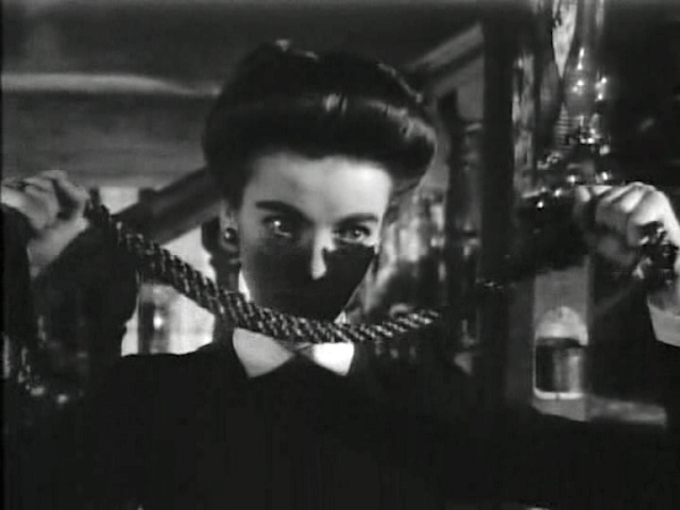
LADIES IN RETIREMENT (1941)

Directed by Charles Vidor  the man responsible for the eminent noir classic, Gilda 1946 and no relation to the more well know King Vidor. With a screenplay by Reginald Denham (The Mad Room 1969 a modern reworking of the same play, Suspense, Kraft Theater and Alfred Hitchock Presents)

The Mad Room 1969 a modern reworking of Denham’s Ladies in Retirement starring Shelley Winters and Stella Stevens.

Based on his play, and given a cast of intelligent performers like Ida Lupino, Elsa Lanchester, Isobel Elsom, Edith Barrett, Evelyn Keyes and Louis Hayward. 

The film is a suspenseful story with tremors of ethical dilemma, evocative of pity and encompassed by the moor like fog of madness and desperation.

Ida Lupino plays the reticent Ellen Creed, housekeeper to the colorful Leonora Fiske (Isobel Elsom) who has retired from the music hall stage. Ellen is the obsessive guardian of her two loosely screwed sisters Emily and Louisa portrayed deliciously vague sort of loony by Elsa Lanchester (Emily) and Edith Barrett (Louisa).

Ellen manipulates Leonora to allow her quirky siblings to come and visit, well aware that she has no intention of making it a temporary stay. Once Leonora realizes that the two are batty, she demands that they leave forcing Ellen to do the unthinkable, to not only murder her employer, but create a deceptive strategy that will allow the sisters to dwell in sanctuary at the cozy manor house by the moors.

Unfortunately, Ellen not only has the full time job of wrangling her nutty sisters, she becomes the target of her blackmailing nephew Albert Feather, played with a dash of charming malevolence by Louis Hayward. ( And Then There Were None 1945, Ruthless 1958, House By The River, Night Gallery: Certain Shadows on The Wall.)

The film is moody, macabre, theatrical, with a musty air of Gothic as Leonora’s remains lay hidden in the coal bin behind the bricks, near the grand piano where she once boisterously sang Tit -Willow from The Mikado

The atmosphere stays closed in, as all three sisters flit about exposing their disconnection to reality. Evelyn Keyes is Lucy the house maid who brings a bit of naivete to the atmosphere as she too falls prey to Albert the ‘charming rogue” who gets her to participate unwittingly in his ruthless scheme of blackmail.

A quiet and delicately creepy hybrid of the old dark house sub genre of horror, mixed with suspenseful psychological thriller as it whimsically touches on the subject of mental illness and the darker sides of human nature.
The brooding Lanchester and the chattering, guileless Barrett (I Walked With A Zombie, The Ghost Ship, Jane Eyre all 1943) are wonderful as the one who is intense and a compulsive collector, to the one who is as fay as an aged wood sprite, wide eyed and childlike.
In contrast to the flightiness of her two sisters, the tightly coiled Lupino is beautiful and menacing as she anguishes over the fate of the peculiar pair who act more like undisciplined children, and less the blatant lunatics.
It’s the subtle intrusions of reality that impinge on the character’s terminal state of fantasy,which brings out the self-centered, insulated psyches of the two sisters. This creates the environment of insanity, and while they cause the situation to ignite a criminal conspiracy because of their unchallenged instability they are essentially harmless ultimately exposing Ellen as the most dangerous and cunning in the family.

Albert charms his way into Leonora’s home and heart!

Louisa Creed: I hate the dark. It frightens me.
Sister Theresa: It shouldn’t, my dear. Don’t you believe we’re watched over?
Louisa Creed: Oh yes. But I’m never quite sure who’s watching us.

Ida Lupino on the set of Ladies in Retirement 1941

There are thousands of films as fabulous as this in my collection, this is just one of them!-MonsterGIrl

William Castle’s: The Tingler (1959) “There’s not a worm in your backbone when you get scared!”

Or the miracle of PERCEPTO! “We must have buzzed 20 million behinds!”-William Castle

THE TINGLER 1959

Directed by William Castle, written by Robb White, and starring Vincent Price, as Dr. Warren Chapin, Patricia Cutts as Isabel Stevens Chapin, Judith Evelyn as Martha Higgins, Philip Coolidge as Ollie Higgins, Darryl Hickman as David Morris, Chapin’s young assistant pathologist, and Pamela Lincoln as Lucy Stevens. Von Dexter’s ominous score helps paint the creepy and menacing atmosphere.

Urbane master of horror Vincent Price stars in one of William Castle’s atmospheric carnival rides as Dr. Warren Chapin, a pathologist whose milieu is the autopsies of executed prisoners from the State prison.

Chapin is driven by a curiosity to find out the source of the mysteriously evil force that creates the SENSATION of fear, and so he sparks a theory that there is an organism called… The Tingler manifests itself at the base of the spine when one is experiencing abject fear. The Tingler however is subdued by the act of screaming. This nightmare from the vertebral id looks like a giant centipede or a flat lobster with mandibles, lots of legs, and armored scales.

Each of us is inhabited by one of these creepy crawling death grippers, which grow larger as our fear expands, but because of our ability to scream, it lays dormant, incognito, and in repose at the base of our spines.

At first, Chapin locks himself in his lab, experimenting by taking doses of LSD and trying to induce fear first in stray cats and then in himself.

So it goes until Chapin meets Ollie and Martha Higgins who own a revival silent movie theater, and oh yes, Martha happens to be a deaf-mute, who also has an extreme phobia of the sight of blood.

As you know, I adore Judith Evelyn and am not very happy when it’s suggested that Chapin injects her with some LSD instead of a sedative in order to induce some nightmarish experiences, in which Martha will not be able to ‘scream’ therefore unable to suppress the little monster waiting to grip her when the moment of fear takes hold…

Click on the image, to see the ghostly chair at work…

In one of the most memorable classic horror movie sequences, Martha (Evelyn) during her presumed lysergic acid journey is stalked through her modest, bleak, and sinister apartment by a ghoulish phantom, who hurls a hatchet at her and then maneuvers her into the bathroom, where blood runs from the sink taps and the white porcelain tub fills with actual red-colored blood (the film is of course in B&W) An arm rises from the tub and clutches toward Martha, who is in the throws of primeval fear, made all the more brutal by the fact that she cannot utter a sound thus not… scream out!

Dying of fright on the bathroom floor, Ollie wraps her up in a sheet and brings her to Dr. Chapin’s house. Sensible, skip the police and straight to the autopsy I say!

Chapin had figured that Martha’s extreme fear would enable the Tingler to grow to its veritable actual size, and thus give him the opportunity to catch a living specimen, by slicing open Martha’s back and peeling the monster from her spinal column.

Having set out to try his experiment, he was unaware that husband Ollie equipped with a ghoul mask, axe, and tub filled with tomato red blood ( in a B & W film, using special focus lenses for the colored sequences) was plotting to scare his poor wife to death, and appropriate Chapin’s LSD inducing experiment to frighten Martha to death.

Once Chapin has the Tingler, Ollie takes his de-tinglered wife back home and Chapin’s wife Isabel (Price always seems to have a scheming hussy for a wife in these flicks) slips him a Mickey and lets loose the Tingler on her unconscious husband, which proceeds to clutch at his throat like a tick on a sunny august hound dog. Luckily sister-in-law Lucy arrives just in time to… SCREAM!

“Don’t you hate it when your neighbor’s dog fluffy humps your leg whenever he’s out for a walk!”

The Tingler lets go of its death grip, Chapin puts the thing in a pet carrier and goes off to Ollie’s apartment to put the darn thing back onto Martha’s backbone. He soon realizes that Ollie murdered his wife, a fight ensues, and the Tingler gets loose, slipping through the floorboards, and is now inside the movie house looking for someone to death grip!

From Guilty Pleasures of The Horror Film page 137- Article by Tom Weaver

William Castle had told Price that:

“Usually people who are frightened scream, and that keeps their Tingler from growing. Judith Evelyn will play a deaf-mute who runs a silent movie theater. Experimenting you scare the hell out of her, but because she can’t utter a sound she’s unable to scream-her Tingler grows, crushing her to death, you operate, remove the Tingler from her spine, but it escapes and gets into the silent movie theater. Well then, make believe that the theater is actually where the picture is playing…all hell breaks loose!”

In Weaver’s article, he discusses the waning horror movie genre after WWII and how Henri-Georges Clouzot’s Diabolique in 1955 was at the vanguard of cinema.

Vera Clouzot in her husband’s masterpiece Le Diaboliques 1955.

Castle was so impressed with how much the younger audiences had a hunger to be scared pantless, that supposedly it was this French thriller, that inspired Castle to try scaring the pants off audiences as well.

Many a Film Noir was tinged with elements of the horrific, with dark undertones and psychological angles that became very influential in American and British cinema. Where else did darker cinema have to go in order to funnel its often transgressive, unorthodox, taboo energies but through the Psychotronic, Cult, or B-Movie horror genres?

The very bizarre, disturbing, and surreal Shanks directed by William Castle.

Around the time of Clouzot’s macabre masterpiece, there were also some very unsettling dark-psychological themed offerings such as Autumn Leaves 1956, The Night Holds Terror 1955, The Three Faces of Eve 1957, A Cry in The Night 1956, Cast A Dark Shadow 1955, The Killer is Loose 1956, The Snorkel 1958, Edge of Fury 1958, Screaming Mimi 1958 and Tennessee William’s emotionally violent  Suddenly, Last Summer 1959 which suggested cannibalism, devouring motherhood and Oedipal rage.

From The Vault: Edge of Fury (1958)

Screaming Mimi (1958) Part 1: Ripper vs Stripper…

Screaming Mimi 1958 Part II: “The way he looks after her, you’d think a bossom was something unique”

Just a little later in the early 60s, I think of The Strangler with Victor Buono in 1964 or Grant Williams in The Couch in 1962, The Nanny in 1965, or The Naked Kiss 1964 which filtrated pretty grotesque narratives of, Pedophilia, deranged psychosis, incest and again, the Oedipus complex.

Aldrich had ushered in a whole new persona for Bette Davis and Joan Crawford with his Grand Dame Guignol tour de force,  What Ever Happened To Baby Jane 1962.

The trumpets were hailing for Castle to step up and create his own uniquely tacky ballyhoo! While not Freud in the inkwell, certainly at least some kitschy Schadenfreude.

Castle could see that young Americans were starving for entertainment that was part horrific and a little exhibitionist. He purchased a copy on the cheap of a horror/mystery novel called The Marble Forest and got television writer Robb White to put a screenplay together, and hey while they were at it, why not give it a french sounding title as a tout to Diabolique!

That’s when they released Macabre 1958 which actually didn’t come until 3 years after the release of Diabolique. Weaver doubts Castle’s accuracy about certain details in his relatings about the series of events but then again William Castle was admittedly a showman, a huckster, the PT Barnum of Horror films, and didn’t deny that he could tell big whoppers at times. It was all in fun…!

William Castle and Mia Farrow on the set of Rosemary’s Baby!

There are even conflicting stories as to how the project for The Tingler came about. White who also wrote the script for House on Haunted Hill claims that it was makeup man Jack Dusick who showed White a foot-long rubber worm that he had created. “This worm, it haunted you… it scared you!!!”

White thought about the idea and went to Castle and told him that they should find out “where fear comes from” and they’ll use the WORM!

Actually, the concept of FEAR itself becomes a vital character to the narrative of The Tingler, although I’m sure Castle couldn’t give a hoot about the real ‘why’ more likely it was the ‘how’ to go about doing the ‘how’! He was more of the discount provocateur than an auteur. He had vision, it was just in 3D.

According to Castle, he asked an artist at Columbia’s art department what a Tingler should look like, ” Sort of like a lobster but flat, and instead of claws, it has long slimy feelers!”

Of course, the cast thought the script preposterous, but Price always approached anything he did with style, and an urbane dignity.

For the promotion of The Tingler, some theaters even had boxes in the lobby, where a live Tingler was being held. You were warned not to panic, but to SCREAM if it breaks loose!

White had written that they couldn’t find anything to make the Tingler look more frightening until Castle (Bill) came in one morning with a small vibrator which eventually saved the picture.

It was his idea to take out all the motors from thousands of vibrators and screw them under the theater seats, then rig everything up at crucial moments so that the audience would suddenly begin vibrating in waves, six rows at a time!

Again, whether this is true or not, Castle claims he got the idea one night after he got a violent electrical shock from changing a light bulb on his bedside table. William Castle wrote in his Step Right Up! “I’m going to buzz the asses of everyone in America!” 

By installing little motors under the seats of every theater in the country, the projectionist would get the special cues on the film itself, then press a button once the Tingler appears on screen to ‘jolt’ the audience, leading them to believe that the Tingler was loose in the actual theater!

Dona Holloway the Associate to the Producer dubbed the process PERCEPTO!

Now that I’m back in the NYC area, I have to see if the Film Forum on Houston Street still runs their horror/sci-fi/fantasy Festivals. Years ago, I happened to catch a showing of The Maze 1953 where they passed out 3D glasses to the audience. At one time the Film Forum ran The Tingler complete with Percepto! I would love to have had my ass in one of those seats…

As far as Robb White, he considered these films dumb, “I hated ’em” and “And for years didn’t see some of the films I made with Bill Castle. I mean they’re so dumb God!- there’s not a worm in your backbone when you get scared.”

“You’ll Scream If You Value Your Life!”

It’s been a SCREAM!-MonsterGirl…!

Postcards From Shadowland No.6

The 49th Parallel (1949) Directed by Michael Powell and starring Leslie Howard and Laurence Olivier
La Belle et la Bête 1946 directed by Jean Cocteau starring Jean Marais and Josette Day
Beggars of Life 1928 staring Wallace Beery, Louise Brooks and Richard Arlen. Directed by William Wellman
Bunny Lake is Missing 1965 Directed by Otto Preminger. Starring Carol Lynley, Laurence Olivier, and Keir Dullea
La Main du Diable or Carnival of Sinners 1943 Directed by Maurice Tourneur and stars Pierre Fresnay, Josseline Gael and Noel Roquevert
The Devil and Daniel Webster 1941 Directed by William Dieterle and stars Walter Houston as Old Scratch, and Edward Arnold, Jane Darwell and Simone Simon.
Dracula’s Daughter 1936 directed by Lambert Hillyer and starring Gloria Holden, Otto Kruger and Marguerite Churchill
Experiment in Terror 1962 directed by Blake Edwards and starring Lee Remick, Glenn Ford, Stephanie Powers and a raspy Ross Martin as ‘Red’ Lynch
Fallen Angel 1945 Directed by Otto Preminger and starring Linda Darnell, Dana Andrews and Alice Faye
Fedra The Devil’s Daughter 1956 Directed by Manuel Mur Oti and stars Emma Penelia, Enrique Diosdado and Vicente Parra
Joan Crawford is Possessed 1947 directed by Curtis Bernhardt, also starring Van Heflin and Raymond Massey
Diaboliques 1955 directed by Henri-Georges Clouzot and starring Simone Signoret, Vera Clouzot and Paul Meurisse
Never Take Sweets From A Stranger 1960 Directed by Cyril Frankel and stars Gwen Watford, Patrick Allen and Felix Aylmer
The Night Holds Terror 1955 Directed by Andrew L. Stone starring Jack Kelly, Hildy Parks, Vince Edwards and John Cassavetes
Robert Mitchum is Harry Powell, in Night of The Hunter 1955 Directed by Charles Laughton also starring Shelley Winters and Lillian Gish
Plunder Road 1957 directed by Hubert Cornfield and stars Gene Raymond, Jeanne Cooper, Wayne Morris and Elisha Cook Jr.
Seance On a Wet Afternoon 1964 directed by Bryan Forbes and stars Kim Stanley, Richard Attenborough and Margaret Lacey
Alfred Hitchcock’s Strangers On a Train 1951 starring Farley Granger, Robert Walker and Ruth Roman
Gloria Swanson is Norma Desmond in Sunset Boulevard 1950 Directed by Billy Wilder and starring William Holden and Erich von Stroheim
Val Lewton’s The Seventh Victim 1943 Directed by Mark Robson and stars Kim Hunter, Tom Conway and Jean Brooks
Boris Karloff and Bela Lugosi star in Edgar G. Ulmer’s The Black Cat 1934 inspired by Edgar Allan Poe’s story.
The Killer Is Loose 1956 Directed by Budd Boetticher and stars Joseph Cotten, Rhonda Fleming and Wendell Corey
The Ox-Bow Incident 1943 Directed by William Wellman and stars Henry Fonda, Dana Andrews, Mary Beth Hughes and Anthony Quinn
The Prowler 1951 Directed by Joseph Losey and stars Evelyn Keyes and Van Heflin
The Queen of Spades 1949 Directed by Thorold Dickinson and stars Anton Walbrook, Edith Evans and Yvonne Mitchell
Lon Chaney stars in Tod Browning’s The Unknown 1927 also starring Joan Crawford and Norman Kerry.
Edward L. Cahn’s 1956 film The Werewolf
Jean Epstein’s The Fall of the House of Usher 1928 inspired by Edgar Allan Poe and adapted for the screen by Luis Bunuel
Carl Theodor Dreyer’s Vampyr (1932) Based on a story by Sheridan Le Fanu. Starring Julian West, Maurice Schutz and Rena Mandel

Val Lewton’s Curse of The Cat People (1944) “God should use a Rose Amber Spot!” Seeing the darkness thru the ‘Fearing Child’ and ‘The Monstrous Feminine’ Part II

Begin ‘The Bagheeta’: Val Lewton’s fantasy/ reality world of Curse of The Cat People: fearing the female/feline monster and the engendering child. Part I

This post continues from Part 1 at the link above!

And now, Part II

FANTASY as REALITY, REALTY as FANTASY – From page 112, Chapter 7, J.P Telotte Dreams of Darkness

The Curse of the Cat People (1944)

The child per se makes us uneasy, ambivalent ; we are anxious about the human propensities concentrated by the child symbol. It evokes too much of what has been left out or is unknown, becoming easily associated with the primitive, mad and mystical. – James Hillman ” Abandoning the Child” in Loose Ends.

The evil little girl in Master of the Macabre Mario Bava’s Kill Baby Kill (1966).
The embodiment of evil in a little blonde girl from Federico Fellini’s segment Toby Dammit of 1968’s Spirits of The Dead.
In stark contrast to those two iconic evil imps of horror (above), Amy Reed is not supposed evil incarnate, but she does threaten the equilibrium of the ‘normal’ world her father inhabits.

To continue with this blog post about one of Lewton’s very precious stories, less dark than his others, and dealing with childhood, the fears of and by children.

All of Lewton’s works dealt with subject matters that forced us to push the boundaries of ‘the familiar.’ They challenged us to face a darker, more mysterious reality of the natural world and the incomprehensible landscape of the human psyche.

Curse of the Cat People (1944) acts as a cinematic continuum to Lewton’s Cat People 1942, featuring Simone Simon once again as the alluring and sensual Irena Dubrovna Reed, who may or may not have belonged to a race of beings that could shapeshift into the physical form of a large cat or black panther when sexually aroused.

The symbol of Irena synthesized the fear of women’s sexuality, sexual freedom, the women’s body, and often the correlation that is made with women’s emotional existence and madness. What is engendered in Cat People (1942) is far less about a woman who can morph into a predatory feline and more about the collective fear of ‘The Monstrous Feminine.’

Amy lashes out at the little boy who has crushed her beautiful friend, the butterfly. Fear the woman/child.

While Amy is not Irena’s biological daughter, Amy is truly more of a progeny to Irena and the mystique she embodies because they are both alienated figures who are frustrated and misunderstood. Who stand outside the social community which is pumped from the veins of ‘rational’, normative thoughts and behaviors. Amy is the figure of ‘The Fearing Child,’ an innocent who not only has ‘power’ but can wreak havoc in our ‘normal’ world.

Both characters are imaginative and rely on their senses. They are more connected to the natural world, to the darkness, which is associated with feminine energy, and less intellectual, which is considered a masculine marker. They are considered emotional, irrational, and dangerously unpredictable. The character of Oliver Reed is just as frightened and, moreover, threatened by his six-year-old little girl as he was of his beautiful and tragic wife Irena, who was more a victim than ever, the ‘monster’ she was perceived to be.

In Cat People, Curse of the Cat People, I Walked With A Zombie, The Leopard Man, The 7th Victim, and Isle of The Dead, there aren’t concrete Monsters as in Universal films, as in Frankenstein’s creation, Dracula, or The Wolf Man.

Universal’s Bride of Frankenstein 1935 Literal monsters in a corporeal world.

RKO studio heads had a mistrust of Lewton’s creative vision, his unconventional approach to some esoteric subject matter, or volatile subjects such as a woman’s sexual desires. Lewton, rather than using literal lumbering, fanged, or hairy monsters, used the powers of suggestion and shadow to tell the story.

Irena emerged from Lewton’s shadow world in Cat People 1942.
Little Amy is lost within the emerging shadows of the old dark house in Lewton’s Curse of The Cat People 1944.
Barbara Ferran always placed by a door like a bystander, she is bombarded by Lewton’s shadows.

Lewton disliked mask-like faces that were hardly human, the kinds of images that were expected from the horror genre he was infiltrating. Lewton liked to reveal the monsters that were lurking in the subconscious primitive recesses of our own imaginations. Shadows become the monster in these films, they are the mysterious layer that surfaces in world that only makes sense in the light of day. And Amy draws the shadows to her…

They do not have scary faces, they are quite human and in fact ordinary. He takes the ‘familiar’ and inverts it, subverts it, rattles the soundness of an accepted experience, and turns it into either an illusion, a nightmare, or a fit of paranoia. He taps into our childhood fears and sets those fears on the frightened characters in his shadow plays. Usually, the thing they fear is uprooting their own personal desires and the fear of coming face to face with them.

The tragic and tormented Irena in Cat People 1942.

Oliver couldn’t handle Irena’s sexual desires, nor her desirability; it triggered too much of his own primal urges, and so he demonized her, a fragile girl in a foreign country who believed in folklore from her very ancient set of beliefs handed down for centuries.

Oliver Reed has a fear of foreign Objects!-Cat People 1942.

A story which quite often itself was ambiguous as to whether the threat was real or imagined. RKO wanted to be in competition with Universal, so they added footage of a menacing Panther, which was inserted into several scenes of Cat People.

Continue reading “Val Lewton’s Curse of The Cat People (1944) “God should use a Rose Amber Spot!” Seeing the darkness thru the ‘Fearing Child’ and ‘The Monstrous Feminine’ Part II”

Begin ‘The Bagheeta’: Val Lewton’s fantasy/ reality world of Curse of The Cat People: fearing the female/feline monster and the engendering child. Part I

Val LewtonMaster of Shadow.

Val Lewton’s short story ‘The Bagheeta’ appeared in Farnsworth Wright’s July 1930 issue of Weird Tales Magazine. Lewton was dabbling in concepts of terror, before he even got to RKO.

The story takes place in Ukraine (from which MonsterGirl’s people hail!) and is a coming-of-age story about a 16-year-old boy named Kolya who helps his Uncle forge armor. Someone comes into the village with a slaughtered sheep, who claims to have seen a Bagheeta, a monstrous black leopard that can change its form into a beautiful woman. Only one person can kill a Bagheeta,  and that is a virgin male, for he needs to be able to resist her seductive powers. If he is seduced, the woman will change back into the black leopard and kill the boy and eat him! Lewton would eventually adapt and produce his story for RKO in the form of Cat People in 1942 starring Simone Simon, the suggested embodiment of a Bagheeta.

The Panther

His vision, from the constantly passing bars,
has grown so weary that it cannot hold
anything else. It seems to him there are
a thousand bars, and behind the bars, no world.

As he paces in cramped circles, over and over,
the movement of his powerful, soft strides
is like a ritual dance around a center
in which a mighty will stands paralyzed.

Only at times the curtain of the pupils
lifts, quietly — An image enters in,
rushes down through the tensed, arrested muscles,
plunges into the heart and is gone.

-Rainer Maria Rilke

Panther at the zoo, caged in Cat People 1942.

CURSE OF THE CAT PEOPLE 1944

Produced by Val Lewton and directed by Robert Wise and Gunther von Fritsch, scripted by DeWitt Bodeen, and stars Simone Simon as the ghost of Irena, Kent Smith as Oliver Reed, Jane Randolph as Alice Reed, Eve March as Miss Callahan, Julia Dean as Mrs. Julia Farren, Elizabeth Russell as Barbara Farren, Sir Lancelot as Edward, and Ann Carter as Amy Reed. Ann Carter played Beatrice Carroll in the riveting noir classic The Two Mrs. Carrolls (1947)with Humphrey Bogart and Barbara Stanwyck.


Curse of the Cat People is filled with poignant original music by Roy Webb and with Cinematography by Nicholas Musuraca (Cat People 1942, The Fallen Sparrow 1943, The 7th Victim 1943, The Spiral Staircase 1945 Bedlam 1946 and Out of The Past 1947) It’s no wonder Curse of The Cat People has many of the elements of a classic film noir piece.

After the tragic death of his wife Irena, played by the beautiful Simone Simon, Oliver Reed, once again played by Kent Smtih, has remarried his co-worker Alice (Jane Randolph). They now have a very serious yet gentle six-year-old girl named Amy (Ann Carter) who is taken to daydreaming and being a loner.

She does not mix in well with the other children at school who do not understand her sensitivity or her private world of fantasy that she has built around her as a survival mechanism.

“My beautiful friend”

Symbolic of Amy’s free spirit, the little boy captures her ‘beautiful friend’ and crushes it. Thinking that this would make her happy, he destroys the very thing that symbolizes her own spirit and her connection to the natural world.
Amy is framed here in absolute alienation from the rest of the world.

Amy’s father, Oliver, constantly wields authoritative criticism of his daughter’s daydreaming and wants her to play with the other children and exist in the ‘real’ world. Amy has a birthday party for which she invites the children in her class, but no one shows up that day, and Oliver discovers that she has mailed out the invitations by placing them in the magic wishing tree, which is a hollowed-out knot of the large tree out behind the house.

Waiting for her classmates to share her birthday wishes. But no one ever comes.

Oliver reaches into the wishing-tree and pulls out the birthday invitations.

.

Amy is again admonished for believing that the tree was a real wishing tree. Something he himself had told her not too long ago.

Oliver had told Amy this was a magic spot when she was younger, and she remembers it, understanding it to be true because her father told her it was. She was taught to believe in magic and then, without preparation, was expected to denounce all things wondrous without any serious provocation on her part. She is only six years old, after all.

Saddened by her classmates’ absence at her party, Oliver, Alice, and Edward, the manservant from Jamaica, throw Amy a smaller party instead, complete with a birthday cake decorated with six little candles.

Amy is told to make a wish but not to tell anyone what it is, or it won’t come true. Again, Amy is conflicted by the mixed messages the adults in her life are giving her. She tells her father that wishes don’t come true. Oliver tells her, “Some do.” Her mother, Alice, embellishes by saying that you just can’t say it out loud, or it will nullify the magic wish.

Once again, there is a suspension of disbelief on their terms, disavowing Amy and her ability to develop a clearly defined sense of fantasy and reality. How can she properly order her world?

The children at school are furious with Amy for not inviting them as promised. As they shun her, they lead her to an old, sinister-looking mansion, where someone calls to her from the window. A voice calls out to her to come closer. Amy looks around, and the unseen person throws down a white handkerchief threading a gold ring.

Continue reading “Begin ‘The Bagheeta’: Val Lewton’s fantasy/ reality world of Curse of The Cat People: fearing the female/feline monster and the engendering child. Part I”

From The Vault: Corridor of Mirrors (1948)

Corridor of Mirrors (1948)

Directed by Terence Young, and starring Eric Portman, Edana Romney, and Barbara Mullen. Edana Romney co-wrote the script.

Eric Portman plays Paul Mangin, who thinks he is Cesare Borgia reincarnated and that Mifanwy Conway (Edana Romney) is his lost love from a previous life. Corridor of Mirrors also showcases appearances by Christopher Lee and Valentine Dyall. A table at a nightclub with Mifanwy and her companions offers a fleeting glimpse of an astonishingly young Christopher Lee in his film debut, marking the beginning of a legendary career.

Terence Young’s film is a masterpiece of exquisite British filmmaking, immersing us in a rich atmosphere and evoking a mood that rivals the best psychological suspense thrillers and horror films from the forties, like the shadow plays of Val Lewton and the Gothic dark romances such as Wuthering Heights 1939, Rebecca 1940, and Jane Eyre 1943.

Corridor of Mirrors evokes an atmospheric, hallucinatory spectacle akin to Henri Alekan’s cinematography as he follows Josette Day’s travels through the mansion in Cocteau’s 1946 fable-like masterpiece Beauty and the Beast, imbued with its baroque, gilded, and ornate set design. Andre Thomas’s poetic lighting and camera angles suffuse the landscape of labyrinthine corridors, creating a somber and otherworldly landscape that evokes traces of Lewis Carroll’s Alice in Wonderland as Edana Romney journeys through the dreamy complexity of the mansion, trying to break free of the spell, as she pursues the white cat, who is an emblem of Alice’s white rabbit.

Terence Young’s haunting directorial debut is one of those rare films that sweeps you straight into its opulent, unsettling dreams. It is a stunning and dreamlike gothic noir steeped in romantic obsession, sorrow, and psychological unease. At the center of it all is Paul Mangin, an enigmatic, larger-than-life artist absolutely obsessed with the past. The story spirals around this mysterious figure who cloaks his mansion and himself (in velvet capes), in Renaissance grandeur and holds the profound certainty that his soul has spent lifetimes, shaped by love and loss, echoing across centuries. Paul’s interest in Mifanwy is nothing more than a reflection of a cherished image, a portrait whose allure her appearance unsettlingly echoes, devoid of true understanding or affection.

Edana Romney wasn’t just cast as Mifanwy; she shaped the role herself, working closely with co-producer Rudolph Cartier to adapt Chris Massey’s novel into the screenplay. Watching her on screen, she moves almost like she’s sleepwalking, and while her acting is somewhat restrained, it actually adds to the film’s hypnotic, dreamlike quality. Throughout, she’s shadowed by a mysterious woman and a fluffy white cat, both quietly watching, which only deepens the sense of eerie voyeurism and subtle unease.

When Paul meets the beautiful Mifanwy Conway, lovely, possibly shady, and just curious enough to get drawn into the sinister spell, his fixation deepens. He’s convinced she’s the reincarnation of a long-lost lover from centuries ago and seeks to shape her to fit this spectral ideal. She rides beside Paul through shadowed London streets, the horse-drawn cab winding toward a vast, brooding mansion at the city’s heart. Paul, a forbidding aesthete veiled in grand delusions of a past life as an Italian noble, seeks to ensnare the sensuous Mifanwy in the dark embrace of his twisted reverie.

From its shadow-drenched corridors and warped reflections, the film blurs the boundary between reality and hypnotic fantasy. Corridor of Mirrors is a wild, shadowy fever dream drenched in mystery and illusion. It carries you from these dark, mirror-lined hallways and the lavish costume balls right into haunting galleries filled with faceless mannequins. Reality and fantasy melt together here; sometimes, you aren’t sure which is which. It’s like stepping into a twisted fairy tale. Each scene pulses with the quiet torment of lives trapped in mirrors, echoes of Pygmalion, Bluebeard, and Cocteau’s haunted fairy tales. It is as if the characters are caught in a maze of glass, unable to escape their own reflections and obsessions.

Paul Mangin’s obsession leads to madness, murder, and a shattering denouement amid wax effigies in Madame Tussauds, where the film’s onyx gloom gives way to truth and a tragic sense of justice.

The film’s Gothic atmosphere occupies a rare and haunting space, yet it draws subtle echoes from both Hitchcock’s Vertigo (1958) and Fritz Lang’s eerie 1947  thriller, The Secret Beyond the Door. In the latter, a new bride, Joan Bennett, uncovers a chilling secret: her husband’s obsession with recreating rooms where murders have taken place, a macabre blurring of the lines between love and death, passion and violence.

André Thomas’s cinematography is a world unto itself, with its eerie, poetic visual style transforming the film into a hypnotic dreamscape. He plays with light and reflection brilliantly so that you almost lose track of where the real world ends and fantasy begins, those iconic mirrored corridors, where characters and their secrets multiply endlessly in flickering candlelight, and movement, fracturing reality and plunging the film’s characters into a labyrinth of shifting perspectives. Thomas’s cinematography exquisitely captures the film’s sumptuous costumes and intricate décor, draping each scene in a play of shimmering shadows and delicate highlights. His lens lingers on textured fabrics and ornate surroundings, bathing the opulence in a luminous glow that feels both intimate and grand, inviting us to step into a world where every detail is a visual feast. Thomas bathes the set in a chiaroscuro haze in key sequences, such as Mifanwy’s passage through the mansion’s long, mirrored hall lined with faceless mannequins. Nothing is quite what it seems. This approach blurs the line between fantasy and reality, uniting the film’s aching romantic longing and its creeping psychological dread. In every veil and distortion, the characters’ tangled obsessions and fractured selves mirror each other.

George Auric’s (who scored Cocteau’s La Belle et La Bête) score for Corridor of Mirrors flows like a dark, Gothic, melancholic river beneath the film’s haunting imagery, its melodies rising and falling with the rhythm of obsession and longing. The music is at once ethereal and grounded, shimmering with delicate strings that weave through shadowy passages and shadow-drenched ballrooms, while moments of brooding brass and subtle piano suggest the deep undercurrents of psychological unease and brooding desperation. The late moments, underscored by sweeping, delicate orchestration, evoke the grandeur and tragic beauty of the unfolding drama, making his score an essential part of the film’s haunting allure. Auric’s composition turns every whispered secret and silken touch into a symphony of passion and peril. The gowns were designed by Owen Hyde-Clark and constructed by French couturier Maggy Rouff.

“In projecting the slow abandonment of one’s identity, her third and final performance on the big screen evokes the pleasure, and the terror of romantic submission,  Smith says — Mifanwy is a princess who, unlike Cinderella, who waits for a prince, or Snow White or Sleeping Beauty, immobile without the touch of a man’s lips, must break her own spell.” (Imogen Sara Smith for Criterion)

Corridor of Mirrors is a lush, visually extravagant meditation on identity and desire, where the past’s spectral grip suffuses every candle-lit room and character’s haunted gaze. The artistry of set and cinematography deepens its poetic melancholy, making the film a rare British gem, finely blended of exquisite and unsettling, and forever suspended between passion and despair, somewhere between the promise of love and the weight of memory.

See you in the mirror soon, MonsterGirl

Coming Soon from Speakeasy The Val Lewton Blogaton!!!!

Kristina of the Speakeasy Blog and Stephen also know as Classic Movie Man will be co-hosting this marvelous event!

There’s just sooo much that can be said for Val Lewton’s contribution and influence on cinema. I have been dragging my feet with a feature, myself, but this years blogathon gives me a chance to talk a little bit about the man who truly created several masterpieces of cinematic history. So join Kristina, and Stephen and all the other bloggers who will be contributing their coverage.

Simone Simon

I am working on a piece for Curse of The Cat People 1944 which was the follow up to Cat People, still appearing is Simone Simon as the ghost of Irena. I’ll be discussing a few things, The Merging of Reality and Fantasy,

The Fear and Threat of Children, the corruption of their innocence, imagination and how their freedom of expression challenges us to either push the boundaries of belief or succumb to Christian myth that would crush it, deem it evil, or call it mental illness.

Also I’ll talk about the Fear of The Female Monster and  The Feminine. Especially in this case, a female child….!

And of course being an avid cat worshiper I’ll address that absurd superstitious malarkey centered around fear of cats being servants of the Devil… in particular black cats. So, stay tuned for a very informative and beautiful ride through the Shadowlands of one of the greatest film makers of all time-

Val Lewton

See it here: Oct 31st 2012

http://hqofk.wordpress.com/val-lewton-event/

See you there-MonsterGirl!

A trailer a day keeps the Boogeyman away! The Man From Planet X (1951)

THE MAN FROM PLANET X (1951)

🚀 “Keep watching the skies!” Science Fiction cinema of the 1950s- The year is 1951- Part 2

Directed by Edgar G. Ulmer (The Black Cat 1934, Detour 1945) and starring Raymond Bond as Professor Elliot who accompanied by his daughter Enid (Margaret Field) sets up an Observatory on a remote Scottish island, to study a rogue planet that is heading toward Earth.

Robert Clarke plays John Lawrence a reporter who shows up, right after the spaceship from Planet X lands near the observatory. Also starring William Schallert as Dr. Mears Professor Elliot’s assistant who tries to communicate with the man from Planet X.

Is this adorable, rubbery astronaut in a silver-tubed space suit, good-natured or an enemy to the people of Earth? Your heart will pound, your pulse will throb…!

Prof. Elliot-“A face…a human face?”

Enid Elliot-“A ghastly caricature like something distorted by pressure… a horrible grotesque imitation looking right in my eyes!”

I actually had the rubber action figure of The Man From Planet X. In the 70s they had put out a series of replicas from various sci-fi movies. I also had the winged angel from Barbarella. Either  Octaman or one of the Green Slime, I can’t quite recall the detail work, (sad to say, I’m getting to be an older MonsterGirl) Plus I had the Red Devil alien from Angry Red Planet!

Do any of you remember these action figures as well? I’d love to hear from you!

“The WEIRDEST Visitor the Earth has ever seen!”

Keep watching the skies!-MonsterGirl

A trailer a day keeps the Boogeyman away! I Married A Monster From Outer Space

I MARRIED A MONSTER FROM OUTER SPACE (1958)

Directed by Gene Fowler Jr. and starring Tom Tryon (he just happened to write 2 of the BEST psychological/supernatural stories The Other, and The Dark Secrets of Harvest Home) who plays Bill Farrell a regular guy newly married to Marge Bradley Farrell (Gloria Talbott) who’s body is taken over by an Alien from Outer Space. Bills’ body is left as a dead shell in the woods.

The Aliens are invading with the purpose of mating with earth women! Gee I thought most earth men had the same idea!

Anyway, the Aliens begin switching places with the real humans. But Marge is no dope. She starts to realize that something’s very wrong with Bill, Alien Bill wants to have children with Marge anyway. Has he fallen for this earth girl?

Much like Invasion of The Body Snatchers 1956, this wonderful sci-fi thriller from the 50s evokes the period’s sense of paranoia, as the townspeople are slowly being taken over by an alien force!

She sees the alien’s face reflected in the pane glass window! And that creepy doll, no wonder she loses it!

 “Shuddery things from beyond the stars, here to breed with human women!”

Make sure you know who you’re kissing tonight – MonsterGirl