This is a western remake of the film noir masterpieceKiss of Death (1947
Hugh O’Brian plays Daniel Slade Hardy a convicted bank robber who just wants to get back to his wife and live a peaceful life. But fellow inmate, the homicidal psychopath Felix Griffin writer/producer (Robert Evans- executive producer onRosemary’s Baby) makes his life a living hell when he starts terrorizing his wife Ellen (Linda Crystal) and begins a killing rampage… Co-starring Dolores Michaels as May, Stephan McNally as Marshal Frank Emmett, Edward Andrews as Judge Parker. Directed by Gordon Douglas (Them 1954, In Like Flint 1967) and scripted by Ben Hecht.& Lederer who did the ’47 screenplay for Kiss of Death.
“Hungrily, he watched her walk down the street…and then he squeezed the trigger!”
There’s a crazed sniper picking off brunettes, as the police scramble to try and profile the psychology of the killer on the loose!
Gritty psycho-sexual film noir based on a story by Edna & Edward Anhalt. Screenplay by Harry Brown (A Place in the Sun ’51, The Man on the Eiffel Tower ’49) Director of Photography is the great Burnett Guffey (From Here To Eternity ’53, Private Hell 36, NIghtfall ’57, The Strange One ’57, Screaming Mimi ’58) With music by George Antheil (uncredited stock music compose)And film editing by the great Aaron Stell(Human Desire ’54, Beginning of the End ’57, Touch of Evil ’58, Lonelyhearts ’58, The Giant Gila Monster & The Killer Shrews ’59, To Kill A Mockingbird 1962).
Directed by Edward Dmytryk  marking his return to Hollywood after he was named on the blacklist and served time in jail for contempt of court.
Richard Kiley as Doctor James G. Kent “I’d look for somebody that’s been getting tough with women from the very beginning… maybe he started small slugging them on a dark street or something like that… maybe some woman did something mean to him when he was a kid. Whoever it was, he’s been killing her over and over again!
The poster for The Baby alone is disturbing in it’s ability to create an instant queasy feeling and queer flutter that hits your senses due to the inappropriate visual environment. A crib with a large pair of legs hanging over the edge. The hands holding an axe and a sexualized young female holding a teddy bear. So let’s just get these words out of the way for starters…
Touching on so many taboos and cultural deviance is director Ted Post’s shocker The Baby 1973. starring the mighty Ruth Roman.
Look at that sensual face… what a beauty Ruth RomanStill of Ruth Roman and Robert Walker in Alfred Hitchcock’s Strangers on a Train (1951)
Day of the Animals 1977, Look in Any Window 1961, Bitter Victory 1957, Strangers on a Train noir thriller Down Three Dark Streets 1954, The Window 1949, various television performances The Naked City’s ‘The Human Trap’ Climax!, Dr. Kildare, The Outer Limits, Burke’s Law, The Name of the Game, I Spy, Marcus Welby M.D, Mannix, Ironside, Gunsmoke, The Sixth Sense, Mod Squad and more!
And I’ve got to mention that Anjanette Comer is an excellent rival to play the ‘outsider’ antagonist against Ruth Roman in this battle of wills.
Anjanette Comer stars in the ABC movie of the week’s Women-in-Peril feature film FIVE DESPERATE WOMEN 1971…
Directed byTed Postwho gave us Beneath the Planet of the Apes 1970, perhaps my favorite of the ‘ape’ films after the original. Saw each of the series during their theatrical release. Sadly Ted Post passed away just this past August 2013.
James Franciscus in Ted Post’s Beneath the Planet of the Apes 1970 Clint Eastwood & Ted Post collaborating on the set of Magnum Force
He directed television for years beginning in the 50s. I love the TV movie also starring Beneath the Planet of the Apes blond hunk James Franciscus… who co-starred with the fabulous Lee Grant in Night Slaves (1970) and Dr. Cook’s Garden 1971 with a murderous Bing Crosby. And hey while I”m touting made-for-TV movies how bout Five Desperate Women1971 where he most likely met Anjanette Comer? He’s also responsible for several episodes of Rod Serling’sThe Twilight Zone (1959-1964), including “Mr. Garrity and the Graves” and “The Fear.”  Post also directed two episodes of the Boris Karloff horror anthology show you know I truly love, Thriller (1961-1962), The Specialists & Papa Benjamin. And geez Columbo ’75-’76, A Matter of Honor and A Case of Immunity. Most people probably cite him for Clint Eastwood’s Dirty Harry vehicle Magnum Force 1973 or Good Guys Wear Black 1978. Ted Post knows how to put together a thriller!
The Baby’s screenplay was penned by Abe Polsky (The Rebel Rousers 1970, The Gay Deceivers 1969)According to IMDb trivia, it took almost a year for Polsky to convince Post to direct the film because Post found the topic too ‘dark.’ While in retrospect the film must have ruffled many feathers, and the themes are truly disturbing, there isn’t anything in there that hasn’t been done in a contemporary film in some way, and ideas that force us to think are a good thing. Especially when it’s wearing 70s clothes, and showcasing groovy genre character actors.
The seventies were rife with psycho-sexual theatre that showcased really uncomfortable themes, but somehow managed to create an atmosphere of low-budget art. Consider this, haven’t you seen episodes of Law & Order SVU, Criminal Minds, & CSI where some of the most brutal acts of inhumanity and grotesque forms of torture and abuse are highlighted in graphic detail? In the 70s it was more nuanced, bathed in muted lighting gels amidst experimental cinematic framing and absolutely moving musical scores.
So on one level refer to the litany of words above and assign your favorite one to The Baby, yet on another level, let’s look at this film and ‘react’ to it and recognize its power.
Baby’s photograph is lensed in an ‘anthropological’ way as it shows him in captivity-the bars of his crib symbolically like the bars of a prison
The Seven Minutes1971 is based on a novel by Irving Wallace. Directed by provocateur Russ Meyer(Lorna 1964), Faster, Pussycat, Kill! Kill! & Mudhoney(1965) with a screenplay by Richard Warren Lewis and an uncredited Manny Diez. This film comes on the heels of his hit at FOX with Beyond the Valley of the Dolls 1970. (Dolls with a screenplay by Roger Ebert) Meyer and Fred Mandl (Checkmate, The Munsters, The Twilight Zone, The Fugitive) create a great visual romp with the cinematography. The opening titles roll over the first almost seven minutes of the film as we hear the ticking of a clock…
With a very unusual cast of character actors starring Wayne Maunder as Mike Barrett, and Marianne McAndrew  (Hello Dolly 1969, The Bat People 1974) as Maggie Russell. Philip Carey (I’ve always been amazed at how much he reminds me of Charlton Heston) as District Attorney Elmo Duncan.
Phillip Carey has always reminded me of Charlton Heston in stature and mannerism- a great underrated character actor…
the ubiquitous John Carradine. I could watch him in anything… he tickles me…the beautiful Yvonne de Carlo here as Constance Cumberland movie actress.love love love that Yvonne de Carlo- a kindly beauty (I met her on the set of Laugh-In at the Westbury Music Fair in the 70s while taping the show live… She was an absolute gem, warm-hearted and filled with tangible grace.)
Music byStu Phillips(Quincy M.E.) with Lionel Newman supervising. BB King sings Seven Minutes.
‘The Seven Minutes’ refers to an artistically erotic banned book published thirty-five years ago in Paris, that essentially opens up the floodgates for the public discourse about pornography, censorship, violence against women, and the dual standards during a time when morality was ambiguous. You know, just like today.
Argo Book Stores clerk played by Robert Maloney… arrested for knowingly selling smut… convenient scapegoat for the cause.Charles Drake plays vice cop Kellogg entrapping the poor Mr. Fremont book seller for being a clerk where an allegedly filthy book is being sold.
A bookstore clerk is indicted for selling obscene material which leads to a court trial. There is also the question as to whether this licentious book actually led to the rape of a young girl. The film is part trial based as the defense lawyers try to hunt down any clues that would prove the author of the book was not a smut merchant but trying to express an artistic viewpoint that can not be silenced by censorship.
Wayne Maundy as Michael Barrett’s defense attorney for bookseller Fremont
The author and the mystery surrounding their identity are key to the plot. Meyers does a high-spirited job of developing this narrative with engrossing scenes that portray a society of zealots and self-serving neophytes in turmoil with themselves. All amidst a groovy 70s palate that’s nostalgic and filled with a colorful verisimilitude.
The film opens with some great 70s devil may care by composer Stu Phillips. At first, we see a beauty chasing her dog passed a small storefront. The story reveals that the vice bureau is staking out the ARGUS bookstore, as Sgt Kellogg (Charles Drake) walks in with his cigarette box tape recorder ready to entrap the clerk for selling smut. He asks the young bookseller for something ‘brand new -unusual, ‘something you wouldn’t find in an ordinary library.’The clerk (Robert Maloney) just tells him to look around, the jackets tell the story pretty well.
Kellogg casually asks for one particular book on display The Seven Minutes by JJ Jadway and the bookseller repeats the title ‘Oh yeah” Kellogg remarks, “That’s a pretty sexy cover ain’t it?” As Kellogg ogles the pretty blonde talking to the young clerk who tells him she’ll see him later.
Sargent Kellogg (Charles Drake) “You read it?” Clerk -“The new addition at least… the first one was banned thirty-five years ago.” Kellogg-Â “How come it was banned?” Clerk– “Cause it was considered obscene” Kellogg-Â “Do you think the book’s obscene?” Clerk– “Why don’t you buy the book and find out for yourself.” “How much is it?” ” $7.30 with the tax.”
“Wrap it up… You the manager around here?” Clerk-“Yeah, the day manager.” Kellogg-“Who do I bring it back to if I don’t like it” The clerk answers– “Fremont, Ben Fremont.”Kellogg waves.
Kellogg’s partner is tape-recording the conversation from the car. “Took you long enough.”“Literary conversations take a little doing, we better start comparing, same jacket same title, same publisher, same publishing date, and copyright… Let’s pay Mr. Fremont another visit.”
They arrest him for knowingly selling obscene matter which is a misdemeanor in the state of California. And this starts the ball rolling in this film. As the powers that be, seek out district attorney Duncan who feels that The Seven Minutes would be found obscene if taken to court.
Mike and Faye Osborne are bed pals. She’s the spoiled daughter of an influential father.Cars the way they used to look… oh those were the days.never had one of these… but I know people who did! cool…70s memorabilia. Even the brown striped sheets.
the hair and the groovy chick appear later on at a funky club but I couldn’t resist putting her in the visual time capsule with the Volkswagon bug and the phone and Selleck…teehee.Mr Selleck don’t you look fine! He plays the publisher’s son Phil Sanford of Sanford Publishing.Â
Check out that cherry Volkswagon and Corvette, check out that cool 70s phallus phone, Check out that really young Tom Selleck as the publishing guy… who calls hot shot attorney Michael Barrett (a very cool Wayne Maunder) who is representing the publisher Phil Sanford (Tom Selleck) who’s in a panic about the book clerk Fremont going to jail for selling one of Sanford House’s books.
The tower of self-righteousness Elmo Duncan the D.A. (Phillip Carey) wants to be propelled into the Senatorial seat in California. The powers that be who want him to become Senator conspire to exploit this contrived issue of corruption & decency so Duncan has a powerful platform to run on. This elite cabal wants to build a state-wide case in which Elmo Duncan can fight the ‘Smut Merchants.’
Defense Attorney Mike Barrett tries to appeal to district attorney Duncan.District Attorney Duncan looms large as the figure of ethical fortitude.the secret cabal setting up the scenario for Duncan to influence public opinion and win the election. Stanely Adams, Olan Soule & Jay C. Flippen
They have a political agenda to stamp all youthful violence incited by salacious material in reading matter and films, and so this cause has become the lynchpin with which they hope to win an election, making ‘The Seven Minutes’ the subject of their campaign.
Meanwhile, a violent rape takes place involving the son Jerry (John Sarno) of a wealthy advertising tycoon Frank Griffith (Lyle Bettger) who owns a copy of The Seven Minutes and was present at the time of the assault committed by his psychotic friend, the one who actually commits the brutal rape.
The rape scene is handled with quick cuts interwoven with Wolf Man Jack doing his thing on the air. It’s all very frenetic as the soundtrack “love train” is sung by Don Reed.
The prevailing secret surrounding pathetic Jerry Griffith (John Sarno) is that he’s been emasculated by his domineering father and now can’t get it up, so he’s impotent sexually and in helping Sheri Moore (Yvonne D’Angers) while she’s being attacked by his violent friend.
Jerry takes the blame for the rape and refuses to talk about it, thereby implicating himself as an impotent sissy and allowing the lynch mob and voyeurs to assert that Jerry would not have committed such an act if The Seven Minutes hadn’t been available to him. Duncan is now convinced that a clean boy wouldn’t have done the crime if it weren’t for the availability of the dirty book.
this is Shawn ‘baby doll’ Devereaux -well it sure ain’t Tennessee Williams and Elia Kazan’s vision of Carroll Baker is it…
These hypocritical old cronies have young girls of their own on the side, watching pornography while salivating at the mouth. Yerkes has a girlfriend he calls ‘baby doll’ who dances provocatively for these guys. She’s got ample boobs (It is a Russ Meyer film after all) hanging out of her 70’s style yellow hot pants. Amidst the interesting subject matter Shawn ‘Baby Doll’ Devereaux gyrates and inserts herself into the frame to show us the hypocrisy of these old farts who condemn others for their own personal agenda all the while being the worst kind of purveyors of sinful behavior.
the wealthy Frank Griffith that wants all this smut taken out of the reach of impressionable teens like his son. What’s carefully framed by Meyers playing in the background is a porn film that the men have been reviewing and enjoying way too much-we witness the HYPOCRISY.
Russ Meyer had his own dealings with censorship so the subject is probably of very personal substance for him. He does a fantastic job of pointing out the duality of persuasions. And he builds the story really well here. Showing the belligerence by equal sides of the coin toward a moral center and a society ripping at the shreds of personal freedom to express, create and destroy.
Whether you’re an avid Russ Meyers fan or just think you might like to venture into the complex questions the film evokes, presented in that real 70s style The Last Drive In weeps for most days, it’s a film worth watching, even just to spot the few character actors that pop up on the screen like baby doll’s and Faye Osborne’s (Yvonne & Edy) eh hems… well you know… the cleavage shot!
What appears on the surface as a controversy surrounding a banned book that contains alleged salacious material-The defense evokes some good examples of Henry Miller’s ‘Tropic of Capricorn’ or, D.H. Lawrence’s ‘Lady Chatterley’s Lover’, etc.
What manifests is an interesting commentary on censorship, masculinity, and the spurious connection between perceived immoral content and violence in society.
Manhood and masculinity is a texture that is not necessarily used as the theme in the story, but let me tell you it is all-pervasive with images of Duncan heaving his heavyweights as he sweats and works out in front of Mike, spouting his holier-than-thou rhetoric. It was almost masturbatory.
He gave Michael that “politician’s holier than thou number” Duncan was hostile while he pumped weights in front of the intellectual Mike Barrett. Dueling of masculinity and the question of causality with pornography and violence against women.
Duncan talks to a church official about ‘freedom’ Duncan–Â “We only want to penalize those who would corrupt it.”
Duncan and his reprehensible comrades belong to a group called Strength Through Decency.
The acronym STD... was this intentional? Probably. It’s hilarious as these types of organizations do spread like a social disease. They’re against lust, motorcycles, homosexuals, and lesbians. All the factors that made the 70s so dangerous of course. Those lustful lesbians on motorcycles riding down 5th Avenue in NYC wreaking havoc with our delicate morality. Why I’m surprised we all survived it…
So as much as the words “smut merchants’ are bandied around, and the question of censorship takes priority in full view, the underlying sub-context is the posturing of masculinity and the double standard of sexism & classism and who gets to play and who must obey.
Marianne McAndrews is fabulous as Maggie Griffith. I really dig those orange orbs… truly the light fixtures I mean…
I won’t get into the story behind the mystery or the trial, the story behind Jerry’s impotence, the elitism, or the ultimate reveal about the author of The Seven Minutes. The media frenzy that occurs feeds on the sensationalism of the situation who condemn the book but want to hear about the details of rape victim Sherri’s violation.
Is The Seven Minutes a beautiful novel about a woman’s awakening or really filthy trash? You’ll have to find out… but I’ll say that Russ Meyer’sThe Seven Minutes is a great addition to the socially conscious sexually charged films of the late 60s & 70s like Roger Vadim’s Pretty Maids All In a Row, and Robert Thom’s Angel, Angel Down We Go 1969…
Director Brian de Palma’sphantasmagorical phantom of the opera rock opera in the vein of Mephistopheles featuring the music from sensational songwriter Paul Williams who also plays Swan and the fantastic Jessica Harper (actress, composer, singer & writer)as Pheonix. William Finley plays Winslow/The Phantom and Gerrit Graham is Beef.
I’d never sell my soul to the devil-just your ordinary little soulful MonsterGirl for sure!
From Dreams of Darkness-Fantasy and the films of Val Lewton by J.P. Telotte: “{The audience} will populate the darkness with more horrors than all the horror writers in Hollywood could think of… if you make the screen dark enough, the mind’s eye will read anything into it you want. We’re great ones for dark patches.” –Val Lewton
Jane Randolph as Alice Moore in Val Lewton’s Cat People 1942 directed by Jacques Tourneur.A scene from Bedlam (1946) directed by Mark Robson.
During the 1940s Val Lewton and his ‘Lewton Unit’ used the essential vision of fantastic darkness to recreate a very unique style of horror/fantasy genre, one which challenged Hollywood’s notion of the tangible monsters Universal studios had been manufacturing. Lewton, while working at RKO Studios, produced an exquisite, remarkable and limited collection of films that came face to face with a ‘nightworld.’ Lewton used our most deepest darkest psychological and innate fears that dwell within the lattice of shadows of our dreams and secret wish-fulfillment.
“Our formula is simple. A love story, three scenes of suggested horror and one of actual violence. Fade out” -Val Lewton
Lewton worked at MGM between 1926 and 1932 and then served eight years under David Selznick. He had published nine novels and a number of short stories. In addition he produced regular radio show versions of MGM films. He also had ties in the industry as his aunt was the very influential silent actress Alla Nazimova.
the great stage and silent screen actress Alla Nazimova-Val Lewton’s very influential aunt…
But Lewton had left his mark with Selznick and in 1940 rival company RKO was interested in hiring him..It was actually Selznick who negotiated Lewton’s contract.
“My task is to initiate a programme of horror pictures to be made at the comparatively low cost of 125,000 each. Which should compete successfully with Universal horror films. Which cost anywhere from 300,000 to a million dollars. I feel I can do this quite easily and the Universal people spend a lot of money on their horror product. But not much on brains or imagination.”-Val Lewton
Lewton put together a team of collaborators with whom he would work closely. He chose Mark Robson to edit. Robert Wise and Lewton worked together on Citizen Kane and The Magnificent Ambersons. DeWitt Bodeen had worked with him during his time with David O’ Selznick was to write the first screenplay for Cat People. His old friend Jacques Tourneur whom he became friends with while working on A Tale of Two Cities. was brought on board to direct. He chose Nicholas Musuraca as his director of photography and Roy Webb to compose the musical scores. They all worked on countless RKO films. It was Lewton’s intention to create quality pictures though he was constrained by a low budget. Jacques Tourneur had said that Lewton was an idealist who had his head up in the clouds and would come up with impossible ideas. However for Tourneur, his feet were planted firmly on the ground, yet somehow they complemented each other perfectly, Tourneur claims it was a very happy time in his life, and that Lewton’s gift to him was the filmic poetry that he was able to carry with him forever.
Jacques Tourneur is perhaps one of my favorite directors, with his use of shadow and all together dreamy lens of the world, he’s responsible for one of THE best classic horror films Curse of the Demon & film noir tour de force Out of the Past.
Jacques Tourneur directs Robert Mitchum and Jane Greer in Out of the Past 1947.Jacques Tourneur’s moody horror with Niall MacGinnis and cat Curse of the Demon 1957.Part of the Lewton Unit- image from the documentary The Man in the Shadows from top left Roy Webb composer, Val Lewton, Nicholas Musuraca Cinematographer, Mark Robson editing/directing, DeWitt Bodeen writing, and Robert Wise-director.
“Horror is created in the mind of the spectator. It’s necessary to suggest things. In all my films you never saw what caused the horror. I saw people screaming in the theater when there was a young girl in a swimming pool, but you never saw the black leopard. The lights blaze up at the end. And there’s Simone Simon. Something has definitely happened. -Jacques Tourneur
Jacques Tourneur looking over the film sketches.Jacques Tourneur on location for Berlin Express 1948.
“Lewton gave us something quite different than what’s known as Hollywood craftsmanship you can say that he presented us with a parallel world in which everything feels both real and a little unreal-familiar but strange. The characters and the viewer slip into a mysterious, troubling gray zone. Where real life and dream life come face to face. And where beauty and destruction merge. Lewton and Tourneur really created a new kind of cinematic beauty”-from The Man in the Shadows Val Lewton documentary
the golden boy from Bedlam
Learning from his last employer Selznick he made sure to supervise absolutely every aspect of the film’s production, from casting, set design, costumes, direction, and editing. He even rewrote every script himself without taking credit or under a pseudonym. In this way he developed his own visual style of storytelling, having prepared each detail before shooting.
“My feelings are generated, however by more than my gratitude for that first opportunity. They come from the warm and highly stimulating creative experience I had working with Val. He taught me so much about directing and filmmaking in general…Val Lewton was one of that fairly rare species, a truly creative producer. As such, he was able to achieve an outstanding reputation for the high quality, unusual and interesting “B” pictures he produced at RKO Studios starting in the early 1940s”Robert Wise, March 1994
Robert Wise behind the cameraRobert Wise, Mark Robson & Val Lewton
“I remember him staying up until all hours of the night working on screenplays. He enjoyed having his hand in the writing. I used to that that he went out of his way to pick inept writers so that he’d have to redo their work. He used to write on a Royal typewriter;he used only two fingers but he was very fast. He’d talk out the different parts as he wrote them and, since my bed was just on the other side of the wall, I’d fall asleep listening.”–Nina Lewton Druckman from the Reality of Terror by Joel Siegel
Robert Wise was part of the Lewton Unit, one of my favorite directors who would go on to direct some of the most outstanding films in a variety of genres, from musicals like West Side Story 1961, and Sound of Music 1965, to Lewton’sCurse of The Cat People 1944 and The Body Snatcher 1945, noir masterpieces, Born To Kill 1947,The Set Up 1949 and The House of Telegraph Hill 1950, I Want to Live! 1958, Odds Against Tomorrow 1959, to sci-fi and Gothic ghost story masterpieces Day the Earth Stood Still 1951, The Haunting 1963, and The Andromeda Strain 1971.
Michael Rennie and Gort in Robert Wise’s Sci-Fi masterpiece The Day the Earth Stood Still (1951)Robert Wise’s boxing noir The Set-Up 1949
Lewton drove himself very hard trying to achieve something beautiful and of high quality. He and his team were given a very small budget, a cast of veritable unknowns, and evocative titles that were sensationalist and lurid in nature and did not truly represent an accurate account of the narrative. There were no gruesome fiends nor even evidence of malevolent forces at work in his ordinary everyday environments. Yet RKO’s studio head Charles Koerner dictated such titles as Cat People 1942, Curse of the Cat People 1944, Bedlam 1946, Isle of the Dead 1946, The Body Snatcher 1945, I Walked With A Zombie, The Ghost Ship, and The Leopard Man in 1943 and The Seventh Victim.
“If you want to get out now, Lewton told Bodeen, I won’t hold it against you.”
“The mansion… the madness… the maniac… no escape.“
Silent Night, Bloody Night (1972)
Alternative title: “Night of the Dark Full Moon”
This is perhaps one of my favorite classic horror films of the 1970s—a gloomy tale of incest, madness, depravity, and revenge. I’ve chosen not to give away any of the plot twists or reveal the secrets of the story. I will not spoil the ending for those who haven’t seen this obscurely surreal gem.
Though many consider the film a cult hit, it’s still obscure and deserves a first look for those who might be interested in seeing it or who are drawn to the newly discovered beautiful moments that occur in such a low-budget horror film.
Directed by Theodore Gershuny (Sugar Cookies 1973), Silent Night Bloody Night 1972 was actually filmed in 1970 but not released until ’72. Contrary to some people’s beliefs,Silent Night Bloody Nightpredates Bob Clark’s Black Christmas by four years. Silent Night Bloody Nightplays like an eerie and odd nightmare. I know it gets compared to Clark’s Black Christmas, which is an undisputed masterpiece, but Silent Night Bloody Night was filmed in 1970 and came out two years before. It has its own very unique story to tell.
Woronov acts as a sort of tour guide/witness, narrating the opening sequence, telling of Butler’s death on the day before Christmas 1950, to the gruesome story that unfolds surrounding the Butler house and its legacy.“One last time I’ve got to see this ground one last time… It’s beautiful now as if nothing had happened here. {…}For twenty years that house lay empty, exactly as Wilfred had left it.”
Based on Jeffrey Konvitz’s story, he wrote yet another of my top favorite horror classics of the 70s, The Sentinel,starring the superb Burgess Meredith as a very cheeky devil. I read both books, which were equally chilling, back when reading the novel was as thrilling as going to see it on the big screen. Silent Night, Bloody Night is being re-released on DVD on December 10th, restored from 35mm. This excites me indeed! My copy has already been pre-ordered.
What made Silent Night, Bloody Nightso richly evocative for me was its uniquely creepy and unselfconsciousness. Dealing with heavy themes, it managed to come across as a startling, fairy tale-like bit of bloodletting with an authentic 70s flair. I don’t need a more hideous version of this movie with hacked body parts as a way to reintroduce this story. This does not frighten me, nor disturb me in a good way. I imagine it might become like every other violent blood show with effects and body violations that will detract from the moodiness of the original.
Silent Night, Bloody Night kicks off with a bang—literally—when old Wilfred Butler is found dead, burned outside his imposing mansion in a small New England town on Christmas Eve, 1950. Decades later, his estranged grandson, Jeffrey, inherits the estate, insisting on selling it off, which brings in a slick city lawyer, John Carter, and his assistant, Ingrid. The local town council is eager to buy the supposedly haunted place for a steal, but as night falls and John and Ingrid decide to spend the night in the house, things go completely off the rails. They’re brutally murdered in their bed by an unseen killer, plunging the town into panic just as Christmas is about to begin.
From there, the film unravels into a tangled web of mystery, violence, and old family secrets. The killer starts making eerie phone calls under the name “Marianne,” summoning townsfolk to the mansion, where they’re picked off one by one, crimes involving axes, candlesticks, and a lot of cleverly staged suspense. Jeffrey shows up, only to find he’s walked into a nightmare. He connects with Diane, the mayor’s daughter, and together, piecing clues from newspaper archives and scribbled notes, they dig into the Butler family’s dark past.
We slowly learn, through an intense sepia-toned flashback, that Wilfred Butler not only lost his wife and committed his daughter Marianne to the house-turned-asylum but fathered a child with her under horrific circumstances. The mansion’s time as a mental institution saw more cruelty, with the staff partying and indulging while the inmates, neglected and abused, finally revolt in a bloody uprising, a sequence as nightmarish as it is tragic.
That legacy of trauma simmers right up to the present. As bodies start piling up, the sheriff, Tess the switchboard operator, and mute newspaperman Charlie Towman, among them, it comes out that the killer is none other than Wilfred himself, who faked his fiery death years ago. He’s been lurking nearby, his life defined by vengeance and unspeakable guilt over what happened in his house. The inmates (Towman, Tess, and the rest) who brutally killed his beautiful Marianne have been living in the town as the respectable people who run the place. In the final chaotic confrontation, both Jeffrey and the mayor are killed, but Diane manages to shoot Wilfred, ending his bloody spree.
The dust settles months later, as Diane returns to watch the mansion—haunted by so many secrets—finally demolished. It’s the kind of ending that’s more mournful than triumphant, really: you get the sense that knocking the house down can’t quite erase the legacy of what happened there. The film wraps all this up in a chilly, Gothic atmosphere, mixing a murder mystery with slasher and haunted house vibes. Silent Night, Bloody Night is part family curse, part small-town horror, and part cautionary tale about the secrets we bury and bodies that refuse to stay hidden.
Patrick O’Neal opens the original film by playing a brief role as a big-shot realtor John Carter who gets axed to pieces in bed with his lover. Cult film star Mary Woronov plays Diane Adams daughter of the Mayor. Walter Klavun is the town Sheriff, Bill Mason.
John Carradine plays mute curmudgeon Charlie Towman, who publishes the weekly newspaper. Apparently, his croaks and grunts were dubbed in afterward. Walter Abel(Fury 1936, Mr. Skeffington 1944) plays Mayor Adams. And Fran Stevens plays Tess Howard, who operates the switchboard.
Plus, the film is set against the backdrop of an assortment of Andy Warhol’s acting “Factory.” Mary Woronov was once married to director Theodore Gershuny, supporting players Ondine, Candy Darling, Kristen Steen, Tally Brown, Lewis Love, filmmaker Jack Smith, and artist Susan Rothenberg. Character actor Philip Bruns plays the patriarch of the estate, now deceased, the eccentric Wilfred Butler.
James Patterson, who plays Grandson Jeff Butler (Lillith 1964, In The Heat of the Night 1967), died of cancer shortly after the principal shooting was completed. They substituted Patterson’s voice with another actor. Patterson’s Grandson, Jeff, has a sort of veiled flirtation with Woronov, the mayor’s daughter.
Henry Shrady’s art direction was responsible for the wonderful sense of claustrophobic ambiance that becomes part of the pervasive madness he created later on with Jack Palance’s and Martin Landau’s hilariously frightening performances in Alone In The Dark in 1982. Shrady also did (Cry Uncle 1971, and Squirm 1976).
In a small rural New England town, (I recently lived in New England for two years and can tell you that writer Stephen King has his pulse on a very real provincial and closed society that keeps its secrets and its turmoil quietly buried underneath the pristine beauty of the landscape) Wilfred Butler, played by Philip Bruns, is the patriarch who reigned over his estate secluded, away from the small town, dies on Christmas Eve 1950 as he runs from the place set on fire.
The film’s prologue shows Wilfred Butler running from the mansion, enveloped by flames. Then we are dropped into the present day. Patrick O’Neal, who plays real estate agent Jack Carter, comes to the small town of East Willard in order to finalize the sale of the Butler house with the town elders. Who are the four sullen and strangely nervous bunch? The excellent casting and presence of these somewhat distressed characters add a nice layer to the creepiness that builds. Fran Stevens as Tess Howard is perfect. Abel as the Mayor, the ubiquitous Carradine as the mute bell-ringer Towman, and Walter Klavun as Sheriff Mason are equally well suited to play this strange and secretive quartet.
Carter reeks of sophistication and arrogance. When Carter arrives at the house with his gorgeous lover Ingrid (Astrid Heeren), as they carry on while spending the night in the house, ultimately, they get themselves hacked up by a mysterious intruder with an axe.
Grandson Jeffrey Butler comes to town as well to sell off the estate. The locals begin to appear agitated, and just to make the story a bit edgier, there’s a nearby insane asylum inmate who has escaped and is on the prowl.
“Tess… I’ve come back,” says the creepy whispering voice on the phone.
Once opulent and inhabited by Wilfred and his young daughter Marianne, the Butler house has been uninhabited and abandoned for years. Twenty years after tragedy struck the Butler estate, horrible events begin to unfold again during the Christmas season. Grandson Jeffrey, who has inherited his grandfather’s creepy place, now wishes to sell it. The town elders are also insistent on buying the Butler house, too, with a strange urgency.
But as Christmas approaches, an unmistakable sense of menace creeps through the old mansion and the town itself. A deadly and unbalanced presence haunts both its shadowy halls and quiet streets. One by one, the four prominent townsfolk drawn by their own secrets or summoned by something darker, find themselves lured back to the old house to be butchered. There, in a grim inversion of holiday cheer, they meet violent and untimely ends, each murder peeling back another layer of the town’s genteel facade and exposing the rot that’s been festering beneath for decades.
Although the film has the appearance of a 1970s’ low-budget’ feature, what has emerged for me as I revisit these films with a sense of nostalgia and the clarity of retrospection is that many obscure films like this one can be considered thrift store classics, minimalist masterpieces because of their sparsely framed environments, authentically offbeat characters, and a realism that doesn’t get covered up by opulent set pieces and star billing. The scratchy, gritty, low lighting creates an eerie darkness and creates its own unease. The film is a pauper’s painting: Beauty and ingenuity flourishing where extravagance is absent.
Still, Silent Night Bloody Night is undoubtedly one of the most atmospheric horrors of the 1970s, like Let’s Scare Jessica To Death. It’s a self-contained world of distorted truths, hysteria, a claustrophobic bit of vintage nihilism, and yet again, a tone of subverted American values.
As the flashback unfolds in Silent Night, Bloody Night, it reveals the mansion’s ghastly second life as a mental institution—a supposed refuge that quickly became a place of deep suffering and profound mistreatment. The story peels back the veneer of holiday celebrations to show doctors and staff feasting and drinking, oblivious or indifferent to the pain in the rooms above, as the patients languish in their cages and cells.
This sequence says a lot about the failures and cruelties of institutional psychiatry: those in power are insulated by privilege and self-indulgence, turning the mansion into a prison of neglect, while at the same time, the most vulnerable are left unheard and abused. The celebration held by the doctors, with its grotesque air of normalcy, underscores just how easily cruelty can hide behind routine and ritual.
Eventually, the mounting resentment and trauma boil over, leading to a rebellion—an eruption of violence that is both horrifying and deeply cathartic. The patients, driven beyond endurance, rise against their oppressors in a sequence shrouded in sepia tones and haunted silence, with the caretakers’ complacency and gluttony ultimately sealing their fate.
Wilfred Butler’s narration captures this chilling contrast:
“Oh I knew that they would gorge themselves into a stupor that afternoon… it was their celebration; I expected no less. Since they had come into my house, they had acted as if they owned it—they had behaved like poor relations, half guilty but finally unable to control their appetites… after dinner, they danced and drank as they usually did.”
We aren’t thinking, “Will the characters survive?” because every aspect of the story sort of lies within the looming darkness as it circles back on the reveal. We’re left to be frightened for ourselves and the creeping dread. The question of escape doesn’t enter into it. The question of ‘what is really going on here?’ does, and it becomes progressively disturbing as we learn the history and the tragedy.
This is one of the most memorable flashbacks of 70s horror films for me. It is performed in murky sepia and with a wide-angle lens to add to it a sickly, decrepit tone of the archaic mournfulness of a disturbing past. As it shows us what happened long ago at the Butler Estate in the 1930s, it’s one grotesque fête. For me, it’s a creepy, claustrophobic sequence that is unforgettable, and for those post-modern junkies, it’s filled with Warhol minions.
Gershuny and Adam Giffard frame the plot from the POV of the mysterious killer stalking the house and the townsfolk. Once again, the film predates Bob Clark’s Black Christmas with its use of the point-of-view of Billy, that film’s psychopathic stalker, the freakishly terrifying voice on the phone, and, of course, the grisly murders.
Patterson, who plays Jeff Butler’s grandson, was dying of cancer at the time. He has an interestingly defined face, like Tommy Lee Jones, partially a type of sensuous ugly, and just a bit menacing.
The townsfolk’s secret is finally revealed. They are not the upstanding citizens they pretend to be. They wanted to purchase the house so they could rid themselves of the history of the place. One by one, they are knocked off by the mysterious black gloved killer.
On his way to investigate the mansion, Sheriff Bill Mason stops by Wilfred Butler’s disturbed grave. There, the killer ambushes him and beats him to death with a shovel, leaving his body at the cemetery.
Tess Howard, the switchboard operator, meets her end when, lured by an eerie, whispering voice over the telephone, she ventures alone into the darkness of the mansion. She’s bludgeoned to death inside the foyer, smacked with a candlestick by the unseen killer.
John Carradine’s character, Towman the mute newspaperman, who constantly rings his bell to grab the others’ attention, although he doesn’t utter a word, exudes a cantankerousness. Charlie Towman is killed when, after having his hands severed by the killer, he blindly stumbles into the road and is fatally run over by Jeffrey’s car.
Summoned to the mansion, Mayor Adams arrives armed with a rifle, ready for confrontation. In the chaos that follows, both he and Jeffrey Butler open fire on each other and are killed in the shootout.
It’s all gruesome and opaque, making this film a uniquely satisfying chiller.
Diane grabs Jeffrey’s revolver and shoots Wilfred Butler—her grandfather and the actual murderer- three times, sending him tumbling down the stairs and ending his murderous rampage. The film ends with Diane as the sole survivor, watching in subdued shock as the haunted Butler mansion is finally demolished, its secrets and the horror that gripped the town buried beneath the rubble. The chilling sense remains that, while the house is gone, the scars of its dark history endure just beneath the surface.
The film possesses some truly effective, grisly death scenes: axe murders and uncomfortable themes. I won’t call this film a slasher flick, though it is referred to as such at times. What is characteristic of 70s atmospheric horror stories is that they emerge more potent in retrospect than when they were initially viewed. I credit this to a sense of unselfconscious filmmaking. Some low-budget horror films possess a natural eeriness that is allowed to come to the surface. Therefore, it forms an organic, horrifying realism and sense of dread.
James Plumb remade Silent Night, Bloody Night in 2013, released as Silent Night, Bloody Night: The Homecoming.
Merry Bloody Christmas from your EverLovin’ 70s MonsterGirl!
Fantasy Melodrama based on Sutton Vane’s play Outward Bound. with a stellar ensemble cast directed by Edward A. Blatt starring John Garfield, Paul Henreid, Sydney Greenstreet, Eleanor Parker, Edmund Gwenn, George Tobias, George Coulouris Faye Emerson, Sara Algood, and Isobel Elsom.
A group of passengers aboard a ship are bound toward their destinies as they come to realize that they are all recently deceased…
“Ancient traditions, when tested by the severe processes if modern investigation, commonly enough fade away into mere dream; but it is singular how often the dream turns out to have been a half-waking one, presaging a reality.”
-T.H.Huxley; The Book of Beast
“Men! The beasts! God would show wisdom if he took the hands from all of them!” –Nanon Zanzi
or… Mad Love Among the Limbless!
The Unknown(1927 USA 49mins)
Lon Chaney Sr as Alonso the Armless
Directed by Tod Browning with a screenplay by Waldemar Young (Island of Lost Souls, 1932). Story by Tod Browning, based on a novel by Mary Roberts Rinehart. (The Bat 1959). Cinematography by Merritt B. Gerstad (Watch on the Rhine 1943). Edited by Harry Reynolds and Errol Taggart. Art Direction by Cedric Gibbons and Richard Day (On the Waterfront, A Streetcar Named Desire) and Lucia Coulter, wardrobe.
Cast: Lon Chaney immortalizes the role of Alonzo the Armless, Joan Crawford plays Nanon Zanzi, Norman Kerry plays the strongman Malabar, John George is Alonzo’s sidekick Cojo, and Frank Lanning plays Costra, Nick De Ruiz as the circus owner and Nanon’s ruthless father, Zanzi.
Lon Chaney’s The Unknown is a dark, poetic ballet of obsession and transformation set beneath the lurid tents of a gypsy circus. In this silent masterwork, Chaney becomes Alonzo, a fugitive who masquerades as an armless knife-thrower, his uncanny dexterity with feet masking both his hidden arms and his criminal past. The heart of the film is Alonzo’s feverish love for his assistant, Nanon (Joan Crawford), whose pathological fear of men’s arms locks her heart away from ordinary affection.
When Nanon’s father discovers Alonzo’s secret and is murdered, Nanon glimpses only a telltale mark, a double thumb, unaware that her protector is the killer. In hopes of forever binding her to him, Alonzo submits to the ultimate sacrifice: the amputation of his own arms. But while he is gone, Nanon’s phobia is cured by the strongman Malabar, shattering Alonzo’s mad delusion. The film’s anguish crescendos in a bravura close-up, as the irony and heartbreak of his irreversible devotion contort Chaney’s face into a silent howl. A story of grotesque yearning and self-destruction, The Unknowndistills the wildest excesses of love into a nightmarishly intimate tragedy, where the boundaries of flesh and feeling dissolve beneath a mask of illusion
The Unknown is a beautifully disturbing film that gains a savage momentum the more you peer into the face of its poetically ugly story. As writer/historian David J. Skal states of the stage contraption at the film’s climax, “the Unknown itself is a perfectly constructed torture machine and arguably Browning’s most accomplished film.”
I want to use the term “Gothic embodiment” from Lina Wånggren’s May 22, 2013 article Gothic Embodiment: Lon Chaney and Affective Amputation because of her astute insight into the overreaching theme of The Unknown, which taps into the fear of castration and the horrific aspect of this bizarrely sensational L’amour Fou, which is both grim and grotesque. a French phrase meaning “mad love” or “crazy love,” referring to an intense, uncontrollable, and often self-destructive passion or infatuation that can be irrational and all-consuming.
Lon Chaney and Joan Crawford.Alonzo and Cojo enter the operating room. The sterile environment envelopes the two men.
Alonzo blackmails the surgeon for the mob into amputating both his arms and showing him his signature double thumbs.
For me, it was an unnerving, disquieting piece of the puzzle when I first watched Alonzo enter the stark surgical room to blackmail the surgeon into amputating both his arms and thereby cutting off his ability to embrace Nanon, his arms an extension of his maleness—the castration anxiety – fulfilled.
Lina Wånggren asks what is a Gothic body? Here she cites a few examples-
“Various scholars have theorized Gothic embodiment and physical difference in Gothic works, such as Judith Halberstam’s Skin Shows: Gothic Horror and the Technology of Monsters (1995) Recently, the collection Demons of the Body and Mind: Essays on Disability in Gothic Literature (2010), edited by Ruth Bienstock Anolik, fruitfully employs the framework of disability studies to study monstrosity in the Gothic. The collected essays focus on the ways in which Gothic texts respond to “˜human beings who are figured as inhuman because they do not align with the physical or mental standards of their society’.
The beautiful Joan Crawford, all of eighteen, and Lon Chaney Sr. in Tod Browning’s striking, disturbing The Unknown, 1927. The circus performer Alonzo the Armless goes to the extremes of amputation so that Joan Crawford’s character Nanon won’t feel threatened by his touch.
Lon Chaney has inhabited so many memorable roles, using theatrically exaggerated Gothic embodiment or characters who are ‘other’ on screen. What quickly comes to mind, of course, is Erik in Phantom of the Opera 1925, Quasimodo in 1925 as The Hunchback of Notre Dame 1923,and of course, the cruel yet redemptive Phrozo in The Penalty 1920.
Lon Chaney as Quasimodo in The Hunchback of Notre Dame 1923.
Chaney possessed the ability to express his innermost desires not only through intuitive emotional expressiveness, alongside his elaborate make-up, but also through the commanding physicality his roles asked of his body.
Alonzo the Armless is showing his arms.
Chaney was heavily inspired by clowns as a young man, fascinated by their personae’s duality. Alonzo is a remarkably complex character as Chaney offers us, with most of his performances, a man who can be simultaneously loathed and yet often wears a complex strata of sympathy as we see into his intricate psyche, A soul torn between tender shadows and stormy wrath. Alonzo is a violent misanthrope, yet he finds tenderness in his love for Nanon, ironically a woman who repels any love from men. The duality of the character exists in this… Chaney deftly balances his ill-spirited belligerence toward the world and his emotional undercurrents within, for the object of his love, the elusive and troubled Nanon.
Side-Kick Cojo is the only one privy to Alonzo’s secret identity, hiding out in the gypsy circus, and the fact that he does, in fact, have two good arms.
Chaney is drawn to these roles like moths to the flame — of men who suffer their differences at the hands of societal norms, exacting a sort of rule of vengeance. While completely cruel, he still manages to convey a deep and abiding pathos.
In one of my other favorite performances, he brings to life the complex Blizzard in The Penalty 1920. Both legs had been amputated as a child by an inept surgeon. This propels his character toward a harsh and unforgiving fate, a descent into a merciless void, one of cruelty, abuse, and a life of crime due to the hardship he endured by being an amputee.
A scene from the hat factory, Chaney as the cruel Blizzard in The Penalty.
His foes refer to him as ‘the cripple from hell.’ Blizzard’s pursuit is to exact revenge on the man who left him a cripple and the absolute objectification of evil. Blizzard’s body has been left imperfect, filling him with a taste for vengeance for those ‘mangled years’ of his childhood, years of being forced to live with his ‘physical difference.’
It is this desire for retribution, a burning ember that fuels the restless heart, seeking justice in the shadows where old wounds bleed, that drives the narrative so strongly. In this story of Gothic difference through the embodiment of amputation, amputation is manifested as a living symbol, a representation of sacrifice, loss, or transformation. Blizzard conceives of a grotesque way of punishing the doctor who rendered him rootless as a broken tree by having him amputate the legs of the daughter’s fiancé, then attach them to his own body.
Ethel Grey Terry and Lon Chaney in The Penalty 1920)- Chaney wearing fitted leather stumps that were painful in order to hide his legs.
While Chaney’s performance as Blizzard cultivates a nuanced portrayal of a criminally unhinged man molded by years of bitterness and an insatiable lust for retribution, it is his performance as Alonzo that truly hits the mark for me.
The Unknown creates a bizarre romantic notion that Alonzo the Armless can choose to have his arms removed for the object of his desire, Nanon, which elevates this Gothic Embodiment into the realm of what contemporary critics and filmmakers like David Cronenberg would cinematically cultivate as ‘body horror.’
Alonzo is also maliciously encouraged by his minion Cojo (John George), who acts like a devil imp, egging Alonzo on, down a more dangerous path of self-destruction. Many classical horror films use the expressly contemptuous ‘little’ evil sidekick as nefarious as the monster itself.
Cojo is the personification of the characteristic little evil sidekick.Cojo reminds Alonzo that he doesn’t have to use his feet in private to do all the things he can do with his two good hands.
The Unknown explores a profoundly unsettling and twisted dimension of love that transcends simple romantic tragedy, entering the realm of grotesque sacrifice and psychological torment. The film’s central act—our antihero Alonzo’s voluntary amputation of his own arms—is not merely a physical mutilation but a symbolic crucible forged by the wild, paradoxical demands of love shaped by fear and desire.
Nanon’s carnal phobia—an intense, almost primal terror of physical touch- renders ordinary expressions of affection impossible. This visceral repulsion creates a cruel paradox: Alonzo’s love cannot find safe harbor within her body unless the very tools of human intimacy, his arms, are rendered powerless. His self-amputation embodies an extremity of devotion, a grotesque mutilation meant to reassure and conquer her deepest fears. It’s a sacrifice that denies his own wholeness in a desperate attempt to claim her love, or at least her presence.
This love story differs radically from The Penalty, which also features physical disfigurement and vengeance but centers more decisively on themes of power lost and regained, and a more straightforward quest for personal justice. The Unknown, by contrast, investigates the darker, more labyrinthine corridors of the human psyche—how obsession mutates love into something both beautiful and horrifying, how the body becomes a battleground for emotional survival.
What emerges is a tale not just of sacrifice but of self-effacement and identity distortion. Alonzo’s mutilation is an anguished corporeal language that speaks to the impossible conditions of loving someone incapacitated by fear. It portrays love as something that can contort, deform, and even destroy the self in its extreme, revealing the grotesque beauty in that madness.
Ironically, he is rejected at the end of this queasy and grim story of unrequited love that turns on itself.
The Unknowncan be considered an allegory of sexual repression and traumatized masculinity. Going all Freudian on the film, one could relate the act of Alonzo’s amputation to that which is Freud’s castration anxiety.
Professor & Author Rick Worland refers to The Unknown and the idea of Alonzo’s amputation, both faked and eventually actualized, as “a fantastic work of psycho-sexual grotesquerie’ its amputation plot presenting a ‘fever dream of phallic symbolism, castration anxiety, and sexual terror.” Alonzo has rendered himself virtually impotent in a sexual way in order to satisfy Nanon’s need to be untouched.
Essentially, the idea of Gothic Embodiment and the fetishistic use of amputation in a psycho-sexual context can not overlook the idea of the act of simple ‘touch.’ The idea of Gothic Embodiment or ‘difference’ is inextricably linked to the act of touching and therefore an indirect link to frustrated intimacy. The human hands best embody this dual nature of touching and the sense of ‘feeling’. Both explore the way we touch and act as tools to explore or express our emotions in kind with another human. What I’d like to call ‘body dialogue.’
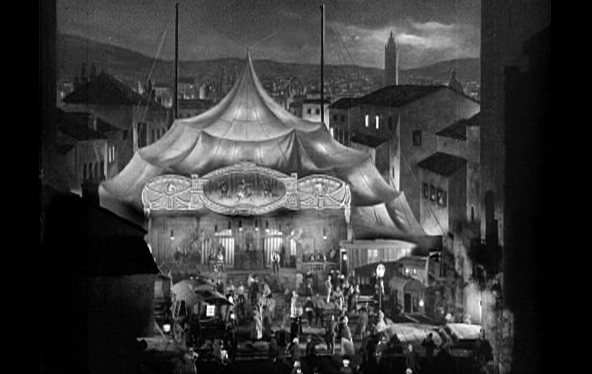
The Unknown released by MGM in 1927 and directed by Tod Browning in the horror genre popularly known for (Dracula 1931, & Freaks 1932) takes place at Antonio Zanzi’s ‘gypsy circus’ in old Madrid. The story unfolds as a bizarre love triangle between circus folk Alonzo the Armless, Nanon Zanzi, and Strongman Malabar the Mighty. Alonzo uses his feet to fire guns and throw knives at Nanon as part of their act.
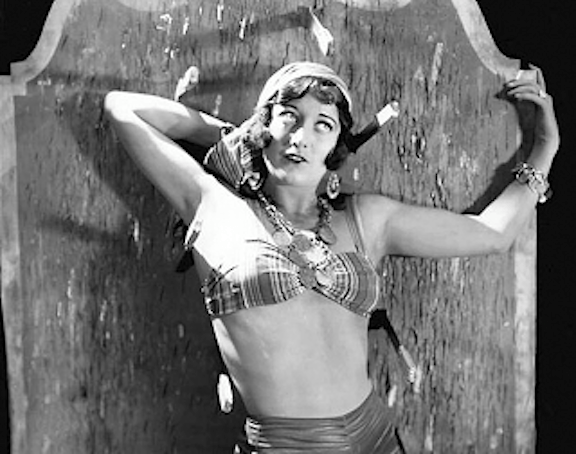
The circus act itself is a destructive spectacle of masochism as Nanon Zanzi assists Alonzo in his death-defying act. Nanon is the daughter of the circus owner, Antonio Zanzi. Alonzo secretly desires Nanon. As part of their dangerously erotic performance that resembles contact, furthermore, penetration. But only in its flair for tease and excitement, the moving target Nanon is strapped to a board that spins. With each shot of the gun, the bullets remove one more article of Nanon’s clothes. Next, with his feet, Alonzo throws the penetrating knives that outline Nanon’s bikini-clad body perfectly.
Alonzo the Armless – the devil to his left side.
Alonzo the Armless can use shotguns to fire bullets that disrobe the beautiful Nanon.
Alonzo is described by the circus owner as “the sensation of sensations!’, and as the“wonder of wonders!”
Chaney collaborated with real-life armless double Paul Dismute, whose dexterity in the remarkable scenes where he uses his feet to handle objects such as strumming guitars, pouring wine, throwing knives, or lighting cigarettes. Tod Browning and cinematographer Merritt Gerstad (who also worked on Freaks) would use Chaney’s upper body and face within the shot frames. It was a brilliant choreography of the body and timing to give the illusion that Chaney was manipulating these objects by himself, while Dismute remained off-camera, handling the objects.
“Reflecting the growing public alarm over the moral tone of films in the late twenties The Unknown was the first film to be frankly and aggressively attacked in the press for it’s melodramatic  morbidity.”The New York Sun assured readers that “the suspicion that the picture might have been written by Nero, directed by Lucretia Borgia, constructed by the shade of Edgar Allan Poe and lighted by a well-known vivisectionist was absolutely groundless….The Sun admitted that The Unknown “may be just what the public wants. If it is- well, the good old days of the Roman Empire are upon us”The New York Daily Mirror suggested that “if you like to tear butterflies apart and see sausage made you may like the climax to The Unknown. … typical Chaney fare spiced with cannibalism and flavored with the Spanish Inquisition.”
The New York Evening Post observed that “Mr Chaney has been twisting joints and lacing himself into strait-jackets for a long time- so long, in fact that there is almost nothing left for him now but the Headless Horseman. The Evening Post called The Unknown ‘a remarkably unpleasant picture.{…} a visit to the dissecting room in a hospital would be quite as pleasant and at the same time more instructive.”
Flesh and Blood- Lon Chaney.
Richard Watts Jr of The New York Herald Tribune said of the film, “The case of Mr. Tod Browning is rapidly approaching the pathological. After a series of minor horrors that featured such comparatively respectable creations as murderous midgets, crippled thieves and poisonous reptiles, all sinister and deadly in a murky atmosphere of blackness and unholy doom… the director presents us now with a melodrama that might have been made from a scenario dashed off by the Messrs. Leopold and Loeb in a quiet moment”
Watts conceded that given cinema otherwise so completely devoted to red blooded values and ‘general aggressive cleanliness’ films of the sort Browning championed might provide a ‘valuable counteracting influence”Obviously he felt repulsed by The Unknown.
The conservative Harrison’s Reports wrote “One can imagine a moral pervert of the present day, or professional torturers of the times of the Spanish Inquisition that gloated over the miseries of their victims on the rack and over their roasting on hot iron bars enjoying screen details of the kind set forth in The Unknown. but it is difficult to fancy average men and women of a modern audience in this enlightened age being entertained by such a thoroughly fiendish mingling of bloodlust, cruelty and horrors. … Of Mr. Chaney’s acting it is enough to say it is excellent of it’s kind. Similar praise might well be given the work of a skilled surgeon in ripping open the abdomen of a patient. But who wants to see him do it?”
Both Tod Browning as a director and Lon Chaney as an actor occupy a unique space in early cinema where grotesque physicality becomes a potent metaphor for deeper human truths. Their films do not merely showcase eccentric or monstrous characters for shock value; rather, they probe the complex interplay of identity, desire, alienation, and the human condition’s darker recesses.
In The Unknown, Browning and Chaney invite us to confront a paradoxical vision of love and sacrifice—a vision that challenges conventional notions of heroism and romantic fulfillment. The physical mutilation (Alonzo’s self-amputation of his arms) is not merely a plot device but a corporeal symbol of profound psychological sacrifice and self-negation. It reflects a profound empathy for the fracture between human longing and the psychological, physical, and social barriers that exclude authentic connection.
Both Browning and Chaney, in all their work together and separately, are fascinated by “the other,” those who are physically marked, emotionally alienated, or psychologically fractured. Their characters embody the struggle of marginalized individuals who live on society’s edges yet possess rich, intense interior lives. The films illuminate how these outsiders grapple with pain, desire, and identity, often through literal bodily transformations or distortions.
Chaney’s mastery lies in translating inner turmoil into visceral, visible form, through prosthetics, makeup, and expressive physicality, to call it a psychological language. Browning’s direction reinforces this by presenting the body as both a site of narrative action and symbolic meaning. Amputation or deformity serves as an allegory for emotional wounds, fractured identity, and the incommunicability between individuals.
Their films portray love as volatile, consuming, and often self-destructive rather than pure or redemptive. In The Unknown, love becomes a force that demands abandonment of self and body, where sacrifice blurs into suffering, and devotion becomes madness. Browning and Chaney dissect the extremities of human emotion—the ways love can turn monstrous when entwined with fear, control, and forbidden desire.
The central conflict in The Unknown—Nanon’s phobia and Alonzo’s desperate self-mutilation—is an exploration of the limits and conditions of empathy. The film asks: How far will one go to bridge the gulf separating two tormented souls? What price does love demand when confronted with psychological barriers that cannot be easily overcome? Their films suggest that connection is fraught with ambiguity, pain, and sacrifice, sometimes demanding catastrophic gestures.
Rather than reading The Unknown and similar Browning-Chaney collaborations simply as stories of tragic physical impairment or melodramatic love, it is more compelling and accurate to see them as profound meditations on:
The intertwining of flesh and psyche, where the body’s alterations mirror emotional and existential fractures. The agonies of unfulfilled desire, where love is as much about yearning and loss as about possession or joy. The psychology of marginalization, portraying characters who are both monstrous and deeply human, forced to negotiate intense passions within alienating circumstances. The philosophy of sacrifice, not just physical but spiritual and psychological, revealing how identity is mutable and contingent upon the painful choices we make to survive or love.
In their collaborations, Tod Browning and Lon Chaney delve beyond mere spectacle or grotesque spectacle, crafting profoundly unsettling meditations on the human condition where the physical body becomes a vivid language of psychological and existential torment. The Unknown stands as a stark embodiment of this vision, where Chaney’s horrific self-amputation transcends literal mutilation to become a corporeal metaphor for the excruciating sacrifices demanded by love’s darker, often unbearable dimensions. This is not a simple narrative of loss or tragedy but a complex exploration of alienation, desire, and the fractured self.
Chaney’s Alonzo exists on the margins of society, a figure whose bodily disfigurement mirrors his tortured interior world, shaped by obsessive love for Nanon, whose phobia of touch erects near-impossible barriers to intimacy. In response, Alonzo’s radical act of self-mutilation is a desperate attempt to bridge the chasm between two haunted souls, a gesture that enacts the limits of empathy and the monstrous lengths to which love can drive a person. Here, the body is not simply a vessel but a battleground where identity warps and fractures in the torment of unfulfilled yearning and profound psychological strife.
Browning and Chaney do not romanticize this sacrifice—rather, they expose love’s capacity to consume, distort, and defy redemption. Their films reveal the paradox of “otherness”: the yearning for connection shadowed by alienation, the collision of fragile humanity with grotesque exteriority. The characters embody liminality, simultaneously monstrous and deeply human, caught in an agonizing dance where flesh and psyche entwine, and where sacrifice is both an act of devotion and a form of self-annihilation. In this world, love is not merely a source of comfort but an existential crucible, demanding anguish and disfigurement as payment for even the smallest glimmers of tenderness.
Ultimately, Browning and Chaney’s artistry compels us to confront love’s most unsettling demands—the violent, ambiguous, and often monstrous interplay of fear, desire, and identity. Through their lens, The Unknown transcends melodrama or physical spectacle to become a haunting, poetic inquiry into the human soul’s desperate quest for connection amid the shadows of alienation and loss. It is a work where beauty and horror coexist, the body speaks its own tragic language, and the pursuit of love unfolds as a fierce, transformative, and deeply precarious journey.
Joan Crawford eighteen at the time recalled Chaney’s ordeal with wearing the leather harness as agonizing a self punishing behavior. Mr Browning would say to him, “Lon, don’t you want me to untie your arms?” ‘No, the pain I am enduring now will help with the scene. Let’s go!” That’s how he was able to “convey such realism” and emotional agony that made it shocking and fascinating.“Chaney projected the image of physical suffering as both the definition and price of his stardom; exactly why he chose to is not so clear and since he left no revealing journals or correspondence on the matter, may forever remain obscure”Crawford said about Chaney, “When he acted, it was if God were working, he had such profound concentration. It was then I became aware for the first time of the difference between standing in front of a camera, and acting.”
“Armless Wonders” were among the most spectacular and well-paid performers in turn-of-the-century American freak shows who would perform tasks and feats (no pun intended) to entertain the onlookers.
Violetta, the limbless beauty.Frances Belle O’Connor was featured in Freaks.
While Freud had his pseudoscience fix for every mental ailment, Tod Browning favored themes of a visceral, sexually charged plot surrounding resentment and revenge. He screened overt manipulation of disturbing sexual symbolism in order to shock his audience into consciousness. The threat of castration is a particularly violent notion and a repressed emotional impulse. Freud’s Uncanny, the idea of disembodied limbs, severed heads, and hands cut off at the wrists, all have something particularly unsettling about them. Especially when they are shown as capable of independent movement, it all springs from the castration complex. Browning’s fascination with sexually motivated mutilation, like that of Cleopatra being turned into a chicken or ‘duck’ lady in Freaks, annihilating her beauty, that quality which she used to lure Hans.
Olga Baclanova as Cleopatra, the trapeze beauty turned into the Chicken Lady by the avenging Freaks.
In Freaks, Francis is an armless woman, and there are two armless girls- Martha Morris and Francis O’Connor. Richard Watts Jr, film critic for the New York Herald Tribune, said of Browning– “Browning is the combination of Edgar Allan Poe and Sax Rohmer of the cinema. Where every director, save Stroheim, breathes wholesomeness. Out-of-door freshness and the healthiness of the clean-limbed, Tod revels in murkiness… His cinematic mind is a creeping torture chamber, a place of darkness,deviousness, and death.”
After Freaks, “In Browning’s next project, the Freudian theory would be bizarrely literalized into a weird and spectacular circus attraction. Based on an original story by Browning. Alonzo the Armless was a vehicle for Lon Chaney that would prove to be one of the darkest carnivals of the entire Browning canon.”
Boxing Helena is a 1993 modern-day, grotesquely romantic melodrama that was directed by Jennifer Chambers Lynch (daughter of David Lynch). The film utilizes the mechanism of amputation as what I’ll call ‘seductive symbology’. Seductive symbology can animate art, literature, film, or even everyday rituals, stirring the imagination and luring the voyeur, the watcher, the witness, us, into deeper contemplation or desire. The film stars Julian Sands and Sherilyn Fenn as the object of his desire, a surgeon who will keep his love closest to him by any means.
David Lynch’s daughter astoundingly subverted my expectations of horror in Surveillance (2008), weaving an audacious blend of grotesque violence and eroticism that marks a remarkable departure from Boxing Helena—a film I met with unsettling, visceral angst. The haunting image of the little girl in pajamas wandering the desert in Surveillancestrikes me as a deliberate, evocative homage to the iconic scene in Them! (1954), underscoring Lynch’s gift for embedding subtle yet powerful nods within his chilling narrative. Her work pulses with genuinely dynamic moments of horror that defy easy categorization, though the film’s ingenious plot twists and mechanisms demand my discretion to preserve its impact should you want to see the film.
In considering contemporary explorations of eroticism intertwined with physical mutilation, Alejandro Jodorowsky’s Santa Sangre (1989) stands as a modern masterpiece. Once again, the Gothic embodiment unfolds within the eerie milieu of a traveling circus, where Concha’s violent amputation of both arms—inflicted by her volatile, sword-throwing, and philandering Neanderthal of a husband, portrayed by Guy Stockwell—becomes a potent symbol of psycho-sexual trauma. The merging of mythic imagery and raw sexual violence, fused with the motif of armless saints, conjures a nightmarish, baroque wonderland through the eyes of their son, Fenix, where horror and desire fuse into a singular, unsettling experience.
Guy Stockwell in Alejandro Jodorwosky’s Santa Sangre.The illusory masterpiece that is Santa Sangre.
The circus features an armless entertainer named Alonzo. He is a knife thrower who could split the hairs on two flies dancing in unison. His claim to fame is that he handles both bullets and blades with his bare feet. In the film’s opening scene, Alonzo performs, showing confidence in his perfect aim by flinging phallic knives at his beautiful assistant Nanon, who is at the receiving end of his knife throwing while seated on a rotating platform. With each delivery, he picks off one more article of Nanon’s clothing that dangles there, boasting of his sexual competence. Through this performance, Alonzo can sublimate his own feverish sexual urges for Nanon.
The secret lies in the fact that Alonzo actually does have two strong, capable arms, a fact that only his dwarf assistant Cojo (John George) is privy to. Each day, Cojo laces Alonzo into a punishing leather corset. Alonzo dons this apparatus to create the appearance of amputation. A disguise he perpetuates because he is on the run from the law, and it also brings him closer to the object of his fixation, the beautiful but sexually constrained Nanon. Nanon is consumed with a phobia surrounding the male anatomy, in particular their hands. She is repulsed by men’s upper extremities, “Men! The beasts! God would show wisdom if he took the hands from all of them!”
What frightens her more is the ‘ideal’ of Malabar’s physique. To Nanon, the object of Gothic horror seems to be the normative body, and strangely enough, not the body that is emphasized as different. Malabar’s body encompasses an extremely forceful ideal of the masculine body. Nanon is traumatized by Malabar’s aggressive touch and grasping hands. She finds him abhorrent.
She finds comfort in Alonzo, who poses no threat to her as he has no arms or hands that can either challenge her desire or harm her.
Although Alonzo possesses arms, he exhibits a freakish anomaly, as he has a double thumb on one hand. In the original story, Browning and screenwriter Waldemar Young had envisioned a claw as his deformity. However, the phallic charge of the double thumb is more in keeping with the influence that Freud’s The Uncanny had made on cinema. According to writer/historians Skal & Savada, ‘doubling’ is viewed by Freud as an imaginative defense against the feared loss of the self, or a part of the self.
Alonzo suffers in silence over his immortal love for Nanon, keeping their relationship strictly platonic, but he still attracts negative attention from Nanon’s father, the circus owner. On a dark and rainy night, Alonzo strangles the man, as Nanon peers outside her window yet does not see the killer’s face. The one thing that she does notice is the unmistakable double thumbs as it grips her father’s throat.
While Alonzo quietly broods over his unrequited love, the strong man Malabar (Norman Kerry) pursues her with all the traditional male prowess of a proud peacock. Of course, this sends Alonzo into fits of irrational jealousy. He blackmails a surgeon into actually removing his arms so that Nanon would assuredly run to him, being the safe male.
Malabar’s sexual advances only push Nanon closer to Alonzo’s friendship. But Alonzo’s sidekick Cojo ( John George, whom Browning used several times throughout his career) warns his friend that he shouldn’t let Nanon get so close as to be able to feel that he truly does have arms that are strapped down.
But when he returns to the circus after the surgery he discovers that Nanon has miraculously overcome her fear of manly chests, bulging muscles, and arms with which to hold her in ecstatic embrace. And the two are also engaged.
There is a sad, ironic scene when Nanon asks Alonzo if he is thinner before she tells him of her love for Malabar. The moment is filled with a typical Tod Browning sense of timely perversity, misdirection, and emotional pain.
She declares to her old friend that she even LOVES Malabar’s hands: “Remember how I used to be afraid of his hands? I am not anymore. I love them now.”
I’ll leave the climax to those who haven’t seen this violently intoxicating film yet.
The film is filled with cruelty, irony, and obsession. While the story is more like a wickedly grotesque fairytale, it observes a journey of its own, nightmarish reasoning, intricate as it is repulsive.
What is Nanon’s strange and horrible fixation on men’s hands? She is terrified by the thought of their hands on her!
“Alonzo, all my life, men have tried to put their beastly hands on me to paw over me.”
Malabar approaches Nanon.
She has “grown so that [she] shrink[s] with fear when any man touches [her]” with their “beastly hands.” Nanon’s fear becomes apparent when she is courted by the circus weight-lifter or strongman Malabar.
When Malabar boasts to Nanon of incredible strength, flexing his arm muscles and grabbing at her hands and her wrists while telling her of how his “hands that long to caress you,” Nanon struggles to get away, experiencing sheer terror.
The surgeon has no choice but to do Alonzo’s gruesome bidding.
Nanon tells Alonzo that he feels thinner.
Nanon’s father, Zanzi, the hard-edged circus owner, grows increasingly suspicious of Alonzo’s presence and motives, repelled by the peculiar intensity of his interest in Nanon. One charged evening, Zanzi’s suspicions crystallize and, by chance, he stumbles upon Alonzo in a compromising moment—witnessing not the spectacle of an armless performer but the shocking reality: Alonzo, unbound and very much in possession of arms, the infamous double thumb unmistakable. The truth arrives with the force of revelation and panic; in that instant, Zanzi realizes he stands face to face not with a broken sideshow oddity, but with a wanted man and a master of deception.
Cornered by exposure, Alonzo reacts with ruthless survival: propelled by fear, rage, and the desperate need to shield both his secret and his last hope for Nanon, he lunges forward and strangles Zanzi with his bare hands, silencing him forever outside the circus wagons. As fate would have it, Nanon glimpses the murder from her window, not the killer’s face, but the damning deformity: a double thumb pressed around her father’s throat, burned into her memory by a bolt of lightning. It is this fragment of a moment, violence half-seen, identity obscured, that sets the final tragedy of the film in motion, leaving Nanon haunted, the crime unsolved, and Alonzo bound even more tightly to a destiny of obsession and doom.
After Alonzo undergoes the gruesome amputation of his arms, driven by the catastrophic logic that this sacrifice will secure Nanon’s love and keep his murderous secret safe, he disappears for weeks to recover, leaving the circus and Nanon behind. In his absence, Malabar’s persistent care and genuine affection for Nanon help her overcome her lifelong fear of a man’s arms. By the time Alonzo, truly armless now, returns to the circus, he rushes to Nanon, uncertain but expectant. Instead of the reunion he imagined, he finds her radiant with newfound happiness; Nanon greets him with the euphoric news that she and Malabar are to be married.
Struck by the cruel irony of his sacrifice, Alonzo is at first hysterical with laughter, then collapses into inconsolable anguish as the reality sinks in: he has maimed himself for nothing. Nanon and Malabar are perplexed by the outburst, Nanon innocently mistaking his tears for happiness at their engagement.
Trying to compose himself, Alonzo discovers that Malabar and Nanon have devised a new circus act: Malabar is tied between two wild horses running on treadmills, each straining in opposite directions, a spectacle of strength and danger. Seized by jealousy and rage, Alonzo, still posing as a friend, secretly sabotages the act. —a horrific fate that mirrors Alonzo’s own self-inflicted mutilation.
During the tense performance, he stops one of the machines, threatening to have the wild horses pull Malabar’s arms from his body—a scene of climactic terror that reflects Alonzo’s own disfiguring obsession.
When Nanon tries to intervene and calm the frantic horses, Alonzo, desperate and unhinged, threatens her with a knife, but instinctively pushes her out of harm’s way at the last instant. In the ensuing chaos, one of the horses knocks Alonzo down. Fatally trampled, he dies as the act is halted, and Malabar is saved from disaster.
Thus, Alonzo’s journey, marked by secrecy, mutilation, and obsession, collapses in a flash of violence and futile longing—a finale as stark and haunting as anything silent cinema ever dared to show.
In this crucible of shadow and flesh, The Unknowninterrogates the paradox of love’s power to both wound and redeem. It demands an almost mythic reckoning with the body’s limits and the emotional scars they inscribe.
The Unknown (1927)-The Armless Wonder.
By MORDAUNT HALL.
Published: June 13, 1927
“Although it has strength and undoubtedly sustains the interest, “The Unknown,” the latest screen contribution from Tod Browning and Lon Chaney, is anything but a pleasant story. It is gruesome and at times shocking, and the principal character deteriorates from a more or less sympathetic individual to an arch-fiend. The narrative is a sort of mixture of Balzac and Guy de Maupassant with a faint suggestion of O. Henry plus Mr. Browning’s colorful side-show background.{…}
“The rôle of Alonzo, who poses as the Armless Wonder with a Spanish circus, is one that ought to have satisfied Mr. Chaney’s penchant for freakish characterizations, for here he not only has to go about for hours with his arms strapped to his body…{…}
“This tale is prefaced as if it were a circus legend, and soon one realizes that Alonzo is not only expert in the use of his feet when serving himself, but he is also supposed to be a crack shot and an unerring knife thrower. The girl who risks her life daily before Alonzo’s bullets and knives is Estrellita, impersonated by Joan Crawford. She becomes interested in Alonzo because most men in the circus without provocation invariably want to caress her.”
You could say that Evelyn Ankers is still the reigning queen of classical 1940s horror fare turned out by studios like RKO, Universal, and Monogram. But there was a host of femme scream tales that populated the silver screen with their unique beauty, quirky style, and/or set of lungs ready to wail, faint, or generally add some great tone and tinge to the eerie atmosphere whenever the mad scientist or monster was afoot. Some were even monstrous themselves…
For this upcoming Halloween, I thought I’d show just a little love to those fabulous ladies who forged a little niche for themselves as the earliest scream queens & screen icons.
I’m including Elsa Lanchester because any time I can talk about this deliriously delightful actress I’m gonna do it. Now I know she was the screaming hissing undead bride in the 30s but consider this… in the 40s she co-starred in two seminal thrillers that bordered on shear horror as Mrs. Oates in The Spiral Staircase1945 and a favorite of mine as one of Ida Lupino’s batty sisters Emily Creed in Ladies in Retirement 1941
I plan on venturing back to the pre-code thirties soon, so I’ll talk about The Bride of Frankenstein, as well as Gloria Holden (Dracula’s Daughter, Frances Dade (Dracula) and Kathleen Burke (Island of Lost Souls) Gloria Stuart and Fay Wray and so many more wonderful actresses of that golden era…
Elsa Lanchester as Mrs.Oates in director Robert Siodmak’s The Spiral Staircase 1945The Sister Creed in Ladies in Retirement 1941 starring Elsa Lanchester, Ida Lupino, and the wonderful Edith Barrett (right)
the playfully pretty Anne Nagel.Anne Nagel & Lon Chaney Jr in a promo shot for Man Made MonsterAnne Nagel was strapped to the slab and at the mercy of the ever-mad Lionel Atwill. Here comes the glowing Lon Chaney Jr! in his electric rubber suit in Man Made Monster!
The depraved mad scientist Lionel Atwill working with electro biology pins gorgeous red-headed Anne Nagel playing June Lawrence, to his operating slab in Man Made Monster 1941. Lon Chaney Jr. comes hulking in all aglow as the ‘Electrical Man’ which was his debut for Universal. He carries Anne Nagel through the countryside all lit up like a lightning bug in rubber armor. Man Made Monsterisn’t the only horror shocker that she displayed her tresses & distresses. She also played a night club singer named Sunny Rogers also co-starring our other 40’s horror heroine icon Anne Gwynne in the Karloff/Lugosi pairing Black Friday in 1940.
She played the weeping Mrs.William Saunders, the wife of Lionel Atwill’s first victim in Mad Doctor of Market Street 1942. And then of course she played mad scientist Dr Lorenzo Cameron’s (George Zucco’s) daughter Lenora in The Mad Monster 1942. Dr. Cameron has succeeded with his serum in turning men into hairy wolf-like Neanderthal monsters whom he unleashes on the men who ruined his career.
Anne Nagel and Lionel Atwill Mad Doctor of Market Street.
Poor Anne had a very tragic life… Considered that sad girl who was always hysterical. Once Universal dropped her she fell into the Poverty Row limbo of bit parts. Her brief marriage to Ross Alexander ended when he shot himself in the barn in 1937, and Anne became a quiet alcoholic until her death from cancer in 1966.
Dr. Cameron’s daughter Lenora (Anne Nagel) discovers the wolf-like man in his laboratory in The Mad Monster.Glenn Strange as Petro the Hairy man in The Mad Monster 1942.
the sultry Anne Nagel and Bela Lugosi in Black Friday 1940 photo courtesy Dr. Macro.
Martha was in noir favorites The Big Sleep 1946 & Alimony1949. This beauty played an uncredited Margareta ‘Vazec’s Daughter’along side Ilona Massey as Baroness Elsa Frankenstein and the marvelous older beauty Maria Ouspenskaya as Maleva the gypsy! in Frankenstein Meets the Wolf Man 1943.Then she played heroine Dorothy Coleman in Captive Wild Woman 1943 and Miss McLean in The Mummy’s Ghost 1944.
Originally Martha MacVickar she started modeling for photographer William Mortenson. David O Selznick contracted the starlet but Universal took over and put in her bit parts as the victim in Frankenstein Meets the Wolf Man and in other ‘B’ guilty pleasures like Captive Wild Woman &The Mummy’s Ghost. She was also the pin-up girl for WWII magazines.
Martha also starred in other noir features such as Ruthless 1948 and The Big Bluff 1955. She was Mickey Rooney’s third wife.
Martha Vickers and Humphrey Bogart in The Big Sleep photo courtesy of Dr. Macro.Martha Vickers and Lon Chaney in Frankenstein Meets the Wolf Man.Martha Vickers and John Carradine in Captive Wild WomanI just can’t resist Vicker’s sex appeal here she is again… Wow!
Though Logan made very few films including Opened By Mistake 1940, her contribution to women who kick-ass in horror films and don’t shrink like violets when there’s a big bald baddie coming after you with a net and a bottle of chloroform, makes you a pretty fierce contender even if you are only 7 inches tall! As Dr. Mary Robinson (Janice Logan), Logan held it all together while the men were scattering like mice from the menacing google eyed Dr. Cyclops played superbly by Albert Dekker.
Fay Helm as Nurse Strand with John Carradine in Captive Wild Woman.
Fay Helm played Ann Terry in one of my favorite unsung noir/thriller gems Phantom Lady1944 where it was all about the ‘hat’ and she co-starred as Nurse Strand alongside John Carradine in Captive Wild Woman. Fay played Mrs. Duval in the Inner Sanctum mystery Calling Dr. Death with Lon Chaney Jr. 1943
Ella Raines and Fay Helm in Phantom Lady.
Fay Helm plays Jenny Williams in Curt Siodmak’s timeless story directed by George Waggner for Universal and starring son of a thousand faces Lon Chaney Jr in his most iconic role Larry Talbot as The Wolf Man 1941
Fay as Jenny Williams: “Even a man who is pure in heart and says his prayers by night, may become a wolf when the wolfbane blooms and the autumn moon is bright.”
Fay was in Night Monster 1942. Directed by Ford Beebe the film starred Bela Lugosi as a butler to Lionel Atwill a pompous doctor who falls prey to frightening nocturnal visitations. I particularly love the atmosphere of this little chiller with its swampy surroundings and its metaphysical storyline.
Dr. Lynn Harper (Irene Hervey- Play Misty For Me 1971) a psychologist is called to the mysterious Ingston Mansion, to evaluate the sanity of Margaret Ingston, played by our horror heroine Fay Helm daughter of Kurt Ingston (Ralph Morgan) a recluse who invites the doctors to his eerie mansion who left him in a wheelchair.
Fay gives a terrific performance surrounded by all the ghoulish goings on! She went on to co-star with Bela Lugosi and Jack Haley in the screwball scary comedy One Body Too Many (1944).
Irene Hervey as Dr. Lynn Harper –Night Monster 1942.
Fay Helm in Night Monster.Fay Helm with Bela the gypsy in The Wolf Man.
Bela Lugosi as half ape half man really needed a shave badly in The Ape Man 1943, and Louise Currie and her wonder whip might have been the gorgeous blonde dish to make him go for the Barbasol. One of the most delicious parts of the film was its racy climax as Emil Van Horn in a spectacle of a gorilla suit rankles the cage bars longing for Currie’s character, Billie Mason the tall blonde beauty. As Bela skulks around the laboratory and Currie snaps her whip in those high heels. The film’s heroine was a classy dame referred to as Monogram’s own Katharine Hepburn! She had a great affection for fellow actor Bela Lugosi and said that she enjoyed making Poverty Row films more than her bit part in Citizen Kane! And I would be remiss if I didn’t mention that she appeared in several serials, from both Universal & Republic like The Green Hornetand Captain Marvel.
Tom Weaver in his book Poverty Row HORRORS! described The Ape Man as “a Golden Turkey of the most beloved kind.”
Louise Currie followed up with another sensational title for Monogram as Stella Saunders in Voodoo Man 1944 which again features Lugosi as Dr. Richard Marlowe who blends voodoo with hypnosis in an attempt to bring back his dead wife. The film also co-stars George Zucco as a voodoo high priest and the ubiquitous John Carradine as Toby a bongo-playing half-wit “Don’t hurt her Grego, she’s a pretty one!”
Pat McKee as Grego, Louise Currie, John Carradine, and Bela Lugosi in Monogram’s Voodoo Man 1944.the outrageous Voodoo Man 1944