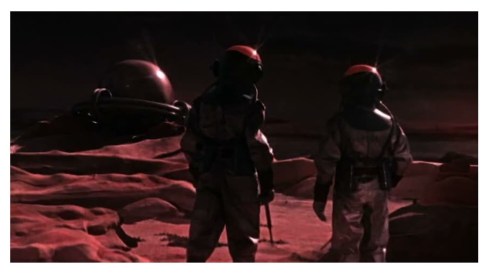
Sunday Nite Surreal: Queen of Blood (1966) She’s a monster!

QUEEN OF BLOOD (1966)

HIDEOUS BEYOND BELIEF… with an INHUMAN CRAVING!

Queen of Blood 1966 is one of the films made by AIP, at the time Roger Corman was working for them. They utilized a lot of Russian film footage mostly because of their superior big-budget special effects (a soviet fable called Mechte Navstrechu from 1963) shooting the action scenes around the cannibalized footage and finished the film in 8 days. Produced by George Edwards and directed & written by one of MY favorite filmmakers –the very original visionary Curtis Harrington, Queen of Blood possesses a dream-like quality, partly due to the atmosphere and colors set forth by Art Director Al Locatelli (Dementia 13 (1963), American Graffiti 1973, Star Wars IV 1977), Set Designer Leon Smith and Cinematographer Vilis Lapenieks

More Soviet footage appears in other American International movies, Voyage to the Prehistoric Planet and Voyage to the Planet of Prehistoric Women.

(uncredited The Little Shop of Horrors 1960, Lapenieks worked on Harrington’s other dreamy fantasy/horror masterpiece Night Tide 1961, the underrated The Hideous Sun Demon 1958, Voyage to the Prehistoric Planet 1965, Deathwatch 1966, The Hellstrom Chronicles 1971, That Certain Summer 1972 tv movie, M*A*S*H 1972 tv series, Kojak 1974 tv series) With costume design by T. Glinkova.

Queen of Blood (1966) stars Dennis Hopper (working once again with Curtis Harrington having done Night Tide 1961).

The plot centers around 3 astronauts on the rescue mission–John Saxon as Allan Brenner, Dennis Hopper as Paul Grant, and Judi Meredith as Laura James. Included are Basil Rathbone as Dr. Farraday who heads an international space agency that receives the distress message from Mars, and a cameo by film historian, collector, and founder of Famous Monsters of Filmland- Forrest J. Ackerman as Farraday’s assistant.

Queen Of Blood, aka Planet Of Blood, USA 1966, Directed: Curtis Harrington, Starring: John Saxon, Basil Rathbone: Image Age Photostock

The year is 1900 and Earth has made contact with an Alien radio transmission. Saxon, Hopper, and Meredith stumble onto a crashed spaceship on Mars that is inhabited by a mysterious sole survivor Velena (Florence Marly) who glows the most trippy verdant alien green, and her hair, well– it is a marvelous killer bee bouffant.

Do you remember this green gal from Lost In Space? She fell in love with Dr. Smith, but I’m pretty sure she didn’t lay jiggly red eggs and suck people’s blood!

They quickly discover that the hemophiliac Alien Queen as she is credited, crazes, no NEEDS blood to sustain herself, like a space vampire. Once upon the crew’s space ship, sets out to kill each of the members. Hopper begins to feel attracted to the Alien Queen who has a strange and sexually deviant mesmerizing lure, eventually, he realizes what she really is, “She’s a monster… We ought to destroy her right now!”

In the end, Meredith is the one who manages to destroy her but cutting her and she winds up bleeding to death. Things of it is, she leaves behind a vampiric aerie of her eggs. which Dr. Farraday decides like all inquiring scientific minds do putting the rest of us at risk, to take the Alien Queen’s spawn back to Earth to study. What he doesn’t realize is that she has already hidden hundreds of her eggs on board the ship. And though Allan keeps saying “We have to destroy them!” Rathbone is insistent on keeping those creepy pulsating red aspic eggs for research! Damn scientists!

Though the story may sound simplistic, Harrington brings his brand of atmospherics to each scene, injecting a sort of queer distorting sense of reality, and as Marly begins her blood feasting, the menace and the fantastical color palate permeates each frame like a nightmare set in space.

From Curtis Harrington’s book Nice Guys Don’t Work in Hollywood. He talks about the Soviet film Mechte Navstrechu in which he took footage by acquiring the American rights to the property, to work from in Queen of Blood. The Soviet version is about “the world’s natural fears of the nature of aliens…)… discovering at the end that the alien wants to be friends.”Harrington wanted to do the complete opposite of that with his film.

“I devised a tale in which the queen of the aliens–brought back to earth by a group of American astronauts –is a vampiric creature who seeks a new food source for her dying planet. The food source, as it turns out, is the human race. Some years later, it was very flattering to realize that I had created the prototype for a whole series of science-fiction movies dealing with monstrous creatures from outer space, beginning with Ridley Scott’s Alien.”

IMDb trivia –

The film was released in the United States in March 1966. Even before the release, its quality was sufficient for Universal to hire Harrington and producer George Edwards to make the feature film Games.

Director Curtis Harrington felt that Ridley Scott’s Alien (1979) must have received some inspiration from his feature, saying “Ridley’s film is like a greatly enhanced, expensive and elaborate version of Queen of Blood”.

This was an ultra low budget production. The elaborate special effects were taken (uncredited) from two big budget Soviet productions, Mechte navstrechu (1963), and The Sky Calls (1959). The film is based on the screenplay for the earlier Soviet feature film Mechte Navstrechu (A Dream Come True).

John Saxon later claimed that Gene Corman had more to do with Queen of Blood than Roger. Saxon estimated that his scenes were shot in seven to eight days and that Dennis Hopper “was trying very hard to keep a straight face throughout” during the making of the film.

Czech actress Florence Marly was a personal friend of director Harrington. He later said that he had to fight with Roger Corman in order to hire her “because she was an older woman. Harrington would say, “I’m sure he had some bimbo in mind, you know? So I fought for Marly because I felt she had the required exotic quality that would work in the role.”Harrington also said Dennis Hopper “was like a part of my little team by then,” so he agreed to also appear.

Harrington had made his name with the feature Night Tide, which impressed Roger Corman enough to offer the director a film project. “Of course, I would like to do a more individual film than Queen of Blood”, said Harrington at the time, “but I can’t get the financing. However, the film is entertaining, and I feel I was able to say something within the context of the genre.”

Your EverLovin’ MonsterGirl sayin gaze into my eyes and tell me, do I look green to you?

Once Upon a Screen… A Hoot and a Holler: James Whale's THE OLD DARK HOUSE (1932) at 86

Aurora over at Once Upon a Screen… offers a wonderful & witty tribute to James Whale’s campy Old Dark House themed film The Old Dark House that set the trend for Old Dark House movies!

Last night Aurora, myself and my girl Wendy had the thrilling pleasure of sitting side by side, popcorn in hand and funny & intelligent yet respectfully quiet commentary in the darkness of a traditional cathedral of film (one of the 5 original movie palaces in the NYC area). A truly great theatre –The Landmark Jersey City Loews for a James Whale/Boris Karloff dynamic double feature. They showcased the 35mm prints of the sublimely brilliant Kenneth Strickfaden-filled laboratory designs, and Composer Franz Waxman’s exhilarating score for The Bride of Frankenstein 1935 and The Old Dark House 1932. Both with outstanding cast members and characters alike! Including the live pipe organist who is there for all of these wonderful events! So without any further hold up…

Head over to the most informative, funny and heartfelt blog and get yourself a Halloween slice of joy, and while you’re at it… “Have a potato!” haha Ernest Thesiger gets me every time he says those three little words as only he can deliver…

A Hoot and a Holler: James Whale's THE OLD DARK HOUSE (1932) at 86

Your EverLovin MonsterGirl sayin’ if you live in the Tri-State area please help keep this historic movie palace alive, they offer a wonderful night’s entertainment and thank you Aurora of Once Upon a Screen… for being the best movie pal!

A Trailer a Day Keeps the Boogeyman Away! Boggy Creeks, Dreaded Sundowns and Mysterious Evictors!

A CHARLES B. PIERCE TRIPLE FEATURE

Indie filmmaker Charles B. Pierce based his stories from his home state of Arkansas, not only using locals as actors but his films cast some fantastic popular stars like Jessica Harper, Michael Parks, Andrew Prine, and Vic Morrow!

Charles B. Pierce’s film fascinate & titillate primarily because they are based on actual events! His films for years now, have an enormous cult following…

The Legend of Boggy Creek (1972)

Half-man, half-beast … a mysterious creature has been stalking the woods and waterways near Fouke, Arkansas since the 1940s

From IMBd Charles B. Pierce bio-In 1971 there were local headlines about a Sasquatch-like creature sighted in the vicinity around the nearby town of Fouke, in Miller County. The “Fouke Monster” was reportedly seen in the Boggy Creek area and was suspected of attacking dogs and livestock as well as a local family. In mid-’72, while still working in advertising, Pierce created a semi-documentary film originally titled “Tracking the Fouke Monster”–later renamed ‘The Legend of Boggy Creek’. Pierce shot the movie with a 16mm camera he assembled himself at home. Much of the movie was filmed in Fouke and Texarkana with local residents and students as actors and/or crew. Estimates place the cost of making the film at about $165,000. Becoming popular as a drive-in horror feature around the country, it became one of the top ten highest-grossing movies of the year, earning over $20 million.

THE EVICTORS (1979)

It was a small Louisiana town where people live and love and die and no one ever thought of locking their doors… except in the Monroe house.

The Evictors is a chilling and moody tale about newlyweds Ben and Ruth Watkins (Michael Parks and Jessica Harper) who rent an old farmhouse from Jake Rudd (Vic Morrow) in a small Shreveport Louisiana town. They are suddenly set upon by a mysterious assailant, and are looked at with mistrust by the rest of the town. Their farmhouse holds an old secret and an oath by the former owners that no one else would ever live on their property. They were slaughtered while fending off the police and the bank who came to foreclose on their land. Do the Watkins discover the truth about the brutal murders and the violent history surrounding their quaint little farmhouse too late?– and is that why they have become targeted for revenge…

The Town that Dreaded Sundown (1976)

Not Everyone Who Comes to This Lover’s Lane Has the Same Thing on Their Mind.

Stars Andrew Prine, Ben Johnson and Dawn Wells (Maryann Gilligan’s Island)

“This movie is a semi-documentary based on the real-life string of mysterious killings that terrorized the people of Texarkana, Texas, in 1946. The murder spree became known as the “Texarkana Moonlight Murders” and ultimately would claim five lives and injure many others. The only description of the killer ever obtained was that of a “hooded man”. To this day, no one has been convicted and these murders remain unsolved.”

“Texarkana today still looks pretty much the same. And if you should ask people on the street what they believe happened to the Phantom Killer, most would say that he is still living here… and is walking free.”

Your EverLovin’ MonsterGirl sayin’ the truth is out there!

Obscure Scream Gem: Night of the Blood Beast (1958)

NIGHT OF THE BLOOD BEAST (1958)

No girl was safe as long as this head-hunting thing roamed the land!

Produced by exploitation filmmaker Roger Corman and his brother Gene Corman, Night of the Blood Beast was one of the first films directed by Bernard L. Kowalski (Attack of the Giant Leeches 1959, tv movies, Terror in the Sky 1971, Black Noon 1971, Women in Chains 1972, Sssssss 1973, tv shows , Mission Impossible, Gunsmoke, The Streets of San Francisco, Columbo, Baretta, The Rockford Files), and was written by first-time screenwriter Martin Varno, who was 21 years old. The script is unexpectedly impressive for a B science fiction film from the late 50s. It stars several actors who had regularly worked with Roger Corman, including Michael Emmet, Steve Dunlap, Georgianna Carter and Tyler McVey and of course my favorite Ed Nelson.

Roger and brother Gene Corman decided to save money and use the costume from Teenage Caveman (1958) the film that boasts a young Robert Vaughn as The Symbol Maker’s rebellious teenage son who goes in search of the legendary God That Gives Death with a Touch. Which looked like a 5 year olds’ version of a mutant parrot using paper mache and schmutz.

The original working title was called Creature from Galaxy 27. The gist of the story is that an astronaut brings back an alien life form that impregnates him in order to propagate their race and take over our planet. Shades & foreshadowing of H.R Giger’s creation in Ridley Scott’s Alien (1980) Major John Corcoran (Michael Emmet) pilots the X-100 rocket, just above the Earth’s atmosphere, the ship suddenly loses altitude. John tries to open his chute but the rocket is speeding toward the Earth with increasing velocity, then the hull of the ship is blown open and John blacks out. Ed Nelson who plays communications expert Dave Randall and photographer Donna Bixby (Georgiana Carter) head over to the crash site. Dave manages to extinguish the fiery capsule and checks John’s pulse to see if there are any signs of life. Donna finds some strange mud samples on the surface of the capsule and gives it to Dave, while more of the mud unseen, slides away into the brush.  Dave calls in the team of scientists, Dr. Alex Wyman (Tyler McVey) Dr. Steve Dunlap (John Baer) and John’s Fiancee Dr.Julie Benson (Angela Greene).

Once Wyman, Dunlap and Julie arrive at the scene of the crash, they examine John who they presume has been dead for several hours, yet he shows no sign of decomposition. They take John’s body to the closest place, an abandoned radar station where all the equipment isn’t working. Dave tries to radio Cape Canaveral but all communications are dead like John. They notice a strange puncture mark on John’s arm, and while his heart has stopped beating, his blood pressure is registering 120/80. Dave goes outside to stand watch and check out the tower. Inside Steve tries to get the radio working. Suddenly all goes dark and Steve is brutally attacked, managing to get a few shots off, the shattered glass in the lab arouses Dave’s attention, where he finds a strange piece of material attached to the broken window.

When Julie and Wyman study John’s blood they find amorphous alien organisms devouring his cells again (shades of It!,The Terror From Beyond Space (1958) which was the inspiration for Alien 1980) Plus the gang is stranded at the radar base because the jeep won’t run and neither the radio or wrist watches work, they figure that it is magnetic related interference from the crashed ship. Then to their shock and horror Dave and Steve find Dr. Wyman’s body hanging upside down much like blood letting with part of his head missing and John’s body is gone, then reappears behind the window in the surgical room, alive!

John can’t remember anything but assumes that he was in a state of suspended animation when the change in pressure occurred during the crash landing. He also has another strange puncture wound on the back of his neck. One other strange aspect of John’s miraculous recovery doesn’t go unnoticed by the gang. John seems to be using vocabulary that sounds more like Dr. Wyman as if what ever part of the brain was devoured has now been assimilated in John’s mind. John, also defends Wyman’s killer saying that it didn’t come to Earth to destroy it, though it’s already eaten part of a man’s brain…

John submits to a series of tests, which show that there are now a bunch of sea horse type beings incubating in his chest cavity. The giant alien parrot creature breaks into the lab and when they throw a kerosene lamp at it, they discover that it’s got a fear of fire. John gets hysterical (nice that it’s a man getting hysterical for a change) and they have to sedate him, the alien only wanted to come and nourish it’s young. Obviously John is tapping into his sense of mothering and feels a symbiotic bond with the creature now.

I’ll leave it here for now, and hope that you’ll track down a copy of Night of The Blood Beast and see it as it is at least a more unusual contribution to the 1950s science fiction tropes of the genre. And who doesn’t love a parrot monster made of paper mache and schmutz…!

Angela Greene and Ross Sturlin as the alien parrot creature in Night of the Blood Beast (1958)

Night of the Blood Beast (1958) was lampooned by the gang at Mystery Science Theater 3000

IMDb trivia–

This was released in one of American International’s prepackaged double features. It was paired with Roger Corman‘s She Gods of Shark Reef (1958), which had been sitting on the shelf for a year and a half.

The alien costume featured in Night of the Blood Beast was the same as the one used in another Roger Corman film, Teenage Caveman (1958). This was done to save money, as the Cormans often tried to incorporate existing sets, costumes and other elements from previous films into new ones for financial savings.

The monster costume scenes in Teenage Caveman and Night of the Blood Beast were shot within about two weeks of each other. The costume was modified slightly for Blood Beast. Ross Sturlin wore the costume for the scenes in both Teenage Caveman and Night of the Blood Beast.

Daniel Haller, who went on to become a film director himself, worked as art director on Night of the Blood Beast. Haller did much of the manual construction work on the set himself

Among the props he built was the rocket-ship, the frame of which was made of plywood that had been cut into circles, then covered with a plastic sheet and spray-painted to look metallic. Haller also created blood cells that the characters looked at under a microscope, and the baby aliens (which resembled seahorses) they looked at under a fluoroscope.

Alexander Laszlo composed the music for the film.Almost the entire crew went on to work on Attack of the Giant Leeches with the Corman brothers and Kowalski

Jerome Bixby, the science fiction screenwriter who wrote It! The Terror from Beyond Space (1958), was originally approached for the job, but Bixby was working on another project and recommended his close friend Martin Varno for the job. Varno, the son of veteran actor Roland Varno

Varno said he received uncredited assistance from his friends and fellow screenwriters Jerome Bixby and Harold Jacob Smith, the latter of whom won an Academy Award for Best Original Screenplay for the film The Defiant Ones (1958).

Smith in particular inspired lines for the speech made by the monster at the end of the film, in which the creature discusses how the human characters consider him the embodiment of evil simply because he is different from them. Varno said much of that dialogue from Smith, however, ended up getting cut from the final film.

One of the primary themes of the film, as embodied in John Corcoran’s attempts to defend the alien creature, was that simply because someone or something is ugly or different does not necessarily make it evil.

Where can I get a model of Night of the Blood Beast????!!!!

However, the script also followed a common trait of most horror films of the 1950s that even somewhat understandable monsters are not entirely sympathetic, and the Blood Beast creature proves itself evil by impregnating Corcoran against his will and pursuing world domination.

Your EverLovin’ MonsterGirl saying Polly doesn’t want a cracker, it want’s a piece of your brains!

Sunday Nite Surreal: Island of Lost Souls (1932) “Are we not men!?”

It begins where DR. JEKYLL & MR HYDE left off! A weird, fantastic adventure with a mad doctor who discovers how to turn animals into humans-but not how to control them! On a lonely tropical island he practices his black art! Changes wild beasts into creatures whose strangely human appearance and action hide raging animal passions! Something brand new in picture plots, with a specially selected cast, that will bring thrills to audiences and joy to exhibitors. Showmanship Plus!

HE DEFIED NATURE … creating men and women from animals … only to find that he could not control them!

Island of Lost Souls (1932)

Adapted from H.G.Wells 1895 novel The Island of Doctor Moreau, Island of Lost Souls was directed by Erle C. Kenton (The Ghost of Frankenstein 1942, House of Dracula 1945, The Cat Creeps 1946) Wells was not content with the film version of his story, though it’s a stunning adaptation of his novel. Karl Struss’ (Murnau’s Sunrise 1921,Dr. Jekyll and Mr. Hyde 1931, The Sign of the Cross 1932, The Great Dictator 1940, Journey into Fear 1943, Rocketship X-M 1950, Limelight 1952, Kronos 1957 and yeah no laughing please… The Alligator People 1959) extraordinary cinematography constructs a perfectly smothering atmosphere though the story’s milieu is the openness of a savage jungle. With fantastical make-up effects by Wally Westmore (Sunset Boulevard 1950, The War of the Worlds 1953, Rear Window 1954, Lady in a Cage 1964, Village of the Giants 1965)

The first adaption of Well’s novel was filmed in France in 1913 called L’Ile d’Epouvante, then it was revisited in 1959 as Terror Is a Man starring Francis Lederer, and finally remade once again in 1977 starring Burt Lancaster as Dr. Moreau in The Island of Dr. Moreau, also starring Barbara Carrera as Lota and Richard Basehart as the Sayer of the Law. The 1977 version lacks the stifling ambiance that Erle C. Kenton’s film possessed.

Charles Laughton with his devilishly cherubic smile is perhaps at his most deliciously wicked as an evil scientist with a god complex the cruel, fiendish and merciless Dr. Moreau, who brandishes his bullwhip like Ilsa the Wicked Warden or me– eating chocolates when I go on a classic horror movie bender!

Dr. Moreau: Mr. Parker, do you know what it means to feel like God?

Moreau performs profane experiments, learning how to accelerate evolution by experimenting on animals turning them into hairy men-beasts by surgically grafting the organs, flesh and genes together. In order to keep his creations under his thumb, he cracks his aforesaid whip while gathering them together like a bestial congregation where they all chant the ‘laws’ set down by the Mephistophelean Moreau.

Dr. Moreau: What is the law? Sayer of the Law: Not to eat meat, that is the law. Are we not men? Beasts (in unison): Are we not men? Dr. Moreau: What is the law? Sayer of the Law: Not to go on all fours, that is the law. Are we not men? Beasts (in unison): Are we not men? Dr. Moreau: What is the law? Sayer of the Law: Not to spill blood, that is the law. Are we not men? Beasts (in unison): Are we not men?

Moreau has been banished to his faraway Island by the scientific community for his bizarre experimentation with plants. Island of Lost Souls is a Darwinian nightmarish journey -from The Monster Show by David J. Skal-“There is an evocative social metaphor here as well: the animals have been given the promise of progress and social elevation. They have dutifully played by their master’s incantatory ‘laws.’ And yet it has all been an ugly trick; their elevation is simultaneously a degradation, and a bloody revolt ensues.”

Also Skal’s book points out a really interesting fact about Laughton’s casting of Dr. Moreau-“already acclaimed for his 1928 stage portrayal of another mad vivisectionist in the Grand Guignolesque A Man with Red Hair at London’s Little Theatre. It was in that production that he learned to crack a bullwhip, a skill also required for Island of Lost Souls…)… Laughton hated the part, though it remains one of his most memorable, an epicene gentleman-monster in a white tropical suit.”

Laughton’s portrayal of Dr. Moreau as an effeminate mad scientist is also noted by David J. Hogan in his terrific book Dark Fromance-Sexuality in the Horror Film- “As filmed, the story is a particularly unpleasant Frankenstein variant, remarkable for it’s oppressive ambience and unrelieved sadism. Charles Laughton played Moreau, a plump, primly bearded genius whose fussy manner and ice cream suit suggest a eunuch, or a malevolent child.”

Bela Lugosi is wonderful as the ‘Sayer of the Law’“Are we not men?” through his hairy make-up he conveys a pathos and ambivalence that must be credited to his fine acting skills, beyond wearing a cape, hovering over nubile maidens and climbing cobwebbed stone steps.

Dr. Moreau: Have you forgotten the house of pain? Sayer of the Law: You! You made us in the house of pain! You made us… things! Not men! Not beasts! Part man… part beast! Things!

Drop dead gorgeous Richard Arlen plays Edward Parker who one his way to meet up with his fiancé Ruth Thomas (Leila Hyams) becomes shipwrecked on a remote Island when he interferes with the ships brutal Captain Davies (Stanley Fields) abusing one of the crew who is a hybrid man-dog M’ling (Tetsu Komai). Davies throws Parker overboard and Parker becomes Moreau’s unwelcome guest. Also on the island is Moreau’s reluctant assistant Dr. Montgomery played by Arthur Hohl who drinks himself numb on the road to redemption. Parker is surrounded by Moreau’s strange ‘Manimals’ servants and laborers who resemble monkey’s, bears, pigs and dogs.

Paramount conducted a nationwide search for the beauty who would play Lota The Panther Woman, which garnered a lot of publicity for the prerelease of the film. They chose a winner from each state, the prize being crowned the Panther Woman of America and the extra benefit of Charles Laughton getting to turn her into a beast!

Paramount’s objectification of Kathleen Burk and Dr. Moreau’s objectification of Lota The Panther Woman… either way she was transformed into a desirable piece of meat!

Island of Lost Souls possesses a perverse eroticism as Moreau’ cold scientific intellectualism seeing neither the animals nor men nor beast-men as anything more than ‘subjects’ of his experimentation into genetic freakery, in particular his most gratifying creation of The Panther Woman Lota, played by Kathleen Burke. Parker is drawn to Lota “You’re a strange child” but he is repulsed when he discovers her panther like claws.


Unfortunately not not only does Lota begin to revert back into her feral origins- Moreau exclaims- “It’s the stubborn beast flesh, creeping back! I may as well quit. Day by day it creeps back!” –But she is as smitten as a kitten with Edward Parker. And while Moreau’s curiosity pushes him to see what would happen if he mates the lusting Lota with pure speciman of an exquisite man, Edward, his jealousy can not be subverted by his systematic spirit of inquiry. Laughton conveys even through his enigmatic silences, this ambivalence as he sweats and broods about the compound watching like a voyeur their every move. Dr. Moreau: “Did you see that, Montgomery? She was tender like a woman. Oh, how that little scene spurs the scientific imagination onward.” and watching while Lota and Parker sit close together her raw sexuality spilling over into the shadows, Moreau whispers, ” I wonder how nearly perfect a woman Lota is. It is possible that I may find out with Parker.”

Ruth (Leila Hyams) and Captain Donahue (Paul Hurst) track Edward down on the island and also become prisoners of Dr. Moreau’s tropical nightmare. Eventually she is chased around the island by Ouran, the man-ape played by Hans Steinke.

Not only is Island of Lost Souls inflammatory with its deviance put forward by the idea of bestiality and the sexual attraction between Parker and Lota as The Panther Woman, one of the most provocative aspects of Island of Lost Souls is it’s dealings with the vicious desecration of the body when Moreau explores his scientific delights in “The House of Pain” the operating theatre where he performs vivisectionist orgies on these poor beasts, their screams remain in my head as something I cannot un-hear or un-see. When the ‘natives’ realize that Moreau has himself broken these laws by killing Donahue (Paul Hurst) who tries to rescue Edward Parker–their prime rule not to kill or spill blood, in the epic fatalistic climax they drag him off to his own ‘House of Pain’.

from The Overlook Film Encyclopedia-Horror: edited by Phil Hardy-“Interestingly, though, Island of Lost Souls anticipates King Kong (1933) in its embodiment of the underground spirit of revolt, a spirit extremely timely in its appeal to victims of the Depression years, who not only resented their material deprivations but were all too willing to blame a system which appeared to thrive on an arbitrary suspension of the individuals’s inalienable right to the pursuit of happiness. The delirious final revolt here, with the master dragged away to the ‘house of pain’ in which he created his subservient brutes, echoes the wilder excesses of the French Revolution…)…Presumably because of its vivisectionist aspects, the film was banned in Britain until 1958. Lost somewhere among the beast-men are Randolph Scott and Alan Ladd. Also appearing as one of the ensemble of beast-men-billed as a furry Manimal is Schlitze from Tod Browning’s Freaks 1932.

From David J. Hogan-“The atmosphere of the island is heavy and foreboding. Vegetation is obscene in its lushness and fertility. Humidity hangs like a curtain. It is in this unforgiving milieu that Moreau, the loveless father, passes his undesirable traits on to his children, and ultimately suffers for it. The manimals are merely extensions of Moreau’s own unchecked cruelty.”

Your EverLovin’ MonsterGirl saying “they’re restless tonight” and so am I-hope I won’t see any of ya in the house of pain- Yikes…!!! Are we not film lovers!

Postcards from Shadowland no. 16 Halloween edition –

The Incredible Shrinking Man (1957) Directed by Jack Arnold adapted by Richard Matheson and starring Grant Williams
Five Million Years to Earth (1967) Directed by Roy Ward Baker, written by Nigel Kneale starring Barbara Shelley and Andrew Keir
The Manster (1959) Directed by George P. Breakston starring Peter Dyneley, Jane Hylton and Tetsu Nakamura
The Twilight People (1972) Directed by Eddie Romero
Bluebeard (1972) Directed by Edward Dmytryk. Starring Richard Burton, Raquel Welch, Virna Lisi, Natalie Delon, Agostina Belli, Karen Schubert, Sybil Danning, Joey Heatherton and Marilù Tolo
The Beast with Five Fingers (1946) Directed by Robert Florey with a screenplay by Curt Siodmak. Starring Robert Alda, Peter Lorre, Andrea King and J. Carrol Naish
Carnival of Souls (1962) Directed by Herk Harvey starring Candace Hilligoss
The Beast with Five Fingers (1946) Directed by Robert Florey Starring Robert Alda, Peter Lorre, Andrea King and J. Carrol Naish
Bedlam (1946) Directed by Mark Robson Starring Boris Karloff, Anna Lee, Ian Wolfe,Billy House, Richard Fraser, Glen Vernon and Elizabeth Russell. Produced by Val Lewton
Dracula (1931) Directed by Tod Browning adapted from the novel by Bram Stoker-Starring Bela Lugosi, Helen Chandler, David Manners, Dwight Frye, Frances Dade and Edward Van Sloane
Blood and Roses (1960) Directed by Roger Vadim. Adapted from the novel by Sheridan Le Fanu- Starring Mel Ferrer, Elsa Martinelli, Annette Stroyberg
Black Sunday (1960) La maschera del demonio-Directed by Mario Bava Starring Barbara Steele, John Richardson and Andrea Checci
The Hunchback of Notre Dame (1939) Directed by William Dieterle Starring Charles Laughton, Maureen O’Hara and Cedric Hardwicke adapted from the novel by Victor Hugo
War of the Colossal Beast (1958) Directed by Bert I. Gordon Starring Sally Fraser and Roger Pace
It Conquered the World (1956) Directed by Roger Corman- Starring Beverly Garland, Peter Graves Lee Van Cleef and The Cucumber Monster
Curse of the Faceless Man (1958) Directed by Edward L. Cahn–Starring Richard Anderson, Elaine Edwards, Adele Mara and Luis Van Rooten
The Old Dark House 1932 directed by James Whale-Gloria Stuart and Boris Karloff
Dead of Night (1945) Directed by Alberto Cavalcanti, Charles Crichton, Basil Dearden, and Robert Hamer.–Starring Michael Redgrave, Mervyn Johns, Roland Culver, Googie Withers, Mary Merrall, Sally Ann Howes, Frederick Valk, Anthony Baird
Die! Die! My Darling! (1965) directed by Silvio Narizzano with a screenplay by Richard Matheson adapted from a novel by Anne Blaisdell–Starring Tallulah Bankhead, Stephanie Powers, Peter Vaughan, Donald Sutherland and Yootha Joyce
The Tenant (1976) Directed by Roman Polanski–Starring Roman Polanski, Isabelle Adjani, Melvyn Douglas, Jo Van Fleet, Bernard Fresson, Lila Kedrova, Claude Dauphin and Shelley Winters
House of Horrors (1946) Directed by Jean Yarborough starring “The Creeper” Rondo Hatton, Martin Kosleck and Virginia Gray
Spirits of the Dead (Italy/France 1968) aka Histoires extraordinaires
Segment: “William Wilson” Directed by Louis Malle
Shown from left: Brigitte Bardot, Alain Delon
Dr. Terror’s House of Horrors (1965) Directed by Freddie Francis–Screenplay by Milton Subotsky–Starring Christopher Lee, Peter Cushing, Neil McCallum, Ursula Howells, Peter Madden, Katy Wild, Alan Freeman, Ann Bell, Phoebe Nichols, Bernard Lee, Jeremy Kemp
Doctor X (1932) Directed by Michael Curtiz-Starring Lionel Atwill, Fay Wray, Lee Tracy, Preston Foster, John Wray, Harry Beresford
Frankenstein (1910) Produced by Thomas Edison Directed by J. Searle Dawley
Horror Hotel aka The City of the Dead (1960) Directed by John Llewellyn Moxey Starring Christopher Lee, Patricia Jessel, Dennis Lotis, Tom Naylor and Betta St. John. From a story by Milton Subotsky
House of Frankenstein (1944) Directed by Erle C. Kenton from a story by Curt Siodmak. Starring Boris Karloff, Lon Chaney Jr. J.Carrol Naish, John Carradine, Anne Gwynne, Peter Coe, Lionel Atwill and George Zucco
Island of Lost Souls (1932) Directed by Erle C. Kenton Starring Charles Laughton, Bela Lugosi, Richard Arlen, Leila Hyams and Kathleen Burke based on a story by H.G.Wells
Isle of the Dead (1945) directed by Mark Robson written by Ardel Wray-Starring Boris Karloff, Ellen Drew, Marc Cramer, Katherine Emery, Helene Thimig, Alan Napier, Jason Robards Sr.
Carl Theodor Dreyer Leaves from Satan’s Book (1921) starring Helge Nissen
Diabolique (1955) Directed by Henri-Georges Clouzot adapted by Pierre Boileau Starring Simone Signoret, Véra Clouzot and Paul Meurisse
The Wolf Man (1941) Directed by George Waggner Starring Lon Chaney Jr. Claude Rains, Warren William, Ralph Bellamy, Patric Knowles, Bela Lugosi, Maria Ouspenskaya, Evelyn Ankers and Fay Helm original screenplay by Curt Siodmak
Night Must Fall (1937)
Directed by Richard Thorpe
Shown from left: Robert Montgomery, Dame May Whitty
Phantom of the Opera (1925) Directed by Rupert Julian and Lon Chaney. Starring Lon Chaney and Mary Philbin story by Gaston Leroux
Strangler of the Swamp (1946) directed by Frank Wisbar-starring Rosemary La Planche, Robert Barrat with an original story by Leo J. McCarthy
Nosferatu (1922) directed by F.W.Murnau Starring Max Schreck
The Abominable Snowman (1957) Directed by Val Guest starring Forrest Tucker, Peter Cushing and Maureen Connell written by Nigel Kneale
The Bat Whispers (1930) Directed by Roland West-starring Chance Ward, Richard Tucker, Wilson Benge, DeWitt Jennings, Una Merkel Grace Hamptom, and Chester Morris
The Curse of the Cat People (1944) directed by Gunther von Fritsch- Starring Simone Simon, Kent Smith, Jane Randolph, Ann Carter, and Elizabeth Russell. Screenplay by DeWitt Bodeen
Mighty Joe Young (1949) Directed by Ernest B. Schoedsack
Young Frankenstein (1974) Directed by Mel Brooks Starring Gene Wilder, Peter Boyle, Marty Feldman, Madeline Kahn, Cloris Leachman, Teri Garr, Kenneth Mars and Liam Dunn.
The Devil Bat (1940) directed by Jean Yarborough Starring Bela Lugosi
The Fly (1958) directed by Kurt Neumann screenplay by James Clavell, Starring David Hedison, Patricia Owens and Vincent Price
The Texas Chain Saw Massacre (1974) directed by Tobe Hooper. Starring Marilyn Burns, Edwin Neal, Allen Danziger and Gunnar Hansen as Leatherface
The Undead (1957) Directed by Roger Corman written by Charles B. Griffith and Mark Hanna Starring Pamela Duncan, Richard Garland, Allison Hayes, Val Dufour, Bruno VeSota, Mel Welles, Dorothy Neumann and Billy Barty
The Witches (1966) directed by Cyril Frankel Written by Nigel Kneale Starring Joan Fontaine, Kay Walsh and Alec McCowen
The Uninvited (1944) directed by Lewis Allen Starring Ray Milland, Ruth Hussey, Donald Crisp, Cornelia Otis Skinner and Gail Russell
THE NIGHT CALLER [BR 1965] aka BLOOD BEAST FROM OUTER SPACE MAURICE DENHAM, JOHN SAXON, JOHN CARSON Date: 1965
Poltergeist (1982) directed by Tobe Hooper written by Steven Spielberg. Starring JoBeth Williams, Beatrice Straight, Craig T. Nelson, Dominique Dunne Heather O’Rourke

A Trailer a Day Keeps the Boogeyman Away! The Beast from Haunted Cave (1959)

Screaming young girls sucked into a labyrinth of horror by a blood-starved ghoul from Hell.

“A group of gold thieves pull off a heist and flee into the snowy wilderness, only to be pursued by a horrible, spider-like monster.”

Frank Wolf plays a cutthroat gangster Alexander Ward who’s used to getting what he wants. Along for the ride are his two gunmen Marty and Byron and his main girl Gypsy Boulet (Sheila Noonan. Noonan is actually fabulous as a “jaded woman regretting a misspent life”. Natalie the bar girl is played by Linne Ahlstrand. The gang winds up hiding out at a local ski resort instructor’s remote cabin in Deadwood South Dakota, after the heist of some gold. They try to muscle in on a local ski instructor Gil Jackson (Michael Forest) (The Saga of the Viking Women… 1957, One Step Beyond 1960, The Outer Limits ‘It Crawled out of the Woodwork 1963, The Twilight Zone ‘Black Leather Jackets” 1964 he’s 6′” and still acting!!!) who meets the gang at a Hotel Lobby, asking him to help guide them down the treacherous snowy mountains through the Black Hills to his remote cabin after they make a gold heist from a bank in town.-They need Gil as a guide until they can make their getaway. Gil warns them that there have been a series of deaths attributed to a cougar that has been seen in the area.

Later on, a sudden blizzard traps them at Gil’s cabin. Gypsy begins making a play for the wholesome hunk -Gil. She is supposed to be watched over by him at the ski lift until the bank robbery is done. Finally, a fourth partner will pilot a plane and pick up the gang flying them to Canada.

Alex Ward doesn’t mind if Gypsy spends some time with Gil since he plans on doing away with the big handsome lug once the heist is finished. The gangsters make a huge mistake in trying to create a diversion for their heist. Marty plants dynamite in the Broken Boot Mine and inadvertently sets off explosions in the nearby cave which unsettles the sleeping spider-like monster.

While Alex’s jealousy begins to boil watching Gypsy snuggle up to Gil, Marty puts business aside and sneaks off with the pretty barmaid Natalie. He takes her to the mine. Once he’s there, he wanders off just to set up the explosives and discovers a strange egg. While in the midst of a smooching session, Marty and Natalie are attacked by the strange Beast, but Marty manages to escape and returns all shaken, telling Alex that Natalie is dead. The next day, the gang pulls off the heist at the bank, and as Gil begins to lead them to his cabin, all the while he is sensing the presence of the Beast on their trail. At one point Marty hears a woman moaning and a strange wailing in the air. As he goes to investigate he finds Natalie, white as chalk all drained of blood and webbed into a tree wrapped up in a giant cocoon!

Once at Happiness Lounge (Gil’s remote cabin) Alex’s jealousy comes to a head and he fights with Gil over Gypsy who slaps Alex and the thug just slaps her right back to keep her in her place. The radio in the cabin reports about the robbery and the watchman who was killed. Gil wonders why she would even stay with such a sadist. Gypsy just feels like she’s been with him too long to leave him.

For comic relief, Gil’s housekeeper Small Dove, and Byron (Wally Campo) begin a sweet romance. They both hear the strange sound that Marty heard while on the trail toward Happiness Lounge. Marty runs out into the woods with his rifle and comes face with the webby Beast who smacks him down with one of its tentacle-like appendages.

The rest of the chaos unfolds as Alex plans to kill off any witnesses including his gal Gypsy who has now decided that Gil’s rustic life ain’t so bad! How will this all play out? I’ll leave that to you all because The Beast From Haunted Cave is a slice of campy pie with whipped cream. And the Hammond Organ adds a special 1950s cheesy ambiance!

The Beast itself could be considered something out of H.P. Lovecraft’s imagination, created by Chris Robinson. (who has a very impressive & prolific IMDb profile as an actor/director and writer if you care to look!)

Like many of Corman’s fantastic exploitation horror and adventure films, The Beast from Haunted Cave is as writer D. Earl Worth calls it a “tangential monster movie” with one foot in a heist/gangster film.

“Since Monte Hellman directed, the slowly-stirred low boil ingredients of Beast From Haunted Cave had the dry taste of studied existentialism found in his later films, notably The Shooting and Ride in the Whirlwind (1965)The plot was mostly Charles Griffith imagination working with Roger Corman…)…and the Leo Gordon script of Gene Corman’s Attack of the Giant Leeches in its focus on sleazy people and a type of monster that sucked blood at gruesome leisure.” –D.Earl Worth from Sleaze Creatures: An Illustrated Guide to Obscure Hollywood Horror Movies 1956-1959

Produced by Gene and Roger Corman The Beast from Haunted Cave is directed by Monte Hellman (Two-Lane Blacktop 1971) Charles B Griffith wrote the original story.

Corman had by now gotten a handle on his economic innovation, being able to shoot several films using the same locations or with the same sets. Corman chose South Dakota as it was a right-to-work state and the town itself Deadwood had a lot of potential, as it is a testimony to a legendary past. Corman’s Ski Troop Attack utilizes most of the cast from The Beast from Haunted Cave.

Stars Michael Forest (The Saga of the Viking Women and Their Voyage to the Waters of the Great Sea Serpent 1957, a lot of 50s television westerns, various teledramas, and Dr.Kildare, The Outer Limits episode It Crawled out of The Woodwork 1963, The Sweet Ride 1968, 100 Rifles 1969, Who Saw Her Die? 1972, Deep Red 1975Michael Forest is currently working still as a very busy character actor) as Gil Jackson.

Sheila Noonan plays Gypsy Boulet, Frank Wolf plays Alexander Ward, Wally Campo plays Byron Smith, Richard Sinatra Plays Marty Jones, Chris Robinson plays the Beast and the Bartender.

This film debuted as a double feature with The Wasp Woman (1959) upon its theatrical release.

According to Chris Robinson, the actor who portrayed the monster, he added aluminum stripping to a plywood base, then covered the frame with chicken wire before wrapping it in sheets and muslin in order to create the monster’s skeletal base. He then soaked the frame in vinyl paint in order to waterproof the design, since it had to be used in the snow. The creature’s head was fashioned out of quarter-inch aluminum wire, which was then encased in steel wire and wrapped in muslin. The creature’s fangs and teeth were also constructed with aluminum wire. Robinson then placed putty and patches of crepe hair onto the design before adding spun glass in order to give it a cobwebby appearance.


Stephen King created a brilliant story with IT, though many of us were disappointed in the crab/spider monster as the ultimate reveal. The Beauty of The Beast From Haunted Cave is that it never pretended to be anything but an ancient cheesy creature that drags it’s catch into the cave! Perhaps if Pennywise transformed into something closer to a humanoid spirit that can eat children’s souls it might have had a more powerful impact…. just a MonsterGirl machination…

Your EverLovin’ MonsterGirl sayin’ Avoid caves or Beasts that may dwell in them-but… Don’t cocoon yourself-it’s a big world out there!

A Trailer a Day Keeps the Boogeyman Away! What can’t be explained, must be explored: Watcher in the Woods (1980) & Something Wicked This Way Comes (1983)

WATCHER IN THE WOODS 1980

It was just an innocent game… until a young girl vanished for thirty years

Once upon a time in the 70s, Disney took guardianship of some pretty dark films. The Watcher in the Woods is one such film. Directed by John Hough (Dirty Mary, Crazy Larry 1974, Escape to Witch Mountain 1975, Return from Witch Mountain 1978, The Incubus 1982).

The film works as a teenage adventure/fantasy meets Modern Gothic story based on the novel by Florence Engell Randall with contributions to the screenplay by Brian Clemens.

An American couple Helen and Paul Curtis, played by two distinctly charismatic actors David McCallum and Carroll Baker, and their two daughters Lynn Holly Johnson and Kyle Richards as Jan and Ellie Curtis, travel to an isolated house in rural England. Bette Davis commands the screen with less blaze and more secretive self-control as Mrs. Aylwood, a strange widow who befriends the girls and whose daughter went missing 30 years ago. The two young women investigate the mysterious happenings at the manor house and stumble onto the truth behind Karen Aylwood’s disappearance. I will not spoil the reveal of this film, in fact, the DVD has alternative endings due to extensive cuts as well as additions of scenes added under the un-credited supervision of Vincent McEveety. — I can say that prefer John Kenneth Muir’s interpretation of one considered outcome as Karen leaving and returning as a “kind of Orphean Underworld story.” For those of you who might not like just one explanation, I’ll leave it as an enticement to watch Watcher through to the end/ends!

While some critics found Watcher in the Woods abysmal there are enough fans who remain devoted to the film as a cult classic. Setting some whiny moments, and a few meandering plot potholes, Watcher in the Woods maintains a certain atmospheric bubble that surrounds the story, and adds nice touches of Gothic motifs, like the abandoned church, as John Kenneth Muir says in Horror Films of the 1980s the crumbling church “representing decay.” 

I see it also as how the old waits quietly for youth to return.

SOMETHING WICKED THIS WAY COMES 1983

After he fulfills your deepest, lifelong dream…he’ll tell you the price you have to pay… Never whisper your dreams, for someone might be listening…

Both the novel and screenplay for Something Wicked This Way Comes were penned by the prolific fantasist/dreamer Ray Bradbury.

Directed by one of the most interesting directors Jack Clayton, a man who summons uncomfortable images and mind frames around dysfunction in the so-called conventional family structure, and even more diffuse in his work he personifies the children, those innocent little souls with a will that can not only be menacing but truly threatening and evil. Clayton has painted landscapes of chilling psychological horror and Something Wicked This Way Comes embraces his haunting perceptions in perfect sync with Bradbury’s malevolent story equal parts fantasy equal parts horror. Bradbury retained the nightmarish poeticism that his novel possessed in the screenplay and then adapted it to the screen.

Bradbury’s fantastic tale began as a short story entitles “Black Ferris” which was originally published in Weird Tales Magazine in 1948. Then he adapted it to his screenplay for use by Gene Kelly who unfortunately was not able to get the funding for the project. The success found Bradbury’s story when he released it as a novel in 1962 which found its way yet back once again into a screenplay in the 1970s when an interesting collection of directors were approached– from Sam Peckinpah, Mark Rydell, and even Steven Spielberg. By the time 1982 came around it was Jack Clayton (The Queen of Spades 1949, The Story of Esther Costello 1957, Room at the Top 1959, The Innocents 1961, The Pumpkin Eater 1964, Our Mother’s House 1967), who was tapped to direct the film, perhaps Spielberg might have added a great commercial veneer to the picture, but the dark dreams that Jack Clayton is capable of envisioning, I think, is the right kind of poison (And I mean that in a good way). The atmosphere of the sleepy little Green Town, Illinois, circa 1920 needed to wash off that mainstream Rockwell Painting style veneer and lay bare the secretive and dreadful things that suppurate in a small old-fashioned and quite often repressed Americana town.

For into this quaint and picturesque Midwestern town comes a dark & arcane carnival led by the mysterious Mr. Dark played exquisitely by Jonathan Pryce. And unlike the lyrical circus of The 7 Faces of Dr. Lao starring the wonderful Tony Randall, this carnival is pure evil.

The 7 Faces of Dr. Lao starring Tony Randall.

As enigmatic as Pryce is in this role, equally mesmerizing is Pam Grier who inhabits the sensuous yet deadly Dust Witch! The otherworldly train that is veiled in fog and spirit lights brings “the Autumn People”  who march through the town slowly like a funeral dirge preparing their secret ceremonies that will summon the darkness to coax and bedevil the unsuspecting yet desperate people of Green Town who are hungry for magic to change their lives.

The carnival seems to tap into the desires of many of the townspeople providing them with wish-fulfillment, to make their every dream come true. Many of the town folk like Mr. Crosetti played by Richard Davalos out of their loneliness seek companionship or Ed the Bartender played by James Stacy who lost a leg and an arm in the war would love to be that football hero again.

What ultimately happens after these unsuspecting but naive town folk should have realized that they have sold their souls and are damned for an eternity to suffer the irony of their wishes. And in the end, it is a lesson in what we desire weighed against what we regret.

As one of the vehicles for Mr. Dark’s malevolent magical conduits, he employs a menacing merry-go-round which can make the rider can grow either younger or older depending on which direction it turns.

Will Halloway and Jim Nightshade are boyhood buddies–Will sees his father struggle with feeling like an old man, while Jim waits hopelessly in vain for his father to return.

Jim buys a lighting rod from Tom Fury (Royal Dano) who warns of the storm that is coming. That night the boys sneak out into the woods and watch as the train pulls in with no one aboard. They do however learn that it is bringing Mr. Dark’s Pandemonium Carnival to their boring little town.

At the centerpiece of the story comes Jason Robards an aging father and local librarian Charles Halloway who feels he’s failed his son Vidal Peterson as Will Halloway. In the end, it is up to the two to fight off Mr. Dark who would like nothing better than take most of the town along board the malefic train to the next destination, collecting souls along the way.

With music by James Horner, and co-starring Royal Dano who sells much-needed lightning rods, Diane Ladd plays Jim Nightshades’ mother, Mary Grace Canfield plays Miss Foley who has lost her youth and beauty and is narrated by Arthur Hill as an older Will. The special effects of the 80s create a moody, fantastical little carnival nightmare that moves like a beautiful & maudlin ballet.

YOUR EVER LOVIN’ MONSTERGIRL SAYIN’ ANYTHING IS POSSIBLE IF YOU BELIEVE IT SO!

Keep Watching the Skies! Science Fiction Cinema of the 1950s: The Year is 1954

CapturFiles_4

Find previous editions of Keep Watching the Skies! Science Fiction Cinema of the 1950s here: 1950, 1951, 1952,1953

A GILL MAN , A DEVIL GIRL , ROCKET MEN , KILLERS FROM SPACE and JULES VERNE…!

20,000 Leagues Under the Sea

squidsub-1-2-2

20000-Leagues-Under-The-Sea-1954

20-000-leagues-under-the-sea-1954

A visual masterpiece directed by Richard Fleischer (Soylent Green 1971) and a screenplay by Earl Felton, who chose to weed out the extremely detailed and descriptive novel by Jules Verne and create a fast-paced visual fantasy that became this fabulous adventure. The film is scored by Paul J. Smith (The Parent Trap 1961) whose splendid music creates a world of majesty surrounding the sets with wonderfully colorful and inventive art direction by John Meehan, (The Strange Love of Martha Ivers 1946, The Heiress 1949, Sunset Blvd 1950, Studio 57 1955-58, M Squad 1957 -58 Boris Karloff’s THRILLER-ep.A Wig for Miss Devore 1962), production design & un-credited art direction by Harper Goff (Fantastic Voyage 1966, Willy Wonker & The Chocolate Factory 1971 also un-credited set design on A Midsummer’s Night Dream 1935,The Life of Emile Zola 1937, Sergeant York 1941, Casablanca 1942) and set direction by Emile Kuri (It’s a Wonderful Life 1946, The Paradine Case 1947, Rope 1948, The Heiress 1949, Dark City 1950, A Place in the Sun 1951, Detective Story 1951, War of the Worlds 1953, The Actress 1953, Shane 1953) brought the enigmatic ship to life as almost creature-like, flaunting interiors that are lavish with gadgets that flirt with scientific-industrious designs of the future!

The film stars Kirk Douglas as Ned Land and James Mason as Captain Nemo. Co-stars Paul Lukas as Prof. Pierre Aronnax, Peter Lorre as Conseil, Robert J. Wilke as first Mate of the Nautilus, Ted de Corsia as Capt. Farragut, Carlton Young as John Howard, J.M Kerrigan as Old Billy, and Percy Helton as the coach driver. 20,000 Leagues helped Peter Lorre step out of his sinister-mystery roles and add great comedic versatility as a character actor to his full career.

20,000 Leagues under the sea

"20000 Leagues Under the Sea" Kirk Douglas 1954 Walt Disney Productions ** I.V.
“20000 Leagues Under the Sea”
Kirk Douglas
1954 Walt Disney Productions

Nautilus

Walt Disney began to depart from the expensive endeavor of producing animated features and started to experiment with live-action films. Disney became aware of George Pal’s desire to persuade Paramount to allow him to produce Verne’s beloved novel initially utilizing a screenplay by Kurt Neumann. Disney got George Pal to relinquish the rights and took over the project, hiring Richard Fleischer (Follow Me Quietly 1949, The Narrow Margin 1952, Compulsion 1959, Fantastic Voyage 1966, The Boston Strangler 1968, Tora! Tora! Tora! 1970, 10 Rillington Place 1971, See No Evil 1971, The New Centurions 1972, Soylent Green 1973), to direct, and Neumann’s script was out.  It’s no wonder Fleischer was tapped to do more fantasy science fiction films, though his psychological thrillers/documentary-style crime films are outstanding contributions.

Adapted from Jules Verne’s fabulous adventure the action takes place in the 19th century – where sailors told tall tales of giant sea creatures that wrecked and devoured sailing ships and the oceans held deep unknowing secrets as unfathomable as the heavens above. The legend of a strange horned sea monster has been wreaking havoc with sailing vessels in the South Pacific. Professor Pierre Arronax (Paul Lukas) and his sidekick Conseil (Peter Lorre) join an American expedition that includes crooning whale hunter Ned Land (Kirk Douglas) in search of this calamitous sea creature. The trio is confronted by the beast and is swept overboard then taken prisoner by the mysterious Captain Nemo (James Mason) whose drill-ornamented submarine ‘the Nautilus’ turns out to be the sea monster of legend.

Nemo turns out to be a fanatic who’s dark mission is total destruction of all the warships responsible for the evils of mankind. There’s a memorable underwater hand-to-tentacle fight with a giant squid!

Capt. Nemo: Think of it. On the surface there is hunger and fear. Men still exercise unjust laws. They fight, tear one another to pieces. A mere few feet beneath the waves their reign ceases, their evil drowns. Here on the ocean floor is the only independence. Here I am free! Imagine what would happen if they controlled machines such as this submarine boat. Far better that they think there’s a monster and hunt me with harpoons.

Captain Nemo: “The natives over there are cannibals. They eat liars with the same enthusiasm as they eat honest men.”

Ned Land: There’s one thing you ought to know, Professor: Nemo’s cracked. I’ve yet to see the day you can make a deal with a mad dog. So while you’re feeding him sugar, I’ll be figuring a plan to muzzle him.

IMDb Trivia: Actors portraying the cannibals chasing Ned Land painted humorous messages on their foreheads (not legible on-screen). In particular, one actor wrote “Eat at Joe’s” while another actor behind him wrote “I ate Joe”.

The climactic squid battle on the Nautilus was originally shot with a serene sunset and a calm sea. Director Richard Fleischer was troubled by the look of it because the cams and gears that operated the squid could easily be seen, making it look obviously fake. Walt Disney visited the set one day and Fleischer told him about the problem. Disney came up with the idea of having the squid battle take place during a fierce storm (another story is that it was actually screenwriter Earl Felton who came up with the idea). The scene was reshot that way and is considered by many to be the highlight of the film.

One of the models of the Nautilus created by Harper Goff was a “squeezed” version which could be filmed with a standard lens and still look normal when projected in Cinemascope.

Creature from the Black Lagoon

Black Lagoon poster

🚀

Clawing Monster From A Lost Age strikes from the Amazon’s forbidden depths!–Creature from a million years ago!… every man his mortal enemy… and a woman’s beauty his prey!–From the Amazon’s forbidden depths came the Creature from the Black Lagoon.

Julia and the Gill Man

Creature From the Black Lagoon showcases Universal’s iconic Gill Man directed by science fiction & noir icon Jack Arnold. (The Glass Web 1953, It Came from Outer Space 1953, Tarantula 1955, The Incredible Shrinking Man 1957, Man in the Shadow 1957, The Tattered Dress 1957) Stars Richard Carlson as Dr. David Reed, Julie Adams as Kay Lawrence, Richard Denning as Mark Williams, Antonio Moreno as Carl Maia, Nestor Paiva as Lucas, and Whit Bissell as Dr. Edwin Thompson.

The Creature or Gill Man is one of the most famous monsters that has endured, and perhaps one of the most emblematic figures of 1950s science fiction. His suit was designed by Bud Westmore and a team of uncredited designers. As Tom Weaver points out the creature suit “is so logical in design that designers of other underwater monsters have to be very careful not too obviously to imitate the monster they are imitating”  Visionary Master Guillermo del Toro’s team of designers and special effects artists did an outrageous job of paying homage to the Gil Man while still maintaining an original, and arresting modern edge to the Amphibian Man in The Shape of Water (2017) The Gill Man still remains the most iconic monster of the 1950s

Creature From The Black Lagoon was also adapted to be shown in 3D! It was after Universal had a hit with Jack Arnold’s It Came From Outer Space in 1953 that they saw the potential for box office success with a science fiction film especially one they could easily adapt to 3D format.

Producer William Alland –(according to writer/historian Tom Weaver)– had heard of a legendary half -man half-fish creature who lived in the upper regions of the Amazon. The Creature suit was extremely form-fitting, too tight to be worn over aquatic breathing equipment. The swimmer would have to hold his breath for extended periods of time. Ben Chapman played the part out of the water wearing ‘the land suit’ modeled with paint (a dark silvery green and red highlights) by Millicent Patrick– Chapman not being a good enough swimmer. Ricou Browning wore the underwater suit which was lighter is color in order to make it stand out in the darker underwater scenes. Because he was able to hold his breath for five minutes, Browning was responsible for the stunning underwater scenes.

“Jack Arnold, started adding fins and gills to a sketch of the Motion Picture Academy’s Oscar statuette, and arrived at the basic look of the new monster. Arnold and Alland did play their originating the design , but actress and artist Millicent Patrick was chiefly responsible for the look of the Gill-Man. At the make up shop, Chris Mueller developed a bust of the Creature using one of Ann Sheridan as the basis. Also contributing to the design were Jack Kevan and Westmore himself, head of the make up division.”

Both Browning and Chapman had full body molds made, so that suit would fit their bodies perfectly. “The result is a remarkably convincing monster, which looks like a suit almost solely because it has to be a suit (…) a tendency fir the suits to look a little rubbery around the joints, The Gill Man is life-like, enough so as to engender a happy suspension of disbelief by most viewers, as the film proved enormously popular.”

tumblr_muqew7iPEF1qzpegpo3_r1_500

Lucas:-There are many strange legends in the Amazon. Even I, Lucas, have heard the legend of a man-fish.”

the_creature_from_the_black_lagoon_wallpaper_jxhy

We can sympathize with monsters, like Dr. Victor Frankenstein’s undead creation, & The Gill Man from Creature From the Black Lagoon. We can find our involvement (at least I can), as one viewed with empathy toward the monster’s predicament. Embedded in the narrative is a simultaneous pathos, that permits these monsters to express human desires, and then make sure that those desires are thwarted, frustrated, and ultimately destroyed.

photo 4

CapturFiles_9
Richard Carlson Julie Adams Richard Denning and Whit Bissell and Dr. Edward Thompson study the fossil of an amphibian man found near the Amazon.
photo 3
The crew catches something in their net… and whatever it was… has ripped a giant Gill Man size hole in it leaving behind a claw!

CapturFiles

CapturFiles_9

CapturFiles_8

CapturFiles_12
Mr. ‘It’s mine all mine” and Kay and Mr. “But think of the contribution to science!” looking at the poor trapped Gill Man-a lonely prisoner of scientific hubris and egocentric men.
CapturFiles_7
The creature trapped in a bamboo cage… floats, quietly thinking deep thoughts–while the three look on pondering what to do with him.

“˜The Outsider Narrative” of 1950s science fiction can be seen so clearly in Jack Arnold’s horror/sci-fi hybrid Creature From The Black Lagoon. Film monsters like The Gill Man form vivid memories for us, as they become icons laying the groundwork for the classic experience of good horror, sci-fi, and fantasy with memorable storytelling and anti-heroes that we ‘outliers’ grew to identify with and feel a fondness for.

As David Skal points out in The Monster Show, he poses that films like Creature From the Black Lagoon …are the “most vivid formative memories of a large section of the {American} population…{…} and that for so many of these narratives they seem to function as “mass cultural rituals.”

creature-from-the-black-lagoon


Continue reading “Keep Watching the Skies! Science Fiction Cinema of the 1950s: The Year is 1954”

A Trailer a Day Keeps the Boogeyman Away! Ms. 45 (1981)

Ms. 45 (1981)

Director/Auteur  Abel Ferrara’s (The Driller Killer 1979, King of New York 1990, Bad Lieutenant 1992, Body Snatchers 1993, The Addiction 1995, The Funeral 1996) distressing cult classic ushering in the 80s–a gritty-elegant rape-revenge masterpiece, a brutal ballet starring Zoë Lund (she was 19 years old at the time she played Thana and died tragically at age 37 from heroin-related heart failure) as a young mute seamstress working in the garment district of New York City who survives two assaults in one day inevitably sending her into a mental tailspin, and goes on a mission of retribution by way of subterfuge. An avatar of vengeance striking back at patriarchal oppression and exploitation of women. Dressing as a purposefully seductive decoy Thana prowls the night streets of the city luring her prey in order to take back the power that had been ripped away from her, drawing out any low-life male predators with her sweet weapon of annihilation –her 45 caliber canon.

From Reverence to Rape:The Treatment of Women in Movies by Molly Haskell“In this, the most significant development of the eighties, movies have served up an endlessly expanding category of neurotics , murderers , femme fatales, vamps, punks, misfits, and free-floating loonies whose very existence was an affront, not only to the old, sexist definitions of pliant women (or even categorizable psychotics), but also to the upbeat rhetoric of the women’s movement. The violence unleased ranged from the homicidal (the women shoppers in Marleen Gorris’s A Question of Silence: the rape victim turned murderer in Ms. 45; Martha Henry as the worm-turned husband-killer in the Canadian film Dancing in the Dark; Chantal Akerman’s powerful study of housewifely anomie, Jeanne Dielman; and Theresa Russell’s greedy disposer-of-men in Black Widow…”

For further interesting reading on the Rape-Revenge formula read Carol J. Clover’s Men*Women* and Chainsaws: Gender in the Modern Horror Film.

Your EverLovin’ Joey sayin’ we’re mad as hell and we’re not gonna take it anymore!!!!!!!