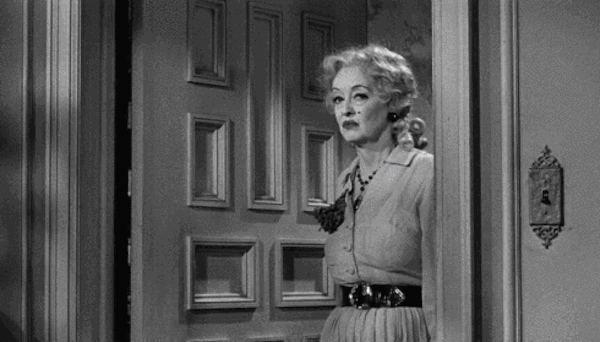
Bette Davis and Joan Crawford on the set of What Ever Happened to Baby Jane?
Robert Aldrich is one of my favorite directors with numerous memorable films that transcend a restrictive genre tag. He always brings us a cynical and gritty story with very flawed characters who are at the core ambiguous as either the protagonist or the antagonist. Aldrich took economics in college, then dropped out and landed a very low-paying job at first as a clerk with RKO Radio Pictures Studio in 1941.
He studied with great directors like Jean Renoir. It was his training in the trenches that made him the auteur he is, delving inside the human psyche and questioning what is morality.
Aldrich has a flair for the dramatic. He likes to break molds and cross over boundaries. He also has a streak of anti-authoritarianism running through the veins of his films. There aren’t just traces of his ambivalence toward the Hollywood machine in his film philosophy; he also conflates the ugly truths beneath the so-called American Dream and the “real” people who inhabit that world.
He died in 1983, and while he remained inside the Hollywood circle, he maintained an outsider persona. In his work, he memorialized the misfits and outcasts by making them the anti-heroes, all of whom ultimately were destined to fall because they refused to play the conformity game.
In 1961, Aldrich partnered with Joseph E. Levin to purchase the rights to the British writer John Farrell’s Hollywood horror book, but at first, no one seemed interested. Aldrich got Seven Arts Pictures curious about the film, and so Warner Bros. agreed to distribute it but didn’t allow it to be made on the Warner lot.
Bette Davis, Jack Warner, Joan Crawford, and Robert Aldrich.Robert Aldrich with Bette Davis and Joan Crawford.
Aldrich relates in an interview that “Eliot Hyman at Seven Arts read the script, studied the budget, and told him candidly: “I think it will make a fabulous movie, but I’m going to make very tough terms because it’s a high-risk venture.”
Baby Jane? was not an easy sell, even with the double billing, both the actress’s box office draw had diminished by then. Later on, Aldrich said that the problem with Jane was that “the topic was perceived as controversial and not a built-in moneymaker which would alienate portions of the public.”
Jack Warner was quoted as saying he “Wouldn’t give a plug nickel for either one of those old broads.”Warner was an asshole!
Warner Studio head Jack Warner with 2 two star ‘broads’ Bette Davis & Joan Crawford.
In interviews with Aldrich, it has been noted that his working relationship with Crawford was already very good, having worked with her on Autumn Leaves (1959). However, with Bette Davis, he had to do a little more convincing. Eventually, she was on board with the project.
By the time Aldrich bought out Levine, the story price had gone from $10,000 to $85,000, and no one seemed interested. But Aldrich relates in an interview that “Eliot Hyman at Seven Arts read the script, studied the budget, and told him candidly: “I think it will make a fabulous movie, but I’m going to make very tough terms because it’s a high-risk venture.”
It was Aldrich’s persistence and his faith in the project that made Davis enthusiastic about the film. Crawford had already expressed a desire to work with Bette Davis in a film. Bette taking on such an unattractive role was pretty gutsy for her.
I choose to focus on Baby Jane? and Sweet Charlotte, as they are not only my favorites of his, but also they are 2 incredible pieces of film art with the allure of the dynamic pairing of two of THE most legendary actresses from the silver screen.
What’s most fabulous about the film is that it has both Bette and Joan, which gives it such a dynamic double billing. The film really was a seminal work because nothing quite like it had been done earlier. Films like Sunset Boulevard (1950)and Autumn Leaves (1959) set some groundwork for older actresses to wax crazy dramatic in film. But ultimately the pot boiled over with Baby Jane?and Hush… Hush, Sweet Charlotte.
Joan Crawford has the more glamorous role of an aging movie starlet, while BetteDavis must inhabit the role of the decrepitude has-been child of vaudeville.
And while Aldrich has a notable filmography to his credit, like his Cold War scare noir masterpiece Kiss Me Deadly, his film that exposes the flawed Total Institution of the penal system, The Longest Yard with Burt Reynolds, and his iconic war ensemble, The Dirty Dozen 1967. There’s his other psychological thriller with Joan Crawford playing wife to the psychotic Cliff Robertson in Autumn Leaves 1956 and the two Hollywood ventures exposing the darker side, The Big Knife 1955 with Jack Palance, and of course, Kim Novak in The Legend of Lylah Clare 1968.
Joan Crawford and Cliff Robertson in Aldrich’s Autumn Leaves ’56
What Ever Happened to Baby Jane?Directed by Robert Aldrich is based on the novel by Henry Farrell with a screenplay by Lukas Heller. Cinematography by Ernest Haller (Gone With the Wind 1939, Mildred Pierce 1945, Rebel Without a Cause 1955), Art Direction by the fabulous William Glasgow, Norma Kotch won an Oscar for her costume design on Baby Jane? and Hush… Hush, Sweet Charlotte as well as Aldrich’sThe Flight Of The Phoenix (1965).
Co-starring: The main players–Victor Buono as Edwin Flagg, Marjorie Bennett as Dehlia Flagg, Anna Lee as Mrs.Bates, Maidie Norman as Elvira Stitt, and Barbara Merrill (Bette’s daughter) as Liza Bates.
The film premiered on October 26, 1962. and released on Halloween of 1962. Davis was nominated for Best Actress and Victor Buono for Best supporting actor.
What Ever Happened to Baby Jane?is filled with grotesque melancholy, the wasteland of forgotten womanhood, and abject psychosis drenched within the portrayal of a repressed woman-child born of rage and delusion. It’s also a striking condemnation of the rampant sexism and ageism in Hollywood. Another reason I want to talk about Aldrich’s two seminal Grande Dame Guignol films is that both motion pictures set the tone for a whole cycle of films to follow.
For the 50s and 60s, melodramas consisting of plots about mental illness weren’t typically conventional, and a film as extremely grotesque as Baby Jane? could be considered very disturbing. Even as groundbreaking as Hitchcock’s Psycho (1960) was, released the same year as Baby Jane?,Psycho’s narrative veiled Norman Bates as a mild-mannered young man with an Oedipus complex. In Baby Jane? her flagrant derangement is glaring.
Perhaps films like Val Lewton’s Bedlam 1946, Anatole Litvak’s The Snake Pit 1948, and Sam Fuller’s Shock Corridor 1963addressed the systemic institutional problems surrounding mental illness, but Aldrich’s films are very intimate ventures.
This lurid pulp melodrama of abject madness is superb, particularly because of the uninhibited performances by Bette Davis and Joan Crawford. It was pretty courageous of both starlets to leave the glamor behind for such a ghastly and unpleasant ceremony.
Image of glamorous Davis & Crawford courtesy AMC’s Backstory.
First of all, I LOVE Bette Davis with a passion, the actress and the woman herself. Have you ever seen the fabulous Dick Cavett interview? If not, you should track down a copy. Bette is an enduring icon and one of a kind. She has a distinct style, a unique “hitch to her git along”, as Andy Griffith would say, and is a true Hollywood legend, thoroughly intrepid, dynamic, and just downright glorious!
And I adore Joan Crawford as well. She was unbelievably beautiful when she first started out in motion pictures, before her signature crazed galvanized eyebrows took over her face and those shoulder pads in her wardrobe. It makes me sad to think that these women might have truly despised each other. It’s truly a shame.
Aldrich directed this film with crude veracity, leaving us to dwell on some feelings of ambivalence toward these particular characters. I was with Jane even at her cruelest, although I pretend that the bird died of natural causes and the rat was found that way. I never warmed up to Blanche, even though she was an invalid; I got the sense from her that she was not what she appeared to be.
Reducing Davis’s performance in histrionic camp would diminish the moments when she is in stark control of the serious meter of Jane’s growing madness. The oscillation between Jane’s childish tantrums and musings and the all-out fury and retaliations is an artful feat delivered by Davis quite masterfully. She must have enjoyed the role immensely. It must have also been challenging. Jane’s dissipated drunken swagger, the way she literally slouches around the house, and her irritable disposition might be the culmination of not only 30 years of taking care of Blanche, but also a sign that she is inappropriately uninhibited by her years of the undigested bile of animosity, hostility and ultimately her malicious outbursts of paranoia, that lead to her aggression and violence.
In the end, Jane’s macabre corpse’s white makeup, painted like a mask with a heart-shaped beauty mark, Kewpie-doll lipstick, and blond wig of a massive ringlet gives Jane an extra bizarre persona. While Jane is supposedly a vain character, ironically, she is under the impression that she is fashionable; she is a vaudeville clown with caked-on face powder and slouchy dresses that are adult versions of the Baby Jane stage outfits she wore as a child. When Jane goes out in public wearing fur, wilted corsage, and antique jewelry, it represents her attachment to the past, although it is not flattering to her at all, when, in fact, she is perceived as pitiful. Apparently, Davis herself created the chalky, pale, freakish makeup that Jane puts on when she starts to plan her comeback. It’s almost a decrepit version of the artist-painted face of Geisha culture. In Peter Shelley’s book Grande Dame Guignol Cinema- A History of Hag Cinema from Baby Jane to Mother, he compares the way Blanche looks at the end, with her pasty death mask and dark rings to the actress Irene Papas. It was definitely the dark, imposing eyebrows.
Directed by Robert Fuest (The Abominable Dr. Phibes 1971, The Devil’s Rain 1975) and written by Brian Clemens. Pamela Franklin plays Jane, and Michele Dotrice is the ill-fated Cathy, two English twenty-somethings touring around the rural French countryside. The two argue about the route and become split up; Cathy vanishes without a trace. Jane begins to search for her friend and stumbles into a world of alienation and the very real threat of a sex murderer on the loose. Who can she rely on as she desperately tries to find her disappeared girlfriend while she is being stalked by a crazed killer.
3 down, 147 to go!- Your EverLovin’ Joey, formally and affectionately known as MonsterGirl
Director/Showman extraordinaire William Castle brings us writer Robb White’s story centered around a quirky, dilapidated mansion once owned by eccentric scientist/occultist Dr. Plato Zorba, who collected ghosts from around the world and invented goggles that enable you to see them. When Dr. Zorba dies, he wills the strange house and its contents to his nephew Cyrus Zorba (Donald Woods) and family, wife Hilda (Rosemary De Camp), son Buck (Charles Herbert), and daughter Medea (Jo Morrow). The Zorba family is broke; the bank has even reclaimed the last bit of furnishings. While blowing out the candles on his birthday, Buck wishes for a house with furniture that can’t be taken away.
So, the fortuitous inheritance comes just in time. Not long after moving in, they discover that the house is haunted. Cyrus finds Uncle Plato’s notes and learns about the 12 ghosts that inhabit the house, including Dr. Zorba himself, who also leaves his housekeeper, Elaine Zacharides (Margaret Hamilton), whom Buck constantly refers to as a witch, not a subtle homage to her role in The Wizard of Oz. Hamilton adds a nice bit of nostalgic camp to the creepy environment: floating objects, hidden panels, a bed canopy that closes up like a vice grip to crush the person sleeping in it, and lurking cobwebby fiends who lunge from the shadows. Trapped within the walls of the house are the 12 manifested ghosties: the crying lady, a feisty skeleton, a meat-cleaving Italian chef who murdered his wife and her lover in the kitchen, a roaring lion alongside its headless tamer, and Dr. Zorba himself. They need a 13th ghost to set them free. The family is in danger because of the fortune hidden in the house. Martin Milner plays Benjamen Rush, the lawyer who handles the estate for the Zorbas. Is there a flesh-and-blood killer among them looking for the hidden fortune? Well, you’ll just have to find out for yourself… A true William Castle fun house ride.
William Castle’s House on Haunted Hill (1959) is a quintessential campy horror film that has become a cult classic. Starring Vincent Price as the eccentric millionaire Frederick Loren, the movie follows a group of strangers invited to a supposedly haunted mansion for a night, with the promise of $10,000 each if they survive until morning.
The film’s plot revolves around Loren and his wife, Annabelle (Carol Ohmart), who have a tumultuous relationship filled with suspicion and accusations of attempted murder. Loren even gives out guns, which are presented as little party favors set inside mini coffins. The guests encounter various terrors as the night progresses, including apparent ghosts, gliding white-eye-balled witches, mysterious attacks, a severed head, and unexplained phenomena, all while Elisha Cook Jr. revels in the violent history of the house while he drinks himself into a stupor.
Castle’s direction combines gothic horror elements with psychological tension, creating a unique atmosphere that blends genuine scares with campy theatrics. The movie is famous for its use of carnival-style haunted house props and effects, which contribute to its distinctive tone. And his infamous gimmicks like Emergo, which entails a floating skeleton that elicited laughs from theatergoers who threw popcorn boxes at it rather than shiver in their seats.
House on Haunted Hill is particularly notable for its twist ending, which plays with audience expectations about the nature of the haunting. The film keeps viewers guessing whether any of the major players elaborately staged the happenings or if it was supernatural in nature.
The movie’s impact extends beyond its initial release, influencing future horror films and inspiring remakes. Vincent Price’s iconic performance has cemented the film’s place in horror cinema history.
1 down, 149 days to go… Your EverLovin’ Joey, formally, affectionately known as MonsterGirl
Beast from 20,000 Fathoms 1953Bela Lugosi and Irene Ware in Chandu the Magician 1932Fred Williamson in Black Caesar 1973Cat People 1942 Alice at the poolLon Chaney -He Who Gets Slapped 1924Claudette Colbert and Henry Wilcoxon in Cleopatra 1934The Sound of Fury aka Try and Get Me 1950Crime Wave 1954Dante’s Inferno (1911)Fallen Angel (1945) Dana Andrews, Alice Faye and Linda DarnellGun Crazy (1950) Peggy Cummins and John DallIn a Lonely Place (1950) Gloria GrahameAnn -Margret in Kitten With a Whip 1964Gene Tierney and Dana Andrews Laura (1944)The Innocents 1961 with Deborah KerrMary Astor The Maltese Falcon (1941)James Garner and Angela Lansbury -Mister Buddwing (1966)Out of the Past (1947) Robert Mitchum and Virginia HustonPlunder Road (1957) Elisha Cook Jr.Kim Stanley and Richard Attenborough Seance on a Wet Afternoon 1964Svengali (1931) John Barrymore and Marian MarshThe Blue Dahlia (1946) Alan Ladd and Veronica LakeAelita: Queen of Mars (1924)
THE BLACK CAT (1934) U.S. (Universal) runs 65 minutes B&W, was the studio’s highest grossing picture in 1934. The film was also ranked #68 on Bravo’s 100 Scariest Movies. Directed byEdgar G. Ulmerand written for thescreen by Ulmer andPeter Ruric.
Also titled: House of Doom; The Vanishing Body (the alternative British title was used in it’s re-release in 1953 as a double bill with The Missing Head an alternative title for the “Inner Sanctum’s” offering Strange Confession.
Tod Browning’s adaptation of Bram Stoker’s Dracula (1931) starring Bela Lugosi.Boris Karloff in Jame’s Whales Frankenstein 1931.
With the success that Universal Studios garnered from Tod Browning’s adaptation of Bram Stoker’sDracula in 1931 starring Hungarian-born actor Bela Lugosi, and the equally sensational popularity of Mary Shelley’s adapted Frankenstein1931 directed by James Whale starring Boris Karloff, it would seem only natural for the studio to harness the cult popularity of these two stars, creating horror vehicles to pair them together in. This is the first collaboration between Boris and Bela. Also, both stars were equally billed in terms of their leading roles. In Lew Landers The Raven 1935, Lugosi dominated as Dr. Richard Vollin and in Lambert Hillyer’sThe Invisible Ray 1936, the emphasis was more on Karloff’s complex character Dr. Janos Rukh. The Black Cat was a huge success for Universal and opened up the floodgates for seven more films featuring the collaboration of Karloff and Lugosi;Gift of Gab (1934), The Raven (1935), The Invisible Ray (1936), Son of Frankenstein (1939), Black Friday (1940), and You’ll Find Out (1940).
Although The Black Cat 1934 claims in its opening credits that the film is ‘suggested’ by Edgar Allan Poe’sstory from 1843 the film bares no resemblance to his short story, nor did Poe ever pen a single word about Satanism in all his volumes of the curiously macabre. The film does evoke the spirit of Poe’s fixation with morbid beauty, the preservation or perseverance of love after death, the suggestive ambiance, the conflation of beauty and death, and the unconscious dread of the uncanny. The architectural lines seem to also evoke the nihilistic sensibilities of Jean-PaulSartre‘s ‘No Exit’ or a Kafka-esque fantasy of entrapment, with a mood set forth of futility and hopelessness. It also represents a cultural aesthetic that was emblematic of WW1.
Ulmer’s The Black Cat is melancholy poetry that articulates its substance within a half-light dream world. There are overcast clouds of menace, with modern Gothic gloom and impenetrable dark spaces. A wasteland of lost hope, it is a land of the dead.
Karloff is driven by his profane lust and twisted faith and Bela is a ghost of a man n a deadly excursion into a vengeful rage.
“Don’t pretend, Hjalmar. There was nothing spiritual in your eyes when you looked at that girl.”-Werdegast
‘the beast’ or the wickedest man in the world Aleister Crowley
Karloff’s character Poelzig is actually based on the notorious occultist Aleister Crowley. Ulmer and Ruric were inspired by an odd news story circulating in the world press shortly before the making of the film. Stranger than fiction, it seems a naive young couple who were visiting a remote home of a magician, became entangled in the occult rituals involving an unfortunate animal sacrifice, a victimized black cat named Mischette. The magician was Aleister Crowley, and the isolated location was his Abbey of Thelema in Sicily. The press got wind of this when Crowley accused one of his writer friends Nina Hamnett of libel in a London Court. Hamnett had mentioned Crowley in her 1932 autobiographyLaughing Torso.
The passage that incited Crowley’s vengeful wrath was Hamnett’s description of his days at the Abbey of Thelema “He was supposed to practice Black Magic there, and one day a baby was said to have disappeared mysteriously, There was also a goat there. This all pointed to Black Magic, so people said, and the inhabitants of the village were frightened of him.” Crowley became known in the public’s perception as ‘the wickedest man in the world.” It was from this story that the seed of sensationalism gave rise to the idea for The Black Cat whichemerged as a tale of savagery and horror for Ulmer.
So, in actuality, the title has nothing to do with Poe’s short story at all, as it merely alludes to Dr.Vitus Werdegast’s (Lugosi) all-consuming fear and dread of cats. A more faithful adaption would be The Living Dead (1934) directed by Thomas Bentley, and Tales of Terror (1962). The Black Cat (1941) starring Basil Rathbone was more of an old dark house mystery.
Roger Corman directs Peter Lorre in Tales of Terror 1962.
It is one of the darkest films of the 30s. The Black Cat is an effusive, atmospheric, and brutal masterpiece of decadent horror among some of Ulmer’s other interesting contributions (People on Sunday 1930, Bluebeard 1944,film noir classicDetour 1945,and the wonderfully lyrical science fiction fantasyThe Man From Planet X 1951).
Influenced by the German Expressionist movement, the film lays out a sinister territory, strange and foreboding, unsavory and dangerous, clandestine and provocative. Ulmer worked for Fritz Lang in the early days living in Germany involved in films including Metropolis (1927) and M (1931). He also worked with F.W. Murnau on Sunrise (1927) Ulmer also worked with Max Reinhardt, and Ernst Lubitsch in the 20s, and Robert Siodmak, Billy Wilder, Fred Zinnermann, and cinematographer Eugen Schüfftan, who was responsible for Metropolis’ miniature sky-scapes and vast edifices.
On the set of The Black Cat.Boris and Bela on the set of Edgar G. Ulmer’s The Black Cat.
The Black Cat is considered to be Ulmer’s best film, though his career did start to maneuver its way down into poverty row’s fabulous cinematic gutter toiling in low-budget features, after beginning an affair with a script girl named Shirley Castle Alexander who was married at the time to one of Carl Laemmle’s favorite nephews. At the time Laemmle was head of Universal Studios, and so Ulmer was essentially blackballed by the mogul from Hollywood. Another factor might have been Ulmer’s unwillingness to sacrifice aesthetic sensibilities over commercial profits.
Ulmer and Shirley got married and wound up moving to New York City spending many of his years working on low-budget films. He began this part of his career by making bargain-basement westerns under the pseudonym John Warner directing a series of cheap ethnic-market movies incorporating groups like Ukrainian, Yiddish, and African Americans before he moved on to the more stylish low-budget thrillers.
By the 1940s Ulmer wound up back in Hollywood but had already resigned himself to making poverty row productions. All of which I find thoroughly enjoyable, such as his Bluebeard (1944) starring the ubiquitous John Carradine, Strange Illusion (1945), and film noir cult classic Detour (1945) starring Tom Neal and Ann Savage whose battered and desolate characters actually fit the noir cannon with an authentic realism despite the anemic budget. I also love The Strange Woman (1946) and another great film noir Ruthless (1948) with Zachary Scott. Ulmer still remained a very productive director with PRC, even if it was one of Hollywood’s bastard children. Studio head Leon Fromkess never gave Ulmer enough money to fund his pictures, Ulmer wanted to produce high-art films and first-class effects as his origin had come from a place where he was such a ”visual artist as well as a filmmaker. The one good by-product of the deal was that it gave him creative license to run with whatever vision he had for a working project of his.
Director Ulmer also doubled as a set designer on The Black Cat to create a work of visual stateliness, beautifully stylish and elaborate with its collection of modernist set pieces, working with the art direction and set design of Charles D. Hall and cinematographer John J. Mescall’s (The Bride of Frankenstein) vision of the striking, uniquely cold and Futuristic Modern Gothic art deco ‘castle fortress’ and it’s interior shots creating the arresting landscape of luxury belonging to the enigmatic Poelzig’s (Karloff) inner-sanctum.
The eclectically sharp and angular camerawork establishes stylish Machine Age imagery and eerie symmetrical aestheticism. Mescall’s camerawork creates a very non-Hollywood and non-stereotypical horror film, filled with a sense of melancholy responsiveness from the heavily influenced authentic Eastern European films of the period. There’s also a quality of cinematic eroticism with Mescall’s use of muting the focus within the shot to create an added emphasis on suggestive sexuality, as the camera dances through various scenes.
The stark use of light and shadow, the well-defined contrast of light and dark with its cold black spaces, and the diffuse whites constructing margins that pay homage to the expressionistic lighting used by German Expressionists filmmakers of the 1920s and early 30s. The atmosphere is oppressive as well as claustrophobic with an added air of perversity that effervesces within the elegant framework.
Ulmer co-wrote the screenplay with Peter Ruric (who used the pseudonym Paul Cain for his hard-edged detective novelettes for pulp magazines, with screenplays such as–Grand Central Murder 1942 and Mademoiselle Fifi 1944). Their script for The Black Cat deals with a deadly game of chess, ailurophobia (fear of cats) rather taboo and provocative subjects such as war crimes, ‘Satan Worship’, human sacrifice, being flayed alive, drug addiction and the underlying perverse fetishism of necrophilia.
Karloff’s character, Hjalmar Poelzig’s morbid and unwholesome preservation of his deceased wife whom he stole from Vitus Werdegast (Lugosi), having manipulated Werdegast’s wife into marrying him telling her that her husband died in the war, ultimately murdering her and then forcibly marrying Werdegast’s daughter is all very salacious material. Werdegast’s wife’s body is kept in a state of suspended animation like a sleeping doll which is visually shocking and gruesome. He tells Werdegast that his daughter too is deceased but in actuality, she is Poelzig’s new young bride. a drugged sexual slave. The film possesses so many strange and disturbing elements. The allusion to incest, sacrificial orgies, and the heightened presence of music drawing heavily from Liszt’s Piano Sonata in B and Schumann’s Quintet in E Flat Major, op.44, Tschaikowsky and most notably for me, Beethoven’s Movement no.7, a personal favorite of mine.
When Universal executives both Carl Laemmle Jr and Sr. screened the film they were horrified by Ulmer’s rough cut, they insisted that he edit the film and so they hacked it up and toned it down. And actually, Bela Lugosi himself was unsettled at the thought of his protagonist showing lusty desires for the very young American girl Joan. Ulmer reluctantly went back and edited some of the harsher scenes out, including the infamous ‘skinning’ sequence, A comparison to the original script from the final version shows that many of the most disturbing elements, including a more unabashed orgy at the black mass, were quickly snipped away and scenes which were more violent and containing more suggestive elements were exorcized like the devil.
But in a subtle victory of wile, Ulmer added a few more scenes showing Karloff taking Lugosi through his historical dungeon artifacts of the encased suspended beautiful women in glass, the posed dead bodies in perpetual lifelike form as if by taxidermy, collecting them as his fetish, the idea of possessing them eternally as an ‘object’ in a state of death, the theme of necrophilia must have slipped by the Laemmles.
Poelzig’s women in glass cases preserved. The imagery is reminiscent of Poe’s fixation with death and beauty, and the conflation of the two
The subject of contemporary Satanism had only been dealt with on the screen once before by Lugosi in his supporting role in the long-forgotten and believed to be lost The Devil Worshipper (1920 German) Die Teufelsanbete.
Universal’s marketing department downplayed the aspect of Satanism in the picture, nervous that the idea of devil worship might not be acceptable to the public theatergoer as entertainment. So in actuality, the original version must have really pushed the boundaries further and been even more sinister. British censors found the film so offensive and unacceptable that the British print of the film, entitled House of Doom replaces any reference to black magic, using less disturbing references to ‘sun worshipper’, (silly) which essentially obliterates the entire transgressive significance and its impact.
Carl Laemmle had given Ulmer free rein on the story’s content but kept a close eye on the director in other respects. Ulmer had not been given the larger budgets that either Dracula or Frankenstein had been endowed with. He was also given a very short span of time to shoot the film, a mere fifteen days. This did not deter or side-track Ulmer at all who was used to working with small budgets and knew how to construct a film that looks as elegant as any largely budgeted project. He began imagining the story, scrapping many scripts that Universal had been collecting. Any pretext associating the picture with Poe’s short story was cast to the wind. And so he created an entirely new vision. At the core, the film works thematically as a revenge piece. But of course, there is so much more bewitching the film’s narrative.
Prague Jew Gustav Meyrink novelist The Golem.Paul Wegener in the adaptation of Czech writer Gustav Meyrink’s The Golem
In the 1960s Peter Bogdanovich interviewed Ulmer in ‘The Devil Made Me Do It‘ who recalled another theme that influenced The Black Cat. He had been in Prague”¦ and met novelist Gustav Meyrink the man who wrote The Golem as a novel. Like Kafka, Mayrink was a Prague jew who was tied up with the mysticism of the Talmud. They had a lot of discussions, contemplating a play based upon the Fortress Doumont which was a French fortress the Germans had destroyed with their shelling during World War I. There were some survivors who didn’t come out for years.The commander who ultimately went insane three years later was brought back to Paris, driven mad because he had literally walked on a mountain of bodies and bones. “The commander was a strange Euripides figure.” Ulmer told Bogdanovich. (Euripides is an archetypal figure as a representational mythical hero, an ordinary person in extraordinary circumstances. Also, Euripides voluntarily exiled himself, rather than be executed like his colleague Socrates who was put to death for his perceived dangerously intellectual influence.)
Much of the ambiance of this historic incident is reflected in Bela Lugosi’s dialogue in The Black Cat.
Vitus Werdegast– “I can still sense death in the air.”
“And that hill yonder, where Engineer Poelzig now lives, was the site of Fort Marmorus. He built his home on its very foundations. Marmorus, the greatest graveyard in the world.” – Vitus Werdegast
Within The Black Cat is there an aesthetic tension between Expressionist Caligarism and The New Objectivity movement or Neue Sachlichkeit, which begin in Habsburg Central Europe at the dawn of the Nazi era? The New Objectivity espoused a new attitude of public life in Weimar Germany with it’s art, literature, music, and architecture created to adapt to the changing mood of the culture. It was characterized by a practical engagement with the world, which was regarded by Germans to be an inherently American style or the cult of objectivity, functionalism, usefulness, essentially- Americanism. While the film injects a modern wholesome American couple into the plot, they are mired down in the decaying ghosts of the past atrocities and sins perpetrated not only on the land but by the presence of the vengeful and malignant atmosphere. An atmosphere represented within the framework of a very Caligarian milieu. This creates friction or contrast by injecting the fresh American presence into the plot, surrounding them within an environment of an arcane and non-naturalist landscape.
The Expressionist Caligarism wasstarted by director Robert Wiene whose surreal masterpiece Cabinet of Dr. Caligari or Das Cabinett des Dr. Caligari will always be remembered as the iconic ultra-expressionist watershed moment of the genre. ‘Caligarism’ Painters turned set designers Walter Röhring and Walter Reimann was responsible for the brilliant expressionist style which influenced other films with both the ornamental patterns transfixed in the dysmorphic repertoire of shapes and configurations that permeated the set designs for 20s science fiction films like Andrew Andrejew’s AELITA – Queen of Mars 1924.
AELITA- Queen of Mars 1924
The use of the color black or more accurately, the absence of light, can also be seen as part of the symbolism in The Black Cat: We are the voyeurs to this claustrophobic madness, as spectators we see the horror as highlighted by the stark blackness of the clothes, the black trees which are filmed in silhouette against a blackened sky. Poelzig is often silhouetted in distinctive blackness. This use of the color black or again more accurately in lighting it with the absence of any color or ‘light’, is used thematically as a way of installing a sadistic marker of the imagery.
The cast of Characters:
Boris Karloff is Hjalmar Poelzig
Bela Lugosi is Dr. Vitus Werdegast
David Manners is Peter Alison
Julie Bishop is Joan Alison (as Jacqueline Wells)
Egon Brecher is The Majordomo to Poelzig
Harry Cording is Thamal Werdegast’s faithful servant
Lucille Lund is Karen Werdegast
Henry Armetta is Police Sergeant
Albert Conti is Police Lieutenant
John Carradine plays the Organist (uncredited)
Boris Karloff playsHaljmar Poelzig who is perhaps one of his most impressively darker characterizations. His all-black attire, strangely androgynous hairstyle, and exaggerated use of make-up accentuate his features giving him the appearance of extreme and austere wickedness. Karloff’s eyebrows arch, his eyes flare and the use of his black lipstick make him almost deathly. Jack Pierce (The Man Who Laughs 1928, Dracula 1931, Frankenstein 1931 White Zombie 1932, The Mummy 1932 Bride of Frankenstein 1935 ) was responsible for the subtle yet dramatic make-up.
Karloff’s voice, his wonderfully lilting voice is typically modulated within the drift of his dialogue. He is remarkable as the incarnation of profane evil, with his icy cold reserve and detachment from the world.
Both protagonists are enigmatic, Karloff’s Poelzig’s utter malevolence and Lugosi’s hero Dr. Vitus Werdegast who is sympathetic yet also damaged, callous, and obsessed by his lust for revenge, make both these disparate figures, magnetic archetypes that are equally compelling.
Boris and Bela in a high-stakes chess match, a game of death
The film takes place in Hungary, starting out with scurrying masses boarding the grandeur of the Orient Express. The Allisons are on their way to Budapest, Visegrad for their honeymoon. American Newlyweds Peter a mystery writer and his new bride Joan Allison board the opulent train. David Manners who plays spare hero Peter Allison portrayed Jonathan Harker in 1931’s Dracula opposite Lugosi and again appeared as the leading man with Karloff in The Mummy 1932.Jacqueline Wells plays Joan. At first, the young love birds have their compartment all to themselves until Dr. Vitus Werdegast, psychiatrist and veteran of World War I, a captive who has just been released from a prisoner of war camp after 15 years imprisonment, (Ulmer himself was a refugee of Hitler) enters the compartment due to a mix up needing a place to sleep. He tells the young couple that he is on his way to visit an ‘old friend.’
Vitus Werdegast -“So you are going to Visegrad” Peter Allison- “Yes to (sounds like) Gaermbish by bus.” Vitus Werdegast– “Gaermbish is very beautiful, I too am going very near there.” Peter Allison– “For sport?” Vitus Werdegast (raising his eyebrows, looking down, and speaking more to himself) perhaps”¦ I go to visit an ‘old friend'” (spoken with a dark unpinning of hatred)
While Joan and Peter fall asleep the gentle yet peculiar Werdegast becomes fixated on her, stroking her hair while her husband Peter who is now awake watches silently for a moment. Werdegast explains that his wife and daughter were left behind when he was sent away to prison.
Vitus Werdegast- “I beg your indulgence, my friend. Eighteen years ago I left a girl, so like your lovely wife”¦ To go to war. Kaiser and country you know”¦ (serious look, deeper inflection) She was my wife. Have you ever heard of Kurgaal? (Peter quietly nods ‘no’) It is a prison below Amsk. Many men have gone there”¦ Few have returned. (taking in a deep breath) I have returned. After fifteen years”¦ I have returned.”
In a premonitory monologue, the driver had spoken of ancient malevolence in Marmorus during the years of the war. “the ravine down there was piled twelve-deep with dead and wounded… the little river below was swollen, a red raging torrent of blood”
When the honeymooners get off the train, it is pouring rain… they agree to share a bus ride with Werdegast, but there is a storm and the desolate rain-soaked roads are treacherous, causing the bus to crash. The bus driver dies, and Joan is injured in the wreck. Needing to seek shelter Dr. Werdegast recommends that they join him at his friend’s home, the Castle Poelzig, so he can take care of the young bride. Werdegast treats Joan’s injury, injecting her with a powerful hallucinogen called hyoscine.
The name Poelzig is an homage to Hans Poelzig set designer/architect of the 1920s whose version of Der Golem was stunning. Real-life Poelzig was responsible for the astonishing Prague set that underpinned the mythic mood of The Golem.
In Hans Poelzig’s own words, “The effect of architecture is magical.”And he meant that literally as he believed that every building was a living thing, had its own musical rhythm and a mystical sound that could be ‘heard’ by those who were initiated into the world of magic. Though a very private man it was known that Poelzig dabbled in magical arts, holding spiritualist seances with his wife at their home and using their daughter as a medium.
According to Poelzig’s biographer, Theodor Heuss, his library was “filled with the works of mystics, the occult sciences and astrology“ he was in the pursuit of the mysteries of eternal forms that he erected and revered through his sacred work constructing his grand style architectural designs as his ‘magic’ medium. Poelzig also found cinema to be an environment for his magical sensibilities, jotting in his notebook “Film”¦ the magic of form-the form of magic”¦ Devil’s Mass”¦”Â
Architect Engineer Hans Poelzig indulged in the magical arts and believed that buildings had a soul…
Poelzig intrigued a lot of people with his mysterious persona. Director Max Reinhardt hired Engineer Hans Poelzig to build sets for his theatrical stages. Ulmer was one of the architect’s junior assistants who later worked on the set of The Golem as a silhouette cutter for Paul Wegeners monumental production. Ulmer had studied architecture in Vienna and so carried that knowledge with him which sheds light on his sense of set design.
Hans Poelzig had a grand imagination, a creative fortitude, and a host of eccentricities, one of which was to be at times a very overpowering presence and domineering personality.
This left an impression on Ulmer, who took those memories from Germany to Hollywood and created a cinematic resurrection of designer Hans Poelzig’s persona in the image of Karloff’s shadowy devil worshiper Hjalmar Poelzig, creating the shades, shadows, and the template for Ulmer’s mystical engineer sadist of The Black Cat’s.
F.W. Murnau’s Faust 1926 too, definitely bears its influence on Ulmer who worked as a crew member on the film. Faust, in terms of the cinema of the Satanic, was a major studio production whose main protagonist was the Devil and who was a complex character, and not merely a vehicle for a simple horror-themed picture, it sprung from a confluence of intellectualism and metaphysical ponderings.
Murnau’s Faust (1926).
DEVILS OF THE GREAT DEPRESSION IN CLASSICAL FILM
Stefan Eggeler-illustrations for Gustav Meyrink-Walpurgisnacht-(1922).Dante’s Inferno
The Black Cat does seem to be one of the earliest illustrations of the Satanic cult film. While the era of Silent Film had a slew of films that dealt with the devil and black magic, (Dante’s Inferno 1911, The Student of Prague 1913, Henrik Galeen’sThe Golem 1914Thomas Edison’sThe Magic Skin 1915, The Black Crook 1916, The Devil’s Toy 1916, The Devil’s Bondswoman 1916, Conscience 1917,Murnau’sSatanas 1919, Der Golem 1920, The Devil Worshipper 1920, Dreyer’sLeaves of Satan’s Book 1920, and 1921’s Häxan, Nosferatu 1922. The Sorrows of Satan 1926 and F.W. Murnau’s Faust 1926) After the economic crash of 1929 these very recognized landmark films seem to disappear. The 30s had The Black Cat 1934 and The Student of Prague (1935), both of these films might be the protracted essence of the Satanic Expressionism of 20s German cinema.
The ‘devil worship’ film or ‘Satanic’ cinema evokes our primal fears, paranoia, and unconscious dread that is implicit toward the ‘Other’ As was in Rosemary’s Baby, Roman Polanski’s adaptation of Ira Levin’s brilliant portrayal of this very paranoia. Satanic films trigger our fears of the intrusion of an outsider who infiltrates society, or rather the comfortability of our moral landscape. It also signposts our secret pleasures which are derivative or surrogate as catharsis by way of the horrors of satanic power. In the 40s the few offerings were William Dieterle’s The Devil and Daniel Webster 1941,Maurice Tourneur’sCarnival of Sinners (1943), and Mark Robson/Val Lewton’s literate and intensely woven The Seventh Victim (1943) and Thorold Dickinson’s imaginative masterpiece The Queen of Spades 1949.
Director William Dieterle’s The Devil and Daniel Webster (1941).The 7th Victim (1943) is a shadow play about a devil cult by Val Lewton.Thorold Dickinson’s story about a pact with the Devil – The Queen of Spades 1949.
While Universal had successes with both Dracula and Frankenstein, The Black Cat is a more intensely layered film with its hidden and not-so-implicit meanings. It has a depth that explores the undercurrent of the 1920s aestheticism and fascination with magic. There are heterogeneous elements that run through both compelling performances by Karloff and Lugosi’s characterizations.
“Next time I go to Niagra Falls.”
Werdegast“You sold Marmorus to the Russians”¦ scurried away in the night and left us to die. Is it to be wondered, that you should choose this place to be your house? A masterpiece of construction built upon the ruins of the masterpiece of destruction”¦ the masterpiece of murder. (he laughs) The murderer of ten thousand men returns to the place of his crime. Those who died were fortunate. I was taken a prisoner to Kurgaal, Kurgaal, where the soul is killed”¦ slowly. Fifteen years I rotted in the darkness. Waited”¦ not to kill you, to kill your soul”¦ slowly. Where is my wife Karen and my daughter?!!!!”
Poelzig–“Karen? Why what do you mean?”
Werdegast –“I mean you told Karen I had been killed, I found out that much in Budapest. I mean you always wanted her in the days at Salzberg before the war, always, from the first time you saw her. I mean that after you saved your own hide and left us all to die in Marmorus, you took Karen and induced her to go to America with you. I traced the two of you there.And to Spain and to South America and finally here. Where is she?”
The film is also powerful in its evoking of the horrors of World War I, which was still a very haunting specter in the public psyche. Most Universal films offered escapism, in contrast, The Black Cat confronts the viewer with a bit of historic retelling of the nightmares of war, more penetrating than the usual concocted monsters the studio was proffering.
“Where is she?”Poelzig- “Vitus.. you are mad” Poelzig “She died two years after the war” Vitus Werdegast -“How?” Poelzig “Of pneumonia, she was never really very strong you know.” Vitus Werdegast- “(crying) And the child”¦ our daughter?” Poelzig “Dead…”
Karloff’s aloof and restrained malevolence guided by the subtle intonations of his melodious voice tethered to Lugosi’s sympathetic and often poignant performance as the broken Vitus Werdegast, in particular the scene when he first sees his dead wife Karen exhibited as if in a museum, suspended in death, evoking authentic tears, “Why is she like this?” All set to the maudlin Ludwig Van Beethoven’s ‘Symphony No. 7: Second Movement.’
Beethovin’s symphony no. 7 often used in films and a most powerfully contemplative piece underscores Karloff’s soliloquy as the camera glides through the dark and dank dungeon of Marmorus taking us on a tour of the decaying deathly oxygen of the place.
Poelzig leads Werdegast through the subterranean enclosures of Marmorus. It is here that Werdegast sees his wife who had died two years after he was in prison, and that his Karen (Lucille Lund) is now encased in glass.
Poelzig reveals the perfectly preserved body of his wife in necrophilic stasis, that he’s encased in glass like an immoral specimen of his unholy fetishism. This might be the only other reference to Poe and his morbid preoccupation with beauty in death. He reveals the dead body of ‘their’ beautifully angelic wife, encased in her crypt-like glass vessel. Poelzig lies to Werdegast telling him that his daughter is also dead.
Werdegast is devastated and demands retribution but Poelzig insists that fate must wait until the ‘outsiders’ are gone. Of course, Poelzig intends to kill the Americans, sacrificing Joan, but forces Werdegast to play a diabolical game of chess the outcome for which the lives of the young couple hinge upon. Werdegast loses and Joan is then taken to another room to await Poelzig, as she is to be his next sacrifice at the black mass ritual during the dark of the moon, in his Bauhaus ceremonial inner sanctum of worship, his sepulcher of debauchery, his sadistic sanctuary, the archaic shrine to the devil.
“Very well Vitus I shall take you to her.”The camera focuses on the darkened spiral staircase heading downward toward the dungeon and then again as Poelzig and Werdegast ascend from the subterranean nightmare.
Poelzig “Come”¦ Vitus”¦ come are we men or are we children? Of what use are all these melodramatic gestures? You say your soul was killed, that you have been dead all these years. And what of me”¦ did we not both die here in Marmorus fifteen years ago ?”¦ Are we any the less victims of the war than those whose bodies were torn asunder? Are we not both, the living dead? For now, you come to me playing at being the avenging angel”¦ childishly thirsting for blood. We understand each other too well. We know too much of life. We shall play a little game Vitus. A game of death if you like. But under any circumstances, you shall have to wait until these people are gone. Until we are alone.”
“You will find her almost as beautiful as when you last saw her… Do you see Vitus I have cared for her tenderly and well.” “Is she not BEAUTIFUL… “ “I wanted to have her beauty always.”-
“Why’s she”¦ why’s she like this…?”-Â
Poelzig has finished his nihilistic sermon. The camera as spectator angles back on the two men walking slowly again. Whatever remained of the man, Vitus Werdegast has now been annihilated.
The essence of this makes the film as disturbing and queasy as any in this contemporary age of violent horror films. Ulmer convinced Laemmle Jr to let him make a film in the European Caligari style, surreal, post-modern, and artistic. The one condition was that he use Poe’s title for the picture. The storyline is hallucinatory, dream-like, and nightmarish, framed within the architecture of a set that becomes part of the character of the plot. Poelzig is revealed is the High Priest of a Satanic Cult, there is a scene where we catch sight of him reading a book entitled The Rites of Lucifer, which promotes the customary sacrifice of virgin blood while Werdegast’s beautiful blonde daughter Karen is believed to be dead, sleeps next to him most likely kept in a drug-induced cataleptic state, to maintain her appearance of a morbid deathly slumber in order to feed Poelzig’s penchant for conflating sexuality with death.
“The dark of the moon, this tonight.”
Hjalmar Poelzig owner, engineer, and designer of the castle is an intense and eccentric man whose castle rests upon the bloody ruins and remains of Fortress Marmorus and the slew of graves where the dead betrayed soldiers, victims of his treason during World War I are buried. Poelzig is as removed from his treacherous past as is his Modern castle which denies its bloody legacy.
Werdegast accuses Poelzig of betraying the Hungarians to the Russians, while he was the commanding officer of the Fort during the war. Telling him that he was responsible for leaving him and the other soldiers to die or be captured. He also believes that Poelzig stole his wife and child when he was sent to prison and that they must still be in the fortress somewhere. Poelzig has a room secretly hidden especially for his satanic black masses. As the conflict unfolds, the young couple becomes the unwitting hostages of these two men.
One of these men is an unorthodox heretic who is consumed with power, death, sublimation, and perverse sensuality. The other is blinded by revenge and hatred for the man who destroyed his life. He also has an all-consuming fear of cats, and early on in the film kills Poelzig’s black cat, although Poelzig is seen carrying around a black cat with him while he glides around his house as he revisits the women he has encased in glass.
We are first introduced to Poelzig as he is laying on a bed with his young wife Karen, a quite provocative image by 1934 Hollywood standards. The vision is sterile and hypothermic, surrounded by glass, chrome, and steel. As the camera moves into Poelzig’s bedroom lair, we see him as he rises up from a prone position emerging in silhouette like a wraith.
Once Joan enters the castle Poelzig is drawn to her, as she is young and attractive possibly bearing a resemblance to his dead wife. As the narrative progresses, it becomes even more strange and uncanny, as Poelzig’s dead wife is revealed to have been married to Werdegast, who believed he died during the battle of Marmorus. She marries Poelzig but he murders her soon afterward, raising their daughter, and then in an imbroglio of incestuous lust, marries the ethereal young girl, it’s so creepy and blasphemous.
“Please child, listen to me we’re all in danger, Poelzig is a mad beast I know.”“I know… I’ve seen the proof-‘He took Karen my wife murdered her and murdered my child.”
Werdegast tells Joan “Did you ever hear of Satanism, the worship of the devil of evil? Herr Poelzig is the great modern priest of the ancient cult. And tonight at the dark of the moon, the rites of Lucifer are recited. And if I’m not mistaken, he intends you to play a part in that ritual. a very important part. There child, be brave, no matter how hopeless it seems. Be brave it is your only chance.”
“‘I’m Karen… Madam Poelzig.”“Karen do you understand me, your father has come for you.”
When Poelzig wins the chess game, Peter Allison is chained up and locked away in the dungeon below. Werdegast is spiraling into madness now and has his loyal servant Thamal merely pretend to be loyal to Poelzig in order to help his true master Werdegast. Joan meets Werdegast’s daughter Karen who wanders into her room like a lithe spirit. She introduces herself as Madam Poelzig. Joan tells her that her father is actually alive and in the castle waiting to rescue her. When Poelzig finds out he brutally kills Karen and leads Werdegast to find her body in order to torture him further.
Poelzig ascends the grand staircase as his cult guests begin to gather around him. The image is pictorial and impressive. as they ready themselves for the Satanic ritual. The soulless expressions on their faces is quite chilling.
Poelzig begins his intonations to the dark master as Joan is led toward the altar.
Karloff improvises giving a compelling invocation to Satan yet actually consists of a few harmless Latin non- sequesters, phrases he used from his college Latin, like Vino Veritas which basically means ‘In wine there is truth’. Cave Canum, ‘Beware of the dog’ and Cum grano salis which is ‘With a grain of salt.’
Werdegast and his servant Thamal (Harry Cording) stop the ceremony, interrupting the sacrifice, and eventually avenge his wife’s death and the plundering and despoiling of his beautiful daughter. They rush Joan away from the ceremony and hide her from Poelzig.
This is when Joan tells him that his daughter is quite alive and has now been forced to marry Poelzig. Joan’s screams alert Peter who can not enter the barred room. He thinks Werdegast is assaulting her when he is trying to help her find the key to the door and so Peter shoots him, but he lets them escape.
Thamal has been wounded by Poelzig’s servant but rushes to help his master. The two men strap Poelzig to his Art Deco-inspired contraption, an embalming rack that looks like an angular cruciform, while Werdegast rips away Poelzig’s shirt, grabbing a scalpel he begins to skin his adversary alive.
I’ll leave it here. It’s enough that you’ve seen Poelzig flayed alive. The film deserves a fresh re-viewing. I hope you’ve enjoyed my little overview of this striking masterpiece of Gothic horror featuring two of the most iconic genre stars Boris Karloff and Bela Lugosi. Please let me know what you think, and please… be kind to black cats…
Directed by Lance Comfort (Devils of Darkness 1965) and based on the play ‘They Walk Alone’ by Max Catto, the film stars Anne Crawford as Bess Stanforth and Siobhan McKenna plays the disturbed Emily Beaudine. Maxwell Reed plays Dan, Barry Morse (Lt. Gerard The Fugative) plays Robert Stanforth, George Thorpe plays Mr Tallent, Honor Blackman as Julie Tallent and Liam Redmond is Father Cocoran.
Emmie is a sensual creature but a quite bewildered young woman who works for Father Cocoran at the church. One day a carnival arrives in the town of Ballyconnen, where she meets Dan a young boxer, who tries to force himself on her under the moonlight. She uses her nails and scratches his face pretty badly.
Father Cocoran sends Emmie away to Yorkshire, where she is cared for by a nice family. But she has repressed her strange desires mixed with longing and repulsion toward men. Much like the hysteria of Catherine Deneuve’s character in Polanski’sRepulsion. The atmosphere is quite gripping and the psycho-sexual anxiety looms over this very obscure little British Noir/Horror odd gem with all sorts of iconography of religious symbolism, Gothic tones with the use of the organ music and the wonderful ‘hysterical woman’ archetype that I so love to write about.
The churches congregation demanding Emmie’s removal from the village as if she were a seductress witch, also goes to the hysteria around women’s sexuality, as Emmie is an ‘object’ of desire for so many around her.
Lon Chaney Sr. (Leonidas Chaney) April 1 1883- August 26 1930
The Film Score Freak wants to pay tribute to The Man of a Thousand Faces, the inimitable Lon Chaney Sr. who’s evocative style of physical performance, volatile and poignant, effusive, penetrating and always sublime characterizations created some of the most memorable roles in cinematic history.
Happy Birthday Lon Chaney, we here at The Last Drive In wish you never get slapped, never to be unknown, never to be in the shadows or swing from a bell unless you’re ringing it for joy, to keep your wonderful face unmasked and the music playing til the ends of time, no matter how many thumbs or arms or legs you have, or whatever unholy mischief you might be up to, we adore you forever from here to Zanzibar….
My song ‘Passing/Arriving’ appears on my lo-fi album The Amber Session, you can visit my official site at EphemeraÂ
as Paul Beamont or HE in He Who Gets Slapped 1924as Tito in Laugh, Clown, Laugh (1928) with Loretta Young Alonzo in The Unknown 1927 with Joan CrawfordLon Chaney as The Phantom of the Opera 1925Lon Chaney as Chinese Immigrant Yen Sin in Shadows (1922)as Professor Edward C. Burke in London After Midnight 1927as Quasimodo in The Hunchback of Notre Dame 1923Chaney in and out of his costume as The Frog for The Miracle Man 1919as Blizzard in The Penalty 1920 with Ethel Terryas Wilse Dilling in The Shock 1923Echo – The Ventriloquist in The Unholy Three 1930Phroso in West of Zanzibar 1928Alfonso in The Unknown with Joan Crawford
Happy Birthday Lon Chaney-With love to a man of many monsters from a MonsterGirl
Bert I. Gordon is just TOO BIG to do in one short post. Hell, I never really do anything in a small way as by now you’ve come to know my style. The fabulous, hysterical, well-informed and outrageously amusing GoreGirl of Goregirl’s Dungeon one of THE BEST blog sites around, has given me the great honor of gracing The Last Drive-In with her enjoyable take of Mr. B.I.G. I thought it would be a perfect segue or Intermission between Part I and Part II of this special feature on the man who brought us giant sized menaces and campy diversions. So without any further ramblings from yours truly, I hand the stage over to the fantastical GoreGirl with her…
THE ABCs Of B.I.G.
Back in July 2009, I did a feature called The Coop of Cthulhu: Five Horror Films that Feature Chickens where I cited Bert I. Gordon’s Food of the Gods. When you are the new kid on the block in the world of blogging it takes some time to get yourself noticed; you are just a drop in an ocean as big as the world. It took a while before I received a comment of any kind, but the most exciting thing that happened to me that first year was receiving a comment from Mr. Gordon on the aforementioned post. When Jo asked me if I would like to contribute something for a feature she was doing on Bert I. Gordon I jumped at the chance. I was long overdue to cover some of the director’s work. In preparation for the feature, I read his autobiography The Amazing Colossal Worlds of Mr. B.I.G. His nickname Mr. B.I.G. not only represents his name; Bert Ira Gordon but his love for giant creatures. Your lesson today is to learn your B.I.G. ABCs…
A is for Attack of the Puppet People. Attack of the Puppet People was made in 1958. Starring John Agar, John Hoyt, and June Kenney; it is the story of a lonely doll-maker who creates a machine that shrinks people. His tiny prisoners inevitably attempt to escape their strange situation. Attack of the Puppet People has been a favourite since childhood. Born well after the film was released I enjoyed the 50s monster movies on Sunday afternoon television and then on video in the early 80s. There were countless films from the 50s with giant creatures in all shapes and sizes but very few had a premise with tiny creatures/people. The idea of which filled my childhood imagination with wonder. I would often daydream about shrinking my tattle-telling little sister.
B is for Beginning of the End. Beginning of the End was made in 1957. Starring Peter Graves and Peggy Castle; it is the story of a journalist who has discovered a species of giant grasshoppers created at an experimental state-run farm. She attempts to make her discovery public despite a government/military cover-up. Mr. Gordon discovered the difficulties of working with live grasshoppers; you can’t really teach a grasshopper to “act” and you cannot prevent them from eating each other either!
C is for The Cyclops. The Cyclops was made in 1957. Starring James Craig, Gloria Talbott, Lon Chaney Jr., Tom Drake, and Duncan Parker; it is the story of Susan Winters who has financed a trip to Mexico to search for her fiancé Bruce whose plane went down three years previous. She arranges a small four-seat plane and hires pilot Lee Brand. Accompanying Susan is BruceÃs closest friend Russ Bradford and Martin Melville who hopes to find uranium. The quartet finds more than they bargain for when they discover the area is inhabited by giant animals. And that is not the only surprise that awaits the group. Although most of The Cyclops was made in and around Los Angeles, Gordon decided he would film several reels of footage in Tijuana to add to the final product. Unfortunately, while there he was arrested and his camera and film were confiscated. Gordon avoided jail time by paying the arresting officer off but his film was exposed before it was returned to him, rendering it unusable.
D is for Kirk Douglas. Bert I. Gordon was hired by a Japanese Ad Agency to do a series of commercials with Kirk Douglas. The commercials, intended strictly for a Japanese audience were for a coffee product and were filmed in Kirk Douglas’ Beverly Hills home.
E is for Earth Vs. the Spider. Earth Vs. the Spider was made in 1958. Starring Ed Kemmer, June Kenney, and Eugene Persson; it is the story of a giant spider found in a cave that is killed and brought to the gymnasium of the local high school to await a team of researchers. The creature as it turns out is not deceased and is revived by rock music! The giant spider wreaks havoc on the small town. Carlsbad Caverns in New Mexico was the perfect location to shoot for Gordon’s Earth Vs. the Spider but there was one problem; he was not permitted to light the Caverns in any way. Apparently light fosters the growth of organisms that would destroy the cavern’s surfaces. Unable to film on location, he shot photographs to use as background plates.
F is for Food of the Gods. The Food of the Gods was made in 1976. Starring Marjoe Gortner, Pamela Franklin, Ida Lupino, Belinda Balaski, and Ralph Meeker; it is loosely based on H.G. Wells’s book of the same name. A meteorite crashes near a small farm that causes a liquid to ooze from the ground. Some rats drink the liquid which causes them to grow to huge proportions. A group of various visitors including a man and his pregnant wife are forced to fight for their lives against the giant rats and a host of other giant creatures. The Food of the Gods was filmed on Bowen Island in British Columbia! Not only made in the motherland but in the province I live in. A former boyfriend’s family had a cottage on beautiful Bowen Island which I visited several times. Gordon built several miniature sets and hired several “rat trainers” for the shoot. Windstorms and snowstorms made shooting difficult but the always inventive Gordon simply wrote a snowstorm into the story.
G is for Grand Prix. The Food of the Gods was awarded the Grand Prix du Festival International Du Paris Fantastique 1977 (Fantasporto).
H is for How to Succeed with (the Opposite) Sex. How to Succeed with Sex was made in 1970. Starring Zack Taylor, Mary Jane Carpenter, and Bambi Allen; it is the story of Jack desperate to get his lovely fiancÈe in bed before their wedding day and her refusal inspires him to purchase a book on seducing women. I have not seen Gordon’s foray into sexploitation so I really can not comment except to say; it appears from what I’ve read that there are no giant creatures in this film.
It is for The International Film Festival of Catalonia. Mr. Gordon’s career was honored in 1998 at The International Film Festival of Catalonia in Sitges Spain where thirteen of his titles were shown.
J is for Leroy Johnson. Stuntman and actor Leroy Johnson appeared in Gordon’s 1962 film The Magic Sword as Sir Ulrich of Germany. Needless to say the man performed his own stunts in pretty much every role in which he was cast.
K is for King Dinosaur. King Dinosaur was made in 1955. Although Serpent Island is listed as his first feature film in his autobiography; IMDB lists King Dinosaur as his first. A new planet called Nova is discovered in the solar system and two couples are sent to explore it. The planet is inhabited by creatures great and small including the titular creature. Made on a micro-budget King DinosaurÃs simple effects were particularly troublesome. The iguanas were uncooperative cast members who refused to move. Gordon went to the local library to read up on Iguanas and found out that they go into a hibernation state in temperatures lower than 120 degrees. A few bathroom heaters fixed the problem and got the little actors moving.
L is for Ida Lupino. The lovely and talented Ida Lupino was featured in Gordon’s Food of the Gods as Mrs. Skinner; one of the last films she did before retiring from acting. Mrs. Skinner is the owner of the farm where a meteor landed that caused the animals of the area to grow to massive proportions. Poor Mrs. Skinner’s husband is eaten by giant rats!
M is for Magic Sword. Magic Sword was made in 1962. Starring Basil Rathbone, Estelle Winwood, and Gary Lockwood; it is the story of George the son of a sorcerer who tricks his mother in order to conjure up a suit of armor, a horse, and a magic sword. George sets out to save the princess who has been kidnapped by the evil Lodac. The princess is being guarded by a two-headed fire-breathing dragon! Gordon stepped aside from the effects in The Magic Sword and let Fox’s art department create the film’s two-headed fire-breathing dragons. Gordon preferred that real fire be used instead of being added in the optical lab. While the creature was not as large as it appeared in the film, it was still one of the largest creatures to appear in one of Gordon’s films and required two men to operate its movements.
the delightfully wonderful Estelle Winwood in The Magic Sword.
N is for Necromancy. Necromancy (aka The Witching) was made in 1972. Starring Orson Welles, Pamela Franklin, Lee Purcell, and Michael Ontkean; it is the story of a witches’ coven in the town of Lilith headed by Warlock Mr. Cato. The local radio station in the town where Gordon filmed coincidently had the call letters CATO; perhaps a little black magic at play here? Okay, probably not.
O is for Michael Ontkean. Michael Ontkean best known and beloved by me for his role as Sheriff Harry S. Truman in Twin Peaks appeared in Gordon’s 1972 film Necromancy as Frank Brandon.
P is for Picture Mommy Dead. Picture Mommy Dead was made in 1966. Starring Don Ameche, Martha Hyer, Zsa Zsa Gabor, and Susan Gordon (her fourth appearance in a Gordon film); is the story of Susan who has recently come home after spending time in an asylum where she was recovering from the shock of her mother’s fiery death. Now living with her father and his new wife whose greedy intentions are less than noble. Picture Mommy Dead is the best film in Gordon’s resume and a real unappreciated gem with great performances. Hedy Lamarr was initially cast as Susan’s mother Jessica but was arrested the week before filming for shoplifting. Zsa Zsa Gabor was cast instead.
Q is for Faith Quabius. Faith Quabius appears in Gordon’s 1973 film The Mad Bomber as Martha; a personal favourite Gordon film of mine. Although Ms. Quabius has an itsy bitsy resume her last name starts with “Q”.
Faith Quabius in The Mad Bomber.Faith Quabius Soylent Green with Edgar G Robinson.
Chuck Connors as The Mad Bomber “You just littered… now pick it up.”
R is for Rathbone. The great Basil Rathbone played the evil wizard Lodac in Gordon’s 1962 film The Magic Sword. Although officially born in South Africa, Rathbone was raised in England. The Magic Sword was released in England under the title St. George and the 7 Curses and would receive a curious rating from the censors in England; a film that was intended to be for general audiences. The film had a problematic and almost non-existent run in the country.
the great Basil Rathbone in The Magic Sword
S is for Satan’s Princess. Satan’s Princess was made in 1990. Starring Robert Forster, Lydie Denier, and Caren Kaye; is the story of an ex-cop hired for a missing persons case whose clues all lead back to the sensual Nicole and a satanic cult. Satan’s Princess is Bert I. Gordon’s last film to date. Generally speaking, Gordon uses closed sets and limited crew for sex/nude scenes but on the request of his lead actress Lydie Denier, her husband was permitted to watch her perform a scene where she takes part in a Lesbian orgy.
T is for Tormented. Tormented was made in 1960. Starring Richard Carlson, Susan Gordon, Lugene Sanders, and Joe Turkel; it is the story of a man tormented by his dead lover, whom he could have saved but chose not to so he could marry another. Gordon is always working with a tight budget and schedule and often has to get creative to capture the shot he needs. In the case of Tormented a lighthouse was an important part of the plot, but it was not in the budget to travel with his cast and crew. Gordon simply shot footage of his ideal lighthouse in Salem, Massachusetts, and melded it with his California footage. The magic of movies!
U is for the University of Illinois. Bert I. Gordon was the special guest at the University of Illinois’ 20th Annual Insect Fear Film Festival on February 15, 2003.
V is for Village of the Giants. Village of the Giants was made in 1965. Starring Tommy Kirk, Johnny Crawford, Ron Howard, Joe Turkel, Beau Bridges, and Joy Harmon; is the story of a group of teenagers who steal the concoction of a brainiac kid that makes things grow to huge proportions. The teenagers ingest the goo and terrorize their community! This movie is a ton of fun and was Gordon’s first picture with AVCO Embassy. Look out for the adorable Toni Basil who was in charge of the film’s dance numbers!
W is for War of the Colossal Beast. War of the Colossal Beast was made in 1958. Starring Sally Fraser, Roger Pace, and Duncan Parkin; it is the sequel to Gordon’s The Amazing Colossal Man (1957). After the events of the first film a series of food truck robberies tip authorities off to the possibility that the Colossal Man is still living. After discovering him in a remote Mexican mountain range they drug and transport him back to America where he escapes and wreaks havoc. Although the horrifically mutated Col. Glenn Manning is the primary focus of War of the Colossal Beast; the character speaks just one word in the film “Joyce” his sister’s name.
X is for Xenonarc Lamp. This has absolutely nothing to do specifically with Bert I. Gordon, but I couldn’t find anything else for X. An Xenonarc Lamp is a high-intensity lighting device used in motion picture projection and eye surgery. Mr. Gordon was a film fan from an early age. At six his mother would drop him off at the local theatre and pick him up in time for dinner. He became friendly with the people who ran the theatre and was even allowed to sit in the projection booth and watch them change the reels. Sometimes if the reels broke during a film they would even let young Burt fix them; he learned to do this simply by observing. Gordon is a director through and through and cites the type of cameras he used often throughout his biography so this seemed like an appropriate “X” word.
A XenonArc Lamp… very cool… go figure
Y is for Yacht; which Mr. Gordon planned to buy after he moved to Hollywood to become a filmmaker.
The SS Minnow Yacht of Gilligan’s Island fame
Z is for Zsa Zsa Gabor. Okay, officially this should be under “G” but come on we all know Zsa Zsa by her first name don’t we?! Zsa Zsa plays Jessica Flagmore Shelley in Picture Mommy Dead; the deceased mother of Susan Shelley whose horrible death by fire caused little Susan to spend time in a mental institution. Zsa Zsa celebrated her birthday on the set of Picture Mommy Dead.
*information for this post was taken from Bert I. Gordon’s IMDB page and his autobiography The Amazing Colossal Worlds of Mr. B.I.G. You can buy his book at his official website www.bertigordon.com