Directer Henry Hathaway’s (The Dark Corner 1946) taut film noir, about a desperately unhappy man who threatens to commit suicide by standing on the ledge of a high-rise building for 14 hours.
With an all star cast- Paul Douglas, Richard Basehart, Barbara Bel Geddes, Debra Paget, Agnes Moorehead, Jeffrey Hunter, Howard Da Silva, Grace Kelly, Martin Gabel and Jeff Corey.
“From the edge of the ledge he defied them all!”
Don’t jump off now…MonsterGirl, helping you down off the ledge
Orson Welles is the black Irish seaman chump Michael O’Hara who falls head long into a web of desire, subterfuge and murder, when he stumbles across (Everette Sloane) Arthur Bannister’s wife Mrs. Elsa Bannister (the exquisite Rita Hayworth) out for a carriage ride in the park one night. With one of the most staggering climaxes in Film Noir!
“I never make up my mind until it’s over and done with.”- Michael O’Hara
1) The tragically poetic Pete Krumbein in Edmund Goulding’sNightmare Alley 1947 played by Ian Keith.2) The flamboyant Franzi Kartos in Caught 1949 portrayed by Curt Bois ‘darling’3) Stauffer, alias Fred Foss in The Dark Corner 1946-played by the wonderful William Bendix in the white linen suit…4) Good-hearted kite hanger, Brenda Martin in Women’s Prison 1955 – the eternal pixie Jan Sterling.5) Jeff Corey, as the cringing, cowardly informer ‘Freshman’ Stack in Brute Force 1947.6) Beulah Bondi as spiittin’ Granny Tucker in Jean Renoir’sThe Southerner 1945 ‘Ah shuckity’7) Ma Stone in William Dieterle’sThe Devil and Daniel Webster 1941– the grand Jane Darwell.8) Cecil Kellaway as Harry Wills and Mary Astor as Jewel Mayhew in Hush Hush Sweet Charlotte 1964.9) Cliff the jazz sexed drummer in Phantom Lady 1944– the ubiquitous Elisha Cook Jr.10) Quirky sisters Louisa and Emily Creed in Ladies in Retirement 1941–Edith Barrett & Elsa Lanchester.11) The wonderful stoolie Mo whose saves for her headstone and plot out on Long Island played with that razor-sharp wit of Thelma Ritter in Pickup on South Street (1953).12) Jack Oakie as Slob in Jules Dassin’s realism masterpiece Thieves’ Highway (1949).
Directed by Reginald Beck, and Anthony Bushell. Written by Nunnally Johnson, Edgar Lustgarten is based on his book “A Case To Answer” and W.E. Fairchild. With cinematography by Wilkie Cooper (Stage Fright 1950, Jason and The Argonauts 1963), granting wisps of shadowy montages that are equally noirish, suspenseful, and simply splendid.
Patricia Cutts gets no sympathy from me after slipping him a mickey and letting loose that darn Tingler on poor unsuspecting Vincent Price.
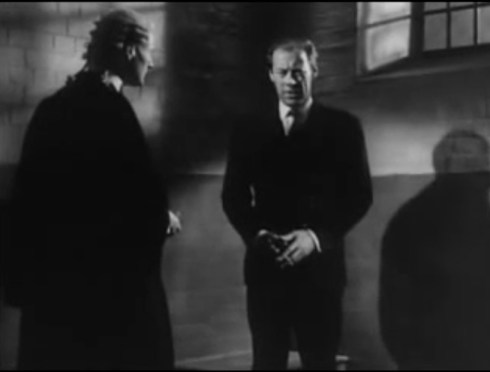
Yielding and obsessive Rex Harrison plays Arthur Groome a London gentleman married to the devoted and lovely Mary (Lilli Palmer.)Unfortunately, Arthur becomes consumed by a flirtatious showgirl Rose Mallory (Patricia Cutts), who winds up being brutally knifed in her boarding house room, and left for the credulous Groome to become suspect one. First gets the splatter of Rose’s blood on his jacket, but then fails to prove his innocence in a sea of circumstantial evidence.
Condemned to hang, this allows the real serial killer played by the tall and eerie Anthony Dawson who looks frightened all the time, a destroyer of wanton women who sees himself as ‘an instrument of justice‘, still lurking about, first at the trial spouting off about his obvious philosophy on sexually independent women, and then creepily shadowing poor Mrs. Groome, whom he idealizes as the perfect woman.
I’ll be up the long dark hall til next time! -Yours always- MonsterGirl
Writer Virginia Kellogg (White Heat 1949) offers us a doozy with this story directed by John Cromwell (Dead Reckoning 1947)
Eleanor Parker is Maria Allen, thrust into the prison system run by a well-meaning warden Ruth Benton played by the inimitable Agnes Moorehead. As in any good women in prison flick, it requires the sadistic matron to roil the exploitation brew with lots of dehumanizing antics like a good head shaving or dare I mention it, a kitten killing. So here’s to Hope Emerson’smean-spirited Evelyn Harper, kitten killing, bon bon eating, Midnight Romance reading, prison caboose with a mean on, that makes Ida Lupino look like Saint Joan. Also starring one of my new favorites and a staple to these great gritty noirs the sprite Jan Sterling, Betty Garde, Ellen Corby, and Jane Darwell.
Battleship Potemkin 1925- Sergei Eisenstein known for his montage framing and editing offers up the epic dramatization of the social uprising in Russia, which brought about a grim massacre with an iconic scene of the baby carriage plummeting down the great stone steps.Dr. Caligari’s somnambulist, Cesare (Conrad Veidt) ascends the abstraction of a stairway to nowhere…in The Cabinet of Dr. Caligari (1920)F.W. Murnau’s 1922 masterpiece of shadow and light. With subtle prominence, the silhouette of the stair rails makes cogent the sinister outline of Max Schreck’s Nosferatu all the more.Alfred Hitchcock’s crime thriller Blackmail (1929).She 1935 Irving Pichel and Lansing C Holden’s fantastical saga based on H. Rider Haggard’s novel about an ancient esoteric civilization reigned over by the cruel high priestess She who must be obeyed, upon the steps by the secret eternal flame of everlasting youth! with an intoxicating score by Max Steiner.Again in 1935, SHE was released in both B&W and a gorgeous colorized version. I’ll be doing a larger overview of the film very soon. Using images from both. Steps upon steps, leading to divinity, or leading to death?Thorold Dickinson’s hauntingly sinister fable- The Queen of Spades 1949- See the intricate network of elaborate stairs that wind within the vast manor house, which lead to the infamous lady who bet her soul away to the devil in order to win at a game of cards.In Alfred Hitchcock’s Notorious (1946) Cary Grant carries Ingrid Bergman to safety down the moonlit stone steps.
Charlie Chaplin in City Lights 1931.
Alfred Hitchcock’s Psycho 1960.
Jack Clayton’s The Innocents 1961 starring Deborah Kerr.
In notorious (1946) Claude Rains stands alone facing his fate up those moonlit stone steps…the end scene.
Photo from February issue of Vogue 1952 here’s cutter Barbara McLean editing All About Eve.
Director William Goulding’s Allegorical Carnival/ Noir masterpiece based on William Lindsay Gresham’s book: an Americanastudy of the rise and fall of personal morality, that reaches to the lowest depths of show business with sleazy inhabitants and the sinister and shadowy world of freak- shows, mentalist acts, geeks, alcoholism and the voyeuristic throng that feed off the human suffering of others …
Tyrone Power as Stan Carlisle and Joan Blondell as Zeena Krumbein.Ian Keith as the alcoholic, mentalist Pete Krumbein.
In Nightmare Alley Barbara McLean contributes to creating a landscape of a distorted reality alongside the dark, clandestine, and arcane carnival atmosphere. The film is beautifully woven, as the seamless images flow into one another. McLean blends together the invisible strands that only one’s dreams could effectively manifest. McLean’s editing constructs much of the surreal and tormented ‘movement’ of the film. It’s what transports each scene of the film, making it every bit as if WE were inhabiting someone’s nightmare.
Coleen Gray created a little electrifying entertainment for the crowd.
With 62 film credits to her name, half of which were with filmmaker Henry King,Barbara McLean is a master of cutting and shaping. She’s worked on some of my all-time favorite films including this film, Goulding’sNightmare Alley,Joseph L. Mankiewicz’s No Way Out (1950),Henry King’s The Song ofBernadette (1943), Robert Wise’s The Desert Rats (1953), John Ford’s Tobacco Road(1941) and again Mankiewicz’s All About Eve (1950). McLean also worked as an editor on Elia Kazan’sViva Zapata in 1953, and in 1954 with Michael Curtiz’s on The Egyptian. She edited the first movie filmed in CinemaScope, The Robe (1952), directed by Henry Koster.
Bette Davis and Celeste Holm in All About Eve.Jennifer Jones in The Song of Bernadette.Linda Darnell in No Way Out.Gene Tierney in Tobacco Road.
Barbara McLean was one of the most recognized editors working during the reign of Darryl F. Zanuck at the 20th Century Fox Studio, from the 1930s to the 1960s. Eventually achieving the honor of division chief of the editing department in 1949. She joined Fox in 1935 as one of only eight female film editors working in Hollywood in the 1930s. McLean was part of a huge team of technicians, writers, directors, and collaborators that Zanuck went to for guidance. She was very influential in much of Zanuck’s decision-making process, as she often acted as an adviser to the Hollywood movie mogul, helping him coordinate even a single shot.
She won the 1944 Academy Award for Film Editing for her work on Wilson (1944) director Henry King’s biopic film of Woodrow Wilson’s political career. McLean was nominated another 6 times for that award, including her work on All About Eve. I think she should have won the 23rd annual Academy Award for All About Eve, but she lost to Ralph E Winters and Conrad A Nerig for their work on King Solomon’s Mines. It was a tough year to compete with nominations also going to The Third Man and Sunset Boulevard. McLean’s greatest collaboration was with filmmaker Henry King, a relationship that spanned over 29 films including Twelve O’Clock High 1949.
Her last editing credit was for Henry King’sUntamed (1955). In later years, McLean acted primarily in a supervisory and administrative capacity, eventually retiring from 20th Century Fox in 1969, due to her husband’s declining health. She received the inaugural American Cinema Editors Career Achievement Award in 1988. McLean died in Newport Beach, California in 1996.
Twelve O’Clock High 1949 with Gregory Peck
Her impact was summarized by Adrian Dannatt in a 1996 obituary in The Independent: McLean was “a revered editor who perhaps single-handedly established women as vital creative figures in an otherwise patriarchal industry.” Writer Tom Stempel, in a piece about Darryl F. Zanuck, writes of McLean‘s influence on Zanuck‘s filmmaking; “For all her focus on keeping the narrative moving, McLean’s editing could dazzle if called for. In A Bell for Adano (1945), she took material director Henry King shot on the return of the Italian POWs to their village and put it together with such a pure sense of emotion that when she cut at exactly the right moment to King’s overhead shot of the prisoners and villagers coming together in the square, the cut was more heart-stopping than conventional close-ups would have been.”
McLean brings together the writer’s and director’s vision and gives it completeness, a cohesion, like alchemy with film footage, she creates cinema gold. According to Bright Lights Film Journal “the basic rules of film editing, first established in the silent era, still govern the industry today: maintain your eye lines, preserve continuity, respect planarity (the rules governing the transposition of three dimensions onto a two-dimensional plane), find a good rhythm, and, most important, always advance the story.” Here is where McLean excels. If you look at the variety of narratives, milieus, and landscapes McLean has stitched together in the editing room, you can see how expansive her vision explores the realms of the human condition, moral corruption, and redemption weaving together images that shape the story into ‘the big picture’, with all the little pieces of the intricate moments of the framework, revealing an intimate story, a memorable story, a universal notion of people living in a state of transformation.
If I could enter the film industry at this stage of my life, there would be one thing aside from my already being a music composer, of course, would be to sit in the editing chair. One of the things I look for in a film, and feel passionately certain about is the cinematography, scoring, and casting, if there is one singularly essential component to what makes a film greater…it’s the editing.
We should also celebrate the women working in the very male-dominated career of film editing, women like Barbara McLean and even Dorothy Spencer(Lifeboat 1944, Stagecoach 1939, and the film I recently blogged about Valley of The Dolls 1967).
I should also mention, Anne Bauchens, who was Cecil B. DeMille’s editor, cutting nearly all his movies from 1915 until his death in 1959, and Margaret Booth. Two women who haven’t been put in the greatest light in terms of their ‘difficult’ personalities and skill, something I’ll write about in future. But aren’t women always difficult to work with? Geez.
And so let’s raise a toast to Barbara McLean’s contributions to the cinema… a pioneer in the industry not only breaking the glass ceiling but taking all the pieces and putting them back together to make an indelible cinematic mural for ages to come.
And now for the Carnival ‘Geek’ in Nightmare Alley: Tyrone Power’sastonishing portrayal of Stanton ‘Stan’ Carlisle the ambitious carney who rises to evangelistic notoriety as a slick and cunning mentalist, only to descend into the realm of self-destruction when power corrupts, consumes and destroys his life, ultimately leading him back to sideshow freakery becoming the very ‘geek’ he once found repulsive. McLean’s treatment of the film’s climatic excursion into the bowels of the carnival and Stan’s diminution into the shadows is quite viscerally staggering.
Tyrone Power’s nightmarish descent into the world of the ‘geek’
According to the book Carny Sideshowsby Tony Gangi, a ‘Geek’ is:
An unskilled performer whose performance consists of shocking, repulsive and repugnant acts. This “lowest of the low” member of the carny trade would commonly bite the head off a living chicken, or sit in a bed of snakes. Some historians distinguish between “geeks” who pretend to be wild men, and “glomming geeks” whose act includes eating disgusting things. See the 1949 movie “Nightmare Alley” for a good geek story as well as for an excellent depiction of the mentalist’s technique of “cold reading”. In later years the geek show turned into a “see the pitiful victim of drug abuse” show. “Geek” as a verb (“he geeked”) is one of several terms in use among wrestlers meaning to intentionally cut oneself to draw blood.
A geek who bites the heads off snakes…
Either on the fairway or the cutting room floor, I’ll be there! Your ever-faithful -MonsterGirl!
La Belle et la Bete (1946)Caged (1950)Criss Cross (1949)Devil Girl From Mars (1954)Les Diaboliques (1955)Experiment in Terror (1962)Les yeux sans Visage (1960)Les yeux sans visage (1960)Gloria Grahame The Cobweb (1955)I Bury The Living (1958)Island of Lost Souls (1932)Kiss The Blood Off My Hands (1948)Lady in a Cage (1964)Mother Joan of The Angels (1961)Belle et la Bete (1946)Strait-Jacket (1964)Sunrise (1927)The Haunting (1963)The Queen of Spades (1949)Vampyr (1932)The World’s Greatest Sinner (1962)
Lee Remick plays bank teller Kelly Sherwood who is being terrorized by ‘Red’ Lynch (Ross Martin) a psychopath with an asthmatic voice like sandpaper who schemes to use her in a plot to steal $100,000 from the bank where she works. Lynch kidnaps Sherwood’s younger sister Toby played by Stephanie Powers, and then threatens to kill her, if she tells the police. Enter Glenn Ford as F.B.I. agent Ripley who is now on the case… setting off a feverish game of cat & mouse between Remick, Martin and Ford.
Directed by Blake Edwards, this is one hell of a gripping Film Noir/ Thriller, with a screenplay by The Gordons, based on Mildred and Gordon Gordon’s 1961 novel Operation Terror.
I love Ross Martin’s portrayal of the murdering, smarmy crushed velvet jacket wearing, tv host art critic Dale Kingston in Columbo’s “Suitable for Framing”
… and Martin inhabits ‘Red’ Lynch giving him a most bizarre sort of vicious earning him the persona here as Fiend of The Day!