Kristina of the Speakeasy Blog and Stephen also know as Classic Movie Man will be co-hosting this marvelous event!
There’s just sooo much that can be said for Val Lewton’s contribution and influence on cinema. I have been dragging my feet with a feature, myself, but this years blogathon gives me a chance to talk a little bit about the man who truly created several masterpieces of cinematic history. So join Kristina, and Stephen and all the other bloggers who will be contributing their coverage.
Simone Simon
I am working on a piece for Curse of The Cat People 1944 which was the follow up to Cat People, still appearing is Simone Simon as the ghost of Irena. I’ll be discussing a few things, The Merging of Reality and Fantasy,
The Fear and Threat of Children, the corruption of their innocence, imagination and how their freedom of expression challenges us to either push the boundaries of belief or succumb to Christian myth that would crush it, deem it evil, or call it mental illness.
Also I’ll talk about the Fear of The Female Monster and The Feminine. Especially in this case, a female child….!
And of course being an avid cat worshiper I’ll address that absurd superstitious malarkey centered around fear of cats being servants of the Devil… in particular black cats. So, stay tuned for a very informative and beautiful ride through the Shadowlands of one of the greatest film makers of all time-
BAD BLONDE (1953) directed by Reginald Le Borg starring Barbara Payton, Frederick Valk and John Slater.Directed by Julien Duviveir – FLESH AND FANTASY(1943) starring Betty Field, Edward G.Robinson, Barbara Stanwyck, Charles Boyer, Robert Cummings, Anna Lee, Dame May Whitty and C.Aubrey Smith Cast A Dark Shadow (1955) directed by Lewis Gilbert and starring Dirk Bogarde, Margaret Lockwood and Kay WalshThe Hitch-Hiker (1953) Directed by Ida Lupino and starring Edmond O’Brien, Frank Lovejoy and William TalmanNight of The Eagle aka Burn Witch Burn (1962) directed by Sidney Hayers, written for the screen by Charles Beaumont, and starring Peter Wyngarde , Janet Blair and Margaret Johnston.Panic In The Streets (1950) directed by Elia Kazan and starring Jack Palance, Richard Widmark, Paul Douglas and Barbara Bel GeddesM (1931) Directed by Fritz Lang and starring Peter LorreThe Queen of Spades (1949) Directed by Thorold Dickinson and starring starring Anton Walbrook, Edith Evans and Yvonne MitchellROPE OF SAND (1949) Directed by William Dieterle and starring Burt Lancaster, Paul Henried, Claude Rains, Peter Lorre and Corinne Calvet.Edge of Doom (1950) directed Mark Robson and starring Farley Granger, Dana Andrews and Joan Evans.Joe Sarno’sSin In The Suburbs (1964)Stranger on The 3rd Floor (1940) Directed by Boris Ingster and starring Peter Lorre, John McGuire and Margaret Tallichet.Strangers on a Train (1951) Directed by Alfred Hitchcock and starring Farley Granger, Robert Walker and Ruth Roman.The 39 Steps (1935) Directed by Alfred Hitchcock and starring Robert Donat, Madeleine Carroll, Lucie Mannheim and Peggy Ashcroft.The Dark Corner (1946) directed by Henry Hathaway and starring Lucille Ball, Mark Stevens, Clifton Webb and William Bendix.Director Robert Siodmak’s masterpiece of film noir adapted from Ernest Hemingway, 1946 The Killers. Starring Burt Lancaster, Ava Gardner, Edmond O’Brien and Albert Dekker.Director Robert Aldrich’s Kiss Me Deadly (1955) Starring Ralph Meeker as Mike Hammer. Featuring a young Cloris Leachman…A Streetcar Named Desire (1951) Director Elia Kazan’s exploration into Tennessee Williams’ iconic characters. Starring Vivien Leigh as Blanche Duboise, Marlon Brando as Stanley Kowalski, Kim Hunter as Stella…and Karl Malden as Mitch.The World, The Flesh and The Devil (1959) Directed by Ranald MacDougall, starring Harry Belafonte, Inger Stevens and Mel Ferrer.
A Cry in The Night 1956 directed by Frank Tuttle, starring Edmund O’Brien, Brian Donlevy and Natalie Wood.Among The Living (1941) directed by Stuart Heisler and starring Albert Dekker, Susan Hayward and Frances FarmerBRUTE FORCE (1947) directed by Jules Dassin and starring Burt Lancaster, Hume Cronyn and Charles BickfordRoman Polanski’sCHINATOWN (1974) starring Faye Dunaway, Jack Nicholson and John Huston.COMPULSION (1959) directed by Richard Fleischer and starring Dean Stockwell, Bradford Dillman and Orson Welles.He Walked By Night (1948) starring Richard Basehart, Scott Brady and Roy Roberts.I Bury The Living (1958) directed by Albert Band and Starring Richard Boone and Theodore BikelIN COLD BLOOD (1967) directed by Richard Brooks and starring Robert Blake, Scott Wilson and John Forsythe.NIGHTMARE ALLEY (1947) Directed by Edmund Goulding, starring Tyrone Power, Joan Blondell, Coleen Gray and Helen Walker.Director Joseph Sarno’s exploitation film from (1964) Sin In The Suburbs stars Judy Young, W.B.Parker and Audrey CampbellThe Prowler (1951) directed by Joseph Losey and Starring Van Heflin, Evelyn Keyes and John Maxwell.THE KILLERS (1946) directed by Robert Siodmak and starring Burt Lancaster, Ava Gardner and Edmund O’BrienThe Two Mrs. Carrolls (1947) directed by Peter Godfrey and starring Barbara Stanwyck, Humphrey Bogart and Alexis SmithThe Uninvited (1944) directed by Lewis Allen starring Ray Milland and Ruth Hussey and Gail RussellThe Unsuspected (1947) directed by Michael Curtiz and Starring Claude Rains, Joan Caulfield and Audrey Totter.Once again Claude Rains in the suspenseful The Unsuspected (1947)Nicholas Ray’s They Live By Night (1949)starring Farley Granger, Cathy O’Donnell and Howard Da SilvaCharles Laughton’s masterpiece Night of The Hunter (1955) Starring Robert Mitchum, Lillian Gish and Shelley Winters.
The Queen of Spades (1949) is an obscure British psychological thriller. Associate Producer Jack Clayton was on board for this film, directed by Thorold Dickinson (Gaslight, 1940), who came onto the project at the last minute. Adapted to the screen by Rodney Ackland and Arthur Boys from the 1834 novella written by Alexander Pushkin. The story could have easily been dreamt up by Aleksei Tolstoy, Ivan Chekhov (The Drop of Water sequence in Black Sabbath), Nikolai Gogol, or even Oscar Wilde.
It also brings to mind Edgar Allan Poe’s short story “Never Bet the Devil Your Head: A Moral Tale.” Which of course was brought to life by Federico Fellini in the segment of Spirits of the Dead 1968called Toby Dammit, featuring the work of divine actor Terence Stamp.
Terence Stamp as Toby Dammit in the segment of the same name as part of Spirits of the Dead. Directed by Federico Fellini, 1968. Based on the short story by Poe, Never Bet The Devil Your Head.From Mario Bava’s Black Sabbath 1963 vignette, The Drop of Water, based on a story by Chekhov.Boris Karloff stars in an adaptation of Tolstoy’s story in the segment about The Wurdelak.
It’s clear that Russians are very good at telling Ghost stories and notorious for telling tales about selling your soul to the Devil!
The Queen of Spades stars Anton Walbrook, Edith Evans, and Yvonne Mitchell. Also in the supporting cast is Ronald Howard, son of Leslie Howard, who bears a striking resemblance to his father. Andrei is of a noble background, a soldier as well, and Herman Suvorin’s only friend. He is truly in love with Lizaveta (Yvonne Mitchell). The evil Suvorin even steals a few of Andrei’s poetic words to use in one of his love letters to lure Lizaveta.
An ambitious officer, Herman Suvorin, becomes obsessed with learning the secret card combination that once made an elderly countess fabulously rich, a secret she supposedly bought with her soul. To get it, he worms his way into the household through her young companion, Lisaveta, only to drive the old woman to her death and find himself haunted, literally and figuratively, by what he’s done.
The film is a lost masterpiece of British Gothic cinema, with its arresting visuals, the elegant but uncanny set design, and the way mirrors, shadows, and sound are used to keep pace with Walbrook’s unraveling.
The evocative music scored by Georges Auric(Beauty and the Beast (1946), The Innocents (1961), and Wages of Fear1953, just to mention a very few!) is as heart-wrenching as it is heroic, drawing out the exquisite melody and chord changes to reach the soul and twist it into knots while it lingers.
What can I say about the gorgeous cinematography by Otto Heller? The odd camera angles are reminiscent of the great German Expressionist movement, something from Fritz Lang, or the use of light and darkly dreamy angles like those of Carl Theodor Dreyer.
Even without any sound, the story would have emerged from the screen as a powerful cautionary tale, rife with grotesque and compelling characters.
The film is an arresting fairytale, that’s dreamy, and haunting in its imagery, and perhaps, as visually stunning as I dare say Jean Cocteau’sLa Belle et la Bete 1946 or Julian Duvivier’s Flesh and Fantasy1943, and the collaborative efforts of Alberto Cavalcanti, Charles Crichton, Basil Dearden, and Robert Hamer’sDead of Night 1945.
Betty Fields and the mysterious mask salesman in Flesh and FantasyMichael Redgrave and his dummy in Dead of Night
There are frames so masterfully conjured in shadow that you might even think you’re watching Film Noir or an obscure Val Lewton production. Either way, TheQueen of Spades defies any single label; it is a wonderful fusion of many compelling elements.
You know, a lesser director would simply sit back and let Walbrook carry everything, but Dickinson matches his intensity by filling the frame with signs of fracture; reflections that don’t feel trustworthy, hallways that seem to lengthen under the pressure of paranoia, and images that keep you guessing whether the Countess is a victim or a supernatural predator.
Dickinson’s direction emphasizes a brooding, Gothic atmosphere through chiaroscuro lighting in opulent Russian interiors and Expressionistic use of shadows to convey psychological turmoil. There are unsettling close-ups of Walbrook’s intense gaze
It has a melancholy, fairy-tale logic of its own, drawing on mystery, crime, noir, and supernatural horror from that golden age when the way a film looked mattered as much as what anyone said or did.
Dickinson films all of this with a rich, brooding flair. The interiors feel like gilded mausoleums: heavy drapes, ornate mirrors, and those deep pools of black shadow that look ready to swallow the characters whole. Light and darkness battle it out in every frame, faces half-carved by candlelight, staircases that vanish into ink, cards gleaming like tiny white tombstones on the imagined color of green baize. There are close-ups of Walbrook’s gaze so intense they almost feel like a challenge to us: are you really sure this is all in HIS head?
The world around him is just as expressive. Otto Heller’s camera turns the Russian aristocracy into a kind of living ghost story, with costumes and sets that feel slightly heightened, slightly unreal, like a memory of the 19th century rather than a documentary reconstruction. Georges Auric’s music threads through it all like a nervous pulse, amplifying the sense that fate is already written, and every choice these characters make is just another step toward it.
What I love is how the film stands at a crossroads: you can feel the influence of German Expressionism in those tilted shadows and uncanny compositions, but there’s also the fatalism and moral rot of film noir seeping through the cracks. It’s Gothic horror dressed in cards and uniforms, already nudging its way toward the more modern obsessions of psychological thrillers, what happens inside a mind when greed, fear, obsession, and desire all start playing their own rigged game.
The Queen of Spades (1949), treated as a major work of British Gothic cinema, gains an even stronger atmospheric charge when you factor in Thorold Dickinson’s background as an editor, his earlier work on the original Gaslight, and the circumstances that brought him onto the film at very short notice, reshaping both script and tone.
Anton Walbrook’s career and temperament; his origins as Adolf Wohlbrück in Vienna; his pre-war success in German cinema and theatre; his flight from Nazi Germany; his reinvention in Britain; and how that history of exile and doubleness feeds into his performance as Herman Suvorin in this film. All of that should feel integrated, a context that enriches the reading of the film, not little biographical footnotes.
Thorold Dickinson leans hard into a brooding, Gothic mood. He floods those St. Petersburg interiors with chiaroscuro light, corridors carved out of shadow, letting faces emerge from the dark as if the shadows are thinking for themselves, surfacing as if summoned rather than simply lit.
The camera keeps circling back to Walbrook’s eyes in unnervingly tight close-ups, so that a single glance can feel like a threat or a crack in his sanity.
The world around him is just as expressive. The cinematography feels like guilty opulence under siege: The rooms are crowded with heavy fabrics, ornate furniture, and elaborate uniforms and gowns that don’t just signal 19th-century Russian aristocracy, they make the whole society feel overdecorated and airless, as if the characters are being slowly smothered by their own luxury.
Otto Heller’s work is explicitly, metaphorically visual with his use of towering shadows, inky pools of darkness, expressionist angles, creating St. Petersburg as a maze of pitchblack and candleflame, faces carved out of shadow like reliefs, the gambling den as a kind of infernal chapel where light and smoke conspire to turn men into specters, and the part of the film’s preoccupation with fate and damnation.
And the way Messel and Kellner’s sets and Heller’s lens make the Welwyn stages feel like a haunted city rather than a modest British studio. The Gothic textures, the baroque interiors, the way mirrors and high angles warp scale and sanity, all circle back to the film’s preoccupation with fate and damnation.
Kellner and Oliver Messel are the production designers; the BFI has a whole piece on his Queen of Spades model work and describes those “rococo flourishes, faded grandeur, flickering candles, mercurial mirrors and architectural pieces capable of throwing the most ominous of shadows.” William Kellner, credited as art director, is specifically praised in a recent Film Experience piece for stuffing the frames with baroque excess.
The Queen of Spades absolutely leans into that slightly baroque and lush mood, mirroring the film’s own sense of ornate decay, while threading through a few precise, cutting images that keep it feeling overstuffed.
The film’s language is rich, tactile, and atmospheric, and the metaphors are layered, curling around the texture of the images, the velvet blacks, hard glints on brass, the gleam of cards, and the pallor of anxious faces, punctuated every so often by a short, almost brutal line that states the psychological or supernatural truth of what we’re seeing.
That duality lets you honor the film’s rococo visual world while keeping your prose disciplined: the baroque tone sits in the sensory detail and rhythm, and the “sting” arrives in those sudden, cool observations that cut through the gloom.
The Queen of Spades is shot as if the entire film were taking place inside a guilty conscience, dressed up in velvet and gilt to keep the truth from showing. Light doesn’t simply illuminate these rooms; it seems to trespass into them, sliding over brocade and brass, catching on the trembling edges of playing cards and the brittle planes of severe faces. The blacks are deep and inky, the kind of darkness that doesn’t just sit in the background but presses forward, swallowing doorways, staircases, and corners until the characters look less like they’re inhabiting a space than being slowly absorbed by it. Candle flames and lamps carve out small, feverish islands of visibility, and within those islands, every crease in the wallpaper and every glint from a picture frame feels complicit in the story’s sense of doom. The camera glides through this environment like an accomplice who already knows the ending, drifting past heavy draperies and ornate furniture with the calm assurance of fate, occasionally settling into compositions so tight and airless that even the grandest rooms feel like traps waiting to spring.
Faces in this film don’t simply appear; they emerge from the gloom in stages, features picked off one by one by slashes of light that seem less interested in revealing identity than exposing motive. Anton Walbrook’s profile, in particular, is treated almost like an architectural element chiseled out of shadow, his eyes catching just enough glimmer to suggest the restless, calculating machinery behind them. The cinematography repeatedly turns him into a figure at war with his own surroundings: one moment, he’s swallowed by the house’s baroque clutter, a man miniaturized by portraits, pillars, and candelabra; the next, the frame clamps down so tightly on his face that the world recedes and all that remains is obsession, flickering in a narrow band of light. There is a sense that each shot is a negotiation between opulence and suffocation, the décor flaunting its richness even as the framing and lighting insist that nothing in this world, no mirror, no staircase, no deck of cards, is safe or neutral. Every visual choice feels like a bet placed against the characters’ better judgment.
What makes the images so unnerving is the way the supernatural never quite announces itself; it seeps in through the textures.
Reflections linger a second too long in those mirrors, suggesting presences that might just be tricks of the light, until we begin to doubt our own eyes along with the characters’. The house behaves like a silent conspirator: staircases vanish into shadow that looks thick enough to touch, doorways become black gaps that seem to promise either revelation or annihilation, and the countess’s rooms feel embalmed under layers of fabric and ornament, like a mausoleum that never admitted it was one. When the uncanny finally steps fully into the frame, it doesn’t arrive as an interruption, but as an inevitability, something the images have been patiently preparing us for since the first candle guttered against the dark.
The overall aesthetic of the costumes in The Queen of Spades feels like an extension of the sets—ornate, faintly unreal, and just a little too sumptuous for comfort. Designer Oliver Messel, better known as a star theatre and production designer, brought his unapologetically anti-naturalistic, “enemy of everything utilitarian” sensibility to the film, dressing characters in layers of brocade, lace, and elaborate trim that make the aristocratic world look both intoxicating and airless.
His inspirations reportedly ran to the pioneering English architect, designer, and artist who introduced Italian Renaissance classicism to English architecture. Inigo Jones, who started as a designer of theatrical masques and sets, also Fragonard, Boucher, and other masters of elegant artificiality, and you can see that in the exaggerated silhouettes, the froth of ruffles and silk, the way collars, cuffs, and headpieces frame faces as if they were portraits being composed for our inspection.
The Countess’s gowns, especially, are like movable shrines— baroque horrors, treasure boxes, guilded nightmares, heavy, rustling constructions that announce her before she even speaks, while Lisaveta’s simpler dresses emphasize how she’s visually of this world but not really allowed to own it.
As far as the men’s uniforms and evening clothes go, they have a sharp, almost rigid formality that contrasts with Suvorin’s inner disarray; he’s buttoned and braided within an inch of his life, yet always looks slightly ill at ease inside Messel’s meticulously tailored elegance. All together, the costume design contributes to that sense of a rococo society drifting toward nightmare: everything is beautiful, everything is heightened, and every ribbon and epaulet feels like one more thread in a web these characters won’t easily escape.
The 1949 film follows the basic spine of Pushkin’s story quite faithfully, but it thickens and reorients the material in ways that make it far more of a Gothic character study and melodrama than the relatively lean, ironic tale on the page.
Pushkin gives you a compact narrative about Herman Suvorin, an outsider obsessed with discovering the secret card-winning formula from an old countess, and the devastating consequences of his cold, calculating ambition; the film keeps that core, but elaborates on the character’s relationships, heightens the supernatural aura, and leans heavily into visual and atmospheric excess that Pushkin only suggests in a few of his clean strokes of the pen.
Plot-wise, the main events are recognizably Pushkin: the legend of the three cards, Suvorin’s manipulation of the young woman connected to the countess, the fatal confrontation, the ghostly visitation, and the final, ironic twist at the gaming table all remain intact. Where the film diverges is in its emphasis and tone; it slows down and luxuriates in spaces, rituals, scheming, and psychological beats that the story moves through with brisk, almost cruel efficiency, turning what a sharp moral fable it is, into something closer to a richly upholstered nightmare about obsession, class, and fatalism.
The Pushkin source, the rewiring of the story by Arthur Boys and Rodney Ackland, the producer Anatole de Grunwald, the late replacement of Ackland by director Dickinson after quarrels with both de Grunwald and Walbrook, and the way Dickinson’s experience on Gaslightinflects the film’s fascination with manipulation, paranoia, obsession, and moral rot.
Otto Heller’s inky black-and-white cinematography, the baroque sets, and the way the film has come to be regarded as a neglected gem or gothic masterpiece of late?40s British cinema, rather than just a handsome literary adaptation.
Walbrook’s performance, which can be seen against his earlier turns in The Life and Death of Colonel Blimp and The Red Shoes, becomes a pivot: another portrait of a driven, haunted man, but here shaded with greed, desperation, and a kind of spiritual homelessness.
Anton Walbrook is wonderful as Moira Shearer’s domineering impresario, Boris Lermontov, in Michael Powell and Emeric Pressburger’s The Red Shoes 1948
Set in 19th-century St. Petersburg, the story follows Captain Herman Suvorin, an obsessive gambler who becomes fixated on learning a secret three-card formula from an elderly Countess who made a deal with the devil himself.
Anton Walkbrook is enigmatic, oozing a mania of greed and obsession, playing the bitter, venomous Capt. Herman Suvorin, an army engineer, was so poisoned by his resentments toward the ruling aristocracy that he wanted to gain his own wealth and punish those around him who had benefited by their birthright and title. Suvorin is under the influence of the supernatural as he manipulates the Countess’s young ward, Lizaveta, to gain access to the Countess’s secrets. Suvorin does not want to take life as it comes; he wants to “Grab life by the throat and force it to give him what he wants!”
Walbrook’s Suvorin is a man forever teetering between reason and delirium. One moment he’s the cool rationalist, sneering at superstition; the next, his eyes catch the light in a way that makes you wonder what, exactly, he’s seeing in the shadows. If the film didn’t point to Suvorin’s entanglement with fear, superstition, and a tremendous ego, you might believe you see a flicker of him haunted by guilt, or has he really opened a door that should have stayed bolted? Is he being hunted by the Devil, or simply losing himself to madness?
The film never quite lets you off the hook; every logical explanation seems to leave just enough room for something uncanny to slip through, and that’s what makes The Queen of Spades so visually intoxicating.
The narrative delves into the destructive nature of avarice, with Herman Suvorin’s relentless pursuit of wealth leading to tragic consequences and his maniacal undoing. The film also examines the tension between rationality and superstition as Suvorin grapples with seemingly supernatural events.
This he conspires to do by trying to learn the secret of winning at the card game named Faro, from the Old Countess Ranevskaya. The Countess, played by Dame Edith Evans with the chill of a mausoleum and the hauteur of a woman who has outlived everyone and everything that ever mattered, becomes his obsession.
A Cry In The Night 1956 starring Brian Donlevy,Edmund O’Brien and Natalie Wood.Among The Living 1941 starring Albert Dekker, Susan Hayward and Francis Farmer.Cape Fear 1962 starring Gregory Peck, Robert Mitchum and Polly Bergen-Directed by J.Lee ThompsonCrime Without Passion 1934 starring Claude Rains, Margo, and Whitney BourneI Walked With A Zombie 1943 starring Frances Dee, Tom Conway and James Ellison. Directed by Jacques Tourneur and scripted by Curt SiodmakStanley Kubrick’sKiller’s Kiss 1955 starring Frank Silvera, Irene Cane and Jamie SmithAnn Margaret in Kitten With A Whip 1964 directed by Douglas HeyesMambo 1954 starring Silvana Mangano, Michael Rennie, Vittorio Gassman and Shelley Winters.The Naked Kiss 1964 directed by Sam Fuller and starring Constance Towers, Anthony Eisley and Michael Dante.Fritz Lang’sThe Secret Beyond The Door (1947) starring Joan Bennett, Michael Redgrave and Anne Revere.No Orchids for Miss Blandish 1958, starring Jack La Rue, Hugh McDermott, and Linden TraversNight and The City (1950) starring Richard Widmark, Gene Tierney. Googie Withers and Hugh Marlowe. Directed by Jules Dassin
Released by Universal in 1943 Flesh and Fantasy is by brilliant director Julien Duvivier, and co-produced by CharlesBoyer, and still remains an obscure forgotten horror gem.
Fatalistic, philosophical, Impressionistic, and hauntingly romantic, it dabbles in destiny and the dynamism of fate’s meddling hand in our lives. Are we all free souls, or is life predetermined for us? Part social commentary with an edge of ironic charm, utilizing elements of the supernatural to drive the narrative.
The film revolves around 3 vignettes, the first written by Eliis St. Joseph, the second adapted from Oscar Wilde, and the third written by László Vadnay.
Turning out a collection of eerie stories told by Gentlemen at their club. The stories are framed by Robert Benchley as Doakes and David Hoffman as Davis.
The first stars Betty Field as Henrietta a dowdy woman who comes upon a mysterious mask during Mardis Gras and then goes to a party festooned with regalia, turbulence, and a romantic game of cat-and-mouse with the handsome Michael (Robert Cummings) A beautifully tragic tale of loneliness and the essence of what beauty is. The use of masks creates a nightmarish landscape of human disconnection.
The shop of mysterious masks.
The second vignette is an adaptation of Oscar Wilde’s, Lord Arthur Saville’s Crime, which stars Edward G. Robinson as Marshall Tyler, a lawyer who is told by a Fortune Teller Septimus Podgers (Thomas Mitchell) that he is going to kill someone. Also at the affair is Dame May Whitty as Lady Pamela Hardwick and C. Aubrey Smithas the Dean of Norwalk.
Playing out the obsessive victim, Tyler devolves ever increasingly into a world of malefic paranoia in that way that Robinson is so good at. He spirals into madness as he is surrounded by reflections and warning shadows, and an impending dread, that creates a sense of the film being a Horror/Noir hybrid. The use of shadow does invoke a bit of Jacques Tourneur’sstyle as well.
In the third installment, Charles Boyer plays an acrobat in the circus named Paul Gaspar, who has a premonition of fatal consequences surrounding his high-wire act. Gaspar has a dream one night before his performance that he falls to his death, and so he decides to take a cruise, where he meets the woman from his dream, Joan Stanley played by Barbara Stanwyck, who was the one person he could still hear screaming as he plunges to his death! This episode concludes the film with a dreamy and grim set of atmospherics.
Impressionism in Nightmares-Symbolism-and the fear of falling…
the woman in dreams, is she as unattainable in real life?
THE GREAT GASPAR: that drunken gentleman of the tightrope will walk 75ft. in the air without a net!
Flesh and Fantasy predate by two years another wonderfully suspenseful ensemble of ghostly stories, Dead of Night 1945 starring Michael Redgrave in the iconic short tale of the ventriloquist and his frightening dummy sidekick!
Never trust a guy who’s made of wood and lets you stick your hand up his shirt for no money!
There are thousands of wonderful obscurities in my collection, this is just one of them!
Nils Asther (Night Monster 1942, Bluebeard 1944) plays Dr. Julian Karell a 120-year-old scientist who has found a way to prolong life. Julian falls madly in love with Eve Brandon (Helen WalkerNightmare Alley 1947, Call Northside 777 1948) Unfortunately he needs new glands in order to survive, and not head toward decrepitude and die!
Eve Brandon: “I’ll share your madness because there’s grandeur in it. And I have faith – and love.”
MonsterGirl is on the go! I’ll be back in a few weeks folks! Stay tuned…
I’m about to leave the beautiful coast of Maine and settle in for a while in Caldwell NJ! So MonsterGirl is on the move again, but not silent for long.I’ll be blogging and recording my music soon enough! But while this journey isn’t Wanderlust on my part, it certainly sort of brings out the true gypsy blood in me!!!!
So here’s to Maria Ouspenskaya as Meleva! I don’t have the earrings, but oy do I have the Babooshkas on hand. So hang in there, and I’ll be posting more in the next few weeks, once I get settled into my new digs.
PS: It’s an 110 year old Victorian and I swear it’s haunted!!!! It’ll make for some inspiring posts, I bet!
Maria Ouspenskaya plays Meleva the Gypsy in George Waggner’s 1941 Universal Horror Classic The Wolf Man 1941
Maria Ouspenskaya as Meleva the Gypsy!Jo Gabriel singer/songwriter-gypsy and part time blogger as MonsterGirl
Written by the prolific Curt Siodmak and starring Lon Chaney Jr. as the ill- fated Lawrence Talbot the Wolfman, Claude Raines as Sir John Talbot Sr and Bela Lugosi as Bela the gypsy! Also starring Evelyn Ankers.
Here’s a to howling successful move to N.J friends!-Joey (MonsterGirl)
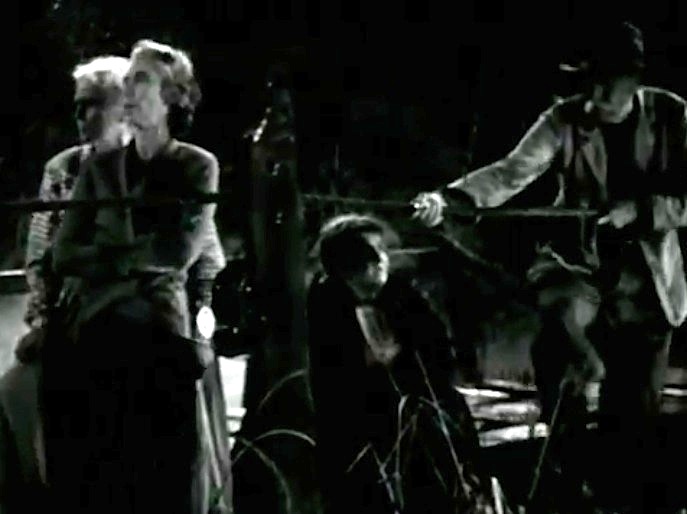
Old legends – strange tales – never die in the lonely swamp land. Villages and hamlets lie remote and almost forgotten. Small ferryboats glide between the shores, and the ferryman is a very important person. Day and night he is at the command of his passengers. On his little barge ride the good and the evil; the friendly and the hostile; the superstitious and the enlightened; the living and – sometimes – the dead.
Directed by Frank Wisbar from his own story, also co-written for the screen by Leo J. McCarthy. Make-up by Bud Westmore. Also co-starring Effie Laird as Martina Sanders, Nolan Leary as Pete Jeffers, Frank Conlan as Joseph Hart, Therese Lyon and Virginia Farmer.
This is a hauntingly beautiful remake of director Frank Wisbar’s own 1936 German film Faehrmann Maria, a retelling of the legend of Death and the Maiden. Which started Sybille Schmitz, the memorable victim of Carl Dreyer’sVampyr (1931).
The enticing German film actress… Sybille SchmitzScene from Wisbar’s Fahrmann Maria 1936
Another scene from Fahrmann Maria 1936
It’s an effectively creepy story from the Poverty Row Film Company PRC), which brought us Bela Lugosi in The Devil Bat 1940 and The Flying Serpent 1946. While this is a low-budget B movie, it is quite effective to watch as the ghost of Douglas seems to dissolve in and out of the darkness.
A slow, dreamlike stylization similar to Dreyer’s work also works here in Strangler of the Swamp. The setting is a lonely backwoods swamplands where the villagers live under a terrible curse left by a wrongly accused man hanged for a crime he did not commit.
The Ghost of Ferryman Douglas and Maria Hart
Three women from the village, including Martina Sanders, glide down the bayou on the ferryboat with Joseph Hart, evoking a mythical quality as if used as augury like that of the Furies, designating Joseph’s ill-fated path for his sins of false witness and murder.
Three women of the village, including Martina Sanders, glide down the bayou on the ferry like the Furies.
Pete Morgan: “I picked up the whip and beat him till he wasn’t handsome anymore, till he was dead, finished.”
Written for the screen and directed by Delmer Daves(Dark Passage 1947) this is a tautly wound horror/thriller featuring one of my favorites, the gruff everyman Edgar G Robinson as Peter Morgan, a very ‘unbalanced’ guy.
Pete ( Edgar G Robinson) and sister Ellen Morgan ( Dame Judith Anderson) have raised pretty Meg ( Allene Roberts) as their own child after her parents ran off and abandon her as a baby.
Meg now a young woman gets her friend Nath (Lon McCallister) to come help out doing odd jobs on the farm because her father Pete has a wooden leg and is getting on in years.
One night, Nath decides to use a shortcut home through the woods, which enrages Pete who warns him to stay clear of the red house, for fear of the unspeakable horrors associated with the dilapidated old wreck.
But like all great horror thrillers, Meg and Nath ignore his warnings and start digging around anyway and of course, the two begin falling in love, which is not only a problem for Meg’s mysterious caretaker, but for Nath’s sexy girlfriend Tibby played by a very youngJulie London.
What is the dark secret of the red house, and what is deranged father Pete Morgan hiding after all these years?