Thelma Ritter is always a joy to watch as well as listen to as no one can quite deliver swifter deadpan humor like this lady-“We’ve become a race of peeping toms” from Alfred Hitchcock’s Read Window 1954
Walter Baldwin is the lovable Orvy who might move a little slow in jail but brightens up the place in Robert Siodmak’s darkly powerful Cry of the City starring Richard Conte
Barbara Nichols getting pigeonholed all her career as the lovable blonde bombshell bimbo is just deliciously sympathetic in the hostile & darkly satirical noir masterpiece The Sweet Smell of Success 1957
Michael Dunn adds another layer of insight & exemplary character acting in the intensely dramatic social commentary Ship of Fools directed by Stanley Kramer.
Betty Garde is truly an unsung character actor- here she gives a very compelling performance as Kitty Stark a woman who’s gotten used to life without men in John Cromwell’s prison noir sensation- Caged (1950)
Anita Sharp-Bolster nearly steals the show in the dark suspense thriller The Two Mrs. Carrolls starring Barbara Stanwyck and Humphrey Bogart as a deranged painter. Christina the maid adds much comic relief with her acerbic puss!
Franz Kortner’s Anzelmo also known as Dr. Oracle is a mysterious and conniving villain who tries to run circles around poor John Hodiak who has lost his memory in Joseph L. Mankiewicz Somewhere in the Night 1946.
Jay C. Flippen always seems to be the guy who got a mug only a mother could love. And in Nicholas Ray’s masterpiece They Live By Night, his T-Dub is a pretty intimidating fellow!
Arthur Kennedy lends his acting depth to this powerful drama by Upton Sinclair co-starring Jean Simmons and Burt Lancaster as Elmer Gantry. Report Jim Lefferts is the clear voice that cuts through the malarkey as the moral compass
This has been a little bit of love to these fabulous character actors who make the cinematic world go round!-Your Ever Lovin’ MonsterGirl
As a treat I thought I’d talk about 4 really interesting films that were released amidst the slew of suspense thrillers of the 1940s. Some Gothic melodrama and a few perhaps conveying an almost hybrid sense of noir with their use of flashback, shadow, odd camera angles and elements of transgressive crime. I’ll just be giving a brief overview of the plot, but no worries there are no spoilers!
I recently had the chance to sit with each film and said to myself… Joey, these would make for a nice collection of obscure thrillers so without further adieu, I offer for your enjoyment, The Suspect, Love From A Stranger 1947, Moss Rose & The Sign of the Ram!
THE SUSPECT 1944
Directed by Robert Siodmak (The Spiral Staircase 1945, The Killers 1946,Criss Cross 1949, The Dark Mirror, Cry of the City, The File on Thelma Jordan 1950) and adapted to the screen by Bertram Millhauser and Arthur T Horman from the novel This Way Out written by James Ronald. This film, very loosely based on Dr. Hawley Harvey Crippen’s murder of his wife, was sensationalized at trial in 1910.
The Suspect stars the inimitableCharles Laughton (Dr. Moreau – Island of Lost Souls 1932, my favorite Quasimodo in William Dieterle’sThe Hunchback of Notre Dame 1939, the most lovable ghost Sir Simon in The Canterville Ghost 1944, The Paradine Case 1947, The Strange Door 1951, Witness for the Prosecution 1957, Spartacus 1960, Advise and Consent 1962 and notably–director of two films–his masterpiece Night of the Hunter and his uncredited The Man on the Eiffel Tower 1949)
The film also stars the underrated Ella Raines (Phantom Lady 1944,Impact 1949), Dean Harens, Stanley Ridges (Possessed 1949, The File on Thelma Jordan and No Way Out 1950)Henry Daniell, Rosalind Ivan and Molly Lamont (The Dark Corner 1946, Devil Bat’s Daughter 1946) Raymond Severnplays the delicious little urchin Merridew who works for Phillip as he tries to keep the little guy on the straight and narrow. Merridew would make the perfect name for a little tabby cat!
Charles Laughton gives one of his most subtle performances as a kindly man trapped by an abusive wife. Siodmak, as usual, creates a dynamic framework for this psychological thriller, lensed in shades of darkly ominous spaces that seem to shape themselves around Laugton’s comfortable face and Ella Raines’ intricate beauty.
Lux Radio Theater held broadcast of a 60-minute radio adaptation of the movie on April 9, 1945, with Charles Laughton, Ella Raines, and Rosalind Ivan reprising their film roles.
Music by Frank Skinner (Blond Alibi 1946, Johnny Stool Pigeon, The Brute Man, The Spider Woman Strikes Back, and way more ) with cinematography by Paul Ivano. Who did the camera work on director Hugo Haas’s treasures like Strange Fascination 1952, One Girl’s Confession 1953, and Hold Back Tomorrow 1955!
And marvelous gowns and hats by Vera West. (The Wolf Man 1941, Shadow of a Doubt 1943, Flesh and Fantasy 1943, Son of Dracula & The Mad Ghoul 1943, Phantom Lady 1944, Strange Confession 1944, Murder in the Blue Room ’44, House of Frankenstein ’44, The Woman in Green 1945, Terror by Night 1946, The Cat Creeps, She-Wolf of London, Dressed to Kill, Danger Woman & Slightly Scandalous 1946.)
In 1902 London, a respected middle-class Englishman but unhappily married shopkeeper Phillip Marshall (Charles Laughton) develops a loving and warm friendship with young and beautiful Mary Gray (Ella Raines), whose father has recently died, leaving her down on her luck and looking for a job. Phillip Marshall is such a kind and genteel man he stops to say a kind word about his neighbor Mrs Simmon’s garden, loves his son, and shows real affection. He is like a father to young Merridew, and beloved by the community. Even when he approaches Mary, and she hasn’t yet looked up from her tear-soaked hanky, thinking a lecherous man in the park is approaching her, “I’m not that sort,” tells her, only wanting to see if she needs help.
Mary, like Phillip, is lonely. The first night, Phillip begins to walk her home —“A cup of tea, a six-pence novel and a good cry.”
Mary- “I’m afraid you’ve been looking in my window.”
Phillip’s dreadful wife Cora (Rosalind Ivan –ideally suited to play the emasculating harpy-she had a similar role tormenting Edward G Robinson in Scarlet Street 1945) is a reprehensible shrew who humiliates and demeans both her husband and her son (Dean Harens who had more room to act in Siodmak’s terrific noir Christmas Holiday 1944 which starred a very different kind of Gene Kelly and the self-persecuting Deanna Durbin) John is shown moving out of the house because his horrible mother has burned some important papers of his. She got into one of her rages, and before he could stop her, she burned a whole week’s work.
Cora Marshall is vicious and cruel, showing no maternal feeling and caring little that her son is leaving home.
Cora-“That’s just what young hopeful did, he’s clearing out bag and baggage that selfish ungrateful good for nothing.” Phillip-“What did you do to him?” Cora- “What did I do to him… that’s right, put the blame on me. All I did was bring him into the world, nurse him, and make myself a doormat for him to walk on!… Go on, go to him and tell him from me that when he leaves this house, needn’t think he can come crawling back. Deserting his own mother!… And what do you think you’re doing now?” Phillip- “I’m moving into John’s room.” Cora- “Of all the indecent…we’re married, aren’t we?” Phillip (deep sigh)- “Oh, we’re married, all right.”Cora –“Then how dare you! I forbid it do you hear me. I forbid you to treat me like this.” Phillip says, “Now Cora, that’s all over now that John’s gone. It’s all over and done with, do you understand me?… I’m moving out of here, and there’s nothing you can do about it.” Cora- “Oh yes, there is. There’s plenty I can do!”
They wrestle with his clean, folded white shirts, which he’s busy moving out of the bedroom. She tries to grab them, but he finally loses his composure and yanks them away.
Cora- “What’s got into you? I’d like to know what’s going on in your head.”Phillip- “It’s much better that you shouldn’t, Cora, it might frighten you…”
Saddened by John’s departure, whom he loves and will miss, Phillip prompts Cora to move into his son’s room. Cora, so bent on appearances, is driven to tirades of abusiveness toward the meek and genteel Phillip, harassing him at every turn. I might have thrown her down the stairs myself or given her one of those late-night glasses of milk!
The scene with Merridew tickles me and shows how kind, compassionate, and caring Phillip is. He calls Merridew over talking to him in a quite earnest and fatherly tone, all the while you can tell he’s quite fond of the little fellow and visa versa.
Phillip- “Merridew, I have to bring a very serious matter to your attention. I regret to say there’s a shortage in your accounts there’s a penny missing from the stamp box.” Merridew- “It… it was for a sugar bun this morning, but I’ll put it back on pay day, honest Mr. Marshall.” Phillip- “And the tuppence the day before yesterday, what was that for?” Merridew- “Acid drops, sir.” Phillip- “Acid drops???Quizzically… that’s very serious. And the hay penny the day before?” Merridew- “For the monkey with the hurdy-gurdy, but I’ll put it all back Saturday every last farthing. “ Phillip- “That’s what all embezzlers plan to do.”
tears in Merridew’s voice make it quiver as the camera shows Mary listening in, she smiles and laughs at this whimsical inquisition.
Merridew- “But I’m not an embezzler.”
Phillip- “Yes, but you can get started that way. It’s the first step that counts… after that, it all becomes too easy. Six pence tomorrow, half a crown the day after… then a five-pound note… I know you’ll always mean to pay it back, but I’m afraid you’ll finish by paying it back in the Portland quarries.”
Merridew- “Don’t send me to no quarries, please, Mr. Marshall(sniffling).”
Phillip- “Well, not this time, Merridew. Now stop sniffling and wipe your eyes.” he hands him a hanky.
Mary has come into the shop looking for employment. When Phillip tells her there isn’t a position available, he later finds her crying on a park bench. He takes her to dinner, gets her a job with a colleague and the two begin a very tender friendship.
Phillip continues his platonic relationship with Mary, but once his wife finds out that he’s been seen supping with the young lady, he breaks it off, as he’s a gentleman who truly thought his wife would want out of a loveless marriage.
Still, Cora threatens him with scandal as well as making trouble for Mary. When Cora refuses to divorce him, worried that gossip will spread that she has failed to hold onto a husband, he is driven to the point of frustration and despair. She tells him the neighbors are all beginning to gossip about him coming in at all hours.
Phillip- “None of that business, Cora.”
Cora- “Ha! Married people’s lives is everyone’s business, and I’m not going to be made an object of pity in front of my friends, do you hear!…I wonder what ever possessed me to tie myself up with a poor stink like you… walked through the forest and picked a crooked tree that’s what I did. A crooked, fat, ugly tree.”
Even after she’s been so cruel, he tries to reason with her about getting a divorce and face things honestly by admitting that they’ve never been happy together. He asks her to let him go. But she wants to punish him because she is a bitter and cruel woman, calling him immoral and indecent.
Phillip is very decent; in fact, even though there’s only been friendship between him and Mary, he breaks it off with her so as to do what’s expected of him, telling Mary that he behaved badly, but he was afraid that she wouldn’t want to see him again. He was sure Cora would let him go… Phillip tells Mary, “And I couldn’t let you go once I’d met you.”
But Cora won’t be happy til she drives them both ‘into the gutter where you belong!”
Because of his gentle nature, Laughton is affable and wonderfully believable as a romantic figure.
His murderous response is more to protect Mary from Cora’s wrath, who tells him with a face like a Victorian harridan spewing poisonous vitriol.
“You better be afraid. As sure as the sun rises tomorrow, I’ll give her the Merry Christmas she’ll never forget.”Paul Ivano’s brilliant camera angle frames Laughton as somewhat diminished, seemingly trapped or rather oppressed by the space around him.
And so, Phillip murders his wife. We see him grab one of his canes and assume, though we don’t see him actually bashing her head in with it, that he has, in fact, brained her. The next morning, she is found dead at the bottom of the stairs, and it is deemed an accident.
Added to the plot’s layering of Sturm & Drang is the always wonderful scoundrel in Henry Daniell’s Gilbert Simmons, Phillip’s neighbor a stumbling drunkard who also beats his wife (Molly Lamont) Mrs Simmons and Phillip also have a very sweet relationship, one that ultimately anchors Phillip to his integrity. But I won’t reveal the outcome of the story. The miserable Gilbert Simmons also has the distinction of turning to blackmail, adding to his other earthly vices.
Amidst all these dreary, grim, and dark ideas, the film still emerges as a beautiful story, partly due to Siodmak’s ability to guide suspense along its way with an appealing cadence. As Foster Hirsch states in his must-read Film Noir-The Dark Side of the Screen, “Siodmak films like Christmas Holiday and The Killers have an extremely intricate narrative development…{…} the relative extremeness of Siodmak’s style is reflected in his obsessive characters.”
The Suspect works as a great piece of Melo-Noir mostly due to Laughton’s absolute perfection as the sympathetic, trapped gentle-man. As always, he is masterful with his intonations, sharpened wit, and ability to induce fellowship with the characters he’s playing… well, maybe not so much with Dr. Moreau, Capt. Bligh, Judge Lord Thomas Horfield or Sire Alaine de Maledroit in The Strange Door. But he’s a lovable sort most of the time, one can’t deny.
Charles Laughton and Margaret O’Brien in Jules Dassins’ The Canterville Ghost, 1944-based on the story by Oscar Wilde.
Ella Raines is just delightful as Mary. She’s such a treat to watch as you start to believe that this beautiful young woman genuinely has fallen for this older, portly, yet kind-hearted misfit. You find yourself hoping that he gets away with his wife’s murder and that the two find happiness together.
Scotland Yard Inspector Huxley (Stanley Ridges) stalks Phillip Marshall, believing he killed his wife.
Phillip is staunchly pursued by Scotland Yard Inspector Huxley (Stanley Ridges), who has the tenacity of Columbo. Speaking of which, a poster of The Suspect appears in an episode of Columbo – “How to Dial a Murder” in 1978.
LOVE FROM A STRANGER 1947
On the darker, more sinister side of these suspense yarns, we find Sylvia Sidney as Cecily Harrington at the mercy of a very deranged bluebeard in John Hodiak as Manuel Cortez.
The exquisite beauty of Sylvia Sidney.
Directed by Richard Whorf, who became more fluent in television directing. Written for the screen by Philip MacDonald(Rebecca 1940, The Body Snatcher 1945 for Val Lewton, The Dark Past 1948, Boris Karloff’s Thriller episode The Fingers of Fear 1961, The List of Adrian Messenger 1963) based on Agatha Christie’sshort story Philomel Cottage. Hair Stylist Eunice Helene King is responsible for slicking back Hodiak’s swarthy and murderously Lothario hair, he’s almost Draculian. He definitely covets his slickety hair as he shows his first sign of deranged pathology when Cecily tries to stroke his locks, and he lashes out at her, telling her not to touch it.
The marvelous costumes equipped with capes, sequins, and ostrich feathers are byMichael Woulfe(Blood on the Sun 1945, Macao 1952, Beware, My Lovely 1952).
Isobel Elsom plays Auntie Loo Loo with her usual exuberance; Ann Richards is Mavis Wilson’s faithful friend. Anita Sharp-Bolsteras Ethel the maid (wonderfully crabby Christine in The Two Mrs Carrolls)
And again, a terrific score by Hans J. Salter. This period piece is lavishly framed by Tony Gaudio(The Letter 1940, High Sierra 1941, The Man Who Came to Dinner 1942). Once the protagonist and her murderous husband honeymoon at their hideaway cottage, the lens turns the film into an almost chamber piece, becoming more claustrophobic as Manuel and Cecily begin to awaken to the revelation of his dangerous nature.
Sylvia Sidney plays Cecily Harrington, an unassuming English girl in Liverpool who has just won £50,000 in the Calcutta Sweepstakes, which was a fortune in turn-of-the-century England. Cecily meets Manuel Cortez (John Hodiak) when he sees her name in the newspaper next to the headline of his latest murder. He follows her and then arranges to make it appear as if he’s looking to rent her flat. She is taken with this mysterious stranger and suddenly breaks off her engagement to her fiancee Nigel Lawrence (John Howard), rushing into marriage with the mysterious stranger, who turns out to be a Bluebeard who is after her money.
The swarthy Manuel Cortez has already alluded the police for the murder of three women believed to have drowned while trying to escape. He has changed his appearance, with darker hair and no beard. Dr Gribble (Philip Tonge), who is a crime connoisseur, collects journals and books, one with a drawing of him showing his beard. It also mentions his earlier crimes in South America and New York (Hodiak’s character is given several Spanish aliases- Pedro Ferrara and Vasco Carrera).
The newlyweds spend the summer at their secret honeymoon cottage, where he’s been planning to kill her and bury her body in the cellar.
Isobel Elsom plays Auntie Loo Loo with her usual exuberance, Ann Richards is the faithful friend Mavis Wilson.Manuel Cortez pretends to be looking for a flat to rent, showing up at Cecily’s door; he has actually followed her from their ‘accidental’ meeting at the post.
Cortez begins to work his Bluebeard charms on Cecily.The handsome John Howard as Cecily’s fiancee, Nigel Lawrence, is crushed to find her love has gone cold, as the swarthy Manuel Cortez now entrances her.Neither Nigel nor Mavis trust this mysterious stranger with the slickety hair and cape.Everyone around Cecily knows there’s something not quite right.
Auntie Loo Loo is surprised at her niece’s impetuous behavior.
Ethel and Billings, the gardener, greet the newlyweds at the cottage they’ve spirited off to.There’s a dark cellar with a lock on the door. That never bodes well!
Digging the hole!Which poisons to use, decisions, and decisions.Manuel warns Cecily to stay away from his experiments in the cellar.Auntie Loo Loo and Mavis find out where the honeymoon cottage is and pay Cecily a visit to ensure she’s alright.The couple are going away on a long voyage soon, though Manuel hasn’t shown her the tickets.
Auntie Loo Loo is worried!Dr Gribble- Walking over to the book shelf- “Ah criminology are you interested in criminology Mr Cortez?” Cortez- “Yes, it’s a sort of hobby of mine, doctor.” Dr Gribble- “Well, we’re fellow enthusiasts” Cecily: “Yes, I think it’s a horrid morbid pastime.”Dr. Gribble “But fascinating Mrs. Cortez. Here’s a great favorite of mine. Criminals and their mentality. That’s great psychology… Bless my soul, the latest journal of Medical Jurisprudence and the Criminal. I should have thought I was the only person within a hundred-mile radius who ever so much as heard of this publication.” Manuel Cortez-“Really, I’ve subscribed to it for years” Dr Gribble: “Let’s see, did I read this issue? Ah, yes, this is the one with the account of that South American Carrera. It’s a very interesting case.” Manuel Cortez- “I don’t believe I’ve read it.” Dr Gribble- “You should have. This fellow Carrera was a professional wife murderer. They caught him after he completed his third crime. Then he was drowned trying to escape.” Manuel Cortez- “Oh yes, I remember. They never found the body, did they?” Dr Gribble- “No, as a matter of fact, they didn’t. I don’t think there’s any real doubt he’s dead!”
Manuel catches Cecily by the cellar door. Look, his hair has finally lost control!
Love From A Stranger is perhaps the more melodramatic and Gothic of all these films I’ve talked about in this post, but perhaps the most unrewarding in terms of its depth. While there are some truly terrifying scenes, the queer chemistry between Sidney and Hodiak creates a distance from the narrative. It’s still worth watching as part of the canon of 40s suspense melodramas.
Sylvia Sidney has a certain edgy sensuality to her that doesn’t make her performance thoroughly implausible for the story, but perhaps a different actress might have brought another style of vulnerability to the role. And Hodiak has an unctuous, gritty sort of sex appeal, which makes his part as a psychopath believable. He’s got intensely dark, focused eyes, sharply defined features, and an iron jawline that slams shut when he’s internally scheming. Toward the end, he brings it a bit over the top, but he’s sort of good at playing a surly mad dog.
Told to read aloud from the Journal of Criminology- “There is no doubt at all that Vasco Carrera, the last name he was known by, is a truly remarkable character. “He posed as a great world traveler; women, even those from a cultured background, succumbed very quickly to his peculiar charms, possessed of a remarkable charm of manner, Carrera exerted an extraordinary fascination over women.”
YOU AND ME 1938- Sidney, Sylvia, and George Raft- Now that’s chemistry!
Perhaps the one issue I have with the casting is the chemistry between Sidney and Hodiak, which never truly rings authentic. He’s too internally frenetic to be romantic. It’s mysterious, but he’s not convincing in his wooing of Cecily. The character of Cecily doesn’t seem to have the layers that peel innocence away, unveiling a vulnerable yet eruptive sensuality that would be unconsciously drawn to the scent of a dangerous man. That’s why Ingrid Bergman in Gaslight and Joan Bennett in Fritz Lang’s Secret Beyond the Door1947 work so well.
John Hodiak is a puzzle for me. I’ve been trying to decide whether he’s one of the most intriguingly sexy men I’ve come across in a while or if I find him completely cold and waxen in his delivery as a leading man. I’m leaning toward sexy.
John Hodiak and Tallulah Bankhead in Alfred Hitchcock’s marvelous floating chamber piece Lifeboat 1944.
He had me going in Hitchcock’sLifeboat 1944. I would have thrown my diamond Cartier bracelet over the bow to tumble under the tarp for a few hours with that sun-kissed, salt-sprayed crude adonis, sweaty, brash, unshaven -the whole deal. I just watched him in Somewhere in the Night 1946, and once again, I found Hodiak’s character of George Taylor compelling in his odd way of conveying vulnerability but faithful to the lure of the noir machismo. I felt sorry for a guy who can’t remember who he is or if he should stay forgetting- in case he was a rotten human being.
But as the cunning and psychopathic lady killer in Love From A Stranger, he sort of makes my skin crawl, which I suppose means he did a fabulous job of inhabiting the role of Manuel Cortez. Maybe he would have had better chemistry with someone like Alexis SmithorAudrey Dalton.
Now, I haven’t yet seen Basil Rathbone’s version in director Rowland V Lee’s 1937, also known as A Night of Terrorwith Ann Harding -still based on the short story by Agatha Christie but set in contemporary England, Rathbone plays the intrepid type of urbane gentleman who sweeps Ann Harding off her feet and plunges her into a sudden and dangerous marriage. Where he then plots to kill her and take her money. In the earlier version, the heroine gradually realizes that she’s in danger.
Basil Rathbone and Ann Harding in the 1937 version of Love From a Stranger.
Sylvia Sidney looks stunning as the new bride who begins to notice her husband’s strange behavior and realizes once she goes down into the cellar that Manuel is hiding something. He spends hours locked away down there, preparing for the moment he will kill Cecily, and has forbidden her to go down there, claiming that he’s doing experiments that are dangerous. Well, that’s true since he’s mixing poisons and digging her grave.
This version places it back in Victorian England, perhaps due to the success of the melodramatic thrillers that were proving to be so successful in the 40s like, Rebecca, Gaslight, The Lodger, Hangover Square, The Woman in White, Fritz Lang’s The Secret Beyond the Door 1947, and The Two Mrs Carrolls 1947.
HOPE EMERSONÂ (Caged 1950, House of Strangers 1949, Thieves Highway 1949, Adam’s Rib 1949) is a pretty formidable lady. Hope Emerson is 6’2″, 230 pounds of actress as she reprises her fluent ‘vicious & sadistic’ characterization of larger-than-life-evil incarnate-much in the vein of her cruel bon bon eatin’ prison matron Evelyn Harper who tortured poor Eleanor Parker inCaged 1950.Oh that hair shaving scene just sticks with ya…
In Robert Siodmak’s sublime noirCry of the City 1948Emerson plays Madame Rose Given who runs a massage parlor, loves to cook, is a pancake eatin’ -looming ‘heavy’… who loves jewels and just wants a little place in the country where she can cook, eat pancakes and fresh eggs… yeah that’s livin’. From her brawny swagger to her grumbling yet leisurely voice, Emerson is the highlight of the film!
“Hmmm…It is good, isn’t it? I have the touch. It’s only given to a few. It’s a matter of knowing the currents of the body. Why waste this on fat old women who think they can lose a few pounds and be beautiful again… Fat old women who have too much money and too many jewels. They think the jewels make them beautiful and they fight to keep them like they fight the years that make them ugly.”
That’s why she didn’t even break a sweat when she strangled old lady DeGrasia for her jewelry. Darn old gal had the nerve to put up a struggle! And does she give self-serving on lam career criminal Marty Rome (Richard Conte) some neck rub while he’s hiding out at her place trying to make a deal. Rose finally gets the jewels as a trade for money and some wheels to get out of town with his girl Debra Paget…
Marty-“Pearl choker with a Ruby pendant. Seven rings. Diamond bracelet with the clasp broken. You must have been in a hurry ha?”
Rose-“Where are they?”
Marty- “In a locker in the subway station… I thought if you went to all that trouble to get ’em once you may wanna get ’em again.”
Rose chuckles-“You’re a cute little man Martin..”
Rose ‘massaging’ Martin- “Hmmm…It is good, isn’t it? I have the touch. It’s only given to a few. It’s a matter of knowing the currents of the body. Why waste this on fat old women who think they can lose a few pounds and be beautiful again… Fat old women who have too much money and too many jewels. They think the jewels make them beautiful and they fight to keep them like they fight the years that make them ugly.”
Rose ain’t someone I’d want giving me a rub down, and I sure wouldn’t want to meet her at the door as the Avon Lady either- Gee wiz.. that woman could scare the horns off the devil- She’s got a smirk & leer that makes her seem like she could eat small children. This pistol-packing, masseuse whose hands should be registered as lethal weapons- is one menacing lady who has earned her place here at The Last Drive Inas Fiend of the Day!
Rose Given (Hope Emerson) gives Marty Rome (Richard Conte) a massage he’ll not soon forget!!!
Just look at that mug! Nah, I bet she was really a pussycat. I mean she was the voice of Borden’s Else the Cow after all! Sadly-Hope Emerson died of liver disease in 1960… Here’s to you Hope Emerson-and your bigger-than-life acting style!-Love Joey
PS: Cry of the City is perhaps one of my new favorite film noirs in Siodmak’s collection. I’m going to have to cover it, because of the great acting, from the entire cast-small parts even for Shelley Winters to the gritty dialogue and sensational cinematography so stay tuned!- Your ever-lovin’ MonsterGirl in the city.
I saw"”with shut eyes, but acute mental vision"”I saw the pale student of unhallowed arts kneeling beside the thing he had put together. I saw the hideous phantasm of a man stretched out, and then, on the working of some powerful engine, show signs of life and stir with an uneasy, half-vital motion. Frightful must it be, for supremely frightful would be the effect of any human endeavor to mock the stupendous mechanism of the Creator of the world.
"” Mary Shelley
When I think of Kenneth Strickfaden I visualize the mad scientist grabbing the master switch in his clandestine laboratory. Suddenly the machinery hums and glows, glass tubes boil with liquids, electrical currents charge through the coiled tubes and conductance. Lighting leaps across the sky and finds its way into the diving spot in the lab. The crackle, snapping hiss and sparks of ozone. The well orchestrated machinery of mad science that now act as futuristic hardware. The electrical odor that would still permeate the air for years to come as he shaped the way we perceived the mad scientist labs and mysterious scientific exploration!
early days Strickfaden assembling a mad scientist apparatus
Kenneth Strickfaden was an expert in high voltage electricity, film set designer, and electrical special effects master. Using his skills as a carnival electrician, he created the science fiction apparatus that can be seen in more than 100 films and television programs, showcasing Strickfaden’s technical phantasmagoria of light and sound!
I often wonder how many of these films centered around mad science and the laboratory environment utilized some of Strickfaden’s machines and electrical effects without giving him credit.
Boris Karloff in The Devil Commands.Boris Karloff in The Man They Could Not Hang.Man Made Monster
I can see influences in Edward Dymtryk’s The Devil Commands 1941 with Boris Karloff. With art direction by Lionel Banks and props by Franz, Oscar, and Paul Dallons.The Man They Could Not Hang 1939  & Man Made Monster 1941 Set direction by Russell A Gausman and John P Fulton who had worked with Strickfaden before. I believe Strickfaden did the special effects and used part of his equipment. Doctor X (1932), The Invisible Man 1933,The Man Who Lived Again, and more!
Dr. X (1932).The Man Who Lived Again.The Invisible Man 1933.
Strickfaden’s first contribution was to Just Imagine 1930. Today it has become something of a "lost" film and nearly impossible to see on the big screen. "While the beautiful art deco sets, enormous miniatures, and remarkable projection effects still amaze," says Production Designer John Muto, Founder of the ADG Film Series, "the music, comedy, and love story are derived from vaudeville and must have seemed very dated as cinematic musicals exploded in the 1930s. I suspect that may be why the film faded from view. Our audience will discover a very surprising film!" "Today, most films set in the future portray a bleak, dystopian, even apocalyptic world.” Besides the beautiful art design Just Imagine featured a stunning laboratory filled with electrical equipment by Ken Strickfaden.
Just Imagine 1930.
The Clutching Hand (1936
But it was his work for James Whale’s 1931 masterpiece Frankenstein, The Bride of Frankenstein, and Ghost of Frankenstein that struck like lightning! Stock footage of the lightning bolt generated by Strickfaden’s equipment can be seen in so many films and television shows. John P Fulton head of the special effects department at Universal Studios was responsible for the special photographic effects-
Jame’s Whalehad wanted a lab that was reminiscent of the one in Fritz Lang’sMetropolis1927 Lang’sart department/set designers Otto Hunte, Erich Kettlehut, Walter Schulze-Mittendorf & Karl Vollbrecht. Special effects by Ernst Kunstmann, Konstantin Irmen-Tschet and Erich Kettelhut. Visual effects Eugen Schufftan, Willy Muller, Hugo O Schulze, and an uncredited Edgar G. Ulmer.
Metropolis 1927.Fritz Lang’s Metropolis 1927.This orb of Kenneth Strickfaden’s has made it through Fu Manchu’s clutches to the Wicked Witch of the West’s long bony fingers
You can see Strickfaden’s wonderful creations in The Wizard of Oz, The Mask of Fu Manchu to television’s The Munsters, and his final work, Young Frankenstein. Strickfaden recycled a number of the pieces that he kept maintained like his“Cosmic Ray Diffuser”that he used in the original Frankenstein.
Kenneth Strickfaden was born in 1896-by the time he was in high school he was using a camera and setting up shots of amusement parks, and battle scenes, and visualizing and creating his own laboratory apparatus and equipment.
Thesiger and Clive in The Bride of Frankenstein
When I was just a little tiny wide-eyed MonsterGirl I would daydream plenty on rainy days and spend hours down in the basement assembling pieces of metal and plastic doohickeys having taken apart various appliances around the house, trying to create my very own little mad scientist lab. I’d get large pieces of wood and paint the control panels. I could literally spend hours down there pretending to be Dr. Pretorious. I was fascinated by science fiction technology and the secrets of life and death, and the fantastical storytelling Universal Monsters had to offer.
Backstage on the set of Frankenstein
My pop would continually ask me where I put his hammer, though it was true most of the time, I did take his tools to aid in my small-scale construction of a basement laboratory. I was constructing panels with knobs and meters, I didn’t always have his hammer. And by no means did I have the eye or the technical brain to develop such intricate machinery that could spark and crackle streams of white heat, the suggestion of the life force arching in splendor. It just felt so good to be living my own fantasies without being told that I should go play with dolls. That’s also partly how I got to be known as MonsterGirl by the neighborhood bullies. Anyway… back to the genius of Frankenstein’s electrician.
Paul Walter’s assistant holds the switch box that controls Strickfaden’s Magnalux invention for lighting simulating flashes-Image from Goldman’s book.
Strickfaden had the sort of fascination for creating a milieu of scientific realism, working on our sense of wonder and the possibilities of the creations these machines would aid in either creating life or destroying it, which was always a draw for me. His special electrical designs and effects were visually groundbreaking for American film audiences, far-fetched perhaps but divine. He used junkyard electrical parts from the 1930s, fake wiring, and high voltage Jacob’s ladders (An electric current then flows until the path of ionized gas is broken or it, as it rises, will pull the arc apart and so extinguish it.), and spark gaps and the occasional Tesla Coil. “Ribbed ceramic insulators are a must… as are the slate front panels and wooden cabinetry that were standard of scientific and medical devices of the day”
And that’s why I wanted to do this little feature tribute to a man who’s responsible for shaping the look of so many classic horror and sci-fi fantasy film milieus over the years. The sets and laboratory apparatus that contributed to the Gothic science mood of the story, came to life because of the innovation Strickfaden used in creating his fantastical yet plausible designs. As a key to the plot structure as the players themselves.
image of Strickfaden’s “Megavolt Senior” from Goldman’s Book
During the grand days of classic horror between the decades of 1930s and 1940s, the landscape might have looked entirely different if Kenneth Strickfaden hadn’t been so fascinated with creating apparatus and contraptions that flashed and sparked with high voltage, meters keeping track, tubes, and coils and large equipment that paid true homage the science fiction writings he was trying to breathe life into himself a technician like Pretorious and Dr. Frankenstein. The appearance of these industrial gadgets and machines, and the look of the laboratory brought such a sense of realism to an already Gothic stunner, and Mary Shelley’s story, too which was ahead for its day. As Harry Goldman refers to in his book title, Strickfaden was the right electrician for the job.
Colin Clive with Elsa Lanchester as The Bride- notice The Nebularium! Image from Goldman’s Strickfaden-Frankenstein’s Electricianon the set of Frankenstein from Famous Monsters of Filmland #21 1963
Though his fascination started in high school by the early 1920s film makers saw the potential in his inventive apparatus. He was given work at many Hollywood studios, in which he offered them a slew of amazing special electrical effects.
From Goldman’s, Kenneth Strickfaden, Dr. Frankenstein’s Electrician, Strickfaden’s work was not easy, “Apparatus constantly failed due to overheating,” he once revealed to writer Scott MacQueen. “Most effects did not photograph as expected, or they were eliminated due to electrical failures.”
Despite these unusual, and expected, setbacks, the onscreen results were phenomenal, and far more convincing than any simulations. Strickfaden made much use of the inventions of Nikola Tesla, which had been perfected more than thirty years before the first Universal Studios “Frankenstein” movie. But, unlike Tesla, he was also concerned with the theatrical “look” of his fanciful contraptions, which had to appear to be futuristic and capable of untold wonders. The names he gave the machines were often equally marvelous, such as: “the retrogressive wave charger,” “DXLAccumulator,”and “High Amperage Pyrogeyser.”
When, in the late 1940s, real-life scientific marvels turned out to be subtler than Strickfaden’s machines, his work apparently went out of fashion and was little seen in Hollywood until the ’60s, when it was used extensively in The MunstersTV show and in commercials.
Before his death in 1984, he spent much time touring with his “Kenstric Space Age Science Show,” educationally demonstrating spectacular electrical phenomena.
Standing fearlessly before a high voltage arc.His reliable switchboard can be seen in the foreground while the famous “Meg Senoir” Tesla coil appears in the background.
The Cosmic Ray Diffuser-Image from Goldman’s Book
A few highlights of Strickfaden’s career include:
Frankenstein (1931) The equipment brought Mary Shelley’s monster to life.
In The Mask of Fu Manchu (1932), Strickfaden created a dazzling electrical death ray even doubling for Boris Karloff, who played Fu Manchu when the evil mastermind spreads his hands and the powerful lightning dances between his long sinister fingernails.
Murders in the Rue Morgue 1932 Bela Lugosi is Dr. Mirakle- Ken Strickfaden lends his electrical gadgets to Mirakle’s laboratory.
Chandu the Magician -Strickfaden’s machines came from FRANKENSTEIN now they equip (Bela Lugosi) Roxor’s lab- His death ray, a giant ray gun that sends pulsating death beams aimed at the major cities of the world!
In The Bride of Frankenstein (1935) Strickfaden configured the electrical displays for the Bride creation sequence.
The Wizard of Oz (1939) He created the effect of the Wicked Witch of the West trying to remove Dorothy’s ruby slippers and receiving an electrical shock. The orb she uses to scry was a Strickfaden design.
The giant crystal ball that Margaret Hamilton uses as the Wicked Witch was actually uncovered in a junkyard found amidst the remnants of other discarded Hollywood memorabilia from a now defunct prop house. The enormous hand-blown glass, with high voltage Tesla coils, had a new owner who spotted it in Goldman’s book Dr. Frankenstein’s Electrician. It had been used by Bela as Roxor in Chandu the Magician. It was a great prop for Boris Karloff in Mask of Fu Manchu, but once he placed it up for auction the new owner learned that it had actually been the crystal ball used in The Wizard of OZ.
Fighting Devil Dogs (circa 1941)“Manifested projectiles of something like ball lightning.”
Sherlock Holmes Faces Death (1943) “He simulated an unusually realistic lightning strike.”
Young Frankenstein (1974) Strickfaden recreated some of his best work from the original Frankenstein.
Bela in Chandu the Magician with the death ray.Boris as the absent-minded scientist in The Boogeyman Will Get You.
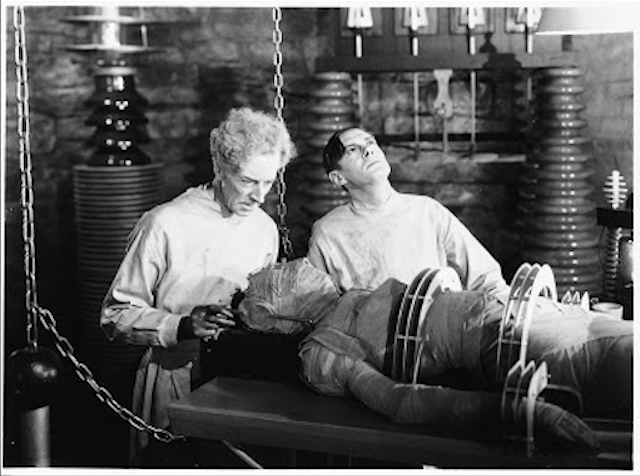
Ernest Thesiger and Colin Clive in The Bride of Frankenstein.
He was born in Montana in 1896, Kenneth Strickfaden was an imaginative and adventurous guy who worked at amusement parks, taking myriads of photos. He traveled overseas serving in World War One. He was also an airplane mechanic so he was very handy technically, having built and tuned Tesla coils and X-Ray machines. A Tesla coil is an electrical resonant transformer circuit invented by Nikola Tesla around 1891. It is used to produce high-voltage, low-current, high frequency …Eventually, he found himself in Hollywood working as a studio electrician in the late twenties.
Image of Strickfaden holding the Melodyne musical disc and large lens that appears in Son of Frankenstein from Goldman’s book Dr. Frankenstein’s Electrician
In 1931, Kenneth Strickfaden was hired to set up the equipment for Frankenstein’s tower laboratory. He was to furnish it with a ‘powerful engine.‘ Strickfaden assembled various machines. One which was used for the lightening powered scene that would help resurrect Boris Karloff’s monster back from the dead to life on the slab. He combined his knowledge of electrical science engineering and part of his love of creating side show electrical pageantry in order to transform Dr. Frankenstein’s laboratory into a place of unorthodox alchemy within a modern science dominion.
Kenneth Strickfaden Bride of Frankenstein control panel-Image from Goldman’s book
At first, the designs were to be more streamlined and modern in their look, but Strickfaden had managed to construct a place of Gothic dread within the medieval structure of the setting and seamlessly adapt the apparatus of modern science with the stone walls. The juxtaposition of the two worlds adds to the feeling of Dr Frankenstein’s heretical, rebellious, and clandestine primacy as his secrets lay hidden away.
Strickfaden's apparatus quivered, sparked, crackled, and shrieked. The imposing levers were pulled in harmony with the dialogue, like an orchestrated scientific waltz. White hot arcs of electrical tendrils reached out and thrust wildly like serpent’s tongues. Beautifully glistening glass vials and tubes sat amidst copper spheres that wound themselves around like industrial jewels. Needles indicated where the force of energy was heading on the dials, and disks whirled like fun-house wheels. It was all so mesmerizing in Frankenstein’s laboratory with its arcane machinery that sang the songs of the universe, and the secrets of immortality and life from death, the sounds of voltage that pushed the machinery to its limits.
The Nebularium device from The Bride of Frankenstein 1935Image from Goldman’s bookStrickfaden created a Nebularium for House of Dracula ’45. Image from Goldman’s book Dr.Frankenstein’s Electrician
From then on 1931 James Whale’s Frankenstein with its elaborately detailed laboratory up on the mountain tops set the tone for all mad scientist laboratories to follow. Kenneth Strickfaden would utilize and reconfigure his glorious apparatus over and over again in the Frankenstein films that followed, like Bride of Frankenstein.
You can see his fantastical machines like his“Megavolt Tesla Coil”& the “Nebularium”in Flash Gordon serials and so many other horror and sci-fi features over the decades. Even in one of the most memorable episodes of The Munsters in the 60s, where Grandpa transfigures Herman into Fred Gwynn, losing his square-headed, neck-bolted Frankensteinian charm! The episode is called “Just Another Pretty Face.”
And Mel Brooks truly paid homage to the Universal cycle of Frankenstein pictures with his Young Frankenstein in 1974. Co-starring with Cloris Leachman, Madeline Kahn doing her Mae Clarke bit as Elizabeth, and Marty Feldman as Igor to Dwight Frye’s Fritz.
Strickfaden’s machines and apparatus were re-used in Mel Brook’s Young Frankenstein
The Gothic laboratory where Gene Wilder plays Doctor, waxes campy and raises Peter Boyle back to life using a lighting storm and complex equipment that sparks and radiates arcs of light was the very same set of scientific apparatus used in Whale’s masterpiece in the 1931 film when Kenneth Strickfaden first configured it all for the set of Frankenstein with Boris Karloff.
Strickfaden died in 1984, and up until that time, he traveled the country with all machines and apparatus, and gave lectures in schools and auditoriums, also creating music with electrical instruments that he designed. He would demonstrate his lighting effects with ultraviolet light on radioactive materials, and shock and amaze students with something he called his “gravity nuetralizer” He did these programs from 1933 til his death.
Son of Frankenstein Basil Rathbone, Bela and once again Karloff as Frankenstein’s monster.Bela Lugosi in The Phantom Creeps
Strickfaden would step in at times as a stunt double in the films, for instance, he played Karloff’s monster for a scene that didn’t make it into the film. When Karloff didn’t want to use the “QUCH” machine fearing it was too dangerous as Fu Manchu, Strickfaden stood in for him. He held a large wand that generated a streaming arc of lightning which called for a million-volt spark to dance over his body. in Mask of Fu Manchu, Strickfaden was thrown across the set when he wasn’t grounded properly and received a jolt of electricity.
Kenneth Strickfaden’s QUCH machine-up for auction
He became the most trusted man around high-voltage trickery, yet Strickfaden admits very plainly that there’s no mystery to what he is able to do and that producing high voltage or amperage is rather simple.
One of the key apparatus that Strickfaden uses is his million-volt generator, which produces large sparks, and fat blue flames that can actually reach a height of 6 feet into the air. It’s his most intricately designed piece of equipment. The multi-distributor consists of a motor-driven set of whirling electrodes that can throw sparks. Strickfaden does say that a shock from the circuits could actually prove fatal.
Another device Strickfaden used was called a ‘lightening screen’This is another high-voltage generator that throws sparks across a large disk with a radioactive backing. Used with a darkened stage, the radioactive material continues to glow along the path of each spark even once the current has been shut off.
A note about Nikola Tesla-THE GENIUS WHO LIT THE WORLD- “ Young Nikola Tesla came to the United States in 1884 with an introduction letter from Charles Batchelor to Thomas Edison:Â Â Nikola Tesla developed polyphase alternating current system of generators, motors and transformers and held 40 basic U.S. patents on the system, which George Westinghouse bought, determined to supply America with the Tesla system.
In February 1882, Tesla discovered the rotating magnetic field, a fundamental principle in physics and the basis of nearly all devices that use alternating current. Tesla brilliantly adapted the principle of rotating magnetic field for the construction of alternating current induction motor and the polyphase system for the generation, transmission, distribution and use of electrical power. Tesla’s A.C.induction motor is widely used throughout the world in industry and household appliances. It started the industrial revolution at the turn of the century. Electricity today is generated transmitted and converted to mechanical power by means of his inventions. Tesla’s greatest achievement is his polyphase alternating current system which lights is used throughout the world
Modern Mechanix scan of a Popular Mechanics article from September 1949-by Eugene M Hanson.
1. Scott MacQueen, “Kenneth Strickfaden: Strange Revelations of the Man Who Lives in the House that Frankenstein Built,” Gore Creatures, no. 24, October 1975, pp. 24-26.
2. William Ludington, “Mister Electricity: The Multi-Volted Career of Kenneth Strickfaden,” American Classic Screen, vol. 7, no. 1, Jan./Feb. 1983, pp. 26-29.
This has been electrifying -your ever lovin’ MonsterGirl
“See the tortured undulations of the unwanted virgins”
One of Roger Corman’smost campy & creepy tale of witchcraft and past life regression. In a claustrophobic world of doom and dread, where a battle of witch’s wills and sadistic pleasures abound. Pamela Duncan(Attack of the Crab Monsters 1957) is Diana Love/ Helene who visits a psychiatrist and when hypnotized is transported back into the brutal and bedeviled Middle Ages.
Suspected of being a witch she is sentenced to death by beheading with a large executioners axe. Richard Garland (Attack of the Crab Monsters, Panic in the Year O) plays Pendragon. Also starring is Allison Hayes  who’s come back down to size from 50 feet. Here she plays Livia, the witch in conflict with Dorothy Neumann(Otis Campbell’s wife on Andy Griffith, The Terror, Sorry, Wrong Number, The Snake Pit ) as the witch Meg Maude. Mel Wellesas Smolkin the grave digger,Billy Bartyas a devil imp! Bruno VeSota as Scroop the innkeeper… and Richard Devon as the Devil.
I had a collection of Super 8 reels when I was just a little MonsterGirl.The Undeadwas one that I would play in my basement theater along with a host of other classic horror and Abbott & Costello features. I used to find this particular film of Corman’s a truly creepy experience and still do. It’s timeless, macabre and hilariously campy. In fact I think this poster is still one of my favorite vintage classic horror posters.
See it with someone you love… and please… don’t lose your head during the scary parts!-Your ever lovin’ MonsterGirl
Psychological thriller directed byW.S. Van Dyke (The Thin Man series) with a screenplay by Christopher Isherwood and Robert Thoeren, based on the novel by James Hilton (Goodbye Mr Chips, Random Harvest)
Starring Robert Montgomery (who was marvelous as Danny the psychopath inNight Must Fall1937) Here he plays Phillip Monrell a mentally disturbed man who is obsessed and paranoid about his friend Ward Andrews (George Sanders) being after his beautiful wife, the always lovely Ingrid Bergman as Stella. Phillip’s jealous obsession drives him into a murderous detachment from reality. Lucille Watsonplays Philips mother, and Oskar Homolka plays Dr. Rameau.
"For some nights I slept profoundly; but still every morning I felt the same lassitude, and a languor weighed upon me all day. I felt myself a changed girl. A strange melancholy was stealing over me, a melancholy that I would not have interrupted. Dim thoughts of death began to open, and an idea that I was slowly sinking took gentle, and, somehow, not unwelcome possession of me. If it was sad, the tone of mind which this induced was also sweet. Whatever it might be, my soul acquiesced in it." "• Joseph Sheridan Le Fanu, ‘Carmilla’
The Light in the Window … The Lock on the Door … The Sounds in the Night! A Possession is Taking Place!
A while ago I double featured Let’s Scare Jessica to Death (1971) and The Night God Screamed (1971). I made it clear that I felt Let’s Scare Jessica to Death was the superior film but somehow they made good companion pieces. And since I’m a child of the 70s, those days of the double bill, musty theaters, milk duds, and groovy posters, I’ve decided to pair these particular films. And once again, I’ll emphasize now that I believe Lemorato be by far not only the superior film but one of the MOST uniquely beautiful horror/fantasy films I’ve ever seen.
Because the film hit a very bumpy road on its release, it wound up being passed around like an orphan from one distributor to another. Thus is the reason for several titles over the years. It has been called The Legendary Curse of Lemora and Lemora, Lady Dracula, the latter hoping to ride the wave of low-budget vampire films that have now also attained cult status such as Bob Kelljan’s authentically potent Count Yorga Vampire 1970 starring Robert Quarry, and the equally stylish Blacula 1972 and of course the Gothic vampire pageantry of Hammer Studios churning out stylish costume melodramas with a lesbian vampire sub-text like The Vampire Lovers 1970 and Lust For a Vampire 1971, Stephanie Rothman’s The Velvet Vampire 1971, and Vicente Aranda’s The Blood Spattered Bride 1972. The liner notes written by Richard Harland Smith of Video Watchdog & Chris Poggiali of Fangoria and Shock Cinema interviewed Richard Blackburn and Byrd Holland and point out that Blackburn’s film is “less exploitative” yet “not unerotic” while using the “fragility of innocence.”
From the Journal of Horror and Erotic Cinema-Edited Andy Black
Bev Zalock’s- Girl Power From The Crypt
“In a sense, horror more than any of the other exploitation genres, with its monsters of the imagination, feeds fantasy and configures fear in a very direct way. With its linking of sex and death, horror taps into the unconscious and is associated with surrealism and the fantastic in both literature and cinema. Desire becomes the primary mise-en-scene within the realm of the supernatural and, as David Pirie observes in his excellent book The Vampire Cinema’ there is a strong cultural connection between our perception of sex and the supernatural. Pirie cites an article by Susan Sontag written in 1967 entitled “The Pornographic Imagination” in which she locates the fantastical realm of the human imagination as the site in which the two are classically connected.” – from Susan Sontag’s piece–Styles of Radical Will 1966
Celeste Yarnall is the dark lady vampire in Stephanie Rothman’s -The Velvet Vampire-co-starring Sherriy Miles.
In addition to these lesbian vampire narratives, you have Jess Franco’sVampyros Lesbos 1970 and auteur Jean Rollin’s distinctive style who like Hammer connected suggestions of the ‘pornographic imagination’ that Susan Sontag describes. Films that use the spectrum of surrealist imagery from the Gothic to the gory. What they share is a ferocious appetite for power and the desire for sexual freedom.
Directed and written by Richard Blackburn (Eating Raoul 1982 with cult idol Mary Woronov and co-written with director Paul Bartel) fresh out of UCLA film school, with his pal Robert Fern. Blackburn has said in interviews that there are things he would have done differently with a better budget and more time. He shot Lemora in a month. I think the crudely macabre tonality of Lemora is what makes films like these from the good old ’70s oneiric, quintessential, haunting, and flawless as is.
There is a discrepancy as to whether the running time of the film is either 85 minutes or 113 minutes (uncut). The remastered DVD through Synapse Films took the original 35mm negatives and brought this film back to its ‘never before seen clarity.’ The prints were presumed lost for over 30 years.
The hauntingly macabre and somber music is by Dan Neufeld who crafted electronica and claviers and what I think might be a Melatron to evoke the eerie essence of the story is absolutely brilliant. With crying strings that fortify distorted wails and moans. With music box tinkling, poignant yet eerie flutes, and piano, muted horns-noises that shimmer and reverberate on cue with the dialogue or surreal set piece- I wish Dan Neufeld had done more movie scores. The sound design, the dysmorphic groans-unearthly wails- they’re the sounds you’d imagine the ‘old ones’ make in a Lovecraftian tale. Even the crickets and chorus frogs of the swamp sound metamorphosized into frightening aberrations.
Alastair Sim, Sybil Thorndike, and the smoking hot Marlene Dietrich as actress/singer Charlotte Inwood who wears Christian Dior gowns and sings the languid torch song- “Laziest Girl in Town.”
Jane Wyman is adorable as always playing a young aspiring actress who tries to help prove her friend, Richard Todd’s innocence in the murder of performer Marlene Dietrich’s husband. One of Hitchcock’s best!- Adapted for the screen by Whitfield Cook (Strangers on a Train) and Hitchcock’s wifeAlma Reville. (Suspicion 1941, Shadow of a Doubt 1943) Based on the novel by Selwyn Jepson. With Fabulously nuanced cinematography by Wilkie Cooper(Jason and the Argonauts.)