We don’t go back, because if we go back, we enter a realm of superstition and madness! -Adam Scovell.
“There are two ways to be fooled. One is to believe what isn’t true; the other is to refuse to believe what is true.” – Søren Kierkegaard
Dream the myth onward and give it modern dress -Jung
As Helena P. Blavatsky suggested —No myth is wholesale fable; even fanciful fables hold a grain of truth.
Horror is a disruption of the way you think things should go- horror begins when the world stops behaving the way we believe it should. When the familiar world breaks its contract with us – when people, places, patterns, and events no longer appear to be as they seem. – jo gabriel
INTO THE DARK AND DREADFUL WOODS—Where Folklore Turns Ferally: A Journey Through Folk Horror -From Ancient Ritual to Modern Nightmare


Watching Kier-La Janisse’s Woodlands Dark and Days Bewitched: A History of Folk Horror (2021) cracked something open in me, a mix of awe and recognition. Janisse’s monumental exploration of folk horror doesn’t just teach you about a cinematic mode, which the term may be more apt than calling folk horror a subgenre; it feels like wandering through a haunted library of collective memory, where every story whispers about what we’ve buried and what refuses to stay down. Folk horror is all about that unsettling tension between the old ways and the modern mind, the rural against the urban, nature against reason, the living against what still stirs beneath the soil, dripped like midnight sap from the bones of the land or old wounds that still bleed.
In the play Penda’s Fen (1974), writer David Rudkin gives folk horror one of its most searching principles when the visionary King Penda calls for “our sacred demon of ungovernableness.” His blessing that Stephen become “dark, true, impure and dissonant” rejects the fantasy of a pure, obedient, respectable England, asking instead that he recognize the repressed forces beneath it—sexuality, pagan memory, violence, desire, doubt, and historical conflict, rather than deny it. It applies to folk horror by using England’s buried pagan past and haunted landscape to expose and reject the false purity and conformity of modern authority.
Hauntology names this unsettling sense and sets an atmosphere around the past’s ghostly persistence: the present has failed to detach itself cleanly from the past, the past survives, and something buried continues to exert pressure on contemporary life.

Modern classic …Midsommar. Photograph: A24/Allstar
Coined by Jacques Derrida in Specters of Marx and later developed in cultural criticism by writers including Mark Fisher, the term ‘hauntology describes not simply ‘ghosts’ but the disturbing persistence of what should have disappeared; what lingers after it should be gone—abandoned beliefs, the repressed, colonial violence, unresolved and buried histories, discarded customs, vanished or lost communities, obsolete forms of culture, and even futures that were promised but never arrived. Its question is quieter, though no less unsettling: why does this past still have such power over the present? It’s not necessarily about literal ghosts; it describes the eerie feeling that time has failed to move cleanly forward.

It may include explicitly – witches, cults, sacrifice, supernatural forces, or even a sacrificial god or deities whose authority persists beneath the surface of modern life.
It may have no monster at all; the dread can arise from memory, nostalgia, loss, or temporal dislocation (for example, in Picnic at Hanging Rock 1975) —where the past never quite stays in the past, and the present begins to feel shaped by something older, stranger, and unresolved -the past, present, and future no longer feel separate, orderly, or stable, as if they have begun to bleed into one another and time feels displaced, repetitive, haunted, or out of joint.

Nigel Kneale, The Stone Tape, BBC, aired 1972
It asks: What ancient force survives here? It asks: Why does this past feel unfinished—and why is it still affecting us? Hauntology gives the folk-horror mode or subgenre a useful language for its particular sense of time- the time that has not passed; it describes the sensation: not simply the survival of old beliefs or rituals, but the uneasy feeling that the past has never properly left.

Peter Weir’s Picnic at Hanging Rock 1975: Temporal dislocation through colonial order meeting an ancient landscape.
In folk horror, the present is “haunted”: a remnant, an afterimage, clings to a field, a village rite, a standing stone, an old song, a ruined church, a bonfire, a May Day procession, a black goat, a strange local custom, a deceptively festive gathering, a tenement hallway, a suburban home, or even a mirror, a forgotten recording, or an old book found in the cellar, making the familiar feel as though it remembers something we do not. These places and objects carry meanings that precede and exceed the outsider who encounters them.
In his 2017 book Folk Horror: Hours Dreadful and Things Strange, Scovell describes a “folk horror chain” built from four connected elements: landscape, isolation, a skewed belief system, and a final “happening” or summoning.
Sam Raimi’s film The Evil Dead 1981 does not follow this pattern in the most traditional way; there is no insular village or community ritual at its center, but it does bend the formula into something leaner, meaner, and considerably bloodier. The remote woods create the landscape; the collapsed bridge turns that setting into a trap; and the skin-bound Book of the Dead and its recorded incantations preserve a buried belief system that the visitors/outsiders unknowingly bring back to life. When they play the tape, the film reaches Scovell’s final link: a supernatural happening that overtakes the cabin, the forest, and eventually the bodies of the people inside it.
Scovell describes landscape as something that isolates characters from the ordinary social world, producing more of a hidden logic at odds with the familiar order of things, and draws them into older, stranger beliefs that end in violence or a supernatural event. That ‘folk horror chain’ fits neatly with Raimi’s The Evil Dead 1981: the remote cabin, hostile woods, ancient text, and the demonic possession it unleashes.

The Evil Dead 1981 cabin: At the edge of an ancient wooded evil, the cabin offers no true refuge; it is the confined threshold where the outside force enters, isolates, and consumes the people inside, and there’s no way back.
The terror lies not only in the possibility that an ancient force has survived, but in the realization that the past remains unfinished: it is still shaping bodies, beliefs, social relationships, and ideas of belonging. And when it makes familiar spaces seem to remember what its characters cannot yet know, it is too late to escape the story those spaces have been keeping alive.
Folk horror returns us to this unruly underside of national identity: a hauntological landscape in which the older world beneath the modern one is never wholly dead, its songs, customs, a legacy of violence, and forbidden desires still murmuring through all these traces and places.

Alan Clarke’s 1974 television film, Penda’s Fen
Penda’s Fen (broadcast in 1974, written by David Rudkin and directed by Alan Clarke) may not be the first film people reach for when they talk about folk horror, but I think it absolutely belongs in the conversation. It has none of the genre’s more familiar machinery: no isolated village turning on a stranger, no masked procession, no final sacrifice staged around a bonfire. What it does have is the familiar folk horror pull of an old landscape and the uneasy feeling that the version of England Stephen has been taught to love is only part of the story.
The past in Penda’s Fen is not some neat evil that can be uncovered and defeated. It keeps breaking through in the hills, in pre-Christian history, in Stephen’s sexuality, religious doubt, national identity that culture prefers to keep out of sight, and in the questions he begins to ask about faith and belonging. That is why the play feels so important to folk horror. It’s not a simple conflict between good and evil. It is not really about a community keeping an old ritual alive; it is about the things a nation tries to tidy away. It works toward the collapse of purity, desire, nationalism, enforced masculinity, religious conformity, contradiction, violence, and doubt, all coming back into view. The BFI places it alongside the folk-horror and folkloric television work that emerged in the late 1960s and 1970s, but what stays with me is how it turns the English pre-Christian past and its landscape into a challenge to the clean, proper version of Englishness Stephen has inherited.
Together, all these things make the familiar uncanny. We often register its persistence through ritual, that ‘landscape’, symbology, and collective memories that linger like ghosts within the present, making familiar places feel charged with that particular reckoning still undone and often an unspeakable legacy.
It all becomes unsettling because it appears to carry an unfinished history into the present. The mode—or subgenre, if that term feels more accurate when you say it- asks not only what ancient force survives, but why that past continues to structure contemporary life. The effect is often this: you look at something ordinary and, all of a sudden, you do not recognize it.
Folk horror is not concerned only with surface scares or ancient rituals. It is interested in the way isolated communities are shaped by inherited customs, collective fears, and sacred prohibitions that can seem irrational from the outside but carry real force within the group.

The films considered here in this essay demonstrate that this haunting need not be limited to an explicitly ancient or pagan past. The Wicker Man 1973 locates it in a revived agrarian religion whose rituals transform Summerisle into a sealed world of sacrificial continuity; Midsommar 2019 reconfigures that model through a contemporary commune that turns grief and emotional belonging into instruments of ritual seduction, initiation, conversion, and control; and Get Out 2017 relocates folk-horror logic to privileged, suspiciously ‘liberal’ America, where racial history persists through the seemingly polite face of doctors, hypnosis, and surgical ‘innovation’, fetishization, ownership, co-optation, and consumption. Together, the films suggest that folk horror’s most enduring specter is not paganism itself, but the recurring ability of communities to disguise violence as tradition, renewal, care, or progress.
In the evolution of Folk Horror in cinema, Chad Crawford Kinkle’s Jug Face (2013) would return to sacrificial logic, depicting an isolated community whose promise of protection depends on surrendering its own people to a sacred pit. Set in an isolated Southern backwoods community in the modern era, Jug Face presents a sacrificial order that has survived alongside the outside world rather than belonging to a safely distant past.
Its deepest horror lies not simply in the power beneath the ground, or ‘the pit,’ but in a social order that has made killing a neighbor an obligation to everyone else. The supernatural threat is real, but the social horror is the conversion of that threat into communal law: someone must die so that everyone else can continue calling the practice protection. It’s a necessary price of collective security.


Folk horror is often about the gulf between what seems familiar and what lies beneath it, between what is imagined and what is real. It does not simply frighten us with phantasms, specters, apparitions, wraiths, curses, or supernatural happenings, nor does it only live or seep in through the soil, the trees, and the old superstitions that cling stubbornly to remote villages.
Some folk-horror stories still unfold in isolated places, where the outside world feels like a distant rumor and local customs carry their own threatening logic, twisted codes, whether pagan rites, occult whispers, or time-worn rituals that blur belief into menace. But the genre can also thrive in modern spaces: suburban homes, institutions, affluent estates, housing blocks, and close-knit communities that make exclusion or cruelty seem natural.
Its visual set pieces do more than decorate those worlds; they make their hidden beliefs visible -physically. A standing stone, a harvest ceremony, a bonfire, a ruined church, or a lone figure in an open field can signal that we have crossed into a place governed by older rules. The landscape is never merely background. It holds a community’s memory and the rituals it has learned to protect or conceal.

In folk horror, the most striking ritual tableaux don’t simply lend a place its uncanny look; they give its beliefs a body, something the characters can gather around, enter, or be offered up to. They show us how belief has been built into ordinary life: where people gather, what they keep, which places they avoid, and what they’re prepared to do when a ritual calls for it. A standing stone or a bonfire matters less as an eerie image on its own than as a clue to the rules everyone seems to know except the newcomer or outsider. The setting begins to feel uneasy because it isn’t just holding a secret; people have arranged their lives around it
What makes folk horror unsettling is not always the supernatural. It is the moment an outsider discovers that a place, a family, or a community is governed by rules they do not understand and cannot easily escape. The collision of rigid, archaic worldviews with the modern, or with the outsider, reveals or exposes that fear is often brewed as much from conviction as from curses. Folk horror may be spun from cultural anxiety, or begin in the wild, dark heart of nature, amid secret ceremonies and shadowed glances, where dread gathers and grows, but it does not end there: its real power lies in the way those forces enter the mind, into an inner world of fear, unsettling memory, identity, desire, coercion and the very sense of what is real.
Rather than treating the past as a fixed pagan relic, the old rites may remain, but so can newer forms of power: class, gender, reproductive control, environmental damage, religious institutions, radicalized histories, medicine, wealth, racial appropriation, therapy, social conformity, gentrification, or the seductive promise of belonging. Now, folk horror is less about the past returning unchanged than about the past’s habits of fear and control finding new places to live.
Here, the forest becomes psychological as well as physical. The forest stops being just a place and becomes something inside us, too. A crowded street can make you feel as alone and as isolating as a moor; a suburban home can preserve and hold onto its own rites of silence, obedience, reverence, and sacrifice. Folk horror does not vanish when it leaves the village; it changes shape.
The folk tradition evolves and adapts rather than disappears—its gods, monsters, and ceremonies come back through the fears of modern life; they re-emerge through the anxieties of the world we live in now. What used to wait beyond the village boundary might now be waiting behind the front door, at the end of the block, or within us – the feeling that, no matter how modern we become, the past never entirely lets us go, and the old beliefs, even with all that progress, have never fully driven the past away.
In film, story often follows what can be most powerfully seen. Every aesthetic choice should lead the way: how a ritual fire burns, how a village appears through mist, how a face is held in silence; it all turns the act of retelling folklore into something visual, sensorial, newly felt and irrevocably transformed: a descent into the tangled roots of fear, culture, and landscape. Cinema does not simply illustrate old stories; it gives them new bodies, new spaces, and new ways of haunting the present. In this sense, the film itself can become folklore, or folk horror: a cinematic mode that thrives in the space between cultural dreaming and psychological unease.

The Babadook 2014 – starring Essie Davis and Samuel Vanek.
At that point, folk horror is no longer just about an isolated setting. The place begins to work on the people inside it—shaping their fears, decisions, memories, and sense of what is real.
If there is a more academic word for that, it is psychogeographic: horror in which the landscape gets inside the mind. Psychogeography is a useful way of describing how a place can get under people’s skin—how a setting affects what they feel and believe. Its landscapes are never passive backdrops, but psychologically charged spaces that influence what characters see, remember, and fear. In folk horror, it makes places feel active rather than atmospheric scenery. A forest, coastline, village, or ruined estate does not simply sit behind the action; it presses on the characters, making them feel isolated and cut off, watched, unsettled, disoriented, or pulled toward a past they do not fully understand. It can hold traces of earlier violence or faith. The land itself can be a psychologically charged “character” that shapes how people perceive the world, confront trauma, and reckon with history.
In this sense, folk horror turns a place into a kind of memory, one that its characters may not fully understand until it begins to shape their choices for them.
Cinema does not merely borrow folklore; it makes folklore visual; landscapes actively rearrange people’s sense of reality; isolation hardens belief; and the genre’s echoes of old fears can move from woods and villages into cities and suburbs.
Swamps and marshlands show up in several folk-horror or folk-horror-adjacent films, especially in Southern Gothic and regional American horror. They work well because they are naturally liminal spaces: neither firm land nor open water, difficult to map, full of decay, and easily imagined as holding old secrets. In these landscapes, old traditions, communal memory, profane rhythms, and buried violence seem to cling to the mud and water, along with the primal fears and desires those earlier worlds have left behind.
As in the Arkansas landscape of The Legend of Boggy Creek 1972 and the Louisiana folk-horror/Southern Gothic tradition of films like The Skeleton Key 2005 and Eve’s Bayou 1997, the latter is more Southern Gothic drama than outright horror, but its folk practices, visions, family secrets, and swamp atmosphere make it very useful for an essay about folklore and haunted regional memory.

Written and directed by Kasi Lemmons, Eve’s Bayou 1997) stars Journee Smollett and Diahann Carroll.
Communities rooted in these places build their own rules around that history: sacred prohibitions, shared rituals, collective anxieties, and sometimes a kind of group hysteria that can make cruelty feel necessary or even holy. In that kind of world, the past is not simply remembered; it becomes a living pressure, deciding what must be feared, what must be protected, and who belongs and who can be sacrificed for the community to endure.
Adam Scovell’s “folk horror chain” gives this pattern a useful structure. Landscape creates the conditions in which isolation deepens; isolation lets unusual belief systems take hold and harden; and those beliefs eventually lead to a final ritual, an act of violence, or a supernatural “happening” that feels both shocking and, by that point, disturbingly inevitable.
The Wicker Man 1973 makes that final “happening” visible not as a private act, but as communal performance. When you think of The Wicker Man, you hear the island’s songs, watch the maypole dance, the animal-masked procession, and the final wicker effigy create a bright, communal spectacle that becomes steadily more disturbing because everyone seems to understand the ritual except the outsider. By the time the wicker effigy burns against the open sky, the film has transformed familiar images of rural festivity into the visible machinery of communal sacrifice.
Consider The Blood on Satan’s Claw 1971, where empty fields, tangled woods, and the discovery of something unnatural in the earth turn the countryside itself into the source of something dark closing in, something evil. These films use pageantry and place to let dread build in plain sight, long before the horror is fully revealed.
The genre’s migration is not simply a matter of replacing the countryside with the city; folk horror does not remain safely buried in the soil or confined to one kind of landscape; it follows the road outward: moving into urban and suburban spaces, those forces do not disappear; they lose their most recognizable signs. Each setting gives the genre a different pressure point.
Folklore may no longer announce itself through a village elder or a stone circle. Instead, it is carried through private rituals, neighborhood codes, inherited prejudices, and institutions whose authority and quiet violence make their beliefs seem ordinary. From the isolated hamlet to the industrial town, from the country house to the suburban cul-de-sac, from the ancient grove to the apartment block and neon-lit street. The old world is not erased by modernity; so much as bury it beneath concrete, traffic, modern routines, and the ordinary spaces of everyday life.

Candyman 1992 starring Kasi Lemmons and Virginia Madsen.
What changes is not the genre’s underlying fear, but its setting and how it evolves as a form of power. In contemporary folk horror, the old rite is often no longer a public ceremony performed in a field. The old ways do not survive merely as relics; they reappear as patterns of coercion and control, producing an altered moral order in which exploitation can seem normal, necessary, or even benevolent. The final violent or uncanny revelation or eruption does not create that order so much as reveal it. Folk horror makes people confront a local order. Whether characters are outsiders, insiders, estranged from their own community – whose logic is difficult to understand, challenge, or escape- drawn in, shut out, or simply trapped, the horror begins when the rules of the world around them can no longer be trusted.

Cinema gives folklore a visual, repeatable body: the burning wicker effigy, the masked procession, the slow turning of the soil that reveals old bones, or a fleeting shadow passing across a face at the moment fear and recognition collide.
These images are not illustrations of folklore so much as its afterlife: they give old fears a body, a rhythm, and a way of returning. They preserve and remake the fears, desires, and inherited memories that folklore carries. —an art form able to give old anxieties a body, a sound, and a sequence of images that we carry with us.
Folklore thrives on memory, and cinema is memory made stone. A local myth may once have warned people against wandering too far into the woods after dark; the folk horror film lets us see what happens when you do.
In folk horror, terror is never abstract; it is made local. It grows from a particular place: where the environment is made tangible through its streets or open land, the habits people live by, the history they would rather leave buried, and the strange feeling that one corner of the world is holding onto something. Those details carry on.
In its later forms, as folk horror moves beyond its classic British landscapes, it does not abandon the force of place; it redistributes it, appearing wherever a place can hold its own habits, pressures, and buried logic, each giving folklore a different way to surface. The genre becomes a language of dread that can travel far beyond its point of origin.
In muddy, strangling woods and sacrificial pits, schools, academies, and other enclosed institutions, those swamps and bayous, juke joints, housing projects, and suburbs. Filmmakers working with both expansive visions and stripped-down means turn local material into a more widely felt unease, allowing each setting to shape the particular form that dread takes.
Forests, villages, standing stones, and fields lead naturally toward The Wicker Man, The Blood on Satan’s Claw, and A Field in England. Along the coast, Whistle and I’ll Come to You, Night Tide, Messiah of Evil, and The Lighthouse turn the shoreline—its distancing vantage point opening onto vast exposure—into a threshold between isolation and the unknown.
Swamps and marshlands bring folk horror as well as the Southern Gothic territory in works such as Strangler of the Swamp 1946, The Legend of Boggy Creek 1972, and The Skeleton Key, released in 2005, set in the Louisiana bayou country, where regional history, spiritual unease, and local belief seep into the landscape.
The ruined estate in Eye of the Devil 1966 redirects that unease toward inherited privilege, secrecy, and decay. In urban and suburban works—including Get Out 2017, Bernard Rose’s 1992 Candyman, Nia DaCosta’s 2021 sequel Candyman, and Luca Guadagnino’s 2018 Suspiria—the cul-de-sac, apartment block, and neon-lit city street become new sites of enclosure, ritual, and collective fear, with their connection to Cabrini-Green, gentrification, racialized urban history, and the past imposing on the present. In Suspiria, the dance academy stands in the shadow of the Berlin Wall, its private rites unfolding in a city already divided against itself.
What changes is not the genre’s underlying fear, but how it evolves as a form of power. In contemporary folk horror, the old rite is often no longer a public ceremony performed in a field. The old ways do not survive merely as relics; they reappear as patterns of control, producing altered moral orders in which exploitation can seem normal, necessary, or even benevolent. The final violent or uncanny event does not create that order so much as reveal it.
Folk horror keeps finding new life through filmmakers with grand visions and bare-bones inventiveness alike—artists who can take one local story, one half-remembered warning, a story told in one town, or in one family or one patch of ground with a bad reputation and widen its reach without emptying it of place. What begins as someone else’s superstition becomes a universal unease and fascination: not because the story loses its specificity, but because its particular fears expose the structures, impulses, and vulnerabilities that travel with us.

The demon mask from Onibaba 1964.
Visual shorthand gives folk horror much of its power. The films are shaped by the logic of a nightmare; images that communicate a whole history or feeling before the film has to explain it. Folk horror will show us something slightly off—a room arranged too carefully, a recurring symbol, or a face held too long in silence – and we instinctively understand that there is a rule at work we have not been told. It can suggest an entire history of belief and threat without the film ever spelling it out.
That is where the logic of a nightmare comes in. Dreams do not always give us a clear cause and effect; they make us feel that something is wrong first, then leave us trying to catch up. In A Field in England 2013, a group of deserters crosses a mushroom or fairy ring, and the ordinary landscape begins to feel trapped, unstable, and hostile. The field does not need to announce what it is doing: the film’s stark black-and-white imagery, repetition, and disorientation make the land feel like an inescapable state of mind.
A Field in England does use black-and-white cinematography, repetition, hallucinogenic mushrooms, and deliberately disorienting editing/structure to make the field feel psychologically inescapable.
Folk horror is not one fixed thing: it can be a pagan sacrifice, a witch hunt, a curse in the soil, or a community whose traditions have become a little too sacred to question.
Films like Häxan (1922), Witchfinder General (1968), The Blood on Satan’s Claw (1971), The Devils (1971), The Witch (2015), and Midsommar 2019 all arrive at that dread from different directions, but each leaves its characters at the mercy of an older belief system—or the people determined to enforce it.
In films like The Wicker Man (1973) and Candyman (1992), folklore does not just warn; it immortalizes, giving dread shape, sound, and color. The vegetation, the costumes, the procession, the rituals, the graffiti-covered walls, and vivid urban decay- all the visual textures- become folklore’s new language.

Tony Todd: “They will say I have shed innocent blood,” a voice rises from the thick, golden murmur of the bees’ music, “What’s blood for, if not for shedding?”
By showing rather than telling, these films conjure myths that feel tangible, offering us a way to see the intangible and to carry it forward in our imagination. Folk horror is global and adaptable. But Cinema doesn’t just adapt folklore; it mutates it. Once a tale is filtered through the camera’s eye, edited for rhythm and beauty and dread, it becomes a new myth altogether, one that now belongs as much to cinema as it once did to oral tradition. Once a director builds the world of a folk tale on screen, it leaves the folkloric cycle and enters another form of storytelling. The camera doesn’t just record the myth; it creates its next life.
The common perception that folk horror originated solely in a British frame stems mainly from the prominence of what scholars call the “Unholy Trinity” of British folk horror films—Witchfinder General 1968, The Blood on Satan’s Claw 1971, and The Wicker Man 1973, which so vividly defined the genre in the late 1960s and early 1970s. These works first crystallized the genre’s mood of pastoral dread and moral decay. Whether it’s the sacrificial ecstasy of The Wicker Man or the earthy corruption of The Blood on Satan’s Claw, Piers Haggard’s film links folk horror’s key images to the social frictions of their times: Or the quiet despair of Witchfinder General, which captures, too realistically, Vincent Price’s calculating and sadistic portrayal of Matthew Hopkins. These films feel like glimpses into dispatches from the hidden corners of our collective imagination and the pagan revivalism of the 1970s.
It is important to recognize that focusing solely on folk horror rooted in British genre cinema would miss the rich, parallel traditions flourishing across the world. Filmmakers worldwide have tapped into their own myths, rituals, psychological undercurrents, mental reverberations, and landscapes to tell stories that are just as haunting and culturally resonant.
When you look beyond the British frame, folk horror reveals itself not as a neat, localized genre but as a sprawling global conversation about fear, folklore, and our deep connection to the land and the past. These films all circle something timeless and refuse to freeze folk horror in one particular world. Familiar tropes of isolated communities and archaic societal rules—hallmarks of classic British folk horror—are reworked to explore contemporary themes of sexuality, faith, and oppression, drawing from a deep and varied well of culture and myth that reaches far beyond its British roots.
Folk horror isn’t confined to a single place or tradition; it’s a pervasive, universal phenomenon that manifests across cultures and centuries, reflected in the diverse visions of filmmakers from Czech forest legends to Russian superstitions, Mexican archetypes, and Italian Catholicism’s collision with superstition. These films don’t just evoke fear; they invite us to confront the shadows cast by history, myth, and identity, crafting stories that feel both timeless and intensely personal, a cinematic reflection of a culture wrestling with its own folklore and collective memory.

Valerie and Her Week of Wonders 1970.
There are Australian haunting folk tales like Picnic at Hanging Rock (1975), directed by Peter Weir. While generally regarded as an Australian Gothic or mystery-fantasy film, it also fits comfortably within the folk-horror sensibility. It doesn’t overtly feature the supernatural, but it does embody the atmosphere and themes that define folk horror—mystic landscapes, colonial unease, and the uncanny merging of nature and psyche.
Lokis. Rokopis profesora Wittembacha or Lokis: A Manuscript of Professor Wittembach, Janusz Majewski’s Polish folk-horror film set in nineteenth-century Lithuania, is an eerie atmospheric classic that draws on local folklore surrounding Count Micha Szemioth, whom villagers suspect was born after his mother, a noblewoman, was attacked—and perhaps impregnated—by a bear.
Classic Japanese folk horror often centers on themes of women’s revenge, weaving haunting narratives where wronged female spirits or witches, like those in Kuroneko 1968, Onibaba 1964, and Kwaidan 1964, embody both sorrow and vengeance, reflecting deep cultural beliefs about injustice, the supernatural, and the enduring power of the feminine in folklore and cinema.
A major strand of classic Japanese ghost and folk-horror cinema often centers on or returns to the wronged woman whose suffering takes supernatural form. In films such as Kuroneko, Onibaba, and Masaki Kobayashi’s Kwaidan, female figures are bound to folk belief, desire, violence, grief, and retribution—though each film approaches those concerns differently. The vengeful female spirit, or onryo, is an especially enduring presence in Japanese horror, linking supernatural terror to women’s suffering and social injustice. Kuroneko clearly involves murdered women returning as avenging demon cats, and female onryo are a major recurring figure. But Onibaba is not chiefly a story of a vengeful female spirit, while Kwaidan is an anthology with several kinds of supernatural tales, not exclusively women’s revenge.
Czech folk horror films, with their blend of raw naturalism and deep roots in Slavic paganism and local superstition, explore themes of human vulnerability against nature’s mystique, the haunting pull of ancient rituals, and the fragile boundary between societal order and primal chaos. They showcase the distinct voice of Czech filmmakers during a politically turbulent era, but also contribute richly to the broader European folk horror. Films like Valerie and Her Week of Wonders (1970), a surreal, fairy-tale-like horror film, conjure puberty, sexuality, and witchcraft with a dreamlike aesthetic.
Jaromil Jireš’s Valerie and Her Week of Wonders (1970), a late Czechoslovak New Wave work, filters fairy-tale forms, local folklore, Catholic imagery, and what Criterion calls a “pagan lyricism” through surrealism. Its dreamlike world of eroticism, religious anxiety, and predatory authority explores Valerie’s sexual awakening and entrance into womanhood, blurring the boundary between childhood fantasy and adult menace.
Drawing on the Czech fairy-tale tradition, the film combines witchcraft, vampiric lore, a sinister priest, and a pagan-inflected coming-of-age symbolism; Valerie’s magical pearl earrings—emblems of femininity read by Criterion as flower-shaped emblems of femininity- repeatedly shield her from harm.
Czech and Czechoslovak folk-horror-adjacent cinema is not a defined genre, but films working in this register can reflect the political repression and cultural uncertainty that followed the Prague Spring. The broader Czechoslovak New Wave had flourished during the 1960s before the Soviet-led invasion of August 1968 ended the liberalizing period and ushered in “normalization.” Valerie was made and released during that early period.
In this context, Jireš uses the familiar fairy-tale form to create a relatively acceptable cultural surface for a surreal, erotic, Gothic encounter with folklore, while also offering an unsettling critique of authority and social norms under the fairy tale’s protective guise. This allowed him to approach sexuality, religion, and predatory and coercive power through cinematic fantasy: fairy tales could appear politically harmless to censors, even as Jireš lets darker pressures take shape around sexual coming of age, religious authority, and social power. The pohádka tradition was widely regarded as culturally safe and politically inoffensive under the Communist regime.
That framing does not mean the film escaped censorship altogether, nor did it evade official disapproval; after its October 1970 premiere, a review in the Communist Party newspaper Rudé právo condemned it as excessively arty, and Barrandov executives later prevented it from representing Czechoslovakia at the 1971 Sydney Film Festival.

Although Swedish director Ingmar Bergman’s The Seventh Seal (1957) is not usually classified as a conventional horror film, it can be understood as an important precursor to folk horror, with its existential dread laying the groundwork, along with its influential aesthetic.
Set in bleak, rural, plague-ravaged medieval Sweden, the film combines a harsh rural landscape with religious terror, superstition, witch-hunting, and the heavy literal presence of Death. Its unforgettable witch-burning sequence especially exposes how fear of disease and mortality can produce scapegoating and humanity’s instinct for collective violence. Bergman’s world moves uneasily between physical reality and bleak nightmare: the plague, penitential processions, belief in the Devil, and Death’s ominous figure all make the landscape feel spiritually as well as physically hostile. The film therefore anticipates later folk horror’s interest in folklore, ritual, fear, and communities attempting to make sense of catastrophe through belief.
The BFI has identified The Seventh Seal as part of Bergman’s influential contribution to folk-horror aesthetics, alongside The Virgin Spring (1960). Adam Scovell noted that Bergman nailed certain folk-horror elements long before the genre took off. The film’s “boundary […] ever shifting within his self-created hinterland, shrouded in twilight, with fear and fantasy in constant collision” describes Bergman’s world, where reality and nightmare blur, especially with the creeping plague, the ominous Grim Reaper, and medieval fears, which resonates strongly with folk horror’s dark heart.
The Literary Shadows Behind Folk Horror

Folk horror in literature and fiction forges new paths through the foundational landscapes of old legends, reinterpreting their timeless themes. They construct entirely new stories that resonate with the enduring echoes of ancient myths. Folk horror films adapted from these stories take those ancient, shadowy fears and spin them into brand-new tales that still hum with the power of something primal and timeless. Think about Bram Stoker’s Dracula, published in 1897 and adapted to the screen in 1931 by Tod Browning, starring the gravely debonair Bela Lugosi; it didn’t just repackage the vampire myth; it drenched it in Victorian dread and Gothic mystique, creating a story that feels at once classic and electrifyingly fresh. Then there’s Nosferatu, the silent film directed by F.W. Murnau, which was released in 1922.
Max Schreck’s performance as Count Orlok in Nosferatu (1922) is captivating and otherworldly. He embodies an eerie, unsettling presence that became iconic for silent horror cinema; his energy on screen is distinctively grotesque and mesmerizing, and his stiff, unnatural movements and uncanny vibe make him feel like a creeping shadow come to life.
Nosferatu was actually an unauthorized adaptation of Stoker’s Dracula, with altered names and some plot changes to avoid copyright infringement, but it was heavily inspired by the novel’s vampire mythos, haunting us with eerie visuals that twist folklore into something uniquely chilling.
To me, folk horror stays alive through adaptation: each return from novel or short story to the screen is a magical mix that lets old worlds meet new nightmares and pulls us in like a flame that draws a moth through the darkness.
Werner Herzog’s Nosferatu the Vampyre (1979) turns the tale into a solemn, plague-haunted folk nightmare, with Klaus Kinski’s Count Dracula emerging from the Carpathian landscape like an ancient contagion rather than a conventional gothic seducer. Isabelle Adjani brings an eerie stillness to Lucy Harker, Bruno Ganz plays the doomed Jonathan, and Roland Topor supplies a feverish Renfield; Herzog’s measured pacing, misty mountain passages, and swarms of rats make the vampire feel inseparable from old-world superstition, disease, and the land itself.
Robert Eggers’s Nosferatu (2024) goes a bit deeper into the folklore: Bill Skarsgård’s Count Orlok is conceived not as a polished aristocrat but as a decaying, and I do mean rotting, corpse-like Transylvanian folk vampire, while Lily-Rose Depp’s haunted Ellen and Nicholas Hoult’s Thomas Hutter stand at the center of the film’s erotic dread and spiritual ruin. Visually, Eggers creates a dense, candlelit world of curses, rural ritual, pestilence, and old beliefs that refuse to yield to modern reason. He has said his approach drew on historical accounts of the “folk vampire,” imagining what a dead Transylvanian nobleman might have looked like within that belief tradition.
Folk horror has a much broader literary family tree than vampire fiction. Its sources include ghost stories, weird fiction, witch-trial accounts, fairy tales, pagan-revival literature, and novels where rural places preserve beliefs the modern world assumes have disappeared. M. R. James, Arthur Machen, Algernon Blackwood, and Alan Garner are especially useful writers.
Long before folk horror became a film label, H. P. Lovecraft was turning rural New England into a landscape of inherited fear. In The Dunwich Horror, an isolated village, a disgraced family, forbidden ritual knowledge, and local stories about whippoorwills —Dunwich residents fear “the numerous whippoorwills” and believe those birds are psychopomps—beings that wait for the souls of dying people- as they gather, making the countryside feel less pastoral than watchful. The horror comes not only from an ancient creature Wilbur summons, but from the suspicion that the land has been keeping an older faith alive beneath the surface of ordinary life.
H. P. Lovecraft is especially interesting in the American literary route into folk horror rather than only a British Gothic one. He is not folk horror in every story, though; Lovecraft is usually classified as cosmic horror because his central fear is humanity’s insignificance before ancient, unknowable forces. But stories such as “The Dunwich Horror” (1928), “The Color Out of Space” (1927), “The Shadow over Innsmouth” (1936), and “The Festival” (1925) often work like folk horror: they place forbidden practices, local legends, inherited corruption, rural or coastal isolation, and ancient entities inside distinctly regional New England settings. Lovecraft’s fictional “country”—Arkham, Dunwich, Innsmouth, and Kingsport—draws on New England geography, Puritan history, witchcraft lore, decaying seaports, and invented local tradition.
The Shadow Over Innsmouth draws on the idea of a closed community. Its decaying Massachusetts port is effectively a sealed local world: outsiders are watched, local history is hidden, and the town’s religious or cultural life is organized around an ancient pact with inhuman sea beings. The narrator arrives as an outsider looking for local color and history, then discovers that the community’s survival depends on a hereditary arrangement that has literally transformed its people. The outsider arrives, the town withholds something, and inherited tradition becomes a living, dangerous social order. Lovecraft’s invented New England settings draw heavily on regional history and folklore, though they are also shaped by his racist and xenophobic worldview—a context worth acknowledging if I were to discuss him at length.
Lovecraft’s Innsmouth is a folk-horror town before folk horror had a name: a decaying coastal community held together by secrecy, inheritance, and an old bargain that outsiders are not meant to see.
M. R. James is probably one of the strongest and cleanest examples—not Lovecraft. His stories regularly use a structure that folk horror loves: Cursed Texts, Buried Relics, and Closed Communities. A rational, often educated outsider enters an old or isolated place. They treat local history as an object to be collected, translated, excavated, or explained. They find a relic: a whistle, crown, manuscript, carving, or burial site. The relic connects them to an older force that does not want to be rationally explained. The surrounding landscape becomes hostile, secretive, or spiritually charged.
Folk horror’s literary history is not only a history of vampires and Gothic castles. In M. R. James’s ghost stories, a rational visitor discovers that an old object or forgotten site still carries a force modern knowledge cannot contain. Television adaptations such as Whistle and I’ll Come to You and A Warning to the Curious turned James’s coastal ruins, buried relics, and uneasy scholars into some of the form’s clearest early screen images.
For example, in James’s Oh, Whistle and I’ll Come to You, My Lad, Professor Parkins finds a whistle near a supposed Knights Templar burial ground on the coast. He ignores the Latin warning engraved on it, blows it, and summons a spectral presence that follows him from the beach to his hotel. Jonathan Miller’s 1968 television adaptation makes the East Anglian coast integral to the fear: wind, sand, empty rooms, and the sense that the landscape has recorded something the visitor cannot read. M. R. James helped establish one of folk horror’s central plots: the modern investigator who mistakes the past for an object of study, only to discover that the past is still alive.
Before folk horror became associated with pagan villages and rural ritual, M. R. James’s “Casting the Runes” established one of its most enduring fears: that beneath the surface of modern, rational life, ancient knowledge can still be used to curse, pursue, and destroy—an idea powerfully brought to the screen in Jacques Tourneur’s Curse of the Demon (1957).
Meanwhile, The Wicker Man, loosely inspired by David Pinner’s Ritual, transformed the novel’s crucial narrative structure- an outsider entering a self-contained community whose traditions are not quaint survivals, but instruments of vitality and fertility. A remote community whose traditions conceal coercion and sacrifice—into the defining dramatic arrangement of 1970s British folk horror: a confrontation between modern rational authority and an older communal order organized around power, regeneration, and continuance.
This genre doesn’t merely project pagan rituals or old superstitions; it’s really about untying the knots made out of the tangled relationships between people, places, and memories- a living archive holding onto stories and revealing how tradition and inherited belief can speak of histories of oppression, inheritance, and those deep, often unsettling, connections that shape who we are.
Folk horror can be seen as a living cultural organism, sometimes forged by the colonial imagination, of resistance, reflecting how cultures hold onto their identities through stories of survival and rebellion, and is haunted by its byproducts.

From Kwaidan 1964
That’s what I want to celebrate this Halloween, not just the jump scares or nostalgia, but that magnetic pull that folk horror exerts on the soul. Its images of fog-drenched moors, whispered incantations, and half-forgotten villages remind us that horror isn’t always about monsters; it’s about memory, about roots. So, with some trailers —tiny cinematic offerings-and some visual cues, I want to invite everyone to peer into that same earthy darkness, to feel the chill where myth and history meet.
After all, as Woodlands Dark so beautifully reminds us, the scariest stories often grow right out of our own backyard. Like a curious archaeologist uncovering bones of old fears, brushing off the dirt to show how our favorite scary stories are like roots in the same soil as our myths and origins.
As Halloween approaches, I keep thinking: what better theme to honor than this eerie conversation between land, legend, and fear? It’s made me want to turn my October into a lantern-lit path through the strange countryside, and a familiar suburb or city made strange and unsettled by dread that can be found in folk horror, where I can share those glimpses through the tease of trailers- as if fairy-light snippets, moments that lure us off the main road and into the thicket, caught in the breath between dusk and dawn.
If you’re ready to dive into the shadowy and mysterious world of folk horror films, here’s a carefully curated list of must-watch titles to get you started—because exploring folk horror is like opening a cinematic treasure chest full of ancient rituals, eerie landscapes, and chilling tales that will leave you both mesmerized and a little bit uneasy. Whether you’re a seasoned fan or just curious, these films offer a perfect window into the mode or subgenre’s haunting magic and rich storytelling tradition.

1920S

THE GOLEM 1915/20
Paul Wegener and Henrik Galeen’s Der Golem (1915) is a partially lost German silent horror film, released on January 15, 1915, that reworks a Jewish folktale associated with Rabbi Judah Loew of Prague. In its modern-day narrative, it delivers Jewish folklore into early horror cinema, transforming the ancient legend of Prague’s clay protector, the Golem, into a modern figure not as a guardian but as an ancient force returned to the world, removed from its original sacred context, and disastrously awakened by those who presume they can control it. It’s a tale of excavation, appropriation, and the perilous return of buried sacred knowledge. Here, an antiques dealer discovers the clay Golem in the ruins of a Jewish temple and revives the being, originally animated centuries earlier to defend Jews from persecution, with disastrous consequences.
The story of the Golem also opens folk horror up in a meaningful way, as long as its Jewish folklore isn’t just flattened into a vague, interchangeable version of “the occult” mythology. Its horror elements arise from the survival of an old legend within the modern world: refusing to stay in the past, a buried sacred object is unearthed, an inherited ritual force is reactivated, essentially brought back to life, and the dormant ritual knowledge is set in motion again, and history returns as an active, dangerous force capable of reshaping the present.
The Golem embodies this hauntological tension: formed from earth and animated through sacred knowledge, it began as a figure of protection for the persecuted. Later recast and reclaimed as a servant, its return is unsettling not simply because an old power has come back to life, but because that protective purpose can be stripped away, leaving the Golem subject to the demands of those who now claim it.

Paul Wegener and Carl Boese’s The Golem: How He Came into the World (Der Golem, wie er in die Welt kam, 1920) may not look like folk horror in its later, more familiar form or narrow sense; there is no outsider wandering into and then trapped in an isolated village or stumbling across a rural cult, but it feels like a vital, essential early ancestor of the subgenre.
This German Expressionist horror film is shaped once again by Jewish folklore, communal memory, sacred language, and the lived threat of persecution. Set in the Jewish ghetto of sixteenth-century Prague, the film follows Rabbi Löw after he reads a dreadful warning in the stars: the Emperor plans to expel his community, and in response, Löw fashions a guardian from clay, hoping that the old legend will defend his threatened community and offer protection when political power will not.
The film’s folk-horror resonance comes from the feeling that this community lives within an inherited spiritual world—one with its own sacred knowledge, warnings, rituals, and rules. Rabbi Löw does not treat the supernatural as an inexplicable intrusion, something random or impossible; when danger closes in, he turns to Kabbalistic knowledge, astrological signs, ritual preparation, and the invocation of the demon Astaroth as resources preserved in tradition, drawing on these religious traditions within the community itself.
The Golem is shaped from earth, brought to life by a sacred word carried within an amulet, and can only be deactivated when that amulet is removed from his imposing clay chest. I cannot find credit for the Golem’s makeup, but the figure’s uncanny effect— carved rather than born, an unnervingly human shape that still appears to be made of clay—remains effective today.
I think in this way, the film anticipates folk horror’s characteristic in material ritual, with the use of enchanted clay, stars, written word, the talisman, and even the walled-in ghetto all becoming tangible parts of the ritual world: spaces and objects where belief does not simply exist as an idea, but takes physical form.
The Golem is created as an act of protection in response to state-sponsored antisemitic violence, summoned because Rabbi Löw’s community faces the Emperor’s expulsion decree and the threat of exile from Prague. It is a desperate act of collective defense when ordinary power has failed them. And that context makes it indispensable. That history matters.
Describing Rabbi Löw’s practices merely as “dark magic” risks echoing the film’s occasional exoticizing imagery and obscuring the legend’s deeper concern with Jewish vulnerability, survival, and the struggle to preserve communal life and cultural continuity. The film’s central horror does much more than warn us about forbidden magic or occult transgression.
The tragedy is that a guardian made to protect a persecuted people becomes unstable, open to manipulation, and ultimately a destructive force, turning that protection into yet another source of danger. A safeguard turned into another source of fear.
Consider this alongside Ryan Cooglar’s Sinners 2025: both films use a supernatural figure not to escape history, but to make the pressures of persecution, survival, and cultural memory impossible to ignore. The bridge is that, in both films, calling the horror merely “dark magic” or “vampiric” strips it of the historical violence that gives the supernatural its meaning.
Sinners 2025 places its vampire threat within 1930s Mississippi, where racial segregation and the vulnerability of Black communal life are not background details but the conditions the horror enters and exploits.
To experience Sinners merely as a vampire story is to overlook the historical trauma that makes its monsters meaningful: the afterlives of slavery and the lived violence of Jim Crow that shape Black life, movement, music, property, and belonging in the Mississippi Delta. The same tragedy occurs in Sinners; vampirism likewise becomes more than a supernatural threat: it tests what a vulnerable community may be asked to surrender—its memory, culture, kinship, and future in exchange for survival.
The Golem also lets German Expressionism make history feel visible. Its ghetto is not designed to look naturalistic or historically exact; the crooked alleys, looming walls, and tightly enclosed buildings make the pressure around the community physical. The ghetto’s distorted, enclosed architecture doesn’t aim for realism; it externalizes a world shaped by vulnerability and confinement. Its cramped, crooked structures appear all at once ancient and dreamlike, creating the impression of a community sealed inside history.
The setting feels both ancient and unreal, as though these people are trapped inside a nightmare shaped by fear, restriction, and the threat of being cast out. Against that landscape, the Golem’s massive clay body becomes more than a character or a monster. It’s a folk symbol. He’s an ancient force materialized, made of earthen flesh. A figure taken out of sacred earth. He feels like the past itself given a body: earth, memory, sacred protection, and collective emergency walking through a world under siege.
That is what makes The Golem such an essential and revealing inclusion within folk horror. It moves the conversation beyond the familiar British countryside and the neo-pagan canon, and the usual images of surviving pagan ritual.
The Golem demonstrates that folk horror can emerge from specific sacred traditions and minority histories, not only from the imagined survival of pre-Christian rural rites. Here, “folk” belongs to a persecuted urban Jewish community: its language, religious and ritual knowledge, legendary protector, and shared memory become ways of survival under authoritarian oppression.
The film’s enduring unease lies in that double truth. Tradition can sustain a community’s identity and offer protection, yet the conditions that make such protection necessary cannot always make the forces threatening that community disappear.—the threat of forced removal, the threat to identity, language, and cultural continuity, exclusion, and violence —remain frighteningly urgent and relevant, don’t they?

Häxan (1922)
Benjamin Christensen’s Häxan (1922) feels like a crucial early ancestor of folk horror: a strange, audacious Swedish-Danish silent film that slips between documentary, historical re-creation, surreally grim imagery, and nightmare. Drawing in part on medieval witch-hunting texts such as the Malleus Maleficarum, it traces the beliefs, rituals, demonic imagery, and brutal persecutions associated with witchcraft.
Yet by the end, Häxan complicates everything we have seen, suggesting that many supposed cases of possession and sorcery may have been misunderstood as conditions that would be associated with mental illness. By its final chapter, Häxan reframes many historical accusations through Christensen’s own early-twentieth-century language of hysteria, nervous disorder, and mental illness.
What gives Häxan its folk-horror charge is its understanding of superstition as a social weapon and as a machinery of persecution. Fear moves through the village; religious authority hardens that fear into certainty; ritualized accusation transforms vulnerable women into scapegoats made to carry a community’s anxieties.
The film certainly gives us devils, sabbaths, and grotesque visions, but its most lasting horror lies somewhere else: in the culture that needs witches, interrogates them, and destroys them, which is the true source of its most enduring and potent horror.

Häxan is full of striking folk-ritual imagery, though one thing to keep in mind is that Christensen is less interested in documenting everyday folk practices than in bringing the fevered fears of old witch-hunting instructional books or guides used by clergy and judges to life on screen, staging the demonological fantasies and accusatory scenes found in religious persecution. Christensen filters much of this material through the lurid demonology of witch-hunting texts rather than presenting an ethnographic record of lived custom and communal belief.

The film shows how official religious fear can turn belief, rumor, misogyny, and spectacle into a system that identifies vulnerable women as threats, and then gives itself permission to destroy them. The old witch hunt survives; it has simply found new stages; rumor, spectacle, and misogyny still turn vulnerable women into targets and punishes them.
It became a cruel social ritual that names women marked as outsiders with little social protection- deemed troublesome, strange, or suspect, most of all the poor, the isolated, and women who did not conform as threats before they moved in to silence and ultimately erase them.
The film’s most famous sequence shows the witches’ Sabbath – a nocturnal gathering around the Devil, with dancing, feasting, mock rites, and acts of homage. It visualizes the imagined anti-community constructed by witch-hunters: a ritual world supposedly opposed to Christian order. Women are shown signing the Devil’s book and making gestures of submission as they make a pact. The book becomes a dark mirror of sacred text, turning testimony and religious authority into images of accusation and control.

It draws on charms, remedies, folk medicine, and popular belief; however, it filters them through demonological texts and through a highly theatrical, often sensational visual style.
Häxan lingers over these small, household charms and curse-making, tactile objects—pots, powders, dolls, animal parts, and domestic tools used in scenes of alleged spells. These details give the film its folk-horror texture: fear gathers around ordinary materials and everyday labor. One scene depicts a divination tool in which molten lead is poured into water to diagnose a man’s illness believed to be caused by witchcraft. It is an especially useful example because it sits at the uneasy border between folk healing, superstition, and communal panic.

The torture and confession sequences of the accused woman under interrogation are perhaps the film’s most important rituals. Official authority produces the witch it claims merely to uncover; interrogation becomes a grim ceremony in which fear is converted into evidence. Criterion highlights the film’s images of torture alongside its satanic-Sabbath visions. Its devils, Sabbaths, charms, curse-making, and forced confessions are not simply Gothic decoration; they reveal how a community can turn fear into ritual and ritual into proof.
That is one of folk horror’s deepest fears: once a group decides who or what is dangerous, the ritual itself becomes a form of confirmation bias: once authorities assume the accused is a witch, every confession extracted under torture, fearful gesture, or supposedly unnatural detail is taken as proof that the accusation is true.
1930s

VAMPYR 1932
Vampyr (1932) is first and foremost a Gothic, Expressionist, dream-horror masterpiece—but I think it would be fair to include it as an early folk-horror ancestor, not a definitive example of the later genre it would become. Its folk-horror qualities arise from its secluded village, local vampire belief, graveyard ritual, and the idea that an old supernatural curse has seeped into the everyday life of an entire place. Rudolph Maté’s hazy photography gives Vampyr the feeling of a waking dream, where familiar places seem to dissolve into shadows and uncertainty.
Unlike the later Hammer vampire films, which largely confine vampirism to aristocratic castles, erotic menace, scantily clad buxom beauties, and an iconic bloodied-eyed fanged fiend in a cape, Vampyr 1932 makes the undead feel like a local contagion of rumor, burial custom, and inherited superstition; a curse embedded in Courtempierre’s mill, graveyard, an oppressive environment, and mist-bound village life rather than merely a villain entering it from without.
Gothic horror in Vampyr is unmistakable: the decrepit manor, threatened daughters, nocturnal visitor, cursed aristocratic woman, living burial, shadows, and suffocating dream imagery all descend from the literary world of Sheridan Le Fanu. Carl Theodor Dreyer and Christen Jul drew their story chiefly from Le Fanu’s “Carmilla” and “The Room in the Dragon Volant,” and the film is built around disorientation, rather than a coherent or straightforward portrait of people’s lives and their everyday customs.
The pale, drifting photography and unstable point of view make Courtempierre feel less like a realistic community, as Dreyer sets Vampyr in this fictional village, a place that never settles into ordinary geography so much as floats untethered into a waking nightmare.
Allan Gray arrives there at night, stays near the village, and is drawn into the vampire’s curse through the manor, castle, shadows, and surrounding misty landscape. For all we know, Gray may be dreaming, hallucinating, or moving through a world that has slipped sideways; the famous coffin sequence, in which he watches his own apparent burial through a window in the lid, is a purely subjective Gothic fever dream. That ambiguity is one of the film’s most striking moments, but it also keeps Vampyr from being folk horror in the most recognizable version.
Still, Courtempierre has features that later folk horror would seize upon. Allan arrives as an outsider at a secluded village inn, already a dreamer obsessed with the superstitions of the past. The village is not simply home to a fiend; it is saturated by rumor and inherited knowledge. A book explains that local people believed an earlier epidemic was caused by Marguerite Chopin (Henriette Gérard), identifying her as a vampire whose curse has carried on even after death.


The film’s turning point comes not through modern investigation, but through an old ritual of protection. To save Léone (Sybille Schmitz), to free her of this curse, Gray and the manor’s servant go to Marguerite Chopin’s grave at dawn, open it, and drive an iron bar through the vampire’s heart. It is a moment shaped by communal custom and folk knowledge rather than science: an understanding of what must be done when the dead refuse to remain dead. At the grave, local memory, burial custom, and supernatural law all meet, and the only way forward is to honor the old rules.
Dreyer also gives the landscape an uncanny influence and agency. The river, mist, mill, cemetery, ruined spaces, and windblown shadows seem to draw the story around themselves as though they possess a force and presence of their own rather than simply serving as its backdrop.
In Dreyer’s Vampyr (1932), the village Doctor is Marguerite Chopin’s living human servant or pawn: he actively assists her, helps endanger Léone and Gisèle, and becomes the film’s most mobile human antagonist. He is essentially acting as Chopin’s Renfield. Renfield in Dracula is usually depicted as a degraded, dependent, and often visibly deranged subordinate of the Count. The Doctor is colder and more capable: he has social authority, medical knowledge, and agency of his own. He is not merely under Chopin’s influence; he uses his position to advance her designs. That makes him feel closer to a corrupt local authority, someone who should protect the village but instead helps infect it from within.

The doctor’s death in the mill, smothered beneath cascading flour, has the rough, elemental force of a folk tale’s punishment: a human villain consumed by the machinery and material of the local landscape. The setting’s effect is less “a castle contains a vampire” than a whole village has been infected by an old story.
Vampyr belongs instead to folk horror’s precursors and borderlands, marking a movement from European Gothic tradition toward the place-bound folklore and rural superstition that later films would make their own, without yet taking on the communal ritual architecture of The Wicker Man or Midsommar 2019.
Carl Theodor Dreyer’s Vampyr (1932) may sit closer to a Gothic Expressionist nightmare than to a full-on folk horror, but it already carries many of the mode’s early shadows: an isolated village, inherited vampiric rumor, a haunted graveyard thick with dread, and a dawn ritual that requires the dead to be dealt with in the old way. It anticipates the genre’s belief that a landscape can be possessed by its oldest stories. In Courtempierre, the past doesn’t just roam the edges; it still presses on the living through customs they cannot fully explain rationally or easily escape.

La Llorona 1933
Ramón Peón’s La Llorona (1933) feels like an important early step toward folk horror because it does more than simply borrow a ghostly woman as a monster. It draws its unease and builds its terror from one of Mexico’s most enduring, shape-shifting oral legends: the story of the Wailing Woman or the Weeping Mother, whose grief has carried through generations in many different tellings. Often described as Mexico’s first horror film with synchronized sound, Peón’s version follows a family caught in La Llorona’s inherited curse, the wailing spirit of a wronged mother, a lament that carries maternal grief, betrayal, and the long shadow of colonial violence into the modern world. The supernatural is held at the edge of the frame rather than constantly displayed, and it uses folklore as an inherited social memory. It speaks of the historical violence of the Conquest and Spanish colonial power, and the idea that a past crime survives in the bodies and children of later generations. This is quite close to what later folk horror often does: local myth and old ritual/belief erupt into a supposedly modern, rational world. But the film’s style is Gothic-secret passages, murder clues, family documents, shadowy interiors- more than the rural landscape and pagan community people associate with British folk horror.

In the colonial past, Ana Xiconténcatl (Virginia Zuri), an Indigenous/Aztec noblewoman, is the mistress of Rodrigo de Cortés, a descendant of Hernán Cortés. Ana has Rodrigo’s illegitimate son. When Rodrigo prepares to marry a socially approved noblewoman rather than acknowledge or marry Ana, Ana publicly disrupts the wedding and is humiliated. In a rage of betrayal and revenge, she kills their young son and then dramatically kills herself in front of everyone with what becomes a ceremonial knife. After her death, she is identified with the legendary crying woman, La Llorona. Before dying, she curses the firstborn male descendants of the Cortés line. The curse is therefore not simply “all mothers will kill their children.” It is a vengeance directed at the male heir: the firstborn son of the offending, conquering family is fated to die in childhood, with the film concentrating on the age of four, the age of her son when he was sacrificed out of a broken heart and the fever for revenge. The four-year mark is presented as the curse’s recurring deadline.
In the present day, Don Fernando de Moncada tells his son-in-law, Ricardo de Acuña, that his own firstborn disappeared after reaching four and was later found stabbed; he also invokes an older fraternal death in the same pattern. Ricardo’s Little Juanito’s fourth birthday is alarming because it signals that he has reached the age at which the family believes the curse claims its victims.
Ana kills her young son in the colonial flashback; her death turns her into the crying, vengeful figure; and her curse condemns the firstborn boys of Rodrigo/Cortés’s family line. The 1933 film then wraps that folk-memory curse inside a Gothic murder mystery, keeping its ghostliness suggestive rather than overt.

In La Llorona, the apparent supernatural mechanism remains deliberately uncertain for much of the film: is La Llorona literally exerting power, or is the legend providing the template and justification for a living killer’s crimes? That ambiguity is exactly why the film feels restrained compared with later ghost-centered Llorona adaptations. Ana’s killing of her child starts the curse, but the film’s larger target is patriarchal and colonial betrayal, not simply dangerous motherhood. Her violence is horrific, but it is also framed as the catastrophic consequence of Rodrigo’s abandonment, class privilege, and refusal to recognize their child. The descendants’ fear-especially their fear for Juanito-shows the crime returning to punish the conqueror’s lineage.
What makes the film especially resonant is that the legend has never stayed fixed. Later filmmakers have returned to La Llorona again and again, reshaping her for new fears, new histories, and newer audiences, while still holding onto the sound of that devastating cry.
Peón’s film is an early cinematic reminder that folk horror does not keep folklore sealed in a glass case, just like the Warrens’ collection of allegedly haunted artifacts in their occult museum (including the Raggedy Ann doll Annabelle). Instead, it keeps stories like La Llorona alive by retelling them, letting an old folk tale change shape as it follows people into the present. The legend of Annabelle is itself a plain doll made frightening by the story attached to it; it can be shut away in a display case, but even that cursed doll has metaphorically escaped the museum through the modern horror franchise of films; La Llorona works similarly, except that her story continues to move through families, places, and films rather than remaining a modern relic sealed up in an occult museum.

The film’s La Llorona is not a European-style vampire or a free-floating Gothic specter. She belongs to a local story. Across Mexico, she appears in many forms: a woman bound to water, death, lost children, betrayal, and that unbearable cry—“¡Ay, mis hijos!” In that sense, she has something in common with the Irish banshee: both are wailing women whose voices reach us as lament and warning. But La Llorona’s sorrow is her own, rooted in maternal grief and a wound that will not close. You hear her before you see her, if you see her at all, and her appearance signals misfortune or death.
That makes the film folk horror in a fundamental sense. The supernatural does not arrive from an exotic castle or laboratory; it rises from a story communities already know, repeat, fear, and adapt. Dr. Ricardo de Acuña initially insists on a rational explanation- a heart attack after a man dies upon hearing the woman’s wail is not connected to La Llorona- while others suspect that the legend has crossed into present-day life. The tension between official skepticism and inherited belief is a classic folk-horror pressure point: reason encounters a local memory that refuses to remain merely superstition.
What gives La Llorona special force is that its folklore is inseparable from Mexican history. Through layered flashbacks, the film links the curse to a colonial past in which a woman is betrayed by a Spanish man who chooses aristocratic marriage and status over her and their child. Her retaliatory murder of the child and suicide give rise to the spectral La Llorona, while the curse follows the descendants of the conquering family.
That structure makes the haunting historical rather than merely familial. La Llorona becomes a woman shaped by colonial violence; her grief becomes a figure for the violence of conquest and the betrayal of women living under colonial rule and the wider devastation, allowing the past to enter the supposedly modern Mexican household. One reading understands this version of the tale as a metaphor for the destruction of Indigenous life under Spanish rule, with La Llorona becoming, in effect, a mourning image of Mexico itself.
La Llorona, the film, lives in folk horror’s Gothic borderlands. Its terror comes from a living Mexican legend, while its secret passages, old houses, melodramatic family secrets, and curse running through the bloodline give it the atmosphere of a Gothic mystery. Yet those elements serve a distinctly folk-horror purpose: the past does not merely haunt one family but returns as a collective reckoning, carried by legend, memory, and the unresolved grief of Indigenous communities devastated by state violence. The film may not rely on folk horror’s most familiar markers—a closed rural community, an isolated landscape, or a secretive cult—but it locates dread in the survival of communal memory and in the old belief that the dead will not remain silent when justice has been denied them.
Ramón Peón’s La Llorona (1933) brings Gothic folklore and folk horror together. Its wailing revenant rises from a Mexican oral tradition shaped by motherhood, betrayal, and death, while the film’s colonial curse lets an older wound keep echoing through one family’s life.
It belongs in my essay as part of a broader international history of folk horror: it shows how a national folktale can make historical trauma audible. The ghost’s cry turns folklore into hauntology; the sound of a past that cannot stay silent, still calling through the present.

Fährmann Maria 1936
Frank Wisbar’s Fährmann Maria (Ferryman Maria, 1936) sits somewhere between a German fairy tale, a Gothic romance, and an early kind of folk horror.
It is not built around cults and ritual-centered work that would become familiar in the tradition of later films like The Wicker Man. Its power comes from the fact that Death is not an abstract Gothic specter but a figure who belongs to the village’s folk landscape: He crosses the river by ferry, appears among the villagers at the harvest festival, is resisted with prayer and cunning, and is finally pulled under, swallowed up by the marsh. The film feels less like a conventional horror story than a dark old tale retold over generations.
A landscape with its own laws:
In Fährmann Maria, the unnamed village is built around a rope-guided ferry and a wide river, always half-hidden by mist. The river is not just a backdrop: it is a threshold landscape; It divides one shore from another, land from water, but also safety from peril and, before long, the living from the dead.
That becomes clear when the old ferryman answers a call on the far shore—by the dull clang of a plowshare struck like a rough service bell—and brings a silent stranger in black aboard, which gives the image its mythic charge.

As he strains to pull the boat midstream, he loses his strength before reaching the opposite bank and dies pulling at the rope. Death does not make a grand entrance or explain himself; he simply takes the ferry back across the river, a quiet, unsettling moment that makes the whole village feel as though it sits right at the edge of another world.
The scene is clearly a nod to Charon, the ferryman of the dead who carries them across the mythic waters of the Greek underworld, but Wisbar gives that ancient figure a home in a small rural German village. The ferry rope looks almost like a lifeline, pulling passengers over a border they may not even realize they are crossing. The old ferryman’s final coin also recalls Charon’s obol, mentioned early on in the film, the traditional fare for a journey into the underworld, their passage into death. In this film, the folklore is built into the landscape itself. It is in the river that looks eerie, the rope, the marsh, and the uneasy sense that one shore could lead somewhere else entirely; it is the film’s border between realms.
Maria, played by Sybille Schmitz, inherits the ferryman’s role and arrives in the village as an outsider with no obvious claim to the place there. She is a homeless young drifter without official papers, which matters; she is easy for the village to overlook—socially unclaimed and, in a practical sense, virtually invisible.
Yet after the old ferryman dies, she takes over the job of carrying people across the river. The woman with nowhere to belong becomes the new keeper of the communal threshold; the overseer of the river crossing, responsible for the one passage everyone will eventually take. The outsider becomes the person standing at the village’s boundary between life and death. The film’s folk-horror tension grows from that reversal.

When she shelters a wounded fugitive, another outsider who arrives on her ferry, she hides him from his pursuers and nurses him back to health; she has to face Death not just for herself, but for someone else who has nowhere safe to go. Saving him means standing up to Death, so the film turns a small act of sheltering a stranger into something much bigger: a fight over who gets to cross, who gets to stay, and who gets to live.
The harvest festival is the film’s most overtly folk-horror scene. Death appears not in a crypt or morbid landscape but among villagers gathered for communal music, dancing, drinking, and seasonal celebration. When the black-clad stranger enters, the atmosphere shifts with uncanny suddenness; the villagers recognize something wrong even before they can name him. When he asks Maria to dance, the moment turns the festival’s usual social ritual into something much more unsettling: a dance with Death, staged right in the middle of the community. As he draws Maria into a dance, the festival becomes an intimate confrontation with mortality.
The harvest festival is where Fährmann Maria comes closest to the kind of folk-horror mood we now recognize. Death does not appear in some obvious “horror” setting. He walks into a village celebration with people enjoying the season together. That ordinary warmth makes his arrival feel even stranger.


The symbolism is wonderfully direct, but that is part of why the scene works. A harvest festival normally celebrates abundance: the crops have come in, there is food to share, and the village has made it through another season together. It honors ripeness, continuity, and collective survival. But Death’s arrival brings out the darker side of that same cycle. His intrusion reveals the other side of the season: what grows will eventually be cut, what ripens will spoil, and what lives must decay. Even the happiest communal feast exists under the shadow of mortality, with Death somewhere in the background. He is not merely disrupting the festival; he is its hidden truth made visible: harvest, survival, and loss are all tied together; they are inseparable.
Maria flees to the church, but the church cannot fully protect her or keep Death away. This is an important folk-tale gesture: formal religion offers consolation and prayer, yet it does not abolish the older, landscape-bound laws of the world. Christianity is present, but it has to share the world with something older and harder to explain. Prayer offers her comfort and strength, but it does not make the danger disappear.
She can turn to God, but she still has to face Death out on the marsh. The final struggle happens away from the church, in the landscape itself, where human cunning and love meet the terrain’s ancient danger, where love and quick thinking have to stand up against a danger that feels as old as the river and the village.

Marsh, sacrifice, and survival: The marsh is the film’s final and strongest folk-horror symbol. It is a liminal place, neither firm land, ground that can be trusted, nor the elements of open water, covered in reeds and treacherous mud. Maria agrees to guide Death to the wounded man’s hiding place; she is not simply trying to escape him. She quietly prays that her own life will be taken instead. Her willingness to sacrifice herself transforms her from a passive, pursued heroine into an active moral force.
But the marsh has its own answer. Death loses his footing and sinks into the sucking mud; the bog consumes him, giving the landscape the role that a human cult or ritual enclosure plays in later folk horror: the natural world enforces an older justice. Maria manages to get free. It is fitting that a figure who has claimed the ferryman at the river is defeated by the unstable ground beside it, the same river where he first claimed the old ferryman. It becomes the force that decides who stays and who is taken. The film does not rationalize the event; Wisbar does not try to explain the moment away. It allows the marsh to remain what it has been throughout: an elemental, unfathomable space. The marsh stays strange and unknowable- a place capable of swallowing fear, sacrifice, divine terror, and even Death itself.
The last ferry crossing quietly turns the opening scene inside out. At the beginning, the old ferryman’s last voyage across the river is a passage into death; By the end, Maria and the recovered soldier make the same crossing with the chance of a life beyond the village ahead of them. The ferry that first seemed like a way toward death becomes, even though it’s a fragile way out. That full-circle feeling is part of what makes the film play like folklore. Death leads to sacrifice, sacrifice makes room for love, and love opens up the possibility of escape.
This recurring pattern—death, substitution, love, escape, crossing—gives the film the compact moral logic of a folktale.
The story returns to the river, but it does not end where it began.
Fährmann Maria matters in a folk-horror essay because it shows that the subgenre can arise from the hushed logic of a folktale as readily as from a cult or a ritual: it has Death who comes to claim what is his.
It does not have to begin with a cult that holds sway, and no pagan officiants or clandestine ceremonies, or a secret village conspiracy. There is no secret group organizing sacrifices, no ritual calendar, and no priesthood running the community. What it does have is just as fundamental: instead, the film gets its power from elements that feel closer to an old folk tale: an isolated community, a threshold landscape, a river crossing that divides one world from another, a personified folkloric figure; the stranger in black – Death walking around as a recognizable figure; ceremony; a seasonal harvest festival; a folk-song frame, prayer, a symbolic journey across water, and a bog that seems to possess its own moral intelligence; the marsh is able to judge people for itself.
That is why the film often feels like it grows out of the logic of a Märchen—a German fantastic fairy tale—rather than a conventional horror film. Its characters can feel almost like figures in an allegory, and its strongly symbolic landscape argues for it in that way. The river, ferry, and bog all carry the story’s moral weight, as though the world itself is helping decide what happens.
Frank Wisbar’s Fährmann Maria (1936) is folk horror because it takes its shape from the German Märchen, bringing folk horror together in a story where the landscape seems to know more than the people living in it. And a devouring marsh that can swallow a person whole turns what might have been a simple love story into a struggle with Death itself.
When the silent stranger in black claims the old ferryman, enters the harvest festival, and later comes for Maria’s wounded lover, the film makes one thing very clear: the landscape reveals its oldest law; the river always asks a price for passage. Still, Maria’s love, her stubborn cleverness and her ability to think quickly when it matters, give the story its small hope, suggesting that even Death can be beaten at his own game.
1940s

CAT PEOPLE 1942
At the center of RKO’s Cat People (1942), directed by Jacques Tourneur, is the tragic heroine Irena Dubrovna (Simone Simon), a Serbian immigrant shadowed by an old story that has crossed the Atlantic Ocean with her: she is haunted by the belief that the women of her village carry an ancient Balkan curse that will transform them into panthers when overcome by passion, desire, or even jealousy. Cat People was scripted by DeWitt Bodeen in close collaboration with Val Lewton, drawing on feline folklore and literary influences rather than directly adapting a single story. Lewton drew ideas from his own “The Bagheeta,” published in Weird Tales in July 1930, and Blackwood’s “Ancient Sorceries,” then gave the old cat legends a new home in modern New York.


If she succumbs to any sexual hunger, like her ancestors, she will turn into a predatory feline and kill her mate or those who threaten her relationship. This curse, rooted in the folklore of her homeland, is not treated merely as a plot device but as an embodiment of lingering, irrational ancestral fear—one of folk horror’s central themes and concerns, and a hallmark of the subgenre, which here explores the enduring power of myth and superstition carried into the modern world.
The conflict grows from the uneasy meeting of the film’s modern American world, the New World rationalism that wants to label, diagnose, and explain away Irena’s fear—and the Old World beliefs she carries with her. Irena’s curse, inherited superstitions, and sense that some things- some supernatural forces cannot be reasoned with and do not follow ordinary logic, so they can’t be fully treated through the language of psychoanalysis.

Cat People is a folktale that places modern office buildings, the emerging cultural authority of psychoanalysis, and other markers of ordinary American life under a dark force that cannot be neatly explained. It also contrasts Irena’s curse and sorrow with Oliver Reed’s (Kent Smith) optimism and Dr. Judd’s (Tom Conway) smarmy brand of faith in modern science.
The panther’s lure rests on an older and deeply conflicted mythology: the feline is imagined as graceful, sensual, seductive, and magnetic, yet also secretive, predatory, and dangerously close to evil. Cat People draws on that uneasy history, especially the Western association of cats with witchcraft and misfortune, to make Irena’s fear feel both intimate and inherited, and something she cannot outrun.
Because the film is centered around ‘cat people’, when talking about folk horror, invoking the dark mystique of the cat, I cannot separate the old fear of witches or otherness from the old fear of cats. To me it isn’t harmless folklore.

Both women and cats have been burdened with a mythology as figures of female evil, which is pure misogyny turned into superstition: a way of seeing women as too independent to govern, the cat too watchful and self-possessed to control. They both become suspect simply because they resist easy interpretation. It is a cruel equation. It turns autonomy into menace, mystery into guilt, and sacred souls who depend on human mercy into targets for violence. In many stories, fictional and real-life, both become scapegoats: women for their agency, cats for their inscrutability and vulnerability to human cruelty.
The witch and her cat became a useful shared enemy, a story that strengthened male authority by insisting that women’s agency and the cat’s untamed presence beside her needed to be subdued and ultimately destroyed. A dangerous misunderstanding carried forward in everyday speech: It is a falsehood that survives by passing casually from mouth to mouth—through a joking suspicion, a casual comparison, a dismissive comment, a playful accusation repeated often enough to sound like common sense.
When that happens, it turns feline independence into coldness, their cautious nature into deceit, and a woman’s self-possession into something threatening. So, it winds up making that contempt feel natural—toward cats for being cats, and toward women for claiming the same right to autonomy.
Calling cats “too independent” says more about the stereotype than about the cat. Spend any time with them, and you’ll see. That’s all it takes to demystify the idea. Cats can be fiercely loyal, deeply loving, and openly demonstrative, not performative—seeking out the people they live with and love, demanding closeness, greeting them with joy, and making their attachments impossible to deny. Their autonomy does not mean they are indifferent to companionship; it means their love is freely given. A cat can be wholly itself and still be profoundly devoted. They don’t love less because they remain themselves.


The fantasy of cats as the sister-symbol, the feline feminine, benefits systems of male authority by recasting female agency and animal freedom as a threat that must be watched, punished, or destroyed. Historically, women accused of witchcraft and the cats imagined as their familiars were often targeted together, with both made to bear communal fears they did not create. With this in mind…


The film highlights otherness, alienation, and repressed desire and channels archetypal anxieties around femininity, sexuality, losing control, intimacy, and the fear of being made an outsider.
This folkloric curse—rooted in Old World superstition—follows her to New York and puts her at odds with a world that expects a rational explanation for everything. It sets up a conflict between personal identity, sexuality, and the logical skepticism of American society. Recurring genre themes directly link Cat People (1942) to postwar horror, psychological horror, and later folk-horror-adjacent cinema, including its 1944 sequel Curse of the Cat People directed by Robert Wise and Paul Schrader’s 1982 remake. In this way, Cat People anticipates concerns that later folk horror would repeatedly return to: the persistence of ancient curses, outsider identity, the fear of inherited or ancestral evil, and the tension between folklore and modern rationalism.
Her fear becomes bound up with who she is, where she comes from, and what she believes may happen if she gives herself over to desire. That is what makes the film so moving as well as frightening. Irena is treated as an outsider from the very beginning, alienated not only by the people around her, but by her own sense that something dangerous lives inside her.


Tourneur’s film turns Irena’s curse into a grim kind of folklore: it makes her sexuality and her desires feel dangerous to her and everyone around her. It is something that must be contained before it becomes destructive. It plays like a dark warning about what happens when a woman’s agency cannot be controlled, while also revealing the fear and repression that make her see herself as monstrous. The tragedy is that the film lets us feel both sides of that fear—its anxiety about female desire, but also the social pressure that makes Irena experience her own desire as a threat.
Cat People has always moved me with a particular ache—not only as a classical horror film, but as a quiet, devastating story that subtly drives the idea home about the misogynistic anxiety we have of women (not to mention, once again, the tragically misguided collective aversion to cats), and the way that fear can be passed on until women are taught to distrust themselves.
In that sense, Cat People does not treat folklore as something safely left behind in the Old World; it brings an ancient, forbidden transformation into modern life, where it opens into exile, desire, loneliness, and the inherited terror of becoming unknowable even to oneself. In Cat People, the horror grows out of Irena’s internalized dread, self-doubt, and anxiety about transformation, sexuality, and the pressure of social repression, all filtered through myth and folklore.


But Lewton and Jacques Tourneur never make those ideas feel simple or neat. Through its shadows, deep silences, and careful ambiguity of each scene, Cat People refuses to tell us exactly where the supernatural ends and Irena’s dread and uncertainty begins. Nicholas Musuraca’s photography makes darkness feel inhabited, letting pools of light and deep shadows suggest what the film refuses to show. Italian-born Musuraca was one of RKO’s great cinematographers and later teamed up with Tourneur again for Out of the Past (1947). He had a gift for making shadows do the storytelling, helping shape the look of both psychological horror and film noir.
That uncertainty sharpens at the wedding reception, when Elizabeth Russell’s striking, catlike stranger crosses the room, looks directly at Irena, and addresses her in Serbian as “moja sestra”—“my sister.” Russell appears only briefly, but she gives Irena’s private fear a possible lineage: she may be a mythic double, another survivor of the old Balkan legend, or simply the figure Irena needs to see in order to believe that the curse has followed her to New York.

It doesn’t give us tidy rational explanations, so in that way it shares folk horror’s fascination with the uncanny and the unexplained. It is that old belief hanging on in a modern world and making everyone uneasy, even when everyone is certain it cannot possibly be real.
What makes the Lewton approach so effective is that it does not rush to prove itself. Lewton and Tourneur’s cinematic techniques make that unease visible without over-explaining it.


Cat People never gives us an explicit transformation scene—nothing that definitively proves what Irena is becoming; instead, it relies on suggestion that underscores the folk-horror logic: it lets a shadow on the wall, a distant growl, suggestive lighting, or a sudden change in the soundscape do the work. It’s the sense of terror – not seen but felt – that allows an ancient dread to intrude upon modern city life. We are left wondering whether Irena is truly changing, whether the curse is real, or whether we are watching her fear take over. That uncertainty is not a gap in the story; it is where the tension lives. It leaves the curse’s reality ambiguous.
Therefore, the old curse is never neatly explained away or fully confirmed; it lingers at the edge of an otherwise recognizable modern world. Lewton, who brought his own outsider sensibility, helped shift atmospheric American horror toward a style built on implication, silence, and the unnerving sense that what we cannot quite see may be the thing that hits us hardest.
The film’s recurring ideas of transformation and predation also echo folkloric warnings: desire has consequences, taboos carry weight, you shouldn’t tamper with forces outside yourself, and ultimately punishment awaits. It’s about the things we believe we can master may finally become the master of us.
Val Lewton and Jacques Tourneur’s Cat People (1942) is frequently recognized as a seminal work of folk horror. It draws on legend, superstition, psychological dread, and cultural alienation, bringing those genre concerns into a very different setting: mid-century New York.

Jacques Tourneur and Simone Simon on the set of Cat People, 1942
The film’s irrational finality—its unexplained, inescapable threat gives the narrative the fatal shape of a folk tale: there is no quiet argument capable of easing what Irena believes she has inherited. Rather than keeping folklore safely confined to a distant village, Cat People lets that fear follow Irena into city life, where it clashes with the orderly, rational world around her.
Cat People reframes its supernatural legend through psychological and cultural anxiety. Irena’s alienation, sexual repression, inner torment, profound loneliness, not to mention her “foreignness,” mark her as both an outsider and, in the eyes of those around her, a possible threat, placing her within folk horror’s recurring concern with who belongs, who is excluded, and what a community fears in those it cannot easily understand. Irena’s struggle is both deeply personal and disturbingly collective: the more others regard her as unfamiliar, irrational, and unknowable, the harder it becomes to tell whether they fear what she is, or what they have imagined her to be.
Folk horror often concerns boundaries: insiders versus outsiders, community versus exile, accepted belief versus “irrational” belief, and modernity versus older customs. Irena’s foreignness, sexual difference, and private conviction put her at several of those boundaries at once. Folk horror often centers the outsider confronting an enclosed community or belief system, and it can also address what a culture represses or excludes.
FROM CRITERION: “ Cat People… has the irrational finality of a folktale… an irrationality the film embraces, even as the characters keep it at bay with sage comments about the influence of superstition and the lingering effects of childhood trauma.”

Like Cat People’s race of mythic she-creatures—a dark thread I’ll be pulling on- will see me returning to this theme when I cover Curtis Harrington’s dreamy folk horror film, Night Tide 1961, where Linda Lawson plays Mora as Irena’s metaphorical, maritime sister: another lonely young woman taught to read her desire as evidence of an inherited ancient monstrosity and the curse that threatens to transform her. Night Tide follows Mora, a sideshow “mermaid” who believes she belongs to an ancient race of sirens fated to lure men to their deaths; like Irena, she fears intimacy because an old-world myth has been made to seem like her destiny.
Folklore After the War. The Curse Continues:
Many 1950s horror films, while more often associated with atomic age anxieties and scientific hubris, also echo Cat People’s key themes- not to claim that all 1950s horror is folk horror. Instead, some films carried forward folk horror’s emotional and narrative worries—inheritance, transformation, skepticism versus belief, and the figure marked as other—even as Cold War, scientific, and atomic anxieties increasingly shaped the genre.
1950s horror exchanged ancestral curses for atomic fallout, outer space, and scientific catastrophe; it retained folk horror’s underlying tension between human attempts at mastery and forces that refuse to be mastered. Many monsters now emerged from radiation, laboratories, the deep sea, or outer space rather than village superstition.
These films redirected folk horror’s anxieties toward atomic power, scientific hubris, and Cold War invasion; they carried forward folk horror’s unease: the sense that modernity has awakened forces too old, vast, or deeply rooted to be fully contained. These forces it has disturbed or inherited cannot be stopped by rational authority.
The inheritance of evil or curses in films like Cat Girl (1957) and Daughter of Dr. Jekyll (1957) features women inheriting monstrous tendencies or family curses, paralleling Irena’s fear and the hereditary burden in Cat People. Both Cat People and numerous 1950s horror films center on outsiders (immigrants, the “otherness’ of “monstrous” women, or the societal exclusion of people they deem social misfits) confronting hostile or disbelieving communities.
Cat People did not create a full-fledged folk-horror tradition in Hollywood, but it left behind a striking set of anxieties that resurfaced throughout 1950s horror. The period is often remembered, as I just pointed out, for radiation, invasion, laboratories, and the terror of science turned against us. Yet beneath those modern fears, older stories still kept returning: cursed bloodlines, inherited violence, forbidden transformations, and people who cannot persuade anyone that what is happening to them is real.
Cat Girl (1957) makes that connection especially clear. Like Irena, Leonora inherits a family curse linked to a predatory feline presence, while the people around her, including a psychiatrist, read her experience as delusion or illness. Curse of the Demon (1957), directed by Jacques Tourneur, stages a related collision between modern skepticism and older belief: its rational American professor tries to dismiss occult danger as fraud, only to find himself drawn into a lethal curse marked by ancient runes.
These films are not identical to the rural communal horrors that later define the genre, but they preserve an essential folk-horror tension, the unnerving possibility that rationality cannot simply explain away the old stories, and that what has been inherited may not be escaped. The unseen supernatural threat:
Like folk horror, many 1950s films, such as Curse of the Demon, dwell on paranoia, transformation, and invisible menace, often rooted in ancient belief or superstition.
That unease carries from Cat People into a handful of films from the 1950s that edge toward folkloric fear. In them, ancestral beliefs persist within a modern world that seeks rationalism and expects to explain them away, while inherited curses, a metaphor for unconscious impulses, give hidden fears a tangible form. Rather than forming a distinct genre yet, these films develop a tension between old knowledge and modern certainty that would become central to folk-horror language.
The Folk-Horror Shadows of the 1940s: Curses, Colonies, and the Old World
Back to the 1940s. The decade offers a useful starting point for this side of folk horror. Another example of how 1940s horror carried folklore into modern settings and psychological spaces, widening the conversation beyond Irena’s personal curse toward folklore shaped by colonial dispossession, domination, and the afterlives of colonial rule.

I WALKED WITH A ZOMBIE 1943
Cat People turns an inherited curse into intimate psychological terror, but I Walked with a Zombie (1943), an RKO masterpiece produced by Val Lewton and directed by Jacques Tourneur, shifts the genre’s concerns toward a Caribbean plantation haunted by its violent colonial history. J. Roy Hunt’s photography gives I Walked with a Zombie its haunted beauty, turning the cane fields and shadowed rooms into places that seem to hold their breath
I Walked with a Zombie, directed by Jacques Tourneur and starring Frances Dee as nurse Betsy Connell, Tom Conway as Paul Holland, Edith Barrett as Mrs. Rand, and Christine Gordon as Jessica Holland, Paul’s catatonic wife, finds its folk horror in a Caribbean landscape that draws on Haitian Vodou and the figure of the zombie; the plantation and the memory of enslavement make the past an active, haunting force; its zombie is less a modern flesh-eating monster than an image of a person held captive by history, a person stripped of agency and made to serve. Carrefour’s (played by Darby Jones) fixed, blank white eyes make him seem not merely sightless but emptied of any claim to his own vision or will: forced to walk and serve in a half-life, he becomes folk horror’s most haunting image of a body made captive by the history surrounding it. His unblinking, whitened eyes are best treated as a visual interpretation of his loss of agency.

That image carries an unavoidable connection to slavery, labor, and the plantation’s enduring terror and power over the people who live there. Its unease comes not only from supernatural possibility, but from the history under the plantation itself: the legacy of enslavement, racial hierarchy, and a culture the outsider cannot fully understand.
Like Irena’s curse in Cat People, that horror is carried inward as well as outward: Both films follow women whose bodies and identities become the ground on which inherited belief, social fear, sexual repression, cultural displacement, and forces beyond their control – the loss of agency are played out. In Lewton’s gorgeous shadow worlds, the women are often seen in fragments—crossing pools of light, disappearing into darkness, or moving through landscapes that seem to watch them back—so that dread gathers around them before it is ever fully named. The result is not simply that they are haunted; the films make their very presence feel caught between what others see and what they may be becoming. They are caught between the old stories that shape them and the world that insists those stories cannot be true—between folklore and reality, superstition and the cultural fears projected onto them.


In I Walked with a Zombie, a young nurse arrives on a Caribbean island to care for the wife of a sugar plantation owner, only to find the wife, Jessica, wandering the estate in a silent, trance-like state. Medicine offers one explanation, while the island’s Vodou traditions offer another, and Betsy’s attempt to help draws her beyond the plantation house into a world the family has never really understood. It’s a simple mystery on the surface, but one rooted in the uneasy question of whose knowledge is trusted—and whose is dismissed.


Jessica’s living death has also torn through the family: her husband, Paul, and his half-brother Wesley were both in love with her, and their resentment still hangs over the house. Dr. Maxwell attributes her condition to the effects of a fever, but their mother, Mrs. Rand—who works alongside the doctor and secretly poses as a Vodou priestess—eventually claims that she herself brought Jessica’s somnambulist state about. The film leaves that confession troublingly uncertain rather than settling whether medicine, a curse, or something less easily named is behind Jessica’s fate.

The film uses Haitian Vodou—the name of a living religion—and acknowledges the film’s complicated perspective on religion. White filmmakers (Lewton was Russian-born and emigrated to America as a child, and Tourneur was Paris-born French-American) made it through the American film industry and filtered it through the gaze of Betsy, a white Canadian nurse arriving on a fictional Caribbean plantation, and its atmosphere sometimes slips into the exoticism common to Hollywood of the period. So its narrative cannot be separated from its colonial framing.

I Walked With a Zombie does incorporate specific Vodou references and directly confronts the island’s history of slavery and plantation power, even if it does it imperfectly. Without letting its age excuse its limitations —I Walked with a Zombie is unmistakably a product of 1940s Hollywood, shaped by a white, colonial perspective and by the era’s narrow ideas about race and the Caribbean. Even so, it allows the history of slavery and plantation power to haunt its story in ways unusual for a mainstream horror film of its time. The film’s engagement with Haitian Vodou and colonial violence is incomplete and often filtered through an outsider’s gaze, but that tension is part of what makes it such a revealing artifact: it reaches toward histories Hollywood rarely confronted directly, even as it cannot fully escape the assumptions of the industry that made it.
In that sense, I Walked with a Zombie shows how folk-horror elements can be both powerful and compromised—drawing on a real religious tradition while viewing it through the limits of a colonial, white-produced film.
Its limitations remain impossible to ignore, yet they are part of what makes the film so compelling to watch: it invites our appreciation for its spellbinding atmosphere while demanding that we stay alert to the perspectives shaping the story.

And The Leopard Man 1943 similarly draws on local superstition in a small New Mexico town, turning a series of murders into a story of animalistic dread, rumor, myth, and collective panic. In that sense, Lewton’s films often work through folklore: The Ghost Ship 1943 leans into sailors’ superstitions, while The Seventh Victim 1943 builds its unease around secret ritual. The Seventh Victim transforms Greenwich Village into the setting of an urban legend about the Palladists, a discreet but powerful Satanic cult whose demand for secrecy makes death feel both inevitable and strangely ordinary. What’s most enigmatic about them is how they appear as a respectable, almost anonymous circle whose quiet power and code of secrecy make them even more frightening.

THE GHOST SHIP 1943
The Ghost Ship (1943), produced by Val Lewton, who also made substantial uncredited revisions to the script, was directed by Mark Robson and stars Richard Dix as the increasingly unhinged Captain Stone and Russell Wade as Tom Merriam, the young officer who begins to question him. Lewton/Robson’s film can be read as folk horror not because it presents literal pagan survivalism, but because it turns the merchant vessel into a closed, customary world governed by the archaic mythology of the sea.
The Altair is separated from land, ordinary law, and reliable external witnesses; once Tom Merriam boards, he enters a closed community whose habits, hierarchy, and superstitions possess the force of ritual. It may not have the pagan rites we usually associate with folk horror, but it turns the Altair into a world of its own, shaped by the old beliefs and customs of life at sea. Far from land, ordinary law, or anyone who might believe his account, Tom finds himself among a crew whose routines, loyalties, and superstitions are hard to challenge and a captain who expects to be obeyed.
The Ghost Ship anticipates some of the salt-stained folk-horror currents that Robert Eggers later pushes into delirium in The Lighthouse: the sea becomes an isolating world with its own rules, while a rigid, older male authority turns maritime superstition, labor, and confinement into something frighteningly oppressive. Captain Stone’s ship is not literally haunted, but like Thomas Wake’s lighthouse, Willem Dafoe’s domineering lighthouse keeper in Robert Eggers’s The Lighthouse (2019), he holds authority over a younger man (Robert Pattinson) in an isolated maritime setting where superstition and psychological strain take hold. The Altair becomes a sealed space where power, loneliness, and the ocean’s old myths begin to warp the mind.
Sailors have traditionally imagined the sea as a realm of unstable fortune, an unpredictable mistress, hostile to human/masculine mastery, marked by omen, taboo, sacrifice, and the dead who never completely leave us. Like all of Lewton’s work, it is suggestive; Mark Robson’s film mobilizes this imaginative inheritance without confirming a supernatural presence. Its ghost or terror is instead the oppressive spirit of command: Captain Will Stone’s belief that authority must remain absolute, even when it becomes murderous. Stone is a man possessed by the righteous conviction that his every impulse carries the weight of law. The Ghost Ship’s central ghost is essentially the Holy Spirit of authority itself.
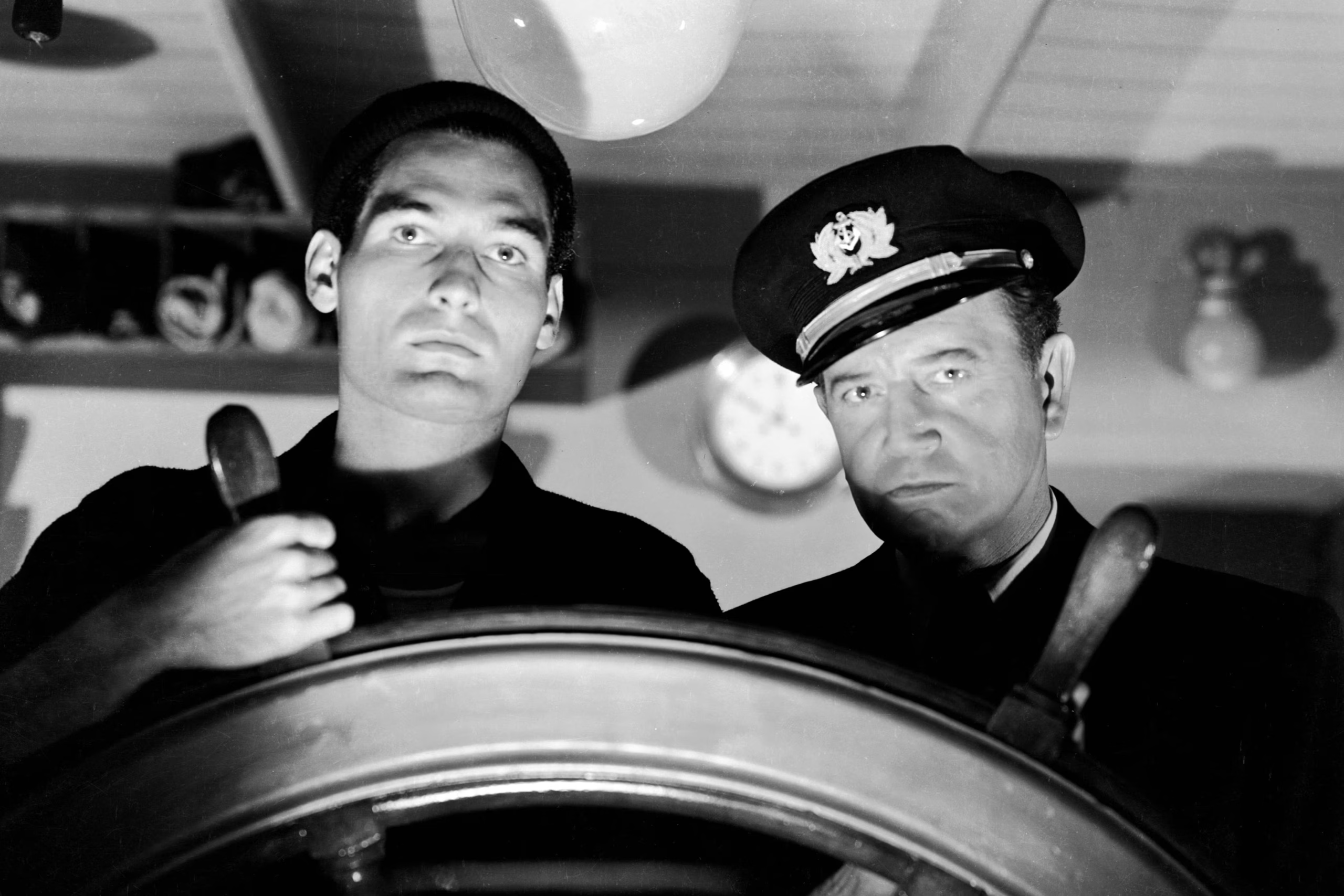
The film announces this atmosphere before the Altair even leaves port. Merriam’s encounter with the blind beggar, who foresees only “bad luck and bad blows at sea,” invokes the familiar folk figure of the prophetic outcast: sightless in a literal sense, yet able to perceive the disaster concealed from those who can see. Such a warning places the voyage within the logic of maritime fatalism. Whether the beggar truly possesses second sight is less important than the fact that his prediction establishes the ship as a cursed space before Merriam recognizes its danger. The Altair becomes, in effect, a floating haunted house—its steel corridors, dark cabins, hatches, and engine noise replacing the ruined manor or isolated village of more familiar horror traditions.
The ship’s machinery is equally important to this folk-horror reading. After Louie questions Stone’s decision to sail without replacing the missing crewmen, Stone shuts him inside the chain locker and is crushed beneath the cascading anchor chain. What might have been ordinary working equipment becomes an instrument of terror, as Tom begins to suspect that Stone has turned the ship itself against anyone who challenges him.
The sequence in which Louie is locked inside the chain locker has always struck me as one of the most stunningly dreadful, quietly devastating images in cinema: filmed in severe and claustrophobic terms, with suffocating precision, it lets the chain descend with a slow, methodical rhythm; each clank is another measure of his helplessness until cold machinery turns the ship itself not only into a trap but his executioner.

The chain becomes a potent symbol: (another weapon in Stone’s hands) meant to secure the ship instead turns into a deadly device, burying the dissenting sailor under the material weight of maritime labor and command. The scene’s horror depends on the terrible contrast between Louie’s human voice and the deafening mechanical din that renders his cries ineffective, a characteristic of Lewton’s deliberate spareness and psychological terror. In folk-horror terms, this is the folk-horror ‘sacrifice’ disguised as accident. Louie is not offered to a god of the sea, but to Stone’s godlike idea of discipline.
Stone’s motto—“Who Does Not Heed the Rudder Shall Meet the Rock”—makes this theology explicit. The rudder is more than nautical imagery: it symbolizes a total social order in which one man’s hand determines everyone else’s course. To disobey is not merely to break a workplace rule but to invite catastrophe. Stone’s fixation turns the captain’s traditional authority, which is practically necessary aboard a vessel, into a cultic doctrine; a rule that demands blind obedience. Stone isn’t just steering the ship anymore; he’s daring anyone who questions him to drown with it.

The crew’s reluctance to believe Tom Merriam, their deference to Stone, and the ship’s removal from effective oversight make the Altair resemble the isolated, rule-bound communities of later folk horror. A shore-side inquiry fails to contain the threat, and Merriam finds himself returned to sea, trapped once more inside the community he tried to expose.
If you read it this way, the title is deliberately deceptive. The Altair is not haunted by a conventional revenant; it is haunted by the older maritime world’s myths of fate and command, and by the institutional belief that the captain’s word is law. The sea supplies the film with a mythic landscape of isolation and superstition, while Stone supplies its human monster. anticipates a modern form of folk horror in which the ancient force is not necessarily supernatural or rural: it may be a closed culture’s inherited code, so entrenched that it can demand sacrifice while calling itself order.

The 7th Victim 1943
Released in 1943, Mark Robson’s The Seventh Victim 1943 follows Mary Gibson (Kim Hunter), a sheltered young woman who leaves boarding school for New York after her older sister, Jacqueline (Jean Brooks), vanishes without explanation. Her search leads her through Greenwich Village’s shadowed rooms and private networks to the Palladists, a clandestine Satanic cult determined to punish Jacqueline for attempting to leave it.
Mary discovers that Jacqueline has become entangled with the cult. This secretive group transforms Greenwich Village’s apartments, restaurants, and back streets into spaces of surveillance and threat. As Mary follows Jacqueline’s trail, the Palladists’ influence makes the city feel less like an open public world than a maze of guarded secrets.

The Seventh Victim (1943) can be read as an urban form of folk horror: it replaces the isolated village, rural rite, and visibly archaic pagan past with Greenwich Village’s underground geography of rented rooms, posh brownstones, and secret communal knowledge. Mary’s search begins at La Sagesse, the Greenwich Village cosmetics company her sister Jacqueline once owned. La Sagesse (French for wisdom) is in fact a front for the cult.
The film trades the isolated village for Greenwich Village’s nocturnal maze of rain-darkened streets, narrow unwelcoming alleyways, and anonymous doorways, where Mary moves through Manhattan’s west-side darkness, and her shadow seems to trail her with an unsettling will of its own, and there’s an unnerving sense that a second presence is keeping pace just beyond the creeping shadows.

The Palladists are a cult rather than a folk community in the pastoral sense, but they perform the same essential function. They constitute a closed world within the modern city, bound by a hidden creed, collective discipline, and an internal logic that outsiders can observe only in fragments. Mary Gibson’s search for her missing sister Jacqueline becomes an initiation into that concealed world: every apparent lead—the cosmetics company, Dante’s restaurant, the psychiatrist’s office, the anonymous apartment—opens onto further evidence of a social order operating beneath the city’s ordinary surfaces. The film explicitly centers on Mary’s discovery that Jacqueline had belonged to the Palladists, the occult sect of darkly religious fanatics whose members have already killed, or driven to death, six people.


The film’s folk-horror quality lies in its sense that modernity has not abolished ritual belief; it has merely hidden it inside modern institutions. Jacqueline’s cosmetics business is a particularly pointed symbol. Cosmetics promise visibility, self-fashioning, and surface beauty, yet the business conceals a more private drama of fear, disappearance, and cultic coercion. Jacqueline’s persecutors make ordinary rooms feel like traps. This secret society polices Jacqueline’s silence. Their beliefs are more forceful and less formal, and they treat dissent as a threat.
The Palladists themselves are not fantastical figures emerging from a remote past. They are respectable-looking urban adults, dispersed through professional and domestic spaces. Their anonymity allows them to move through New York unnoticed, transforming the city into a place where danger does not announce itself through an ancient monument or forbidden forest but through an ordinary door, a dim corridor, or an unfamiliar face in a crowd.
Robson’s use of enclosed interiors reinforces this effect. Jacqueline’s room above Dante’s restaurant, with its noose and chair, turns an anonymous rental space into a deconstructed minimalist site of suspended ritual violence: death is anticipated there before it occurs, as though the room has been prepared to absorb its occupant into a fate already decided for her. Later, the Palladists’ coercive “trial” makes their creed chilling precisely because of its procedural restraint.
They forbid themselves from directly murdering Jacqueline, so they arrange a poisoned cup and subject her to sustained communal pressure, attempting to make her choose her own death. This is ritual as moral evasion. By preserving an abstract principle of nonviolence while engineering the conditions of suicide, the cult transfers responsibility from itself to its victim.

For them not to kill Jacqueline outright hardly makes them innocent. Instead, they set out with their poisoned cup and surround her with the pressure to use it, hoping she will commit suicide. It is a chilling kind of moral loophole: the group can claim it does not believe in violence while carefully creating the fear, isolation, and despair that make suicide seem like her only way out.
Jacqueline’s final encounter with her dying neighbor places two women on opposite sides of the same threshold: Mimi (Elizabeth Russell), gravely ill, is frightened to die and clings to the possibility of one last night of life, while Jacqueline, physically able to leave, has been pushed toward death by fear, isolation, and the Palladists’ pressure.
Her connection with Mimi, a woman openly drawn toward death, creates a painful counterpoint to the film’s central threat: while the Palladists try to wear Jacqueline down until she chooses suicide, Mimi offers her a vision of death as release, leaving Jacqueline caught between a grim determination to keep living and the seductive possibility of simply letting go.

In this urban folk-horror world, death is not simply an individual choice but a force the community helps make imaginable; the danger is not a monster emerging from the woods but a private, contagious culture of despair, where a secretive group’s ritual pressure and an ordinary neighbor’s longing for oblivion make death feel like something the city quietly invites.
In essence, the poison chalice is the film’s crucial folk-horror object. It resembles a sacramental vessel, but its promise is not redemption: it offers Jacqueline annihilation, presented as the proper conclusion to her betrayal of the group. Around it gathers a small congregation whose power derives from unanimity. The Palladists do not need an altar, a bonfire, or a ceremonial costume because their ritual is constituted by collective witnessing and insistence. Their ceremony converts isolation into a sort of weaponized obligation. Jacqueline’s personal despair becomes usable to the group, just as sacrifice in more traditional folk horror converts an individual life into an instrument of communal preservation; the Palladists turn private suffering into a collective obligation: the individual is asked to yield to a supposedly higher order, so that coercion can masquerade as ritual duty.

Just like the Hårga community in Ari Aster’s Midsommar—in both films, individual suffering is absorbed into a collective moral logic: the community presents death, sacrifice, or submission as something necessary for a larger order, then uses shared ritual and emotional pressure to make resistance seem selfish or unnatural. In Midsommar, the Hårga treat life and death as communal responsibilities governed by ritual cycles; Aster himself described them less as a conventional “cult” than as a community and family with deeply embedded laws and traditions.
The scene with Jacqueline exposes the cruelty beneath the Palladists’ idea of communal preservation: as in Midsommar, where the group imagines death not as a private catastrophe but as an obligation that can be organized, witnessed, and folded into the needs of the collective, though The Seventh Victim makes that horror intimate, urban, and almost unbearably quiet.

The film’s most haunting gesture, however, is its refusal to make cult coercion the sole explanation for Jacqueline’s death. Jacqueline is already profoundly alienated from life; the film repeatedly associates her with exhaustion, disappearance, and a desire to escape an unbearable consciousness. You can see this when she sought psychiatric treatment for depression connected to both her Palladist membership and her attempt to leave it. The Palladists exploit this despair rather than create it. Consequently, Jacqueline’s final suicide cannot be understood as a simple defeat of the heroine by an external Satanic conspiracy. It is the culmination of a world in which private suffering finds no secure refuge, from family, marriage, psychiatry, religion, or urban life itself.
To me, The Seventh Victim is especially useful when thinking about hauntology in folk horror. The film suggests that the city is haunted not by a single, literal demon, but by the persistence of hidden systems of belief and coercion within supposedly rational modern life. The Palladists’ Satanism is less important than the atmosphere of invisible affiliation they create: ordinary-looking people share a secret language, follow an inherited rule, and can close ranks around a victim without seeming to do anything at all. What makes it frightening is the realization that someone might already be inside the community’s ritual space without even knowing it. Like the outsider who enters a rural folk-horror village, Mary discovers too late that the familiar world has another history, another law, and another congregation operating beneath its surface.

STRANGLER OF THE SWAMP 1946
Frank Wisbar’s Strangler of the Swamp (1946) is an American folk-horror variation on his earlier German Fährmann Maria (1936), but it changes the original’s allegorical figure of Death into something more recognizably regional and folkloric: the vengeful ghost of a ferryman lynched by his own community. Set in an isolated, fog-bound backwater, it treats the swamp as a place with a long memory. Douglas was falsely accused of murder, hanged by fearful townspeople, and left to haunt the marsh, strangling the male descendants of those who condemned him. The town’s present is therefore governed by an old injustice that it has tried, unsuccessfully, to bury.
The swamp remembers: The film announces its folk-horror world almost immediately with a noose hanging from a tree over stagnant water. It is an image of lynching made part of the landscape: rope, branch, mud, mist, and still water join together as a local memorial nobody has formally erected. A dead boy is found tangled in swamp vines, while the ferryman’s passengers exchange stories about “the strangler.” Before the ghost is fully seen, the community has already made him real through rumor. The swamp is a storytelling environment, where deaths are interpreted through shared memory rather than through police procedure or rational explanation.
That is why the film reaches beyond ordinary ghost-story territory. Douglas’s haunting is not merely personal revenge; it is the return of a communal crime. The villagers’ fathers helped create the curse, and their sons inherit its consequence. Like the ancestral dead in Kwaidan, or the colonial wail in La Llorona, Douglas is history made physical. He is the specter of a scapegoating community confronted by the violence it authorized.


The ferry and the noose: The ferry is the film’s most resonant symbol. Ferryman Joseph Hart operates a small boat that moves along a rope stretched between trees, carrying villagers back and forth across the marsh. It recalls the great Greek psychopomp Charon’s crossing of the Styx, but in Wisbar’s American remake the image becomes more ominous: the ferry is a local service built into a landscape where the boundary between life and death is dangerously thin. When Joseph dies, his granddaughter Maria, played by Rosemary La Planche, takes over the crossing, effectively inheriting a role tied to passage, loss, and the region’s haunted past.
The noose doubles this symbolism. It is the instrument of Douglas’s murder, a warning placed in the trees, and the ghost’s favored means of attack. In a conventional Hollywood horror film, a noose might be an isolated prop. Here it becomes a local emblem: the physical scar of a collective act that has poisoned the swamp and its descendants. When Douglas’s ghost targets Chris Sanders, the son of one of the men associated with the original injustice, the old rope becomes a generational cord, binding the present to its guilty past.


A key late sequence pushes the film into the moral territory of folk tale. Maria and Chris’s father, Christian Sanders, takes Chris to the ruins of an old church, where the strangler, Douglas, cannot cross onto consecrated ground. The church offers temporary refuge, but it cannot heal the region’s older wound: Chris, already gravely weakened, remains near death, while escape from the sanctuary would leave him vulnerable to Douglas’s ghost again. Resolution and salvation come only when Maria crosses that threshold herself and confronts Douglas in the swamp, offering her life in exchange for Chris’s. She presents herself as a willing sacrifice and appeals to him to abandon vengeance and make peace with God; Douglas is then moved to kneel in prayer and disappears.
When Maria puts her own life in Douglas’s hands to save Chris’s, it echoes the sacrificial logic of Wisbar’s earlier Fährmann Maria. But the film refuses a simple revenge ending. Her plea that Douglas “leave vengeance to the Almighty” finally breaks the curse, with his ghost vanishing into the marsh. This resolution makes the swamp a space of moral reckoning rather than a mere supernatural lair. The community’s old crime can be brought to rest only through compassion, sacrifice, and an acknowledgment of its harm, not through brute force but grace.

A haunted regional fable: Strangler of the Swamp earns its place in a folk-horror lineage because it makes landscape, legend, and communal guilt inseparable. The misty marsh is not just an atmospheric set; it contains the memory of a lynching. The ferry is not just transportation; it is a crossing between historical violence and present consequence. And Douglas is not merely a strangler in the dark; he is the tale the village tells itself because it cannot admit what it did.
Frank Wisbar’s Strangler of the Swamp (1946) turns the American backwater into a folk-horror landscape where a falsely hanged ferryman returns as the embodied memory of communal injustice. Its noose in the trees, rope-guided ferry, ruined church, and fogbound marsh transform the ghost story into a regional legend like a great folk tale: the dead man’s vengeance becomes the curse of a town that has never truly reckoned with the violence it has built.
1950s

THE WHITE REINDEER 1952
The White Reindeer (Valkoinen peura, 1952) is more than merely adjacent to folk horror; it stands as one of the genre’s most distinctive early examples. Set in the snowbound landscape of Finnish Lapland/Sápmi, the film draws on pre-Christian Finnish mythology and stylized Sámi shamanic traditions, making folklore the force that shapes both Pirita’s (Mirjami Kuosmanen) bodily transformation and the world of the reindeer-herding community around her.
Pirita’s loneliness and sexual frustration lead her to seek ritual help from a shaman. The sacred ritual and her encounter with the white reindeer transform her desire into a tragic, dark, fatal folk-horror nightmare. The community’s world is organized around a harsh landscape, reindeer, inherited belief, and spiritual danger rather than the rational institutions that would dominate a modern urban horror film.
Pirita’s story follows a central folk-horror pattern: private desire collides with an inherited ritual order. Lonely in her marriage to the reindeer herder Aslak, she seeks a shaman’s help, and she is given a love spell to help her become irresistible to him. Pirita does not merely receive a love spell that accidentally awakens witchcraft; she is presented as the daughter of a witch, and the shaman’s ritual demands that she sacrifice the first living thing she sees at the seita (a sacred stone/site).
When Pirita kills the white reindeer calf Aslak has given her, the promised love magic now becomes a curse. Under the full moon, she transforms into a rare white reindeer, lures herders into the Arctic wilderness, and then shifts into a fanged, vampiric human form to kill them. The landscape is not a backdrop here; the tundra, snow, reindeer herd, and moon form a spiritual world in which transgression is answered through metamorphosis, with Pirita’s body becoming the place where desire, punishment, and folklore meet.
Interpretive ambiguity connects her maternal inheritance, her voluntary ritual act, and the film’s transformation imagery, and it does it without overstating whether she has active supernatural powers before the shaman’s intervention. In the film, something that should seem beautiful and lucky becomes vampiric and dangerous: beauty becomes deadly, and a blessing turns into something terrifying.
The white reindeer is a striking inversion of a spiritually significant animal in Sámi tradition; it takes the reindeer, which is associated with good fortune in Sámi tradition, and turns it inside out

In the film, that auspicious figure becomes bloodthirsty and predatory—beauty turns fatal, blessings turn into a curse. Pirita’s monstrous transformation makes visible the conflict at the center of the film: her desire to be wanted and her frustration with a marriage that doesn’t fulfill this need, leaving her alone, are recast by the community as dangerous. Instead of treating that loneliness as understandable, the world around her turns her desire into something excessive, threatening, and supernatural.
The White Reindeer makes folk horror out of ice rather than earth. Its wilderness is not the green, encircling countryside of English folk horror but the vast white silence of Lapland, where mythology appears to be written directly into animal tracks and moonlit snow.
Pirita’s curse begins with a simple, human desire: to be loved by the husband whose work repeatedly carries him away, but the shaman’s rite translates that loneliness into monstrous form. As a white reindeer, she becomes a beautiful omen that leads men toward death: a sacred creature inverted into a fatal lure, and a woman’s unfulfilled desire turned by folklore into something the community must fear and destroy.

CURSE OF THE DEMON 1957
Jacques Tourneur’s Night of the Demon (1957), first released in Britain and later in the United States as Curse of the Demon, deserves a place near the beginning of British folk horror, because it makes an old system of magic feel disturbingly at home in the modern world.

Curse of the Demon moves through England as though modern life has been built on top of an older map that can still break through. Its streets, libraries, train stations, country estates, and stone circles all look ordinary at first, but the film keeps finding the weak places in them: the dark patch beyond a headlight, the wind in a garden, the folded scrap of paper in a stranger’s hand. Dr. John Holden (Dana Andrews) starts out convinced that witchcraft can be filed under fraud or psychological disturbance. Yet the film’s atmosphere keeps putting him in spaces where reason feels too small. He can identify symbols, interview witnesses, and collect evidence, but none of that stops the old rules from taking hold.
Its folk-horror power comes from the collision between rational modernity and a surviving system of old magic: runic curses, an arcane cult, inherited superstition, and a countryside where the supernatural can still take physical form.
It is also an occult thriller, full of investigation, deadlines, clues, and the archetypal hero: a man of reason and a devotee of rationality, certain that Julian Karswell’s occult power can be exposed as performance and fraud. He is an apostle of disbelief, but he is entering a world where disbelief offers no protection.


Curse of the Demon (1957) may not be a traditional classic folk-horror film; it leans into supernatural mystery rather than rural-cult ritualism, but its secret rites and sense of an older power intruding on modern life make it hard to leave out of the conversation. Still, it stands at the edge of folk horror, borrowing its ancient curses, pagan symbols, and lingering occult dread while steering clear of the genre’s more familiar world of isolated villages and collective ritual.
Julian Karswell’s (Niall MacGinnis) followers do form a closed rural circle, held together by fear as much as belief: their devotion offers the comfort of belonging, but it also makes them complicit in a system that can turn even family against family. Rand Hobart, one of the circle’s own, survives the demon by passing the cursed runic parchment to his own brother; the brother dies instead, and Rand is left broken and catatonic by what he has witnessed and done. He is left a human remnant of the group’s supposedly controlled power. Rather than trapping its characters inside a rural cult’s closed belief system, the film unfolds as a supernatural mystery in which a modern skeptic is drawn into a hidden network of magic, inheritance, and demonic retribution.
The story’s moral isolation comes less from literal village banishment than from the way the group’s supernatural law turns kinship into betrayal and abandons Rand inside the consequences of its own ritual system.

Dr. John Holden arrives in England from America as a professional skeptic, attending a scientific conference hoping to reveal Julian Karswell as a charlatan who is exploiting his devil-worshipping followers’ belief in supernatural forces and is possibly involved in suspicious deaths. When his colleague Professor Henry Harrington suddenly and violently dies under bizarre circumstances, Holden is drawn into a trail of clues, retracing the investigation Harrington left behind, only to discover too late that its rituals may possess the supernatural power he has spent his career denying. Holden begins as a scholar armed with reason rather than faith, but the film slowly turns that confidence into vulnerability. A believer in the visible world, Holden is unprepared for a threat that can move through curses, paper, rumor, and fear before it takes physical form.
One of the film’s deepest fears comes from the fact that Dr. John Holden’s professional confidence has no power once he steps into Karswell’s world. Holden arrives from America as a psychologist determined to expose this supposed Satanic cult as a fraud. He expects superstition to collapse under evidence, diagnosis, and common sense. Instead, he finds a curse that follows rules he does not understand, passes from person to person through a scrap of parchment paper inscribed with runes, and eventually calls something real out of the dark.

Karswell’s estate also gives the film its distinct folk-horror atmosphere. Karswell looks like a respectable English gentleman, but the country house conceals an occult court; a children’s party becomes a grotesque masquerade; and the green, wind-stirred English landscape seems capable of opening up long enough to release something ancient and winged. The demon is less a random monster than the violent proof that buried folklore has teeth.
The film makes its position clear before Holden even appears. Before his death, Professor Henry Harrington, who has been investigating Karswell, arrives at the occultist’s country home terrified and desperate. He begs Karswell to lift the curse placed on him. Karswell, played by MacGinnis with unnerving good manners, refuses. Harrington leaves through a storm, crossing the grounds as wind tears at the trees and the night seems to move around him. Then the demon comes for him. The scene is important because the horror is not random: Harrington has challenged a local authority and has been given a ritual sentence. The demon is the executioner of a system Karswell controls.
Edward “Ted” Scaife’s photography makes the threatening darkness feel watchful, revealing just enough, often letting headlights or flashlights reveal only fragments of a scene, leaving the rest completely unsettling
The terror arrives through the surroundings first. Before the demon takes shape, the night seems to make room for it. What makes the demon’s approach feel close to folk horror is that it does not simply appear, as though stepping onto a stage. A strange sound rises out of the darkness, thin and grating; the air stirs, sparks flicker above the trees, and a cloud of smoke gathers where nothing should be. It swells and advances, turning the space around Harrington into a warning before any creature appears. For a moment, the demon is less a figure than a disturbance in the world itself, as though something summoned by an old rite has reached through the landscape and begun to breathe.

That system is most clearly embodied by the parchment. Karswell secretly slips the small piece of runic symbols on paper to Holden at a public library, and the object becomes the center of the film’s logic. Covered in strange runes, it is not just a clue or a magical prop. It is a portable ritual, a transferable death sentence. Whoever possesses the parchment is marked; the only way to survive is to pass it on before the deadline, ‘time allotted ‘. The curse turns a piece of paper into a kind of folk talisman, ordinary enough to carry in a coat pocket, yet charged with rules, danger, and inherited belief. Holden tries to discard it, but it returns. He studies its symbols, compares them to ancient markings at Stonehenge, and slowly realizes that his usual methods can describe the object without protecting him from it.
The runic parchment is the film’s smallest and most important folk-horror object. It is a thin piece of paper marked with runes, easily slipped into a pocket or hidden among ordinary documents. It’s a forbidden talisman, passing doom from one hand to another according to ritual rules. The story’s horror is not merely that a demon exists, but that modern evidence, psychology, and professional authority cannot protect Holden once he enters a belief system older than his own.
When Karswell passes the parchment to Holden during his visit to the library without his knowledge, the film makes a simple act of handling paper feel dangerous. The curse does not need a crumbling tomb, a blood-stained altar, or a dramatic public ceremony. It travels through an object that could be mistaken for throwaway rubbish.
Tourneur gives the object a life of its own. The parchment flutters, vanishes among papers, returns when Holden tries to burn it in the fire, whipped away from the fireplace by an unnatural blast of wind. It is almost absurdly fragile, but it has more authority than Holden’s scientific training, his skepticism, or the institutions around him. A library reading room and a scholarly conference should be places where knowledge is orderly and secure. In this film, they become places where an occultist can silently place a curse in another man’s possession. The horror lies in that quietness. Karswell does not need to chant over Holden in a ruined chapel; he only needs to make sure the right object reaches the right hands.
This is where the film’s folk-horror power really begins. Curse of the Demon/Night of the Demon is not saying that modern knowledge is useless; Holden does investigate, collect evidence, and eventually learn the rules of the curse. But it makes rationalism feel fragile. Holden arrives certain that folklore belongs to the past and that ritual belief can be explained as hysteria or deception. Karswell’s magic forces him to confront a different kind of knowledge: not a theory you can dismiss, but a practical system with consequences. The runes work whether Holden believes in them or not. By the time he accepts their meaning, the curse has already selected him.
Karswell himself gives the film its particular folk-horror texture. He is not a ruined hermit or a wild-eyed sorcerer living outside society. Karswell himself appears genial, cultured, and almost ridiculous at times, especially when he plays host at a children’s party in a clown costume.
He is respectable, educated, charming, and comfortably installed at Lufford Hall, a country estate that disguises a small occult court, where Karswell presides over a world in which hospitality, magic tricks, family life, and Satanic power blur together. Karswell’s country estate deepens that unease.
Lufford Hall is not a remote fortress occupied by an obvious villain. It is a respectable English house, full of guests, servants, children, and polite social rituals. But that scene at the children’s party becomes one of the film’s strangest scenes and one of the most unnerving folk-horror set pieces because Karswell turns a familiar communal gathering into a display of occult power.
He performs magic tricks, pulling puppies out of a hat, etc., and seems eager to play the benign English gentleman. Karswell’s magic does not entertain in a harmless way; it establishes his control over the local world around him. The children’s party is important because it places ritual power inside ordinary social life. Karswell is not hidden away from the community; he is a host, a local authority, and a figure who knows how to make the uncanny look like entertainment until it no longer does.
The garden is full of children, games, and English summer brightness; then he calls up a violent windstorm to show Holden what he can do. The weather changes at Karswell’s command, tearing through the party and making the whole pleasant scene suddenly feel exposed to something older and meaner.

When he conjures the maelstrom, the dark and foreboding wind, Karswell turns the weather into a quiet act of intimidation and uses the storm to put Holden in his place. The storm also becomes Karswell’s demonstration of power over nature, not just Holden. He calls up the wind as a casual show of occult dominance, making it clear that the skeptical American has entered a landscape whose rules are not his to define.
And the menace in the garden, the cheerful gathering suddenly feels like a ritual space in which everyone else is expected to accept the host’s rules. The country house is not simply Gothic décor. It is the center from which Karswell’s private folklore spreads outward.
The cult itself is more private than the bright, public paganism of The Wicker Man. The film’s sense of a closed community is quieter than the one found in Robin Hardy’s film or Horror Hotel/The City of the Dead.
Karswell does not rule an entire village that publicly sings the same songs, openly participates in a harvest rite, or gathers for a visible sacrifice. Instead, Karswell’s True Believers operate through secrecy, money, family connections, and social protection. That makes the film’s closed community feel less like a separate village and more like a hidden network inside respectable English society. His circle is smaller, secretive, and socially protected. They can attend parties, live in country houses, and move through public institutions while maintaining their allegiance to a darker set of rules. Yet it still has the folk-horror structure of insiders who possess local knowledge and outsiders who do not.
The cult’s power is not that everyone in England believes; it is that enough people believe to make the ritual work. Karswell’s followers preserve an older system of belief without having to withdraw completely from the present.

As Harrington discovered too much and threatened to expose this closed society, in this way, he was the outsider who intrudes. Holden has come from elsewhere to expose what the insiders preserve; Joanna Harrington (Peggy Cummins plays Annie Laurie Starr, the seductive, ruthless sharpshooter in Joseph H. Lewis’s Gun Crazy 1950), grieving her father, stands between the two worlds. The cult’s power depends partly on secrecy, but it also depends on its members’ willingness to treat the supernatural as a usable social force. Karswell’s followers are not just worshippers; they are the human network that helps an old belief survive in a modern England that thinks it has outgrown it.

The film’s folk-horror feeling also comes from its landscapes. The countryside matters as much as the cult. Tourneur fills the film with wet roads, wind-bent trees, dark woods, stone circles, and the long shadow of the country estate. These landscapes do not function as neutral scenery. They seem ready to open and reveal something ancient underneath.
Holden’s investigation carries him out of London and toward woods, farms, ancient stones – Stonehenge- and Karswell’s estate, as though each movement away from the city takes him further into a buried England. Stonehenge appears not as a tourist attraction but as an unsettling archive of older belief. Holden approaches it as a scholar, searching for a way to decode the runes and make them intelligible. But the monument refuses to become merely evidence. The stones remain heavy, mute, and resistant—an ancient form standing outside the neat categories of modern investigation. The scene suggests that Holden can study the past, but studying it is not the same as mastering it.
The encounter at Stonehenge gives this feeling a particularly strong form. Holden approaches the monument as a researcher, trying to decode the runes with archaeological and scholarly tools. But the stone circle does not become fully knowable just because he can compare its symbols with those on the parchment. It remains an older, heavier presence: a place that turns modern inquiry into another form of trespass.

The demon is controversial for some viewers because Tourneur’s usual gift was suggestion, and producer Hal E. Chester insisted that the creature be shown. But within a folk-horror reading, its visibility gives the film an unusual force. The fire demon is not a generic creature that happens to attack people in the woods. It is the physical proof that the old stories are not safely metaphorical. It has been called through runes, released according to ritual procedure, and sent after those who receive the parchment. It emerges from the same English landscape that Holden believed he could interpret from the outside. The trees, mist, and fields do not merely conceal a monster; they give shape to a belief system that has survived because someone like Karswell knows how to activate it.
The first great image is the most direct: Professor Harrington runs through the night after begging Julian Karswell to lift the curse. The scene begins with a country house, a wet road, and a man trying to reach the safety of his own home, but it does not stay in the ordinary world for long. A strange noise gathers in the darkness, a sound emerges, stretched beyond recognition, and an enormous shadow seems to move through the trees. The demon’s arrival is not just a scare. It establishes the film’s ritual law: Karswell can give someone a runic parchment, and when the appointed time arrives, the thing called through that curse will come to collect its victim. Harrington has tried to escape the ritual, but the landscape itself seems to deliver him back to it.

The final train sequence brings all these ideas together and gives this conflict its perfect modern setting. Holden has learned that the curse can be escaped only by returning the parchment to Karswell. In a crowded, modern railway carriage—full of luggage, tickets, strangers, and routines of travel- it becomes the site of a ritual contest.- the very image of speed, technology, and public life—the old ritual still holds. Holden must get the paper back into Karswell’s possession before the deadline and slips the parchment into Karswell’s pocket. The scene turns an everyday object into a ritual battlefield: those hands, pockets, luggage, tickets, and a folded scrap of paper now determine who will live and who will be claimed.
The paper changes hands again. Karswell realizes too late that the curse now belongs to him, chases the fluttering parchment down the tracks, and finds that there is no longer any distance between modern machinery and ancient terror. The oncoming train, the storm-dark sky, and the demon converge at once.
Once Karswell is forced from the train and the demon comes for him beside the tracks, the film refuses the comforting idea that modern movement has carried society beyond old fears. The train does not escape the curse; it becomes the place where the curse is completed.


What makes Night of the Demon an essential folk-horror precursor, then, is its combination of ritual, landscape, and belief. Its arcane cult remains hidden rather than becoming the whole town, but it operates through the same logic later folk horror will explore: a closed group preserves an older order; a skeptic enters from outside; ordinary spaces become ritual spaces; and the landscape proves more receptive to ancient terror than modern reason is prepared to admit. Karswell’s curse moves politely through the world as a piece of paper, but it carries a whole buried system behind it—runes, sacrifice, fear, and a demon waiting just beyond the trees.
The film finally makes modern skepticism seem almost defenseless. Holden begins by treating superstition as an object of study. He ends by understanding that folklore is not only a story people tell about the past; in Karswell’s world, it is a living form of power. That is the film’s folk-horror nightmare: old magic has learned the manners of the English country house, the library, the railway carriage, and the professional conference. It does not need to hide from modernity. It has simply learned how to move through it.
Curse of the Demon is a foundational folk-horror nightmare because it makes modern rationalism feel almost touching in its fragility. Dr. Holden enters England convinced that superstition is a relic to be examined and dismissed, only to find that old magic has learned the manners of the country house: it passes politely through a handwritten parchment, waits with perfect patience, and finally steps out of the trees. In Karswell’s world, folklore is not the opposite of knowledge—it is a darker kind of knowledge, one that the skeptic understands only when it has already chosen him.
That ending captures why the film remains so useful for folk horror. The old magic is not sealed in a countryside shrine waiting to be uncovered. It moves through the contemporary world with perfect patience: in a library, through a polite exchange of papers, across the grounds of a country house, and onto a train line. Its force comes from ritual rules, old symbols, a secret circle of believers, and a landscape that seems ready to give ancient fears a body. Curse of the Demon makes modern skepticism feel almost tender in its confidence. Holden believes the supernatural can be exposed, explained, and dismissed. Karswell shows him something worse: folklore is not simply an old story. In this world, it is a living knowledge system, and it already knows how to find its way home.
1960s

City of the Dead 1960 aka Horror Hotel
John Llewellyn Moxey’s The City of the Dead (1960)—released in the United States as Horror Hotel—belongs with folk-horror not simply because it has witches and sacrifice, but because it imagines Whitewood as a place where the past has never become past.
The director began in British television and made several notable horror films, including The City of the Dead (1960) starring Christopher Lee and Night of the Eagle (1962), but he became even more closely associated with television. After moving to the United States, he directed several notable horror-leaning television films, especially in the early 1970s. John Llewellyn Moxey built a substantial body of horror-oriented TV movies, often returning to the same haunted domestic spaces, inherited secrets, and lingering supernatural histories that shape his earlier feature The City of the Dead (1960). Moxey’s other major horror-inflected feature was Circus of Fear (1966), also called Psycho-Circus. It reunites him with Christopher Lee, but it’s more a crime mystery with horror overtones than a straight horror film like The City of the Dead (Horror Hotel).
His made-for-TV films include A colonial-era haunted-house story, in which a family encounters the lingering presence of witches executed centuries earlier – The House That Would Not Die (1970); and A Taste of Evil (1971), starring Barbara Stanwyck, Barbara Parkins, and Roddy McDowall, a psychological Gothic thriller involving an isolated family home, maternal resentment, and a traumatized young woman. Both films star Barbara Stanwyck. The Last Child 1971) is primarily dystopian science fiction, but with horror-inflected authoritarian and reproductive-control themes rather than supernatural horror.
There is the holiday-set proto-slasher/old-dark-house thriller: four sisters return home after their father claims that his new wife is poisoning him —Home for the Holidays (1972), and A Strange and Deadly Occurrence (1974), another haunted-house chiller in which a family faces paranormal activity in an isolated home.
His most celebrated and influential television horror film is The Night Stalker (1972), in which intrepid reporter Carl Kolchak, played with a rumpled charm and stubborn wit by Darren McGavin, later seen in a seersucker suit, white sneakers, and yellow Mustang, investigates a sequence of Las Vegas murders connected to a vampire; it became an enormous ratings success and helped establish the modern made-for-TV horror movie as a major form. Together, these films show Moxey’s attraction to stories where familiar domestic or modern spaces become unsettled by violence, secrecy, and forces that seem to have survived from the past.

The City of the Dead creates an isolated rural town steeped in history and tradition, where occult rituals, witchcraft, and the supernatural are woven into local folklore. Outsiders encounter old customs, secret cults, and an ancient evil- the familiar folk-horror pattern in which a place’s inherited beliefs become lethal to anyone who does not belong. Rather than needing another direct comparison to The Wicker Man, the film works through the same ritualized atmosphere and closed-world logic: its setting turns local tradition into an instrument of dread. By now it’s clear we’ve established that folk horror often centers around isolated rural communities, ancient rituals, and the persistence of premodern beliefs or practices, manifesting fear through landscape, community, and tradition. This film checks those boxes, immersing us in a world where the past is never truly gone and where superstition and ritual govern the rhythm of life.
In Whitewood, even the ordinary world and the natural order seem to be hiding something older and hungrier, horrifying and deeply rooted: beneath its fog, sparse old buildings, and empty streets lies a ritual order that demands blood in exchange for continued survival.


The film opens in 1692, with the burning of Elizabeth Selwyn (Patricia Jessel), a woman condemned for witchcraft. Her execution is not merely prologue or historical color. At the stake, Selwyn and Jethrow Keane call on Lucifer, exchanging their souls for survival and revenge; the bargain requires the town to provide recurring human sacrifices. From the first scene, then, Whitewood is founded on a cycle: communal violence produces an occult pact, and that pact returns as a demand for further communal violence. From the opening scenes, the film grounds itself in the witch-trial fervor of colonial New England. The burning of Elizabeth Selwyn at the stake is both a literal and metaphorical ignition for the story: the violence of the past resurfaces, infecting modernity through the unbroken thread of occult tradition.

Centuries later, the town has not moved forward so much as sealed itself inside that original crime. Nan Barlow, a young student of Professor Alan Driscoll (Christopher Lee) researching witchcraft, arrives expecting its history, something she can study, read about, and turn into academic knowledge. Instead, she finds a town where history is still practiced.
The trip to Whitewood has the strange feeling of crossing out of ordinary time. The roads into Whitewood are empty; the village seems sunk beneath a permanent blanket of fog. And Nan’s first encounters make the town feel less guarded than strangely vacant. A man asks her for a lift, only to disappear from the car without explanation; The hitchhiker is Jethrow Keane, Elizabeth Selwyn’s fellow witch from the 1692 prologue.


The scene almost feels like a story out of an urban legend. Through Whitewood’s smoky mist, the villagers are silent figures who drift like phantoms, their fixed, cold stares and unblinking eyes making Nan feel as though the town itself has turned to look at her, yet making the empty streets feel less abandoned than watchful. Whitewood’s few inhabitants move through that fog like revenants, their hostile gaze turning the ghostly streets into a silent accusation.


At the Raven’s Inn, Mrs. Newless receives her with a watchful, overly controlled hospitality. The unease comes not just from a crowd of hostile villagers, but from the sense that Whitewood is withholding itself from her.
The Raven’s Inn is especially important because it turns hospitality into a trap. Nan checks in as a guest, expecting the usual safety of a hotel room, but the inn sits on the site where Selwyn was burned. Its owner, Mrs. Newless, initially seems like one more eccentric local figure—stern, watchful, and oddly invested in Nan’s stay. The film slowly reveals that Newless is Selwyn herself (the name is an anagram), still alive through the pact made centuries earlier. That revelation gives the inn a distinctly folk-horror function: it is not just a Gothic building with a hidden cellar or network of cold, dank tunnels, but a threshold where the town’s buried history is kept active. The past is not represented by ruins or old documents; it is running the hotel, greeting visitors, and deciding who will be offered up next.
The most unsettling ritual occurs on Candlemas Eve, a seasonal date associated with the turning point between winter and spring. Nan reads a local book on witchcraft and realizes too late that the date matters. She is lured below the inn into a crypt-like space, bound on an altar, and surrounded by members of the coven in dark robes. Their ritual is not improvised; it has the calm, practiced feeling of an obligation being fulfilled. The town needs a sacrifice to maintain the bargain that has preserved its witch community, and Nan has arrived at precisely the moment when the old calendar requires one. On the altar, a ritual knife makes her the offering the calendar demands. This is a central folk-horror idea: the horror does not come from an individual killer acting alone but from a collective tradition, repeated so long that murder has become custom.
The film’s fog is more than an attractive piece of black-and-white atmosphere; it becomes the visual identity. It makes Whitewood feel physically detached from the wider world, as if the town has become its own closed system. People can enter, but they do not easily leave; roads, graveyards, the ruined church, and the Raven’s Inn all seem to lead back into the same small circle. The landscape works with the coven. It hides the town from casual scrutiny, obscures distance and direction, and makes outsiders unsure whether they are approaching an answer or moving deeper into the trap. Although the film was shot on English soundstages rather than in New England, its artificial-looking mist and cramped village streets strengthen the idea that Whitewood is a constructed world—a pocket of colonial terror preserved behind a wall of fog.

The churchyard sequence makes the conflict between old evil and Christian protection unusually concrete. When Nan’s brother Richard and Patricia Russell (Betta St. John) investigate, they are not simply facing a supernatural threat; they are facing a town whose social order has been overtaken by the coven.
Patricia is the granddaughter of Whitewood’s blind Reverend Russell and runs the town’s antique/book shop; she initially befriends Nan and lends her a book about regional witchcraft. After Nan disappears, Patricia goes to Nan’s brother, Richard Barlow, and her boyfriend, Bill Maitland, to explain that Nan came to Whitewood and may be in danger.
Patricia returns to—and remains in—Whitewood because she has to care for her grandfather. Once Nan vanishes, she becomes part of Richard’s search and is herself endangered because the coven needs another young woman for its ritual sacrifice.
Reverend Russell knows the truth but has been powerless to stop it. The shadow of a cross offers a means of breaking Selwyn’s protection, but the film does not suggest that religion has kept Whitewood safe all along. On the contrary, the original witch-burning reminds us that religious authority helped create the violence from which the curse grew. The cross becomes useful at the end, but it cannot erase the fact that the town’s nightmare began with public persecution and execution.
That contradiction is what gives The City of the Dead more weight than a simple “witches in a foggy village” story. Whitewood is not frightening only because supernatural evil lives there. It is frightening because the community has organized itself around an inherited bargain. Its residents preserve themselves by selecting victims, concealing evidence, maintaining the calendar of sacrifice, and treating outsiders as raw material for the town’s survival. In that sense, the cult is not separate from the village; it is the village. Local custom, hospitality, family authority, seasonal observance, and communal silence all become part of the ritual machinery.


The film also anticipates later folk horror in the way it makes an outsider’s curiosity dangerous. Nan comes to Whitewood because she wants to understand folk belief and witchcraft, but she approaches both as an object of research. Her mistake is to assume that folklore is safely over—that it belongs to books, lectures, museums, and the distant colonial past. Whitewood corrects her brutally. There, folklore is not a faded story but a living system of belief that governs bodies, spaces, and time. The coven’s rituals turn scholarship into vulnerability: the more Nan seeks the history of the town, the more completely she places herself inside its old pattern.
In this sense, she anticipates the academic outsiders in Ari Aster’s Midsommar, especially Josh and Christian, who arrive at the Hårga commune believing its sacred practices can be observed, documented, and folded into a dissertation. Their intellectual curiosity carries a colonial kind of hubris: they treat a closed community’s rites as material for their own careers rather than traditions with boundaries, rules, and consequences. Josh’s decision to secretly photograph the Hårga’s forbidden sacred text makes that violation explicit. Like Nan, he learns too late that folklore is not a dead object of study but a living order capable of turning the observer into part of its ritual.
That is why The City of the Dead works so well as exemplary folk horror. It has the recognizable pieces—an isolated town, an outsider, witchcraft, a secret coven, seasonal sacrifice, and a landscape that closes around those who enter it- but its strongest idea is that tradition can become a method of preserving violence. Elizabeth Selwyn’s burning does not end the past; it gives the past a reason to reproduce itself. Whitewood survives by making its founding trauma ritual, and the film’s eerie power comes from watching that ritual absorb anyone who assumes the town is merely a relic of history.
The City of the Dead (1960), The Blood on Satan’s Claw (1971), and The Wicker Man (1973) all make folk horror out of communities whose customs seem older than the outsiders who enter them, but they locate the source of dread differently. The City of the Dead turns colonial history into its central nightmare: Whitewood’s present-day coven grows out of a 1692 witch burning, so the town is haunted by the violence of its own founding. The sacrifice required by Elizabeth Selwyn’s pact makes the past into an ongoing communal obligation, not a sealed-off historical event.
What makes The City of the Dead particularly effective as folk horror is its depiction of the village as not simply a backdrop, but a living ecosystem of dread. The inhabitants, secretive and bound together by a centuries-old pact, recreate ancient rites, requiring human sacrifice and lurking in the shadows of ruined churches and crumbling inns. These communal rituals and the corrupting, unstoppable influence of the supernatural are trademarks of folk horror, as seen in films like The Wicker Man.
In The Wicker Man, the terror comes from rural isolation turned into a complete social order. Sergeant Howie arrives on Summerisle believing he can investigate it by the rules of mainland law and Christian morality, only to find an island community organized around its own seasonal religion and agricultural needs. The failed harvest gives the final sacrifice its logic: the island does not see its ritual as a relic, but as a necessary act of collective survival.
The Blood on Satan’s Claw makes the countryside itself feel infected. When a plowman digs up a grotesque buried remnant in a field, the land releases something that spreads through the village’s young people and turns them toward secret rites, violence, and sacrifice. Here, rural isolation is not simply a setting for an already organized cult; it allows a buried force to take hold before the adult world understands what is happening.


Together, the films show two connected pillars of folk horror. Colonial fear asks what happens when a community’s founding violence refuses to stay in the past; and rural isolation asks what happens when a place becomes closed enough for its own customs, calendar, landscape, and beliefs to overrule the outside world. In City of the Dead, Whitewood preserves an old crime by repeating it. In The Wicker Man, Summerisle preserves itself through sacrifice as well. In The Blood on Satan’s Claw, the soil itself seems to remember what the village has tried to bury.
The Conversation of Landscape and Lore: The fog-drenched town and its population are more than atmospheric choices; they are embodiments of a history that refuses to remain buried. The entire setting is haunted, not by a singular ghost, but by the collective memory and ongoing allegiance of its residents to dark, occult forces. A recurring threat in folk horror is that the natural ritual order conceals something horrifying, rooted in the land and its history, ready to demand blood as the price of power or survival.

THE MASK 1961
Although I have written elsewhere about Julian Roffman’s The Mask (1961), I have not yet considered what it contributes or examined it through a folk horror lens.
It does not offer the genre’s familiar heath, village, or harvest rite. Instead, it compresses folk horror into an object: an artifact, a ritual mask whose ancient power survives removal from its original cultural and ceremonial context. When archaeologist Michael Radin acquires the mask and, later, psychiatrist Allan Barnes inherits it, the past does not remain safely cataloged as history. It crosses into the present, demanding not interpretation but participation.
Radin’s visit to Barnes is the film’s first failed act of transmission. He comes with the kind of warning that begins many folk tales: he has encountered something he cannot explain, and he fears it has followed him—but he delivers it to a man whose profession requires him to hear that kind of story as a symptom.
The mask carries an inherited cosmology, a ritual command, and a set of violent consequences that Barnes’s modern psychiatric rationalism cannot contain. Each time the wearer is instructed to “put the mask on,” the film stages a passage into a hallucinatory ritual space of skulls, flames, monstrous bodies, and sacrifice. The recurring command has the force of an incantation: the object does not simply reveal horror; it recruits us to watch it, to experience it ourselves. Roffman’s 3-D sequences push this further, asking the cinema audience to wear special “Magic Mystic Masks,” so that spectators, too, become briefly implicated in the rite.

As a folk-horror mechanism, the artifact brings an ancient, culturally specific force into an ordinary modern setting, turning its wearer into a temporary vessel for a power they cannot fully control. The film’s mask origin story was inspired by an Aztec museum exhibit, but The Mask is a Canadian production that turns ancient Mexico and Central American imagery into a generalized ancient and primitive menace rather than representing a specific living Indigenous tradition. Its folk-horror interest lies precisely in that uneasy act of appropriation: the museum artifact becomes a Western fantasy of buried, foreign power, and the modern professional man who believes he can diagnose everything is undone by the cultural object he has failed to understand.
Rather than leading the film’s protagonist into a remote village where ancient custom still governs the living, it brings the ancient object into his space and asks him to place it over his face. Once Barnes does, the museum piece becomes a ritual threshold: a relic of a culture he can neither translate nor master, drawing him into a fevered ceremonial underworld where modern reason dissolves into blood, desire, and ancestral dread.
Symbols of ritual and return:
The mask makes folk horror work as a portable folk landscape. The Mask does not place folk horror in a village or forest; it brings folk horror indoors, in the form of an artifact that carries its own ritual world with it. Michael Radin first holds the mask, then passes it to Dr. Allan Barnes after Radin’s death, creating a cursed succession that resembles the transmission of folklore itself: an old object, a warning ignored, a new keeper convinced he will fare better. Barnes, a psychiatrist trained to name and contain psychic disturbance, discovers that the mask cannot be clinically interpreted into safety. It insists on being worn.

The command—“Put the mask on now”—is central to the film’s folk-horror logic. It is not an invitation to observe an ancient ritual from a protected distance; it is an imperative that makes the wearer participate. Once Barnes puts it on, he crosses from the ordered rooms of modern professional life into a ceremonial underworld of robed figures, skulls, snakes, sacrificial altars, fire, and a deathly river lined with bones. These images may not accurately represent Aztec belief; the film uses Mesoamerican visual material in a generalized, exoticizing way, but they give the mask a ritual grammar: the body is no longer private, violence is no longer accidental, and horror appears as an inherited ceremony demanding repetition.
Julian Roffman’s The Mask is most convincing as folk horror not because it shows us an ancient rite we can easily identify because we can’t; it’s that the mask has clearly come from a world of ritual, while no one can account for its power. The film leaves the mask’s original purpose uncertain; its sacrificial vision does invite interpretation, but it doesn’t quite give us a reliable picture of the past and a history of the folk horror object. That uncertainty is part of the film’s force, and that’s one of the reasons it’s so unsettling.
The dream sequences feel like a pagan realm or dreamscape, sealed-off ritual territories that exist beneath or beside Barnes’s modern world. Once the mask is worn, the film abandons apartments, offices, and clinical reason for a nightmare landscape ruled by idols, fire, skulls, serpents, masked attendants, sacrificial victims, and wordless ceremonial movement. These spaces feel less like dreams in the ordinary psychological sense than forbidden sanctuaries: places where an older, bloodier spiritual order still governs the body.
The couch and the altar: One of the strangest moments comes when Barnes’s own psychiatric couch turns up inside the nightmare. It ought to belong to the world where he can sit back and make sense of what he hears. Instead, the vision draws it toward the sacrificial altar, until Barnes is no longer the man interpreting someone else’s terror but a body caught up in the rite. The older order has not simply displaced his modern world; it has found a way to use its furniture.
What makes that moment so eerie is that Barnes’s consulting room doesn’t stay safely outside the nightmare. The vision takes something familiar from his own world and brings it into the scene of sacrifice. He isn’t simply stepping into some distant ritual place; that place is beginning to take shape around him, even in the room where he thought he could depend on reason. That’s the folk-horror turn: the old rite doesn’t need a remote place to survive when it can reach into the very room Barnes trusts to explain it.
The mask doesn’t take its wearer to some forgotten place; it brings that place to life inside the modern mind, where reason has little say in what happens next, and no rational explanation can survive.
Barnes does not merely dream of these places; he is repeatedly delivered into them, an unwilling initiate crossing a threshold into a ceremonial past that has retained its power precisely because it has been buried.
If folk horror often leads its protagonist into an isolated village where older customs still rule, the mask creates those enclaves within the dream itself. Each vision is a private pagan territory—part temple, part tomb, part fevered memory—where the artifact restores a sacrificial order that modernity has tried to place it within a museum.
The mask’s skull-like face binds several folk-horror motifs together: death, ancestral survival, concealment, and transformation. A mask normally hides the self, yet here it becomes a brutal form of revelation. The more Barnes covers his face, the more the film exposes the violence he has denied in himself; he becomes a Jekyll-and-Hyde figure whose “other” self is released not by scientific experiment but by contact with a ritual object. The artifact makes a folk-horror proposition: beneath modern identity lies an older, bodily self—irrational, desirous, and susceptible to taboo.

There’s a Jungian way of looking at the mask that deepens its folk-horror pull. Barnes’s visions seem to reach beyond his own memories toward recurring images of death and sacrifice, something like what Jung called the collective unconscious. The mask may bring out something in Barnes, but it also draws him into a pattern that feels like an older rite. That’s where the folk horror lies: he cannot tell whether the ritual is coming from within him or whether he has stepped into the hidden shadow, something that was there long before him. That’s what makes the visions so unnerving: he cannot tell whether he is dreaming up the rite or being made to take his place in it. The mask is a fitting folk horror object for Barnes: the more it covers the face he presents to the world, the more it seems to bring out the hidden terrors.
It brings that force into the world of urban crime, psychology, and modern masculinity. Barnes may believe he is confronting a criminal problem, but the film gradually suggests that he has entered something much older: a cycle of possession, ritual violence, and inherited fear. The mask does not simply create his monstrous double; it makes visible how thin the boundary is between civilized self-control and the forbidden impulses beneath it. In that sense, The Mask shows that folk horror can survive far beyond the countryside: its real setting is any modern world that assumes it has left the old powers behind.
BURN, WITCH, BURN! aka Night of the Eagle 1962

Burn, Witch, Burn!—released in Britain as Night of the Eagle (1962)—is not quite folk horror in the strict sense, but it is an important occult-horror predecessor with clear folk-horror textures. Its witchcraft is not rooted in a remote village or rural pagan community; it unfolds within a modern English university, where academic rationalism and professional ambition conceal a network of charms, curses, and conjuring practice.
Burn, Witch, Burn! (1962) is a psychological horror film directed by Sidney Hayers, based on Fritz Leiber’s novel “Conjure Wife.” The film stars Peter Wyngarde as Norman Taylor, a psychology professor, and Janet Blair as his wife Tansy. Norman Taylor is a rational, skeptical psychology professor who discovers his wife, Tansy, has been practicing witchcraft to protect him and advance his career. Outraged, Norman forces Tansy to burn all her magical ritual tools, unwittingly exposing himself to malevolent forces. The discovery scene where Norman finds Tansy’s charms hidden throughout their house starts to build tension and establishes the conflict between the couple.

The burning of the magical items serves as a catalyst for the ensuing chaos. There is a harrowing sequence where Tansy attempts to sacrifice herself by drowning to protect Norman. As Norman’s life unravels, he faces a series of increasingly dangerous situations: A female student falsely accuses him of rape. He narrowly escapes being run over by a van. Strange, threatening phone calls plague him.
Peter Wyngarde (who played the demonic Peter Quint, the dead former valet at Bly in The Innocents) delivers a compelling performance as Norman, portraying his transition from staunch skeptic to a man grappling with the supernatural. Janet Blair brings depth to Tansy, conveying her desperation and willingness to sacrifice herself for her husband.

Margaret Johnston stands out as Flora Carr, the antagonist whose imposing presence and own practice of witchcraft threaten the Taylors. Her portrayal of madness and malevolence is particularly chilling. In Burn, Witch, Burn/Night of the Eagle, Flora uses sound to torment Norman. The distorted recording and its strange, throbbing sound turn modern technology into a kind of ritual instrument: the tape, telephone, and later the college loudspeaker carry the spell into Norman’s most ordinary spaces, overwhelming his senses until he cannot tell whether he is being hypnotized, haunted, or driven toward the supernatural terror he has refused to believe in
The stone eagle atop the university chapel serves as a looming symbol of threat throughout the film. Auditory hypnosis is used in a climactic scene where Flora manipulates Norman into believing the stone eagle has come to life.
The contrast between rationality and superstition is one of the central themes explored through Norman’s academic background and his confrontation with the supernatural and Flora Carr, who has built a dangerous resentment toward Norman’s academic success.

Witchcraft and a skeptical protagonist are not, by themselves, enough to make something folk horror. The connection is more specific: Flora’s spells give an older system of belief real power inside a modern institution, while Norman’s academic authority cannot protect him from it. That clash resembles a common folk-horror pattern, in which an established, rational worldview loses its footing against occult practices. But the tape, telephone, loudspeaker, and stone eagle are not inherently folk-horror elements. They’re the film’s distinctive way of staging that clash. And because the film lacks the isolated landscape and community so central to many definitions of folk horror, folk-horror-adjacent is the more careful claim. Burn, Witch, Burn! brings folk horror’s fear of older, ritual powers into the university, where Flora turns the tools and symbols of modern life against a man certain that such powers cannot exist.
Reginald H. Wyer’s black-and-white cinematography enhances its eerie atmosphere. Director Sidney Hayers uses shadow and light effectively to create a sense of mounting dread, particularly in scenes set in the Taylors’ home and on the university campus.
The film culminates in a tense sequence where Flora uses witchcraft to set fire to the Taylors’ home with Tansy trapped inside. Norman, now a believer in the supernatural, must confront the illusory threat of the animated stone eagle. The resolution sees Lindsay Carr, Flora’s husband, inadvertently causing her death when the real stone eagle falls on her, providing an ironic end to the witch’s machinations.
Burn, Witch, Burn!’s folk-horror charge comes from its insistence that an older magical worldview survives beneath educated, institutional life. Norman treats superstition as a primitive error that modern knowledge has outgrown. Rather than simply staging a collision between an old magical world and a modern one, Burn, Witch, Burn! reveals that modern life has always depended on systems of belief and protection that Norman refuses to see.
Tansy’s charms are not nostalgic relics intruding on his academic success; they are the hidden infrastructure of it, quietly shielding his career, home, and marriage from the jealous ritual expectations operating beneath the university’s respectable surface.
When Norman makes Tansy burn her charms, he thinks he is clearing away irrational clutter; symbolically, he is tearing down the household’s spiritual boundary. The film’s charms and poppets are small domestic versions of standing stones—quiet objects charged with an older law—and when Norman Taylor burns them in the name of reason, he does not free himself from superstition. By destroying them, he mistakes disenchantment for liberation, stripping away the domestic safeguards that have allowed his rational, upwardly mobile life to appear self-made. He opens the door to attack. What follows is a nightmare in which academic prestige, marital authority, and masculine certainty prove to be only thin walls against a more ancient, feminine, and ritualized world.

It is better categorized as modern occult horror, domestic Gothic, or academic horror. Still, it anticipates folk horror’s core anxiety: the civilized present is porous, and old belief systems do not vanish simply because institutions declare them irrational. The university becomes a warped village; its rival faculty wives form a clandestine magical network, and its chapel eagle is transformed into a nightmare emblem of the ancient force pressing through official architecture.
Burn, Witch, Burn! fits folk horror because it reveals that old magic has not disappeared beneath modern British respectability; it has merely moved indoors.
The film relocates folk horror’s old magic from the heath; it is stripped of its isolated village and replaced with a university campus and a middle-class home, but preserves folk horror’s defining collision between rational modernity and an older ritual order. Beneath lectures on reason and the polished rituals of academic prestige, charms, curses, and protective spells continue to govern human fate, proving that modernity has not abolished superstition so much as taught it to hide in plain sight. The film’s folk-horror tension then lies in the exposure of modernity’s vulnerability: behind the lecture hall, professional rivalry, and suburban home, older forms of fear, envy, rivalry, and protective rituals continue to organize the world.

Professor Norman Taylor begins as an apostle of disbelief, lecturing students that superstition is a primitive attempt to control the natural world. Yet his domestic life is quietly fortified by poppets, amulets, protective markings, and spoken spells that his wife, Tansy, has learned through “conjure” practice.
His academic career and masculine authority have been protected by a hidden, feminized world of ritual labor, objects pinned under furniture, tucked into clothing, placed at thresholds. Once those protections are destroyed, the ordinary world becomes hostile: accidents, sexual accusation, paranoia, professional ruin, and finally the nightmare figure of the stone eagle. Folk horror often locates dread in an ancient landscape; Burn, Witch, Burn!/Night of the Eagle finds it in the domestic threshold, suggesting that a home can be as ritually charged as a standing stone.
The film also has a potent, if uncomfortable, gender politics. Tansy’s magic lets us see what’s been going on all along, what’s expected of women but rarely acknowledged: she protects Norman’s status while he receives the public credit, and he dismisses her knowledge as embarrassing superstition until he needs it.
The film risks exoticizing Caribbean-derived spiritual practice by calling it “conjure magic,” and it treats a network of magically active women as a source of male anxiety. But that tension gives the film its folk-horror bite: the supposedly rational man discovers that the women around him possess a language of survival that he has neither learned nor respected.

Both Burn, Witch, Burn!/ Night of the Eagle and The Wicker Man make modern life feel much less secure than it first appears. In this film, a confident academic discovers that logic and professional status cannot protect him from witchcraft; in The Wicker Man, a devout policeman’s moral certainty is gradually overwhelmed by an isolated community whose beliefs operate outside his rules. Together, the films define folk horror through precarious modernity: the idea that reason, authority, and progress are fragile surfaces that can collapse when older rituals and collective beliefs return.
Folk horror develops from the uneasy idea that old beliefs can survive inside modern life to the more familiar image of isolated rural communities ruled by ritual. In 1960s urban witchcraft films such as Burn, Witch, Burn!/ Night of the Eagle, witchcraft works its way into marriage, the university, and respectable middle-class life, making modern society itself feel unstable. Nothing about the setting looks removed from the modern world, which is precisely what makes Norman’s loss of certainty so unsettling. What was hidden within familiar institutions now governs an entire place.


CURSE OF THE CRYING WOMAN 1963
The Curse of the Crying Woman, portrayed by Rita Macedo as the sinister witch Selma, similarly commands her spectral hounds within a desolate, atmospheric setting. Both sequences evoke a potent blend of Gothic allure and supernatural dominion, using the motif of women exerting eerie control over dark, menacing forces. This parallel underscores a shared cinematic language of fear and mystical power that defines these classic horror films.
The Curse of the Crying Woman (La Maldición de la Llorona), directed by Rafael Baledón, was released in Mexico in 1963, on August 15, 1963. Its U.S. theatrical release came later, in 1969.
The film remains a standout symbol of Mexican Gothic horror that masterfully builds a mood thick with creeping unease and folkloric mysticism, crafting a film that remains captivating despite its modest budget. Starring Rosita Arenas as the innocent Amelia, Abel Salazar as her husband Jaime, and Rita Macedo as the enigmatic Aunt Selma. The fog-laden woods, shadow-drenched hacienda, and the eerie presence of the mansion are key visual elements that heighten the film’s unsettling mood. Themes of ancestral curses, witchcraft, madness, and resurrection are central, with the story focusing on the malevolent Aunt Selma’s plan to use Amelia as a vessel to resurrect an ancient witch.

Thematically, The Curse of the Crying Woman explores inheritance not just of wealth but of darkness, the oppressive grip of history manifested through supernatural forces that blur the line between life and death. It engages with folklore while transplanting Gothic conventions, such as the haunted estate, familial madness, and resurrection, into Mexican contexts, making it a crucial point of cultural translation for the genre. The film’s restrained yet effective makeup effects (aside from the disfigured character shut away), atmospheric score, and artfully controlled pace merge elements to build a vivid cinematic world.
The Curse of the Crying Woman is a refined example of Mexican folk-inflected Gothic horror’s power to evoke nostalgia, mystery, and dread, steeped in ancestral curses and a family’s dark legacies. What draws me to this film is the creative vision of filmmakers like Rafael Baledón and the nuanced performances from Rosita Arenas and Rita Macedo, who so skillfully navigate the fragile balance between innocence, historic malignancy, and creeping doom.
The traditional version of La Llorona is the ghost of a woman who has drowned her children, returning to steal those of the Spanish settlers. Baledón’s free adaptation of the myth turns the classic colonial figure of filicide into a powerful witch, from whom Selma descends. Selma, too, is a sorceress who seeks to bring La Llorona back to life in a ritual in which Amelia will play a key role.

Baledón’s staging makes it one of the best films from the época d’oro, or golden age, where the highly accomplished sets by designer Roberto Silva and Armando Meyer’s make-up created a film now rightly regarded as among the best horror films of that decade (and subsequent ones as well), a triumphant finish for the Cinematográfica ABSA Gothic saga.

The Curse of the Crying Woman belongs in a folk-horror discussion not because it abandons its Gothic identity, but because it lets Mexican folklore become the law of its world. Baledón takes the familiar figure of La Llorona and turns her into an inherited family nightmare: Amelia does not simply enter a haunted hacienda; she returns to a lineage in which blood, gender, and ancestral wrongdoing have already assigned her a role.
The film’s strongest folk-horror images are the remote hacienda. More than a haunted house, it isolates Amelia inside inherited family history and turns domestic space into a trap. Cut off by woods, fog, and the night road, it creates a threshold between the ordinary world and the territory governed by legend; the opening attack on travelers establishes that crossing into this region has consequences.

With La Llorona’s cry: The crying woman in the darkness, a specifically Mexican folkloric sound that announces the return of a past the characters cannot rationally contain.
Selma’s blackened eyes and hounds: Selma appears as a guardian of the family’s forbidden knowledge, while the dogs turn her supernatural authority into something animal, territorial, and predatory. Blood and the female line: Amelia’s approaching twenty-fifth birthday and her status as the youngest woman in the family make her body the site where tradition tries to reproduce itself. The intended resurrection is also a forced inheritance.
The hidden body of Doña Marina, Doña Marina’s preserved body, makes the family’s earlier crime materially present. The dead are not metaphorical here; they are kept close, fed, protected, and prepared to return. And the ritual demand for Amelia’s blood makes the landscape feel less like scenery than a sealed-off ritual space. Its horror comes from the sense that the past has not stayed buried; it waits in the family home, in the local legend, and in the body of the woman expected to carry the curse forward. The film is therefore a particularly rich hybrid of Mexican Gothic and folk horror: its haunted mansion and resurrection plot are Gothic, but its deeper terror comes from an old communal story that survives as a living system of belief, punishment, and inheritance.
Curse of the Crying Woman replaces the best-known version of La Llorona—with its grieving mother who kills her children—with the family story of Doña Marina, the executed witch whose descendant Selma tries to restore her through Amelia. That departure is part of what makes the movie feel like folk horror: folklore is not simply reproduced; it becomes a family history that Selma tries to bring violently to life, waking the dead past by sacrificing Amelia to it.

NIGHT TIDE 1963
Curtis Harrington’s Night Tide (1961) is a haunting and dreamlike exploration of love, mystery, and psychological terror set against the backdrop of a sun-bleached seaside carnival. Roger Corman bought and helped finance Curtis Harrington’s screenplay, The Girl from Beneath the Sea, which Harrington eventually made as Night Tide (1961). Both written and directed by Harrington, this independent fantasy-horror film marked his feature debut. It showcased his ability to blend elements of surrealism, Gothic horror, and human vulnerability, all within the framework of a uniquely atmospheric landscape. The aspect of human frailty is something that became a signature of Harrington’s work, known for films that tapped into the horror of personality.
Curtis Harrington’s later work continued to explore the horrors and the danger that emerge from emotional damage, private obsession, or unstable personalities —less through external monsters than through repression, grief, delusion, and the violence people enact when they cannot escape themselves. Becoming a prison of its own.
Harrington would return throughout his career to the horror of personality: That tendency can be seen in the psychological gamesmanship and chamber piece – Games (1967); through the anxious, paranoid maternal melodrama What’s the Matter with Helen? (1971); the darkly twisted poisoned fairy-tale nightmare about grief with his Whoever Slew Auntie Roo? —released in the United States in December 1971 and in the United Kingdom in February 1972, and the brutal psycho-sexually violent thriller The Killing Kind 1973. His films repeatedly locate terror in people whose inner wounds become impossible to contain.


For me, Night Tide builds folk horror in a less obvious way. There is no isolated village, harvest rite, or openly pagan ceremony; instead, Curtis Harrington creates a kind of coastal enclosure where folklore survives as spectacle, lingers in sideshows, local gossip and rumor, and the private pressures placed on Mora. At first, the Santa Monica boardwalk seems completely modern—crowded with amusements, jazz clubs, sideshows, electric signs, and sailors passing through on leave. But the sea keeps disturbing and interrupting that modern surface. It brings in an older rhythm to the film: the pull of the tides, the loneliness and isolation of dark water, the threat of drowning, and that ancient maritime fear that something female and not quite human might be calling from beyond the shore.
Night Tide owes its haunted seaside beauty to two cinematographers: Vilis Lapenieks, who receives the screen credit and handled the location photography, and Floyd Crosby, who photographed the studio scenes without credit. Lapenieks later worked with Harrington again on Queen of Blood (1966), while Crosby had already shot High Noon (1952). 4600 Together, they make the waterfront feel both wonderfully ordinary and quietly removed from the waking world.
Roger Corman helped Harrington get Night Tide off the ground by promising distribution through his company, Filmgroup—a guarantee that helped secure financing without making it a Corman production.
David Raksin’s score gives Night Tide the sound of the sea remembering something it should have carried away. Raksin, whose “Laura” theme from the film noir classic Laura 1944, directed by Otto Preminger, became one of the most recorded pieces in film-music history, brings the same gift for melancholy melody to Harrington’s odd little waterfront dream. His music does not force the mermaid myth into a grand, monster-movie register; it moves with a jazzy, moonlit unease—part lonely nocturne, part half-heard coastal lament.
That restraint is why it serves the film’s folk-horror energy so well. The score makes the carnival shore feel less like a tourist attraction than a borderland where the city’s bright surfaces give way to older, less explainable stories. Its recurring melodic sadness keeps Mora’s legend poised between enchantment and grief, while the music’s off-kilter shifts make the ocean feel like an inherited presence rather than scenery. Raksin turns the film’s waves, piers, and nighttime dances into part of its folk logic: a place where local myth has seeped into the atmosphere, and where desire is always shadowed by an ancient warning.
What I find especially striking is that Harrington never treats the coast as simple scenery; he shoots the coastline as a threshold, not just a backdrop. The carnival sits right on the border between land and water, daylight playfulness and nocturnal dread, not to mention the commercial spectacle and old myths surrounding the rumors about Mora. In that sense, it starts to work a lot like the isolated village or forbidden woods in more traditional folk horror.

It is a contained little world with its own beliefs, warnings, stories, and the rituals of looking at people—especially at Mora, whose “mermaid” identity is both a paid performance for outsiders and something everyone around her has helped make frighteningly real. An outsider can walk into this world, but that does not mean he understands its rules. Johnny (Dennis Hopper) arrives on shore leave hoping for brief romantic companionship, then gradually realizes that the mermaid legend has more power here than his ordinary, rational expectations allow for. Instead, he crosses into a world in which the sea’s legends carry more authority than his ordinary, rational expectations. The film’s real unease comes from watching him discover that the myth is not safely contained in a sideshow tank; it has spilled out into the people, the coastline, and the way Mora has been taught to understand herself.


Night Tide makes an especially rich companion to Jacques Tourneur’s Cat People (1942), whose tragic center is Simone Simon’s Irena Dubrovna—a woman living in modern New York but haunted by a Serbian village legend that tells her desire may expose a hereditary monstrosity. Irena fears that sexual intimacy or jealousy will transform her into a murderous panther; Mora similarly comes to believe that love will awaken the siren within her and doom the man she loves. In both films, the apparent monster is also the person most cruelly imprisoned by the story of monstrosity. Irena and Mora are isolated not only by the possibility that the legend is true, but by the fact that the men around them respond to their terror with impatience, diagnosis, ownership, or manipulation rather than genuine understanding.


Harrington’s film effectively reworks Cat People’s tragedy through a maritime folk-horror lens. Where Irena’s inherited curse follows her from an unnamed Balkan past into the city, Mora’s supposed sea lineage is staged directly on the California coast, where carnival spectacle, the full moon, and the dark water make myth seem physically present. Both women are suspended between rational explanation and supernatural fate, and both are made to carry social anxiety about female sexuality: their desire is imagined as dangerous, their bodies are treated as potential sources of male death, and intimacy becomes indistinguishable from catastrophe. Women with agency are supremely dangerous; it’s that simple. Yet Night Tide makes the mechanism of that fear more explicit through Captain Murdock, who cultivates Mora’s belief in the mermaid myth while murdering the men around her. If Cat People leaves Irena’s curse haunted by ambiguity, Night Tide shows how a patriarchal keeper of stories can weaponize folklore, turning a vulnerable woman into the captive “creature” he insists she must be.

Curtis Harrington gives this belief system a physical shape in the black-clad Water Witch, who appears at the edges of scenes like an omen rather than a character who can be safely questioned; she functions much like Elizabeth Russell’s mysterious Cat Woman in Jacques Tourneur’s Cat People (1942), who approaches Simone Simon’s frightened Irena at her wedding dinner and murmurs moja sestra—“my sister.” In both films, this spectral female double is a summons from the old story: a silent recognition that Mora and Irena are not simply lonely women suffering private fears, but figures whom legend has marked as kin, drawing them toward the monstrous identities they most desperately hope to escape
Harrington’s direction imbues Night Tide with an atmosphere that is both enchanting and unsettling. Filmed on location at Santa Monica Beach, the movie captures the sensory overload of carnival life, the calliope music, flickering lights, and salty sea air, while balancing it with the vast, unknowable expanse of the ocean.
In Night Tide, the ocean seems to take on the same uneasy feminine charge as Mora herself: rooted in old maritime myths of sirens and sea-women, it is imagined as beautiful, alluring, and life-giving from a distance, yet potentially possessive and lethal to the men drawn too close to it. The sea has often been feminized in maritime language, myth, literature, and visual art, but that femininity is deeply double-edged: it can be imagined as maternal, fertile, life-giving, and even sheltering, while also becoming unpredictable, seductive, moody, and fatal.


Sea-women such as Greek sirens, mermaids, selkies, sea goddesses, and water spirits give that tradition a body, turning sailors’ dependence on the ocean into stories about beautiful female figures who lure, protect, punish, deceive, or destroy.
What makes Night Tide feel so distinctly like 1960s horror is that Harrington never fully settles whether Mora is possessed by an ancient curse or psychologically trapped by Murdock’s manipulation: the film suggests that myth can be real, but it is just as frightening to see how an old story, repeated by someone in power, can make a vulnerable person doubt her own memory, fear her desires, and begin to perform the monster everyone has told her she is.
The film follows Johnny Drake (Hopper), a young sailor on shore leave who becomes infatuated with Mora (Linda Lawson), a mysterious young girl who is the main attraction as a mermaid in a sideshow act at an oceanfront carnival. Johnny first sees Mora at the Venice Beach pier and later in a jazz club. She is introduced through her mermaid persona: she’s literally displayed as a “half-woman, half-fish.”Before Mora can define herself, the carnival has already given her an identity, transforming her into a strange, exotic creature to be watched. She has already been turned into an object.
When Mora calls herself a siren to Johnny, the film leaves open whether she is revealing something supernatural or repeating the damaging myth and fear that has shaped her life. She tells Johnny that she may be descended from the “Sea People,” and she comes to believe that the men she loves are doomed.
As their relationship deepens, Johnny begins to suspect that Mora may be more than just a sideshow performer; could she actually be a siren, the mythical creature destined to lure men to their deaths beneath the waves? The story unfolds in this noir-inspired seaside town filled with eccentric characters, eerie carnival attractions, and an omnipresent sense of foreboding. As Johnny unravels the truth about Mora’s past and her connection to an enigmatic figure known as the Water Witch (played by Marjorie Cameron), the film blurs the line between reality and myth, drawing us into its hypnotic embrace.
The classical Greek temptress is traditionally a beautiful, deadly figure of legend, associated with sailors, seduction, and luring men to their death at sea. Mora interprets her own desire and attraction as lethal. Instead of seeing romance as something she can choose, she has learned to believe that loving a man means destroying him. The myth turns ordinary female sexuality into evidence of a curse.
The earlier deaths of men close to her seem to support this belief, even though she has no clear memory of harming them. That uncertainty is exactly what makes the myth so powerful. Mora does not need to be physically restrained if she has been made to see her own attraction to men as dangerous. The folklore turns love into guilt and makes her watch herself as though she is already a potential monster.

The Greek siren myth then gives this pattern a darker meaning. The stories of her former lovers dying make this belief feel convincing, even though she has not actually committed the murders herself. In effect, the pattern makes her police her own feelings, treating desire and intimacy as proof that she is dangerous.
Night Tide uses Greek siren mythology and the vaguely Eastern European occult aura around the fortune teller Madame Romanovitch not just for atmosphere, but to control Mora’s sense of herself. It also gives the later folklore an unsettling foothold: the mermaid begins as a costume, an otherworldly figure, but the film gradually encourages both Johnny and Mora, not to mention us, to wonder whether it reveals a fixed truth about her.
Mora is exhibited as “the mermaid” in Captain Murdock’s sideshow, but the film’s real horror lies in how readily a male authority turns legend into a cage, cultivating her belief that she is destined to lure men to their deaths. Captain Murdock acts as the manufacturer, the keeper, and enforcer of this local mythology. He occupies a deceptively powerful position because he controls the stories surrounding Mora as fully as he controls the mermaid attraction in which she works. He deepens this control and strengthens this fear by telling Mora that he found her on Mykonos and that she belongs to an ancient race of “Sea People”; her real home is the sea. Telling Mora that she belongs to the Sea People and feeding her the siren story becomes a fate she believes she cannot escape.

He calls himself her protector and presents his account as an old sailor’s wisdom: he claims to have found her as a child on a Greek island and tells Johnny that she belongs to the ancient race of these sea people, capable of becoming a mermaid under the full moon and of drawing lovers to their deaths.
In this case, folklore is not just a story; it becomes a way of controlling Mora. Murdock does not merely repeat a frightening tale from the past; he gives it authority through his role as foster father, employer, sailor, and apparent witness to Mora’s origins. He turns a young woman’s loneliness, sexual awakening, and uncertainty about herself into symptoms of a mythic identity, then uses that identity to make intimacy appear lethal and independence impossible.
The stories of Mora’s dead lovers follow a repeated pattern that resembles a folk curse: men who approach the supernatural woman die. The deaths create proof that Mora’s self-understanding is correct. The two dead men linked to Mora become evidence that the legend is true, even though Murdock himself is responsible for their deaths. His myth therefore takes on the awful self-confirming shape folklore can take in folk horror: a community repeats a story, interprets every event through it, and gradually produces the very proof it claims only to have discovered.
She does not need to witness herself committing murder; the pattern alone encourages guilt and self-surveillance. Murdock can kill the men and let Mora blame her supposed inhuman nature. By giving her an ancient, supernatural ancestry, he takes away the possibility that she is simply a young woman with an unclear past who might choose a different future.
Murdock’s story of finding her on Mykonos links her origin to a Greek island and to the “Sea People,” framing her as descended from an ancient, non-human lineage. This is the foundation of the manipulation. Murdock replaces Mora’s real, unknowable past with an identity he controls: she is not an orphan who could build a new life, but a being destined and bound to return to the sea. That story keeps her dependent on him as the person who “knows” what she is and that she is unable to escape her inherited nature.
Mora’s identity becomes something fixed and inherited: she is not supposed to leave, fall in love, or live freely because she supposedly belongs to an older world. Murdock can therefore appear protective rather than controlling. He positions himself as the only person who understands what Mora really is, while quietly making sure that she remains dependent on him.

Madame Romanovitch’s (Marjorie Eaton) appearances and ominous warnings bring fortune-telling with the tarot cards, occult authority, and a foreign, old-world occult aura into the film. Her name and role evoke the film’s vaguely Slavic/Eastern European quality in the film’s folk horror. She gives the myth a second voice. Because the warning seems to come from outside Murdock, Mora can read it as confirmation rather than manipulation. The control works better when it feels communal and supernatural, not like one man’s possessiveness.
This mystique makes the myth seem bigger than Murdock’s private influence and obsession alone, as though a whole tradition confirms that Mora is cursed. Romanovitch does not need to explain the curse in detail; her presence makes it feel as if Mora’s fate is confirmed by a wider supernatural tradition. The black-clad Sea Witch works in a similar way. She appears to follow Mora and call her back to the water, turning Mora’s private fear into something visible and outside herself.
The black-clad “Sea Witch” follows Mora. The figure resembles a folkloric messenger or witch calling Mora back to the sea and to her inherited destiny. Whether she is supernatural or not, the figure externalizes Mora’s fear. She begins to experience the imposed story as something that follows her physically through the world. This is powerful psychological pressure: folklore becomes visible, restless, and impossible to escape.

Whether she is real or imagined, supernatural or not, matters less than the effect she has on Mora, who begins to feel that escape is impossible because her supposed destiny can find her anywhere. Murdock turns the story she was told into something that seems to follow her everywhere.
Night Tide is folk horror without the expected village green or harvest bonfire: its folklore washes ashore at a California carnival, where the old maritime myth of the siren persists beneath the neon, salt air, and music of the boardwalk.
Curtis Harrington turns the Venice Beach and Santa Monica shoreline into a liminal space, a kind of modern folk-horror landscape, neither fully modern nor fully mythic- where sailors still fear the sea’s call and a young woman can be made to believe that her body belongs to an ancient, monstrous lineage. Where the carnival lights, boardwalk attractions, dark water, and lonely seaside spaces make it feel as if Greek myth has quietly survived beneath everyday California life.
The film becomes even more distinctly folk-horror in the way it turns the boardwalk into a small, self-contained world with its own witnesses, warnings, and unofficial history. Johnny’s first real encounter with Mora takes place not in a private romantic space but amid the public spectacle of the amusement pier, where she is already framed as an object of collective curiosity: a living woman placed behind glass, costumed as a creature from a story. The mermaid tank is therefore more than carnival decoration. It acts like a folk-horror enclosure, a modern display case in which a myth has been made visible, marketable, and inescapable. Johnny is drawn toward Mora because he sees the person behind the role, but the people around her have learned to see only the legend. Before he has enough time to understand her, the pier has already supplied him with a ready-made narrative—men who loved her died, the sea calls to her, and a full moon may bring out the thing she is supposedly destined to become.


Like folk horror, then, Night Tide lets inherited belief overwhelm rational explanation. Johnny enters this enclosed world as an outsider; he encounters ominous warnings, a full-moon ritual logic, drowned former lovers, and the eerie figure of the Sea Witch, all of which make folklore feel less like a story than a fate waiting to be fulfilled. Yet Harrington gives the form a quietly tragic twist: when Murdock’s violence is exposed, the supposed monster becomes a victim of patriarchal possession. The sea myth is not merely supernatural atmosphere; it is the script by which Mora is isolated, controlled, and finally destroyed.
On the boardwalk, its mythology spreads through rumor rather than anything written down, and that is exactly what makes it so powerful: everybody seems to know the story, but nobody can ever fully prove it.
Harrington gives this belief system a physical shape in the black-clad Water Witch, who appears at the edges of scenes like a wraith or a harbinger of doom rather than a character who can be safely questioned. Her sudden presence during Mora and Johnny’s dance, where Mora becomes feverish and disoriented, establishes the film’s recurring pattern: an ordinary social ritual—a night out, music, flirtation, movement through public space—can at any moment become a summons from another world.
When Johnny follows this figure and hears Murdock’s account of the Sea People, the film leads him into a familiar folk-horror position. He is the skeptical newcomer who receives a local explanation for events that seem impossible, yet the explanation is offered by precisely the person who benefits from keeping the legend alive. Murdock’s story gives Mora’s life a terrible predetermined shape. Her moods, loneliness, sexuality, and desire to leave can all be translated into proof that the sea is claiming her; folklore becomes an interpretive trap that makes any assertion of her humanity sound naïve.
Johnny initially treats Mora’s belief as a delusion rather than a real curse. His skepticism offers Mora a brief alternative: she might be a person, not a monster. But the film makes that alternative fragile because every eerie detail—the dead men, the Sea Witch, the full moon—has been arranged to make his disbelief increasingly untenable.
Mora’s tragedy lies in the gap between the life she actually wants and the identity she has been taught to fear. With Johnny, she is shy, affectionate, curious, and capable of imagining a future away from the pier; she is not introduced as an ancient monster but as a person whose sense of self has been eroded by years of being displayed as “Mora the Mermaid.” Yet the more she falls in love, the more violently the old story reasserts itself. The full moon, the woman in black, the sound inside a seashell. Mora catches a seagull with her bare hands while she and Johnny are together; Johnny is startled by it, and the moment helps establish her unusual, instinctive connection to the shore and sea. There’s also the deaths of her previous lovers, all of which seem to tell her that desire will unlock an inherited monstrosity. Harrington does not dismiss this belief as merely irrational, nor does he settle the film into uncomplicated supernatural certainty. He makes us feel why Mora is vulnerable to the story. A myth becomes psychologically effective when it supplies an explanation for feelings that have otherwise been denied language; in Mora’s case, it turns fear of love, the threat of adult sexuality, and her longing to escape Murdock’s control into a single terrible destiny. Her apparent attack on Johnny beneath the water therefore works as more than a suspense sequence. Whether a real sea-spirit compels her or whether she enacts the role forced upon her, the scene shows folklore becoming bodily action: she has been given a script, and the tide seems to pull her toward performing it.


This pressure reaches its height in the film’s full-moon diving sequence, its clearest scene of myth becoming lived ritual. Johnny goes underwater like the sailor in a traditional siren tale, expecting intimacy and possibly revelation, but the ocean strips away the boardwalk’s artificial lights, chatter, and protective distance. The sea calls its daughter back, and in the muted, suspended space beneath the surface, Mora appears drawn toward the role she has been taught to fear: she removes his air hose and leaves him struggling for breath before disappearing into the water. The attack makes the myth seem to fulfill the siren legend—an irresistible sea woman luring a sailor to his death—but it is frightening precisely because Harrington refuses to settle it into a simple explanation. Mora behaves as though she has to become the deadly mermaid everyone has told her she is. The myth has become self-fulfilling. By the time she disappears into the sea, it seems to complete that story as though the supernatural world has reclaimed her; the film suggests that folklore has won, making an ordinary relationship with Johnny impossible.
Mora may be acting under a belief planted in her since childhood; she may be seized by an authentic supernatural compulsion, or she may be caught between both. Folk horror often draws force from this kind of uncertainty: a ritual works not only because its participants understand it, but because the belief in its inevitability can make people carry out the part the myth has assigned them. The sea, in this sense, is not merely a setting for the climax; it becomes the original law of the film, an immense and ancient element against which Johnny’s rational explanations have no weight.
Mora seems to have disappeared into the sea. Her departure seems to complete the legend: the siren returns to her element after claiming, or nearly claiming, another victim. The film lets the folklore explanation dominate at precisely the moment when Mora loses the possibility of an ordinary future with Johnny. Her disappearance is not liberation; it is the apparent triumph of the identity Murdock created for her.


Johnny finds Mora’s body in the mermaid tank. The sideshow image returns, but now the “mermaid” is visibly a dead young woman placed back on display. This is the cruelest reveal. Murdock turns Mora’s body into the final exhibit, preserving the myth even after she is gone. Her death is packaged as sideshow pageantry, so the controlling narrative outlives the person it destroyed. Mora’s death inside the mermaid tank restores the image that his deception created. The film suggests that myth doesn’t have to be factually true to have supernatural force. Once it has organized a woman’s life, shaped her fears, and given an abuser a language of authority, it becomes real in its consequences.
When Mora’s body is found in the mermaid tank, the cruelty of that control becomes even clearer: even in death, she is returned to the role of spectacle and monster. Still, the film leaves the Sea Witch unexplained, which means it never entirely replaces folklore with a rational answer. Night Tide remains folk horror because it suggests that the old stories may have some life of their own, but its real horror is how easily those stories can be used to make a vulnerable person believe that she has no self outside the fate someone else has invented for her.
The revelation that Murdock has killed Mora’s earlier lovers does not simply replace supernatural horror with a conventional criminal explanation. The ending reveals how calculated that story has been. Murdock’s confession that he planted the idea of Mora’s mermaid identity and murdered the men around her shows that the curse has been a form of psychological imprisonment. He has used folklore to isolate her, make her distrust her own desires, and keep her from leaving him.
The folkloric curse is exposed as a constructed belief system: Murdock confesses that he planted the mermaid idea and killed the men Mora loved. The ending clarifies that the real monster is patriarchal possession, not Mora’s supernatural bloodline. Murdock weaponizes folklore to keep her childlike, dependent, sexually unavailable to others, and convinced that escape would bring catastrophe. He turns myth into a form of gaslighting.
It reveals the human machinery through which folklore is manufactured and sustained. As Mora’s adoptive father, employer, and self-appointed interpreter, Murdock has controlled every institution that might have allowed her to define herself otherwise: her home, her work, her past, and the story told about her body. His confession that he deliberately fostered the mermaid belief exposes a darker folk-horror mechanism than a literal curse. The myth survives because a patriarchal authority repeats it, stages it, and turns it into the shared truth of the pier; Mora is made monstrous so that her confinement can appear necessary. Yet the final uncertainty surrounding the Water Witch keeps the supernatural possibility alive. Murdock may have invented the story, but he cannot account for every apparition that has haunted Mora, which leaves the film suspended between exposure and enchantment.

This tension between psychological delusion and ancient myth places Night Tide squarely within a strain of 1960s horror preoccupied with unstable perception, repression, and the fragility of identity—territory Harrington explores with unusual sensitivity and unease.
The film uses the conventions of psychological horror- the possibility that Mora is deluded, the suspicion that Johnny has misread what he sees, the final explanatory confession—to promise that the nightmare might be brought safely back into the realm of human cause. Murdock’s admission that he invented the siren story and murdered Mora’s earlier lovers seems, at first, to strip the story of magic. But Harrington refuses a fully rational ending.
The spectral Water Witch remains an unnerving trace that Murdock cannot entirely explain. The final uncertainty about the Sea Witch remains when Murdock denies knowing who the black-clad woman was, leaving her identity suspended somewhere between a real person, a figure of folklore, and a projection of Mora’s fear. Even after the abuse is exposed, the possibility of a genuine supernatural presence remains. That ambiguity matters: the folklore is both an instrument of control and a lingering force the film will not entirely dismiss.
That irresolution is what makes the conclusion so mournful. Mora’s body returns to the sideshow tank, displayed once again as the mermaid, and the carnival transforms her death into the final and most grotesque version of the role imposed on her. Even after Murdock’s violence is uncovered, she is visually returned to the same enclosure that defined her life. The ending refuses the clean restoration of normality that a detective story might provide: Johnny can leave the pier, and Murdock can be taken away, but the myth has already done its work. Harrington closes with lines from Edgar Allan Poe’s “Annabel Lee,” binding the film’s seaside romance to an older Gothic tradition of love, death, and the beloved lost “by the sea.”
The poem’s presence reinforces the sense that the story has become legend even as it is being explained away. Night Tide thus fulfills folk horror’s central pattern in an unusual setting: a vulnerable outsider enters a bounded community; inherited narrative overwhelms ordinary perception; an archaic force—whether truly supernatural or socially manufactured—claims a body; and the modern world, with its police, neon, and carnival commerce, proves unable to dissolve the old tale’s fatal hold.
The ending changes the film’s definitive reading without making it fully comfortable. When Johnny finds Mora’s body and Murdock confesses that he invented the story of her supernatural identity and murdered the men she loved, it becomes clear that the real monster is Murdock’s possessiveness. He has used folklore to isolate Mora, keep her dependent on him, and convince her that leaving would destroy the people around her.
Yet the film still leaves room for uncertainty; it never completely dismisses the supernatural. That is what makes Night Tide such an interesting piece of folk horror: it shows that old myths can be frightening not only because they might be true, but because someone can use them to make another person believe they are trapped by a fate they never chose.
That is why Night Tide meets folk horror’s essential mechanisms so elegantly despite its unusual setting. It offers a liminal landscape whose natural environment carries an older, threatening history; an outsider who is gradually initiated into local knowledge; warnings and mysterious deaths that create a chain of communal belief; a folkloric mediator who claims authority over the legend; and a vulnerable figure marked as the site through which an archaic force returns. Mora becomes the offering the old story has been waiting for. Most importantly, it presents modernity as incapable of dissolving the past. The carnival may package the mermaid as entertainment, but it cannot make the myth harmless. Its tanks, ticket booths, and neon lights simply give the old story a new enclosure. In the final image, Mora is returned to the display that helped imprison her, and the boardwalk’s ordinary commerce continues around a catastrophe it has helped make possible. Harrington’s coastal folk horror is therefore less concerned with whether a siren literally exists than with the dread of being assigned an ancient identity by the people who claim to know where you came from and being unable to escape the fate that story demands.

KWAIDAN 1964
Masaki Kobayashi’s Kwaidan (1964) is a Japanese anthology of four supernatural tales, adapted by screenwriter Yoko Mizuki from stories collected and retold by Lafcadio Hearn. More accurately a work of supernatural folklore than folk horror in the strict, community-and-ritual sense, it is nevertheless essential folk-horror-adjacent cinema: its vengeful spirits, snow demon, haunted battle memories, Buddhist ritual, and moral reckonings make traditional Japanese belief an active, inescapable force in human life.
A central example of the genre’s closed-community or sacrificial-cult tradition. Its strongest relevance is that it shows folklore operating as a living structure of belief, ritual, landscape, and moral consequence rather than simply providing decorative ghost-story material.
Kobayashi adapts four tales from Lafcadio Hearn’s collections, drawing on Japanese ghost traditions rather than inventing a contemporary monster mythology. The film’s supernatural figures—especially the Snow Woman and the Heike ghosts—emerge from culturally specific folk belief.

Landscape as supernatural territory: In “The Woman of the Snow,” the blizzard, mountainous wilderness, and isolated fisherman’s hut remove Minokichi and Mosaku from ordinary social protection. The Snow Woman is not merely present in this setting; she seems to belong to the lethal winter landscape itself. The natural world becomes a place with its own ancient rules and taboos.
Taboo and inherited law: Minokichi survives only on the condition that he never discloses his encounter with the Snow Woman. When he breaks that injunction, the past returns in the form of his wife’s revealed identity. This is close to folk horror’s recurrent structure of transgression: a character unknowingly enters an older system of law, violates it, and discovers that its punishment has not become obsolete.

Ritual confronting the dead: “Hoichi the Earless” is the clearest folk-horror segment. Hoichi’s performance of The Tale of the Heike summons—or answers the summons of—the ghosts of the defeated Heike at Amida-ji, where their collective historical trauma remains rooted in a particular site. Buddhist monks cover Hoichi’s body with sacred writing to protect him, making religious ritual physically visible as a barrier against a local, ancestral haunting. Because the priests forget to inscribe his ears, the ghosts take them: an act that gives the tale its title and transforms an incomplete protective rite into bodily horror.
History that refuses burial: The Heike episode makes the past materially present. Hoichi does not encounter abstract phantoms; he is drawn into an endlessly repeating historical memory of the Battle of Dan-no-ura, enacted for an invisible audience of dead warriors. This is perhaps the film’s most hauntological feature: the dead preserve an old defeat as an event that has never fully ended.
Although Kwaidan is more accurately an anthology of supernatural folktales than a conventional folk-horror film, its “Hoichi the Earless” segment powerfully anticipates the genre through its isolated sacred landscape, ancestral dead, taboo, and incomplete Buddhist protection ritual.
It’s a useful international counterpoint: while The Wicker Man, Midsommar, and Get Out emphasize community, social control, and sacrificial systems, Kwaidan emphasizes folklore’s ability to make history and place themselves seem animate, watchful, and morally binding.

EYE OF THE DEVIL 1966
Eye of the Devil 1966 feels like a folk horror film hiding in plain sight: on the surface, it is a glossy black-and-white studio production about an aristocratic family and their crumbling vineyard, but just beneath that polish runs a current of ritual, blood, and very old beliefs refusing to die. The story follows Catherine, the elegant outsider wife (Deborah Kerr), who returns with her husband Philippe (David Niven) to his ancestral estate of Bellenac and gradually realizes that the land’s prosperity is tied to something much darker than weather patterns or bad luck. The villagers are watchful and tight-lipped, the local clergy seems powerless or complicit, and the château itself becomes a kind of altar where the past keeps demanding the same sacrifice, generation after generation. The film’s restraint, elliptical dialogue, slow reveals, and a constant sense that everyone knows more than they will say let the horror seep in as Catherine pieces together that her husband may be walking willingly toward a ritual death.

The cinematographer for Eye of the Devil (1966) was Erwin Hillier. His stylized black-and-white photography makes the Dordogne countryside look both beautiful and forbidding, which fits the film’s tension between aristocratic refinement and older ritual violence.
The black-and-white photography intensifies this sense that Bellenac is caught outside ordinary historical time. Rather than using color to romanticize the vineyard, J. Lee Thompson renders the estate in hard contrasts of stone, shadow, white clothing, black robes, bare branches, and candlelight. The look gives the château the texture of a fairy tale that has soured into ritual nightmare: bright pastoral surfaces are continually invaded by figures who appear half-ceremonial, half-funerary. Hooded bodies within the château or gathering in the woods are frightening not because the film explains them as supernatural monsters, but because they erase individual identity.
They become the visible face of communal consensus, the community’s shared decision a human face. An anonymous human mechanism carrying out what everyone has agreed must happen.
Catherine is often alone in the frame set against them, repeatedly isolated against that collective presence, which makes her investigation feel less like detective work solving a mystery than an impossible struggle against a system, trying to get through to people who no longer question what they’ve been taught or destined to carry out. Whose members have ceased to distinguish personal feeling from inherited duty.

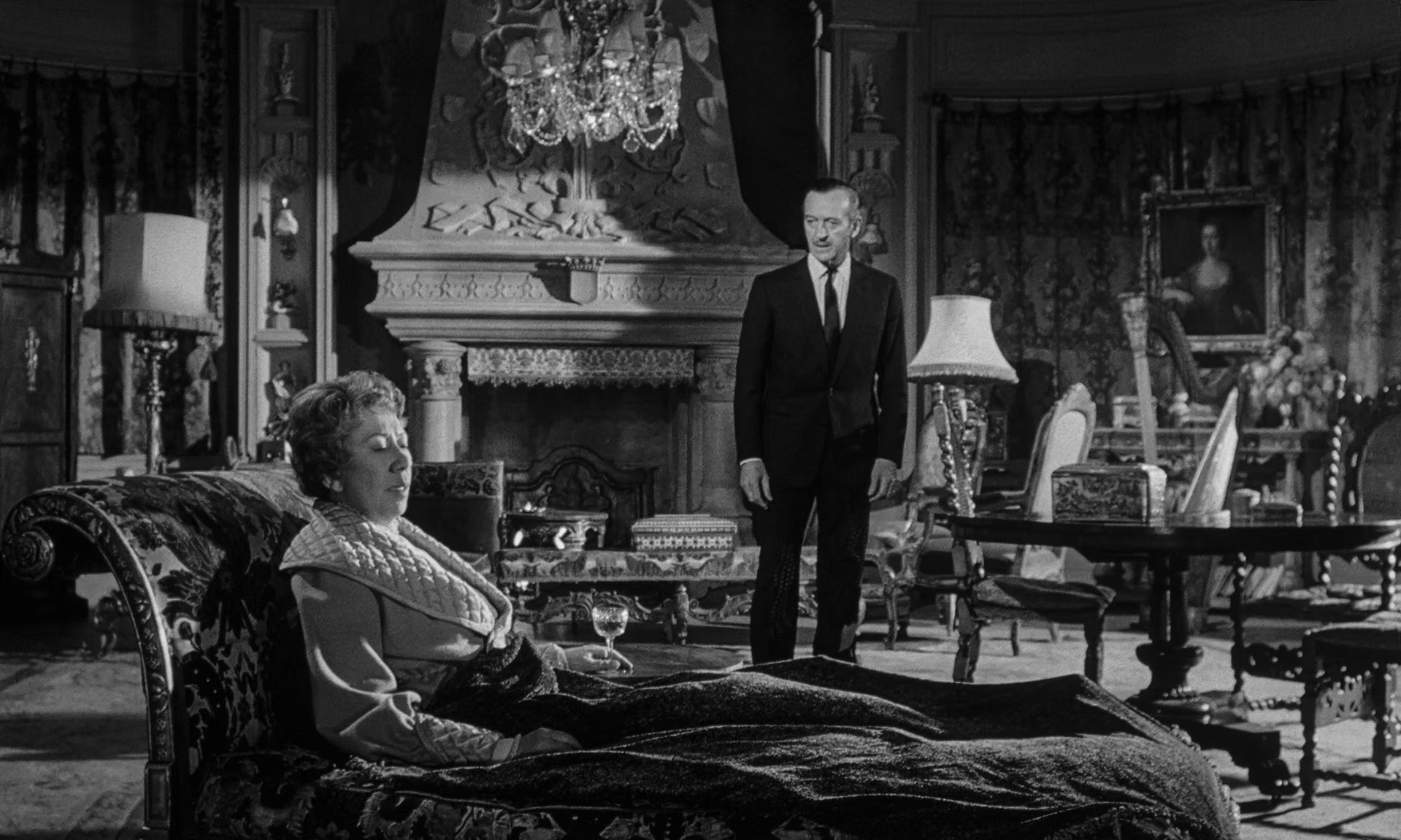
Flora Robson plays Countess Estelle, Philippe de Montfaucon’s aunt and a severe but quietly protective witness to the family’s secret. Countess Estelle stands at the edge of Bellenac like the family’s living memory: she understands the old bargain better than anyone, yet her silence shows how tradition can make even sympathetic people complicit in its cruelty.
What marks Eye of the Devil as a key precursor to folk horror is the way it frames rural tradition not as a quaint background, but as a closed belief system that eclipses modern morality. The vineyard community operates according to an agrarian logic older than Christianity, one in which the land’s survival justifies human sacrifice and collective silence. (Seven years ahead of The Wicker Man, Philippe accepts his fate; Howie is led to it). The film’s imagery- hooded figures, ancient stones, fires, and ceremonies staged against the night- connects that seemingly sophisticated French estate to the same pagan undercurrents that later folk horror would mine more explicitly in films like The Wicker Man. Its real terror lies in the collision between rational, cosmopolitan sensibilities and a self-contained rural world where the “old ways” are not metaphor, but policy. In that sense, Eye of the Devil anticipates the genre’s defining pattern: an outsider wandering into a community whose pact with the land has already been signed in blood.
The film’s opening movement already establishes Bellenac as a folk-horror space defined by summons, inheritance, and a knowledge withheld from the outsider. Philippe does not decide to inspect the failing vines as an ordinary landowner might; he is called back from Paris by a messenger whose urgency carries the force of a command.

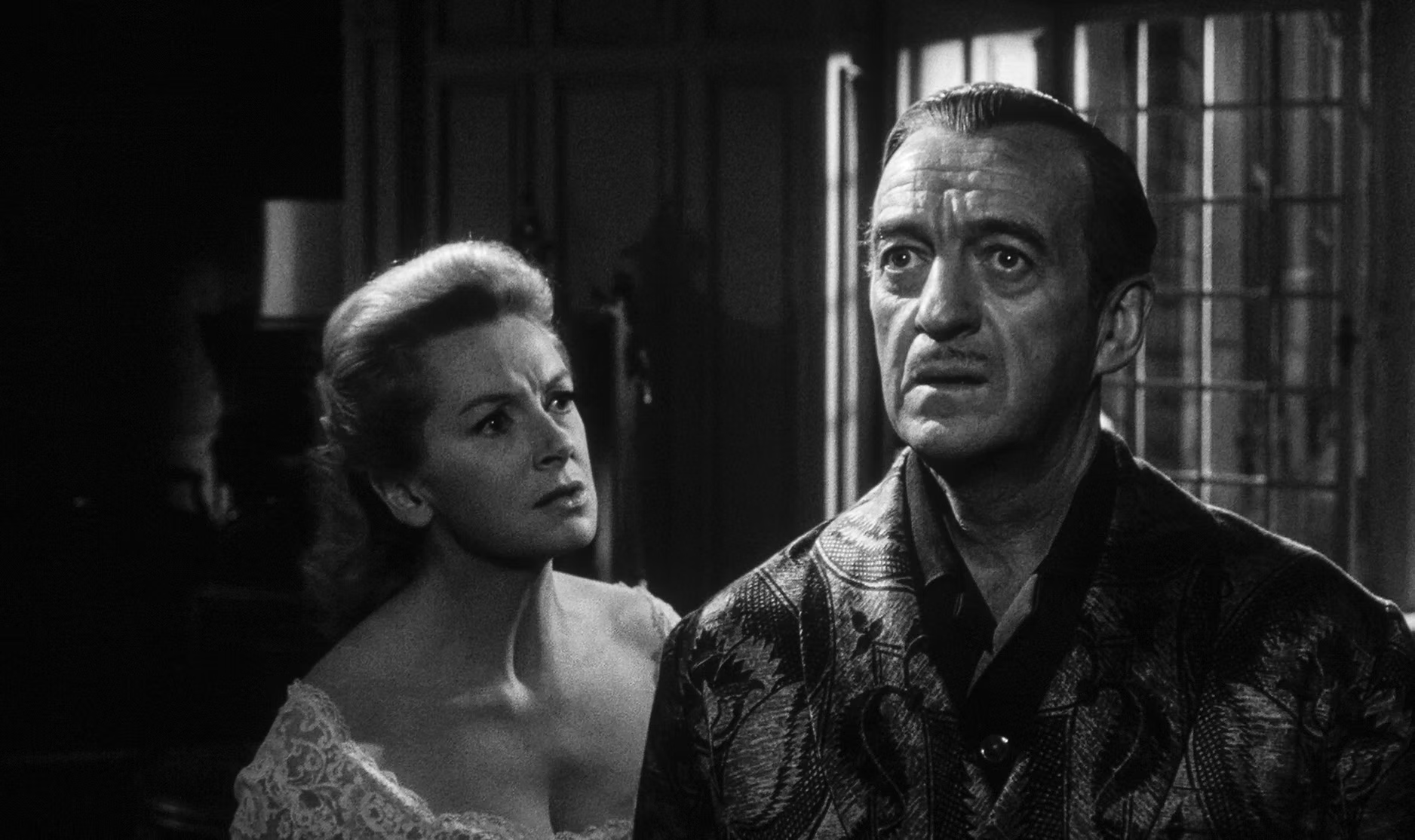
Catherine insists on following her husband and bringing her children with her against Philippe’s protests. This matters because it shows the estate’s ritual logic entering the family before Catherine reaches the château. The children are not merely bystanders to an adult secret: they are receptive to the place, drawn toward it by images and intuitions that the rational adult world cannot translate. Folk horror often makes the young unsettlingly available to the old order, and the Jacques’ growing fascination with the estate suggests that Bellenac does not simply demand a sacrifice from the current Marquis; it also prepares the next generation to inherit the meaning of that sacrifice.
Eye of the Devil is a film about ritualized inevitability, where specific moments quietly declare that this estate is less a home than a shrine. We could linger on the scenes where the villagers gather with a kind of solemn, unblinking calm—no torches or pitchforks, just an eerie acceptance that something must be given to keep the vines alive. The procession-like movements toward the old stones or elevated ground play as rehearsed choreography; the way bodies arrange themselves around Philippe turns him from a protagonist into an offering. Those compositions, framed against austere architecture and wintry countryside, signal that this is folk horror, as everyone seems to be participating in a belief system older than any one person’s will.
Another key thread is the way Catherine moves through the château like a modern woman wandering into a ritual text she cannot read. Each encounter with the children, the priestly figures, or the younger, more overtly pagan presences teases out that divide between rational concern and communal fatalism.


Christian de Caray’s (David Hemmings) first appearance, the casual shooting of a dove from the sky, suggests that generations have repeated the same pattern of sacrifice with ritual precision into a single, elegant image. The dove conventionally evokes innocence, peace, the Holy Spirit, and domestic gentleness, but the arrow that pierces it turns those associations inside out. Christian’s skill is not heroic or recreational; it is a rehearsal for the weapon he will later use against Philippe. When he and Odile (Sharon Tate) bring the impaled bird into the candlelit gathering, they place its body before an altar whose cross resembles the amulet associated with the estate’s hidden tradition.
David Hemmings later became a recurring presence in European and Australian genre cinema, moving from the uncanny ritual world of Eye of the Devil to paranoid psychological horror in Fragment of Fear (1970), Dario Argento’s giallo landmark Deep Red (1975), and occult-inflected films such as Thirst (1979) and Harlequin (1980).
Although Sharon Tate’s screen career was brief, horror gave her two memorable early roles: the eerily self-possessed Odile de Caray in this film, J. Lee Thompson’s occult folk-horror precursor Eye of the Devil (1966), and Sarah Shagal in Roman Polanski’s Gothic vampire comedy The Fearless Vampire Killers (1967), a range that reveals how effectively Tate could turn beauty, vulnerability, and an elusive air of danger into distinctive genre presences.
Deborah Kerr’s most celebrated venture into horror is Jack Clayton’s The Innocents (1961), the exquisitely unnerving adaptation of Henry James’s 1898 novella The Turn of the Screw, in which she gives Miss Giddens a performance of extraordinary, tightly wound intensity—poised between moral determination, psychic wounds, sexual repression, genuine terror, and the terrifying possibility that the ghosts she sees may be projections of her own unraveling mind.
The scene stages an unmistakable collision between Christian symbolism and an older sacrificial grammar: the forms of religion remain—an altar, a cross, a congregation- and the hushed ceremony still looks religious, but they have been taken over and turned into the needs of the fertility cult whose allegiance is to blood, lineage, and the harvest. The dove’s death is a miniature version of Philippe’s fate. What Catherine sees is not an eccentric private rite but a carefully maintained rehearsal for the estate’s human offering.
Odile and Christian are just as important because they show how ritual knowledge is passed down through youth, beauty, and the way it feels casual, natural, and almost entertaining rather than solemn or frightening, through family inheritance and the seductive promise of belonging. Their pale, poised presence carries the eerie self-possession of initiates rather than the impulsiveness of ordinary adolescents; they seem to know the château’s rules instinctively, while Catherine must reconstruct them from glances, warnings, symbols, and forbidden spaces.

Odile’s transformation of a toad into a dove, or the film’s suggestion that she can perform such a transformation, turns a childlike object lesson into an unsettling declaration of power over the natural order.
The siblings’ special attention to Jacques carries an even darker implication. They do not simply menace him; they court him, offering the appeal of secret knowledge and belonging. In a genre so often concerned with closed communities, this matters because the true threat is not only that Catherine is excluded from Bellenac’s inner circle, but that her son may be included in it. The estate’s continuity depends on the next heir learning to accept the tradition that will one day require him to surrender himself to it.
Certain close-ups behave like warnings: faces lit in stark contrast, eyes that look past her rather than at her, suggesting she has arrived too late to change anything. The quiet, staged cruelty of the “tests” and demonstrations she witnesses—moments that seem almost ceremonial in their coldness—mark the film’s folk horror identity. They show a community so bound to the land and its cyclical demands that human life becomes one more season to manage, one more harvest to see through, no matter whose blood is required.
One of the most striking things about Eye of the Devil is how it lets folk horror creep in through small, polished details rather than grand, bloody gestures. You might linger on the sequence where Catherine glimpses Odile (Sharon Tate) and Christian carrying the impaled dove into a candlelit chamber, the bird held with the same unhurried care you might give a family heirloom. The bird’s body transformed into a mute offering as robed figures sit in patient, unnerving silence. The kind of quiet that suggests this is not an aberration but a ceremony that has been repeated so often it no longer feels shocking to anyone but the outsider at the threshold.
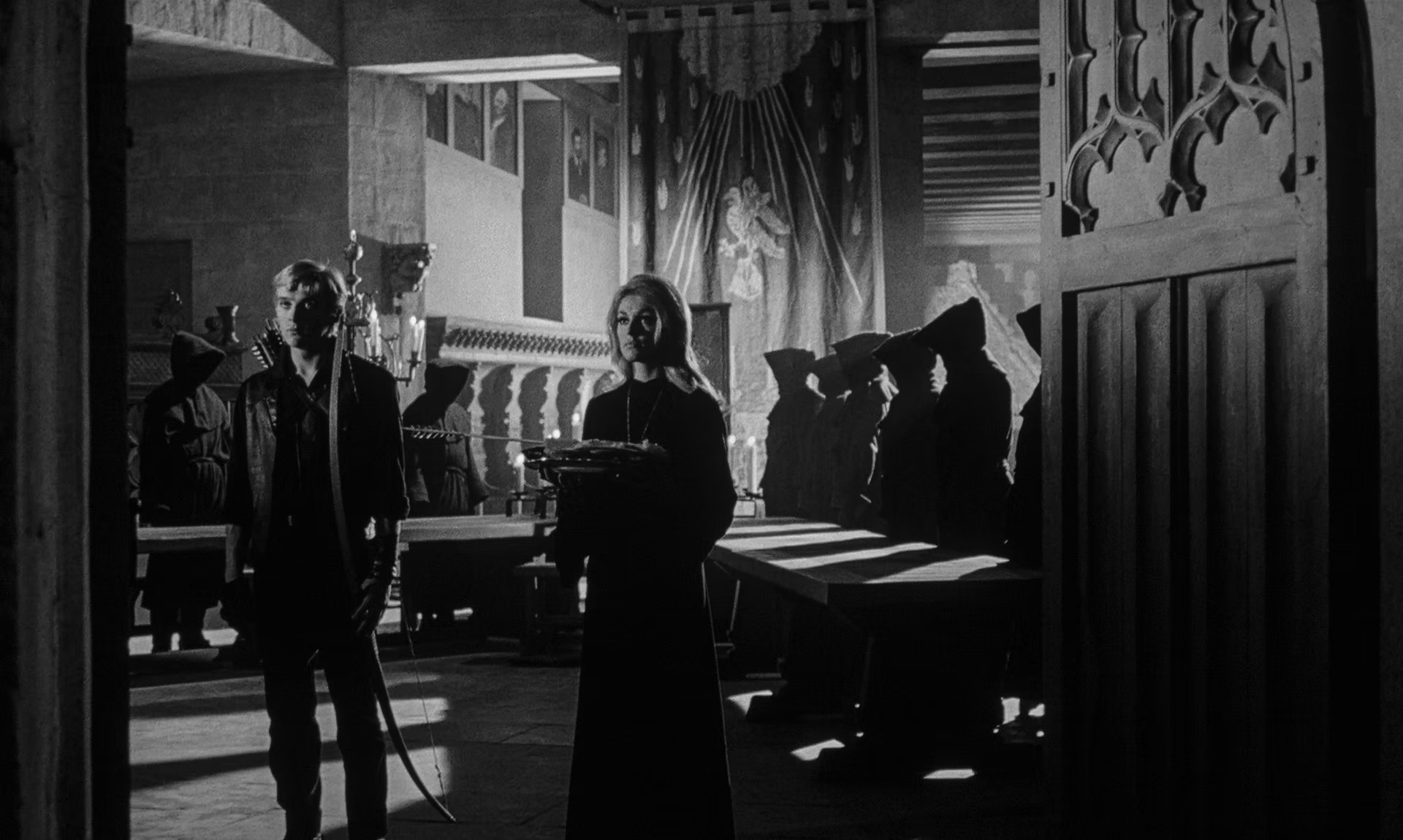

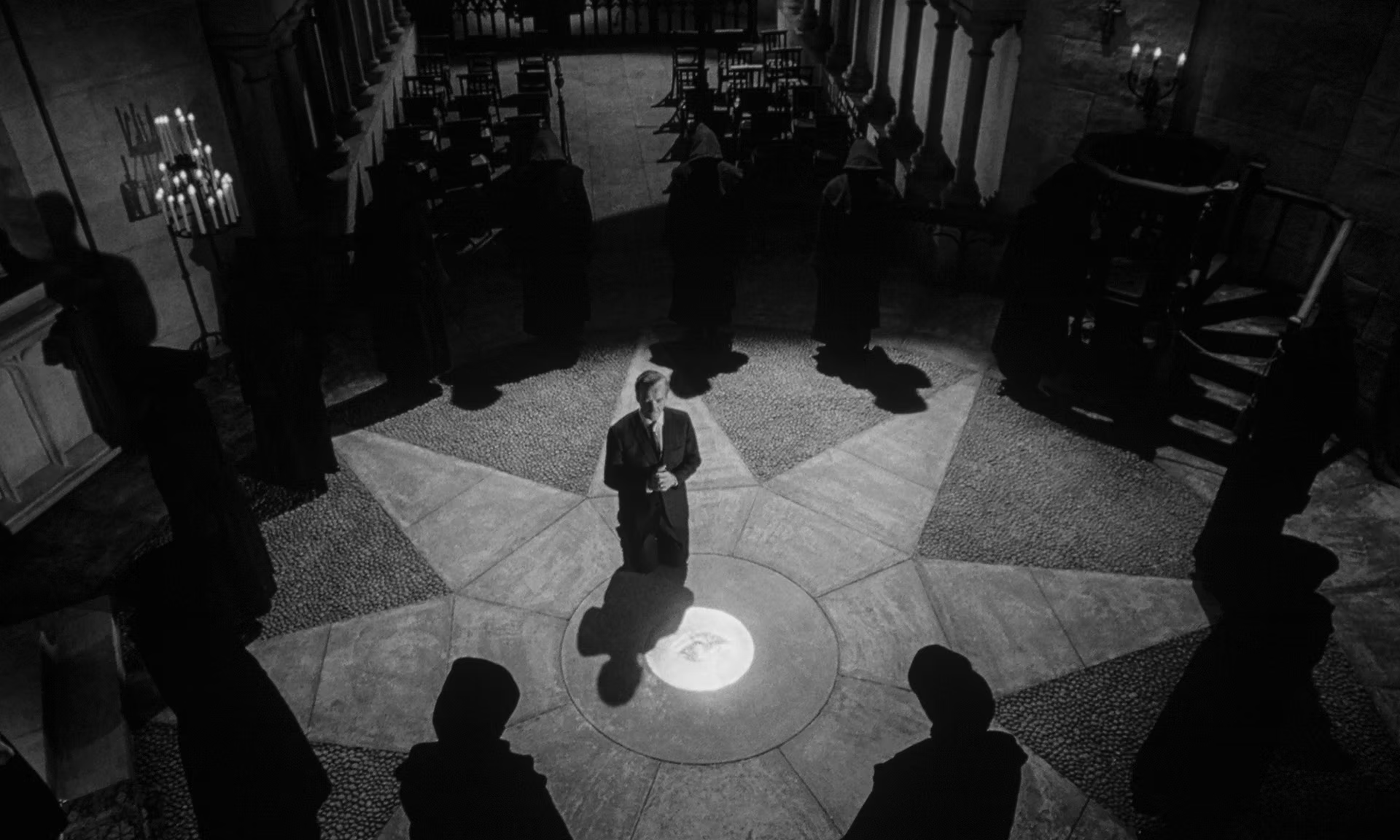
The door shutting in Catherine’s face does more than shut her out of a single room; it seals her off from an entire cosmology that has no interest in explaining itself, a belief system that accepts animal sacrifice as a practical, even necessary, transaction with the land. That casual, matter-of-fact approach to ritual—the sense that the village is tending to its business- is a literal barrier between modern sensibility and a sealed-off cosmology that has no interest in being understood, only obeyed. Rather than dabbling in “evil”—is exactly where the film’s folk horror power gathers. It is folk horror distilled: a private ritual in an old stone room, an animal sacrifice framed as completely ordinary, and an outsider reduced to a witness who is not invited to comprehend the rules. Catherine was never meant to belong at Bellenac; she is not there to be initiated into its ancient rules, only to be kept outside them or, once she learns too much, treated as a trespasser the moment she begins to understand them.
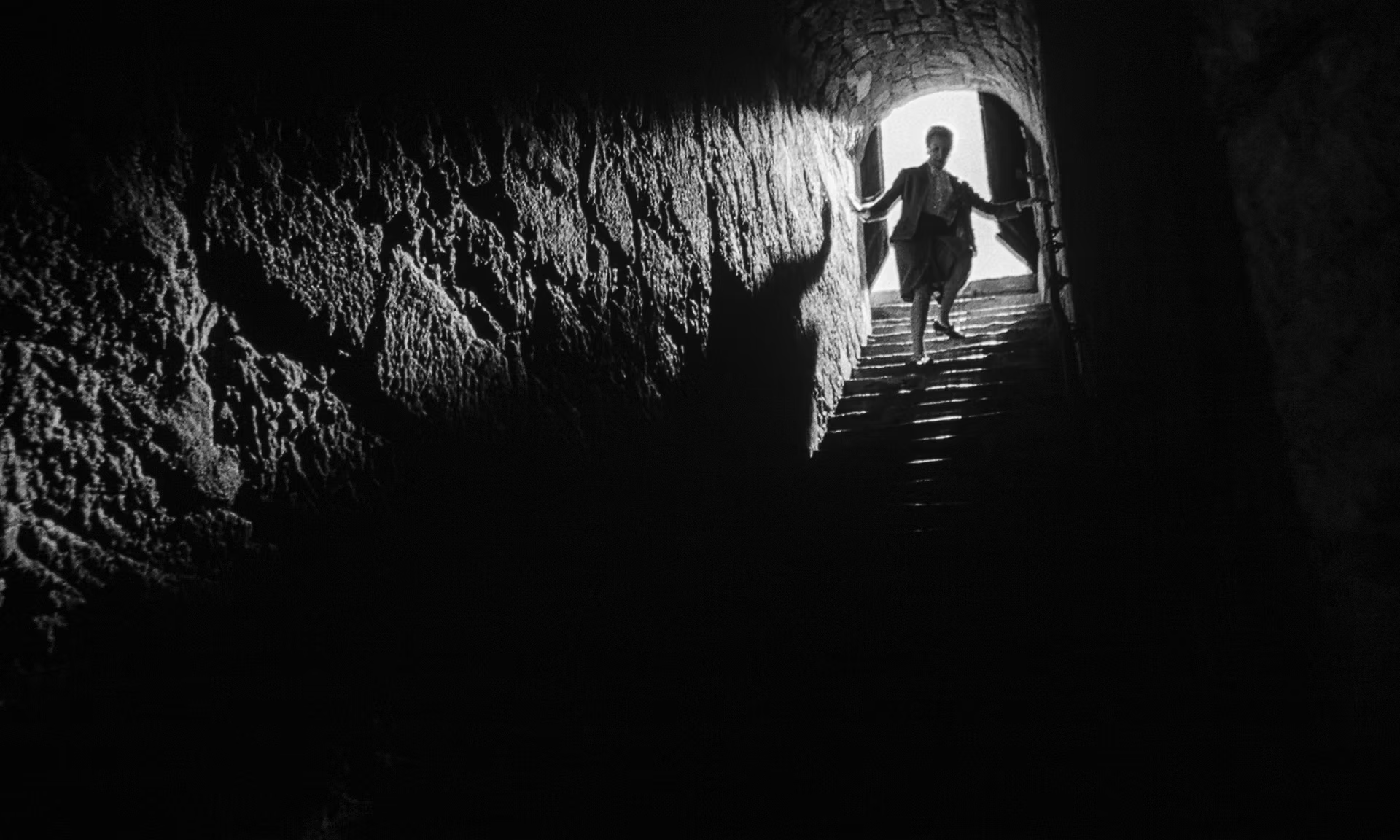
When Catherine wanders into the tomb of Edouard de Montfaucon, the film lets stone do the speaking. Inscriptions and carvings hint at the “twelve dancers” and earlier rites, quietly aligning the château’s present troubles with a lineage of sacrifice that has already been sanctified by time. The mausoleum feels less like a memorial and more like a buried record of promises; it’s a place where debts to the land have been recorded in cold, durable, and unpassionate markers, and the demands have gathered over generations, held in the hush of carved names and weathered stone, and Catherine’s dawning comprehension plays almost like an intrusion into a sealed inheritance.
It reads like an archive of the estate’s real history, one written in stone instead of family anecdotes, suggesting that generations have danced this same pattern of sacrifice in solemn synchronicity with the seasons. When she emerges and is pursued by robed figures, the chase is not about sudden peril or an action beat, so much as it is about enforcement; she has trespassed into forbidden knowledge the community considers sacred property, and the landscape itself seems to tighten around her. It is much more of a reckoning of their laws; and now with her forbidden knowing, the community moves to fold her back into ignorance or remove her altogether.
You can also give special attention to the final woodland procession, when Philippe rides out with the hooded villagers and Christian moving in grim, ceremonial formation. The forest becomes a kind of open-air temple, the trees standing in for stone pillars as Catherine scrambles after them, desperately human in a scene that treats her husband as already half-absent, claimed by custom. Christian’s killing blow feels preordained rather than impulsive, the completion of a pattern that began long before this particular marquis was born—an execution carried out with the affectless calm of people tending their crops. Describing these moments as iterations of a cycle, rather than isolated shocks, lets you argue that Eye of the Devil isn’t just brushing against folk horror; it is articulating the genre’s central idea that a community’s pact with the land can make human life negotiable.
Catherine’s attempts to find help make the film’s insularity still more oppressive. The old man who warns her to leave, later revealed as Philippe’s father, Alain, understands the danger but has become a damaged, marginal figure, unable to break the pattern he exposes. The priest – Donald Pleasence, a familiar face across British cinema and a fixture of horror well beyond Halloween, gives Père Dominic a soft-spoken watchfulness; his reassurances carry the icy certainty of something he considers sacred—and already inevitable.

Meanwhile, Dominic offers none of the moral or spiritual protection Catherine expects. In a conventional Gothic mystery, church and family lineage might provide documents, authority, or sanctuary; here, both are contaminated by the estate’s deeper obligation. The Montfaucon history, with its succession of family heads who have died in suspicious circumstances, turns aristocratic inheritance into a sacrificial role.
All of this bends toward the final woodland procession, where Philippe rides out with the villagers in a formation that reads less as a search party than a pilgrimage. The trees stand like rough-hewn pillars, turning that patch of forest into an outdoor chapel as Christian takes his place at Philippe’s side, not as a rebellious youth, but as the designated instrument of the ritual to come. Catherine’s frantic attempts to catch up feel heartbreakingly human against their measured, ceremonial pace; she is fighting for a husband who has already been surrendered in the eyes of the community. When Christian delivers the killing shot, it lands with the terrible calm of something long agreed upon—an execution that functions as harvest, sustaining the vineyard through blood rather than rain. In these images, Eye of the Devil reveals itself as folk horror at its most refined: a world where the land demands sacrifice, the village complies, and the horror lies in how quietly everyone accepts the cost.

Philippe is not merely selected because he happens to be present during a bad harvest. As Marquis, he occupies the role of sacred king: the man whose body symbolically belongs to the land he owns, and whose death is imagined as the price of restoring its fertility. The film’s folk horror comes from this inversion of class privilege. The château gives Philippe status, wealth, and command, but it also binds him to an ancient debt from which neither rank nor modern urban life can release him.
The final ritual acquires its real folk-horror force through Philippe’s fatalism. Catherine’s fight to save him is urgent because she still sees him as an individual husband and father who can be removed from danger; the community sees him as a necessary figure in an agricultural drama that predates their marriage and will outlast their grief. His procession into the forest therefore resembles a funeral, a coronation, and a harvest rite at once. The horse, the robes, the trees, the quiet movement toward the appointed place, and Christian’s arrow all convert a private murder into an act the villagers understand as seasonal maintenance. Even Philippe’s apparent acceptance makes the scene more unsettling, since it shows how completely the old narrative has colonized personal agency. He is not simply killed by the community; he has been taught that his death is the natural obligation of his bloodline. The ritual’s purpose is the return of fertility to the vines, but its deeper horror lies in the fact that human sacrifice has been made to feel administrative, hereditary, and inevitable.
The ending’s darkest suggestion is that Catherine’s escape does not amount to a true defeat of the tradition. She leaves Bellenac with the knowledge of what the estate requires, but knowledge alone has not been enough to save Philippe, and the children have already encountered its seductive imagery. The film leaves us with a world in which the old rite cannot be dismissed as a delusion belonging to ignorant villagers: it has survived through architecture, kinship, religious disguise, local silence, and the inherited authority of the Montfaucon name. That makes Eye of the Devil such a consequential precursor to later folk horror. It establishes a pattern that The Wicker Man and other films would make more overt—the outsider who discovers a rural community organized around sacrifice, the threatened child who may become the rite’s next believer, and a landscape whose abundance appears to demand a human price. At Bellenac, the vineyard is never merely scenery. It is the altar, the beneficiary, and the silent god to whom everyone else has learned to answer.
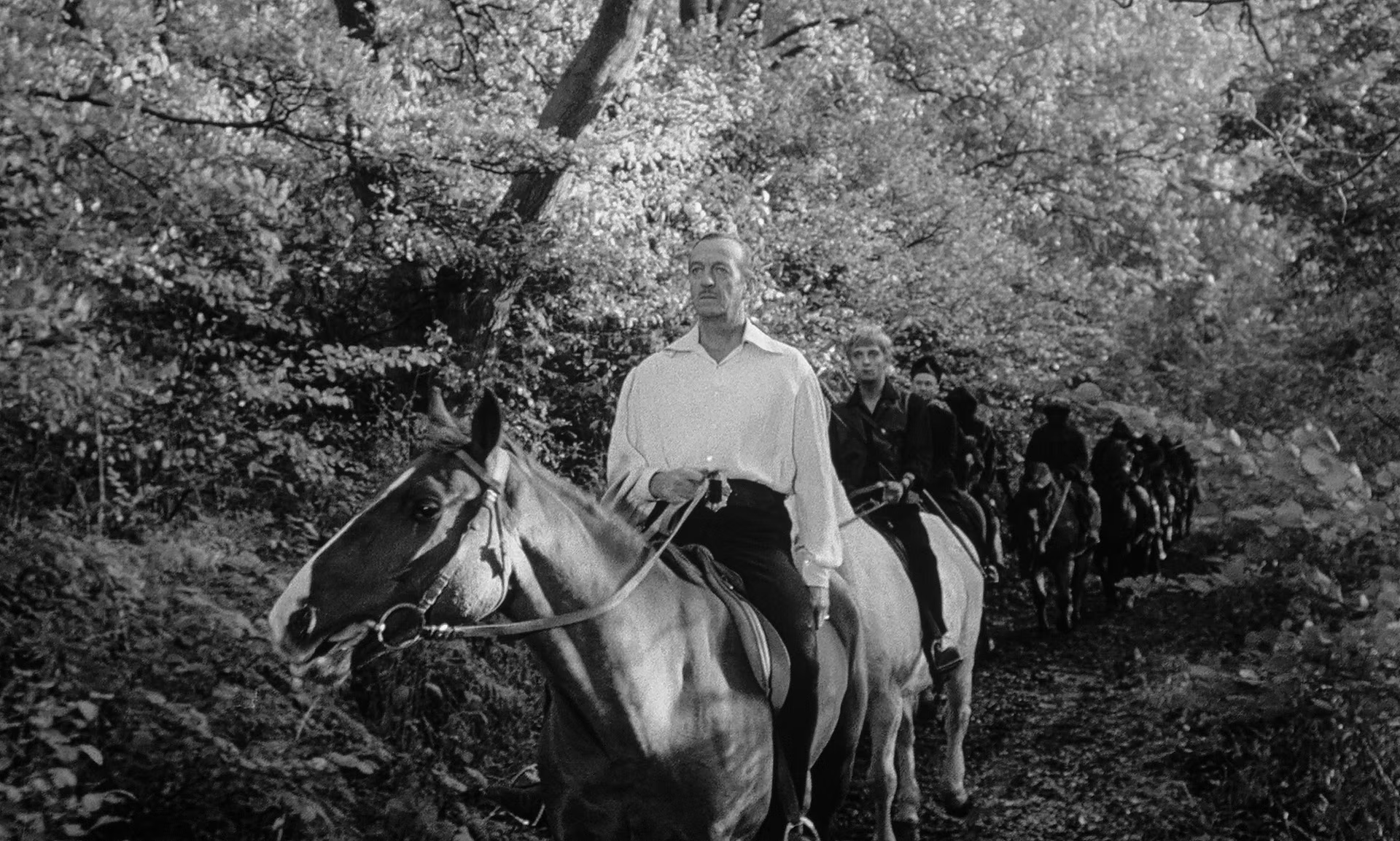
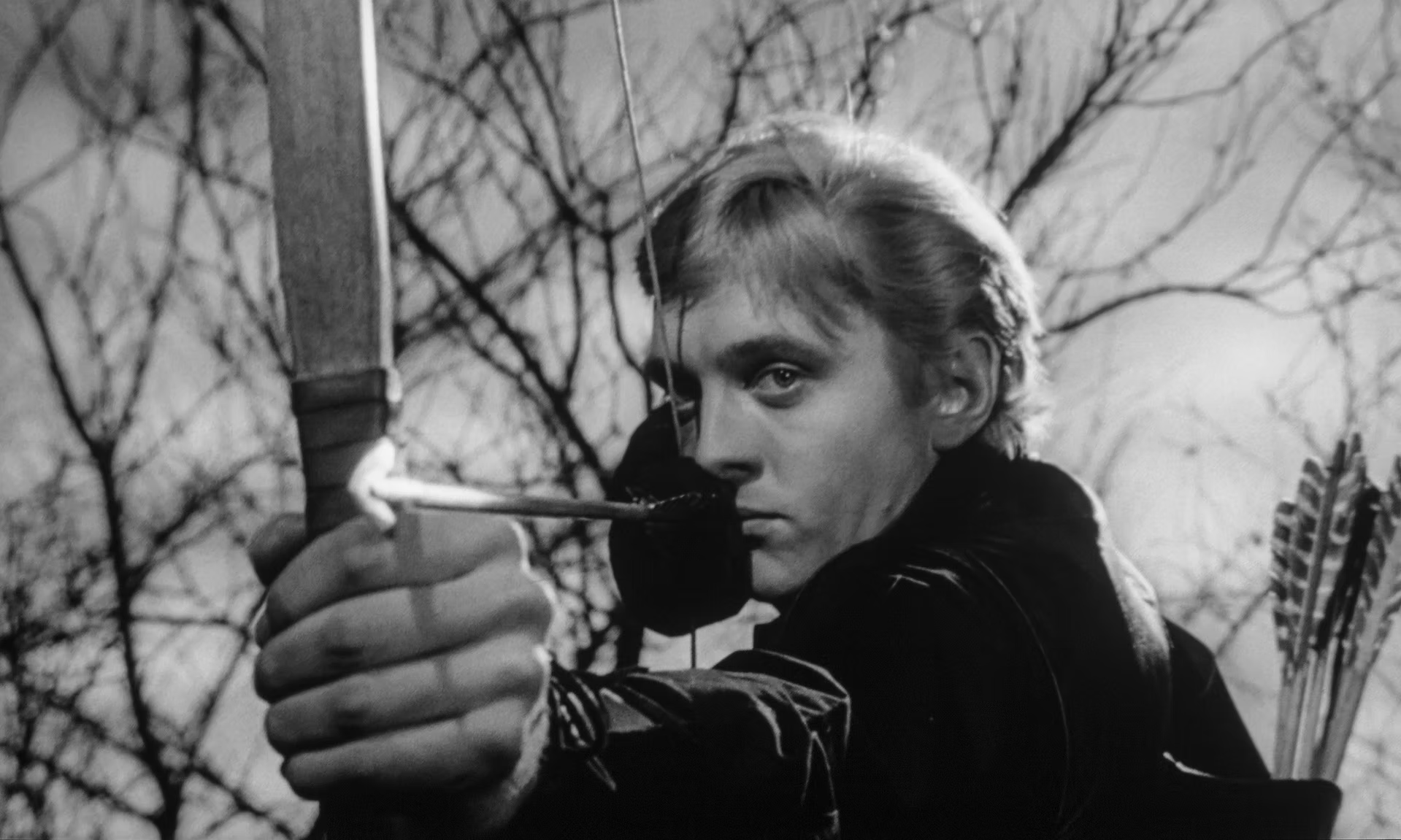
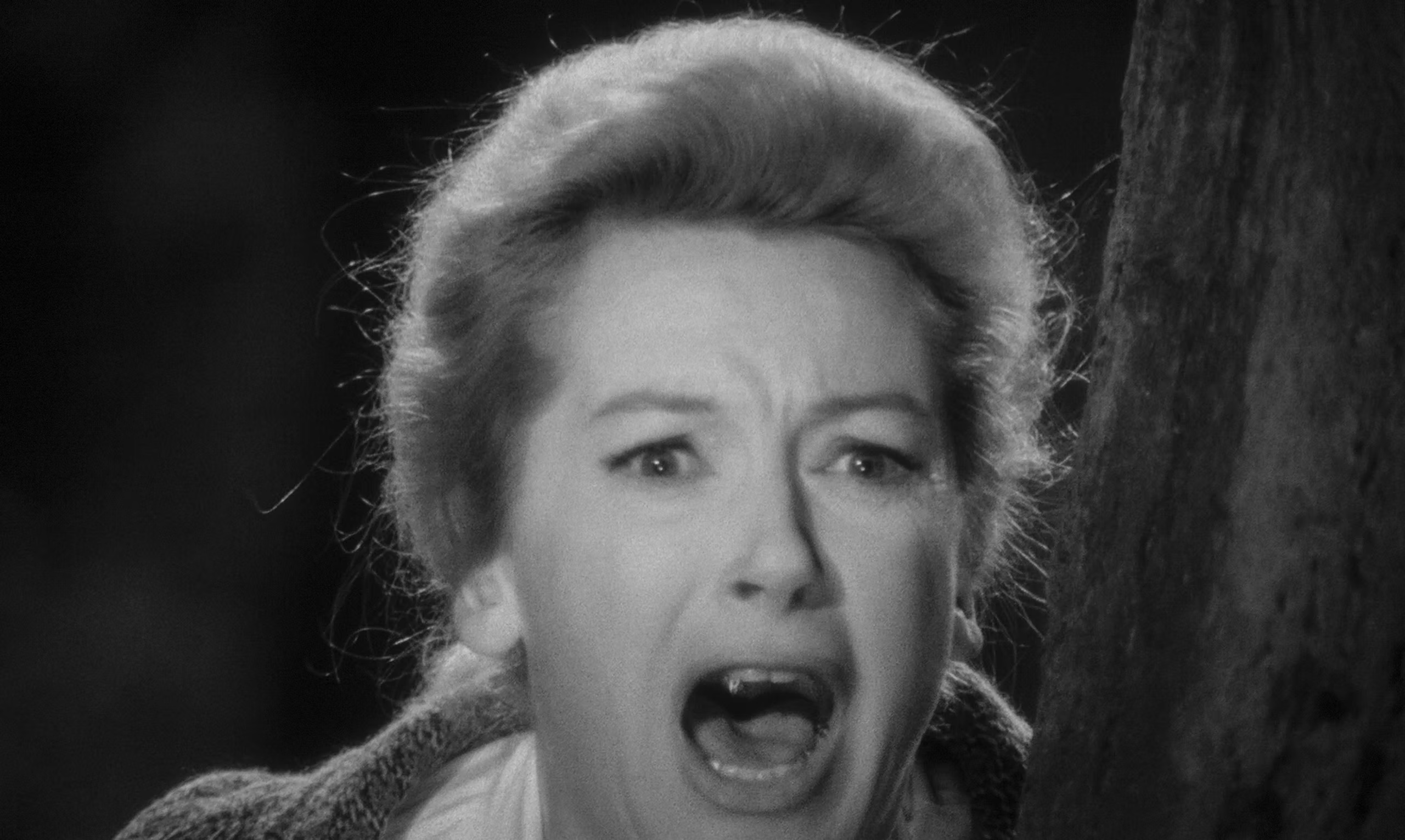
Eye of the Devil and The Wicker Man share folk horror’s foundational premise: a seemingly self-contained rural community preserves a sacrificial religious order beneath the surface of ordinary social life, and that order comes into view when the crops fail. At Bellenac, the dying vineyard demands the Marquis Philippe de Montfaucon as a hereditary offering; on Summerisle, Lord Summerisle’s failing apple harvest requires Sergeant Howie as the carefully selected victim. In both films, silent villagers, guarded rituals, pagan imagery, and the conversion of landscape into an altar make human life subordinate to agricultural renewal. Eye of the Devil anticipates several motifs The Wicker Man would make iconic: the outsider’s gradual discovery of a local secret, a community’s collective complicity, and a ritual killing presented not as murder but as necessary seasonal maintenance.
Their most significant difference lies in perspective and tone. Eye of the Devil is a somber, Gothic mystery seen largely through Catherine’s horrified investigation; its cult operates in shadows, through ancestral obligation, aristocratic secrecy, hooded processions, and the fatal inheritance of the Montfaucon line. The Wicker Man is brighter, bawdier, and more openly communal: Summerisle’s paganism is sung, taught to children, woven into May Day customs, and defended by Lord Summerisle as a coherent alternative to Howie’s Christianity. Where Philippe accepts himself as a sacred king bound to the land, Howie is an outsider deliberately manipulated into becoming the ideal sacrifice. Both end with ritual death, but Eye of the Devil puts forth sacrifice as an inherited family duty, while The Wicker Man makes it the endpoint of a community-wide trap.

Eye of the Devil makes its occult symbolism inseparable from inheritance and agriculture: the impaled dove, hooded gatherings, candlelit rites, ancestral tombs, forest processions, and the ominous image of the “twelve dancers” all suggest a pre-Christian sacrificial system surviving beneath the respectable surface of a French aristocratic vineyard. Philippe de Montfaucon is not merely threatened by that system; as the Marquis, he is its designated sacred victim, expected to die so that the land may become fertile again. This fusion of rural isolation, collective secrecy, seasonal necessity, pagan ritual, and human sacrifice anticipates the central grammar of later folk horror—most notably The Wicker Man—where the countryside’s apparent order depends on an ancient bargain that outsiders discover too late.

THE WITCHES aka The Devil’s Own 1966
Cyril Frankel’s The Witches (1966), starring Joan Fontaine, is very reasonably read as early British folk horror, though it is more often filed under Hammer witchcraft or occult horror. It has nearly every major folk-horror mechanism: an isolated village, an outsider trying to recover from trauma, a local community governed by secrecy and superstition, corrupted religious imagery, a clandestine coven, a seasonal rite, and the threatened sacrifice of a young woman. Its structure is particularly folk-horror in the way it makes Heddaby look like a refuge before revealing it as a closed system.
Gwen Mayfield begins the film as a British missionary schoolteacher in Africa, a figure of colonial Christian authority who arrives to reach, reform, and impose an outside moral order; she believes that education, order, and rational certainty can hold local superstition at a distance. Her return to the rural village of Heddaby unsettles that confidence, revealing that the old occult world she imagined she had escaped is waiting within England itself.


She comes to the village hoping to recover after the traumatic witch-doctor attack that led to her breakdown, but the place repeats the conditions of her earlier terror rather than curing them. Her trauma makes her perceptions vulnerable to dismissal: when she suspects that local people are practicing witchcraft, her past seems to provide an easy explanation that others can use against her. This is a familiar folk-horror arrangement: the modern outsider recognizes a local evil but lacks the social authority to name it, while the village’s calm surface becomes part of its menace. The film also turns the institutions that ought to give Heddaby stability into signs of absence or disguise.
The church is in ruins; Alan Bax wears a clerical collar despite not being a minister; and the school is neither an innocent civic space nor a clear refuge for children. These details make the village feel spiritually unmoored, a place where the forms of ordinary English respectability remain but their moral content has drained away. When the child Ronnie’s doll is found with pins driven into it and its head removed, the domestic plaything becomes a poppet: a small, tactile folk object through which hidden power can be exerted at a distance. Ronnie’s sudden illness gives the superstition material force, confirming that the community’s old practices are not merely local color or the residue of an older generation. The climax firmly places the film in folk-horror territory. Wonderful British actress Kay Walsh plays Stephanie Bax, whose coven gathers at the ruined church on Lammastide, the early-August harvest festival, to sacrifice Linda and renew or extend the witch’s life.


The choice of a calendrical, agricultural feast day matters: it connects the coven’s hidden authority to seasonal ritual rather than to the arbitrary plotting of a conventional thriller. Linda’s virginity is treated by the cult as ritual currency, while Gwen’s intervention, cutting herself and smearing blood onto Stephanie’s robe, turns the rite’s own demand for spiritual purity against its leader. The scene offers a characteristic folk-horror inversion: the countryside’s apparently harmless customs are revealed as the surface of an older sacrificial order, and the only way out, the only way for salvation to arrive, is to understand the ritual’s rules well enough to break them.


Cyril Frankel’s The Witches (1966) is an overlooked early folk-horror film, disguising its occult terror within the quiet routines of an English village. Like later classics of the form, it begins with an outsider seeking refuge in the countryside and discovers that rural calm is sustained by silence, secrecy, and an older ritual order. Heddaby’s ruined church, false reverend, bewitched doll, and Lammastide sacrifice make the film feel like a rehearsal for the British folk-horror cycle that would fully emerge in the latter part of the decade and the 70s to follow.

WHISTLE, AND I’LL COME TO YOU 1968
Primarily a supernatural ghost story, Whistle and I’ll Come to You 1968 nevertheless brushes against folk horror through its ancient relic, isolated coastal landscape, and the past’s malevolent return. Jonathan Miller’s Whistle and I’ll Come to You (1968) is a 42-minute BBC television adaptation of M. R. James’s 1904 ghost story “Oh, Whistle, and I’ll Come to You, My Lad,” written and directed by Miller and starring Michael Hordern as the rationalist Professor Parkin.
Professor Parkin approaches a seaside holiday with the anxious precision of a man who has packed not merely a suitcase but an entire private constitution: every meal, walk, object, and conversational exchange must occur at its proper distance, in its proper order, and preferably without the inconvenience of another person. Michael Hordern is so good at making Parkin’s little routines feel suffocating that I find myself wanting to take a breath for him, as if even the air around him also has to follow his rules.
Hordern makes Parkin’s rationalism feel less like calm intellectual confidence and more like a collection of little habits and a system of small rituals he relies on to get through the day – those solitary breakfasts, going on his carefully planned jaunts on the beach, and avoiding too much conversation he has no interest in carrying on with the other guests.
That is why the whistle is so unsettling: it brings something strange and impossible into a life Parkin has arranged so neatly that nothing unexpected is supposed to get in. He has built a life around keeping everything in its place.
Because Parkin is happiest keeping to himself, his preference for isolation, his discomfort with hotel sociability, dodging the small talk at the hotel, and finding a sensible explanation for anything strange, denying the existence of the uncanny, make that collapse of routine especially pointed and particularly satisfying and unsettling to watch as his carefully managed routine starts to come apart.
That fussy self-containment makes Parkin an almost comically ill-suited folk-horror outsider, a man who meets the irrational not with curiosity or reverence but with the reflex to tidy it away, yet the joke turns into dread when the presence he has dismissed proves capable of entering the carefully sealed world of his routines.
Set against the desolate East Anglian coast, it is an austere, foundational work of British folk horror: while holidaying near Norfolk, Parkin finds an ancient bone whistle in an eroded Knights Templar graveyard and, by blowing it, summons a hostile presence that overturns his certainty in reason. The film’s empty beach, exposed burial ground, ambiguous relic, and landscape-bound supernatural force make the past feel physically uncovered and dangerously alive in the present.
For me, Miller’s adaptation really gets its folk-horror power from Parkin’s casual relationship to the whistle. He does not inherit it, receive it as a warning, or approach it with reverence; he digs it up from an eroded graveyard, wipes the sand from it with the mild pleasure and curiosity of someone who has stumbled across an unusual little find, an interesting collectible, and then blows it almost for the fun of it.
His small act of curiosity, that gesture, turns the story into a quietly potent drama of intrusion: as a modern academic, Parkin treats the remnant of an older, sacred order as an object to be examined almost too casually, something available for him to inspect, classify, and even possess, and assumes that finding it gives him the right to handle it. He assumes that because he has found the whistle, he is entitled to use it. Yet Parkin soon discovers the object carries its own history, rules, obligations, and consequences that he cannot understand, let alone explain away. He cannot read in any meaningful sense, even when the evidence is literally engraved on it.
Its Latin inscription—“Who is this who is coming?”—feels less like a mysterious riddle for him to solve than a question; no, an invitation he accepted the moment he put the whistle to his lips. Parkin answers the second he blows it. In the logic of folk horror, the past is never really gone; here it hasn’t vanished beneath the sand. It is only buried for a while; time hasn’t made it harmless. It waits for the moment an outsider – Parkin mistakes access for permission.

The beach sequence gives that idea its unforgettable visual form. Parkin walks alone across an immense, nearly empty shoreline, repeatedly looking back toward a distant, indistinct figure that seems all at once stuck in its place and impossibly close. The sight is frightening precisely because it is not placed in a traditionally Gothic setting: there is no ruined castle, thunderstorm, or crowded cemetery to announce danger. There is only wind, winter daylight, the exposed coast, and a solitary body moving across a landscape that offers no shelter. Miller turns East Anglia’s flatness into a mechanism of unease. The coast makes Parkin visible, vulnerable, and unable to tell whether he is being followed; it is a landscape in which the boundary between land and sea, present and past, has literally been worn away by erosion like the shoreline.
The apparition’s connection to ordinary, physical objects matters just as much. Instead of giving it a clear, fixed theatrical form, Miller lets it feel unstable—something that seems to emerge from the everyday things around Parkin rather than appearing as a straightforward figure. Miller lets it emerge through flapping fabric, disturbed bedclothes, strange sounds, a figure on the shore, and finally the empty second bed in Parkin’s hotel room.

The famous image of a ragged, sheet-like shape moving along the beach makes the familiar uncanny: It appears first as a distant, vague figure during Parkin’s walk and then much more vividly in the dream/chase sequence; it follows him across the sand, resembling a tattered sail or scrap of fabric rather than appearing as the conventional human ghost. The figure is more unsettling because it never settles into a reassuringly recognizable shape; it is a moving, half-seen presence that remains open to interpretation, letting Parkin’s fear—and ours—fill in what the film refuses to define. Miller repeatedly keeps it distant, obscured, and unstable, so it can feel at once supernatural and like an outward form of Parkin’s own unraveling, a metaphor, just like the tattered sheet itself.
The presence also emerges as domestic linen that becomes a shroud, and the comfortable guest room becomes an extension of the graveyard Parkin believed he had left behind. The supernatural does not remain outdoors, contained by the ruins or the landscape; it follows him into the temporary domestic refuge of the hotel, collapsing the distinction between his rational, private world and the force he has summoned. The minimal effect is a crucial part of its power; the apparition is barely defined, so we are forced into Parkin’s position of sensing a presence before being able to name it.
Parkin’s breakdown- he is reduced to frightened sounds and whimpers, sucks his thumb, and can barely repeat “Oh no.” at the end also makes the film feel like more than a typical ghost story. The whistle does not just punish him for being curious—it slowly dismantles the intellectual certainty he has used to keep his life neat, ordered, and explainable. His solitude is initially comical because he seems so content to keep the world at a distance, but it becomes unbearable once he can no longer trust what he sees, make sense of what is happening, or even feel safe in the privacy of his own room
The film treats isolation as more than simply a location; it becomes part of what makes him vulnerable to the presence that begins to close in around him

Whistle and I’ll Come to You feels almost like a small blueprint for the British folk horror that would follow. Parkin is the familiar outsider: he arrives in a place whose quietness seems to conceal a buried history he cannot see, uncovers a relic that ties him to an older system of belief, and finds that the beach and surrounding landscape are becoming less like scenery than something that quietly works against him. What unsettles him is not simply the possibility of a ghost, but the discovery that all his knowledge cannot grant him control over the past. And common sense gives him no real control over what he barely understands.
Its power comes from how little it needs to make that point. Its modest storytelling is exactly what makes this story so enduring. There is no elaborate mythology or grand spectacle—just a whistle, an empty stretch of beach, a hotel room, and one increasingly frightened man. Yet those few elements are enough to make the past feel not distant or safely buried, but uncomfortably close, as if it has been waiting just beyond the edge of Parkin’s orderly world.

WITCHFINDER GENERAL 1968
Michael Reeves’s Witchfinder General was released in 1968 in the UK on 19 May 1968 and is commonly grouped with The Blood on Satan’s Claw (1971) and The Wicker Man (1973) as the British folk-horror “Unholy Trinity.” It is not folk horror because witchcraft proves real; it is folk horror because of a rural landscape, civil conflict, religious dread, and communal superstition that allows human cruelty to become its own kind of demon.
A landscape made vulnerable. Witchfinder General turns the English countryside into an exposed wound. Its villages, fields, churches, taverns, and muddy roads offer none of the pastoral safety usually promised by the period film; they are isolated pockets of fear where the law has thinned out, and violence travels freely on horseback. In the disorder of the English Civil War, Vincent Price manifests the brutal (and nobody does it better) Matthew Hopkins, who moves from village to village with the authority of a plague, converting rumor into accusation and accusation into torture. The horror is rooted in a folk-horror truth more chilling than any curse: when a community is frightened enough, superstition can become a system of government.


The story is a heavily fictionalized account of the real Matthew Hopkins, who claimed authority to identify witches during the English Civil War. The film makes its horrors very much and deliberately human; there is no proof that its victims possess occult powers, so Hopkins’s methods expose belief itself as a weapon. The film is unusually political among foundational folk-horror works: paganism and witchcraft are not the source of terror but an excuse by which men acquire money, status, sexual access, persecution and destruction of women especially, and ultimately social control.
It is the false ritual of justice. Reeves presents witch-hunting as a grotesque civic ritual. Villagers gather, testimony becomes performance, torture produces the confession it requires, and hanging or drowning turns public punishment into the spectacle of collective ceremony. Hopkins and John Stearne do not uncover evil; they manufacture it, making the bodies of vulnerable people carry a community’s terror, misogyny, and hunger for order.
The witchfinder’s methods—searching, stripping, pricking, dunking, and execution—function like folk ritual corrupted into bureaucracy: a repeated sequence through which ordinary people convince themselves that violence is purification.

Reeves understands that witch-hunting depends on performance. Early interrogation scenes do not simply establish Hopkins’s cruelty; they show the social theatre where his authority is created. His methods require an audience: villagers see a suspected witch searched, subjected to ordeals, accused of possessing unnatural marks, and forced into the verbal shape of a confession.
What strikes me as the most common element in these witch-hunting films is how self-validating the whole process becomes. Torture produces terror, terror produces submission, and that submission is then displayed as proof that the original accusation must have been right. Witchfinder General treats persecution as a kind of twisted folk ritual. Its gestures are repetitive and ceremonial: questions, examinations, dunking, payment, execution, but instead of binding a community through seasonal memory or shared belief, they bind it through the public spectacle of an expendable victim. Hopkins’ genius, if that is even the word for someone so vile, is his ability to make exploitation look like communal cleansing.
Rural England’s nightmare landscape: If later folk horror imagines an ancient countryside rising against the modern outsider, Witchfinder General imagines something bleaker: a countryside already terrorized by its own people. There is no hidden cult waiting in the woods, no supernatural god beneath the soil, only the devastating discovery that faith, folklore, and fear can make a monster of a man in broad daylight.
Hopkins needs no demon at his shoulder. The villagers’ need to believe in witches gives him all the power he requires. That grounded cruelty is why the film is such a foundational work: it helped establish a strain of British folk horror in which landscape is not merely scenic, ritual is not necessarily pagan, and the oldest horror may be the human institution that calls itself righteous.


Vincent Price gives one of his most chilling performances as Matthew Hopkins, the self-appointed “Witchfinder General,” a man who moves through the torn landscape of Civil War England with the cold assurance of someone convinced that cruelty is a form of that righteousness. Rather than playing Hopkins as a theatrical monster, Price makes him unnervingly controlled: his soft voice, rigid composure, and bureaucratic calm make each accusation feel more vicious. He turns village superstition and religious panic into a private industry, traveling from community to community to manufacture guilt, extract confessions through torture, and profit from fear.

The film’s brutal power comes from its refusal to place horror safely outside ordinary life. Hopkins does not descend on East Anglia as a flamboyant villain from a Gothic castle; he arrives through inns, village squares, farmhouses, churches, and courtrooms, spaces that ought to organize communal life but which the war has left exposed and open to intrusion. Michael Reeves repeatedly frames the countryside in broad, beautiful views, allowing the pale sky, green fields, and scattered villages to resemble the England of pastoral memory before filling those same spaces with cells, chains, gallows, mounted men, and public humiliation.
The contrast is fundamental to the film’s folk-horror power. Nature has not become visibly cursed, yet the landscape is made uncanny because it cannot protect those who live within it. Its openness means that no village is beyond Hopkins’s reach; each isolated settlement becomes a small jurisdiction where fear can be converted into spectacle. The Civil War remains mostly offscreen, but that absence makes it feel more pervasive, an unseen national rupture that has stripped local communities of security and allowed private violence to masquerade as public duty.
The devastation of John Lowes (Rupert Davies) and Sara (Hilary Dwyer) makes the film’s politics personal without narrowing it to a private revenge plot. Hopkins recognizes immediately that local patriarchal authority can be bent to his purpose: Lowes’s status as priest and landholder cannot protect him once the witchfinder turns the community’s fear against him, while Sara’s body becomes the site over which male power repeatedly asserts itself. Hopkins’s bargain with Lowes, the torture that follows, and the coercion of Sara expose the obscenity concealed behind his claim to moral order. His witch-hunting is inseparable from sexual domination, class power, and profit. That is why the film’s horror has such a forceful folk-horror resonance: it does not imagine folklore as a quaint survival in the countryside, but as a language through which an anxious, divided society can decide whose body will bear the burden of its fears. The supernatural never has to appear because the belief in it already produces material suffering. Belief gives it hands enough to do its work; the harm done in its name is real enough.
Richard Marshall’s (Ian Ogilvy) pursuit of Hopkins initially seems to promise the moral restoration of a revenge narrative that folk horror so often refuses to give us: the persecutor will be hunted down, the innocent who suffer will be avenged, and the lover driven to vengeance will eventually set things right. Seeking justice for what was done to Sara, Richard’s rage will finally bring an end to Hopkins. The corrupted rural world is returned to order. Reeves dismantles that expectation in the dungeon climax.

When Richard breaks free and attacks Hopkins with an axe, the killing does not read as heroic cleansing justice at last, but as the final horrifying release of rage; it’s the contagion of a violence that mirrors the unrestrained brutality Hopkins has spread through village after village throughout the film.
Richard has been pulled into the same brutal logic that drives the witchfinder: pain must be answered with more pain, bodies become proof of that brutality, and vengeance is treated as something the world demands. By the time he reaches Hopkins, his anger transforms him from rescuer into another figure trapped inside the same cycle of violence Hopkins created.
When his fellow soldiers shoot Hopkins before Richard can fully finish him, this act doesn’t restore anything; it can’t undo its moral damage. It only leaves the violence hanging in the air, with no one truly saved by it. Richard’s final attack seems, for a moment, like the justice the film has been withholding: the persecutor is finally helpless, the lover has arrived, and the violence might at last be returned to its source. Instead, Richard is swallowed by the same brutal logic that has governed the film from the beginning.


Hopkins’s death does not restore Sara; she is left psychologically shattered after her torture and sexual violence, and can only scream; Sara’s scream and Richard’s answering cry leave us with something far more unsettling than revenge: the feeling that violence has simply moved through everyone it touched. Richard’s scream rising to meet Sara’s closes out the film on the sound of two people pushed past the point where words or revenge can offer any comfort.
None of this heals the community, or returns the world to moral order. There’s a refusal of redemption, with Richard becoming as violent as the men he pursues and Sara left ruined rather than saved.
In folk-horror terms, the false ritual of purification has achieved the opposite of what it set out to do. Rather than driving evil from the community, it has distributed evil through it, leaving the survivors unable to return to the world that existed before the accusation, interrogation, and punishment began.
The culmination of the film’s folk-horror argument reveals that a community cannot be purified through ritualized violence, because the violence has already become its shared language. This final refusal of catharsis is why this iconic film remains so central to the folk-horror canon. The climax is what makes Witchfinder General an essential part of British folk horror’s Unholy Trinity, and such a powerful counterpoint to folk horror built around literal supernatural forces. It finds the genre’s terror without ever needing a witch to be real.
For me, the film gathers together so many of the elements and earns its place beside the other folk horror we associate with the genre, but not because it gives us folk horror in its familiar form: it strips that form down to its most disturbing truth. It has the isolated villages, a vulnerable rural community cut off by geography and the wider national crisis; an old belief that seems to offer certainty when everything else feels unstable; the ritual of accusation and punishment; the authoritative figure who claims to hold all the answers; the rites, and the scapegoated body on which society stages and acts out its idea of purification; the threatened landscape, the rites, the old beliefs, and the sense of a past pressing hard against the present. But Reeves turns each of these elements inside out. The ancient force haunting the English countryside is not witchcraft at all, but the very human willingness to turn rumor into law and cruelty into virtue. That, I think, is what makes the film’s pastoral England feel so unsettling and extraordinarily bleak, that even in broad daylight, it becomes one of British cinema’s most haunted landscapes.
There is no literal demon to banish and no hidden ancient pagan god to destroy and no occult revelation that explains away its terror. Hopkins is mortal, and he can be killed, but the ideological machinery of persecution that often powers folk horror is horrifyingly human. And the haunting remains after the supposed monster is dead shows us how what made him possible—war, misogyny, religious panic, local suspicion, and the desire to see suffering as moral order—outlives him. His death offers no catharsis.

Reeves replaces the genre’s conventional climactic exorcism with a more devastating realization: the countryside has not been haunted by an outside evil at all; it has been trained to perform its own terror. The final screams are the sound of that recognition, leaving the pastoral landscape morally ruined even when the witchfinder is gone.
Alongside The Blood on Satan’s Claw and The Wicker Man, it understands that a landscape can hold more than scenery: it can preserve fear, memory, division, and the pressure of older beliefs. But Reeves gives that idea its harshest form. His England is not possessed by an ancient life force or secretly governed by a pagan cult; it is made monstrous by people who decide that cruelty is righteous, and by communities so frightened that they allow violence to pass for protection. The film is widely treated as one of the three foundational works of British folk horror, precisely because it makes the countryside, communal ritual, belief, and isolation feel inseparable from its sanctioned violence.
That is why the film still feels so bleak. Hopkins can be killed, but there is no satisfying release once he is gone, because he is not the whole problem. He has learned how to make war, religious panic, local suspicion, persecution of women, and institutional authority work together—and, more disturbingly, he has shown others how easily they can be made to work. The villagers’ fears give him an audience; the rituals of accusation and punishment give him legitimacy; and the landscape’s scattered, vulnerable communities give him room to move around freely. The horror is not that evil has invaded rural England from somewhere outside it, but that it has found a language the countryside is already prepared to speak. Reeves refuses the comforting promise that revenge will repair what Hopkins has destroyed. Reeves leaves us in broad daylight with an England that looks beautiful but has been morally devastated—a folk-horror world where the most frightening thing is not what may be buried in the soil, but what ordinary people can persuade themselves to do to one another.
1970S

CRY OF THE BANSHEE 1970
The Banshee’s Fatal Summons -The Cry That Foretells Death; The Sound of Inherited Doom:

A few years later, Cry of the Banshee (1970) returns to the witch-hunting anxieties running through late-1960s and early-1970s horror cinema, again casting Vincent Price as a man who uses moral authority as a license for cruelty. Gordon Hessler’s film embodies a classic British folk-horror narrative set against the bleak puritanical backdrop of England, a place where the cold stone walls and misty moors hide not just secrets but something far darker.
The film features one of the best titles designed by Terry Gilliam, whose use of evocative folk art is followed by this epigraph. “England in the Sixteenth Century a dark and violent time. Witchcraft and the ghosts of the old religion still hold sway in the minds of the people, preoccupying both the law and the church, for who can be sure that it is just primitive superstition and childish fear?”

Gordon Hessler’s film plunges us right into this dire, oppressive world through the eyes of Lord Edward Whitman, a magistrate who tortures anyone he recklessly deems a witch, whose cruelty towards accused witches is as brutal as it is unrelenting. His violent witch-hunts tear through a rural community, brandishing not just iron tools but a merciless moral absolutism that understands no mercy. Yet, as he wields power through torture and fear, the film’s heartbeat pulses from the coven’s leader, Oona (Elizabeth Bergner), whose wrath is a chilling invocation of old-world vengeance. When Whitman’s rampage shatters her world, slaughtering her ‘children’, Oona’s curse summons an avenger, a sinister entity disguised as the loyal servant Roderick—a supernatural sigil of retribution that methodically unravels the Whitman family, each death echoing with the eerie howl of the banshee, a spectral omen etched deeply into Celtic folklore.
John Coquillon, who also photographed Witchfinder General and later Straw Dogs and Cross of Iron, gives Cry of the Banshee a brooding look that makes its rural world feel anything but peaceful.


This isn’t just a story of witchcraft or torture; it’s a deeply British folk horror lament, where ancient grudges mingle with the stark landscape, knotted together like ancient roots, and the fate of the powerful and the powerless plays out in shadows, curses, the collision between human cruelty and arcane forces, and ritual fury that feels both inevitable and tragically human.
It’s a quintessential tale of rural English dread and mythic horror. This blend of historical witch hunts and supernatural vengeance situates the film firmly within the traditional folk horror aesthetic, rich in its depiction of isolated communities, age-old curses, and the palpable fear of otherworldly retribution.
Cry of the Banshee stars Price in a commanding performance as Lord Edward Whitman, a cruel and tyrannical nobleman in 16th-century Elizabethan England who ruthlessly persecutes, for sport, those he suspects of witchcraft to maintain his authority. His character is a sadist who enjoys luxury, debauchery, and the brutal treatment of women and peasants. Whitman unknowingly incurs a terrible curse upon his family.


In Cry of the Banshee, the folk-horror landscape is divided between Whitman’s world of law, punishment, and patriarchal order, and Oona’s hidden world of woodland ritual, female kinship, and prohibited belief. Her coven—her “children”—first appears in the soft iconography of pagan pastoralism, draped in white and garlanded against the trees; but after Whitman’s raid turns their gathering into a massacre, ritual becomes revenge. Oona’s ceremonies are not simply spectacles of witchcraft: they are acts of remembrance for those whom official power has made disposable. The film’s so-called banshee, a sidhe-like spirit that possesses the servant Roderick, carries that vengeance into Whitman’s own house. It is the old world returning not as a distant cry from the heath, but as a monstrous presence already breathing beneath the roof of the man who believed he had destroyed it.


The film is folk horror because it imagines the English countryside not as a pastoral refuge but as a buried battlefield between official Christian power and older, outlawed belief. Lord Edward Whitman rides through Elizabethan villages as magistrate, patriarch, and self-appointed purifier, treating local women’s bodies as proof of sin and the hills as terrain to be cleared of superstition. But when he breaks up Oona’s coven, the landscape seems to answer him: the rites he dismisses as peasant nonsense are real, the scattered women and men who have survived Whitman’s onslaught retain their power, and a curse returns from the margins to enter his own household.
Its horror grows from that familiar folk-horror reversal of class and patriarchal control. Whitman believes that civilization means discipline: trials, stocks, whips, public humiliation, and the church’s sanctioned violence, while the coven appears to represent wilderness, disorder, and pagan night; the dark, pre-Christian or non-Christian spiritual world associated with the natural landscape, secrecy, ritual, and powers that Whitman’s religious and legal authority wants to suppress. Yet the film makes both worlds cruel.


The magistrate’s persecution awakens the very supernatural vengeance he hopes to eradicate, and Roderick (Patrick Mower), transformed into Oona’s deadly servant, becomes the old belief stalking through the corridors of the powerful. The banshee’s cry is so much less a monster’s call than the sound of repressed folklore coming back for its debt: the heath, the coven, the sage woman’s knowledge, the village memory and the hidden places beyond Whitman’s reach refusing to stay buried beneath law, prayer, state power and patriarchal certainty.
The film’s atmosphere is heavy with doom and foreboding, blending elements of occult horror with the ancient lore of a shapeshifting beast summoned by a thirst for vengeance. Set against the backdrop of 16th-century superstition and religious fervor, the movie creates a palpable and heightened sense of dread that permeates every scene.

The story follows Whitman as he leads a violent crusade against the coven of witches led by the mysterious Oona (played by Elisabeth Bergner). After slaughtering many of her peaceful followers in the woods, Oona, seeking vengeance, summons a demonic spirit to destroy Whitman’s family. This entity takes possession of Roderick, Whitman’s loyal stable servant, transforming him into a beast with an insatiable appetite for violence.
Price’s portrayal of Lord Whitman is particularly unsettling. From the opening moments, he abuses a young woman publicly. Price delivers the chilling first line, “H is for Heretic,” before sentencing her to be branded and whipped through the village streets.


Through Whitman’s second wife, Lady Patricia (Essy Persson), Cry of the Banshee makes it clear that his violence and misogyny are not confined to the women he accuses of witchcraft; it reaches inside his own home, where patriarchal authority turns marriage and family life into another space ruled by fear, aggression, surveillance, and control.


Patricia is important because she brings Whitman’s public violence home: she is not an accused witch from the village but his own wife, and yet she is still exposed to the same contempt and coercion, and made into an object that shapes his rule outside the house. She sees Whitman for what he is—she calls him a murderer—but being his wife and that recognition offers her no protection. The film shows that the same man who stages the punishment of supposedly dangerous women outside his gates also presides over a household in which women’s suffering can be ignored or justified.
This is what gives one of Price’s colder lines its real weight. When Whitman asks, “How much are we paying the weepers?” and then orders, “See that they weep until dawn,” he is not responding to grief so much as managing its appearance. It’s another one of his public performances of authority rather than a human response to suffering. Mourning, like law and religious righteousness, becomes something he can buy, choreograph, display, and use to reinforce his position. The line is almost casually cruel, but it reveals a great deal about Whitman: he does not recognize sorrow as something to be shared; he sees it as another ceremony to be controlled.
Patricia’s condemnation of him as a murderer, followed by the violence and psychological damage she endures within the household, makes her central to the film’s portrait of patriarchal power.
Without disappointment, Price embodies the sinister haughtiness that made him a horror icon, playing the cruel magistrate with chilling conviction. His character’s bloodlust and abuse of power drive the narrative forward, setting in motion a chain of supernatural retribution to settle the legacy of his extreme brutality.
One of the most chilling aspects of the film is the way it builds tension through the gradual reveal of Oona’s banshee. The presence of the beast is often signaled by distant, eerie wailing, a clever nod to the banshee of the title, though the film doesn’t actually feature the Irish mythological figure. The deaths are mildly gruesome and shocking, with family members being picked off one by one and torn to shreds.


The film’s title is only slightly misleading: the beast is not a traditional Irish banshee, whose wail foretells a death, but an avenging sidhe-like spirit that possesses Roderick and turns him into a wolfish killer. This folkloric film treats Celtic myth less as cultural accuracy than as an atmospheric vocabulary for the return of the repressed. Roderick is the curse inside the manor: the supernatural does not merely lurk beyond civilization in the woods; it enters Whitman’s own household through the loyal servant he assumes he owns.
Roderick is a groom who has an uncanny influence over nature’s beasts, socially beneath the Whitmans and secretly in love with Maureen, Whitman’s daughter; once possessed, he becomes the means by which Oona’s revenge is able to penetrate the family structure from within. The magistrate’s household, supposedly protected by wealth, religion, and hierarchy, cannot withstand a threat that has already slipped inside. His power proves to be a fragile illusion.
In that sense, the banshee is the sound—and then the body—of consequences arriving: not an external monster alone, but Whitman’s persecution returning home with sharp and fierce teeth. The beast turns Whitman’s own logic back on him and makes him and his family live under the same fear they have inflicted on others, turning the witch-hunter into the hunted. In true folk-horror fashion, the banshee turns the old order against itself: the people and beliefs Whitman tries to suppress become the force that enters his home and destroys its sense of safety.

In Cry of the Banshee, folk-horror symbolism gathers around a conflict between institutional power and forbidden local knowledge. Lord Whitman imagines himself as the agent of civilization: he polices the village, persecutes alleged witches, and treats religious conformity as proof of moral order. Yet his violence is what gives the countryside its supernatural force. The woods, the white-robed coven, garlands, and nocturnal rites form an alternative spiritual world that Whitman can suppress physically but cannot extinguish. When his men raid Oona’s gathering and slaughter her followers, the film turns persecution into sacrilege: official violence becomes the act that awakens the curse.


Oona is more than the film’s conventional ‘dark’ witch; she is more of an earth mother. As the elderly leader of the coven, she is a matriarchal counter-image to Whitman’s patriarchal household: where he commands through law, torture, inheritance, and paternal authority, she gathers her “children” through ritual, secrecy, and an affinity with the natural world. Oona’s bond with the coven is real, protective, and loving—and Whitman’s violence attacks that bond. Calling the coven her children gives the group the shape of a chosen family; it answers Whitman’s brutal bloodline with a chosen, occult kinship. The contrast between the coven’s gentle, communal visual language and Whitman’s view of them as a corrupt threat helps reveal how much of the “monstrosity” his persecution produces.
So his attack is not simply the defeat of a coven; it is an invasion of an alternative household, after which Oona turns mourning into retribution.
The ceremonies initially make Oona’s followers appear like the familiar folk-horror image of rural paganism: woodland gatherings and an easy sensuality that places them outside the strict moral order Whitman tries to enforce, with bodies arranged outside the church’s approved order. But the film complicates that pastoral image. After the massacre, Oona abandons the gentler visual language of fertility and community for curses, effigies, and demonic invocation. Her magic becomes a dark mirror of Whitman’s own system:

Although Oona’s vengeance ultimately reaches beyond Whitman himself, the film does not make her a mirror image of her persecutor. Whitman’s violence flows downward through the institutions of class, gender, and religious authority; Oona’s wrath rises from a community he has already tried to destroy, and both forms of violence transform human lives into instruments of punishment. Whitman’s power as lord is institutional and coercive. Oona’s revenge is indiscriminate; yet her pain is justified.


The film’s climax is particularly effective, as Whitman believes he has triumphed over the supernatural threat, only to realize in a final, terrifying moment that his nightmare is far from over.
Whitman spends the film treating the countryside’s beliefs as something he can police, punish, and burn out of existence; even when he finally acknowledges the curse, he imagines he can contain it by killing its apparent human vessel.
Believing the curse broken and Roderick dead, Whitman sets out by coach with his surviving children, stopping at the cemetery only to assure himself that the danger is safely buried.
The ending preserves a distinctly folkloric sense of retribution: Whitman can burn the coven, kill Oona, and believe the possessed Roderick dead, but he cannot simply end the consequence of what he has set in motion. Yet the empty coffin reveals the failure of that confidence. The supernatural does not remain where authority expects it to remain—not in the grave, the forest, the witch’s body, or the servant’s body.
When the empty coffin and the murdered children reveal that the creature still lives, the coach becomes more than an escape vehicle—it becomes a moving trap, converting the nobleman’s last symbol of security into the instrument of an older justice. Whiteman realizes Roderick is alive and driving the coach.
Price’s anguished scream as he discovers his children dead in the carriage and the beast now in control is one of the most memorable and chilling in the entire movie.
It turns the social order Whitman relies on for safety against him. His carriage, an emblem of aristocratic privilege, escape, and domestic continuity, becomes a sealed chamber of retribution, carrying him away not from the old belief he tried to destroy but deeper into its power. More than a final reversal, the coach ride gives the film’s folk-horror vision its last, cruel expression.
The terror of the ending lies in that folkloric inevitability: Whitman attacks something sacred, a reckoning has to follow; a violated taboo demands repayment, and the force summoned from the margins outlasts Whitman’s laws, his house, and the certainty of his power. It turns the film’s final shock into a wider folk-horror argument about power: how it punishes what it fears, but it cannot always destroy the beliefs- or the people it has tried to erase.
Cry of the Banshee deserves recognition alongside folk-horror’s canonical Trinity not because it simply repeats their ingredients, but because it arrives at the threshold of the 1970s cycle already testing what the form can do. It stands at the beginning of the decade not as a lesser echo of the films that followed, but as an unstable and revealing blueprint for them.
Released in 1970—between Witchfinder General (1968) and The Blood on Satan’s Claw (1971)—it turns persecution, landscape, ritual, and the supernatural into a story in which authority creates the very terror it believes it has extinguished. Its countryside is neither innocent nor merely pagan; it is a space where official violence, outlawed belief, family loyalty, and old supernatural grievance become impossible to separate. By making Whitman’s destruction of the coven the condition of his own ruin, the film gives folk horror one of its most enduring insights: the past does not return because it has been forgotten, but because power has tried to erase it. In that sense, the banshee’s cry is more than a warning of death—it is the sound of history refusing to remain buried. The banshee does not bring an otherworldly curse into his world; it reveals the curse already embedded in it.
If Witchfinder General, The Blood on Satan’s Claw, and The Wicker Man form folk horror’s canonical Trinity, Cry of the Banshee belongs at their edge as the missing provocation: a 1970 film that catches the genre in the act of becoming. It understands that folk horror’s deepest unease lies not in pagan ritual alone, but in the collision between inherited belief and the authorities determined to destroy it. The final coach carries that idea forward: Whitman is not merely pursued by a monster, but enclosed within the consequence of his own brutality.

THE DUNWICH HORROR 1970
H.P. Lovecraft can be seen as flirting with folk horror through his use of local legends and the arcane book of magic, the Necronomicon. Lovecraft’s fictional forbidden grimoire recurs throughout the Cthulhu Mythos as a source of occult knowledge about the Old Ones.
His stories and the offshoot films include ancient rituals, old ones and old ways, and isolated communities steeped in superstition, which ground his cosmic terror in a tangible, eerie folk landscape; though his focus was on otherworldly cosmic horrors, the folkloric elements give his stories a deeply rooted, atmospheric sense of dread that overlaps with the themes of folk horror, blending the cosmic and the terrestrial in ways that have inspired both genres.
The Dunwich Horror was directed by the underrated Daniel Haller, Roger Corman’s essential art director and production designer across the Poe cycle, who gave those low-budget Gothics their lavish, dreamlike visual force, using bold, psychologically charged color to turn castles and corridors into extensions of nightmare, madness, desire, and ultimately doom.


The Dunwich Horror, starring Sandra Dee and Dean Stockwell, came crashing out of 1970 like a psychedelic fever dream mixed with Lovecraftian gloom. Sandra Dee, breaking free from her squeaky-clean past, dives into this weird tale of a creepy family, occult rituals, and Dean Stockwell’s Wilbur Whateley, a would-be sorcerer determined to make people and elemental forces bend to his will. Looming over it all is an invisible terror—basically the ultimate unseeable monstrosity—summoned by the mere invocation of Yog-Sothoth.


Filmed in the foggy wilds of California, standing in for the mythical Arkham, Massachusetts, the movie’s got that low-budget charm where cosmic horror meets trippy visuals, like Lovecraft went on an acid trip and just kept going. It’s weird, wacky, and totally memorable, and is a pleasurable indulgence of mine whenever I want to summon some serious eldritch vibes.


The Dunwich Horror is one of the clearest places where folk horror and Lovecraftian cosmic horror overlap, though the 1970 film is a loose adaptation that trades much of the novella’s New England regional texture for psychedelic occult spectacle. Lovecraft’s Dunwich is a backwoods Massachusetts community whose landscape, family histories, superstitions, and half-hidden rites have become open to forces older and vaster than humanity.
Lovecraft did not simply build his mythos out of folk tradition; he invented an elaborate cosmic mythology and frequently rooted it in the form of folklore: local rumor, inherited family secrets, strange place names, forbidden books, rural isolation, and rituals passed between generations. In The Dunwich Horror, the Whateleys are a corrupted bloodline at the edge of a provincial community, and their occult practices transform the farm and hills into a threshold between the human world and the “Old Ones.” That is folk horror’s local, soil-bound dread enlarged to cosmic scale.


The Dunwich Horror is folk horror looking up at the stars and back at something arcane and primal, realizing that the old gods were never gods at all, but something colder. Lovecraft’s Dunwich is built from the grammar of folk belief: a community whose suspicions and fear of the Whatelys give shape to what it cannot explain, a degenerate family line, whispered knowledge, forbidden rites, and a landscape whose hills appear to keep secrets from the civilized world beyond them.


The Whateleys do not merely worship an abstract cosmic evil; they make it local. Through their household, their legacy, their bloodline, and their ritual use of the Necronomicon, cosmic horror presses against the boundaries of the known world, turning inherited superstition into a doorway through which the universe’s oldest hungers may enter.
Art director Daniel Haller’s (he was the major collaborator of Roger Corman on his Poe cycle: House of Usher (1960), The Pit and the Pendulum (1961), Tales of Terror (1962), The Raven (1963), The Haunted Palace (1963), and The Masque of the Red Death (1964) Daniel Haller gave Corman’s Poe films their decaying splendor: rooms dressed in velvet and candlelight, where every saturated color seems to glow a little too brightly against the rot), 1970 adaptation keeps that fundamental folk-horror structure even as it shifts the emphasis toward occult ritual and psychedelic excess. Wilbur Whateley draws Nancy (Dee) from the university into the decaying Whateley estate, where the respectable world gives way to an enclosed hereditary order of secrets, sacrifice, and a creature kept behind a door, beyond sight. The film makes its horror domestic and ceremonial: an ancestral house becomes a temple, a young woman becomes the intended offering, and a rural family’s private mythology threatens to reopen the world to the Old Ones.

You can call The Dunwich Horror cosmic folk horror, but I’m not saying that all of Lovecraft’s work is folk horror. His defining mode is cosmic horror—the terror of human insignificance before an indifferent, incomprehensible universe. Dunwich is distinctive because it filters that cosmic terror through the folk-horror materials of countryside, lineage, local legend, and ritual. The landscape does affect the story; for instance, it is influenced —the birds are symbols of the dark soul’s flight and death, and release. Beyond the birds’ unnatural cries, the hills themselves seem to lose their innocence: at Wilbur’s altar, the landscape becomes a threshold through which something older than the land might enter.


The 1970 film The Dunwich Horror gives examples of folk-horror ritual: the forbidden book, the compromised woman, the ancestral estate, the hostile local community, and the hilltop altar where a family’s private mythology becomes public catastrophe. It is less subtle than Lovecraft’s novella, but that vividness makes its folk-horror mechanics easy to trace.
The film’s folk horror takes shape as the Whateleys’ private beliefs draw the library, the family home, the burial ground, and the surrounding landscape into the same growing threat.


It starts in a university library, of all places. Wilbur Whateley comes to Miskatonic for the Necronomicon, an occult grimoire or major text kept among the tools of scholarship but treated more like a dangerous ritual object. The book is guarded, dangerous, and understood only to those willing to use this forbidden knowledge as a means of invocation. Once he uses his hypnotic influence over Nancy, it transforms the university library into the first threshold of ancestral magic, closing the distance between modern academic knowledge and the Whateleys’ beliefs.


Sam Jaffe plays Old Whateley, Wilbur’s grandfather, a cantankerous keeper of the family’s occult secrets who makes the Whateley house feel burdened by generations of forbidden knowledge.


That distance closes further when Nancy is stranded in Dunwich: Wilbur disables her car, drugs her drink, and brings her into a decaying family house where she begins to see visions of psychedelic ceremonial bodies, pagan rituals, and sacrifice. Behind a locked upstairs door is his monstrous twin. The unsettling family house becomes folk horror’s enclosed world: a domestic space built over an occult inheritance, with a locked upstairs room concealing Wilbur’s monstrous twin. It establishes that the Whateleys’ bloodline is not merely eccentric; the house makes the family’s beliefs feel less like something Wilbur has chosen; it is part of his hereditary ritual tradition and something he’s kept alive.
At the isolated clifftop altar at Devil’s Hopyard, what has been hidden in the house moves out into the landscape. Wilbur brings Nancy there under his influence and violates her as part of his plan to summon the Old Ones; this is the film’s central folk-horror image: an outsider is carried beyond the boundaries of ordinary society and placed upon an ancient ritual site, her body used as a conduit for a family’s archaic cosmology. The place feels frightening not because evil comes from the land, but because he uses it as a threshold.

Wilbur attempts to give his grandfather a non-Christian burial, using an occult rite at the open grave. The local townspeople intervene, and their outrage makes Dunwich itself feel divided between a local communal order and the Whateleys’ older, corrupt private religion. The clash also emphasizes a classic folk-horror anxiety: what appears to be a family tradition may in fact be a ritual threat buried inside the community.
Another element of folk horror happens at the institution where Wilbur’s mother, Lavinia, has been confined. She dies there after Wilbur has taken the Necronomicon, and the danger in Dunwich is moving toward the final ritual. The film’s whip-poor-wills draw on the story’s belief that the birds gather around the dying and may catch a departing soul. The haunting idea is that the birds seem to sense Lavinia’s death before anyone else does. That makes the moment folk horror because an ordinary part of the landscape becomes an omen tied to a family’s hidden history. When Lavinia dies, the birds answer from outside. Their calls make her death feel less like an ending than another moment when the Whateley family’s old secrets have drawn the natural world into their orbit.


Now begins the final invocation and sacrifice. Having stolen the Necronomicon, at the isolated altar at Devil’s Hopyard, what has been hidden in the house moves out into the landscape. The family secret can no longer be contained.
Wilbur prepares Nancy again at the altar, chanting to summon Yog-Sothoth and the Old Ones. As the Whateley estate burns and his invisible twin rampages like a psychedelic cloud tearing through Dunwich’s landscape, the family’s hidden myth erupts into the physical world. When Dr. Henry Armitage (Ed Begley), a Miskatonic University professor, counter-chants, it becomes a battle of competing ritual languages: academic occult knowledge against hereditary, sacrificial magic.


The most consummate folk-horror moments in The Dunwich Horror occur when Wilbur Whateley turns myth into ceremony. The Necronomicon, preserved behind glass at Miskatonic University, is not merely a forbidden book but an escaped relic of older belief, slipping from institutional custody kept at the university library back into ritual use. At the Whateley house, Nancy’s dreams of masked bodies and sacrifice reveal that she has entered a bloodline whose domestic life is already ceremonial; behind a locked door, family inheritance has taken monstrous flesh. The Devil’s Hopyard altar brings these elements together. There, on an exposed hillside beyond the reach of ordinary law, Nancy is transformed from visiting student into sacrificial medium, while Wilbur attempts to force the universe’s oldest gods through the narrow doorway of a single human body.
With its sealed bloodline, forbidden book, drugged visions, and hilltop sacrifice, The Dunwich Horror deserves to be remembered as a hidden folk-horror gem, one that lets cosmic dread take root in the most intimate places: the home, the family, and the body.

QUEENS OF EVIL 1970 and TAM LIN 1970
Queens of Evil and Tam Lin are quintessential folk horror films because they plunge us into eerie, ritual-filled worlds where ancient power struggles and mystical forces collide with human desire and fear.
Tam Lin and Queens of Evil turn early-1970s folk horror into a psychedelic trap: each follows a seemingly free young man drawn into an isolated, female-ruled world where pleasure, hospitality, and sexual liberation gradually reveal themselves as forms of captivity. In Queens of Evil, David’s detour into the forest leads him to three sisters whose modern lakeside home operates like an enchanted fairy-tale house, its private ceremonies and final murder converting seduction into sacrifice; in Tam Lin, Tom Lynn is held within Mickey Cazaret’s glamorous Scottish “court,” a contemporary version of the Queen of the Fairies’ realm, where youth is consumed, and ritual obligation waits beneath the surface of luxury.

Queens of Evil, also known by its Italian title Le Regine, or Il Delitto del diavolo, presents a thought-provoking allegory on the clash between counterculture ideals and traditional societal norms, an infusion of high fashion, psych-folk horror, pastoral fantasy, and dreamlike isolation, much like Tam Lin 1970, The Wicker Man 1973, Messiah of Evil 1974, and Psychomania 1973.
The film is part of a niche cinematic sub-genre that blends pastoral fantasy with elements of folk horror, set in the late 1960s to early 1970s. These films juxtapose high fashion with mature fairytale narratives, featuring unconventional behavior and a darkness of spirit, creating a unique atmosphere that merges glamour with nature’s mystique.
Queens of Evil plays with the idea of seductive, supernatural women exerting control, blending pastoral fantasy with creeping menace. The film, directed by Tonino Cervi, stars Ray Lovelock as David, a carefree motorcyclist who enters a sinister Garden of Eden and becomes entangled with three enigmatic sisters, Liv (Haydée Politoff), Samantha (Silvia Monti), and Bibiana (Ida Galli). These archetypal maidens embody facets of temptation—material comfort, intellectual seduction, and sensual pleasure, drawing David into their dreamy, nearly hypnotic trap.


It draws parallels to folklore, with David comparing the house to “Snow White’s house,” setting up a dark fairy tale account. This comparison enhances the symbolic nature of the women as enchantresses or witches.
Along with the essence of an intensely bleak tale, it definitely possesses a duality. Queens of Evil manages to be both beautiful and repulsive. Echoing everything from ancient Greek myths to classic literature and the Bible. The dark, hypnotic twist makes Queens of Evil unique and trippy, as David is supposed to be the symbol of freedom, but then he falls under the Queens’ spell so easily.
A striking parallel exists between the archetypal narratives of wayward, virile ‘princes’ or studs ensnared within a pastoral paradise and the insatiable, evil Queens (i.e., Ava Gardner in Tam Lin) and seductive sirens who seek to possess them. This clash of archetypes, the untamed masculine spirit versus the ruthless feminine intellect, reflects the deep-seated cultural anxieties and preoccupations surrounding the nature of power, desire, and the fear of women’s primacy in particular, as with Tam Lin, older women’s primacy.

Tam Lin and Queens of Evil feel akin to the psychedelic folkloristic cinema, which captures that brief moment when fashionable trends were turning towards folklore motifs. These films thrive on strong storytelling, and legends are fed by things that are false and things that are true.
From the mythic sirens to folkloric temptresses, male protagonists throughout literary and cultural narratives have repeatedly found themselves ensnared by seductive forces that promise liberation but ultimately threaten destruction.
These stories often serve as cautionary tales, warning against the dangers of temptation, curiosity, or naivety. They reflect the consequences of unchecked desires.
David stumbles upon an ‘uncanny house’ in the middle of the woods, home to these three enigmatic and captivating women. Liv, Samantha, and Bibiana – the three wicked sirens. This ultra-modernist house embodies a striking contrast of elements: the clash between the Arcadian and the sleek. It’s perfect because it captures that feeling of being in-between. The house is in the woods surrounded by nature, but inside, it’s all modern, luxurious, almost sterile, like it doesn’t quite belong to either world.

The house in the woods stands alone as a false utopia, a trap disguised as paradise, with the alluring sisters each representing a different kind of temptation. As he stumbles upon these three mysterious and alluring women, their lair becomes the stage for a series of perplexing events, obscuring the boundaries between hospitality and manipulation. As David becomes entangled in their web of mystique, he finds himself the centerpiece of an elaborate and unsettling game. The beautiful sisters seem to be playing with David, engaging him in a complex and sinister misdirection filled with puzzling rituals and evening ceremonies.
Queens of Evil cleverly inverts traditional fairy tale narratives and contains the sexual politics and power dynamics of female agency: The women’s sexual assertiveness challenges traditional notions of passive femininity that test the male fantasy and vulnerability of David’s situation, which ultimately reveals his weakness. The three sisters – Liv, Samantha, and Bibiana – symbolize temptation and represent the seductive power of evil, luring David away from his free-spirited lifestyle. With their avant-garde aura, they are like exotic poisonous flowers that attract insects with their vibrant colors and sweet scents, but then they trap and devour them.

What makes Queens of Evil more than a decorative fairy-tale fantasy is the film’s insistence that David does not simply wander into a beautiful house: he enters a separate moral territory with rules he is too arrogant, distracted, and enchanted to recognize. His motorbike, initially a symbol of youth, mobility, and countercultural freedom, becomes useless once he flees the road and disappears into the forest. The journey away from the highway is a classic folk-horror movement from the known world into a bounded, unfamiliar space. By the time he wakes near the sisters’ lakeside home, he has crossed a threshold that is never formally announced but is repeatedly felt in the film’s dreamlike discontinuities. The women offer food, shelter, flirtation, and apparent liberation, yet their hospitality has the ominous quality of an old cautionary tale: every gift carries an obligation, every pleasure draws him further from the possibility of leaving, and the isolated house functions less as a sanctuary than as a place of enchantment.


The sisters’ rituals provide the clearest evidence of the film’s folk-horror logic. David’s nocturnal discovery of them outside the house, engaged in a ceremony whose meaning he cannot grasp, puts him in the archetypal position of the intruding witness. He sees an action that belongs to the women’s hidden order but has no language through which to interpret it; when they find him, the ritual does not end in a simple expulsion but in his deeper incorporation into their world. This is a key distinction. Folk horror often makes the outsider’s curiosity dangerous because the community’s secret is not merely concealed—it is active, and knowledge of it places the witness under its power. David’s eventual fate is therefore not simply punishment for a moral failure or a conventional slasher-style murder. His death by the sisters’ blades completes the fairy-tale structure the forest house has been quietly building: the wandering young man mistakes a supernatural household for a private paradise and discovers too late that he has been selected as its sacrificial prey.


Cervi’s unusual fusion of contemporary design and pastoral seclusion also has genuine folk-horror significance. The sleek interiors, haute-couture clothing, and stylized poses do not dispel the sense of an ancient world; they make it stranger. The sisters appear to have translated an old enchantress figure into the glamorous vocabulary of 1970s fashion, as though the witch has survived by learning to speak the language of the modern image. Their house is neither a traditional cottage nor an ordinary modern home, and the forest around it is neither wholly wild nor safely domesticated. The result is a landscape where the modern and archaic do not clash so much as coexist, each making the other uncanny. David is most vulnerable not when he confronts a visibly monstrous force, but when he accepts the polished, luxurious surface of the sisters’ world as evidence that it cannot be dangerous. The film makes glamour itself a folk-horror disguise: the old danger is not buried beneath the soil, but concealed in the seductive promise that the countryside can offer pleasure without consequence.
Another early 70s horror favorite that registers with its mod/post-modern indulgence – Messiah of Evil 1973. Messiah of Evil began to show signs of a crack in the shimmery good vibes of the 1960s as it dips its toes – heavily – into the stark contrast of the coming brutal, gritty tone of later 1970s horror films. Tam Lin and Queens of Evil feel akin to the Psychedelic Folkloristic cinema, which captures that brief moment when fashionable trends were turning towards folklore motifs. Films thrive on a strong narrative, and legends are fed by things that are false and things that are true.
A pioneering work of folk horror, Tam Lin can be considered a proto-folk horror film. Not only does it predate The Wicker Man by four years, but it shares some striking thematic similarities. Both films delve into the darkness of cults, driven by a need to appease deities through ritual sacrifice. An unsettling yet obscured supernatural atmosphere permeates both narratives, further accentuated by their remote, rural settings, fertile ground for tales of witchcraft and pagan practices.
While Tam Lin retells the haunting Scottish ballad of a woman who rescues her lover from the clutches of a wicked enchantress—the artful Queen of the Faeries the once-majestic faerie court in the original ballad has undergone a metamorphosis, evolving into a community of counter-culture idlers and, eventually, a menacing, murderous cabal in McDowall’s film.


As Mickey Cazaret, Ava Gardner moves through Tam Lin with a regal incandescence made newly dangerous—sweeping through the film with imperious ease in Balmain brocades and drifting chiffon caftans, her glamour and velvety command turning every languid glance into a spell.
She’s an intoxicating force of nature, a sorceress whose ageless beauty and commanding presence cast a hypnotic trance of both allure and menace. As Mickey, she embodies the dark queen of the fairy tale come to life, a woman who devours youth and passion with a haunting mix of elegance and predatory hunger, in a film that mixes folklore, magic, sensuality, and dark ritual.
Mickey enraptures the young with her otherworldly beauty and beguiles and mesmerizes them to drain their vitality. And there is a cruel twist to this Gothic fable. At sunset of the seventh year, she is compelled to sacrifice her favorite male love (Ian McShane as Tom Lynn) to replenish her (life force or her desire). Eternally restless, she is a damned soul; she is a paradox both breathtaking and horrifying, filled with a hunger that can never be satiated.
The film’s narrative retells the allegory enchanted by the verses of Robert Burns, who based his work on the timeless Scottish folktale, “The Ballad of Tam-Lin.” The film is known by various alternative titles, including the delightfully absurd The Devil’s Widow, which unfurls it as a tale of mesmerizing intrigue.


Central to the original fable’s narrative is the Elvin prince Tam Lin (Lynn), who faces the grim fate of being offered as a sacrifice to hell by the faeries. Tam Lin watches for maidens and takes a tax if they cross over into the realm. The tax could even be their virginity, as it is his joy to rob them of their virtue. Janet is discovered by him picking roses on his territory one day. It is his job to watch over the borderlands. Thus, the symbolism of the bridges in the film. She tells him that she owns the land and that it was given to her by her father, a rich lord. The lovers are brought together again when she tells him she’s carrying his child. But he tells her he is to be sacrificed during a Halloween ritual, an event that occurs every seven years.
Set in the Scottish Borders, the story has undergone countless retellings, each with its unique twists. Perhaps most notably, Robert Burns penned his iteration of this supernatural ballad in 1770, drawing inspiration from the 16th-century fairy tale.
The original story takes a darker turn when it reveals Tam Lin wasn’t always a creature of Faerie. Once a mortal man captured by the Queen, he’s now bound to her service. But Tam Lin (Tom Lynn) sees that his chance to escape rests with Janet. This folk tale recounts the daring rescue of the young Tam Lin of the Elves from the clutches of the Queen of the Fairies by a maiden named Janet. Only she can rescue him from the deadly Faerie ceremony.

Tam Lin reaches toward folk horror from the opposite direction. Rather than placing its myth in a remote premodern past, Roddy McDowall brings a Scottish ballad into the milieu of late-1960s wealth, fashion, and sexual permissiveness, then allows the old narrative to gather force inside that contemporary setting. Mickey’s estate initially resembles an exclusive playground for the beautiful and bored: expensive cars, drifting young companions, alcohol, parties, and the languorous atmosphere of a private court. But that court gradually reveals itself as a folk-horror community. It has a dominant figure whose will governs the group, an inner circle bound by loyalty and secrecy, a secluded rural setting that separates its inhabitants from ordinary social restraints, and an approaching ritual deadline that turns pleasure into dread. The film’s achievement is to make the decadent country-house party feel like a modern disguise for the Queen of Faerie’s retinue.


Tom Lynn’s relationship with Mickey is crucial because it translates the ballad’s captive knight into the language of emotional and social dependence. He is not held in a literal enchanted kingdom, yet he is sustained, displayed, and possessed within Mickey’s world, which means that his apparent freedom is always conditional. When his attachment shifts toward Janet, the film invokes the old tale’s central threat: the chosen favorite is no longer simply a lover but a life that must be retained, punished, or offered up when the Queen’s authority is challenged. The film’s repeated emphasis on Mickey’s need to surround herself with youth makes the folklore psychological as well as supernatural. Her court is organized around the extraction and preservation of vitality; the young are invited into luxury but become resources for the older woman who presides over them. Whether the film insists on literal witchcraft or lets the supernatural remain at the edge of suggestion, it retains the ballad’s basic folk-horror certainty that desire can become a contract, and that crossing into an enclosed, charismatic social order may place the body under rules it never agreed to.

The climax, in which Tom is marked for sacrifice and Janet must intervene, makes the film’s Scottish folk source especially visible. In the traditional ballad, Janet’s rescue of Tam Lin depends on endurance: she must hold him through a sequence of terrifying transformations rather than surrender him to the Queen of the Fairies. McDowall’s film alters the literal machinery of the tale, but it preserves that decisive folk-horror structure—an innocent or less-corrupted outsider enters a closed ritual world and discovers that love alone is not enough; survival requires confronting the rite on its own ground. The seven-year cycle and the sunset deadline give the drama the calendrical inevitability that folk horror often draws from seasonal customs and sacrificial myth. Mickey’s court may wear contemporary clothes and travel in Jaguars, but its logic is archaic: the leader demands renewal, the favorite must be offered, and the ritual serves to preserve a hierarchy that feeds upon youth.
Taken together, both these films show that folk horror is not defined by straw masks, village greens, or visibly historical settings. Queens of Evil finds its archaic force in the forest house, the hidden female ritual, and the deadly hospitality extended to a wandering stranger; Tam Lin finds it in a private Scottish court whose fashionable surfaces conceal the compulsions of an old ballad. Both make the modern figure—David on his motorbike, Tom amid late-1960s glamour—believe that freedom consists of movement, appetite, and sexual access. Both then reveal that these freedoms can be absorbed by an older mythic structure, one that turns the landscape into a threshold, desire into entrapment, and beauty into the mask of sacrificial power.

Released in the same year, Tam Lin and Queens of Evil offer two strikingly fashionable, psychedelic versions of folk horror, each transforming rural seclusion into a trap governed by older, seductive rules. Both films begin with a man who appears mobile, sexually confident, and socially free, then place him within a privileged but enclosed feminine domain: David abandons the road and enters the three sisters’ forest house in Queens of Evil, while Tom Lynn lives inside Mickey Cazaret’s glamorous Scottish court in Tam Lin. Their plots enact a recognizably folkloric movement from freedom into enchantment. Hospitality becomes captivity, erotic invitation becomes an unspoken contract, and the men gradually discover that the women’s apparent generosity conceals a system of possession. In Cervi’s film, the fairy-tale pattern is comparatively stark: David’s arrival at the house, which he himself likens to Snow White’s, leads through seduction, confusion, and a mysterious nocturnal ceremony toward a sacrificial murder. McDowall’s Tam Lin, by contrast, adapts the Scottish ballad’s structure of captivity and rescue: Tom is the favored young man whose attachment to Janet threatens Mickey’s power, drawing him toward the ritual fate traditionally reserved for the Queen of the Fairies’ chosen victim.
The films differ most sharply in the folk traditions they evoke. Queens of Evil treats folklore as an unstable, composite dream: the sisters suggest fairy-tale witches, Greek sirens, fatal women, and the dangerous hosts of woodland legend without ever settling into a single named mythology. Its forest house is a threshold site where the logic of the road and the modern world fails, and where the three women’s games, ceremonies, and shifting identities give David no reliable way to interpret what he has entered. The lack of a fixed explanatory legend makes the film feel like a nightmare assembled from folklore’s recurring images—three sisters, an isolated house, forbidden knowledge, seduction, a stranger unable to leave, and death as the price of curiosity. Tam Lin is more specific and more overtly traditional. Its narrative derives from the Scottish “Tam Lin” ballad, in which a mortal man held by the Queen of the Fairies faces sacrificial danger, and a woman must resist the fairy court’s transformations to save him. The film relocates that tale to an affluent, contemporary Scottish setting, but retains its core folk-horror machinery: a charismatic Queen figure, an enclosed court, a cyclical sacrificial demand, a threatened favorite, and a landscape that seems to preserve an order older than the people moving through it.
Their shared visual language makes that style’s archaic structure feel distinctly 1970s folk horror and good companion pieces: high fashion, drifting fabrics, lush woodland, strange interiors, decadent parties, and soft-focus glamour that make the ancient feel seductively contemporary. Queens of Evil uses the artificial beauty of high fashion, sleek modern design, bright cakes and interiors, and lush woodland to create a pastoral fantasy that is at once inviting and poisonous. The sisters seem less like figures who have wandered out of a remote historical past than ancient enchantresses who have learned how to inhabit the visual language of magazine glamour and late-1960s counterculture.
Rather than presenting folklore as mud, masks, and village austerity, both films make it chic, erotic, and hallucinatory, an old sacrificial order disguised as countercultural freedom. The forest house and aristocratic estate become liminal spaces where modern identity loosens, myth takes over, and the outsider discovers too late that the beautiful world inviting him inside already has a role prepared for him.


The effect is a kind of psychedelic fairy tale: pastoral isolation is filtered through saturated color, stylized femininity, and the sense that the beautiful image itself may be a lure. Tam Lin is equally interested in opulence, but its style is more explicitly theatrical and aristocratic—Ava Gardner’s caftans, brocades, and imperious stillness turn Mickey’s estate into a contemporary version of a faerie court. Filmed in and around Selkirk, Ettrick Forest, and Traquair House, the Scottish locations give the film a genuine regional texture beneath its mod surfaces, while Pentangle’s music links the fashionable present to an older British folk sound.
Together, the films show that early-1970s folk horror could be glamorous rather than earthy, erotic rather than puritanical, and modern in costume while remaining ancient in narrative logic. Neither needs the visibly rustic cult imagery later associated with the genre in order to work as folk horror. Their essential shared image is the outsider drawn into an isolated world whose pleasures conceal an inherited system of power. In Queens of Evil, David’s body becomes the final cost of accepting the sisters’ hospitality; in Tam Lin, Tom’s youth and desire become resources claimed by Mickey’s court. Both films treat beauty as ritual camouflage and make the countryside less a place of escape than a zone where old stories quietly resume control over those who believe themselves most free.
Both films, Queens of Evil and Tam Lin, easily blur the line between reality and the supernatural, capturing folk horror’s signature themes of enchantment, transformation, and the uneasy relationship between humanity and the mysterious forces lurking just beyond the everyday.

BLOOD ON SATAN’S CLAW 1971
Blood on Satan’s Claw (1971) explores misogynistic superstitions, especially through its possession narrative involving Angel Blake (Linda Hayden) , a young woman whose body becomes the center of supernatural evil, highlighting social anxieties about female sexuality and authority.
Piers Haggard’s The Blood on Satan’s Claw (1971) is one of the grand, unruly pillars of British folk horror, a genre that fused rural setting with occult dread that makes it profoundly unsettling; a film where the English countryside does not merely conceal evil but appears to grow it right out of the earthen soil.
Haggard, who worked primarily in television, crafted a deliberately atmospheric period piece set in early 18th-century England, a time when superstition and emerging Enlightenment rationalism clashed amid the countryside’s isolation.
The screenplay, originally penned by Robert Wynne-Simmons as an anthology called Satan’s Skin, was reshaped by Haggard into a cohesive narrative that explores the eruption of a demonic curse following the discovery of a distorted, fur-covered, one-eyed demonic skull unearthed from the field by local farmer Ralph Gower (Barry Andrews), which becomes the source of the evil influence spreading through the village.
Visually, the film owes much to Dick Bush’s expressive cinematography, whose painterly compositions and low angles emphasize the wild, pastoral landscapes of the Chiltern Hills, blending natural beauty with visceral dread. The look is sunlit yet unnerving, infusing the English countryside with a palpable sense of looming evil, where ancient trees and ruined churches become crucibles for diabolical rites. The haunting score by Marc Wilkinson further saturates the atmosphere, underscoring everything with unsettling melodies that enhance the mixing of pagan mystique and brutal hysteria.
Bush is known for his inventive and visually arresting work; beyond The Blood on Satan’s Claw, some of his notable credits include Ken Russell’s Savage Messiah (1972), Mahler (1974), and Tommy (1975). He also worked on Sorcerer (1977), The Philadelphia Experiment (1984), and a film I recently wrote about, Russell’s The Lair of the White Worm (1988).
When plowman Ralph Gower (Barry Andrews) turns up a furred, one-eyed fragment of something ancient in the soil, he has effectively opened a wound in the landscape.

This eerie find unleashes a spreading possession among the village’s young people, particularly a sinister coven led by the enigmatic Angel Blake (Linda Hayden), whose witchcraft and cult rituals swell into violent acts of sacrifice, murder, and sexual corruption.
The story unfolds gradually: after Ralph’s gruesome discovery and the visiting judge’s (Patrick Wymark) initial dismissal, unsettling incidents escalate; Rosalind Barton (Tamara Ustinov) descends into madness and, after a disturbing experience in the attic room, is attacked by a creature. In a later scene, she reveals a demonic claw instead of a normal hand.

From there, the village is infected by a dread that spreads through its young people: strange marks on the body, secret meetings in the woods, and the slow formation of a cult devoted to rebuilding a buried demon piece by piece. Linda Hayden’s Angel Blake is one of the genre’s great unsettling figures, not simply a witchy temptress or a one-dimensional villain, but a gleeful, unnerving young prophet who turns the adults’ fear of youth, sex, and rebellion into a full-blown rural nightmare.


Children grow patches of fur symbolizing their possession and corruption; Angel’s seductions and control lead to ritualistic games and gruesome murders, including the death of young Mark Vespers. The village’s futile attempts to reason with or contain the spreading darkness further illustrate the theme of failed authority and escalating chaos, which culminates with the return of the London judge (Wymark), who, after studying witchcraft texts, remains cautious but takes their ritual knowledge seriously enough to act on it. Combining Enlightenment skepticism with occult horror, an approach that combines disbelief with ritual knowledge. He confronts the demonic Behemoth, who has finally emerged, with a giant cross-sword hybrid weapon, impaling and incinerating the demonic creature to lift the infernal curse.


What makes the film so potent is the way it pits the ordered world of reason, church, and law against an older, wilder force that rises straight out of the earth. Wymark’s Judge is initially skeptical of superstition, yet he is forced to confront a community whose moral center has cracked open beneath him. The film is folk horror almost in its purest form: isolated countryside, a local belief system overtaken by something ancient, bodies marked by the land’s return, and ritual violence carried out beyond the reach of ordinary authority. But it is also deliciously strange, part rural nightmare, part feverish coming-of-age panic, and part cautionary tale about what happens when a supposedly well-ordered society discovers that its buried fears have teeth and hellish fur. Haggard’s film is routinely grouped with Witchfinder General and The Wicker Man as British folk horror’s “unholy trinity,” and it earns that reputation by making England itself feel ancient, watchful, and just a little bit hungry.
One of the things that stays with me most about The Blood on Satan’s Claw is Marc Wilkinson’s score: like Paul Giovanni’s music for The Wicker Man, it does not merely sit beneath the horror and tell us when to feel afraid; it makes the whole world feel slightly wrong before anything terrible has fully revealed itself.
Wilkinson’s music is one of The Blood on Satan’s Claw’s quietest but potent spells. The film’s secret weapon, though secret hardly feels right once those strange, rising-and-falling figures get under your skin, just like the demonic contagion but in a very good way.
He builds it around a largely classical orchestra, then unsettles that familiar sound with two unusual colors. It begins with pastoral colors that could almost belong to an old English countryside drama, then lets them slip sideways into something nervous and unclean with its eerie, off-kilter sound. Strings and winds carry the film across its fields and village lanes; the bright cimbalom’s metallic shimmer and the eerie, otherworldly electronic voice of the Ondes Martenot’s wavering, ghostly drift turn even the film’s pastoral moments uneasy. The effect is beautifully wrong—pastoral music that seems to have caught a chill. All of it keeps reminding us that something older and less natural is stirring beneath the soil.
That, including distinctive descending clarinet phrases, creates sounds that seem to hover between a village tune and a warning carried across the fields. The music makes the landscape feel less like a place of refuge than a place listening back or eavesdropping.
Marc Wilkinson said in an interview published by Trunk Records, the label that released the soundtrack, that the score used a mostly classical orchestra—40 musicians for two sessions and 12–15 for two others. The cimbalom is a hammered dulcimer with a bright, metallic, percussive shimmer—the kind of sound that can make a melody feel brittle, folkloric, and just slightly off-center instead of comfortably pastoral. Then there is the Ondes Martenot, an early electronic instrument that slides and wavers in spectral, almost voice-like glissandos, giving the score that hovering, uncanny quality, as though something is drifting just beyond the edge of the image.
What Wilkinson understands is that the film does not need the score to announce every scare; it needs it to keep the village subtly off balance. His melodies can be oddly beautiful, even playful, but they never quite settle, pushing the atmosphere forward with a nagging sense that something ancient has been disturbed. That tonal instability is pure folk horror: the familiar has not vanished; it has just gone wrong. Piers Haggard praised Wilkinson’s gift for finding unusual sounds rather than resorting to stock horror cues, calling it among the best scores he had for a film.

The hairy patches and the skull are more than memorable bits of monster design; they are the film’s most powerful folk-horror mechanism. The skull first appears as a fragment pulled from the soil, a small but vivid piece of the land’s buried past. Once it is passed from hand to hand, it works like a contagious relic: proof that something old has been unearthed, and an invitation to put it back together. The patches of fur that begin appearing on the villagers’ bodies, called the Devil’s skin, make the curse intimate and inescapable. Evil is no longer lurking somewhere in the woods or hidden beneath a field; it has taken root under the skin. The cult does not simply worship the demon. It literally builds him, cutting those patches away and assembling a body from the transformed flesh of the village.
That makes the fur especially evocative as a folk-horror image. It blurs human and animal, innocence (the use of the children as acolytes) and appetite, civilization and the wild force the adults believe they have mastered. It also brushes against the unease of adolescence: hair appears, bodies change, privacy becomes secrecy, and a child’s body begins to feel unfamiliar even to the child. The film turns that ordinary threshold into something infernal, exploiting the fear that youth is slipping beyond adult authority and joining a world of its own. The claw is the visual trigger, the first unmistakable sign of a buried, predatory past, while the fur shows how that past reproduces itself through the community. In folk-horror terms, the landscape initiates the infection, isolation lets it spread, and the villagers’ altered bodies become the ritual ground on which the old god is rebuilt. There’s a reason this is one of the most defining films of the folk horror canon.
The film’s most disturbing scenes make clear that the demonic eruption is not a private haunting but a corruption of social bonds.
Angel’s encounter with Reverend Fallowfield, in which she strips before him and invites him to join the young people’s secret world, turns the familiar authority of the parish into a battlefield.


He resists her, but Angel and the cult retaliate by planting evidence that makes him look guilty of the very thing he refused to do. That’s what makes the scene so disturbing: it shows how quickly suspicion can overtake the truth. The scene is crucial to the film’s folk-horror logic because it shows how swiftly communal belief can decide someone’s fate: once suspicion takes hold, the village’s structures of moral judgment become easy to redirect. The reverend faces more than a supernatural threat. He is made vulnerable by the fact that authority itself depends on what the community is willing to believe about him, and the cult knows how to turn that against him.
That sense of a world slipping out of adult control reaches its ugliest expression in the cult’s treatment of Cathy Vespers. Her ordeal is not presented as glamorous transgression or youthful liberation, but as the point at which play, initiation, and collective cruelty collapse into one another. Haggard frames the young people not as a disciplined secret society with a clear doctrine, but as a loose, frighteningly contagious force led by children and adolescents discovering that their shared secrecy gives them permission to abandon ordinary restraint.


They piece their rituals together from gestures they barely understand, acts of violence, pagan-looking gatherings, the pieces of the creature appearing on people’s bodies, and the fierce excitement of belonging to a group that answers to no parent, priest, or judge.
This is one of the film’s most unnerving ideas about rural community. The village does not merely fail to protect its young; its isolation allows a new, predatory form of belonging to form in the gaps between its institutions.
The ruined church where the cult gathers gives this reversal its most concentrated image. A sacred building, already broken and abandoned, becomes the site where the young attempt to complete the demon’s rebirth, transforming the remains of Christianity into an accidental shelter for something it cannot contain. There is a bleak irony in that setting: the structures meant to order village life have survived only as ruins, while the force rising from the field has found eager bodies, voices, and rituals through which it can renew itself.
When Ralph awakens there among the cult, close to cutting the growth from his own leg in a trance, the change in his own body shows how far the cult’s influence has reached. He is neither a simple victim nor a willing devotee, but a man caught between horror at what is happening to his body and the magnetic pull of the group that has learned to treat that transformation as sacred.

The Judge’s final arrival might seem to restore a sense of order; sword, cross, fire, and judicial force are marshaled against the demon and its followers. Yet Haggard refuses to let the conclusion become comfortably cleansing. The defeat of the creature ends the immediate curse, but it does not erase the knowledge that the village’s young people were capable of building a world of violence beside the ordinary one, or that the adults were initially slow to recognize what had taken root in front of them. The film’s final images linger on the Judge as he watches the demon burn, his face held in a strange, almost arrested expression; the victory feels less like reassurance than an encounter with something he has only barely understood. In The Blood on Satan’s Claw, evil is not an otherworldly invader vanquished from a stable England. It is a buried possibility still lying within the land, the body, and the community, one that can be exposed, burned, and still leave the world feeling permanently altered.
Linda Hayden’s Angel embodies a chilling blend of innocent allure and merciless darkness, and Patrick Wymark is perfect as the Judge, conveying the conflicted figure of the Enlightenment man battling forces he neither fully believes nor dismisses.


The film’s tone is unsettling, blending horror with a critique of social order, gender dynamics, and the tension between old pagan beliefs and modern rationalism. Its treatment of satanic cult worship echoed the early 1970s’ fascination and panic around occult practices, marking it as an influential piece in the folk horror tradition alongside Witchfinder General and The Wicker Man.
The raw depiction of youth corrupted by evil is often expressed through chilling sexual violence, disturbing bodily transformation, rituals carried out in the countryside, and the eerie sense of communal paranoia, offering a potent, if sometimes uncomfortable, reflection on control, fear, and repression in rural England.
The Blood on Satan’s Claw has stayed with me for its visually striking, thematically complex narrative, a classic of British folk horror, notable for its distinctive blend of superstition, resignation, the historical setting, atmospheric dread, and exploration of the era’s cultural tensions. I’m drawn to the way it portrays witchcraft not just as a supernatural threat but as a symbol of societal anxieties about youth, sexuality, and the uneasy transition from old-world beliefs and the authority trying to contain them.

LET’S SCARE JESSICA TO DEATH 1971
Let’s Scare Jessica to Death (1971) works especially well as New England folk horror fused with psychological and vampiric horror. Its central terror is not a pagan cult but an isolated rural community whose local legend, guarded history, and collective hostility transform Jessica’s hoped-for recovery into a trap. Let’s Scare Jessica to Death turns folk horror’s external social enclosure into an internal and gendered condition of disbelief.
Directed by John D. Hancock, who also gave us Bang the Drum Slowly (1973), a baseball drama starring Robert De Niro and Michael Moriarty that hits harder than its gentle pace suggests and is easily worth six boxes of Kleenex.
With the ambiguity of the plot, madness becomes the only language available to a woman who may actually be seeing the truth. Folklore becomes gaslighting. The community has the power to define reality. The menace is social before it is supernatural. The film traps her in a kind of psychic enclosure.


Jessica (Zohra Lampert), her husband Duncan, and their friend Woody leave New York… for a neglected Connecticut farmhouse and apple orchard, imagining the countryside as restorative. Instead, they enter a place governed by old stories: Abigail Bishop drowned before her wedding in 1880, but local rumor insists that she still roams the area as a vampire.
The film’s folk-horror power lies in the town’s suspicious, visibly wounded men, the antique dealer’s warning, the graveyard, a mysterious red-headed drifter, and the lake, which create the sense that everyone except the newcomers already knows the rules of the place. Is there the possibility of an undead plot?


Jessica’s deepest, most radical separation is not simply that she is far from the city, but that she is stranded alone inside her own version of reality, unable to tell whether the terror surrounding her is a local curse.
In the Connecticut countryside, isolated in a hostile rural community, every leer, figure in white, and disturbance in the water can be read either as proof of a genuine evil, a reality no one else can see, or the feared return of an earlier episode in New York she has already survived.
What makes this uncertainty so cruel: Jessica sees and hears things that may point to a supernatural threat, yet she has no secure way to distinguish an actual vampire conspiracy from a recurrence of her illness. The local supernatural legend and her private psychological distress become indistinguishable. Every sighting, voice, and fear carries the burden of possible relapse. In the uneasy quiet, every accurate perception can be recast as proof that she is slipping again. She is on the metaphorical rowboat adrift on an uncanny lake.

Her past makes that uncertainty socially dangerous. Still living in the fragile afterlife of her breakdown, in this uneasy space, Jessica has been asked to begin again before she has fully regained a sense of safety.
Jessica is endangered not just by the legend. She is left with a mind without witnesses, but disappearing proof, and no evidence that stays visible; the more urgently she tries to explain what is happening, the easier it becomes for Duncan, Woody, and Jessica herself to treat her terror as illness rather than knowledge. Her fear begins to speak in the same voice as madness.
This is what gives the film its punishingly gendered folk-horror logic. Jessica enters a closed community with its own unspoken knowledge, guarded local history, legend, and social rules, but she is shut out of the shared reality everyone else appears to occupy. The town’s greatest power lies not merely in what it may be hiding, but in its ability to make Jessica’s testimony sound hysterical and impossible.
What makes this especially unsettling is that the film never cleanly separates Jessica’s inner life from the town’s hidden order. In this corner of rural America, folklore becomes a mechanism of alienation, placing Jessica inside a history and a social order she cannot read.
In more conventional folk horror, the outsider enters a remote community and gradually discovers its secret beliefs; here, Jessica’s past makes her the ideal outsider because she cannot establish that a secret exists at all.


Her breakdown becomes a second haunted place: Her psychological unraveling is its own kind of eerie folk-horror state of suspension, running alongside the farmhouse and the lake: a private territory with no reliable map, and no route back to the shared reality of the people around her. Only returning fragmented voices, and fear that cannot be shared without it being turned against her.
The film suggests that folk horror’s closed community doesn’t need to take the familiar form of the traditional collective—a cult or a family—so central to British folk horror. It can also take the form of the social enclosure imposed on a person already marked as unstable. The film creates a second folk-horror abyss: the distance that opens between Jessica and any shared account of reality
Jessica is cut off by geography, by marriage, by the fragile domestic arrangement she enters, and by a medical history that makes other people’s reassurance feel perilous. In that sense, the title is brutally revealing. Let’s Scare Jessica to Death is not merely a threat from an external monster; it names the collective process by which a woman can be pushed into inner exile, emotional abandonment, and made to distort her own reality until there is nowhere safe to stand.

The film’s estrangement operates on two inseparable levels: Jessica is physically removed from the city and placed in an insular world whose history, folklore, and social rules she can’t access, but she is also trapped inside the private enclosure of a mind whose perceptions have already been discredited. The move to the Connecticut farmhouse is meant to restore her, yet it instead places her in a community where she cannot tell whether the town’s social refusal is supernatural, local, or imagined. In folk horror, isolation, like the remoteness in Let’s Scare Jessica to Death, can itself give birth to a certain madness.
The local vampire legend: That larger structure of disbelief begins with the town’s most enduring story: Abigail Bishop, a drowned bride said to have returned as a vampire. The story gives the film a specifically regional Gothic texture. There’s historical resonance too. New England had its own “vampire panic” traditions. Folklorist Michael Bell has documented nineteenth-century cases in Connecticut in which families, responding to tuberculosis deaths, exhumed relatives; the dead were believed to be draining life from the living, and sometimes their hearts were burned.

The film does not necessarily inherit that history literally by reenacting those cases directly, but Abigail’s story draws on the regional idea that the dead may remain active within a family, a home, and a community, tapping into the same folk belief that death is not the end of the story; the film then gives American folk horror its own local bloodline: not imported Transylvanian aristocracy, but a drowned bride, an old orchard, a graveyard, and a countryside that has retained its dead.
Let’s Scare Jessica to Death makes folk horror out of a Connecticut farmhouse, outsiders intruding, and the story a town refuses to relinquish. Jessica comes to the country seeking quiet, but quiet is precisely what gives the place its insidious and unyielding coldness: beneath the orchard, the lake, and the dust-covered antiques, lies the local memory of Abigail Bishop.
The film never allows Jessica to stand securely outside that legend, because being marked as unstable has already taught everyone—including Jessica herself—to distrust what comes her way.

The legend of Abigail Bishop, the mute girl in white played by Gretchen Corbett, the bandaged men who seem to control the island, and the recurring imagery of graves, water, and the strange scars the men in the town bear may all point to a vampiric conspiracy. Yet these signs reach us through a consciousness that has been taught to doubt itself. The ambiguity does not weaken the folk-horror reading; it sharpens it.
Let’s Scare Jessica to Death (1971) is an unusually pure strain of American folk horror because it makes a rural New England community feel less like a place one moves into than a story one is swallowed up by.
The film’s central folk-horror trap. With those two histories already hanging over her—the personal history of breakdown and the local history of Abigail Bishop—Jessica’s new beginning begins to look less like an escape than a return to a story already waiting for her. By the time the film brings Jessica to the farmhouse, we already know enough to see how cruel its promise of a fresh start really is.
John D. Hancock begins with a premise of fragile hope: Jessica, recently discharged from psychiatric care, travels with her husband Duncan and their friend Woody from New York City to a decaying Connecticut farmhouse and apple orchard. They mean to grow food, restore the house, and begin again. But their pastoral dream has already been claimed by a local legend. An uninvited young woman named Emily (Mariclare Costello) is living in the farmhouse; an antique-shop owner recognizes the Bishop family portrait they bring into town; and the photograph’s beautiful daughter, Abigail, looks exactly like their guest. Abigail drowned in the nearby cove before her wedding in 1880; her body was never recovered, and local lore says she still roams the country as a ghostly vampire.


The film’s first folk-horror gesture is deceptively gentle. Before Jessica even reaches the farmhouse, the film gives that story a physical presence in the cemetery. The village that already knows: If the cemetery makes the past visible, the town’s men show how thoroughly that past has shaped the living.
On the way to their new home, Jessica pauses in an old cemetery to make gravestone rubbings. A young girl in white appears beyond the graves, then seems to vanish.

The scene makes the past physically present before the characters even enter the house: the cemetery is not a historical site but a permeable threshold, and Jessica’s desire to take an impression from a grave becomes an apt image for the film itself. She believes she is collecting the past as texture, as something beautiful, quaint, even creative. Instead, the past begins taking an impression of her. That choice of cemetery is especially resonant: the scene was filmed at East Haddam’s First Church Cemetery, where Jessica rubs the real gravestone of Venture Smith, a formerly enslaved man whose life narrative records violence and survival. The film may not develop that history directly, but its presence makes the landscape feel historically layered rather than generically picturesque. Even if the film does not pause to interpret Venture Smith’s history, and even if Hancock’s reason for invoking his grave remains undocumented—the reference matters. It places Jessica’s private terror within a landscape already marked by captivity, endurance, and an American past that has never been as quiet as the countryside appears.
Let’s Scare Jessica to Death was photographed by Bob Baldwin, whose cinematography makes the Connecticut countryside feel less like an open refuge than a place that watches Jessica back.

Baldwin films the bandaged men not as ordinary townspeople but as half-hidden verdicts. Their faces arrive in hard, watchful profile, with the bandages turning skin into something sealed, wounded, and unreadable; the close-ups linger just long enough for their silence to feel accusatory. They do not need to threaten Jessica aloud. The camera lets their narrowed faces, their stillness, and the blank white strips across their features turn the local men into a wall of suspicion, a community whose hostility is felt before it is spoken. In these shots, the landscape’s menace suddenly acquires human features: not a monster leaping from the woods, but a town closing its face against the woman who has come looking for peace.
The film’s unsettling visual style comes from the way Baldwin’s camera keeps moving between seductive openness and suffocating enclosure: Connecticut locations provided the lake and rural exteriors, while the farmhouse interiors were shot separately at the Dickinson Estate in Essex.
Bob Baldwin’s camera makes the Connecticut countryside look almost too beautiful to trust, with the deceptive glow of a memory. The lake shimmers and glimmers with a sleepy, dreamlike calm, the orchard seems to promise fruitfulness and renewal, and the country roads open onto a pastoral world Jessica hopes might repair her. And the farmhouse initially seems to offer Jessica room to begin again.

Yet none of that space ever truly feels free. Water becomes a reflective surface that can conceal a body; the orchard feels less like a sanctuary than a place where someone might be watching from just beyond the trees; even the long views of the house leave it stranded beneath a heavy sky, more exposed than peaceful.
The film steadily folds that pastoral openness inward. Inside the house, that openness collapses. The farmhouse narrows into airless rooms crowded by old furniture, half-heard voices, watchful faces, and unfinished histories.


When Jessica, Duncan, and Woody reach town, the film establishes its closed community not through a spectacle of robed villagers but through a quieter, more unnerving social absence. The local general store is populated by these suspicious, bandaged older men; women seem to have disappeared from public life. Their faces and bodies bear wounds that imply a shared history nobody will explain. They look at the outsiders as if they have arrived late to a disaster that happened long ago and is still happening. The town does not need to announce a rulebook. Its silence is the rulebook.
This is where the film becomes an “extreme” form of folk horror: the community is not merely secretive but almost already dead, an enclave of men who appear to have survived an encounter with the local myth by becoming part of its infrastructure. Their injuries make them resemble failed witnesses—people marked by the legend yet incapable of breaking its spell.
The film gives rural paranoia a cruelly gendered logic too: the outsider woman who is at the edge of the community is endangered not only by the legend, but by a world prepared to treat her testimony as illness before it treats it as truth.
Abigail’s unfinished wedding: The legend of Abigail Bishop is folk horror in miniature. A bride drowns before her wedding; her body is never found; a community turns the absence into a story; and the story outlives everyone who first told it. The wedding dress becomes its central image. It represents the future Abigail was promised but never allowed to enter—marriage, domestic recognition, adulthood—and her return as Emily transforms that arrested future into a form of hunger. She is a bride without a ceremony, a woman without a proper burial, a photograph that steps out of its frame to claim the living. And from the lake’s murky, clouded depths, the apparition surfaces deathly pale and water-swollen, as though the water itself has remembered a body it was meant to keep, and reaches to pull Jessica down into its silence. Emily/Abigail rises from the lake, a drowned memory reaching for her as if she was sent to claim her.

When the antique dealer recounts the tale, and the camera allows the Bishop portrait to rhyme with Emily’s face, the film does something fundamental to folk horror: it reveals that the local past is not just remembered but embodied. Emily is not simply a stranger at the farmhouse. She is the legend arriving in a body beautiful enough to be welcomed, and intimate enough to disrupt Jessica’s marriage, and familiar enough to make the house seem to recognize her. The old farmhouse, the lake, the portrait, and the wedding story become a ceremonial circuit: every object returns Jessica to the same conclusion, even as Duncan’s concern for her fragility pressures her to doubt it.
Duncan often treats Jessica’s vulnerability as something to be carefully managed rather than something to listen to.
So his concern for Jessica is never entirely innocent: it often takes the form of speaking around her fragility rather than listening to what she is trying to tell him. Although Duncan presents the move as an act of care, the film frames his concern as superficially protective: he has moved her to the country so she can recover—but that care can become patronizing; he is quick to read her fear through the lens of her previous hospitalization, rather than treating her perceptions as potentially valid. Duncan and Woody infantilize Jessica, and the seeming protectiveness repeatedly slides into condescension. He does not simply dismiss Jessica; he pre-dismisses her.

He supposedly means to protect Jessica, but his reassurance often asks her to become quiet, calm, and legible rather than believed. Duncan treats Jessica as precarious, someone who might “fall apart” at any moment, and that assumption makes it easier for him to hear her terror as hysteria rather than warning. Because of her history, he approaches each new fear as a possible symptom before he considers it as knowledge. His tenderness has a paternal edge. Duncan’s concern becomes suffocating, and he urges her to return to her doctor when he can no longer “deal” with her.
The lake and the threshold: Water is the film’s true folk-horror landscape. The lake gives this system of silence its most powerful visual form. The lake becomes the film’s central threshold, a body of water that joins past and present, burial and return, private terror and local myth. Abigail’s alleged drowning gives the water a folkloric charge, but it is never only a site of backstory
The cove where she supposedly drowned lies behind the farmhouse, so the place Jessica has chosen for recuperation is literally bordered by the unburied past. The lake is at once pastoral and grave-like: it invites swimming and escape, yet its dark surface keeps returning bodies, apparitions, and fragments of narrative that cannot be held still. Its surface continually promises revelation while concealing evidence beneath it: submerged bodies, shifting reflections, and the possibility that Jessica’s visions may be real.

When Jessica encounters the soaking, laced, wedding-white-clad figure near the water, or discovers what she believes to be a dead body only to have it disappear, Hancock turns the lake into an instrument of uncertainty. It does not merely conceal the vampire; it destroys the very possibility of proof. The film’s drifting camera, murmured interior voiceover, and hazy natural light make this uncertainty sensuous rather than merely intellectual. We are placed near Jessica’s experience without being granted complete access to its truth. As a result, the question of whether Emily is Abigail, whether the islanders are vampires, or whether Jessica is relapsing isn’t as important as the social fact that Jessica has no credible way to make herself heard. Her vulnerability is not incidental to the horror; it is the condition that permits the legend to become real around her.


That is why the film’s terror is so corrosive. Jessica is caught between two explanations, neither of which offers refuge. Either Emily/Abigail is truly an undead bride gathering victims around the old Bishop property, or Jessica is experiencing another break with reality while her husband becomes increasingly drawn romantically to the woman she fears. Folk horror usually presents an outsider with customs they do not understand; Let’s Scare Jessica to Death makes the outsider unable to establish whether the custom, curse, or monster exists at all. The legend takes hold of perception. Once it has entered Jessica’s mind, every creak of the farmhouse, every whisper, every figure glimpsed through the trees becomes a possible message from the local dead.
A poisoned pastoral: Hancock’s rural world makes clear why these outsiders mistake this danger for refuge in the first place. What makes the film’s life beyond the city setting so potent is its refusal of the usual rural-revival fantasy. Jessica, Duncan, and Woody arrive with the hopeful, countercultural belief that a quieter life might offer renewal after Jessica’s institutional care and urban exhaustion.
But the film’s Connecticut dream is a poisoned pastoral: apple orchards, antique furniture, white clapboard houses, old cemeteries, and lakeside serenity rendered as instruments of enclosure rather than healing. Rural self-sufficiency, escape from the city, simplicity, anti-consumerism, and the hope of building a more authentic life. That is what the 1960s–70s movement broadly promised, even if films like Let’s Scare Jessica to Death show its darker underside.
Duncan and Woody’s optimism about self-sufficiency is a recognizably 1970s desire to leave the city, cultivate the soil, and begin all over again. But Hancock overturns that fantasy. The countryside does not purify them; the landscape will not provide recovery; it absorbs them into a history their outsider idealism cannot see. Jessica falls into a rabbit hole of a social and supernatural system already in place. The farmhouse is not an empty property waiting for renovation, because the local legend has never vacated it. The island’s inhabitants are less a conventional coven than a collective with an instinct for exclusion, their scarred faces, silence, and hostile stares making them appear to belong to the terrain more completely than the newcomers ever can. When Jessica sees a dead man in the water and then finds the evidence gone, the film does not offer her a stabilizing witness. Instead, it teaches her—and us—that the community’s knowledge is organized around withholding. This is one of the film’s most unsettling folk-horror ideas: isolation is not simply geographical. It is produced by a shared local silence that leaves the outsider unable to prove what she has seen.

In the film’s most disorienting moments, the town’s faces gather around Jessica in a dark, disorienting space until they no longer register as neighbors but as a hostile, dreamlike tribunal: an almost ritualized audience for Jessica’s unraveling. Bodies looming too close, features made strange by proximity, their presence pressing her toward the role everyone expects her to play. The result is a folk-horror environment that never needs to announce its menace; it simply closes around her. Baldwin does not simply show Jessica a haunted landscape; he lets the visual world shift around her, from luminous refuge to enclosed, suffocating accusation.
Let’s Scare Jessica to Death is folk horror at its most intimate because it does not announce its curse with a bonfire or a coven; it lets the curse sit down at the kitchen table in the form of Emily. Jessica comes to Connecticut looking for recovery, but the farmhouse has already been claimed by Abigail Bishop’s unfinished story: a drowned bride, a missing body, a wedding dress never worn, and a legend that has seeped from the lake into the people who live beside it. Around her, the town’s wounded men keep their knowledge close, the orchard grows over old violence, and Emily smiles with the face of a woman dead for nearly a century. The horror is not simply that Jessica may be losing her mind. It is that the place has made madness the only language available to anyone who sees it clearly.


The film deepens that spreading sense of unbelonging by making every ordinary act of looking, listening, and remembering feel contaminated by the place Jessica has entered. She sees the pale figure in the cemetery before the local legend has fully taken hold; later, while making a rubbing from Abigail Bishop’s grave, she is lured away by the same silent young woman in white, as though the past has not merely been preserved in the graveyard but is actively recruiting her into its logic. The gesture of grave rubbing is especially revealing: Jessica approaches history as something tactile and benign, an image to be copied and carried away, but the film turns that antiquarian curiosity into a dangerous crossing of boundaries.


In folk horror, the outsider often assumes that the local past can be observed from a safe distance; Let’s Scare Jessica to Death insists that the past is not an archive. It is a presence that watches back. The Bishop photograph, which returns to the attic after being sold and seems to reveal Emily’s likeness to Abigail, extends this unease into the domestic space, suggesting that the house cannot be cleared, renovated, or possessed in any uncomplicated way. Its history reasserts itself through objects, faces, and repetitions, until the newcomers’ claim to the property begins to feel temporary and almost absurd.

Emily’s arrival intensifies the film’s concern with unstable identity and displacement. She is first encountered as a seemingly harmless squatter in the farmhouse, but she rapidly unsettles the household’s fragile balance, drawing Duncan’s attention and occupying spaces that Jessica hoped would belong to her new life. Her resemblance to Abigail, confirmed through the old family portrait, makes her less a straightforward intruder than an embodiment of the house’s refusal to release its former inhabitants. In that sense, the film’s vampirism is not only about predation or blood; it is about repetition. The dead return through the living, private jealousy becomes difficult to separate from supernatural possession, and the farmhouse transforms from a refuge into a site where personal anxieties are given an older, regional, and seemingly inescapable form. This is why Let’s Scare Jessica to Death belongs near folk horror even without a visible ritual circle or pagan sacrifice: its terror arises from the encounter between a vulnerable outsider and a local past that has become communal, territorial, and alive.

THE LEGEND OF BOGGY CREEK 1972
The Legend of Boggy Creek (1972) is a strong, distinctly American example of folk horror, though it is equally important as a regional docudrama and cryptid film and a horror of the landscape itself. Rather than inventing a pagan cult, it lets an already circulating Arkansas legend—the Fouke Monster—shape the fears, habits, and storytelling of a real rural community, turning that landscape itself into an unreliable witness.
The film’s monster is inseparable from its setting; it belongs to the place that fears it. The Fouke Monster—a large, hair-covered, three-toed humanoid said to haunt the swamps and woods around Fouke, Arkansas—does not feel like a creature simply dropped into the landscape. It feels like something the landscape has created: a figure that seems to have risen up and is sustained by local rumor, memory, and colorful testimony. Charles B. Pierce’s documentary style deepens that effect and makes that connection especially eerie. Residents recount their own sightings, while local people reenact encounters in the locations where they supposedly happened, until the film blurs folklore with lived experience and begins to feel less like a tale than a fact of life in the Arkansas backwoods

The Legend of Boggy Creek is not a typical creature feature: there’s no clear explanation; it never seems very interested in explaining exactly what the thing is or giving us the neat relief of watching it get caught or proven, actually.
The creature comes and goes at the edge of vision; its presence is held together by all the witness accounts, the shadowy water, animal cries, and the uneasy knowledge that the wilderness begins just beyond the porch lights. Pierce’s documentary-inflected style makes that uncertainty feel wonderfully creepy: just as it does in his other work based on true events, like The Town that Dreaded Sundown and The Evictors; this film has the loose, local texture of a story being passed around rather than a traditional plot centered around a monster being neatly resolved, and that is where its strange, delightful campfire-like atmosphere lives.
The swamp becomes what the village is in British folk horror: a threshold where ordinary social rules start to fall away and a local, ancient-seeming fear takes control.

The Legend of Boggy Creek is American folk horror because its monster is not merely hiding in the Arkansas swamp; it treats legend as a communal habit rather than a plot device, and it is made by the swamp’s stories.
The Fouke Monster exists in the film as a collective inheritance, passed through testimony, rumor, recollection, and fear until the distinction between what is witnessed and what is believed becomes almost irrelevant. It does not descend upon Arkansas from some separate realm of fantasy; it emerges from the stories, anxieties, animal tracks, murky water, and half-seen movement in the dark already woven into Fouke life.
The film works so well as folk horror because it understands that a monster is most frightening when it already belongs to a place. The Fouke Monster is not introduced as a creature arriving from somewhere else; it seems to grow out of the Arkansas swamps, the dark tree line, the isolated farmhouse, and the uneasy spaces where a road gives way to water and woods. By mixing local testimony with reenactments, Charles B. Pierce gives the story the texture of something passed around rather than simply invented: a warning told by neighbors, revised with each sighting, and made more believable because nobody can quite prove it. The film’s subject is therefore not just a Bigfoot-like figure, but the way a community lives alongside the possibility that its landscape is watching it back.
Charles B. Pierce’s docudrama narrative form is crucial: Pierce had a knack for making horror feel like a local story someone had lived through; his documentary-style narration and regional settings lend even his reenactments the texture of testimony. The Town That Dreaded Sundown 1976 loosely revisits Texarkana’s 1946 Phantom Killer murders, while The Evictors 1979 turns a reported eviction killing into a tale of a Louisiana farmhouse with a violent past—neither is a literal record of what happened.


By placing real locals in a position to appear as themselves and reenact their encounters alongside staged recreations ot the attacks, the film makes folklore feel contagious and less like a tale invented than a local language where a community explains itself: every porch, dog bark, flashlight beam, and patch of black water becomes another witness to a creature that may be flesh and blood, or may be the landscape imagining itself into the lives of the people who live beside it.
The Legend of Boggy Creek is that it does not merely depict folklore; it performs the process by which folklore becomes believable. Its real monster is not only the Fouke Monster, but the shared act of witnessing, retelling, filming, and preserving the possibility that something lives beyond the edge of the town, something ‘out there’.
The film’s apparent simplicity is its radical quality. There is no grand revelation, no learned investigator who arrives to classify the creature, and no final act in which the wilderness is safely mastered. The monster remains elusive, glimpsed in silhouette or registered as a smell, a cry, a three-toed print, a shadow against the swamp. This refusal of proof is exactly how folk belief works: it lives by gathering force. One testimony is doubtful; a dozen stories told in the same regional voice begin to create a world.
The Fouke Monster becomes real not because the camera conclusively captures it, but because the land seems to generate the conditions in which believing in it is entirely reasonable.
The film turns southern Arkansas into a folk-horror threshold. Homes, children, hunting parties, dogs, and fishing holes sit right beside a wet, tangled wilderness that never feels fully outside of town life. Boggy Creek is not just where the monster hides; it is the other half of the community’s identity, a dark ecological double that resists roads, porches, and the idea that people can ever fully own the land. You get the feeling that the creek has been there longer than anyone and will still be there after they are gone. The creature’s three-toed tracks and rank odor are almost more frightening than its body because they make the wilderness feel suddenly, physically close: something has crossed into human space and then slipped back out again.
There is also a fascinating contradiction in the film’s affection for the community. Pierce does not present Fouke’s residents as naïve people fooled by a monster story. Rather, the film grants rural testimony an authority that conventional horror often denies. The people who know the creek, the woods, the animals, and the rhythms of local life are the people capable of recognizing that something does not belong. In this sense, Boggy Creek reverses a familiar folk-horror pattern: it is not the city outsider who must learn an old rural secret, but us who must decide whether to trust a community’s collective memory. The documentary voice is an invitation to believe and, more uneasily, an invitation to become part of the chain of belief and be taken in just by watching.
The Legend of Boggy Creek makes folklore cinematic not by solving its mystery but by protecting it. The Fouke Monster stays at the edge of what we can see, remaining at the rim of visibility, which is exactly where a legend like this properly belongs: in the reeds, under the trees, just beyond the reach of the porch light. The more the film holds back, the more it lets your imagination do the work. A monster fully exposed becomes an object, but one held in common—repeated by neighbors, marked in the mud, heard at night, and never quite seen- starts to feel like part of the land itself.
That same feeling runs through American legends such as the Jersey Devil of the Pine Barrens and the Mothman of Point Pleasant. These figures haunt liminal territory—woods, marshes, bridges, back roads, abandoned industrial edges, and the threshold between settled life and the unknown—and they give local anxieties a body, a cry, or a pair of eyes in the dark. The Jersey Devil’s legend has circulated in southern New Jersey and the Pine Barrens for centuries, while Mothman grew from reported sightings around Point Pleasant into a lasting regional myth; what matters is not whether the creatures can be verified, but that their stories make ordinary geography feel charged with memory and threat.
That is why The Legend of Boggy Creek is such an important folk-horror film: it shows that the genre does not need a ruined manor, a pagan ceremony, or even a clear explanation of the supernatural. It only needs a landscape with stories embedded in it, people who know where not to go after dark, and the uncomfortable sense that rational life ends at the edge of the trees. Its rough docudrama style makes that sense of uncertainty feel communal rather than private, turning us into another listener around the local campfire, and proving that folk horror is at its most effective when a legend feels less like fiction than something the land has been quietly keeping alive.

PSYCHOMANIA aka The Death Wheelers 1973
Psychomania (1973) can reasonably be read as folk horror, though it is a strange hybrid rather than a pure example: a supernatural biker film in which youth culture crashes into ancient, rural occultism. It is best called psychedelic folk horror or folk-horror-inflected supernatural horror. Psychomania (1973)—also released in the U.S. as The Death Wheelers—was directed by Don Sharp, an Australian-born director known for his work in British horror, which includes Hammer’s The Kiss of the Vampire (1963). He also directed the psychological horror Dark Places 1974 about a man who inherits a supposedly haunted country estate while there’s a scheme to find a fortune rumored to be hidden there. It stars Robert Hardy, Christopher Lee, Joan Collins, Herbert Lom, Jane Birkin, and Jean Marsh, and To the Devil a Daughter is a very Hammer kind of occult nightmare: with Christopher Lee, Richard Widmark, Honor Blackman, and a young Nastassja Kinski caught up in Satanic trouble.

The film is folk horror with a motorbike engine and leather: it drags the ancient, occult English landscape into the gaudy present of 1970s youth culture, marked by old magic, where stone circles, a mysterious toad cult, séances, graveyards, and rituals of death and return survive beneath the noise of leather jackets and exhaust fumes. The Living Dead believe they have invented their own freedom through death, but the film suggests something older is using them—a buried folk magic returning in the form of teenage rebellion.


Tom and the Living Dead are not simply rebellious teenagers; they become undead through a belief system that appears older than them, a supernatural inheritance they exploit without fully understanding. Its folk-horror charge comes from that collision between engines, leather, and the deep past—the roar of motorbikes echoing through a landscape that has not forgotten its pagan or occult claims.
Unlike The Wicker Man or Eggers’ The Witch, Psychomania does not center on an isolated rural community enforcing an ancient social order. Its central figures are urban/suburban outsiders, and its tone shifts between camp, youth-revolt fantasy, black comedy, and Gothic supernatural horror. So it does not meet every conventional folk-horror criterion—especially social isolation and a closed community—but folklore is structurally important to the plot, not just surface decoration.
Psychomania (1973) belongs in the folk-horror canon because it turns a modern youth subculture into the latest expression of an ancient English curse. Its genius, and its absurdity, is that it refuses to choose between leather jackets and standing stones: the motorbike gang does not invade the old landscape so much as become absorbed by it, literally.
At the end, Psychomania leaves its undead bikers frozen like a grotesque roadside monument. The ancient stones drink them up with a thirst, until leather, chrome, flesh, motorcycles, and youthful immortality harden into one silent ring of rock, while the mother who summoned the horror is swallowed by the fairy-tale punishment of becoming a frog.
Their engines circle the Seven Witches, a Stonehenge-like monument in the Surrey countryside, and the film suggests that adolescent rebellion has merely found an older ritual language in which to make itself immortal.
The Seven Witches: The opening image of motorbikes threading through the stone circle tells you almost everything you need to know. In conventional folk horror, an ancient monument like The Seven Witches is usually a place of reverence, taboo, and buried communal memory; in Psychomania, it is where the Living Dead come to play. But the gang cannot make the stones modern; no matter how fast they ride or how much noise they make, it only sharpens the stones’ austerity. Their bravado and their speed only make the stones seem older and stiller. In the end, the circle just waits them out.


The name “The Seven Witches” matters because it gives the place its own ready-made local legend. Shadwell, played with wonderfully sinister ease by George Sanders, is the Lathams’ butler—but “butler” hardly covers it. He is really the household’s occult concierge, hovering around Mrs. Latham’s séances, her son Tom’s gang, the Living Dead’s little secret, with the calm of someone who may have a direct line to the Devil. According to Shadwell’s account, witches once practiced there and were turned to stone for breaking occult law. By the end, Tom and his followers meet the same fate, petrified at the site and made into new stones in the circle. That is what makes the ending so satisfying: the film turns folklore from background atmosphere into the story’s real origin and payoff. What first looks like a picturesque ruin turns out to be an active moral landscape, a place that remembers transgression by setting it permanently in stone.
In Psychomania, the stone circle is not a relic of a dead past but a machine for making legends. The bikers roar around it believing they are modern, invulnerable, and free; by the end, they are frozen into the same landscape they mocked, their leather-clad bodies added to an old arrangement of warning and immortalized punishment.

The toad god and Tom’s mother: Mrs. Latham’s (great British actress Beryl Reid) home offers a second folk-horror closed world: a respectable country house concealing séances, a locked room, occult books, magic mirrors, a medallion, and devotion to a grotesque Frog God. The toad is a wonderfully folkloric creature—associated with poison, witchcraft, transformation, and the damp margins between land and water. Mrs. Latham’s pact makes that symbolism literal. She trades spiritual authority and her son’s resurrection for a debt that eventually transforms her into a toad, a fate both grotesque and perfectly shaped to the icon she has worshipped.

Mrs. Latham is also a dark folk-horror matriarch. Like Oona in Cry of the Banshee or the Hårga elders in Midsommar, she knows the old rules and controls the threshold between ordinary life and ritual power. Tom’s fatal mistake is not merely that he wants immortality; it is that he mistakes occult knowledge for something he can own, a rebellious son can inherit without obligation. He learns the secret of returning from death—absolute belief at the instant of self-destruction; he encourages his gang to each commit suicide in creative ways, which is the entry to their rebirth—but ignores the moral price of the bargain. The film’s supernatural logic is firmly folkloric: power is real, but it is never free.
Death as initiation: Tom’s (Nicky Henson) suicide and resurrection are the film’s corrupted rite of passage. He rides his motorcycle off a bridge, is buried upright on the bike within the ground near the Seven Witches, and then bursts back from the grave. The image is deliciously, ludicrously exhilarating, but symbolically precise: the motorbike becomes a kind of modern ritual horse, a steel animal carrying him through death and back into the human world as something no longer human. He has not escaped death; he has crossed a line of taboo and returned as the proof that the old magic works.


The gang’s subsequent suicides transform youth rebellion into contagious ceremony. Each member chooses a death in order to join the Living Dead, turning freedom into ritual obedience and individual defiance into a collective cult. This is where Psychomania achieves a surprisingly sharp folk-horror insight: the promise of eternal youth becomes a trap. The Living Dead believe they have rejected parents, police, mortality, and social expectation, but they end up bound to a much older authority: the pact their leader inherited from his mother and the stone circle that will finally claim them.
The final petrification and folk-memory are the key that makes Psychomania more than a supernatural biker film. After Mrs. Latham’s arrangement with Shadwell fails, the pact’s terms catch up with her, and its power is revoked; she becomes a toad, and Tom and the gang are transformed into stone. This ending echoes British folktales in which dancers, witches, or Sabbath-breakers are punished by being petrified, explaining the existence of strange stones in the landscape. The film does not merely use a stone circle as a creepy location; it imagines itself as the secret legend behind one.
The final image offers an origin myth in reverse. The standing stones do not commemorate an ancient event already beyond reach; they are still being made. Tom and the Living Dead become folk memory at the moment they are destroyed—new figures in an old circle, their rebellion fossilized into a warning for whoever next mistakes the English countryside for empty space.

Psychomania is not “pure” folk horror in the manner of The Wicker Man: its tone is campy, its story is a collision of youthploitation, black comedy, undead horror, and occult fantasy. But that collision is precisely why it matters. It recognizes that folk horror does not have to remain trapped in a mythic past. The old English landscape can absorb pop culture, teenage nihilism, motorcycles, bourgeois indulgence, and suburban boredom, then return them as folklore. The film’s unsettling joke is that the bikers think they are creating their own legend, when they are really only becoming the latest victims of one. The folk horror symbology of Psychomania: mapping the Seven Witches ritual to its stone and toad-transmutation ending.

THE WICKER MAN 1973
Songs of Summer Isle: Where Old Gods Dance and New Faith Burns
There are films that rattle the senses, and then there are films like The Wicker Man, proto-folk horror gold, both a stunning treasure and a vessel, preserving and displaying the sacred, even haunting heart of folk horror, forever pulsing with a strange, ritualistic life that refuses to be confined by genre or tradition. The Wicker Man does more than just rattle the senses; it creates new ones.
Robin Hardy’s 1973 masterpiece burns with pagan radiance, its pastoral serenity and lilting folk songs like honeysuckle on the fence of a field where something dreadful waits, ancient groves and orchard boughs. Harry Waxman’s idyllic visual atmosphere is a key part of the film’s eerie charm, creating a deceptive sense of pastoral beauty that masks the ominous undercurrents of the story. To call this a mere horror film is to miss the urgent energy thrumming beneath every single carefully thought-out frame, as if the island of Summerisle itself sings with the old gods, eerily self-assured, bawdy, reborn in every firelit dance and Summerisle’s fading apple groves.
Harry Waxman photographs The Wicker Man with a bright, open embrace of the landscape, giving its rites the warmth and color of a community celebrating what it believes. The horror unfolds in plain sight, without the photography casting suspicion on every flower or smiling face. His credits—from Brighton Rock, Sapphire, to The Day the Earth Caught Fire, The Nanny, The Anniversary, Twisted Nerve, Vampyres, and The Pink Panther Strikes Again- speak to his versatility; here, his gift is letting beauty remain beautiful, even when it offers no protection


Into this sun-drenched embrace steps Sergeant Neil Howie (Edward Woodward), a mainland policeman as rigid and upright as the iron cross he clings to. Dispatched to this remote Scottish isle in search of the missing girl Rowan Morrison, Howie finds himself an exile, his Christian certainty jarred at every turn by the utopian anarchy of Summerisle, where children laugh as they twine the Maypole and the villagers’ sensual rituals resonate with the pulse of pagan spring. Free love sprawls in the fields, and rites of fertility are celebrated not behind closed doors but beneath the open sky, naked and jubilant as the flames leap to incite the land to birth.

Howie, part Puritan hero, part unwelcome blasphemer, roams this world as both judge and uncomprehending witness. He moves through sun-dappled groves and firelit ceremonies, his stern abstinence standing in starker contrast with every uninhibited celebration. At the center and in opposition to Howie, reigns Lord Summerisle (Christopher Lee), regal and wry, whose hair bears the fierce grandeur of a lion’s mane, who guides the island’s pageant of faith with the amused tolerance of a priest and the crafty calculation of a sorcerer. For Howie, every answer sparks only further confusion, his faith tested against a community whose beliefs, rooted in the cycle of earth and sun, harvest and rebirth, seem both radically alien and unnervingly ancient.


Music weaves the villagers together: rowdy pub songs, haunting hymns to nature, the eerily sweet “Maypole Song” sung by children learning about death as merely another turning of the wheel. And most evocatively set to the film’s pulse is the muse, Britt Ekland’s character Willow, who enchants with a hypnotic sensuality, her body swaying and pressing herself against the wall, tempting Howie to the haunting hypnosis of “Willow’s Song” (“How Do”), a melody arranged and written by Paul Giovanni. This dance, a silent spell woven through shadow and light, beckons Howie not just with flesh but with the ancient rites of desire. Later, as a young boy loses his virginity to Willow, the music deepens, an intimate, trembling passage, ‘Gently Johnny, ’ marking the painful initiation into manhood, underscored by Giovanni’s ethereal, unsettling score that calls us back to the seductive, dangerous pulse of nature’s oldest rhythms. The land feels alive, the boundary between flesh and field dissolving in scenes of maypole dances and orgiastic celebration. Here, faith is written into evocative masks and burning pyres, and for Howie, the revelation comes too late, the logic of sacrifice inexorable. He is to be the lamb led not by cruelty but by the primal conviction of those who truly believe.

At last, crowned the fool, Howie is led to his fated appointment: the towering wicker man that gives the film its name. Here is horror wrought not from monsters or fiends, but from ideals and rituals, as Howie’s prayers echo against the Summerislers’ songs and the harvest’s promise hangs in the air like the scent of rotting apples and spring blossoms. In this final moment, Howie stands not as martyr or savior, but as the unwitting offering, his voice rising in psalm as the flames claim both flesh and faith, consumed by the gods old and new.
The Wicker Man endures because it refuses easy answers. Pagan rites and Christian conviction collide on Summerisle’s shore in a primal contest that is as much about fear and desire as it is about faith. The land and its traditions are neither villain nor victim; they are the soil from which horror and beauty both grow. And as the smoke rises, folk song mingling with the screams of sacrifice, we are left on that threshold, haunted, shocked, exhilarated, questioning whether any faith, when absolute, can survive the wild, ungovernable earth.

The folk-horror tableau: Slipping beneath the willow boughs and stepping deep into Summerisle’s fiery green heart, following the echo of Maypole songs and the flickering firelight that stokes ancient rites still pulsing with untamed spirit. To wander alongside the island’s strange celebrations, from the innocent, sweet songs of children weaving their dances, to the fierce and carnal energy of nighttime fertility rites, where bodies move free, and flames climb toward the night sky. To trace the old ways through sacred fields and waters, where every flowering branch shelters secrets of transformation and duty, and every festival hums with the breath of ancient gods. Get ready for a journey where primal masks are worn and sacrifices kindled, where the air holds a yearning, because in The Wicker Man, the old paths never disappear. They lie smoldering beneath the ash, waiting to burst back into flame, calling us again and again to a world where nature, desire, and faith collide in haunting, beautiful mystery.


The film’s detective-story structure is one of its most ingenious folk-horror devices. Howie arrives believing that his official role, his notebook, and the procedures of the mainland police will allow him to separate fact from superstition. Instead, every interview folds him further into a communal performance. The villagers deny that Rowan exists, identify a grave as hers even though the grave’s contents prove otherwise, and offer smiles or evasions so coordinated that Summerisle begins to feel less like a location than a single organism protecting its secret. The missing-child investigation gives Howie a rational reason to keep looking, while the island uses that sense of duty to lead him exactly where it wants him to go. Folk horror frequently traps an outsider through unfamiliar local custom; The Wicker Man perfects the mechanism by making Howie’s own moral certainty the leash by which he is led. Anthony Shaffer’s screenplay delays explanatory certainty with extraordinary discipline, allowing every apparently useful clue to become part of a larger ritual deception.
For me, The Wicker Man’s folk-horror world comes together around five forces that keep organizing around one another: isolation, paganism, fertility, ritual, and a clash of faiths. Summerisle is remote enough to feel like a world unto itself, allowing it to become a self-contained culture. Every innkeeper, teacher, child, and farmer seems to share the same stories and protect the same secrets, which leaves Sergeant Howie with no one inside the island’s shared version of events to trust.
That isolation is ideological more than geographical, though. Christianity has not merely been neglected, simply faded into the background; it has been replaced by what the islanders call the Old Religion. It’s a communal faith you can feel everywhere—expressed in the songs, seasonal customs, masks, May Day pageantry, and even in the way the landscape itself is treated as something spiritually alive.


What you see is that fertility is the principal binding force that really holds Summerisle’s whole world together. The apple orchards are the island’s livelihood, so when they fail, sex, reproduction, harvest, and sacrifice all start to feel like parts of the same sacred belief system. The film keeps making those connections in ways that are hard to ignore: children are taught about the maypole’s phallic symbolism, young women leap naked over fire to raise the hopes of conception, and the pub’s erotic songs and open sexuality repeatedly join human desire to the fertility of the soil.
Once the harvest fails, that logic turns much darker. Lord Summerisle’s faith demands an offering, and the final wicker figure makes the cost of that logic brutally visible: Howie’s body becomes the exchange through which the island and its community hope to restore the land’s abundance. So the rituals aren’t just colorful folk-horror atmosphere or aesthetic spectacle. They are Summerisle’s way of trying to survive, and, by the end, they are the island’s practical system for negotiating survival and who has to pay.


Diane Cilento plays Miss Rose in The Wicker Man (1973), the coolly self-assured schoolteacher who teaches pagan fertility rites with the matter-of-fact confidence of an arithmetic lesson, making the island’s beliefs seem perfectly ordinary, which is all the more unsettling to Sergeant Howie.


Howie’s Christian faith gives the film its final and most painful tension. His insistence on law, chastity, sin, and individual moral judgment collides with an island whose people understand death as part of an agricultural and spiritual cycle. The community exploits precisely the virtues Howie believes set him apart—his authority as a policeman, his voluntary arrival, and his sexual purity—to make him their ideal sacrifice. As he sings “The Lord is My Shepherd” from inside the burning wicker man, the villagers answer with the medieval summer song “Sumer Is Icumen In,” turning the climax into a confrontation between two absolute belief systems. The horror is not that one side is simply ancient and the other modern: it is that both understand their convictions as sacred, while only one has the collective power to turn faith into ritual murder.
The schoolhouse scene is among the film’s most important statements of belief as social inheritance. Howie expects education to represent the mainland virtues of knowledge, discipline, and secular progress, but he finds children being taught the island’s seasonal cosmology: the phallic maypole, the fertility of the earth, the irrelevance of Christian sin, and the naturalness of death within the cycle of rebirth. The girls sing the “Maypole Song” with bright, untroubled voices, and their innocent choreography makes the scene more disturbing than any conventional threat. Summerisle’s paganism is not a clandestine cult practiced by a few corrupted adults; it is a total culture, transmitted through lessons, nursery songs, ritual games, and the ordinary language of childhood. The folk-horror force lies in its normality. The children do not seem possessed or frightened; they have simply been taught that the island’s old gods are part of how the world works.
The deserted church makes the conflict between Howie’s faith and Summerisle’s faith material. Finding it in ruins, the former altar looking desecrated and derelict, establishes the island’s rejection or abandonment of institutional Christianity.
Howie gathers fragments of wood from the damaged altar and constructs a makeshift cross, an improvised act that is both moving and futile. The gesture suggests that Christianity has not been violently erased so much as displaced, left as debris within an island whose rituals now answer to the sun, fertility, animals, and the harvest. The action is emotionally meaningful to Howie and works dramatically as an assertion of his Christian identity in a place where it has no social authority.
Later, Lord Summerisle turns Howie’s cross into a part of the May Day procession; it’s an especially pointed insult because Howie has left it at the church and regards it as sacred. The moment that captures the film’s unusually complex religious politics. The islanders do not regard Christian objects as untouchable; they absorb them into a competing symbolic system, reducing Howie’s sacred emblem to one more piece of ceremonial equipment. His horror comes partly from this desecration, but it also exposes the limits of his assumption that his faith alone possesses the right to define the sacred.


The animal imagery scattered throughout the island gives Summerisle’s faith its visual grammar. The hare that emerges from the grave is a false clue and a fertility emblem at once, redirecting Howie’s investigation while hinting at the animal life and seasonal regeneration the island seeks to restore. The hobby horse at the head of the May Day procession, the Fool, Punch, the masked figures, the hand of glory, and the ritualized “head-chopping” game create a pageant in which village entertainment and sacrificial symbolism cannot be cleanly separated. Each emblem has been made to look both festive and slightly threatening: a tradition carried forward so routinely that the people performing it need not explain its meaning to themselves. Howie sees incoherent blasphemy; the islanders see a language of fertility, animal vitality, death, and renewal. The film’s greatest folk-horror achievement may be this density of ritual signs, which allows us to experience Summerisle as Howie does, surrounded by symbols whose meanings are socially shared everywhere except in his own mind.

The island’s apparent openness is another form of enclosure. On the surface, Summerisle is almost extravagantly public: yes, the people sing in the tavern, teach sexual knowledge to children, conduct fertility rites outdoors, and laugh at the stranger’s outrage. Yet this freedom conceals an extraordinary discipline. Howie cannot find a trustworthy witness because every villager knows the same story to tell, the same silence to observe, and the same part to play. Lord Summerisle’s explanation of the island’s modern history sharpens the irony.
But the community’s supposedly ancient religion also carries the cold pragmatism of an agricultural project. Lord Summerisle’s grandfather brought fruit-growing to the island, introduced orchards, and transformed a poor island into a fertility experiment in cultivation. He gave its people the old gods along with it; what began as a way to make the orchards flourish became the story the island lived by.

The residents require faith because their prosperity has been built on a fragile ecological wager: apple varieties cultivated outside the conditions in which they naturally flourish. The imminent sacrifice is therefore not simply a return to the archaic; it is a desperate response to the collapse of a modernized rural utopia.

The May Day sequence is the film’s symbolic key, because it gathers the scattered signs of Summerisle’s worldview—sex, agriculture, masks, music, hierarchy, and death—into one public ritual, a liturgy of sun and seed. Earlier scenes have already taught Howie to read the island’s culture through fertility: the schoolgirls circle the maypole while singing of its phallic symbolism, women leap naked over a fire in the fields to encourage conception and crop growth, and the island’s bawdy songs repeatedly connect human desire with the ripening of the land. By the procession, these ideas have become a total ceremonial language. The villagers do not regard the rites as eccentric entertainment. They see them as practical work, a way to restore the harmony between the island’s bodies, its animals, its orchards, and the forces they believe govern the seasons. May Day is therefore not background color in The Wicker Man; it is the calendar date on which Summerisle makes its religion visible.
“The Maypole Song,” sung by the schoolchildren, makes fertility education sound sweet, transparent, and communal, while “Gently Johnny” frames sexual initiation as a hushed, tender folk ballad rather than a transgression.
Howie is chosen not at random but as what Lord Summerisle calls an ideal victim: he has come of his own free will, carries the authority of law, possesses “the power of a king” in the eyes of the community, and is a virgin. These qualifications make the ending far more disturbing than a conventional abduction. The villagers have studied the ritual’s requirements and engineered the entire investigation so that Howie will satisfy them. Even Rowan’s disguise and the false trail of the grave are not merely plot twists but parts of the ritual: a community using theatre, folklore, and an outsider’s assumptions to produce the body it needs. When Howie believes he is freeing Rowan from the cave, he is not breaking the ritual but walking into its final stage, accepting the Fool’s costume and taking the place already prepared for him. The film’s title object is the culmination of this symbolic logic: a giant anthropomorphic cage that turns a human being into an offering while also making the sacrificial act visible to the entire community.


By the film’s end, at the head of the parade comes the hobby horse, a man-animal figure who charges playfully at the women and embodies the film’s recurring fusion of animal vitality, sexual energy, and communal fertility. Behind him are the other ritual figures, each of whom makes social identity unstable: the “man-woman,” played by Lord Summerisle, is a teasing, gender-crossing priestly figure; the Fool is Punch, a king-for-a-day whose comic violence and permitted disorder recall the temporary inversion of ordinary authority associated with carnival; and the swordsmen lock their blades together to form the sun’s symbolic shape. The costumes are not simply picturesque relics. They let Summerisle stage an alternative society in miniature, one where animal, human, male, female, ruler, fool, child, and sacrifice can exchange symbolic roles. Crucially, Howie himself is eventually made part of this pageant when he dons Punch’s costume to enter the cave. His disguise gives him the illusion of control, but it also places him inside the ritual machinery that has been waiting for him all along.


The procession moves through the island as though mapping its faith onto the landscape. It passes cottages, fields, the ruined church, and the coastline, demonstrating that Summerisle’s paganism is neither hidden in a single sacred grove nor practiced only at night. It inhabits the ordinary spaces of work and domestic life. Howie’s makeshift cross, fashioned from wood at the abandoned church altar, is carried into the parade and absorbed into the island’s own ceremonial order, a small but potent image of Christianity’s displacement. His faith remains personally meaningful; his final psalm gives the climax much of its moral gravity, but on Summerisle it has become a broken relic, material available for reuse by a culture whose sacred meanings are rooted elsewhere.
The scene’s folk-horror force comes from that collective ease: children, elders, tradespeople, and landowners all participate with the assurance of people performing a tradition that requires no explanation. The song choices sharpen the film’s uneasy mix of beauty and threat.


The ending is unforgettable not simply for its image of a man burning, but for the competing sounds that accompany it.
Inside the wicker figure, Howie sings “The Lord is My Shepherd” and calls on Christ; below him, the islanders join in “Sumer Is Icumen In,” the 13th-century medieval English song whose refrain welcomes summer, which becomes the most chilling musical emblem in the film because the Summerislers sing it as Howie goes up in flames. Its cheerfulness does not soften the horror; it exposes the sincerity of the community’s conviction. The musical confrontation gives the film’s spiritual conflict its purest expression. Against it, Howie continues to sing “The Lord is My Shepherd,” and the two songs become competing spiritual claims: one individual voice insisting on Christian salvation, one collective voice welcoming summer through sacrifice. The final soundscape makes clear that the wicker figure is not merely an instrument of execution. It is the climactic ritual object through which the island attempts to turn death into renewal.
Neither side falls silent, and neither faith is granted an easy victory: Howie’s prayer affirms the integrity of a man facing death, while the villagers’ communal song is warm, harmonious, and appallingly sincere. The blazing wicker man finally collapses against the horizon, leaving the setting sun visible through its burning frame—a stark emblem of the sun god, the failed harvest, and the terrible fusion of landscape with sacrifice. It is folk horror at its most complete: the community sings not because it believes itself evil, but because it believes the ritual is necessary.

The wicker man itself condenses every preceding symbol into a single image. It is shaped like a giant human body but made of organic material; it is both a cage and an effigy, a piece of communal craftsmanship and a sacrificial altar. The animals placed inside it alongside Howie extend the ritual beyond one human death, suggesting a whole hierarchy of living beings offered to safeguard the harvest. As the fire rises, the figure becomes a blazing stand-in for the fertility god the island invokes, while the setting sun seen through its burning frame completes the association with seasonal return and solar power. Yet the film leaves a fissure in Summerisle’s certainty: Howie warns Lord Summerisle that if the harvest fails again, the people will turn on him next May Day. The warning transforms the ritual from a stable tradition into a system that inevitably will consume its own authorities.
In The Wicker Man, the most frightening symbol is not simply the burning effigy, but the communal belief that makes another body always available when the land demands payment.
The film’s lasting unease rests on that refusal to make Summerisle a simple collection of monsters. Its paganism is sensual, comic, musical, communal, and attentive to natural cycles, but those qualities coexist with manipulation, coercion, and murder. Howie’s Christianity, meanwhile, offers moral conviction and genuine courage but also carries the rigidity that prevents him from seeing the islanders as anything other than degraded sinners. The film does not ask us to accept a comforting choice between enlightened modernity and primitive superstition. It stages belief itself as a social force powerful enough to shape landscape, childhood, desire, law, and death.
That is why The Wicker Man has become the defining work of British folk horror: it demonstrates that the Summerislers, a closed folk community’s songs, customs, and seasonal pageantry, can be beautiful, but are also inseparable from the collective belief strong enough to make sacrifice possible.

MESSIAH OF EVIL 1973
Some horror films feel less like stories and more like the memory of a dream you’re not entirely sure you had, and Messiah of Evil is very much one of those. It doesn’t so much invite you in as leave a door ajar on a dark, surreal night, the kind where you can sense the dread lurking, creeping slowly ‘out there’ but can’t quite see it.
Looking at the color palette in Messiah of Evil, the film already feels like it has slipped out of the ordinary and becomes chemically saturated. Daniel Haller’s work on Roger Corman’s Poe cycle comes to mind, though his films are known for lurid, highly controlled color, ornate yet artificial-surreal feeling interiors, and spaces that were designed to externalize psychological decay, which he did masterfully; Messiah of Evil does sort of turn architecture and color into an unstable emotional environment. The difference is that Haller’s work is a Gothic studio stylization, while Messiah of Evil uses Joan Mocine and Jack Fisk’s L.A. pop-art design to make modern California look contaminated from within, perfect visual poetry for the sense that beneath America’s comfortable, well-kept surfaces, something has already been corrupted.


We follow a young woman, Marianna Hill (Marianna Hill, familiar from High Plains Drifter, The Baby, starring Ruth Roman and The Godfather Part II, has a striking, quietly enigmatic screen presence: she draws you in without giving away what she’s thinking, making her a compelling guide through the strangeness of Messiah of Evil ) as Arletty Lang, drifting into a coastal town to find her missing father, but almost immediately the plot starts to feel secondary to the mood, as if she has stepped into someone else’s bad dream and we’re just keeping pace with her confusion. The town is strangely underpopulated; the few locals she meets speak as if they’re half there and half somewhere else, and the whole place has that waiting quality, like a stage set after closing when the audience has gone home but the lights never fully went out. A liminal space hangs between nightmare and a dire, brutal, and half-eaten reality.


Messiah of Evil is one of the 1970s’ strangest orphans: a California coastal nightmare that behaves like a zombie movie, a vampire movie, and a folk horror all at once, without ever fully settling into any of them. Arletty travels to the decaying seaside town of Point Dune to find her missing painter father (Royal Dano), but instead finds a community sleepwalking toward some apocalyptic homecoming, their eyes fixed on the horizon as if the tide itself were about to stand up and walk. Willard Huyck and Gloria Katz (it’s striking that this pair also wrote American Graffiti (1973), Lucky Lady (1975), French Postcards (1979), Indiana Jones and the Temple of Doom (1984), and Radioland Murders (1994), directed the film, and part of its uncanny power comes from that partnership: it feels written by people who understand how urban ennui, Californian weirdness, and small-town mythology can fuse into something that looks like Americana from a distance but rots the closer you get.
From the beginning, the film tilts the world just a few degrees off center. Photographed by Stephen M. Katz, whose career moved easily between cult horror and larger studio productions, gave Messiah of Evil its dreamy, unnerving coastal look before going on to shoot John Landis’s The Blues Brothers, Bill Condon’s Oscar-winning Gods and Monsters, and comedies including The Kentucky Fried Movie and Who’s Harry Crumb?.
The way Katz’s camera hangs back in long, slightly chilly wide shots makes the heroine look even more isolated, a small figure moving through spaces that don’t seem built for her comfort. Her father’s house, with its expanses of white and walls smothered in mural-like paintings, feels less like a home than an installation someone forgot to de-install, an art gallery where the paintings are starting to remember they’re supposed to be alive. The conversations she has there, whether with strangers who seem too curious or with people who behave as if they’ve known her longer than she’s been alive, are clipped, off-tempo, and just polite enough to be unnerving. You can feel the film quietly nudging you away from solid ground: this is not going to be the kind of horror movie where everything is neatly explained.

What holds it together is that peculiar 70s horror texture: the sense of a world that is a little sun-faded and tired, but also ripe for intrusion. The performances play into that beautifully. The lead has that open, slightly wounded quality you see a lot in early 70s genre heroines; she looks like someone who has already lived through a few disappointments and came here half hoping for a fresh start, only to discover that she’s strayed into a story that doesn’t particularly care what she wants. Her scenes with the more flamboyant, transient characters who latch onto her—drifters, hangers-on, self-styled bohemians—give the film a social texture that makes the supernatural elements feel more invasive, as if something very old and very hungry has slipped in through the cracks of the era’s casual sex and rootless wandering. Michael Greer plays the self-assured playboy Thom, while Anitra Ford and Joy Bang play Laura and Toni, his two equally strange companions—outsiders who turn up in Arletty’s life and make Point Dune feel even less stable.
In The Gay Deceivers, Michael Greer plays Malcolm, the flamboyant landlord who helps two straight men keep up the act that they are a gay couple so they can avoid the draft. Greer was openly gay at a time when very few actors were out in mainstream film, and his performance made enough of an impression that the distributor reportedly began putting him at the center of the movie’s advertising after it opened.


And what marks Messiah of Evil as a very odd, very modern strain of folk horror is the way it replaces quaint village customs with a kind of roadside Americana liturgy of salt, blood, and moonlight. Instead of stone circles and maypoles, there are gas stations, supermarkets, and a movie theater, all quietly claimed as ritual spaces where the townspeople enact their new “tradition” of feeding on outsiders. The town’s lore hinges on a Dark Stranger who once came out of the sea and promised to return, a messianic figure whose second coming gives the film its title and turns Point Dune into a community living under a prophecy rather than a government. That’s classic folk horror logic: a closed group bound together by a local myth, obeying the prophecy even when it demands blood.


The film begins in pure nightmare logic: a man sprints down a narrow street at night, clearly fleeing something we never see, until he collapses and staggers into what looks like a safe suburban backyard, all patio and swimming pool. A young girl lets him in, kneels beside him with angelic concern, and then, in one clean, shocking gesture, draws a razor across his throat, turning that little pocket of California comfort into a murder site before the credits even have a chance to settle. From there, the film shifts to an asylum, where a woman we’ll come to know as Arletty recounts what happened to her in a flat, haunted voice, so that everything we’re about to see arrives already framed as a story that has broken her.
When the real story begins, we get to meet Arletty again, more put together, a young woman who has been receiving increasingly disturbing letters from her estranged painter father in a coastal town called Point Dune; when the letters stop, she drives there herself, on the kind of empty highway that already feels like it’s leading out of the everyday world. A late-night stop at a gas station sets the tone: the attendant is firing a rifle out into the dark at something he can’t quite name and all but begs her to turn around and leave, but she presses on, following her father’s trail. In Point Dune, she finds his house perched by the water, strangely immaculate and utterly empty, its white walls covered in mural-like paintings of townspeople and faceless crowds, as if the absent artist has turned the town into a looming, two-dimensional chorus that now stares down at his daughter.


Arletty settles into the house and starts reading her father’s diary, which charts his own mental unraveling: he writes of losing all physical sensation, of his body becoming corpse-like while his mind remains lucid, and of a darkness creeping through Point Dune as locals gather on the beach at night to await a promised messiah. Out in town, she searches for anyone who can tell her where he’s gone and is met mostly with evasions and that unnerving small-town blankness; people either claim barely to have seen him or look at her as if she’s arrived too late to a story that’s already ended. Her path crosses that of Thom, a smooth, slightly opaque drifter who calls himself a collector of tales, traveling with two younger women, Laura and Toni, whose relationship to him is left teasingly undefined. She finds them in a motel room interviewing a drunk old local, Charlie, who spins a story of how, a century earlier, the moon turned red, the townspeople began to change, and a “dark stranger” came down out of the canyon to lead them into a new, cannibalistic faith.


Charlie warns Arletty that her father is still alive but changed, and tells her, with unnerving certainty, that if she loves him she will have to kill him and burn his body, advice she cannot bear to absorb.
Shortly afterward he’s dispatched offscreen, another loose end snipped by whatever force is tidying Point Dune up for the Blood Moon.

A legendary character actor best known for anxious, doomed figures in films such as The Maltese Falcon, The Big Sleep, House on Haunted Hill, and Rosemary’s Baby, Elisha Cook Jr. plays Charlie, the disheveled local storyteller in Messiah of Evil. Charlie appears fairly early, when Thom, Toni, and Laura listen to him recount Point Dune’s past in a motel room; his story of a blood moon, townspeople changing, and a malevolent figure emerging from the hills gives Arletty—and the audience—the first real glimpse of the town’s buried mythology. His role is significant because he functions like a damaged folk witness: he may sound incoherent, but his fractured memories preserve the warning that the rest of Point Dune has either forgotten or become too corrupted to tell.
Circumstances leave Thom and his two companions stranded, and they end up staying at Arletty’s father’s house, turning it into an uneasy little commune where flirtation, jealousy, tensions, and barely concealed dread all share the same eerie murals and echoing rooms.


Thom and Arletty circle each other romantically, their tentative intimacy undercut by Arletty’s deepening preoccupation with the diary and the sense that the town outside is quietly rearranging itself each time they close the door.
The town’s strangeness begins to express itself through those justly famous set-pieces and, in my mind, one of the most arresting visual examples of horror in cinema. The film’s standout sequences play like discrete nightmares stitched into a larger, unraveling fabric. There’s the infamous late-night Ralph’s grocery store, for instance: all that blank fluorescent brightness and aisles of anonymous food, packages of meat – a savage consumerist feast, the everyday American abundance turned into a kind of sterile packaged purgatory.
Laura, jealous and restless, hitches a ride out of the house with a mole-eating albino oddball she meets on the road, only to abandon his car and wander into that set-piece for what initially looks like an empty supermarket, lit in punishing hard white glare.


For a few minutes it’s just Laura and the aisles, the camera gliding behind or beside her as she pilfers snacks and looks around; gradually, silently, figures begin to appear at the ends of aisles, and when she finally notices other shoppers, they’re already watching her with the flat, hungry attention of the town’s undead congregation. By the time she realizes what she’s walked into, it’s too late: the townspeople close in on her between the shelves, treating her like just another item to be consumed like the blood-red packages of raw meat, and the bright, banal grocery store becomes a kind of abattoir under strip lighting. Watching Laura, played by Anitra Ford, wander those aisles as figures slowly appear behind her, the camera tracking just a beat slower than our anxiety, is one of those moments where you feel your own body stiffen in anticipation. The horror isn’t loud; it’s patient. It knows the geography of that supermarket better than she does. When the threat finally closes in, it feels less like an attack than the fulfillment of something that’s been moving toward her since the first part of the scene.

Back at the house, Arletty is experiencing her own transformation by degrees. She begins to show signs of the same sickness her father described in his journal. She burns her hand on the stove without feeling it; later she pricks her leg and feels nothing. When she vomits live beetles, worms, and even a lizard into the sink, it’s clear these physical betrayals are what happened to her father, and are now moving through her.
The distinction between her own memories and the diary’s entries starts to blur, as the voice of her father overlays images of the town, people gathering on the beach at night, staring up at a moon that grows steadily redder, as if she’s walking into scenes he has already lived. Thom, meanwhile, tries to keep his entourage together, but Toni eventually peels off for her own nocturnal adventure, ending up in a nearly empty movie theater where, at first, she’s one of only a handful of patrons. As the film on the screen unreels, more townspeople silently file in around her, rows filling with those same blank-eyed locals, until she realizes she’s been surrounded and the late-night cinema, that supposed refuge for dreamers, misfits and cineasts, has turned into another feeding ground.


Outside these killings, the town itself feels increasingly like a single organism under the Blood Moon’s influence: streets that were merely quiet become deserted, shopfronts darken, and clusters of people stand staring out to sea, waiting for the return of the messiah of evil, a dark stranger tied through whispers and Charlie’s story to a survivor of the Donner Party who founded a cannibal cult on this coast.
Arletty and Thom begin to grasp that what is happening is not random madness but a ritual repetition. Describing the first Blood Moon, Charlie says, “It was like the redder the moon got up there, the closer people were gettin’ jerked to hell.” A hundred years later, Point Dune is caught in that same cycle. Its residents are turning into pale, red-eyed ghouls who bleed from the eyes and feel no pain. As Arletty’s own symptoms worsen, she and Thom try to flee, only to find the roads and beaches swarmed with the town’s undead faithful, gathering under the red moonlight like parishioners at some perverse open-air service.
The final stretch is all flight and collapse. Arletty’s father re-enters the story, but as one more corrupted figure she fears rather than a source of rescue. She tries to follow Charlie’s brutal instruction to destroy him.


Arletty ends up at the beach bonfire at the climax after she burns her possessed father and escapes the house with Thom. They run to the shoreline hoping to get away from Point Dune, only to find the town’s pale inhabitants gathered there for the Waiting—the ritual gathering around the fires for the Dark Stranger’s return.


Later, Arletty and Thom make one last attempt to escape Point Dune, swimming toward a boat offshore they spot from the beach. Thom drowns before they can reach it. The townspeople bring Arletty back to the beach, where the Dark Stranger lets her go- but the film leaves the path from that shore to the asylum unseen. It all folds into her loss of autonomy as the cult closes in around her, as if Point Dune’s nightmare has left her stranded between land and sea. Total abandonment, suspended between the asylum’s institutional reality and the coastal dreamscape of folk horror, where the cult’s hold on Point Dune still seems to reach her.
What’s clear is that Arletty, who began as a worried daughter on a fact-finding trip, ends as the institutionalized narrator we saw near the beginning, confined to an asylum where she tells anyone who will listen that the undead from Point Dune are coming for the rest of the world.
The last images leave us with that double sense the film trades in so well: on the one hand, a woman whose story sounds like psychosis; on the other, the queasy possibility that the cult under the Blood Moon really has moved beyond that little town, and that Arletty is merely one of the first people to comprehend the scale of what was happening in Point Dune.
Many key scenes practically announce the film’s folk-horror credentials while leaning into its offbeat, pop-art sensibility. The supermarket sequence, alongside Laura’s attack, even shows a character absentmindedly eating from open meat packages as glassy-eyed townsfolk slowly gather around the meat counter, turning a mundane late-night shop into a feeding ritual, with fluorescent lights standing in for torches.

The movie theater sequence is another minor masterpiece of controlled dread. A woman, Joy Bang’s (who brought a breezy, early-’70s energy to roles in films such as Pretty Maids All in a Row, Play It Again, Sam, and Cisco Pike—a quality that makes her presence in Messiah of Evil feel especially vulnerable as its mood darkens), free-spirited and hedonistic character Toni, settles into a nearly empty cinema, a place that should feel like a sanctuary to movie fans like us, and slowly realizes that the darkness around her is filling up with the wrong kind of audience. The screen itself becomes a distraction, a glowing rectangle that draws her eyes away as she quietly eats her popcorn, from what is happening in the seats. The way the camera frames her from behind, the rows stretching out, the shadows thickening as more bodies appear—somewhat like the birds in Hitchcock’s masterpiece of winged fury, The Birds (1963)- there’s a very specific shiver in that. It’s the horror of realizing you’ve misread the social contract of a space; what is supposed to be a communal, anonymous pleasure turns into a trap because the community in the room has quietly shifted into something inhuman.
The movie-theater scene, with its nearly empty auditorium and a crowd that grows row by row silently behind an oblivious viewer, plays like a communal hunt disguised as casual entertainment, the screen’s flickering light casting the congregation of the damned in a sickly, devotional glow. Even the recurring images of townspeople staring out to sea feel like worship: the ocean is their altar, the returning messiah, their god, and the bloodshed that follows is simply the price of belonging.
The characters orbit this cult-like setup in ways that underscore the film’s strangeness. Arletty functions as the classic folk horror outsider, rational and increasingly desperate, her father’s paranoid paintings of faceless crowds turning out to be less metaphor than a visual record of events. The trio of drifters she encounters, stylish, rootless, and blithely detached, feel like 1970s youth culture wandering into a story that runs on older, darker rules, their nonchalance slowly stripped away as the town asserts its will.
Around them drift the townspeople, who barely register as individuals; they behave more like a single hungry body with many pale, vacant faces.
When you do see people, they have that blank, watchful look that suggests they’re not individuals so much as extensions of a single will. A collective of ghouls. They move like a single, sleepwalking congregation. They drift about like a colony of the undead with undead impulses.
The result is a film that treats America’s coastal fringe as if it were just another haunted village, proof that folk horror does not need stone cottages and foggy moors when you have a ghostly boardwalk, an empty highway, and a town waiting patiently for its sea-born god to rise again.
A lot of what makes Messiah of Evil linger is how it treats the town itself as a kind of organism. The streets seem a little too empty, the gas station and storefronts a little too abandoned, as if the town is holding its breath or as if the town has the hush of a settlement that a plague passed through and never really left.


Katz’s cinematography leans into this, using distance and strange angles so that even when we’re close to the characters, we’re also aware of the spaces around them—the horizon, the waterline, the darkened buildings where something could be standing just outside the frame. The color palette has that washed, nocturnal look that feels halfway between documentary and hallucination, which suits a story that never quite commits to explaining whether what we’re seeing is a supernatural curse, mass psychosis, or some grim little pocket of mythological American history bleeding through.


There’s a melancholy running underneath the horror, too, and that’s where the film’s psychological implications start to hum. The heroine Arletty’s search for her father is not just a plot device; it’s a way of tapping into the feeling of arriving late to a story your parents began without you, discovering that their secrets have grown teeth in your absence. The town’s history, with its hints of cults, betrayals, ritualistic ceremonies – the cannibalistic Blood Moon and promises made in blood- mirrors that private family history. It’s as if the film is suggesting that every quiet seaside town has its own buried scripture, and that some unlucky person will always be the one elected to read it aloud. The messiah of the title doesn’t come across as a singular villain so much as an idea, a kind of dark gravity pulling lost souls into alignment.
In terms of its place in 70s folk horror, Messiah of Evil feels like a cousin to the dreamier, more dislocated films of the era—for example, if Carnival of Souls 1962 were to be transplanted into a California that’s already woken up from the 60s and doesn’t like what it sees, or Let’s Scare Jessica to Death with a stronger sense that the land itself is complicit. It contributes something quietly unique to the genre: a vision of American horror where the monsters aren’t hiding in the woods or the basements so much as in public spaces we thought we understood—gas stations, supermarkets, cinemas, beachfront promenades. It trusts slow, growing unease over jump scares, and it isn’t in a hurry to reassure us that everything can be explained.

One of the quietly disturbing scenes: Laura ventures out into the night without a car, where she encounters Bennie Robinson’s Albino Trucker in one of those moments where Messiah of Evil makes Point Dune feel less like a town than a place that has quietly stopped belonging to the living. She heads out alone into streets that seem strangely vacant, with the surf in the distance the only sign that the world is still moving. Then a red pickup pulls up beside her, its bed packed with pale, silent men lying flat on their backs facing up at the moon as if they have been arranged there rather than picked up. He’s unnervingly polite, an icy white-haired figure who asks Laura if she wants a ride and plays Wagner as though this is an ordinary nighttime drive. Once she gets in, the conversation turns casually grotesque: he asks whether she was at “the Waiting,” mentions that everyone was there, “even the little creatures,” and then eats a small beach rat with the same offhand manner someone might bring to offering a snack. The blood drips down his chin, and Laura gets out, but the scene leaves behind the feeling that Point Dune’s sickness is no longer hidden; it is riding openly through town in a red pickup.
What has always struck me about the film is how personal it starts to feel the longer you sit with it. You’re not just thinking about what happened to Arletty or this one cursed town; you’re thinking about every place you’ve ever passed through that felt a little too empty, every late-night public space where you suddenly became aware that you were the only person in the room who didn’t know the script. Messiah of Evil understands that horror isn’t just about what’s lurking in the dark; it’s about the moment you realize that everyone else here has already decided what you’re there for.

Messiah of Evil is a strong, if slightly unconventional, folk-horror film because it treats Point Dune not as a neutral coastal town but as a place with a memory that has never gone away. Arletty arrives searching for her missing father and expects a personal mystery, yet the town gradually reveals itself as a landscape shaped by an older local story: the legend of the Dark Stranger, whose earlier arrival, blood-red moon, and promised return have become woven into Point Dune’s identity. Its residents do not merely believe in this history; they seem to live inside it, turning into hungry, emptied-out followers when the old cycle begins again. That is one of folk horror’s central ideas—the past is not finished, and a community’s buried belief can reappear as a force more powerful than the ordinary rules of modern life.

The film also shifts folk horror away from the usual fields, villages, and standing stones without losing its essential mood. Point Dune’s beaches, cliffs, shorelines, empty streetscapes, gas stations, supermarkets, and movie theaters are all recognizably modern, but Huyck and Katz make them feel strangely cut off from the world. The ocean is especially important: it is less a beautiful coastal backdrop than a dark edge between the everyday town and something ancient waiting beyond it. Like the woods in more traditional folk horror, the sea becomes a boundary where familiar social rules weaken. Its presence helps explain why the film’s horror feels so dreamy and disorienting: Point Dune is technically part of modern California, but spiritually it has become an isolated pocket of myth.

Arletty’s father’s letters, his painted walls, and the scattered testimony of local figures give the film the texture of folklore being pieced together from fragments. Nobody hands Arletty a clear explanation. Instead, she moves through warnings, legends, images, rumors, and half-understood stories until she realizes that the town’s history has already begun to claim her. The famous supermarket and cinema sequences are frightening for the same reason: they take public, ordinary places and reveal a community that is no longer governed by ordinary human feeling. The people around Laura and Toni are not simply monsters in disguise; they are townspeople who have become participants in a local rite of hunger, watching and consuming together.

What finally makes Messiah of Evil important to folk horror is its sense that myth does not need to look old to be powerful. The Dark Stranger’s legend survives through paintings, stories, dreams, and the collective behavior of the town, but it also speaks to a distinctly early-1970s fear that people can be absorbed by a charismatic, violent belief system. The film makes Point Dune feel both ancient and contemporary: a seaside community under an inherited curse, but also a modern America, rot underneath, uneasy about cult influence, alienation, and the collapse of communal trust. In that way, Messiah of Evil expands the genre’s map. It proves that folk horror can flourish not only in an English village or a rural backwater, but anywhere a local myth takes hold so completely that the landscape, the people, and even we begin to feel there may be no way back out.


GANJA & HESS 1973
Ganja & Hess (1973), directed by Bill Gunn, is a tale of bloodlust and blues, like a whispered incantation from the shadows of folk horror, a film that thoughtfully explores African diasporic themes. While often regarded as a hybrid of avant-garde vampire tale and Blaxploitation, it blends several genre identities, including folk horror. Rather than simply retelling the vampire mythos, it reimagines it as a ritual of haunting identity, centered on faith and the burden of heritage.
Duane Jones brings a quiet, commanding presence to Dr. Hess Green in Ganja & Hess (1973), giving us a cultured, thoughtful man whose composure cannot quite conceal the hunger taking over his life. He makes Hess someone we can feel for without letting us forget what he is capable of. Five years earlier, Jones had made horror history as Ben in George A. Romero’s watershed Night of the Living Dead (1968), a resourceful Black leading man trying to hold a room full of frightened white people together while the hungry dead gathered outside. His intelligence and authority gave that film its human center; his killing by a white posse made its ending devastating far beyond the zombie story. In Gunn’s film, that same unmistakable presence faces a different terror: this time, the hunger is inside him.
Marlene Clark plays Ganja Meda in Ganja & Hess (1973), bringing sensuality and a commanding presence that refuses to let her character become merely the woman in Hess’s story. There’s vulnerability beneath her confidence; Clark makes Ganja feel like someone with appetites and demands of her own, not simply someone waiting to be desired. Horror fans may also recognize her from The Beast Must Die (1974), where she plays Caroline Newcliffe opposite Calvin Lockhart and Peter Cushing, but Ganja gives her room to be wounded, imperious, and dangerously alive, sometimes within the same scene
It defies simple classification: a vampire narrative in which the curse operates like a spiritual affliction, filtered through themes of African spirituality, blood symbolism, Christian guilt, and the isolation of Hess’s haunted estate, all rendered in a dreamlike arthouse style. While marketed during the 1970s, it is a profound reinterpretation, eschewing genre conventions in favor of a spiritual and anthropological exploration rooted in Black cultural history. Much of the film’s unsettling atmosphere derives from its liminal environments, which evoke the eerie boundaries common in folk horror.

Ganja & Hess engages with ancient African myths, the fictional Myrthians, and the prominent tension between African-derived sacred traditions and Christianity, a clash between old and new worldviews, alongside ritualized depictions of death and blood, all key tenets of folk horror.
It is also a story of ancient belief resurfacing to challenge modernity. But unlike the British folk horror of The Wicker Man, with its rural pagan cult, Gunn’s film situates horror within Black American religious consciousness, ancestral memory, and the pressures of modern identity and race.
Ganja & Hess explores what is passed down through generations: collective pain, spiritual inheritance, and a cultural legacy marked by colonial violence and exploitation, and the emotional scars history leaves behind. Hess’s addiction to blood turns that history into a bodily need, while his longing for release becomes, in part, a search for belonging. The film finds horror and beauty in that struggle the characters inherit, steeped in the deep, unspoken rhythms of African American cultural legacy.

What becomes clear to me is that Gunn’s Ganja & Hess is a rare 1970s folk horror film that possesses an artistic kinship to Ryan Coogler’s Sinners (2025). Both films use the vampire mythos to explore African diasporic identity through blood, music, spirituality, cultural trauma, religious imagery, and resistance through a distinctly Black cultural lens, though Sinners brings those concerns into a more overtly genre-driven story with a contemporary style and urgency. Whether or not Coogler intended a direct homage, his film belongs in a Black vampire lineage that Bill Gunn’s Ganja & Hess helped open up.


Ganja & Hess centers on Dr. Hess Green, a wealthy doctor of anthropology and geology who lives on a secluded country estate haunted by ancestral memory and steeped in ritual, where he studies the fictional Myrthians, an ancient African people associated with blood-drinking rites and immortality. The estate’s isolation, distance from ordinary life, and mysticism establish a distinctly folk-horror aesthetic before grounding it in pre-modern religious traditions and visions of the world before its central horror takes hold.
Hess brings home a new research assistant, George Meda, whose volatility is clear from the start. After Hess talks the unstable Meda down from a suicidal episode, Meda attacks him later that night, stabbing him three times with a ceremonial Myrthian dagger before taking his own life. Hess survives, but the weapon leaves him altered: he develops an insatiable need for blood and becomes vampiric, first drinking Meda’s blood.
His craving makes the past physical, something carried in the body rather than safely contained in history. Hess initially steals blood plasma from a blood bank and drinks it at home, often from elegant crystal glassware. Later, when that is no longer enough, he begins killing people for their blood.

Rather than functioning as a typical horror trope, blood and life force become a ritualized language of desire, inheritance, mortality, intimacy, isolation, longing, violence, addiction, transformation, and guilt (Hess’s Christian conscience, his torment, and his eventual choice to seek release through the cross), giving the film its folkloric depth.
The film follows his attempt to live with that condition in the isolated house. When Meda’s estranged wife, Ganja, arrives at the estate looking for her husband, she is drawn into Hess’s private world of blood, death, desire, and uneasy companionship. They fall in love and marry, and Hess later uses the same dagger and stabs Ganja three times, making her immortal and blood-dependent like himself. The story eventually turns toward Hess’s effort to escape the life he has created. Its mythology invokes an ancient slave population, blood, immortality, and the cross as an implement of torture.


The shadow of the cross becomes the means of spiritual release, making the tension with Christianity central. The film’s own myth says slaves were bled and cursed to live forever unless a cross’s shadow touches their hearts; Hess enters a church and dies when its shadow falls across his heart, while Ganja survives.

This is a folk-horror film that breathes not through ancient forests or distant superstitious villages, but through inner ritual and mythology that live in inherited wounds and haunted souls, inside the characters themselves and in their connection to the Myrthian myth of African blood-drinkers. With its dreamlike experimental style, symbolic editing, and disjointed narrative, it creates unease and mysticism that resembles folk horror’s often ambiguous storytelling. The film pushes past genre boundaries, transforming folklore into a meditation on legacy and loss.

Lemora: A Child’s Tale of the Supernatural 1973
Richard Blackburn’s 1973 only feature film (he would later co-write Paul Bartel’s Eating Raoul, 1982) is also a vampire story, a Southern Gothic, and a dark fairy tale. Its folk-horror force comes from the journey into an isolated place where the woods, the people, and the local rules grow harder to separate
Howard David Ingham included Lemora in his We Don’t Go Back folk-horror project, explicitly calling Depression-era America “a natural home for the American folk horror narrative.” His reading focuses on the journey to a secluded woodland community, its strange inhabitants, and the different forms of supernatural change within it.

Lemora: A Child’s Tale of the Supernatural begins with a child whom everyone seems eager to define. Lila Lee (Cheryl Smith) is the daughter of a violent gangster, but in the care of a Baptist minister, she has become the church’s “Singin’ Angel,” praised for the innocence of her voice. The Reverend’s attention is less innocent than his sermons suggest. Then a letter arrives from a woman named Lemora, telling Lila that her father is dying and wants to see her. Lila leaves alone for Astaroth, a remote town beyond the reach of the world she knows. What sounds like a journey toward a final act of forgiveness becomes a passage into another kind of captivity.


The bus ride is where the film begins to change shape. Lila is its only passenger, carried through the dark by a driver who knows enough about the road ahead to be afraid of it. When figures rush from the woods and attack the bus, the ordinary means of getting to Astaroth fails her.
The creatures that rush from the woods make the road to Astaroth feel like a border Lila has crossed rather than a route she can retrace. Their bestial appearance sets them apart from Lemora’s private domain and her children; these creatures give the place a dangerous boundary. Yet they belong to the same hidden world. That distinction matters to the film’s folk horror: what waits outside the house is not a return to safety, but another form of the place’s violence. Lila cannot simply leave the house and return to the world she once knew, because the route through the trees is just as dangerous. The woods make Lila’s isolation physical, closing off the ordinary escape that a road ought to promise.
Lemora doesn’t announce its folk-horror imagery through a single ceremony. It builds it out of thresholds: Lila, the church’s white-clad “Singing Angel,” boards the night bus to see her dying father, only for the road into Astaroth to become a passage she can no longer control. The attack from the woods breaks the journey apart. From then on, each apparent refuge carries her farther into the place’s danger. It is a fairy-tale journey filmed as a series of waking nightmares and increasingly uncertain entrances.
It is a familiar move in folk horror: the road leads into the place, but offers no reliable way back. Blackburn makes that threshold feel especially uncertain because Lila has come willingly, following a message addressed to her. The danger has not simply found her in the wilderness; it has called her by name.

Lemora (Lesley Gilb) rescues Lila from the creatures outside, though “rescues” soon becomes a difficult word to trust. She offers shelter, speaks gently, and promises access to Lila’s father, while controlling when and how the girl may see him. In her house, Lila encounters strange children and an old woman whose behavior makes even the domestic spaces feel unsteady. The film takes its time allowing Lila to understand what kind of refuge she has entered. Lemora is a vampire who feeds on children, and the father Lila came to find has become something monstrous himself. The woods are dangerous, but the house that seemed to promise safety has its own appetite.


Lesley Gilb’s Lemora looks as though she has been waiting in that house since the beginning of the story, before Lila was born, perhaps before anyone thought to lay a road through the woods. Her dark clothes and chalk-pale face give her the severe beauty of a figure in an old portrait; the stillness of her expression makes it hard to tell whether she is studying Lila or remembering her. She does not rush to frighten the girl. She speaks softly, offers shelter, and lets each kindness linger just long enough to become a form of possession. Gilb plays her like the lady of a fairy tale who opens the door herself, certain that the child will eventually come upstairs.
Lemora’s velvet and satin seem to drink the light that falls on them. Against that black, her pale face has the hush of a candlelit portrait, while her dark lips make every gentle word look faintly poisonous. Lesley Gilb gives her the composure of someone who has never had to chase a guest: she can wait at the far end of a room and make the room feel smaller around Lila. She belongs to a dark adult fairy tale, where the woman who welcomes a lost child is beautiful enough to trust for one more minute, even after the child has begun to understand the mistake.

There is desire beneath Lemora’s solicitude, and the film lets it remain uneasy rather than naming it away. Her attention to Lila has a queer charge—part fascination, part invitation—but it is also the attention of an adult vampire drawing a child into her power. That imbalance matters. Lemora’s appeal lies in the way Gilb can make an invitation feel intimate and threatening in the same breath. She is the beautiful stranger in the woods, the mistress of the dark house, and the reason its doors are so difficult to leave by.
The children around Lemora make that mistake harder to escape. Their black nails are a small, startling detail—the sort of mark a fairy-tale child might carry after touching something forbidden. But they are not merely eerie decoration for Lemora’s house. They show Lila what it can mean to remain there: a child may be welcomed, kept close, and changed until she looks as though she has always belonged. In folk-horror terms, they make the household feel like a community that can absorb an outsider. No invented ceremony is needed; the children’s presence, and the sight of them beside Lemora, give that possibility a face.


That is their folk-horror significance: they make the danger feel less like one vampire’s private hunger and more like a way of life that has endured in this secluded place. The children are central to the film’s folk-horror structure because they turn Lemora’s threat into something communal. If she were alone, Lila would be facing a vampire in an isolated house. With the children there, she is entering a secluded group that has already made room for people her own age. Their altered appearance makes the possibility of Lila joining them visible before the film has to explain it. The horror lies not just in what Lemora might do to her, but in the prospect that Lila could become part of the household that frightened her when she arrived.

The old woman gives that household another fairy-tale face: the cackling crone who brings Lila food while she is shut in a room, circling her and singing. She is not identified as a witch in the plot, but she carries the witch’s visual and dramatic role. Food, song, and confinement arrive together through her; even the most ordinary acts of care become part of keeping the child inside. Beside Lemora’s elegant welcome and the children’s eerie belonging, the old woman makes the house feel complete—a place with different generations, familiar routines, and no clear way for Lila to tell comfort from captivity.
When the old woman brings Lila a plate of raw meat in the little stone enclosure, her singsong tune makes the scene feel like a nursery rhyme gone wrong. The contrast is what matters: she approaches a frightened child with food and a song, two familiar gestures of care, but the food is repellent, and Lila is trapped. The old woman gives Lemora’s household a voice that sounds almost traditional, as if frightening a captive child were an ordinary part of life there. It is a folk-horror image built from the scene’s concrete details—stone walls, raw meat, and a tune used to startle Lila—rather than from any claim that the woman performs a ritual or possesses witchcraft.
Cheryl “Rainbeaux” Smith gives Lila Lee the face of a girl everyone has mistaken for an angel. Blonde, pale, and dressed in white when she sings for the congregation, Lila looks almost too luminous for the dark country waiting beyond the church doors. But Smith never plays her as a porcelain innocent. There is a watchfulness in her expression, a quiet resolve beneath the hymn-singing sweetness. When the blue light of Lemora’s world finds her, that whiteness no longer suggests protection; it makes her look like a small, living thing that the night can see perfectly.
Smith would go on to appear in such cult favorites as Caged Heat, Phantom of the Paradise, Massacre at Central High, and Laserblast, but there is something especially affecting about her presence here. Lila has been called an angel so often that it seems to have become a part she is expected to play. Smith lets us glimpse the girl still looking out from inside it, curious enough to follow her father’s letter, frightened enough to understand the danger, and stubborn enough to keep moving through a tale that grows darker each time someone offers to take care of her. Cheryl “Rainbeaux” Smith died in 2002, aged just 47, from complications of hepatitis; it’s a sad, early end to a life and career that had taken her through some of the most memorable corners of 1970s cult cinema.

The most suggestive tableaux set Lila’s pale figure against dark woods, enclosed rooms, strange children, and Lemora’s composed presence. Robert Caramico’s sharply stylized lighting makes these spaces feel less like ordinary locations than fragments of a child’s nightmare: the woods have creatures in them, but shelter has its own threat. Lemora offers the courtesies of a host while keeping Lila from the father she came to find. That reversal gives the imagery its folk-horror bite. The isolated household has rules Lila does not know, and the woman who understands them is the one inviting her inside.
Caramico’s lighting deepens that uncertainty carried through the imagery. Cinematographer Robert Caramico gives the film deep shadows and saturated color, particularly the blue that seems to settle over Lemora’s world after dark. Lila’s pale clothes stand out against it, but they do not make her look secure; they make her look exposed. Blackburn’s modest budget sometimes shows, yet the roughness can work in the film’s favor. Rooms and paths seem to appear out of the night without giving us a firm sense of how they connect. Astaroth feels less like a town we could map than a place Lila must keep moving through, never knowing which face or doorway will prove safe.

What makes this more than a vampire film with a rural setting is the way the threat belongs to the place. The figures in the woods are not an isolated monster encountered along the way; they are part of the same frightening world as Lemora and the children in her house. Astaroth has its own inhabitants, divisions, and ways of receiving an outsider, most of which Lila can only learn too late. Folk horror often draws its unease from that imbalance: the visitor knows the ordinary rules, while the secluded community knows another set and has no reason to explain them. Here the contrast between the church Lila leaves and the world she enters is sharp, but the film refuses to let the Reverend stand for uncomplicated safety. The danger in Astaroth is real; but so is the adult desire concealed beneath his care for her.
Lemora also has the shape of a cruel children’s tale. A girl sets out to find her father, crosses a forbidden stretch of country, meets a woman who appears to help her, and discovers that nearly every offer of protection carries a claim on her. The film’s treatment of Lila is troubling in ways worth acknowledging rather than smoothing over: she is a child surrounded by adults whose interest in her is possessive or predatory. That is part of why its fairy-tale imagery never feels comfortably quaint. Lemora’s house is not a magical refuge tucked into the woods. It is where the promise of care becomes a means of keeping Lila close.
There is a particularly sharp contrast between the film’s two images of Lila: singing before a congregation in white, and moving through Lemora’s nocturnal world. Both the Reverend and Lemora speak as though they know what is best for her; neither leaves her much room to decide for herself. The church and the house look like opposites, yet each frames Lila as someone to be watched and claimed. Lemora finds its folk-horror imagery in that collision between an isolated, predatory place and a familiar world that was never quite safe to begin with.

The ending brings that dread back to the world Lila came from. Her encounter with the Reverend turns their earlier relationship inside out, and the film closes on an image of her singing in church again. Rather than neatly explaining what has happened, that return makes the familiar scene difficult to see in the same way. Lemora earns its place in a folk-horror essay at that point: it has led us through the woods to a community governed by its own frightening life, then leaves us unsure how far that life has followed Lila home.

THE TEXAS CHAINSAW MASSACRE 1974
Tobey Hooper’s The Texas Chain Saw Massacre (1974) is usually filed under “slasher,” but it earns a strong claim to folk horror through its oppressive rural setting and its vision of a family whose values have twisted into a private, murderous tradition. It’s an inverted, or should I say inbred, fairy tale that features Sally Hardesty (Marilyn Burns as one of the iconic final girls) and her friends driving into the Texas heat to visit her grandfather’s old home, only to become stranded in a landscape of empty roads, decaying farmhouses, animal bones, and sun-blasted silence. Hooper turns that mistake into a vicious adult fairy tale that inverts the American family with a much older, uglier idea of what strangers are for.
The Sawyer family is not simply a collection of maniacs waiting for teenagers to wander by; it is a sealed-off clan with its own household rituals, inherited labor, and grotesquely self-contained moral order. Former slaughterhouse workers displaced by industrial change, they have redirected the skills and tools of their trade toward human prey. The result is not merely a killing spree, but a nightmare family dinner in which the old ways have become so warped that outsiders are treated as livestock.


One moment makes that idea brutally clear: it is a master class in shock through speed: Kirk (Bill Vail) barely has time to register the hulking figure in the doorway before Leatherface brings down the hammer, hauls him into the butcher room, and slams the heavy steel door shut with a brutal finality. That metallic crash is more than punctuation—it feels like the ordinary world has just been locked outside, leaving us with our collective mouths dropping, sealed in the house along with these poor souls, waiting for whatever comes next. Leatherface was played by Gunnar Hansen, whose physical, wordless performance makes the entrance feel less like a villain’s introduction than a slaughterhouse scarecrow suddenly brought to life with a grotesque mask made out of a victim’s skin. The 1974 film presents several masks, including the “Killing Mask,” the “Old Lady Mask,” and the made-up “Pretty Woman Mask,” each helping him perform a different identity.


For all its noise and brutality, The Texas Chain Saw Massacre has an undercurrent of melancholy. The Sawyer family is not a smoothly functioning clan of sadists but a household in collapse, still trying to perform the old roles of breadwinner, butcher, caretaker, and patriarch after the world that gave those roles meaning has disappeared. Even Leatherface, briefly held in that amber light, can seem less triumphant than stranded—an enormous, frightened figure carrying out the work his family has handed him. The image does not excuse his violence; it makes the house feel sadder and more frightening, a place where cruelty has become the family trade because nothing else remains. That sad, inherited domestic logic is also what draws the film toward folk horror: violence has become the family custom, passed down as work, ritual, connection, and survival.


The film’s real monster is the place itself. Hooper turns rural Texas into a furnace: the heat exhausts, the distance isolates, and the house seems to gather every leftover piece of violence in the region—hooks, hides, bones, preserved animals, and the decaying relics of a vanished agricultural world. That setting does what folk-horror landscapes are supposed to do: it removes the characters from ordinary social protection and leaves them trapped inside a local system whose rules they neither understand nor survive. Adam Scovell’s “folk horror chain”—landscape, isolation, distorted morality, and a culminating violent “happening”- fits the film remarkably well: the vast countryside cuts these young travelers off, the Sawyer family’s values are terrifyingly askew, and the dinner sequence becomes a kind of profane domestic ritual not unlike my Sunday dinners at my ex’s house except with really good Italian gravy. Scovell himself identifies The Texas Chain Saw Massacre as a film that can be read through this framework, while also noting that “backwoods horror” may be the more precise neighboring label. The Texas Chainsaw Massacre sits on the ragged border where American backwoods horror and folk horror meet, with no supernatural monster required.


Toby Hooper’s dark satirical masterpiece of horror brilliantly shows how isolation, especially within a twisted, insular family unit, can breed a toxic mix of rage, corruption, and cruelty, turning what should be a source of comfort- you know, roots and refuge, the glow of good manners and Sunday dinners, that polite facade before it splits, and the tidy mythology of home- into something monstrous. This razor-sharp depiction of an American folk horror taps into those deep fears about what happens when a family becomes its own oppressive, closed-off world, infused with savagery and endurance. They embody brutal, relentless violence combined with a grim, almost inhuman stamina that festers and explodes into chaos. It’s a chilling reminder that sometimes horror isn’t lurking outside; it’s right there at the bone-scattered dinner table.
Though The Texas Chain Saw Massacre (1974) is usually classified as rural/slasher horror rather than strict folk horror, its props create a powerful American folk-horror vocabulary. The Sawyer house is not simply a murder scene; it is a closed, hereditary culture with its own tools, ceremonies, domestic objects, and relation to the land. The more precisely you frame it, the stronger the claim: it is folk horror without paganism, where slaughterhouse labor, family tradition, and rural isolation replace the usual village ritual.
Objects that make it folk horror:
The Graveyard and disturbed corpses—The film begins with violated burial space. Sally and Franklin travel to check on their grandfather’s grave, so the narrative begins with family memory, local death, and the fear that even the dead are no longer safe. It establishes that this region has broken its covenant with the dead.
The Dead Armadillo—On the road, the sun-baked animal is an omen and a miniature of the human bodies to come: a creature flattened, exposed, and left for the heat. It announces a landscape in which death is ordinary, visible, and unceremoniously discarded.
The gas station -It functions as a false threshold. The Old Man appears to offer fuel, food, local information, and paternal warning—the ordinary rural hospitality that often precedes folk-horror entrapment. But the station belongs to the same family system as their farmhouse; commerce and welcome are disguises for ritual predation.


The Bone Furniture —Lampshades, chairs, ornaments, and household objects made from human and animal remains turn the home into an ossuary. The Sawyers do not dispose of victims; they absorb them into domestic tradition, making death useful, decorative, entertaining, and inherited.

Leatherface’s human-skin masks -the masks make identity a ritual costume rather than an individual essence. Leatherface wears human faces as social roles—particularly the “Pretty Woman” and “Old Lady” masks—suggesting that gender, hospitality, and family duty are performances enacted through skin. He is less a lone killer than the household’s designated butcher and ceremonial servant.


The Meat Hook and Freezer-These are slaughterhouse implements repurposed for human bodies. Pam’s suspension on the hook transforms a person into livestock; the freezer turns the domestic space into cold storage for the family’s food economy. The film’s horror is inseparable from the language of rural industry and animal processing.
Grandfather’s Hammer —The hammer links murder to inherited craft. Grandfather is praised for his old slaughterhouse skill, and the family’s attempt to make him kill Sally stages violence as an intergenerational rite: the old patriarch must demonstrate that he remains the source of the family’s authority.

The family dinner table—This is the film’s fullest ritual scene. Sally is bound before a table laid with bones, a skull, a dead bird, and food implied to be human flesh; the family gathers, argues, feeds Grandfather blood, and attempts a ceremonial killing. It parodies the American family meal, turning domestic unity into an ordeal of sacrifice.
The Chainsaw—Not a supernatural relic but a regional work tool turned mythic. It is the sound of industrialized killing and the instrument of Leatherface’s hereditary role; its roar in the final sunrise dance converts a practical machine into a grotesque ritual emblem. (the mode of death – like the witch’s oven in Hansel and Gretel).

The house as enclave: The farmhouse is the film’s closest equivalent to the isolated folk-horror village. Once the travelers cross its threshold, they enter a family enclave governed by rules that precede them: bodies become material, women become meat or captives, labor becomes killing, and the patriarch’s failed authority still demands ritual affirmation. The family retains a warped memory of an older economic world, Grandfather’s former pride as a slaughterhouse worker, and responds to its loss by applying the skills of animal processing to human prey.


The Sawyers’ house is folk horror’s village reduced to a single family: an enclosed, hereditary world whose customs have become unspeakable but remain fiercely intact. Its lampshades, chairs, masks, hooks, and bones are not merely gruesome decorations; they are the household’s folklore, objects through which it remembers how to live. Every victim is converted into furniture, food, costume, or story. The family does not simply murder outsiders—it incorporates them. The unnerving thing is how little Hooper had to invent about the house. Accounts of Ed Gein’s crimes had already described masks and household objects made from human skin and bone; Hooper took those real details and gave them a life of their own on screen.
The dinner sacrifice scene is especially important because it transforms the slasher chase into ceremony. Sally is no longer merely a survivor fleeing a killer; she is an outsider captured for a domestic rite. The family places her at its table, cuts her finger to feed Grandfather, and expects the old man to complete the killing with his hammer. The ritual is comic, chaotic, and repulsive, but it remains a ritual: an attempt to renew bloodline, hierarchy, and tradition through the body of a stranger.

The Texas Chain Saw Massacre finds folk horror in the American abattoir. It replaces standing stones with bone furniture, pagan sacrifice with a family dinner, and the village elder with a desiccated slaughterman who must be fed blood before he can lift the hammer. In Hooper’s Texas, the old gods are not hidden in the woods; they are the ruined rituals of work, family, consumption, and inheritance, still grinding on long after the world that gave them meaning has disappeared.

PICNIC AT HANGING ROCK 1975
Peter Weir’s Picnic at Hanging Rock belongs here because, as in his later film The Last Wave 1977, he lets an apparently familiar Australian landscape take on a force that ordinary explanations cannot contain, a distinctly folk-horror kind of unease.
Picnic at Hanging Rock (1975) is best described as folk-horror-adjacent, or as an essential Australian Gothic precursor to contemporary folk horror. It does not have a coven, a harvest rite, or an explicit sacrificial cult; its terror is quieter. An ancient landscape absorbs people without explaining itself, and the ordinary social world begins to collapse around what it cannot name.
Hanging Rock functions as folk horror’s sacred, quietly hostile terrain: a volcanic formation older than the colonial society gathered at its base, resistant to clocks, rules, and rational investigation. At noon, the party’s watches stop; Miranda, Marion, and Irma climb in a trance-like state, while Edith alone returns in terror. Miranda, Marion, and Miss McCraw vanish permanently, while Irma reappears with no account of what happened. The film refuses to identify a monster because the Rock itself is the disturbing presence, the land as an intelligence that neither the visitors nor we can fully translate.


The film’s folk-horror force stages a confrontation between the rigid, imported order of Appleyard College, corsets, etiquette, class hierarchy, sexual repression, and imperial certainty, and the uncanny Australian landscape beyond its walls. The girls’ white dresses make them look almost ceremonial as they move toward the Rock, while the school’s colonial propriety proves powerless before heat, stone, time, and desire. Afterward, the unexplained absence spreads like a curse through the school, exposing the cruelty and fragility beneath its civilized surface.
Weir’s film is folk horror because it makes landscape the film’s oldest and most powerful character. There is no coven explaining the rules and no creature waiting in the dark; Hanging Rock itself becomes the sacred, indifferent presence before which human order loses its authority. When three schoolgirls and their governess vanish during a Valentine’s Day picnic in 1900, the film does not solve the mystery. Instead, it lets the Rock remain ancient, silent, and untranslatable, a force that seems to call people toward it while refusing the colonial society below any explanation.

Russell Boyd’s cinematography gives Picnic at Hanging Rock its languor and its dread. Seen through a veil of softened light, the girls’ white dresses seem almost to dissolve into the sun-bleached landscape; the afternoon looks too still, too beautiful, as though the heat has slowed time itself. That dreamy, gauzy haze never quite lets us settle into the scene. The Rock remains solid and indifferent beneath it, while the people passing through seem capable of vanishing from the image at any moment. In that uncertainty, the landscape takes on the force it has in folk tales: Boyd’s soft focus makes the girls look fragile against the Rock’s hard, imposing forms, turning a sunlit picnic into folk-horror imagery.
The Rock as ritual site: The excursion begins as a ritual of colonial gentility. Appleyard College brings its girls out in white dresses, corsets, gloves, and straw hats—an institution of etiquette carrying its rules into the open bush. The picnic attempts to make the landscape decorative: a pretty view, a safe place to eat, a backdrop for civilized femininity. But as Miranda, Marion, and Irma begin climbing, the ceremony reverses. They remove shoes and stockings, lie down in the heat, and seem increasingly entranced by the formation above them. The school’s rituals of discipline fall away, replaced by the Rock’s strange gravity.


At noon, watches stop. This is one of the film’s most important folk-horror signs: the landscape breaks the machinery of modern time. The girls are not attacked in any conventional sense; they are summoned, or absorbed. Folk horror often imagines a protagonist crossing into a community governed by an older moral order. Picnic at Hanging Rock makes the land itself that community—the ancient law that has no language the visitors can understand.
The film’s folk-horror force also comes from its colonial tension. The British world of the school imagines itself separate from and superior to the Australian continent: its authority is imported, rigid, class-conscious, and obsessed with controlling young women’s bodies and desires. Hanging Rock, a volcanic formation in Victoria and a place of cultural significance to Indigenous peoples, precedes that order by a scale of time the film makes almost unbearable. The landscape is not empty wilderness; it has history, meaning, and care that colonial culture has ignored or erased.
This does not mean the film straightforwardly depicts an Indigenous belief system; it doesn’t, and it must not be treated as one. Its power lies rather in showing settler certainty confronted by a land it has failed to know. The girls’ disappearance gives form to an imperial anxiety: that the environment categorized as scenery may possess an agency and an irreducible history that refuses colonization’s maps, the tempo of watching time, the regimented hours of colonial life, schools, and rules.

Repression becomes uncanny: Appleyard College is the film’s enclosed society, and Mrs. Appleyard is its authoritarian priestess. Her school demands purity, obedience, femininity, and social performance; its white clothing turns the girls into symbols of controlled innocence. The Rock offers the inverse: heat, sleep, bodily freedom, silence, disorientation, and the possibility of becoming ungovernable. Miranda’s beauty and calm make her seem almost mythic to the other girls, while Edith, the one who returns, does so screaming, incapable of articulating what she saw.
Picnic at Hanging Rock is folk horror without a cult: because its cult is colonial respectability, and its god is the land that refuses to be made respectable. Hanging Rock rises beyond the reach of the school’s clocks, rules, and colonial manners, an ancient formation that Appleyard College’s white dresses and genteel certainties seem almost absurdly delicate against.


The schoolgirls arrive dressed for a picnic, white and orderly against the Australian heat, but the Rock receives them according to a different calendar. So the symbol of their watches pushes back against time and stops; their shoes come off, and the rules that have shaped their bodies dissolve beneath an ancient formation that does not have to explain itself.
When the girls ascend, they do not appear to be chased or attacked; they seem as if they’re being called. The terror lies in that invitation: the possibility that the land does not need to justify its appetite, only to open a crevice and let the human world disappear into it. A folk-horror sacrifice with no altar, no priest, and no visible act of violence, only the unsettling possibility that the Rock has drawn the girls in and the land has swallowed them whole.
The terror is not that something jumps out from the bush; it is that the bush, the stone, and the vast silence may have been watching all along.

DARK AUGUST 1976
Dark August (1976) is a very defensible, if little-seen, American folk-horror film. It is a quiet regional New England variation on the genre, rooted in rural isolation, outsider unease, curse lore, local psychic practice, and a landscape that seems to hold grief long after the official world has declared a tragedy finished.
Martin Goldman’s film follows Sal Devito, a New York artist who has relocated with his girlfriend to rural Stowe, Vermont. After his car accidentally kills a local girl, Sal is legally cleared, but the child’s grieving grandfather, Ned McDermott, places a curse on him. Sal begins suffering physical attacks and visions of a hooded figure in the woods, and Jackie turns to Adrianna Putnam, a local psychic branded by townspeople as a witch, for protection.


A lovely touch is the appearance of Kim Hunter—already an Oscar-winning actor for A Streetcar Named Desire and familiar to horror and science-fiction audiences from the original Planet of the Apes films- as Adrianna Putnam, the Vermont psychic and witch who offers Sal protection against McDermott’s curse. Hunter arrives midway through the film and lends its scruffy regional production a quietly authoritative Old Hollywood presence, playing Adrianna not as a flamboyant occult stereotype but as a practical, grounded woman fluent in the local supernatural order.
Dark August has a strong, classical folk-horror framework, even though it unfolds as a modest regional supernatural thriller rather than a grand ritual spectacle.


As a New York artist, the outsider in a closed rural world, Sal has recently moved to Vermont, looking for a new life but with no way of reading the older beliefs that shape the place. He enters the local community without its codes, histories, or supernatural vocabulary. After the fatal accident, he discovers that official institutions, the police, and the courts can decide whether he is legally responsible, but they cannot settle what the child’s grandfather believes he owes. Rational explanation cannot protect him from the area’s older moral order. He may be legally absolved, but the dead child’s grandfather answers this debt through a curse. Folk horror opens in that gap between the law’s verdict and the community’s reckoning.


Then we come to the landscape as an active force. Vermont’s wooded roads, covered bridges, and isolated houses gradually become more than the setting for Sal’s fear. Nighttime lanes make Sal’s danger feel embedded in the terrain itself. The rural environment seems to hold the memory of the child’s death and continually returns him to it; the hooded apparition is often glimpsed at the edge of roads or among the trees, making the landscape feel watchful and embodied in the image of a wraith. Until a drive through the countryside feels like another encounter with the accident. The land seems to remember what happened there, even when Sal would rather leave it behind.
A death curse rooted in kinship and grief. McDermott’s curse is not arbitrary occult villainy. It emerges from a grandfather’s grief, not from a desire for evil for its own sake. It turns his profound loss into a local supernatural law.
Sal may escape criminal punishment, but he cannot escape the family’s loss or the place where it occurred. As in Pumpkinhead, released in 1988, grief reaches for a supernatural form of justice, with consequences no one can easily control. The accident ruptures the community, and the curse becomes a kind of extra-legal reckoning: Sal’s escape from criminal punishment does not free him from the dead child’s family or from the landscape in which she died.


There’s a competing local ritual knowledge that exists in the Dark August. The film contrasts McDermott’s revenge magic with Adrianna Putnam’s protective folk practice. The old man t is not the only person who knows how to act within this older order. Adrianna Putnam’s tarot reading, divination, and protective counter-rituals respond to his curse, establishing magic as an everyday, contested language within the region rather than something strange and exotic that suddenly appears. This gives Sal a language for what is happening to him. Their opposing practices make magic feel less like a sudden intrusion than a familiar, contested part of local life. Kim Hunter’s performance gives her the quality of someone who has lived alongside these beliefs long enough to understand their danger.
The witch, Adrianna, is a complex local figure who is marked by local gossip and suspicion, but the film does not make her its villain. Her reputation sets her apart, but the film does not turn that suspicion into proof that she is dangerous. She is a healer and mediator, a woman who recognizes the curse’s reality when more conventional authority cannot. She is the one who can recognize the curse and try to help Sal resist it. That reversal matters: the woman others might dismiss as a witch understands the threat better than the authorities Sal first turns to. This makes her a useful inversion of folk horror’s familiar persecuted or demonized witch: the socially marginal woman is the one most capable of reading the landscape’s hidden workings.


The film is built around return: a hauntological repetition. Sal’s ordeal keeps returning him to the moment he wants to put behind him. The hooded figure reappears; visions and seizures make him relive the fatal encounter; even his new home offers no clean beginning. His new rural life cannot be separated from the tragedy that brought him there. The court’s decision closes the case, but it cannot make the past stay in the past. It persists in images, roads, and ritual consequence.
In Dark August, rural Vermont becomes a folk-horror landscape where a city outsider’s legal innocence is overridden by older forms of judgment: a grieving family’s curse, a watchful woodland apparition, and competing systems of local magic turn one accidental death into an inescapable ritual debt.

THE DARK SECRET OF HARVEST HOME 1978
Leo Penn’s The Dark Secret of Harvest Home (1978) deserves a firm place in any folk-horror canon, even if it first arrived as a two-part NBC television miniseries rather than a theatrical feature. Adapted from Tom Tryon’s 1973 bestseller Harvest Home, it brought the genre’s defining scenario—the urban family seduced by an apparently idyllic rural community with a murderous ritual life—into American prime-time television on January 23 and 24, 1978. Tryon’s story strikes me as perhaps one of the best examples of folk-horror adapted to the screen.
NOTE: I apologize for the low-quality images. The series desperately needs remastering, and these are the only accessible images available.

At the center of The Dark Secret of Harvest Home stands the fiercely commanding Bette Davis’s Widow Fortune, a healer, midwife, and village matriarch whose clipped New England authority makes the old ways sound less like superstition than local common sense. Around her, corn becomes sacrament, the seasonal calendar becomes liturgy, and the scythe becomes a sacrificial instrument: Cornwall Coombe’s folksy festivals conceal a fertility religion in which the Corn Maiden and Harvest Lord are selected to make the land, and the community, flourish.

On the set of the Dark Secrets of Harvest Home

The story follows New Yorkers Nick (David Ackroyd) and Beth (Joanna Miles) Constantine and their daughter Kate (Rosanna Arquette), who use an inheritance to move to Cornwall Coombe, a secluded Connecticut farming village governed by “the old ways.” The town rejects modern agricultural methods, minimizes its contact with the outside world, and organizes its social, religious, and economic life around corn. Its matriarch is Widow Fortune, played with beautifully controlled menace by Davis: an herbalist and midwife whose folksy warmth conceals a formidable authority over the village’s women, childbirth, medicine, and ritual knowledge.
Cornwall Coombe as ritual machine:

Cornwall Coombe is not simply a quaint setting hiding a secret; it is a self-enclosed ritual system. Seeding, harvesting, marriage, sex, childbirth, gender roles, and local status all serve the village’s agricultural theology. Corn is not merely a crop but sustenance, currency, tithe, fertility, symbol, and sacrament—a sacred material object through which the community imagines its survival. The repeated injunction, “Make thee the corn,” reduces this worldview to a command: human labor, lineage, sexuality, and, ultimately, sacrifice must all serve abundance. The villagers’ rejection of machinery therefore has ideological force: they are not merely eccentric traditionalists but a people who believe human labor, sexual fertility, and the fertility of the soil must remain bound together.
Beth and Kate are gradually absorbed into Cornwall Coombe’s social life, while Nick’s investigations and artistic interest in the village make him increasingly suspect. The community does not merely attack him; it patiently divides his family and reassigns each member a place within its older order.
The village calendar gives that command a reassuring social form. Planting Day, the Agnes Fair, Plowing Day, and Harvest Home appear to be the ordinary markers of rural community life, yet their folksy pageantry conceals a ritual order older and more demanding than modern civic life. The celebrations operate as a kind of agricultural liturgy, converting labor into ceremony and ceremony into obedience. Cornwall Coombe’s rejection of machinery therefore has ideological force. The villagers are not merely picturesque traditionalists; they believe that the fertility of the soil must remain bound to human work, sexual reproduction, and the submission of individual desire to communal need.

The horror lies partly in consensus. The villagers evade Nick Constantine’s questions, speak cautiously of the past, and accept “the ways” through a mixture of belief, fear, custom, and social pressure. No single revelation exposes an isolated cabal because the entire town has already absorbed the ritual logic into ordinary life. The community’s violence is frightening precisely because it has the force of common sense.
That miniseries’ central ritual logic reaches its most explicit form in Harvest Home, held every seven years, a ceremony meant to secure the crops’ continuing abundance. Its rustic pageantry conceals a pagan fertility rite built around the Harvest Lord and Corn Maiden. The rite dramatizes a sacred sexual union between male and female agricultural figures, whose ceremonial union is supposed to ensure fertility, then turns to blood sacrifice; the women attending the rite kill the Harvest Lord with a scythe.


The scythe gives the rite its most concentrated folk-horror image. An instrument used to cut corn becomes the tool that “harvests” a human being, collapsing the distinction between cultivating the land and taking a life. The Harvest Lord is not simply murdered; he is treated as a crop whose death is imagined to nourish collective survival.
Widow Fortune’s position as healer and midwife is inseparable from her ritual power: she presides over birth, health, fertility, and death as parts of the same sacred cycle. Her authority makes reproductive control inseparable from religious power.
Cornwall Coombe appears to elevate women’s knowledge and women’s authority, but it finally turns both women and men into functions of the crop. When Kate is drawn toward the role of Corn Maiden, the Constantines’ hoped-for pastoral refuge reveals itself as a system prepared to claim their daughter as ritual property.
This is where the work becomes especially striking. Cornwall Coombe’s power is explicitly matriarchal, yet it is not uncomplicatedly liberatory.
The women preserve the community’s knowledge of pregnancy, childbirth, herbs, crops, sexual conduct, and rule its ceremonial life, through which Cornwall Coombe reproduces itself. But that authority is sustained through coercion, secrecy, bodily control, and murder. Widow Fortune’s role as matriarch is central: she presides over birth, health, fertility, and death, making her the keeper of the entire cycle that the village calls “the old ways.” When Kate is chosen as the new Corn Maiden, the family’s hoped-for pastoral refuge is revealed as a system prepared to claim the daughter as ritual property.

Bette Davis’s Widow Fortune is the miniseries’ great folk-horror figure: not a shrieking villain but a brisk, practical New England matriarch whose authority seems older than the town’s official institutions. She is healer, midwife, landlord, civic power, and keeper of Cornwall Coombe’s ritual memory—a woman who can soothe a child, prescribe an herbal remedy, arrange a marriage or pregnancy, and quietly determine who belongs to the village’s future. Davis plays her with clipped, unsentimental certainty; the menace lies in how little she needs to raise her voice.
Her command of local aphorisms and country idiom- those familiar sayings of hers come across as though they were settled truths, and her herbal wisdom makes “the old ways” sound like ordinary local knowledge while making resistance feel both rude and futile
Its television format is not a weakness but part of its historical importance. Watching TV miniseries used to feel like a real event—something you settled into and lived with over several nights. Harvest Home, especially, was unforgettable for me: eerie, immersive, and completely intoxicating.
Over two evenings and roughly five hours, The Dark Secret of Harvest Home has time to let Cornwall Coombe become seductive: the fields are beautiful, neighbors are welcoming, the family’s urban frustrations begin to ease, and the village initially appears to offer exactly the health, simplicity, and belonging the Constantines lack. The horror grows from that gradual incorporation rather than from abrupt shocks. It is folk horror built on hospitality, seasonal pacing, and the slow realization that a community’s warmth can be a means of capture.
You could introduce it in the essay this way:
Though made for NBC television, Leo Penn’s The Dark Secret of Harvest Home (1978) is one of American folk horror’s most expansive achievements. In its secluded Connecticut village, corn becomes sustenance, currency, and sacrament; under Bette Davis’s imperious Widow Fortune, “the old ways” culminate in a seven-year fertility rite that transforms pastoral abundance into ritual murder.

Bette Davis’s Widow Fortune is the miniseries’ great folk-horror figure: not a shrieking villain but a brisk, practical New England matriarch whose authority feels older than the town’s official institutions. She is healer, midwife, landlord, civic power, and keeper of Cornwall Coombe’s ritual knowledge—a woman who can soothe a child, prescribe an herbal remedy, arrange a marriage or pregnancy, and quietly decide who belongs to the village’s future. Davis plays her with clipped, unsentimental certainty; the menace lies in how little she needs to raise her voice. Her command of local aphorism, country idiom, and herbal wisdom makes the Widow feel like the living embodiment of “the old ways,” warm enough to invite trust and powerful enough to make resistance seem both rude and futile.
Like The Wicker Man, The Dark Secret of Harvest Home turns rural abundance into a theology of blood:
Both films are close cousins in folk horror: both place a skeptical outsider inside a picturesque, self-contained agricultural community whose seasonal pageantry conceals human sacrifice.
Summerisle’s failed orchards demand a May Day victim for the sun and orchard gods, while Cornwall Coombe’s corn-centered calendar culminates in the ceremonial union and scythe-sacrifice of its Harvest Lord. In each, the pastoral setting is not an escape from modern life but a ritual machine—one that treats the human body as another crop to be planted, harvested, or offered when the land’s fertility appears threatened. The Wicker Man stages this logic through Summerisle’s failed apple crop and its May Day offering: Lord Summerisle explicitly invokes the sun god Nuada, “mighty God of the Sun,” and the orchard goddess Avellenau, “bountiful Goddess of our orchards.” Harvest Home makes corn the sacred center of Cornwall Coombe’s entire social and spiritual order.
The sacrificial structures are nevertheless revealingly different. Summerisle’s ritual is a singular emergency response to disaster: the previous year’s apple crop failed, so Lord Summerisle and the islanders require the “right” victim—an authority figure, a virgin, a man who has arrived of his own free will—to renew the orchards. Sgt. Howie is therefore selected through a carefully engineered deception and burned inside the wicker effigy.
The wicker man is both effigy and vessel: its enormous human shape visually fuses Howie’s body with the animals placed beside him, the island’s agricultural crisis, and the community’s hope for renewed life
Yet while Lord Summerisle calls for sacrifice as a necessary offering around a single ideal victim, Bette Davis’s Widow Fortune presides over a more deeply institutionalized fertility cult, in which childbirth, harvest, sex, and sacrifice have long been woven into the village’s ordinary life.

Cornwall Coombe’s Harvest Home rite is more cyclical and more embedded in the village’s ordinary life. Its Corn Maiden and Harvest Lord are not simply victims caught by surprise, but ritual offices produced by the town’s seasonal and social structure; their sexual union and the Harvest Lord’s scythe death enact the premise that human fertility, female reproductive power, and the harvest are inseparable.
The strongest parallel lies in the way both communities disguise ritual violence as communal celebration. Summerisle’s May Day pageant fills the island with songs, masks, dance, erotic games, animal costumes, phallic processions, and the apparent search for the missing Rowan Morrison. Cornwall Coombe’s seasonal observances—Planting Day, the Agnes Fair, Plowing Day, and finally Harvest Home—in their way make ceremony feel like ordinary local tradition until their underlying logic comes into view. In both works, festival is a form of concealment: outsiders are invited to watch a culture at play, only to realize that the entire performance has been leading toward a death, theirs.
This distinction also clarifies the films’ contrasting forms of authority. The Wicker Man is governed by Lord Summerisle, a patrician male figure who presides over a consciously revived pagan system and frames sacrifice as rational agricultural necessity. Harvest Home is controlled by Widow Fortune and the village women, who monopolize the secrets of childbirth, herbs, sexual conduct, and ceremony. But neither film offers a romantic version of “natural” rural life. Both reveal that claims of tradition and communal survival can authorize coercion; the difference is whether that coercion is administered by Summerisle’s feudal patriarch or Cornwall Coombe’s matriarchal reproductive order.
The Dark Secret of Harvest Home, The Wicker Man, and Midsommar form a particularly clear folk-horror trilogy of total cult communities: each begins with an apparently self-sufficient rural society whose warmth, beauty, and collective confidence gradually reveal a system that treats selected individuals as ritual resources.
These are not secret societies operating outside daily life. They are whole communities in which agriculture, sexuality, kinship, authority, celebration, and murder have been folded into one governing belief system.
Three total forms of communities:
The comparison with The Wicker Man points toward what makes these works especially potent examples of folk horror. The three communities differ in what they claim sacrifice accomplishes, yet each makes human life less important to collective continuation.
Their cults do not merely conceal ritual activity behind rural custom; they organize ordinary life so thoroughly that the distinction between social belonging and ritual participation disappears.
What distinguishes these films from stories of secret covens or isolated villains is the completeness with which ritual governs social life. In The Dark Secret of Harvest Home, Cornwall Coombe is a village-wide fertility order. Seasonal custom, reproductive knowledge, courtship, childbirth, and agricultural labor all converge under the authority of Widow Fortune and the village women, whose power depends on making the Corn Maiden and Harvest Lord rite seem inseparable from the natural order of communal life. So the sacrifice is not an exceptional intrusion into the village: it is the deeply rooted culmination of everything the village has taught its members to value.


Summerisle is organized differently. Its paganism is public, theatrical, and explicitly managed from above by Lord Summerisle. The island’s songs, games, erotic customs, masks, and May Day spectacle make participation appear cheerful and voluntary, even as they prepare the population to accept human sacrifice as an agricultural necessity. Where Cornwall Coombe conceals power in women’s domestic, reproductive, and ritual knowledge, Summerisle gives that power a genial patriarchal face: Lord Summerisle turns a failed harvest into an argument for the sacrificial usefulness of a particular man.

Midsommar shifts the emphasis from agricultural emergency to emotional and communal purification… Midsommar extends the model into a still more intimate form of collective control. Its final ceremony gathers the Hårga’s imagery of seasonal beauty and collective violence in one place: flowers, fire, the yellow temple, and the prepared bodies turn death into a spectacle of spiritual balance and communal cohesion. The synchronized wailing that accompanies Christian’s burning is equally important. It converts individual pain into collective performance, showing that the Hårga demands not only belief or obedience but emotional surrender. By the end, Dani (Florence Pugh) seems to give them even that: her face opens into a smile as the temple burns, a moment of apparent joy made terrible by what, and whom, it celebrates.
The Hårga does not merely stage a festival; it organizes identity through hereditary belonging, prescribed life stages, shared emotion, reproduction, visual art, and ceremonial time. Its elders and ritual specialists or sages define the terms under which grief, sexuality, kinship, and death can be experienced, while the ninety-year midsummer rite frames nine human deaths as a reciprocal act of purification and renewal. The film’s particular horror is that Dani’s final acceptance is made to feel like emotional incorporation: the commune offers her the belonging that her outside life has failed to provide, but only by making her complicit in its violence. Christian, sealed inside a bear’s body and unable to move as the flames take hold, becomes the most grotesque expression of that transformation: a former guest remade as ritual material. Incredibly arresting, few tableaux in recent horror have stayed with me quite like this one. The image lingers—his body held still inside the burning animal, as though the ceremony has swallowed him whole.
The Hårga’s rare festival occurs once every ninety years and culminates in nine sacrifices—four outsiders, four Hårga members, and one final person chosen by the May Queen. The offering purges evil and completes a cycle of reciprocity.
Taken together, the three films show different systems of communal totality: Cornwall Coombe treats life as less important than fertility and reproduction; Summerisle makes sacrifice a civic response to agricultural crisis; and the Hårga converts grief, kinship, and collective feeling into instruments of ritual control. In each case, folk horror emerges not simply from pagan imagery or human sacrifice, but from a society so internally complete that it can redefine murder as tradition, necessity, reciprocity, or love.
In all three works, the cult is strongest because it appears as ordinary life. Cornwall Coombe’s agricultural calendar, Summerisle’s exuberant May Day culture, and the Hårga’s meals, dances, white clothing, and collective crying make ritual feel habitual rather than exceptional. The communities do not need to persuade every member over again, each time a sacrifice is needed; their shared ideology has already trained people to accept the rite as necessary. That is what makes them more frightening than a small conspiracy: their violence is communal common sense.
The outsider as ritual material:
Each story relies on a variation of the same cruel narrative mechanism. An outsider believes they are entering a place of refuge, investigation, or cultural encounter, then discovers that the community has placed them inside a ritual script.
The Constantine family’s arrival makes Harvest Home a particularly revealing variation on folk horror’s outsider structure. But the threat is more intimate than in a simple “strangers enter a strange village” story.
The community does not merely threaten Nick, Beth, and Kate from without; it patiently divides the family and assigns each member a different place within its older order. Beth and Kate are drawn toward Cornwall Coombe’s social and reproductive life, while Nick’s curiosity and artistic attention make him increasingly suspect.
In The Dark Secret of Harvest Home, Nick, Beth, and Kate Constantine leave New York for Cornwall Coombe, hoping to find a more meaningful, peaceful existence. The village receives them warmly, but this hospitality is strategic. Nick’s curiosity makes him threatening, while Beth and Kate are progressively absorbed into the village’s gendered, reproductive, and ceremonial order. Kate’s selection as Corn Maiden shows the cult’s real intention: the family is not merely being welcomed into the community; it is being assessed for ritual usefulness.
In The Wicker Man, Sgt. Neil Howie arrives in Summerisle as a police officer investigating the supposed disappearance of Rowan Morrison. The entire investigation is a manufactured labyrinth. Rowan is not the sacrificial victim; Howie is. By presenting him with clues that appeal to his Christian moralism and professional duty, Summerisle’s people induce him to fulfill the exact sacrificial rules Lord Summerisle requires: kingly authority, sexual purity, and voluntary arrival. He is placed in the wicker effigy alongside animals and burned while the villagers sing.
Midsommar makes this structure more emotionally complicated. Dani, Christian, Josh, Mark, Simon, and Connie arrive in Hårga as invited guests, but the commune has already divided them into functions: research subject, breeding partner, May Queen, or sacrifice. The Hårga does not merely conceal its rites; it uses drugs, hospitality, attention, and emotional mirroring to weaken the visitors’ capacity to resist, or even interpret, what they are seeing. Dani’s final choice between Christian as the ninth sacrifice and a lottery-selected Hårga member lets her appear to exercise power, but it occurs only after the commune has engineered her grief, isolation, and identification with its collective body.
The Dark Secret of Harvest Home belongs beside The Wicker Man and Midsommar as a study of folk-horror in which cult power is not a cabal, hidden apart from society, but embodied by a whole way of life and a complete social world. Cornwall Coombe’s corn rites, Summerisle’s May Day sacrifice, and the Hårga’s midsummer festival all convert agriculture, sexuality, hospitality, and communal celebration into preparations for murder. Yet their methods reveal three forms of power: Bette Davis’s Widow Fortune governs through reproductive knowledge and seasonal custom; Christopher Lee’s Lord Summerisle constructs an ideal sacrificial victim through pageantry and deception; and the Hårga absorb Dani through drugs, grief, and the seductive promise of collective feeling. In each case, ritual does not interrupt daily life; it is daily life, made visible at the moment it demands a body.

THE BROOD 1979
The Body as Folk Horror’s Battleground: When Folk Horror Gets Under the Skin:
In Cronenberg’s cinema, the mind–body divide is never stable: thought, desire, fear, and trauma do not remain private or psychological, but erupt outward through flesh, infection, mutation, and technological transformation.
The Brood 1979 lives and breathes folk horror in a way that’s as unsettling as it is uniquely Cronenberg—a strange, visceral blend of the archaic and the clinical, the primal bleeding through the sterile walls of modernity. At its core, the film excavates the body as a haunted landscape, but beneath that surface is a story deeply rooted in folk horror’s signature soil: isolation, ancient ritualistic echoes, and the terrifying hold of family as a crucible of fear and violence. The remote, snow-blanketed setting creates a kind of frozen aloneness, a classic folk horror landscape where nature imposes its own cold dominion, and human presence feels fragile, even invasive. Then there’s Nola—the tragic, wrathful mother whose anger births living embodiments of pain and trauma, almost like modern-day changelings, yet terrifyingly organic, eerily tethered to her body in a way that echoes the folk belief in curses and physical manifestations of emotional torment.

The Brood pulses with a ritualistic rhythm, where Dr. Raglan’s sinister “psychoplasmics” therapy twists the ancient idea of healing into something monstrous, suggesting that underneath the veneer of science lurks an older, darker magic, and it’s this collision between the clinical and the arcane that roots the film squarely in folk horror’s tradition. It’s not just about the supernatural or the grotesque; it’s about a worldview clashing with itself, the fragility of social and familial bonds melting away to reveal raw, hereditary fears, pain passed down like a curse from one generation to the next. In The Brood, the grotesque children are not merely monsters; they symbolize the wild, uncontrollable forces that simmer beneath the surface of civilization, dark forces that folk horror loves to explore, where the uncanny manifests in the everyday and the boundaries blur between flesh, spirit, and memory.

The Brood also pulses with a fierce undercurrent of gender politics, cracking open the conventional notions of motherhood and female power with a sharp, unsettling glare. Nola isn’t your everyday maternal figure; she’s a storm of pain made flesh, a body that both nurtures and destroys, a terrifying embodiment of how female rage can be marginalized, feared, and ultimately weaponized against her. The film unravels the domestic myth, exposing the prison of the female body caught between creation and destruction, care and violence—a liminal space where societal expectations suffocate and the primal screams find horrid release. Through Nola’s fractured psyche and the monstrous children she births, Cronenberg taps into deep anxieties about women’s autonomy, mental health, and the scars—both visible and invisible—that patriarchal structures inflict under the guise of control and “healing.” It’s no accident that Dr. Raglan’s psychoplasmics clinic, with its cold authority, invokes the sinister shadow of controlling institutions policing female bodies and minds, rendering Nola’s trauma a political battlefield.


The Brood challenges us to reckon with the dark side of motherhood where love and violence are inseparable, unruly forces defying neat categorization, reminding us that beneath the surface of family lies a volatile negotiation of gendered power, fear, and resistance.

Cronenberg’s The Brood (1979) is widely acclaimed as a landmark in psychological and body horror, featuring Samantha Eggar in the chilling role of Nola Carveth, a character now frequently cited in film criticism as a definitive embodiment of the “monstrous feminine.”
David Cronenberg regarded The Brood as one of his own deeply personal responses, shaped by the pain of his own turbulent divorce and custody battle, that winds through the film’s disturbing story. He later described it as his version of Kramer vs. Kramer—“but more realistic.”
The film channels that domestic upheaval into an unsettling nightmare of a woman undergoing radical experimental therapy designed to purge her psychic demons and externalize her emotional pain.


Oliver Reed plays Dr. Hal Raglan, the charismatic, unorthodox psychiatrist, head of the Somafree Institute, and creator of “psychoplasmics,” a controversial treatment in which suppressed trauma and fury trigger terrifying manifestations that take physical form. What emerges from Nola Carveth’s anguish is not healing but monstrosity: a brood of savage children, or at least childlike killers, more than mere metaphor; they literalize rage, trauma, and the destructive fantasies buried within a collapsing family.
The Brood gradually reveals that its real terror lies not in a supernatural intrusion from outside domestic life, but in the possibility that resentment, parental conflict, instinct, and psychic injury can become violently corporeal.

Samantha Eggar’s performance is quietly intense; she brings a controlled, unsettling vulnerability to Nola, who is both a suffering patient and the source of the film’s most frightening bodily horror and a chilling realization of what her turmoil has spawned. The film gradually unveils a disturbing truth: that beneath the veneer of normalcy, our most primal fears and buried anger can make themselves flesh.
Eggar, chosen partly for her physical resemblance to Cronenberg’s ex-wife, although Nola should not be reduced to a direct portrait; she is a grotesque fictional transformation of the emotional conflict surrounding divorce, custody, motherhood, and anger.


She brings a nuanced, disturbing presence to Nola, a mother whose repressed psychic pain literally gives her anguish a body of its own, and pushes her repressed anger out of the mind and into the world, turning psychic wounds into flesh-and-blood consequence: the rage-fueled, killer children (the titular brood). Her scenes were shot in an intense burst of only a reported three to four days, but her concentrated performance sparks the film’s climactic emotional violence with startling conviction.


The Brood is one of Eggar’s most celebrated contributions, and her portrayal of the tormented, mysterious Nola Carveth is as mesmerizing as it is terrifying. Eggar channels raw pain and feral resolve within the tale’s body horror, her presence at once maternal and monstrous, a chilling engine of Cronenberg’s disturbing vision.
Samantha Eggar’s performance transcends what you might expect from a typical horror film, pushing into abjection and emotional extremity. Barbara Creed’s influential theory of the “monstrous-feminine,” drawing upon Julia Kristeva’s notion of the abject, finds perhaps its most visceral cinematic realization in Nola Carveth. Eggar’s Nola disrupts the reassuring myth of maternal gentleness; she is at once victim and tyrant, mother and monster. The infamous birthing scene, where Eggar’s Nola lifts her gown to reveal an external womb and licks the blood from her grotesque offspring, is a moment of high metaphor, literalizing anxieties about motherhood, female sexuality, and generative power, and rendering the body as at once miraculous and disgusting.

Cronenberg’s film reframes family trauma, anger, and repression through the lens of horror. The psychic therapy at the Somafree Institute (run by Reed’s Dr. Raglan) induces physical symptoms of the characters’ emotional wounds, most dramatically for Nola, whose “brood” enacts her suppressed rage in paroxysms of violence. But Nola is not the only source of the horror. Raglan’s treatment gives a man the authority to draw anger out of a woman’s body and call the result a cure; what it produces instead is a grotesque loss of control over her own flesh. Raglan is more than the doctor who fails to stop the horror: he helps make it possible. His therapy treats Nola’s anger as something he can summon, shape, and study, while keeping her isolated from the people closest to her. There is an ugly gendered logic to that arrangement. Raglan presents himself as the man who can cure a troubled woman, yet he turns her body into the instrument of his experiment—and, eventually, a weapon he can no longer control. Nola’s violence is real, but it does not absolve the man who helped bring it into being.
Eggar’s performance is deliberately ambiguous, fueling debate about whether Nola is a villain, a victim, or a tragic vessel, embodying not just monstrous appetite but rage, despair, devastation, isolation, and longing. Her androgynous, almost spectral beauty is weaponized to unsettling effect; As Eggar personifies a “devouring mother,” her emotional needs consume all around her, particularly her daughter Candy, whose trauma is central to the film’s lasting horror.
The Brood cuts deeper than the usual surface-level horror clichés. It is a haunting exploration of trauma that lives beneath the skin, peeling back layers to reveal something raw, unsettling, expository, and profoundly human. Not as a private feeling but as a force capable of taking bodily form.

It can be seen as the raw anxieties in which divorce, custody, parenthood, and childhood injury become inseparable; the cracks that can split a family; and that disturbing feeling of the body turning alien to itself and retaliating.
Samantha Eggar’s performance as Nola stands at the center of that nightmare, capturing this terrifying shift where a mother figure stops being a source of safety, comfort, and care and instead becomes a vessel for rage, grief, psychic injury, and fear that acquires a terrifying life of its own. For me, her Nola is a powerful symbol of how pain and loss can twist something familiar into something horrifying, making the film a reflection of the loss of control, identity, and motherhood’s autonomy in the late ’70s.
That is why The Brood belongs beside folk horror, even as it remains fundamentally a work of body horror. Somafree functions like a modern, clinical version of the isolated folk-horror community: a closed world governed by Dr. Hal Raglan’s private doctrine, where pain is interpreted through a system that overrides ordinary family bonds and produces its own ritualized forms of obedience. Psychoplasmics turns therapy into a dark ceremony of confession, provocation, and bodily revelation. The “brood” are not simply creatures; they are the violent offspring of a family’s buried history and an institution that promises catharsis while making suffering physically contagious.


Cronenberg replaces the old village, harvest rite, and sacrificial calendar with the clinic, the family courtroom, and the wounded maternal body. Yet the underlying fear is recognizably adjacent to folk horror: an individual enters—or is trapped within—a total system of belief that makes violence seem necessary, therapeutic, even natural. In The Brood, the body becomes the landscape, and the family becomes the cult. What emerges is not merely a film about monsters, but an unnerving vision of pain made flesh, motherhood turned into an arena of control, and private anguish transformed into a hereditary nightmare. The film’s body horror is rooted in the connection between emotional conflict and physiological transformation, while its domestic story remains inseparable from divorce and custody conflict.
Old roots reach into today’s darkest imaginings. Folk Horror, Part II—from the ’80s to today—in the next feature.