And not forgotten: yet more women still in peril

In my series women in peril, I am approaching certain films that fit several other sub genres. I might use titles for this particular series but later on down the road, I will examine them further with commentaries which  fall under other genres / Classic horror, obscure cult films of the 70’s, Cinematic madness, Satan in Suburbia, the slasher flick and so on. These might be approached from a different P.O.V. or thematic relevance.

Although I’ve been showing images and listing titles of films that stroke that certain chord of femmes in distress, I will want to approach certain of these films in more depth under other categories later on. And just to mention a few more ladies whom I adore: Veronica Lake, Eleanor Parker, Gena Rowlands, Nina Foch, Merle Oberon, Gene Tierney, Ruth Gordon, Linda Darnell, Jane Greer, Jeanne Moreau, Charlotte Rampling, Karen Black and so many more.


Scenes from The Witches

Shadows In The Night (1944)

Carnival of Souls (1962)

The Damned Don’t Cry (1950)

The Night Porter (1974)

The Birds (1963)

Ms.45 (1981)

The Innocents (1961)

Dear Dead Delilah (1972)

Trilogy of Terror (1975)

The Witches (1966) alt title The Devil’s Own

Kind Lady (1951)

The Hearse (1980)

Barbarella (1968)

Marnie (1964)

Secret Ceremony (1968)

Ash Wednesday (1973)

Cat people (1942)

Possession (1947)

Bluebeard (1944)

Bedlam (1946)

Three Faces of Eve (1957)

Let’s scare Jessica to death (1971)

Straight on til morning (1972)

Svengali (1931)

My blood runs cold (1965)

Haunts (1977)

In the devil’s garden (1971)

Twisted Nerve (1968)

House of whipcord

Sudden Fear: Shadows wicked, shadows gladdened, an offertory of clocks: time’s running out.

SUDDEN FEAR Joan Crawford: Queen of the volatile eyebrows with a life all their own. Her vulcanized eyebrows frame her austere gaze.

In Sudden Fear, the tale of Myra Hudson, a wealthy San Fransisco Heiress and playwright whose new play Halfway To Heaven is about to become another smashing success. At first, we see a very empowered woman who doesn’t like to be referred to as an heiress. She’s independent and obviously is well-guarded in terms of her emotions. Here she is an iconic figure of the woman as an upper or middle-class protagonist, perhaps unconsciously inviting in something ominous into her safe environment. She’s unaware of being provocative yet allowing this intruder into her normal life.

This is a stylish noir – melodrama with a villain lying in wait for the innocent, vulnerable bystander to give way to the intrusion. A secret desire perhaps to shake up the ordinary world they usually inhabit.

Lester Blaine is played by Jack Palance*, the imposing and saturnine actor whose appearance generates that of a Minotaur rather than a leading man. (Palance’s appearance fated him to play the villain in more than one Noir film in its prime. His jawline conveys menace, his dark and brooding deep-set eyes betray a sinister inner prayer for self-satisfaction and malice.)

Lester has failed to land the lead in the play. Myra, watching from the theater seats while auditioning him, says “he sounds romantic enough, he just doesn’t look romantic enough”

Once Blaine finds out that he hasn’t landed the part in Myra’s play he bursts forth onto the stage and delivers a diatribe about a famous painting of Casanova that she should really visit. “He’s got big ears and a scar, and looks just like me.”

Is he genuinely hurt or is he contriving to get close to Myra? At this point, we are unsure of his motivations, yet we do see a glimpse of something unsavory, sinister in his unctuous mannerism.

Now Myra is on a train from New York headed back to San Francisco, where she sees Blaine from her compartment window and calls out to him. Miraculously Blaine is boarding the same train. After a few awkward moments, Myra trying to justify not picking him for the lead actor in the play, the ice is broken and Blaine begins to romance her. We sense that his charm, his parlor tricks of affectionate gestures are lures for the bait. His oily, silken tone, wiling her into his gaze and out of her safety zone. To us, he has a sadist’s air, but Myra has already started to loosen her grip on her formality. She has given in. They ride through to Chicago, where he takes her to an acting school for wrestlers, we’re told. Back on the train, he asks her why she works. “The desire to achieve, to stand on my own two feet, instead of my father’s fortune, make a place in the world.” Here again, we are reminded that Myra was a very strong-minded and independent femme inoffensif.

Now that the Minotaur is lurking, and the romance has been kindled, Crawford’s face is softening with each frame as she accepts him into her soul’s stoic citadel. They share quotes from Shakespeare’s Julius Caesar, and then their hands mesh, his fingers baring a ring, she asks if it’s a wedding ring, he says it’s his mother’s.

The trap is set. She is caught. She brings him home to her apartment in San Francisco where he meets her two friends, her lawyer Steve Kearney – played by the innocuous Bruce Bennett, the ever-vigilant and devoted attorney/friend. She then takes him up to her study where “plays are born” She shows him her dictaphone where she records everything, scene descriptions, and the bequests for her last will and testament. And they drink milk. A virtuous drink. The drink of lily white modesty. He begins a soliloquy from one of her plays. ” It’s flattering to be quoted. Another move closer, piercing her tough heart seed. He moves towards her and now they kiss.

We are taken along through scenes of sightseeing the great points of the lookout for San Francisco; the Trolley, the Bridge, and Muir Woods. The music tells us the mood is that of metropolitan musings. The bustle of car horns and trumpet hollers. The city is now fresh with a new love for Myra and Lester Blaine.

The celebratory, outdoor frames end and suddenly relinquish themselves into a frantic moody setting at  Myra’s apartment. Guests downstairs at a party she’s thrown in honor of Lester. She’s frantically ringing his room. We see her black glassy shoes pacing in the room. She lights a cigarette. Her friends Steve and Ann come in to see if she’s coming back down to the party.

Now we see Blaine pacing. His shoes are the vantage point with which we understand the fervor of his first inscrutable stratagem set forth to weaken Myra’s self-possession. She relentlessly rings his phone. He’s lying on top of his bed, smoking a cigarette allowing her to become more diminished with every dead silence.

She tells her friends to “Tell the guests anything”. She is now a desperate woman, something must have happened to him. She goes to his room. We see him at the top of the stairs with his bags packed. He looms like a great menacing presence. Stairs in Noir films are often a symbol, a mechanism to facilitate the atmosphere of the ascent toward danger and insecurity. He tells her that he doesn’t belong in her world. She tells him she has nothing without him. His ruse has worked. They are married.

At her summer house, they awaken from their marriage bed, and greet the new day, by walking out onto the balcony near the stairs leading down towards the ocean. It’s very steep and rocky with no guardrail. Treacherous if you were to lose your balance. I wondered, will he try to push her down this rocky tor? What Myra calls the precipice. Blaine feigns concern for her safety and she quotes Nietzsche’s ‘Live dangerously” a foreshadowing of the pact she has inadvertently signed with the devil.

At the reception of Mr and Mrs Lester Blaine, the dubious Irene Neves played by the sweltering Gloria Grahame comes walking in on the arm of Steve’s brother Jr. (Mike Connor) The sultry vulpine blond unwraps her white head scarf and everything changes from here.

We see Lester leering at Irene curiously. Do they have a past relationship?

After the reception Irene, once again climbing a set of stairs to her apartment, puts the key in the door, and is startled by Lester who comes at her from behind. She screams as he pushes her into the apartment with brutal compulsion. Sounding furious he asks ” What are you doing in San Francisco?” she replies so cooly “An old friend of mine married a San Francisco girl.” Throwing a newspaper at him she follows up with “Here I’ll show you it was in all the newspapers.” He slaps it out of her hands and says “Don’t be cute.”

Now we understand that we have a pair of anti-social opportunists who not only know each other but have never severed the relationship. Lester gets furious at the thought of Irene dating Jr. and wants to know what she’s done to impress him. He warns Irene, if she ever does, she’ll need a new face! Blaine’s violent potency has manifested in full force now for us to see.

Amidst several diversionary tactics, like asking Steve, Myra’s trusted friend and lawyer to help him find work because he would never live off his wife’s money. Lester and Irene meet in secret. He asks why she’s still dating Jr. “Cause the rents are due, and I’d rather eat dinner than starve.” These two ruthless people begin to plot Myra’s demise. They must be careful. It must look like an accident.

Steve suggests to Myra that she makes a sensible change in terms of the will. She is about to inherit her father’s entire fortune soon. But Myra says she won’t hang onto any man she loves from the grave nor from this side of the grave either. For the first time, she feels poor because all she has to give is her love to Lester. And for the first time, she feels rich because she is getting so much back from him in return. She wants to share all her worldly goods with this reptilian deceiver she’s fallen in love with. She bequeaths her entire estate onto the Dictaphone, in her study. That night there is a party, and people are playing poker, Lester and Irene slip away into Myra’s study and begin to conspire and embrace.

The next day, the secretary tells Myra that she left the dictaphone on. Myra disagrees but lets the issue drop. Once in the study, she listens to the bequest “For the happiness he’s given me…” then a sudden skip in the recording and now we hear Lester and Irene who had inadvertently recorded themselves scheming.

And now the veil of deception has been lifted. She has been so naive, so fragile for once. She is horrified, the look on her face bears her devastation and betrayal. She hears how he’s never loved her. How it makes his skin crawl to tell her he loves her. She weeps, as she hears them read the will that Steve intended for Lester. ”She doesn’t sign the Will until Monday, and can’t get the old man’s money ’til then, suppose something happens between now and Monday?” They have to make it look like an accident. They’ve got 3 days. The record starts to skip. And Gloria Grahame’s razor-edged voice, drones on and on ” I know a way… I know a way”. Myra runs to the bathroom and gets sick. She realizes that she’s got proof of their plot to murder her, but in her frenzy to hide the recording she accidentally breaks it.

This scene is one of the most powerfully driven slow burning revelations– the gestalt of this dark story. The droning voice of Irene, she’s defenseless, staring at her marriage bed, where lies were perpetrated upon her. The incessant violation, “It’ll have to look like an accident.” She clasps her ears. She begins to dream, the dreams sow the seed of nightmares. All the ways she could die. Being pushed from the tallest window. Being smothered by unseen hands pushing a pillow over her face. Suddenly she is woken up by Blaine who has broken through the door, acting concerned. She flinches, afraid of him. We see the shift in her now. Her gaze has shifted to abject fear of this man. Then her fear seems to turn to scorn. A little sign of her durability comes back to her complexion.

Instead of going to her friend Steve who would have readily believed her story, she contrives to undermine Lester and Irene by laying the groundwork for her own strategy, to set them both up. The film begins to unwind into a dark forest of shadowy contours and murkiness. Scenes of Crawford’s machinations through the lens of her extraordinary eyes. The shadow of the clock’s pendulum oscillates on her face, over her heart, while she envisions her plan enacted. There are a variety of scenes with clocks. The use of the clock in this film is emblematic of Myra’s living on borrowed time. Of time running out for all the players. There’s also a very gripping and inventive scene with a little wind-up toy dog that escalates the atmosphere of agitation and tautness. The shadows that frame the figures are like contoured walls of darkness. Crawford’s eyes convey much of the rest of the narrative.

You’ll have to see the film yourself, I will not spoil the way the rest of this film plays out. It doesn’t unbend at the final frame but rather awakens from the shadows, the noir landscape, the sound of high heels fleeing on cobblestone streets no more. Wet down in bleak and dreary puddles of rain. The sun comes up slowly mounting on the back of the morning sky, ascending renewal. The end of sudden fear.

Sudden Fear features a screenplay by Lenore Coffee and Robert Smith from the novel by Edna Sherry and was directed by David Miller and the director of photography was Charles Lang Jr. (Some Like It Hot, How The West Was Won, The Magnificent Seven, Charade, and Wait Until Dark.)
The film’s evocative score is by the prolific composer Elmer Bernstein.

* Several years ago I had the great privilege of sitting at a neighboring table across from the great Jack Palance, at a very quaint Italian restaurant on the Upper East Side. Although I had been such a huge fan of his for years, I did not want to insinuate myself into his dinner conversation. He had been sketching with crayons on the tablecloth something for someone who appeared to be a director. They were obviously discussing the details of some project. I felt so special to be seated near him. In person, he seemed as gentle as a labrador retriever. Not the imposing gargoyle of a man that he came across in most of his films. I consider that meal, a very special moment in time.


Women In Peril: Feature Overview Part II

Here is the second installment, a few more films that I consider highly engrossing for this theme, Women In Peril, horror/noir/mystery, and thriller. Some films create environments where the women in danger are subjected to psychological distress as much as they are in mortal danger of their lives. I hope you find this additional list interesting and entertaining. Again, I will review some or most of what I’ve listed below. I’ll go more in-depth as I usually do once I am examining a film as a singular entry which allows me more time to elaborate on the details, plot design, my impressions of the film, and a little referential details as I always like to do.

Note: I can’t do Last House On The Left, because I could never bring myself to see it. And I was interested in covering Tattoo, but I’ve heard it’s just a vile misogynist mess, so I’m not sure I’d even waste the time.

And I haven’t been able to get my hands on a copy of The Todd Killings which I would LOVE to see. Update: Got it!

The Todd Killings (1971) -The Oedipal Minstrel Killer of Tuscon and the Cult of Anti-Hero Worship

The Killing Kind (1973) I won’t be reviewing this film. I mention it because it fits the genre, yet I won’t be able to watch it again as I have previously stated there is a horrible scene of animal cruelty to cats and I just can’t bring myself to watch it again. I am a huge admirer of Curtis Harrington, yet I believe the film would have been better if he hadn’t included that aspect in this film. John Savage plays illegitimate Terry Lambert a young man falsely accused of participating in a gang-rape. While in prison he develops a violent sexual penchant towards women. Once released he moves back home with his emasculating mother played by Ann Southern, which only fuels his rage further. He winds up going on a killing spree of revenge toward all the women he perceives as having wronged him. Also stars Ruth Roman

Daddy’s Gone A-Hunting (1969) A mentally disturbed man stalks a woman who had once aborted the child he had fathered.

Stars Paul Burke and Carol White. Directed by Mark Robson. Again, I vaguely remember a cat being killed in this film, so I might skip the review.

Conflict (1945) Humphrey Bogart plays Richard Mason who pretends to be an invalid so he can plot to kill his wife Kathryn He does, however, kill her on a lonely mountain road. Or did he really succeed? Soon after, He smells her perfume, finds her jewelry, and sees an envelope addressed in her handwriting. Stars Alexis Smith and Sydney Greenstreet.

The Fantasist (1986) When an Irish woman moves from the suburbs to Dublin, she begins receiving phone calls from a stranger. Stars Moira Harris, Christopher Cazenove, and Timothy Bottoms.

Screaming Mimi (1958) Starring Anita Ekberg and directed by Gerd Oswald, She plays a tormented Exotic dancer Virginia Wilson. Who witnesses a murder? Each victim had purchased a contorted sculpture of a woman called the Screaming Mimi, which was created by her step-brother Charlie who was also responsible for shooting her attacker.

So Sad About Gloria (1975)

A young woman just released from a mental hospital moves back in with her family. However, she is soon troubled by disturbing visions in which she commits a series of axe murders. Stars Lori Saunders and Dean Jagger.

The Climax (1944)

Starring Boris Karloff he plays Dr Hohner the theatre physician at the Vienne Royal Theatre who has already killed his mistress and then becomes obsessed with a young diva (Susanna Foster)and goes to extreme lengths to make sure she will never sing for anyone else but him.

The 7th Victim (1943) A young woman (Kim Hunter) in search of her missing sister uncovers a Satanic cult in New York’s Greenwich Village and finds that they may have something to do with her sibling’s random disappearance. Starring Kim Hunter and Jean Brooks, this is yet another of Val Lewton’s masterpieces, directed by Mark Robson who worked very closely with Lewton on his collection of shadow masterpieces for the poverty row scene set up to compete with Universal. I will be doing a feature on Val Lewton in the future and will be revisiting this film as part of his collection.
Jane Eyre (1943) Faithful adaptation of Charlotte Bronte’s gothic romance about Jane played by Joan Fontaine, who has had a brutal childhood in a stark and cruelly run orphanage, comes to an old manor house, to take care of Margaret O’Brien, the daughter of the mysterious and angry Edward Rochester, played by the brooding Orson Welles.
The Big Heat (1953) Starring Glenn Ford as a jaded cop and Gloria Grahame the ex-mob gal whose face has been disfigured by her scorned lover (Lee Marvin). Ford enlists her help in trapping the mobster who was responsible for killing his wife. Grahame’s character is so integral to the plot, as she is thrown in harm’s way once again. Noir at its best.
Straight Jacket 1964) stars Joan Crawford and Diane Baker. Directed by the showman William Castle and written by Robert Bloch, this is a story about insanity and the mother/daughter relationship complexities that unfold, once Crawford is released from an institution
Revenge, Axes, and Motherhood.
In Walk On The Wild Side (1962) Capucine plays Halie Gerard a kept woman by Jo (Barbara Stanwyck)who runs a house of ill repute. Jane Fonda(Kitty) and Laurence Harvey (Dove) stumble onto the House where Barbara Stanwyck keeps a tight hold on her call girls. When Capucine wants to leave with Harvey she threatens her safety and puts her life in jeopardy. Directed by Edward Dmytryk and the sultry titles by Saul Bass, make this a sexy thriller. Also starring Anne Baxter and Joanna Moore who also suffers at the hands of her brutal boyfriend Richard Rust.
Bunny Lake Is Missing (1965) Otto Preminger directs this psychological masterpiece, where Carol Lynley comes to London with her little girl and her brother Kier Dullea. When Bunny her child goes missing after dropping off at school, no one believes her story, or that the little girl ever existed at all. Lynley’s ordeal is almost more punishing than if she herself were in danger because the psychic pain she endures is more compelling in a lot of ways. Laurence Olivier plays the kindly detective on the case.
 
Midnight Lace (1960)
Doris Day stars as the wife of David Niven. One day she hears a voice in the fog, and then she is continued to be assailed by an unseen figure. Is David Niven trying to gaslight her?
The Lodger (1944) Directed by John Brahm and scripted by Barre Lyndon, this adaptation of the Jack the Ripper-themed treatment stars Merle Oberon and Laird Cregar as the mysterious boarder who lives upstairs with his little black bag.
 
The Snake Pit (1948)
Directed by Anatole Litvak, this stars Olivia de Havilland as a woman whose harrowing life of hallucinations and memory loss come spiraling out of control as she is then thrown into a mental institution, the snake pit.

When A Stranger Calls (1979) Carol Kane stars as the babysitter who picks up the phone only to hear the voice on the other end say ” Have you checked the children”

Laura(1944) directed by Otto Preminger is a film noir masterpiece starring Gene Tierney, Dana Andrews, and Vincent Price. A police detective Dana Andrews falls in love with the woman whose murder he’s investigating.
 
Human Desire (1954) Directed by Fritz Lang this stars Gloria Grahame as the emotionally abused wife of jealous brut Broderick Crawford who works with Glenn Ford as a train engineer. Once Ford starts up an affair with Grahame things really get complicated for everyone. Blackmail, violence, murder, and passion. Another noir masterpiece.
The Unsuspected (1947) Directed by Michael Curtiz, Claude Raines plays Victor Grandison “Grandy” who hosts a radio show called ” The Unsuspected” which is a murder mystery program. A girl has been murdered. Joan Caulfield and Audrey Totter star in this intense thriller.
 
Fingers At The Window (1942)Stars Lew Ayres and Laraine Day and Basil Rathbone. There is an Axe Murderer running amok in the streets of Chicago. Lew Ayres takes a special interest in Laraine Day when he discovers that she might be next.

Dragonwyck (1946) Directed by Joseph L. Mankiewicz starring Gene Tierney and Vincent Price as the Lord of the Land in old Upstate New York, who takes Tierney as his bride after his first wife succumbs to illness. Once Tierney is on the estate, she finds her gentleman husband, who has strange mood swings and secrets as he insists that she bare him a son. Outstanding story with exceptional acting by Price and Tierney. Another of my favorite actresses.

 
The Woman In White (1948) Starring Alexis Smith, Eleanor Parker, Gig Young, and Agnes Moorehead, Young is a painter who comes to give lessons to Eleanor Parker, when a strange and mysterious woman dressed in white keeps appearing. Is she a ghost? And what are the secrets that Sidney Greenstreet is keeping?

*Screaming Mimi https://thelastdrivein.com/2012/03/24/screaming-mimi-1958-part-1-ripper-vs-stripper/

*The Big Heat https://thelastdrivein.com/2020/08/11/the-big-violence-of-fritz-langs-the-big-heat-1953/

*Bunny Lake is Missing https://thelastdrivein.com/2013/03/29/bunny-lake-is-missing-1965-seance-on-a-wet-afternoon-1964-otto-premingerbryan-forbes-a-conspiracy-of-madness-part-1/

*Dragonwyck https://thelastdrivein.com/2015/04/03/dark-patroons-hat-box-killers-2015-the-great-villain-blogathon/

Women In Peril Series Overview: A part of film history/sub-genre Part I

Barbara Stanwyck in Sorry, Wrong Number 1948.

With the countless list of films in the sub-genre, I am starting to list just a smattering of very memorable women in peril films over the past decades that have left an impression on me and some that have truly left their mark on the horror/Noir/mystery/thriller genres.

Here are the films that I plan on discussing in depth with individual reviews to follow. I’m sure that I’ve forgotten some, so I’ll be periodically adding whatever films I might have overlooked during this series. Each day I’ll offer another essay on most, if not all of the films seen here. If there’s a film that you’ve noticed I’ve omitted please feel free to drop me a note and I’ll gladly add it to the mix.

I’ve considered adding Rosemary’s Baby and The Mephisto Waltz, but I’d like to save them as a pair of essays on Witchcraft in cinema.

The criteria that I am using to classify what I consider to be a woman in peril film is how I view the plot narrative as seen a) through the female gaze b)there is one or several main female characters who are central to the plot and are not just on the periphery of the film. There are so many films where women characters are either victims, in danger, or are targeted, and so their presence satellites around the story but does not drive the narrative enough for me to qualify it for this sub-genre study.

As in Psycho, Dressed To Kill where the female lead is killed in the beginning these films we are following more of the Protagonist(Norman Bates) as in Peeping Tom, or Silence of The Lambs( Hannibal Lechter)where women have been murdered, they should be reserved for solo review because the plot is viewed through the Protagonist’s lens. In The Boston Strangler 1968, there are various women victims, yet the film is shot almost sensitively facilitated by Henry Fonda’s character who guides Tony Curtis ( Albert DeSalvo) through a self-reflexive process in order to reassemble the timeline and the motivation and substance of his insanity which lead to his crimes. It is more Psychological True Crime Police Drama

The films are not in any chronological order nor are they sorted by definition of how much I either loved the film or at least found the film entertaining. Here is a general synopsis:

You will notice that I am a huge fan of Bette Davis, Elizabeth Taylor, Anne Baxter Joan Bennett, Joan Crawford, Olivia de Havilland, Barbara Stanwyck, Gloria Grahame, Lee Remick, Simone Signoret, and more. 70’s actresses like Faye Dunaway, Tuesday Weld, Joan Hackett, Barbara Parkins, Joanna Pettit, Stefanie Powers, and more.

Beware My Lovely (1952)

Stars Ida Lupino and Robert Ryan whose volatile temper makes him a walking time bomb.

The Blue Gardenia (1953) Starring Ann Baxter and Richard Conte

Baxter gets mixed up in a murder mystery and must try and figure out whether she’s the killer or not!

Lady In A Cage (1964) 

Cast A Dark Shadow (1955)

Stars Dirk Bogarde as the sociopath Edward “Teddy” Bare who marries an elderly woman Margaret Lockwood, for her money. He dotes on her until the time is right, then moves on to his next victim.

Hush Hush Sweet Charlotte (1964)

Charlotte is a wealthy southern spinster who is shunned by her community for the grisly murder some 40 years prior.

She is taken care of by her faithful servant Velma played brilliantly by Agnes Moorehead. Charlotte holds up in the house refusing to leave when she is issued an eviction notice. Enter, “Cousin Miriam” with her gentleman friend played by Joseph Cotton. Unfortunately, Miriam has other motivations for coming to the Hollis Plantation. Miriam is the sole beneficiary once she can manage to have Charlotte committed for her odd and reclusive behavior. This is a tragic and twisted tale of revenge and greed.

What Ever Happened to Baby Jane (1962)


Directed again by the great Robert Aldridge this was the first time he brought the two great titans together, regardless of how tumultuous their relationship was off-screen.

Bette Davis plays Jane Hudson, a washed-up child star living as a recluse in her mansion with her invalid sister, Blanche played by Joan Crawford. The psychological warfare that Jane wages against her sister a virtual prisoner is intense. A story of envy, jealousy, loss of youth and revenge.

Sudden Fear (1952)

Starring Joan Crawford, Jack Palance, and Gloria Grahame. After an ambitious actor insinuates himself into the life of a wealthy middle-aged playwright and marries her, he plots with his mistress to murder her.

Die Die My Darling aka Fanatic (1965)

Stephanie Powers stars as Patricia Carroll who arrives in London to get remarried, and regretfully takes a detour out to the rural English countryside to see her former fiance’s mother the controlling Mrs Trefoile. Played by Tallulah Bankhead. Mrs.Trefoile blames Pat for an automobile accident that killed her son.

Sorry Wrong Number (1948)

Dial M For Murder (1954)

Another Hitchcock thriller:

Ex-tennis pro-Tony Wendice decides to murder his wife for her money. He blackmails an old college associate to strangle her, but when things go wrong he sees a way to turn events to his advantage.

Ray Milland plays Tony Wendice who finds out that his wife Margo played by Grace Kelly had an affair. Tony sets out to plan the perfect murder but his plans go terribly astray when the killer becomes the victim instead. Wendice trying to cover everything up, decides then to make it appear that Margo had an ulterior motive for killing the man.

The Spiral Staircase (1945)

directed by Robert Siodmak

Gaslight (1944)

Why does the flame go down? In a London house where the fixtures are gas flames. The lovely Ingrid Bergman plays Paula Anton who is being driven mad by her husband Charles Boyer. Joseph Cotton plays a Scotland Yard detective who suspects that something isn’t quite right. suspects. This Oscar-winning (Best Actress) dark mystery, introduces Angela Lansbury in her first acting role plays one of the servants. Also nominated for Best Picture, and Best Actor (Boyer).

Repulsion (1965)Catherine Deneuve plays a very troubled Belgian girl, Carol, who works as a manicurist at a London beauty salon. She shares a flat with her sister Helen and her sister’s married lover, Michael. Carol has a distrust of men. The Landlord is a lecherous sort who terrorizes her, and ultimately her mind begins to unravel over a long weekend while she’s alone in the flat.  Roman Polanski directs this disturbing imaginative film. The scenes of catalepsy and hallucination are very heavy as Carol descends into madness. I wrote a song called There’s A Crack In The Wall off my neo-classical album The Last Drive In as a tribute to this film.

Reflections of Murder (1974)

Directed by John Badham and stars Tuesday Weld, Sam Waterston, and Joan Hackett. this is a very faithful retelling of Diabolique.

Nightmare (1964) Hammer Horror

A British thriller by the Hammer group. A young girl is released from an institution on her sixteenth birthday, after having been believed to have killed her parents. Is someone trying to drive her mad?

A Kiss Before Dying (1956)

Robert Wagner plays a perfect all-American sociopath in this film about an opportunistic fellow who sets his sights on becoming successful at any cost. When his girlfriend Joanne Woodward gets pregnant that puts an obstacle in his way


Scream Of Fear aka Touch of Fear (1961) Hammer Horror

Starring Ann Todd, Christopher Lee, and Susan Strasberg and scripted by Jimmy Sangster

In England, the body of a young girl is found determined to be an apparent suicide In Nice, France, the chauffeur, , dutifully arrives at the airport to pick up Penny Appleby(Susan Strasberg). She is confined to a wheelchair since a long-ago horse riding accident, Penny has come to stay with her wealthy father and stepmother, Jane played by Ann Todd.

All Penny knows is that she’s told her father is away, but she keeps seeing his corpse all around the house.

A Place In The Sun (1951) Based on Theodore Dreiser’s An American Tragedy, stars Montgomery Clift, Elizabeth Taylor, and Shelley Winters.

Games (1967)

One of Curtis Harrington’s best psychological thrillers starring James Caan, Katherine Ross, and Simone Signoret. Ross and Caan are a New York City couple who like to play games. Suddenly Simone Signoret comes into their lives and now the atmosphere changes from parlor games to deadly games.

Diabolique (1955) directed by Henri -George Clouzot

and starring Simone Signoret as the mistress to a cruel headmaster at a private school for boys. She befriends the emotionally abused wife played by Vera Clouzot. And this friendship starts a series of events that are equally mysterious and disturbing.

What’s The Matter With Helen (1971)

Curtis Harrington’s best film, starring Debbie Reynold’s Shelley Winters and Dennis Weaver. The two film queens, play mothers of sons who are convicted of the sensational crime of murder. To escape the scrutiny of the press and the public, they move and open up a small dance studio for little girls. But terror follows them as some unknown assailant is lurking in the shadow, or is there something seriously wrong with Helen ( Shelley Winters)

Wait Until Dark (1967)

Audrey Hepburn plays Susie a blind woman who spends most of the film in the claustrophobic apartment waiting for her husband to come home. He’s been asked to hold a doll for a woman as they get off an airplane. The doll winds up in Susie’s possession. Enter Richard Crenna and Alan Arkin play memorable roles as the thugs who are after the doll which has been stuffed with the heroine.

See No Evil aka Blind Terror (1971)After being blinded in a horseback-riding accident, Sarah Mia Farrow moves in with her aunt, uncle, and cousin. During her absence, the entire family is murdered. She is unaware of this until she stumbles onto the bodies, and now  Sarah is trapped in the remote farmhouse and must try and escape the killer who is now hunting her.

Fright (1971)Susan George is the young babysitter Amanda who arrives at the Lloyd residence to spend the evening looking after their young son. There is an escaped maniac from the local asylum on the loose and soon a series of frightening occurrences in the dark old house has Amanda frightened to death. Starring Honor Blackman and Ian Bannen.

And Soon The Darkness ( 1970)

Pamela Franklin stars in this film about two British tourists, young girls who decide to travel the lovely country side of France only to encounter a psychosexual rapist/murderer who begins to stalk them while vacationing. Very taut and claustrophobic journey of two girls out of their element and in harm’s way.


The Collector 1965)

Freddie (Terence Stamp) is a shy psychopathic bank clerk whose passion is collecting butterflies, When he becomes obsessed with art student Miranda Grey (Samantha Eggar) he sets out to acquire her the same way. He prepares the cellar of the house to be a collecting/killing jar. Based on the novel by John Fowles.

The Stepford Wives (1972) Written and scripted by Ira Levin who also wrote Rosemary’s Baby and Boys from Brazil. It stars Katherine Ross, who unwittingly becomes the target of an elite group of men who decide that their wives in this bedroom town of successful beautiful people aren’t quite perfect as they are. Also starring Paula Prentiss.

No Way To Treat A Lady (1968) Starring Rod Steiger, George Segal, and Lee Remick. Directed by Jack Smight. George Segal is a nice jewish boy detective who’s under his mother’s thumb, this weary yet clever cop winds up playing a cat-and-mouse game with a highly dramatic and psychotic killer who is using the art of disguise to lure and trap his women victims. The element of the Oedipus complex is richly explored in this film and Steiger is masterful as a man coming undone on his mission to destroy his mother with every stroke of the red lipstick he leaves as his calling card.

Blood Simple (1984)

Joel Coen’s of the Coen Brothers startling thriller with Frances McDormand, M.Emmet Walsh, and Dan Hedaya. A bar owner hires a private eye to follow his wife to make sure that she’s not cheating on him.

Night Watch (1973) Elizabeth Taylor plays Ellen Wheeler, a rich widow, who is recovering from a nervous breakdown. One day, while staring out the window, she witnesses a murder. No one especially her husband played by Laurence Harvey nor her friend Billy Whitelaw believes that she’s actually seen a gruesome murder take place in the abandoned house across the courtyard.


Klute (1971)  http://www.imdb.com/video/screenplay/vi2492530969/

John Klute’s (Donald Sutherland)friend has totally disappeared. The only clue is a connection with a call girl, Bree Daniels played by Jane Fond. Klute sets up shop in Bree’s apartment to try and uncover the answers to what has happened and must guard against the allure of the beautiful New York City call girl he enlists to help him while putting her in grave danger.

You’ll Like My Mother (1972) made for television film

Patty Duke stars as a young pregnant woman who comes to her mother-in-law’s house after her husband dies. Something is not quite right in the house and Richard Thomas plays a really convincing psychopath in this chilling made for tv movie also stars Rosemary Murphy


Night Must Fall (1937)

Robert Montgomery plays the likable psychopath who is hiding out on the loose and keeping his victim’s head in a hat box. I prefer this earlier adaptation of the film with Rosalind Russell to the later 1964 version with Albert Finney. Robert Montgomery is spectacular as the charming psychopath, and Dame May Whitty is superb.

Undercurrent (1946)

Starring Katherine Hepburn, she plays the wife of Robert Taylor who may be a psychopath trying to kill her. Also starring Robert Mitchum.

Shadow Of A Doubt (1943) is another Hitchcock masterpiece.

this one’s about good old Uncle Charlie masterfully played by Joseph Cotton, who just might be the Merry Widow Killer. Teresa Wright is his niece who starts to see him for who he really is.


The Secret Behind The Door (1947)Fritz Lang

Joan Bennett and Michael Redgrave are exceptional in this tale of newlyweds Celia and Mark Lamphere. This is a Freudian journey of insanity, undying love, and redemption. Is Redgrave a twisted murderer and will Bennett survive what lies behind the door?

The Two Mrs. Carrolls (1947)

Humphrey Bogart, Barbara Stanwyck, and Alexis Smith.

Bogart is brilliant as he plays struggling artist Gerry Carroll who meets Sally while on holiday in the country. A romance develops but he doesn’t tell her he’s already married. Suffering from mental illness, Gerry returns home where he paints an impression of his wife as the angel of death and then promptly poisons her. He marries Sally but after a while, he finds a strange urge to paint her as the angel of death too and history seems about to repeat itself. The film also stars the angelic Ann Carter as Carroll’s lonely daughter.

Looking For Mr. Goodbar (1977)Directed by Richard Brooks

Stars Diane Keaton as a dedicated teacher of deaf children by day but lives a dual life as she cruises the bars at night looking for abusive men to have dangerous sexual encounters with. Also stars Richard Gere, and Tuesday Weld.

Ladies In Retirement (1941) Starring Ida Lupino as a housekeeper trying to look out for her two emotionally disturbed sisters. One of which is the wonderful Elsa Lanchester.

The Night Walker (1964) directed by William Castle and written by Robert Bloch stars Barbara Stanwyck whose dream lover Lloyd Bochner may or may not be real. She is haunted by these nightly visions of her dead husband. Also starts Robert Taylor.

Cape Fear (1962)

Exceptional thriller especially with great performances by Gregory Peck, Robert Mitchum, and Polly Bergen. Peck is the lawyer who puts Mitchum a rageful psychopath, Max Cady in jail, and now he’s out to terrorize the entire family.

Experiment In Terror (1962)

Directed by Blake Edwards, Lee Remick plays Kelly Sherwood a woman who is being terrorized by a creepy asthmatic man named Garland “Red” Lynch brilliantly played by Ross Martin. He wants her to steal $100,000 from the bank where she works. Red kidnaps Kelly’s younger sister Stefanie Powers in order to strong-arm her into doing what he wants. Glenn Ford plays the cool agent on Red’s trail.

The Eyes Of Laura Mars (1978) written for the screen by John Carpenter

Stars Faye Dunaway, Tommy Lee Jones, and Brad Dourif a very underrated actor.

Dunaway is a high fashion photographer and her models are being assailed and gruesomely murdered by a  psychopath who doesn’t approve of her point of view as art. Very disturbing and well-done thriller.

Coma (1978)

Based on Michael Crichton’s book, stars Genevieve Bujold and Michael Douglas. Bujold becomes curious about several deaths where patients are inexplicably going into comas.


A Howling In The Woods(1971) Barbara Eden stars as a woman who comes back to the family estate, only to find that her father has disappeared and her stepmother is acting strange. So are all the town folk. Vera Miles and Larry Hagman also star in this made-for-TV film

Death Car On The Freeway (1979)

Starring Shelley Hack and Peter Graves. There is a psychotic driver playing fiery fiddle music on his 8-track stereo as he runs women off the L.A. Freeway in his van. Fun made for tv film.

The Screaming Woman (1972)

The great Olivia de Havilland hears a woman crying from underneath the ground on her property, but no one in the area will believe her. Has Ed Nelson buried his wife alive?

Crescendo ( 1970) Scripted by Jimmy Sangster, Stefanie Powers is an American girl who goes to France to work on her thesis. She stays with the family of a famous pianist/composer, but something isn’t quite right.

Scream Pretty Peggy(1973)

Directed by Gordon Hessler, it stars Bette Davis the mother of Ted Bessell(That Girl) a sculptor who hires young girls to come and take care of his aged mother and insane sister.

The Mad Room (1969)

A remake of 1941’s “Ladies in Retirement” Stars Stella Stevens as a psychotic woman who is a companion to the wealthy Shelley Winters. Stella’s younger sister and brother have just been released from an institution have believed that they killed their parents years ago.

Don’t Be Afraid Of The Dark (1973) tv film

John Newland directed this really spooky film starring Kim Darby and Jim Hutton. About little evil gremlins that have been trapped in the family fireplace down the cellar. It’s a classic spooky tv film

When Michael Calls (1972) made for tv film

Starring Michael Douglas, Ben Gazzara, and Elizabeth Ashley play Helen who keeps on receiving phone calls from a child, who claims to be her nephew Michael – but Michael died 15 years ago.

Sweet Sweet Rachel (1971) was made for a tv film starring Pat Hingle, Louise Latham, and Stefanie Powers.

An ESP expert uses his powers to try to track down a psychic who uses telepathy to commit murder.

A Taste Of Evil (1971)

Directed by John Llewellyn Moxey, this film stars Barbara Stanwyck, Barbara Parkins, Roddy McDowall and William Windom. Barbara Parkins has been in an institution after a brutal rape as a child. Now she’s come home to her mother’s house where it happened, and strange things begin to happen. Is she going crazy or is she being assailed by an unseen stalker?

Picture Mommy Dead (1966)Bert I Gordon directs something other than things either growing large or shrinking into oblivion this film is starring Don Ameche, Martha Hyer, and Zsa Zsa Gabor

Susan Shelley is released from an asylum where she’s been confined to after the shock suffered over the fiery death of her mother.

Welcome to Arrow Beach (1974)

Starring Laurence Harvey a Korean War veteran who lives with his sister Joanna Petit. A girl wandering on the beach is taken in by Harvey but she soon learns of his strange appetites. Also starring John Ireland and Stuart Whitman.


Walter Graumen puts Olivia de Havilland in peril as a Lady in a Cage (1964) “Right now I am all *animal*” or “Oh, dear Lord… I am… a monster!”

Grande Dame/Guignol Cinema: Robert Aldrich’s Hag Cinema Part III Hush…Hush, Sweet Charlotte 1964 “He’ll Love You Til He Dies”

BRIDES OF HORROR – Scream Queens of the 1960s! – Part 2

Fiend of The Day! Private Detective Loren Visser: Blood Simple (1984)

Halloween Spotlight: ABC NBC & CBS Movies of the Week–the year is 1973 – 13 Fearful Tele-Frights!!

Dark Patroons & Hat Box Killers: 2015 The Great Villain Blogathon!

70s Cinema: Runaway Trains, Racing toward oblivion, Psycho-sexual machinations, and ‘the self loathing whore’ Part 1

The Two Mrs. Carrolls (1947) The ‘Angel of Death’ and a nice glass of warm milk!

The House Of The Devil ( 2009 ) A Contemporary Vintage masterpiece

House Of The Devil (2009) is a truly effectively creepy film that doesn't purport to be creepy yet just is by virtue of using an almost unselfconscious lack of high art "high artiness". By the time the House Of The Devil found its climax, I was certain that I would suffer a nightmarish revisitation of the images from this film. Seldom does a contemporary film manage to throw itself way back to the time during the late sixties, seventies and early 80's when filmmakers on the fringe created subtle classic masterpieces with originality and a philosophical vision of what is truly horrible, disturbing, or frightening. Not just by the use of violence, although they knew how to impact the narrative with a powerful dose of that as well.

Shot on 16mm film which was very popular in the 80s it gives House Of The Devil its very retro stylistic look.

A style that uses understatement, and calculated pacing and is driven by human nature on a trajectory path toward the malevolent and stomach-turning possibilities that certain characters and events can conjure for you. Directors like Wes Craven and Toby Hooper knew how to utilize this. Or Curtis Harrington did this with several of his obscure art house /grade b movies like What's the Matter With Helen, How Awful About Allen, and Games, which were more of what I call "The Horror of Personality" than supernatural film. Although, when someone's mind is truly twisted in a dark way, it borders on the supernatural I think. And whether this small migratory group of people like a band of "yuppie gypsies" conjured a real demon (The Blue Demon)or not, is not relevant, what is, is that "they" believe it's possible and so everything that happens is essentially just as horrific.

Above is filmmaker Curtis Harrington. And the always great Shelley Winters in What’s The Matter With Helen

My problem with many of the contemporary horror films is that they keep remaking films created as perfectly charming and yet deliciously spooky experiences, which now become a roller coaster ride, a clockwork orange, eyes taped wide open assault of body violation and severe and abject violence for the sake of causing as much psychic harm as possible while filling the theaters with gore going patrons. I have no problem with gore. One of my favorite films is Romero’s Dawn of The Dead. It's a beautifully campy and compelling watch. I can't however subject myself to half the films that have insignificant actors being violated horribly against no plot, no substantive concepts, and the only driving force is to see how many grotesquely brutal ways there are to hurt someone. If I wanted that, I would commission someone on Etsy to build me a time machine and step back to the Inquisition or The Middle Ages.

Now, House Of The Devil does something very very different, and yet scared me more than Saw, or The Grudge and Hostel put together. It lurked like a shadow outside your mind's window. The pump was beautifully primed for that sense of dread but it wasn't right there in your face, rather, it lurked. HouseOfTheDevil doesn't depend merely on some artifices like tortured victims, mind-assaulting CGI’s, or violent death scenes perpetrated on beautiful youth. It just paced itself in a way that lured you into an expanding sense of something's very wrong here, but there isn't any blood yet and there aren't any histrionic acting moments that irritate yet inform you of the plot's motivation. There are no images flashing before your eyes like gruesome psychedelic visions of blurry distorted faces sliced in mock smiles from ear to ear, hacked like Conrad Veidt's character Gwynplaine from the (1928) adaptation of Victor Hugo's novel The Man Who Laughed, which did it much more effectively than a literal onslaught like that of so many women who's faces have been slashed that way in many of the genre films in recent years.

Tom Noonan

of Michael Mann's superior Manhunter (Red Dragon) and veteran cult film actress Mary Woronov (Silent Night, Bloody Night) also one of my favorite obscure films of the early 70s create a sort of gothic "lack of affect", that is chilling.

Jocelin Donahue is so believable as the girl in peril in this film, that it's hard not to consider that we are actually watching a true story on hidden home video. Actually, it supposedly does take place in the 80s and is based on events that might have happened although there are no textual props to back up this claim. Probably generated by the urban legend of that era, I remember growing up on Long Island and hearing the urban myths about hidden Devil Cults and Satanism in Suburbia. They would hold sacrifices in abandoned Asylums, the woods on the North Shore, or someone's palatial mansion on the Gold Coast of L.I. or the more seedy mysterious end of Long Island. Perhaps that's an extra reason why the film felt so authentic to me. Ti West really caught the feeling and atmosphere of 1980's Long Island, and I know, because I was there! There was an almost brilliantly conducted mathematical equation to the way West built the tension in this film.

From the start, you feel like you're just watching a girl desperately trying to live her life, get out of a repulsive living situation with a filthy, slovenly sex addict for a roommate, and so she winds up making a decision to take a babysitting job on the night of a lunar eclipse because she needs the money for her new apartment Landlorded by Dee Wallace (The Howling ) of similar 80's horror film jewels. The eye for detail in terms of the music, and the clothing are meticulously dead on for that 1980's slasher-style film. It's so accurate that you might almost believe it was shot back then and held for a 2009 release.

Samantha herself is portrayed as someone very tightly wound, and pretty much of an anal-retentive germaphobe. The character development in this film does more in one subtly expository yet passive scene, than all the dialogue spouted in Lake Mungo. While I watched frustratingly as Sam chooses to stay in a strange scenario for the sake of the money, I wasn't angry at her. I did care what happened to her because she was so believable. I also liked her more cautious friend Megan played by Greta Gerwig, who was very likable and the voice of reason, the sort of ArchAngel Gabriel messenger of doom, heralding the warning to Samantha that something wasn't quite right about the job.

After a stalled attempt at meeting her new employer, the red flags should have gone up right then, but the way this film builds its tension is so exquisite not exasperating like Lake Mungo. So, in order to set the tempo for the inevitable horrifying reveal, we must allow Samantha's distraction and suspend our disbelief in order to get her to the house. And once again, we all might do things at one time or another, because we're on a mission and ignore the signals that we're heading down a dangerous path. It's not inconceivable that back then, someone would take a weird job for the promise of much-needed cash. It wasn't quite like now, the day of serial killers and thrill killers in every city and town. Depicted on television shows like CSI and Criminal Minds with nasty things being done to good people just going about their daily lives.

Now once, Samantha finally meets Admiral Akbar ( Tom Noonan ) who has hired her to babysit his elderly mother, you might scratch your head and ask, why would you take a job, all the way out of town, particularly when the first signs of odd behavior presents itself you'd get out of there right away. The odd man has been evasive and has already admitted one lie, but Samantha Hughes does what probably a lot of kids would do, and stick it out because you need the money, and hey, so what if the guy lied once, what could he be hiding he seems so harmless and mild-mannered. Tom Noonan is wonderfully creepy. He has a certain odd, but gentle quirkiness that comes across as haunting and edgy.

There is even a sense in which the film acts as a cautionary tale/metaphor which a lot of the films of the 80s manifested themselves from the drug and club culture and indulgences of the Seventies which became the onset of the preoccupation with health and the scare that was brought about by the AIDS epidemic.

Watching Samantha’s uncomfortability, her idiosyncratic neat freakery and her anxiousness unfold in this house, a house which is every bit a character in the film, causing a grotesque suburban bourgeois persona, creates the eerie pacing that slowly unravels into a grotesquely nightmarish conclusion. Perhaps it's just a babysitter in distress movie to some, but there is so much more going on in this film because of its masterful storytelling by vintage veritae.

Not that I would ever compare the great Rosemary's Baby, my all-time favorite film in general, but that sense of impending doom, and the disturbing reality that comes knocking in a very ordinary person's life, is quite well done here too.

And I will not soon forget how my stomach churned at the climax, not because someone was graphically tortured on film in gory autopsy style for no reason other than to shock and disgust. This ending made me shiver because it felt so real and so abnormal in its ordinary horror. It's simple storytelling like the real boogeyman or the devil and demons do exist. That Hansel and Gretel followed the breadcrumb trail and found a witch with a really hot oven. A true retro suburban fairy tale.

MonsterGirl’s Quote of the Day! The Haunting (1963)

“No one comes any further than town, in the dark, in the night. No one will come any further than that; In the dark, in the night.

Mrs. Dudley, Robert Wise’s 1963 masterpiece, The Haunting

MonsterGirl’s Quote of The Day! Rosemary’s Baby

”Pain be gone, I shall have no more of thee!”Rosemary Woodhouse, Rosemary’s Baby

The Grim Reaper [Essay on Thriller with Boris Karloff] “To me death is no more than a business partner”

The Grim Reaper -aired (13 Jun. 1961)

Directed by Herschel Daugherty and adapted by Robert Bloch from a story by Harold Lawlor it concerns a 19th-century painting and its fatalistic legend The Grim Reaper created by a morbidly obsessed painter Henri Radin. Radin who hangs out in graveyards and paints “still lifes” at the morgue, creates this cursed painting and then proceeds to hang himself. Again, much like with “The Cheaters”, whoever the painting falls into the hands of seems to doom them to a tragic or violent death.

The wonderful Henry Daniell plays Henri Radin’s father who comes looking for his son, only to find that he’s hung himself, leaving his morbid portrait of death behind.

CapturFiles_1
Fifi D’Orsay and Henry Daniell open The Grim Reaper.

CapturFiles_2

CapturFiles_3
“last month he did a painting at the morgue His model was a corpse he called his painting… -still life-“

CapturFiles_4

CapturFiles_6

CapturFiles_7

CapturFiles_11

CapturFiles_15 his last picture and he finished it Perhaps the picture finished him
Pierre Radin-“His last picture… and he finished it” Toinette-“Perhaps the picture finished him.”

Boris Karloff presents the evening’s tale of terror standing in front of the infamous painting.

CapturFiles_15

CapturFiles_16
“Yes the painting did finish its morbid creator but I can assure you that our story is not finished. Oh no"¦ it’s only just begun"¦ (He walks over to the painting and swipes the scythe getting blood on his hands) Blood!"¦ think of that, this painting is over a hundred years old, and yet real blood still glistens on the scythe of the Grim Reaper. Which by no mere coincidence is the title of our story for tonight. How strange indeed that the immortality sort by our mad artist should assume the form of death. But even stranger are the fearful consequences to these others"¦ whenever the grim reaper’s scythe drips blood"¦ You’ve seen the harbinger of evil. Someone is in mortal danger as sure as my name is Boris Karloff.”
CapturFiles_21 ah stay where you are, I'll join you
“Ah… stay where you are, I’ll join you”

CapturFiles_21

CapturFiles_22

CapturFiles_24 we musn't let fresh air into the house
“Is everything alright Aunt Bea?”
CapturFiles_25 isn't it the ever lovin' end
“Isn’t it the ever lovin’ end (referring to her hearse) the only one who drove it was a little old corpse from Pasadena.”
CapturFiles_23 Isn't it the ever lovin' end the only one who drove it was a little old corpse from Pasadena
‘let’s not let all the fresh air into the house”

Fast forward to the present-day Natalie Schafer "Lovie Howell" from Gilligan's Island plays famous mystery writer Beatrice Graves who has a penchant for the dramatic, drives a hearse, and lives at Grave's End, a Charles Adams-style mansion she uses for publicity. She purchases the cursed painting in order to garner some attention from the press. She also has a preference for lecherous husbands and has now married her 6th, a smarmy actor Gerald Keller (Scott Merrill) 20 years younger who is constantly chasing her after Bea’s lovely secretary Dorothy Lyndon (Elizabeth Allen) who looks like a Hitchcock blonde in this episode.

William Shatner plays Bea’s nephew Paul Graves who reads about his eccentric aunt obtaining the cursed painting. He arrives hoping to convince her that she's in mortal danger, having made the fatal error of bringing this cursed monstrosity into her home.

CapturFiles_27

CapturFiles_28

CapturFiles_31

CapturFiles_32

CapturFiles_34

In actuality Paul is plotting to kill her and blame her death on the painting~ His eccentric Aunt Bea is a lush who waves him away as if swatting a fly and dismisses him for being “the world’s oldest eagle scout.” In reality, Paul is setting everyone up using the legend of Radin’s painting to cover his murderous plans to become the recipient of Beatrice Grave's inheritance until the painting decides to hold court and wield its bloody justice with its scythe. There are some authentically chilling aspects to this episode. The subject of Stigmata is injected into the plot, as part of the legend holds that the painting bleeds whenever someone has been chosen to die. Dorothy understands Stigmata to be a religious phenomena Paul tells her “No it’s not a religious painting unless the man who painted worshiped death.”

CapturFiles_35

CapturFiles_38

CapturFiles_41 that old story about the curse has been running in the sunday supplements for years
Paul tries to warn Bea about the curse-Bea tells him-“That old story about the curse has been running in the Sunday supplements for years.”

CapturFiles_41

CapturFiles_42

CapturFiles_45 every time someone is about to die the painting starts to bleed- oh you're making this up

CapturFiles_46

CapturFiles_48

CapturFiles_50

CapturFiles_53

CapturFiles_52

Natalie Schafer is wonderful as Aunt Bea modulating between being a sympathetically fragile, sensually self-destructive, and tragic character then she emerges as vitriolic and sulfurous as the great Medusa quite imposing as a figure of the Monstrous Feminine.

CapturFiles_55

CapturFiles_54

CapturFiles_56

CapturFiles_57

CapturFiles_58

CapturFiles_60

CapturFiles_62

CapturFiles_61

CapturFiles_63 here's to you old buddy buddy
“Here’s to you old buddy buddy”

Many of Thriller’s female characterizations were very complex and well-developed. Medusa as an archetype has historically been seen as the archetype of “the nasty mother” Bea Graves having wed a man young enough to be her son. While Medusa symbolizes sovereign female wisdom and female mysteries Bea being a “mystery’ writer, understands her predicament and walks into the flames of desire anyway. She is universal Creativity and Destruction in eternal Transformation. She rips away our mortal illusions. Bea has no illusion that her husband loves anything more than her millions but she desires him anyway. In this case, Bea knows that she is on a self-destructive path and seems to embrace it willingly. “To me, death is no more than a business partner.”

CapturFiles_64

CapturFiles_65

CapturFiles_66

CapturFiles_74

CapturFiles_67

CapturFiles_69

CapturFiles_71

CapturFiles_73

CapturFiles_75

CapturFiles_76

CapturFiles_83

CapturFiles_87

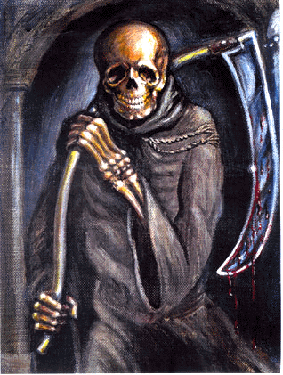
We never see the actual Reaper step out of the painting, in the way he was used in the literal sense in Fritz Lang’s 1925 masterpiece Metropolis where you see him step forward swinging his scythe. With this episode’s adaptation of the myth, It’s the sound and glimpse of his scythe cutting through the air in volatile swipes that create the slashing, nightmarish effect.

tumblr_ljirtiMoSb1qcay1ao1_500

“In English lore, death is often given the name the “Grim Reaper” and shown as a skeletal figure carrying a large scythe, and wearing a midnight black gown, robe or cloak with a hood, or sometimes a white burial shroud Usually when portrayed in the black-hooded gown, his face is not to be seen, but is a mere shadow beneath the hood.”

In some cases, the Grim Reaper is able to actually cause the victim’s death, leading to tales that he can be bribed, tricked, or outwitted in order to retain one’s life. Other beliefs hold that the Spectre of Death is only a psychopomp, serving only to sever the last tie from the soul to the body and guide the deceased to the next world and having no control over the fact of their death. image at bottom ; dance of death. psychopomps”

The origins of the Grim Reaper go back far into the past and he was known by many names. In old Celtic folklore, he was known as L'Ankou, sometimes called Father Time. To the Greeks he was known as Cronus and the Romans called him Saturn.

Don’t be grim, I’ll be back with more Thrilling episodes! MonsterGirl

The Hungry Glass [Essay on Boris Karloff’s Thriller] “Oh leave me alone won’t you, leave me alone… with my mirrors!”

“A beautiful face in the mirror, a pitiful old face at the door, could they have been one in the same” ” And sometimes its better not to see too deeply into the darkness behind our mirror; For there live things beyond our imagination as sure as my name is Boris Karloff “

Ottola Nesmith copy

The Hungry Glass aired Jan 3, 1961 ~

Written and Directed by Douglas Heyes (Kitten With a Whip ’64) from a short story by Robert Bloch (Psycho) with music by Jerry Goldsmith & Pete Rugolo. The episode stars William Shatner and Joanna Heyes (wife of Douglas) as Gil and Marsha Thrasher. Russell Johnson and Elizabeth Allen as Adam and Liz Talmadge Donna Douglas (Ellie May Klampet-The Beverly Hillbillies) as Young Laura Bellman and Ottola Nesmith as Old Laura Bellman. Heyes also directed the iconic Twilight Zone episode Eye of the Beholder which also featured Donna Douglas as the ‘ugly’ girl.

CapturFiles

CapturFiles_3

At first, we see the young and audaciously cute Donna Douglas as young Laura Bellman, fanning herself like a peacock in the myriad of mirrors. There is a themed waltz accompanying her, which reprises itself later on in the episode, a delirious little melody that merely hints at dementia. Then, a sea captain with a hook for a hand comes rapping on the door with his metal claw, in the company of several of the town folk, “I know she’s in there, she’s always in there with her cursed mirrors!”

CapturFiles_6

CapturFiles_9

CapturFiles_11

CapturFiles_13
“Oh leave me alone won’t you, leave me alone… with my mirrors!”

Once the door is open only partially to reveal the very grotesquely painted face of Old Laura Bellman, wearing white gloves, her lips smudged in presumably bright red lipstick, as she had just drank the blood from a freshly killed carcass. The exaggerated outline distorts her already sagging and wrinkled mouth.“Oh leave me alone won’t you, leave me alone… with my mirrors!”

Boris Karloff once again steps in to introduce the evening’s story dressed in a black cape and top hat in front of a very ornate mirror holding a lantern.

CapturFiles_16
“A beautiful young face in the mirror"¦a pitiful old face in the door"¦could they have been one and the same? Some people say that mirrors never lie"¦others say that they do, they lie, they cheat, they kill"¦.some say that every time you look in one"¦you see death at work. But most of us see only what we want to see"¦and perhaps it's best not to see too deeply into the darkness behind our mirrors"¦for there live things beyond our imagination as sure as my name is Boris Karloff"¦”

William Shatner gives a very compelling albeit high-strung performance as a photographer Gil Thrasher who, with his wife Marcia (Joanna Heyes) has purchased a house that is purported to be haunted by the locals–(Aside from the various made for tv movies and B movies he appeared in around the 1970s and his iconic Captain Kirk in Roddenberry’s Star Trek legacy it’s easy to remember Shatner as airplane passenger Bob Wilson in Twilight Zone’s Nightmare at 20,000 Feet-10/11/63 or his superstitious Don Carter trapped in a small Midwestern diner at the mercy of a bobblehead diamond eyed devil napkin holder who serves out 1 cent per question fate in… Nick of Time -18 Nov. 1960 one of my favorite episodes in the series).

The previous owner of the house was Old Laura Bellman, played as the quintessential hag by Ottola Nesmith, (The Wolfman 1941 & Mrs Lowood, Highcliff Headmistress in Val Lewton’s 1946 The 7th Victim ) who locks herself away in the house and spends all her time gazing at her own reflection in her palace of mirrors.

Ottola Nesmith
Ottola Nesmith
photo of seated, Ottola Nesmith in Lewton’s The 7th Victim with Kim Hunter far right.


CapturFiles_19

CapturFiles_20 "And it never struck you curious to find nary a looking glass in all of it?"
“And it never struck you curious to find nary a looking glass in all of it?”

CapturFiles_23

After having met the caustically provincial locals of Cape Caution New England, who warn the couple “that tarnation property comes full equip with visitors, nary a looking glass in the whole of it” Gil and Marcia move into the house on a very stormy night. Soon, they and their two new friends Russell Johnson and Elizabeth Allen Adam the realtor, and wife Liz Talmadge who sold them the place at a suspiciously low cost, begin to see apparitions in various windows of the house. There are no mirrors when they first move in because they’ve been removed and secretly hidden away and padlocked in the attic. Seems the local superstition holds that not only is the house unlucky but the Bellman place has had its share of nasty accidents all having to do with broken mirrors, and a couple of people were killed by shattered glass. Adam Talmadge explains that the locals have worked themselves up to believe that these people were actually murdered by the mirrors with malice of forethought.

The four get into their station wagon and amuse themselves while speculating about the lack of mirrors meaning the house was previously owned by vampires, superstition, and a series of mysterious accidents

CapturFiles_25 that old inside had us thinking the place was built by vampires
“That old bird inside had us thinking the place was built by vampires.”
CapturFiles_25
Gil says to Adam “The truth now"¦the people who built that place"”where were they from?”
Adam answers, “The Bellmans? Pennsylvania, I think"¦” “You sure it wasn't Transylvania?”
Adam tells him “The mirrors"¦so that's what the old coots were bending your ears about”
Gil says “Now, look"¦I'll admit that you warned us that the roof leaks and the cellar floods and the shutters go bang, but what's this about no mirrors?”
Adam jokes, “Didn't I tell you why you got the place so cheap?”
Gil responds, “Yeah, you said the local characters think the place is unlucky”
Adam earnestly, “Well, unlucky because of the broken mirrors. Gil, you have no idea how these people can build up a story. Seems that there were some nasty accidents up there years ago. A couple of people killed by shattered glass, so now the yarn's been worked around to where they actually murdered by the mirrors… with malice aforethought"¦”
Marcia pipes in, “Seems logical"¦”
Gil says, “Sure"¦some mornings when I'm shaving, the guy in the glass looks pretty deadly, especially with a razor in his hand” Adam gets out of the car, “Well, I hadn't thought about it, but, I'd better get you some sort of mirror, at least until you get settled,” Marcia tells him, “Never mind, there's one in my traveling case”
Gil teases, “Oh, Marcia couldn't live without her mirrors”
Marcia replies, “What woman could?”
CapturFiles_29 didnt i tell you why you got the place so cheap-you said the local characters think its unlucky
Adam-“Didn’t I tell you why you got the place so cheap?”Gil-“You said the local characters think it’s unlucky”
CapturFiles_31 Well oh well early mausoleum -liz
Liz-“Well oh well.. early mausoleum.”

CapturFiles_31

The jovial couples arrive at the Bellman house which in the dark of the storm still appears to be a showplace with the vastness of the ocean view as the center attraction. The Thrashers start to imagine all the things they will do to fix up the grand old house, Marcia is a decorator. Suddenly Liz catches sight of an apparition, a ghostly figure reaching for Marcia in the window. Liz screams and startles Adam into dropping the celebratory bottle of champagne, the broken glass cutting his hand, a small homage to the history of the odd accidents that plague the Bellman place.

CapturFiles_37

CapturFiles_33

CapturFiles_38

CapturFiles_35

CapturFiles_39 when you let out that blasted howl I cut my hand
“When you let out that blasted howl… I cut my hand.”

CapturFiles_39

CapturFiles_41

CapturFiles_42

CapturFiles_43

CapturFiles_44 oh liz drop it"¦ but he had a hook, a hook for a hand
Adam annoyed at Liz for harping on the incident says “Oh Liz drop it"¦ She tells him “But he had a hook, a hook for a hand”

CapturFiles_45

CapturFiles_46

CapturFiles_47

Once the visions start, Korean war vet Gil is driven half crazy by suspicion and fears that it’s his post-traumatic stress disorder, “When I had the fever in Korea, I saw things you wouldn’t believe… They said I was delirious -but what I saw was real!”

Or thinking that maybe it was the power of suggestions brought on by the collective hysteria of the local superstitious gossip. Various incidents occur where Gil, Marcia, and even Liz see ghostly images floating in the glass, but everyone keeps justifying it somehow. Although Marcia feels very unwelcome in the house and Gil truly knows that something is not right, they decide to stay and try and make it work, regardless of the bogeyman in the looking glass.

CapturFiles_49

CapturFiles_52

CapturFiles_53

CapturFiles_55

Until one night while Gil is down in his darkroom developing some film. he actually captures the image of a little girl who we find out later, had gone missing while playing by the house years ago.

The Hungry Glass, dealt with themes that were so ahead of their time for that era on television~ Shatner’s character is struggling with a form of Post Traumatic Stress disorder from the effects of war, and the idea of narcissism as a devouring entity that can feed on itself. A life force. like the classical myth that vanity = death and is capable of sucking you into a mirrored void is absolutely chilling.

The effectively imposing New England house on the cliff that no one will rent, somewhat like the house in 1944’s The Uninvited.The idea is that a woman could manifest an actual malevolent life force because of her obsession with her youth and beauty. The haunting as it were, works on so many levels in this episode. There’s a claustrophobic quality, in terms of feeling like everything is hurling towards being sucked into the mirrored void, the voyeuristic quality of feeling like you’re being watched by the ghostly inhabitants of the reflective world that gazes back at us.

Mirrors are usually used to create gateways or portals or for divination purposes. When a mirror breaks it can symbolize such things as a loss of beauty or innocence, foreshadowing a loss in general, or a spell or dream being broken. In the case of Old Lady Bellman, her tragic obsession with her beauty created a conduit between life and death. Her loss of youth, the end of life.

CapturFiles_57

CapturFiles_60
“Well Well now Marcia, you’re not afraid of mirrors are you? Why should you be, you have nothing to fear, not yet anyway. Not for a few more years”

While Gil is looking at his child specter in print through a magnifying glass, Marcia is exploring the attic when she stumbles onto the padlocked door. She breaks it open and discovers dozens of mirrors that had been hidden away. They stare back at her like thousands of eyes from an insect’s gaze flashing at her. This is where Laura Bellman’s waltz motif begins to play again. Marcia has opened Pandora’s box. She starts an outer monologue “Well Well now Marcia, you’re not afraid of mirrors, are you? Why should you be, you have nothing to fear, not yet anyway. Not for a few more years”

Again, the emphasis is on the loss of youth and beauty. Gil finds her in the attic amidst all the mirrors. She tells him it’s like a funhouse. Well, it sort of is, since everything about the idea of looking at yourself is distorted in this episode. Gil tells her he doesn’t even like to look in one mirror let alone fifty, and Marcia tells him

CapturFiles_63

CapturFiles_61
“That’s because you’re not a woman, mirrors bring a house to life ” Gil responds, “Well you ought to know you spend half your life in one”
Marcia says “Alright I’m vain, foolish, and female and I like mirrors”
Gil“And they like you, baby.”

CapturFiles_65

CapturFiles_66

CapturFiles_69

CapturFiles_70

In the story of The Hungry Glass the legend that circulates amongst the locals is that Jonah Bellman built the house to be a showplace, he said he’d make it a jewel box (again a reference to symbolism often used in paintings where the theme is Vanity) As retold by Adam Talmadge–

CapturFiles_71b
“He’d pull the sunlight and silver off the sea. He built it for the most beautiful bride, the most desired woman in New England. He was madly in love with her, she was madly in love with herself. It was more than Vanity though it was a tragic sickness. She didn’t belong to him, but only to her own reflection. He died of a broken heart and so the years passed and the house and servants grew old, but Laura never grew old, at least not in her mirrors. She was very old and very ugly painted and powdered like a bad job of embalming. Her nephew brought a doctor to the house who said she belonged locked away in a madhouse. but her nephew decided to keep her there, locked in her room away from her mirrors. She was still able to find herself in the window glass. One night she danced herself right through it. That is how she died. But the story goes that she still lives on in her mirrors; because there had more of her living there than in her own body.”

CapturFiles_72

This is where I leave off… I won’t spoil the story for you by giving away the ending… this time.

The symbolism of vanity

The idea that mirrors are a living realm unto themselves and yet another thread running through The Hungry Glass is the idea that narcissism and Vanity are not only inherent in women but isolated to the female gender, and certain male’s assumptions that women are fixated on their own image~ I find it an odd contradiction that The Narcissus myth was a male gazing at himself in the water!

All_Is_Vanity
“All Is Vanity” by C. Allan Gilbert
Suggesting an intertwinement between life and death.
All is Vanity by Charles Allan Gilbert carries on this theme. An optical illusion, the painting depicts what appears to be a large grinning skull. Upon closer examination, it reveals itself to be a young woman gazing at her reflection in the mirror.

Some excerpts are taken from Wikipedia Vanity ;

During the Renaissance, vanity was invariably represented as a naked woman, sometimes seated or reclining on a couch. She attends to herself in the mirror. The mirror is sometimes held by a demon. Often, vanity is portrayed by the figure of death himself.

Seven Deadly Sins. Hieronymus Bosch depicts a bourgeois woman admiring herself in a mirror held up by a devil. Behind her is an open jewelry box. A painting attributed to Nicolas Tournier, which hangs in the Ashmolean Museum, is An Allegory of Justice and Vanity. A young woman holds a balance symbolizing justice; she does not look at the mirror or the skull on the table before her.

Johannes_Vermeer_1632-1675_-_The_Girl_With_The_Pearl_Earring_1665
Vermeer’s famous painting Girl with a Pearl Earring 1665 is sometimes believed to depict the sin of vanity, as the young girl has adorned herself before a glass without further positive allegorical attributes.
The Narcissus Myth as portrayed by Waterhouse is a reflection on the nature of intimacy and Vanity.
Narcissus Myth

In many religions, vanity is considered a form of self-idolatry in which one rejects God for the sake of one’s own image and thereby becomes divorced from the graces of God.

Given all these different references to Vanity, The Hungry Glass, with its focus on the female gaze and the correlation with beauty, obsession, life, and death, is a very layered concept within a very simply haunting story on the surface.

MonsterGirl- Beware of mirrors and their contents!