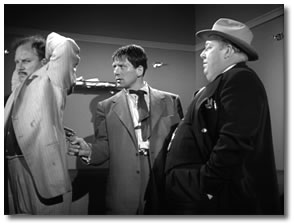
The Man Who Turned To Stone (1957) Are those stones in your pocket or are you just happy to see me!

The Man Who Turned To Stone  (1957) was directed by Leslie or László Kardos and produced by Sam Katzman. Screenplay by Raymond Marcus, Bernard Gordon. Cinematographer Benjamin H. Kline, whose work was prominent in low-budget films, westerns, and serials (The Man They Could Not Hang 1939, film noir Detour 1945, Zombies of Mora Tau 1957, The Giant Claw 1957).

The cast: Victor Jory, Ann Doran, Charlotte Austin, William Hudson (Allison Hayes’s louse of a husband in 50 Foot Woman – Sometimes a monster girl just wants to see the giant rubber hand smash through the roadside cafe and grab that cheating lecherous creep of a husband of Allison Hayes and not think of the feminist overtones of a 50 foot woman enraged.)

There’s also Paul Cavanagh, Jean Willes, and Frederick Ledebur. Incidentally, Hudson’s older brother John was also a louse of a husband in another gem, The Screaming Skull (1958), although I recommend the MST3K version too, it’s a hoot!

This is a quirky, outre fun obscure horror film that I simply love. It combines the women in prison thingy with the mad scientist genre. It could even be considered a sci-fi film. It’s very hard to categorize some films because they do cross-pollinate with multiple themes, to me it’s all instant vintage bliss.

The idea of women in captivity isn’t new, and certainly putting them at risk within their confinement creates a very frantic atmosphere. We feel trapped along with them, right? So add to that a really tall man in a black suit who looks like pigeons would love to alight upon his shoulders, and you get The Man Who Turned To Stone – the man who could sit in the park and collect pigeon shit all over himself.

Naughty girls are put away from society, being experimented on for the purpose of extending the secret of eternal life.

The theme of using women in prison is sort of an extension of the confinement of women out in the world who are thought of as captive objects, an archaic tradition of ” a woman’s place is in the home,” an institutionalized sort of domestic restraint for some.

I find it gratifying to be at home, watching horror and noir films, playing with my cats, drinking coffee, then doing a quick vacuuming and setting the crock pot up for 6 hours, chili at 7 p.m. Housewifery is nirvana for me.I am merely making an observation about the implications and allure of the women in prison genre. Also, watching a gratuitous girl fight has its fascinations. Guilty as charged as the conductor of the steel tub in this movie!

In typical girls behind bars flicks, there’s always the tough one who’s been around longer than mud, and the new fish who comes in and transforms the dynamic with her fresh innocence and naivete, eventually helping the other inmates achieve some kind of revelation about life and themselves.

There’s also the stock evil “total institution” figure or figures that hovers over the women, exploiting, abusing, and being, well, horrible authoritarians, tyrannical fascist dirtbags on a power trip.

The women in LaSalle Detention Home for “Girls” have been inextricably dying, in a most mysterious way. These are young girls, and yet they are suffering heart attacks? This has been going on for 2 years. Over the course of those 2 years, the inmates hear disturbing screams in the middle of the night.

The problem is that there aren’t any people who would care about “bad girls” in jail. They’ve lost all their rights, no one cares about such types, and so it’s a perfect environment to perform experiments on these women because they are a)helpless and b)anonymous. Hidden away from watchful, responsible eyes.

And you see the people running the prison aren’t really evil agents of the law, they are actually really, really old evil people who do esoteric science and are using the prison as a cover.

Charlotte Austin plays Carol Adams, the social worker who actually does give a damn about the girls. Carol has integrity and wants to help the girls reform and make sure that their living conditions are more than just adequate.

Tracy, the iconic old-timer inmate of the group, tells Carol about the suspicious string of “heart attacks”that have occurred over the past two years. Carol tries to investigate. This puts Carol in danger because she’s starting to interfere with Dr. Murdock’s (played by naturally stone-faced Victor Jory) experiments. He and his assistants try to deter Carol at every turn. So Murdock, Mrs.Ford ( beloved character actress Ann Doran), and the other scientists start panicking.

No one knows that these people are actually over 200 years old. It’s delicious to see these evil practitioners of eternal life wearing eighteenth-century clothes. Way back in the 1700s, they had uncovered a method of prolonging the life force or actually renewing life by transferring energy from one person to another. It had something to do with electricity, blood transfusions, and large steel bathtubs.

Not unlike Vampirism, but by sucking the life force out of one body and infusing it into themselves. These scientists have been virtually using the girls to literally feed their years. When one of the girls is chosen to re-energize one of the scientists, she dies, and they make it look like a heart attack. These scientist vampires have figured out that women in their childbearing years are the best givers of this life-nurturing force. The jail is full of those.

Thus the reason why Murdock has set up their laboratory in prison for “bad girls” The one problem Murdock and his accomplices face is that if they go too long without sustaining themselves with a new source of energy, their skin becomes as hard as stone, and their hearts pounds so wildly that it’s actually audible, then they die!

This happens to a few of them, and the sound we hear when time runs out is really creepily cool. So is the makeup for the stone skin. Another problem they are faced with is the rocky, ghoulish-looking brute Eric (Frederick Ledebur), a walking, mindless statue who suffered brain damage in their first experiments. It’s curious why they would keep him around for a couple of centuries. Perhaps he made a nice dining room ornament at the annual mad scientist cocktail party, or perhaps he looks great in the garden in his off hours, terrorizing the girl. It’s really Eric that gives The Man Who Turned To Stone its creepitude. The way he hulks around the house would give anyone the heebies, even a “bad girl.”

Eric is also taking longer and longer to respond to the recharging treatments, so they have to up the amount of female sacrifices from the jail pool.

Once one of the girls supposedly commits suicide, Dr Jesse Rogers (Hudson), a psychiatrist with the State Department of Corrections, takes Carol’s pleas seriously and tries to help find out what’s been going on at the prison.

Eventually, Carol and Dr. Rogers uncover the secret. Dr Murdock and the others try to kill Rogers and Carol, but they fail to do so. Eric is out of control and winds up kidnapping one of the inmates from her bed. After several mishaps, the scientists are vanquished of their nefarious and unholy rituals, and their lab is burned to the ground. And the girls can go back to confinement without Eric lurking about.

I’ll be here like a faithful stone statue! Your EverLovin’ -MonsterGirl

BUtterfield 8 (1960) Part I “I’d know her with my eyes closed, at the bottom of a coal mine, during the eclipse of the sun”

Spoiler Alert: I do discuss the film through to the end. So if you haven’t seen it yet skip the review!

Butterfield 8 – Directed by Daniel Mann and scripted from the John O’Hara novel. One of his early works which garnered a lot of attention, primarily because O’Hara dealt bluntly with matters of social class, sex, and ambition that other novelists didn’t write about during the 50s and 60s.He acquired a grasp of social stratification that is pervasive in his writing.

The melodramatic score by Bronislau Kaper is as beautifully dramatic as it is as trashy as a Harold Robbins novel.

Butterfield 8 Stars the great lilac-eyed beauty of the golden age of cinema, when the big studio empires ruled over their actors. One of my favorites is Elizabeth Taylor.

Taylor won an academy award for her role as Gloria Wandrous and Laurence Harvey play Weston Liggett(without his groovy sideburns that he sported in the early 70s. Harvey whose speaking voice is like silk to my ears.)Both actors had played husband and wife in the psychological thriller Night Watch (1973) which I plan on reviewing down the road.

First some blurbs about O’Hara’s novel:

“Gloria Wandrous is New York’s ultimate playgirl–a professional escort in the down and out days of the Depression. O’Hara bitingly paints a portrait of despair in Gloria’s life–from the minute she wakes up in a strange bed, to the moment her life ends. Based on a true story, men flock to Gloria–raped by her father figure as a child, her security with love is thin, though she continues to seek support from her friend Eddie, and her seducer Liggett. In the speakeasy culture of New York, sex and booze is all the rage, and yet Gloria’s one real desire, love, only leads her to her death.”
Angela Allan, Resident Scholar

“Gloria Wandrous is a golddigger extraordinaire in New York City during the depths of the Depression, circa 1931. She escaped a molesting uncle in the sticks and has made her own way in the big city ever since. When she tangles with prosperous businessman and Yale grad Weston Liggett, it’s hard to tell who’s leading whom. David Loftus, Resident Scholar

Butterfield 8(1960)

The film unlike the novel is set in the 60s era style and not the Depression era 30s.It is a story not just about Gloria Wandrous a tragic figure, at the mercy of her past and present demons that haunt her, the film is about male ego, male control, and male pride. In order for Taylor’s character to be redeemed in the end as a good person, she must be obliterated by the plot. Similar to the way Kelly had to leave the clean town of Grantville In The Naked Kiss, Gloria must die in order for her existence to be redeemed.

This is what happens to girls who are either hyper-sexual, sexually independent, or perceived as wild and immoral. It’s a tragedy of moralizing. For me Butterfield 8 is a story about society’s fear as well as male fear of the female body, when neither are in control of it.

Gloria is portrayed as an amoral sex addict whose trajectory was formed at age 13 when a man her mother was engaged to marry raped her over the course of a week. Now her only goal in life is to obtain wealth and power through her body. The abuse is alluded to early on, we catch wind of Gloria’s mother Annie saying that Gloria didn’t like her fiance the Major.

The fact that her self-worth and promiscuity might stem from early childhood sexual abuse and that Gloria is a victim condemned to repeat the abuse with each man she flagrantly sleeps with isn’t really part of the narrative until much later in the film during a very powerful confession to her dearest friend Steve. Yet another male who needs to look after Gloria, and act as brotherly protector for her.

Not having read O’Hara’s book I am not sure if he wrote Gloria’s character as sympathetic. Taylor does her best to show us a compassionate woman in turmoil regardless of the moralizing in the film.

Dina Merrill plays Liggett’s wife Emily a “decent” respectable woman of breeding who is also portrayed as having stripped Weston Liggett of his manhood by foisting a life upon him that wasn’t of his own choosing, thus giving him an excuse for why he seeks the comfort of other woman and the excesses of booze. He too is self-deprecating and self-destructive like Gloria, but unlike Gloria, he gets the opportunity to find himself at the end, whereas Gloria had to literally crash and burn.

And yet we don’t see Liggett’s actions as being amoral. He gets a small lecture from an associate Bing who while on a train bound for Long Island, tells him he’s making a mess of his life, but people make excuses for Liggett all the way through. Liggett’s own wife recognizes her part of the blame in infantilizing her husband, therefore, taking the burden of blame off of him.

However, Gloria is a walking sexual plague, a virtual epidemic capable of taking men and marriages down with one phone call to BUtterfield 8. She is a rolling one-woman demolition team, smashing through sexual encounters like a bulldozer. Until she meets the one man she actually falls in love with, Wes Liggett. Only with this one man can she find self-worth and become redeemed. Finally, she starts to shed her life and aspire for more than taking from men, by giving over her body. Women are not allowed to be sexual beings, not in the way that men are expected to be.

The wonderful Mildred Dunnock ( she was in one of my favorite episodes of Boris Karloff’s Thriller, The Cheaters) plays Gloria’s fragile and inhibited mother Annie and Annie’s neighbor and best friend Fannie Thurber is played by Betty Field who adds some comic relief to the tension at times. She’s a constant in Annie’s troubled life, worrying about her daughter and her reputation.

Gloria Wandrous high priced call girl just dial BUtterfield 8 and wakes up in Wes Liggett’s bed in his lavish apartment. She starts calling for Liggett (Laurence Harvey) who we see stepping into an elevator. The vintage baby blue Crosley phone is off the hook. The oboe is ominous and alienating. She picks up a pack of crumpled cigarettes and flings it when she discovers it’s empty.

She keeps picking at the ashtray looking for the remnant of a cigarette butt that she can smoke. She finds a pack of Liggett’s cigars and lights up, inhales, and starts choking on it. Pours herself a glass of scotch. Walks around the swanky apartment in the bed sheets, and kicks a silk salmon dress she wore the night before lying on the floor next to her pumps. Picks up the dress and holds it to herself. Remembering last night she crumples it up and throws it back on the floor. Puts her slip on and saunters off to find Liggett calling his name. She steps into an ultra-ornate bathroom splattered with flecked pink and gold.

Her curves are accented by the silk slip. She drips sex. Looking in the mirror she wipes the night before out of her eyes. Rinses her toothbrush in the glass of scotch and brushes her teeth, gargles with the scotch, and spits into the sink.Sitting at Emily Liggett’s dressing table deciding on which perfume to douse herself with.

The film is photographed in washes of that fabulous vintage muted pink, blue, and gold tones fashionable for the 60s style. Gloria goes to the closet and fondles a brown mink coat, holding it close to her body like a lover. Sets it back in the closet and picks the other white fox-lined coat, wearing it over her slip. Goes into the bedroom and hangs up the phone.

She then goes over to her gold purse and pulls out a note written on an envelope”Gloria-$250 enough? Will phone you later. L” Lingering on the note a bit, she is visibly upset, this is not something she’s expected

The brash horns underscore her fervor when she grabs her lips stick and writes on the mirror in big red letters “NO SALE” and places the money on an ornate clock atop the mantle. She rips up the note and goes back to the closet to hang up the white fox coat, and grabs the more expensive brown mink instead.

Gloria picks up the phone and says “BUtterfield 8, it’s Gloria any messages for me…mhm, Charlie, yeah George, yeah, listen to a Mr. Liggett will try to call sometime today, He might use Mr. L…find me where ever I am…this is one call I want to take personally…and immediately” she hangs up. She picks up a bottle of scotch and then pulls out money for it and places it on the bar, and walks out into the gray New York City day. Hails a yellow cab and says she’ll double her tip for a cigarette. As is the assumption of the brash New Yorker attitude, the taxi nearly runs into an older couple crossing the street and yelling ensues. Gloria tells him that he’s in a good voice this morning.

This is how Butterfield 8 opens. We see a woman who is insulted that she has been paid for sex by the one man she thought was different. She arrives at her friend’s apartment, knocks on the door, and finds Steve Carpenter (Eddie Fisher), obviously a poor struggling composer, trying to work on tomorrow’s arrangements on the piano. She hands him the bottle of liquor and says “tribute” for his “faith, hope, and charity” and kisses him on the cheek. He says she’s got scotch on her breath, but she says it’s good scotch at 20 years old. He says “And the cigar smoke?”I always said I’d try anything once” Steve says”You ever try common sense?” and she answers “Only in desperation”

She tells him that she stole the fur coat, not for real, just long enough to get even with somebody. He made her so damned mad, he left her money,” he actually left me money!”

Steve tells her that his work is designed to get paid. She says it didn’t work. Besides, her dress was torn so she borrowed something “spiteful and elegant” She utters his name Weston Liggett, Steve’s heard of him, as very social. She says and “Very Yale” “what’s with you Yale?, always Yale,” she tells him it’s the last college left, she started with Amherst and worked her way through the alphabet to Yale” and puffs on her cigarette “I’m stuck there…of course, I could work backward again”

Steve and Gloria are childhood friends, and he is very protective of her. Steve tells her to put the coat back on”Half-dressed women make it difficult to concentrate” She tells him “Don’t think of me as a woman, after all, we’re just like brother and sister, remember” He gets agitated and tells her to put the coat back on.

He tells her.  I’m sick of opening up that door every other day and  finding you boozed up, burned out, and ugly”


She says “Sick for me or sick for you?” he comes back “For you, for everything you’re wasting…why do you come here like this?” he asks. She tells him that she always comes to him because at least she can be honest with him. He tells her to start being honest with herself.”You’re making a mess out of your life and you’re forcing me to watch it.”

Gloria says ” It’s terrible Steve, I say yes too much, when I shouldn’t and you say no too much when you shouldn’t”

She wonders how she’s gonna get home dressed in only a slip and fur coat what will her mother think? Steve says that her mother knows everything about her. She agrees but says she’d never admit it. “I’m still her innocent little girl…and she’s my dear sweet cookie-baking mother””So go home, give her an innocent smile, and have a cookie”

Gloria asks to borrow one of Steve’s girlfriend’s dresses. Steve’s girlfriend Norma played by the lovely Susan Oliver feels threatened by the friendship between Gloria and Steve. Gloria gives Steve a little of her philosophy on women.
“The more you ask her to sacrifice, the more she knows you love her…honestly”

Cross Fade

On the LIRR heading to Long Island Liggett is smoking a cigar and lost in deep thought. On the train sitting next to him is a colleague Bing who asks “Problems Ligg?” he tells him “Do you know 3 of the most overrated things in this world, home-loving, home cooking, and security”

Ligg’s got everything, lots of people would envy him, but he wonders “But am I happy?”Bing says “Obviously not” “Ever wonder why?” “I have…can you take it from an old fraternity brother…you’re a heel…a low down rotten heel…anything that doesn’t go your way, anything that you can’t have you destroy” This is the one enlightened moment of the film where there is an insight into Liggett’s pathology and the narrative holds him accountable for his behavior. Bing tells him he could still come back and be a law partner with him any time.


Now on Long Island Ligg is skeet shooting with his wife Emily. He asks when she’s coming back to town(NYC). But the question is more of curiosity than passion. There is an obvious strain in the marriage. They are shooting at targets instead of engaging in a real conversation.

We’re back with Gloria, who’s borrowing a suit dress from Steve’s girlfriend Norma. She tells Gloria, “Just remember that suit has lived a sheltered life…it shocks easily” “Well then, it’s time it had a little adventure” A sarcastic banter ensues and Norma asks what happened to Gloria’s dress  “It’s a funny thing, one minute it was there, and the next minute it wasn’t” Norma lilts her voice “much like your virtue I presume”

Gloria shows up at home in her little red sports car. Her mother says “Here’s Gloria now” Her friend Fannie says”From where, girl scout camp?” Mother Annie is holding a little Yorkshire Terrier and asks her skeptical friend Mrs. Francis Thurber who is drinking coffee. “Do I look alright?” setting the little dog down on Fannie’s lap. Fannie wriggles with displeasure, shooing it away. Gloria comes in and hugs her mother. Mrs. Thurber asks “How’s church?”Gloria snaps back “Why don’t you go sometime and find out.”

Her mother remarks about the nice suit, and Gloria tells her that she picked it up at the designer’s last week. Mrs Thurber gives a dig by saying” It must be hard changing dresses in one of those sports car trunks” Gloria shoots daggers back at her.

Then her mother tells her that the modeling agency sent some dresses, one of them they want her to wear to 3 different places tonight, but Mrs. Thurber interjects again with yet another dig “the Salvation Army, The Public Library, and The PTA in Brownsville” Gloria lets out a fake laugh for Mrs. Thurbers benefit.

Gloria’s mother is the only one who doesn’t openly acknowledge Gloria’s lifestyle “Francis don’t joke about Gloria’s work it’s very important to her…she’s one of the few girls of her kind in the city” Gloria asks if Butterfield 8 called? Her mother tells her she’s 2 weeks late on her car payment and Gloria asks to borrow some money.

Ligg is back at his apartment in NYC. He sees the lipstick writing on the mirror NO SALE and picks up the dress from the floor. He calls Gloria, they arrange to meet that night. She shows up at the bar wearing a stunning black dress, black gloves, and pearls. “He apologizes about the money. He tells her she’s with him tonight, and she comes back with “by choice, only”


Liggett says “Women are all alike, play tough,” Gloria says “I’m not like anyone, I’m me!” “That’s right I shouldn’t knock it should I?”He says she’s something different, she says “Sure I’ve got the world by the tail” He calls her doll face.

She gets up and says goodnight but he grabs her arm. “You’ve got a great act” She digs the heel of her pump into his shoe. He grabs her tighter, holding onto her wrist. It’s a battle of the wills. Neither one winces or cries out in pain. Ligg says “Go ahead rub your wrist”, and she says “Not if it killed me” Then Ligg says “I want to carry you out of here.” But Gloria slams him back “That was a lesson pal, not a treatment”

He says he won’t talk about money again, but offers her an apartment as big as she’d like, and charge accounts. “Mr. Liggett put your assets away…you don’t have enough,” he says to try him, but she tells him about offers she’s turned down “You couldn’t match what I’ve already turned down”, Yachts in the Riviera, genuine Van Goghs in every room, paid for by men with “pocket money” annuities for life, jewelry.”

She turned them down flatly, she earned her money modeling clothes. He remarks”Now I get it…you pick the man…he doesn’t pick you” “Finally, why I’m not teaching logic at Columbia I’ll never know” ” You also drop the man when you want to” and she snickers ”and without a parachute”

He’s driving her little red sports car but he purposely misses her stop. He says he’s tired of looking and listening. He says nobody treats him that way. She says “Oh Weston Liggett the wealthy,” he says “No Weston Liggett the man” I wasn’t cut out to be a chauffeur, an escort, or a straight man for your nightclub repertoire”

Gloria says “The next time you get angry just remember you sent for me, I didn’t send for you”. She puts a cigar in his mouth and lights it for him. He blows the smoke in her face and looks at her seductively, then he says “Like hell, you didn’t send for me” ” and now what you’re going to drag me up to your cave?”

He says his apartment is close. She tells him “Oh no not again.” He says it was alright last night. But she says “Last night my sense of direction was slightly impaired by gin,” he tells her “That’s okay I’ve got caves all the place” She rests her head on his shoulders. He says “Hello” she answers softly “Hello” the battle is over, they are seeing each other for the first time.

They Arrive at Happy’s Motel. Happy played by Kay Medford runs this out-of-the-way motel. Liggett calls out for Happy. She looks into the car and says “Oh we always have room for 2 weary travelers” Happy wants to tell him a joke about 2 old maids but he says later. She says “A man’s gotta get his “rest” he’s gotta get it regular”(rest is code for sex of course)

Happy was in Vaudeville once. Looks at Gloria, and they enter the motel room. A Saxophone is playing sultry music and the neon lights are flashing red and green in and out invading the darkness every time they blink. We know what’s next as they embrace in the doorway of the room and as the screen darkens they shut door number 9. End scene.

The next morning in a diner, the jukebox playing torchy music, “You know you’re liable to wind up psychologically famous, a case history in a medical book” He asks “You writing it?” “No, but I have to tell my psychiatrist everything that happens to me” (psychoanalysis was becoming the trend for the bored disillusioned angst of the middle class.)…” Even down to the smallest deepest, darkest detail,” Ligg says earnestly “That’s a set of notes I’d like to read”

He asks why she needs a psychiatrist. “I’ve never met anyone direct and uninhibited as you” she smiles, “Wild is the word,” He says “First genuine wildness I’ve ever come across in a woman”

fade out

Steve and Norma always fight about Gloria so he explains “Gloria and I grew up in the same neighborhood. I’ve known her all my life, we went to the same school together. Her father died when she was very little, and her mother went to work, so I sort of became her family”He gets in closer to Norma, “Somebody’s got to look after her…I”m gonna do it for as long as it takes, now will you try to understand?”

she says “I understand, I understand that it’s worse than I thought, much worse, you are actually in love with her and you don’t even know it”

“Steve is she or is she, not a tramp?” he says” I never liked that word” “Is she not the biggest tramp in this whole city?” Steve says “I especially don’t like to hear you use it”

Norma starts to suppose about marriage and children, Steve is plunking out indiscriminate chords on the piano. She asks “Do you want her hanging around us all the time, babysitting…nipping brandy out of a handbag at 8 in the morning and telling them the story of little red riding hood and the 3 lecherous bears. Do we keep a spare room where she can sleep off her hangovers?”

Steve answers “All I know is I worry about her” “But does she worry about you?” now Steve gets up and yells in Norma’s face ” I don’t know and I don’t care, this is something I’m gonna do whether you like it or not Norma”

Continued in Part II

Sam Fuller’s The Naked Kiss (1965): Part I: “There’ll be no later, this town is clean”


Sam Fuller’s The Naked Kiss: Part III “Tell me where is the blue bird of happiness found?”

The Naked Kiss (1965) Part III Meaning it bares no emotion. It’s empty of real substance. It has the taste of perversion to it.

SPOILER ALERT!!!!  I DO THE SYNOPSIS RIGHT TO THE END OF THE FILM…

Working at the hospital while Kelly and one of the nurses are bathing the children Kelly notices that she is troubled and asks “Do you want to talk about it? Have you been to a doctor?” She has the intuition that the young girl is pregnant. Kelly instead of bringing the ‘plague’ to Grantville has brought insight and compassion to the women who are troubled in this provincial prison. In this way, the film can be viewed as feminist. She brings her strength and independence.

Crossfade, Kelly, and Grant are slow dancing at Grant’s house. Kelly tells him that she wants to talk about something, something she needs to get off her mind. “I’m afraid our dance is over.” Asks him to sit down and listen to the words. “When I came to this town, the first day I came… I was a prostitute. My first customer was my last one, next morning I quit. Now I’m in love with a man who’s the dream of every woman.” Grant is seated looking puzzled Kelly continues “Every woman who has the right to dream…but the man has got to stop seeing me before the volcano erupts.”

Grant looks up at her and grabs her hand. Pulls her close to him.“I love you Kelly.. .will you marry me?” She says “I’ve got to think it out.. .(now cheek to cheek) Oh I’ve got to think it out.”

Kelly’s in her room drinking from the blown Venetian glass from Venice that Grant gave her. She’s contemplating the marriage proposal. We hear a voice over, it’s Grant’s monologue “I wasn’t cut out to be a monk and you’re not the type to turn nun… but together we’ll prove our whole existence for each other, the only woman I want for my wife.”

Voice over by Grant “I wasn’t cut out to be a monk, and you’re not the type to turn nun. But together we’ll prove our whole existence for each other. You’re the only woman I want for my wife… If they condemn you for your past, I don’t want them for my friends. Kelly darling no one can forbid you your tomorrow. And I’m all your tomorrows. 

Kelly gets up from the bed, sighs and walks over to the tailor’s dummy, and asks “Charlie, what should I do?” Again we hear Grant’s voice “If they condemn you for your past, I don’t want them as my friends, Kelly darling…no one could forbid you tomorrow, and I’m all your tomorrows, all of them.” Kelly raises her glass and answers to Charlie “That’s right!…why should Grant want to marry a woman like me?.. .confidentially Charley, (her arm around the fake soldier now) we girls are always chasing dreams… why shouldn’t I have a right to catch mine?”

Now Kelly has an internal monologue “Many women had a past like mine, and they made out didn’t they?” She answers aloud asking the question “Or did they?… ah, of course, they did.. .and you know why because there was always the Rock of Gibraltar to give them strength” She raises the blown glass to Charlie in a toast “That’s what Grant is…The Rock…The Rock of Gibraltar.”

So Kelly needs a man to legitimize her self-worth, otherwise, she is still considered machinery. “Oh Charlie” now we hear Grant’s voice again “We’d be living an endless honeymoon” She goes back over to Charlie and hugs him “Oh Charlie, the dread of every woman in my business…is ending up alone…I know that world.”

She looks at the glass again and says “And I know his world( chuckles ironically) and that makes me a woman of 2 worlds… and that’s not good, or is it?” She looks at Charlie’s hat. She’s got her arm around his stuffed shoulders. “With him, I’m complete, a whole woman” the voiceover by Grant breaks in again “I’ll never strike at your past, not even with a flower” Kelly hugs Charlie closer, “Oh Charlie, Charlie Charlie, Charlie…what should I do?…”

Fade to Black.

in this look on Grant’s face, we sense something cold and unsavory deep-rooted in his soul. A removed reptilian hypothermic smile. It is not his fine breeding, it is something dark and unwholesome he keeps bubbling below the surface of his refinement.

At Grant’s house, the doorbell rings, and Kelly comes bursting in “Oh it’s a wonderful day Barney!… it’s a beautiful day!” Barney tells her that Grant is still asleep. She ignores him and yells “It’s a glorious day!” She goes to the stereo and puts on Beethoven’s 5th Symphony and conducts. Barney still in his robe goes upstairs to get Grant. Kelly is conducting the music, she spins the large globe as if she’ll be able to see the world now.

Grant comes down in his silk pajamas, yawning and putting his robe on, he watches as she pretends to conduct the music. She runs to him and grabs his hands “I love you…it’s a deal” He looks oddly at her, pleased but more like he’s just sealed a business deal, not the reaction from a man truly in love. As they discover wedding plans he wants to send her to Paris to buy the most expensive wedding gown. Kelly has always paid for every stitch of clothing on her back. That tells you how independent she has been while working as a prostitute. Not taking any more than for her services to get by. Kelly has throughout shown to be a woman of integrity, thus the challenge in the narrative is to balance the conflict of judging her as a whore with morals.

Dusty gets help from Kelly. Who gives her $1,000 and tells her whether the guy marries her or not she is to keep the baby. Dusty tells her, “Boy or girl I’ll name it Kelly.”

Kip’s gaze, the sadness shared with a child, as he watches Dusty crying. Sympathetic.

Now nurses and orderlies are bringing in the children one by one. And a record begins to spin. Kip the little boy wearing the First Mate pirate hat begins to sing this song which has an eerily tragic poignancy.

“Mommy dear, tell me please, is the world really round” Another little boy takes it from there, “Tell me where, is the bluebird of happiness found” Now a little girl sings “Tell me why is the sky up above so blue” now they all sing in unison “and when you were a child, did your mommy tell you?

All of the children standing like wounded soldiers with their hats and crutches singing this sad little song together. The song creates an element of melancholy, and pathos in the film. It’s the children asking the question where is happiness?

The children are a diverse group of races, the spirit of these children fuels the film’s angst and alienation, for they are like castaways in a world that is perfect, while they are broken and striving to be whole.

“What becomes of the sun when it falls in the sea” “And who lights it again, as bright as can be” Together they sing again “Tell me why can’t I fly without wings through the sky” Back to Kip who sadly sings “tell me why mommy dear…are there tears in your eyes?”

Now Kelly joins in as an answer to the song’s questions singing “Little one, little one, yes the world’s really round, and the bluebird you search for is surely is found… and the sky up above is so blue and clear (the staff including Mac is watching Kelly serenade the children they are so sullen, yet proud) so that you’d see the bluebird if it should come near… and the sun doesn’t fall in the sea out of sight, all it does is make way for the moon’s pretty light… and if children could fly there’d be no need for birds… and I cry little ones cause I’m touched by your words.”

The children surrounding Kelly sing the song together, she has left a mark on them, she has found a different way to have worth, and she sees herself through these child’s eyes. They are ultimately truly innocent, yet they are the ones who don’t objectify Kelly.

“Tell me please Mommy dear is it true the world’s round, I will search, round the world til the bluebird is found” Then Kelly sings “Little one there’s no need to wander too far, for what you really seek is right here where you are.”

Griff and Grant are walking out of a building. Grant has asked Griff to be the best man at the wedding but Griff can’t fake how miserable he is. Grant tells him to get it off his chest. Bunny comes running over to Grant with her dolly and he picks her up and spins her around. Griff is still visibly upset, holding his cigarette and frowning. Bunny congratulates Uncle Grant on his wedding, and he kisses her cheek, she beams a smile half filled with baby teeth.

Now in the classroom back at the hospital, the children are getting a spelling lesson. Kelly is fixing Kip’s shoelace. Griff knocks on the window glass to get Kelly’s attention. Through the glass panel in the door, we see them talking seriously again a frame within a frame, symbolizing the entrapment of both characters who are stuck by their roles. They move into an empty room so they can continue to talk.

Continue reading “Sam Fuller’s The Naked Kiss: Part III “Tell me where is the blue bird of happiness found?””

The Narrow Margin 1952: Nobody likes a fat man

The Narrow Margin (1952) Directed by Richard Fleischer and starring Charles McGraw plays the sandy graveled voice of Detective Sgt. Walter Brown who’s reluctantly been chosen to escort a mob widow to the grand jury hearing in Los Angeles by train.

In the process of picking up Mrs. Frankie Neal, in Chicago, Walter’s partner is shot and killed in the darkly lit stairwell by a mysterious assassin played by Peter Virgo, the ruthless Densel, who wears a fur-trimmed coat.  This only causes Walter to further resent the woman he’s been charged to protect and see to it that she makes it to the trial to testify against the mob.

This noir film has a lot of familiar elements, gangsters, the train ride, the detective’s dilemma – as the die-hard cop fends off the criminal elements that surround him, and the wrong man/woman trope. The mobsters, Vincent Yost, Densel, and Joseph Kemp want to get hold of a valuable list of names that Frankie’s widow will bring to trial. Yost tries to bribe Det. Walter Brown, but he’s an honest cop who can’t be taken in.

The Narrow Margin also stars Marie Windsor as Mrs. Frankie Neal’s widow and Jaqueline White as the respectable Ann Sinclair, a classy woman, and mother,  traveling on the train with her little boy Tommy and their nanny.

Ann gets caught in the cross hairs of the intrigue when the gangsters mistakenly take Ann for Frankie’s widow. The majority of the film takes place on the train heading for Los Angeles. Don Beddoe plays Det. Sgt. Gus Forbes, “the fat man” who keeps getting in the way of Walter. He repeats the self-abasing proverb “Nobody likes a fat man” as he lumbers his way through the narrow passageways of the train en route to L.A.

Frankie’s widow Mrs. Neal is an obnoxious loud-mouthed dame, who doesn’t want to play by the rules and blasts her record player even after Walter warns her to hide out in the train compartment that the thugs think is empty. Marie Windsor reminds me a bit of the wonderfully quirky Ileana Douglas (Goodfellas, Six Feet Under, Cape Fear 1991). Douglas is the granddaughter of the great actor Melvyn Douglas. The fabulous actress isn’t a stranger to film noir, having appeared in some of the most underrated films of the genre, Force of Evil 1948 with John Garfield, The Sniper 1952, City that Never Sleeps 1953, and what I consider to be one of the top ten film noirs of all time, Stanley Kubrick’s The Killing 1956. Windsor is perhaps at her best in the role of the conniving Sherri Peatty who beats the spirit of her husband George (Elisha Cook) until he’s desperate to pull a heist that goes terribly wrong.

Walter: Sister I’ve known some pretty hard cases in my time, you make em all look like putty. You’re not talkin’ about a sack of gum drops gonna get smashed. You’re talkin’ about a dame’s life.You make think it’s funny for a woman with a kid to stop a bullet for ya, but I’m not laughing.

Frankie’s widow: Really well I don’t care, she got twins, you talk like you’d rather I got the bullet who’s side are you on anyhow?

Walter: Listen Jingle Jaw nothin’s happened to you yet has it?

Frankie’s widow: No, well it better not.

Walter: Well then shut up!

Altman’s That Cold Day In The Park: 1960’s Repressed Psychosexual Spinster at 30+ and the Young Colt Playing Mute

“How far will a woman go to possess a 19 year old boy?”

“When does that screaming loneliness drown the silence? When do the innermost cravings of a woman, tear away the iron-clad bonds of her small Victorian world? For Francis Austin- a virgin spinster of 32, it happens that cold day in the park. For Francis, the promise of fulfillment comes in the form of a wet 19 year old boy.”

That Cold Day In The Park (1969) is by Robert Altman, an iconic American director (M.A.S.H 1970, Nashville 1975) best known for his very naturalistic approach to plot development in his films. He has a very stylized viewpoint, creating an atmosphere in which the actors’ dialogues overlap. He allowed his actors to improvise their lines, which was a very unorthodox method of filmmaking. He’d often refer to a screenplay as a “blueprint” for the action and cared more about character motivation than the relevant components of the plot. In Cold Day, he uses a more somber monotone dialogue, still informal and intimate, yet not as cluttered with the chatter he uses in his later works.

That Cold Day in the Park includes a screenplay by Gillian Freeman, from the novel by Richard Miles and was produced by Donald Factor and Leon Mirell.

The film works as a mood piece of modern Gothic horror that eventually devolves into the Grande Guignol style. Another aspect of this subtler psychological horror film is how it makes the protagonist particularly ambiguous as we are not sure where our sympathies lie. Considering the boy’s entrapment, which he becomes complicit in since he has several opportunities to stay away once he realizes that Frances is not emotionally stable, he’s complacent in luring Frances into his game. While Frances is both predator and victim, the moral ambiguities lay open.

Altman often presents Frances in that iconographic mirror in order to represent her duality—the reflections of the repressed woman and the voyeur who seeks to fulfill her sexual desires. While ‘the boy’ walks around the apartment naked, he becomes an ‘object’ of desire for Francis’s fragile self-control. She is a pathetic, deranged time bomb who will eventually lose all hold on reality.

Again, I will not give away the climactic ending. It’s too powerful through the camera’s framing, the storytelling, and, of course, Dennis and Burns’s extraordinary performances.

At first, I set out to do this review with a mind towards coupling it with another psycho-sexual film experiment Secret Ceremony 1968 starring Liz Taylor and Mia Farrow, by the great director Joseph Losey, but once I started thinking and writing about That Cold Day in the Park, I realized I had a lot to say, so I’ll save that other psychologically startling feature for another time, although it makes for a good companion piece.

Johnny Mandell’s music works well as the very minimalist piano score that creates the atmosphere of loneliness. It’s a beautifully evocative piece of film scoring. Laszlo Kovacs’s cinematography creates a stark and sterile landscape whose monochromatic colors seem to implode around the characters.

Starring the criminally underrated actress Sandy Dennis (Who’s Afraid of Virginia Woolf?’66, The Fox, The Out of Towners ’70) as Frances Austen.

And Michael Burns was credited as The Boy (loads of television appearances and he plays yet another strange boy in Grand Guignol’s The Mad Room 1969), a psychological horror film directed by Bernard Girard, which was a retelling of the stage play Ladies in Retirement. Ladies in Retirement was written by Edward Percy and Reginald Denham. The play premiered on Broadway at Henry Miller’s Theatre on March 26, 1940, and ran until August 3, 1940, for a total of 151 performances. The original Broadway production was produced by Gilbert Miller and staged by Reginald Denham. It starred Flora Robson as Ellen Creed, Isobel Elsom as Leonora Fiske, and Estelle Winwood as Louisa Creed.

The Boy’s sister is played by Susanne Benton, Nick is played by John Garfield Jr., and Cult actress Luana Anders plays the Prostitute.

Susan Benton as The Boy’s sister.

Below includes a feature on Luana Anders as part of Brides of Horror 1960s!

BRIDES OF HORROR – Scream Queens of the 1960s! – Part 1

Sandy Dennis, an Actor’s Studio disciple, is the compelling embodiment of the quirky, neurotic wounded bird. All of her unique idiosyncrasies manifest themselves with an air of offbeat mannerisms.

And in this way, you either are drawn to her non-subtle methodology, which seems more natural to her than affected, or… her quirky charisma and physical ticks – the stuttering, nervous laughter, hysterical writhing, and awkward fits and starts- might just repel you. There’s probably no middle ground. That didn’t stop her from winning Academy Awards and Golden Globes for her various performances. Best Supporting Actress for Who’s Afraid of Virginia Woolf? 1966, nominated for Best Actress in The Out of Towners 1971, and The Moscow International Film Festival Award for Best Actress in Up the Down Staircase 1967, and a Tony Award for A Thousand Clowns 1962-63.

This is what distinguishes Sandy Dennis from any other actor. She is memorable, and everything she touches will keep you transfixed because she is a brilliant sprite who possesses a hint of madness and jubilation.

The film is premised on Dennis’ character being a psychotic, sexually repressed woman whose loneliness has driven her to a spiraling madness. She is portrayed as the figure of an archaic high-born spinster devoid of emotional or physical connection to her own body or any other individual, male or female. A sexless drone living outside the world in her own isolated imprisonment/apartment in Vancouver left to her by her wealthy deceased mother. Frances carries on the ritual of entertaining her mother’s older friends out of an empty obligation filled with no joy or passion for life.

I’ve not read Richard Miles’s book, but I think that this story would have made for a compelling stage piece.

At the same time, Sandy Dennis was quite a young actress of 31; her tightly upturned hairstyle and mannerisms indicate that she is taking on the role her mother once had, presenting herself as an ‘older’ woman.

She seems to be more of a recluse than a hostess. She is repulsed by the old doctor friend (Edward Greenhalgh) who keeps trying to get her alone. It revolts her that he wears support bands to hold up his socks and smells like an old man. And she doesn’t seem to want to engage in conversation with any of her older guests. One wonders if these gatherings are just Pavlovian rituals of the idle rich, a circumstance she has been conditioned to since birth, or is she shielding herself from any real contemporary human contact by hanging around this collection of fossilized bores?

[And I mean no disrespect for the elderly; I hold a very high reverence for people who have claimed the right to life experience, but here in this situation, these particular guests seem to be used as a conveyance of sour, cynical, and hardened natural snobbery.]

However, the film uses artifacts of growing older to symbolize Frances’s revulsion of time-honored traditions and older people. Though she surrounds herself with remnants of a past way of life handed down by her mother, her growing antagonism and loneliness spark her madness.

Frances lives in her own world and, for no reason that we are privy to, has been terribly damaged by her loneliness and self-imposed isolation handed down by the matriarch.

One day, one cold and rainy day during a very strained social dinner party at her nondescript urban setting, she notices Michael Burns (The Boy) sitting on the park bench outside her apartment window. At first, Frances, wearing a forbidding black dress, ignores the young man who is conspicuously perched on the bench with no apparent purpose. Only later do we learn that he had been waiting for his sister Nina (Susanne Benton), who fails to show up that day. Most likely in bed with her rough-around-the-edges, Vietnam-vet, drug-using, oversexed boyfriend, played by John Garfield Jr.

A lone passerby drops a newspaper in the trash can by the bench, and The Boy uses it as a blanket to shield himself from the rain. This poignant action creates an aura of a wounded soul at the mercy of the elements- an influence that draws the boy closer to Frances’s gaze—a praying mantis who has stumbled onto her mate/prey sanctuary.

She studies him with fascination. Perhaps, she glimpses a kindred spirit in his solitariness. We see how she sets herself apart from her guests. We sense a certain hostility, an obvious antagonism toward her gathering, rather than empathy. Even her trusty servants, who dote on her like mother hens, evoke a level of disdain in Francis. Her housekeeper, Mrs. Parnell, played by Rae Brown, sheds a disapproving air about Francis once she’s let the boy into the apartment. Everyone involved in the periphery of Francis’s life assumes her loneliness is unhealthy. Yet Francis continues to shield herself from any genuine human contact until she discovers The Boy. The Boy is the catalyst for her latent sexual desire.

She sends her guests away early and runs outside, standing behind the chain link fence of the apartment complex, where an almost prison-like effect is constructed. She calls to the boy from her fortress. He comes to the fencing, and Francis invites him into her apartment to dry off. She then runs him a bath and begins to dote on him, feeding him and playing him records of various varieties of music. She hovers over him as if he were a stray puppy or, as the New York Times reviewer (Howard Thompson) referred to him, a young colt she has found.

In Peter Shelley’s Grande Dame Guignol Cinema, he observes how Kovacs lenses Frances in shadow as if she is a ‘female monster’ when she asks ‘The Boy’ to stay. This also suggests that Altman presents Frances’s persona as likened to ‘vampirism’ as she wears her hair down at night.

The Boy feigns being mute. This is something his sister lets us know he does from time to time. We do not understand why he would shut off from communicating, but he uses it as a way to watch Francis from a distance. He tells his sister the first time he sneaks out the bedroom window back to his real home that he’s never met anyone who talked as much as Francis and that she is sexually weird. Perhaps we are supposed to decipher something significant about a boy who chooses not to talk and a woman who chooses only to talk. Francis’s chatter is so trivial at times. But we attribute it to her loneliness.

Early on, we sense that his being mute is a ruse to elicit sympathy from Francis and take away the burden of engaging with her completely; we also see glimpses of Francis knowing all too well that he is only playing mute. But she is suddenly drawn to him, and now their game has commenced, which plays out very tediously, yet compelling all the same.

Michael Burns has an impish face. He’s a highly underrated actor of the ’70s. In Cold Day, his range is truly utilized in neo-Gothic urban fashion. His role in The Mad Room (1969), released that same year, starring Shelley Winters and Stella Stevens, didn’t really give him the environment to expand his acting prowess. He’s got boyish good looks. Almost Cherubim-like. We see his naked bum a lot, prancing around the apartment with only a bath towel and his silent body language. Doing a little Chaplinesque pantomime to convey his spirit, as he is acting mute for Francis. He exudes a hint of dangerous quality yet manifests a gentleness. Perhaps in his mind, he at first romanticizes in a dreamy fashion that he is an Oliver Twist who has stumbled onto something good. A street urchin who has been taken in by a seemingly kind yet odd woman. And so he’s playing along with the game, all the time realizing that Sandy Dennis’s character is not quite right. She talks incessantly about things that aren’t relevant. He humors her in an odd sort of sympathetic way.

Of course, there is another element of his motive for allowing himself to be taken in. His opportunism is shown as he tolerates her advances, the exploitation of her quirkiness, and the foisting of gifts and comforts upon him. We later come to learn that he is from a very dysfunctional home. When he runs home to his sister Nina, who’s smoking hash and carrying on with her boyfriend, he tells her how grateful he is to finally have his own room and bed.

Nina is a hypersexual sister who has more than incestuous overtones for her little brother. The Boy also has a strain of sexual dysfunction in him as well. There are no boundaries as his sister has sex with her boyfriend while her brother watches through the fire escape outside her window. Later on, she shows up uninvited to Francis’s apartment and takes a bath; she plunges him into the tub with her and then, while lying on the bed naked, tells him that he excites her and she excites him. If not for her breaking the tense and perverse moment with laughter, we might have seen The Boy move onto the bed to have sex with her. These are streetwise and blamelessly ruthless children. Apparently, the mother is not involved, and these siblings are out to fend for themselves. There is no familiar foundation from which they spring, and so they seem to wander aimlessly, pleasuring themselves with whatever comes their way.

After the first night of Francis’s treacly verbal stroking of her new pet, she tucks him into bed like a child, and then she locks the door. He is able to sneak away through the window to retreat back to his origin. To meet up with his sister. To relate the strange situation he has stumbled into. But we get the first sign that this diversion, this subterfuge, will not end well.

From that very first night, there is a sort of tedium that drones on as Dennis’s character starts to care to take him, which begins with the locking of the door to his room. Though striking the boy as bizarre, he seems untroubled by this maneuver and so slips out at night through the window, planning to return later on, unnoticed by Francis.

Screenshot

Later on in the film, entering his room, she discovers he’s out again at night after having poured her heart out with more than the usual meaningless diatribes. She realizes it’s really a lump of dolls he’s stuffed under the blanket, made to look like him sleeping.

In a moment of vulnerability, she had extended an intimate invitation, that it’s okay if he wants to make love to her, and that she’d like him to, expressing her desire for physical intimacy and reassuring him of her consent. However, upon discovering his absence from the bed, her emotions undergo a dramatic shift. The realization that he has departed ignites a profound sense of betrayal and abandonment. Her initial disappointment quickly escalates into outrage, manifesting in an anguished scream that pierces the silence. This outburst serves as a catalyst, allowing the first glimpses of her suppressed anger to surface. The carefully maintained facade of composure begins to crumble, revealing the raw, unfiltered emotions that lie beneath—a complex mixture of hurt, indignation, and a deep-seated fury at being left alone in such a vulnerable state.

So, no more slipping out for the boy. She nails down every window and locks all the doors and keeps him prisoner. When he returns after the revelation that he’s been slipping out, he now finds that he is a virtual prisoner, not a fitful one. He tells her that he can leave any time he wants. He looks for knives in the kitchen and grabs a meat cleaver to try and wrench the nails from the window sills. The tension is building as he realizes that this is not a game anymore, that she is truly mentally deranged, and he is now her captive.

She tells him that she understands that he’s young and needs sex and that she’ll bring him someone.

She then proceeds to go to a seedy bar, trying to procure a prostitute as a surrogate for her sexual repression. At the first bar Francis goes to, she sits and watches a girl, beehived and exuding a Mary Quant’s black eyeliner and attitude. Francis approaches her in the bathroom and asks if she’ll come home with her because she has a boy there who needs sex. The girl asks how much, then rebuffs Francis and calls her a pervert. Assuming that the sexual procurement was for herself, a woman, and not someone else. But overhearing the incident, Michael Murphy as The Rounder takes on the task of recruiting a prostitute for Francis. The smarmy character that Murphy plays brings Francis to what looks like an all-night dive diner/lesbian hangout, where all the players in the room are further used to set off an ambiguous puzzle as to whether the prostitute is for her or not. Francis’s sexuality is truly ambiguous in this film.

A scene at the gynecologist (a male doctor) is part of the narrative that tells us how clinically Francis is disconnected from the sex act. Her body is something she is not attached to, but finding this boy, as a keepsake, a plaything, brings her madness to the level of psycho-sexual and psychopathic breakdown.

Ultimately, while we’ve been dancing back and forth between both characters who have been humoring each others’ motives and whims, the fracturing of reality has begun for Francis, and ultimately for The Boy, to see that he has entered a savage trap. The tension stems from more of a growing inertia that suddenly combusts.

Luana Anders plays Sylvie, the prostitute, in one of the more emotionally connected scenes that give us some frame of reference of reality to the real world, a more engaging character who comes into the framing of the story. The whole thing culminates in a very disturbing moment that abruptly grabs at your psychic jugular vein and leaves you speechless. That Cold Day in the Park is a tragic, bleak, dismal, and psychologically grotesque film to watch.

It’s a compelling interaction of misguided souls triggering a psychotic combustion of parts and leaving you more than a little uncomfortable. Sandy Dennis has done her share of films where she can be like a languid train wreck. That is manifest in Altman’s psycho-sexual drama.

Perhaps in its initial theatrical release, audiences found it disturbing and unsavory, today it satisfies my taste for eclectic cinema and character acting with a slow burn and an undeniable gestalt-laden, thought-provoking climax that permeates the brain cells and lasts on the tongue like a big clove of garlic, the film disturbs the mind for hours. While That Cold Day In The Park obviously reviled film critics and moviegoers during its theatrical release in 1969, I think it’s one of Altman’s most underrated pieces of work.

Movie Review, The New York Times Published June 9, 1969, by Howard Thompson

“The kindest thing to say of this misguided drama, about a wealthy, thirtyish spinster, who installs, then imprisons a coltish youth in her apartment, is that it caused a healthy flurry of filming activity in Vancouver, British Columbia, by an enterprising American production unit.”

“The climax is a gory business with a bread knife.”

And not forgotten: yet more women still in peril

In my series women in peril, I am approaching certain films that fit several other sub genres. I might use titles for this particular series but later on down the road, I will examine them further with commentaries which  fall under other genres / Classic horror, obscure cult films of the 70’s, Cinematic madness, Satan in Suburbia, the slasher flick and so on. These might be approached from a different P.O.V. or thematic relevance.

Although I’ve been showing images and listing titles of films that stroke that certain chord of femmes in distress, I will want to approach certain of these films in more depth under other categories later on. And just to mention a few more ladies whom I adore: Veronica Lake, Eleanor Parker, Gena Rowlands, Nina Foch, Merle Oberon, Gene Tierney, Ruth Gordon, Linda Darnell, Jane Greer, Jeanne Moreau, Charlotte Rampling, Karen Black and so many more.


Scenes from The Witches

Shadows In The Night (1944)

Carnival of Souls (1962)

The Damned Don’t Cry (1950)

The Night Porter (1974)

The Birds (1963)

Ms.45 (1981)

The Innocents (1961)

Dear Dead Delilah (1972)

Trilogy of Terror (1975)

The Witches (1966) alt title The Devil’s Own

Kind Lady (1951)

The Hearse (1980)

Barbarella (1968)

Marnie (1964)

Secret Ceremony (1968)

Ash Wednesday (1973)

Cat people (1942)

Possession (1947)

Bluebeard (1944)

Bedlam (1946)

Three Faces of Eve (1957)

Let’s scare Jessica to death (1971)

Straight on til morning (1972)

Svengali (1931)

My blood runs cold (1965)

Haunts (1977)

In the devil’s garden (1971)

Twisted Nerve (1968)

House of whipcord

Sudden Fear: Shadows wicked, shadows gladdened, an offertory of clocks: time’s running out.

SUDDEN FEAR Joan Crawford: Queen of the volatile eyebrows with a life all their own. Her vulcanized eyebrows frame her austere gaze.

In Sudden Fear, the tale of Myra Hudson, a wealthy San Fransisco Heiress and playwright whose new play Halfway To Heaven is about to become another smashing success. At first, we see a very empowered woman who doesn’t like to be referred to as an heiress. She’s independent and obviously is well-guarded in terms of her emotions. Here she is an iconic figure of the woman as an upper or middle-class protagonist, perhaps unconsciously inviting in something ominous into her safe environment. She’s unaware of being provocative yet allowing this intruder into her normal life.

This is a stylish noir – melodrama with a villain lying in wait for the innocent, vulnerable bystander to give way to the intrusion. A secret desire perhaps to shake up the ordinary world they usually inhabit.

Lester Blaine is played by Jack Palance*, the imposing and saturnine actor whose appearance generates that of a Minotaur rather than a leading man. (Palance’s appearance fated him to play the villain in more than one Noir film in its prime. His jawline conveys menace, his dark and brooding deep-set eyes betray a sinister inner prayer for self-satisfaction and malice.)

Lester has failed to land the lead in the play. Myra, watching from the theater seats while auditioning him, says “he sounds romantic enough, he just doesn’t look romantic enough”

Once Blaine finds out that he hasn’t landed the part in Myra’s play he bursts forth onto the stage and delivers a diatribe about a famous painting of Casanova that she should really visit. “He’s got big ears and a scar, and looks just like me.”

Is he genuinely hurt or is he contriving to get close to Myra? At this point, we are unsure of his motivations, yet we do see a glimpse of something unsavory, sinister in his unctuous mannerism.

Now Myra is on a train from New York headed back to San Francisco, where she sees Blaine from her compartment window and calls out to him. Miraculously Blaine is boarding the same train. After a few awkward moments, Myra trying to justify not picking him for the lead actor in the play, the ice is broken and Blaine begins to romance her. We sense that his charm, his parlor tricks of affectionate gestures are lures for the bait. His oily, silken tone, wiling her into his gaze and out of her safety zone. To us, he has a sadist’s air, but Myra has already started to loosen her grip on her formality. She has given in. They ride through to Chicago, where he takes her to an acting school for wrestlers, we’re told. Back on the train, he asks her why she works. “The desire to achieve, to stand on my own two feet, instead of my father’s fortune, make a place in the world.” Here again, we are reminded that Myra was a very strong-minded and independent femme inoffensif.

Now that the Minotaur is lurking, and the romance has been kindled, Crawford’s face is softening with each frame as she accepts him into her soul’s stoic citadel. They share quotes from Shakespeare’s Julius Caesar, and then their hands mesh, his fingers baring a ring, she asks if it’s a wedding ring, he says it’s his mother’s.

The trap is set. She is caught. She brings him home to her apartment in San Francisco where he meets her two friends, her lawyer Steve Kearney – played by the innocuous Bruce Bennett, the ever-vigilant and devoted attorney/friend. She then takes him up to her study where “plays are born” She shows him her dictaphone where she records everything, scene descriptions, and the bequests for her last will and testament. And they drink milk. A virtuous drink. The drink of lily white modesty. He begins a soliloquy from one of her plays. ” It’s flattering to be quoted. Another move closer, piercing her tough heart seed. He moves towards her and now they kiss.

We are taken along through scenes of sightseeing the great points of the lookout for San Francisco; the Trolley, the Bridge, and Muir Woods. The music tells us the mood is that of metropolitan musings. The bustle of car horns and trumpet hollers. The city is now fresh with a new love for Myra and Lester Blaine.

The celebratory, outdoor frames end and suddenly relinquish themselves into a frantic moody setting at  Myra’s apartment. Guests downstairs at a party she’s thrown in honor of Lester. She’s frantically ringing his room. We see her black glassy shoes pacing in the room. She lights a cigarette. Her friends Steve and Ann come in to see if she’s coming back down to the party.

Now we see Blaine pacing. His shoes are the vantage point with which we understand the fervor of his first inscrutable stratagem set forth to weaken Myra’s self-possession. She relentlessly rings his phone. He’s lying on top of his bed, smoking a cigarette allowing her to become more diminished with every dead silence.

She tells her friends to “Tell the guests anything”. She is now a desperate woman, something must have happened to him. She goes to his room. We see him at the top of the stairs with his bags packed. He looms like a great menacing presence. Stairs in Noir films are often a symbol, a mechanism to facilitate the atmosphere of the ascent toward danger and insecurity. He tells her that he doesn’t belong in her world. She tells him she has nothing without him. His ruse has worked. They are married.

At her summer house, they awaken from their marriage bed, and greet the new day, by walking out onto the balcony near the stairs leading down towards the ocean. It’s very steep and rocky with no guardrail. Treacherous if you were to lose your balance. I wondered, will he try to push her down this rocky tor? What Myra calls the precipice. Blaine feigns concern for her safety and she quotes Nietzsche’s ‘Live dangerously” a foreshadowing of the pact she has inadvertently signed with the devil.

At the reception of Mr and Mrs Lester Blaine, the dubious Irene Neves played by the sweltering Gloria Grahame comes walking in on the arm of Steve’s brother Jr. (Mike Connor) The sultry vulpine blond unwraps her white head scarf and everything changes from here.

We see Lester leering at Irene curiously. Do they have a past relationship?

After the reception Irene, once again climbing a set of stairs to her apartment, puts the key in the door, and is startled by Lester who comes at her from behind. She screams as he pushes her into the apartment with brutal compulsion. Sounding furious he asks ” What are you doing in San Francisco?” she replies so cooly “An old friend of mine married a San Francisco girl.” Throwing a newspaper at him she follows up with “Here I’ll show you it was in all the newspapers.” He slaps it out of her hands and says “Don’t be cute.”

Now we understand that we have a pair of anti-social opportunists who not only know each other but have never severed the relationship. Lester gets furious at the thought of Irene dating Jr. and wants to know what she’s done to impress him. He warns Irene, if she ever does, she’ll need a new face! Blaine’s violent potency has manifested in full force now for us to see.

Amidst several diversionary tactics, like asking Steve, Myra’s trusted friend and lawyer to help him find work because he would never live off his wife’s money. Lester and Irene meet in secret. He asks why she’s still dating Jr. “Cause the rents are due, and I’d rather eat dinner than starve.” These two ruthless people begin to plot Myra’s demise. They must be careful. It must look like an accident.

Steve suggests to Myra that she makes a sensible change in terms of the will. She is about to inherit her father’s entire fortune soon. But Myra says she won’t hang onto any man she loves from the grave nor from this side of the grave either. For the first time, she feels poor because all she has to give is her love to Lester. And for the first time, she feels rich because she is getting so much back from him in return. She wants to share all her worldly goods with this reptilian deceiver she’s fallen in love with. She bequeaths her entire estate onto the Dictaphone, in her study. That night there is a party, and people are playing poker, Lester and Irene slip away into Myra’s study and begin to conspire and embrace.

The next day, the secretary tells Myra that she left the dictaphone on. Myra disagrees but lets the issue drop. Once in the study, she listens to the bequest “For the happiness he’s given me…” then a sudden skip in the recording and now we hear Lester and Irene who had inadvertently recorded themselves scheming.

And now the veil of deception has been lifted. She has been so naive, so fragile for once. She is horrified, the look on her face bears her devastation and betrayal. She hears how he’s never loved her. How it makes his skin crawl to tell her he loves her. She weeps, as she hears them read the will that Steve intended for Lester. ”She doesn’t sign the Will until Monday, and can’t get the old man’s money ’til then, suppose something happens between now and Monday?” They have to make it look like an accident. They’ve got 3 days. The record starts to skip. And Gloria Grahame’s razor-edged voice, drones on and on ” I know a way… I know a way”. Myra runs to the bathroom and gets sick. She realizes that she’s got proof of their plot to murder her, but in her frenzy to hide the recording she accidentally breaks it.

This scene is one of the most powerfully driven slow burning revelations– the gestalt of this dark story. The droning voice of Irene, she’s defenseless, staring at her marriage bed, where lies were perpetrated upon her. The incessant violation, “It’ll have to look like an accident.” She clasps her ears. She begins to dream, the dreams sow the seed of nightmares. All the ways she could die. Being pushed from the tallest window. Being smothered by unseen hands pushing a pillow over her face. Suddenly she is woken up by Blaine who has broken through the door, acting concerned. She flinches, afraid of him. We see the shift in her now. Her gaze has shifted to abject fear of this man. Then her fear seems to turn to scorn. A little sign of her durability comes back to her complexion.

Instead of going to her friend Steve who would have readily believed her story, she contrives to undermine Lester and Irene by laying the groundwork for her own strategy, to set them both up. The film begins to unwind into a dark forest of shadowy contours and murkiness. Scenes of Crawford’s machinations through the lens of her extraordinary eyes. The shadow of the clock’s pendulum oscillates on her face, over her heart, while she envisions her plan enacted. There are a variety of scenes with clocks. The use of the clock in this film is emblematic of Myra’s living on borrowed time. Of time running out for all the players. There’s also a very gripping and inventive scene with a little wind-up toy dog that escalates the atmosphere of agitation and tautness. The shadows that frame the figures are like contoured walls of darkness. Crawford’s eyes convey much of the rest of the narrative.

You’ll have to see the film yourself, I will not spoil the way the rest of this film plays out. It doesn’t unbend at the final frame but rather awakens from the shadows, the noir landscape, the sound of high heels fleeing on cobblestone streets no more. Wet down in bleak and dreary puddles of rain. The sun comes up slowly mounting on the back of the morning sky, ascending renewal. The end of sudden fear.

Sudden Fear features a screenplay by Lenore Coffee and Robert Smith from the novel by Edna Sherry and was directed by David Miller and the director of photography was Charles Lang Jr. (Some Like It Hot, How The West Was Won, The Magnificent Seven, Charade, and Wait Until Dark.)
The film’s evocative score is by the prolific composer Elmer Bernstein.

* Several years ago I had the great privilege of sitting at a neighboring table across from the great Jack Palance, at a very quaint Italian restaurant on the Upper East Side. Although I had been such a huge fan of his for years, I did not want to insinuate myself into his dinner conversation. He had been sketching with crayons on the tablecloth something for someone who appeared to be a director. They were obviously discussing the details of some project. I felt so special to be seated near him. In person, he seemed as gentle as a labrador retriever. Not the imposing gargoyle of a man that he came across in most of his films. I consider that meal, a very special moment in time.


Women In Peril: Feature Overview Part II

Here is the second installment, a few more films that I consider highly engrossing for this theme, Women In Peril, horror/noir/mystery, and thriller. Some films create environments where the women in danger are subjected to psychological distress as much as they are in mortal danger of their lives. I hope you find this additional list interesting and entertaining. Again, I will review some or most of what I’ve listed below. I’ll go more in-depth as I usually do once I am examining a film as a singular entry which allows me more time to elaborate on the details, plot design, my impressions of the film, and a little referential details as I always like to do.

Note: I can’t do Last House On The Left, because I could never bring myself to see it. And I was interested in covering Tattoo, but I’ve heard it’s just a vile misogynist mess, so I’m not sure I’d even waste the time.

And I haven’t been able to get my hands on a copy of The Todd Killings which I would LOVE to see. Update: Got it!

The Todd Killings (1971) -The Oedipal Minstrel Killer of Tuscon and the Cult of Anti-Hero Worship

The Killing Kind (1973) I won’t be reviewing this film. I mention it because it fits the genre, yet I won’t be able to watch it again as I have previously stated there is a horrible scene of animal cruelty to cats and I just can’t bring myself to watch it again. I am a huge admirer of Curtis Harrington, yet I believe the film would have been better if he hadn’t included that aspect in this film. John Savage plays illegitimate Terry Lambert a young man falsely accused of participating in a gang-rape. While in prison he develops a violent sexual penchant towards women. Once released he moves back home with his emasculating mother played by Ann Southern, which only fuels his rage further. He winds up going on a killing spree of revenge toward all the women he perceives as having wronged him. Also stars Ruth Roman

Daddy’s Gone A-Hunting (1969) A mentally disturbed man stalks a woman who had once aborted the child he had fathered.

Stars Paul Burke and Carol White. Directed by Mark Robson. Again, I vaguely remember a cat being killed in this film, so I might skip the review.

Conflict (1945) Humphrey Bogart plays Richard Mason who pretends to be an invalid so he can plot to kill his wife Kathryn He does, however, kill her on a lonely mountain road. Or did he really succeed? Soon after, He smells her perfume, finds her jewelry, and sees an envelope addressed in her handwriting. Stars Alexis Smith and Sydney Greenstreet.

The Fantasist (1986) When an Irish woman moves from the suburbs to Dublin, she begins receiving phone calls from a stranger. Stars Moira Harris, Christopher Cazenove, and Timothy Bottoms.

Screaming Mimi (1958) Starring Anita Ekberg and directed by Gerd Oswald, She plays a tormented Exotic dancer Virginia Wilson. Who witnesses a murder? Each victim had purchased a contorted sculpture of a woman called the Screaming Mimi, which was created by her step-brother Charlie who was also responsible for shooting her attacker.

So Sad About Gloria (1975)

A young woman just released from a mental hospital moves back in with her family. However, she is soon troubled by disturbing visions in which she commits a series of axe murders. Stars Lori Saunders and Dean Jagger.

The Climax (1944)

Starring Boris Karloff he plays Dr Hohner the theatre physician at the Vienne Royal Theatre who has already killed his mistress and then becomes obsessed with a young diva (Susanna Foster)and goes to extreme lengths to make sure she will never sing for anyone else but him.

The 7th Victim (1943) A young woman (Kim Hunter) in search of her missing sister uncovers a Satanic cult in New York’s Greenwich Village and finds that they may have something to do with her sibling’s random disappearance. Starring Kim Hunter and Jean Brooks, this is yet another of Val Lewton’s masterpieces, directed by Mark Robson who worked very closely with Lewton on his collection of shadow masterpieces for the poverty row scene set up to compete with Universal. I will be doing a feature on Val Lewton in the future and will be revisiting this film as part of his collection.
Jane Eyre (1943) Faithful adaptation of Charlotte Bronte’s gothic romance about Jane played by Joan Fontaine, who has had a brutal childhood in a stark and cruelly run orphanage, comes to an old manor house, to take care of Margaret O’Brien, the daughter of the mysterious and angry Edward Rochester, played by the brooding Orson Welles.
The Big Heat (1953) Starring Glenn Ford as a jaded cop and Gloria Grahame the ex-mob gal whose face has been disfigured by her scorned lover (Lee Marvin). Ford enlists her help in trapping the mobster who was responsible for killing his wife. Grahame’s character is so integral to the plot, as she is thrown in harm’s way once again. Noir at its best.
Straight Jacket 1964) stars Joan Crawford and Diane Baker. Directed by the showman William Castle and written by Robert Bloch, this is a story about insanity and the mother/daughter relationship complexities that unfold, once Crawford is released from an institution
Revenge, Axes, and Motherhood.
In Walk On The Wild Side (1962) Capucine plays Halie Gerard a kept woman by Jo (Barbara Stanwyck)who runs a house of ill repute. Jane Fonda(Kitty) and Laurence Harvey (Dove) stumble onto the House where Barbara Stanwyck keeps a tight hold on her call girls. When Capucine wants to leave with Harvey she threatens her safety and puts her life in jeopardy. Directed by Edward Dmytryk and the sultry titles by Saul Bass, make this a sexy thriller. Also starring Anne Baxter and Joanna Moore who also suffers at the hands of her brutal boyfriend Richard Rust.
Bunny Lake Is Missing (1965) Otto Preminger directs this psychological masterpiece, where Carol Lynley comes to London with her little girl and her brother Kier Dullea. When Bunny her child goes missing after dropping off at school, no one believes her story, or that the little girl ever existed at all. Lynley’s ordeal is almost more punishing than if she herself were in danger because the psychic pain she endures is more compelling in a lot of ways. Laurence Olivier plays the kindly detective on the case.
 
Midnight Lace (1960)
Doris Day stars as the wife of David Niven. One day she hears a voice in the fog, and then she is continued to be assailed by an unseen figure. Is David Niven trying to gaslight her?
The Lodger (1944) Directed by John Brahm and scripted by Barre Lyndon, this adaptation of the Jack the Ripper-themed treatment stars Merle Oberon and Laird Cregar as the mysterious boarder who lives upstairs with his little black bag.
 
The Snake Pit (1948)
Directed by Anatole Litvak, this stars Olivia de Havilland as a woman whose harrowing life of hallucinations and memory loss come spiraling out of control as she is then thrown into a mental institution, the snake pit.

When A Stranger Calls (1979) Carol Kane stars as the babysitter who picks up the phone only to hear the voice on the other end say ” Have you checked the children”

Laura(1944) directed by Otto Preminger is a film noir masterpiece starring Gene Tierney, Dana Andrews, and Vincent Price. A police detective Dana Andrews falls in love with the woman whose murder he’s investigating.
 
Human Desire (1954) Directed by Fritz Lang this stars Gloria Grahame as the emotionally abused wife of jealous brut Broderick Crawford who works with Glenn Ford as a train engineer. Once Ford starts up an affair with Grahame things really get complicated for everyone. Blackmail, violence, murder, and passion. Another noir masterpiece.
The Unsuspected (1947) Directed by Michael Curtiz, Claude Raines plays Victor Grandison “Grandy” who hosts a radio show called ” The Unsuspected” which is a murder mystery program. A girl has been murdered. Joan Caulfield and Audrey Totter star in this intense thriller.
 
Fingers At The Window (1942)Stars Lew Ayres and Laraine Day and Basil Rathbone. There is an Axe Murderer running amok in the streets of Chicago. Lew Ayres takes a special interest in Laraine Day when he discovers that she might be next.

Dragonwyck (1946) Directed by Joseph L. Mankiewicz starring Gene Tierney and Vincent Price as the Lord of the Land in old Upstate New York, who takes Tierney as his bride after his first wife succumbs to illness. Once Tierney is on the estate, she finds her gentleman husband, who has strange mood swings and secrets as he insists that she bare him a son. Outstanding story with exceptional acting by Price and Tierney. Another of my favorite actresses.

 
The Woman In White (1948) Starring Alexis Smith, Eleanor Parker, Gig Young, and Agnes Moorehead, Young is a painter who comes to give lessons to Eleanor Parker, when a strange and mysterious woman dressed in white keeps appearing. Is she a ghost? And what are the secrets that Sidney Greenstreet is keeping?

*Screaming Mimi https://thelastdrivein.com/2012/03/24/screaming-mimi-1958-part-1-ripper-vs-stripper/

*The Big Heat https://thelastdrivein.com/2020/08/11/the-big-violence-of-fritz-langs-the-big-heat-1953/

*Bunny Lake is Missing https://thelastdrivein.com/2013/03/29/bunny-lake-is-missing-1965-seance-on-a-wet-afternoon-1964-otto-premingerbryan-forbes-a-conspiracy-of-madness-part-1/

*Dragonwyck https://thelastdrivein.com/2015/04/03/dark-patroons-hat-box-killers-2015-the-great-villain-blogathon/

Women In Peril Series Overview: A part of film history/sub-genre Part I

Barbara Stanwyck in Sorry, Wrong Number 1948.

With the countless list of films in the sub-genre, I am starting to list just a smattering of very memorable women in peril films over the past decades that have left an impression on me and some that have truly left their mark on the horror/Noir/mystery/thriller genres.

Here are the films that I plan on discussing in depth with individual reviews to follow. I’m sure that I’ve forgotten some, so I’ll be periodically adding whatever films I might have overlooked during this series. Each day I’ll offer another essay on most, if not all of the films seen here. If there’s a film that you’ve noticed I’ve omitted please feel free to drop me a note and I’ll gladly add it to the mix.

I’ve considered adding Rosemary’s Baby and The Mephisto Waltz, but I’d like to save them as a pair of essays on Witchcraft in cinema.

The criteria that I am using to classify what I consider to be a woman in peril film is how I view the plot narrative as seen a) through the female gaze b)there is one or several main female characters who are central to the plot and are not just on the periphery of the film. There are so many films where women characters are either victims, in danger, or are targeted, and so their presence satellites around the story but does not drive the narrative enough for me to qualify it for this sub-genre study.

As in Psycho, Dressed To Kill where the female lead is killed in the beginning these films we are following more of the Protagonist(Norman Bates) as in Peeping Tom, or Silence of The Lambs( Hannibal Lechter)where women have been murdered, they should be reserved for solo review because the plot is viewed through the Protagonist’s lens. In The Boston Strangler 1968, there are various women victims, yet the film is shot almost sensitively facilitated by Henry Fonda’s character who guides Tony Curtis ( Albert DeSalvo) through a self-reflexive process in order to reassemble the timeline and the motivation and substance of his insanity which lead to his crimes. It is more Psychological True Crime Police Drama

The films are not in any chronological order nor are they sorted by definition of how much I either loved the film or at least found the film entertaining. Here is a general synopsis:

You will notice that I am a huge fan of Bette Davis, Elizabeth Taylor, Anne Baxter Joan Bennett, Joan Crawford, Olivia de Havilland, Barbara Stanwyck, Gloria Grahame, Lee Remick, Simone Signoret, and more. 70’s actresses like Faye Dunaway, Tuesday Weld, Joan Hackett, Barbara Parkins, Joanna Pettit, Stefanie Powers, and more.

Beware My Lovely (1952)

Stars Ida Lupino and Robert Ryan whose volatile temper makes him a walking time bomb.

The Blue Gardenia (1953) Starring Ann Baxter and Richard Conte

Baxter gets mixed up in a murder mystery and must try and figure out whether she’s the killer or not!

Lady In A Cage (1964) 

Cast A Dark Shadow (1955)

Stars Dirk Bogarde as the sociopath Edward “Teddy” Bare who marries an elderly woman Margaret Lockwood, for her money. He dotes on her until the time is right, then moves on to his next victim.

Hush Hush Sweet Charlotte (1964)

Charlotte is a wealthy southern spinster who is shunned by her community for the grisly murder some 40 years prior.

She is taken care of by her faithful servant Velma played brilliantly by Agnes Moorehead. Charlotte holds up in the house refusing to leave when she is issued an eviction notice. Enter, “Cousin Miriam” with her gentleman friend played by Joseph Cotton. Unfortunately, Miriam has other motivations for coming to the Hollis Plantation. Miriam is the sole beneficiary once she can manage to have Charlotte committed for her odd and reclusive behavior. This is a tragic and twisted tale of revenge and greed.

What Ever Happened to Baby Jane (1962)


Directed again by the great Robert Aldridge this was the first time he brought the two great titans together, regardless of how tumultuous their relationship was off-screen.

Bette Davis plays Jane Hudson, a washed-up child star living as a recluse in her mansion with her invalid sister, Blanche played by Joan Crawford. The psychological warfare that Jane wages against her sister a virtual prisoner is intense. A story of envy, jealousy, loss of youth and revenge.

Sudden Fear (1952)

Starring Joan Crawford, Jack Palance, and Gloria Grahame. After an ambitious actor insinuates himself into the life of a wealthy middle-aged playwright and marries her, he plots with his mistress to murder her.

Die Die My Darling aka Fanatic (1965)

Stephanie Powers stars as Patricia Carroll who arrives in London to get remarried, and regretfully takes a detour out to the rural English countryside to see her former fiance’s mother the controlling Mrs Trefoile. Played by Tallulah Bankhead. Mrs.Trefoile blames Pat for an automobile accident that killed her son.

Sorry Wrong Number (1948)

Dial M For Murder (1954)

Another Hitchcock thriller:

Ex-tennis pro-Tony Wendice decides to murder his wife for her money. He blackmails an old college associate to strangle her, but when things go wrong he sees a way to turn events to his advantage.

Ray Milland plays Tony Wendice who finds out that his wife Margo played by Grace Kelly had an affair. Tony sets out to plan the perfect murder but his plans go terribly astray when the killer becomes the victim instead. Wendice trying to cover everything up, decides then to make it appear that Margo had an ulterior motive for killing the man.

The Spiral Staircase (1945)

directed by Robert Siodmak

Gaslight (1944)

Why does the flame go down? In a London house where the fixtures are gas flames. The lovely Ingrid Bergman plays Paula Anton who is being driven mad by her husband Charles Boyer. Joseph Cotton plays a Scotland Yard detective who suspects that something isn’t quite right. suspects. This Oscar-winning (Best Actress) dark mystery, introduces Angela Lansbury in her first acting role plays one of the servants. Also nominated for Best Picture, and Best Actor (Boyer).

Repulsion (1965)Catherine Deneuve plays a very troubled Belgian girl, Carol, who works as a manicurist at a London beauty salon. She shares a flat with her sister Helen and her sister’s married lover, Michael. Carol has a distrust of men. The Landlord is a lecherous sort who terrorizes her, and ultimately her mind begins to unravel over a long weekend while she’s alone in the flat.  Roman Polanski directs this disturbing imaginative film. The scenes of catalepsy and hallucination are very heavy as Carol descends into madness. I wrote a song called There’s A Crack In The Wall off my neo-classical album The Last Drive In as a tribute to this film.

Reflections of Murder (1974)

Directed by John Badham and stars Tuesday Weld, Sam Waterston, and Joan Hackett. this is a very faithful retelling of Diabolique.

Nightmare (1964) Hammer Horror

A British thriller by the Hammer group. A young girl is released from an institution on her sixteenth birthday, after having been believed to have killed her parents. Is someone trying to drive her mad?

A Kiss Before Dying (1956)

Robert Wagner plays a perfect all-American sociopath in this film about an opportunistic fellow who sets his sights on becoming successful at any cost. When his girlfriend Joanne Woodward gets pregnant that puts an obstacle in his way


Scream Of Fear aka Touch of Fear (1961) Hammer Horror

Starring Ann Todd, Christopher Lee, and Susan Strasberg and scripted by Jimmy Sangster

In England, the body of a young girl is found determined to be an apparent suicide In Nice, France, the chauffeur, , dutifully arrives at the airport to pick up Penny Appleby(Susan Strasberg). She is confined to a wheelchair since a long-ago horse riding accident, Penny has come to stay with her wealthy father and stepmother, Jane played by Ann Todd.

All Penny knows is that she’s told her father is away, but she keeps seeing his corpse all around the house.

A Place In The Sun (1951) Based on Theodore Dreiser’s An American Tragedy, stars Montgomery Clift, Elizabeth Taylor, and Shelley Winters.

Games (1967)

One of Curtis Harrington’s best psychological thrillers starring James Caan, Katherine Ross, and Simone Signoret. Ross and Caan are a New York City couple who like to play games. Suddenly Simone Signoret comes into their lives and now the atmosphere changes from parlor games to deadly games.

Diabolique (1955) directed by Henri -George Clouzot

and starring Simone Signoret as the mistress to a cruel headmaster at a private school for boys. She befriends the emotionally abused wife played by Vera Clouzot. And this friendship starts a series of events that are equally mysterious and disturbing.

What’s The Matter With Helen (1971)

Curtis Harrington’s best film, starring Debbie Reynold’s Shelley Winters and Dennis Weaver. The two film queens, play mothers of sons who are convicted of the sensational crime of murder. To escape the scrutiny of the press and the public, they move and open up a small dance studio for little girls. But terror follows them as some unknown assailant is lurking in the shadow, or is there something seriously wrong with Helen ( Shelley Winters)

Wait Until Dark (1967)

Audrey Hepburn plays Susie a blind woman who spends most of the film in the claustrophobic apartment waiting for her husband to come home. He’s been asked to hold a doll for a woman as they get off an airplane. The doll winds up in Susie’s possession. Enter Richard Crenna and Alan Arkin play memorable roles as the thugs who are after the doll which has been stuffed with the heroine.

See No Evil aka Blind Terror (1971)After being blinded in a horseback-riding accident, Sarah Mia Farrow moves in with her aunt, uncle, and cousin. During her absence, the entire family is murdered. She is unaware of this until she stumbles onto the bodies, and now  Sarah is trapped in the remote farmhouse and must try and escape the killer who is now hunting her.

Fright (1971)Susan George is the young babysitter Amanda who arrives at the Lloyd residence to spend the evening looking after their young son. There is an escaped maniac from the local asylum on the loose and soon a series of frightening occurrences in the dark old house has Amanda frightened to death. Starring Honor Blackman and Ian Bannen.

And Soon The Darkness ( 1970)

Pamela Franklin stars in this film about two British tourists, young girls who decide to travel the lovely country side of France only to encounter a psychosexual rapist/murderer who begins to stalk them while vacationing. Very taut and claustrophobic journey of two girls out of their element and in harm’s way.


The Collector 1965)

Freddie (Terence Stamp) is a shy psychopathic bank clerk whose passion is collecting butterflies, When he becomes obsessed with art student Miranda Grey (Samantha Eggar) he sets out to acquire her the same way. He prepares the cellar of the house to be a collecting/killing jar. Based on the novel by John Fowles.

The Stepford Wives (1972) Written and scripted by Ira Levin who also wrote Rosemary’s Baby and Boys from Brazil. It stars Katherine Ross, who unwittingly becomes the target of an elite group of men who decide that their wives in this bedroom town of successful beautiful people aren’t quite perfect as they are. Also starring Paula Prentiss.

No Way To Treat A Lady (1968) Starring Rod Steiger, George Segal, and Lee Remick. Directed by Jack Smight. George Segal is a nice jewish boy detective who’s under his mother’s thumb, this weary yet clever cop winds up playing a cat-and-mouse game with a highly dramatic and psychotic killer who is using the art of disguise to lure and trap his women victims. The element of the Oedipus complex is richly explored in this film and Steiger is masterful as a man coming undone on his mission to destroy his mother with every stroke of the red lipstick he leaves as his calling card.

Blood Simple (1984)

Joel Coen’s of the Coen Brothers startling thriller with Frances McDormand, M.Emmet Walsh, and Dan Hedaya. A bar owner hires a private eye to follow his wife to make sure that she’s not cheating on him.

Night Watch (1973) Elizabeth Taylor plays Ellen Wheeler, a rich widow, who is recovering from a nervous breakdown. One day, while staring out the window, she witnesses a murder. No one especially her husband played by Laurence Harvey nor her friend Billy Whitelaw believes that she’s actually seen a gruesome murder take place in the abandoned house across the courtyard.


Klute (1971)  http://www.imdb.com/video/screenplay/vi2492530969/

John Klute’s (Donald Sutherland)friend has totally disappeared. The only clue is a connection with a call girl, Bree Daniels played by Jane Fond. Klute sets up shop in Bree’s apartment to try and uncover the answers to what has happened and must guard against the allure of the beautiful New York City call girl he enlists to help him while putting her in grave danger.

You’ll Like My Mother (1972) made for television film

Patty Duke stars as a young pregnant woman who comes to her mother-in-law’s house after her husband dies. Something is not quite right in the house and Richard Thomas plays a really convincing psychopath in this chilling made for tv movie also stars Rosemary Murphy


Night Must Fall (1937)

Robert Montgomery plays the likable psychopath who is hiding out on the loose and keeping his victim’s head in a hat box. I prefer this earlier adaptation of the film with Rosalind Russell to the later 1964 version with Albert Finney. Robert Montgomery is spectacular as the charming psychopath, and Dame May Whitty is superb.

Undercurrent (1946)

Starring Katherine Hepburn, she plays the wife of Robert Taylor who may be a psychopath trying to kill her. Also starring Robert Mitchum.

Shadow Of A Doubt (1943) is another Hitchcock masterpiece.

this one’s about good old Uncle Charlie masterfully played by Joseph Cotton, who just might be the Merry Widow Killer. Teresa Wright is his niece who starts to see him for who he really is.


The Secret Behind The Door (1947)Fritz Lang

Joan Bennett and Michael Redgrave are exceptional in this tale of newlyweds Celia and Mark Lamphere. This is a Freudian journey of insanity, undying love, and redemption. Is Redgrave a twisted murderer and will Bennett survive what lies behind the door?

The Two Mrs. Carrolls (1947)

Humphrey Bogart, Barbara Stanwyck, and Alexis Smith.

Bogart is brilliant as he plays struggling artist Gerry Carroll who meets Sally while on holiday in the country. A romance develops but he doesn’t tell her he’s already married. Suffering from mental illness, Gerry returns home where he paints an impression of his wife as the angel of death and then promptly poisons her. He marries Sally but after a while, he finds a strange urge to paint her as the angel of death too and history seems about to repeat itself. The film also stars the angelic Ann Carter as Carroll’s lonely daughter.

Looking For Mr. Goodbar (1977)Directed by Richard Brooks

Stars Diane Keaton as a dedicated teacher of deaf children by day but lives a dual life as she cruises the bars at night looking for abusive men to have dangerous sexual encounters with. Also stars Richard Gere, and Tuesday Weld.

Ladies In Retirement (1941) Starring Ida Lupino as a housekeeper trying to look out for her two emotionally disturbed sisters. One of which is the wonderful Elsa Lanchester.

The Night Walker (1964) directed by William Castle and written by Robert Bloch stars Barbara Stanwyck whose dream lover Lloyd Bochner may or may not be real. She is haunted by these nightly visions of her dead husband. Also starts Robert Taylor.

Cape Fear (1962)

Exceptional thriller especially with great performances by Gregory Peck, Robert Mitchum, and Polly Bergen. Peck is the lawyer who puts Mitchum a rageful psychopath, Max Cady in jail, and now he’s out to terrorize the entire family.

Experiment In Terror (1962)

Directed by Blake Edwards, Lee Remick plays Kelly Sherwood a woman who is being terrorized by a creepy asthmatic man named Garland “Red” Lynch brilliantly played by Ross Martin. He wants her to steal $100,000 from the bank where she works. Red kidnaps Kelly’s younger sister Stefanie Powers in order to strong-arm her into doing what he wants. Glenn Ford plays the cool agent on Red’s trail.

The Eyes Of Laura Mars (1978) written for the screen by John Carpenter

Stars Faye Dunaway, Tommy Lee Jones, and Brad Dourif a very underrated actor.

Dunaway is a high fashion photographer and her models are being assailed and gruesomely murdered by a  psychopath who doesn’t approve of her point of view as art. Very disturbing and well-done thriller.

Coma (1978)

Based on Michael Crichton’s book, stars Genevieve Bujold and Michael Douglas. Bujold becomes curious about several deaths where patients are inexplicably going into comas.


A Howling In The Woods(1971) Barbara Eden stars as a woman who comes back to the family estate, only to find that her father has disappeared and her stepmother is acting strange. So are all the town folk. Vera Miles and Larry Hagman also star in this made-for-TV film

Death Car On The Freeway (1979)

Starring Shelley Hack and Peter Graves. There is a psychotic driver playing fiery fiddle music on his 8-track stereo as he runs women off the L.A. Freeway in his van. Fun made for tv film.

The Screaming Woman (1972)

The great Olivia de Havilland hears a woman crying from underneath the ground on her property, but no one in the area will believe her. Has Ed Nelson buried his wife alive?

Crescendo ( 1970) Scripted by Jimmy Sangster, Stefanie Powers is an American girl who goes to France to work on her thesis. She stays with the family of a famous pianist/composer, but something isn’t quite right.

Scream Pretty Peggy(1973)

Directed by Gordon Hessler, it stars Bette Davis the mother of Ted Bessell(That Girl) a sculptor who hires young girls to come and take care of his aged mother and insane sister.

The Mad Room (1969)

A remake of 1941’s “Ladies in Retirement” Stars Stella Stevens as a psychotic woman who is a companion to the wealthy Shelley Winters. Stella’s younger sister and brother have just been released from an institution have believed that they killed their parents years ago.

Don’t Be Afraid Of The Dark (1973) tv film

John Newland directed this really spooky film starring Kim Darby and Jim Hutton. About little evil gremlins that have been trapped in the family fireplace down the cellar. It’s a classic spooky tv film

When Michael Calls (1972) made for tv film

Starring Michael Douglas, Ben Gazzara, and Elizabeth Ashley play Helen who keeps on receiving phone calls from a child, who claims to be her nephew Michael – but Michael died 15 years ago.

Sweet Sweet Rachel (1971) was made for a tv film starring Pat Hingle, Louise Latham, and Stefanie Powers.

An ESP expert uses his powers to try to track down a psychic who uses telepathy to commit murder.

A Taste Of Evil (1971)

Directed by John Llewellyn Moxey, this film stars Barbara Stanwyck, Barbara Parkins, Roddy McDowall and William Windom. Barbara Parkins has been in an institution after a brutal rape as a child. Now she’s come home to her mother’s house where it happened, and strange things begin to happen. Is she going crazy or is she being assailed by an unseen stalker?

Picture Mommy Dead (1966)Bert I Gordon directs something other than things either growing large or shrinking into oblivion this film is starring Don Ameche, Martha Hyer, and Zsa Zsa Gabor

Susan Shelley is released from an asylum where she’s been confined to after the shock suffered over the fiery death of her mother.

Welcome to Arrow Beach (1974)

Starring Laurence Harvey a Korean War veteran who lives with his sister Joanna Petit. A girl wandering on the beach is taken in by Harvey but she soon learns of his strange appetites. Also starring John Ireland and Stuart Whitman.


Walter Graumen puts Olivia de Havilland in peril as a Lady in a Cage (1964) “Right now I am all *animal*” or “Oh, dear Lord… I am… a monster!”

Grande Dame/Guignol Cinema: Robert Aldrich’s Hag Cinema Part III Hush…Hush, Sweet Charlotte 1964 “He’ll Love You Til He Dies”

BRIDES OF HORROR – Scream Queens of the 1960s! – Part 2

Fiend of The Day! Private Detective Loren Visser: Blood Simple (1984)

Halloween Spotlight: ABC NBC & CBS Movies of the Week–the year is 1973 – 13 Fearful Tele-Frights!!

Dark Patroons & Hat Box Killers: 2015 The Great Villain Blogathon!

70s Cinema: Runaway Trains, Racing toward oblivion, Psycho-sexual machinations, and ‘the self loathing whore’ Part 1

The Two Mrs. Carrolls (1947) The ‘Angel of Death’ and a nice glass of warm milk!

MonsterGirl’s Quote of The Day! Rosemary’s Baby

”Pain be gone, I shall have no more of thee!”Rosemary Woodhouse, Rosemary’s Baby