Director Robert MulliganDirector Robert Mulligan’s masterpiece, based on Harper Lee’s To Kill A Mockingbird.
Based on actor/author Thomas Tryon’sbest-selling novel, about the duplicity of innocence and evil in the incarnation of twin boys. Set in the Depression era during a hot and dusty summer of 1935. The atmosphere of rural quaintness is painted beautifully by cinematographer Robert Surtees.
Niles and Holland Perry (Chris and Martin Udvanoky) live with their extended family on a rural farm. The boys are looked after by their old-world loving Russian Grandmother Ada (the extraordinary icon Uda Hagen).
The sagely mysterious and angelic Ada has taught the boys a special and esoteric gift from the old country, she calls ‘the game.’
When several inextricably grotesque accidents beset the town, the clues start to point toward Niles’ wicked brother, Holland, who may be responsible for the gruesome deaths.
Also starring Diana Muldaur as the boy’s hapless mother, Alexandra.
Norma Connolly plays Aunt Vee, Victor French co-stars as the drunken swarthy handyman Angelini, Lou Frizzell is Uncle George, Portia Nelson as the uptight Mrs. Rowe, Jennie Sullivan as Torrie, and a young John Ritter as Rider.
Tryon’s story is a most hauntingly mysterious journey through the eyes of a child, a macabre and provocative psychological thriller from the 70s that has remained indelible in triggering my childhood fears, filled with wonder and the impenetrable world of the supernatural. I plan on doing a broader overview of this film as I am prone to being long-winded. But for now, The Film Score Freak would like to focus on the film’s hauntingly poignant score contributed by one of my favorite and in my opinion one of THE BEST composers of all time, Jerry Goldsmith.
Lon Chaney Jr. is the sympathetic Bruno the chauffeur, who teaches the kids a little bit about ethics in Jack Hill’s sublime cult horror gem Spider Baby or, The Maddest Story Ever Told (1968)
“Just because something isn’t good doesn’t mean its bad.”
Doreen Lang designated ‘the Hysterical Mother in the diner’ on IMDb. From Hitchcock’s The Birds (1963) A cautionary tale based on friend Daphne Du Maurier’s book about nature gone wild. With the screenplay penned by Evan Hunter.
Watch the hysterical woman in the diner accuse Tippi Hedren’s character Melanie Daniels of practically being the Whore of Babylon, having brought upon this flying wrath from the sky, as all the winged mayhem began the moment she stepped onto the dock of the pristine and pious sleeping fishing village of Bodega Bay.
Billy Wilder’s Ace in The Hole (1951) Starring Kirk Douglas and Jan SterlingJules Dassin’s prison noir masterpiece-Brute Force 1947 starring Burt Lancaster, Hume Cronyn, and Charles BickfordOrson Welles- Citizen Kane (1941) also starring Joseph CottenWilliam Dieterle’s The Devil and Daniel Webster 1941Directed by John Brahm-Hangover Square 1945 starring Laird Cregar , Linda Darnell and George SandersFritz Lang’s House By The River 1950 starring Louis Hayward, Lee Bowman and Jane Wyatt.I Cover the Waterfront 1933- Claudette Colbert, Ben Lyon and Ernest TorrenceRobert Aldrich’s Hush Hush Sweet Charlotte 1964 starring Bette Davis, Olivia de Havilland, Joseph Cotton, Mary Astor, Agnes Moorehead and Cecil KellawayJohn Huston’s Key Largo 1948 Starring Edward G Robinson, Humphrey Bogart and Lauren BacallStanley Kubrick’s Killers Kiss 1955 Starring Frank Silvera and Irene Kane.Orson Welles penned the screenplay and stars in iconic film noir The Lady from Shanghai 1947 featuring the sensual Rita Hayworth, also starring Everett SloaneLady in a Cage 1964 directed by Walter Grauman and starring Olivia de Havilland, James Caan, and Jennifer Billingsley.The Long Dark Hall 1951 Starring Rex Harrison and Lilli PalmerFritz Lang’s chilling M (1931) Starring Peter LorreMark Robson directs, Val Lewton’s occult shadow piece The Seventh Victim 1943 Starring Kim Hunter, Tim Conway and Jean BrooksKirk Douglas in Ace In The Hole 1951 written and directed by Billy WilderAkira Kurosawa’s film noir crime thriller Drunken Angel (1948) starring Takashi Shimura and Toshiro MifuneElia Kazan’s socio-noir Panic in The Streets 1950 starring Jack Palance, Richard Widmark, Paul Douglas, Barbara Bel Geddes and Zero MostelIngmar Bergman’s Persona 1966 starring Liv Ullmann and Bibi AnderssonThe Queen of Spades 1949 directed by Thorold Dickinson and starring Anton Walbrook, Edith Evans and Yvonne MitchellDirector Jerzy Kawalerowicz’s beautifully filmed Mother Joan of The Angels 1961 starring Lucyna Winnicka.Josef von Sternberg’s Shanghai Express 1932 Starring Marlene Dietrich, Clive Brook and Anna May WongThe Devil and Daniel Webster 1941Robert Wise’s The Haunting 1963. Screenplay by Nelson Gidding based on the novel by Shirley Jackson. Starring Julie Harris, Claire Bloom, Richard Johnson, and Russ TamblynMichael Curtiz’s The Unsuspected 1947 starring Claude Rains, Joan Caulfield and Audrey TotterLuis Bunuel’s Viridiana 1961 Starring Silvia Pinal, Fernando Rey and Fransisco RabalRobert Aldrich’s cult grande dame classic starring Bette Davis and Joan Crawford-What Ever Happened To Baby Jane? 1962
The beautiful Tippi Hedren, who is a woman after my own heart. Surviving the experience of working with Alfred Hitchcock and the onslaught of his birds, now surrounds herself with pet lions, and large cats at her sanctuary.Actress and animal activist Tippi Hedren, in a swimming pool, playing with her lion Neil, in Sherman Oaks, California, May 1971. (Photo by Michael Rougier/Time & Life Pictures/Getty Images)
Pay back is a psychotic escapee from the local asylum when Joan Collin’s whacks her husband with a fire iron to get his large life insurance policy. In the 1st segment called And All Through The House
Just one of the five stories told by the crypt keeper Ralph Richardson, to the five guests who learn of the ways in which they have met their deaths. Based on E.C. Comics, it’s Classic horror at it’s very best!!!!!
And remember…Don’t open the window, door or chimney flue to anyone in a red flannel suit and phoney white beard unless it’s your jolly uncle Stanislaw-MonsterGirl
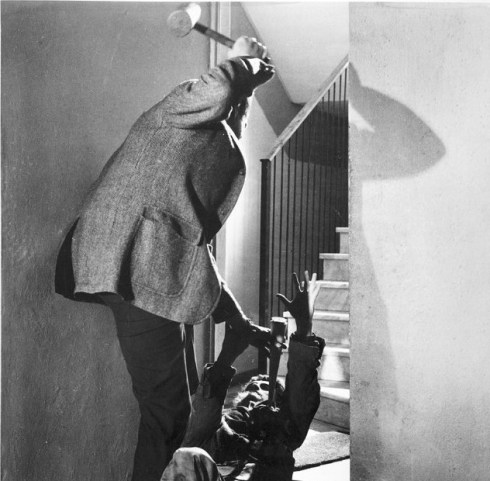
Battleship Potemkin 1925- Sergei Eisenstein known for his montage framing and editing offers up the epic dramatization of the social uprising in Russia, which brought about a grim massacre with an iconic scene of the baby carriage plummeting down the great stone steps.Dr. Caligari’s somnambulist, Cesare (Conrad Veidt) ascends the abstraction of a stairway to nowhere…in The Cabinet of Dr. Caligari (1920)F.W. Murnau’s 1922 masterpiece of shadow and light. With subtle prominence, the silhouette of the stair rails makes cogent the sinister outline of Max Schreck’s Nosferatu all the more.Alfred Hitchcock’s crime thriller Blackmail (1929).She 1935 Irving Pichel and Lansing C Holden’s fantastical saga based on H. Rider Haggard’s novel about an ancient esoteric civilization reigned over by the cruel high priestess She who must be obeyed, upon the steps by the secret eternal flame of everlasting youth! with an intoxicating score by Max Steiner.Again in 1935, SHE was released in both B&W and a gorgeous colorized version. I’ll be doing a larger overview of the film very soon. Using images from both. Steps upon steps, leading to divinity, or leading to death?Thorold Dickinson’s hauntingly sinister fable- The Queen of Spades 1949- See the intricate network of elaborate stairs that wind within the vast manor house, which lead to the infamous lady who bet her soul away to the devil in order to win at a game of cards.In Alfred Hitchcock’s Notorious (1946) Cary Grant carries Ingrid Bergman to safety down the moonlit stone steps.
Charlie Chaplin in City Lights 1931.
Alfred Hitchcock’s Psycho 1960.
Jack Clayton’s The Innocents 1961 starring Deborah Kerr.
In notorious (1946) Claude Rains stands alone facing his fate up those moonlit stone steps…the end scene.
La Belle et la Bete (1946)Caged (1950)Criss Cross (1949)Devil Girl From Mars (1954)Les Diaboliques (1955)Experiment in Terror (1962)Les yeux sans Visage (1960)Les yeux sans visage (1960)Gloria Grahame The Cobweb (1955)I Bury The Living (1958)Island of Lost Souls (1932)Kiss The Blood Off My Hands (1948)Lady in a Cage (1964)Mother Joan of The Angels (1961)Belle et la Bete (1946)Strait-Jacket (1964)Sunrise (1927)The Haunting (1963)The Queen of Spades (1949)Vampyr (1932)The World’s Greatest Sinner (1962)
They want my blood. Their lives are mine. I still get squeamish.
THE LAST MAN ON EARTH (1964)
Directed by Ubaldo Ragona and Sidney SalkowThe Last Man on Earth 1964 is based on the best-selling sci-fi/horror novel I Am Legend by Richard Matheson, who, unhappy with the script, used the pseudonym Logan Swanson for the screenplay. The film remains pretty close to the book, and keep in mind that The Last Man on Earthpredates Night of the Living Dead (1968) by 4 years.
Piero Mecacci ( Suspiria 1977, Hatchet For A Honeymoon 1970, The Young, The Evil and The Savage 1968, was responsible for the film’s make-up.
Matheson’s story is perhaps the first involving vampire-like beings whose origin is not rooted in the supernatural but stems from a scientific, biological catastrophe. This pandemic wipes out an entire civilization. It is also the first of three adaptations of Matheson’s book, and stands alone as the most striking, although I will always have a special kind of 70s love for director Boris Sagal’s version of TheOmega Man 1971.
Heston plays Neville, and Rosalind Cash plays Lisa in The Omega Man (1971), the second adaptation of Matheson’s book. It is an even more modern reworking of a timeless story. A victim of the plague in 1971.
Starring Vincent Price as Dr. Robert Morgan, Franca Bettoia as Ruth Collins, Emma Danieli as Virginia Morgan, Umberto Raho as Dr. Mercer, and Giacomo Rossi-Stuartas Ben Cortman. In 1971, it is the wonderful Anthony Zerbe as Matthias who reprises the role of the vengeful cult leader of ‘the family’ who craves Heston’s (Neville) lifeblood.
“Alive among the lifeless… alone among the crawling creatures of evil that make the night hideous with their inhuman craving!”
Synopsis:
“December 1965. Is that all it has been since I inherited the world? Only three years. Seems like 100 million.”
The year is 1968, Vincent Price in a somber fashion plays Dr. Robert Morgan who like Sisyphus is condemned to repeat his daily tasks of replenishing his stock of garlic and mirrors (the undead hate both), adding gasoline to his generators, collecting the dead bodies that lay strewn around his dismal and cluttered house, and throwing them into the enormous pit where he burns the remains while wearing a gas mask, which is effectively creepy on its own.
“I need more mirrors, and this garlic has lost its pungency.”
For much of the film’s beginning, Morgan narrates his story as an inner dialogue: “An empty, dead, silent world.”
“There was a time when eating was pleasurable now it bores me. just a fuel for survival, I’ll settle for coffee and orange juice this morning. But first, there’s my life to consider, I better replace that garlic I’ll need more lots more, better stop off and get ’em”
Morgan is the seemingly sole survivor in a global outbreak of an unknown bacterium. By day, he collects his needed supplies, tries to make contact by radio with any other survivors, makes repairs to his house, from the onslaught of undead who attack by night, and basically tries to maintain his sanity in the bleak environment of apocalyptic ruin.
Each day, he wakes up, checks off the date on his primitively scrawled calendars, sharpens his wooden stakes, the weapons he uses to defend himself against a surviving race of vampire-like undead that roams the night air, calling out his name, “Morgan, come out!”pounding at his door. “Morgan! We’re going to kill you!” they taunt him endlessly, led by his old colleague Ben Cortman.
Former colleague Ben Cortman taunts his old friend Morgan on a nightly basis…
Living Ben Cortman: There are stories being told, Bob.
Robert Morgan: By people who are out of their minds with fear.
Living Ben Cortman: Maybe. But there are too many to be just coincidental. Stories about people who have died and have come back.
Robert Morgan: They’re stories, Ben, stories.
Robert Morgan: “I can’t afford the luxury of anger, anger can make me vulnerable. it can destroy my reason and reason is the only advantage I have over them. I’ve gotta find where they hide during the day. Uncover every one of them.”
Morgan tests the sharp point of his newly crafted wooden stake, a primitive weapon in the modern world.
“And how many more of these will I have to make before they’re all destroyed?”
“More of them for the pit. tonight there’ll be more of them, they live off the weak ones., leave them for the pit.”
The use of the gas mask has a chilling effect visually.
Less like a Gothic Hammer vampiric epic or prior decades features from Universal and Bela Lugosi featuring swarthy eastern Europeans, The Last Man on Earth is set in a modern urban landscape and acts like a hybrid horror/science fiction morality play, as Morgan drudges on to persevere against the army of soulless humans that haunt his existence.
They have become inhuman things to hunt, and he has been transformed into a veritable Adam living in a post-nuclear anti-paradise with no companionship. It’s merely the primal need to survive that drives him. In this way, he has been reduced to a scavenging animal, living on instinct, with an inescapable mission to hunt and kill people who were once human like himself.
“I can’t live a heartbeat away from hell.”
Morgan inhabits a world, where everyone else has been infected by the plague, they cannot tolerate sunlight, hate to see their own image in mirrors, and more likened to the ancient folklore of Vampires are repelled by garlic.
At night, these undead civilians try to get into Morgan’s house; they have a desire to kill him as much as he has to destroy every one of them.
Each day, he gets in his large automobile in search of more lifeless bodies scattered around the city and seeks out those in hiding to use his wooden stakes to impale and then throw them in the mass grave, fumes rising from the gasoline-soaked funeral pyre.
He finds a dead girl outside his house and picks her up as she flops like a rag doll. He finds another one in his driveway. He loads them into the trunk of his car. He realizes that he’s out of gas. Dead bodies line the road.
Notice the legs and feet dangling out the back of the station wagon like rubbish being taken out to the dump…
“I can get rid of them later, right now I’m out of gas.”
As he drives over scattered bodies like human road kill, he thinks to himself.
“They can wait too, I’ve got my life to worry about, those mirrors will have to be replaced before dark.”
The cinematography by Franck Delli Colliis stunning as it is stark. He paints an apocalyptic wasteland, with the addition of the mass graves and gas masks, which to me, evoke the specter of war-torn Europe after WWII.
In a flashback, we see Morgan as a happily married man with a beautiful wife and daughter. As the memory unfolds, we see that the plague has affected his wife and daughter. While his daughter is taken away to the public burning pit after she succumbs, Morgan secretly buries his wife, not knowing that the dead are coming back to life.
Once he returns home and is attacked by his dead wife, he realizes that he must dispose of all the plague victims before they reanimate themselves into zombies who can spread the plague. Morgan has a theory that his immunity to the bacteria is due to an infected bite he received from a vampire bat while stationed in Panama. This prior exposure to the plague allowed his blood and immune system to build up a tolerance over time.
One day, he finds a wandering dog and takes it home, joyous for the company the little guy will be. Unfortunately, he, too, has fallen ill from the plague, and sadly, Morgan has to kill him, too. Just to let you dog lovers know what to expect…
During one of his daylight excursions, he notices a woman moving around in the distance. It is Ruth Collins, who is terrified of Morgan when she first sees him, but he convinces her to come home with him. When Ruth becomes sickened by a string of garlic waved in her face, she claims she is just weak, but Morgan becomes suspicious of her.
Morgan catches Ruth trying to inject herself with the vaccine that he’s been working on, which seems to stave off the effects of the disease. At first, she attempts to point a gun at Morgan but eventually admits that she was sent to spy on him and that she is part of a secret group of people like her, who are infected by the plague but are using a treatment that restores their health while still in the bloodstream but wears off after a time only to be reinfected again.
Ruth tells Morgan that her group is trying to rebuild their wiped-out civilization, while destroying the remaining infected walking dead, also telling Morgan that many of the people he has killed were technically still alive.
Morgan- “Your new society sounds charming.”
Ruth Collins: You can’t join us. You’re a monster to them. Why do you think I ran when I saw you, even though I was assigned to spy on you? Because I was so terrified, what I’d heard about you. You’re a legend in the city. Moving by day, instead of night, leaving as evidence of your existence bloodless corpses. Many of the people you destroyed were still alive! Many of them were loved ones of the people in my group.
Morgan: I didn’t know.
Morgan transfuses his own blood into Ruth’s while she is asleep, and she is immediately cured.
This encourages Morgan as he sees hope that he can now cure the remainder of Ruth’s people, the surviving yet suffering group of humans between the living dead and Morgan, the last completely healthy survivor of the human race.
In the climatic ending, the hand of irony strikes Morgan’s triumph down, as Ruth’s people begin to attack, forcing Morgan to flee. The band of Ruth’s survivors then kills off the rest of the undead, who are aimlessly threatening, menacing, and, of course, stalking Morgan’s house.
Ruth’s people see Morgan and begin chasing him, as he picks up tear gas and grenades from a police station arsenal, they exchange gunfire, and Morgan is wounded.
He finds his way into a church, with Ruth begging her people to let Morgan live.
They finally impale him on the altar with a spear. Of course, a very Christ-like image, the symbolism is not lost here, he has been sufficiently sacrificed, the only man who could truly save them.
Morgan’s last dying words are “You’re freaks, all of you! All of you, freaks, mutations!” and declares that he is “the last true man on earth.”
This is truly not the end, my friends… -MonsterGirl
But, I that am not shap’d for sportive tricks, Nor made to court an amorous looking-glass I, that am rudely stamp’d and want love’s majesty To strut before a wanton ambling nymph; I, that am curtail’d of this fair proportion, Cheated of feature by dissembling nature, Deform’d unfinish’d sent before my time Into this breathing world scarce half made up, and that so lamely and unfashionable That dogs bark at me as I halt by them-
-Shakespeare, King Richard III, I.I.14-23
Merry Anders plays the attractive and likable Nancy Campbell married to Scott Campbell (Ron Foster) an architect who is hired by their mutual friend Joseph Schiller( Richard Crane), to survey a castle up in the Hollywood hills. It’s more like a Hollywood Spanish fortress set in the middle of nowhere, for the reclusive Rochester’s who had it built for privacy.
Upon driving up to the Rochester Castle up on the isolated hill, it brought to mind the long opening driving sequence in House on Haunted Hill (1959), with its similar eccentric mansion, opulent… a monstrosity… Same with Eleanor Lance driving up to Hugh Crane’s twisted damned architectural fiend that was Hill House.