WELCOME TO JO GABRIEL & THE LAST DRIVEIN’S –500th POST!
“Ghosts are the outward sign of an inward fear”-Ambrose Bierce
“Everything is worse…if you think something is looking at you.” ” — Shirley Jackson
From- Cinematic Hauntings edited by Gary J. and Susan Svehla chapter The Haunting by Bryan Senn.
“Adult in concept and wide in scope. The Haunting is designed not only to appeal to those who approach the supernatural from an intellectual level, but also to the legions of movie patrons who delight in a genuine ghost story.”-The Haunting press book
Halloween is around the corner, I hear the rusty gates creaking, the rattling of skeletons, the flapping wings of jolly bats, smell the candy corn and Hershey’s kisses and the owls are hooting, the spooks are spooking, and I sense the chill of night seeping through the curtains as the best holiday of the year is upon us!
What better way to honor such a ghoulishly ghostly and creepy eve than to explore one of the all-time great movies, ghost story notwithstanding, in honor of my 500th post? Yes, long-winded me has finally reached a milestone.
How do you begin to write about a film that continues to share the spot of the favorite movie in my world alongside Rosemary’s Baby?What can I say that hasn’t already been said about Robert Wise’s masterwork, The Haunting,from 1963? How do you even give suitable tribute to a timeless masterpiece that defies genre and deserves to be upheld as unremarkable?
Incidentally, I was reading Pam Keesey’s terrific essay, The Haunting and the Power of Suggestion: Why Robert Wise’s Film Continues to ‘Deliver the Goods’ to Modern Audiences.Keesey points to a comment that Stephen King makes while admiring Wise’s film. He remarks, “Something is scratching at the ornate, paneled door… Something horrible… but it is a door Wise elects never to open.” Once again, Pam Keesey cites Wise’s influence as written about in Edmund G. Bansak’s wonderful Fearing the Dark: The Val Lewton Career, one of my favorite books in my library. Wise finally found a film that could pay homage to his mentor, Val Lewton.
“Lewton trademarks–the reverence for the underdog, the focus upon humanist concerns, the alliance between danger and darkness, the depiction of fate as an unstoppable force, and, of course the preoccupation with things unseen.”-Bansak
Sorry, Stephen King, but we don’t always need to see the monster– Val Lewton understood that well, and managed to create some of the most compelling moments of terror for us, just by suggesting and triggering our own innate fears of the unknown. This is one of the most essential working mechanisms of Wise’sThe Hauntingthat has withstood the perils of time.
Robert Wise worked as an editor among Val Lewton’s magic team of artists.
He learned the secret to any good work of fantasy/horror/suspense/noir is to suggest, BUT not reveal, what is the heart of the narrative on the screen itself, but allow our own subconscious fears and anxieties to do their work. Much credit has to be given to Nelson Gidding’s (I Want to Live! 1958, The Andromeda Strain 1971) remarkable screenplay.
While working on West Side Story, Robert Wise picked up a copy of Shirley Jackson’s ghost story. In an interview in Midnight Marquee #37, Wise recalled, “I was reading one of the scary passages–hackles were going up and down my neck–when Nelson Gidding (screenwriter)… burst through the door to ask me a question, I literally jumped about three feet out of my chair. I said, ‘If it can do that to me sitting and reading, it ought to be something I want to make a picture out of.”
Wise wasn’t sure he’d get to direct the film, noted in Bright Lights #11–“I called nervously to see if it might be available…{…}because usually by the time a book comes out in New York, the big movie companies have scouts back there, story departments, and they grab it up and it’s gone. I found out this one hadn’t been picked up.”
According to Bryan Senn in an interview in 1995, “I persuaded United Artists to buy the book rights for me and finance a screenplay. And I got Nelson Gidding, who did I Want to Live! (1958) for me to do the screenplay. When we got it done however United Artists got a little cold on it and didn’t want to proceed with it. So I talked to my agent about it. I had left a contract with MGM a few years before; I got out of the contract early but I had to promise to give them another film.
THE HAUNTING, Claire Bloom, Russ Tamblyn, Julie Harris, Richard Johnson, 1963.
The studio wasn’t keen on a supernatural horror thriller, nor of the idea of not using big named stars for the picture.Wise wanted to use classically trained actors like both British Shakespearean actors Richard Johnson and Claire Bloom and American actress Julie Harris.Wise also wanted to work with Russ Tamblyn again whom he worked with in 1961 on West Side Story. Tamblyn was reluctant to do the part after reading the script but threat of suspension from the studio urged him to take the role. Years later he recounts it being one of his favorite roles.
Luck will out and Wise needing to go over to England for a command performance of West Side Story, was able to use MGM’s little studio outside London called Boreham Wood Studios which gave him a bigger budget to work with.
And I can say without any doubts, that I’m with Robert Wise- when I was little, watching The Haunting even during the day, sun shining outside, my heart would pound and I would feel a restless shudder as I sat quietly watching what I consider to still be one of the scariest films of all time. And though I’ve seen it again and again, I still feel said hackles up the back of my neck. The shivers of fear and dread, and a true sense of terror that grips you every single time!
The confluence of artistry, Robert Wise’s sensibility that he synthesized from working with ValLewton, Jackson’s incredible ghost story, Gidding’s compelling script, the collective ensemble performances by all the great actors involved, the effective score by Humphrey Searle, and idiosyncratic and visually disorienting cinematography by Davis Boulton (Stage Fright 1950, I Thank A Fool 1962) The sense of place and the incredible performances that inhabited that uncanny space.
Photo of Richard Johnson, Claire Bloom, Russ Tamblyn, and Julie Harris in the movie The Haunting, 1963. Photo/Art by: anon.
All these elements went into creating one masterfully crafted visual narrative, a psychological maneuver, a tale of terror, and one memorable landscape of uncanny dread and paranoia.
The house itself was set in England and not the story’s old-money New England territory. While there are numerous tales of haunting in England, Jackson’s story was set in New England, and Wise wanted to stay close to the novel’s reality. It wasn’t hard to find the right house in England. However, the more daunting task was getting the roads closed off so Julie Harris could drive her car on the wrong side of the road for the scene where she travels to Hill House. Robert Wise explained in Fantastic Films, that “We wanted a house that basically had an evil look about it” He finally found the perfect house in Warwickshire, a 200-year-old manor house called Ettington Park, Wise felt that its, “facing of mottled stone with gothic windows and turrets” was exactly what they needed.
The house possessed an “unexpected, even frightening, authenticity” According to Russ Tamblyn, “It was definitely a strange place, especially the grounds. The house itself, had a history… oh, children who had been murdered, and a twelve year old who had committed suicide, some other woman who had fell out of a window.” Not to mention the little cemetery out in the back which was supposedly haunted. People had seen ghosts there.
Dr. John Markway: [voice-over narration] “An evil old house, the kind some people call haunted, is like an undiscovered country waiting to be explored. Hill House had stood for 90 years and might stand for 90 more. Silence lay steadily against the wood and stone of Hill House, and whatever walked there… walked alone.”
The film is powerful in the way it brings us into its mystifying grasp. We hear the velvet tones of Richard Johnson narrating to us, greeting us, if you will join the haunting. His voice-over is the visual montage of past events that reveals to us the menacing house. The inception of its evil roots, a domineering man, Hugh Crain, had built Hill House for his wife and daughter, “in the most remote part of New England he could find.” In a freak or strange accident, the wife had “died seconds before she was to set eyes on the house.” Her carriage crashed against a tree, her lifeless arm hanging out of the carriage in close-up. Crain’s second wife floats down the dark Victorian-style hall (Wise was the editor of The Magnificent Ambersons (1942), and the figure of the wife moving swiftly through the darkness reminds us of that film-This impression is also confirmed in More Things Than Are Dreamt of edited by Alain Silver & James Ursini ) then tumbles down a flight of stairs breaking her neck.
“The audience is thrown into the point of view of the second Mrs. Crain as she stumbles down the stairs and blurred, twisted shots approximate the last things she saw in life. Finally a grim but striking deep focus wide angle captures her sprawled at the foot of the main stairs, eyes wide in fright and her corpse in the lower foreground of the frame and behind her shadowy killer, the house itself.”–source More Things Than Are Dreamt Of -edited by Silver & Ursini
After Crain dies in England, his only daughter Abigail “grew up and grew old” In Hill House, eventually hiring a village girl to be a paid companion, “it’s with this young companion the evil reputation of Hill House really begins” When the companion took a farmhand out onto the veranda while her mistress banged on the wall with her cane and died calling for help. The companion inherited Hill House only to be driven to suicide by the unseen, menacing atmosphere of the place. She walked up to the top of the spiral staircase in the library and hanged herself. “They say that whatever there was–and still is–in the house eventually drove the companion mad.”
For Dr. John Markway (Richard Johnson), Hill House is a chance to prove himself. Eleanor has been chosen to be part of the research team because of the shower of stones that had fallen on her house when she was a little girl. Possibly possessing the powers of psychokinesis, the ability to materialize her inner demons, anger, and nightmares. Pointedly, when Eleanor says, “Suppose the haunting is all in my mind?”
From Silver & Ursini’s edited chapter Modern Classics- in More Things Than Are Dreamt Of- “The harp, the knockings, the writing on the wall-all these have a visual and aural presence in film which contradicts any inclination of the viewer to believe that Eleanor is doing this herself; and yet the word on Markway’s questionnaire which Luke doesn’t understand ‘psychokinesis’, makes it possible that she is. Even the interruption of her most flirtatious moment with Markway permits two readings. The house, her possessive, predestined lover, strikes at the harp strings out of jealousy and the need to control her. Or, like Henry James’ repressed governess in Edmund Wilson’s reading, Eleanor does it herself out of fear of sex. Both are possible.”
Having read an interesting essay that touches on Robert Wise’s 1963 ghost story from Hidden Horror, the chapter on Carnival of Souls by Prof. Shelly Jarenski makes a few interesting comparisons to Carnival of Souls 1962
Such as the prelude –“And we who walk here, walk alone.” in my malleable childhood mind, both the prelude and the coda stayed with me like a creepy lullaby or maudlin soliloquy. Jarenski asserts, “The film’s core themes are encapsulated in that line uttered by the misfit heroine Eleanor Lance.” I would totally agree with her assessment. The Haunting is not merely a ghost story; it is a story about an alienated loner, a ‘misfit heroine’ who is in dire search for relief or release, possibly from this world. We, too, are witnesses to a lonely, disillusioned woman (I loathe to use the word: spinster), most likely a virgin, who is longing to make a connection.
Jarenski writes, “Words like “˜we’ or “˜walking’ does create an “ominous ambiguity.” That Eleanor will either join the collection of lost souls in Hill House or be doomed to walk alone for all eternity in “˜isolation and despair.’
Asserting that Carnival of Souls can be understood as a corollary to the more ceremonious and celebrated The Haunting because“It portrays what being part of the community of the dead, while simultaneously feeling utterly alone, looks like.”
In More Things Than are Dreamt Of-Silver and Ursini point out the idea thatThe Hauntingis much more than just a ghost story. As Shirley Jackson wrote in her novel, “During the whole underside of her life, ever since her first memory Eleanor had been waiting for something”¦”
Theodora, affectionately known as Theo, has been recruited to help in the research because of her extremely honed powers of ESP. This becomes established before Dr. Markway introduces everyone around the breakfast table. While Mrs. Dudley regurgitates her soliloquy of fear & gloom, Theodora takes a mental inventory of Eleanor’s psychic bag, and when Eleanor asks how she knew what she was thinking, Theo cheekily replies, “You wear your thoughts on your sleeve.”
The Haunting(1963)could be said to be the penultimate example of ‘nothing up that proverbial sleeve’ and ‘it’s what you don’t see’ cinematography. The visual narrative is what makes it timelessly heart-pounding to watch and what gives it an artistic atmosphere of misdirection, anxiety, hysteria, dread, romanticism, and well, yes, that “haunting’ feeling.
Memorable scenes of veiled terror lurking in the corners or beyond the massive wooden door frames. The allusion to the various cold spots is underscored by trilling piano keys. Stark frames capture a portion of the house as if it were a live entity. Dr. Markway refers to the house as being ‘born bad. The manifestation of the angry and tyrannical Hugh Crane, who built an evil house. There are so many moments of The Haunting that have stayed with me for years. And I must admit that I usually watch it several times a year, like one makes pot roast because the craving strikes you at that moment. “It’s time to watch The Haunting again,” is heard in our house. I can never forget the moment when Julie Harris as Nell awakens frightened, where we hear a child’s muffled laughter swiftly turning to a menacing scream. She tells Theo that she’s breaking her hand, she’s holding it so tight. The camera only focuses on Nell and her outstretched arm in the darkness, swallowed up in her ornate room, like a fly in a spider’s web. When she can no longer bear Theo’s tight grip, she screams, “Stop it!” and turns the light on, only to find in horror that she’s been holding a ghostly hand. “Whose hand was I holding?” Theo is shown across the room, still lying in bed, unaware that Nell had been going through any nightmarish ordeal.
In other sequences, the visual perspective seems to warp all we see, pulling us into the dis-ease of Hill House. From the moment Eleanor pulls up to Hill House, the point of view is skewed so that we are watching Eleanor, who is also being watched by the house. It’s a startling moment as she realizes, “It’s staring at me.”
And of course, there’s the eerie and otherworldly invisible assault on the two women as something unseen pounds on the doors with a ‘cannonball’ Disembodied laughter, scratching, growling, and Baroque-style brass doorknobs with Medusa’s face that turn ever so slowly, as if something trying to gain entry into the room.
Eleanor ‘Nell’s’ name has been scripted on the wall in something ‘like chalk.’
And then the ghostly message written on the ostentatious wallpaper in ‘something like chalk’ outside the dining room-“Help Eleanor -Come Home!”
Hill House’s expression of love, the seduction by way of written message in ‘something like chalk’ both frightens Eleanor yet stimulates her because someone or something was finally paying attention to her. as Alain Silver and James Ursini point out the house’s dark secrets, “represent the intimacy which Eleanor has never had with any other being…”
There’s also the emphasis on the powerfully imposing use of matrix work, utilizing the inherent designs of the interiors themselves, textiles, wallpaper, and wood carvings to create diabolical faces watching back at us. The stone and bronze cherubs and gargoyles that inhabit Hill House, the myriad of mirrors, and long winding hallways mixed with the turbulent sky outside the towering Hill House.
The iconic scene where the door seems to expand as if breathing was actually two technical people who used 2x4s to push into the middle to create the effect. It’s that simple, and yet it is one of the most lasting scenes in film history.
The book by Shirley Jackson, The Haunting of Hill House, is a hell of a read, but as a rarity, the film invokes the uncanny of the story even better than the novel.
“SCREAM…no one will hear you! RUN…and the silent footsteps will follow, for in Hill House, the dead are restless!”
I’ve had any number of people over the years say to me, ‘You know, Mr. Wise, you made the scariest picture I’ve ever seen and you never showed anything. How’d you do it?” And it goes back to Val Lewton, by the powers of suggestions”–Robert Wise in Fearing the Dark: The Val Lewton Career
Robert Wisemade The Haunting in 1963 as a way of paying homage to his mentor, Val Lewton, who had died 12 years earlier.
The always-poised Richard Johnson plays the very earnest Dr. John Markway, a researcher in the paranormal who wants to use Hill House, an imposing Gothic New England house, as the main epicenter for his studies in the supernatural. Based on the legend of all the ghostly goings-on surrounding said place, Markway gets Mrs Sanderson (Fay Compton) to agree to lease the house to him for one year. Though she is the voice of caution
– Mrs. Sanderson: “The dead are not quiet in Hill House.”
The great Fay Compton as the crusty waspy Mrs. Sanderson warns Markway that the dead are not restful at Hill House.
Markway initially collects the names of potential participants in his experiment and chalks them on his blackboard. Eventually, the names drop off, and only two women arrive to help him uncover the truth behind the legend of Hill House. Is it truly haunted?
Theodora: “Haven’t you noticed how nothing in this house seems to move until you look away, and then you just… catch something out of the corner of your eye?”
Theo, sensing a presence, says, “It wants you, Nell… the house is calling you.”
Mrs. Sanderson sends along her cocky nephew out of the Midwest, Luke (Russ Tamblyn) to accompany Dr. Markway since one day Luke hopes to inherit Hill House. The exterior of Hill House is an actual Hotel called the Ettington Park Hall Hotel in Stratford-upon-Avon, England. The interior sets were brilliantly designed by John Jarvis.
We meet Eleanor ‘Nell’ Lance (Julie Harris) in her sister’s living room, which doubles as her bedroom. The very hypersensitive Nell is being tortured by her sister, brother-in-law, and their precocious brat of a child who insists on playing a child’s record march consisting of inane flutes and snare rattles, causing a pervasive tenor of chaos, madness, and dysfunction. Like nails on a blackboard, the little tune serves not only to cause psychic aural conflict and irritate Nell but also pulls us into her sense of being trapped in a claustrophobic world where she must break free. Nell steals the family car and hits the road with all her belongings in a box, driving out of Boston out into the light of the New England air toward something, anything, even the unknown, which would be better than the captivity she’s been experiencing. She is one of the people Dr. Markway has invited to participate in exploring Hill House.
More Things Than Are Dreamt Of edited by Alain Silver & James Ursini- The Haunting of Hill House is a third-person novel with a lot of interior monologues and other first person aspects…{…}Eleanor is neither a para-psychologist nor a believer, but a disheartened spinster yearning for escape and adventure; or as Jackson puts it, ‘During the whole underside of her life, ever since her first memory, Eleanor had been waiting for something…’
Eleanor is the first person to see the ‘vile’ house. Silver & Ursini frame it by Jackson’s occult vision, that Hill House is the cause of Eleanor’s ‘deliverance and destruction’. How Eleanor’s religious discourse becomes an ironic fate that turns inward on itself for in the end, “journeys end in lovers meeting” Eleanor’s volatile relationship with Hill House is absolutely one of love/hate.
Upon her arrival, she is confronted by two of the locals who harbor a maniacal animosity toward city people. The Dudleys were played by Rosalie Crutchleyand Valentine Dyall ( Who was perfectly sinister as Jethrow Keane in Horror Hotel 1960, yet another favorite classic horror film of mine.)
Rosalie Crutchley attributes the films power to Robert Wise’s skillful direction and David Boulton’s sinister cinematography that transformed the benign Ettington Park into the malevolent manor of Hill House. “It was a strange house” the actress told Bryan Senn. Crutchley continues, “which looked threatening from the outside but which wasn’t actually at all. But it was brilliantly shot you see, so that it looked very, very threatening.”
Mr. Dudley: “You’ll be sorry I ever opened the gate.”“Get away from here; get away at once. It’s my chance. I’ve been given a last chance. I could turn my car around and go away from here, and no one would blame me. Anyone has a right to run away. But you are running away, Eleanor. And there’s nowhere else to go.”
Mrs. Dudley takes care of the interior of Hill House as no one else in the village dares come near the place, setting out the meals but being very clear about leaving before it gets dark. The sardonic grin on her face as she divulges to Nell and Theo her little creepy-intoned soliloquy… “No one will come any further than town…”
No one will hear you scream… Mrs. Dudley’s expression is somewhat a combination of that intense little fellow, the prairie dog from the viral YouTube video where he turns around and stares, and Lewis Carroll’s Cheshire Cat.
Anyhoo… Markway leads the other three on a journey of discovery of the unknown. He chose Eleanor ‘Nell’ because of her poltergeist experience that occurred when rocks pelted her family home for a week. Eleanor suffered from a tremendous guilt complex shortly after losing her chronically ill mother, whom she cared for and who passed away, and this puts Nell on the edge of a breakdown. Theodora is known quite well for her powers of ESP. Luke Sanderson is the skeptical playboy of the foursome…
Markway is filled with glee as they have stumbled onto the proverbial ‘cold spot.’Luke-“There’s got to be a draft!”Dr. Markway tells Luke-“Look I know the supernatural is something that isn’t supposed to happen but it does happen… and if it happens to you your liable to have that shut door in your mind ripped right off its hinges!”
The ‘Adventurous All’ get together, trading small conversations and observations, while Hill House begins to reveal its cold heart. Or is the house truly a bad place? Built by a man who used odd angles and macabre embellishments, he created one “distortion as a whole,”as Nell comments. Hugh Crane, a man who was a religious zealot, entrapped his daughter in the foul house until her death as an old maid. She grew up and grew old in the house, where a series of mysterious accidents, suicides, and deaths ensued… Hill House is the epitome of Dark spaces or Bad spaces.
The nurse is too busy out on the veranda with the farm hand to hear Abigail pound on the door with her cane, and eventually hangs herself after inheriting Hill House.
Eleanor Lance: “Can’t you feel it? It’s alive… watching.”
Hill House does begin to show particular attention toward the vulnerable, fragile, and bedeviled Nell. But…
That begs a larger question. Can a house be born bad, or have Nell’s neurotic fixations and need to belong caused her to unravel the mysteries of the place much quicker? Is it just her longing and alienation that has created a certain madness, or is it both a ghost story and a story of abject loneliness and psychosis? Much like a Lewton story, there is the feeling of intense loneliness, an imbalance in the environment that is either mental or perceived to be a reality, and ambiguity that links these elements to the supernatural world.
There are definitely themes of repressed sexuality exhibited by the presence of the very stylish Mary Quant sporting Theo (Claire Bloom), who it is heavily suggested is a sophisticated Greenwich Village Sapphic who toys with the uptight Nell. When asked what frightens Theo, she glumly replies, “Of knowing what I want.”
Something that begins to cause friction between the ensemble because Nell has fallen into the well of deep delusion and longing, for Dr. Markway not realizing that he is not just only interested in her as a test subject but he is already married.
Theodora, dressed like a black widow, spins her web of jealousy yet reveals the truth about Markway and Nell’s unrequited love.Theo-“You’re making a fool of yourself over him.” Nell-“I’d rather be innocent than like you.”Theo-“Meaning what?” Nell-“Now, who’s being stupid and innocent? You know perfectly well what I mean.” Theo- “Is this another of your crazy hallucinations?”Nell- “I’m not crazy.”Theo-“Crazy as a loon. You really expect me to believe you’re sane and the rest of the world is mad.” Nell-“Well, why not? The world is filled with inconsistencies, unnatural things, nature’s mistakes, they’re called you, for instance!”Nell tells Theodora that “she’s the monster of Hill House.”Markway sees that Nell is unraveling and threatens to send her packing.
Poor Nell is a tragic Gothic figure whose famous inner monologues might slightly touch the third rail of hysterical camp yet somehow manage to become a restrained performance of inner turmoil and madness that perfectly co-exists parallel to the odd and uncanny manifestations escalating in Hill House, with a rainstorm of inner monologues to guide us through the treacherous darkness.
Mrs. Markway shows up unexpectedly and asks to sleep in the most rotten heart of the house… Nell obliges by telling her about the nursery, which, until now, has been sealed.
“Now I know where I’m going–I’m disappearing inch by inch into this house.”
In Scarlet Street Magazine, Julie Harris stated that she would have played Nell differently. “Well, I would’ve been odder looking as Eleanor,” Harris said. “I think she was too ordinary. I just wanted to be — odder.” That’s okay, Julie Harris, whom we sadly lost on August 24th of last year. No one could have done a better job of bringing Eleanor Lance to life than you did… Your Eleanor Lance will eternally remain the central tragic figure of the play, as Pam Keesey calls her the ‘persecuted innocent.’
By the end of the film, Luke, who is the cynic of the bunch, tells us…” It ought to be burned down… and the ground sowed with salt.”
The poor bedeviled Nell dances with the statue of Hugh Crane, believing that both he and she have killed Grace Markway.Grace Markway ( Lois Maxwell) doesn’t go untouched by the dark forces that lay behind the stone and silent standing wood… well, maybe not so silent!
–Happy Halloween, gang… and thanks for making all 500 posts a whirling experience! – Your Everlovin’ MonsterGirl
I saw"”with shut eyes, but acute mental vision"”I saw the pale student of unhallowed arts kneeling beside the thing he had put together. I saw the hideous phantasm of a man stretched out, and then, on the working of some powerful engine, show signs of life and stir with an uneasy, half-vital motion. Frightful must it be, for supremely frightful would be the effect of any human endeavor to mock the stupendous mechanism of the Creator of the world.
"” Mary Shelley
When I think of Kenneth Strickfaden I visualize the mad scientist grabbing the master switch in his clandestine laboratory. Suddenly the machinery hums and glows, glass tubes boil with liquids, electrical currents charge through the coiled tubes and conductance. Lighting leaps across the sky and finds its way into the diving spot in the lab. The crackle, snapping hiss and sparks of ozone. The well orchestrated machinery of mad science that now act as futuristic hardware. The electrical odor that would still permeate the air for years to come as he shaped the way we perceived the mad scientist labs and mysterious scientific exploration!
early days Strickfaden assembling a mad scientist apparatus
Kenneth Strickfaden was an expert in high voltage electricity, film set designer, and electrical special effects master. Using his skills as a carnival electrician, he created the science fiction apparatus that can be seen in more than 100 films and television programs, showcasing Strickfaden’s technical phantasmagoria of light and sound!
I often wonder how many of these films centered around mad science and the laboratory environment utilized some of Strickfaden’s machines and electrical effects without giving him credit.
Boris Karloff in The Devil Commands.Boris Karloff in The Man They Could Not Hang.Man Made Monster
I can see influences in Edward Dymtryk’s The Devil Commands 1941 with Boris Karloff. With art direction by Lionel Banks and props by Franz, Oscar, and Paul Dallons.The Man They Could Not Hang 1939  & Man Made Monster 1941 Set direction by Russell A Gausman and John P Fulton who had worked with Strickfaden before. I believe Strickfaden did the special effects and used part of his equipment. Doctor X (1932), The Invisible Man 1933,The Man Who Lived Again, and more!
Dr. X (1932).The Man Who Lived Again.The Invisible Man 1933.
Strickfaden’s first contribution was to Just Imagine 1930. Today it has become something of a "lost" film and nearly impossible to see on the big screen. "While the beautiful art deco sets, enormous miniatures, and remarkable projection effects still amaze," says Production Designer John Muto, Founder of the ADG Film Series, "the music, comedy, and love story are derived from vaudeville and must have seemed very dated as cinematic musicals exploded in the 1930s. I suspect that may be why the film faded from view. Our audience will discover a very surprising film!" "Today, most films set in the future portray a bleak, dystopian, even apocalyptic world.” Besides the beautiful art design Just Imagine featured a stunning laboratory filled with electrical equipment by Ken Strickfaden.
Just Imagine 1930.
The Clutching Hand (1936
But it was his work for James Whale’s 1931 masterpiece Frankenstein, The Bride of Frankenstein, and Ghost of Frankenstein that struck like lightning! Stock footage of the lightning bolt generated by Strickfaden’s equipment can be seen in so many films and television shows. John P Fulton head of the special effects department at Universal Studios was responsible for the special photographic effects-
Jame’s Whalehad wanted a lab that was reminiscent of the one in Fritz Lang’sMetropolis1927 Lang’sart department/set designers Otto Hunte, Erich Kettlehut, Walter Schulze-Mittendorf & Karl Vollbrecht. Special effects by Ernst Kunstmann, Konstantin Irmen-Tschet and Erich Kettelhut. Visual effects Eugen Schufftan, Willy Muller, Hugo O Schulze, and an uncredited Edgar G. Ulmer.
Metropolis 1927.Fritz Lang’s Metropolis 1927.This orb of Kenneth Strickfaden’s has made it through Fu Manchu’s clutches to the Wicked Witch of the West’s long bony fingers
You can see Strickfaden’s wonderful creations in The Wizard of Oz, The Mask of Fu Manchu to television’s The Munsters, and his final work, Young Frankenstein. Strickfaden recycled a number of the pieces that he kept maintained like his“Cosmic Ray Diffuser”that he used in the original Frankenstein.
Kenneth Strickfaden was born in 1896-by the time he was in high school he was using a camera and setting up shots of amusement parks, and battle scenes, and visualizing and creating his own laboratory apparatus and equipment.
Thesiger and Clive in The Bride of Frankenstein
When I was just a little tiny wide-eyed MonsterGirl I would daydream plenty on rainy days and spend hours down in the basement assembling pieces of metal and plastic doohickeys having taken apart various appliances around the house, trying to create my very own little mad scientist lab. I’d get large pieces of wood and paint the control panels. I could literally spend hours down there pretending to be Dr. Pretorious. I was fascinated by science fiction technology and the secrets of life and death, and the fantastical storytelling Universal Monsters had to offer.
Backstage on the set of Frankenstein
My pop would continually ask me where I put his hammer, though it was true most of the time, I did take his tools to aid in my small-scale construction of a basement laboratory. I was constructing panels with knobs and meters, I didn’t always have his hammer. And by no means did I have the eye or the technical brain to develop such intricate machinery that could spark and crackle streams of white heat, the suggestion of the life force arching in splendor. It just felt so good to be living my own fantasies without being told that I should go play with dolls. That’s also partly how I got to be known as MonsterGirl by the neighborhood bullies. Anyway… back to the genius of Frankenstein’s electrician.
Paul Walter’s assistant holds the switch box that controls Strickfaden’s Magnalux invention for lighting simulating flashes-Image from Goldman’s book.
Strickfaden had the sort of fascination for creating a milieu of scientific realism, working on our sense of wonder and the possibilities of the creations these machines would aid in either creating life or destroying it, which was always a draw for me. His special electrical designs and effects were visually groundbreaking for American film audiences, far-fetched perhaps but divine. He used junkyard electrical parts from the 1930s, fake wiring, and high voltage Jacob’s ladders (An electric current then flows until the path of ionized gas is broken or it, as it rises, will pull the arc apart and so extinguish it.), and spark gaps and the occasional Tesla Coil. “Ribbed ceramic insulators are a must… as are the slate front panels and wooden cabinetry that were standard of scientific and medical devices of the day”
And that’s why I wanted to do this little feature tribute to a man who’s responsible for shaping the look of so many classic horror and sci-fi fantasy film milieus over the years. The sets and laboratory apparatus that contributed to the Gothic science mood of the story, came to life because of the innovation Strickfaden used in creating his fantastical yet plausible designs. As a key to the plot structure as the players themselves.
image of Strickfaden’s “Megavolt Senior” from Goldman’s Book
During the grand days of classic horror between the decades of 1930s and 1940s, the landscape might have looked entirely different if Kenneth Strickfaden hadn’t been so fascinated with creating apparatus and contraptions that flashed and sparked with high voltage, meters keeping track, tubes, and coils and large equipment that paid true homage the science fiction writings he was trying to breathe life into himself a technician like Pretorious and Dr. Frankenstein. The appearance of these industrial gadgets and machines, and the look of the laboratory brought such a sense of realism to an already Gothic stunner, and Mary Shelley’s story, too which was ahead for its day. As Harry Goldman refers to in his book title, Strickfaden was the right electrician for the job.
Colin Clive with Elsa Lanchester as The Bride- notice The Nebularium! Image from Goldman’s Strickfaden-Frankenstein’s Electricianon the set of Frankenstein from Famous Monsters of Filmland #21 1963
Though his fascination started in high school by the early 1920s film makers saw the potential in his inventive apparatus. He was given work at many Hollywood studios, in which he offered them a slew of amazing special electrical effects.
From Goldman’s, Kenneth Strickfaden, Dr. Frankenstein’s Electrician, Strickfaden’s work was not easy, “Apparatus constantly failed due to overheating,” he once revealed to writer Scott MacQueen. “Most effects did not photograph as expected, or they were eliminated due to electrical failures.”
Despite these unusual, and expected, setbacks, the onscreen results were phenomenal, and far more convincing than any simulations. Strickfaden made much use of the inventions of Nikola Tesla, which had been perfected more than thirty years before the first Universal Studios “Frankenstein” movie. But, unlike Tesla, he was also concerned with the theatrical “look” of his fanciful contraptions, which had to appear to be futuristic and capable of untold wonders. The names he gave the machines were often equally marvelous, such as: “the retrogressive wave charger,” “DXLAccumulator,”and “High Amperage Pyrogeyser.”
When, in the late 1940s, real-life scientific marvels turned out to be subtler than Strickfaden’s machines, his work apparently went out of fashion and was little seen in Hollywood until the ’60s, when it was used extensively in The MunstersTV show and in commercials.
Before his death in 1984, he spent much time touring with his “Kenstric Space Age Science Show,” educationally demonstrating spectacular electrical phenomena.
Standing fearlessly before a high voltage arc.His reliable switchboard can be seen in the foreground while the famous “Meg Senoir” Tesla coil appears in the background.
The Cosmic Ray Diffuser-Image from Goldman’s Book
A few highlights of Strickfaden’s career include:
Frankenstein (1931) The equipment brought Mary Shelley’s monster to life.
In The Mask of Fu Manchu (1932), Strickfaden created a dazzling electrical death ray even doubling for Boris Karloff, who played Fu Manchu when the evil mastermind spreads his hands and the powerful lightning dances between his long sinister fingernails.
Murders in the Rue Morgue 1932 Bela Lugosi is Dr. Mirakle- Ken Strickfaden lends his electrical gadgets to Mirakle’s laboratory.
Chandu the Magician -Strickfaden’s machines came from FRANKENSTEIN now they equip (Bela Lugosi) Roxor’s lab- His death ray, a giant ray gun that sends pulsating death beams aimed at the major cities of the world!
In The Bride of Frankenstein (1935) Strickfaden configured the electrical displays for the Bride creation sequence.
The Wizard of Oz (1939) He created the effect of the Wicked Witch of the West trying to remove Dorothy’s ruby slippers and receiving an electrical shock. The orb she uses to scry was a Strickfaden design.
The giant crystal ball that Margaret Hamilton uses as the Wicked Witch was actually uncovered in a junkyard found amidst the remnants of other discarded Hollywood memorabilia from a now defunct prop house. The enormous hand-blown glass, with high voltage Tesla coils, had a new owner who spotted it in Goldman’s book Dr. Frankenstein’s Electrician. It had been used by Bela as Roxor in Chandu the Magician. It was a great prop for Boris Karloff in Mask of Fu Manchu, but once he placed it up for auction the new owner learned that it had actually been the crystal ball used in The Wizard of OZ.
Fighting Devil Dogs (circa 1941)“Manifested projectiles of something like ball lightning.”
Sherlock Holmes Faces Death (1943) “He simulated an unusually realistic lightning strike.”
Young Frankenstein (1974) Strickfaden recreated some of his best work from the original Frankenstein.
Bela in Chandu the Magician with the death ray.Boris as the absent-minded scientist in The Boogeyman Will Get You.
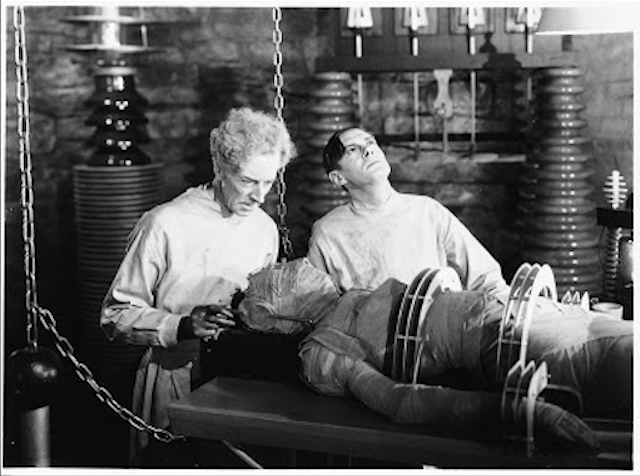
Ernest Thesiger and Colin Clive in The Bride of Frankenstein.
He was born in Montana in 1896, Kenneth Strickfaden was an imaginative and adventurous guy who worked at amusement parks, taking myriads of photos. He traveled overseas serving in World War One. He was also an airplane mechanic so he was very handy technically, having built and tuned Tesla coils and X-Ray machines. A Tesla coil is an electrical resonant transformer circuit invented by Nikola Tesla around 1891. It is used to produce high-voltage, low-current, high frequency …Eventually, he found himself in Hollywood working as a studio electrician in the late twenties.
Image of Strickfaden holding the Melodyne musical disc and large lens that appears in Son of Frankenstein from Goldman’s book Dr. Frankenstein’s Electrician
In 1931, Kenneth Strickfaden was hired to set up the equipment for Frankenstein’s tower laboratory. He was to furnish it with a ‘powerful engine.‘ Strickfaden assembled various machines. One which was used for the lightening powered scene that would help resurrect Boris Karloff’s monster back from the dead to life on the slab. He combined his knowledge of electrical science engineering and part of his love of creating side show electrical pageantry in order to transform Dr. Frankenstein’s laboratory into a place of unorthodox alchemy within a modern science dominion.
Kenneth Strickfaden Bride of Frankenstein control panel-Image from Goldman’s book
At first, the designs were to be more streamlined and modern in their look, but Strickfaden had managed to construct a place of Gothic dread within the medieval structure of the setting and seamlessly adapt the apparatus of modern science with the stone walls. The juxtaposition of the two worlds adds to the feeling of Dr Frankenstein’s heretical, rebellious, and clandestine primacy as his secrets lay hidden away.
Strickfaden's apparatus quivered, sparked, crackled, and shrieked. The imposing levers were pulled in harmony with the dialogue, like an orchestrated scientific waltz. White hot arcs of electrical tendrils reached out and thrust wildly like serpent’s tongues. Beautifully glistening glass vials and tubes sat amidst copper spheres that wound themselves around like industrial jewels. Needles indicated where the force of energy was heading on the dials, and disks whirled like fun-house wheels. It was all so mesmerizing in Frankenstein’s laboratory with its arcane machinery that sang the songs of the universe, and the secrets of immortality and life from death, the sounds of voltage that pushed the machinery to its limits.
The Nebularium device from The Bride of Frankenstein 1935Image from Goldman’s bookStrickfaden created a Nebularium for House of Dracula ’45. Image from Goldman’s book Dr.Frankenstein’s Electrician
From then on 1931 James Whale’s Frankenstein with its elaborately detailed laboratory up on the mountain tops set the tone for all mad scientist laboratories to follow. Kenneth Strickfaden would utilize and reconfigure his glorious apparatus over and over again in the Frankenstein films that followed, like Bride of Frankenstein.
You can see his fantastical machines like his“Megavolt Tesla Coil”& the “Nebularium”in Flash Gordon serials and so many other horror and sci-fi features over the decades. Even in one of the most memorable episodes of The Munsters in the 60s, where Grandpa transfigures Herman into Fred Gwynn, losing his square-headed, neck-bolted Frankensteinian charm! The episode is called “Just Another Pretty Face.”
And Mel Brooks truly paid homage to the Universal cycle of Frankenstein pictures with his Young Frankenstein in 1974. Co-starring with Cloris Leachman, Madeline Kahn doing her Mae Clarke bit as Elizabeth, and Marty Feldman as Igor to Dwight Frye’s Fritz.
Strickfaden’s machines and apparatus were re-used in Mel Brook’s Young Frankenstein
The Gothic laboratory where Gene Wilder plays Doctor, waxes campy and raises Peter Boyle back to life using a lighting storm and complex equipment that sparks and radiates arcs of light was the very same set of scientific apparatus used in Whale’s masterpiece in the 1931 film when Kenneth Strickfaden first configured it all for the set of Frankenstein with Boris Karloff.
Strickfaden died in 1984, and up until that time, he traveled the country with all machines and apparatus, and gave lectures in schools and auditoriums, also creating music with electrical instruments that he designed. He would demonstrate his lighting effects with ultraviolet light on radioactive materials, and shock and amaze students with something he called his “gravity nuetralizer” He did these programs from 1933 til his death.
Son of Frankenstein Basil Rathbone, Bela and once again Karloff as Frankenstein’s monster.Bela Lugosi in The Phantom Creeps
Strickfaden would step in at times as a stunt double in the films, for instance, he played Karloff’s monster for a scene that didn’t make it into the film. When Karloff didn’t want to use the “QUCH” machine fearing it was too dangerous as Fu Manchu, Strickfaden stood in for him. He held a large wand that generated a streaming arc of lightning which called for a million-volt spark to dance over his body. in Mask of Fu Manchu, Strickfaden was thrown across the set when he wasn’t grounded properly and received a jolt of electricity.
Kenneth Strickfaden’s QUCH machine-up for auction
He became the most trusted man around high-voltage trickery, yet Strickfaden admits very plainly that there’s no mystery to what he is able to do and that producing high voltage or amperage is rather simple.
One of the key apparatus that Strickfaden uses is his million-volt generator, which produces large sparks, and fat blue flames that can actually reach a height of 6 feet into the air. It’s his most intricately designed piece of equipment. The multi-distributor consists of a motor-driven set of whirling electrodes that can throw sparks. Strickfaden does say that a shock from the circuits could actually prove fatal.
Another device Strickfaden used was called a ‘lightening screen’This is another high-voltage generator that throws sparks across a large disk with a radioactive backing. Used with a darkened stage, the radioactive material continues to glow along the path of each spark even once the current has been shut off.
A note about Nikola Tesla-THE GENIUS WHO LIT THE WORLD- “ Young Nikola Tesla came to the United States in 1884 with an introduction letter from Charles Batchelor to Thomas Edison:Â Â Nikola Tesla developed polyphase alternating current system of generators, motors and transformers and held 40 basic U.S. patents on the system, which George Westinghouse bought, determined to supply America with the Tesla system.
In February 1882, Tesla discovered the rotating magnetic field, a fundamental principle in physics and the basis of nearly all devices that use alternating current. Tesla brilliantly adapted the principle of rotating magnetic field for the construction of alternating current induction motor and the polyphase system for the generation, transmission, distribution and use of electrical power. Tesla’s A.C.induction motor is widely used throughout the world in industry and household appliances. It started the industrial revolution at the turn of the century. Electricity today is generated transmitted and converted to mechanical power by means of his inventions. Tesla’s greatest achievement is his polyphase alternating current system which lights is used throughout the world
Modern Mechanix scan of a Popular Mechanics article from September 1949-by Eugene M Hanson.
1. Scott MacQueen, “Kenneth Strickfaden: Strange Revelations of the Man Who Lives in the House that Frankenstein Built,” Gore Creatures, no. 24, October 1975, pp. 24-26.
2. William Ludington, “Mister Electricity: The Multi-Volted Career of Kenneth Strickfaden,” American Classic Screen, vol. 7, no. 1, Jan./Feb. 1983, pp. 26-29.
This has been electrifying -your ever lovin’ MonsterGirl
"For some nights I slept profoundly; but still every morning I felt the same lassitude, and a languor weighed upon me all day. I felt myself a changed girl. A strange melancholy was stealing over me, a melancholy that I would not have interrupted. Dim thoughts of death began to open, and an idea that I was slowly sinking took gentle, and, somehow, not unwelcome possession of me. If it was sad, the tone of mind which this induced was also sweet. Whatever it might be, my soul acquiesced in it." "• Joseph Sheridan Le Fanu, ‘Carmilla’
The Light in the Window … The Lock on the Door … The Sounds in the Night! A Possession is Taking Place!
A while ago I double featured Let’s Scare Jessica to Death (1971) and The Night God Screamed (1971). I made it clear that I felt Let’s Scare Jessica to Death was the superior film but somehow they made good companion pieces. And since I’m a child of the 70s, those days of the double bill, musty theaters, milk duds, and groovy posters, I’ve decided to pair these particular films. And once again, I’ll emphasize now that I believe Lemorato be by far not only the superior film but one of the MOST uniquely beautiful horror/fantasy films I’ve ever seen.
Because the film hit a very bumpy road on its release, it wound up being passed around like an orphan from one distributor to another. Thus is the reason for several titles over the years. It has been called The Legendary Curse of Lemora and Lemora, Lady Dracula, the latter hoping to ride the wave of low-budget vampire films that have now also attained cult status such as Bob Kelljan’s authentically potent Count Yorga Vampire 1970 starring Robert Quarry, and the equally stylish Blacula 1972 and of course the Gothic vampire pageantry of Hammer Studios churning out stylish costume melodramas with a lesbian vampire sub-text like The Vampire Lovers 1970 and Lust For a Vampire 1971, Stephanie Rothman’s The Velvet Vampire 1971, and Vicente Aranda’s The Blood Spattered Bride 1972. The liner notes written by Richard Harland Smith of Video Watchdog & Chris Poggiali of Fangoria and Shock Cinema interviewed Richard Blackburn and Byrd Holland and point out that Blackburn’s film is “less exploitative” yet “not unerotic” while using the “fragility of innocence.”
From the Journal of Horror and Erotic Cinema-Edited Andy Black
Bev Zalock’s- Girl Power From The Crypt
“In a sense, horror more than any of the other exploitation genres, with its monsters of the imagination, feeds fantasy and configures fear in a very direct way. With its linking of sex and death, horror taps into the unconscious and is associated with surrealism and the fantastic in both literature and cinema. Desire becomes the primary mise-en-scene within the realm of the supernatural and, as David Pirie observes in his excellent book The Vampire Cinema’ there is a strong cultural connection between our perception of sex and the supernatural. Pirie cites an article by Susan Sontag written in 1967 entitled “The Pornographic Imagination” in which she locates the fantastical realm of the human imagination as the site in which the two are classically connected.” – from Susan Sontag’s piece–Styles of Radical Will 1966
Celeste Yarnall is the dark lady vampire in Stephanie Rothman’s -The Velvet Vampire-co-starring Sherriy Miles.
In addition to these lesbian vampire narratives, you have Jess Franco’sVampyros Lesbos 1970 and auteur Jean Rollin’s distinctive style who like Hammer connected suggestions of the ‘pornographic imagination’ that Susan Sontag describes. Films that use the spectrum of surrealist imagery from the Gothic to the gory. What they share is a ferocious appetite for power and the desire for sexual freedom.
Directed and written by Richard Blackburn (Eating Raoul 1982 with cult idol Mary Woronov and co-written with director Paul Bartel) fresh out of UCLA film school, with his pal Robert Fern. Blackburn has said in interviews that there are things he would have done differently with a better budget and more time. He shot Lemora in a month. I think the crudely macabre tonality of Lemora is what makes films like these from the good old ’70s oneiric, quintessential, haunting, and flawless as is.
There is a discrepancy as to whether the running time of the film is either 85 minutes or 113 minutes (uncut). The remastered DVD through Synapse Films took the original 35mm negatives and brought this film back to its ‘never before seen clarity.’ The prints were presumed lost for over 30 years.
The hauntingly macabre and somber music is by Dan Neufeld who crafted electronica and claviers and what I think might be a Melatron to evoke the eerie essence of the story is absolutely brilliant. With crying strings that fortify distorted wails and moans. With music box tinkling, poignant yet eerie flutes, and piano, muted horns-noises that shimmer and reverberate on cue with the dialogue or surreal set piece- I wish Dan Neufeld had done more movie scores. The sound design, the dysmorphic groans-unearthly wails- they’re the sounds you’d imagine the ‘old ones’ make in a Lovecraftian tale. Even the crickets and chorus frogs of the swamp sound metamorphosized into frightening aberrations.
Directed by Robert Allen Schnitzer and written by Anthony Mahon, Schnitzer, and Louis Pastore? Okay… While I’ve never seen anything else by Schnitzer, this moody, surreal, haunting, and often frenetically disturbing reverie has remained with me all these years. Some people think it’s a weak film, not even a horror movie. I’m not saying it’s a masterpiece, but I think it’s a genre gem!
What’s really strange about this hidden terror film is cinematographer/director Victor Milt ( Run Stinky Run, Sex Wish) has done some weird really obscure stuff after working on The Premonition and director-writer Schnitzer hasn’t done anything I can talk about here either. So how did this remarkably creepy film become what it is??? I wish I knew the answer, but there have been memorable films created by one-time feature film directors like Herk Harvey who usually did shorts or documentaries that envision the gorgeous dreamlike Carnival of Souls 1962. At least writer-actor Richard Blackburn did Eating Raoul in 1982 after his unbelievable Lemora: A Child’s Tale of the Supernatural 1973. (Coming to the Last Drive In soon!)
Great character actor Jeff Corey plays the investigating Police Det. Lt. Mark Denver. There’s even a gypsy woman, played by Wilmuth Cooper.Â
Jeff Corey plays the investigating Police Det. Lt. Mark Denver.
I saw The Premonition when it first arrived in theaters in 1976. It frightened the bejesus out of me then, with its nightmarish segments in particular Jude’s (Richard Lynch) and Andrea’s (Ellen Barber) uncontrollable fits of rage. Their joint psychosis was a very powerful elixir as part of the carnival set piece. Their relationship alone could have made for an interesting story of madness, obsession, and self-destruction.
This film was my introduction to the interesting actor that is, Richard Lynch. The film has stayed with me. I’ve read other people’s reviews who think the script is ridiculous, muddled and the pacing is choppy. Still, it has a haunting quality to it, especially Lynch and Ellen Barber’s performances. The music by Henry Mollicone is fantastical for the vibe of the film and fascinates me, now I have to see his musical performance in the fascinating documentary The Face on the Barroom Floor 2013.
The lens has a ghostly haze over it. with a low drab subdued tonality. The music brings you in like a soft wailing of an otherworldly siren. An eerie Glossolalia, the fluid vocalizing of the tormented Andrea. Reminding me of the amazing Lisa Gerrard from Dead Can Dance.
The institutional green bus pulls over and Andrea grips herself looking toward something. The clear pale blue sky hovering over Andrea feels chilly. She is beautiful yet strange, walking slowly toward the carnival grounds. A flutter of birds let out into the air, the vocalizing continues and Ferris Wheel comes into focus with another stomach-turning carnival ride. These daydreaming machines add color to the midway landscape. It is desolate here.
It somewhat creates a colorful version of Carnival of Souls the haunting set pieces of desolation, and otherness that play on our deepest thoughts. The impressions effervesce in fairgrounds and we construct fantasies.
Dulcimer and glistening piano bring forth Jude, a cigarette hanging out of his oddly angular face and lion-like blonde mane, he’s almost sexy ugly. The film is still lensed in cold aqua greens and pale blue. He steps out of his trailer, we see he’s wearing white ballet slippers like a mime. The piano rolls magnificently. Henry Mollicone is a virtuoso. With electronic music by Pril Smiley.
Jude steps out onto the pavement, wearing suspenders he begins a series of theatrical movements. Moving dramatically with his scarf.
Jude expresses with his body more fervently as if he hears the grand piano playing. He reaches up to the blue sky so vivid so crystalline blue. As Jude, it is a lonely dance for a sad solitary clown. As he bends downward he sees Andrea standing there. It is a portent, life is about to be turned truly upside down.
The story is a simple and unreserved one, gripping and nightmarish for all the players and us who witness a small girl being hunted psychically by her dangerously unstable biological mother who is traveling with a carnival.
The scene cuts to them sitting in his trailer she’s looking at photographs through a spyglass. He says “Look at those eyes, Andrea, and the mouth… see that. I saw her yesterday when I took the photograph. This time I’m positive I know it’s her” “You sure her name is Janie” “Yeah I’m sure, here look”He flips the photo over and the name and age are on the back.“Janie Bennett the age is right… it all figures… it’s gotta be her” Andrea asks, “Where does she live?” Jude tells her, ” Dover is about 5 miles from here.”
Jude begins to put on his heavy white grease paint. Andrea goes to the board and touches the photo of Janie…
She turns to him…Â ” I thought you’d forgotten about me Jude” ” I told you I’d call you as soon as I found something didn’t I?” “Jude what if it’s not her, what if it’s like all the other times… what if we come out with nothing what then?” Then we wait and we keep on waiting until we find her”
When Andrea shows up at Janie’s school, the music becomes a flutter of wings with flute as the children run free from their inside captivity. Andrea fingers the metal holes in the fence moving slowly, waiting for her little girl to appear. Finally, Janie is standing before her she calls to her, then Janie runs to her adoptive mother Sherrie who is waiting in the car.
Back in Jude’s trailer-Jude says, “We were lucky it couldn’t of taken years to find her” “It did take years… five stinkin’ years in that rotten pit” Jude answers, “Oh it wasn’t all that bad, I mean we wouldn’t have met otherwise.”Â
Andrea’s horrible beer-drinking tv junkie landlady in Curlers.
The use of ‘red’ in this movie is distinct. It is the characteristic color that symbolizes Andrea’s passion, madness, and self-destruction. Red is Andrea’s COLOR… down to her lipstick.
The window impresses me as a Mark Rothko painting. The color red is very impressionistic and so vital to the film’s narrative.
Jude tells Andrea that he has found a house. A small house in the woods, a nice place to settle down with the kid.
Andrea glows and a weird smile emerges at first “Settling down!” Then clenching her teeth as she drags the comb through wet raven tresses. “What are you talking about settling down for… what are you talking about. Sometimes I just don’t understand you Jude. Settling down for what…?this comes first! “
But Jude explains that they can hide out in that house til things blow over. She walks away towel drying her hair.
He remains on the topic “Nobody’s lived there for years. they’ll never find us”
Jude lays on the bed smoking a cigarette while Andrea in a red bathrobe, plays a beautiful piece of music on the piano.
The scene switches to Miles talking to Dr Kingsly his associate about parapsychology as she instructs a small class.
“The Clairvoyant reality is totally rejected by science and finds expression only in our art, music religion.”
At the same time, the film is juxtaposing images of Andrea having a primordial psychic meltdown. Not even a maternal scream, just a core anaphylactic roar from deep within.
Sherrie begins to see visions of a volatile confrontation between Jude and Andrea. On the spectral plane, it comes across in distorted yowls and negative film images. It’s quite a frightening effect. I remember being terrified by these scenes in the darkness of the theater. Like little shock treatments to a burgeoning MonsterGirl mind…
For people who think there isn’t enough explanation to the narrative Sherrie’s friend hints at the idea when spending the night telling Sherrie that she had heard of two minors who had been trapped for several days, they began sharing the same hallucinations. In this way, her question about Sherry’s disturbing visions somehow being linked to Janie’s bad dreams is true.
A psychic storm is brewing from the rage and unrequited desires of both Jude and Andrea. Janie and Sherrie naturally begin to form a single wavelength that tunes into this frequency. At least this is the premise of the film. The one link is Janie the child… and who will be the conquering mother?
While Miles is not working late with the attractive Professor Kingsly, he’s eating cotton candy and riding the merry-go-round with her.. hhm… at the carnival-definitely research related… as she suddenly looks down at Mile’s wedding band her happy expression fades away.
Meanwhile, Andrea and Jude pull up in that fabulous green pickup. The crickets and chorus frogs are singing their night song. Jude shuts the motor off. In her red dress, nails, and oz slippers like the Witch of the West Andrea creeps or slithers into the house to take Janie.
the frame appears to give an almost fun house effect with the striped wallpaper that disorients us.Andrea’s presence on the stairs casts a dark menacing shadow along the wall, reminiscent of Nosferatu.
The use of electronic sounds is excellent.
Andrea’s casting darkness, shadowing the wall is reminiscent of Nosferatu. Andrea is almost as icy as a dead thing herself… wanting to lure the child back, it looks and feels vampiric. Yet this is Janie’s biological mother, which creates some ambivalence for me as she deserves to have at least guided contact with her daughter, otherwise, why let her out of the mental hospital?
It creates the effect of psychic static the use of sound used whenever the camera focuses on Andrea’s movements.
And the framing of Andrea looking back into the den while Sherri sleeps utilizes the striped walls as they also become as distorted as a fun house room. Very disorienting.
The last remnant of shadow left from Andrea creeping up the steps is eerie as Sherri sleeps as if under a spell. Once again… a notion of Nosferatu. Andrea even has a dark complexion that could even be considered Eastern European gypsy, like Bela Lugosi.
The use of electronic static, noise represents Andrea’s state of mind at the moment. The use of low lighting and color is well-placed and creates a surreal atmosphere of worlds colliding.
The electronic noises that represent Andrea’s madness and presence are like a metallic insect. As if she hisses and slithers into Janie’s room. Everything is backlit. Andrea’s color is hot reds, and Janie’s is a cool blue.
Sherrie wakes up to the sound of the rocking chair in Janie’s room.
Nobody can tell me that this film isn’t an eerie, haunting little story, that stays with you… If it doesn’t deliver on the kinds of gruesome gory chills you’d expect from a 70s horror story then you’re watching the wrong film. But this film is highly underrated and often shot down by critics who feel it falls short. Oh well… The rest of us who know its strength will continue to advocate for it…Back to the film….-MonsterGirl ♥
Andrea runs down the stairs taking one of Janie’s dolls after fighting with Sherrie who is clinging to Janie on the bed. Andrea screams up to Sherrie… “She is Mine… she will always be mine-!!!!!!” Her voice is strained, powerful, almost magnetic.
Back at Jude’s little house in the woods, Andrea is holding Janie’s doll as if it were her.
“You are such a pretty baby,” Andrea says to the doll. Jude staring out the bleak window of the little house looks on with a worried stare. He rips the head off the doll as it squeaks Andrea screams and cries. Jude has become more unhinged himself. It has been brewing in him since the beginning. But it is not working out the way he had envisioned. He can’t control Andrea, and she obviously doesn’t care for him the same way. Two mentally ill people fighting over their own neurosis.
“What’d you do to my baby?”“Your baby, your baby is back in the goddam house with its mother.”
“What’s it to you? You’re not her father!! You are nobody’s father. And you’re never gonna be anyone’s father… You aren’t even a goddam MAN!!!!
Andrea destroys Jude’s manhood as if she took a knife and thrust it in.
Jude loses it… we hear screams.
At the same time…Sherrie gets cold in the bathroom, and the mirror freezes over. She cannot see herself. It’s a supernatural event that begins to connect the events surrounding the players involved.
Jeff Corey the investigating cop shows up at Janie’s biological father’s house to ask some questions about Andrea.
I’ve noticed the narrative uses a lot of frames where people are either looking out windows or doors or standing in the doorframe looking in. It’s that tout to parapsychologies’ introspective plane of existence…the within powers that surround all of us on a personal level. The character look inward, we’re watching them look inward and we wind up looking inward with them…
Danielle Briseboismakes her debut playing Janie Bennett the wee one who is being visited by her psychic/psychotic mother through horrifying visions like a vampiric wraith filtering through the ether reaching outward to contact her little girl who was given away to foster parents while she was in the mental ward. But Janie is terrified and wants to remain with her foster parents Prof. Miles and Sherri Bennett played bySharon Farrell  (Larry Cohen’sIt’s Alive 1974) and Edward Bell. Farrell is always good at playing adorable cheap, neurotic, and a little over the edge. Brisebois was still really cute at this stage before she became Archie Bunker’s annoying niece until she grew up into a sexy rock singer.
I have to admit that seeing this film in the theater when I was an impressionable teenager really freaked me out a bit. The images were quite startling, and in retrospect, anything Carnival-related is wonderfully creepy and wonderfully eerie, as it attains its own self-contained world. The vision of the crazy Andrea Fletcher is quite stunning as well, so as far as the pacing being muddled or uninteresting, I suppose those people who hated this film were looking for more 70s bloody, axes, psycho-sexual mind games, animals attacking or devil children. This story is a bit of a childlike nightmare amidst, Folie à deux insanity, loss, possession, motherhood, and longing. The narrative slips between a mordant sense of all these themes, as it expands beyond the literal world and works on our unconscious participation in moral ideals of motherhood, rights, and the boundaries that separate us all by a psychic thread.
Andrea (Ellen Barber who plays Mickey Roarke’s secretary in Nine 1/2 Weeks (1986) comes to Janie’s school to try and grab her, but Janie’s new mommy Sherri has a premonition and manages to arrive just in time to save Janie. Andrea lives with her wildly menacing boyfriend, a clown named Jude. Yikes, as if Lynch wasn’t frightening on a good day, wearing white face paint and painted on tears… it still gives me the heebie-jeebies.
Andrea is obsessed with getting Janie back, and Jude will do anything for his nutty girlfriend. The pair manage to kidnap Janie leaving the Bennetts in a panic who then seek out the help of a parapsychologist Dr. Jeena Kingsly (Chitra Neogy) a colleague of Miles. They hope that she can decipher Sherrie’s terrifying visions, as she also has a psychic link to Janie she must try and track her down before the unstable Andrea loses it completely and harms her daughter.
The story makes it hard for us to sympathize with Andrea as a protagonist longing to be reunited with her daughter because she herself is such a threatening figure. She’s been recently released from an institution and is still emotionally volatile. She met Jude while she was hospitalized. Jude keeps a watchful eye out for Janie, working for the carnival he’s in the position to see a lot of children pass through. One day he spots Andrea’s daughter with Sherri.
He tells Andrea that he’s seen Janie which is the catalyst for a wave of psychic visions that beset Sherri. Dr. Kingsly tries to guide Sherri to use her powers of ESP to find Janie and connect with her to track her down and bring her back.
Jeff Corey is on the scene talking to the landlady and helping to locate the kidnapped Janie.
Filmed in Mississippi the look has a haunting rustic and starkly Gothic feel to it. There’s an untouchable sense of a dreamy, trance-like aura that surrounds the frames. It disconnects us from all things being easily explained, but dreams are like that and the atmosphere of the eerie and urgent narrative compensates for the lack of cohesive and sensible plot design.
In the 70s not all things were explained coherently. Sometimes the figures floated upon landscapes that were nightmarish and made no sense. As in Let’s Scare Jessica to Death 1971, and yet it was this ambiguity that created the mystique, the mystery, and the mood.
What makes a story a thing that is haunting are visions not clearly defined, nor affirmations said aloud. The outstanding theme that jolts you into a sense of agony is the pull between two mothers, one who is emotionally destructive yearning for her child, and the other, desperately trying to protect the child she believes is hers now.
Caught in between is Janie who can only feel the thrust of possession surrounding her, the vivid nightmares and fears of innocence and unknown. Also tangled in the web of possession is Jude who is merely being used as a means to procure Janie for Andrea. His frustration turns outward like the rage of a tornado. Lynch’s face reveals his turbulence well. Andrea taunts him until he is so wounded that he keeps the child even when he doesn’t have to. If I say more I will give away part of the story…
There are some truly shocking moments-The painting crying blood when Dr. Kingsly tells Sherri just to let it flow when trying to teach her to hone in on her psychic insights. -Andrea wearing a ruby red evening gown soaked in blood appears in Janie’s bedroom with a rocking chair (turtle lovers look away) it is extremely eerie and somber. Her hands seem like talons, once again The Monstrous Feminine arrives on cue.
There are a few visions or apparitions of Andrea drenched in blood and the recurring forming of ice on those iconographic mirrors. Mirrors, the pathway to see ourselves is clouded by ice in order to obscure Sherri’s view into the psychic world.
The climax is a mesmerizing sequence, one that will either have you laughing and dismissing this film completely as others have done, or it will stay with you as it has with me, a beautiful little nightmare.
This is your EverLovin’ Joey sayin’ I have a premonition you’ll be back to The Last Drive In!
From Dreams of Darkness-Fantasy and the films of Val Lewton by J.P. Telotte: “{The audience} will populate the darkness with more horrors than all the horror writers in Hollywood could think of… if you make the screen dark enough, the mind’s eye will read anything into it you want. We’re great ones for dark patches.” –Val Lewton
Jane Randolph as Alice Moore in Val Lewton’s Cat People 1942 directed by Jacques Tourneur.A scene from Bedlam (1946) directed by Mark Robson.
During the 1940s Val Lewton and his ‘Lewton Unit’ used the essential vision of fantastic darkness to recreate a very unique style of horror/fantasy genre, one which challenged Hollywood’s notion of the tangible monsters Universal studios had been manufacturing. Lewton, while working at RKO Studios, produced an exquisite, remarkable and limited collection of films that came face to face with a ‘nightworld.’ Lewton used our most deepest darkest psychological and innate fears that dwell within the lattice of shadows of our dreams and secret wish-fulfillment.
“Our formula is simple. A love story, three scenes of suggested horror and one of actual violence. Fade out” -Val Lewton
Lewton worked at MGM between 1926 and 1932 and then served eight years under David Selznick. He had published nine novels and a number of short stories. In addition he produced regular radio show versions of MGM films. He also had ties in the industry as his aunt was the very influential silent actress Alla Nazimova.
the great stage and silent screen actress Alla Nazimova-Val Lewton’s very influential aunt…
But Lewton had left his mark with Selznick and in 1940 rival company RKO was interested in hiring him..It was actually Selznick who negotiated Lewton’s contract.
“My task is to initiate a programme of horror pictures to be made at the comparatively low cost of 125,000 each. Which should compete successfully with Universal horror films. Which cost anywhere from 300,000 to a million dollars. I feel I can do this quite easily and the Universal people spend a lot of money on their horror product. But not much on brains or imagination.”-Val Lewton
Lewton put together a team of collaborators with whom he would work closely. He chose Mark Robson to edit. Robert Wise and Lewton worked together on Citizen Kane and The Magnificent Ambersons. DeWitt Bodeen had worked with him during his time with David O’ Selznick was to write the first screenplay for Cat People. His old friend Jacques Tourneur whom he became friends with while working on A Tale of Two Cities. was brought on board to direct. He chose Nicholas Musuraca as his director of photography and Roy Webb to compose the musical scores. They all worked on countless RKO films. It was Lewton’s intention to create quality pictures though he was constrained by a low budget. Jacques Tourneur had said that Lewton was an idealist who had his head up in the clouds and would come up with impossible ideas. However for Tourneur, his feet were planted firmly on the ground, yet somehow they complemented each other perfectly, Tourneur claims it was a very happy time in his life, and that Lewton’s gift to him was the filmic poetry that he was able to carry with him forever.
Jacques Tourneur is perhaps one of my favorite directors, with his use of shadow and all together dreamy lens of the world, he’s responsible for one of THE best classic horror films Curse of the Demon & film noir tour de force Out of the Past.
Jacques Tourneur directs Robert Mitchum and Jane Greer in Out of the Past 1947.Jacques Tourneur’s moody horror with Niall MacGinnis and cat Curse of the Demon 1957.Part of the Lewton Unit- image from the documentary The Man in the Shadows from top left Roy Webb composer, Val Lewton, Nicholas Musuraca Cinematographer, Mark Robson editing/directing, DeWitt Bodeen writing, and Robert Wise-director.
“Horror is created in the mind of the spectator. It’s necessary to suggest things. In all my films you never saw what caused the horror. I saw people screaming in the theater when there was a young girl in a swimming pool, but you never saw the black leopard. The lights blaze up at the end. And there’s Simone Simon. Something has definitely happened. -Jacques Tourneur
Jacques Tourneur looking over the film sketches.Jacques Tourneur on location for Berlin Express 1948.
“Lewton gave us something quite different than what’s known as Hollywood craftsmanship you can say that he presented us with a parallel world in which everything feels both real and a little unreal-familiar but strange. The characters and the viewer slip into a mysterious, troubling gray zone. Where real life and dream life come face to face. And where beauty and destruction merge. Lewton and Tourneur really created a new kind of cinematic beauty”-from The Man in the Shadows Val Lewton documentary
the golden boy from Bedlam
Learning from his last employer Selznick he made sure to supervise absolutely every aspect of the film’s production, from casting, set design, costumes, direction, and editing. He even rewrote every script himself without taking credit or under a pseudonym. In this way he developed his own visual style of storytelling, having prepared each detail before shooting.
“My feelings are generated, however by more than my gratitude for that first opportunity. They come from the warm and highly stimulating creative experience I had working with Val. He taught me so much about directing and filmmaking in general…Val Lewton was one of that fairly rare species, a truly creative producer. As such, he was able to achieve an outstanding reputation for the high quality, unusual and interesting “B” pictures he produced at RKO Studios starting in the early 1940s”Robert Wise, March 1994
Robert Wise behind the cameraRobert Wise, Mark Robson & Val Lewton
“I remember him staying up until all hours of the night working on screenplays. He enjoyed having his hand in the writing. I used to that that he went out of his way to pick inept writers so that he’d have to redo their work. He used to write on a Royal typewriter;he used only two fingers but he was very fast. He’d talk out the different parts as he wrote them and, since my bed was just on the other side of the wall, I’d fall asleep listening.”–Nina Lewton Druckman from the Reality of Terror by Joel Siegel
Robert Wise was part of the Lewton Unit, one of my favorite directors who would go on to direct some of the most outstanding films in a variety of genres, from musicals like West Side Story 1961, and Sound of Music 1965, to Lewton’sCurse of The Cat People 1944 and The Body Snatcher 1945, noir masterpieces, Born To Kill 1947,The Set Up 1949 and The House of Telegraph Hill 1950, I Want to Live! 1958, Odds Against Tomorrow 1959, to sci-fi and Gothic ghost story masterpieces Day the Earth Stood Still 1951, The Haunting 1963, and The Andromeda Strain 1971.
Michael Rennie and Gort in Robert Wise’s Sci-Fi masterpiece The Day the Earth Stood Still (1951)Robert Wise’s boxing noir The Set-Up 1949
Lewton drove himself very hard trying to achieve something beautiful and of high quality. He and his team were given a very small budget, a cast of veritable unknowns, and evocative titles that were sensationalist and lurid in nature and did not truly represent an accurate account of the narrative. There were no gruesome fiends nor even evidence of malevolent forces at work in his ordinary everyday environments. Yet RKO’s studio head Charles Koerner dictated such titles as Cat People 1942, Curse of the Cat People 1944, Bedlam 1946, Isle of the Dead 1946, The Body Snatcher 1945, I Walked With A Zombie, The Ghost Ship, and The Leopard Man in 1943 and The Seventh Victim.
“If you want to get out now, Lewton told Bodeen, I won’t hold it against you.”
“The mansion… the madness… the maniac… no escape.“
Silent Night, Bloody Night (1972)
Alternative title: “Night of the Dark Full Moon”
This is perhaps one of my favorite classic horror films of the 1970s—a gloomy tale of incest, madness, depravity, and revenge. I’ve chosen not to give away any of the plot twists or reveal the secrets of the story. I will not spoil the ending for those who haven’t seen this obscurely surreal gem.
Though many consider the film a cult hit, it’s still obscure and deserves a first look for those who might be interested in seeing it or who are drawn to the newly discovered beautiful moments that occur in such a low-budget horror film.
Directed by Theodore Gershuny (Sugar Cookies 1973), Silent Night Bloody Night 1972 was actually filmed in 1970 but not released until ’72. Contrary to some people’s beliefs,Silent Night Bloody Nightpredates Bob Clark’s Black Christmas by four years. Silent Night Bloody Nightplays like an eerie and odd nightmare. I know it gets compared to Clark’s Black Christmas, which is an undisputed masterpiece, but Silent Night Bloody Night was filmed in 1970 and came out two years before. It has its own very unique story to tell.
Woronov acts as a sort of tour guide/witness, narrating the opening sequence, telling of Butler’s death on the day before Christmas 1950, to the gruesome story that unfolds surrounding the Butler house and its legacy.“One last time I’ve got to see this ground one last time… It’s beautiful now as if nothing had happened here. {…}For twenty years that house lay empty, exactly as Wilfred had left it.”
Based on Jeffrey Konvitz’s story, he wrote yet another of my top favorite horror classics of the 70s, The Sentinel,starring the superb Burgess Meredith as a very cheeky devil. I read both books, which were equally chilling, back when reading the novel was as thrilling as going to see it on the big screen. Silent Night, Bloody Night is being re-released on DVD on December 10th, restored from 35mm. This excites me indeed! My copy has already been pre-ordered.
What made Silent Night, Bloody Nightso richly evocative for me was its uniquely creepy and unselfconsciousness. Dealing with heavy themes, it managed to come across as a startling, fairy tale-like bit of bloodletting with an authentic 70s flair. I don’t need a more hideous version of this movie with hacked body parts as a way to reintroduce this story. This does not frighten me, nor disturb me in a good way. I imagine it might become like every other violent blood show with effects and body violations that will detract from the moodiness of the original.
Silent Night, Bloody Night kicks off with a bang—literally—when old Wilfred Butler is found dead, burned outside his imposing mansion in a small New England town on Christmas Eve, 1950. Decades later, his estranged grandson, Jeffrey, inherits the estate, insisting on selling it off, which brings in a slick city lawyer, John Carter, and his assistant, Ingrid. The local town council is eager to buy the supposedly haunted place for a steal, but as night falls and John and Ingrid decide to spend the night in the house, things go completely off the rails. They’re brutally murdered in their bed by an unseen killer, plunging the town into panic just as Christmas is about to begin.
From there, the film unravels into a tangled web of mystery, violence, and old family secrets. The killer starts making eerie phone calls under the name “Marianne,” summoning townsfolk to the mansion, where they’re picked off one by one, crimes involving axes, candlesticks, and a lot of cleverly staged suspense. Jeffrey shows up, only to find he’s walked into a nightmare. He connects with Diane, the mayor’s daughter, and together, piecing clues from newspaper archives and scribbled notes, they dig into the Butler family’s dark past.
We slowly learn, through an intense sepia-toned flashback, that Wilfred Butler not only lost his wife and committed his daughter Marianne to the house-turned-asylum but fathered a child with her under horrific circumstances. The mansion’s time as a mental institution saw more cruelty, with the staff partying and indulging while the inmates, neglected and abused, finally revolt in a bloody uprising, a sequence as nightmarish as it is tragic.
That legacy of trauma simmers right up to the present. As bodies start piling up, the sheriff, Tess the switchboard operator, and mute newspaperman Charlie Towman, among them, it comes out that the killer is none other than Wilfred himself, who faked his fiery death years ago. He’s been lurking nearby, his life defined by vengeance and unspeakable guilt over what happened in his house. The inmates (Towman, Tess, and the rest) who brutally killed his beautiful Marianne have been living in the town as the respectable people who run the place. In the final chaotic confrontation, both Jeffrey and the mayor are killed, but Diane manages to shoot Wilfred, ending his bloody spree.
The dust settles months later, as Diane returns to watch the mansion—haunted by so many secrets—finally demolished. It’s the kind of ending that’s more mournful than triumphant, really: you get the sense that knocking the house down can’t quite erase the legacy of what happened there. The film wraps all this up in a chilly, Gothic atmosphere, mixing a murder mystery with slasher and haunted house vibes. Silent Night, Bloody Night is part family curse, part small-town horror, and part cautionary tale about the secrets we bury and bodies that refuse to stay hidden.
Patrick O’Neal opens the original film by playing a brief role as a big-shot realtor John Carter who gets axed to pieces in bed with his lover. Cult film star Mary Woronov plays Diane Adams daughter of the Mayor. Walter Klavun is the town Sheriff, Bill Mason.
John Carradine plays mute curmudgeon Charlie Towman, who publishes the weekly newspaper. Apparently, his croaks and grunts were dubbed in afterward. Walter Abel(Fury 1936, Mr. Skeffington 1944) plays Mayor Adams. And Fran Stevens plays Tess Howard, who operates the switchboard.
Plus, the film is set against the backdrop of an assortment of Andy Warhol’s acting “Factory.” Mary Woronov was once married to director Theodore Gershuny, supporting players Ondine, Candy Darling, Kristen Steen, Tally Brown, Lewis Love, filmmaker Jack Smith, and artist Susan Rothenberg. Character actor Philip Bruns plays the patriarch of the estate, now deceased, the eccentric Wilfred Butler.
James Patterson, who plays Grandson Jeff Butler (Lillith 1964, In The Heat of the Night 1967), died of cancer shortly after the principal shooting was completed. They substituted Patterson’s voice with another actor. Patterson’s Grandson, Jeff, has a sort of veiled flirtation with Woronov, the mayor’s daughter.
Henry Shrady’s art direction was responsible for the wonderful sense of claustrophobic ambiance that becomes part of the pervasive madness he created later on with Jack Palance’s and Martin Landau’s hilariously frightening performances in Alone In The Dark in 1982. Shrady also did (Cry Uncle 1971, and Squirm 1976).
In a small rural New England town, (I recently lived in New England for two years and can tell you that writer Stephen King has his pulse on a very real provincial and closed society that keeps its secrets and its turmoil quietly buried underneath the pristine beauty of the landscape) Wilfred Butler, played by Philip Bruns, is the patriarch who reigned over his estate secluded, away from the small town, dies on Christmas Eve 1950 as he runs from the place set on fire.
The film’s prologue shows Wilfred Butler running from the mansion, enveloped by flames. Then we are dropped into the present day. Patrick O’Neal, who plays real estate agent Jack Carter, comes to the small town of East Willard in order to finalize the sale of the Butler house with the town elders. Who are the four sullen and strangely nervous bunch? The excellent casting and presence of these somewhat distressed characters add a nice layer to the creepiness that builds. Fran Stevens as Tess Howard is perfect. Abel as the Mayor, the ubiquitous Carradine as the mute bell-ringer Towman, and Walter Klavun as Sheriff Mason are equally well suited to play this strange and secretive quartet.
Carter reeks of sophistication and arrogance. When Carter arrives at the house with his gorgeous lover Ingrid (Astrid Heeren), as they carry on while spending the night in the house, ultimately, they get themselves hacked up by a mysterious intruder with an axe.
Grandson Jeffrey Butler comes to town as well to sell off the estate. The locals begin to appear agitated, and just to make the story a bit edgier, there’s a nearby insane asylum inmate who has escaped and is on the prowl.
“Tess… I’ve come back,” says the creepy whispering voice on the phone.
Once opulent and inhabited by Wilfred and his young daughter Marianne, the Butler house has been uninhabited and abandoned for years. Twenty years after tragedy struck the Butler estate, horrible events begin to unfold again during the Christmas season. Grandson Jeffrey, who has inherited his grandfather’s creepy place, now wishes to sell it. The town elders are also insistent on buying the Butler house, too, with a strange urgency.
But as Christmas approaches, an unmistakable sense of menace creeps through the old mansion and the town itself. A deadly and unbalanced presence haunts both its shadowy halls and quiet streets. One by one, the four prominent townsfolk drawn by their own secrets or summoned by something darker, find themselves lured back to the old house to be butchered. There, in a grim inversion of holiday cheer, they meet violent and untimely ends, each murder peeling back another layer of the town’s genteel facade and exposing the rot that’s been festering beneath for decades.
Although the film has the appearance of a 1970s’ low-budget’ feature, what has emerged for me as I revisit these films with a sense of nostalgia and the clarity of retrospection is that many obscure films like this one can be considered thrift store classics, minimalist masterpieces because of their sparsely framed environments, authentically offbeat characters, and a realism that doesn’t get covered up by opulent set pieces and star billing. The scratchy, gritty, low lighting creates an eerie darkness and creates its own unease. The film is a pauper’s painting: Beauty and ingenuity flourishing where extravagance is absent.
Still, Silent Night Bloody Night is undoubtedly one of the most atmospheric horrors of the 1970s, like Let’s Scare Jessica To Death. It’s a self-contained world of distorted truths, hysteria, a claustrophobic bit of vintage nihilism, and yet again, a tone of subverted American values.
As the flashback unfolds in Silent Night, Bloody Night, it reveals the mansion’s ghastly second life as a mental institution—a supposed refuge that quickly became a place of deep suffering and profound mistreatment. The story peels back the veneer of holiday celebrations to show doctors and staff feasting and drinking, oblivious or indifferent to the pain in the rooms above, as the patients languish in their cages and cells.
This sequence says a lot about the failures and cruelties of institutional psychiatry: those in power are insulated by privilege and self-indulgence, turning the mansion into a prison of neglect, while at the same time, the most vulnerable are left unheard and abused. The celebration held by the doctors, with its grotesque air of normalcy, underscores just how easily cruelty can hide behind routine and ritual.
Eventually, the mounting resentment and trauma boil over, leading to a rebellion—an eruption of violence that is both horrifying and deeply cathartic. The patients, driven beyond endurance, rise against their oppressors in a sequence shrouded in sepia tones and haunted silence, with the caretakers’ complacency and gluttony ultimately sealing their fate.
Wilfred Butler’s narration captures this chilling contrast:
“Oh I knew that they would gorge themselves into a stupor that afternoon… it was their celebration; I expected no less. Since they had come into my house, they had acted as if they owned it—they had behaved like poor relations, half guilty but finally unable to control their appetites… after dinner, they danced and drank as they usually did.”
We aren’t thinking, “Will the characters survive?” because every aspect of the story sort of lies within the looming darkness as it circles back on the reveal. We’re left to be frightened for ourselves and the creeping dread. The question of escape doesn’t enter into it. The question of ‘what is really going on here?’ does, and it becomes progressively disturbing as we learn the history and the tragedy.
This is one of the most memorable flashbacks of 70s horror films for me. It is performed in murky sepia and with a wide-angle lens to add to it a sickly, decrepit tone of the archaic mournfulness of a disturbing past. As it shows us what happened long ago at the Butler Estate in the 1930s, it’s one grotesque fête. For me, it’s a creepy, claustrophobic sequence that is unforgettable, and for those post-modern junkies, it’s filled with Warhol minions.
Gershuny and Adam Giffard frame the plot from the POV of the mysterious killer stalking the house and the townsfolk. Once again, the film predates Bob Clark’s Black Christmas with its use of the point-of-view of Billy, that film’s psychopathic stalker, the freakishly terrifying voice on the phone, and, of course, the grisly murders.
Patterson, who plays Jeff Butler’s grandson, was dying of cancer at the time. He has an interestingly defined face, like Tommy Lee Jones, partially a type of sensuous ugly, and just a bit menacing.
The townsfolk’s secret is finally revealed. They are not the upstanding citizens they pretend to be. They wanted to purchase the house so they could rid themselves of the history of the place. One by one, they are knocked off by the mysterious black gloved killer.
On his way to investigate the mansion, Sheriff Bill Mason stops by Wilfred Butler’s disturbed grave. There, the killer ambushes him and beats him to death with a shovel, leaving his body at the cemetery.
Tess Howard, the switchboard operator, meets her end when, lured by an eerie, whispering voice over the telephone, she ventures alone into the darkness of the mansion. She’s bludgeoned to death inside the foyer, smacked with a candlestick by the unseen killer.
John Carradine’s character, Towman the mute newspaperman, who constantly rings his bell to grab the others’ attention, although he doesn’t utter a word, exudes a cantankerousness. Charlie Towman is killed when, after having his hands severed by the killer, he blindly stumbles into the road and is fatally run over by Jeffrey’s car.
Summoned to the mansion, Mayor Adams arrives armed with a rifle, ready for confrontation. In the chaos that follows, both he and Jeffrey Butler open fire on each other and are killed in the shootout.
It’s all gruesome and opaque, making this film a uniquely satisfying chiller.
Diane grabs Jeffrey’s revolver and shoots Wilfred Butler—her grandfather and the actual murderer- three times, sending him tumbling down the stairs and ending his murderous rampage. The film ends with Diane as the sole survivor, watching in subdued shock as the haunted Butler mansion is finally demolished, its secrets and the horror that gripped the town buried beneath the rubble. The chilling sense remains that, while the house is gone, the scars of its dark history endure just beneath the surface.
The film possesses some truly effective, grisly death scenes: axe murders and uncomfortable themes. I won’t call this film a slasher flick, though it is referred to as such at times. What is characteristic of 70s atmospheric horror stories is that they emerge more potent in retrospect than when they were initially viewed. I credit this to a sense of unselfconscious filmmaking. Some low-budget horror films possess a natural eeriness that is allowed to come to the surface. Therefore, it forms an organic, horrifying realism and sense of dread.
James Plumb remade Silent Night, Bloody Night in 2013, released as Silent Night, Bloody Night: The Homecoming.
Merry Bloody Christmas from your EverLovin’ 70s MonsterGirl!
Metropolis 1927Earth vs the Flying Saucers 1956The Uninvited 1944Bedlam 1946The Mad Monster 1942Black Sunday 1960The Cabinet of Dr. Caligari 1920Tales from the Crypt 1972The Wolf Man 1941Night Monster 1942 Island of Lost Souls 1932Carnival of Souls 1962 Frankenstein Meets the Wolf Man 1943 The Hunchback of Notre Dame 1939 London After Midnight 1927 Abbott & Costello Meet Frankenstein 1948West of Zanzibar 1928The Invisible Man1933Daleks’ Invasion Earth -2150 A.D. (1966) The Man from Planet X (1951) The Bride of Frankenstein 1935The Unknown 1927The Amityville Horror 1979The Man They Could Not Hang 1939Corridors of Blood 1958The Cabinet of Dr. Caligari 1920 The Ape Man 1943Chandu the Magician 1932The Time of Their Lives 1946 The Ghost of Frankenstein 1942The Invisible Man 1933The Raven 1935Dracula’s Daughter 1936 Bloody Mama 1970 Son of Frankenstein 1939 White Zombie 1932 The Cat and the Canary 1927 Dr. Renault’s Secret 1942 Black Sunday 1960Kill Baby Kill 1966 The Abominable Dr. Phibes 1971 Dracula 1931 Dragonwyck 1946 House of Wax 1953 The Raven 1963 Dracula’s Daughter 1936The Adventures of Sherlock Holmes 1939 the Bride of Frankenstein 1935 Beauty and the Beast 1946 The Incredible Shrinking Man 1957 Invasion of the Body Snatchers 1956 Tarantula 1955 Village of the Damned 1960 Cat and the Canary 1927
Silent Night, Bloody Night 1972Freaks 1932 West of ZanzibarHe Who Gets Slapped 1924 Family Plot 1976Â (rip Karen Black) Curse of the Demon 1957 Devil Girl From Mars 1954 Dr Cyclops 1940 Double Door 1934 Rosemary’s Baby 1968Pit and the Pendulum 1961 Experiment in Terror 1962 Eyes Without a Face 1960 Curse of the Demon 1957 The Giant Behemoth 1959 The Bride of Frankenstein 1935 The Ghost of Frankenstein 1942 The Haunted Palace 1963 Curse of the Demon 1957 He Who Gets Slapped 1924 Blackmail 1929 House on Haunted Hill 1959 House of Frankenstein 1944 The Haunting 1963 Night of the Living Dead 1968 Island of Lost Souls 1932MetroÌpolis 1927 It Came From Beneath the Sea 1955 The Crawling Eye 1958 It Came from Outer Space 1953 It Came from Outer Space 1953Lifeboat 1944 Man Made Monster 1941 The Monster 1925 Faust 1926 Curse of the Demon 1957 Night Monster 1942 The Day the Earth Stood Still 1951 The Thing from Another World 1951 The Devil Commands 1941 The Stepford Wives 1975The Screaming Skull 1958 the Bride of Frankenstein 1935 The Creature from the Black Lagoon 1954 The Black Cat 1934 The Black Cat 1934 The Fly 1958 The Ghost Ship 1943 The Invisible Ray 1936 The Leopard Man 1943 Freaks 1932The Man They Could Not Hang 1939 The Man They Could Not Hang 1939 The Mummy 1932 Psycho 1960 The Thing from Another World 1951 The Mummy’s’ Ghost 1944 The Undying Monster 1942 Jane Eyre 1943The Woman Who Came Back 1945 the Amazing Colossal Man 1957 The Incredible Shrinking Man 1957 The Seventh Seal 1957 The Haunting 1963 The Devil CommandsThe Thing From Another World 1951 The Undying Monster 1942 The Unholy 3 (1925) Vampyr 1932 I Walked with a Zombie 1943The Exorcist 1973 Carnival of Souls 1962White Zombie 1932 Island of Lost Souls 1932 Munster, Go Home! 1966
Special appreciation for several of the fabulous images courtesy of Dr. Macros High Quality photos!
HAVE A VERY SAFE & HAPPY HALLOWEEN FROM YOUR EVERLOVIN’ MONSTERGIRL!!!!!!