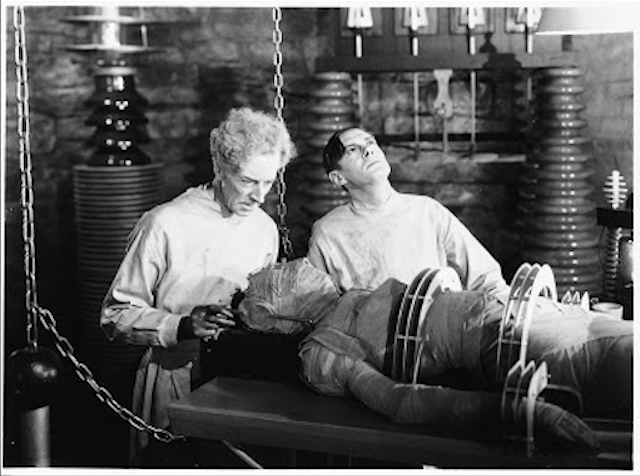
I saw"”with shut eyes, but acute mental vision"”I saw the pale student of unhallowed arts kneeling beside the thing he had put together. I saw the hideous phantasm of a man stretched out, and then, on the working of some powerful engine, show signs of life and stir with an uneasy, half-vital motion. Frightful must it be, for supremely frightful would be the effect of any human endeavor to mock the stupendous mechanism of the Creator of the world.
"” Mary Shelley
When I think of Kenneth Strickfaden I visualize the mad scientist grabbing the master switch in his clandestine laboratory. Suddenly the machinery hums and glows, glass tubes boil with liquids, electrical currents charge through the coiled tubes and conductance. Lighting leaps across the sky and finds its way into the diving spot in the lab. The crackle, snapping hiss and sparks of ozone. The well orchestrated machinery of mad science that now act as futuristic hardware. The electrical odor that would still permeate the air for years to come as he shaped the way we perceived the mad scientist labs and mysterious scientific exploration!
early days Strickfaden assembling a mad scientist apparatus
Kenneth Strickfaden was an expert in high voltage electricity, film set designer, and electrical special effects master. Using his skills as a carnival electrician, he created the science fiction apparatus that can be seen in more than 100 films and television programs, showcasing Strickfaden’s technical phantasmagoria of light and sound!
I often wonder how many of these films centered around mad science and the laboratory environment utilized some of Strickfaden’s machines and electrical effects without giving him credit.
Boris Karloff in The Devil Commands.Boris Karloff in The Man They Could Not Hang.Man Made Monster
I can see influences in Edward Dymtryk’s The Devil Commands 1941 with Boris Karloff. With art direction by Lionel Banks and props by Franz, Oscar, and Paul Dallons.The Man They Could Not Hang 1939  & Man Made Monster 1941 Set direction by Russell A Gausman and John P Fulton who had worked with Strickfaden before. I believe Strickfaden did the special effects and used part of his equipment. Doctor X (1932), The Invisible Man 1933,The Man Who Lived Again, and more!
Dr. X (1932).The Man Who Lived Again.The Invisible Man 1933.
Strickfaden’s first contribution was to Just Imagine 1930. Today it has become something of a "lost" film and nearly impossible to see on the big screen. "While the beautiful art deco sets, enormous miniatures, and remarkable projection effects still amaze," says Production Designer John Muto, Founder of the ADG Film Series, "the music, comedy, and love story are derived from vaudeville and must have seemed very dated as cinematic musicals exploded in the 1930s. I suspect that may be why the film faded from view. Our audience will discover a very surprising film!" "Today, most films set in the future portray a bleak, dystopian, even apocalyptic world.” Besides the beautiful art design Just Imagine featured a stunning laboratory filled with electrical equipment by Ken Strickfaden.
Just Imagine 1930.
The Clutching Hand (1936
But it was his work for James Whale’s 1931 masterpiece Frankenstein, The Bride of Frankenstein, and Ghost of Frankenstein that struck like lightning! Stock footage of the lightning bolt generated by Strickfaden’s equipment can be seen in so many films and television shows. John P Fulton head of the special effects department at Universal Studios was responsible for the special photographic effects-
Jame’s Whalehad wanted a lab that was reminiscent of the one in Fritz Lang’sMetropolis1927 Lang’sart department/set designers Otto Hunte, Erich Kettlehut, Walter Schulze-Mittendorf & Karl Vollbrecht. Special effects by Ernst Kunstmann, Konstantin Irmen-Tschet and Erich Kettelhut. Visual effects Eugen Schufftan, Willy Muller, Hugo O Schulze, and an uncredited Edgar G. Ulmer.
Metropolis 1927.Fritz Lang’s Metropolis 1927.This orb of Kenneth Strickfaden’s has made it through Fu Manchu’s clutches to the Wicked Witch of the West’s long bony fingers
You can see Strickfaden’s wonderful creations in The Wizard of Oz, The Mask of Fu Manchu to television’s The Munsters, and his final work, Young Frankenstein. Strickfaden recycled a number of the pieces that he kept maintained like his“Cosmic Ray Diffuser”that he used in the original Frankenstein.
Kenneth Strickfaden was born in 1896-by the time he was in high school he was using a camera and setting up shots of amusement parks, and battle scenes, and visualizing and creating his own laboratory apparatus and equipment.
Thesiger and Clive in The Bride of Frankenstein
When I was just a little tiny wide-eyed MonsterGirl I would daydream plenty on rainy days and spend hours down in the basement assembling pieces of metal and plastic doohickeys having taken apart various appliances around the house, trying to create my very own little mad scientist lab. I’d get large pieces of wood and paint the control panels. I could literally spend hours down there pretending to be Dr. Pretorious. I was fascinated by science fiction technology and the secrets of life and death, and the fantastical storytelling Universal Monsters had to offer.
Backstage on the set of Frankenstein
My pop would continually ask me where I put his hammer, though it was true most of the time, I did take his tools to aid in my small-scale construction of a basement laboratory. I was constructing panels with knobs and meters, I didn’t always have his hammer. And by no means did I have the eye or the technical brain to develop such intricate machinery that could spark and crackle streams of white heat, the suggestion of the life force arching in splendor. It just felt so good to be living my own fantasies without being told that I should go play with dolls. That’s also partly how I got to be known as MonsterGirl by the neighborhood bullies. Anyway… back to the genius of Frankenstein’s electrician.
Paul Walter’s assistant holds the switch box that controls Strickfaden’s Magnalux invention for lighting simulating flashes-Image from Goldman’s book.
Strickfaden had the sort of fascination for creating a milieu of scientific realism, working on our sense of wonder and the possibilities of the creations these machines would aid in either creating life or destroying it, which was always a draw for me. His special electrical designs and effects were visually groundbreaking for American film audiences, far-fetched perhaps but divine. He used junkyard electrical parts from the 1930s, fake wiring, and high voltage Jacob’s ladders (An electric current then flows until the path of ionized gas is broken or it, as it rises, will pull the arc apart and so extinguish it.), and spark gaps and the occasional Tesla Coil. “Ribbed ceramic insulators are a must… as are the slate front panels and wooden cabinetry that were standard of scientific and medical devices of the day”
And that’s why I wanted to do this little feature tribute to a man who’s responsible for shaping the look of so many classic horror and sci-fi fantasy film milieus over the years. The sets and laboratory apparatus that contributed to the Gothic science mood of the story, came to life because of the innovation Strickfaden used in creating his fantastical yet plausible designs. As a key to the plot structure as the players themselves.
image of Strickfaden’s “Megavolt Senior” from Goldman’s Book
During the grand days of classic horror between the decades of 1930s and 1940s, the landscape might have looked entirely different if Kenneth Strickfaden hadn’t been so fascinated with creating apparatus and contraptions that flashed and sparked with high voltage, meters keeping track, tubes, and coils and large equipment that paid true homage the science fiction writings he was trying to breathe life into himself a technician like Pretorious and Dr. Frankenstein. The appearance of these industrial gadgets and machines, and the look of the laboratory brought such a sense of realism to an already Gothic stunner, and Mary Shelley’s story, too which was ahead for its day. As Harry Goldman refers to in his book title, Strickfaden was the right electrician for the job.
Colin Clive with Elsa Lanchester as The Bride- notice The Nebularium! Image from Goldman’s Strickfaden-Frankenstein’s Electricianon the set of Frankenstein from Famous Monsters of Filmland #21 1963
Though his fascination started in high school by the early 1920s film makers saw the potential in his inventive apparatus. He was given work at many Hollywood studios, in which he offered them a slew of amazing special electrical effects.
From Goldman’s, Kenneth Strickfaden, Dr. Frankenstein’s Electrician, Strickfaden’s work was not easy, “Apparatus constantly failed due to overheating,” he once revealed to writer Scott MacQueen. “Most effects did not photograph as expected, or they were eliminated due to electrical failures.”
Despite these unusual, and expected, setbacks, the onscreen results were phenomenal, and far more convincing than any simulations. Strickfaden made much use of the inventions of Nikola Tesla, which had been perfected more than thirty years before the first Universal Studios “Frankenstein” movie. But, unlike Tesla, he was also concerned with the theatrical “look” of his fanciful contraptions, which had to appear to be futuristic and capable of untold wonders. The names he gave the machines were often equally marvelous, such as: “the retrogressive wave charger,” “DXLAccumulator,”and “High Amperage Pyrogeyser.”
When, in the late 1940s, real-life scientific marvels turned out to be subtler than Strickfaden’s machines, his work apparently went out of fashion and was little seen in Hollywood until the ’60s, when it was used extensively in The MunstersTV show and in commercials.
Before his death in 1984, he spent much time touring with his “Kenstric Space Age Science Show,” educationally demonstrating spectacular electrical phenomena.
Standing fearlessly before a high voltage arc.His reliable switchboard can be seen in the foreground while the famous “Meg Senoir” Tesla coil appears in the background.
The Cosmic Ray Diffuser-Image from Goldman’s Book
A few highlights of Strickfaden’s career include:
Frankenstein (1931) The equipment brought Mary Shelley’s monster to life.
In The Mask of Fu Manchu (1932), Strickfaden created a dazzling electrical death ray even doubling for Boris Karloff, who played Fu Manchu when the evil mastermind spreads his hands and the powerful lightning dances between his long sinister fingernails.
Murders in the Rue Morgue 1932 Bela Lugosi is Dr. Mirakle- Ken Strickfaden lends his electrical gadgets to Mirakle’s laboratory.
Chandu the Magician -Strickfaden’s machines came from FRANKENSTEIN now they equip (Bela Lugosi) Roxor’s lab- His death ray, a giant ray gun that sends pulsating death beams aimed at the major cities of the world!
In The Bride of Frankenstein (1935) Strickfaden configured the electrical displays for the Bride creation sequence.
The Wizard of Oz (1939) He created the effect of the Wicked Witch of the West trying to remove Dorothy’s ruby slippers and receiving an electrical shock. The orb she uses to scry was a Strickfaden design.
The giant crystal ball that Margaret Hamilton uses as the Wicked Witch was actually uncovered in a junkyard found amidst the remnants of other discarded Hollywood memorabilia from a now defunct prop house. The enormous hand-blown glass, with high voltage Tesla coils, had a new owner who spotted it in Goldman’s book Dr. Frankenstein’s Electrician. It had been used by Bela as Roxor in Chandu the Magician. It was a great prop for Boris Karloff in Mask of Fu Manchu, but once he placed it up for auction the new owner learned that it had actually been the crystal ball used in The Wizard of OZ.
Fighting Devil Dogs (circa 1941)“Manifested projectiles of something like ball lightning.”
Sherlock Holmes Faces Death (1943) “He simulated an unusually realistic lightning strike.”
Young Frankenstein (1974) Strickfaden recreated some of his best work from the original Frankenstein.
Bela in Chandu the Magician with the death ray.Boris as the absent-minded scientist in The Boogeyman Will Get You.
Ernest Thesiger and Colin Clive in The Bride of Frankenstein.
He was born in Montana in 1896, Kenneth Strickfaden was an imaginative and adventurous guy who worked at amusement parks, taking myriads of photos. He traveled overseas serving in World War One. He was also an airplane mechanic so he was very handy technically, having built and tuned Tesla coils and X-Ray machines. A Tesla coil is an electrical resonant transformer circuit invented by Nikola Tesla around 1891. It is used to produce high-voltage, low-current, high frequency …Eventually, he found himself in Hollywood working as a studio electrician in the late twenties.
Image of Strickfaden holding the Melodyne musical disc and large lens that appears in Son of Frankenstein from Goldman’s book Dr. Frankenstein’s Electrician
In 1931, Kenneth Strickfaden was hired to set up the equipment for Frankenstein’s tower laboratory. He was to furnish it with a ‘powerful engine.‘ Strickfaden assembled various machines. One which was used for the lightening powered scene that would help resurrect Boris Karloff’s monster back from the dead to life on the slab. He combined his knowledge of electrical science engineering and part of his love of creating side show electrical pageantry in order to transform Dr. Frankenstein’s laboratory into a place of unorthodox alchemy within a modern science dominion.
Kenneth Strickfaden Bride of Frankenstein control panel-Image from Goldman’s book
At first, the designs were to be more streamlined and modern in their look, but Strickfaden had managed to construct a place of Gothic dread within the medieval structure of the setting and seamlessly adapt the apparatus of modern science with the stone walls. The juxtaposition of the two worlds adds to the feeling of Dr Frankenstein’s heretical, rebellious, and clandestine primacy as his secrets lay hidden away.
Strickfaden's apparatus quivered, sparked, crackled, and shrieked. The imposing levers were pulled in harmony with the dialogue, like an orchestrated scientific waltz. White hot arcs of electrical tendrils reached out and thrust wildly like serpent’s tongues. Beautifully glistening glass vials and tubes sat amidst copper spheres that wound themselves around like industrial jewels. Needles indicated where the force of energy was heading on the dials, and disks whirled like fun-house wheels. It was all so mesmerizing in Frankenstein’s laboratory with its arcane machinery that sang the songs of the universe, and the secrets of immortality and life from death, the sounds of voltage that pushed the machinery to its limits.
The Nebularium device from The Bride of Frankenstein 1935Image from Goldman’s bookStrickfaden created a Nebularium for House of Dracula ’45. Image from Goldman’s book Dr.Frankenstein’s Electrician
From then on 1931 James Whale’s Frankenstein with its elaborately detailed laboratory up on the mountain tops set the tone for all mad scientist laboratories to follow. Kenneth Strickfaden would utilize and reconfigure his glorious apparatus over and over again in the Frankenstein films that followed, like Bride of Frankenstein.
You can see his fantastical machines like his“Megavolt Tesla Coil”& the “Nebularium”in Flash Gordon serials and so many other horror and sci-fi features over the decades. Even in one of the most memorable episodes of The Munsters in the 60s, where Grandpa transfigures Herman into Fred Gwynn, losing his square-headed, neck-bolted Frankensteinian charm! The episode is called “Just Another Pretty Face.”
And Mel Brooks truly paid homage to the Universal cycle of Frankenstein pictures with his Young Frankenstein in 1974. Co-starring with Cloris Leachman, Madeline Kahn doing her Mae Clarke bit as Elizabeth, and Marty Feldman as Igor to Dwight Frye’s Fritz.
Strickfaden’s machines and apparatus were re-used in Mel Brook’s Young Frankenstein
The Gothic laboratory where Gene Wilder plays Doctor, waxes campy and raises Peter Boyle back to life using a lighting storm and complex equipment that sparks and radiates arcs of light was the very same set of scientific apparatus used in Whale’s masterpiece in the 1931 film when Kenneth Strickfaden first configured it all for the set of Frankenstein with Boris Karloff.
Strickfaden died in 1984, and up until that time, he traveled the country with all machines and apparatus, and gave lectures in schools and auditoriums, also creating music with electrical instruments that he designed. He would demonstrate his lighting effects with ultraviolet light on radioactive materials, and shock and amaze students with something he called his “gravity nuetralizer” He did these programs from 1933 til his death.
Son of Frankenstein Basil Rathbone, Bela and once again Karloff as Frankenstein’s monster.Bela Lugosi in The Phantom Creeps
Strickfaden would step in at times as a stunt double in the films, for instance, he played Karloff’s monster for a scene that didn’t make it into the film. When Karloff didn’t want to use the “QUCH” machine fearing it was too dangerous as Fu Manchu, Strickfaden stood in for him. He held a large wand that generated a streaming arc of lightning which called for a million-volt spark to dance over his body. in Mask of Fu Manchu, Strickfaden was thrown across the set when he wasn’t grounded properly and received a jolt of electricity.
Kenneth Strickfaden’s QUCH machine-up for auction
He became the most trusted man around high-voltage trickery, yet Strickfaden admits very plainly that there’s no mystery to what he is able to do and that producing high voltage or amperage is rather simple.
One of the key apparatus that Strickfaden uses is his million-volt generator, which produces large sparks, and fat blue flames that can actually reach a height of 6 feet into the air. It’s his most intricately designed piece of equipment. The multi-distributor consists of a motor-driven set of whirling electrodes that can throw sparks. Strickfaden does say that a shock from the circuits could actually prove fatal.
Another device Strickfaden used was called a ‘lightening screen’This is another high-voltage generator that throws sparks across a large disk with a radioactive backing. Used with a darkened stage, the radioactive material continues to glow along the path of each spark even once the current has been shut off.
A note about Nikola Tesla-THE GENIUS WHO LIT THE WORLD- “ Young Nikola Tesla came to the United States in 1884 with an introduction letter from Charles Batchelor to Thomas Edison:Â Â Nikola Tesla developed polyphase alternating current system of generators, motors and transformers and held 40 basic U.S. patents on the system, which George Westinghouse bought, determined to supply America with the Tesla system.
In February 1882, Tesla discovered the rotating magnetic field, a fundamental principle in physics and the basis of nearly all devices that use alternating current. Tesla brilliantly adapted the principle of rotating magnetic field for the construction of alternating current induction motor and the polyphase system for the generation, transmission, distribution and use of electrical power. Tesla’s A.C.induction motor is widely used throughout the world in industry and household appliances. It started the industrial revolution at the turn of the century. Electricity today is generated transmitted and converted to mechanical power by means of his inventions. Tesla’s greatest achievement is his polyphase alternating current system which lights is used throughout the world
Modern Mechanix scan of a Popular Mechanics article from September 1949-by Eugene M Hanson.
1. Scott MacQueen, “Kenneth Strickfaden: Strange Revelations of the Man Who Lives in the House that Frankenstein Built,” Gore Creatures, no. 24, October 1975, pp. 24-26.
2. William Ludington, “Mister Electricity: The Multi-Volted Career of Kenneth Strickfaden,” American Classic Screen, vol. 7, no. 1, Jan./Feb. 1983, pp. 26-29.
This has been electrifying -your ever lovin’ MonsterGirl
THE BLACK CAT (1934) U.S. (Universal) runs 65 minutes B&W, was the studio’s highest grossing picture in 1934. The film was also ranked #68 on Bravo’s 100 Scariest Movies. Directed byEdgar G. Ulmerand written for thescreen by Ulmer andPeter Ruric.
Also titled: House of Doom; The Vanishing Body (the alternative British title was used in it’s re-release in 1953 as a double bill with The Missing Head an alternative title for the “Inner Sanctum’s” offering Strange Confession.
Tod Browning’s adaptation of Bram Stoker’s Dracula (1931) starring Bela Lugosi.Boris Karloff in Jame’s Whales Frankenstein 1931.
With the success that Universal Studios garnered from Tod Browning’s adaptation of Bram Stoker’sDracula in 1931 starring Hungarian-born actor Bela Lugosi, and the equally sensational popularity of Mary Shelley’s adapted Frankenstein1931 directed by James Whale starring Boris Karloff, it would seem only natural for the studio to harness the cult popularity of these two stars, creating horror vehicles to pair them together in. This is the first collaboration between Boris and Bela. Also, both stars were equally billed in terms of their leading roles. In Lew Landers The Raven 1935, Lugosi dominated as Dr. Richard Vollin and in Lambert Hillyer’sThe Invisible Ray 1936, the emphasis was more on Karloff’s complex character Dr. Janos Rukh. The Black Cat was a huge success for Universal and opened up the floodgates for seven more films featuring the collaboration of Karloff and Lugosi;Gift of Gab (1934), The Raven (1935), The Invisible Ray (1936), Son of Frankenstein (1939), Black Friday (1940), and You’ll Find Out (1940).
Although The Black Cat 1934 claims in its opening credits that the film is ‘suggested’ by Edgar Allan Poe’sstory from 1843 the film bares no resemblance to his short story, nor did Poe ever pen a single word about Satanism in all his volumes of the curiously macabre. The film does evoke the spirit of Poe’s fixation with morbid beauty, the preservation or perseverance of love after death, the suggestive ambiance, the conflation of beauty and death, and the unconscious dread of the uncanny. The architectural lines seem to also evoke the nihilistic sensibilities of Jean-PaulSartre‘s ‘No Exit’ or a Kafka-esque fantasy of entrapment, with a mood set forth of futility and hopelessness. It also represents a cultural aesthetic that was emblematic of WW1.
Ulmer’s The Black Cat is melancholy poetry that articulates its substance within a half-light dream world. There are overcast clouds of menace, with modern Gothic gloom and impenetrable dark spaces. A wasteland of lost hope, it is a land of the dead.
Karloff is driven by his profane lust and twisted faith and Bela is a ghost of a man n a deadly excursion into a vengeful rage.
“Don’t pretend, Hjalmar. There was nothing spiritual in your eyes when you looked at that girl.”-Werdegast
‘the beast’ or the wickedest man in the world Aleister Crowley
Karloff’s character Poelzig is actually based on the notorious occultist Aleister Crowley. Ulmer and Ruric were inspired by an odd news story circulating in the world press shortly before the making of the film. Stranger than fiction, it seems a naive young couple who were visiting a remote home of a magician, became entangled in the occult rituals involving an unfortunate animal sacrifice, a victimized black cat named Mischette. The magician was Aleister Crowley, and the isolated location was his Abbey of Thelema in Sicily. The press got wind of this when Crowley accused one of his writer friends Nina Hamnett of libel in a London Court. Hamnett had mentioned Crowley in her 1932 autobiographyLaughing Torso.
The passage that incited Crowley’s vengeful wrath was Hamnett’s description of his days at the Abbey of Thelema “He was supposed to practice Black Magic there, and one day a baby was said to have disappeared mysteriously, There was also a goat there. This all pointed to Black Magic, so people said, and the inhabitants of the village were frightened of him.” Crowley became known in the public’s perception as ‘the wickedest man in the world.” It was from this story that the seed of sensationalism gave rise to the idea for The Black Cat whichemerged as a tale of savagery and horror for Ulmer.
So, in actuality, the title has nothing to do with Poe’s short story at all, as it merely alludes to Dr.Vitus Werdegast’s (Lugosi) all-consuming fear and dread of cats. A more faithful adaption would be The Living Dead (1934) directed by Thomas Bentley, and Tales of Terror (1962). The Black Cat (1941) starring Basil Rathbone was more of an old dark house mystery.
Roger Corman directs Peter Lorre in Tales of Terror 1962.
It is one of the darkest films of the 30s. The Black Cat is an effusive, atmospheric, and brutal masterpiece of decadent horror among some of Ulmer’s other interesting contributions (People on Sunday 1930, Bluebeard 1944,film noir classicDetour 1945,and the wonderfully lyrical science fiction fantasyThe Man From Planet X 1951).
Influenced by the German Expressionist movement, the film lays out a sinister territory, strange and foreboding, unsavory and dangerous, clandestine and provocative. Ulmer worked for Fritz Lang in the early days living in Germany involved in films including Metropolis (1927) and M (1931). He also worked with F.W. Murnau on Sunrise (1927) Ulmer also worked with Max Reinhardt, and Ernst Lubitsch in the 20s, and Robert Siodmak, Billy Wilder, Fred Zinnermann, and cinematographer Eugen Schüfftan, who was responsible for Metropolis’ miniature sky-scapes and vast edifices.
On the set of The Black Cat.Boris and Bela on the set of Edgar G. Ulmer’s The Black Cat.
The Black Cat is considered to be Ulmer’s best film, though his career did start to maneuver its way down into poverty row’s fabulous cinematic gutter toiling in low-budget features, after beginning an affair with a script girl named Shirley Castle Alexander who was married at the time to one of Carl Laemmle’s favorite nephews. At the time Laemmle was head of Universal Studios, and so Ulmer was essentially blackballed by the mogul from Hollywood. Another factor might have been Ulmer’s unwillingness to sacrifice aesthetic sensibilities over commercial profits.
Ulmer and Shirley got married and wound up moving to New York City spending many of his years working on low-budget films. He began this part of his career by making bargain-basement westerns under the pseudonym John Warner directing a series of cheap ethnic-market movies incorporating groups like Ukrainian, Yiddish, and African Americans before he moved on to the more stylish low-budget thrillers.
By the 1940s Ulmer wound up back in Hollywood but had already resigned himself to making poverty row productions. All of which I find thoroughly enjoyable, such as his Bluebeard (1944) starring the ubiquitous John Carradine, Strange Illusion (1945), and film noir cult classic Detour (1945) starring Tom Neal and Ann Savage whose battered and desolate characters actually fit the noir cannon with an authentic realism despite the anemic budget. I also love The Strange Woman (1946) and another great film noir Ruthless (1948) with Zachary Scott. Ulmer still remained a very productive director with PRC, even if it was one of Hollywood’s bastard children. Studio head Leon Fromkess never gave Ulmer enough money to fund his pictures, Ulmer wanted to produce high-art films and first-class effects as his origin had come from a place where he was such a ”visual artist as well as a filmmaker. The one good by-product of the deal was that it gave him creative license to run with whatever vision he had for a working project of his.
Director Ulmer also doubled as a set designer on The Black Cat to create a work of visual stateliness, beautifully stylish and elaborate with its collection of modernist set pieces, working with the art direction and set design of Charles D. Hall and cinematographer John J. Mescall’s (The Bride of Frankenstein) vision of the striking, uniquely cold and Futuristic Modern Gothic art deco ‘castle fortress’ and it’s interior shots creating the arresting landscape of luxury belonging to the enigmatic Poelzig’s (Karloff) inner-sanctum.
The eclectically sharp and angular camerawork establishes stylish Machine Age imagery and eerie symmetrical aestheticism. Mescall’s camerawork creates a very non-Hollywood and non-stereotypical horror film, filled with a sense of melancholy responsiveness from the heavily influenced authentic Eastern European films of the period. There’s also a quality of cinematic eroticism with Mescall’s use of muting the focus within the shot to create an added emphasis on suggestive sexuality, as the camera dances through various scenes.
The stark use of light and shadow, the well-defined contrast of light and dark with its cold black spaces, and the diffuse whites constructing margins that pay homage to the expressionistic lighting used by German Expressionists filmmakers of the 1920s and early 30s. The atmosphere is oppressive as well as claustrophobic with an added air of perversity that effervesces within the elegant framework.
Ulmer co-wrote the screenplay with Peter Ruric (who used the pseudonym Paul Cain for his hard-edged detective novelettes for pulp magazines, with screenplays such as–Grand Central Murder 1942 and Mademoiselle Fifi 1944). Their script for The Black Cat deals with a deadly game of chess, ailurophobia (fear of cats) rather taboo and provocative subjects such as war crimes, ‘Satan Worship’, human sacrifice, being flayed alive, drug addiction and the underlying perverse fetishism of necrophilia.
Karloff’s character, Hjalmar Poelzig’s morbid and unwholesome preservation of his deceased wife whom he stole from Vitus Werdegast (Lugosi), having manipulated Werdegast’s wife into marrying him telling her that her husband died in the war, ultimately murdering her and then forcibly marrying Werdegast’s daughter is all very salacious material. Werdegast’s wife’s body is kept in a state of suspended animation like a sleeping doll which is visually shocking and gruesome. He tells Werdegast that his daughter too is deceased but in actuality, she is Poelzig’s new young bride. a drugged sexual slave. The film possesses so many strange and disturbing elements. The allusion to incest, sacrificial orgies, and the heightened presence of music drawing heavily from Liszt’s Piano Sonata in B and Schumann’s Quintet in E Flat Major, op.44, Tschaikowsky and most notably for me, Beethoven’s Movement no.7, a personal favorite of mine.
When Universal executives both Carl Laemmle Jr and Sr. screened the film they were horrified by Ulmer’s rough cut, they insisted that he edit the film and so they hacked it up and toned it down. And actually, Bela Lugosi himself was unsettled at the thought of his protagonist showing lusty desires for the very young American girl Joan. Ulmer reluctantly went back and edited some of the harsher scenes out, including the infamous ‘skinning’ sequence, A comparison to the original script from the final version shows that many of the most disturbing elements, including a more unabashed orgy at the black mass, were quickly snipped away and scenes which were more violent and containing more suggestive elements were exorcized like the devil.
But in a subtle victory of wile, Ulmer added a few more scenes showing Karloff taking Lugosi through his historical dungeon artifacts of the encased suspended beautiful women in glass, the posed dead bodies in perpetual lifelike form as if by taxidermy, collecting them as his fetish, the idea of possessing them eternally as an ‘object’ in a state of death, the theme of necrophilia must have slipped by the Laemmles.
Poelzig’s women in glass cases preserved. The imagery is reminiscent of Poe’s fixation with death and beauty, and the conflation of the two
The subject of contemporary Satanism had only been dealt with on the screen once before by Lugosi in his supporting role in the long-forgotten and believed to be lost The Devil Worshipper (1920 German) Die Teufelsanbete.
Universal’s marketing department downplayed the aspect of Satanism in the picture, nervous that the idea of devil worship might not be acceptable to the public theatergoer as entertainment. So in actuality, the original version must have really pushed the boundaries further and been even more sinister. British censors found the film so offensive and unacceptable that the British print of the film, entitled House of Doom replaces any reference to black magic, using less disturbing references to ‘sun worshipper’, (silly) which essentially obliterates the entire transgressive significance and its impact.
Carl Laemmle had given Ulmer free rein on the story’s content but kept a close eye on the director in other respects. Ulmer had not been given the larger budgets that either Dracula or Frankenstein had been endowed with. He was also given a very short span of time to shoot the film, a mere fifteen days. This did not deter or side-track Ulmer at all who was used to working with small budgets and knew how to construct a film that looks as elegant as any largely budgeted project. He began imagining the story, scrapping many scripts that Universal had been collecting. Any pretext associating the picture with Poe’s short story was cast to the wind. And so he created an entirely new vision. At the core, the film works thematically as a revenge piece. But of course, there is so much more bewitching the film’s narrative.
Prague Jew Gustav Meyrink novelist The Golem.Paul Wegener in the adaptation of Czech writer Gustav Meyrink’s The Golem
In the 1960s Peter Bogdanovich interviewed Ulmer in ‘The Devil Made Me Do It‘ who recalled another theme that influenced The Black Cat. He had been in Prague”¦ and met novelist Gustav Meyrink the man who wrote The Golem as a novel. Like Kafka, Mayrink was a Prague jew who was tied up with the mysticism of the Talmud. They had a lot of discussions, contemplating a play based upon the Fortress Doumont which was a French fortress the Germans had destroyed with their shelling during World War I. There were some survivors who didn’t come out for years.The commander who ultimately went insane three years later was brought back to Paris, driven mad because he had literally walked on a mountain of bodies and bones. “The commander was a strange Euripides figure.” Ulmer told Bogdanovich. (Euripides is an archetypal figure as a representational mythical hero, an ordinary person in extraordinary circumstances. Also, Euripides voluntarily exiled himself, rather than be executed like his colleague Socrates who was put to death for his perceived dangerously intellectual influence.)
Much of the ambiance of this historic incident is reflected in Bela Lugosi’s dialogue in The Black Cat.
Vitus Werdegast– “I can still sense death in the air.”
“And that hill yonder, where Engineer Poelzig now lives, was the site of Fort Marmorus. He built his home on its very foundations. Marmorus, the greatest graveyard in the world.” – Vitus Werdegast
Within The Black Cat is there an aesthetic tension between Expressionist Caligarism and The New Objectivity movement or Neue Sachlichkeit, which begin in Habsburg Central Europe at the dawn of the Nazi era? The New Objectivity espoused a new attitude of public life in Weimar Germany with it’s art, literature, music, and architecture created to adapt to the changing mood of the culture. It was characterized by a practical engagement with the world, which was regarded by Germans to be an inherently American style or the cult of objectivity, functionalism, usefulness, essentially- Americanism. While the film injects a modern wholesome American couple into the plot, they are mired down in the decaying ghosts of the past atrocities and sins perpetrated not only on the land but by the presence of the vengeful and malignant atmosphere. An atmosphere represented within the framework of a very Caligarian milieu. This creates friction or contrast by injecting the fresh American presence into the plot, surrounding them within an environment of an arcane and non-naturalist landscape.
The Expressionist Caligarism wasstarted by director Robert Wiene whose surreal masterpiece Cabinet of Dr. Caligari or Das Cabinett des Dr. Caligari will always be remembered as the iconic ultra-expressionist watershed moment of the genre. ‘Caligarism’ Painters turned set designers Walter Röhring and Walter Reimann was responsible for the brilliant expressionist style which influenced other films with both the ornamental patterns transfixed in the dysmorphic repertoire of shapes and configurations that permeated the set designs for 20s science fiction films like Andrew Andrejew’s AELITA – Queen of Mars 1924.
AELITA- Queen of Mars 1924
The use of the color black or more accurately, the absence of light, can also be seen as part of the symbolism in The Black Cat: We are the voyeurs to this claustrophobic madness, as spectators we see the horror as highlighted by the stark blackness of the clothes, the black trees which are filmed in silhouette against a blackened sky. Poelzig is often silhouetted in distinctive blackness. This use of the color black or again more accurately in lighting it with the absence of any color or ‘light’, is used thematically as a way of installing a sadistic marker of the imagery.
The cast of Characters:
Boris Karloff is Hjalmar Poelzig
Bela Lugosi is Dr. Vitus Werdegast
David Manners is Peter Alison
Julie Bishop is Joan Alison (as Jacqueline Wells)
Egon Brecher is The Majordomo to Poelzig
Harry Cording is Thamal Werdegast’s faithful servant
Lucille Lund is Karen Werdegast
Henry Armetta is Police Sergeant
Albert Conti is Police Lieutenant
John Carradine plays the Organist (uncredited)
Boris Karloff playsHaljmar Poelzig who is perhaps one of his most impressively darker characterizations. His all-black attire, strangely androgynous hairstyle, and exaggerated use of make-up accentuate his features giving him the appearance of extreme and austere wickedness. Karloff’s eyebrows arch, his eyes flare and the use of his black lipstick make him almost deathly. Jack Pierce (The Man Who Laughs 1928, Dracula 1931, Frankenstein 1931 White Zombie 1932, The Mummy 1932 Bride of Frankenstein 1935 ) was responsible for the subtle yet dramatic make-up.
Karloff’s voice, his wonderfully lilting voice is typically modulated within the drift of his dialogue. He is remarkable as the incarnation of profane evil, with his icy cold reserve and detachment from the world.
Both protagonists are enigmatic, Karloff’s Poelzig’s utter malevolence and Lugosi’s hero Dr. Vitus Werdegast who is sympathetic yet also damaged, callous, and obsessed by his lust for revenge, make both these disparate figures, magnetic archetypes that are equally compelling.
Boris and Bela in a high-stakes chess match, a game of death
The film takes place in Hungary, starting out with scurrying masses boarding the grandeur of the Orient Express. The Allisons are on their way to Budapest, Visegrad for their honeymoon. American Newlyweds Peter a mystery writer and his new bride Joan Allison board the opulent train. David Manners who plays spare hero Peter Allison portrayed Jonathan Harker in 1931’s Dracula opposite Lugosi and again appeared as the leading man with Karloff in The Mummy 1932.Jacqueline Wells plays Joan. At first, the young love birds have their compartment all to themselves until Dr. Vitus Werdegast, psychiatrist and veteran of World War I, a captive who has just been released from a prisoner of war camp after 15 years imprisonment, (Ulmer himself was a refugee of Hitler) enters the compartment due to a mix up needing a place to sleep. He tells the young couple that he is on his way to visit an ‘old friend.’
Vitus Werdegast -“So you are going to Visegrad” Peter Allison- “Yes to (sounds like) Gaermbish by bus.” Vitus Werdegast– “Gaermbish is very beautiful, I too am going very near there.” Peter Allison– “For sport?” Vitus Werdegast (raising his eyebrows, looking down, and speaking more to himself) perhaps”¦ I go to visit an ‘old friend'” (spoken with a dark unpinning of hatred)
While Joan and Peter fall asleep the gentle yet peculiar Werdegast becomes fixated on her, stroking her hair while her husband Peter who is now awake watches silently for a moment. Werdegast explains that his wife and daughter were left behind when he was sent away to prison.
Vitus Werdegast- “I beg your indulgence, my friend. Eighteen years ago I left a girl, so like your lovely wife”¦ To go to war. Kaiser and country you know”¦ (serious look, deeper inflection) She was my wife. Have you ever heard of Kurgaal? (Peter quietly nods ‘no’) It is a prison below Amsk. Many men have gone there”¦ Few have returned. (taking in a deep breath) I have returned. After fifteen years”¦ I have returned.”
In a premonitory monologue, the driver had spoken of ancient malevolence in Marmorus during the years of the war. “the ravine down there was piled twelve-deep with dead and wounded… the little river below was swollen, a red raging torrent of blood”
When the honeymooners get off the train, it is pouring rain… they agree to share a bus ride with Werdegast, but there is a storm and the desolate rain-soaked roads are treacherous, causing the bus to crash. The bus driver dies, and Joan is injured in the wreck. Needing to seek shelter Dr. Werdegast recommends that they join him at his friend’s home, the Castle Poelzig, so he can take care of the young bride. Werdegast treats Joan’s injury, injecting her with a powerful hallucinogen called hyoscine.
The name Poelzig is an homage to Hans Poelzig set designer/architect of the 1920s whose version of Der Golem was stunning. Real-life Poelzig was responsible for the astonishing Prague set that underpinned the mythic mood of The Golem.
In Hans Poelzig’s own words, “The effect of architecture is magical.”And he meant that literally as he believed that every building was a living thing, had its own musical rhythm and a mystical sound that could be ‘heard’ by those who were initiated into the world of magic. Though a very private man it was known that Poelzig dabbled in magical arts, holding spiritualist seances with his wife at their home and using their daughter as a medium.
According to Poelzig’s biographer, Theodor Heuss, his library was “filled with the works of mystics, the occult sciences and astrology“ he was in the pursuit of the mysteries of eternal forms that he erected and revered through his sacred work constructing his grand style architectural designs as his ‘magic’ medium. Poelzig also found cinema to be an environment for his magical sensibilities, jotting in his notebook “Film”¦ the magic of form-the form of magic”¦ Devil’s Mass”¦”Â
Architect Engineer Hans Poelzig indulged in the magical arts and believed that buildings had a soul…
Poelzig intrigued a lot of people with his mysterious persona. Director Max Reinhardt hired Engineer Hans Poelzig to build sets for his theatrical stages. Ulmer was one of the architect’s junior assistants who later worked on the set of The Golem as a silhouette cutter for Paul Wegeners monumental production. Ulmer had studied architecture in Vienna and so carried that knowledge with him which sheds light on his sense of set design.
Hans Poelzig had a grand imagination, a creative fortitude, and a host of eccentricities, one of which was to be at times a very overpowering presence and domineering personality.
This left an impression on Ulmer, who took those memories from Germany to Hollywood and created a cinematic resurrection of designer Hans Poelzig’s persona in the image of Karloff’s shadowy devil worshiper Hjalmar Poelzig, creating the shades, shadows, and the template for Ulmer’s mystical engineer sadist of The Black Cat’s.
F.W. Murnau’s Faust 1926 too, definitely bears its influence on Ulmer who worked as a crew member on the film. Faust, in terms of the cinema of the Satanic, was a major studio production whose main protagonist was the Devil and who was a complex character, and not merely a vehicle for a simple horror-themed picture, it sprung from a confluence of intellectualism and metaphysical ponderings.
Murnau’s Faust (1926).
DEVILS OF THE GREAT DEPRESSION IN CLASSICAL FILM
Stefan Eggeler-illustrations for Gustav Meyrink-Walpurgisnacht-(1922).Dante’s Inferno
The Black Cat does seem to be one of the earliest illustrations of the Satanic cult film. While the era of Silent Film had a slew of films that dealt with the devil and black magic, (Dante’s Inferno 1911, The Student of Prague 1913, Henrik Galeen’sThe Golem 1914Thomas Edison’sThe Magic Skin 1915, The Black Crook 1916, The Devil’s Toy 1916, The Devil’s Bondswoman 1916, Conscience 1917,Murnau’sSatanas 1919, Der Golem 1920, The Devil Worshipper 1920, Dreyer’sLeaves of Satan’s Book 1920, and 1921’s Häxan, Nosferatu 1922. The Sorrows of Satan 1926 and F.W. Murnau’s Faust 1926) After the economic crash of 1929 these very recognized landmark films seem to disappear. The 30s had The Black Cat 1934 and The Student of Prague (1935), both of these films might be the protracted essence of the Satanic Expressionism of 20s German cinema.
The ‘devil worship’ film or ‘Satanic’ cinema evokes our primal fears, paranoia, and unconscious dread that is implicit toward the ‘Other’ As was in Rosemary’s Baby, Roman Polanski’s adaptation of Ira Levin’s brilliant portrayal of this very paranoia. Satanic films trigger our fears of the intrusion of an outsider who infiltrates society, or rather the comfortability of our moral landscape. It also signposts our secret pleasures which are derivative or surrogate as catharsis by way of the horrors of satanic power. In the 40s the few offerings were William Dieterle’s The Devil and Daniel Webster 1941,Maurice Tourneur’sCarnival of Sinners (1943), and Mark Robson/Val Lewton’s literate and intensely woven The Seventh Victim (1943) and Thorold Dickinson’s imaginative masterpiece The Queen of Spades 1949.
Director William Dieterle’s The Devil and Daniel Webster (1941).The 7th Victim (1943) is a shadow play about a devil cult by Val Lewton.Thorold Dickinson’s story about a pact with the Devil – The Queen of Spades 1949.
While Universal had successes with both Dracula and Frankenstein, The Black Cat is a more intensely layered film with its hidden and not-so-implicit meanings. It has a depth that explores the undercurrent of the 1920s aestheticism and fascination with magic. There are heterogeneous elements that run through both compelling performances by Karloff and Lugosi’s characterizations.
“Next time I go to Niagra Falls.”
Werdegast“You sold Marmorus to the Russians”¦ scurried away in the night and left us to die. Is it to be wondered, that you should choose this place to be your house? A masterpiece of construction built upon the ruins of the masterpiece of destruction”¦ the masterpiece of murder. (he laughs) The murderer of ten thousand men returns to the place of his crime. Those who died were fortunate. I was taken a prisoner to Kurgaal, Kurgaal, where the soul is killed”¦ slowly. Fifteen years I rotted in the darkness. Waited”¦ not to kill you, to kill your soul”¦ slowly. Where is my wife Karen and my daughter?!!!!”
Poelzig–“Karen? Why what do you mean?”
Werdegast –“I mean you told Karen I had been killed, I found out that much in Budapest. I mean you always wanted her in the days at Salzberg before the war, always, from the first time you saw her. I mean that after you saved your own hide and left us all to die in Marmorus, you took Karen and induced her to go to America with you. I traced the two of you there.And to Spain and to South America and finally here. Where is she?”
The film is also powerful in its evoking of the horrors of World War I, which was still a very haunting specter in the public psyche. Most Universal films offered escapism, in contrast, The Black Cat confronts the viewer with a bit of historic retelling of the nightmares of war, more penetrating than the usual concocted monsters the studio was proffering.
“Where is she?”Poelzig- “Vitus.. you are mad” Poelzig “She died two years after the war” Vitus Werdegast -“How?” Poelzig “Of pneumonia, she was never really very strong you know.” Vitus Werdegast- “(crying) And the child”¦ our daughter?” Poelzig “Dead…”
Karloff’s aloof and restrained malevolence guided by the subtle intonations of his melodious voice tethered to Lugosi’s sympathetic and often poignant performance as the broken Vitus Werdegast, in particular the scene when he first sees his dead wife Karen exhibited as if in a museum, suspended in death, evoking authentic tears, “Why is she like this?” All set to the maudlin Ludwig Van Beethoven’s ‘Symphony No. 7: Second Movement.’
Beethovin’s symphony no. 7 often used in films and a most powerfully contemplative piece underscores Karloff’s soliloquy as the camera glides through the dark and dank dungeon of Marmorus taking us on a tour of the decaying deathly oxygen of the place.
Poelzig leads Werdegast through the subterranean enclosures of Marmorus. It is here that Werdegast sees his wife who had died two years after he was in prison, and that his Karen (Lucille Lund) is now encased in glass.
Poelzig reveals the perfectly preserved body of his wife in necrophilic stasis, that he’s encased in glass like an immoral specimen of his unholy fetishism. This might be the only other reference to Poe and his morbid preoccupation with beauty in death. He reveals the dead body of ‘their’ beautifully angelic wife, encased in her crypt-like glass vessel. Poelzig lies to Werdegast telling him that his daughter is also dead.
Werdegast is devastated and demands retribution but Poelzig insists that fate must wait until the ‘outsiders’ are gone. Of course, Poelzig intends to kill the Americans, sacrificing Joan, but forces Werdegast to play a diabolical game of chess the outcome for which the lives of the young couple hinge upon. Werdegast loses and Joan is then taken to another room to await Poelzig, as she is to be his next sacrifice at the black mass ritual during the dark of the moon, in his Bauhaus ceremonial inner sanctum of worship, his sepulcher of debauchery, his sadistic sanctuary, the archaic shrine to the devil.
“Very well Vitus I shall take you to her.”The camera focuses on the darkened spiral staircase heading downward toward the dungeon and then again as Poelzig and Werdegast ascend from the subterranean nightmare.
Poelzig “Come”¦ Vitus”¦ come are we men or are we children? Of what use are all these melodramatic gestures? You say your soul was killed, that you have been dead all these years. And what of me”¦ did we not both die here in Marmorus fifteen years ago ?”¦ Are we any the less victims of the war than those whose bodies were torn asunder? Are we not both, the living dead? For now, you come to me playing at being the avenging angel”¦ childishly thirsting for blood. We understand each other too well. We know too much of life. We shall play a little game Vitus. A game of death if you like. But under any circumstances, you shall have to wait until these people are gone. Until we are alone.”
“You will find her almost as beautiful as when you last saw her… Do you see Vitus I have cared for her tenderly and well.” “Is she not BEAUTIFUL… “ “I wanted to have her beauty always.”-
“Why’s she”¦ why’s she like this…?”-Â
Poelzig has finished his nihilistic sermon. The camera as spectator angles back on the two men walking slowly again. Whatever remained of the man, Vitus Werdegast has now been annihilated.
The essence of this makes the film as disturbing and queasy as any in this contemporary age of violent horror films. Ulmer convinced Laemmle Jr to let him make a film in the European Caligari style, surreal, post-modern, and artistic. The one condition was that he use Poe’s title for the picture. The storyline is hallucinatory, dream-like, and nightmarish, framed within the architecture of a set that becomes part of the character of the plot. Poelzig is revealed is the High Priest of a Satanic Cult, there is a scene where we catch sight of him reading a book entitled The Rites of Lucifer, which promotes the customary sacrifice of virgin blood while Werdegast’s beautiful blonde daughter Karen is believed to be dead, sleeps next to him most likely kept in a drug-induced cataleptic state, to maintain her appearance of a morbid deathly slumber in order to feed Poelzig’s penchant for conflating sexuality with death.
“The dark of the moon, this tonight.”
Hjalmar Poelzig owner, engineer, and designer of the castle is an intense and eccentric man whose castle rests upon the bloody ruins and remains of Fortress Marmorus and the slew of graves where the dead betrayed soldiers, victims of his treason during World War I are buried. Poelzig is as removed from his treacherous past as is his Modern castle which denies its bloody legacy.
Werdegast accuses Poelzig of betraying the Hungarians to the Russians, while he was the commanding officer of the Fort during the war. Telling him that he was responsible for leaving him and the other soldiers to die or be captured. He also believes that Poelzig stole his wife and child when he was sent to prison and that they must still be in the fortress somewhere. Poelzig has a room secretly hidden especially for his satanic black masses. As the conflict unfolds, the young couple becomes the unwitting hostages of these two men.
One of these men is an unorthodox heretic who is consumed with power, death, sublimation, and perverse sensuality. The other is blinded by revenge and hatred for the man who destroyed his life. He also has an all-consuming fear of cats, and early on in the film kills Poelzig’s black cat, although Poelzig is seen carrying around a black cat with him while he glides around his house as he revisits the women he has encased in glass.
We are first introduced to Poelzig as he is laying on a bed with his young wife Karen, a quite provocative image by 1934 Hollywood standards. The vision is sterile and hypothermic, surrounded by glass, chrome, and steel. As the camera moves into Poelzig’s bedroom lair, we see him as he rises up from a prone position emerging in silhouette like a wraith.
Once Joan enters the castle Poelzig is drawn to her, as she is young and attractive possibly bearing a resemblance to his dead wife. As the narrative progresses, it becomes even more strange and uncanny, as Poelzig’s dead wife is revealed to have been married to Werdegast, who believed he died during the battle of Marmorus. She marries Poelzig but he murders her soon afterward, raising their daughter, and then in an imbroglio of incestuous lust, marries the ethereal young girl, it’s so creepy and blasphemous.
“Please child, listen to me we’re all in danger, Poelzig is a mad beast I know.”“I know… I’ve seen the proof-‘He took Karen my wife murdered her and murdered my child.”
Werdegast tells Joan “Did you ever hear of Satanism, the worship of the devil of evil? Herr Poelzig is the great modern priest of the ancient cult. And tonight at the dark of the moon, the rites of Lucifer are recited. And if I’m not mistaken, he intends you to play a part in that ritual. a very important part. There child, be brave, no matter how hopeless it seems. Be brave it is your only chance.”
“‘I’m Karen… Madam Poelzig.”“Karen do you understand me, your father has come for you.”
When Poelzig wins the chess game, Peter Allison is chained up and locked away in the dungeon below. Werdegast is spiraling into madness now and has his loyal servant Thamal merely pretend to be loyal to Poelzig in order to help his true master Werdegast. Joan meets Werdegast’s daughter Karen who wanders into her room like a lithe spirit. She introduces herself as Madam Poelzig. Joan tells her that her father is actually alive and in the castle waiting to rescue her. When Poelzig finds out he brutally kills Karen and leads Werdegast to find her body in order to torture him further.
Poelzig ascends the grand staircase as his cult guests begin to gather around him. The image is pictorial and impressive. as they ready themselves for the Satanic ritual. The soulless expressions on their faces is quite chilling.
Poelzig begins his intonations to the dark master as Joan is led toward the altar.
Karloff improvises giving a compelling invocation to Satan yet actually consists of a few harmless Latin non- sequesters, phrases he used from his college Latin, like Vino Veritas which basically means ‘In wine there is truth’. Cave Canum, ‘Beware of the dog’ and Cum grano salis which is ‘With a grain of salt.’
Werdegast and his servant Thamal (Harry Cording) stop the ceremony, interrupting the sacrifice, and eventually avenge his wife’s death and the plundering and despoiling of his beautiful daughter. They rush Joan away from the ceremony and hide her from Poelzig.
This is when Joan tells him that his daughter is quite alive and has now been forced to marry Poelzig. Joan’s screams alert Peter who can not enter the barred room. He thinks Werdegast is assaulting her when he is trying to help her find the key to the door and so Peter shoots him, but he lets them escape.
Thamal has been wounded by Poelzig’s servant but rushes to help his master. The two men strap Poelzig to his Art Deco-inspired contraption, an embalming rack that looks like an angular cruciform, while Werdegast rips away Poelzig’s shirt, grabbing a scalpel he begins to skin his adversary alive.
I’ll leave it here. It’s enough that you’ve seen Poelzig flayed alive. The film deserves a fresh re-viewing. I hope you’ve enjoyed my little overview of this striking masterpiece of Gothic horror featuring two of the most iconic genre stars Boris Karloff and Bela Lugosi. Please let me know what you think, and please… be kind to black cats…
In 1952 the world celebrated the famous Bridey Murphyregression case. It began when one Morey Bernstein hypnotized a Colorado housewife named Ruth Simmons. Under a trance, emerged the personality of Bridey Murphy an 18th Century Irish woman.
from the film The Search For Bridey Murphy
In 1956 Bernstein published his book The Search For Bridey Murphy. Eventually the story made it onto the screen by Paramount Pictures, starring Teresa Wright and Louis Hayward, a film which is on my short list of things to watch.
And if you have a guilty pleasure for musicals as I do, you’ll see the story retold in Vincente Minneli’sOn A Clear Day You Can See Forever 1971 starring musical diva Barbara Streisand, Yves Montand and Jack Nicholson. With some of the BEST music by Burton Lane and lyrics by Alan Jay Lerner.
Barbara Streisand as Daisy Gamble in Vincente Minneli’s1970 On A Clear Day You Can See Forever.
Now in 1956 when A.I.P was churning out goodies like It Conquered The World 1956Â for Roger Corman, the idea of past life regression became of some interest to producer Alex Gordon.
The She Creature incorporated the concept of a lovely girl harboring a past soul or souls, but due to the fact that A.I.P. wanted monsters in their pictures, they used the best of both worlds and mixed an unconventional idea that was all the rage at that time, and threw in an ancient busty crusty beastie that rose from the sea, whenever the girl was in a trance.
So you have it, a girl from the 20th century inhabited by a female creature from the primordial edges of time’s beginning. Schlocky fun from Samuel Z. Arkoff,Alex Gordon and one of my favorite directors who can take a b-movie sci-fi/horror picture and bring a bit of grimy noir sensibility to it the great Edward L. Cahn.
Jerry Zigmond’s contribution was coming up with the title THE SHE CREATURE and the screenplay was written by Lou Rusoff. The film stars Chester Morris as Dr Carlo Lombardi, Marla English as his subject Andrea, good ole Tom Conway as Timothy Chappel, Cathy Downes as Dorothy Chappel, Ron Randell as Lt. Ed James, Lance Fuller as Dr. Ted Erickson Frieda Inescortas Mrs Chappel and of course Paul Blaisdell as Beulah!
Chester Morris (Alibi 1929, The Big House 1930, Five Came Back 1939) plays the smarmy Dr. Carlo Lombardi, carnival hypnotist and prognosticator extraordinaire. Morris brings smarmy to a whole new level here, that it even makes Jack Cassidy‘s villains’ seem Christ like. Lombardi travels around rich circles impressing the affluent patrons, with his ability to regress his female hostage, oops I mean patient back in time, probing old memories of their past lives, thereby proving that reincarnation is real.
Another nifty trick is the claim that he can summon forth the incorporeal spirit or soul from the past and manifest it into a physical form.
It starts out on the desolate beach at night where the mustachioed mad hypnotist Lombardi is standing in silhouette , then walking along the shore, dressed in black like a villain from a silent movie, about to tie a maiden to the train tracks. He’s staring out at the sea, a distant shape is forming in and out of the breaking tides.
Dr. Carlos Lombardi communing with the ancient she creature that is waiting out in the misty turbulent ocean.
“Now on This very night I have called into the unknown depths of time itself. She is here. And with her coming, the world will never be as it was. Neither man nor animal will be the same. This, I, Dr. Carlo Lombardi have brought into being!”
Suddenly the camera focuses on a monstrous invisible foot print in the sand. The moment is broken when King the loyal dog of Dorothy Chappel, starts barking and breaks Lombardi’s concentration. Dorothy’s father Timothy Chappel a promoter, is hosting a party this particular weekend at their fancy beach house. Invited to the party is Dorothy’s boyfriend Dr. Ted Erickson who is a notable expert on the subject of psychic research. He’s not comfortable mingling with the idle rich, he’s basically just a ‘farm boy’ and just doesn’t fit in with Dorothy’s father’s crowd.
Mrs.Chappel believes in the powers of the supernatural She tries to convince her husband that Lomardi’s prediction that something terrible is going to happen along this part of the coast tonight, they’ll be ‘a visitation from the occult world’ and tells him seriously that he must meet him. Tim Chappel laughs at his wife, and remarks, that “Some women keeps pets, or grow roses for kicks, my wife supports quack occultists.”
Mrs.Chappel tells her husband that he puts this girl in a deep trance and sends her back over 300 years. When she was a girl in England. ” I tell you it’s uncanny!” Mrs.Chappel is vehement!
The Incredible Doktor Markesan played by Boris Karloff for one of Thriller’s most memorable episodes of the series!
A sign reads “NO TRESPASSING ~VIOLATORS WILL BE SHOT ON SIGHT~DokTor Konrad Markesan”
The Incredible DokTor Markesan aired Feb 26 1962 perhaps the most creepy of all the Thriller stories, originally appeared in Weird Tales Magazine and was taken from a story written by August Derleth and Mark Schorer, and adapted by Donald S Sanford and directed by Robert Florey. The rotting corpse makeup byJack Barron actually predates Romero’s 1968 Night Of The Living Dead, which I feel only made both effectively more creepy by the B&W film.
Mort Stevens’s score begins as gravely contemplative and daydreamy single notes on the piano beckon us into this episode, then begins the darker, deeper cello strings foreboding and ominous. As the piano resolves into more somber chords, the young Fred Bancroft and his new bride Molly drive up to the entrance of Oakmoor. What has happened to the broad green lawns and the servants in starched white uniforms? They proceed to enter the house, the door having been strangely left unlocked. Seemingly vacant, Oakmoor is crocheted in cobwebs, from years of neglect. There is no electricity. Fred lights a candelabra and the couple continue to search for Fred’s Uncle Konrad. As they start to ascend the staircase, suddenly a door creaks open, the music sways from ominous to severe, and a sallow, blank, expressionless, Konrad Markesan steps out of the shadows. Uncle Konrad stares up at them, ashen, emotionless, his right hand poised in a state of rigor, he stares off, silent. Fred trying to ingratiate himself awkwardly, remains smiling, excruciatingly strained in the midst of his Uncle’s peculiarly inhospitable behavior. Molly acutely more aware of his uncle’s bizarre presence stands there obviously horrified and uncomfortable while Fred still flounders to make a connection with his relative. Molly chirps out a “Hello” and from the moment Fred holds out his hand to shake his Uncle’s, Markesan turns away and says “Come with me” and proceeds to leave the grand hallway.
This is an obscure scream gem. The monster really freaked me out when I was a kid. Not only was he purely merciless, but the ripping off heads thing, really scared the crap out of me back when I was young and they aired the movie frequently on Saturday afternoons. I usually really love monsters, except for that nasty bastardly brain Gor, in The Brain From Planet Arous 1957. The Giant Sea Mollusk in Monster that Challenged the World 1957, and perhaps that outre nasty stowaway alien in Edward L Cahn’sIt, the Terror from beyond space 1958
NOTE THE SIMILARITY: PAUL BLAISDELL’S FRIGHTENINGLY IMPOSING ALIEN!
I loved the giant ants in Them 1954 although they did kill Gramps Johnson. I love ants in general and the Grasshoppers in The Beginning of The End and The Praying Mantis and I didn’t blame the Tarantula that much. These are creatures that act from a nervous system that is set in stone, with no other mission but to procreate, eat to survive, and procreate, did I already say that? I didn’t like the Killer Shrews because they killed the horses. Hmm, maybe I should make a post someday about sympathetic monsters vs bad bad monsters. The reasons why we identify with some and can’t wait to see others be blasted to pieces by the local police, military, or savvy reporter or scientist, usually male who has a beautiful girlfriend. I love the blog pants monsters, so what could I call this comparative study of Ugly Evil Mess vs. Cheesy Likability? Well, that’s something to ponder later on.
Anyway. The Monster From Piedras Blancas stars Les Tremayne as Dr. Sam Jorgensen, Forrest Lewis (the lovable hard-of-hearing trombone player in The Mayberry Band episode of The Andy Griffith Show) as Constable George Matson, John Harmon as Sturges, the lighthouse keeper, Jeanne Carmen as Lucy Sturges. An interesting note is when the credits roll, the characters are made impersonal by giving them titles instead of their actual names, like Lewis as The Doctor, Sturges as The Lighthouse Keeper, Jeanne Carmen as Lucy The Girl, Frank Arvidson as The Storekeeper and Don Sullivan who plays Fred is The Boy.
The dreamy DON SULLIVAN IN THE GIANT GILA MONSTER
Produced by Jack Kevan and Directed byIrvin Berwick and screenplay by C. Haile Chace.
Producer Jack Kevan was actually responsible for creating such fantastical figures from The Wizard of Oz 1939 during his time at MGM. He did the makeup for Spencer Tracy in his version of Dr. Jekyll and Mr. Hyde 1941 and of very cool note, he created the decomposing features of Hurd Hatfield’s Dorian Gray 1945 Kevan was already making a name for himself in Hollywood with his special makeup effects when he signed onto Universal. It was actually Bud Westmorehead of the department at that time that got the notoriety. There was also a monster designer named Millicent Patrick who was also bathed in anonymity. She managed to become recognized not as a designer but for a few acting roles, as she was a sensual beauty as well. Beauty over brains I guess. But I always love to see women working and showcased in the fields of engineering, technology, science, and art design when it is almost always assumed that the men held the reins in that department and in particular in the Horror and Sci-Fi Genres. Women didn’t just design gowns like Edith Head,Norma Koch, and Theoni V. Aldredge.
So when you consider the notable names of make-up designers from that period, Bud Westmore is one of the first people who come to mind. Creating The Gil Man character which needed to not only look compelling, it needed to be functional as Ben Chapman and Ricou Browning needed to be filmed underwater for many of the The Creature From The Black Lagoon’s sequences. Westmore having come from a famous line of Westmore artists elevated him to administrative status in the industry.
Once at Universal Kevan became friends with Irvin Berwick, who was actually a dialogue coach for such stars as Rock Hudson Tony Curtis, and John Saxon. There was also a technical adviser for racing films there named C Haile Chace. Universal went through a period where they had massive budget cutbacks and layoffs ensued. So in 1958 Kevan and Berwick founded VanWyck Productions. The first film was supposed to arc off the Gil Man craze at Universal and they wanted a movie that would be equal to or more shocking than Creature From The Black Lagoon. Filming began in the small town of Cayucos in California, and partially at Point Conception. Piedras Blancas literally means White Rocks in Spanish.
NOTE: I apologize for the less-than-stellar quality of my photos in this post, the copy of the film I have isn’t the greatest. I’ll try and replace the more blurry ones, later on, I just couldn’t wait to share the film. MG.
The film opens in the early morning, at the Point Piedras Blancas Lighthouse. The beacon has just been shut down. There is a view of a rugged crag, on the rocky part of the cliffs, a scaly tusk-like claw grabs at an empty tin plate. We do not see this creature, but we watch as it pulls the plate out of view and then thrusts it back onto the rocks. The scene is stark and abrupt.
John Harmon who plays Sturges The Lighthouse Keeper runs the tower as a way to remain isolated from society. He is ready to do his daily routine of going into town for provisions. He spots two fishermen getting too close to the rocks and warns them off in his usual cantankerous manner.
Once Sturges gets to the small fishing town on his bicycle, we see a crowd of people surrounding a battered rowboat on the beach. Inside the boat are two headless bodies of the Rinaldi brothers.
At the site of the Rinaldi brother’s crime scene, one of the town’s people says~”Never seen anything like it in my life, head’s ripped clean off.” Then he asks Constable Matson what he makes of it “I don’t know what to think, they’re as white as sheets they don’t look like they have a drop of blood left in ’em.”
“I bet old Sturges knows more than he’ll tell.” The townspeople clearly have a mistrust of Sturges. “I still think Sturges oughta tell us what he knows”… “Maybe he don’t know nothing”, “You wanna bet!” Matson says, “Okay quit your grumbling.”
Sturges arrives at Kochek’s store on his bicycle. He starts to put in his weekly order. Kochek talks about the Rinaldi killings, “I didn’t pay attention til it drifted toward the pier then I seen them… like a slaughtered steer.” He makes a gesture with his finger as if to cut his throat. “Throats cut clean, not much blood around. You wanna know what I think, it ain’t rocks and it ain’t squalls. It’s something living that did it.”
Sturges tells Kochek that he talks too much. But Kochek says that’s what they said about the couple 2 years ago from the east when their boat washed ashore but they weren’t found. “We should pay more attention to these legends it would explain a lot many things that have happened over the last 3o years.” Sturges leers at him, “Kochek you’re a lot bigger fool than I thought.”
When Kochek tells him that he gave his meat scraps away to Burt for his hogs. “You idiot you’ll be sorry for this,” Kochek argues with him that Burt got them for his hogs when Sturges didn’t come in yesterday, besides he paid for them, and he’s getting tired of giving him his weekly meat scraps for free. It’s curious that Sturges gets so riled about a bunch of meat scraps.
I want to add this little note to my post. I did happen to find mention of Blaisdell in at least 2 books so far that are part of my library. Since I’ve moved to the coastal city of Bath Maine, my studio and library are in a disarray, so many of my books and things are sort of caught between worlds of stasis and static. Keep Watching the Skies by Bill Warren volume II 1958-1962 does cover Paul Blaisdell a bit as well as D. Earl Worth’s Sleaze Creatures. And now Randy Palmer's book, Paul Blaisdell: Monster Maker This makes me a little less sad! M.G.
Paul Blaisdell was an unsung asset to American International Pictures (A.I.P) and to the truly unprecedented, unintentional pioneer and auteur of cheap, cheesy and campy gems on shoe string budget that somehow have been elevated to icon status because of their enduring charm.
THE GREAT ROGER CORMAN
Thanks to Roger Corman for giving Paul Blaisdell the opportunity to create his omnipresent monster — the busty Beulah the incarnation of an arcane female manifestation from out of the primordial ooze channeled through Marla English during regressive hypnosis, in The She Creature (1956).
THE GREAT PAUL BLAISDELL
Beulah went on to appear albeit altered +crazy wig for Voodoo Woman (1957).
and an oddly incongruous to the plot, a derivation of her had a cameo inThe Ghost Of Dragstrip Hollow (1959).
Beulah in The Ghost Of Dragstrip Hollow is just a little less busty!
The reason Beulah got around was due to the production company having no budget for any special effects so they asked Blaisdell if he would let them use Beulah and he was kind enough to consent allowing them to bring her out for a command performance.
I especially love the adorably nasty little bug-eyed creatures with large heads somewhat like brussel sprouts who loved to get cows drunk, not to mention a young Frank Gorshin in Invasion Of the Saucer Men (1957)
LITTLE CABBAGE HEADED BUG EYED FIENDS!
And we can’t forget his laughable cucumber Mutant in It Conquered the World (1956), and of course the alien cucumber’s little flying minion a crusty umbrella bat thingy that implanted a doodad in your neck so you’d do its bidding.
Of course, there’s the mutant that was supposedly most likely a bear at one time before the fallout’s noxious vapors transformed it into a monstrous 3 eyed horny creature in Day The World Ended(1955)
And one of my personal favorites is the awesome Tabanga tree stump equipped with a beating heart that walked really slow and could hardly move a branchy arm yet inspired great fear amongst the superstitious jungle folk and interloping Western scientists alike.
Paul Blaisdell was an artist who worked in rubber like Auguste Rodin.
worked in marble, well maybe not, but to those of us who grew up with his cheesy monsters, it was art after all.
At first, Blaisdell was a sketch artist, fine arts painter, and sculptor, being an artist/musician myself I understand how poor one person can be by doing what they love. He never made a lot of money as a monster maker in the height of the fabulous 50s. Also, like me, he drew monsters and did models as a kid.
and sketched the creatures from those sacred rags and superheroes from my huge Marvel and D.C. comic book collection. I would be stinkin’ rich if I hadn’t sold each and every one for 10 cents a copy while sitting on the street corner back in the good old days, in the suburbs of Long Island New York.
little monster girl and her pop who didn’t mind her playing with monsters!
Obviously, Blaisdell was really good at what he did, because he wound up making a great and lasting contribution to the monster business and Roger Corman’s campy cult films of the 50s. Me I went on to become a songwriter inspired by these glorious childhood memories, but I am better at playing piano and songwriting than building giant rubber mutants with bulging eyes. Although I did try to build a space station in the basement with parts that I got from our vacuum cleaner, which wasn’t broken at the time… don’t ask.
From that point on, every time the hammer went missing in my house, my father would give me the most piercing looks and start yelling. To his credit, he’s the one who would take me to the local mom-and-pop stationery store to buy or bring me home the latest Famous Monsters Magazine, and never said, “Little girls shouldn’t be interested in monsters”, so he was truly a great guy, even if he did yell about the hammer a lot! So anyway…
Blaisdell submitted his illustrations to pulp sci-fi publications like Spaceways
and Otherworlds. And eventually, he was discovered by magazine publisher Forrest J. Ackerman who was so impressed with Paul’s work that he became his agent.
Because of Ackerman, Blaisdell got his first film job designing the alien creature for The Beast With a Million Eyes (1955). He actually helped the project out because at the point he came on board, there wasn’t any little alien yet in the movie at all, which would have to be problematic!
Paul and Jackie Blaisdell with ‘Little Hercules’ between them.
The beastly slave of the alien is a hand puppet created by the cheesy greatness that was Paul Blaisdell.
Interesting side note: For The Beast with a Million Eyes (1955), Corman needed someone to design the alien who originally was supposed to be an invisible force marauding through the galaxy hitching rides on various life forms and taking over their consciousness, like the mind control of the animals in the film. In Bill Warren’s informative book Keep Watching the Skies, Corman contacted friend collector/historian Forrest Ackerman suggesting stopping animation genius Ray Harryhausen (who obviously was way out of Corman’s league and price range) Warren-“Corman recoiled in economic in shock.” Then Forrest recommended Jacques Fresco a futuristic eco-conscious architect and designer who had created the space station and rockets for Project Moon Base (1953)
But Fresco wanted too much money to do the job, so Ackerman came up with another idea. There was an illustrator who designed cover art and did illustrations for his magazines, named Paul Blaisdell. It wasn’t like Blaisdell had the experience building movie models but the young guy did build model kits (the Aurora kind I used to spend the days gluing and painting) and he also did some sculpting. Blaisdell said he would try it for $200 for the job and another $200 for materials. It was still more than Corman wanted to invest, but it seemed the last resort if he wanted a creature in his film. Corman sent the poster to Blaisdell as a composite and informed him that it didn’t have to do much more than show itself on screen for a few moments, then collapse. Blaisdell could then make it on a small scale, using only the upper torso since the rest would be hidden by the ship’s hatch. And so he made a hand puppet which was a dragon-like creature with wings he molded from clay and placed a simple latex mold over it. Paul’s wife Jackie modeled its hands. The Blaisdell nicknamed him “Little Hercules.”
Blaisdell made him a leather jacket, an eight-starred medallion, and a toy gun and then added manacles and chains to its arms to point out that he was really a slave to the alien intelligence. According to Randy Palmer's book, Paul Blaisdell: Monster Maker he was happy with his work, and so were the crew.
Corman and American Releasing Corp must have been satisfied enough with Blaisdell’s skill and his price as well, as he went on to become the go-to monster-maker for the studio during the 1950s. Including The busty She-Creature (1956), the cucumber alien in It Conquered the World (1956), The fanged umbrella bat in Not of This Earth (1957), The alcoholic Google-eyed brain invaders in Invasion of the Saucer Men (1957), my personal favorite Tobanga the walking tree spirit in From Hell it Came 1957 and the alien stow away in It! The Terror from Beyond Space (1958).
He also acted inside the suits he designed, created special effects, and did his own dangerous stunts in Corman's movies. However, the 60s were not kind to Blaisdell and he decided to retire. He did co-publish a monster movie magazine with fellow collector and friend Bob Burns but walked away from the industry entirely. Blaisdell passed away in 1983 suffering from stomach cancer at the age of 55.
Paul went on to design monsters for all the low-budget American International Pictures like the little flying thingy in Not of This Earth (1957). The bug-eyed little green men in Invasion of the Saucer Men (1957) and Earth Vs. the Spider (1958). He was also responsible for an uncredited corpse in The Undead (1957), but I don’t know if that counts as a monster, unless it was a crusty rubber corpse with bulging eyes. Blaisdell also created the imposing alien creature in the tautly paced and fantastic It, The Terror From Beyond Space (1958), which was an inspiration for Ridley Scott’sAlien (1979)
One of my absolute favorites is the Tabanga tree monster in From Hell It Came (1957) as well as the cucumber guy, as they are both hilarious and I simply just adore trees and cucumbers.
In terms of the cucumber mutant, I don’t know if I dreamt this up, pulled it out of my arse, or am just misremembering reading an interview or watching a documentary with Corman saying that Blaisdell’s cucumber creature sat in a shed for years until Paul and Roger got drunk one night and took it out and played with it until the arms fell off. If anyone else recollects hearing or reading this, please drop me a note so that I don’t start doubting myself.
So Blaisdell had a unique vision with the design of his campy mutants and aliens and little flying thingies He probably will be most remembered for Beulah the grotesque representation of primordial womanhood with the scaly protruding mounds of what were supposed to be her luscious scaly creature boobs? in The She Creature.
Of course, he’ll be fondly thought of for the outrageous cucumber creature in It Conquered the World that terrorized Beverly Garland thanks to husband Lee Van Cleef who invited the damn thing to earth. It’s just sad that he doesn’t get more notoriety for creating some of the most ludicrously delicious and silly monsters of all time.
In addition to designing these creatures, he also often played them as well. Unfortunately, Blaisdell became disillusioned with the film business and just quit making anything more for the movies in the 50s. How many times can Beulah make an entrance right?
I would have thought that Paul designed the giant Crab Monsters for Corman in what else but Attack of the Crab Monsters,(1957) but he was already working on The She Creature and apparently the low budget for the special effects on that film had put Blaisdell off.
In the early 60s, Blaisdell started his own magazine called Fantastic Monsters of the Films but it was a very short-lived endeavor which featured a “how to” section called The Devil’s Workshop
In the early 60s, he did some conceptual artwork on several movies which never made it out of the can. And like a lot of talented people, he wound up living out his life in obscurity. I’ve tried to find his name in several indexes of the film books about the 50s genre that I have here and I can’t find mention of him at all. It made me a little sad.
It would be really interesting to see what kind of monsters he could envision today if he were still with us.
Blaisdell had a knack for working with no budget and yet slapping something together although absurd and silly looking he always came through for AIP and even Bert I Gordon who soon realized that Blaisdell could get things done – and not just make rubber monster suits. Bert I. Gordon hired him to build all the miniature and oversized props needed for his films The Amazing Colossal Man, (19570 Earth vs. the Spider, and Attack of the Puppet People (1958). It was Blasidell who was responsible for the giant hypodermic needle in Colossal Man and for the set of doll-sized items used in Puppet People.
He also worked doing some conceptual sketches for the Milner brothers, designing my favorite Tabanga Tree in From Hell It Came. While the Milners based their menacing tree-stump on his designs, Blaisdell didn’t receive any money, and awful but true he didn’t even get credit for it either, that’s why it’s a lesser known fact that he was responsible for the Tabanga Tree Guy at all.
Sadly, Paul died of stomach cancer at the very young age of 55 on July 10, 1983, in Topanga Canyon, California. But Beulah, the cuke, the flying thingies, Tabanga, all the little bug-eyed guys, and Paul Blaisdell’s devoted fans like me, will always appreciate the giggles and chills he/they evoked when watching his wonderful creations come to life.
I found these two links about Paul Blaisdell and thought that both people put a lot of heart and effort into collecting great information about this unsung patron saint of foam rubber and glue.