The Killers (1946): Brutal Noir- A green silk hankerchief with golden harps

The Killers (1946) is the quintessential existentialist film. Based on Ernest Hemingway’s 1920s short story as he was immersed in the pre-war existentialism of that time period, which fostered tales of crimes and violence. As the two French critics Raymond Borde and Etienne Chaumeton remark in their fantastic read and seminal work A Panorama of American Film Noir 1941-153 the killer’s gunmen walking into the diner in Brentwood N.J. and begin complaining about the menu predates the dark Absurdism of the existential movement of playwrights like Harold Pinter and Samuel Beckett.

It reminds me of how great directors like Quentin Tarantino pay homage to films like The Killers in Pulp Fiction, or the work of Samuel Fuller who didn’t hold back on the vicious realism that was groundbreaking in its day.

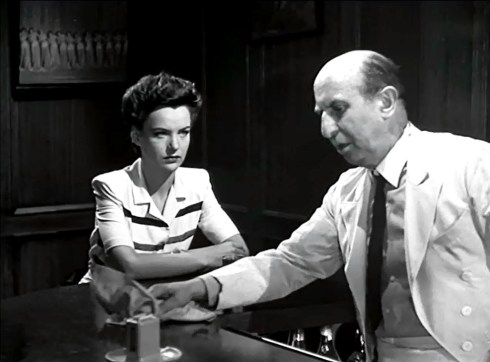
According to the Electric Sheep blog, “The first twelve minutes of The Killers (1946) is a faithful (almost word for word) adaptation of Ernest Hemingway's much-anthologized short story. Two hit men enter a diner (shot to look like Edward Hopper's painting Nighthawks "“ itself apparently inspired by Hemingway's story) typical Hemingway heroic fatalism.”

Robert Siodmak’s The Killers (1946): Brutal Noir- The First 12 Killer Minutes!

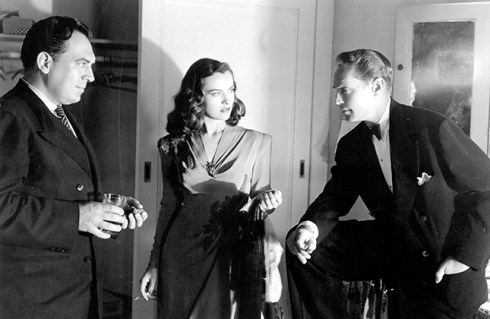
The Killers (1946) the original version scripted by Hemingway himself, was produced by Mark Hellinger (The Naked City, Brute Force, and The Two Mrs Carrolls– 3 of my favorite films,) and once again boldly directed by the great Robert Siodmak. With the rise of Nazism Siodmak left Germany for Paris and then for Hollywood. He’s singularly responsible for a great deal of the noir films that are so memorable.

In my opinion, Siodmak’s film is a meatier piece of work that rendered a more brutal impression than the 1964 version directed by Don Siegel.

Perhaps due to its more neo-gangster noir style, it gave it a liminal and evocative intensity. Siodmak’s Killers has a more violently surreal tone, than the stylishly slick and richly colorful pulpy Siegel version. The effective black-and-white environment of the 1946 Killers once again sets the stage for the players to live in a world that is condemned by shadow. While I love Siegel’s version, it does seem brighter and the world more aired out than usual frames of noir desolation.

Although I’m a huge fan of Angie Dickenson and she was incredibly lush and provocative in the role of Sheila, Ava Gardner’s Kitty Collins was more subtly carnal as the temptress who becomes Swede’s downfall. Siodmak’s version gives us the noir police investigation, there is pervasive Machiavellian cruelty, and the characters have more stratum to their personas. John Cassavetes is more icy while Burt Lancaster’s Swede is a very sympathetic yet imperfect man, that fatalistic heroism.

Burt Lancaster plays Ole “Swede” Andersen ex-boxer and con, Ava Gardner is Kitty Collins, Edmond O’Brien is  Jim Reardon insurance investigator, Albert Dekker is Big Jim Colfax (Dr. Cyclops) criminal mastermind and Virginia Christine is Lily Harmon Lubinsky (she cameos in the ’64 version as the blind secretary).

Sam Levene is Lt. Sam Lubinsky Swede’s old childhood friend Charles McGraw( The Narrow Margin) is Al the killer and William Conrad (Cannon tv series)is Max the other killer. The Killers also casts Jeff Corey as “Blinky” Franklin (The Outer Limits O.B.I.T.episode) one of Big Jim’s criminal lackeys with a “monkey on his back” implying that he has a drug addiction. And Vince Barnett as Swede’s devoted and world-weary petty thief Charleston.

The film opens with Miklos Rozsa’s ominous brassy jazz score that later becomes the killer’s motif, as the two men drive into a small American town, anywhere USA,  we see them from behind in the darkest black silhouette in the car. Then a long view of them walking onto the scene still surrounded in shadow, we know they are trouble. The opening scene of The Killers is perhaps one of the most powerfully ferocious I’ve seen from a 1940s film.

The two men enter Henry’s Diner William Conrad’s Max and McGraw’s Al, are The Killers, who begin to psychologically torture George who works the counter, and Nick Adams the boy at the end of the counter. They exude an obnoxious egotism. A cruel anti-social spirit as they barrage the men in the diner with verbal assaults, having a somewhat perverse quality that begins with the menu.

George: What’ll it be, gentlemen?
Max: I don’t know. Whatta you want to eat, Al?
Al: I don’t know what I want to eat.
Max: I’ll have the roast pork tenderloin with apple sauce and mashed potatoes.
George: That’s not ready yet.
Max: Then what’s it on the card for?
George: Well, that’s on the dinner. You can have that at six o’clock. That clock is ten minutes fast. The dinner isn’t ready yet.
Max: Never mind the clock. What have you got to eat?
George: Well, I can give you any kind of sandwiches: bacon and eggs, liver and bacon, ham and eggs, steak…
Al: I’ll have the chicken croquettes with the cream sauce and the green peas and the mashed potatoes.
Max: Everything we want is on the dinner.

They continue to harass George, asking for alcohol, “Al: You got anything to drink? George tells them “I can give you beer, soda, or ginger ale. Al: I said you got anything to drink?” George submits a quiet “no.” Max says “This is a hot town, whatta you call it?“George“Brentwood” Al turns to Max “You ever hear of Brentwood?” Max shakes his head no and then Al asks George “What do you do for nights?”Max takes in a deep breath and groans out “They eat for dinner, they all come here and eat The Big Dinner” George looks downward and murmurs  “That’s right” and Al says

“You’re a pretty bright boy aren’t you”, meanwhile George is a grown middle-aged man. The term “boy” is designed  to demean him. George mutters “sure” and Al snaps back “Well you’re not!”

Al now shouts to the young man at the end of the counter “Hey you what’s your name?” he looks earnestly at Al and says “Adams, Nick Adams.” Al says, “Another bright boy.” There is an emerging sadism at work here, almost subconsciously homophobic/homoerotic, in the way they are using the terminology of “boy” working to subvert these bystanders’ manhood. Max says, “Town’s full of bright boys”

The cook comes out from the kitchen bringing the plates of ” one ham and one bacon” George starts to serve the men the food and asks “Which one is yours?“Al says “Don’t you remember bright boy?” the continued use of this phrase truly begins to flay the layers of our nerve endings. George starts laughing and Max says “What are you laughing at?” “nothing” “You see something funny?” “no” “Then don’t laugh” “Alright” Again Max says, ” He thinks it’s alright,” Al says “Oh, he’s a thinker” Here we see the anti-social backlash to an intellectual society that would perceive them as outcasts. The term “thinker” is used pejoratively as is “boy.” This is where the film begins to break the molds of the Hollywood window dressing of a civilized society when two intruders trespass on an ordinarily quiet community and shatter its sense of security. It is the death of humanism in film language.

Max and Al proceed to tie up Nick Adams and the cook in the kitchen. They further taunt George who asks “What’s this all about?” Max “I’ll tell ya what’s gonna happen, we’re gonna kill a Swede, you know big Swede, works over at the filling station” he lights a cigarette. George says, “You mean Pete Lund?” As Max takes the cigarette out of his mouth the smoke enervates in George’s face, “If that’s what he calls himself’, comes in every night at 6 o’clock don’t he?” Georges asks “What are you gonna kill him for? what did Pete Lund ever do to you?” Max replies,” he never had a chance to do anything to us he never even seen us.” The conversation is so matter-of-fact that it’s almost chillingly absurd. Again George asks, “What are you gonna kill him for?” and Max smirks “We’re killing him for a friend.” Al pokes his head in from the sliding panel window to the kitchen “Shut up you talk too much” but Max says ” I gotta keep bright boy amused don’t I?”

Once the killers believe what George tells them, that Swede isn’t coming into the diner for his supper because it’s passed 6 pm, they go to Swede’s boarding house. George unties the two men in the kitchen who have been bound up with dish rags, and Nick jumps over fences trying to head off the killers and warn Swede that they’re coming for him. Nick bursts into Swede’s room.

At first, we only see the obscured figure of a man lying on his bed, only from the neck down to his feet. We do not yet see the figure clearly. Swede is framed in shadow. Nick tells him about the men at Henry’s Diner, they were going to shoot him when he came in for supper.”George thought I oughta come over and tell ya” Out of breath Nick is panting, and we still only hear Lancaster’s substantial voice in a whispering tone “There’s nothing I can do about it,” Nick says “Don’t you even wanna know what they’re like?” “I don’t wanna know what they’re like, thanks for coming” Don’t you wanna go and see the police?” “No that wouldn’t do any good,” Swede tells Nick he’s sick of running and “I did something wrong (pause) once, thanks for coming” he ends very solemnly. Nick leaves. The last words we hear Swede utter are “Charleston was right, Charleston was right.”

Now we see Swede’s face just staring and waiting. Sitting up, as the killers come bursting into the room, blasts of light from the gun spray, we are left looking at Swede’s hand lying limp against the side of the bed, surrounded in shadow once again, he is dead.

The Killers relies a lot on the noir mechanism of the flashback. At times there are flashbacks within flashbacks.

We’re now at the police station with Nick and Sam the cook giving their statements. We see a silk scarf with harps among his effects. Swede left a death benefit life insurance policy for $2,500 that goes to a woman in Atlantic City. The case is now being investigated by an insurance detective for the Atlantic Casualty and Insurance Company. Edmond O’Brien plays Reardon, who refuses to drop the case even after his boss insists that it’s not financially worth the company’s time. But Reardon wants to know what happened to this man who had “8 slugs in him, nearly tore him in half.”

Reardon goes to the hotel in Atlantic City and talks to the old chambermaid, Queenie, who is the beneficiary of Swede’s death benefit. She tells Reardon that at least he could be buried in consecrated ground and Reardon asked why she thought it was a suicide.

Queenie tells him in flashback how she was working that night and came into Swede’s room to clean, and he was visibly disturbed, smashing and stomping the furniture crying out “She’s gone, she’s gone!” Queenie asks “Who’s gone, mister?” He picks up a chair and breaks the window and tries to jump out, but Queenie grabs him and tells him” For the sake of God, you’ll burn in hell for all time” and stops him from killing himself. The death benefit was his way of saying thanks for her kindness.

Reardon embarks on a journey to get the bell to ring in his head, about why the green silk handkerchief with the golden harps is on the tip of his mind. His boss says that claims are piling up and he’s off running around with a 2 for a nickel shooting, but Reardon wants to know why 2 professionals put the blast on a filling station attendant, a nobody. He also notices his hands, scarring which indicates that Swede had been a boxer at one time.

He meets up with Swede’s old boyhood friend from the 12th ward in Philly. Lt Sam Lubinsky who is now married to Swede’s one-time girlfriend Lily played by the young and ever-present character actress Virginia Christine who was also in The Killer Is Loose. In The Killers, she is absolutely beautiful as the “nice girl” playing opposite Ava Garner’s femme fatale role as Kitty. Sam joined the police force and Ole Swede started fighting professionally. They always kept in touch, but “when you’re a copper, you’re a copper” and eventually after taking a savage beating in the ring, Swede breaks his knuckles beyond repair and has to stop boxing. Sam winds up putting ” the pinch” on his friend Ole later on.

In a flashback, we see Lily and Swede at a party thrown at a swanky hotel by Jake, one of Big Jim Colfax’s men. Lily doesn’t like Jake, he’s got mean eyes. Swede sees Kitty for the first time sitting at a piano. Swede is mesmerized by Kitty. The women share competitive glances. Kitty says, “Jake tells me you’re a fighter,” he says “Do you like the fights?” Kitty says “I hate brutality Mr. Anderson the idea of 2 men beating each other to a pulp makes me ill.” Lily tells Kitty that she’s seen all of Swede’s fights, but Kitty comes back with “Oh really, I couldn’t bare to see the man I care about hurt” At that point Lily is finished once Swede remarks how beautiful Kitty is Lily leaves the party.

Lt. Lubinsky tells Reardon that “It seems like I was always in there when he was losing, ever see him fight? He took a lot of punishment.”

Ole’s manager leaves Swede after he isn’t any good as a money-making fighter anymore since the bones in his hand are crushed. It’s why he didn’t use his right hand to fight the night he lost the bout to Tiger Lewis. That night his manager says “No use hanging around here, never did like wakes”

In a flashback within a flashback, Ole starts dating Kitty Collins, Big Jim’s girl. Evidently, she shoplifts a diamond pin, Reardon recognizes it as she’s wearing it at a table sitting with a group of thugs who work for Big Jim Colfax. She drops it into a plate of soup, but Reardon stops the waiter, fishes it out, and rinses it off in a cup of coffee then tries to take Kitty in, but then “Ole” Swede walks in and winds up taking the rap for her spending 3 years in jail for Kitty’s robbery then he gets released for good behavior.

Kitty’s given him this green silk scarf with golden harps of hers, which he strokes in jail. Swede has a cellmate and friend in a man named Charleston, a petty larceny crook and old-time hoodlum who bonds with Swede while in prison. Charleston brings up Jupiter one night. He liked to look at the stars after lights out, he knew their names because he got a book from the prison library.

“You can’t learn any better about stars than by staring” Swede and Charleston stares out the window at the stars, while Swede is stroking the silk scarf Kitty gave him. He asks Charleston if he knows what “harp” means. He says “Yeah, angels play ’em” “They mean Irish, Kitty gave me this scarf.” But Kitty hasn’t come to see Swede once while he’s in prison for the robbery she pulled. Swede asks Charleston to look up Kitty when he gets out because he’s worried about her. But Charleston knows she’s not sick or in trouble. Swede is too much in love to see it.

Later on, Charleston relates to Reardon at a pool hall where he was told to bring Swede on the day after his release from jail because Big Jim is planning a “big set-up.” Also in the room is a thug named Dumb Dumb and Blinky Franklin. Charleston opts out, he only wants easy pickings at his age he’s spent half his life in stir, but Swede seeing Kitty in the room, still Big Jim’s girl, says he’s in. Kitty becomes Swede’s mistress again. We see the glances between the two, and Swede knocks Jim down when he tries to hit Kitty. The two men swear that after the heist, they will even up the score with each other.

The last thing Charleston says to Swede before he leaves the room is “Want a word of advice? stop listening to golden harps, they’ll land you in a lot of trouble.” We now know what Swede meant by his last words. Charleston leaves the room. Closing the door, hoping Swede will follow, but ” he never showed up, and I never seen the Swede again” We see the character Charleston in flashback standing outside the door. Framed by the shot making the door a principal moment in the film. Charleston stared at the door waiting, looking trapped and small. The door symbolizes the unknown and what lies behind or ahead.

Back at Atlantic Casualty and Insurance Co. Reardon tells his boss the “bell rang” he remembered hearing about it in relationship to a big caper that was pulled on July 20th, 1940 at The Prentiss Hat Company. Armed gunmen got away with a quarter of a million of Atlantic’s money. One of the robbers was seen wearing a green scarf with golden harps wrapped around his face like a bandit. Swede was one of the people involved in the heist. Now hiding out under an assumed name, and working at a filling station supposedly hiding all the loot from the Hat Company heist, taken away from the other members of the gang. Who sent the killers to assassinate Swede and did Kitty Collins sign his death warrant?

The Killers, details double crosses of all double-crosses, as ‘the killers’ go to the sleepy town of Brentwood to even a score with Swede, who didn’t take Charleston’s advice and stops listening to golden harps. In noir films, there is often a fetishistic quality to an item or action. I think the scarf is a sexual symbol of Kitty for Swede. It bares her scent, it was a token of her sexuality being made of “real silk” as if her skin. the idea of touching something golden. The scarf acts as a surrogate for Kitty’s body, as he strokes it in place of the real thing.

Panic In The Streets 1950: Elia Kazan’s Socio-Noir A Plague of Immigrants

Panic In The Streets 1950 – Directed by Elia Kazan who sees the world of film through a Socio-Noir lens.

Noir has it’s socio-political roots in post war Europe, and was strongly influenced by German Expressionism. In America the post-war atmosphere engendered a realism which manifested in the noir film as well as the crime/police drama with a documentary sensibility.

Kazan himself an immigrant is one of the great American directors well known for such seminal films as A Streetcar Named Desire, A Face in The Crowd, On The Waterfront and Boomerang.


Starring Richard Widmark as Lt. Cmdr Clinton Reed M.D. naval officer and family man, Paul Douglas (Douglas gave his best performance in Fritz Lang’s Clash By Night,) as Captain Tom Warren. Barbara Bel Geddes as Clint’s wife Nancy (also in a great episode of Alfred Hitchcock Presents Lamb to The Slaughter) and the always great Jack Palance as the nefarious Blackie. Also, co-stars the wonderful Zero Mostel as Raymond Fitch, Blackie’s slovenly flunkie.

Elia Kazan’s sociological perspective reveals to us the human condition in a naturalistic style. His films elucidate the way in which the collective soul reacts to an existing situation. Kazan was part of the movement of the New Realism, which bared witness to the state of paralysis of a post-World War II identity and shed light on the stunted psychological elements of that current time.

In Panic In the Streets Kazan’s opening shot, we are plunged into a world of immigrants and trains. The trains cut through the grimy metallic city nightscapes. Here, New Orleans is as mysterious as its inhabitants. New Orleans, the seaport shipping city, is filled with lowlifes and a sense of desolation. Imports/exports, and the working class immigrants who suffer and toil for their daily bread and muddle their way through life in the slums, row houses, on the streets, and in local bars. They are an anonymous, shabby yet tenacious community of otherness existing but not quite persevering. The aggregate disdain for authority and the mistrust of the surrounding influences form the power structures that control and look upon them as subservient class.

There is a commanding scene in a diner, Clint stops in for a coffee and the people sitting at the counter look isolated and sullen. Dirty and sickly and downtrodden. They all have cracked faces. There is a photographic quality as if capturing the weathered souls of the Okies in The Grapes of Wrath.

What I call socio-noir is present in particular for Panic In the Streets. The film works as much as social commentary as it does dark crime drama, with protagonists and anti-heroes. Panic in The Streets is in keeping with the police documentary moral where the hero, Lt Clint Reed M.D. sets out on a righteous path as savior. He is incorruptible and courageous.

Along with the trains cutting through the grungy metallic night in the city and its din, the film creates the unwashed environment and the oily screechy noises of movement. struggling people trying to survive. Desperate criminal elements abound amidst the sounds of blaring ship horns coming into dock. The city is an alive filth stained entity.

There is evidence of Kazan’s attitude crystallized when dialogue towards the end refers to community and what that truly means. Kazan shows us cityscapes and panoramic views to evoke how people can be swallowed up by the enormity of urbanization. An urbanized society is split by class and race.

The people in these city settings do their unnamed tediums, and rituals, sitting solemnly at bars, sitting outside the building on steps and street corners. These are people outside of society as the cinematography would frame them, Living together, collections of tired faces, ethnicities, and class distinctions. The working class, the bureaucrats, the law enforcers, and the riffraff feed off the weaker of the herd.

There is an extreme juxtaposition of the clean lily white suburbia that Richard Widmark’s character Lt Reed, lives in, to the filthy environmental mechanisms of the inner city dweller. Reed comes home to a freshly scrubbed house, a refined and virtuous wife in a pristine neighborhood, the idealism of post-World War II America. With all the amenities that are afforded the white-collar social class.

Even Paul Douglas’ hardened cop Capt. Warren, at first feels standoffish about the naval officer Dr Reed invading his territory. There is an obvious hierarchy amongst who serves the community. Questions of rank of the military, and education background amongst the civil servants and professionals.

Captain Warren’s dynamic of feeling threatened by the authority of a possible Naval Academy Elite and the hard-working class cop on the beat. The struggle of power between the two coming to terms with working with each other.

Panic In The Streets is less about the pneumonic plague and more about the way people are reacting to each other around the situation. It is the catalyst for them to expose their inner demons and fears. Mistrust and paranoia. The need for self-preservation. Blackie’s character is a very paranoid personality, that symbolizes the mistrust of a society that would cheat him out of what he perceives to be rightfully his.

The story begins one night in the slums when the ruthless criminal and paranoid Blackie aided by his miscreant cohorts kills Poldi’s illegal immigrant cousin who Blackie believes cheated at cards because he won too much money. Once again the angular rock-jawed Jack Palance projects himself as an imposing Minotaur who holds sway over his subordinated companions. Within this community, there are hierarchical sub-structures set up in order for the vicious opportunistic Blackie to maintain survival and control.

What wasn’t known at the time of Poldi’s cousin’s murder was that he was already dying of the plague by the time his body was dumped like garbage.

The next morning on the docks a child shows the cops where the dead body is. Lt Dr Clint Reed of the Public Health Service confirms that the dead man had pneumonic plague. In order to prevent an epidemic of catastrophic proportions, Clint and Capt. Warren, must hunt down the killers, and inoculate anyone who came in contact with them all in the span of 48 hours. This they must struggle with under secrecy, holding the news agency at bay as not to panic the public, chase off the carriers of the plague and thus create chaos in the streets. They are also met with resistance and suspicion by the very community, a melting pot of ethnicity they are trying to help.

We see dock workers and ships populated by foreigners. We hear a comment made about the dead man being a foreigner after they bring the body on a gurney through the back hospital entrance. Kazan uses a semi-documentary style, constructing a neo-urban naturalistic environment. Framing the story on a mis en scene proscenium stage. We see real people going about their daily lives, along the fault lines of the surrounding class and ethnic differences in the community.

The two medical examiners are more concerned about where and what to eat for lunch, while there’s a dead man lying on the table. For them it’s business as usual, they show no empathy.

The city has taken a life, and these two medical examiners are just doing a job, while the only thought is about food and getting their needs met as a priority. After discussing the sexy waitress that one has his sights on, one of the guys says that it might take longer than he expected. Another man comes in and asks “Is that the foreigner that they brought in?” Again, emphasis on otherizing this human being.

The examiner named Cleaver orders the less attentive man to get out. He realizes something doesn’t look right with the body. Then Clint Reed is called in to look at slides. Photographs are snapped. He’s asked who else has come in contact with the body. He wants everyone inoculated. The FBI doesn’t have any info on the man. But obviously, he was carrying something infectious. He also wants to know if it was the bullet or the infection that killed the foreigner.

Kazan himself a Turkish immigrant used a lot of social commentary on the American Dream, the people who live outside the context of that framework, and how foreigners were treated here in the U.S. when after World War II the fear of foreigners was rampant. In Panic in The Streets, they carry the plague. They are dirty and suspicious. They represent a dangerous element.

Clint is now sitting around a table of suits. He is relating a tale about a woman in 1924 who was carrying a disease that killed 26 people, who died suddenly and horribly from an outbreak. The disease was found to be pneumonic plague, a pulmonary form of the black death, of the middle ages.

One of the men sitting at the table is asking “Who is he” about Lt. Clint Reed. Reed asserts himself with authority in this room of skeptics. “One of the jobs of this department is to keep plagues out of this country. This kind of plague can be spread easily like the common cold. Through sneezing”

“The committee is asking why are you telling us this.” “Because this morning the police found a man who was infected with this disease.” “Our reports show the man died of 2 bullet wounds” “Regardless of what the police surgeon said, he would have died within 12 hours.”

Paul Douglas as Capt. Warren is at the table. He’s arguing that he did die from 2 bullet holes. The mayor and the other men around the table want them to check but Lt Clint Reed tells them that he had the body destroyed. Cremated so as not to spread the infection. The men seem outraged. There is a power struggle going on about who is in control of this situation. Panic is very much a film about control.

Everyone has been isolated and inoculated but there’s still one man “The man who killed him” whoever dumped him might be walking around with incipient plague at this moment. Capt. Warren exudes his disdain and is being stubborn, he doesn’t feel that there’s going to be a problem. But Lt. Reed insists “We have 48 hours. If the killer is incubating the plague then time will be running out. before it spreads amongst the city. You’ll have the makings of an epidemic.”

He burned all the dead man’s possessions because they were contaminated too, so they don’t have the identity of this man. The commissioner is saying that the police department can’t be held responsible for it. Captain Warren is highly skeptical and the commissioner is only concerned about his own accountability. They can’t find an unnamed man in 48 hours. The commissioner doesn’t believe Dr. Reed and acts like he’s making a big deal out of it. He tells the mayor, if you want to believe him then give the story to the press. Then Dr Reed says “I may be an alarmist. but I’ve seen this disease work and it can spread all over the entire country and the result would be worse than anything you could ever imagine.” Reed implores them that the key to the whole thing lies here, now and what they decide to do with the next 48 hours will be crucial. They ask Lt Reed “What can we do?”

Reed says “Find this man” and so the plot becomes focused on finding Blackie before he can spread certain catastrophic diseases. They all leave saying that they will give Reed their full cooperation, but Captain Warren remains behind with his hand on his chin while Lt Reed remains seated at the table.

Warren asks Reed “An Annapolis Man?” he answers No, Why? Warren says “No reason” but he’s got a quizzical look on his face. His question of whether Reed went to the elite military school shows the rift between the two Warren says “Now I’d start worrying what you’re going to do when we don’t turn up your boy” and mentions again, he doesn’t want him to think he’s one of the sailors in his navy. Again we start to see some kind of class battle, a distinction between the two men.

Outside in the hallway, a reporter starts snooping, but they brush him off. Shades of trouble come about from the right of the press to full disclosure and the responsibility these people have to the public’s safety. What is good for them? Again we see a paradigm of hierarchy at work.

At the police station Mostel’s character Fitch who is no stranger to the police is being questioned. He says “You can’t do this to me I’m a US citizen, I got rights.” Here again, is the assertion of the foreigner being alien and the paranoia of the American people that their rights will be taken away by the people in positions of power, the U.S. Government, and most especially the foreign element.

They shove the photo of the dead guy at Fitch. He says he hasn’t seen that guy he’s interrupted, “Where were you, fat boy? I think you’re a constitutional liar” Again, the patriotic ethnocentric zeitgeist is evoked during the exchange.

Capt. Warren is back at the morgue with Lt Reed~ they think he might have been Armenian, Czech, or mixed blood. Reed tells them to notify the immigration authorities immediately. They find traces of rust, fish, and shrimp on him which shows that he might have come in on a boat. Warren still annoyed at Reed, says “unless he walked through a fish market, bought 5 pounds of shrimp, and brushed against a freshly painted fire escape.” Warren is still so resistant to help Reed and doesn’t want his company or input at all. Reed insists that Warren get inoculated like everyone else.

Reed gets to assert his manliness by making Warren take his shot because he told the commissioner, and Warren just got through telling the other cop in the room why the boys had to take their shots when they were complaining and Warren barks “because the commissioner said so” Reed says ” roll it up” makes him roll up his sleeves. Again, the film asserts that control is an underlying issue at play. The dynamic between these two men going head to head is building and you can tell that Warren comes across like a strong-willed Bull Mastif but we sense that he is a decent man with principles of his own. “Half the two-bit criminals in town are in the precinct. Sneak thieves, wife beaters, and pickpockets. It isn’t going to work though”. Reed gets mad. “Why are you doing it this way then if it isn’t going to work?” Warren tells him that he’s rounding up all the usual suspects because it’s the only way he can make progress in finding the dead man’s identity. Warren then accuses Reed of making this case a big issue just to make a name for himself.

Reed asks Warren to come to have coffee across the street. Now in the diner. “Look Captain do you have a family, are you married?” “No, my wife died 8 years ago.” We start to get a closer look inside this man Warren. Kazan loves to build his characters, to unfold them like an artichoke heart, peeling away the layers, until we see the core. Reed is trying to appeal to Warren’s human side, the family man.

“The doctors said it was neuralgia but it was a brain tumor.” This reveals a bit more of the picture of Warren’s mistrust of doctors. Reed replies “You don’t think much of me as a doctor do you” Warren shoots back “You keep asking questions you finally get answers. NO.” So we see Warren not only has a dislike for military snobs, but a mistrust of doctors as well. Reed’s just a plain working-class slob, a cop who is trying to sort through the trash of human debris that he comes across. Warren again says “Civil Service, you get a pension, what do you make?” Reed says it runs about the same as police.

Capt. Warren frowns, he looks like he took a hit. “Look this man obviously came off a boat, he was obviously smuggled into the country. They probably don’t want to talk to the police, they’ve been coming to the docks and the streets but no one is talking.” “Maybe they want to talk to their mothers,” Warren says, then Reed “Offer them a reward, promise them immunity for information. Bring in another set of experts from Washington to help me out. Well, you could use it.” “You’ll never see the day,” says Warren glaring proudly. Reed gets frustrated. “I’m not gonna wait til the facts penetrate that thick skull of yours, there just isn’t that much time”

Now at a dingy laundromat, Fitch runs, up to a woman, his wife, who says “Blackie makes you tag around like a dog on a leash. He’s a big goon.” “He pays me,” Fitch asks if his bags are packed. She says “Why don’t you stand up to him sometime? Why don’t you tell him off.” He says “Angie will you shut up! Why don’t you go inside.” She says she doesn’t want to be alone with that big Ape Blackie,

Fitch calls out “he’s coming down the stairs.” He doesn’t want Angie hanging around. He doesn’t like a smart cracking dame. He yells at her to get away from the washing machines. Fitch keeps insisting to Blackie that they should leave the city, they’re picking everybody up. He wants to know why Poldi hasn’t shown. Fitch tells him “He’s got a date with a dame”. Concerned Blackie says “Where’d he get the doe? You know I got a hunch about him. They’re not gonna pick me up. You see those machines. That’s business. Legitimate even. They ain’t gonna pick up a legitimate businessman.” 


Blackie begins to rant. Argues, Fitch tells him that they’re picking up legitimates. “They’re picking everybody up?” “Why, why are they picking everybody up Fitch why? You don’t know. You got a high school education you’re a smart fella. This guy Kolchak (the dead man) is just a floater. He gets off a boat, gets very unsocial, even pulls a knife that he’s gonna use on Poldi. So they turn the town upside down for one crumb. They got every cop in town huffin and puffin, trying to find out who he is. Why are they doing it?”

Fitch says he doesn’t know. “Well, I’ll figure it out for you. I got a hunch he brung something in. I got a hunch he brung something in and they’re looking for it.” Blackie’s alienation is beginning to grow, he suspects he is being cheated out of something big, that rightfully should be his. This man is filled with Egomania. Classic anti-social behavior. He continues his rant.

“Only he ain’t got it, and you know why. Cause friend Poldi’s got it.” Fitch comes back at him “Poldi do you think he’d do something like that? He’s his cousin ain’t he? I told you I had a hunch about that guy.” Blackie snorts back. Fitch sweating says “look Poldi is a nice guy he wouldn’t do something like that.”

“Poldi is trying to put something over on me, I saved his life and that’s how he repays me.” Blackie is paranoid,  big dark, and brooding. He tells Fitch there’s one thing he doesn’t like, Fitch says “Sure Blackie” “It’s somebody trying to put something over on me. I never liked it”

Now there is a long shot of Blackie sitting at the counter, framed by the landscape, the atmosphere of alienation. He is in black a quiet powder keg and Fitch l in the backdrop going out the door looking so small and insignificant. The shot frames how the power is manifested by Palance’s character and Mostel is just a periphery character powerless and subordinate. Again we hear train whistles. Trains symbolize the ever-changing movement, the transients of urban city life. We now see Blackie all alone in the cluttered unattractive room.  Sitting alone. A man with thoughts on his mind, paranoid, greedy, and angry.

A seaplane lands. We see the Nile Queen. The captain of the Nile Queen denies that the man could have been on his ship. “I’m not calling you a liar, I’m calling you a fool. Most of your crew will be dead.” The captain won’t listen. Warren and Clint look over the people on board. They look away. There are almost 200 “rats” on the ship. He yells “See, you might be carrying plague.” Rats, a double entendre.

The captain yells for the men to get back to work. but the crew says they want to hear what Clint Reed has to say. “Never mind what he says.” But the crew resists and fights ensue. Chaos. “Break out the weapons. You’re inciting my men to mutiny. I’m the master here.” Again the prevailing hegemony of xenophobia in this film is highlighted. An Asian man says, one of the cooks is down with a fever. “Right now I want to put everyone in quarantine.” They inoculate them. “They got on in Iran. They just dumped him over the side.”

Another Asian cabin boy brings the men food. “They ever talk about anything else. They want a shish kabob.” He asks what it is. “Lamb on a stick, some of the Greek and Armenian restaurants serve it.” Warren hoped they had a lead to the eats place where the illegal immigrants who got smuggled on board would have gone to get food. Athena Cafe they’ve covered 11 joints and had no luck.

At the Athena Cafe, the diner owner’s wife says to her husband in the back kitchen, about Kolchak that Poldi brought him. She says he was contagious but tells Warren and Reed that we know nothing. “I got a headache”. Although the man wants to tell them who Kolchak was, he does not.

Warren and Reed get into the car. Blackie comes up along the street. A midget tells him they found Poldi. He gives the little man money and rubs his head like a child. Blackie goes inside, Fitch says “I found him.” Blackie says what’s that smell. Have you been trying that stuff on your head again Fitch? Blackie takes a piece of food and asks if it’s been touched yet. Ironically Blackie’s paranoia extends to his being a germaphobe as well. The food had been touched by a foreigner.

Now it’s nighttime and the cops find a very sick person in the emergency, a high fever case.  The cops call out to Captain and Reed. Another woman is sick fever case. The Athena owner’s wife. They run up the stairs of the tenement, it’s too late- she is dead. They have to quarantine the whole apartment. “Dr put down on death certificate tentative pneumonia. That’ll have to do for now. Clothes will have to be burned”. All of a sudden the Greek owner comes in and calls for Rita. asks for his wife. Reed looks disturbed. “Where is she.” “What you do. I can’t let you go in there.” “Your wife is dead” “She can’t be, you lie. She said she just don’t feel good.”

“Remember me Matharis. We showed you a picture. If you told us the truth the chance your wife alive.” “Poldi brought him. Kolchak. Gloria Hotel. Find Poldi” They run down the stairs. Tell the police to get a list of people in the food place. Nobody in or out and then they speed away to the Gloria Hotel, the reporter Neff hears them and goes after them. They ask to be taken to Poldi’s room.

Neff confronts them. Why wasn’t this story released to the press? “I figure you guys running around town, he probably had smallpox or cholera.” Reed reasons with him. Tells him it’s the plague. “We can’t let you have the story.” “With the chance of an epidemic. You guys are crazy. You’ve wasted a day. I represent the public. No two-bit civil servant.” Reed says “There’s a chance we can contain it.” Warren tells the cop to take Neff into custody and luckily finds out the editor doesn’t have the story yet, Reed asks the police officers on the scene if Neff can make trouble, and they said Warren would be lucky to get a job mopping floors.

By now, we have a sense of how foreigners are dirty, mistrustful, and alien to us, even when the one cop jokes about liking shish kabob. The foods are unfamiliar. The foreigners don’t trust the Americans, cops, doctors, and vice versa, This film shows the disconnect and separation between immigrants and the America they live in.

Reed goes home for a bit to get some rest and is met by his wife. “Don’t come any closer. Another contagion case. Another uniform to be decontaminated.” “You didn’t catch it yourself hon, you look a little beat.” “Yeah, I look so good normally.” He blows up at her. He spent the money for the cleaner’s bill on the reward money. “Whenever you’re tired you think I’m scolding.” “I spent it on something for the dept. You can put in a voucher No one has figured how to get money back from the U.S. gov. I have to go out again” Gruffs, “Just get me some coffee.” He looks at a piece of furniture being refinished in his yard and taps it. This is part of his real life before this filthy mess. This belongs to his clean life.

He didn’t call his wife last night. “It’s a plague case.” “Here in New Orleans? At least they have you, you’ve been through it.” “Now look hon, let’s not be little miss sunshine.” “We went through it in California.” “What’s eating you?” “I’m tired and fed up” “Stick around, just afraid if I lie down I’ll fall asleep. If I fall asleep I’m dead. Just don’t let me fall asleep. Today I took a perfectly nice guy, a cop not particularly bright, but what do I do, I push him around, make a lot of smart cracks about him. And I tell him off all day long. He winds up proving he’s 4 times the man I am. I do the same thing to you. Why do I do that?”

Capt. Warren meets Reed on the corner. Reed tells the mayor that Warren arrested the reporter Neff on his orders. Someone starts talking about how a woman died last night in their own community. Reed yells, “Community. what community, do you think you’re living in the middle ages.”

“If they alert the media the man carrying the plague will leave.” All these men in power are only concerned about their portion of the responsibility. “Anybody that leaves here can be in any city within 10 hours. I can leave here today and be in Africa tomorrow and whatever disease I had would go right with me” The mayor says “I know that”~“Well think about it when you’re talking about communities we’re all in the community, the same one.” Reed who is finally smiling asks Warren for a cigarette and says “Take the pack.” He finally sees Reed as a regular guy fighting the same bureaucracy he does. This comment about community, I suspect is Kazan injecting his point of view about the universal ideal of what community truly means into the film.

The chief couldn’t hold Neff and admits that he agrees with Reed but he couldn’t stop him. They’ll have 4 hours before it hits the papers. and Neff can color the story any way he wants. One of the other cops says he will be in the morning but he has to be honest he’s taking his wife and kids up to the grandmothers they’ll be safer there. Reed says  as he turns away, “Well here we go” “Don’t misunderstand he’ll be there, Oh sure he will, never the less here we go, kids are kids.” “Tell you the truth I’m scared to death I want to call Washington and get some help here.”

The next morning, church bells are ringing, and the old woman Poldi’s mother and the midget are walking. The midget brings Poldi’s mama and introduces her to Blackie. He speaks in his unctuous manner “Yes I heard he was sick but I couldn’t find him, mama.” “No, he’s dying. I’m gonna send for a doctor, neighbors already sent.” “No mama this is my doctor he’s the best.” Fitch is helping Poldi drink water. Blackie walks in. “I didn’t want to leave Poldi, I was gonna get ya, but he’s so sick.”

A nurse comes in. She yells at Blackie. This man has to go to the hospital. Blackie says he aint going. High fever. rapid pulse. The nurse tries to convince Blackies doctor that he needs to be in the hospital Fitch says I had an aunt who once went in but never came out. The doctor says “I know these people, they are very superstitious.” Again otherizing them as alien and strange in their ways.

They start to move Blackie down the stairs when Lt. Clint Reed confronts them saying he wants to talk to Poldi. Blackie violently flings Poldi and the mattress off the stairs as if they were mere garbage and runs away with Fitch as we hear the police sirens closing in.

The film is proliferated, as in all his films, Kazan’s proto-naturalistic style within the environments he shoots. Richard Widmark displays an inward discontent while Paul Douglas has a more restrained anger and hardboiled everyman quality. This heterogeneous chemistry between the two actors fuels the film and is as potent as their mission to hunt down the plague-carrying killers from every coastline dump and cheap rooming house.

Jack Palance, whose strong saturnine looks often put him in the role of villain is marvelous as the unmerciful Blackie under Kazan’s directing. The Verite of the grittier moments feel as if we are watching the actors up close on a stage. I’m reminded of Street Car and how much I felt like I was in the room with Blanche when Stanley taunts her ruthlessly.

The narrative is sharp and driving and the tautness of the plot at times sensational, is tense during the investigative process when Warren and Reed interview people from the film’s collection of characters some, brutish misogynists, gruff dock laborers, cliched grinning Chinese ship cooks, worn out street dames and superstitious immigrants who are still living outside of the conventions of the American experience.

At the end Reed returns to his home, back in the neat world that he inhabits with his untainted family, to live out the American dream once again.

The Killer Is Loose: Gutsy Crime Noir: Get Lila (1956)

Part of my Women in Peril series.

The Killer is Loose (1956) directed by Budd Boetticher revolves around a bank robbery in downtown L.A. While the police have set up a wiretapping operation it is revealed that the meek bank teller Leon Poole is the inside man. Leon had faked going after the robbers and getting struck by one of them in the process. This impresses his old army Sargent who was in the bank at the time. We learn that the nickname Foggy was given to Leon by his superior officer and the entire company apparently to poke fun at Leon” Foggy” Poole for being a simple-minded coward. Starring Joseph Cotten as Detective Sam Wagner, Rhonda Fleming as his wife Lila, and Wendell Corey as Leon “Foggy” Poole.

During the apprehension of Leon, Detective Sam Wagner accidentally kills Poole’s young wife who wasn’t supposed to be home, and at Leon’s trial, he swears to get back at Detective Wagner while staring at Detective Wagner’s wife who is present in the courtroom.

This is the inception of the woman in peril theme once Leon sets his gaze on Sam’s wife Lila the object of his hatred fixed on her from here on in.

In a very chilling manner, Leon asks why Sam’s wife Lila should still be alive. Leon’s lack of affect shows us a more deranged man than someone who might be prone to violent outbursts, and it is this subtlety of his underlying psychosis that is so frightening.

About three years later, Poole (until then a model prisoner) abruptly takes his chance to kill a guard and escape. It’s clear during the ensuing manhunt that Poole is obsessed in pursuit of a single end; but not quite the end everyone supposes.

After serving 3 years in prison, Leon gets assigned to an “honor” work farm, where because of his mild manner and seemingly model behavior is trusted to go on a ride with one of the prison guards to unload a truck. Leon seizes the opportunity to escape by brutally killing the driver and then proceeds on his odyssey of revenge. Like a shark that never stops moving, Leon is driven only by his desire to exact the same outcome for Detective Wagner, to target Lila as retribution for the killing of his beloved wife. Leon becomes a killing machine. Going from one opportunistic murder to the next until he can reach Sam’s wife. So begins the full-scale manhunt for the killer on the loose.

Budd Boetticher gives us a very bleak yet dramatic landscape of America’s man vs society, cop vs criminal, and good vs evil. Like some of the wild west pictures that Boetticher is known for, except here it’s played out in an urban city setting. Leon is a man set on revenge with no other driving desire and void of a consciousness that we can see.

The Killer is Loose is uncompromisingly realistic and often brutal in its portrayal of the ordinary machinations of a psychotic murderer, especially for its time. I’m not a huge Rhonda Fleming fan, but I do love Joseph Cotten in anything even his later cult and horror period like Baron Blood, Airport ’77, and Soylent Green.

The really memorable star of this gutsy Mise en scene police vs criminal noir is the killer himself Leon “Foggy” Poole played brilliantly by Wendell Corey who defined his sober character with simplicity, and an almost naivete childlike quality. This is what makes the film so compelling. Leon doesn’t understand why he shouldn’t kill the people who are getting in the way of his fixing Detective Sam Wagner for having inadvertently killed Leon’s wife during a raid on his apartment.

Wendell Corey’s Leon never comes across as unhinged in an overt way, it’s the way he holds back his emotions that makes his killer enigmatic and makes your skin crawl.

There are moments of exasperation in The Killer Is Loose for me. The police often miss the mark when trying to effectively do their job, and I find Rhonda Fleming’s character as Sam’s wife Lila annoying most of the time. I  was more sympathetic to Mary, the wife of Sam’s partner Michael Pate (Curse Of The Undead)Detective Chris Gillespie played by great character actress Virginia Christine.

Still, The Killer Is Loose is a compelling watch, because of its existential informality in some of the more brutal moments which are powerful. The tone of Killer overrode the failings of this film for me and so  I was able to separate myself from the few things that irked me like Lila’s stubborn harping and the police’s ineffectual fumblings.

There are some other great veteran actors in this film like the always jovial Alan Hale Jr and John Larch who plays Otto Flanders, Foggy’s superior officer in the army who gave him the nickname Foggy as an insult.

Phantom Lady: Forgotten Cerebral Noir: It’s not how a man looks, it’s how his mind works that makes him a killer.

Phantom Lady (1944)

Directed by the master of suspenseful thrillers and fabulous noirs- Robert Siodmak; (Son of Dracula 1943, The Suspect 1944, Christmas Holiday 1944 The Strange Affair of Uncle Harry 1945, The Killers 1946, The Dark Mirror, The Spiral Staircase 1946, Cry of the City 1948, Criss Cross 1949, The File of Thelma Jordon 1948) is as nightmarish and psychologically aromatic as it is a penetrating crime noir. The distinguishing cinematography by Woody Bredell.

Phantom Lady is a sadly neglected film noir based on a story by Cornell Woolrich and scripted for the screen by Bernard C. Schoenfeld. Stars the quietly enigmatic Ella Raines (Cry ‘Havoc’ 1943, The Suspect 1944, Impact 1949), as Carol “Kansas” Richman, Franchot Tone as Jack Marlow, and Alan Curtis as the leading man Scott Henderson. The film also co-stars Thomas Gomez (Key Largo) as perceptive Detective Burgess, the intelligent and compassionate detective who eventually comes around to believe in Scott Henderson’s innocence. This film noir is directed by Robert Siodmak who derived attention after the release of Phantom Lady which carved out a niche for him in film noir. Adding to the wonderful direction, the film benefits from Woody Bredell’s cinematography (Black Friday 1940, Christmas Holiday 1944, The Ghost of Frankenstein 1942, The Mystery of Marie Roget 1942) He added the elements of Woolrich’s world, from the fraught innocence roaming New York City, a dark blistering urban landscape, threatening shadows, seedy bars, jazz and Kansas’ high heels escaping the pavement.

Phantom Lady utilizes noir’s innocent man theme beautifully. Siodmak’s directing creates an often nightmarish realm, the characters float in and out of. The intersectionality frames the story between crime melodrama and psychological thriller. Siodmak is a master storyteller who earned an Oscar nomination for The Killers in 1946.

Although on the surface you would assume Phantom Lady to be a man-in-peril film, it actually functions as a woman in danger as well because Carol “Kansas” puts herself in harm’s way in order to help her boss, whom she’s in love with. Fay Helm’s mysterious woman has a tragic trajectory herself as a woman who is spiraling into oblivion by a mental decline after losing her beloved fiance.

Scott Henderson (Alan Curtis), a successful young businessman, spends the night with a mysterious woman whose identity is unknown to him. Only later do we learn that her name is Ann Terry (Fay Helm) The two first meet in a bar after Scott has been shunned by his wife for the last time. The phantom lady is obviously disturbed by something causing her emotional pain, she finally agrees to take in a show with Scott who has tickets. The conditions are that they do not exchange names as it’s just a way for both of them to keep themselves occupied at a moment when both are feeling dejected.

The “Phantom Lady” is wearing a sensationally quirky hat which the film revolves around in a sense because Scott returns home to find his apartment crawling with police after his wife has been brutally strangled, with one of Scott’s expensive ties. The anonymous lady who wore this stand-out hat is the only key to providing Scott with an alibi.

Scott proceeds to tell Inspector Burgess (the wonderful Thomas Gomez), that he spent the night with this no-name woman, after fighting with his wife and that there are several people who would have seen them together. The bartender, the cabbie with a very memorable name, and the temperamental lead singer/dancer in the musical review could identify him accompanied by the phantom lady, because of her supposedly original hat– the performer Estela Monteiro (Aurora Miranda) was also wearing the same hat on stage, which is later used as a lead. Aurora shoots daggers at the phantom lady for having worn the same design. You could see the fury on her face as she sings her musical number. Estela Monteiro has a fit, walks off stage and decrees that no one would have the nerve to wear one of her original hats, and throws hers away. Wonderful character actor Doris Lloyd plays the designer Kettisha who is sought after for her one-of-a-kind hat designs.

Inspector Burgess takes Scott around to each of these witnesses but no one recalls having seen him with the woman at all. They all very curiously deny seeing the lady, and it becomes obvious that something is very wrong with the testimony from all these people who were obviously covering something up. Neither the cab driver, the bartender, nor the singer will confirm his story. The outcome looks bleak for Scott.

Inspector Burgess: [Questioning] You’re a pretty neat dresser, Mr. Henderson.

Detective Tom: [Taunting] Yeah. Everything goes together. It’s an art.

Inspector Burgess: Nice tie you’re wearing.

Scott Henderson: [Upset] Tie?

Detective Tom: Pretty taste. Expensive. I wish I could afford it.

Scott Henderson: Hey, what are you trying to do to me? Marcella’s dead, gimme a break! What’s the difference if my tie is OK or not?

Inspector Burgess: It makes a great deal of difference, Mr. Henderson.

Scott Henderson: Why?

Inspector Burgess: Your wife was strangled with one of your ties.

Detective Chewing Gum: Yeah. Knotted so tight it had to be cut loose with a knife.

Because it appears that Scott is guilty of the crime he is sentenced to death and faces the electric chair in 18 days. With no witnesses to back him up.

Even his best friend sculptor Jack Marlow played by gravel-toned sophisticate Franchot Tone who doesn’t come onto the scene until midway through the film, is away on business in Brazil, so there is no one but sweet and devoted secretary Kansas who is left to stand by Scott. Scott resigns himself to his fate and doesn’t even blame the jury for their decision.

Scott Henderson is a civil engineer who was in a loveless marriage with a beautiful associate, his faithful secretary who works for him, which he affectionately calls Kansas. She never doubts his innocence for a moment and devoutly sets out on a mission to try and find this mysterious lady to prove she really does exist, before it’s too late. Inspector Burgess and Kansas both believe Scott’s innocence and help each other to try and prove it. Kansas tracks down those whom she knows have lied about seeing this woman. She haunts the bar where Scott first met this mysterious woman.

Kansas assumes the role of serious cookie as she taunts Mac the bartender who denies having ever seen the woman with the funny hat in his bar with Scott at the time his wife was murdered. The bartender winds up getting killed in a car accident. She also goes undercover as a “hep kitten” to trap the lecherous and super frenetic drummer Cliff played to the sweaty frenzied orgasmic nines by Elisha Cook Jr. The jazz fanatic admits that he has been paid off to “forget” the woman. But when Kansas drops her purse and Cliff sees the police sheet on him that she’s carrying on him, he goes even wackier and pursues her. She evades him and calls Burgess.

Along the way, Inspector Burgess confronts Kansas in her apartment and tells her that although he did his job at the time, he also believes in Scott’s story because a child could make up a better alibi than the story he has stuck to so religiously. So now Kansas and Burgess set about to prove that someone has been tampering with these witnesses.

At this point, Jack Marlow, Scott’s secretly crazed artist friend comes back from Brazil to lend his help in getting to the bottom of the case. Jack was having an affair with Scott’s wife and killed her when she refused to run away with him. The always-present Jack begins to play an important role in helping solve the murder. He meets Kansas at the prison while both are visiting Scott.  He wants to help her find the real murderer. They eventually trace the hat to Ann Terry after they find the milliner who designed the unusual hat. Ann gives them the hat.  Kansas goes back to Jack’s studio to wait for Burgess and winds up discovering her stolen purse, realizing that Jack is in fact the murderer. Jack begins to untie his scarf, another strangulation on his mind, but Burgess arrives just in time and Jack commits suicide by defenestration. Interesting to note that Jack’s obsession with his hands reminds me of Maurice Renard’s novel The Hands of Orlac adapted in 1924 starring Conrad Veidt, again in Mad Love in 1935 starring Peter Lorre, and then again in 1960 starring Mel Ferrer.

What lies ahead is a very gripping story with several taut and fiery moments amidst the looming shadows and dead ends.

Elisha Cook Jr. is too believable yet fantastic as the tweaked sleazy drummer who’s got an appetite for women in the audience, even the phantom lady whom he flirted with.

And Fay Helm plays a very palpable victim of her own sadness as the Phantom Lady who alludes to the police after that one night at the musical revue with Scott.

What adds to the noirish obfuscation of the story is the witnesses who are despicable in their evasiveness, which creates an atmosphere of obstruction that is stirring and at times, maddening. But they will all meet a certain cosmic justice by the film’s end.

Woolrich was a prolific writer whose work came close to being as popular as Raymond Chandler, and he was responsible for many of the screenplays of the 1940s as well as the radio drama Suspense. Ella Raines is absolutely breathtaking to look at. And sadly Alan Curtis having died in the 50s of complications from surgery was not only great at being sympathetic, but he was also strikingly handsome as well.

Carol ‘Kansas’ Richman: [Visiting Scott in prison] Is there anything I can do for you?

Scott Henderson: Yes. You can thank the foreman. I forgot to.

Carol ‘Kansas’ Richman: I don’t know what to say.

Scott Henderson: Skip it, Kansas. I’ll be all right now that I know where I stand. Yes, I’ll be fine. Last night for the first time I didn’t have to count sheep. I slept like a guilty man.

Phantom Lady is a cerebral excursion, which uncovers a lot of psychological layers for us, as it progresses.

Without giving away any key parts of the plot, I’ll say that the film shows us the dark side of humanity.

Without going into the background of the characters, the narrative of Phantom Lady is drawn out in little scenic bursts of disclosure. While the film doesn’t describe to us why these characters are doing what they do with the use of flashback another noir technique, we see who these people are by their actions. The film explores human nature in a slightly gritty naturalistic style.

The cinematography by Elwood Bredell (The Ghost of Frankenstein 1942, The Mystery of Marie Roget 1942, Christmas Holiday 1944, Lady on a Train 1945, The Killers 1946, The Unsuspected 1947, Female Jungle 1956)  is remarkable as Bredell paints a landscape of looming shadows, dark sinister corners and breaks of light that cut through the clouds of mystery and excursions into bad spaces.

A nightmarish journey of the wrongly accused, the tragedy of loss, greed, true madness, and sometimes darkness of the soul. And ultimately the love that bears its fruits by unrelenting devotion and the pursuit of the truth at any cost.

Kansas will need to wash her mouth out with bleach after the predatory Cliff plants a raptorial kiss on her!

Inspector Burgess: The fact remains that none of you could have committed these murders.

Jack Marlow: Why not?

Inspector Burgess: You’re all too normal.

Jack Marlow: Oh, the murderer must be normal enough. Just clever, that’s all.

Inspector Burgess: Yes, all of them are. Diabolically clever.

Jack Marlow: Who?

Inspector Burgess: Paranoiacs.

Jack Marlow: That’s simply your opinion. Psychiatrists might disagree.

Inspector Burgess: Oh, I’ve seen paranoiacs before. They all have incredible egos. Abnormal cunning. A contempt for life.

Jack Marlow: You make it sound unbeatable.


Save

Save

Save

Save

Save

The Dark Corner: Private Detective Noir: Mark Stevens-Lucille Ball-Clifton Webb-William Bendix “for 6 bits you’d hang your mother on a meathook”

The Dark Corner (1946) Director Henry Hathaway’s (Niagra 1953, Kiss of Death 1947 )rhythmical detective Noir, with more than just one great line here or there to fill out the plot. Based on a story by Leo Rosten and adapted to the screen by Bernard C Schoenfeld (Phantom Lady 1944, Caged 1950, Down Three Dark Streets 1954, There’s Always Tomorrow 1955) and Jay Dratler.(Laura 1944, Call  Northside 777 (1948), Pitfall 1948, Impact 1949, The Las Vegas Story 1952)  Cinematography by Joseph MacDonald(Panic in the Streets 1950, The Young Lions 1958, Walk on the Wild Side 1962, The List of Adrian Messenger 1963, The Carpetbaggers 1964, The Sand Pebbles 1966). Music composed by Cyril J. Mockridge.

“Hard-boiled, well-paced narrative, — tough-fibered”– Bosley Crowther-The New York Times May, 9 1946.

The Dark Corner is a particularly violent example of film noir the idea of a private detective being pursued by a gunman, whom he captures and proceeds to smash his hand and smears his white suit in order to make him confess to the reason he is tailing him. Later when William Bendix (white suit) breaks into the detective’s apartment he knocks him out viciously and before he leaves, he pays him in kind by stomping on Mark Steven’s hand while he’s unconscious. Dark Corner pushes the limits in drawing out anxiety in the audience. Still, as yet Bradford Galt the private eye (Mark Stevens) cannot imagine why he is being persecuted and hunted down. He doesn’t even know the identity of his enemy. There is a Machiavellian villainous mastermind who is pulling the strings, and Galt is merely a puppet but not the true object of his ire. The great thrust of this narrative is the sense of meaningless suffering mixed with motiveless persecution.

In most Noir films there are the elements of existential anguish– the angst that runs through the central characters’ narrative. Bradford Galt is a prime example of the detective with this sense of being at the mercy of his past burden, the one that haunts his present life. He got a fast shuffle out west, accused of a crime he did not commit, serving time in prison for vehicular manslaughter, set up by his partner-the double-crossing dandy Tony Jardine (Kurt Kreuger) Now he just wants the chance to start up a legitimate business as a Private Detective in New York City.

Kathleen “But remember, I can get brand new tough guys for a dime a dozen.”

Bradford “Here, get yourself two dozen.”

[Bradford tosses two dimes at Kathleen across the table]

Kathleen Kathleen pushes them back towards Bradford] “I’d rather pick you up at a rummage sale. I’m a sucker for bargains. Speaking of bargains, if you can’t get nines in those nylons, I’ll take eight-and-a-half or even ten. Doesn’t matter.”

Bradford I’ll make a note of it.”

Mark Stevens (The Snake Pit, The Street With No Name) is Bradford Galt, the hemmed-in beleaguered protagonist of the film. A private dick who just can’t escape his past, and is targeted as the fall guy in a malicious plot of revenge. As Foster Hirsch says in Film Noir: The Dark Side of the Screen “His life is subjected to wild reversals and inversions… Cornered, framed, set up as the patsy and the fall guy, these victims are the playthings of a malevolent noir fate…”

The Dark Corner (1946) Directed by Henry Hathaway Shown from left: Lucille Ball (as Kathleen), Mark Stevens (as Bradford Galt).

Lucille Ball is Kathleen Stewart his always faithful and trustworthy secretary who is with Galt for keeps. And then there’s the inimitable Clifton Webb as Hardy Cathcart who reprises his role as the effete love-struck snob Waldo Lydecker in Otto Preminger’s Laura (1944).

In The Dark Corner, he plays the overrefined art dealer whose sanctimonious utterances drive much of the film’s best lines. William Bendix is the quintessential homicidal thug, Cathcart’s paid muscle, Stauffer alias Fred Foss who’s been hired to shadow Galt and unnerve him just enough to manipulate Galt into having a confrontation with ex-partner Tony Jardine in hopes of framing him for his murder by creating a motive for Jardin’s murder. Jardine is a man who blackmails women with incriminating love letters, in addition to having set Bradford Galt up for the previous manslaughter sentence, he is having an affair with Cathcart’s wife Mari (Cathy Downs) giving him money and jewels so they can take their stash and run away together and therein lies the tale of revenge. Galt is just the patsy, the fall guy, and the sacrificial goat.

Hardy Cathcart has a psycho-sexually grotesque obsession with his wife Mari played by Cathy Downs In fact, his icy preoccupation with owning fine things in particular his wife, who bares a striking resemblance to a rare painting, presents Webb’s character as a collector indeed, by entrapping his wife in a marriage as the ultimate ill fated ‘object’.

Hardy Cathcart: “The enjoyment of art is the only remaining ecstasy that is neither immoral nor illegal.”

In the realm of the Noir as detective yarn, The Dark Corner goes smoothly through each scene, darker than some contributions to Noir, it is sustained by some memorable dialogue and a psycho-sexual current that flows underneath the narrative. In particular, Cathcart is a coded-gay character, which I will cover in my upcoming feature Queers & Dykes in the Dark: Classic, Noir & Horror Cinema’s Coded Gay Characters.

Chapter 3 – Queers and Dykes in the Dark: Classic, Noir & Horror Cinema’s Coded Gay Characters:

The Dark Corner utilizes some of the characteristic visual motifs of the Noir film The frame within a frame, creates the environment of imprisonment. Bradford Galt is an iconic figure whose existential anxieties create the trope of no way out.

Bradford Galt murmurs “There goes my last lead. I feel all dead inside. I’m backed up in a dark corner, and I don’t know who’s hitting me”. This reflects the uncertainty of the character’s situation. Mired in the existential despair of going down blind alleys and not being able to see who his enemies truly are.

Even the shot of Kathleen waiting in the cab, looking out the window, Kathleen’s (Lucille Ball looking gorgeous) face is framed by the glass and the darkened night. She is fixed on her love for Bradford Galt. As she tells him

Kathleen-“I haven’t worked for you very long, Mr. Galt, but I know when you’re pitching a curve at me, and I always carry a catcher’s mitt.”

Bradford-“No offense, A guy’s got to score, doesn’t he?”

Kathleen-“I don’t play for score. I play for keeps.”

There is a very memorable scene in The Dark Corner which has a very vivid moment of someone being flung out a window. I guess defenestration is a popular method of character disposal in Noir/Thrillers. Being hurled out a window is quite a drastic way to die, let us say rather than being shot in the heart once with a small pistol. Defenestration is an utterly violent way to die.

The Dark Corner has other inherently typical themes of Noir in addition to the detective yarn, it also shares the “wrong man archetype”. Galt has been framed for a crime he did not commit. For the first part of The Dark Corner, it is also not made very clear who and/or why someone, possibly this Jardine character is persecuting Galt.

The chiaroscuro is used powerfully when obscuring the embrace of Jardin and Cathart’s wife downstairs in the lower level of the art gallery, while Hardy Cathcart stands off stage. This ambiguous shadow-play that Hardy Cathcart witnesses reveal that he might have known for quite some time about his wife’s unfaithfulness.

More disturbing is the idea, that as his prized possession, wife Mari is an object d ‘art, a thing, that will remain with him even if she doesn’t love him, even if she’s been with other men. This is the main underpinning for the film. Without Cathcart’s sinister obsession, there would be no story.

Hardy Cathcart “Love is not the exclusive province of adolescence, my dear; it’s a heart ailment that strikes all age groups-like my love for you. My love for you is the only malady I’ve contracted since the usual childhood diseases. And it’s incurable.”

Hardy “I found the portrait long before I met Mari, and I worshiped it. When I did meet her it was as if I’d always known her. And wanted her.”

Party Guest “Oh how romantic”

Hardy “If you prefer to be maudlin about it. Perhaps.”

Bradford Galt (Mark Stevens) is superb as the private investigator who after serving 2 years for vehicular manslaughter, in which he was set up by his ex-partner a shyster lawyer the suave Tony Jardine (Kurt Kreuger), Galt comes to New York from San Fransisco to start over. He’s got a kind of Alan Ladd, nice guy looks about him.

He opens up his new detective’s agency. Bradford Galt sits in his huge mostly empty office with one large desk and a map of the city on the wall, and a phone.

Lt Frank Reeves ( Reed Hadley) is the ever-present detective on Bradford Galt’s back, watching over him to make sure that he isn’t going to slide into any criminal behavior again and let Bradford Galt know that he’ll be watched from here on out. The detective promised his friends in California that Bradford Galt wouldn’t get into any mischief, saying “He’s an impulsive youth” and he’d be smart to keep it clean.

One of the driving narratives of The Dark Corner is Bradford Galt’s self-persecution and Kathleen’s need to prop him up and keep him from feeling sorry for himself. The more he tells her to forget him, the tighter she holds on and sticks by him.

Kathleen-“What’s done to you is done to me.”

The banter between Stevens and Ball is highly palpable and it’s quite sweet the way they develop their relationship. Even when she mentions him being a detective and uncovering a pair of nylons size nine for her and he keeps saying he’ll make a note of that. It’s their chemistry, their adoring partnership that’s yet the other real focus of the story.

 (Frank Foss also known as ‘White Suit’ throughout the film) hired muscle and tail, dressed in an ‘out of season’ linen white suit is tailing Galt and his secretary very conspicuously, while Galt and his new secretary and lady friend are on their first unofficial date, wandering through the Tudor Penny Arcade, they confer that white suit’s been tagging along. Both Bradford Galt and Kathleen notice him and conspire to get him up to Galt’s office. Kathleen is supposed to wait in a taxi and then follow Foss to where ever he goes. After Galt finds out what his game is. Once Bradford Galt gets hold of Foss (Bendix) he hits back hard, smashes his thumb with a rolled-up wad of quarters used like brass knuckles, and finds out that Jardine the ex-partner who had framed Galt back in San Fransisco and is now after him once again. Or is this just a ruse, set up by yet another nefarious mastermind behind a scheme to frame Galt for murder once again?

This sets off a chain reaction for Bradford Galt to uncover why Jardine is so interested in him again. Bradford Galt roughs up Bendix, humiliates him, takes his wallet so he can remember his name and where he lives, and when Foss spills ink on his desk, he wipes his inky fingers all over the nice white linen suit. Bradford Galt also breaks Frank Foss’ (Bendix’s) thumb. Which becomes significant later on in the film.

During the film, Bradford Galt is as sullen as a wounded animal having been set up a few years earlier by his ex-partner and now is being targeted once again, but this is secondary to the plot. It’s the vehicle for which Galt can finally put the demons from the past to bed and start over as a stronger more complete man who’s found his strength and love in his “faithful noir lady” Kathleen(Lucille Ball), who dotes on him and is the strong shoulder to lean on, whenever things get confused or dangerous. Kathleen’s in it for keeps.

Kathleen just won’t quit her boss. She knows he’s in trouble and wants to help him in any way she can. She keeps pushing Galt to open up his steel-safe “heart”, of his and let her help. After a wonderful kiss, He just tells her “If you don’t want to lose that stardust look in your eyes, get going while the door’s still open… If you stick around here, you’ll get grafters, shysters two-bit thugs, maybe worse, maybe me.”

The one-liners are great in this film. And there are so very many of them. Webb is perfect as the pretentious predatory art gallery, he’s a snobbish fop who is more concerned about his collectibles namely his wife Mari though he connects them with his sense of pride and dignity without any moral principle. His wife is his possession and keeping her as such is the only thing that matters to Cathcart.

The Dark Corner is filled with quirky, interesting moments that fill out the landscape with memorable plot devices. One such wonderful element is when the little blonde girl who keeps playing her penny whistle irks Bendix’s character and adds a light comical edge to the picture. Galt is being hounded by Bendix using the alias name Foss who doesn’t succeed in running him down with his car, Detective Frank Reeves is trailing Bradford Galts’ every move to make sure he isn’t into any unsavory business.

Tony Jardine looms over Bradford Galt, the memory of having been framed for manslaughter by Jardine who doused him up with booze, puts him in the car, and leaves him to take the rap for killing a truck driver. At times we see Galt as he sits in his big mostly empty office except for his desk. This shot makes him look small and swallowed up. Again, Joseph MacDonald’s cinematography frame the shot within an atmosphere of entrapment.

memorable lines:

KathleenI’ve never been followed before.”

Bradford Galt “That’s a terrible reflection on American manhood.”


Hardy Cathcart “How I detest the dawn. The grass always looks like it’s been left out all night.”


Bradford Galt “{to Anthony Jardine} “For six bits you’d hang your mother on a meat hook.”


Bradford Galt: “I’m playing this by the book, and I won’t even trip over a comma!”


Bradford Galt “There goes my last lead. I feel all dead inside. I’m backed up in a dark corner, and I don’t know who’s hitting me.”


Bradford Galt “I’m clean as a peeled egg. No debts, no angry husbands, no payoffs… nothin’.”


Bradford Galt: “I can be framed easier than “Whistler’s Mother”.


Mrs.Kingsly: Isn’t my Turner divine? Look at it! It grows on you.”

Hardy Cathcart: “You make it sound like a species of fungus.”


Hardy “I found the portrait long before I met Mari, and I worshiped it. When I did meet her it was as if I’d always known her. And wanted her.”

Party Guest “Oh how romantic”

Hardy “If you prefer to be maudlin about it. Perhaps.”


Bradford Galt You know, I think I’ll fire you and get me a Tahitian secretary.”

Kathleen “You won’t like them; those grass skirts are a fire hazard.”


Bradford Galt [replying to Anthony Jardine] “You, on the level. Why, for six bits you’d hang your mother on a meathook.”


Hardy Cathcart “Take, uh, Tony for instance. I never imagined him to be interested in… Lucy Wilding.”

Mari Cathcart “But he loathed her! It’s not true.”

Hardy Cathcart “He loathed her intimately.”

Mari Cathcart “He couldn’t!… she’s too old for him!”

Altman’s That Cold Day In The Park: 1960’s Repressed Psychosexual Spinster at 30+ and the Young Colt Playing Mute

“How far will a woman go to possess a 19 year old boy?”

“When does that screaming loneliness drown the silence? When do the innermost cravings of a woman, tear away the iron-clad bonds of her small Victorian world? For Francis Austin- a virgin spinster of 32, it happens that cold day in the park. For Francis, the promise of fulfillment comes in the form of a wet 19 year old boy.”

That Cold Day In The Park (1969) is by Robert Altman, an iconic American director (M.A.S.H 1970, Nashville 1975) best known for his very naturalistic approach to plot development in his films. He has a very stylized viewpoint, creating an atmosphere in which the actors’ dialogues overlap. He allowed his actors to improvise their lines, which was a very unorthodox method of filmmaking. He’d often refer to a screenplay as a “blueprint” for the action and cared more about character motivation than the relevant components of the plot. In Cold Day, he uses a more somber monotone dialogue, still informal and intimate, yet not as cluttered with the chatter he uses in his later works.

That Cold Day in the Park includes a screenplay by Gillian Freeman, from the novel by Richard Miles and was produced by Donald Factor and Leon Mirell.

The film works as a mood piece of modern Gothic horror that eventually devolves into the Grande Guignol style. Another aspect of this subtler psychological horror film is how it makes the protagonist particularly ambiguous as we are not sure where our sympathies lie. Considering the boy’s entrapment, which he becomes complicit in since he has several opportunities to stay away once he realizes that Frances is not emotionally stable, he’s complacent in luring Frances into his game. While Frances is both predator and victim, the moral ambiguities lay open.

Altman often presents Frances in that iconographic mirror in order to represent her duality—the reflections of the repressed woman and the voyeur who seeks to fulfill her sexual desires. While ‘the boy’ walks around the apartment naked, he becomes an ‘object’ of desire for Francis’s fragile self-control. She is a pathetic, deranged time bomb who will eventually lose all hold on reality.

Again, I will not give away the climactic ending. It’s too powerful through the camera’s framing, the storytelling, and, of course, Dennis and Burns’s extraordinary performances.

At first, I set out to do this review with a mind towards coupling it with another psycho-sexual film experiment Secret Ceremony 1968 starring Liz Taylor and Mia Farrow, by the great director Joseph Losey, but once I started thinking and writing about That Cold Day in the Park, I realized I had a lot to say, so I’ll save that other psychologically startling feature for another time, although it makes for a good companion piece.

Johnny Mandell’s music works well as the very minimalist piano score that creates the atmosphere of loneliness. It’s a beautifully evocative piece of film scoring. Laszlo Kovacs’s cinematography creates a stark and sterile landscape whose monochromatic colors seem to implode around the characters.

Starring the criminally underrated actress Sandy Dennis (Who’s Afraid of Virginia Woolf?’66, The Fox, The Out of Towners ’70) as Frances Austen.

And Michael Burns was credited as The Boy (loads of television appearances and he plays yet another strange boy in Grand Guignol’s The Mad Room 1969), a psychological horror film directed by Bernard Girard, which was a retelling of the stage play Ladies in Retirement. Ladies in Retirement was written by Edward Percy and Reginald Denham. The play premiered on Broadway at Henry Miller’s Theatre on March 26, 1940, and ran until August 3, 1940, for a total of 151 performances. The original Broadway production was produced by Gilbert Miller and staged by Reginald Denham. It starred Flora Robson as Ellen Creed, Isobel Elsom as Leonora Fiske, and Estelle Winwood as Louisa Creed.

The Boy’s sister is played by Susanne Benton, Nick is played by John Garfield Jr., and Cult actress Luana Anders plays the Prostitute.

Susan Benton as The Boy’s sister.

Below includes a feature on Luana Anders as part of Brides of Horror 1960s!

BRIDES OF HORROR – Scream Queens of the 1960s! – Part 1

Sandy Dennis, an Actor’s Studio disciple, is the compelling embodiment of the quirky, neurotic wounded bird. All of her unique idiosyncrasies manifest themselves with an air of offbeat mannerisms.

And in this way, you either are drawn to her non-subtle methodology, which seems more natural to her than affected, or… her quirky charisma and physical ticks – the stuttering, nervous laughter, hysterical writhing, and awkward fits and starts- might just repel you. There’s probably no middle ground. That didn’t stop her from winning Academy Awards and Golden Globes for her various performances. Best Supporting Actress for Who’s Afraid of Virginia Woolf? 1966, nominated for Best Actress in The Out of Towners 1971, and The Moscow International Film Festival Award for Best Actress in Up the Down Staircase 1967, and a Tony Award for A Thousand Clowns 1962-63.

This is what distinguishes Sandy Dennis from any other actor. She is memorable, and everything she touches will keep you transfixed because she is a brilliant sprite who possesses a hint of madness and jubilation.

The film is premised on Dennis’ character being a psychotic, sexually repressed woman whose loneliness has driven her to a spiraling madness. She is portrayed as the figure of an archaic high-born spinster devoid of emotional or physical connection to her own body or any other individual, male or female. A sexless drone living outside the world in her own isolated imprisonment/apartment in Vancouver left to her by her wealthy deceased mother. Frances carries on the ritual of entertaining her mother’s older friends out of an empty obligation filled with no joy or passion for life.

I’ve not read Richard Miles’s book, but I think that this story would have made for a compelling stage piece.

At the same time, Sandy Dennis was quite a young actress of 31; her tightly upturned hairstyle and mannerisms indicate that she is taking on the role her mother once had, presenting herself as an ‘older’ woman.

She seems to be more of a recluse than a hostess. She is repulsed by the old doctor friend (Edward Greenhalgh) who keeps trying to get her alone. It revolts her that he wears support bands to hold up his socks and smells like an old man. And she doesn’t seem to want to engage in conversation with any of her older guests. One wonders if these gatherings are just Pavlovian rituals of the idle rich, a circumstance she has been conditioned to since birth, or is she shielding herself from any real contemporary human contact by hanging around this collection of fossilized bores?

[And I mean no disrespect for the elderly; I hold a very high reverence for people who have claimed the right to life experience, but here in this situation, these particular guests seem to be used as a conveyance of sour, cynical, and hardened natural snobbery.]

However, the film uses artifacts of growing older to symbolize Frances’s revulsion of time-honored traditions and older people. Though she surrounds herself with remnants of a past way of life handed down by her mother, her growing antagonism and loneliness spark her madness.

Frances lives in her own world and, for no reason that we are privy to, has been terribly damaged by her loneliness and self-imposed isolation handed down by the matriarch.

One day, one cold and rainy day during a very strained social dinner party at her nondescript urban setting, she notices Michael Burns (The Boy) sitting on the park bench outside her apartment window. At first, Frances, wearing a forbidding black dress, ignores the young man who is conspicuously perched on the bench with no apparent purpose. Only later do we learn that he had been waiting for his sister Nina (Susanne Benton), who fails to show up that day. Most likely in bed with her rough-around-the-edges, Vietnam-vet, drug-using, oversexed boyfriend, played by John Garfield Jr.

A lone passerby drops a newspaper in the trash can by the bench, and The Boy uses it as a blanket to shield himself from the rain. This poignant action creates an aura of a wounded soul at the mercy of the elements- an influence that draws the boy closer to Frances’s gaze—a praying mantis who has stumbled onto her mate/prey sanctuary.

She studies him with fascination. Perhaps, she glimpses a kindred spirit in his solitariness. We see how she sets herself apart from her guests. We sense a certain hostility, an obvious antagonism toward her gathering, rather than empathy. Even her trusty servants, who dote on her like mother hens, evoke a level of disdain in Francis. Her housekeeper, Mrs. Parnell, played by Rae Brown, sheds a disapproving air about Francis once she’s let the boy into the apartment. Everyone involved in the periphery of Francis’s life assumes her loneliness is unhealthy. Yet Francis continues to shield herself from any genuine human contact until she discovers The Boy. The Boy is the catalyst for her latent sexual desire.

She sends her guests away early and runs outside, standing behind the chain link fence of the apartment complex, where an almost prison-like effect is constructed. She calls to the boy from her fortress. He comes to the fencing, and Francis invites him into her apartment to dry off. She then runs him a bath and begins to dote on him, feeding him and playing him records of various varieties of music. She hovers over him as if he were a stray puppy or, as the New York Times reviewer (Howard Thompson) referred to him, a young colt she has found.

In Peter Shelley’s Grande Dame Guignol Cinema, he observes how Kovacs lenses Frances in shadow as if she is a ‘female monster’ when she asks ‘The Boy’ to stay. This also suggests that Altman presents Frances’s persona as likened to ‘vampirism’ as she wears her hair down at night.

The Boy feigns being mute. This is something his sister lets us know he does from time to time. We do not understand why he would shut off from communicating, but he uses it as a way to watch Francis from a distance. He tells his sister the first time he sneaks out the bedroom window back to his real home that he’s never met anyone who talked as much as Francis and that she is sexually weird. Perhaps we are supposed to decipher something significant about a boy who chooses not to talk and a woman who chooses only to talk. Francis’s chatter is so trivial at times. But we attribute it to her loneliness.

Early on, we sense that his being mute is a ruse to elicit sympathy from Francis and take away the burden of engaging with her completely; we also see glimpses of Francis knowing all too well that he is only playing mute. But she is suddenly drawn to him, and now their game has commenced, which plays out very tediously, yet compelling all the same.

Michael Burns has an impish face. He’s a highly underrated actor of the ’70s. In Cold Day, his range is truly utilized in neo-Gothic urban fashion. His role in The Mad Room (1969), released that same year, starring Shelley Winters and Stella Stevens, didn’t really give him the environment to expand his acting prowess. He’s got boyish good looks. Almost Cherubim-like. We see his naked bum a lot, prancing around the apartment with only a bath towel and his silent body language. Doing a little Chaplinesque pantomime to convey his spirit, as he is acting mute for Francis. He exudes a hint of dangerous quality yet manifests a gentleness. Perhaps in his mind, he at first romanticizes in a dreamy fashion that he is an Oliver Twist who has stumbled onto something good. A street urchin who has been taken in by a seemingly kind yet odd woman. And so he’s playing along with the game, all the time realizing that Sandy Dennis’s character is not quite right. She talks incessantly about things that aren’t relevant. He humors her in an odd sort of sympathetic way.

Of course, there is another element of his motive for allowing himself to be taken in. His opportunism is shown as he tolerates her advances, the exploitation of her quirkiness, and the foisting of gifts and comforts upon him. We later come to learn that he is from a very dysfunctional home. When he runs home to his sister Nina, who’s smoking hash and carrying on with her boyfriend, he tells her how grateful he is to finally have his own room and bed.

Nina is a hypersexual sister who has more than incestuous overtones for her little brother. The Boy also has a strain of sexual dysfunction in him as well. There are no boundaries as his sister has sex with her boyfriend while her brother watches through the fire escape outside her window. Later on, she shows up uninvited to Francis’s apartment and takes a bath; she plunges him into the tub with her and then, while lying on the bed naked, tells him that he excites her and she excites him. If not for her breaking the tense and perverse moment with laughter, we might have seen The Boy move onto the bed to have sex with her. These are streetwise and blamelessly ruthless children. Apparently, the mother is not involved, and these siblings are out to fend for themselves. There is no familiar foundation from which they spring, and so they seem to wander aimlessly, pleasuring themselves with whatever comes their way.

After the first night of Francis’s treacly verbal stroking of her new pet, she tucks him into bed like a child, and then she locks the door. He is able to sneak away through the window to retreat back to his origin. To meet up with his sister. To relate the strange situation he has stumbled into. But we get the first sign that this diversion, this subterfuge, will not end well.

From that very first night, there is a sort of tedium that drones on as Dennis’s character starts to care to take him, which begins with the locking of the door to his room. Though striking the boy as bizarre, he seems untroubled by this maneuver and so slips out at night through the window, planning to return later on, unnoticed by Francis.

Screenshot

Later on in the film, entering his room, she discovers he’s out again at night after having poured her heart out with more than the usual meaningless diatribes. She realizes it’s really a lump of dolls he’s stuffed under the blanket, made to look like him sleeping.

In a moment of vulnerability, she had extended an intimate invitation, that it’s okay if he wants to make love to her, and that she’d like him to, expressing her desire for physical intimacy and reassuring him of her consent. However, upon discovering his absence from the bed, her emotions undergo a dramatic shift. The realization that he has departed ignites a profound sense of betrayal and abandonment. Her initial disappointment quickly escalates into outrage, manifesting in an anguished scream that pierces the silence. This outburst serves as a catalyst, allowing the first glimpses of her suppressed anger to surface. The carefully maintained facade of composure begins to crumble, revealing the raw, unfiltered emotions that lie beneath—a complex mixture of hurt, indignation, and a deep-seated fury at being left alone in such a vulnerable state.

So, no more slipping out for the boy. She nails down every window and locks all the doors and keeps him prisoner. When he returns after the revelation that he’s been slipping out, he now finds that he is a virtual prisoner, not a fitful one. He tells her that he can leave any time he wants. He looks for knives in the kitchen and grabs a meat cleaver to try and wrench the nails from the window sills. The tension is building as he realizes that this is not a game anymore, that she is truly mentally deranged, and he is now her captive.

She tells him that she understands that he’s young and needs sex and that she’ll bring him someone.

She then proceeds to go to a seedy bar, trying to procure a prostitute as a surrogate for her sexual repression. At the first bar Francis goes to, she sits and watches a girl, beehived and exuding a Mary Quant’s black eyeliner and attitude. Francis approaches her in the bathroom and asks if she’ll come home with her because she has a boy there who needs sex. The girl asks how much, then rebuffs Francis and calls her a pervert. Assuming that the sexual procurement was for herself, a woman, and not someone else. But overhearing the incident, Michael Murphy as The Rounder takes on the task of recruiting a prostitute for Francis. The smarmy character that Murphy plays brings Francis to what looks like an all-night dive diner/lesbian hangout, where all the players in the room are further used to set off an ambiguous puzzle as to whether the prostitute is for her or not. Francis’s sexuality is truly ambiguous in this film.

A scene at the gynecologist (a male doctor) is part of the narrative that tells us how clinically Francis is disconnected from the sex act. Her body is something she is not attached to, but finding this boy, as a keepsake, a plaything, brings her madness to the level of psycho-sexual and psychopathic breakdown.

Ultimately, while we’ve been dancing back and forth between both characters who have been humoring each others’ motives and whims, the fracturing of reality has begun for Francis, and ultimately for The Boy, to see that he has entered a savage trap. The tension stems from more of a growing inertia that suddenly combusts.

Luana Anders plays Sylvie, the prostitute, in one of the more emotionally connected scenes that give us some frame of reference of reality to the real world, a more engaging character who comes into the framing of the story. The whole thing culminates in a very disturbing moment that abruptly grabs at your psychic jugular vein and leaves you speechless. That Cold Day in the Park is a tragic, bleak, dismal, and psychologically grotesque film to watch.

It’s a compelling interaction of misguided souls triggering a psychotic combustion of parts and leaving you more than a little uncomfortable. Sandy Dennis has done her share of films where she can be like a languid train wreck. That is manifest in Altman’s psycho-sexual drama.

Perhaps in its initial theatrical release, audiences found it disturbing and unsavory, today it satisfies my taste for eclectic cinema and character acting with a slow burn and an undeniable gestalt-laden, thought-provoking climax that permeates the brain cells and lasts on the tongue like a big clove of garlic, the film disturbs the mind for hours. While That Cold Day In The Park obviously reviled film critics and moviegoers during its theatrical release in 1969, I think it’s one of Altman’s most underrated pieces of work.

Movie Review, The New York Times Published June 9, 1969, by Howard Thompson

“The kindest thing to say of this misguided drama, about a wealthy, thirtyish spinster, who installs, then imprisons a coltish youth in her apartment, is that it caused a healthy flurry of filming activity in Vancouver, British Columbia, by an enterprising American production unit.”

“The climax is a gory business with a bread knife.”

Nightmare Alley: Faustian Carnival Noir: The rise and fall: From Divinity to Geek

The Hanged Man XII or Dying God – this figure is Osiris or Christ and shows redemption through suffering. He is drowned in the waters of affliction.


“The spook racket – I was made for it.”

Nightmare Alley (1947)

Directed by Edmund Goulding is one of the more moody, nightmarish and sophisticated Noir films of it’s time. Goulding’s direction works like an expose of the sleazier aspects of carnival life, threaded with romance, both surreal and unseemly. Based on William Lindsay Gresham’s book and scripted by Jules Furthman (To Have and Have Not, The Big Sleep). The film is a grim and somber look inside the lives of carnival folk and the demons who ride their backs with drug and alcohol abuse, which breeds inhumanity and the nadir that people are capable of reaching. This beautiful nightmare is both picturesque and polluted with ugly ideologies.

Cinematography by Lee Garmes, (Morocco 1930, Shanghai Express 1932, Scarface 1932, Duel in the Sun 1946, The Paradine Case 1947, The Captive City 1952, Lady in a Cage 1964) Music by Cyril J. Mockridge, and set direction by Thomas Little (Laura 1944, Day the Earth Stood Still 1951). Edited by Barbara McLean.(All About Eve 1950, No Way Out 1950, Niagara 1953).

The film stars Tyrone Power as Stanton Carlisle a ruthless con artist with no morals who stumbles onto a traveling carnival. Not only did Powers want to see Nightmare Alley made, but he also wanted the leading role to show 20th Century Fox that he was more than just a pretty face. It also stars Joan Blondell (one of my favorites and known for her wise-cracking sex appeal) as Zeena Krumbein, Colleen Gray (Kay in The Killing 1956) as Molly, Ian Keith in an intense role as alcoholic mentalist Pete Krumbein and Mike Mazurki as the strongman Bruno.

Nightmare Alley is an enthrallingly morbid fable about the rise and fall of a greedy, socio-pathic charlatan Stanton Carlisle (Power) who uses his good looks and skillful deception to work his way from traveling carnival barker to high society mentalist. First, he seduces Zeena (Joan Blondell) a gentle soothsayer, in order to obtain the key to her and her husband Pete’s (Ian Keith) mind-reading code. Stanton accidentally poisons Pete when he gives him a bottle of wood alcohol. He then moves on to romance Molly (Colleen Gray) the beautiful young girlfriend of the strongman Bruno (Mazurki). Stanton winds up marrying Molly, and the two leave the seedy carnival life for better pickings as successful nightclub mentalists, of course using the code he charmed out of Zeena. But even the nightclub act is not enough to satiate his desire for power. He meets Lilith (Helen Walker) an unscrupulous psychologist (the film’s coded lesbian and cunning femme fatale) who has access to her clients and can feed Stanton confidential details from her patients. The pair begin to blackmail their clients out of money. The ‘spook racket’ is an extremely profitable scheme, but his plans to build a spiritualist empire is at risk when Molly’s integrity overshadows Lilith’s avarice.

Stanton Carlisle is the film’s charismatic Anti-Hero, the central character who thrusts the film’s narrative forward though there are three very strong female leads. Stanton is portrayed by Tyrone Power in perhaps one of the most enigmatic performances of his career; an amoral misanthrope whose inherent skill is to prey on the vulnerability of people’s weakness.

The film’s two powerful and kind women have a crucial interdependence on Stanton. They are the ‘caregiver’ archetype of women, who while not in threat of bodily harm, their danger lies more in the betrayal of their trust. However, Helen Walker’s heinous psychiatrist who preys on the weakness of others is aptly named Lilith, the most ‘notorious demon’ in Hebrew mythology. Stanton exploits the opportunity that each woman offers up.

It’s a story of a immoral, ill-fated scoundrel who spirals down even farther, into a remote dark corridor where humanity has no place to radiate its light. It’s a story of devouring power and the leap into the pit of perdition with no sign of redemption. A truly nihilistic vision. Ultimately at the climax of Nightmare Alley, Stanton has fallen into the depths of the self-imposed freak show in purgatory.

Mademoiselle Zeena is portrayed by the earthy, gutsy Joan Blondell who is seduced by Stanton Carlisle, the charming carnival barker, con-man into teaching him the secret of “The Blind Fold Code”. A word code that helps mentalists work a crowd of people who submit questions for the “Mentalist” to answer. This was once a very lucrative stunt that Zeena and her husband Pete (Ian Keith) used, which was worth its weight in gold.

Zeena is the catalyst, the unwitting Prophetess who gives away the word code to Stanton. A Faustian contract that ultimately seals his condemned fate. Stanton will sign his soul away for the secret. For him, it is a one-way ticket to obtaining a dark providence for the sake of a brief dance with power. His appetite is fueled by Protean greed to obtain more and more power and riches. He longs to be a bona fide Mentalist, in high society, not just a two-bit cheater in a fleabag carnival. He wants to tap into the profitable Spook Trade where there is more of a potential for wealth. Stanton sees himself becoming more like an Evangelist, a prophet helping ease people’s crisis of faith as well as their grief while turning a sizable profit.

Zeena is also a Circe or Hecate — a witch, a seer, like a figure seen in her obedience to the art of Tarot. And her visions see very dark forces ahead for Stanton. She is a tragic figure because she has fallen under Stanton’s alluring influence, yet she is a devoted caretaker to her husband Pete whose drinking has cast a shadow over their career and marriage. Zeena is a woman trapped by her superstitions and her reverence for the arcane mysteries of life. She’s also a woman driven by her devotion and desires.

Stanton Carlisle: You’ve got a heart as big…

Zeena Krumbein: Sure, as big as an artichoke, a leaf for everyone.


In the opening scene we behold The Miracle Woman Zeena, standing on the platform by her tent, like a Greek goddess, a soothsayer, weary with visions of things that have played out in her life. Circumstances the Tarot Cards have foretold, that she is driven by the past winds of fate to observe. Zeena is at the mercy of her willing subjugation to her plight and the sacrifices she’s made in life as a caretaker and mystic witness.

Molly (played by Coleen Gray) is the sweet young girl in the carny act, billed as the Electro Girl who sports a galvanic bra that can withstand electrical shocks so she doesn’t get fried in her seat. Letting the arc of electricity flow between her hands is a mesmerizing scene. It gives Molly her almost fairy-like quality. The mirror with which to reflect whatever decency might still be inherently shrouded in Stanton’s dark heart. She can only see his beauty and his passion for working the crowd and his gift for showmanship. She doesn’t understand his ruthless nature, or that he is exploiting her affections. Molly is in danger of being manipulated by Stanton who plunges into marrying Molly for the purpose of using her in his new act. Her face is almost lit like an icon of a painted Roman angel, cannot see the wheels turning in Stanton’s eyes when he talks about them being together.

Stanton is fascinated by The Geek in the sideshow. This is the carnival’s biggest draw, but a subversive illegal attraction that even some performers won’t work there if a show carries such a grotesque feature. But Stanton is fixated on him. “How do you get a guy to be a Geek, is he born that way?” It’s an unsettling foreshadowing of events. “I can’t understand how can get so low” We can hear the live chickens squawking as they are being fed to The Geek. It’s a disturbing effective use of background sound.

Stanton thrives on the energy of the carnival “I like it, it gets me to see those yokels out there gives you a superior feeling, as if YOU were in the know and they were on the outside looking in.” We see Stanton as an egoist with a ruthless narcissism to take over, be in control, to be omnipotent.

Stanton first starts working on Zeena’s affections in order to procure the secret code. She doesn’t want to hurt Pete. But she is taken in by Stanton’s seductions. If the new act works, she could make enough money to get Pete “the cure”. “Oh Stan do you think I could make the big time again?” Her arm stretched out leaning on a pole, he kisses the soft insides where her arm bends. She is torn between enabling Pete and being seduced by their lustful manipulations by Stanton.

Stanton Carlisle: What kind of deck is this?

Zeena Krumbein: This is the tarot. Oldest kind of cards in the world. Pete says the gypsies brought them out of Egypt. They’re a wonder for giving private readings.

Stanton Carlisle: I’d say. They look plenty weird.

Stanton shows up later at Zeena’s hotel room where she has laid out the Tarot cards. He asks what she’s doing. “This is the Tarot, the oldest kind of cards in the world … whenever I have something to decide or don’t know which way to turn.”

She tells him to cut the cards 3 times. “Look Stan that’s the Wheel of Fortune, Pete and I never had it this good!” Everything looks good for them in the reading, but there is no sign of Pete dead or alive. Zeena starts to panic. Stanton picks up a card that had fallen on the floor face down. Zeena is shaken, “It couldn’t be like that it’s too awful, it’s too crazy what have I done!”

She tells Stan to take his bags and get out, it’s all off. Stan asks what he’s done, she says “Nothing! but I can’t go against the cards.”

Nightmare Alley’s characters each have their own level of spiritual awareness, an intimate relationship with their own nature of worship. Zeena dabbles in the esoteric mystical aspects of superstitions of luck and curses. The Marshall who comes to shut the carnival down, has a very quiet reverence as a good Christian man, Molly is the embodiment of moral purity, and Stanton sees himself wielding his own religion as a Nietzcsheqsue Uberman.

Zeena shows Stanton Pete’s card. The Hanged Man is the recurring theme of the film. This again is the foreshadowing of what can happen when humanity is sacrificed for power. She tells Stan when a card falls face down on the floor, whatever is going to happen is going to happen fast and it’s never good. Stans says “That’s for the chumps, to fall for one of your own boob catchers” He’s so superior, so ruthless, he cannot even fathom that the warning might be credible. We don’t really see shades of humanity in him but a curiosity, as Stanton asks “I wonder why I’m like that, never thinking about anybody but myself.” Zeena asks if his folks dropped him on his head. “Yeah, they dropped me.” This gives us a little background, he grew up in an orphanage where he became aware of the Gospel that came with black and blue bruises and its useful passages he can avail himself of later. They kiss, and Zeena is once again under his charismatic control.

Molly: You ought to have heard Stan spout the gospel to that old hypocrite. It was like being in Sunday school.

Zeena Krumbein: You must have been raised pretty religious.

Stanton Carlisle: Yeah, in a county orphanage.

Molly: Didn’t you have any folks?

Stanton Carlisle: If I did, they weren’t much interested.

Zeena Krumbein: Where’d you learn all this gospel?

Stanton Carlisle: In the orphanage. That’s what they used to give us on Sunday after beating us black-and-blue all week. Then when I ran away, they threw me in the reform school. But that’s where I got wise to myself. I let the chaplain save me, and got a parole in no time. Boy, how I went for salvation! Comes in kind of handy when you’re in a jam.

On a foggy night, crickets chanting, Zeena’s husband Pete, staggering in between the caravans of the carnival stumbles upon Stanton one night. Zeena has cut him off from his drinking. Pete has the dropsies. In the background, we hear the Geek wailing, screaming, ungodly screams. He’s got the heebie-jeebies again.”

Throughout the film’s darker scenes the usage of music by Cyril Mockeridge, with orchestral arrangements by Maurice Packh underscores moments with a diabolical motif, again in keeping with the Faustian theme. Several waves of glossolalia especially where the Geek runs amok on the carny grounds are simply mind-altering.

Stanton gives Pete the bottle he’s stashed in the prop trunk and says here you need this more than me. Pete tells him “You’re a good kid Stan, you’re going places, nothing can keep you out of the big time, just like I used to have.” He reminisces about him and Zeena during their big time when they had top billing. The Geek comes stumbling near them singing an incoherent tune, “Poor guy” Stanton says. “If it weren’t for Zeena they’d be saying that about me, Poor Pete, Pete the Geek” He remembered that fellow when he’d first showed up at the carnival. He used to be plenty big-time. “Mental Act?” “what difference does it make, old smoked meat now, just a bottle a day rum dumb and he thinks this job is heaven, as long as there’s a bottle a day and a dry place to sleep it off. There’s only one thing this stuff (bottle) will make you forget how to forget.”

Pete jumps onto the platform, turns the grungy, swinging overhead lamp on, and begins his little soliloquy, his old spiel “Throughout the ages certain men have looked into the polished crystal (holds the bottle of liquor to his breast and gazes) and see, is it something about the quality of the crystal itself, or does the gazer merely use it to turn his own gaze inward” now holding his hands to his temples as if to gleaning visions” in a seriously, sage like tone, as if giving a sermon (again the comparative to religion).

“Who knows, but visions come, slowly shifting their form, visions come, WAIT! the shifting shapes, begin to clear.”

Pete Krumbein: Throughout the ages, man has sought to look behind the veil that hides him from tomorrow. And through the ages, certain men have looked into the polished crystal… and seen. Is it some quality of the crystal itself, or does the gazer merely use it to turn his gaze inward? Who knows? But visions come. Slowly shifting their forms… visions come. Wait. The shifting shapes begin to clear. I see fields of grass… rolling hills… and a boy. A boy is running barefoot through the hills. A dog is with him. A… DOG… is… with… him.

Stanton Carlisle: Yes… go on… his name was Jib. Go on!

Pete Krumbein: [Choked laughter] Humph. See how easy it is to *hook* ’em!

He begins to describe fields of rollings hills to Stanton, a young barefooted boy, and a dog. Stanton caught up in Pete’s oration begins to tell him, “His name is Jim, go on” Pete breaks from his trance and begins to laugh sardonically, “See how easy it is to hook ’em!” he cackles. “Stock reading fits everybody. Every boy has a dog”, as he laughs. But Pete’s demonstration deepens Stanton’s hunger to obtain the ability to entrance people by elocution and persuasion. To divine people’s souls by reading their body language. To Stanton, this is a form of religion. To be a holy man of the mental act. An art form, a business, and again, a spiritual rescuer to those who are in a crisis of faith — only… for a price.

That night, Stanton unknowingly slips Pete a bottle of wood alcohol that Zeena uses to burn the papers of written questions from the audience. Stanton accidentally reaches into the prop trunk and grabs the wrong bottle. The bottle that Pete had been drinking that night. He dies and leaves Zeena to renew the act with Stanton as her partner working for the crowd. But the guilt that starts to build up in Stanton’s psyche haunts him, and eventually becomes the spiraling down, the turn of his destiny and his ruination. While climbing to the top in society being billed at a Chicago nightclub as a Mentalist he is attracting a lot of attention.

Zeena shows up at Stanton and Molly’s hotel for a surprise visit. Again she lays out the Tarot cards “You’re going to the top, like a skyrocket” The one card face down is The Hanged Man, Pete’s card. This rattles Stanton. Molly believes it and Zeena warns Stanton not to take the act in the direction he is thinking. He calls Zeena and Bruno carnival freaks and tells them to get out. But Zeena comes back having forgotten her Tarot deck. Again, Zeena finds The Hanged Man face down on the floor. We hear the music glossolalia again, the disturbing voices resurrected in the backdrop. Later, Stanton goes to get a massage and when the masseuse puts alcohol on Stan’s skin to close his pores, he thinks of Pete about the night he inadvertently switched the bottles of alcohol that killed Pete. The act he benefited from because it created his opportunity to use “the code” and rise to the top.

At the nightclub in Chicago, in the audience one night, there is a woman, Dr Lilith Ritter (Helen Walker) a cunning psychoanalyst, who challenges Stanton. He goes to see her at her office and a new unholy relationship is forged. Not based on sexuality but the mutual bond of greed and opportunistic paranoia. She is the femme fatale of this noir film. She records all her patient’s sessions and Stanton wants to be able to use that information to his advantage, by having inside details of people’s lives that he can use in his Mentalist act. The name Lilith again is an interesting element. Lilith in Hebrew mythology is related to a class of female demons. When Stanton accuses her of secretly recording her patient’s sessions she espouses “Anything my patients reveal is as sacred as if given under the seal of the confessional.” Again references to the religious structure. And the twisted bond they forge from this point on is based on “it takes one, to catch one.”

Ritter gives Stanton secret information about a wealthy patient of hers. Ezra Grindle (Taylor Holmes). Stan sees it as “An absolute blown in the glass clincher” Stan doesn’t see this skeptic as a challenge because his ego is so poised that he is certain he can con this old man into believing that he can manifest the spirit of his long-dead love Dory. Using his command of the Gospel, Ezra a man who obviously struggles with religion, is told to “prepare himself more with prayer and good works” To Stanton this translates into receiving enough money for his own radio station and tabernacle.

Trying to use Molly as an accomplice to dupe the very wealthy man out of a fortune Molly threatens to leave Stan. He manipulates her love for him by telling her “What should I do, should I let the man’s soul be lost forever, or should I stake my own to save it!” It is this brilliant subterfuge that convinces Molly to stand by him for this ruse. She is so bound by her blindness, that she follows Stanton a bit further. She agrees to play the ghost of Dora.

From here on in, Stanton begins his descent down the darkened pit, where he losses his wicked identity and transforms into a damned, lowly geek.

Stanton Carlisle: Listen to me, I’m no good. I never pretended to be. But, I love you. I’m a hustler. I’ve always been one. But, I love you. I may be the thief of the world, but, with you I’ve always been on the level.

McGraw – Final Carnival Owner: Wait. I just happened to think of something. I might have a job you can take a crack at. Course it isn’t much and I’m not begging you to take it, but it’s a job.

Stanton Carlisle: That‘s all I want.

McGraw – Final Carnival Owner: And we’ll keep you in coffee and cake. Bottle every day, place to sleep it off in. What do you say? Anyway, it’s only temporary, just until we can get a real geek.

Stanton Carlisle: Geek?

McGraw – Final Carnival Owner: You know what a geek is, don’t you?

Stanton Carlisle: Yeah. Sure, I… I know what a geek is.

McGraw – Final Carnival Owner: Do you think you can handle it?

Stanton Carlisle: Mister, I was made for it.

McGraw – Final Carnival Owner: Well, he certainly fooled me. I never recognized him. Stanton. Stanton the Great.

Roustabout at Final Carnival: How can a guy get so low?

McGraw – Final Carnival Owner: He reached too high. Good night, boys. Lock up.

Roustabout at Final Carnival: Good night.

William Lindsay Gresham discusses his creative angst researching Nightmare Alley, as a backdrop to his own movement toward faith. Here it’s cited his discovery of Tarot:

“During my analysis I had a brief period of prosperity: I managed to write a novel, savage, violent, and neurotic, which made money. Yet with a temporary release from financial worries, my own inner nightmare grew worse. It was not true, then, that men live by bread alone?” (Source)

And not forgotten: yet more women still in peril

In my series women in peril, I am approaching certain films that fit several other sub genres. I might use titles for this particular series but later on down the road, I will examine them further with commentaries which  fall under other genres / Classic horror, obscure cult films of the 70’s, Cinematic madness, Satan in Suburbia, the slasher flick and so on. These might be approached from a different P.O.V. or thematic relevance.

Although I’ve been showing images and listing titles of films that stroke that certain chord of femmes in distress, I will want to approach certain of these films in more depth under other categories later on. And just to mention a few more ladies whom I adore: Veronica Lake, Eleanor Parker, Gena Rowlands, Nina Foch, Merle Oberon, Gene Tierney, Ruth Gordon, Linda Darnell, Jane Greer, Jeanne Moreau, Charlotte Rampling, Karen Black and so many more.


Scenes from The Witches

Shadows In The Night (1944)

Carnival of Souls (1962)

The Damned Don’t Cry (1950)

The Night Porter (1974)

The Birds (1963)

Ms.45 (1981)

The Innocents (1961)

Dear Dead Delilah (1972)

Trilogy of Terror (1975)

The Witches (1966) alt title The Devil’s Own

Kind Lady (1951)

The Hearse (1980)

Barbarella (1968)

Marnie (1964)

Secret Ceremony (1968)

Ash Wednesday (1973)

Cat people (1942)

Possession (1947)

Bluebeard (1944)

Bedlam (1946)

Three Faces of Eve (1957)

Let’s scare Jessica to death (1971)

Straight on til morning (1972)

Svengali (1931)

My blood runs cold (1965)

Haunts (1977)

In the devil’s garden (1971)

Twisted Nerve (1968)

House of whipcord

Fear.dot.com/ Film Pilager The Devil as Little blond girl and her white ball

I suffer from remake-itus as it is. Very rarely do I have interest unless I feel that either the director or the use of technology might make the film a unique offering or an interesting addition and not a substitute?*

Special note about FeardotCom– I not only hated this film but I was angered by the blatant rip-off of Bava’s imagery of the little blond girl used as the symbolic Devil figure in Kill Baby Kill and the Toby Dammit sequence from Spirits of The Dead directed by Federico Fellini and artfully acted by the great Terence Stamp.

The use of the little eerie blond girl bouncing a white ball was a well-known motif used by these directors and I wish that William Malone would have at least admitted his usage as homage. I could find no such tip of the hat to these iconic images in any of his interviews about the film, and so I dismiss this film with a certain antagonism toward pillaged workmanship. At least DePalma talks openly about his reverence for Hitchcock when he’s used similar mechanisms in his films. I wonder if Malone thought that this new contemporary filmgoer might not have knowledge of the great Bava. He insults my intelligence, as well as the curiosity of young people everywhere. insert (deep huff). Ti West Lucky Mckee, Fessenden,  del Toro, and JT Petty manage very well to come up with inspiring imagery and unique characters in their screenplays.

And notice, as I’ve mentioned in prior posts, her mouth is slashed from ear to ear, what an original concept. This film utilizes nothing unique, I’m surprised it didn’t incorporate a “women skinning psychopath” who’s out to make himself a lady suit, a mummified mother in the basement, the seven deadly sins, and kryptonite.

Let’s throw in taking the slashed mouth from Conrad Veidt’s portrait of Hugo’s character Gwynplaine in The Man Who Laughs(1928)-MG


list of late 20th & 21st century contemporary films I actually liked or found some interesting elements

CONTEMPORARY HORROR FILMS THAT ARE WORTH CHECKING OUT!

The Butterfly Room 2012

Albert Fish 2007

Cropsey 2009

Hard Candy 2005


The Woods 2006

Trick ‘r Treat 2007

Horror 2002

Donie Darko 2001

House of the Devil 2009

Jeepers Creepers 2001

Let the Right One In 2008

Pan’s Labyrinth 2006

Session 9 (2001)

The Burrowers 2008

Dark Water 2005

The Descent 2005

The Devil’s Backbone 2001

The Gift 2000

The Bone Collector 1999

Wisconsin Death Trip 1999

Wicked Little Things 2006

images

The Babadook 2014

Shiver 2008

  • 28 Days Later (2002)

  • Albert Fish (2007)

  • American Psycho (2000)

  • The Babadook (2014)

  • The Bone Collector (1999)
  • Borgman (2013)

  • Bubba Ho-Tep (2002)

  • The Burrowers (2008)

  • The Butterfly Room (2012)

  • The Cell (2000)

  • Changling(2008)

  • Cropsey (2009)

  • The Descent (2005)

  • The Devil’s Backbone (2001)

  • Dark Waters (2005)

  • Donnie Darko (2001)

  • Dawn of The Dead (2004)

  • Death Of A Ghost Hunter (2007)

  • The Dead Girl (2006)

  • Desecration (1999)

  • The Exorcism Of Emily Rose (2005)

  • Final Destination (2000)

  • Fragile (2005)

  • Frailty (2001)

  • The Gift (2000)

  • Ginger Snaps (2000)

  • Hard Candy 2005

  • House of The Devil (2009)

  • House of Voices 2007

  • Identity (2003)

  • The Invasion (2007)

  • Jeepers Creepers (2001)

  • Let The Right One In (2008)

  • Martyrs (2008)

  • May (2002)

  • The Mothman Prophecies (2002)

  • MulHolland Drive (2001)

  • The Ninth Gate (1999)

  • The Others (2001)

  • The Order (2003)

  • The Orphanage (2007)

  • Pan’s Labyrinth (2006)

  • Population 436 (2006)

  • The Reflecting Skin (1990)
  • Resident Evil (2002)

  • The Return (2003)

  • The Ring (1998)

  • Satan’s Playground

  • Shiver (2008)

  • Session 9(2001)

  • The Skeleton Key(2005)

  • Stigmata (1999)

  • Silent Hill (2006)

  • Saw (2004)

  • Shaun Of The Dead (2004)

  • Surveillance (2009)

  • Suspect Zero(2004)

  • Sweeney Todd (2007)

  • The Cold Light of Day (1996)

  • The Tall Man

  • The Woods (2006)

  • Trick ‘r Treat 2007

  • Wendigo (2001)

  • War of The Worlds (2005)

  • Wicked Little Things (2006)

  • Wisconsin Death Trip (1999)

  • The Woman 2011


WITH MARTYRS: I WARN YOU OF DISTURBING IMAGES

borgman_ver3

Â