Grande Dame/Guignol Cinema: Robert Aldrich’s Hag Cinema Part 2 Hush…Hush, Sweet Charlotte 1964 “He’ll Love You Til He Dies”

Hush… Hush, Sweet Charlotte (1964)

Directed by Robert Aldrich, written by Henry Farrell, who also wrote What Ever Happened to Baby Jane? (1962), How Awful About Allan (1970) and the made-for-tv film The Eyes of Charles Sand (1972) scripted by Lukas Heller and Farrell. Starring the legendary Bette Davis as Charlotte Hollis, Olivia de Havilland as cousin Miriam Dearing, and Joseph Cotten as Drew. The inimitable Agnes Moorehead as Velma Cruthers. Cecil Kellaway as Harry Mills, Victor Buono as Big Sam Hollis, Mary Astor as Jewel Mayhew, and a very young Bruce Dern as John Mayhew. George Kennedy as the foreman and extra recasting of Wesley Addy as Sheriff Luke Standish, and Dave Willock from Baby Jane?

Aldrich apparently had another hit with his 2nd genre film, which opened to generally positive reviews. With the exception of this scathing review in The New York Times, by Bosley Crowther who couldn’t have been more off the mark, he writes “So calculated and coldly carpentered is the tale of murder, mayhem, and deceit that Mr. Aldrich stages in this mansion that it soon appears grossly contrived, purposely sadistic and brutally sickening. So, instead of coming out funny, as did Whatever Happened to Baby Jane? it comes out grisly, pretentious, disgusting, and profoundly annoying.”

Again, I wholly disagree with Crowther, as this film wasn’t meant to be as campy as Baby Jane, and “funny” is an odd word for the film as well, nor was there an unwritten rule that said Aldrich had to restrain some of the grisly details from this picture. I don’t believe chaining an invalid to a bed, feeding them road kill, and slowly starving them to death is the less disgusting proposal. And as far as being brutally sickening, I see Charlotte as a hauntingly nightmarish allegory.

Let me say that I loved Peter Shelley’s book. He compiled some great examples of the genre and added a lot of information and insight to the subject matter; I was with him all the way, so there were a few points of divergence in our opinions of Hush… Hush, Sweet Charlotte isn’t a slight to the author at all. According to Peter Shelley in his Grande Dame Guignol Cinema: A History of Hag Horror from Baby Jane to Mother, the chapter on Hush Hush Sweet Charlotte, the film suffered from the absence of Joan Crawford. Shelley considered the follow-up film to be a “bloated reprisal of the pivotal components of the earlier film” (pg.57). Actually, I think quite the contrary about this suspenseful, understated film. It has less of a feeling of a”bloated” extension of the first Hag film, as Charlotte appears more distilled, virtually more refined in its subtle use of hallucinatory machinations, with a very cogent argument for Charlotte’s sustained ire and melancholy. Shelley considers the location an attempt to surpass the Grande Guignol aspect of its predecessor by placing it in a southern Gothic milieu, the Ascension Parish, but he thinks it fails with its “florid exoticism” again because it lacks the electrifying cast choice by not reuniting Crawford and Davis. Additionally, I say too much of a good thing becomes a device therefore a reuniting of the two would have minimized the impact that the prior collaboration by both film stars made on Baby Jane. I think that Hush… Hush, Sweet Charlotte is perhaps even an elegant piece and stands well on its own, as a taut psychological portrayal of the regressive woman, and at its very essence is an ideal Grande Dame film.

I think Crawford would have brought a certain purposeful intensity that worked for her in so many films, but would have overshadowed the interplay between Davis’s Charlotte and Olivia de Havilland’s subtle, malignant charm in her characterization of cousin Miriam. Supposedly, after the great success of Baby Jane, Crawford agreed to do a follow-up film. Aldrich encouraged writer Henry Farrell to create a new story called “What Ever Happened To Cousin Charlotte?” Bette Davis asked that the title be changed to fit the line from the song. So Aldrich agreed, and Davis signed on. Crawford, however, wanted her name to come first on the credits, unlike Baby Jane, where Davis’s name appeared left of the screen or side by side. Leftward is the more pronounced association as the star. Bette Davis even agreed to this provision. Once the shooting began in Baton Rouge on June 4th, 1964, Davis only got to film one scene with Crawford, where she watches Crawford enter the mansion. Otherwise, they never did another scene together from that point on. The production was put on hold because Davis was called away to finish some re-shoots on Where Love Has Gone in Los Angeles. Continue reading “Grande Dame/Guignol Cinema: Robert Aldrich’s Hag Cinema Part 2 Hush…Hush, Sweet Charlotte 1964 “He’ll Love You Til He Dies””

MonsterGirl’s Sunday Nite Surreal: Spider Baby 1968-“This has gone well beyond the boundaries of prudence and good taste.”

Spider Baby or The Maddest Story Ever Told -1968

Virginia “I caught a big fat bug right in my spider web and now the spider gets to give the bug a big sting. Sting, Sting, Sting, Sting, Sting!”

Spider Baby is one of the most original psychological horror gems that is as queerly frightening as it is endearing. It opens with Bruno the Chauffeur played by Lon Chaney Jr. singing a little nursery song about werewolves and vampires and it’s quite effectively eerie as the opening hymn. Chaney’s character delivers one of my favorite lines–it’s a childish hymn that tributes oddballs in the world who struggle to find their place in the world.

Bruno, The Chauffeur: “Just because something isn’t good doesn’t mean it’s bad.”

The film is special partly due to the presence of Lon Chaney Jr. as Bruno who looks after the Merrye children with undying devotion. Living in the decrepit and crumbling old family mansion, they are the last generation of surviving Merryes occupying the odd space like a whimsical little fun-house.

Because of inbreeding the family has been cursed with a type of mental regression, and arrested development. Bruno sort of cleans up any of the messes or homicidal fatalities that happen due to the Merryes being like wild unchecked gremlins.

Including the postman (Mantan Moreland busy actor in the 40s who often took off on black caricatures for the all-white films he played all jittery or stereotyped buffoonery Hollywood made a brand out of his name and his ebullient persona. Anyway, he should have known better than to try and leave a package any further than the steps, instead of poking his head inside the window and being trapped in Virginia’s theoretical web and being sliced up with a large pair of knives, losing an ear that will be kept in a little box as a token. He was a big bug caught in her net after all.

sb2-hr

Directed by Jack Hill (Blood Bath 1966, The Big Doll House 1971, Coffy 1973 and F0xy Brown 1974) who brilliantly populates this queer little world with the perfect characters, all on a budget of $65,000.

Lon Chaney was only paid a flat fee of $2,500 for his role and it was a little poignant to watch his performance with bits of his alcoholism seeping through the character, he had been drinking pretty heavily at that point but had remained sober during filming. The role had meant a lot to Chaney, who got the part after John Carradine turned it down.

Ronald Stein’s music is often lyrical & offbeat (Attack of the 50 Ft Woman (1958), Dementia 13 (1963), It Conquered the World & She Creature (1956) Not of this Earth, Attack of the Crab Monsters, The Undead, Dragstrip Girl (1957) The Girl in Lovers Lane (1960) The Haunted Palace (1963).

The film’s alternative titles are The Liver Eaters. Cannibal Orgy– I assure you there is no orgy, and there isn’t any cannibalism on screen. There is the family bible or a reference book that explains how exclusive Merrye Syndrome affects only that family, where the disease: causes its victims to regress mentally to a pre-infantile state of savagery and cannibalism. The three surviving children of Titus Merrye are Elizabeth who dresses like a little girl (creepy) and Virginia who thinks she’s a giant spider.

The Merrye sisters Virginia (Jill Banner) and Elizabeth (Beverley Washburn) are suited as the demented girls, and then there’s Ralph, adorable feral little Ralph manifested by the quirky Sid Haig who would later take on grittier roles as screen heavies in exploitation films.

Carol Ohmart (House on Haunted Hill 1959) comes into the picture as Cousin Emily Howe who is after the family fortune not expecting to uncover the house of Merrye madness.

31 Flavors of Noir on the Fringe to Lure you in! Part 4 The last Killing in a Lineup of unsung noir

1911484,J8pewl_AL5lVjAz0EF78Zj+1+ep9VZmtno7d6guTTjRw+7oNmxMioOI6kztYzm9gPGnkVBCfYYeZ3H8jcyq0DA==

The film has been compared to the work of iconoclast Luis Buñuel. who was considered a moralist director who definitely populated his films with the sense that revolution was necessary to change the stagnant ways people conform to their lives.

I can see the dinner scene as a nod to his The Exterminating Angel, as the table is set where everyone but the guests are vegetarians. Ralph has caught a Rabbit. Unfortunately, it’s the neighborhood cat. When Ralph grabs the ‘rabbit’ and starts tearing into it, Cousin Peter (Quinn Redeker)  is confused because he thought he was a vegetarian. Bruno tells him “But Ralph is allowed to eat anything he catches!”

Spider Baby creates its own little universe of characters who move in their own orbit with a sense of unorthodoxy. Virginia with that large bow in her hair is ridiculous as it is uncomfortably creepy for an obviously grown young woman to sport a child’s ribbon like a doll, where she evolves into a monstrous assassin with her two sharp knives in her anxious hands elevating her to a truly gruesome character and not just a childish simpleton.

It’s this teetering irony of the film that takes us from darkly whimsical to suddenly going for the jugular that creates the uneasy feeling surrounding the Merrye family.

It’s one of THE definitive Cult films for sure, as it’s witty, macabre, quirky, irreverent, and a bit of film noir in its use of shadows and devious figures doomed from the beginning. Spider Baby is an adult fairy tale with dark corners and speculative questions about madness and responsibility and who gets to make those decisions. And Carol Ohmart just looks damn sexy in her black lingerie as she runs around amidst the ‘old dark house’ trope as the woman in peril.

4796_tn

Savage hunger of a BLACK WIDOW.

MBDSPBA EC005

IMDb Fun Fact:

The film was shot in August and September of 1964 with the title “Cannibal Orgy, or The Maddest Story Ever Told”, but its release was held up for years because the producers went bankrupt, which tied up the film in legal limbo. Independent producer David L. Hewitt acquired it for distribution in 1968 and changed the title to “Spider Baby” and “The Liver Eaters.”

MonsterGirl’s Quote of The Day! The Black Cat (1934)

The Black Cat (1934) – Bela Lugosi

“Supernatural, perhaps; baloney, perhaps not.”

EDGAR G.ULMER’S: THE BLACK CAT (1934) “ARE WE BOTH NOT"¦ THE LIVING DEAD?”

Amazing Rasputina score The New Zero feat to The Black Cat 1934.

Melora Creager plays a wicked Cello!!!!!!

Chills -M.G.

The Tacky Magnetism of Paul Blaisdell’s Fantastically Ridiculous Sci-Fi/Horror Puppetry

I want to add this little note to my post. I did happen to find mention of Blaisdell in at least 2 books so far that are part of my library. Since I’ve moved to the coastal city of Bath Maine, my studio and library are in a disarray, so many of my books and things are sort of caught between worlds of stasis and static. Keep Watching the Skies by Bill Warren volume II 1958-1962 does cover Paul Blaisdell a bit as well as D. Earl Worth’s Sleaze Creatures. And now Randy Palmer's book, Paul Blaisdell: Monster Maker This makes me a little less sad! M.G.

Paul Blaisdell was an unsung asset to American International Pictures (A.I.P) and to the truly unprecedented, unintentional pioneer and auteur of cheap, cheesy and campy gems on shoe string budget that somehow have been elevated to icon status because of their enduring charm.

THE GREAT ROGER CORMAN

Thanks to Roger Corman for giving Paul Blaisdell the opportunity to create his omnipresent monster — the busty Beulah the incarnation of an arcane female manifestation from out of the primordial ooze channeled through Marla English during regressive hypnosis, in The She Creature (1956).

THE GREAT PAUL BLAISDELL


Beulah went on to appear albeit altered +crazy wig for Voodoo Woman (1957).

and an oddly incongruous to the plot, a derivation of her had a cameo in The Ghost Of Dragstrip Hollow (1959).

Beulah in The Ghost Of Dragstrip Hollow is just a little less busty!

The reason Beulah got around was due to the production company having no budget for any special effects so they asked Blaisdell if he would let them use Beulah and he was kind enough to consent allowing them to bring her out for a command performance.

I especially love the adorably nasty little bug-eyed creatures with large heads somewhat like brussel sprouts who loved to get cows drunk, not to mention a young Frank Gorshin in Invasion Of the Saucer Men (1957)

LITTLE CABBAGE HEADED BUG EYED FIENDS!


And we can’t forget his laughable cucumber Mutant in It Conquered the World (1956), and of course the alien cucumber’s little flying minion a crusty umbrella bat thingy that implanted a doodad in your neck so you’d do its bidding.

Of course, there’s the mutant that was supposedly most likely a bear at one time before the fallout’s noxious vapors transformed it into a monstrous 3 eyed horny creature in Day The World Ended(1955)


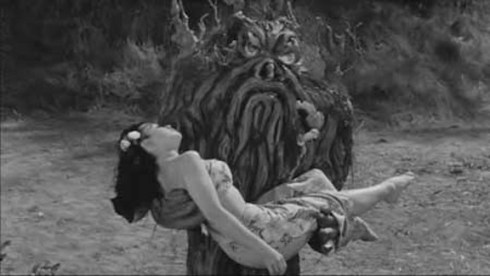
And one of my personal favorites is the awesome Tabanga tree stump equipped with a beating heart that walked really slow and could hardly move a branchy arm yet inspired great fear amongst the superstitious jungle folk and interloping Western scientists alike.
5 Movie Monsters in Search of an Existential Crisis: AntiFilm School Presents the 3rd Annual Halloween Horror Movie Spooktacular!

Paul Blaisdell was an artist who worked in rubber like Auguste Rodin.


worked in marble, well maybe not, but to those of us who grew up with his cheesy monsters, it was art after all.

At first, Blaisdell was a sketch artist, fine arts painter, and sculptor, being an artist/musician myself I understand how poor one person can be by doing what they love. He never made a lot of money as a monster maker in the height of the fabulous 50s. Also, like me, he drew monsters and did models as a kid.

I used to make all the Aurora Universal monster models. Collected all of Forrest J. Ackerman’s Famous Monsters of Filmland Magazines.

and sketched the creatures from those sacred rags and superheroes from my huge Marvel and D.C. comic book collection. I would be stinkin’ rich if I hadn’t sold each and every one for 10 cents a copy while sitting on the street corner back in the good old days, in the suburbs of Long Island New York.

little monster girl and her pop who didn’t mind her playing with monsters!

Obviously, Blaisdell was really good at what he did, because he wound up making a great and lasting contribution to the monster business and Roger Corman’s campy cult films of the 50s. Me I went on to become a songwriter inspired by these glorious childhood memories, but I am better at playing piano and songwriting than building giant rubber mutants with bulging eyes. Although I did try to build a space station in the basement with parts that I got from our vacuum cleaner, which wasn’t broken at the time… don’t ask.

From that point on, every time the hammer went missing in my house, my father would give me the most piercing looks and start yelling. To his credit, he’s the one who would take me to the local mom-and-pop stationery store to buy or bring me home the latest Famous Monsters Magazine, and never said, “Little girls shouldn’t be interested in monsters”, so he was truly a great guy, even if he did yell about the hammer a lot! So anyway…

Blaisdell submitted his illustrations to pulp sci-fi publications like Spaceways


and Otherworlds. And eventually, he was discovered by magazine publisher Forrest J. Ackerman who was so impressed with Paul’s work that he became his agent.

Because of Ackerman, Blaisdell got his first film job designing the alien creature for The Beast With a Million Eyes (1955). He actually helped the project out because at the point he came on board, there wasn’t any little alien yet in the movie at all, which would have to be problematic!

Paul and Jackie Blaisdell with ‘Little Hercules’ between them.

The beastly slave of the alien is a hand puppet created by the cheesy greatness that was Paul Blaisdell.

Interesting side note: For The Beast with a Million Eyes (1955), Corman needed someone to design the alien who originally was supposed to be an invisible force marauding through the galaxy hitching rides on various life forms and taking over their consciousness, like the mind control of the animals in the film. In Bill Warren’s informative book Keep Watching the Skies, Corman contacted friend collector/historian Forrest Ackerman suggesting stopping animation genius Ray Harryhausen (who obviously was way out of Corman’s league and price range) Warren-“Corman recoiled in economic in shock.” Then Forrest recommended Jacques Fresco a futuristic eco-conscious architect and designer who had created the space station and rockets for Project Moon Base (1953)

But Fresco wanted too much money to do the job, so Ackerman came up with another idea. There was an illustrator who designed cover art and did illustrations for his magazines, named Paul Blaisdell. It wasn’t like Blaisdell had the experience building movie models but the young guy did build model kits (the Aurora kind I used to spend the days gluing and painting) and he also did some sculpting. Blaisdell said he would try it for $200 for the job and another $200 for materials. It was still more than Corman wanted to invest, but it seemed the last resort if he wanted a creature in his film. Corman sent the poster to Blaisdell as a composite and informed him that it didn’t have to do much more than show itself on screen for a few moments, then collapse. Blaisdell could then make it on a small scale, using only the upper torso since the rest would be hidden by the ship’s hatch. And so he made a hand puppet which was a dragon-like creature with wings he molded from clay and placed a simple latex mold over it. Paul’s wife Jackie modeled its hands. The Blaisdell nicknamed him “Little Hercules.”

Blaisdell made him a leather jacket, an eight-starred medallion, and a toy gun and then added manacles and chains to its arms to point out that he was really a slave to the alien intelligence. According to Randy Palmer's book, Paul Blaisdell: Monster Maker he was happy with his work, and so were the crew.

Corman and American Releasing Corp must have been satisfied enough with Blaisdell’s skill and his price as well, as he went on to become the go-to monster-maker for the studio during the 1950s. Including The busty She-Creature (1956), the cucumber alien in It Conquered the World (1956), The fanged umbrella bat in Not of This Earth (1957), The alcoholic Google-eyed brain invaders in Invasion of the Saucer Men (1957), my personal favorite Tobanga the walking tree spirit in From Hell it Came 1957 and the alien stow away in It! The Terror from Beyond Space (1958).

He also acted inside the suits he designed, created special effects, and did his own dangerous stunts in Corman's movies. However, the 60s were not kind to Blaisdell and he decided to retire. He did co-publish a monster movie magazine with fellow collector and friend Bob Burns but walked away from the industry entirely. Blaisdell passed away in 1983 suffering from stomach cancer at the age of 55.

Paul went on to design monsters for all the low-budget American International Pictures like the little flying thingy in Not of This Earth (1957). The bug-eyed little green men in Invasion of the Saucer Men (1957) and Earth Vs. the Spider (1958). He was also responsible for an uncredited corpse in The Undead (1957), but I don’t know if that counts as a monster, unless it was a crusty rubber corpse with bulging eyes. Blaisdell also created the imposing alien creature in the tautly paced and fantastic It, The Terror From Beyond Space (1958), which was an inspiration for Ridley Scott’s Alien (1979)

One of my absolute favorites is the Tabanga tree monster in From Hell It Came (1957) as well as the cucumber guy, as they are both hilarious and I simply just adore trees and cucumbers.


In terms of the cucumber mutant, I don’t know if I dreamt this up, pulled it out of my arse, or am just misremembering reading an interview or watching a documentary with Corman saying that Blaisdell’s cucumber creature sat in a shed for years until Paul and Roger got drunk one night and took it out and played with it until the arms fell off. If anyone else recollects hearing or reading this, please drop me a note so that I don’t start doubting myself.

So Blaisdell had a unique vision with the design of his campy mutants and aliens and little flying thingies  He probably will be most remembered for Beulah the grotesque representation of primordial womanhood with the scaly protruding mounds of what were supposed to be her luscious scaly creature boobs? in The She Creature.

Of course, he’ll be fondly thought of for the outrageous cucumber creature in It Conquered the World that terrorized Beverly Garland thanks to husband Lee Van Cleef who invited the damn thing to earth. It’s just sad that he doesn’t get more notoriety for creating some of the most ludicrously delicious and silly monsters of all time.

In addition to designing these creatures, he also often played them as well. Unfortunately, Blaisdell became disillusioned with the film business and just quit making anything more for the movies in the 50s. How many times can Beulah make an entrance right?

I would have thought that Paul designed the giant Crab Monsters for Corman in what else but Attack of the Crab Monsters,(1957) but he was already working on The She Creature and apparently the low budget for the special effects on that film had put Blaisdell off.

In the early 60s, Blaisdell started his own magazine called Fantastic Monsters of the Films but it was a very short-lived endeavor which featured a “how to” section called The Devil’s Workshop

In the early 60s, he did some conceptual artwork on several movies which never made it out of the can. And like a lot of talented people, he wound up living out his life in obscurity. I’ve tried to find his name in several indexes of the film books about the 50s genre that I have here and I can’t find mention of him at all. It made me a little sad.

It would be really interesting to see what kind of monsters he could envision today if he were still with us.

Blaisdell had a knack for working with no budget and yet slapping something together although absurd and silly looking he always came through for AIP and even Bert I Gordon who soon realized that Blaisdell could get things done – and not just make rubber monster suits. Bert I. Gordon hired him to build all the miniature and oversized props needed for his films The Amazing Colossal Man, (19570 Earth vs. the Spider, and Attack of the Puppet People (1958). It was Blasidell who was responsible for the giant hypodermic needle in Colossal Man and for the set of doll-sized items used in Puppet People.

He also worked doing some conceptual sketches for the Milner brothers, designing my favorite Tabanga Tree in From Hell It Came. While the Milners based their menacing tree-stump on his designs, Blaisdell didn’t receive any money, and awful but true he didn’t even get credit for it either, that’s why it’s a lesser known fact that he was responsible for the Tabanga Tree Guy at all.

Sadly, Paul died of stomach cancer at the very young age of 55 on July 10, 1983, in Topanga Canyon, California. But Beulah, the cuke, the flying thingies, Tabanga, all the little bug-eyed guys, and Paul Blaisdell’s devoted fans like me, will always appreciate the giggles and chills he/they evoked when watching his wonderful creations come to life.

Paul Blaisdell’s film contributions:

I found these two links about Paul Blaisdell and thought that both people put a lot of heart and effort into collecting great information about this unsung patron saint of foam rubber and glue.

http://www.badmovieplanet.com/3btheater/tributes/Paul_Blaisdell/paul_blaisdell.html

http://www.bloodsprayer.com/uncategorized/how-to-make-a-monster-paul-blaisdell-remembered/

MonsterGirl’s Saturday Nite Sublime: Coffin Joe: At Midnight I’ll Take Your Soul 1964

Jose’ Mojica Marins is:

Zé do Caixão: “What is life? It is the beginning of death. What is death? It is the end of life! What is existence? It is the continuity of blood. What is blood? It is the reason to exist!”

MonsterGirl’s Saturday Morning Some Men Doing Science In Their Laboratories!

Saturday mornings are for MEN WHO DO SCIENCE… BEWARE…!!!!!!!

THE 4D MAN

PETER CUSHING- The Curse of Frankenstein 1957

BLOOD OF THE VAMPIRE 1958

DR. PHIBES

DR FRANKENSTEIN

ATOM AGE VAMPIRE


Leo G Carroll playing with the forces of nature

TARANTULA

BEN TURPIN

THE BRAIN FROM PLANET AROUS

IT CONQUERED THE WORLD

THE INVISIBLE RAY

THE BRAIN THAT WOULDN’T DIE

EYES WITHOUT A FACE

BRIDE OF FRANKENSTEIN

JOHN CARRADINE

MONSTER ON CAMPUS 1958

ATTACK OF THE PUPPET PEOPLE 1958

THE DEVIL BAT

THE DEVIL COMMANDS 1941

DR JEKYLL AND MR HYDE

DONOVAN’S BRAIN 1953

DR. CYCLOPS 1940

THE FACE OF MARBLE

DR MORBIUS – FORBIDDEN PLANET 1956

CORRIDORS OF BLOOD

HELP ME HELP ME ….THE FLY 1958

METROPOLIS

THE UNEARTHLY

THE INDESTRUCTIBLE MAN 1956

DR MOREAU THE ISLAND OF LOST SOULS

THE INVISIBLE MAN – CLAUDE RAINS

THE THING -HOWARD HAWKS

THE MAD GHOUL

THE MAD DOCTOR OF MARKET STREET

THE TINGLER

MonsterGirl’s Quote Of The Day!: Carnival Of Souls

Carnival of Souls 1962Herk Harvey’s one film Masterpiece.

“I don’t belong in the world.”

“It’s funny… the world is so different in the daylight. In the dark, your fantasies get so out of hand. But in the daylight, everything falls back into place again.”

– Mary Henry – Candace Hilligoss

Carnival of Souls (1962): Criterion 60s Eerie Cinema: That Haunting Feeling


The Face of Marble (1946) An Odd John Carradine Obscurity with an “Identity Crisis”

The Face of Marble (1946) Directed by William Beaudine (Ghosts on the Loose and Bela’s The Ape Man and Billy the Kid VS Dracula)


Screenplay Michel Jacoby Original Story William Thiele and Edmund Hartmann.

Since I’d like to be a John Carradine completest I was very thrilled to get the chance to finally watch The Face Of Marble. Carradine whom I adore so much that I could virtually watch the man eat a tuna sandwich with a cup of coffee and I’d be content because Carradine has such a wonderfully sublime complexion.

Expecting such as the case with The Man Who Turned To Stone, that the horrific side effects of the unusually well intended Dr Charles Randolph’s experimenting with re-animation of dead people, that said dead people would appear to have well…. FACES OF MARBLE!!!!!!!!! not Faces of Pallor.

The guy looks more like he belongs in a German 80s New Wave music video.

I’m not saying that I didn’t enjoy the film, as it had some interesting atmospherics and again, Carradine always brings something wonderful to the table. It’s just that this offering from Monogram Pictures, sort of suffered from a severe identity crisis!

The Face of Marble didn’t know what kind of film it was supposed to be. Frankenstein, The Man They Could Not Hang, Isle Of The Dead, The Hound of the Baskervilles, I Walked With a Zombie, Ghosts On The Loose, Dracula, The 4D Dog? or a variation on White Zombie. And even though it predates The She Creature the end of the film is pretty much the same with footprints in the sand that lead into the ocean, the waves breaking against the shore with no sign of Elaine or Brutus.

The character of Maria reminds me more of the superstitious old women Madame Kyra who suspected the beautiful Ellen Drew of being a “Vorvolaka” a Greek sort of succubus or vampire in Val Lewton’s Isle of the Dead (1945)

John Carradine plays the kindly Dr Charles Randolph who has moved to an isolated house on the coast somewhere to pursue his experimentation in reviving dead bodies. Unlike most mad scientist’s who are narcissistic Megalomaniacs Dr Randolph is more like the kindly altruistic humanitarian type that Boris Karloff often played who is truly looking to help mankind with his discovery. He is assisted by a clean-cut young man Dr. David Cochran played by Robert Shayne. Dr Randolph isn’t even one of those tyrants who forces David to work with him, by threatening either his death or worse the life of his girlfriend. At one point he accepts David’s wishes to go home with Linda. So Randolph doesn’t fall into the evil mad scientist trope, just an altruistic good-natured scientist who wants to help all of humanity by bringing them back to life if let’s say they drown or fall out of a building, you know help a poor dead person out. Continue reading “The Face of Marble (1946) An Odd John Carradine Obscurity with an “Identity Crisis””

MonsterGirl’s: Saturday Morning’s Some Men Who Do Science-posters

It’s Saturday morning so here’s some men who do science posters!

Next Saturday perhaps we’ll see inside their laboratories….!