Directed by Reginald Beck, and Anthony Bushell. Written by Nunnally Johnson, Edgar Lustgarten is based on his book “A Case To Answer” and W.E. Fairchild. With cinematography by Wilkie Cooper (Stage Fright 1950, Jason and The Argonauts 1963), granting wisps of shadowy montages that are equally noirish, suspenseful, and simply splendid.
Patricia Cutts gets no sympathy from me after slipping him a mickey and letting loose that darn Tingler on poor unsuspecting Vincent Price.
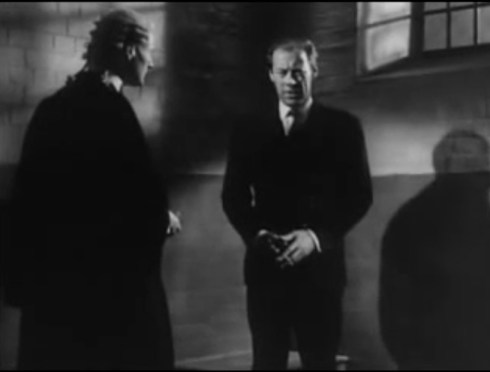
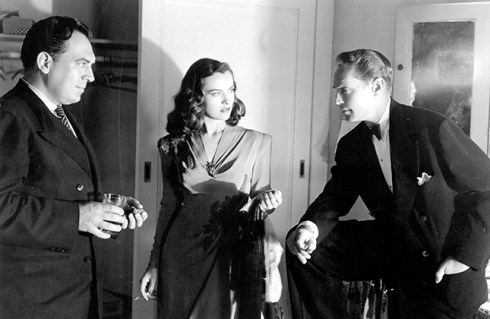
Yielding and obsessive Rex Harrison plays Arthur Groome a London gentleman married to the devoted and lovely Mary (Lilli Palmer.)Unfortunately, Arthur becomes consumed by a flirtatious showgirl Rose Mallory (Patricia Cutts), who winds up being brutally knifed in her boarding house room, and left for the credulous Groome to become suspect one. First gets the splatter of Rose’s blood on his jacket, but then fails to prove his innocence in a sea of circumstantial evidence.
Condemned to hang, this allows the real serial killer played by the tall and eerie Anthony Dawson who looks frightened all the time, a destroyer of wanton women who sees himself as ‘an instrument of justice‘, still lurking about, first at the trial spouting off about his obvious philosophy on sexually independent women, and then creepily shadowing poor Mrs. Groome, whom he idealizes as the perfect woman.
I’ll be up the long dark hall til next time! -Yours always- MonsterGirl
Starring Sidney Blackmer as Edward Stapleton and Patricia Medina as Victorine also starring Boris himself as Dr. Thorne and Scott Marlowe as Julian Directed by Douglas Heyes and adapted from Edgar Allan Poe. Script by William D. Gordon.
Original Air Date"”2 October 1961
Jo Gabriel’s How The Devil Falls In Love appears my album Fools and Orphans
featuring the incredible performance by cellist Matt Turner
The song How The Devil Falls In Love is dedicated to my beloved Lady Cat Angeline who passed away tragically too soon from this earth. I cannot breath without you here.
The Man Who Turned To Stone (1957) was directed by Leslie or László Kardos and produced by Sam Katzman. Screenplay by Raymond Marcus, Bernard Gordon. Cinematographer Benjamin H. Kline, whose work was prominent in low-budget films, westerns, and serials (The Man They Could Not Hang 1939, film noir Detour 1945, Zombies of Mora Tau 1957, The Giant Claw 1957).
The cast: Victor Jory, Ann Doran, Charlotte Austin, William Hudson (Allison Hayes’s louse of a husband in 50 Foot Woman – Sometimes a monster girl just wants to see the giant rubber hand smash through the roadside cafe and grab that cheating lecherous creep of a husband of Allison Hayes and not think of the feminist overtones of a 50 foot woman enraged.)
There’s also Paul Cavanagh, Jean Willes, and Frederick Ledebur. Incidentally, Hudson’s older brother John was also a louse of a husband in another gem,The Screaming Skull (1958), although I recommend the MST3K version too, it’s a hoot!
This is a quirky, outre fun obscure horror film that I simply love. It combines the women in prison thingy with the mad scientist genre. It could even be considered a sci-fi film. It’s very hard to categorize some films because they do cross-pollinate with multiple themes, to me it’s all instant vintage bliss.
The idea of women in captivity isn’t new, and certainly putting them at risk within their confinement creates a very frantic atmosphere. We feel trapped along with them, right? So add to that a really tall man in a black suit who looks like pigeons would love to alight upon his shoulders, and you get The Man Who Turned To Stone – the man who could sit in the park and collect pigeon shit all over himself.
Naughty girls are put away from society, being experimented on for the purpose of extending the secret of eternal life.
The theme of using women in prison is sort of an extension of the confinement of women out in the world who are thought of as captive objects, an archaic tradition of ” a woman’s place is in the home,” an institutionalized sort of domestic restraint for some.
I find it gratifying to be at home, watching horror and noir films, playing with my cats, drinking coffee, then doing a quick vacuuming and setting the crock pot up for 6 hours, chili at 7 p.m. Housewifery is nirvana for me.I am merely making an observation about the implications and allure of the women in prison genre. Also, watching a gratuitous girl fight has its fascinations. Guilty as charged as the conductor of the steel tub in this movie!
In typical girls behind bars flicks, there’s always the tough one who’s been around longer than mud, and the new fish who comes in and transforms the dynamic with her fresh innocence and naivete, eventually helping the other inmates achieve some kind of revelation about life and themselves.
There’s also the stock evil “total institution” figure or figures that hovers over the women, exploiting, abusing, and being, well, horrible authoritarians, tyrannical fascist dirtbags on a power trip.
The women in LaSalle Detention Home for “Girls” have been inextricably dying, in a most mysterious way. These are young girls, and yet they are suffering heart attacks? This has been going on for 2 years. Over the course of those 2 years, the inmates hear disturbing screams in the middle of the night.
The problem is that there aren’t any people who would care about “bad girls” in jail. They’ve lost all their rights, no one cares about such types, and so it’s a perfect environment to perform experiments on these women because they are a)helpless and b)anonymous. Hidden away from watchful, responsible eyes.
And you see the people running the prison aren’t really evil agents of the law, they are actually really, really old evil people who do esoteric science and are using the prison as a cover.
Charlotte Austin plays Carol Adams, the social worker who actually does give a damn about the girls. Carol has integrity and wants to help the girls reform and make sure that their living conditions are more than just adequate.
Tracy, the iconic old-timer inmate of the group, tells Carol about the suspicious string of “heart attacks”that have occurred over the past two years. Carol tries to investigate. This puts Carol in danger because she’s starting to interfere with Dr. Murdock’s (played by naturally stone-faced Victor Jory) experiments. He and his assistants try to deter Carol at every turn. So Murdock, Mrs.Ford ( beloved character actress Ann Doran), and the other scientists start panicking.
No one knows that these people are actually over 200 years old. It’s delicious to see these evil practitioners of eternal life wearing eighteenth-century clothes. Way back in the 1700s, they had uncovered a method of prolonging the life force or actually renewing life by transferring energy from one person to another. It had something to do with electricity, blood transfusions, and large steel bathtubs.
Not unlike Vampirism, but by sucking the life force out of one body and infusing it into themselves. These scientists have been virtually using the girls to literally feed their years. When one of the girls is chosen to re-energize one of the scientists, she dies, and they make it look like a heart attack. These scientist vampires have figured out that women in their childbearing years are the best givers of this life-nurturing force. The jail is full of those.
Thus the reason why Murdock has set up their laboratory in prison for “bad girls” The one problem Murdock and his accomplices face is that if they go too long without sustaining themselves with a new source of energy, their skin becomes as hard as stone, and their hearts pounds so wildly that it’s actually audible, then they die!
This happens to a few of them, and the sound we hear when time runs out is really creepily cool. So is the makeup for the stone skin. Another problem they are faced with is the rocky, ghoulish-looking brute Eric (Frederick Ledebur), a walking, mindless statue who suffered brain damage in their first experiments. It’s curious why they would keep him around for a couple of centuries. Perhaps he made a nice dining room ornament at the annual mad scientist cocktail party, or perhaps he looks great in the garden in his off hours, terrorizing the girl. It’s really Eric that gives The Man Who Turned To Stone its creepitude. The way he hulks around the house would give anyone the heebies, even a “bad girl.”
Eric is also taking longer and longer to respond to the recharging treatments, so they have to up the amount of female sacrifices from the jail pool.
Once one of the girls supposedly commits suicide, Dr Jesse Rogers (Hudson), a psychiatrist with the State Department of Corrections, takes Carol’s pleas seriously and tries to help find out what’s been going on at the prison.
Eventually, Carol and Dr. Rogers uncover the secret. Dr Murdock and the others try to kill Rogers and Carol, but they fail to do so. Eric is out of control and winds up kidnapping one of the inmates from her bed. After several mishaps, the scientists are vanquished of their nefarious and unholy rituals, and their lab is burned to the ground. And the girls can go back to confinement without Eric lurking about.
I’ll be here like a faithful stone statue! Your EverLovin’ -MonsterGirl
The Naked Kiss(1965) Shock and Shame, the story of a Night Girl.
Directed by the maverick auteur Samuel Fuller, with a screenplay by Fuller and black, gray, and white shades in the striking cinematography by Stanley Cortez
-(The Magnificent Ambersons 1942, Since you Went Away 1944, The Night of the Hunter 1955, Shock Corridor 1961), Cortez creates a sense of space that is almost surreal and disconnected from the outside world. The Naked Kiss stars Constance Towers as Kelly, Anthony Eisley as Griff, Michael Dante as Grant, Marie Devereux as Buff, Patsy Kelly as Mac, and one of my favorite unsung actresses Virginia Grey (The Women 1939, All The Heaven Allows 1955, Crime of Passion 1956, Backstreet 1961) as Candy.
Let me say that this is one of my favorite films. I think that it’s such a bold concoction of visual style, specific alienation that we as spectators experience along with Kelly our female Protagonist. The undercurrent of sexual pathology of a perverse nature and raw energy that fuels some crude reactionary moments on film. Normally I wouldn’t write about the ending of a film so as not to ruin it for the viewer, yet Constance Tower’s remarkable performance and Fuller’s raw cinematic veritae must be experienced, the story will not lose anything by my relating it here. I actually consider this part of my Women in Peril series, but more aptly put, it’s a womanhood in peril film.
Samuel Fuller’s B post-noir films are not like anyone else’s. Fuller’s work is often confrontational and visceral considered the kinkiest of all the B post-noir auteurs. Naked Kiss is his most potent work alongside his noir masterpiece Pickup on South Street (1953) starring Richard Widmark and Thelma Ritter as Moe Williams.
Alain Silver and James Ursini’s Film Noir Reader 2 “Fuller’sNaked Kiss“boldly offers a different kind of descriptive pause. Fuller takes on Patriarchy and directly assaults the spectator with a bizarre opening”
In their book they inform us that Fuller actually attached a camera to actor Monte Mansfield who plays Kelly’s pimp Farlunde, the guy she pummels in his swanky apartment right from the tip of the film. He has shaved off her hair and in retaliation she takes her primal vengeance out on his, beating him with her purse and high heels. Kelly only takes the money owed to her. The scene already prepares us, and what is created is an off-kilter and disorienting mood. The opening of The Naked Kiss is perhaps for me one of the most audacious beginnings to any cinematic work. It sort of punches you right in the face along with Farlunde.
The greater theme of the film is its narrative of women’s role within society. In a way not unlike Elia Kazan, Fuller has created a sociological framework, to lay out questions of what womanhood, as well as motherhood, means discursively. While at the end of the film, Kelly is relegitimized as being a savior and not a whore, she is still not allowed to live amongst the clean town’s people. She is still an outsider. Silver and Ursini also correctly bring out in their noir reader the fact that the context of the film is a “discursive-based attack on men and how they define women as well as the limits they place on them”. Also notable is the displaced female rage that only became better articulated later on with feminists during the 60s and 70s.
It reminds me while watching television’s soap opera junk food Peyton Place with its pillory that sits prominently in the middle of the town square as a reminder of New England Puritanical morals and the lurking hypocrisy in the shadows of quiet provincial values, that warn girls to beware of giving away their virtue. Betty Anderson (Barbara Parkins) learns this when she is condemned as the archetypal whore, the tainted girl who gave up her purity to a boy during a summer fling and then was thrown away like autumn trash. The pillory stands in the middle of the town, 200 years prior a woman like Betty had her head shaved bald, was locked in the pillory to be mocked, and then was driven out by the good town folk of Peyton Place. Much like Kelly who we first meet at the shocking opening of the film (one reason The Naked Kiss is such a uniquely memorable excursion for me) is completely bald and striking back at the man who took her hair, her power away.
The Naked Kiss written, directed, and produced by Sam Fuller, opens wide like a steel trap, with Constance Towers as Kelly viciously beats up a pimp Farlunde in his swanky apartment, smashing away at him with her handbag. Hitting his face and neck, it’s like watching a brutal choreographed dance. Fuller creates this wavering movement to give us a sense of the dizzying brutality. Farlunde begs “I’m drunk Kelly please,” “Enough Kelly please.” The savage jazz riffs underscore the bashing. Her wig comes flying off, and now we see a bald Kelly still attacking the man relentlessly. The jazz is coherent with the hyperactive saxophone.
Stripped of her hair looking like a mannequin (perhaps to show us Kelly as an “object”) she beats him till he staggers to the floor, spraying seltzer water in his face. He’s wasted by the beating, she rifles through his pockets and grabs some cash from his wallet. “Eight hundred dollars… you parasite… I’m taking only what’s coming to me.” She starts counting out bills, throwing them down upon his chest, “Fifty, sixty, seventy-five… I’m not rolling you, you drunken leech, I’m only taking the seventy-five dollars that’s coming to me.”
She crumples up her share, shoves it into her bra, and kicks him while he’s lying there. She stares at us like we’re her mirror. Gratified she puts her wig back on and the title rolls, The Naked Kiss. Sam Fuller’s story of alienation, gender subjugation, and the question of immorality and deviant sexual pathology, opens up in a big way.
The Paul Dunlop score becomes more dreamy, with melodramatic strings and Kelly brushing her wig. getting it right. The credits roll and Kelly are applying her eye pencil transforming herself back into a woman and not a bloodthirsty she-devil. Now the blush is applied, the music fades back into the jazz number and we see Farlunde knocked out, lying on the floor. The saxophone is hurling trills at us, Kelly grabs a photograph down from a collection of beauties and she starts tearing it up to pieces, throwing them on the ground, the Farlunde stirs, coughs a bit, and starts to get up, Kelly slams the door.
As he starts picking up the debris Kelly has left in her wake he puts crumpled-up bills on top of a calendar and we see the date July 4, 1961. A quick cut, flash forward to a banner in the street touting August 12, 1963, and the melodramatic music is serenading us again. The camera pulls out for a wider angle, we can see the entire banner now, it reads 2 years later. August 12, 1963 Fashion Show for Handicapped Children Grantville Orthopedic Medical Center
The top of a bus moving through the street, a parked car, a mostly empty street, with a few people crossing it, and mulling about. This is the suggestion of a quiet, quaint American town.
Then a car horn toots, 3 men standing outside a Bus Depot, Griff (Anthony Eisley) says “Ten bucks, that right Mike?”Mike says “Why spend your own money on that punk?” Griff turns to the young man and says while stuffing it in his pocket “Here’s your ticket”smiles at him and shoves some money into his pocket as well. All the time the young man is looking down as if ashamed. He says “Thanks a lot Griff… I’ll pay you back.” Griff looks at him sternly, “I’m giving you a break, cause your brother was in my outfit… I don’t want to see you in this town again.”The young man looks down again.
Then a Greyhound bus pulls over to the curb. We see the marquee of the movie theater is playing Shock Corridor, a nod to Fuller’s other psychologically wrenching film about a newspaper reporter going undercover in a lunatic asylum, only to become one of the patients.
Directed by the master of suspenseful thrillers and fabulous noirs- Robert Siodmak; (Son of Dracula 1943, The Suspect 1944, Christmas Holiday 1944 The Strange Affair of Uncle Harry 1945, The Killers 1946, The Dark Mirror, The Spiral Staircase 1946, Cry of the City 1948, Criss Cross 1949, The File of Thelma Jordon 1948) is as nightmarish and psychologically aromatic as it is a penetrating crime noir. The distinguishing cinematography by Woody Bredell.
Phantom Lady is a sadly neglected film noir based on a story by Cornell Woolrich and scripted for the screen by Bernard C. Schoenfeld. Stars the quietly enigmatic Ella Raines (Cry ‘Havoc’ 1943, The Suspect 1944, Impact 1949), as Carol “Kansas” Richman, Franchot Tone as Jack Marlow, and Alan Curtis as the leading man Scott Henderson. The film also co-stars Thomas Gomez (Key Largo) as perceptive Detective Burgess, the intelligent and compassionate detective who eventually comes around to believe in Scott Henderson’s innocence. This film noir is directed by Robert Siodmak who derived attention after the release of Phantom Lady which carved out a niche for him in film noir. Adding to the wonderful direction, the film benefits from Woody Bredell’s cinematography (Black Friday 1940, Christmas Holiday 1944, The Ghost of Frankenstein 1942, The Mystery of Marie Roget 1942) He added the elements of Woolrich’s world, from the fraught innocence roaming New York City, a dark blistering urban landscape, threatening shadows, seedy bars, jazz and Kansas’ high heels escaping the pavement.
Phantom Lady utilizes noir’s innocent man theme beautifully. Siodmak’s directing creates an often nightmarish realm, the characters float in and out of. The intersectionality frames the story between crime melodrama and psychological thriller. Siodmak is a master storyteller who earned an Oscar nomination for The Killers in 1946.
Although on the surface you would assume Phantom Lady to be a man-in-peril film, it actually functions as a woman in danger as well because Carol “Kansas” puts herself in harm’s way in order to help her boss, whom she’s in love with. Fay Helm’s mysterious woman has a tragic trajectory herself as a woman who is spiraling into oblivion by a mental decline after losing her beloved fiance.
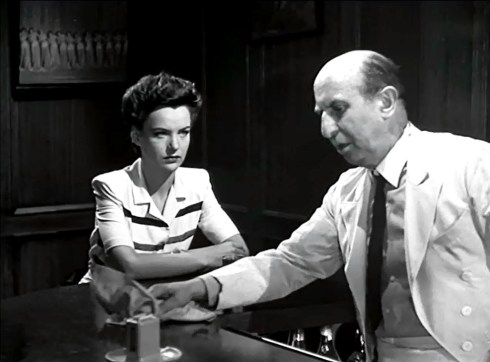
Scott Henderson (Alan Curtis), a successful young businessman, spends the night with a mysterious woman whose identity is unknown to him. Only later do we learn that her name is Ann Terry (Fay Helm) The two first meet in a bar after Scott has been shunned by his wife for the last time. The phantom lady is obviously disturbed by something causing her emotional pain, she finally agrees to take in a show with Scott who has tickets. The conditions are that they do not exchange names as it’s just a way for both of them to keep themselves occupied at a moment when both are feeling dejected.
The “Phantom Lady” is wearing a sensationally quirky hat which the film revolves around in a sense because Scott returns home to find his apartment crawling with police after his wife has been brutally strangled, with one of Scott’s expensive ties. The anonymous lady who wore this stand-out hat is the only key to providing Scott with an alibi.
Scott proceeds to tell Inspector Burgess (the wonderful Thomas Gomez), that he spent the night with this no-name woman, after fighting with his wife and that there are several people who would have seen them together. The bartender, the cabbie with a very memorable name, and the temperamental lead singer/dancer in the musical review could identify him accompanied by the phantom lady, because of her supposedly original hat– the performer Estela Monteiro (Aurora Miranda) was also wearing the same hat on stage, which is later used as a lead. Aurora shoots daggers at the phantom lady for having worn the same design. You could see the fury on her face as she sings her musical number. Estela Monteiro has a fit, walks off stage and decrees that no one would have the nerve to wear one of her original hats, and throws hers away. Wonderful character actor Doris Lloyd plays the designer Kettisha who is sought after for her one-of-a-kind hat designs.
Inspector Burgess takes Scott around to each of these witnesses but no one recalls having seen him with the woman at all. They all very curiously deny seeing the lady, and it becomes obvious that something is very wrong with the testimony from all these people who were obviously covering something up. Neither the cab driver, the bartender, nor the singer will confirm his story. The outcome looks bleak for Scott.
Inspector Burgess: [Questioning] You’re a pretty neat dresser, Mr. Henderson.
Detective Tom: [Taunting] Yeah. Everything goes together. It’s an art.
Inspector Burgess: Nice tie you’re wearing.
Scott Henderson: [Upset] Tie?
Detective Tom: Pretty taste. Expensive. I wish I could afford it.
Scott Henderson: Hey, what are you trying to do to me? Marcella’s dead, gimme a break! What’s the difference if my tie is OK or not?
Inspector Burgess: It makes a great deal of difference, Mr. Henderson.
Scott Henderson: Why?
Inspector Burgess: Your wife was strangled with one of your ties.
Detective Chewing Gum: Yeah. Knotted so tight it had to be cut loose with a knife.
Because it appears that Scott is guilty of the crime he is sentenced to death and faces the electric chair in 18 days. With no witnesses to back him up.
Even his best friend sculptor Jack Marlow played by gravel-toned sophisticate Franchot Tone who doesn’t come onto the scene until midway through the film, is away on business in Brazil, so there is no one but sweet and devoted secretary Kansas who is left to stand by Scott. Scott resigns himself to his fate and doesn’t even blame the jury for their decision.
Scott Henderson is a civil engineer who was in a loveless marriage with a beautiful associate, his faithful secretary who works for him, which he affectionately calls Kansas. She never doubts his innocence for a moment and devoutly sets out on a mission to try and find this mysterious lady to prove she really does exist, before it’s too late. Inspector Burgess and Kansas both believe Scott’s innocence and help each other to try and prove it. Kansas tracks down those whom she knows have lied about seeing this woman. She haunts the bar where Scott first met this mysterious woman.
Kansas assumes the role of serious cookie as she taunts Mac the bartender who denies having ever seen the woman with the funny hat in his bar with Scott at the time his wife was murdered. The bartender winds up getting killed in a car accident. She also goes undercover as a “hep kitten” to trap the lecherous and super frenetic drummer Cliff played to the sweaty frenzied orgasmic nines by Elisha Cook Jr. The jazz fanatic admits that he has been paid off to “forget” the woman. But when Kansas drops her purse and Cliff sees the police sheet on him that she’s carrying on him, he goes even wackier and pursues her. She evades him and calls Burgess.
Along the way, Inspector Burgess confronts Kansas in her apartment and tells her that although he did his job at the time, he also believes in Scott’s story because a child could make up a better alibi than the story he has stuck to so religiously. So now Kansas and Burgess set about to prove that someone has been tampering with these witnesses.
At this point, Jack Marlow, Scott’s secretly crazed artist friend comes back from Brazil to lend his help in getting to the bottom of the case. Jack was having an affair with Scott’s wife and killed her when she refused to run away with him. The always-present Jack begins to play an important role in helping solve the murder. He meets Kansas at the prison while both are visiting Scott. He wants to help her find the real murderer. They eventually trace the hat to Ann Terry after they find the milliner who designed the unusual hat. Ann gives them the hat. Kansas goes back to Jack’s studio to wait for Burgess and winds up discovering her stolen purse, realizing that Jack is in fact the murderer. Jack begins to untie his scarf, another strangulation on his mind, but Burgess arrives just in time and Jack commits suicide by defenestration. Interesting to note that Jack’s obsession with his hands reminds me of Maurice Renard’s novel The Hands of Orlac adapted in 1924 starring Conrad Veidt, again in Mad Love in 1935 starring Peter Lorre, and then again in 1960 starring Mel Ferrer.
What lies ahead is a very gripping story with several taut and fiery moments amidst the looming shadows and dead ends.
Elisha Cook Jr. is too believable yet fantastic as the tweaked sleazy drummer who’s got an appetite for women in the audience, even the phantom lady whom he flirted with.
And Fay Helm plays a very palpable victim of her own sadness as the Phantom Lady who alludes to the police after that one night at the musical revue with Scott.
What adds to the noirish obfuscation of the story is the witnesses who are despicable in their evasiveness, which creates an atmosphere of obstruction that is stirring and at times, maddening. But they will all meet a certain cosmic justice by the film’s end.
Woolrich was a prolific writer whose work came close to being as popular as Raymond Chandler, and he was responsible for many of the screenplays of the 1940s as well as the radio drama Suspense. Ella Raines is absolutely breathtaking to look at. And sadly Alan Curtis having died in the 50s of complications from surgery was not only great at being sympathetic, but he was also strikingly handsome as well.
Carol ‘Kansas’ Richman: [Visiting Scott in prison] Is there anything I can do for you?
Scott Henderson: Yes. You can thank the foreman. I forgot to.
Carol ‘Kansas’ Richman: I don’t know what to say.
Scott Henderson: Skip it, Kansas. I’ll be all right now that I know where I stand. Yes, I’ll be fine. Last night for the first time I didn’t have to count sheep. I slept like a guilty man.
Phantom Lady is a cerebral excursion, which uncovers a lot of psychological layers for us, as it progresses.
Without giving away any key parts of the plot, I’ll say that the film shows us the dark side of humanity.
Without going into the background of the characters, the narrative of Phantom Lady is drawn out in little scenic bursts of disclosure. While the film doesn’t describe to us why these characters are doing what they do with the use of flashback another noir technique, we see who these people are by their actions. The film explores human nature in a slightly gritty naturalistic style.
The cinematography by Elwood Bredell (The Ghost of Frankenstein 1942, The Mystery of Marie Roget 1942, Christmas Holiday 1944, Lady on a Train 1945, The Killers 1946, The Unsuspected 1947, Female Jungle 1956)Â is remarkable as Bredell paints a landscape of looming shadows, dark sinister corners and breaks of light that cut through the clouds of mystery and excursions into bad spaces.
A nightmarish journey of the wrongly accused, the tragedy of loss, greed, true madness, and sometimes darkness of the soul. And ultimately the love that bears its fruits by unrelenting devotion and the pursuit of the truth at any cost.
Kansas will need to wash her mouth out with bleach after the predatory Cliff plants a raptorial kiss on her!
Inspector Burgess: The fact remains that none of you could have committed these murders.
Jack Marlow: Why not?
Inspector Burgess: You’re all too normal.
Jack Marlow: Oh, the murderer must be normal enough. Just clever, that’s all.
Inspector Burgess: Yes, all of them are. Diabolically clever.
Jack Marlow: Who?
Inspector Burgess: Paranoiacs.
Jack Marlow: That’s simply your opinion. Psychiatrists might disagree.
Inspector Burgess: Oh, I’ve seen paranoiacs before. They all have incredible egos. Abnormal cunning. A contempt for life.
The Dark Corner (1946) Director Henry Hathaway’s (Niagra 1953, Kiss of Death 1947 )rhythmical detective Noir, with more than just one great line here or there to fill out the plot. Based on a story by Leo Rosten and adapted to the screen by Bernard C Schoenfeld (Phantom Lady 1944, Caged 1950, Down Three Dark Streets 1954, There’s Always Tomorrow 1955) and Jay Dratler.(Laura 1944, Call Northside 777 (1948), Pitfall 1948, Impact 1949, The Las Vegas Story 1952) Cinematography by Joseph MacDonald(Panic in the Streets 1950, The Young Lions 1958, Walk on the Wild Side 1962, The List of Adrian Messenger 1963, The Carpetbaggers 1964, The Sand Pebbles 1966). Music composed by Cyril J. Mockridge.
“Hard-boiled, well-paced narrative, — tough-fibered”– Bosley Crowther-The New York Times May, 9 1946.
The Dark Corner is a particularly violent example of film noir the idea of a private detective being pursued by a gunman, whom he captures and proceeds to smash his hand and smears his white suit in order to make him confess to the reason he is tailing him. Later when William Bendix (white suit) breaks into the detective’s apartment he knocks him out viciously and before he leaves, he pays him in kind by stomping on Mark Steven’s hand while he’s unconscious. Dark Corner pushes the limits in drawing out anxiety in the audience. Still, as yet Bradford Galt the private eye (Mark Stevens) cannot imagine why he is being persecuted and hunted down. He doesn’t even know the identity of his enemy. There is a Machiavellian villainous mastermind who is pulling the strings, and Galt is merely a puppet but not the true object of his ire. The great thrust of this narrative is the sense of meaningless suffering mixed with motiveless persecution.
In most Noir films there are the elements of existential anguish– the angst that runs through the central characters’ narrative. Bradford Galt is a prime example of the detective with this sense of being at the mercy of his past burden, the one that haunts his present life. He got a fast shuffle out west, accused of a crime he did not commit, serving time in prison for vehicular manslaughter, set up by his partner-the double-crossing dandy Tony Jardine (Kurt Kreuger) Now he just wants the chance to start up a legitimate business as a Private Detective in New York City.
Kathleen“But remember, I can get brand new tough guys for a dime a dozen.”
Bradford“Here, get yourself two dozen.”
[Bradford tosses two dimes at Kathleen across the table]
Kathleen Kathleen pushes them back towards Bradford] “I’d rather pick you up at a rummage sale. I’m a sucker for bargains. Speaking of bargains, if you can’t get nines in those nylons, I’ll take eight-and-a-half or even ten. Doesn’t matter.”
Bradford “I’ll make a note of it.”
Mark Stevens (The Snake Pit, The Street With No Name) is Bradford Galt, the hemmed-in beleaguered protagonist of the film. A private dick who just can’t escape his past, and is targeted as the fall guy in a malicious plot of revenge. As Foster Hirsch says in Film Noir: The Dark Side of the Screen “His life is subjected to wild reversals and inversions… Cornered, framed, set up as the patsy and the fall guy, these victims are the playthings of a malevolent noir fate…”
The Dark Corner (1946) Directed by Henry Hathaway Shown from left: Lucille Ball (as Kathleen), Mark Stevens (as Bradford Galt).
Lucille Ballis Kathleen Stewart his always faithful and trustworthy secretary who is with Galt for keeps. And then there’s the inimitable Clifton Webb as Hardy Cathcart who reprises his role as the effete love-struck snob Waldo Lydecker in Otto Preminger’s Laura (1944).
In The Dark Corner, he plays the overrefined art dealer whose sanctimonious utterances drive much of the film’s best lines. William Bendix is the quintessential homicidal thug, Cathcart’s paid muscle, Stauffer alias Fred Foss who’s been hired to shadow Galt and unnerve him just enough to manipulate Galt into having a confrontation with ex-partner Tony Jardine in hopes of framing him for his murder by creating a motive for Jardin’s murder. Jardine is a man who blackmails women with incriminating love letters, in addition to having set Bradford Galt up for the previous manslaughter sentence, he is having an affair with Cathcart’s wife Mari (Cathy Downs) giving him money and jewels so they can take their stash and run away together and therein lies the tale of revenge. Galt is just the patsy, the fall guy, and the sacrificial goat.
Hardy Cathcart has a psycho-sexually grotesque obsession with his wife Mari played by Cathy Downs In fact, his icy preoccupation with owning fine things in particular his wife, who bares a striking resemblance to a rare painting, presents Webb’s character as a collector indeed, by entrapping his wife in a marriage as the ultimate ill fated ‘object’.
Hardy Cathcart: “The enjoyment of art is the only remaining ecstasy that is neither immoral nor illegal.”
In the realm of the Noir as detective yarn, The Dark Cornergoes smoothly through each scene, darker than some contributions to Noir, it is sustained by some memorable dialogue and a psycho-sexual current that flows underneath the narrative. In particular, Cathcart is a coded-gay character, which I will cover in my upcoming feature Queers & Dykes in the Dark: Classic, Noir & Horror Cinema’s Coded Gay Characters.
The Dark Corner utilizes some of the characteristic visual motifs of the Noir film The frame within a frame, creates the environment of imprisonment. Bradford Galt is an iconic figure whose existential anxieties create the trope of no way out.
Bradford Galt murmurs “There goes my last lead. I feel all dead inside. I’m backed up in a dark corner, and I don’t know who’s hitting me”. This reflects the uncertainty of the character’s situation. Mired in the existential despair of going down blind alleys and not being able to see who his enemies truly are.
Even the shot of Kathleen waiting in the cab, looking out the window, Kathleen’s (Lucille Ball looking gorgeous) face is framed by the glass and the darkened night. She is fixed on her love for Bradford Galt. As she tells him
Kathleen-“I haven’t worked for you very long, Mr. Galt, but I know when you’re pitching a curve at me, and I always carry a catcher’s mitt.”
Bradford-“No offense, A guy’s got to score, doesn’t he?”
Kathleen-“I don’t play for score. I play for keeps.”
There is a very memorable scene in The Dark Corner which has a very vivid moment of someone being flung out a window. I guess defenestration is a popular method of character disposal in Noir/Thrillers. Being hurled out a window is quite a drastic way to die, let us say rather than being shot in the heart once with a small pistol. Defenestration is an utterly violent way to die.
The Dark Corner has other inherently typical themes of Noir in addition to the detective yarn, it also shares the “wrong man archetype”. Galt has been framed for a crime he did not commit. For the first part of TheDark Corner, it is also not made very clear who and/or why someone, possibly this Jardine character is persecuting Galt.
The chiaroscuro is used powerfully when obscuring the embrace of Jardin and Cathart’s wife downstairs in the lower level of the art gallery, while Hardy Cathcart stands off stage. This ambiguous shadow-play that Hardy Cathcart witnesses reveal that he might have known for quite some time about his wife’s unfaithfulness.
More disturbing is the idea, that as his prized possession, wife Mari is an object d ‘art, a thing, that will remain with him even if she doesn’t love him, even if she’s been with other men. This is the main underpinning for the film. Without Cathcart’s sinister obsession, there would be no story.
Hardy Cathcart “Love is not the exclusive province of adolescence, my dear; it’s a heart ailment that strikes all age groups-like my love for you. My love for you is the only malady I’ve contracted since the usual childhood diseases. And it’s incurable.”
Hardy“I found the portrait long before I met Mari, and I worshiped it. When I did meet her it was as if I’d always known her. And wanted her.”
Party Guest “Oh how romantic”
Hardy“If you prefer to be maudlin about it. Perhaps.”
Bradford Galt (Mark Stevens) is superb as the private investigator who after serving 2 years for vehicular manslaughter, in which he was set up by his ex-partner a shyster lawyer the suave Tony Jardine (Kurt Kreuger), Galt comes to New York from San Fransisco to start over. He’s got a kind of Alan Ladd, nice guy looks about him.
He opens up his new detective’s agency. Bradford Galt sits in his huge mostly empty office with one large desk and a map of the city on the wall, and a phone.
Lt Frank Reeves ( Reed Hadley) is the ever-present detective on Bradford Galt’s back, watching over him to make sure that he isn’t going to slide into any criminal behavior again and let Bradford Galt know that he’ll be watched from here on out. The detective promised his friends in California that Bradford Galt wouldn’t get into any mischief, saying “He’s an impulsive youth” and he’d be smart to keep it clean.
One of the driving narratives of The Dark Corner is Bradford Galt’s self-persecution and Kathleen’s need to prop him up and keep him from feeling sorry for himself. The more he tells her to forget him, the tighter she holds on and sticks by him.
Kathleen-“What’s done to you is done to me.”
The banter between Stevens and Ball is highly palpable and it’s quite sweet the way they develop their relationship. Even when she mentions him being a detective and uncovering a pair of nylons size nine for her and he keeps saying he’ll make a note of that. It’s their chemistry, their adoring partnership that’s yet the other real focus of the story.
 (Frank Foss also known as ‘White Suit’ throughout the film) hired muscle and tail, dressed in an ‘out of season’ linen white suit is tailing Galt and his secretary very conspicuously, while Galt and his new secretary and lady friend are on their first unofficial date, wandering through the Tudor Penny Arcade, they confer that white suit’s been tagging along. Both Bradford Galt and Kathleen notice him and conspire to get him up to Galt’s office. Kathleen is supposed to wait in a taxi and then follow Foss to where ever he goes. After Galt finds out what his game is. Once Bradford Galt gets hold of Foss (Bendix) he hits back hard, smashes his thumb with a rolled-up wad of quarters used like brass knuckles, and finds out that Jardine the ex-partner who had framed Galt back in San Fransisco and is now after him once again. Or is this just a ruse, set up by yet another nefarious mastermind behind a scheme to frame Galt for murder once again?
This sets off a chain reaction for Bradford Galt to uncover why Jardine is so interested in him again. Bradford Galt roughs up Bendix, humiliates him, takes his wallet so he can remember his name and where he lives, and when Foss spills ink on his desk, he wipes his inky fingers all over the nice white linen suit. Bradford Galt also breaks Frank Foss’ (Bendix’s) thumb. Which becomes significant later on in the film.
During the film, Bradford Galt is as sullen as a wounded animal having been set up a few years earlier by his ex-partner and now is being targeted once again, but this is secondary to the plot. It’s the vehicle for which Galt can finally put the demons from the past to bed and start over as a stronger more complete man who’s found his strength and love in his “faithful noir lady” Kathleen(Lucille Ball), who dotes on him and is the strong shoulder to lean on, whenever things get confused or dangerous. Kathleen’s in it for keeps.
Kathleen just won’t quit her boss. She knows he’s in trouble and wants to help him in any way she can. She keeps pushing Galt to open up his steel-safe “heart”, of his and let her help. After a wonderful kiss, He just tells her “If you don’t want to lose that stardust look in your eyes, get going while the door’s still open… If you stick around here, you’ll get grafters, shysters two-bit thugs, maybe worse, maybe me.”
The one-liners are great in this film. And there are so very many of them. Webb is perfect as the pretentious predatory art gallery, he’s a snobbish fop who is more concerned about his collectibles namely his wife Mari though he connects them with his sense of pride and dignity without any moral principle. His wife is his possession and keeping her as such is the only thing that matters to Cathcart.
The Dark Corner is filled with quirky, interesting moments that fill out the landscape with memorable plot devices. One such wonderful element is when the little blonde girl who keeps playing her penny whistle irks Bendix’s character and adds a light comical edge to the picture. Galt is being hounded by Bendix using the alias name Foss who doesn’t succeed in running him down with his car, Detective Frank Reeves is trailing Bradford Galts’ every move to make sure he isn’t into any unsavory business.
Tony Jardine looms over Bradford Galt, the memory of having been framed for manslaughter by Jardine who doused him up with booze, puts him in the car, and leaves him to take the rap for killing a truck driver. At times we see Galt as he sits in his big mostly empty office except for his desk. This shot makes him look small and swallowed up. Again, Joseph MacDonald’s cinematography frame the shot within an atmosphere of entrapment.
memorable lines:
Kathleen “I’ve never been followed before.”
Bradford Galt “That’s a terrible reflection on American manhood.”
Hardy Cathcart“How I detest the dawn. The grass always looks like it’s been left out all night.”
Bradford Galt“{to Anthony Jardine} “For six bits you’d hang your mother on a meat hook.”
Bradford Galt: “I’m playing this by the book, and I won’t even trip over a comma!”
Bradford Galt “There goes my last lead. I feel all dead inside. I’m backed up in a dark corner, and I don’t know who’s hitting me.”
Bradford Galt “I’m clean as a peeled egg. No debts, no angry husbands, no payoffs… nothin’.”
Bradford Galt: “I can be framed easier than “Whistler’s Mother”.
Mrs.Kingsly: “Isn’t my Turner divine? Look at it! It grows on you.”
Hardy Cathcart: “You make it sound like a species of fungus.”
Hardy“I found the portrait long before I met Mari, and I worshiped it. When I did meet her it was as if I’d always known her. And wanted her.”
Party Guest “Oh how romantic”
Hardy“If you prefer to be maudlin about it. Perhaps.”
Bradford Galt “You know, I think I’ll fire you and get me a Tahitian secretary.”
Kathleen“You won’t like them; those grass skirts are a fire hazard.”
Bradford Galt [replying to Anthony Jardine] “You, on the level. Why, for six bits you’d hang your mother on a meathook.”
Hardy Cathcart“Take, uh, Tony for instance. I never imagined him to be interested in… Lucy Wilding.”
Mari Cathcart“But he loathed her! It’s not true.”
Hardy Cathcart“He loathed her intimately.”
Mari Cathcart“He couldn’t!… she’s too old for him!”
Directed by Edmund Goulding is one of the more moody, nightmarish and sophisticated Noir films of it’s time. Goulding’s direction works like an expose of the sleazier aspects of carnival life, threaded with romance, both surreal and unseemly. Based on William Lindsay Gresham’s book and scripted by Jules Furthman (To Have and Have Not, The Big Sleep). The film is a grim and somber look inside the lives of carnival folk and the demons who ride their backs with drug and alcohol abuse, which breeds inhumanity and the nadir that people are capable of reaching. This beautiful nightmare is both picturesque and polluted with ugly ideologies.
Cinematography by Lee Garmes, (Morocco 1930, Shanghai Express 1932, Scarface 1932, Duel in the Sun 1946, The Paradine Case 1947, The Captive City 1952, Lady in a Cage 1964) Music by Cyril J. Mockridge, and set direction by Thomas Little (Laura 1944, Day the Earth Stood Still 1951). Edited by Barbara McLean.(All About Eve 1950, No Way Out 1950, Niagara 1953).
The film stars Tyrone Power as Stanton Carlisle a ruthless con artist with no morals who stumbles onto a traveling carnival. Not only did Powers want to see Nightmare Alley made, but he also wanted the leading role to show 20th Century Fox that he was more than just a pretty face. It also stars Joan Blondell (one of my favorites and known for her wise-cracking sex appeal) as Zeena Krumbein, Colleen Gray (Kay in The Killing 1956) as Molly, Ian Keith in an intense role as alcoholic mentalist Pete Krumbein and Mike Mazurki as the strongman Bruno.
Nightmare Alley is an enthrallingly morbid fable about the rise and fall of a greedy, socio-pathic charlatan Stanton Carlisle (Power) who uses his good looks and skillful deception to work his way from traveling carnival barker to high society mentalist. First, he seduces Zeena (Joan Blondell) a gentle soothsayer, in order to obtain the key to her and her husband Pete’s (Ian Keith) mind-reading code. Stanton accidentally poisons Pete when he gives him a bottle of wood alcohol. He then moves on to romance Molly (Colleen Gray) the beautiful young girlfriend of the strongman Bruno (Mazurki). Stanton winds up marrying Molly, and the two leave the seedy carnival life for better pickings as successful nightclub mentalists, of course using the code he charmed out of Zeena. But even the nightclub act is not enough to satiate his desire for power. He meets Lilith (Helen Walker) an unscrupulous psychologist (the film’s coded lesbian and cunning femme fatale) who has access to her clients and can feed Stanton confidential details from her patients. The pair begin to blackmail their clients out of money. The ‘spook racket’ is an extremely profitable scheme, but his plans to build a spiritualist empire is at risk when Molly’s integrity overshadows Lilith’s avarice.
Stanton Carlisle is the film’s charismatic Anti-Hero, the central character who thrusts the film’s narrative forward though there are three very strong female leads. Stanton is portrayed by Tyrone Power in perhaps one of the most enigmatic performances of his career; an amoral misanthrope whose inherent skill is to prey on the vulnerability of people’s weakness.
The film’s two powerful and kind women have a crucial interdependence on Stanton. They are the ‘caregiver’ archetype of women, who while not in threat of bodily harm, their danger lies more in the betrayal of their trust. However, Helen Walker’s heinous psychiatrist who preys on the weakness of others is aptly named Lilith, the most ‘notorious demon’ in Hebrew mythology. Stanton exploits the opportunity that each woman offers up.
It’s a story of a immoral, ill-fated scoundrel who spirals down even farther, into a remote dark corridor where humanity has no place to radiate its light. It’s a story of devouring power and the leap into the pit of perdition with no sign of redemption. A truly nihilistic vision. Ultimately at the climax of Nightmare Alley, Stanton has fallen into the depths of the self-imposed freak show in purgatory.
Mademoiselle Zeena is portrayed by the earthy, gutsy Joan Blondell who is seduced by Stanton Carlisle, the charming carnival barker, con-man into teaching him the secret of “The Blind Fold Code”. A word code that helps mentalists work a crowd of people who submit questions for the “Mentalist” to answer. This was once a very lucrative stunt that Zeena and her husband Pete (Ian Keith) used, which was worth its weight in gold.
Zeena is the catalyst, the unwitting Prophetess who gives away the word code to Stanton. A Faustian contract that ultimately seals his condemned fate. Stanton will sign his soul away for the secret. For him, it is a one-way ticket to obtaining a dark providence for the sake of a brief dance with power. His appetite is fueled by Protean greed to obtain more and more power and riches. He longs to be a bona fide Mentalist, in high society, not just a two-bit cheater in a fleabag carnival. He wants to tap into the profitable Spook Trade where there is more of a potential for wealth. Stanton sees himself becoming more like an Evangelist, a prophet helping ease people’s crisis of faith as well as their grief while turning a sizable profit.
Zeena is also a Circe or Hecate — a witch, a seer, like a figure seen in her obedience to the art of Tarot. And her visions see very dark forces ahead for Stanton. She is a tragic figure because she has fallen under Stanton’s alluring influence, yet she is a devoted caretaker to her husband Pete whose drinking has cast a shadow over their career and marriage. Zeena is a woman trapped by her superstitions and her reverence for the arcane mysteries of life. She’s also a woman driven by her devotion and desires.
Zeena Krumbein: Sure, as big as an artichoke, a leaf for everyone.
In the opening scene we behold The Miracle Woman Zeena, standing on the platform by her tent, like a Greek goddess, a soothsayer, weary with visions of things that have played out in her life. Circumstances the Tarot Cards have foretold, that she is driven by the past winds of fate to observe. Zeena is at the mercy of her willing subjugation to her plight and the sacrifices she’s made in life as a caretaker and mystic witness.
Molly (played by Coleen Gray) is the sweet young girl in the carny act, billed as the Electro Girl who sports a galvanic bra that can withstand electrical shocks so she doesn’t get fried in her seat. Letting the arc of electricity flow between her hands is a mesmerizing scene. It gives Molly her almost fairy-like quality. The mirror with which to reflect whatever decency might still be inherently shrouded in Stanton’s dark heart. She can only see his beauty and his passion for working the crowd and his gift for showmanship. She doesn’t understand his ruthless nature, or that he is exploiting her affections. Molly is in danger of being manipulated by Stanton who plunges into marrying Molly for the purpose of using her in his new act. Her face is almost lit like an icon of a painted Roman angel, cannot see the wheels turning in Stanton’s eyes when he talks about them being together.
Stanton is fascinated by The Geek in the sideshow. This is the carnival’s biggest draw, but a subversive illegal attraction that even some performers won’t work there if a show carries such a grotesque feature. But Stanton is fixated on him. “How do you get a guy to be a Geek, is he born that way?”It’s an unsettling foreshadowing of events. “I can’t understand how can get so low” We can hear the live chickens squawking as they are being fed to The Geek. It’s a disturbing effective use of background sound.
Stanton thrives on the energy of the carnival “I like it, it gets me to see those yokels out there gives you a superior feeling, as if YOU were in the know and they were on the outside looking in.”We see Stanton as an egoist with a ruthless narcissism to take over, be in control, to be omnipotent.
Stanton first starts working on Zeena’s affections in order to procure the secret code. She doesn’t want to hurt Pete. But she is taken in by Stanton’s seductions. If the new act works, she could make enough money to get Pete “the cure”. “Oh Stan do you think I could make the big time again?” Her arm stretched out leaning on a pole, he kisses the soft insides where her arm bends. She is torn between enabling Pete and being seduced by their lustful manipulations by Stanton.
Zeena Krumbein: This is the tarot. Oldest kind of cards in the world. Pete says the gypsies brought them out of Egypt. They’re a wonder for giving private readings.
Stanton shows up later at Zeena’s hotel room where she has laid out the Tarot cards. He asks what she’s doing. “This is the Tarot, the oldest kind of cards in the world … whenever I have something to decide or don’t know which way to turn.”
She tells him to cut the cards 3 times. “Look Stan that’s the Wheel of Fortune, Pete and I never had it this good!”Everything looks good for them in the reading, but there is no sign of Pete dead or alive. Zeena starts to panic. Stanton picks up a card that had fallen on the floor face down. Zeena is shaken, “It couldn’t be like that it’s too awful, it’s too crazy what have I done!”
She tells Stan to take his bags and get out, it’s all off. Stan asks what he’s done, she says “Nothing! but I can’t go against the cards.”
Nightmare Alley’s characters each have their own level of spiritual awareness, an intimate relationship with their own nature of worship. Zeena dabbles in the esoteric mystical aspects of superstitions of luck and curses. The Marshall who comes to shut the carnival down, has a very quiet reverence as a good Christian man, Molly is the embodiment of moral purity, and Stanton sees himself wielding his own religion as a Nietzcsheqsue Uberman.
Zeena shows Stanton Pete’s card. The Hanged Man is the recurring theme of the film. This again is the foreshadowing of what can happen when humanity is sacrificed for power. She tells Stan when a card falls face down on the floor, whatever is going to happen is going to happen fast and it’s never good. Stans says “That’s for the chumps, to fall for one of your own boob catchers”He’s so superior, so ruthless, he cannot even fathom that the warning might be credible. We don’t really see shades of humanity in him but a curiosity, as Stanton asks “I wonder why I’m like that, never thinking about anybody but myself.” Zeena asks if his folks dropped him on his head. “Yeah, they dropped me.” This gives us a little background, he grew up in an orphanage where he became aware of the Gospel that came with black and blue bruises and its useful passages he can avail himself of later. They kiss, and Zeena is once again under his charismatic control.
Molly: You ought to have heard Stan spout the gospel to that old hypocrite. It was like being in Sunday school.
Zeena Krumbein: You must have been raised pretty religious.
Stanton Carlisle: In the orphanage. That’s what they used to give us on Sunday after beating us black-and-blue all week. Then when I ran away, they threw me in the reform school. But that’s where I got wise to myself. I let the chaplain save me, and got a parole in no time. Boy, how I went for salvation! Comes in kind of handy when you’re in a jam.
On a foggy night, crickets chanting, Zeena’s husband Pete, staggering in between the caravans of the carnival stumbles upon Stanton one night. Zeena has cut him off from his drinking. Pete has the dropsies. In the background, we hear the Geek wailing, screaming, ungodly screams. “He’s got the heebie-jeebies again.”
Throughout the film’s darker scenes the usage of music by Cyril Mockeridge, with orchestral arrangements by Maurice Packh underscores moments with a diabolical motif, again in keeping with the Faustian theme. Several waves of glossolalia especially where the Geek runs amok on the carny grounds are simply mind-altering.
Stanton gives Pete the bottle he’s stashed in the prop trunk and says here you need this more than me. Pete tells him “You’re a good kid Stan, you’re going places, nothing can keep you out of the big time, just like I used to have.” He reminisces about him and Zeena during their big time when they had top billing. The Geek comes stumbling near them singing an incoherent tune, “Poor guy” Stanton says. “If it weren’t for Zeena they’d be saying that about me, Poor Pete, Pete the Geek” He remembered that fellow when he’d first showed up at the carnival. He used to be plenty big-time. “Mental Act?” “what difference does it make, old smoked meat now, just a bottle a day rum dumb and he thinks this job is heaven, as long as there’s a bottle a day and a dry place to sleep it off. There’s only one thing this stuff (bottle) will make you forget how to forget.”
Pete jumps onto the platform, turns the grungy, swinging overhead lamp on, and begins his little soliloquy, his old spiel “Throughout the ages certain men have looked into the polished crystal (holds the bottle of liquor to his breast and gazes) and see, is it something about the quality of the crystal itself, or does the gazer merely use it to turn his own gaze inward” now holding his hands to his temples as if to gleaning visions” in a seriously, sage like tone, as if giving a sermon (again the comparative to religion).
“Who knows, but visions come, slowly shifting their form, visions come, WAIT! the shifting shapes, begin to clear.”
Pete Krumbein: Throughout the ages, man has sought to look behind the veil that hides him from tomorrow. And through the ages, certain men have looked into the polished crystal… and seen. Is it some quality of the crystal itself, or does the gazer merely use it to turn his gaze inward? Who knows? But visions come. Slowly shifting their forms… visions come. Wait. The shifting shapes begin to clear. I see fields of grass… rolling hills… and a boy. A boy is running barefoot through the hills. A dog is with him. A… DOG… is… with… him.
Pete Krumbein: [Choked laughter] Humph. See how easy it is to *hook* ’em!
He begins to describe fields of rollings hills to Stanton, a young barefooted boy, and a dog. Stanton caught up in Pete’s oration begins to tell him, “His name is Jim, go on” Pete breaks from his trance and begins to laugh sardonically, “See how easy it is to hook ’em!” he cackles. “Stock reading fits everybody. Every boy has a dog”, as he laughs. But Pete’s demonstration deepens Stanton’s hunger to obtain the ability to entrance people by elocution and persuasion. To divine people’s souls by reading their body language. To Stanton, this is a form of religion. To be a holy man of the mental act. An art form, a business, and again, a spiritual rescuer to those who are in a crisis of faith — only… for a price.
That night, Stanton unknowingly slips Pete a bottle of wood alcohol that Zeena uses to burn the papers of written questions from the audience. Stanton accidentally reaches into the prop trunk and grabs the wrong bottle. The bottle that Pete had been drinking that night. He dies and leaves Zeena to renew the act with Stanton as her partner working for the crowd. But the guilt that starts to build up in Stanton’s psyche haunts him, and eventually becomes the spiraling down, the turn of his destiny and his ruination. While climbing to the top in society being billed at a Chicago nightclub as a Mentalist he is attracting a lot of attention.
Zeena shows up at Stanton and Molly’s hotel for a surprise visit. Again she lays out the Tarot cards “You’re going to the top, like a skyrocket”The one card face down is The Hanged Man, Pete’s card. This rattles Stanton. Molly believes it and Zeena warns Stanton not to take the act in the direction he is thinking. He calls Zeena and Bruno carnival freaks and tells them to get out. But Zeena comes back having forgotten her Tarot deck. Again, Zeena finds The Hanged Man face down on the floor. We hear the music glossolalia again, the disturbing voices resurrected in the backdrop. Later, Stanton goes to get a massage and when the masseuse puts alcohol on Stan’s skin to close his pores, he thinks of Pete about the night he inadvertently switched the bottles of alcohol that killed Pete. The act he benefited from because it created his opportunity to use “the code” and rise to the top.
At the nightclub in Chicago, in the audience one night, there is a woman, Dr Lilith Ritter (Helen Walker) a cunning psychoanalyst, who challenges Stanton. He goes to see her at her office and a new unholy relationship is forged. Not based on sexuality but the mutual bond of greed and opportunistic paranoia. She is the femme fatale of this noir film. She records all her patient’s sessions and Stanton wants to be able to use that information to his advantage, by having inside details of people’s lives that he can use in his Mentalist act. The name Lilith again is an interesting element. Lilith in Hebrew mythology is related to a class of female demons. When Stanton accuses her of secretly recording her patient’s sessions she espouses “Anything my patients reveal is as sacred as if given under the seal of the confessional.” Again references to the religious structure. And the twisted bond they forge from this point on is based on “it takes one, to catch one.”
Ritter gives Stanton secret information about a wealthy patient of hers. Ezra Grindle (Taylor Holmes). Stan sees it as “An absolute blown in the glass clincher” Stan doesn’t see this skeptic as a challenge because his ego is so poised that he is certain he can con this old man into believing that he can manifest the spirit of his long-dead love Dory. Using his command of the Gospel, Ezra a man who obviously struggles with religion, is told to “prepare himself more with prayer and good works” To Stanton this translates into receiving enough money for his own radio station and tabernacle.
Trying to use Molly as an accomplice to dupe the very wealthy man out of a fortune Molly threatens to leave Stan. He manipulates her love for him by telling her “What should I do, should I let the man’s soul be lost forever, or should I stake my own to save it!”It is this brilliant subterfuge that convinces Molly to stand by him for this ruse. She is so bound by her blindness, that she follows Stanton a bit further. She agrees to play the ghost of Dora.
From here on in, Stanton begins his descent down the darkened pit, where he losses his wicked identity and transforms into a damned, lowly geek.
Stanton Carlisle: Listen to me, I’m no good. I never pretended to be. But, I love you. I’m a hustler. I’ve always been one. But, I love you. I may be the thief of the world, but, with you I’ve always been on the level.
McGraw – Final Carnival Owner: Wait. I just happened to think of something. I might have a job you can take a crack at. Course it isn’t much and I’m not begging you to take it, but it’s a job.
McGraw – Final Carnival Owner: And we’ll keep you in coffee and cake. Bottle every day, place to sleep it off in. What do you say? Anyway, it’s only temporary, just until we can get a real geek.
William Lindsay Gresham discusses his creative angst researching Nightmare Alley, as a backdrop to his own movement toward faith. Here it’s cited his discovery of Tarot:
“During my analysis I had a brief period of prosperity: I managed to write a novel, savage, violent, and neurotic, which made money. Yet with a temporary release from financial worries, my own inner nightmare grew worse. It was not true, then, that men live by bread alone?”(Source)
Adapted for the screen byJohn Kneubuhl (The Screaming Skull ’58, Two on a Guillotine ’65 both have a similar eerie Gothic sensibility) and directed by John Newland. (One Step Beyond 60s tv series, Don’t Be Afraid of the Dark ’73)PigeonsFrom Hell was another story taken out of Weird Tales Magazine from a story by Robert E. Howard (Author of Conan the Barbarian), in 1938, which he based on old legends that his grandmother had told him in West Texas.This also seems to coincide with similar themes of Voodoo by Zora Neale Hurston  Author Folklorist/Anthropologist during the time of the Harlem Renaissance who wrote the non-fiction exploration of Haitian/Caribbean rituals in Tell My Horse in 1937, just a year earlier.
With original music by Jerry Goldsmith and Mort Stevens which is perfectly haunting for this Southern Gothic tale. And fabulous art direction by George Patrickand set design by Julia Heron who also worked on The Incredible Doktor Markesan (Spartacus ’60) and John McCarthy Jr. The Blassenville house is a place of fear and desolation. The camera frames the characters within the tired structure itself, cobweb-laced door frames, dark staircases that hold their ascent, and black box rooms with scattered dusty relics.
The story takes place one fateful night when two New York brothers Johnny and Tim Branner, driving over a rickety wooden bridge (shot in obvious day for night), suddenly hit a muddy ditch and begin spinning their tires to no avail. Now they remain stranded under a wonderfully bewitching weeping willow, a classic prop for a southern Gothic tale, in the swamp lands of the Louisiana countryside.
The opening scene is embellished with the willow’s mossy tendrils, swaying, drifting, and blowing as if by an unseen lazy wind. And so it begins.
The boys get out of the car and Tim played by the very wholesome-looking Brandon De Wilde says “Welcome to the fabled south, land of Crinoline, Magnolias, lovely ladies, and swamps”
Johnny defends himself for having been chided about his shortcut, “Okay okay so it’s not the new york thruway you’ve got to admit that this is the way it truly is”
While Johnny goes off to find a pole that they can use to dislodge the tire from the mud that’s when a strange wailing starts, like that of a distressed alley cat in heat.
Johnny wanders off starting to reach deeper into the context of the landscape. As he pushes aside the dangling mossy vines, he stumbles upon dozens of pigeons that begin cooing madly. He discovers the desolate antebellum plantation, The Blassenville Mansion dying from decay. The place seems plagued by these mysterious, demonic pigeons. There is an eerie cackling, unearthly wails, and the pervasively hellish fluttering of their wings. They begin to converge on Johnny, coming right at his face, like a scene out of Hitchcock’s adaptation of Daphne Du Maurier’sThe Birdswhich wasn’t released until two years later in 1963.
Once Tim catches up after hearing his brother’s bloodcurdling screams, Johnny tells him that the pigeons seemed like they were trying to kill him! “That ‘s just it it was like they were attacking me”
The two young men decide they’re tired and should take refuge in the old house for the night.
Like many great Southern Gothic tales, this one is surrounded by the presence of something lurking behind the silent deteriorating walls. The wonderful B&W and shadows of pale and steely gray cinematography by Lionel Lindon ( Alfred Hitchcock Presents ’55, The Manchurian Candidate ’62, Dead Heat on a Merry- Go- Round ’66)
Time has stood still. There’s a sense that the house is diseased with a family secret, much like one of my other favorite episodes Parasite Mansion. The setting bares the remnants of a Robert Aldrich film like Hush Hush Sweet Charlotte ’62. We break for Boris’ prologue.
By an old gnarled tree, BorisKarloff steps out to greet us. A cautionary deep string flourish leads the way, as he looks around, standing in a swirl of mist.
“The swamp is alive, crawling with creatures of death. Creatures that lurk, camouflaged in the undergrowth waiting patiently for an unsuspecting victim. And our young friend was alarmed by a flock of pigeons. Harmless you say"¦Well, you’ll see that he has good cause for alarm. For those were no ordinary pigeons. They were the pigeons from hell. That is both the title and the substance of our story. Why… spirits come back from the dead to guard their ancestral home against intruders. Spirit that in life fed on evil and now in death returns to feed upon the living. Return each night driven relentlessly by the spell of a terrible curse” “Join us now as night is falling in the old house where evil dwells two brave young brothers dare to intrude”
Once Johnny and Tim are inside the house, we see a large winding staircase that hints at a time when this might have been an opulent showplace. I was struck by a frame that shows the disconnection with life outside the old house with its splendid chandelier which looms prominently over the two boy’s heads as they enter the empty dusty gray of the beginning of the house.
Tim calls out as they start to climb the stairs, “Is anybody home?” There’s a quick cut to a darkened room filled with cobwebs and the outline of an old seamstress dummy. To the left of screen, we see a door as it subtly closes ever so slightly. It’s an eerie touch, that lends to the menacing atmosphere of the decrepit house.
There is no furniture downstairs yet a strange portrait of a woman who seems to be reigning over the emptiness, the place is a musty, decaying hollow shell of another era like the exoskeleton of a giant decomposing beetle. Preparing to take refuge overnight on the lower floor they set out their sleeping bags, but Johnny still seems like he’s in a state of shock. He begins to walk around and finds a cobweb-covered painting of a woman whom he senses holds the secret to what is haunting the place. From the beginning, Johnny does seem to have an uncanny second sight which is causing him great distress. Staring at the painting, a poignant violin melody begins its undercurrent, it is the theme of this mysterious woman. Dissolve, into the spooky, dreamy gray facade of the mansion. Columns, the rhythmically otherworldly drone of these sentinel pigeons guarding their ancient Gothic citadel. Winged gatekeepers to a graveyard.
Tim is awakened in the middle of the night and discovers that his brother Johnny is not there. We hear a sweet, distant vocalize like the siren Lorelei of Greek mythology who lured the sailors onto the rocks. Johnny has been aroused by this haunting lullaby lilting in the air and seems to be drawn upward as if in a somnambulist’s trance. Moving by some unseen provocation, the voice leads him up the staircase.
We are sharing his enchantment. We follow him. Now we hear the pigeons in a fury. Louder like a heart pumping blood, pulling us up the stairs with Johnny. Once Tim starts to stir he discovers that his brother is not in his sleeping bag next to him.
wonderful silhouette of Johnny lurking in the shadow regions of the Blassenville house under its spell… holding a hatchet
Tim proceeds to look for his missing brother. The vocalize is more audible to him now, as Johnny ascends the stairs there is a crescendo of fluttering, wings, and a female voice. Tim about to reach the top of the stairs is startled by his brother’s screams. Johnny emerges from the shadows, blood flowing down his face. He is holding a bloody hatchet. He moves towards Tim and strikes with the hatchet but misses and sinks it into the wall behind his brother. Tim runs down the stairs, calling his brother’s name. “John, John!” He runs out of the house fleeing in terror into the dark night through the mossy guilded trees.
He stumbles into the swamp after hitting his head on a rock. Johnny still sleepwalking or is he the walking dead, holding the hatchet, collapses as he buries the weapon in the sleeping bag where Tim’s head would have been.
Johnny walks down the staircase still in a trance, holding the hatchet up as if ready to strike.
This is where county Sheriff Buckner (Crahan Denton) enters the story. He is attending to the gash on Tim’s head. Sheriff Buckner tells him that a local, Howard had found him while coon hunting and found him out cold in the woods, bringing him to this nearby cabin. Tim wakes screaming “Johnny, Johnny… Where am I?” He begins telling Sheriff Buckner that Johnny’s head was smashed but he was still walking with a hatchet in his hand. “He was walking down the stairs to me, his head was split, he was dead, I know he was dead.” Buckner realizes that the only place he could be talking about is the old Blassenville Plantation.
In order to clear his name and recover his brother’s body, Tim agrees to go back to the house with Sheriff Buckner. Buckner seems not to believe the boy and is pretty sure that he’s either crazy or murdered his own brother. Back at the Blassenville house, Tim tells Buckner, “He came down those stairs”The sheriff holds his lantern and shines a light on a blood stain. Tim says, “Look there’s my brother’s blood” Buckner gripes, ” Yeah yeah yeah I see”
They go into the room where Johnny is lying dead on the floor-“He tried to kill me, he tried to kill me”The somber violin and the use of shadow underpin the tension. Buckner doesn’t believe Tim yet.
“Why do you suppose he went upstairs,”Tim says “I don’t know but from the moment we saw this house it was as though he was listening all the time. just listening… and then those pigeons started, they’re not there now, but I saw them!”Tim struggles, to press the truth but Buckner tells him that it’s the judge and jury that he has to convince. Sheriff Buckner wants to go upstairs and investigate but Tim doesn’t want to be left alone, so he follows him. The lantern shines a light on the bloody trail leading up the stairs.
They find Johnny’s body face down on the sleeping bag still holding the hatchet which is placed on the spot where Tim was sleeping. He’s dead.
An unseen and eerie breeze seems to dim their lantern
An effectively creepy moment happens while they are searching upstairs, the lantern goes out. Buckner tells Tim there’s plenty of kerosene and the wick is fine, and there standing right on the spot where Johnny had been struck by the hatchet. Buckner gets spooked and tells Tim they’re getting out of that room and going back downstairs. Once at the bottom of the stairs and the lantern lights up again-
Buckner says, “Whatever it is up there, I aint gonna tackle it in the dark”
The sheriff decides that he believes Tim’s story and that the only way he’s going to get anyone to believe it is to find out what’s in the house. They put Johnny’s body in the station wagon and go back into the house and “wait for something to happen”
Tim sees the portrait and asks “Who is she?” “I’m not sure, one of the Blassenville sisters I think. Miss Elizabeth, she’s the last one who lived here. She lived here for years after her sisters were gone… Townsfolk wondered how long they were going to hold onto this house, falling into ruin, plantation gone all to weeds, then when they disappeared no one was surprised… Sisters growing old in a place like this, with no one to take care of them, cause they had a mean streak in them. All the plantation workers ran away. With the exception of Jacob Blount, who’s very old and half out of his mind. They beat him… the sisters, but he stayed on. And there was a young servant girl, Eula Lee…they beat her too. Finally, she ran away.”
Tim wonders if whatever is in the house chased the sisters out as well. Buckner tells him that the last Blassenville sister left the house over fifty years ago.
Back upstairs they find a piano, dust all over everything… tons of it but nothing on the keys. It’s as though somebody’s been playing it. Then they find a diary with what looks like Elizabeth’s name on it. The sad violin melody, the Blassenville theme begins to sway again. Tragically drawn-out notes. Tim tries to read the fine writing. “I can sense someone prowling about the house at night, after the sun has set, and the pines outside are black. Often at night I hear a fumbling at the door, I dare not open it. Oh merciful heaven, What shall I do”
The sheriff responds. “The thing was after her too!”Tim continues reading from the diary“All the help have run away, my sisters…gone, I am here alone. If someone murdered my poor sisters. (pause) Then, Eula Lee named Jacob Blount and Eula Lee would not speak plainly, perhaps she feared I shall die as hideously as they.” Then Buckner says “We’ll see Jacob Blount”Jacob Blount is portrayed by the wonderful Ken Renard.
They arrive at Jacobs shack. He’s an old raggedy man lying in his cot. Buckner starts shaking Jacob and says “I’ve got some questions I wanna ask you, Come on boy get up. (I was very offended at this gesture, Jacob was a very old southern black man and the use of the term ” boy” was a very racist remark. I don’t believe he would have referred to an old white male this way) He proceeds to tell him that tonight a boy was killed over at the old Blassenville Place. Jacob looks terrified.
In an accent assumed to be of Caribbean origin, Jacob tells them “Nobody dares (there) now, all dem (them) dead, but de come back at night, all dem pigeons”Buckner interrogates him and tells Jacob that Miss Elizabeth thought he knew who murdered the sisters, and she might still be in the house, after 50 long years. Eula Lee would have a reason. Elizabeth was afraid her sisters had been murdered Eula Lee would have reason… they beat her. “Why did they beat an innocent servant girl?”
“Eula Lee was no servant… She was a lady of quality. A Blassenville likes them… Eula Lee was their half-sister. They had the same mother, but different fathers” Sheriff Buckner reasons, “That would explain part of it, the sister’s rage at Eula Lee. Elizabeth’s terror of her. That plantation that house she could live there alone for years… It is Eula Lee in that house”
Jacob tells them, “Life is sweet to an old man” meaning that someone would harm him if he continued to talk about it. But he says “No Human… No Human. De big serpent will send a little brudda (brother) to kill me if I told. I promised when de make me maker ofZuvembies–“ (Voodoo superstition. They’re women who are not human anymore)… Soshe knew I was maker of Zuvembies, so she come and stand right dare in my hut, and beg for de holy drink. They live forever, time mean nuting, an hour, a day, a year, all de same. She can command de dead, de birds, de snakes, de fowls, and only a led bullet can kill her”
Then begins the sound of the unholy fluttering of wings outside the hut. “Listen, no more no more, If I tell, she will come” As Jacob starts to stoke the fire with a stick he begins to scream wildly. He’s been bitten by a snake. A little brother has visited him, and he is now dead.
Buckner and Tim go back to the plantation where they find pigeons sitting on the sheriff’s wagon where Johnny’s dead body is laid out. Interesting touch which would later be profoundly, iconically amplified in The Birds in ’63
Tim wakes up and finds Sheriff Buckner missing. The climax of Pigeons From Hell leads us once again to the sweetly haunting, mesmerizing musical motif that is the Blassenville theme. The eerie woman’s vocalization now summoned Tim up the stairs. We see, in a slow shot, an old decaying hand not quite in focus yet, reaching around the corner in tattered rags. Until it is framed in necrotic splendor.
Tim keeps ascending the stairs in a hypnotic state. The Lullaby, the southern Gothic call of Eula Lee, and we now see the old crone’s desiccated face. The pigeons begin their demonic cooing.
There is some wonderful use of shadow, reminiscent of a good classic suspense thriller as we see Tim’s shadow cast in silhouette on the rotting drapery then moving further deeper into the house’s darkness.
She’s waiting, she opens the door all the way, holding a meat cleaver. A horrifying vision that still holds its shock value watching it nearly thirty times I figure. There’s something quite gripping about a lost soul living in desolation who comes erupting out of darkness, commands even the smallest living creatures, and wields a very sharp instrument of pain and death.
One of my favorite images from the episode. Eula Lee is a presence of grand Gothic dread and frightening spirit
Just as she’s about to hack into Tim, Sheriff Buckner shoots at her and she falls away. Once Tim comes out of his trance, he follows Buckner behind a secret passageway and they stumble onto an incredibly macabre and horrific discovery. With a small candle lit, they find three skeletons, embellished with lace and pearls, “Our three sisters, all murdered, the way your brother was, the way you were supposed to be”Then they turn and see something stage right. Walking slowly. The sweet sorrowful melody begins to play on the violin, the resolve to the nightmarish years at the plantation.
Eula Lee is slumped in a chair, Buckner mutters, “Eula Lee, Eula Lee” Buckner holds the candle to her face-It is an eerie yet poignant moment.
Is she dead? Her eyes stare off -we hear the sweet vocalize once again as it leads us out of the episode. The last thing we see is a close-up of her ancient face.
Fade to black.
I haven’t read Howard’s original publication of the story, so I am not sure where he is coming from in terms of the message. There are definite racial themes in this adapted script. But from reading an excerpt from Howard’s story I think that the racial overtones are more severe there. I hesitate to use the word “miscegenation ” because it is problematic in the fact that people find this term offensive. Usually, scholars use this when discussing the historical relevance of interracial relationships. The taboo of the mixing of ethnic bloodlines. Coming from a time when the process of racial interaction was taking place because of the European Colonization of The Americas and the Atlantic Slave Trade. The idea is that the Blassenville sisters raged against Eula Lee for being the product of a biracial relationship.
Having the same mother, but not sharing a white father, was a bold underpinning motive for the turbulence and hatred that inflicted the curse upon the family. And the story does “Otherize” Eula Lee.
The fact that she seeks retribution through such “non-Christian” methods, the implication that she’s a savage. Read the little tidbit from Howard’s story below; The references to Eula Lee being a beast only reinforces my sense that she was considered “Other” With words like beast and bestial nature. Of course, the story was couched in very supernatural terms but the thread of racism seems so pervasive in this story.
Here’s an excerpt from the original story that didn’t make it into the Thriller script: The name Griswell had been the original last name for Tim and Johnny.
Sheriff Buckner:
“They say the pigeons are the souls of the Blassenvilles, let out of hell at sunset. The Negroes say the red glare in the west is the light from hell, because then the gates of hell are open, and the Blassenvilles fly out.
Was that thing a woman once?" whispered Griswell(Tim). "God, look at that face, even in death. Look at those claw-like hands, with black talons like those of a beast. Yes, it was human, though "” even the rags of an old ballroom gown. Why should a mulatto maid wear such a dress, I wonder?" "This has been her lair for over forty years," muttered Buckner, brooding over the grinning grisly thing sprawling in the corner. "This clears you, Griswell (TIm) "” a crazy woman with a hatchet "” that’s all the authorities need to know. God, what a revenge! "” what a foul revenge! Yet what a bestial nature she must have had, in the beginnin’, to delve into voodoo as she must have done"”"”" (“Pigeons From Hell” by Robert E. Howard)
From the show’s opening iconic musical score, you know something deliciously sinister is about to occur. The word THRILLERappears against a fractured white web like graphic title design quite a bit in the style of Saul Bass. The discordant piano and horn stabs of modern jazz already bring you into the inner sanctum of menacing story telling. As Boris would often say as a precursory welcome,“Let me assure you ladies and gentlemen, as sure as my name is Boris Karloff, this is a thriller.”
The series was developed by Executive Producer Hubbell Robinson and producers William Frye, Fletcher Markle & Maxwell Shane for MCA’s Revue Studios. The format was somewhat plagued by two ambivalent themes, leaving the show’s narrative straddling both crime melodrama and tales of the macabre genres. But… either atmospheres created by some of the best writers, directors and players delivered a highly intoxicating blend of both.
“I think the title leaves the stories wide open to be based on melodrama not violence or shock. They’ll be stories about people in ordinary surroundings and something happened to them. The whole thing boils down to taste. Anybody can show you a bucket of blood and say-‘This is a bucket of blood’, but not everyone can produce a skilful story”-Boris Karloff (1960)
Karloff starred in five episodes: The Prediction, The Premature Burial, The Last of the Somervilles, Dialogues With Death, and The Incredible Doctor Markesan.
Many of the stories were based on writing taken from Weird Tales and scripted by that magazine's contributors such as Robert Bloch (author of the novel Psycho) who wrote one of my favorite episodes The Cheatersas well as adapting his story The Weird Tailor.
THRILLERhad an incredible line up of serious dramatic players.Leslie Nielsen, Mary Astor, Rip Torn, Patricia Barry, Richard Anderson, Martin Gabel, Cloris Leachman, Fay Bainter, Victor Buono, Audrey Dalton, Alan Caillou, Elisha Cook, Robert Lansing, Mary Tyler Moore, Beverly Garland,Warren Oates, Werner Klemperer, Harry Townes, Jack Weston, Paul Newlan, Ed Nelson, Mildred Dunnock, Phyllis Thaxter,William Shatner, Elizabeth Allen, Guy Stockwell, Susan Oliver, Nehemiah Persoff, Torin Thatcher, Marlo Thomas, Robert Vaughn, John Ireland, Pippa Scott, Jeanette Nolan, Guy Rolfe, HazelCourt, Lloyd Bochner, Brandon DeWilde, Sidney Blackmer, George Macready, Tom Poston, Constance Ford, Elizabeth Montgomery, John Carradine, Edward Andrews, Estelle Windwood, Bruce Dern, Jo Van Fleet, Jane Greer, Richard Long, Ursula Andress, Lillian Bronson, Reta Shaw, Dick York, Howard McNear, Richard Carlson, Nancy Kelly, John Fiedler, Linda Watkins, Martita Hunt, George Grizzard, Robert Middleton, Natalie Schafer, James Griffith, Bethel Leslie, Patricia Medina, Richard Chamberlain, Sarah Marshall, Conrad Nagel, Reggie Nalder, Henry Jones, Russell Johnson, Natalie Trundy, Diana Millay, Philip Carey, Kathleen Crowley, Susan Oliver, J. Pat O’Malley, Judith Evelyn, Tom Helmore, Robert Vaughn, Virginia Gregg, Scott Marlowe, Judson Pratt, Marion Ross, Antoinette Bower, Jocelyn Brando, William Windom, George Kennedy, Abraham Sofaer, Monte Markham, Patricia Breslin, Charles Aidman and so many other great character actors.
Ida Lupino directed Last of the Summervilles, The Lethal Ladies, The Bride Who Died Twice, La Strega, The Closed Cabinet, and What Beckoning Ghost? Guillotine, Mr. George, and Trio for Terror
The series drew much of its artist edge because of the directors who contributed their stylistic observations of the storytelling like Robert Florey, a French Screenwriter who was responsible for contributing to The OuterLimits, Alfred Hitchcock Presents, and The Twilight Zone as well as assistant director on Murders In The Rue Morgue and the 1946 film The Beast With 5 Fingers yet another take of the Orlac saga. John Brahm directed the 1944 version of The Lodger and Hangover Square. Much of the overall tone of the series combined elements of film noir and classical horror. The shadowy gray-toned cinematography created so much of the atmospherics for some of the most memorable episodes in the series. Pigeons From Hell is yet another story adapted fromWeird Tales Magazine. This episode was directed by John Newland of One Step Beyond, a television series consisting of half-hour episodes that were purported to be based on true paranormal events. Some other notable directors who contributed their work to the series were the ever-versatile Ida Lupino, Arthur Hiller, Lazlo Benedak, (The Wild One ’53) Hershel Daugherty,Paul Henreid, Douglas Heyes, andJules Bricken.
THRILLER’S musical compositions seemed to be sculpted perfectly for each episode, underscoring the haunting and poignant quality of each story in such an evocative way that the music itself became integral to the narrative. The subtly intrinsic emotional quality in each of the arrangements help forge a climate of the distinctive theater of dramatic and unearthly chills.
Henry Daniell, who in addition to his marvelous face, had a wonderfully theatrical voice, plays the 17th-century reincarnation of his ancestor Vicar Weatherford in God Grante She Lye Stille.He condemns the witch Elsbeth Clewer to be damned to the fires of hell and burn at the stake. Memorable is his invocation “God Grant That She Lye Still.” in that measured and lucidly flowing tone of his.”Thou shall not suffer a witch to live!”
Henry Daniell in God Grant That She Lye Stille.
Daniell would inhabit several striking characters in the series, including Dirk van Prinn the alchemist in The Cheaters.
Henry Daniell as the cruel headmaster in Jane Eyre 1943.
I’ll be writing about some of my favorite episodes in depth because THRILLER was so ahead of its time in terms of the serious and artful risk-taking of the various directors on board, the incredibly spellbinding storytelling and dialogue, inspired set & art design, experimental cinematography, dramatic performances, and evocative musical scoring.
Together the confluence of all these elements contributed to a show that often pushed the boundaries of what you might expect from a 1960s television series. Its moody, compelling, and haunting quality, has not been duplicated on any other anthology series of its type to date. Although I also feel passionate about The Outer Limits for much of the same reasons, a show philosophizing on morality with a very science fiction lens. I plan on covering that series in depth as well. Alfred Hitchcock Presents & The Alfred Hitchcock Hour was a fabulous mystery series that also merged noir with suspense. This is another show I’ll be talking about in the future. Yet THRILLERholds a special fascination for me, partly due to my enduring love for Boris Karloff.
Somehow THRILLER seemed to encapsulate its own Gothic methodology and mythos.
The sets had a uniquely eerie landscape and their own vitally uncanny, bizarre, and shadowy environment. Not unlike the way Val Lewton seemed to create his own unique cycle of supernaturally themed shadow plays for RKO.
The show still evokes chills and Gestalt responses in me even after having watched these episodes a hundred times over.
Also notable isJack Barron’smake-up on the series, including The Incredible Doktor Markesan~
So please stay tuned as I journey back to Boris Karloff’s Thriller and wander through some of my most treasured episodes I’d love to share with you!
Also notable is Jack Barron’s make-up on the series, including Doktor Markesan
a few scenes from a most groundbreaking & thrilling series!
A Wig for Miss Devore – Patricia Barry & Linda Watkins.The Storm-Nancy Kelly.What Beckoning Ghost?-Judith Evelyn.Fingers of Fear- Robert Middleton.Mr.George- Virginia Gregg and Lillian Bronson.Masquerade – John Carradine, Tom Poston, and Elizabeth Montgomery.Rose’s Last Summer– Mary Astor.Parasite Mansion- James Griffith and Jeanette Nolan.Pigeons From Hell– Ottola Nesmith.Prisoner in the Mirror – Lloyd Bochner. The Cheaters- Mildred Dunnock.The Ordeal of Doctor Cordell-Robert Vaughn.The Grim Reaper– himself.The Hollow Watcher– Audrey Dalton.The Hungry Glass– William Shatner and Joanna Heyes.The Premature Burial- Sidney Blackmer.The Purple Room.The Remarkable Mrs. Hawk– Jo Van Fleet.The Weird Tailor- Sandra Blake & Hans the Mannequin.The Incredible Doktor Markeson – Boris Karloff.Doktor MarkesonThere are 2 episodes listed that never made it to the screen- A Secret Understanding and The Black-Eyed Stranger.