
This is Day 6 of The Great Villain Blogathon! There’s lots of fiends to go around so dive in at your own risk… that is!
Author: monstergirl
Indie artist Jo Gabriel reminisces on film & television, from silent film to the 80s, horror, sci-fi, cult, thriller, film noir, and retro TV.
Day 5: The Great Villain Blogathon
Walter Graumen puts Olivia de Havilland in peril as a Lady in a Cage (1964) “Right now I am all *animal*” or “Oh, dear Lord… I am… a monster!”

THE GREAT VILLAIN BLOGATHON APRIL 20-26, 2014 hosted by Speakeasy*Shadows and Satin * Silver Screenings
“She was very badly raped, you see! We were assaulted by a gang of vicious, young, hoodlums in this house! In this very room, you are sitting in now! I was left a helpless cripple, but for her, the agony was too great! The doctor said it was pneumonia; because it happened some months later! During a flu epidemic! The doctors told me it was pneumonia, but I knew what it was! A VICTIM OF THE MODERN AGE! Poor, poor girl!”-quote from Stanley Kubrick’s A Clockwork Orange (1971)


Lady in a Cage is a nasty and vicious piece of work.
James Caan- is the violent anti-social ruffian Randall Simpson O’Connell and a good choice for ‘The Great Villain Blogathon’ Since I’ve covered two sympathetic antagonists, I thought it was necessary to write about a true villain in every sense of the word. He’s an *animal* as he calls himself. He is not an anti-hero, he is a sadistic, and violently wired punk, a vicious hoodlum, a product of a modern age.
The young James Caan embodies such a sociopathic, undomesticated menacing rage that even though the cliché stocking on his face, it makes him all the more frightening. Randall is the axis of this amoral trio who are such anti-social, narcissistic degenerates that they do not evoke a smidgen of sympathy from the audience. Though he may come from troubled beginnings, his displaced rage pits him against Hilyard who represents everything he despises.
Randall is a misogynist brute who beats his girlfriend Elaine (we hear the blows from behind the door as she both screams and exults in sexual excitement), and would have probably sexually harassed Mrs. Hilyard but for the fact that he mentions how he hates his grandmother, an older and sexless figure. He is physically rough with her, feeling that she is an ‘old crow’ who is controlling and manipulative and has pushed her son to threaten suicide. Undertones of an Oedipal nature run through the plot line as Randall is raging against the devouring mother, that Hilyard represents in the story, which truly plays like a modern mythic tragedy. Randall traumatizes Hilyard until she is almost insane with fear.
Lady in a Cage is a grimy urban ordeal drenched in taboo and inhabited by drunken derelicts, boozy dames, doped-up delinquents, and menacing cruelty that escalates until it is almost unbearable.Â
de Havilland’s lovely face distorts in the reflected mirrored panel of the elevator as she begins to unravel from the brutality and captivity she confronts, all within the vanilla-white tonality of her quiet house. The interior shots alternate with the outer rat race, the urban grime, and modern desolation.


As Tony Williams writes in his chapter Trying to Survive on the Darker Side in The Dread of Difference-edited by Barry Keith Grant-where he cites Grauman’s film “The monstrous adult child product of a traumatic family situation existed in Earlier Decades, as works such as Curse of the Cat People 1944, Psycho, The Strangler 1963, Lady in a Cage 1964, Marnie 1964, I Dismember Mama 1972, The Killing Kind 1973.”
James Caan made an appearance as a soldier with radio in Billy Wilder’s Irma La Douce (1963)
Randall was James Caan’s first credited feature film role after getting his start with small television parts such as The Alfred Hitchcock Hour, “Memo from Purgatory” where he plays a writer who goes undercover in a street gang so he can get inspiration for his book. Kraft Suspense Theatre in 1963, Dr. Kildare, Death Valley Days, Combat!, and the ruthless Marty Feketi in ‘Bullets Cost Too Much’ episode of The Naked City 1961 extraordinary social commentary police procedural tv series that ran from 1958-1963. I’m still working through my new DVD box set, and let me tell you, there ain’t nothing like this show with its incredible cast of character actors, dramatic storytelling, and on-location cinematography in New York City in the 60s.
A snippet of the exchange between Hilyard and Randall…
Mrs.Hilyard-“You’re from an asylum?”
Randall-“Asylum? Oh no, you don’t. Reformatory. Work farm. I have been inside every way there is to be inside. I have been some kind of inside since I was nine years old.“
Mrs. Hilyard-“Oh I see. You’re one of the many bits of offal produced by the welfare state. You’re what so much of my tax dollars goes for the care and feeding of.”
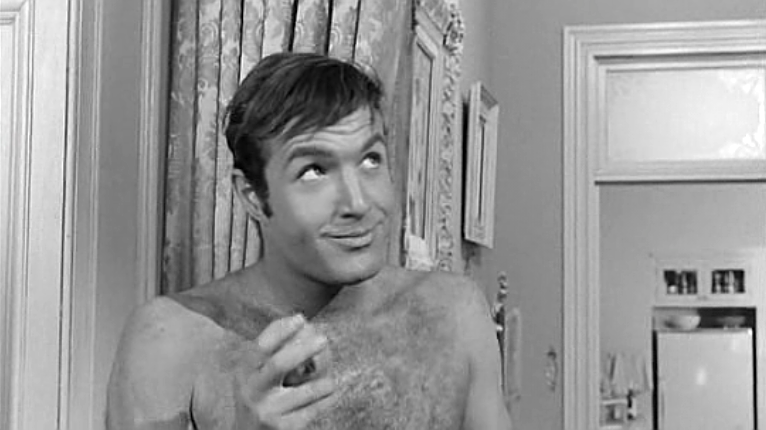
Caan, with his very ‘masculine’ hairy chest, was a much more subtle psychopath in Curtis Harrington’s psychological thriller Games 1967 where he gaslights the beautiful but emotionally delicate Katherine Ross with the help of sensual goddess Simone Signoret. BTW, I’ll be doing a special feature on the works of Curtis Harrington hopefully by the summer.

Randall even takes off on Marlon Brando’s Stanley Kowalski from Tennessee William’s A Streetcar Named Desire, as he belches, shirtless (most of the film), and leers and smirks in his outre tight jeans.
This evokes “I think I’m going to be sick” from the respectable Mrs. Hilyard who voices her scorn. Randall is in control and enjoys the power struggle, sadistically amused by her indignation and repulsion, “Watch the human being be sick in a cage.” He’s looking for any excuse to lash out.
Randall says [to George Brady the bum] “We’re gonna kill you. First you, then the pig (Sade)… and then, the human being!”
It is suggested that Randall also likes to beat up on his girlfriend Elaine, as she has a black eye. As I stated earlier, off camera while up in the master bathroom behind closed doors, it is implied that she actually vocalizes pleasure when he hits her. Elaine herself is an angry and hyper-sexual oddity, perhaps even a sociopath as well, as she moves her body provocatively, quite aware of her seductive maneuvering. She enjoys watching violent acts and she dances to a small music box in a very sexually inappropriate way. Obviously, she is wired to believe that sexuality and violence go together.
Olivia de Havilland as Mrs. Cornelia Hilyard is terrorized by James Caan as the violent Randall Simpson O’Connell and his gang of sociopathic miscreants.
de Havilland’s Cornelia Hilyard suffers from delusions toward the climax –that Randall is her son Malcolm. First when she faints after she speaks to Randall thinking he is Malcolm and then again when he reads the letter and uses the words ‘release’ – as the screen becomes all wavy, as she self-accuses that she is a ‘monster.’
de Havilland having taken the role after Joan Crawford turned down the part of Cornelia Hilyard, and then ironically stepping in a little later that year to fill Joan’s high heels in Hush Hush… Sweet Charlotte when personalities clashed on the set with Bette Davis and Robert Aldrich.
Walter Grauman (his first film obscure B cult classic- The Disembodied 1957, writing for television Peter Gunn, Matinee Theatre, Perry Mason, The New Breed, The Untouchables, Naked City, Twilight Zone (Miniature) Route 66, Burke’s Law, Kraft Suspense Theatre, Honey West, The Fugitive, The Streets of San Fransisco and Barnaby Jones- Directing tv movie horrors like Daughter of the Mind, The Man Who Cried Wolf, Crowhaven Farm, Paper Man, They Call it Murder and The Golden Gate Murders ’79, a terrific hard to find a film with David Janssen and Susannah York.
I just love Grauman’s realist style– it’s raw and captivating mise en scène and here he directs this very taut thriller, that somehow seems to elude a definitive genre category as it falls into place amongst the transgressive noir-hybrids of the 60s, its been linked with Grande Dame Guignol cinema, and it’s every bit a suspense crime drama but there is little written about it in any of my books on the THRILLER or NOIR film genres. Film historian Kim Newman points out that the sub-genre that was a popular psycho trend of the 1960s where “the aging actress as *monster* was inaugurated” by Aldrich’s Whatever Happened to Baby Jane? (1962)

It also showcases elements of the horror style rampant in the 60s and yet again, I’ve found it difficult to locate it in any index, and I’ve got a full library on that subject as you can imagine. The idea of home invasion and torture isn’t a subject that’s been missed this side of the 21st Century. It’s been a featured narrative on shows like Law and Order, Dexter, and Criminal Minds comes to mind.
Gregory A Waller writes in the introduction in American Horrors: Essays on the Modern American Horror Film- “The 60’s provided a number of noteworthy horror films -still disturbing oddities like What Ever Happened to Baby Jane? (1962), Lady in a Cage (1964), and The Haunting (1964) with its restrained ‘adult’ major studio, quasi-Victorian terror.”
The idea of the home being invaded in an era that was coming off of the industrial age of suburban comforts, ice maker refrigerators, frozen dinners, air conditioners, and appliances for an easier way to be a homemaker. the notion of this once safe, comfortable, and innocent lifestyle is thus shattered by the intrusion of a doomed and violent world out of control. Even more stunning is that the action happens in broad daylight.
Martin Rubin sums it up in his book Thrillers-Lady in a Cage “epitomizes modern day social decay through the predicament of a cut-off shut-in Olivia de Havilland terrorized by lowlifes and juvenile delinquents.”


The script was written by writer/producer Luther Davis The Hucksters 1047, B.F.’s Daughter 1948, Kismet 1965, Across 110th Street (1972, tv movies Daughter of the Mind 1969 with Ray Milland and Gene Tierney, The Old Man Who Cried Wolf 1970 with Edgar G. Robinson.
co-starring as Caan’s female sidekick is Jennifer Billingsly as Elaine, Rafael Campos is Essie (a very hard-working character actor in the sixties and seventies, I especially loved him as Little Emanuel with one leg shorter than the other in All in the Family), William Swan as Malcolm Hilyard, Scatman Crothers as the junkman’s assistant,
Lady in a Cage also includes Ann Sothern as the weary and wanton Sade, Jeff Corey as the derelict George L Brady/ who decries, “Repent, repent” the two outliers of society, taking advantage of Mrs. Hilyard’s predicament instead of helping her.
With art direction and production design by Hal Pereira who worked on such great Hitchcock thrillers as Rear Window ’54, Vertigo ’58, and Capote’s Breakfast at Tiffany’s ’61
The evocative soundtrack of beat jazz and experimental nuances by composer Paul Glass (Bunny Lake is Missing 1965, Five Desperate Women 1971 tv movie, To the Devil a Daughter 1976)
At times Glass underscores the world gone awry with sounds akin to the mechanism of social order having just snapped a spring, and becoming uncoiled and shorted out!
The opening credits are framed with the use of bar-like graphics symbolic of not only the literal plot entrapment but the atmosphere of being caged in as well. The linear graphics that interplay with the rolling list of credits remind me of the work of title designer Saul Bass.


Leon Barsha takes care of the tense editing. Barsha knows how to create claustrophobic chaos as he did with Joan Crawford in Sudden Fear 1952, Midnight Lace 1960, editing a few of the most outstanding episodes of The Twilight Zone– A Penny For Your Thoughts ’61, The Grave ’61 and Will the Real Martian Please Stand Up ’61.
Rudolph Sternad production designer/art director-died a year before the film was released. Just to mention a few of his credits-(Dead Reckoning 1947, Walk a Crooked Mile 1948, The Member of the Wedding 1952, High Noon 1952, The Wild One 1953, The Defiant Ones 1958, Inherit the Wind 1960, It’s a Mad Mad Mad Mad World 1963) Set designers were Sam Comer and Joseph Kish.
Cinematographer Lee Garmes has a list of credits, having started as a painter’s assistant and prop boy. He lensed some of the most beautifully visual films, The Garden of Allah 1927, Lilies of the Field 1930, Scarface 1932, Call Her Savage 1932, Strange Interlude 1932 then later uncredited for Gone With the Wind, Guest in the House 1944, and of course some of my favorite films, Nightmare Alley 1947, The Paradine Case 1947 and Portrait of Jennie 1948 onto noirs, Detective Story and The Captive City.
Garmes sets up certain shots that give the impression of a brutally grotesque modern masquerade fête of social misfits on a rampage in a woman-in-peril film.
With various close-ups on the players’ faces, in particular, de Havilland as she begins to lose it. Often the trio are framed at angles where they look over Mrs. Hilyard who appears like a trapped animal in a cage, as they taunt her from above. She seems smaller and helpless. de Havilland begins to lose her coiffed appearance as she devolves, her hair becomes unkempt and she is drenched in perspiration. It’s quite visually disturbing and graphically unnerving. As these good shockers often are as Grauman and Garmes use extreme close-ups of de Havilland’s mouth when she screams for help. The emphasized shots of the alarm bell ringing to no avail, reminds of the detail that cinematographer Ernest Haller paid toward elements of communication and non-escape (the myriad shots of the phone, the stairs) in Aldrich’s What Ever Happened To Baby Jane?


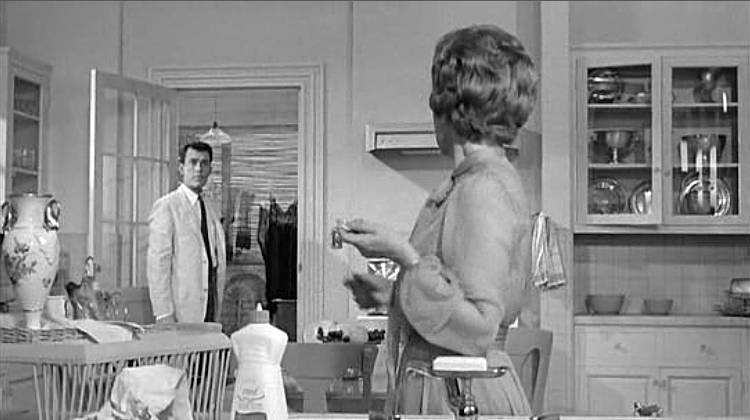


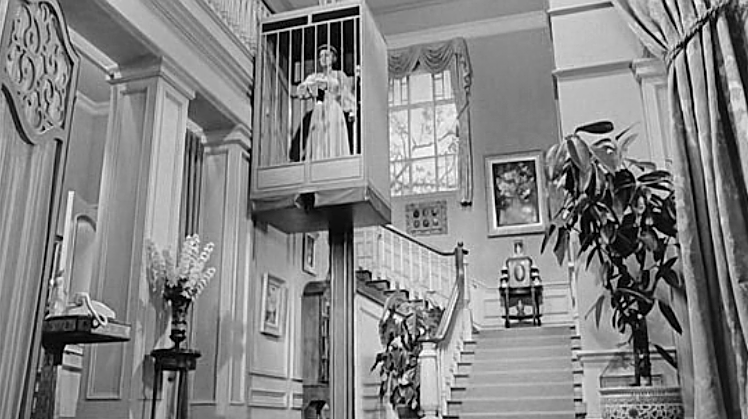


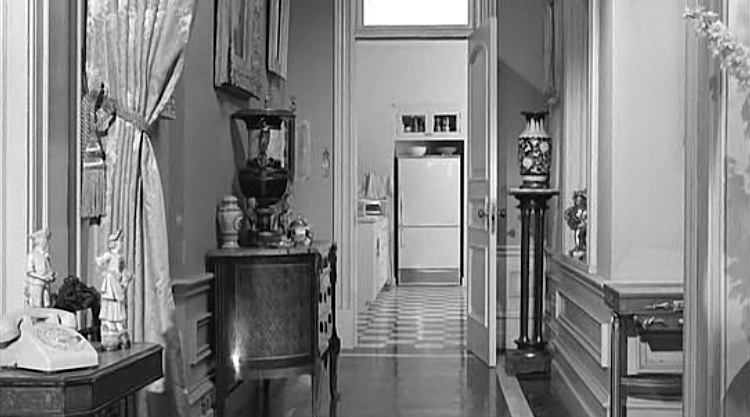
Lady in a Cage –Hal Pereira’s set is more modern, sterile, streamlined, inharmonious, and unwelcoming. There are many disturbing scenes with the subtle distinction of this hostility and inhumanity like the girl who runs her roller skates over the leg of an unconscious man, an evangelist spouting off about the evils of the world on the radio, a dog hit by a car that drivers keep passing by without stopping.
The date is the 4th of July, it is an extremely hot day, and people’s nerves are more sensitive and agitated during these heat waves which usually leads to more crime. There are exploding garbage cans in the street to mark the holiday.
Garmes focuses on Mrs. Hilyard through the bars of her cage and the reflections in the mirrored panel. We begin as voyeurs. Malcolm is writing his letter, addressing his mother as ‘darling.’ Perhaps a little undeveloped sub-text is to be discussed in a different kind of post. Considering that this one is in a series of ‘love notes’ he writes to her. “Darling” Hhmm???
It is made apparent though not explicitly, that Malcolm is in fact gay, and his mother’s domineering personality is at the source of his homosexuality, which is what films of the 60s & 70s would tend to illustrate.
de Havilland has a screen presence that is quite sophisticated and almost imposing with her sense of stylish intellect and decorum. This puts de Havilland’s Mrs. Hilyard in an interesting position on the graph of class struggle, as Randall and his gang aren’t just fighting amongst their own contemporaries, he is challenging an upper-class society lady and mother figure to attack back.
Ironically what sets off the sequence of actions that ensue is Malcolm whose car hits a ladder, that tears out wires that short out the power lines. He causes the accident that creates the electricity to go out leaving his mother stranded in her gilded prison. He is yet another character in the film who is distracted by his own agenda, self-absorbed carelessness, and indifference. Played out like a tragedy, it is at the chance moment when Malcolm causes the power outage that his mother wearing a sheer negligee gets into her elevated cage locking herself inside like a sitting canary. The ‘cage’ has a mirrored panel by the buttons, that allow for de Havilland/Mrs.Hilyard is to be seen from various angles and expressions.
With her in her gilded trap is a transistor radio, which is reporting about the uncovered murder victim, a woman who has been decapitated!
Mrs. Hilyard (Olivia de Havilland) is a poetess and a wealthy widow who lives in a stifling bourgeois mansion with her son Malcolm (William Swan) Cornelia, though she is never actually called by her first name, has had an elevator installed in her mansion after she breaks her hip. We see Malcolm writing a letter to his mother as he is about to go away for a weekend, leaving his mother all alone in the house. Malcolm appears to be stifled by his mother’s overbearing love, even to the point of her insisting that he drink his orange juice. As he leaves in his car, he backs into a ladder that nudges a wire that short circuits.
This subtle set of events triggering a negative chain reaction causing a power outage, only sparks the larger series of violent circumstances that begin to spiral out of control. Of course, Cornelia Hilyard is now trapped in her gilded cage of an elevator. She has an emergency alarm, which she uses while the electricity is out, but only one person is aroused by the alarm. A derelict wino named George L. Brady (Jeff Corey) hearing the alarm in the alley he ignores her cries for help, and instead helps himself to some of her things. Brady feigns muteness while he rummages around her things, as she is helpless to do anything about it. In desperation she tries to bargain with him to help her, “I will build a shrine to you.”


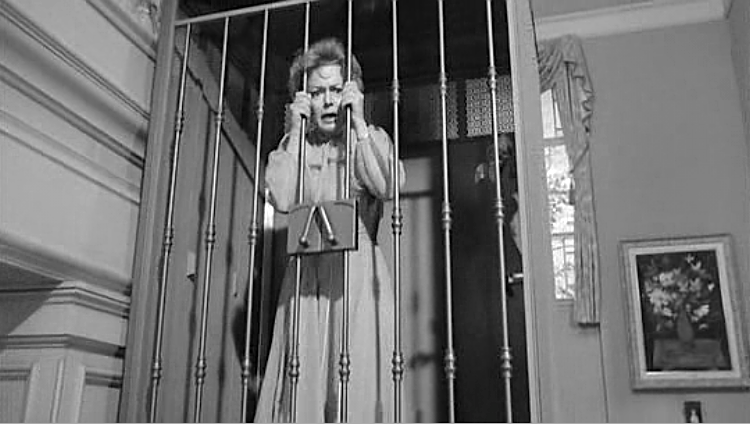


But Brady is only the first character who will prey on the weakness and vulnerability of Mrs. Hilyard. The ferocious and unsympathetic opportunism is a theme that will carry through the film’s storytelling. And none is likable and no one is safe from harm. While we might feel slightly ambivalent toward the poor souls who are down and out on their luck, or the proper and uptight Mrs Hilyard who is the central sufferer in the piece, the narrative doesn’t allow much time for us to feel compassion which only illustrates that the message of nihilism translates with an authentic sting. Mrs. Hilyard is every bit part of the testimony of elitist apathy and arrogance that comes along with a hypocritical and so-called civilized modern society.
The film begins to escalate with a real sense of urgency and a smothering atmosphere of dread. The derelict Brady fences the goods and then pays a visit to his slovenly dame Sade (Ann Sothern). This sets off yet another ripple in the threatening current that is building in the narrative.
Following Brady from the junk dealer to Sade’s apartment the vicious trio learns about Mrs Hilyard’s house. The savage bunch of hoodlums Randall, Elaine, and Essie hang back and wait for the right time to strike. The three lowlifes follow George and Sade to the mansion wearing stockings to obscure their identities, as they start ravaging the place. Eventually, they kill the old bum George L Brady who is in a way the second catalyst for the crime of invading and tormenting the trapped Mrs. Hilyard. Hypocritical too as he decries, ‘repent’ though he not only ignores her pleadings for help, he engages the mechanism of ill-fate-he must also be the first to be disposed of. And although we do not see any of the gory details when they stab him to death, the murder is still quite gruesome, as the force of violence still permeates the screen with Paul Glass’ use of music box nuance to create contrast between the two experiences.

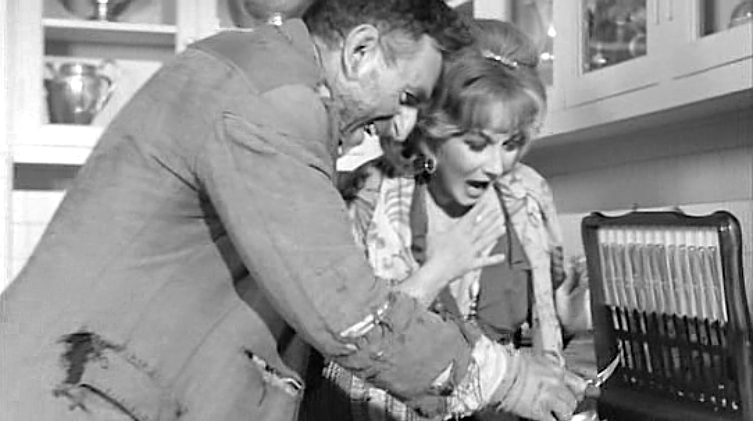


They lock Sade in the closet never to be heard from again–not before they rough her up a bit, pushing her into a mirrored dressing table, where she cuts herself. George Brady’s fate is much worse.
At this point, Randall sets his sights on Mrs.Hilyard who is trapped as the lady in said cage.
Mrs. Hilyard becomes less consequential at the moment the vicious trio arrives, as she is a symbol of the weakened society–the raw meat for the predatory wild animals, the more vulnerable of the modern jungle which will get picked off first. As Shelley so aptly notes, it’s very ‘Darwinian’ and the survival of the fittest. Mrs. Hilyard as much as refers to the city as a jungle.
Mrs. Hilyard-“I am a human being. A feeling, thinking, human being.”
Randall-mocking her- “Okay. I am *all* animal. Sure beats the hell outta being an inmate…”
Mrs. Hilyard ” … inmate?… Asylum?
Randall begins tormenting her, by playing head games. He shows her a note from her son Malcolm telling her he’s about to commit suicide because of her overbearing motherly love. “Release me from your generosity. Release me from your beauty. Release me from your love.”
The entire film’s universe is filled with deviant and transgressive characters. Sade is a self-hating woman who demeans herself because of her weight. Her ability to escape the chaos is hampered by her greed to take part in the looting of Mrs, Hilyard’s house. To add to the queasy touches, Sade wears a jeweled headband giving her an odd-ball air of eccentricity. She would again play a similar type of character as Thelma Lambert in Curtis Harrington’s The Killing Kind 1973-another mother who loves her son too well, he becomes a lady killer…
The pawnbroker Mr. Paul only has one eye. perhaps this is symbolic of a skewed vision of the world that surrounds him. He is also an opportunistic figure. Brady and Sade are afflicted with alcoholism.Â
As Peter Shelley says in Grande Dame Guignol Cinema the film is “A disturbing indictment of the amorality of 1964 American society, as well as a nightmare for those suffering from claustrophobia and vertigo, this film introduces Olivia de Havilland to the Grande Dame Guignol subgenre.”
Walter Grauman creates an atmosphere of deafening nihilism that is so harsh and brutal it is almost hard to watch it at times. An indictment of modernity, opportunism, and the industrial age, the use of sound with the car horns blaring in clusters of traffic, the sounds from the streets that invade Mrs. Hilyard’s closed-in world is exhausting. The film delivers a sense that all of life is a furious, insensitive rhythm of hostility and discord. There is no empathy toward the individual and people are merely anonymous faces making the strident and shrill noise and disturbing the quietude of civilized life.
What makes this a suspense/noir hybrid is the environment of entrapment and flawed characters, with Lee Garmes’ camera angles and Leon Barsha’s razor-sharp editing that keeps the pacing at an uncomfortable beat. Even the graphics that follow the credits representative of the bars of a cage symbolizing the narrative’s imprisonment. Cinematic bars were deftly used in What Ever Happened to Baby Jane? as Aldrich wanted us to feel at every turn the same sense of captivity that Blanche as well as Jane’s state of mind, and the landscape of the old Gothic mansion which felt like it was desolate and decaying.
And much like What Ever Happened to Baby Jane’s use of the outer world excursions Jane would take that would constantly throw light into the closed-in universe of Hudson’s mansion, Grauman and Garmes utilize shots of the ever-turning world outside Mrs. Hilyard’s captivity to emphasize this contrast visually reinforcing the horror that is taking place within the confines of the house that is shut off. We feel that every frame has a sense of intrusion.




The film was refused a cinema certificate in the UK by the BBFC and remained unavailable until 2000.
Reviews courtesy of Paul Shelley’s Grande Dame Guignol Cinema- The picture was released on July 8, 1964.

“Lady in a Cage adds Olivia de Havilland to the list of cinema actresses who would apparently rather be freaks than be forgotten … a grande chance to go ape. Attagirl, Ollie“- Time, June 19, 1964
“…{S}ordid, if suspenseful, exercise in aimless brutality… A discerning viewer is left curious and repelled… Olivia de Havilland as the trapped ‘Lady’ does project a sense of fear and self-appraisal … a surface, somewhat obvious portrayal.” -A. H. Weller, The New York Times, July 11, 1964
“…{A} noxious, repulsive, grueling experience… Davis’s sensationalistically vulgar screenplay is haphazardly constructed, full of holes, sometimes pretentious, and in bad taste. {de Havilland} gives one of those ranting, raving wild-eyed performances often thought of as Academy Award oriented. {She} does about as well as possible under the dire circumstances.” Variety May 25, 1964
 Right now I’m all *MonsterGirl* Hope you’ve enjoyed this post for The Great Villain Blogathon!
When the Spider Woman Looks: Two Glorias- “Wicked Love, Close ups & Old Jewels”- The sympathetically tragic villainesses of Sunset Blvd (1950) and Dracula’s Daughter (1936)

This is part of the Great Villain Blogathon hosted by Speakeasy* Shadows and Satin & *Silver Screenings from April 20th – 26th 2014
“All men dream, but not equally. Those who dream by night in the dusty recesses of their minds, wake in the day to find that it was vanity: but the dreamers of the day are dangerous men, for they may act on their dreams with open eyes, to make them possible.”– T.E. Lawrence
“You can’t depend on your eyes when your imagination is out of focus.”- Mark Twain
IT’S ALL IN THE EYES! -THE LEGACY OF GLORIA SWANSON/NORMA DESMOND & GLORIA HOLDEN/COUNTESS ZALESKA


Are these wicked women? Do they exemplify the monstrous feminine? I dare say NO! They are sensual yet tragic figures!

Gloria Holden’s Countess Zaleska is a victim of her bloodline (literally)–her father Dracula’s legacy, desperately seeking out redemption and’ release’ from the torture of her relentless desires. (lesbianism in the form of blood lust) And Gloria Swanson‘s enduring Norma Desmond an aging silent screen star pushed out by talkies-a victim of a punishing Hollywood institution that forces older women into self-delusion. Though her beauty did not fade, the praise and recognition have.
Both women are literally immortal!
Ironically without realizing the connection, there are two threads of synchronicity that revealed themselves after I decided to pair both Glorias. A) Both women have male servants who show a stoic undying co-dependent worship of their mistress and B) Hedda Hopper appears in both films…
“She gives you that weird feeling!” –tagline from Dracula’s Daughter
Two Glorias, two dynamic forces on screen- Written about endlessly, on the surface spider women, vamps and villainesses perhaps… but to the thoughtful observer and film fanatic like myself… they are sympathetic figures in a cruel world…
“Cast out this wicked dream that has seized my heart.”- subtitle from one of Gloria/Norma’s silent films.

First, let’s begin with our ‘close-up’- on Gloria Swanson as the eternally mesmerizing Norma Desmond in Billy Wilder’s masterpiece! Norma is in actuality the one trapped in an orbit of ambivalence about her own primacy which ultimately devolves into a vulnerable, needy, discontented, and brooding personality whose dependency upon men and (one opportunistic man in particular) is self-destructiveness turned outward.
SUNSET BOULEVARD 1950

Written and directed by auteur Billy Wilder (Double Indemnity 1944, The Lost Weekend 1945, Ace in the Hole 1951, Stalag 17 (1953), Witness for the Prosecution 1957, Some Like It Hot 1959, The Apartment 1960, which won BEST PICTURE that year, beating out ELMER GANTRY!).
Considered the last motion picture in the film noir canon. The first is Billy Wilder’s Double Indemnity 1944 with his notoriously sexified femme fatale Phyllis Dietrichson, who’s got a great pair of gams showcasing that diamond ankle bracelet, dark sunglasses, and Barbara Stanwyck’s cool exterior. And Wilder’s last noir, Sunset Boulevard, unofficially marked the end of classical noir’s heyday. Sunset Boulevard truly pushes the conventions of noir to its limits.
Written for the screen by Wilder and Charles Brackett (The Lost Weekend ’45, Edge of Doom, ’50, Niagara ’53).
Music by Franz Waxman (Magnificent Obsession ’35, The Invisible Ray ’36, A Day at the Races ’37, The Man Who Cried Wolf ’37, Gone With the Wind -uncredited, Humoresque ’46 I Married a Monster From Outer Space, Home Before Dark, there’s so much more– see IMDb profile).Waxman’s score is superb, from the exhilarating opening sequence that accompanies the flurry of police and newsreel camera trucks racing to the crime scene, the vibrant strings and strident horns that accentuate modernity, to the more subtle, poignant moments that underscore Norma’s internal agony.

John Seitz is responsible for the evocative and quirky noir-esque cinematography (Sullivan’s Travels ‘4I, Double Indemnity ’44, The Lost Weekend ’45).
The use of light in key frames showcases Gloria Swanson as Norma Desmond who exults whenever she is either watching herself or is thrust into sudden illumination rendering her as somehow lost. The use of shadows and oddly lit spaces evoke the sense of her tragic misconstruction of reality.
Bruce Crowther on- Cinematographer Seitz who helped to define some of the memorable images of Sunset Boulevard– “Rarely does full light intrude upon this movie… Seitz handles the often cluttered sets using lighting to direct the eye to each scene’s key areas. Even when light is used fully, as when Norma steps into the beam of her home movie projector or when a lighting technician at the studio turns the spotlight on her, it serves a dark purpose… Here it shows with appalling clarity the incipient madness that will eventually destroy Norma.”
Arthur P Schmidt, the film editor, died at age 52 (worked on Ace in the Hole and Some Like it Hot with Wilder).
Art direction by Hans Dreier and John Meehan, fabulous mise-en-scène by set designers Sam Comer & Ray Moyer who both worked on (Read Window 1954, Vertigo 1958, Breakfast at Tiffany’s 1961) Which arranges the landscape of Norma’s World with Art Deco style furnishing, elaborate candelabras, wrought iron scrolled staircases, tapestries, and ornate lighting fixtures. Norma’s bedroom is something out of a Gothic fairytale with its superfluous ruffles and claustrophobic pageantry.
Wilder and his artistic design team create an atmosphere of decadence and decay. Using an ornate baroque visual style that puts emphasis on the surroundings which are careful set pieces of time-worn opulence. The scenes are filled with a cluttered and suffocating mise-en-scène. Sunset Boulevard reveals the conflict of the old grandeur of the silent era with the hollow clamor of modernity, as a ‘clash of styles and eras.’
Once Joe walks in from the brightly lit Los Angeles hustle and bustle, the tone turns darker, as he steps inside the confines of the mansion, crowded with the serpentine wrought iron staircase, large yet dim light fixtures, and ancient-looking columns that appear to be disintegrating in small scattered parts. Set against the crispness of Max’s white gloves and Norma’s black sateen lounging pajamas, it offsets the sense of a perishing house oddly and creepily. Again, this is where noir meets horror by the elements combined in the visual style.
Most effectively is the central character of Norma Desmond whose electrifying intensity and melodramatic flare projects an other-world style in contrast with the biting and cynical, dispassionate humor of the younger screenwriter from the age of talkies.

According to Sam Kashner and Jennifer MacNair, many of the film’s props came from own Swanson’s home and scrapbooks. “One shot pans across the table covered with Swanson’s film stills, the photographs in old frames capturing her young face and heavily painted eyes.”
The portrait in Norma’s living room was painted by Geza Kende. Wilder also borrowed a film clip of “Norma” in her prime from a Swanson film Erich Von Stroheim directed, Queen Kelly 1929.
From Foster Hirsch’s The Dark Side of the Screen- he cites Amir Karimi in Toward a Definition of the American Film Noir as the true period of noir beginning with Wilder’s Double Indemnity and ending with the same directors Sunset Boulevard 1950. He goes on to say that Wilder’s noir drama’s contain “the biting social comment, the stinging disapproval of the American way” Sunset Boulevard “transfers noir psychology to a novel setting, the decaying mansion of a once-grand film star. Wilder’s portrait of the megalomaniacal Norma Desmond is etched in acid; she is the embodiment of Hollywood’s rotting foundations, its terminal narcissism, it’s isolation from reality.”
Norma’s sensational costumes were created by prolific designer Edith Head, who resurrected Swanson’s silent era look, the exotic and exaggerated costumes and fashions of an ex-screen Goddess, which point back toward Swanson’s past. She wears a hat, adorned with a peacock feather, in the scene where she is reunited with Cecil B. DeMille. This is a visual homage to a headdress she wore in Male and Female 1919 one of the first films in which she was directed in.
The silent movie queen Norma Talmadge is reported as “the obvious if the unacknowledged source of Norma Desmond, the grotesque, predatory silent movie queen” – Dave Kehr, “An independent woman, nobly suffering in silents”, New York Times, 11 March 2010.
Sunset Boulevard could not have been cast with anyone better than the dynamic and grande actress who in 1919 was signed to a contract by Cecil B. DeMille.With this, her comeback role, Gloria Swanson ignites the screen with her eponymous Norma Desmond -star of the silent screen -Norma Desmond, the tragic central satellite of the story, who herself is dreaming of a comeback. Swanson’s performance is as much transfixing as it is exquisite.


Swanson herself was a very hard-working actress in the 1910s and 1920s with Mack Sennett before joining Paramount Studios. She started her own production company in the mid-’20s but only made a few talkies in the 1930s. She made six silent films with Cecil B. DeMille.
As Leo Braudy says in his insightful book, The World in a Frame: What We See– Aesthetically, Swanson faces into the film as the fictional character Norma Desmond and faces outward toward us as the star. He calls her role a ‘meditation’ on her screen image and the relationship between the old world of silent films and the new world of 1950s Hollywood. He refers to the other actors who were her contemporaries playing themselves as ’embalmed’ with her in the past, losing their relevance to the audience and ultimately their power.
Billy Wilder’s film is, as James Naremore says in his book More Than Night- Film Noir in its Contents, an “iconoclastic satire” and “a savage critique of modernity.” Much like Aldrich’s The Big Knife, it is a condemnation of Hollywood in the cycle of films released in the 1950s. Also notable is The Bad and The Beautiful 1952. Naremore points out that these films coincided with the blacklist and the decline of studio-owned theater chains, marking the end of an era. Norma’s character is a casualty of changing times.

Co-starring as the ill-fated, gutless, ‘big dope’, unemployed screenwriter who becomes Norma’s gigolo is smooth and sexy William Holden as Joe Gillis. Erich Von Stroheim plays Norma’s devoted butler and ex-hubby Max Von Mayerling. Erich Von Stroheim who had directed Swanson in Queen Kelly ’29 is perfectly suited to play her servant/ex-husband/devotee.
The film also co-stars Nancy Olson (Union Station 1950) as Betty Schaefer, Fred Clark as Sheldrake, Lloyd Gough as Morino, Jack Webb as Artie Green, Franklyn Farnum as the undertaker, and special appearances as themselves, Cecil B. DeMille, Hedda Hopper, Buster Keaton, Anna Q Nilsson, H.B. Warner, and composers Ray Evans and Jay Livingston.
The film is a Gothic, poetic nightmare in noir that so often evinces a sympathetic lens toward the forgotten characters who engage the audience like apparitions of another time in Hollywood. The unorthodox narrative embraces a vividly unstable noir identity that dwells within the constructs of American life, pushing the limits of social and sexual convention to a dark place of obsession and excess. However, Wilder scripted this as a black comedy, the noir stylization that had by now run through its recurring patterns still manages to create the incessant mood of bleak cynicism and a distant vulgarity.
Bruce Crowthers Reflections in a Dark Mirror- “Of the other German emigres who worked in Hollywood the most significant contributor to the film noir is Billy Wilder, whose Ace in the Hole perhaps the most cynical movie ever to come out of Hollywood, Double Indemnity with its mesmerizing manipulative spider-woman and Sunset Blvd with its atmosphere of brooding baroque insanity are classics of the genre.”
“Wilder introduces a creepy atmosphere of eccentric ruin that’s strange and destroys lives, yet hypnotically alluring and seductive from a lost indulgent age.”– Alain Silver & James Ursini from The Encyclopedia of Film Noir-The Directors
Wilder wanted stark reality and realism to pierce the veil of illusion and fantasy that was the dream factory of Hollywood in the 1950s. He portrays a corrupt landscape of used-up people, conniving agents, writers hustling to get their scripts sold, and the loneliness and alienation that permeates a world of broken dreams and perpetual struggle. Andrew Dickos in Street With No Name calls Wilder’s noir films “visions are steeped in cruel and corrosive humor, distinctive in its own right and its ability to function apart from the noir universe.”

In this provocative masterpiece, Billy Wilder masterfully evokes a shudder in us, “by emphasizing its verisimilitude, though, Wilder reveals the hidden truths of the world’s cruelest company town- from the isolation of forgotten celebrities to the crass efficiency of producers. Not only a thrilling and strange piece of entertainment, the film also is an indictment of Hollywood.” –Kashner & MacNair
Louis B. Mayer, at a private screening of Sunset Boulevard, was furious with Wilder for his cruel portrayal of the industry that supported him. At the party before the various celebrities, he reproached him, “You have disgraced the industry that made and fed you! You should be tarred and feathered and run out of Hollywood!”Wilder kept the script hush-hush using the innocuous code title A Can of Beans. Wilder and Brackett feared that Hollywood would respond negatively to their damning portrayal of Hollywood.
He offers us the very typified archetypes of classical noir with his doomed anti-hero, the dangerous femme fatale, and the good girl redeemer. Also present are the familiar themes of entrapment, claustrophobia, instability, corruption, flawed character, psychological crime melodrama and even the police procedural with it’s thrilling opening sequence as the newsreel cameras and police cars, their sirens blaring, tear up the streets as they speed toward the murder scene.

Originally, Billy Wilder wanted the legendary & incomparably sexy and suggestive writer/actress Mae West to play Norma. West declined because she found the story to be ‘too dark’. She also didn’t want a film that portrayed the relationship between an older woman and a younger man that reflected itself as hideous. The two approached Greta Garbo, who also declined the offer. Wilder also approached Mary Pickford , who was appalled by the offer, and they had to apologize to her. It was George Cukor who suggested Gloria Swanson. Wilder asked Gloria Swanson to screen test for the part in 1949, and she almost said no. She had worked with Wilde, who had adapted the screenplay for her film Music in the Air 1934. Norma is a larger-than-life film character, though an exaggeration of reality, considering Swanson wasn’t ancient, she was only fifty at the time!
Wilder had contracted Montgomery Clift to play Joe Gillis. Clift left the picture, finding it too uncomfortably close to his own life, because of the younger man’s relationship- he allegedly had an affair with Libby Holman, a popular singer of the 20s whose career was ruined by the scandal surrounding the shooting death of her husband. Clift had spent time with Holman, who also lived in a sprawling mansion much like Norma’s. Wilder worried that the age difference between Swanson and Holden wasn’t big enough; Swanson was fifty, and Holden was thirty-one.Wilder hadn’t been impressed with some of Holden’s more mediocre films of the ’40s, even though he had starred in Rouben Mamoulian’s Golden Boy (1939) with co-star Barbara Stanwyck. Sunset Boulevard made William Holden’s career. While I find Joe Gillis to be a dismissive, smarmy ass who sort of had it coming to him, in this picture, I let it be known that I’m a huge fan of William Holden!- he did a superb job of playing it cagey, opportunistic, and sarcastic as hell.
Wilder mirrors Joe Gillis’ from his own start as a shaky Hollywood writer having moved from Germany to America after Hitler’s rise to power, He used to be a “˜taxi dancer’ who would dance with any unattached older women who were willing to pay for his services.
One of the most iconic scenes from Sunset Boulevard, aside from the film’s fever dream climax where Norma descends the grand staircase, plunging into her gathering madness, is the scene that illustrates the withering passage of a lost era. The three fading silent film stars play bridge in the parlor of Norma’s decaying Gothic mausoleum. During the scene with the old stars playing bridge, the collectors come and take Joe’s car away, the only passport to freedom he has.
“˜The wax works’ cracks-wise, struggling snarky screenwriter Joe Gillis, referring to Norma’s bridge party guests. Wilder envisioned this scene as purposefully macabre, or as Kashner and MacNair call it, “ghastly.” See figures gathered around the table, as the sequence unfolds, it is revealed that these actors are actually playing themselves. Silent screen actress Anna Q. Nilsson and H.B. Warner, who had played Christ in Cecil B. DeMille’s 1927 picture The King of Kings. And the Legendary actor of silent cinema, Buster Keaton, is there too. Kashner and MacNair describe his features ravaged by alcohol abuse.” Even Gloria Swanson as Norma Desmond in a way is paying tribute to herself by recalling the bridge game in the parlor scene-“Came close to giving us all the creeps.”

Like the bridge guests, DeMille plays himself with scenes shot on the real set of his 1949 motion picture Samson and Delilah. Erich Von Stroheim, himself a once great director, Wilder uses him poignantly as Max, who mourns his former life. Wilder touches on the fact that Stroheim in real life had a rough time with his career, often going over budget and ultimately making box office flops.
As I’ve pointed out here in this piece for The Great Villain Blogathon, I am using Norma Desmond to argue that she isn’t the psychotic spider woman or villainess that she’s been referred to and that the film neither makes fun of her, yet creates a sense of sympathetic apology to this grande dame mostly revealing her as quite a tragic figure. I neither see her as washed up nor grotesque, but a beautifully powerful woman possessed of intensity. She is the one who is ‘trapped’ in the web of an unforgiving culture that demonizes women for their sexual primacy. Norma is possessed of desire. The desire to still be adored. The desire to make a ‘return’ to motion pictures. The desire to be loved as a great star. The desire to be loved by Joe.
It’s Joe Gillis that is not a very likable guy, who is uncaring, weak, too shallow, and powerless. Let’s face it he’s a self-acknowledged heel. Ironically, sadly it is Norma’s story that is being told through this guy’s voice and perspective yet another way that her character is silenced, her personae distorted and perverted through the male gaze.
Once again Silver & Ward point out eloquently-
“Norma herself as portrayed by Gloria Swanson is a tragic figure. imbued by Wilder with powerful romantic presence… A woman obsessed, she clings to her vision with a tenacity that must ultimately be granted a grudging admiration and she is the only character in the film with the possible exception of Erich Von Stroheim’s fanatically loyal Max, who inspires genuine sympathy. Watching herself on screen in an old movie, she leaps into the projector’s murderous blast of light and cries, ‘They don’t make faces like that anymore!’ It is difficult for the viewer to favor Joe’s cynicism over her fervor, however misguided or self-centered it may be…”
THERE’S A MONSTROUS FEMALE IN OUR MIDST- SOME CHARACTERIZATIONS OF NORMA:
Coming to The Last Drive In
THE GREAT VILLAIN BLOGATHON- SUNSET BOULEVARD, DRACULA’S DAUGHTER & LADY IN A CAGE
When the Spider Woman Looks: Two Glorias-“Wicked Love, Close ups & Old Jewels”- The Sympathetically Tragic Villainesses of Sunset Blvd (1950) and Dracula’s Daughter (1936)
Walter Graumen puts Olivia de Havilland in peril as a Lady in a Cage (1964) ” Oh, dear lord… I am… a monster!”

OBSCURE SCREAM GEMS, THE UNKNOWN TERROR (1957)–NIGHT CALLER FROM OUTER SPACE (1965)–THE FLESH EATERS (1964) AND KRONOS (1957)

Don't attempt to adjust that dial, we have taken over your television set: The Transendental fancy of The Outer Limits 1963
THE BELLERO SHIELD–A FEASIBILITY STUDY–BEHOLD ECK–MAN WITH THE POWER–THE ARCHITECTS OF FEAR

Robert Siodmak's noir masterpiece The Killers (1946) The first 12 "˜Killer' minutes!

Shelley Winters: "˜Bloody Mama -The Voluptuous Diva of Cinematic Psycho Drama'

60’S CINEMA: Ship of Fools–In Cold Blood–They Shoot Horses Don’t They–Mother Joan of the Angels–Lolita–Blow Up–Psycho and– The Swimmer!

Continuing 150 Days of MonsterGirl’s Classic Horror

Quotes… Trailers AND…!!!!!!!!!!!!!!!!!!
MonsterGirl’s 500th anniversary post

THE HAUNTING- ‘There’s nothing to see…In the dark, in the night… Robert Wise’s enduring masterpiece!’

See you at the snack bar!
Quote of the Day! Blast of Silence (1961)
BLAST OF SILENCE 1961

“You were born with hate and anger built in… took a slap on the backside to blast out the scream… and then you knew you were alive!”
Directed by Allen Baron (who worked mostly in television, in particular, Kolchak: The Night Stalker “The Devil’s Platform”, “The Werewolf”, “The Ripper” and shows like Room 222, Barney Miller, and Charlie’s Angels)
This gritty and brutal noir stars Allen Baron as Frankie Bono a professional hitman who returns to New York City for a ‘job’ taking out someone in the mob. Trying to keep a low profile Bono is recognized by a childhood friend from the orphanage and a girl who he used to have feelings for. The contrast between the two extremes shines a drastically divergent light on Bono’s desolate existence. He begins to question his journey as killer. Pet rats and bleak shots photographed by Merrill S. Brody (Violent Women 1960, Terror in the City 1964, The Name of the Game tv series) make for a unique and darkly toned film.

This has been a blast from -Your Ever Lovin’ MonsterGirl
From The Vault: The Naked Edge 1961
THE NAKED EDGE 1961

“ONLY THE MAN WHO WROTE PSYCHO COULD JOLT YOU LIKE THIS”
Director Michael Anderson ( The House of the Arrow 1953, The Dam Busters 1955, Chase a Crooked Shadow 1958, Conduct Unbecoming 1975, Logan’s Run 1976, Dominique is Dead 1979 ) creates a wavelength of dark tension and monochromatic extremes in this atmospheric post noir suspense yarn.
Adapted for the screen by Joseph Stefano’s (The Outer Limits 60s & Psycho 1960) based on the novel by Max Ehrlich (The Reincarnation of Peter Proud, The Glass Web, various dramatic television series)
The Naked Edge opens as the credits roll in a manner similar to Saul Bass, we are dropped into a gruesome stabbing in the darkly lit office building, where George Radcliffe (Gary Cooper)is the key witness.
Sadly, This would be Gary Coopers last film, after battling cancer. The Naked Edge was released a month after his death, but was not received well at the box office.
After Mr. Evan Wrack (the marvelous Peter Cushing) grills the only witness to murder in court Gary Cooper in his last role plays American George Radcliffe whose testimony helps bring a guilty verdict for murder and theft of his co-worker Donald Heath (Ray MacAnally) who then gets sent to prison.
There’s a question as to whether Heath actually committed the crime???


Years later…
George’s wife Martha, the always enchanting Deborah Kerr begins to suspect her husband when various clues start pointing in his direction… Is she married to a cold blooded killer?
With a fantastic supporting cast, Peter Cushing, Michael Wilding, Eric Portman, Diane Cilento,Hermione Gingold, as Lilly Harris, Ronald Howard, Helen Cherry, Wilfrid Lawson and Diane Clare.
Dramatic musical score by William Alwyn (The Fallen Idol 1948, She Played with Fire 1957, I Accuse! 1958, A Night to Remember 1958, Burn Witch Burn 1962)
Most impressive is the offbeat cinematography by Erwin Hillier (The Mark of Cain 1947, The House of the Arrow 1953, Chase a Crooked Shadow 1958, and perhaps his best–the extraordinary Eye of the Devil 1966 again with Deborah Kerr, David Niven and Sharon Tate)
Hillier’s quirky angles and low lighting add an apprehensive atmosphere, and loads of key frames that are just beautifully shot as a refrain to the tension. Both Anderson & Hillier love to emphasize faces… it’s a touch that I love about their work together.


There are thousands of films in my collection… this has been one of them! Your ever lovin’ MonsterGirl
Saturday Afternoon: Men Doing Science Again….!!!
Four Sided Triangle (1953)

Based on the novel by William Temple and adapted to the screen and directed by Terence Fisher, this intriguing, thought provoking British sci-fi melodrama invokes the question of creation, playing god, obsession and fate.
Barbara Payton (Bad Blonde 1953) plays both Lena and Helen a beautiful women caught between two friends who have adored her since they were children. The brilliant Bill (Stephen Murray) invents a duplication machine, and has pined for Lena since he and Bill used to vie for her affections playing knights with wooden swords. But Lena has always been in love with Robin (John Van Eyssen) the other friend that make up the love triangle.
After succeeding in duplicating watches and rabbits Bill wants to try a human subject. One in particular! Tinges of Lang’s Metropolis...
When Lena and Robin get married, Bill asks Lena to allow him to reproduce her in his contraption so he can possess her too. And Lena agrees… the results are disastrous. Co-starring James Hayter as the sympathetic Dr. Harvey.


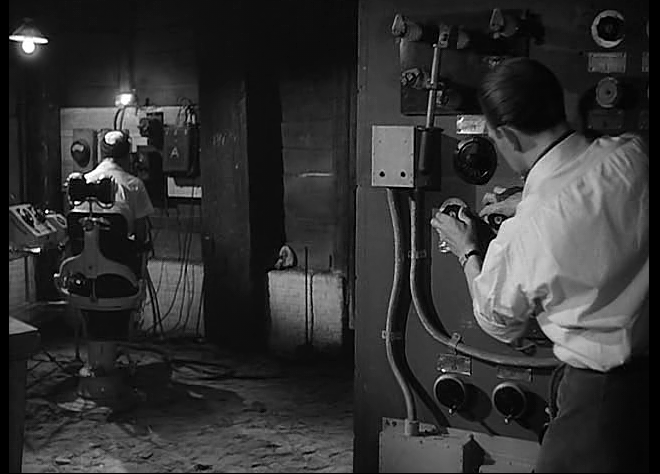

Frankenstein 70 (1958)

Karloff still possesses that lyrical majesty and does the best job he can with this slightly meandering 50’s schlocky script, directed by noir, cult, television drama and big box office–producer/director Howard W. Koch and written by Richard H Landau who scripted The Quartermass Experiment 1955, The Girl in the Black Stockings 1957
As always Karloff’s presence makes any film a joy to watch. He always took his acting seriously and it shows here, which makes this odd little modernity meets old mad science horror flick with some interesting set design and chilling moments worth watching.
Karloff plays the last of the line of Frankensteins who desperately needs money in order to continue his arcane experiments on the reanimation of the monster, he has hidden beneath the family crypt in the Castle. The monster is kept bandaged through out the film, (saves on make-up) and becomes a lumbering bandaged plaster of Paris block head with two hollow holes for eyes. Is it effective or defective… well, I focused on Boris Karloff most of the time.
Frankenstein is now using atomic energy to resurrect his ancestors creation (the lab is actually very groovy Strickfaden would approve), but needs a few more things, like an atomic reactor, brains, eyeballs etc.
Baron Von Frankenstein whose face is badly scarred from the Nazi’s who tortured when he refused to experiment on their victims, allows a film maker and his crew to shoot their low budget horror picture on the grounds, finds their presence an immortal intrusion but he is broke and must put up with the nuisance.
But– the aggressive and meddlesome bunch uncover Dr. Frankenstein’s secret laboratory and it just gets chaotic from there…
Rudolph Anders plays the Baron’s confidante Wilhelm Gottfried, and Norbert Schiller plays the very simple butler Shuter… poor poor Shuter…


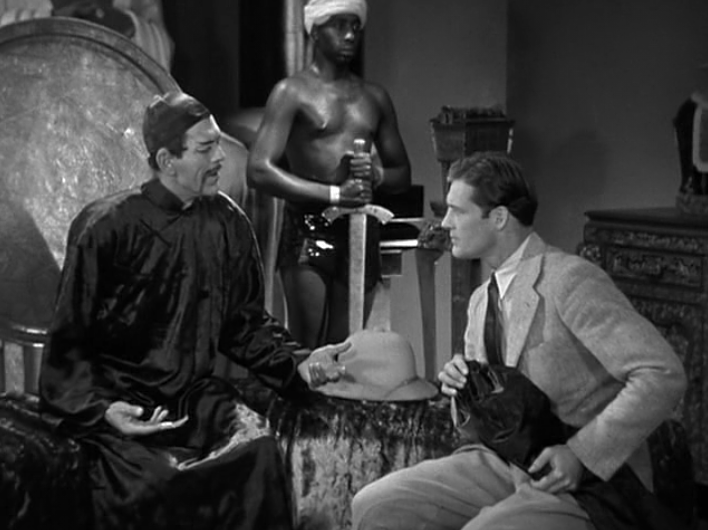
The Mask of Fu Manchu 1932

Directed by Charles Brabin and an uncredited Charles Vidor they offer this highly stylized horror/sci-fi-/fantasy hybrid from the 30s!
Boris Karloff is the diabolical genius Fu Manchu who only wishes to conquer the world with the help of his beautiful but equally nefarious daughter Fah Lo See played by the exquisite Myrna Loy.
Sir Nayland Smith of the British Secret Service played by Lewis Stone rushes to the Gobi Desert to find the mysterious mask and sword of Genghis Khan. He must get there before Fu Manchu possesses it’s power.
Fu Manchu kidnaps Sir Lionel Barton and tortures him in order to find out where the great treasures of Genghis Khan are buried in his lost tomb, but Barton refuses to tell…
Mean Sir Lionel’s daughter Sheila (Karen Morely) Sir Nayland Smith, Terrence Granville (Charles Starrett) and Von Berg (Jean Hersholt) set out to uncover the whereabouts of the relics before the evil menace can use them in his diabolical plan to conquer the world!
The Mask of Fu Manchu boasts the wonderful Kenneth Strickfaden designs!






Your Ever Lovin’ MonsterGirl!
From The Vault-My Name is Julia Ross (1945)
MY NAME IS JULIA ROSS (1945)

“She went to sleep as a secretary… and woke up a madman’s bride!”
“I don’t know what this is all about, but I promise you some very serious trouble unless you stop it immediately. You know perfectly well I’m Julia Ross.”
Directed by Joseph H. Lewis (The Mad Doctor of Market Street 1942, So Dark the Night 1946, Gun Crazy 1950, A Lady Without Passport 1950, The Big Combo 1955) Screenplay by Muriel Roy Bolton from the novel The Woman in Red by Anthony Gilbert. With a fabulous odd-angled, shadow-stricken spin by cinematographerBurnett Guffey, it’s no wonder this suspense thriller has the elements of a stylized psychological noir. Â


Nina Foch is Julia Ross, a young English girl seeking employment. She answers an ad at a fake employment agency run by none other than Anita Sharp-Bolster as Sparkes, who’s even more cantankerous in this role. Julia, saddened by the news that the guy she loves is marrying another girl, thinks she’s found the perfect job working for a wealthy widow Mrs. Hughes (Dame May Witty), whose son, the creepy Ralph (George Macready), lives with her.

George Macready is exceptional as a psychotic murderer who is prone to fits of violence. He has already killed his wife, stabbing her to death and throwing her body into the quiet sea.
Ralph Hughes– {Looking out at the ocean] “Beautiful, isn’t it? Would you like to listen to the sea and hear what it says? It doesn’t say anything, does it? That’s what I like about the sea. It never tells its secrets, and it has many – very many secrets.”
Ralph has a thing for knives, and Mommy Hughes has to keep taking sharp objects away from him and locking them away in a drawer. Dame May Witty is superb as his overprotective mother, who is willing to concoct an elaborate scheme and even kill in order to cover up her son’s murder.
Ralph Hughes- “It’s all Marion’s fault. She shouldn’t have cried.”
Mrs. Hughes- “Ralph, you never told me – was it an accident, or did you intend to kill her after she made her will?”
Ralph- “I didn’t plan it. I liked her well enough, but when she found out I’d been lying about my income, she accused me of marrying her for her money. I said of course that was what I’d married her for. Then she cried. She was always crying. Then she slapped me. I had my knife in my hand, and I…” [He begins slashing at the sofa cushion with his knife, slicing it over and over]
Mrs. Hughes- “Stop it, stop it!” (she tries to take the knife away)
Ralph- “Don’t do that!”
Mrs. Hughes- “Put that away! Ralph, I’m trying to help you.”
Ralph- “I still say we should have called the police and told them a prowler broke in and killed her.”
Mrs. Hughes- “With the marks of your fingers on her? The scratches on your face?”

Julia goes to live at the house, but once she’s there, Mrs. Hughes, Ralph, and Sparkes drug her tea and spirit her off to the ocean village of Cornwall.
They’ve burned her clothes, stopped any means of communication from getting through, put bars on her windows, and convinced the village that she’s out of her mind so no one believes her story about being held prisoner by these seemingly well-bred murderous grifters.
There, they gaslight Julia, telling her that she is the first Mrs. Marion Hughes who has had a nervous breakdown. They’ve even convinced Alice, the maid (Queenie Leonard), that she’s going mad and that she’s suicidal. Alice gossips around town, and soon after, everyone, even the police, the doctors, and the reverend and his wife, believe Hughes’ story. It seems like there’s no escape for Julia in sight. Along the path to doom, Ralph torments Julia with his menacing presence, and every attempt Julia makes to escape is thwarted.


They plan on making it look like she’s committed suicide so they can bury her as Mrs. Hughes since the real wife is lost at sea – and take her money.
After, it looks like Julia has taken an overdose of poison… Ralph –“Why try to save her? Let her die. That’s what we want.” Mrs. Hughes- ” Don’t be stupid, Ralph. If she’s taken poison, we must act as though we cared!”


This is a very taut little suspense yarn that keeps you on the edge up until the end. With some extraordinary camera work and a very simple tale of murder, mistaken identity, and mayhem!
Co-starring Ottola Nesmith as Mrs. Robinson, Joy Harrington as the resentfully sullen Bertha, Doris Lloyd is marvelous as Mrs. Mackie, Julia’s landlady, Roland Varno and as Julia’s love interest Dennis Bruce, Olaf Hytten as Reverend Lewis and Leonard Mudie as Peters.
