
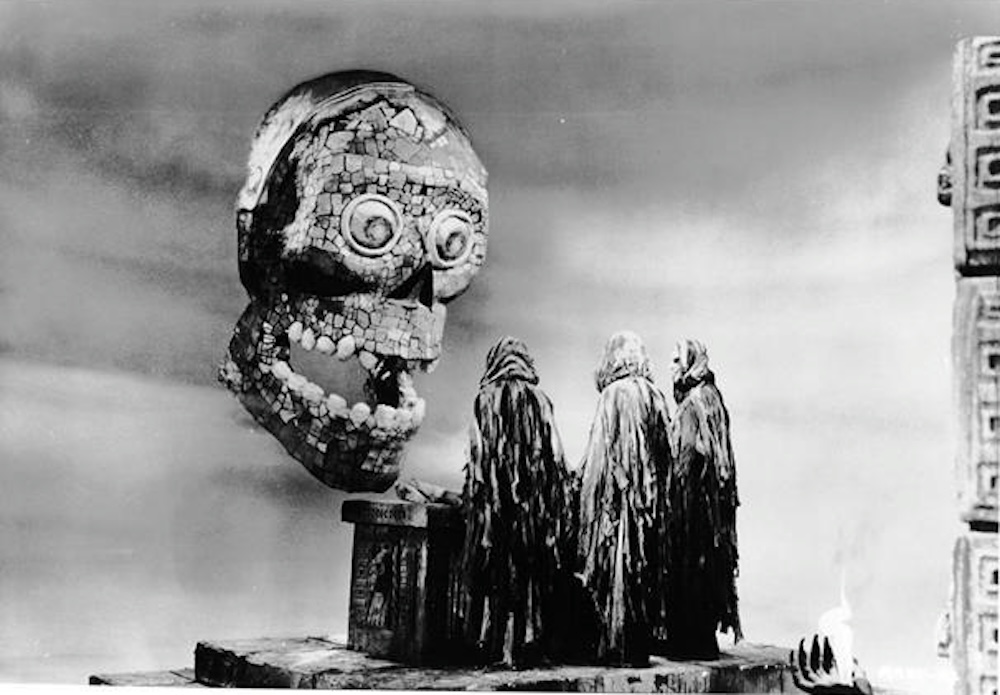
Put the Mask On…Now!: Glimpses into the Abyss: Descent and Desire, Depth and Despair – The Mask (1961)
“I MUST EXPERIENCE THE GREATEST ACT OF THE HUMAN MIND… TO TAKE ANOTHER LIFE”
A oneiric trippy experience, The ‘Mask’, which looks like a tribal bejeweled skull, enables the wearer to see his own psyche, much like the episode scripted by Donald S. Sanford adapted from a short story by Robert Bloch, The Cheaters television episode of Boris Karloff’s Thriller airing on December 27, 1960 in which the wearer donning these spectacles of revelation, the ‘unmasking glasses’ as it were, is given special insight into their true self, their soul. In both The Cheaters and The Mask, everyone who accepts the invitation to see more than they should eventually regrets what comes into view.
At its core, The Mask keeps one unsettling question alive: is Barnes possessed by a supernatural force, or is the mask merely giving shape to addiction, obsession, and the human capacity for violence that already exist within him and us?
The Mask follows a psychiatrist whose curiosity about an ancient tribal mask draws him into an increasingly violent, hallucinatory stream of consciousness. Dr. Allan Barnes is plunged into a succession of horrific visions—monstrous presences, occult ceremonies, and ritual torture. Convinced that the mask has given him access to the buried chambers of his own mind, he keeps returning to this psychic underworld, even though it draws out a latent violence in him that he can no longer safely contain, which spills over into his life, putting his fiancée Pam in grave danger.
There’s something about this film—a rare, exquisitely offbeat gem—that calls out to me for a deeper dive, the kind of exploration that goes beyond surface impressions and into the surreal corridors of its imagination. Like its mask that seems to reveal more with every viewing, it’s a cinematic artifact begging to be turned over in the light, each angle catching a new glint of meaning or madness, whichever you prefer. The film’s avant-garde visuals and daring use of metaphor are like secret passageways, each one leading further from the familiar and deeper into a world where logic is only a suggestion and atmosphere reigns supreme.
I can’t remember the first time I encountered The Mask 1961 as a kid, but I have never forgotten the disturbance it left behind. Its afterimage has endured (within my wanting hunger for unique horror narratives) as vividly as many of the horror films that shaped my early education in the genre throughout the sixties, or (seventies – which offered a whole other transformation to the genre, but that’s another essay entirely), and onward. I grew up on monsters and mad doctors, old dark houses and doomed Gothic lovers; on the formal elegance of Universal horror, the nocturnal shadows and moral unease of Val Lewton, the baroque, dream-soaked Gothic of sixties Italian horror either b&w or in vivid color that was painterly and sensual from Bava or Margheriti, the haunted poetry of Mexican horror cinema and the rougher B-picture pleasures of creatures, curses, and campy shocks from low budget auteur Corman, not to mention the Gothic pageantry of Hammer where the crimson blood ran like a river. Even when those films were strange, their strangeness usually had a recognizable shape. They led you through a world of threats that could be named, you could put a face to, and, at least temporarily, be contained.
The Mask seemed to come from somewhere else entirely. It did not simply unsettle the familiar order of horror; it appeared to abandon that order. There was no comforting rhythm of suspense and release, no dependable monster waiting at the end of the corridor or lurking in a cave (usually Carlsbad Caverns), no clear border between waking life and nightmare. Instead, the film opened a trapdoor beneath the conventions I thought I knew. Its images felt less like scenes than incursions, violent flashes from a private mythology that had no obligation to explain itself. Where the classic horror films of my childhood often gave fear a body, a face, a recognizable source of terror and a tangible threat- a shadowy old space or a castle to inhabit- The Mask made fear feel abstract, invasive, and oddly disturbingly intimate: something that could take possession not only of a character, but of your own imagination.
Maybe that’s why its impression has lasted. I may have forgotten the circumstances of that first viewing, but I remember the sensation: the feeling that a film could be more than a story about terror, that it could become a hostile, surreal dream you carried away with you.


In The Mask 1961, with its hypnotic, incantatory rhythm, demons leer from behind these veils of fog, writhing serpents coil around the sacrificial altars, ritual torture, and masked and scarred figures drift through the surreal landscapes that resemble the fevered sketches of a mad architect. The figures feel like a macabre Greek chorus, though they could just as easily be players from the theatre of the absurd: tattered, silent, and trapped in some haunted recurrence, a ritualistic loop. Everything seems staged at the edge of hell, where the mask turns the dream into a kind of sensory assault.
The mask, which is itself a paradox of reality and hallucination, concealment and revelation: the more it hides Barnes behind another face, the more ruthlessly it exposes what is buried within him, while bringing his inner darkness into brutal view.


The Mask and masks in general have remarkable staying power, showing how this seemingly simple object keeps taking on new meanings. Horror films don’t always treat them as just props or costumes: they are charged devices that connect ritual, power, identity or depersonalization, performance, liminality, and transformation. In horror, the mask never stays still for long and is one of the genre’s most enduring and flexible images.
Here, it asserts itself, and the film splits into another mode entirely, one that belongs less to classical narrative than to the history of avant-garde montage and experimental horror shorts. It can be described as a semi-experimental oddity, a sublime little effort or a weird, good movie covered up by a shoddy B-movie—a hybrid creature where surreal horror meets television procedural. Either way, it’s worth the 83-minute journey.


The film opens with an insidious, unsettling tone, with a William Castle-like gimmick: an authoritative narrator instructs us to “PUT THE MASK ON, NOW!” whenever the morally compromised Barnes does, turning its 3-D passages into a kind of participatory spectacle. It recalls Castle’s Illusion-O promotion for 13 Ghosts (1960), which supplied theatergoers with “Ghost Viewer” glasses that, depending on the filter used, either allowed them to see the ghosts or blot them out. As soon as you entered the theater for The Mask, audiences were issued cardboard masks with polarized lenses over the eyeholes.
If you saw The Mask when it first played in its original theatrical form, the 3-D images came at you through red-and-green glasses. With most later home-video releases and reproductions, that familiar effect was switched to red-and-blue or red-and-cyan glasses instead. The 2015 Kino Lorber Blu-ray lets you watch the nightmare sequences two ways: with simple red-and-cyan glasses in the old anaglyph style, or in the pristine full-blown stereoscopic 3-D experience if you’re lucky enough to have a compatible 3-D television.
If you’re like me and do not have a 3-D TV or a 3-D Blu-ray player, you can still watch the whole film on Kino Lorber’s disc in regular 2-D. You will see a 3-D option on the menu, but it will not work on standard equipment; that does not mean there is anything wrong with the disc. To see the film’s 3-D dream sequences in true stereoscopy, you’ll need the compatible equipment and, of course, the funky glasses.
There is an old-school alternative. The disc also includes the dream sequences in red-and-cyan anaglyph 3-D format, the kind that works with the familiar paper shades.
But… It is not the sleek, high-definition 3-D experience promised by modern equipment; the colors get a little strange. The screen looks like two slightly offset color images layered over each other; put on the glasses, and each eye picks up a different image, creating the illusion of depth, which can be rough around the edges, but the roughness can be part of the charm if that helps you accept the limitations. It will not be as clean or colorful as the stereoscopic version, and you may see a little blur around the edges, but when the film gives the command to “put the mask on, now!” skulls, hands, flames, and assorted phantoms will begin coming for you, reaching out from the screen in that wonderfully old-fashioned crude spirit of 1961. You are not watching a polished digital spectacle—you are answering a sixty-five-year-old invitation to let a delirious red-and-cyan nightmare invade your living room.
I learned this lesson the hard way after buying the Blu-ray of It Came from Outer Space 1953 which includes the option to watch it in glorious 3-D- and even purchasing my own red-and-cyan glasses- settling in for what I imagined would be the perfect Jack Arnold evening: a bowl of popcorn, my nifty paper glasses, vintage 3-D magic, and my favorite spot on the couch, with Archie and Tallulah purring approvingly at either side of me. Then came the cruel twist—not from outer space, not from the cyclopean aliens, but from my own television. Somewhere between the opening main menu and my mounting anticipation, I discovered that the disc required an actual 3-D-capable TV. My charming cardboard specs were ready. The popcorn was properly salted. Even my nostalgia had shown up early. Archie and Tallulah were more than ready, and so were the cyclopean visitors from outer space. My television, however, was having none of it and drew the line at 3-D. So the full experience was thwarted right there and then.
In the early 1980s, a restored stereoscopic version of The Eyes of Hell was made available for television broadcasts during the brief 3-D revival, paired with the Three Stooges shorts Spooks (1953) and Pardon My Backfire (1953).
Putting Castle’s ballyhoo aside, there is something darker going on here in Roffman’s film. Barnes keeps putting on the mask even after he recognizes its danger – he’s a psychiatrist, for Pete’s sake; he knows the risks – but he allows its hold over him to deepen, and we’re repeatedly invited to join him.
The mask’s real power is that it draws out the wearer’s darkest impulses out of the shadows. It has a way of dragging up whatever the wearer has buried, turning them inside out, giving shape and appetite to the impulses they have kept hidden. What it unleashes is not an outside evil, so much as a forbidden piece, the darkest material of the self, until desire, terror, and violence aren’t private anymore.


The Mask also finds a distant cousin in Hellraiser’s Lament Configuration, the puzzle box from the original release in 1987. There is a real and fruitful vein connecting the two films. Both are objects you are tempted to touch again, even after you understand that they will not leave you unchanged. Both are seductive objects that promise an experience beyond ordinary life, only to expose the person who reaches for them to a destructive form of desire. In Hellraiser, the hunger is for sensation beyond all ordinary limits; in The Mask, it is for a release from the self that ends by swallowing the self whole.
The difference is that Hellraiser makes that hunger explicitly erotic and bodily; the puzzle box turns desire into a doorway, and sensuality takes on the exquisite, punishing shape of pain: the box calls to people seeking sensation beyond conventional pleasure, and the hellish Cenobites dissolve the distinction between ecstasy and agony.
Both objects invite their bearer toward an experience that seems to promise revelation, liberation, or some forbidden intensity. Yet what they offer is never simple pleasure: Hellraiser’s puzzle box is a doorway to excess, turning desire into an ordeal of pain and ecstasy. The mask in The Mask, by contrast, opens onto a mind already becoming unable to resist itself. Its appetite is less sexual than psychological; it offers Barnes release, power, and a forbidden encounter with the hidden self, only to turn that encounter into compulsion and his craving for curiosity and release into a progressive undoing of the self.
The Mask is not just a story, but a living, breathing riddle, one that rewards our curiosity with bursts of inspiration and moments of genuine eye-popping awe.


It’s a film that doesn’t just want to be watched; it wants to be unraveled, revisited, and experienced with the kind of open-minded enthusiasm that will feel familiar to anyone who is a true film lover, especially someone who is drawn to the offbeat and the obscure.
Julian Roffman’s film (shot in Toronto on a shoestring budget and released in 1961, later retitled Eyes of Hell) announces itself, from its first frames, as a film with divided loyalties: perhaps part exploitation hook, part sincere attempt at a modernist horror trance. Whatever the intention, for me the latter takes over. This avant-garde Canadian horror film is less a narrative than a haunted mirror or mirage, its story flickering on the edge of consciousness like a fever dream glimpsed through a veil of celluloid dry-ice and brain fog.


Peter Falk in Roffman’s The Bloody Brood 1959
Roffman produced and directed The Bloody Brood (1959): a gruesome, gritty crime drama centered on a gang of psychotic beatniks, dope dealers, and subculture that explores the dark side of existential malaise and criminality in late-1950s urban life. In one of the more disturbing scenes, Nico (Peter Falk) and Francis trick a young delivery boy into eating a hamburger laced with ground-up glass, just so they can watch him die. The killing launches the investigation by the victim’s brother, Cliff. Before Columbo made Peter Falk’s rumpled raincoat and underestimated manner a source of comfort, his early work showed how chillingly well he could play masculinity gone rancid: from the beatnik poisoner Nico in The Bloody Brood (1959), to the rabid hit man Abe “Kid Twist” Reles in Murder, Inc. (1960), released in the U.S. on June 28, 1960, about a year after The Bloody Brood, to the false revivalist and woman-killer Robert Evans in The Alfred Hitchcock Hour’s episode titled “Bonfire” (1962), Falk is extraordinary at turning male bravado into something frantic, needy, and faintly apocalyptic. Link to post below:
Julian Roffman also produced The Pyx with Karen Black. The Pyx is a Montreal-set occult horror thriller about a detective investigating the death of a heroin-addicted prostitute and uncovering a Satanic conspiracy.
The Mask is generally hailed as Canada’s first feature-length horror film and one of its strangest early entries.
Roffman had worked as a producer-director with the National Film Board and was trying to create a viable independent commercial Canadian horror film with an eye on both domestic and U.S. markets; it was designed to capitalize on the American horror boom and receive wide international distribution and the first Canadian 3-D feature
became the first Canadian feature to receive relatively wide U.S. distribution, which is why Warner Bros. handled the 3-D release and why the film came with its built-in gimmick: audiences were given cardboard 3-D glasses or Magic Mystic Masks and instructed, along with Barnes, to “Put the mask on… now!” whenever the off-screen voice intoned that immortal command. Only the hallucination sequences are in 3-D. Warner promoted it as a sensational, melodramatic, high-energy spectacle with a blood-and-thunder advertising campaign: “Management is not responsible for nervous breakdowns!”
Julian Roffman and his backers could not afford to shoot the entire film in stereoscopic 3-D, so it is structured around three psychotronic descents into a visual abyss, each one framed by a return to more conventional scenes.
The script, credited to Franklin Delessert, Sandy Haver, and Frank Taubes, moves through the straight scenes with a procedural rhythm: a noir, low-lit world of cops at the scene, psychiatrists in their offices, modest apartments, and the concerned innocent heroine. Everything clipped and functional, as if this could be any low-budget crime thriller of the early sixties.
If you wanted to, you could seize on that structure as the film’s central oddness and its chief strength: the wraparound storyline may sometimes feel like a mediocre frame around three experimental shorts, but those shorts are so distinctive that they give the whole film a lingering aftertaste of genuine strangeness.


Pioneering Hollywood montage artist Slavko Vorkapich was involved in the early conceptual phase of The Mask (1961), specifically for its original surreal dream sequences, which were ultimately pared back because of their elaborate, costly effects.
Vorkapich, who co-directed with Robert Florey the avant-garde short The Life and Death of a Hollywood Extra (1928) and later devised the montage sequences in Frank Capra’s Mr. Smith Goes to Washington (1939), brought a modernist visual intelligence to Hollywood, with a remarkable gift for making images rush, collide, and dissolve into one another. He had a grasp of the language of movement, montage, and inner turmoil, which made it a subjective visual force; he could take something inward, like panic, desire, memory, or a sudden loss of control, and make it visible on screen.
His montage work became so recognizable that scripts sometimes simply called for “a Vorkapich”; he used rapid kinetic editing, optical effects, superimposition, and camera movement to compress time and turn inner experience into image, and Hollywood screenwriters and studio personnel used a “Vorkapich” as shorthand for the sort of dynamic montage sequence he had made famous. ( source: Jan-Christopher Horak, “An Historical Examination of the Film Theories and Avant-Garde Practice of Slavko Vorkapich”)
The legendary Vorkapich instilled in the film its uncanny visual rhythm, its delirious tableaux, its surreal dream logic, its jolting sense of movement, and its feeling that we are watching a mind come undone.
However, while he is credited for his contributions, his actual designs and plans were ultimately not used in the finished film. Vorkapich’s ideas, ambitious, elaborate, and expensive, were deemed impractical for the film’s modest budget and production timeline. Some of his proposed concepts included tanks of black ink, thousands of frogs, and large numbers of mice, which proved too costly and complex to realize, leaving the finished scenes to be adapted by Roffman and the effects team.
Vorkapich’s influence is still felt in the film’s dynamic, allegorical montage and surreal visual language, but the actual designs and execution were the work of other artists, with director Julian Roffman and his team adapting and simplifying the original vision. As a result, the final dream sequences created by the collaborative team of technicians, including storyboard artist Hugo Wuetrich, still drew inspiration from Vorkapich’s style while working within the film’s constraints.
Once the 3-D sequences begin—supervised by Charles Smith through Raymond Spottiswoode’s Depth Dimension process—they explode that confinement, literally blowing open the film’s constricted, narrow black-and-white reality into a nightmare that is more layered, more aggressive, and gloriously in-your-face, reaching for the lens. Skulls, hands, fireballs, and faceless ritualistic figures lunge toward the screen; gnarled trees, steps, and arches fall away into impossible depths; fog and smoke coil across the foreground while sacrificial altars loom somewhere beyond them.
These passages are not simply showing us what the doomed Barnes sees in a literal sense; they announce themselves as pure cinema, as Roffman and the echo of Vorkapich build visual collisions of sex, death, symbolic compulsion, and ritual power that don’t need dialogue to be open enough for us to interpret.


Though unrealized, you can still feel Vorkapich’s presence in the way the dream sequences are cut: quick flashes of objects and bodies, rhythmically put together, the movement building on one another until they gather into a kind of visual crescendo. The momentum doesn’t flow from a character’s psychology in a traditional sense, but from one image sparking the next and each new vision pushing the nightmare further.
That is what he brings to The Mask: not just a barrage of strange images, but the unnerving sensation of being pulled through someone else’s unraveling. I find that incredibly disorienting: we are inside it, not outside it. The real trick of Vorkapich’s original vision, as realized by Roffman and his creative team, is that it refuses to leave us on the sidelines of Barnes’s breakdown. It draws us so far into the panic that the images stop feeling like things we are merely watching, and it becomes an aesthetic immersion without identification.
The film makes us submit to the texture and pressure of Barnes’s nightmare, even if we don’t like the man or feel any empathy for him at all. We don’t stand safely outside Barnes’s collapse and just watch it happen. Subjective editing shapes our experience through weird pacing, nightmarish imagery, and visual disorientation; Vorkapich’s original designs, carried forward and expanded by Roffman and the rest of the production, pull us uncomfortably close, so far inside Barnes’s panic that the film begins to make us feel the speed of the confusion and the private terror of a mind losing touch with reality, and it does this without relying on us to share his chaos with him. Yet, it all happens at us.
The same sort of experience can be said of Roman Polanski’s Repulsion 1965, where the apartment and its sounds become increasingly disorienting as it takes on Carol’s (Catherine Deneuve’s) unstable perspective, so her fear feels less observed than shared; we are kind of trapped within her narrowing reality. I could say the same of Darren Aronofsky’s Black Swan 2010, though I wasn’t a fan at the time , and probably ought to revisit it. Its use of mirrors, doubles, bodily distortions, and frantic close-ups puts you right inside Nina’s spiraling perception rather than letting us see it from a safe, reassuring distance. It is a subjective strategy that these later films, Repulsion and Black Swan, used to devastating effect: rather than showing us a character’s fracture from the outside, they lock us inside it.
Much of the film’s unnerving visual pull comes from the work of cinematographer Herbert S. Alpert; his contribution is best defined by the film’s eerie black-and-white photography that helps give both the ordinary scenes and the visual nightmares their uneasy texture. The live-action sections are relatively conventional, but his work on the dream sequences, along with the film’s visual-effects team, gives The Mask its uncanny, hallucinatory quality. Beyond this film, his screen work appears limited, with only a few other cinematography credits, including A Dangerous Age (1957), A Cool Sound from Hell (1959), The Hired Gun (1961), and Harry and the Hookers (1970), which shounds like a grindhouse title that promises chaos, and then mostly delivers a gloomy, shaggy shrug with a detective Harry Clegg, played by Gilbert Wynne in the middle of it. This exploitation film enjoyed a limited release in the U.S in 1973.
Herbert Alpert’s black-and-white cinematography supplies the connective tissue between those hellscape worlds. In the “flat” reality, the images have the unvarnished, slightly grainy look of low-budget horror from that era, the sort of visual grit people often compare to Night of the Living Dead 1968—even though Romero’s film would arrive a few years later, and even in that film’s modest interiors and exteriors, it is far more assured in both atmosphere and execution.


The white-faced figure staggering through Barnes’s nightmare seems to prefigure Romero’s ghouls in Night of the Living Dead: seven years before Romero’s 1968 film gave the lumbering undead their enduring modern form, The Mask was already turning a slow, unsteady human body into something uncanny, emptied-out, and frighteningly close to death.
Here the interiors are modest—police stations, Barnes’s office, Radin’s cramped apartment, Pam’s bright apartment space and Alpert tends to frame Barnes in ways that suggest narrowness: doorways that cut the frame, office walls closing in around him, shadows that skate across his face as if an inner darkness is waiting to push through.
Alpert and the special effects team conjure these sequences with a tactile, handmade quality. Within the hallucinatory scenes, they emphasize psychedelic, nightmare imagery. Grasping hands reach from impossible angles, and the screen itself seems to ripple like the surface of a disturbed pond. The imagery is both primitive and sophisticated, a primal scream filtered through the lens of modernist abstraction. Shooting flames, women’s faces turn into skulls, eyeball trauma, hissing serpents, shamans. Disfigured faces, cowled figures. A giant floating mask. Choking fog. A faceless man as white as Ivory soap, and underworld human sacrifice.
James B. Gordon contributed the special photographic effects; Herman Townsley and Dick Williams worked on the practical effects; David R. Ballou was credited as art director and Hugo Wuethrich served as associate art director.
Accounts of the production describe sets built on wheels for fast reconfiguration—almost Romanesque altars, vaulted arches, and all of it fog-shrouded ritual spaces. The mask’s world is a kind of assembled nightmare: pagan rituals, hooded cultists, a sacrifice whose masked face becomes a skull, and other monstrous figures. A far darker tableau than Cocteau’s Beauty and the Beast 1946, whose realm of living statues, smoke, and fog breathes a dreamy, whimsical atmosphere.


The imagery openly courts psychoanalytic reading—the eruption of sadistic desire in the respectable analyst, the fusion of eros (life instinct, love, sexuality, creation, connection) and thanatos (death instinct, aggression, destruction, self-dissolution)—but it also plays like a pop-surrealist grab bag, a collision of EC Comics panels from publications like Creepy, Eerie, and Weird Tales, Cocteau-style dream logic, and carnival-ride 3-D thrills.
While I haven’t found a specific makeup credit for the film, the visual effects seem to come instead from a broader collaboration of the art direction, optical design, cinematography, and montage work. The mask’s eerie appearance and the surreal hallucination sequences are part of what gives the film its unsettling visual impact.
The film’s nightmare procession in The Mask brings to mind, though unexpectedly, The Omega Man 1971, the adaptation of Richard Matheson’s novel I Am Legend. I am not suggesting a direct line between the two films so much as an eerie visual kinship.
In Boris Sagal’s film, the monastic figures have the uncanny look of the vampire-like mutants in The Omega Man, where bodily ruin, plague, contagion, heresy, quasi-religious ritual, fanaticism, and cult-like assault bleed into one another. They have merged into a single unnerving vision of the end of humanity.
I see a connection in the way each turns infection into a kind of heretical faith. Together, they imagine a kind of post-human congregation, gathered in ceremonial menace. That’s where The Mask becomes even stranger.
The phantoms may resemble the “Family”; the same kind of dread in pale, nocturnal cultish antagonists of The Omega Man, as with both films they imagine a shared apocalyptic image not in costume but of the eerie post-human decay and in the way they gather through the same blend of deviant ritual and bodily ruin.


What separates The Mask is that its infection is psychic, not bodily. The Mask’s apocalypse occurs inside Barnes’s head, not in the outside world. The phantoms in The Mask are decayed, and somehow no longer fully human. They aren’t figments of disease; they do not rise up from an infection of the body or physical contagion, of course; they seem to come from a different kind of sickness – but from something equally diseased: an imagination that has become infected from within. Here, the destruction they embody is inward – an inner world in which nightmare spreads, multiplies, and finally takes control.
The Mask does not show a world ruined by plague; it draws us into a self-realized ruin of the mind and soul.
In Ken Russell’s Altered States (1980), probably the closest major comparison: a man’s altered consciousness erupts into a primal, cosmic, aggressive, hallucinatory visual experience. Like The Mask, it makes inner transformation feel psychic and hard to contain. In The Cell (2000), directed by Tarsem Singh, it’s a plunge into another person’s psychic landscape that has the same sense of ornate nightmare pageantry—ritualized bodies, surreal tableaux, and images that operate more by emotional force than literal explanation.
The Mask is a bit of drugged b&w delirium, a hallucinatory chiaroscuro; ordinary reality has given way to private nightmare, sheer phantasmagoric density; it feels spiritually closed off: a hostile procession of grotesque forms and a universe that seems to run on its own morbid, dreamlike logic.
Louis Applebaum’s unsettling score for The Mask is really less memorable as background music than as part of the film’s hallucinatory machinery. In the dream passages, the sound turns starkly experimental, with electronic textures, squelching tones, watery drops, rapid figures, and ominous low rumbles, so the score feels like the mask has infected the soundtrack itself.
Applebaum was born in Toronto in 1918, studied in Toronto and New York, and by the mid-century had become one of Canada’s most prolific composers, writing roughly 250 scores for the National Film Board and serving as its music director. He also became the first music director of the Stratford Festival, where he spent decades shaping the musical life of the stage. (source TIFF Canadian Film Encyclopedia biography)
Having already spent years shaping Canadian film and theater, this background gave him a rare command of atmosphere, and in The Mask that command gives it its most uncanny dimension: replacing ordinary suspense cues with electronic shivers, drips, and eruptions of sound that seem to emanate from the psyche rather than the orchestra pit. In the dream sequences, the music becomes a kind of sonic possession, a fevered texture that deepens the film’s atmosphere of ritual, confrontation, delirium, and psychic collapse.
The electronic score pulses like a second bloodstream beneath the film, cold, restless, and clinically hypnotic; a sonic drug. It does not merely underscore the images, but seems to animate them from within, as if it’s a nightmare being composed in real time.
From the sound infecting the film to the mask infecting Barnes, the idea of possession runs straight through the movie. With that in mind, if you track Dr. Barnes (Paul Stevens)’s journey across the film, what emerges is less that he is simply cursed than that he’s been stricken with a habit: each trip to the mask leaves him more corrupted and under its control. It’s not an arc of possession in The Exorcist sense; it’s more a gradual shift in his loyalties, as the mask’s magic increasingly shapes how he thinks, feels, and acts—a slow reorientation of allegiance to the mask itself.
At the outset, he is a rational authority figure, someone both Radin, the first victim of the mask, and the police treat as a stabilizing force. With each return to the mask, that authority erodes. He neglects his practice, lashes out at his fiancée Pam (Claudette Nevins), seduces and tries to strangle Miss Goodrich, and seems to seek out the mask as much as it seeks him.


Seen through that lens, Barnes’s arc reads like addiction—curiosity turning into craving, and craving into compulsion.
A Taste for the Abyss: The Addictive Logic of the Mask
“I tried to stop, I can’t, I don’t want to!
The hallucinations, meanwhile, grow more violent and more centered on him: he is not just witnessing sacrificial scenes; he becomes the threatening figure. Rudi Linschoten appears in the film’s 3-D nightmare sequences as a figure associated with Barnes’s alter ego. Barnes becomes the one whose desire to see what’s on the other side licenses him to do harm.
That doubling—Barnes as healer in the ordinary world, and as a figure implicated in the mask’s ritual violence- makes the film feel morally queasier than a simple cursed-object tale.
As the ambiguity progresses, you can see how the mask seems less an external demon than a device that strips away the analyst’s professional veneer, revealing appetites that the surrounding culture would prefer to keep buried.
All of this—the imagery, the score, Barnes’s unraveling—starts to look less like a simple cursed-object story and more like a film about addiction.
As I view it this way, The Mask is less a simple horror film than a story about giving in over and over again —a study of compulsive surrender. The object promises release, exaggeration, and power, yet each encounter leaves you or the self more worn out, more divided, and more dependent on the very force that erodes it.
In that sense, the mask functions like a habit made visible – a glittering outer shell that hides a deeper surrender, pleasurable at first and devastating by the end.
The mask offers power, release, and a kind of rush, but every time Barnes returns to it, he seems a little more split apart and a little more under its control. In that sense, the mask is just like addiction: more tempting at first, then consuming, and finally destructive.
So I could be onto something: The Mask can be read as an allegory of addiction in disguise. Barnes does not simply encounter the mask; after he keeps returning to it, that repeated surrender makes the object feel like addiction itself — seductive at first, then corrosive, and then impossible to ignore, turning desire into a trap. The mask offers ecstasy and transformation, but its true effect is to hollow out the person wearing it and make compulsion itself look like freedom.
On a more intimate level, it can be seen as a story of losing control, and of a self hollowed out by the object it cannot stop returning to. Barnes is drawn back to the object again and again, knowing it is dangerous but unable to resist it. What begins as curiosity turns into craving, and the mask starts to feel less like a cursed relic than a habit that takes over his mind, distorts his behavior, and pulls him deeper into a self-destructive cycle. The mask’s obsessive lure, its siren call burrowing into Barnes’s mind until he is hopelessly ensnared, each encounter leaving him more ravenous and haunted by the urge to spill blood.
As I’ve already suggested, the mask behaves like a habit: tempting at first, then consuming, and finally destructive—and that’s exactly what it feels like to put it on. To slip on ‘The Mask’ is to tumble headlong into a labyrinthine abyss – a disorienting dreamscape of phantasmal solemnity where cinema itself becomes the instrument of possession.
I also agree with Broomer that The Mask is a sort of film about addiction as a social disease, one that is passed from one person to another, The mask does not merely destroy its individual wearer; it carries its delusion forward, passing from Radin to Barnes and finally lingering as a temptation for whoever comes next in the chain of possession – From an essay by Stephen Broomer, “The Eyes of Hell: Depth and Despair in The Mask,” ep 32, published by Art & Trash.
“The most superficial allegory of The Mask is straightforward: this is a film about addiction as a social disease, transmitted from person to person, inhabiting and eroding the individual.”
The film feels less like a pseudo-occult story about a cursed object than a passage into the infernal logic that Freud found in Virgil’s Aeneid. From its first gesture, the film frames the mask as a descent: not simply into madness, but into a realm of darker, older forces. Freud opens The Interpretation of Dreams with Virgil’s line ‘Flectere si nequeo superos, Acheronta movebo ’—translation: ‘If I cannot bend the gods above, I will stir the infernal regions’—it’s a classical epigraph that frames his study as a descent into the infernal/unconscious.
The Mask deepens its unsettling premise with a series of long, eerily inventive dream sequences that unravel like drug-induced tremors that fuel the images. The final vision that lingers is especially vivid: for four hypnotic minutes, Barnes’s ‘alter-ego in nightmare’ is ferried down a spectral river of dry ice by a skeletal boatman, the air thick with drifting skulls and the water choked with human bones.


The imagery and iconography strongly suggest the River Styx: a liminal passage between one state of being and another, with Barnes cast like a soul being carried toward judgment rather than merely transported.
As he silently drifts down the waterway, it’s as though he is being ferried through a threshold of the dead, suspended between earthly guilt and the dark hush of mythic reckoning, a condemned soul adrift in a half-world between life, death, and an underworld of psychological and mythic reckoning where he is carried not by choice but by the relentless logic of fate.
His vessel, revealed as a coffin, glides steadily toward a colossal visage of the mask itself, which erupts in a riot of spectral, colored flames- greenish, bluish, and acid-white. Not so much naturalistic reds as strange, sickly tones; the greens electrically unreal —an apocalyptic beacon in the dream’s mist. Suddenly, Barnes discovers his fiancée lying unconscious on a stone altar; in a flicker, she dons the mask, and in the next breath, she’s transformed within the boundaries of nightmare and reality dissolving before his eyes.
Though the original dreamscapes credited to Slavko Vorkapich were often too elaborate for the film’s modest budget and were replaced by Roffman’s simpler ones, they were no less arresting; these surreal interludes remain the film’s most hypnotic offerings.
In the dreamworld of The Mask (1961), a few of the most haunting figures are the male specter (Barnes’s alter-ego) whose face is an uncanny blank—smooth, undetailed, a canvas wiped clean of identity and emotion. He moves through the fevered landscape like a living absence, a presence defined by what is missing. His face is less a visage than a veil, a pale moon of uncarved marble that refuses to yield meaning or memory. In this realm of shifting phantoms and fractured selves, he becomes the embodiment of the unknowable—the echo of a man before he was shaped by life, or perhaps after all identity has been stripped away.


The man without a face recalls for me Michael Myers’s blank Shatner mask in Halloween 1978, a gesture of facelessness that strips his body of identity, leaving only an impersonal, almost elemental menace. Even if unintentional, here the image works in the same register as Carpenter’s decision to give Michael Myers the Shatner mask: both figures become terrifying not through expression, but through the eerie vacancy of expression itself. The faceless figure in The Mask turns that absence into a chilling presence, using blankness as a visual shorthand for something stripped of human warmth, and it leaves it completely rendered mythic, like a figure lifted from Greek tragedy, where blankness becomes the mask of fate itself.
Anne Collings portrays the blonde woman in the black tattered dress who appears in The Mask’s dream sequences. In the film’s credits, she is listed as both Miss Goodrich (Barnes’s secretary in the waking world) and “Woman in Nightmare,” confirming her dual presence in reality and the mask-induced hallucinations.
Within the surreal, nightmarish world conjured by the mask, she seems to become a central figure of desire, peril, eroticized violence, and transformation. Her appearance invites us to read her as both a damsel and a spectral guide – blonde, hauntingly beautiful, and garbed in a black, tattered dress. She is repeatedly cast as the object of Barnes’s pursuit, embodying various archetypes: the unattainable beloved, the sacrificial maiden, and the enigmatic muse of the subconscious.


She functions as a mythic, shifting cipher; her waxen, mask-like face, elusive presence, and nightmare imagery position her as a living emblem of longing, seduction, danger, and death.
She is not simply passive in the sense of being narratively insignificant; an aspect of the visions shows she still has agency within that fate. Her sacrifice becomes the central image through which Barnes’s unconscious fears and desires take form. She is made into a sacrificial victim, carried by the three robed figures to the altar and transformed into an image of death through which Barnes confronts desire, abject terror, and helplessness. Transformed, and finally sacrificed: her flesh is stripped away in ritual, and in these sequences, her form seems to morph from woman to mask to skeleton, and at times she is animated by snakes, each metamorphosis mirroring Barnes’s deepest anxieties and obsessions. Fluid in status, she symbolizes the damsel in distress, the vessel of forbidden longing, and the conduit for the mask’s necromantic power, always just out of reach, a spectral lure and a warning, forever on the brink of being lost to the dream realm’s dark forces.
Even in the story’s simplicity, Roffman’s direction is both sly and audacious, immersing us in the nightmare and orchestrating a collision between the clinical sterility of Barnes’s waking life and the molten surrealism of his masked visions. The film’s most infamous device—the recurring command, “Put the mask on… now!”—is not just a cue for the doomed protagonist, but a whispered incantation to the audience, who don the polarized 3D glasses and are plunged, alongside Barnes, into a world where logic dissolves, and nightmare reigns. Here, the narrative fractures: we are no longer spectators, but participants in a ritual of cinematic hypnosis.
The mask’s visions are a delirious gallery of Freudian horrors and Jungian archetypes, rendered in a style that shares the aesthetic nuance of Maya Deren or Salvador Dalí.
For me, I need the dummies version, to put it plainly so I can tell the difference on a dime – Freud thought your problems come mostly from buried childhood desires and trauma, while Jung thought the mind is also shaped by shared myths, symbols, and a lifelong search for meaning.
In terms of the aesthetic nuances, Maya Deren’s work helps clarify the logic of The Mask: like her trance films, it turns dream, movement, and ritual into a cinematic language for the subconscious, so the film’s hallucinations feel less random than ceremonially staged.
Deren was a groundbreaking Ukrainian-born American filmmaker, choreographer, writer, and theorist who is often hailed as the “mother” of American avant-garde cinema. Arriving in the United States as a child, Deren became a visionary artist whose work in the 1940s and 1950s reshaped the possibilities of film as an art form. Her films—most famously Meshes of the Afternoon (1943), At Land (1944), and Ritual in Transfigured Time (1946)—are celebrated for their dreamlike, nonlinear narratives, surreal imagery, and deep engagement with movement, ritual, and the subconscious.
The wall of primitive masks can be understood as doing double duty: it points to psychiatry and anthropology through a clinical, interpretive eye, and to anthropology through its interest in ritual objects, cultural remnants, and premodern belief. It already suggests a mind suspended between psychiatry and anthropology, where the clinical study of the psyche merges with an almost ethnographic fascination for ritual, relic, and the archaic unconscious.


Visage of Forgotten Nightmares: The Sculpted Enigma of the Mask, Where Nightmares Take Shape in the Dream Abyss:
Before going back to credits and production history, I want to linger on the object itself for a moment and switch to a poetic description of the mask, the way it feels on screen.
The mask’s haunted, mythic presence was designed to evoke the look of an ancient Aztec artifact, inspired directly by a museum exhibit that director Julian Roffman encountered. While the film’s production involved a number of creative talents, such as effects artist Herman Townsley, who contributed significantly to the film’s surreal visual sequences, the specific sculptor or prop designer responsible for physically creating the mask itself is not named in available sources. However, it is clear that Roffman’s vision was to model the mask after tribal ceremonial objects, giving it a primitive, ritualistic appearance that would feel both ancient and ominous.
The power of its design lies in its stark, primitive menace; there are no sparkling distractions, only the raw, unsettling contours that seem to hold the memory of countless visions and nightmares that predate memory, evoking the sense that the object feels ancient on a level deeper than history, as if it existed before anyone could remember or record its origins. The design is a chillingly poetic way to suggest that the mask carries a primordial weight, as if it were forged in the shadows before stories were ever told, and that its presence taps into fears and visions older than conscious recollection, to strip away the mundane and expose the raw, feverish machinery of the mind.
Less an object than a portal—The mask in The Mask (1961) is a relic forged from the molten ore of nightmares, its surface a shifting map of the subconscious. To gaze upon it is to peer into a cracked mirror, where the boundaries between self and shadow dissolve in a shimmer of ancient menace. It is a face carved from bone and delirium, inviting the wearer to unlock the hidden chambers of their own mind, each groove and ridge whispering secrets in a language older than fear. This is where I think it leans more into Jung than Freud.
The mask itself sits somewhere between relic and revenant, an object unearthed from the ruins of forgotten nightmare-scapes. When donned, the mask becomes a living artifact—a parasite of vision and desire, fusing to the face like a second, more primal skin. Its surface is a pitted, cracked, weathered centuries of silent screams, mottled with irregular fissures that seem to pulse with a faint, eerie glow – the pallor of ancient bone dusted with the shadow of old rituals.
Its shape is roughly oval, fitting snugly over the face, but the most arresting feature is the exaggerated, grotesque skull-like grin carved into the surface, stretching unnaturally from ear to ear, as if a mad sculptor had etched a permanent, twisted smile. The brow juts forward in a perpetual scowl, casting the hollow eyes into deep, haunted pools—windows not just to the soul, but to whatever writhes beneath it.
The mask’s hollow eyes are bottomless wells, drawing the soul downward in a spiral of hallucination; The eye sockets gape wide and uneven, as if the mask itself is caught mid-recoil from something unspeakable, and when worn, they turn the wearer’s gaze into blankness, swallowing light and reason alike. The holes are sunken and abyssal, darkly vacant, giving the impression that the mask is a living void rather than an inanimate object.
Around the edges, jagged ridges and chipped fragments suggest age and neglect, as if it were an ancient, cursed relic pulled from some forgotten tomb that beckons the wearer into a surreal nightmare.


The nose is broad and flattened, animalistic, while the mouth is frozen in a twisted rictus—half-grimace, half-scream—its lips carved thick and crude, the teeth within little more than jagged hints of what once was human, hinting at the unspeakable truths that lurk behind the veil of consciousness.
Every line and groove seems to pulse with a secret history, as if the mask remembers every vision it has ever conjured. It’s not just a face, but a threshold: a ceremonial artifact that invites you to step across, to shed your own skin and slip into the fevered delirium that waits on the other side.
Wearing the mask is like slipping into the undertow of a dream: it drags you beneath the surface of waking life, where logic is drowned and only the pulse of the irrational remains. It is both a curse and an invitation— to step into one of the hallucinatory spectral boats adrift on shifting tides in one of those visions, while fiery orbs—launched from the clawed hands of its masked demons—arc through the smoky air, daring you to cast off from the shore and risk never returning to the world you once knew.
The Mask draws on a familiar mid-century horror convention: an artifact removed from another culture is made to carry the threat of an unknowable, supposedly primitive violence, the vessel for ‘exotic’ danger. Seen from the film’s white cultural perspective, which filters that threat through a settler-colonial imagination, something to be studied and displayed, turning the mask into a forbidden object of fear and desire.
Its danger lies partly in the taboo of a white professional man putting it on, as though contact with an unfamiliar spiritual world can release the “savage” impulses that respectable modern society has kept hidden. When Barnes puts it on, the film imagines this outside force unleashing the violence supposedly buried beneath the surface of civilized life.
Paul Stevens, as Dr. Barnes, who plays the protagonist with a kind of clenched Method intensity, appeared in films including The Black Six (1973), in which he played Detective Octavias. He was also a frequent guest star on major series like Mission: Impossible, Mannix, Gunsmoke, The Rockford Files, The Streets of San Francisco, and Ironside. In film, he’s also remembered for Patton, Exodus, and Battle for the Planet of the Apes. He had a long TV career and was especially well known for daytime soap work: he appeared on The Young and the Restless, and I used to watch him as Brian Bancroft on Another World from 1977 to 1985.


As Dr. Allan Barnes, Paul Stevens gives the film its center of gravity. He anchors the story with a performance that veers off between rational detachment and mounting hysteria, pitched somewhere between the baroque and the delirious, and he centers the phantasmagoria with a fevered intensity that never lets go. His descent is mirrored in the shifting visual grammar: the real world is shot with a documentary flatness, while the mask’s domain is a riot of double exposures, negative images, and assualtive camera angles.
The supporting cast—Claudette Nevins as the concerned fiancée, Pam Albright; Martin Lavut as the doomed patient, Radin; and Bill Walker as Lieutenant Dan Martin- tethers the story to reality, their presence increasingly spectral as Barnes spirals deeper into obsession. The film also costars Barnes’s friend/colleague, Professor Hiram Quincy, played by Norman Ettlinger. Paul Elsom is identified as the “scarred figure in nightmare.” Rudi Linschoten is credited as “Barnes’ Alter Ego in Nightmare” or “Mime in Nightmare”
Part of what fascinates me is how this odd Canadian horror sits alongside Stevens’s and Nevins’s broader careers…
Claudette Nevins brings a polished, veteran presence to the film; a seasoned stage and screen actress, she also spent time in daytime television, including the soap opera Love of Life, before going on to recurring roles in Melrose Place and JAG. Her screen work in that stretch includes The Nurses and The Defenders on TV in the mid-1960s, then feature/TV credits such as Headmaster (1970), Mrs. Sundance (TV movie, 1974), The Magician (1974), Guilty or Innocent: The Sam Sheppard Murder Case (TV movie, 1975), Return to the Planet of the Apes (1975), The Dark Side of Innocence (TV movie, 1976), and The Possessed (TV movie, 1977). A particular favorite early made-for-TV horror film of mine, The Possessed is a supernatural story about a former priest battling evil at a girls’ school, with underrated actress Joan Hackett as the tense and memorable headmistress.
Pam Albright’s presence adds another layer of unease to the film. On paper, she is the supportive love interest, the person who notices Barnes slipping away and tries to keep him connected to ordinary life. But that devotion leaves her dangerously close to being a victim. Her vulnerability and her proximity to Barnes’s unraveling turn her into the natural target of his violence; as with Radin, the mask’s visions and compulsions work themselves through male bodies; men’s fears, visions, and compulsions – while its violence repeatedly finds its way to women.
The film never explicitly frames this as a critique of gendered violence, but the pattern is hard to ignore: each wearer’s “trip” into the mask’s realm is followed by strangling, pursuit, or threatened harm toward a woman close at hand. Modern critics like Brian Orndorf say The Mask is “an exercise in strangeness, but only in spurts… Surreal horror meets television procedural”; they’re also gesturing toward that jarring oscillation between lurid ritual images of threatened women and the flatly shot aftermaths in apartments and police stations. The tonal mismatch becomes part of the horror: a sense that the most dangerous thing the mask reveals is how easily everyday spaces can become sites of intimate brutality.
But The Mask is not content to merely unsettle; it wants to implicate. The film’s use of 3-D is not a gimmick but a provocation, a way of collapsing the boundary between us and hallucination. When the mask commands us to “put it on,” we are invited to surrender our critical distance, to become complicit in the protagonist’s unraveling. The result is a kind of cinematic séance, where the ghosts conjured are our own anxieties and desires, projected in lurid relief across the screen.


Canada has given horror some of its most memorable names and strangest visions, from Julian Roffman’s The Mask to the icy dread of Bob Clark’s proto-slasher Black Christmas, the ghostly unease of The Changeling, and the body-horror nightmares of David Cronenberg. Cronenberg in particular changed the game: Shivers, Rabid, The Brood, Scanners, Videodrome, and The Fly don’t just scare you; they get under your skin and stay there, mixing flesh, technology, and psychological disturbance in a way that feels unmistakably Canadian in its coolness and control.
The more obscure psychological thriller from 1983, Curtains; the holiday body-count slasher My Bloody Valentine 1981; and, more recently, films like the superior werewolf film Ginger Snaps 2001 with a screenplay by Karen Walton. Canadian horror is at its best when it’s strange, smart, and willing to go all the way into the dark.


The Mask (1961): A Descent into Celluloid Dreamspace
On the surface, it’s a cautionary story about a respectable man undone by an object he should have left alone. The plot, on paper, is almost a pretext: a psychiatrist, Dr. Allan Barnes, receives a frantic patient who has inherited a mysterious ancient mask from a suicidal patient.
Michael Radin (Martin Lavut), a troubled young archaeologist who works for the Museum of Ancient History, is introduced in a state of panic, already convinced he has been cursed by an ancient ritual mask linked to a recent expedition from a South American dig and found its way into his possession from the museum.
The film opens with Radin already under the mask’s shadow, agitated and frightened, as if he has stumbled into something ancient that has no interest in remaining dormant. His panic gives the mask its first charge: it is not introduced as an object, but as a threat.


The mask, a skull-like Aztec death-mask artifact, infects Radin’s dreams with sadistic visions and compels him toward violence. Radin no longer keeps the violence contained within his nightmares. Under the mask’s influence, he lumbers through the dark woods, stalks a helpless woman, and brutally strangles her; when it is over, the camera lingers on her ghost-white hand, still against the ground, while her body remains just beyond the frame.
He believes the mask is taking him over as he commits the crimes, leaving him powerless to stop. Having fallen into terror, he rushes to his psychiatrist, Dr. Allan Barnes, with this desperate tale about this bizarre ritual mask that gives him nightmares, compelling him to kill. Radin tries to explain that the mask is causing terrifying visions and these violent impulses. Barnes listens as a professional might listen to an unstable patient, but he does not yet believe the story, treating it as the nervous ravings of a troubled mind and dismissing Radin’s tale. The film quietly establishes the gulf between rational explanation and psychic terror.
Barnes asks him: “Show it to me.” Radin: Why do you want me to show it to you? You want it for yourself?”
Radin bolts from the office, leaving Barnes to tell his secretary, Miss Goodrich (Anne Collings)—who seems to regard him with a quiet, almost private longing—that his patient is deeply disturbed.


Afterward, Radin boxes up the mask and sends it to Barnes, as though passing on both evidence and curse in one final act; he then kills himself, leaving his life shrouded in tragedy and inaugurating Barnes into the world of the nightmarish object that Radin believed was destroying him.
Radin pauses over a small toy, then raises the gun to his head with a strange, almost casual flirtation before pulling the trigger. His landlady finds what he has left behind and calls the police, who arrive to pick through the stillness of the room and the mystery of his death.
The police begin investigating Radin’s death. Lieutenant Dan Martin (Bill Walker) begins looking into Radin’s suicide, circling around the uncanny circumstances surrounding the mask and the object’s history. He questions the people connected to Radin and Barnes, trying to piece together how the mask moved from the archaeologist to the psychiatrist.
Martin’s presence and the investigation give the story an outward procedural frame, but that frame keeps bending under the pressure of the film’s hallucinated logic. It never fully explains the nightmare Barnes is living through. The investigation moves forward, but the mystery itself seems to move sideways. Martin keeps following the facts, but the mask keeps pulling the narrative into hallucination and dread. As he hunts for answers, the film cuts between his more grounded police work and Barnes’s increasingly unstable encounters with the mask.
The film keeps moving between the rational world of police and doctors and the irrational world the mask opens up, making him seem increasingly isolated in his own mind.


Lieutenant Martin follows the missing mask back to the museum, where Dr. Soames (Leo Leyden) explains that it is a rare Indian ritual mask—the kind of archaeological find that would mean little to an ordinary thief, but everything to someone who knew its history. Radin had taken it home for a few weeks of study, which strikes the detective as an oddly casual arrangement for something so valuable to leave the museum’s walls. Soames explains that its worth has little to do with money. To scholars, it is priceless—not because it can be sold, but because of the history and the legend sealed inside it. Then Soames begins to tell the story of the mask.
Dr. Soames: “It may have had some other kind of value. I don’t want to be accused of spinning old wives’ tales, but There’s a legend connected with this mask. Detective gives him a bit of a skeptical hard time but Soames continues, saying its not that he is saying its true – ‘The legend states that in the wrong hands this mask can do a great deal of harm It can put the wearer in a hypnotic trance Make him do cruel and unnatural things” “ That’s quite a legend doctor, if i believed it it would solve a lot of things…. the legend tells of rites connected with this mask which are filled with human sacrifice… suppose someone knew about this legend, and believed it.”
Martin asks if Soames knows Dr. Barnes; he found his name in Radin’s papers, but Dr. Soames does not. Next stop: Dr. Barnes’s office.
Lieutenant Martin visits Barnes’s office to ask what Radin had told him before his death. Barnes recounts Radin’s strange story: an ancient rite, an obsession he could not shake, and visions and nightmares he blamed on the mask. Martin says he would like to examine it, to see in some way how it could induce someone to commit suicide, but Barnes cannot see what that would prove: that the mask had nothing to do with his death. As far as he is concerned, Radin’s suicide came from a troubled mind, not an object. All the while, the answer—or at least the next terrible question—is sitting right there under their noses on Barnes’s desk: the unopened package containing the mask, with the irony that it is quietly waiting inside the box as the two men debate whether it could possibly have any power at all.


Once Martin leaves, Barnes finds the box and opens it. The mask has now found its way into the doctor’s once-reluctant hands. Radin’s final act is both desperate and ominous, as if he is passing along a contagion he can no longer carry. From here on, the mask feels less like a relic than like a burden handed off.
With a mix of curiosity and professional skepticism, he takes possession of the mask and eventually puts it on. The film lets the mask sit there like a sleeping thing, waiting for someone to wake it. This moment is important because the horror has not yet begun visibly, but it has already entered the room. He takes it out of its box, looks at it, and sets it down on the desk.
Pam, Barnes’s fiancée, shows up, happy to see him. He tells her about Radin’s suicide. He kisses her and then tells her to leave.
Now alone at his desk, Barnes opens the letter Radin has sent with the cursed thing. As he reads, the film slips into a familiar noir voiceover, carried by Radin’s troubled, lingering voice.
“How could you know the living hell I was going through? Once I was a scholar – now I am like an animal fleeing from my own nightmares – sleeping by day, prowling by night. And how about you, Dr Barnes? Are you certain that just underneath the surface of your own mind there does not lurk a storm and fury waiting, waiting to be released? Are you willing to make the experiment, Doctor? You hold the key in your own hands. If you are not afraid (his voice deepens, gathering weight as it fills the room with an eerie reverberation), put the mask on now!” The command keeps repeating itself until Barnes finally puts the mask on.
He is determined to approach the whole thing as a rational man of science, but he is gradually drawn into the same orbit, and he is irresistibly influenced by its silent summons. The mask, once worn, does not simply conceal—it devours, hurling its wearer into a vortex of hallucinations so vivid and tactile they seem to pulse from the screen itself.


The film breaks open into the film’s first major hallucination sequence. The ordinary world falls away, and he is plunged into a feverish realm of skulls, darkness, and uncanny motion. This is the moment when The Mask stops behaving like a narrative and starts behaving like a bad dream.
Barnes succumbs to the mask’s telepathic call and lowers it onto his face. Instantly, he is swept from the waking world and plunged into a fevered dreamscape—an underworld haunted by death’s shadowy visions spun from the raw fabric of nightmare, where every image pulses with horror and the boundaries of reality dissolve into darkness and psychedelic panic.
As he puts the mask on to see what Radin experienced, he is plunged into the first of a series of three stylized, surreal set-pieces—the famous 3-D hallucinations that establish the mask’s power, where ritual, sadomasochistic imagery, and death-cult symbols fuse into a single wordless nightmare. He is overwhelmed by violent impulses and horrific visions that pull him out of ordinary reality, and he experiences a hellish world that seems to externalize fear itself—an eerie, theatrical realm filled with skulls, figures, fire, death imagery, and surreal landscapes that feel less like a dream and more like a psychotropic descent.
In the dream world, Barnes encounters a ragged double of himself in a tattered suit, while the dead Radin seems to return in distorted, disfigured forms. One nightmare figure has an eye hanging grotesquely down its cheek.
The imagery is operatic and surreal, but it also feels deeply intimate, as though the mask has turned his mind inside out and projected the result into space. The film’s style here is not decorative; it is psychological. These sequences are the film’s most extravagant passages, and they register the mask not just as an artifact but as a portal into a private underworld.


Pam returns to the office and finds Barnes collapsed on the floor, shaken but almost exhilarated by what he has seen. Trying to explain it, he tells her the mask ” reveals something I’ve never seen before”—something, he admits uneasily, that “must have been in my own mind.” He tells Pam that Radin took it from the Museum of Ancient History; Barnes barely seems to hear the warning. “What difference does that make?” he says. “It’s mine now.” In that small, possessive sentence, the mask has already begun to sound less like an artifact than a craving.
“Pam, you don’t realize what this is.” Barnes grows increasingly frantic, insisting that there is no one he can trust. Pam tries to give his terror an ordinary explanation, blaming the strain of the Radin case and urging him to see Professor Quincey. Barnes only tells her to leave him alone. Then, sweating and feverish, he turns back toward the mask: “Look at it, can’t you feel it?… its power.” Pam looks at the object and sees none of his fascination—only “that it’s ugly and cruel.” But Barnes cannot let it go. “Can you feel that it’s pulling at you?” he asks, as though the mask’s command has already become impossible to resist. It is ordering him to put it on again.


When Barnes tells Pam that the mask is ordering him to pick it up, she grabs the mask, bolts from Barnes’s office, hails a cab, and brings it to the Natural History Museum with the hope of putting it back where it belongs, as a relic rather than the drug it has become for Barnes. But Barnes follows her close behind in his car, waits for the cab to pull away, and slips into the now-empty museum with the single-minded urgency of someone in the grip of mania. He finds the mask and reaches for it with the hungry relief of an addict who has located the next fix.
He takes it back to his office. The whole sequence plays like an addiction relapse. Pam tries to remove the temptation, but He cannot leave it alone. At this point, he is not just haunted by the mask; he is already chasing it.
Lieutenant Martin turns up at Pam’s apartment, a clean, bright little showcase of mid-century good taste. He lights her cigarette and explains that he is investigating Radin’s death and looking for Barnes. The detective knows Barnes was aware of the mask and had discussed it with Radin at length, so he tells Pam what he has learned about its legend: it can work on people “even to the nicest people; the mask can hypnotize people and bring out the evil… bring it out and magnify it,” drawing out what is ugly inside them. Pam listens, then apologizes and says she cannot help him. With that, Martin leaves her in the neat brightness of the apartment, while the mask’s shadow hangs over the conversation.


Back at the office, Barnes is alone with the mask again, and he puts it on for a second time. The nightmare returns. In this vision, a woman’s face is hidden behind the mask—until it comes away, revealing Pam beneath it. Barnes tears the mask off, but the visions have already found their way into him again.
After putting on the mask for the first time, Barnes is exhilarated by what he thinks he has found: “man’s most secret mind,” a realm “even deeper than the subconscious.” The film flirts with the tempting idea that beneath the masks we wear in ordinary life lies a truer, freer self. But The Mask has a grim joke about where that search leads. What it uncovers is not liberation so much as a taste for violence—and, perhaps, the sheer pleasure of firing snakes and fireballs at an audience.
Or both. When Barnes finally admits later in the film, “I tried to stop. I can’t. I don’t want to,” Pam’s response, “Do you have to take the drug again, Allan?” makes the addiction metaphor impossible to miss.
He is increasingly drawn back to the mask, as it keeps calling to him. What started as curiosity becomes compulsion, and the object takes on the logic of obsession: it does not merely reveal his hidden thoughts but feeds on them. Each time Barnes returns to the ordinary world, the mask summons him back with its hypnotic command—“Put the mask on… now!”—and his waking life frays a little further, his behavior growing more erratic.
When Barnes emerges from these visions, he returns to ordinary reality, unnerved and uncertain. He has not simply seen something strange; he has crossed a threshold and returned altered, as though the mask has already begun to exert an addictive power over him. The film makes this return feel unstable, as if the visible world can no longer be trusted to stay still.
Miss Goodrich (Anne Collings) arrives just as Barnes is coming out of the nightmare, disheveled and hollowed out by it. She looks at him with concern, “Doctor, I’m worried about you. You look so worn out,” and he insists on driving her home. He becomes fixated on Miss Goodrich, and the mask turns that fixation violent.
Before they leave, he puts his hands on her face. They hold each other’s gaze, and she seems to have been waiting for him to finally see her. “I should have noticed you before,” he tells her. In the car, the mood turns tender and uneasy. Barnes strokes her hair; Goodrich admits that she has wanted him, and they lean into each other. Then he tells her, “No words.” Just his hands close around her throat. As she gasps that she cannot breathe, the car horn blares, jolting him out of the moment. The scene’s dreamy haze begins to dissolve, and Barnes is suddenly back in the world he thought he understood. Barnes makes his way to Professor Soames, looking for help.


As Barnes’s professional composure collapses. Desperate and unraveling, Barnes turns to his fiancée, Pam, and seeks counsel from his former professor (Norman Ettlinger), trying to explain what is happening to him, only to find his pleas met with resistance and disbelief in the mask’s power beyond Barnes’s own mind. No one around him fully accepts the reality of his experience. Isolated within the labyrinth of his own unraveling psyche, Barnes is left to wander the shadowlands alone, his terror and longing echoing unheard.
With Professor Quincey, Barnes finally says aloud what has been gathering around him: “I want you to help me understand the mask.” He fears it may already be too late for him, but Quincey tries to pull the conversation back toward the man wearing it, asking, “Isn’t the problem one of understanding you?” Barnes will not accept that answer. He has experienced the mask’s power, and now he wants to know why it works, how it works, and what such a discovery could mean for psychiatry.
Quincey explodes at the very idea: “Psychiatry! – you’re asking me to enter the world of the mystic, the occult!” Barnes wants him to guide him through sessions, but Quincey has a more earthly concern: the authorities know the mask was stolen, and Barnes is inviting trouble by keeping it. Once they have finished studying it, Quincey insists, it must be returned. When Barnes finally goes to Quincey, he receives a response that echoes his own earlier dismissal of Radin: Quincey refuses to believe the mask has any power, treating Barnes’s fear as something generated by his own mind.
Pam senses that he’s slipping away from her. She notices his growing instability, that he has become distracted and emotionally distant, and as he grows more unstable, her worry deepens. Her concern gives the film a human counterweight, but it also sharpens the sense that Barnes is slipping away from ordinary intimacy. She represents the life the mask is steadily corroding.


Pam returns to Barnes’s office and finds him still under the mask’s spell. He tells her she has been very sweet to him; she answers that she does not understand him anymore. What follows is Pam’s clearest diagnosis of his condition: not simply a curse, but an addiction taking hold—one that has made the mask feel less like an object than a hunger steadily eating its way through him.
He tells Pam, “I love you very much; I always will.” She does not doubt the feeling, exactly; she doubts what it can possibly mean now. “If you love me, don’t go on with this.” But Barnes is already beyond persuasion. “I must go on; I must know what is in the human brain. Places that man has never reached before. If you only knew what I’ve already seen. “
As he strokes her throat, lovingly, yet with something darkly sinister beneath the tenderness, he begins, “ What I’ve already learned.” Pam wants no part of it. She calls it evil. His answer is immediate: “You better go, Pam. You better go now.”
She turns back to him with the disbelief, hurt, and quiet judgment of someone watching an addiction take hold in real time. “Is it that bad, Allan? That you have to get rid of me. That you have to take the drug? Like an addiction that builds. Until every part of your body craves for it. Is that what you are, Allan? The need for the mask? The need to satisfy the beast that’s eating into you. And when you put it on again, what will it be like? Like a shot, a jolt, a charge that cools your burning body. Will it lift you up and carry you along until you’re ready to be plunged down again? Deeper, deeper. Each time, deeper, until you die!”
“Shut up, shut up!” He tells her. The question hanging between them is whether Barnes is still master of the mask—whether he can still choose to walk away. Pam tells him the choice will not be his for much longer unless he gives it up. She is going to Lieutenant Martin. “You’d destroy my work?”
Barnes asks for a few more days. Pam says she cannot do this anymore, then kisses him.
Looking for someone who can still explain what is happening to Barnes, Pam goes back to Professor Quincey. This time, instead of dismissing the mask outright, he reaches for an old text—The Masks: The Many Faces of Men—and begins to trace the unsettling history behind it:


“Pam, man is constantly faced with the unknown, inexplicable, but through study and experiment he learns. Look, Pam, this book: ‘The Masks: The Many Faces of Men. ‘ This is a translation from the Greek, written three thousand years ago. You see, the legend of the mask is not at all new. Even then, they believed that the masks had magical powers to transform personalities. Now listen to this ‘ The personality of the wearer is submerged, then transformed into a person with voice, character, and governing motives different from his own.” “It’s incredible a person made to do things.”
What makes all of this more than a tidy cursed-object plot is the way Roffman and his collaborators lean into that division between the flat, almost television-plain realism of Barnes’s “real” world and the baroque delirium of the hallucinations.
The story continues to build through a combination of investigation, alarm, and mounting psychic collapse: Barnes becomes more violent and less able to separate what he sees from what he does, and the film moves between his increasingly disoriented inner experience and the investigation outside him, until the mask’s power has fully taken hold and the story drives toward a bleak confrontation with the violence it has unleashed.
The mask is no longer simply a disturbing object but the engine of his breakdown, as it was with Radin. Pam remains part of the emotional framework, trying to reach him as he slips further away, while the police close in on the mystery from the outside. At a certain point, his encounters with the mask stop feeling like separate episodes and start feeling like one continuous descent.
Because no one can fully understand what he is experiencing, the film pushes deeper into symbolic horror and psychic fracture. He is fully under the mask’s spell when the story reaches its last eruption of danger, and he finally becomes a threat to Pam.
Back at Barnes’s apartment, the mask begins calling to him again. He gives in, puts it on, and falls into one last nightmare.
The film culminates in a final stretch where the mask’s influence and power have fully overtaken him. The climax is driven by psychic collapse and the closing in of the mask’s nightmare logic, and the ending is disorienting and dreamlike, surreal and ambiguous. The tension of the film lies in that split: the outside world trying to explain events that are internally, dreamily, and grotesquely transformed. Barnes is carried deeper into the mask’s visual world, where death imagery and symbolic spectacle merge into a final overwhelming vision.
Barnes is found in the grip of the mask’s power, and the situation inevitably turns self-destructive. He has let himself be drawn into the mask’s altered, Hades-like underworld realm, signaling the depth of his breakdown.
In the last of the dream sequences, Barnes is carried down a river that seems to have been dredged from the bottom of a grave, rowed through the drifting vapors by a skeletal ferryman. Skulls float above him like malignant stars, while the water below is thick with bones. The vessel itself is finally revealed as a coffin, gliding toward an immense, looming likeness of the mask, which erupts in lurid red, ghostly white, and green/blue flames. Then the nightmare makes its cruelest turn: Barnes finds Pam unconscious upon a stone altar. She is wearing the mask and, before his eyes, her body is transformed into a skeleton.


When he comes out of it, Pam and Professor Quincey have arrived, but their presence does not steady him. Barnes tries to harm Pam, then bolts from the apartment and tears away in his car.
Pam calls the police, though she cannot quite bring herself to report him to Lieutenant Martin. To her, Barnes is not a criminal; he is someone she loves who is coming apart. Quincey is less willing to gamble on that distinction. They cannot take the chance, he tells her.


Barnes flees and winds up at Miss Goodrich’s door disheveled and panicked, begging her to come outside and talk to him. When she does, his desperation turns violent. As he tries to strangle her, he says, “I want to know what it’s like to take another life.” Goodrich scratches his face, breaks free, and escapes.
The police tell Pam to take the mask and get out of the house before Barnes returns; Lieutenant Martin is already on his way and not far behind. Pam runs upstairs to get it, but Barnes arrives before she can leave.


He tries to choke Professor Quincey, then rushes upstairs after Pam. There, he tells her to put on the mask and forces it over her face. “Tell me what you see.” Pam looks at him and answers, “I see you, Allan.” he screams at her, “You lie. Tell me the truth.” He shakes her, then begins to strangle her. Martin bursts in, strikes Barnes down, and the scene ends with Barnes sprawled on the floor beside the mask.
The film cuts to the museum, where a guide calmly leads a tour past the mask, reducing its historical background to a few safe facts as it is displayed proudly on a pedestal. Then one man slips away from the group. Drawn toward it, the mask seems to catch him, and he reaches out and touches it. His hand hovers for a moment, and then makes contact.
With that small gesture, the nightmare begins all over again: The ending leaves us with the uneasy sense that whatever claimed both men has not been contained at all; the mask’s hunger has simply found another person to answer its call.


Radin’s terror, Barnes’s craving, the violence waiting beneath the surface, all of it passed forward like a dark contagion. The mask has not been defeated or even understood. It has simply been put back on display, waiting for the next curious soul to mistake its invitation for a revelation. The ending suggests not that curiosity is automatically humanity’s damnation, but that the mask’s invitation and the dangerous desire to look deeper will keep finding someone willing to answer it.
Barnes’s own fate remains suspended somewhere between breakdown and nightmare: damaged by his encounter with the mask, but never fully explained or resolved. The film pushes toward an ending that feels both apocalyptic and unresolved. Barnes is ultimately damaged and driven toward insanity after the mask’s legacy has run its course with him, and the film closes on the grim sense that the object has claimed him completely.
What lingers is the possibility that the mask’s power has not simply caused hallucinations, but exposed a fatal fracture vulnerability, a fracture between reason and desire, curiosity and compulsion, sanity and surrender.


The Afterlife of a Curiosity
Historically, the film’s reputation has drifted as strangely as its images. On release, it was sold primarily on its gimmick: posters and trailers hammered the “Put the mask on now!” hook and the novelty of 3D hallucinations, while the Canadian production context was more a footnote than a selling point.
No one has ever suggested that the 1961 film directly inspired it, but the basic idea behind The Mask has an intriguing resemblance to the later Dark Horse comic series of the same name, famously adapted into the 1994 Jim Carrey film. In both, a mask does more than conceal a face: it releases something buried, unstable, and potentially dangerous in the person who puts it on.
Over time, as horror scholarship and fan writing have dug into national cinemas and technological experiments, The Mask has picked up a modest cult following as both Canada’s first feature-length horror film and a unique hybrid of art-house aspiration and exploitation instinct.
With its stylized set-pieces, method-flavored acting, and gritty black-and-white textures, it gives it an almost documentary eeriness even as the 3-D sequences pull it toward the abstract.
Stephen Broomer’s recent video essay, The Eyes of Hell: Depth and Despair in The Mask, folds it into a larger conversation about 3D, depth, and spiritual crisis, reading the hallucination sequences as visualizations of psychic descent rather than mere sideshow. That critical afterlife has, in turn, reframed Roffman—who would go on to produce the occult-tinged Canadian thriller The Pyx—as a more adventurous figure than his modest filmography might initially suggest.
Taken together, all these elements—the divided visual style, the national industry context, the odd marriage of Vorkapich montage and drive-in horror, the repeated pattern of men who put on a mask and emerge as stranglers—make The Mask feel like a film about the seduction of surrendering to images or addiction depending on how you read it. Barnes is not simply “cursed” by an object; he is lured into a world where his professional skepticism gives way to a desire to see more, to go further, to keep putting the mask on even as it ruins him.
The film’s original exhibition gimmick implicated the audience in that desire: every time the voice orders “Put the mask on now,” the theater itself becomes part of the ritual, the cardboard mask a small, communal surrender to sensation over sense. By the time the mask’s journey has run its course and the narrative tie-offs arrive, the straight scenes can feel almost beside the point.
What lingers are those three plunges into Depth Dimension: a psychiatrist wandering through a cavern of shrines and skeletons, a woman chained to an altar as knives and skulls float toward us, bodies and objects flickering at the threshold between cheap gimmick and genuine nightmare. It’s in that uneasy space—between sober Canadian procedural and delirious, almost wordless fever dream—that The Mask finds its peculiar power, and where it still speaks, sideways, to our own era’s appetite for images that promise to show us more than we ought to see.


A Brief Word for the Format Fiends
Gary Tooze review: for the Kino Lorber release: As told to me by Robert Furmanek (in email):
“Like many independently produced films, THE MASK has not been well cared for over the years. After producer/director Julian Roffman sold the rights to 3D Video Corporation in July 1982, the film changed hands a dozen times. Each subsequent owner cared less about the property as a motion picture and owned it strictly as an asset. At one point, the rights were held by a company whose primary business was the placement of advertising in airport terminals! We acquired the rights in 2008 and put it on our growing list of 3-D elements for future restoration.
In November 2014, we learned that TIFF in Canada had an interest in preserving the film. We approached Jesse Wente, Director of Film Programmes at TIFF Bell Lightbox, and worked out an arrangement to collaborate on the project. TIFF’s primary 35mm print (with faded Eastman printed anaglyphic 3-D footage) was in poor condition, and the initial 1440x1080p scans from Technicolor Digital in Toronto were not usable. Sadly, the 35mm camera negatives and magnetic audio tracks are long gone. However, the 3-D Film Archive has a nearly complete and pristine 35mm master fine grain, which is missing one reel of 2-D material. In addition, we have discrete left/right 35mm footage and an optical track master on the 3-D segments.
Geo. Willeman and Mike Mashon at the Library of Congress were extremely helpful and allowed access to their 1961 copyright deposit print (with the 3-D segments printed in dye-transfer Technicolor), and that helped us to repair problematic spots on our master elements. TIFF agreed to scan and oversee restoration of the flat footage in 2K while Greg Kintz tackled the 3-D segments (with our wetgate 4K scans) and the mono optical audio restoration. Technicolor in Toronto did new scans of our superior 35mm elements, and the TIFF release print was used for seven minutes (the missing reel in our fine grain) and a handful of damaged shots in our discrete left/right 3-D footage. The Archive utilized its arsenal of digital tools to extract the left/right images from the select anaglyphic shots needed for the final restoration master.
Damaged segments in our discrete 3-D scans were sent to Thad Komorowski for additional dirt and scratch removal. The final results are outstanding. With the combined talent and resources utilized to accomplish this restoration – and the opportunity for viewers to finally see this incredible footage in discrete polarized left/right 3-D and hear the pioneering Electro Magic Sound in 5.1 – I can honestly say that Julian Roffman’s psychotronic classic THE MASK is truly better than ever before.”


