
Ghosts in the Well, Gags in the Ether: Abbott & Costello’s Time of Their Lives 1946
Growing up in New York during the 1960s was like having a front-row seat to a rich lineup of classic films and TV spilling out across our local stations. It was a wild mix that cracked open my world to Universal’s shadowy monsters, those gloriously campy and often schlocky but at times hauntingly prescient ’50s B-movies featuring invaders from space and giant bug epics born from Cold War jitters, and then there was the shimmering glamour of Hollywood’s golden age. But somewhere amid the chills, thrills, and glamour, two goofy geniuses stole my heart and tickled my funny bone for good: Abbott and Costello, from their timeless “Who’s on First?” mind-bender to the delicious genre mash-up of Abbott and Costello Meet Frankenstein 1948, that made that particular screwball horror comedy of the 40s lighthearted yet endlessly clever.
One gem in particular lit me up like a burst of summer fireflies, fanning my love for the uncanny—featuring Revolutionary ghosts with spectral slapstick and the buoyant, savvy charm that defined ’40s comedy gold. It was 1946, The Time of Their Lives.
In the 1960s, we had a big Magnavox console TV in the den, one of those solid wooden cabinet sets that felt enormous to a kid. It made balmy Saturday afternoons and cozy nights in the suburbs just a little more magical and built for a lifetime of happy memories.
Let me take you down a little nostalgia lane for a sec, because digging into The Time of Their Lives always tugs at those soft, fuzzy childhood memories like a well-worn blanket. There was something so truly special about a comedy duo like Abbott and Costello riffing on a classic ghost story that always made me so happy every time they dusted it off and put it on the air.
I anxiously awaited channel 11 (WPIX), which used to show the Abbott and Costello movies every Sunday. On one of my many tangents, I’ll mention how:
I’d get a nostalgic rush whenever WOR-TV Channel 9’s Million Dollar Movie came on, featuring its montage-style opening, and the whole thing paired with that unforgettable “Tara’s Theme,” from Gone with the Wind, which made the sequence feel a little grander, a little dreamier, my pulse quickening for that sweeping intro, I became lost in the full magic of the moment.
Then, like a secret midnight screening, I get a thrill every time I think of all the programming that ushered in those classic films like old friends slipping through the dusk at the drive-in under a black blanket sky, filled with stars that flicker softly while below, there’s a sea of headlights staring at the giant screen. Those were the days.
There was Chiller Theater—WPIX Channel 11’s late-night horror haven from the ’60s that lasted through the early ’80s, lured us with its macabre claymation freak show: a six-fingered sinister hand erupting from a blood-river swamp, snatching glowing “CHILLER” letters amid whistling wails and a groaning “Chilllller…” that ‘chilled’ my spine like a glorious ice pick, it sounded like a foghorn in a graveyard. All my Saturdays at 8 p.m. began the ritual in NYC, serving up my beloved Boris Karloff and Vincent Price and what would become rare classic horrors that still haunt my mind, with that iconically eerie hand clawing from crimson muck, devouring its own name, sending sonic shivers, was my portal to monster matinees and late-night excursions that I believe hooked a generation of us.
Watching an old 70s made-for-TV movie from The ABC Movie of the Week, with its intro playing the arrangement “Nikki” by Burt Bacharach, paired with that sleek, futuristic title sequence. It had a polished, slightly dramatic feel that made even an ordinary TV premiere seem like a big event. When that music swelled through the Movie of the Week opening, an anticipation, a cozy excitement each week became a quiet promise that something truly compelling was about to unfold, drawing me into its spell.


So, when the listings teased that The Time of Their Lives was coming up, I’d hover. by our old faithful Magnavox, like a moth drawn to its glow, then, as the credits rolled, I’d surrender completely, lost in the film’s delirious blend of spooky mischief and pure comedic joy, its whimsy and laugh-out-loud charm. So what better moment to raise a glass of spirits to this gem than by joining the CMBA’s Spring Blogathon: Make ‘Em Laugh! And please visit all the wonderful submissions to show support for our members!
The Time of Their Lives is a 1946 American fantasy/comedy Universal gem where Bud Abbott and Lou Costello ditch their usual tag-team antics, a departure from their standard slapstick, like in Buck Privates. No straight-man/stooge routine here; the duo barely shares screen time.
The film lets Lou and Bud breathe in ways their formula flicks rarely allowed, all scored by Milton Rosen’s sly, shimmering cues that nod to Boccherini’s famous minuet, which signals class, manners, and pre-Revolutionary refinement, while underscoring the eerie hijinks for something spookier, sillier, and downright inventive.
The periwigged costumes handsomely fashioned by Rosemary Odell in The Time of Their Lives shimmer with period authenticity that elevates the film’s dual timelines, from the lavish silks and brocades of the 1780 estate ball, where Melody’s gown catches candlelight like whispered secrets, to the contemporary 40s fashions that ground the modern hauntings in postwar ease. The costumes lent the flashback an opulent sheen amid the comedy; the wardrobe’s knack for blending Revolutionary finery with spectral playfulness, making every ruffled cuff and powdered wig a sly nod to cinema’s costume artistry.


Odell lent her artistry to a string of Universal gems that span Western grit, creature-feature chills, and literary heft. Think the rugged frontier silhouettes of Bend of the River (1952), Julie Adams’ fashions for the Gill-Man with its eerie aquatic allure in Creature from the Black Lagoon (1954), and the quaint Southern dignity draping To Kill a Mockingbird (1962). Atticus’s quietly impeccable suits, the children’s worn, Depression-era play clothes, and the small-town Southern wardrobe that feels lived-in rather than overly designed. Her touch graces earlier Abbott and Costello outings, too, like the Egyptian wraps and gowns in Abbott and Costello Meet the Mummy (1955), alongside lighter fare such as The Ghost and Mr. Chicken (1966) (one of my favorites from the 1960s!)and The Rare Breed (1966), where her costumes bridge postwar playfulness with historical whisper. Odell was a Universal regular, and her eye for period and mood helped shape the look of well over a hundred films.


In the 1940s, they turned out this post–Little Giant experiment, a film that feels oddly timeless because it leans on wit rather than just rattling off wisecracks. Critics were enthusiastic, but The Time of Their Lives underperformed in 1946, hampered less by what’s on screen than by off-screen turmoil. Abbott and Costello’s contract battles and salary standoffs with Universal soured the studio’s push and cooled audience expectations just as it landed in theaters that late summer
After Little Giant faltered quietly at the box office, Universal made the most of that audacious gamble of fracturing Abbott and Costello across two separate souls—but with a more deliberate elegance this time, honing the formula to a fine gleam.
Gone was the lingering tug of sentiment in Little Giant, replaced by a focus on unfiltered comedy: not just in that glorious 18th?century flashback, but in the way its Revolutionary betrayals and crimes echo forward into the 1940s, where the aftershocks become the real engine of the laughs, making The Time of Their Lives one of their most luminous, offbeat triumphs.


Whispers persist of some shadowy off-screen rift; some details and motivations are still a bit elusive, fogged by perspective and ego about what kept the duo physically divided, yet the move to make this film could have been more about a clever shake-up and reinvention rather than discord.
From IMDb trivia: “Supposedly, when this film was scheduled to be shot, Bud Abbott and Lou Costello were in the midst of a feud, and were not speaking to each other. This is thought to be the reason that their characters are separated throughout. While it is true that the two had a feud at one time, this was actually during the filming of Here Comes the Co-eds 1945 and The Naughty Nineties 1945. The feud didn’t last past these two films, but after their release, it was apparent that their popularity was dwindling. As a result, a decision was made to try some new formulas and move away from the old routines. The same rumor applies to the filming of Little Giant 1946 in which they also have few scenes together.”
The Time of Their Lives shines as Abbott & Costello’s boldest formula-breaker by ditching their signature straight-man/stooge patter for a ghost story where the duo hardly interacts, letting Lou’s mime-like panic and tender-hearted underdog and Bud’s dual-role smarm carry the chaos solo.
Writing in the “Saturday Evening Post” in 1949, Bud Abbott said this was his favorite film role because, for a change, he was the butt of all the punishment instead of Lou Costello.
Lou, whom I absolutely adore, did step out on his own for television, most notably in an episode of Wagon Train, where he delivers a genuinely affecting turn opposite Beverly Washburn as his orphaned companion, and later in The Thirty Foot Bride of Candy Rock. But time, unfortunately, wasn’t especially kind to him—his already fragile heart gave out while he was still only in his early fifties.
Lou Costello’s mime mastery really shines, without Bud Abbott’s usual interruptions, and the result feels like a fascinating sidestep rather than a break from form. It didn’t exactly set the box office on fire—arriving as it did amid the duo’s contract woes, but it’s long since settled into its reputation as one of Abbott and Costello’s finest works, one that dances on the grave of their older clichés while revealing just how sharp and inventive they could be. For me, it’s always had the air of a small, slightly uncanny treasure that endures, from beyond the veil.
Walter DeLeon, Val Burton, and Bradford Ropes, fortified by the instinctive comic instincts of John Grant, fashion a script that deftly sidesteps the duo’s familiar burlesque chesnuts, compelled by the story’s own momentum, and travels down a more earnest narrative path while the humor remains keen and unyielding.
Costello’s spectral capers strike with disarming precision, while Abbott coaxes forth a few resonant chuckles that linger like smoke from a well-struck match.


Horatio’s frantic flight turns into pure slapstick splendor: tumbling headlong into a haystack after sneezing, then getting a pitchfork in his backside with ruthless precision, before scrambling onto a horse that hauls him off backward through the moonlit frenzy. Later, Costello’s spectral form lands another one of the film’s keenest visual gags, drinking water that spills straight out through phantom bullet holes, like shimmering dike holes leaking, turning his grim fate into an exquisite, spectral physics.
Directed by the nimble Barton, who’d later helm their monster mash-up Abbott and Costello Meet Frankenstein, it’s a cheeky horror-comedy hybrid that lets Lou shine solo as the hapless tinker-turned-phantom Horatio Prim, while Bud pulls double duty as the 18th-century character Cuthbert Greenway, the devious butler to estate owner Tom Danbury and Horatio Prim’s romantic rival, and then as Cuthbert’s 1940s shrink descendant Dr. Ralph Greenway.
Charles Barton, in the first of eight films he directed for Bud and Lou, had a real feel for how to let Abbott and Costello do what they did best, and here, he gave their comedy just the right space to shine while still making the whole thing feel lively and well put together.
Critics welcomed it as one of the duo’s sharpest efforts, with Variety (Aug 1946): “well-aimed at the bellylaugh level”; “direction is well-aimed at the bellylaugh level”; praised the “flawless” trick photography and situational gags over routines. While the Hollywood Reporter noted “by long odds… the best A&C show to date”, and Motion Picture Herald, audiences “rolled in the aisles.”


The duo’s lack of their signature “Who’s on First?” routines alienated fans craving the expected comedic rhythm, leaving the situational spooks feeling like a risky detour amid post-war fatigue. Post-war audiences sought lighthearted, escapist entertainment, with top 1946 hit dramas and musicals dominating the box office; there were no monster films in the top ranks. While 1945 split rumors and the comedy duo’s troubles hurt their momentum, The Time of Their Lives takes what could’ve been a rough patch for the team and quietly turns it into a plus, showing how solid Abbott and Costello are even when they’re kept on separate tracks, without the movie itself feeling off-balance.


Released June 20 after the March–May shooting, it grossed modestly as Lou’s health woes and Bud’s ego clashes leaked to the trades, dimming star power, yet A&C’s Abbott and Costello Meet Frankenstein (1948) later revived monster comedies. Their familiar double act snapped back into place soon after with the postwar follow-up Buck Privates Come Home (1947), and within a couple of years, they’d be riding a fresh wave of popularity as Universal rolled them out alongside its old horror hall of fame and started pairing Bud and Lou with the studio’s aging horror royalty. The film now plays less like a misstep and more like a curious, transitional gem in their run.
Costello, liberated from his usual straight-man tether, finds fresh footing alongside Marjorie Reynolds’ poised clarity, and it’s her steady presence that tempers his whirlwind energy just enough to let their interplay breathe, each complimenting the other’s rhythm without stealing the scene. They form an enchanting partnership.


Melody Allen: You know no self-respecting ghosts do any haunting before midnight.
Horatio Prim: Alright, I’ll wait. But tonight, I haunt!Telephone operator: [Horatio picks up the phone receiver] Number, please.
Horation Prim: Spooks! runs over to Melody] That thing just talked to me!
Melody takes Horatio gently by the hand through the arcane arts of vanishing and sudden reappearances, granting him room to remain that breathless, faint-hearted, innocent boyish man—gasping out “Odds bodkins!” and other antique exclaimations of astonishment that punctuate the spectral haze like echoes from a forgotten play.
Abbott, for his part, holds his role with admirable restraint, only venturing into wide-eyed comic alarm when the unseen forces demand it: floating matches, drifting decanters, all wielded by Horatio’s invisible whims to unravel the man’s composure thread by thread.


Sheldon Gage: Come on, Ralph, now tell us what happened.
Dr. Ralph Greenway: Bottles floating through space, glasses filling up by themselves, and somebody tooted into my stethoscope!Dr. Ralph Greenway: Emily! When you came in here just now, did you or did you not kick me?
Emily: Certainly not.
Dr. Ralph Greenway: [getting worried] Oh!


The Time of Their Lives (1946) masterfully fuses horror tropes, and I think transcends typical horror-comedy hybrids by merging Abbott & Costello’s slapstick into a poignant ghost story of spectral lovers each tethered to their own lost heart.
At its core are Horatio and Melody, both caught under the shadow of treason, who race to clear their names, as the film threads their predicament through a light, easygoing mix of supernatural mischief, offbeat ghostly interference, period romance, and a playful blend of Topper-style hauntings and a neatly played dual-role twist.
Not to mention a riff on the mysterious housekeeper trope. Emily draws on the familiar Gothic tradition of the austere, watchful housekeeper, an archetype defined by its quiet authority, emotional repression, and almost spectral allegiance to the house itself, inevitably inviting comparison to Mrs. Danvers in Rebecca 1940.


With its wistful wit, these restless shades aren’t sinister spooks but wronged romantics, and the emotional stakes elevate it beyond slapstick spookery via Horatio and Melody’s afterlife quest.
Gale Sondergaard’s eerie medium and the estate’s atmosphere also help it surpass spectral slapstick to pure haunted romantic comedy with the longing to be free and a lovers’ reunion.
Let’s plunge into The Time of Their Lives (1946), where Bud Abbott and Lou Costello trade their formulaic banter and routine ribbing for a haunted house romp. Director Barton with the crisp efficiency of a man who knew how to wring laughs from chaos (we’d see that when he’d later unleash the duo on Dracula, the Wolf Man and Frankenstein’s monster), this Universal classic an ethereal, spirited romantic comedy casts Lou as Horatio Prim, an earnest bumbling tinker and Bud in his dual role nails Cuthbert Greenway (1780 jealous schemer) and Dr. Ralph Greenway (smug 1946 psychiatrist).
It’s a whirlwind of hidden clocks, stolen commendations, and heavenly hijinks, with poignant pathos, as Horatio and Melody haunt and are haunted by the living.
Odds bodkins and spotty widgeons!


Flash back to that fateful 1780 night in Kings Point New England at the Danbury estate, 4 years into the War for Independence, where master tinker Horatio Prim (Costello, all wide-eyed earnestness in knee breeches and tousled hair, eyes wide with Costello’s signature gleam), heads to the manor house with his bag of tinkering tools, soon to discover betrayal, and a violent toss into a well to be doomed for all eternity; he and Melody Allen (Marjorie Reynolds, luminous) as restless ghosts bound to the grounds.
In 1780, Revolutionary War tensions flicker at the edges of the grand estate ball, where candlelight and politics mingle a little too easily. Tom Danbury presides as master of the house, quietly entangled in treasonous leanings against George Washington. Meanwhile, Bud Abbott’s Cuthbert, a wily, slightly inebriated butler with schemes to spare, pursues a lovely housemaid, Nora, whose devotion remains firmly fixed on a far more humble tinker.
Horatio arrives at the Kings Point estate of Tom Danbury (Jess Barker), a wealthy landowner hoping to marry his beloved Nora O’Leary. In Danbury’s employ is butler Cuthbert Greenway, who will do whatever it takes to make Nora his own. Horatio is his rival for her affections.
Horatio has failed to come up with the money needed to release Danbury’s housemaid, but he now proudly carries a glowing letter, a sealed commendation from General George Washington like a talisman, praising his tinkering for the Continental Army, convinced it will be enough to sway Danbury and win Nora’s freedom from servitude so they can marry.


Horatio Prim: [Horatio and Nora are lying in the hay, Nora kisses him, he gasps and stutters] Nora!
Nora O’ Leary: Oh, Horatio, do my kisses thrill you that much?
Horatio Prim: I’m sitting on a pitchfork!Letter in hand (“I got it here”), eager to present it, when he reaches Kings Point, Nora sees it and reads it aloud, excitedly quoting Washington (“splendid artisan… excellent tinker… true patriot”).


Horatio faces a treacherous twist: he suddenly finds himself with a romantic rival in Cuthbert Greenway (Abbott, sneering beneath his elitist periwig), Danbury’s oily butler, whom Abbott will later echo as ancestor Dr. Greenway. When the scheming Cuthbert gets wind of Horatio’s letter, he takes no chances: he locks Horatio in a trunk to remove the competition, hoping to thwart his plans to marry Nora and to sabotage his chance at delivering that exonerating letter, neatly framing the poor sap as a spy.
In the meantime, Danbury proves to be a British loyalist, conducting secret meetings that amount to outright treason and betrayal of his own countrymen
Nora dashes off to show Master Danbury the letter. But she unwittingly overhears Danbury’s treasonous pact with Benedict Arnold, as he agrees to aid Arnold in betraying the Patriot cause and aligning with the Loyalist Tories.
Tom Danbury grabs her (and the letter) and silences her, then hides the commendation in the mantel clock’s secret compartment.


Danbury’s fiancée, Melody Allen (Marjorie Reynolds—probably her best remembered role after playing Bing Crosby’s girlfriend in Holiday Inn in 1942), witnesses Nora’s kidnapping and fate, and the full extent of the treachery; she sees the betrayal for what it is. She changes clothes, and once Horatio escapes, Melody wastes no breath in enlisting the clumsy Horatio’s help, the two of them riding hard to warn Washington’s army of the plot before it’s too late.
Melody Allen: Here’s a horse pistol.
[Gives him the gun. Horatio turns to the horse behind him]
Horatio Prim: Here, this is for you. Now what do I shoot with?
But before anything can be set right, Washington’s men storm the estate and nab the treasonous Tom Danbury.


Amidst the chaos, Melody and Horatio bolt for patriot lines on horseback. But they are chased by Major Putnam (Robert Barrat) and Washington’s men, and they are mistaken for a pair of traitors and shot! Their bodies are unceremoniously thrown into a well while he curses them ‘till the crack of doom.’
Gordon Lightfoot later confirmed that the movie inspired a line in his song “If You Could Read My Mind”: “just like an old-time movie about a ghost in a wishing well.”
From that moment on, their souls remain bound to the estate, condemned to linger until the letter is discovered and their innocence is finally brought to light.
Melody and Horatio’s spirits peel away from their fallen forms just as Horatio, parched apparition that he is, gulps water only for it to fountain spectacularly from his bullet-riddled frame; moments later, they behold Danbury Manor going up in flames as the soldiers ransack the place, hauling off furniture amid them, setting it on fire.
For the next 166 years, Horatio and Melody’s ghosts drift over the estate grounds, bound by their tragic curse, like echoes of a life cut short, connected by their unfinished business. And time passes in its own quiet way, measured by the lovers’ initials carved into heart-shaped marks on the estate trees, each one lingering as the years move on
The film’s spectral effects land with cheeky finesse, for instance, Melody and Horation pass right through each other, only to discover they’ve swapped clothes.
Horatio Prim: [he and Melody collide and are wearing each other’s clothes] Odds bodkins, we’re all mixed up! [They run into each other again and get back into their own clothes.] Melody, don’t ever do that again, I’m a boy!
A roadside sign unveils their raw deal: here lie two traitors, that cruel curse pinning them earthbound. If only they could find Horatio’s letter, then freedom beckons, but time drags on, the note’s hiding spot a maddening riddle, leaving them adrift in their own haunted limbo.


Horation Prim: I don’t want those people coming around here saying,
{singing]
Horation Prim: Here lie the dirty traitors! Here lie the dirty traitors!
[crying]
Horatio Prim: Here lie the dirty traitors.

Fast-forward to the 20th Century, and it’s now 1946: the manor reborn with its original grandeur, as a swanky retreat for its modern guests. The 1940s-era Danbury household opens up a whole playground of sight gags, as Melody and Horatio fumble their way through the supposed wonders of modern life—electric lights, telephones, and radios included.


Our two ghosts bear silent witness as the new owner, Sheldon Gage (John Shelton), resurrects Danbury Manor to its pristine, bygone elegance, then extends an invitation to guests, drawing them into the remodeled shadow of its haunted past.


Horatio: [after seeing Emily for the first time] Zounds! What well did she come out of?
The living arrive: Gage seeks that elusive atmospheric spell and breathes new life into the manor, restoring it to its original splendor with an eye toward transforming it into a welcoming inn.
Also along are his fiancée, June Prescott (Lynn Baggett), her wise-cracking aunt, Mildred (Binnie Barnes), and psychiatrist Dr. Ralph Greenway (Abbott again, all bluster and pomposity is a descendant of the 18th-century scoundrel), who is tied to the cursed Cuthbert Greenway line. Eventually, Dr. Greenway devolves from a pompous skeptic reduced to a frantic, panicking fool as he is mistaken for his ancestor Cuthbert, haunted by ghostly torments inflicted by Horatio.


It’s all primed for a weekend of otherworldly goings on and spectral shenanigans as they stumble into poltergeist pranks to séance revelations led by eerie maid Emily, who is a psychic in sympathy with the restless spirits (Gale Sondergaard channeling sly mystique). Sondergaard’s mesmerizing medium Emily, whose Oscar-winning gravitas (she snagged Supporting Actress for Anthony Adverse) lends the farce a flicker of genuinely calm otherworldliness, serene but unsettling.
Gale Sondergaard makes the character of Emily very much her own, but you can feel Mrs. Danvers from Rebecca in the bones of it, and of course, there’s the delightful Binnie Barnes as Mildred Dean, cracking wise at every opportunity.

Mildred Dean: [to Emily] Pardon me, but did I see you in “Rebecca?”
In fact, Anderson was considered for the role before Sondergaard was finally cast.
Emily: [about the ghosts] I must go to them.
[takes the tray of brandy with her]
Mildred Dean: Wait a minute, better leave that with us.
[takes the brandy]
Mildred Dean: We need it more than the ghosts do.
Emily possesses a sixth sense sharper than a straight razor, who clocks the haunted vibes humming through the grounds like static before a storm.
Horatio and Melody, those restless shades, can’t resist a spectral prank spree, rattling Greenway most of all, since Horatio first pegs him for that rat Cuthbert in a cruel case of ghostly déjà vu. The duo gets their own jolt from 1946 gadgets like electric lights buzzing like angry fireflies and radios blaring chaos from the ether, flipping the fear right back on them.
Melody Allen: [turning on the house’s electric lights] What an astonishing idea… probably got it from Ben Franklin, he’s always inventing things.
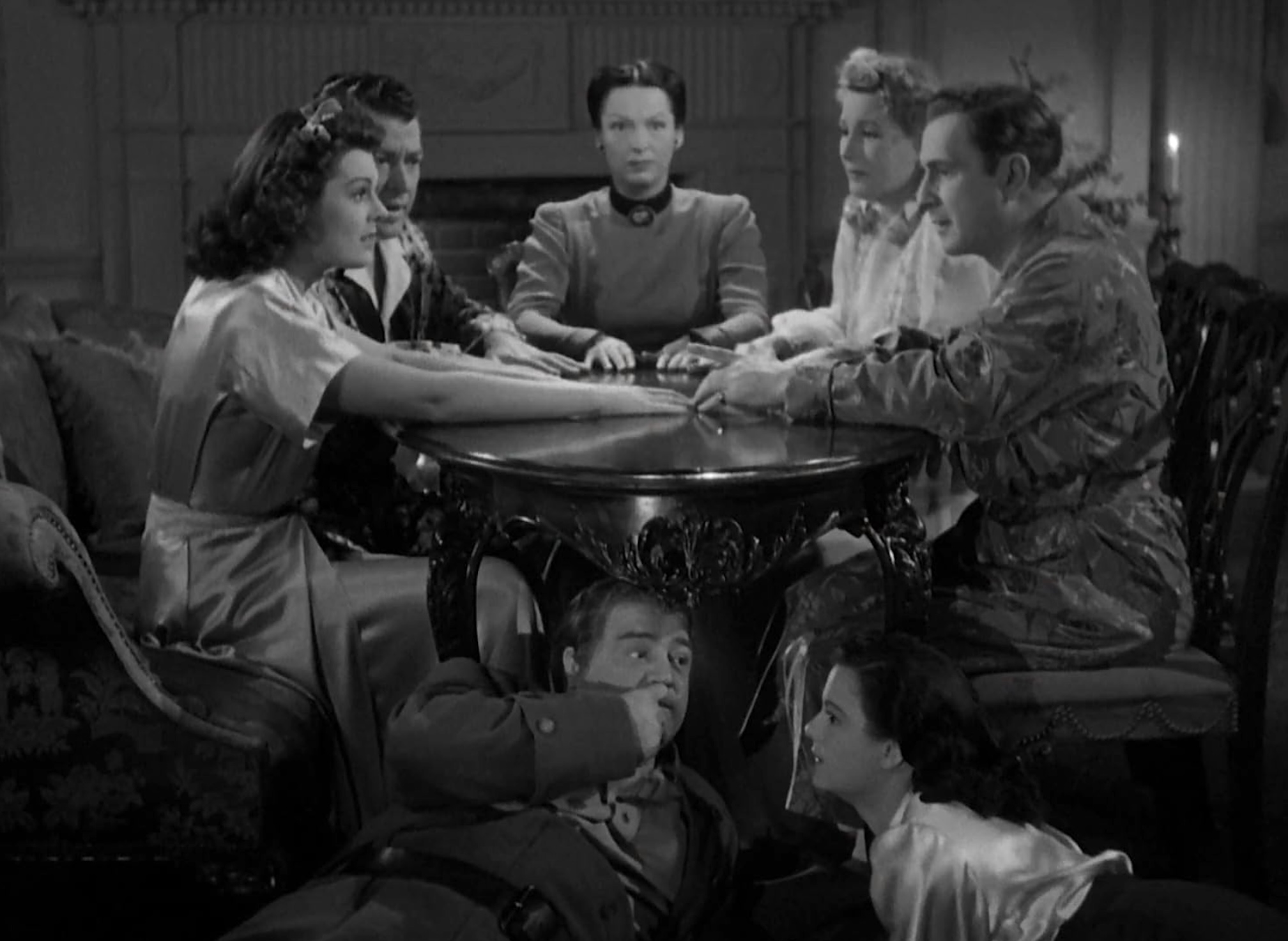
Cue the gang’s séance, orchestrated by Emily’s eerie intuition. Melody and Horatio, still unseen, manage just enough strategic table-knocking to send the household searching for the crucial letter that can finally clear their names.
Dropping breadcrumbs from Horatio, Melody, and even Tom’s remorseful spirit, they unravel the ghosts’ tale and unearth that long-lost letter waiting to be found so they can cut their chains for good.


No sequence steals the show quite like the séance, though, where Emily (Sondergaard, eyes like smoked amber) gathers the spooked party around the candlelit table, her voice a hypnotic purr invoking spirits amid the flickering shadows. Horatio and Melody tap the table from below. Emily channels Tom Danbury, whose voice gives them cryptic clues with a rhyme about the Queen Anne clock that holds the letter from within.


Emily: [Calling to the ghosts of the well] Analog dos mirabus spirae cuttar, nimbus hypnosticos lazzum bid-dar.
Mildred Dean: There she goes again. It must be number one on her Hit Parade.Dr Ralph Greenway: [contacting the ghosts] Are you the spirits of the traitors in the well?
[Horatio raps once for ‘no’, hits Cuthbert on the foot] Dr Greenway: OUCH!Melody Allen: [Tom’s voice is coming through Emily] Horatio, why can’t I see him?
Horatio Prim: You can’t, you poor kid. You see, he’s got his wings, and we’re still grounded.Emily: [in a trance and speaking with the voice of Thomas Danbury] Melody, my beloved, it’s Tom. I’ve come to help you.
June Prescott: Oh, Shelly, what does it mean?
Sheldon Gage: It-it must be Danbury speaking through Emily.
Mildred Dean: Oh, fine. A ghost-to-ghost broadcast.Dr Ralph Greenway: If he had a letter from George Washington, then he couldn’t have been a traitor.
Horatio Prim: [raps on the table] That’s right!
Mildred Dean: Now don’t tell me we’re going to stay up the rest of the night contacting George Washington!
There’s a small, piercing ache to a moment during the séance that’s hard to shake: the way Emily (Tom’s spirit) stretches out Melody’s name, letting “Mel-o-deee… Mel-o-deee” drift through the room like a voice borrowed from the grave, calling across years of guilt and unfinished business. When he reaches for her like that, it isn’t just a parlor trick or a spooky flourish; it lands with the strange tenderness of someone trying to make contact from the wrong side of history.
But then there’s the film’s hilarious poltergeist antics, the invisible exertion comedy as Emily tries to conjure the spirits of Horatio and Melody as a psychic medium.
In The Time of Their Lives, Horation and Melody’s first bid for visibility, a manifestation masterclass in frustration and flair, Horatio and Melody, invisible to all, huff and puff to levitate a breakfast tray, silverware clattering like skeletal castanets as eggs splatter and coffee cascades in slow-motion glory, all while Lou’s phantom form stretches and arms flailing to snatch a napkin that floats just out of reach. It’s pure physical poetry.


Above: Horation and Melody learning about light, how to walk through solid objects, or not!
Costello’s body contorting through solid objects with trick-shot wizardry, his grunts and grimaces selling the ethereal agony as the living guests scatter, blaming drafts or drinking.
Then we come to one of my favorite scenes, Melody’s staircase descent, that kicks off the gag, when Melody succumbs to the siren call of modern fashions, slipping into an evening gown and jewels that shimmer with contemporary allure, only the finery reveals itself, a comically haunting image of silk, satin, and sparkle.


She becomes a cheeky phantom in walking clothes and stockings that glides into view, only to dissolve into a lone pair of stockings running up the stairs as the gag’s slyness scares the bejezus out of Binnie Barnes. A crescendo of finery then liberation. From full-figured specter to dismembered clothing in one impish heartbeat, it’s the film’s purest distillation of spectral mischief, unraveling propriety with gleeful abandon.
The gang goes in search of Horatio’s letter, only to hit a snag: that original mantel clock hiding it has landed in a stuffy New York museum, ticking away like a taunt from fate. Dr. Greenway, itching to atone for the past sins and scrub clean his ancestor’s black mark, rushes off to the museum to retrieve the letter. But when the museum officials refuse to let him examine the clock, he turns into a petty thief and steals the whole darn thing.
Greenway’s impulsive swipe of the Queen Anne clock from the museum ultimately kicks things into broad farce, setting off a climactic car hijinks between Horatio and the thoroughly beleaguered police Lieutenant Mason (Donal MacBride). It’s a rare nod here to Bud and Lou’s more familiar slapstick turf.


When Greenway slips back to the estate and begins to examine the clock with Horatio and Melody in the barn, Lt. Mason snaps him up and arrests him, but Lt. Mason is not dragging Greenway off the grounds just yet; they’re all kept from leaving by Horatio and Melody, who exploit the curse cleverly:
Sitting in the squad car that’s supposed to haul Greenway off to jail, Lt. Mason, another state trooper, and Greenway himself; Mason and the trooper are all blissfully unaware that they have two extra passengers: Horatio and Melody. Because the ghosts can’t actually leave the estate, the car simply balks at the property line, stubbornly refusing to cross over.
The harried Lt. Mason, whose hat Horatio keeps nudging askew, steps out to inspect the “stalled” vehicle, only for Horatio to slip into the driver’s seat, work the steering wheel and gas pedal, and send the car careening toward the well, with both the clock and Greenway in tow until the police clear out. Powered by an invisible Horatio at the wheel, this becomes the film’s major slapstick set piece, a wild chase in an otherwise offbeat fantasy, with Lt. Mason and his deputy pounding along on foot, baffled, breathless, and utterly outmatched by a driver they can’t even see.
Donald MacBride marvelous character actor the officious everyman unraveling with gravelly precision who is seen flustered in (Room Service 1938, during the Marx Bros. hotel chaos, My Favorite Wife 1940, Big Mac in High Sierra 1941, The Thin Man Goes Home 1944, and The Killers 1946) nails it as the state trooper in the climax, his patented slow-burn unraveling pure gold as these lovable ghosts hijack his patrol car like spectral joyriders. It’s classic comic timing that seals the film’s cheeky chaos.
When the clock is finally opened, and the letter is revealed, Melody and Horatio’s innocence is proven, and they are freed.


Both Horatio and Melody are called to heaven; Melody is reunited with her lost love in a stream of heavenly confetti. It’s all so bittersweet and melancholic as Tom’s voice woos Melody home, while Nora greets Horatio at the pearly gates, only for her to point her finger at a cheeky sign, “Closed for Washington’s Birthday.” He’s got one more day to wait. Poor Horatio.


