


THE WITCH’S MIRROR 1962
For as long as I can remember, Mexican Gothic horror has held me in its spell—a mysterious enchantress. It’s a genre that doesn’t rush to terrify but creeps, with all the grace of crumbling haciendas and forgotten rituals, a thing of uncanny, eerie, atmospheric beauty.
That beguiling mix of sophistication and a bit of a spectral menace has been my cinematic obsession, and soon enough, at The Last Drive In, I’m ecstatic to say I’m planning on unraveling these haunting tales in all their rich, shadowed glory. And not always exclusively poetically Gothic… Abel Salazar’s turn in The Brainiac/el Baron del Terror 1962 proves that vengeance never looked so delightfully bizarre: a comically monstrous baron (Abel Salazar) returning from the Inquisition’s flames, armed with a forked tongue for brain-sucking and an impeccably grim sense of revenge, proves that in Mexican Gothic horror, even a centuries-old curse can come with a wink and a forked tongue firmly in cheek of campy charm.
Mexican directors like Chano Urueta, Carlos Enrique Taboada, Fernando Méndez, and Rafael Baledón wove tales where the uncanny is everyday, where haunted mansions are not mere settings but characters steeped in cultural memory, and where the supernatural reflects the darkest ache of human frailty and historical burden. Mexican Gothic horror reimagines the European tradition onto a landscape scorched by history and infused with folk belief. These films’ shadow-heavy, sparsely furnished interiors don’t just set the scene; they breathe a tangible dread, favoring spectral haze over baroque European flourish, tinged with repression and familial betrayal, while steering clear of monstrous spectacle. They tended to focus on mood, psychological tension, and the uncanny rooted in folklore and cultural history. The emergence of Gothic sensibility in Mexican horror cinema marked a profound evolution in the genre, transforming it from straightforward monster tales into a nuanced exploration of psychological, social, and moral anxieties bathed in atmospheric dread and framed within a distinctly Mexican cultural landscape. Echoing European Gothic traditions, this movement adopted and adapted motifs of haunted mansions, spectral vengeance, and forbidden knowledge, infusing them with colonial legends, supernatural folklore, social realism, and a rich atmospheric texture that emphasized mood, isolation, and the uncanny. Central to this sensibility was a deep engagement with themes of deception and the fractured human psyche, inner conflict, and the duality of good vs evil, often portrayed through claustrophobic settings, chiaroscuro lighting, and slow-building anxiety rather than overt gore or spectacle.
Mexican Gothic horror films like The Witch’s Mirror and The Curse of the Crying Woman walk that fascinating line between psychological unease and overt supernatural spectacle. While the genre often shares a commitment to atmospheric tension, deep cultural roots, and an exploration of human fears, it does not shy away from revealing terrifying, tangible horrors, such as the ancient eyeless witch whose presence dominates the latter film. This openness to explicit monstrous imagery distinguishes Mexican Gothic from other strands of horror that rely almost exclusively on suggestion, shadow, and the unseen to evoke fear, a sensibility you see in the films of Val Lewton. Here, the horror feels both intimate and immediate, grounded in visceral and unsettling visuals that confront us directly. Mexican Gothic cinema often synthesizes these elements and infuses its films with sometimes brutal displays of the uncanny, striking a compelling, evocative, and unflinching balance. This dynamic interplay between the suggestive and the explicit allows Mexican Gothic films to evoke a haunting sense of decay and moral ambiguity, where ancient witchcraft or scientific coldness compete not only with each other but also with our expectations about fear and spectacle.
This sensibility, born in black and white, a flicker of the ’50s and ’60s, pulses with a moral complexity and atmospheric richness that redefined horror beyond sudden shocks to something unsettlingly poetic. It is a cinema that speaks in whispers rather than screams, inviting us to peer behind the veil of apparitions and into the very heart of a haunted culture. In the deeper essay to come, I will trace this evocative lineage, diving deep into the works that shaped Mexican Gothic’s unique dialogue between past and present, intimacy and terror, myth and reality. Stay tuned, as I explore the uncanny reflections in The Witch’s Mirror, The Curse of the Crying Woman further and beyond.
Reflections of Revenge and Ritual: Unveiling Chano Urueta’s The Witch’s Mirror in Mexican Gothic Horror
In the shadowed corridors of Mexican cinema’s golden era, its own distinct brand of Gothic sensibility took root, an elegy whispered in chiaroscuro, where ancestral ghosts twist with the weight of colonial ghosts yet unsettled. Mexican Gothic cinema doesn’t indulge in the sumptuous, sensuous romanticism typical of its European Gothic counterpart; instead, it roots itself in a grittier, more immediate reality.
Emerging from the decay of grand haciendas and curses uttered quietly, lingering in ancient mirrors, films like The Witch’s Mirror use stark black-and-white visuals to emphasize collapse, neglect, and claustrophic interiors capturing peeling walls, overgrown cemeteries, and unsettling domestic spaces filled with hidden terrors, turning the environment into something more than a backdrop, but almost a living, brooding presence that wraps itself around the story.
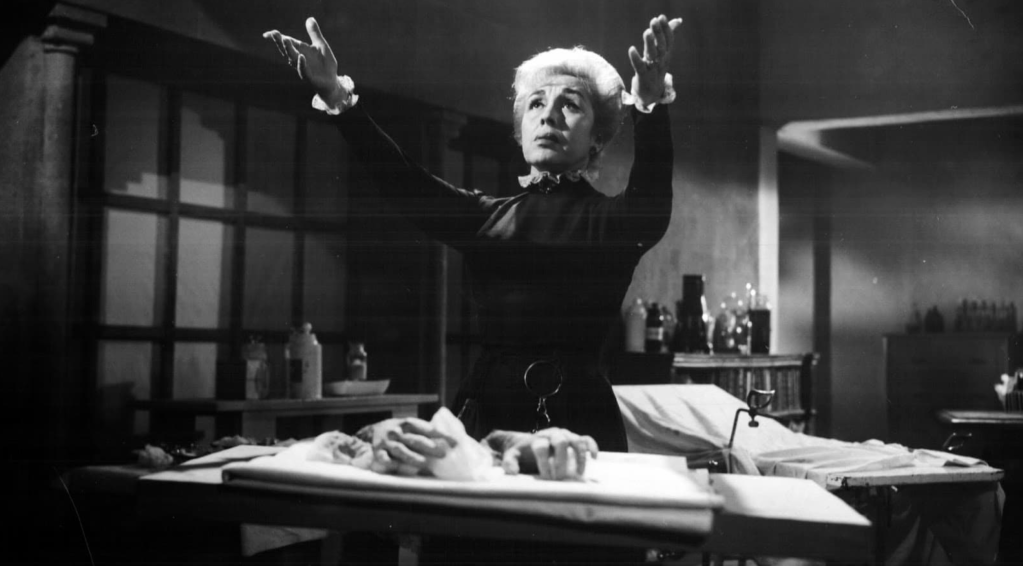
In the feverish gloom of Mexico’s golden age of horror, Chano Urueta’s The Witch’s Mirror (1962) carves a place for itself with a genre-blending swirl of Gothic intrigue, medical suspense, and supernatural revenge.
The Witch’s Mirror (El espejo de la bruja) is the first in Chano Urueta’s unforgettable horror trilogy for ABSA and a key chapter in the studio’s Gothic saga. Alongside Urueta’s distinctive sure hand behind the camera, this film quietly brings in that other giant of Mexican horror, Carlos Enrique Taboada, not yet as a director but as a formidable presence as the film’s screenwriter and the mind orchestrating its intricate plot.
What’s striking here is how Taboada’s script reveals its true shape only after you’ve surrendered to its haunted corridors; it unfolds with all its complexity gradually, presenting a world where morality resists clear boundaries. An amoral tale where lines between right and wrong shimmer and vanish, and where the dark heart of the story is a duel between two forms of cunning: It’s a story where the clash becomes an unsettling contest fought by ancient witchcraft and chilling science, each with its own brand of darkness.
There’s no sanctity here, only shifting shadows that run through every scene, inviting us to explore a space where neither side comes out innocent; both are allowed the same wicked edge. In this world, the sinister isn’t a shadow cast in one direction, but a fog that seeps into every corner. It is just never that straightforward, but always layered and complex. It’s the sort of complexity that makes revisiting these films endlessly rewarding, and reminds me why the Gothic, especially in Mexican cinema, is so enticing and thoroughly compelling.
With The Witch’s Mirror, Urueta, a master of visual invention, orchestrates a whirlwind narrative where the chilling performances of Isabela Corona as the cunning witch Sara, Armando Calvo as the coldly ambitious Dr. Eduardo Ramos, Rosita Arenas as the ill-fated Deborah, and Dina de Marco as the tragic Elena anchor a tale that skips past cliché and plunges straight into the gorgeously painted macabre.
Urueta’s directing eye, aided by the atmospheric black-and-white cinematography of Jorge Stahl Jr., fills the screen with brooding shadows, empty interiors, and artfully surreal supernatural tableaus, a style that nods to Universal monster classics while weaving a distinctly Mexican sensibility primed for local and international fans alike.
The tragedy at the heart of the story is, on the surface, pretty straightforward: Dr. Ramos has grown to despise his wife Elena and plots to kill her so he can marry Deborah, a naive young woman completely unaware of his dark intentions. Elena, meanwhile, is Sara’s goddaughter; Sara is a formidable witch aligned with darker powers. Though Sara can’t stop Elena’s murder, she summons otherworldly forces to exact revenge on Eduardo Ramos and his new bride. Things take a twisted turn when an incident, cleverly disguised as an accident but in fact orchestrated by Sara, leaves Deborah horribly disfigured. What follows is Ramos’s obsessive, chilling quest to reclaim Deborah’s lost beauty, venturing further into shadowy, morally fraught terrain where the unethical, the unorthodox, and sacrilegious converge. In this place, conventional boundaries dissolve into a sinister haze of transgression.
The Witch’s Mirror opens with Sara, housekeeper and godmother to Elena, peering into her magic mirror and witnessing the fate of her beloved charge: Elena’s scientist husband, Eduardo, is about to poison her for the love of Deborah, his secret mistress. With cosmic powers blocked and revenge promised, Elena drinks the fatal potion and is interred in a bleak, candlelit cemetery scene.
Sara’s witchcraft bridges the chasm between life and death, calling Elena’s spirit to join her in plotting vengeance. Eduardo swiftly takes Deborah as his new wife, but the glow of marital bliss is darkened by the creeping chill and spectral phenomena stalking the mansion, music plays itself, wilted flowers resist Deborah’s touch, and Elena’s presence saturates the air.
Deborah suffers a supernatural attack, and Eduardo’s desperate solution is a descent into body horror: Eduardo launches a series of grotesque experiments (evoking French director Franju’s Eyes Without a Face 1960), robbing corpses for skin grafts and, ultimately, severed hands to repair the damage inflicted upon Deborah in a blaze of unearthly fire.
Urueta builds tension with set-bound claustrophobia and fraught, visceral pacing, crafting scenes where Deborah, shrouded in bandages, haunts the house as a living relic of Eduardo’s hubris, while Sara drives the narrative’s spectral machinery forward with incantations and vengeful resolve. The cold logic of Eduardo’s surgery collides with the fever-dream logic of Sara’s magic, and the climax reveals the monstrous cost: transplanted hands magically revert to those of Elena, moving with a will of their own.
Deborah, driven by occult force and unburdened fury, kills Eduardo in the supernatural thrust of justice; the horror piles on as severed hands take on Gustavo, and Sara uses her magic to help Elena find peace, having fulfilled her promise of vengeance, disappears into mist.
Of course, by now you know me, my natural inclination is to fully support Sara, yet what makes the film compelling is how it gradually shifts our sympathies toward the witch. Hating Eduardo is a given. This speaks to the deep, archetypal roots these characters embody. The witch resonates as a timeless figure from folk tradition, familiar and deeply human, connected to a primal desire for justice. In stark contrast, this cold-blooded murderer and deranged scientist represents a cold lack of humanity and arrogant rationality that was typical of American sci-fi villains of the era. Eduardo’s cruelty is undeniable, marking him as a reprehensible villain. While the pursuit of justice here tragically harms an innocent woman, the film challenges us to confront the complexities of vengeance and the dark consequences it can unleash.
Carlos Enrique Taboada, emerging in his early career but already displaying his mastery, takes the narrative of The Witch’s Mirror and turns it into a darkly elegant conflict. Here, he paints the picture of a malevolent supernatural force that sets loose a terrible, cruel vengeance on a murderous, corrupt, and unscrupulous scientific mind. Between these destructive powers stand the two young women, both beautiful, both tragically fated to become wounded sacrifices in this grim struggle. The Witch’s Mirror draws on timeless stories of the confrontation between good and evil.
For devotees of classic horror, the film offers subtle tributes to European masterpieces: Benjamin Christensen’s Häxan (1922), with its unsettling blend of folklore and documentary; Robert Wiene’s silent German expressionist masterpiece The Hands of Orlac (1924), evoking the dread of the unknown body; and Georges Franju’s Eyes Without a Face (1960), a haunting meditation on identity and monstrous transformation released just barely a year earlier and Jesús Franco’s Gritos en la noche / The Awful Dr. Orloff in 1962.
This careful blend of influences reveals not only Taboada’s cinematic literacy but also the thoughtful craftsmanship of producer Abel Salazar and director Chano Urueta. Layered atop these cinematic dialogues are universal mythologies, the restless spirit of the dead bride who returns, the archetypal witch, all woven seamlessly into ABSA’s signature claustrophobic brooding and oppressive environment with chilling grace.
With The Witch’s Mirror, Cinematográfica ABSA really found its footing as a studio making horror films that clicked with audiences, and even won over some of the usually harsh Mexican critics. This wasn’t a fluke. They brought together a team of skilled artists and technicians who combined their natural talents with a solid understanding of Gothic horror’s mechanics, skillfully adapting those classic fears and moods to a Mexican setting. The result was a film that felt both familiar and fresh, balancing proven horror formulas with a local flair that resonated deeply with audiences.
A brisk, 75-minute black-and-white night terror, The Witch’s Mirror became a landmark of Mexican horror by fusing European Gothic inspirations with folk mysticism and a uniquely Mexican moral sensibility; its reverberations echo in the later films of Carlos Enrique Taboada and the broader Latin American horror tradition. The iconic performances, haunting visual style, and deliriously inventive plotting combine to ensure Urueta’s film still lingers in the imagination, a shimmering reflection of revenge in a haunted glass.

THE CURSE OF THE CRYING WOMAN 1963
Echoes of Shadows , Blood and Hollow Eyes: Unraveling the Haunting Legacy of The Curse of the Crying Woman
The motif of dark, hollow eyes is a key and haunting visual element in The Curse of the Crying Woman, symbolizing the spectral presence of the weeping woman and the eerie, unsettling nature of the curse itself. This imagery recurs in moments of supernatural revelation and is central to the film’s unsettling atmosphere.
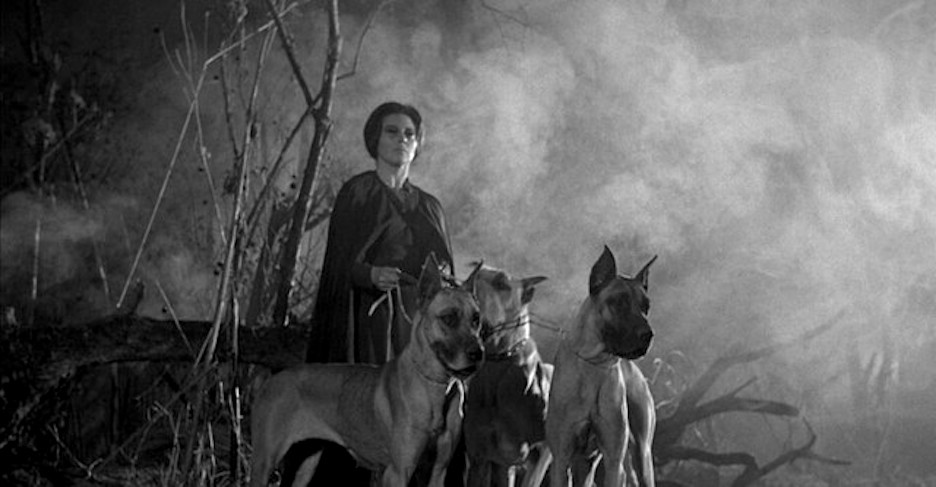
And yes, there is a compelling visual symmetry between Barbara Steele’s unforgettable image in Black Sunday 1960, standing amidst misty ruins with fierce dogs leashed by her side, and the eerie apparition with haunting black eyes in The Curse of the Crying Woman, portrayed by Rita Macedo as the sinister witch Selma, who similarly commands her spectral hounds within a desolate, atmospheric setting. Both sequences evoke a potent blend of Gothic allure and supernatural dominion, using the motif of women exerting eerie control over dark, menacing forces. This parallel underscores a shared cinematic language of fear and mystical power that defines these classic horror films.
The Curse of the Crying Woman (La Maldición de la Llorona), directed by Rafael Baledón in 1963, remains a standout symbol of Mexican Gothic horror that masterfully builds a mood thick with creeping unease with folkloric mysticism, crafting a film that remains captivating despite its modest budget. Starring Rosita Arenas as the innocent Amelia, Abel Salazar as her husband Jaime, and Rita Macedo as the enigmatic and sinister Aunt Selma. The fog-laden woods, shadow-drenched hacienda, and the eerie presence of the mansion are key visual elements that heighten the film’s unsettling mood. Themes of ancestral curses, witchcraft, madness, and resurrection are central, with the story focusing on the malevolent Aunt Selma’s plan to use Amelia as a vessel to resurrect an ancient witch.
The opening, and its undeniable suggestive power, is very reminiscent – and in the best way – of the classic Black Sunday (La maschera del demonio, 1960 aka The Mask of Satan), directed by the Italian maestro Mario Bava, a film which Baledón admitted to being an admirer of. As in that Italian cult movie, The Curse of the Crying Woman plunges us into a nineteenth-century terror with a deep Gothic vein, where the demonic forces incarnated in Aunt Selma come together with the heavy atmosphere of a gloomy mansion, in which her niece, Amelia, and her husband will spend a terrifying night.
From its ominous opening, where a stagecoach falls prey to a terrifying assailant, the film plunges us into a world drenched with Gothic tropes that feel both universal and uniquely Mexican. Unlike many adaptations, this version of the legendary La Llorona, a weeping specter whose cries foretell doom, deviates, instead presenting a tale centered around a cursed hacienda in the remote woods, haunted by dark secrets and malevolent sorcery.
The cinematography by José Ortiz Ramos employs evocative black-and-white visuals, with fog-laden woods and shadow-drenched interiors that transform the hacienda into a living entity. With its peeling walls, reverberating halls, and secret passageways, cobweb-infested tunnels, staircases leading to different levels, trapdoors, and secret rooms, the decrepit mansion becomes a claustrophobic stage where Amelia’s innocence confronts her aunt’s unnatural thirst for witchcraft and resurrection. Particularly noteworthy is the skillful deployment of lingering shots and contrasting shadows, which intensify the suspense and render even the most subdued moments charged with spectral portent. The visual atmosphere is thick with an almost tangible heaviness, as though the walls themselves are closing in, mirroring the unseen force tightening its grip as the curse edges forward, silent and relentless, slow but inevitable.
After a brutal and calculated attack on their stagecoach, which serves as the catalyst for the events to follow, newlyweds Amelia and Jaime arrive at Aunt Selma’s remote estate. Amelia immediately feels unsettled, her first unnerving encounter being a glance in an antique mirror revealing a dark-eyed woman and a corpse. Creeping tension mounts with strange cries in the night and Selma’s eerily unchanging youthful appearance, suggesting her unnatural pact with an ancient witch named Marina, kept in a liminal state between life and death. Selma’s plan becomes clear: she desires to use Amelia as a vessel to resurrect Marina, perpetuating a generations-old curse by sacrificing descendants of those who condemned Marina.
Selma reveals to Amelia that their family is cursed, the legacy of the original Crying Woman (La Llorona), who was a witch condemned and killed for her dark dealings. A central tension arises as Selma tries to resurrect her mother, Doña Marina’s, spirit through Amelia, intending to pass on the curse and continue her reign of terror.
In The Curse of the Crying Woman, Jaime’s character epitomizes the archetypal Gothic horror husband, frail, ineffectual, and deeply reliant on the strength of his wife, Amelia. Jaime often finds himself ensnared in danger, whether being overpowered by supernatural forces or succumbing to manipulation under the malevolent influence of Selma. His vulnerability is palpable as Amelia not only grapples with the haunting curse threatening their lives but also, of course, must take on the role of protector and savior. This dynamic inversion of traditional gender roles unearths an interesting complexity within their relationship, highlighting Amelia’s resilience against the backdrop of Jaime’s helplessness. Jaime’s sporadic moments of bravado are often undercut by his nervous disposition and tendency to involuntarily stumble into peril.
A chilling moment comes when the couple discovers the monstrous, however crude, make-up of Selma’s husband, disfigured and mad, locked away in the attic, whose presence punctuates the film’s pervasive sense of decay and hidden horrors. Their spectral presence, isolated and shrouded in darkness, symbolizes the decay and secrets lurking within the estate.
The climax hinges on Selma’s orchestration of a macabre ritual, culminating in the ringing of a massive bell, a haunting symbol that binds the film’s themes of doom, fate, and the supernatural. This bell tolls ominously as the conflict between old curses and desperate survival reaches its peak, marked by a tense and dramatic confrontation in the collapsing hacienda, where physical battles reach a fever pitch between the heroine and the film’s dark forces. The scene culminates with the ‘possessed’ Amelia trying to liberate La Llorona by removing a stake from her body, accompanied by the striking visual of a huge bell in the bell tower chiming twelve times.
The combination of the storming fight, the supernatural possession, and the hauntingly persistent bell delivers an unforgettable conclusion that is both Gothic magic and deeply unsettling. The climax signals the unraveling of the curse and the mansion’s decay, suggesting a Poe-like haunted house finale.
Thematically, The Curse of the Crying Woman explores inheritance not just of wealth but of darkness, the oppressive grip of history manifested through supernatural forces that blur the line between life and death. It engages with folklore while transplanting Gothic conventions, such as the haunted estate, familial madness, and resurrection, into Mexican contexts, making it a crucial point of cultural translation for the genre. The film’s restrained yet effective makeup effects (aside from the disfigured character shut away), atmospheric score, and artfully controlled pace merge elements to build a vivid cinematic world.
The Curse of the Crying Woman is a refined example of Mexican Gothic horror’s power to evoke nostalgia, mystery, and dread, steeped in ancestral curses and a family’s dark legacies. What draws me to this film is the creative vision of filmmakers like Rafael Baledón and the nuanced performances from Rosita Arenas and Rita Macedo, who so skillfully navigate the fragile balance between innocence, historic malignancy, and creeping doom. As someone who’s drawn to atmospheric, folk-inflected Gothic horror, The Curse of the Crying Woman feels like an essential, haunting classic I’ll keep coming back to.
The traditional version of La Llorona is the ghost of a woman who has drowned her children, returning to steal those of the Spanish settlers. Baledón’s free adaptation of the myth turns the classic colonial figure of filicide into a powerful witch, from whom Selma descends. Selma, too, is a sorceress who seeks to bring La Llorona back to life in a ritual in which Amelia will play a key role.
Baledón’s staging makes it one of the best films from the época d’oro, or golden age, where the highly accomplished sets by designer Roberto Silva, and Armando Meyer’s make-up, created a film now rightly regarded as among the best horror films of that decade (and subsequent ones as well), a triumphant finish for the Cinematográfica ABSA Gothic saga.
It is worth mentioning that The Curse of the Crying Woman (La maldición de la Llorona, 1963) is ABSA’s filmic testament, the total impact of its technical and artistic achievements, to which it pays self-tribute by incorporating footage from its previous titles as a macabre flashback. The film pays homage to ABSA’s earlier works by creating a self-referential tribute while wrapping up their legacy in an atmospheric way.
The legend of La Llorona, Mexico’s founding fright mother, has been present in Mexican cinema right from its earliest days. La Ilorona, directed by Ramón Peon, became the first feature film based on this legend and the first Mexican horror feature film back in 1933. She returned to Mexican movie screens with La herencia de la Llorona (1947) by Mauricio Magdaleno, and then again with La Llorona (1960) by René Cardona. A year later, in 1961, Cinematográfica ABSA started production on The Curse of the Crying Woman.
The most recent notable film about La Llorona is The Curse of La Llorona (2019), an American supernatural horror directed by Michael Chaves. The film was produced within The Conjuring Universe but is considered a standalone story. Another recent title is The Legend of La Llorona (2022), another American horror film directed by Patricia Harris Seeley, with a different take on the legend. I have yet to see either iteration of the legend.
#148 down, 2 to go! Your EverLovin’ Joey formally & affectionately known as MonsterGirl!


